check oil DATSUN 210 1979 Workshop Manual
[x] Cancel search | Manufacturer: DATSUN, Model Year: 1979, Model line: 210, Model: DATSUN 210 1979Pages: 548, PDF Size: 28.66 MB
Page 167 of 548
Starting
motor
S
DIAGNOSES
OF
TEST
I
Low
speed
with
no
load
and
high
current
draw
may
result
from
the
following
I
Tight
dirty
or
worn
bearings
2
Bent
armature
shaft
or
loosened
field
probe
3
Shorted
armature
Check
armature
further
4
A
grounded
armature
or
field
a
Remove
input
terminal
b
Raise
two
negative
side
brushes
from
commutator
c
Using
a
circuit
tester
place
one
probe
onto
input
terminal
and
the
other
onto
yoke
d
If
tester
indicates
continuity
raise
the
other
two
brushes
and
check
field
and
armature
separately
to
deter
mine
whether
field
or
armature
is
grounded
2
Failure
to
operate
with
high
cur
rent
draw
may
be
caused
by
the
following
I
A
grounded
or
open
field
coil
Inspect
the
connection
and
trace
circuit
with
a
circuit
tester
2
Armature
coil
does
not
operate
Inspect
commutator
for
excessive
burning
In
this
case
arc
may
occur
on
damaged
commutator
when
motor
is
operated
with
no
load
3
Burned
out
commutator
bar
Weak
brush
spring
tension
broken
Engine
Electrical
System
Switch
Battery
Vultmeter
Ammeter
EE738
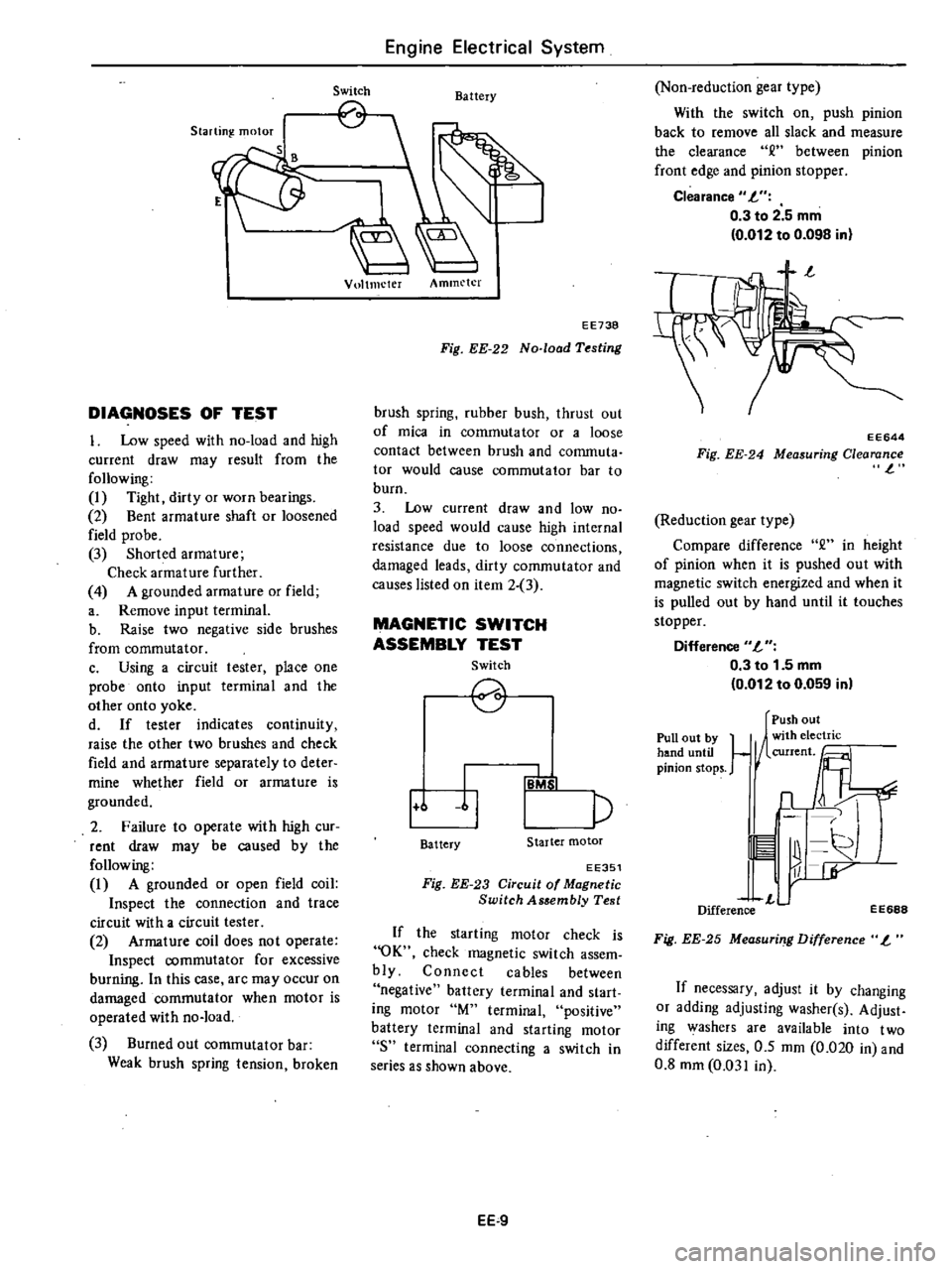
Fig
EE
22
No
load
Testing
brush
spring
rubber
bush
thrust
out
of
mica
in
commuta
tor
or
a
loose
contact
between
brush
and
conunuta
tor
would
cause
commutator
bar
to
burn
3
Low
current
draw
and
low
no
load
speed
would
cause
high
internal
resistance
due
to
loose
connections
damaged
leads
dirty
commutator
and
causes
listed
on
item
2
3
MAGNETIC
SWITCH
ASSEMBLY
TEST
Switch
2
1
6
11
p
IB
b
I
Battery
Starter
motor
EE351
Fig
EE
23
Circuit
of
Magnetic
Switch
Assembly
Test
If
the
starting
motor
check
is
OK
check
magnetic
switch
assem
bly
Connect
cables
between
negative
battery
terminal
and
start
ing
motor
M
terminal
positive
battery
terminal
and
starting
motor
8
terminal
connecting
a
switch
in
series
as
shown
above
EE
9
Non
reduction
gear
type
With
the
switch
on
push
pinion
back
to
remove
all
slack
and
measure
the
clearance
between
pinion
front
edge
and
pinion
stopper
Clearance
L
0
3
to
2
5
mm
0
012
to
0
098
in
EE644
Fig
EE
24
Measuring
Clearance
l
Reduction
gear
type
Compare
difference
2
in
height
of
pinion
when
it
is
pushed
out
with
magnetic
switch
energized
and
when
it
is
pulled
out
by
hand
until
it
touches
stopper
Difference
L
0
3
to
1
5
mm
0
012
to
0
059
in
Pull
out
by
hand
until
pinion
stops
Push
out
1
1
n
11
r
L
Difference
EE688
Fig
EE
25
Measuri
g
Difference
L
If
necessary
adjust
it
by
changing
or
adding
adjusting
washer
s
Adjust
ing
washers
are
available
into
two
different
sizes
0
5
mm
0
020
in
and
0
8
mm
0
031
in
Page 172 of 548
REMOVAL
1
Disconnect
battery
negative
cable
2
Disconnect
two
lead
wires
and
oonnector
from
alternator
3
Loosen
adjusting
bolt
4
Remove
alternator
drive
belt
5
Remove
parts
associated
with
alternator
from
engine
6
Remove
alternator
from
car
DISASSEMBLY
I
Remove
through
bolts
Separate
front
cover
with
rotor
from
rear
cover
with
stator
by
lightly
tapping
front
bracket
with
a
wooden
mallet
rnJ
J
i
EE525
Separating
Front
COI
T
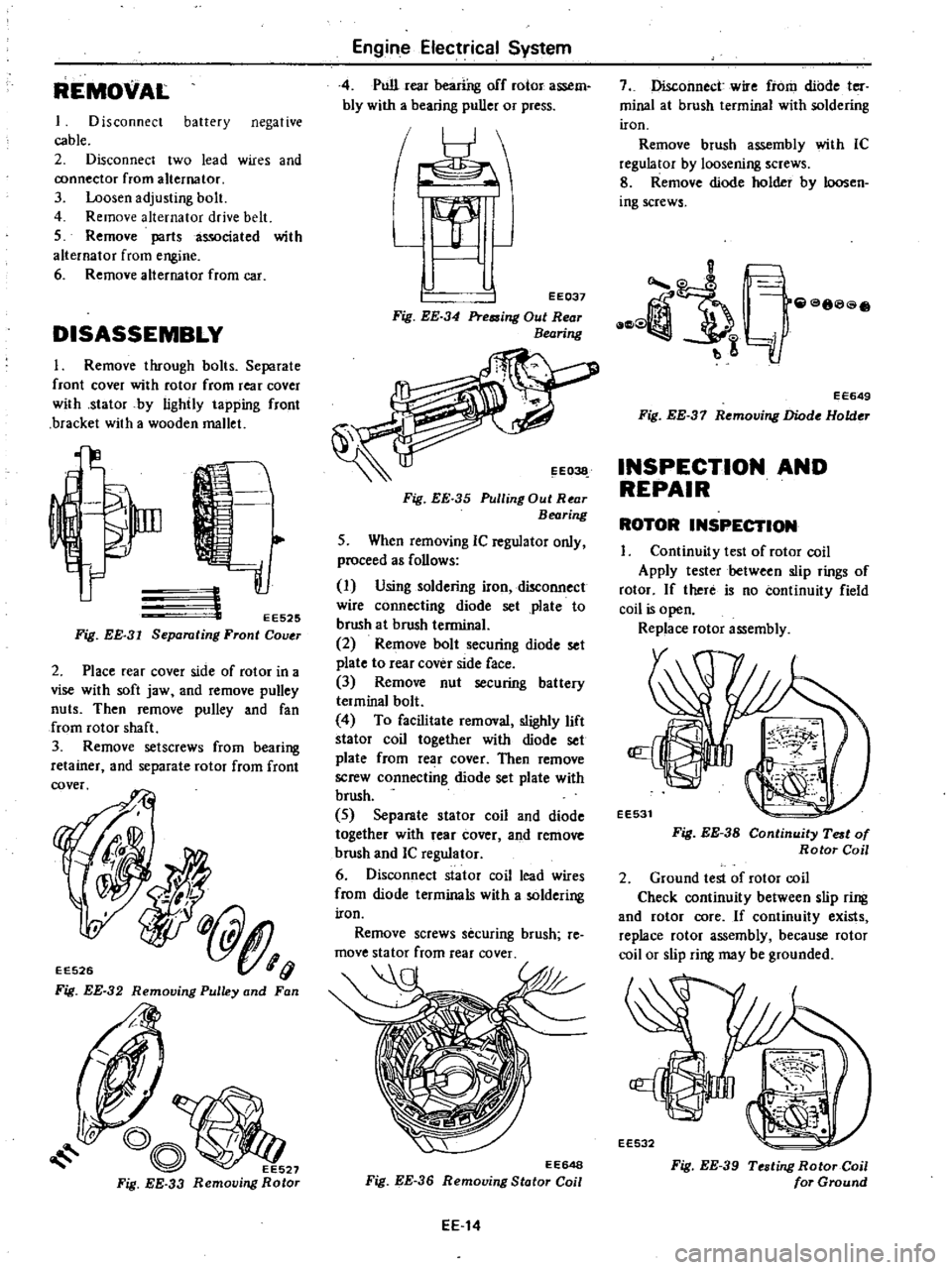
Fig
EE
31
2
Place
rear
cover
side
of
rotor
in
a
vise
with
soft
jaw
and
remove
pulley
nuts
Then
remove
pulley
and
fan
from
rotor
shaft
3
Remove
setscrews
from
bearing
retainer
and
separate
rotor
from
front
EE526
Fig
EE
32
Removing
Pulley
and
Fan
tr
s
0
27
Fig
EE
33
Removing
Rotor
Engine
Electrical
System
4
Pull
rear
bearfug
off
rotor
assem
bly
with
a
bearing
puller
or
press
EE037
Fig
EE
34
Pressing
Out
Rear
Bearing
I
EO
Fig
EE
35
Pulling
Out
Rear
Bearing
5
When
removing
IC
regulator
only
proceed
as
follows
I
Using
soldering
iron
disconnect
wire
connecting
diode
set
plate
to
brush
at
brush
terminal
2
Remove
bolt
securing
diode
set
plate
to
rear
cover
side
face
3
Remove
nut
securing
battery
terminal
bolt
4
To
facilitate
removal
s1ighly
lift
stator
coil
together
with
diode
set
plate
from
re
r
cover
Then
remove
screw
connecting
diode
set
plate
with
brush
5
Separate
stator
coil
and
diode
together
with
rear
cover
and
remove
brush
and
IC
regulator
6
Disconnect
stator
coil
lead
wires
from
diode
terminals
with
a
soldering
iron
Remove
screws
securing
brush
re
move
stator
from
rear
cover
EE648
Fig
EE
36
Removing
Stator
Coil
EE
14
7
Disconnect
wire
from
diode
tor
minal
at
brush
terminal
with
soldering
iron
Remove
brush
assembly
with
IC
regulator
by
loosening
screws
8
Remove
diode
holder
by
loosen
ing
screws
acefii
li
E
E649
Fig
EE
37
Removing
Diode
Holder
INSPECTION
AND
REPAIR
ROTOR
INSPECTION
I
Continuity
test
of
rotor
coil
Apply
tester
between
slip
rings
of
rotor
If
there
is
no
continuity
field
coil
is
open
Replace
rotor
assembly
Fig
EE
38
Continuity
Test
of
Rotor
Coil
2
Ground
test
of
rotor
coil
Check
continuity
between
slip
ring
and
rotor
core
If
continuity
exists
replace
rotor
assembly
because
rotor
coil
or
slip
ring
may
be
grounded
EE532
Fig
EE
39
Te
ting
Rotor
Coil
for
Ground
Page 174 of 548
Test
probe
of
a
circuit
tester
e
8J
terminal
EB
plate
@
plate
terminal
terminal
e
plate
e
plate
tenninal
e
plate
8J
plate
EB
plate
e
plate
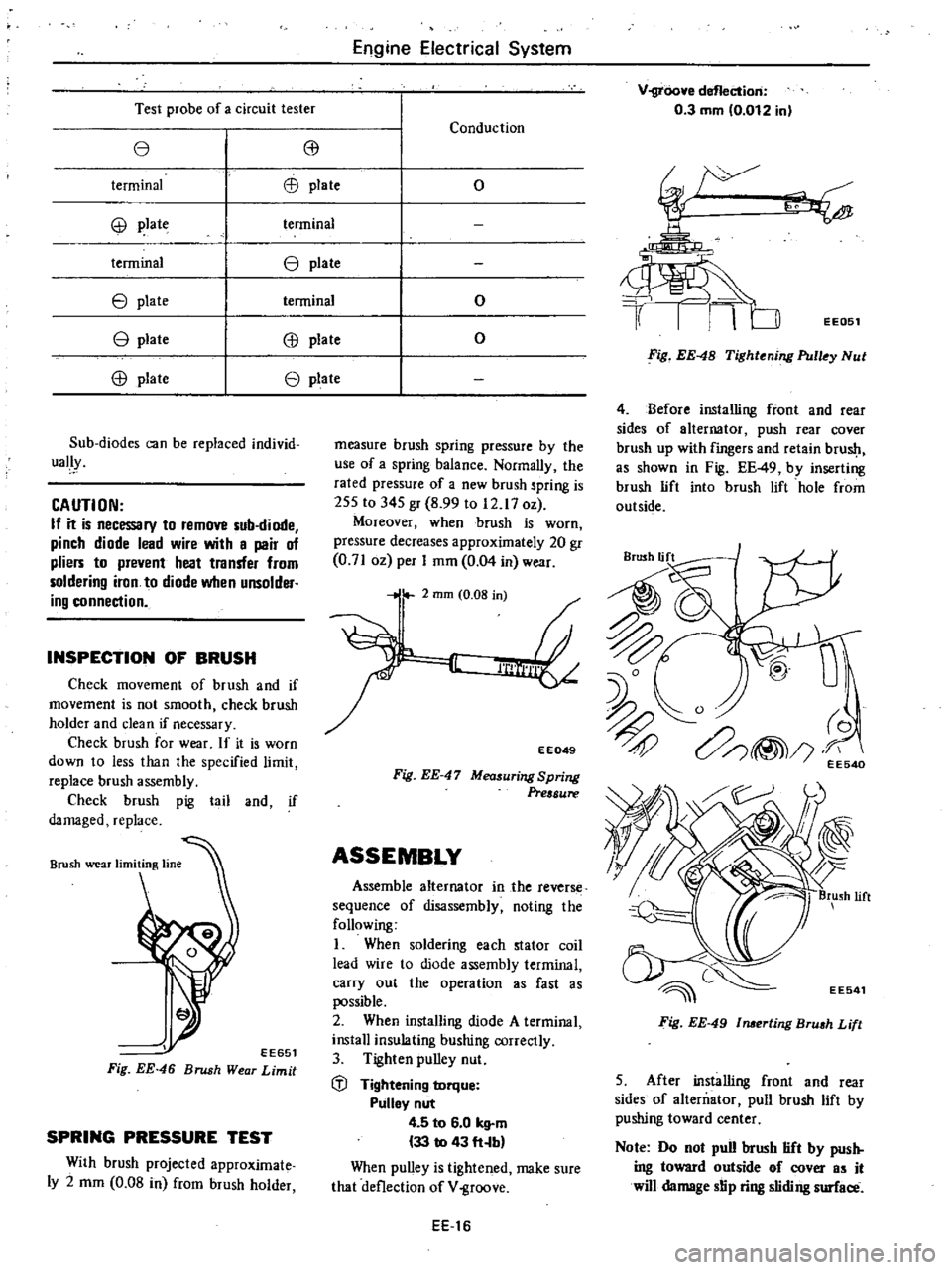
Sub
diodes
can
be
replaced
individ
ually
CAUTION
If
it
is
necessary
to
remove
sub
diode
pinch
diode
lead
wire
with
a
pair
of
pliers
to
prevent
heat
transfer
from
soldering
iron
to
diode
when
unsolder
ing
connection
INSPECTION
OF
BRUSH
Check
movement
of
brush
and
if
uv
ent
is
not
smooth
check
brush
holder
and
clean
if
necessary
Check
brush
for
wear
If
it
is
worn
down
to
less
than
the
specified
limit
replace
brush
assembly
Check
brush
pig
tail
and
if
damaged
replace
EE651
Fig
EE
46
Brush
Wear
Limit
SPRING
PRESSURE
TEST
With
brush
projected
approximate
Iy
2
mm
0
08
in
from
brush
holder
measure
brush
spring
pressure
by
the
use
of
a
spring
balance
Normally
the
rated
pressure
of
a
new
brush
spring
is
255
to
345
gr
8
99
to
12
17
oz
Moreover
when
brush
is
worn
pressure
decreases
a
pproxirnately
20
gr
O
71
oz
per
I
mm
0
04
in
wear
Bru
h
lift
0
0
lJrJ
EE540
Engine
Electrical
System
Conduction
o
o
o
t
2
mm
0
08
in
L
ee049
Fig
EE
47
Mea
uring
Spring
Pressure
ASSEMBLY
Assemble
alternator
in
the
reverse
sequence
of
disassembly
noting
the
following
I
When
soldering
each
stator
coil
lead
wire
to
diode
assembly
terminal
carry
out
the
operation
as
fast
as
possible
2
When
installing
diode
A
terminal
install
insulating
bushing
conectly
3
Tighten
pulley
nul
dJ
Tightening
torque
Pulley
nut
4
5
to
6
0
kg
m
33
to
43
ft
lbl
When
pulley
is
tightened
make
sure
that
deflection
of
V
groove
EE
16
V
grOove
deflection
0
3
mm
0
012
in
slik
1I
I
I
EE051
Fig
EE
48
Tightening
Pull
y
Nut
4
Before
installing
front
and
rear
sides
of
alternator
push
rear
cover
brush
up
with
fingers
and
retain
brus
J
as
shown
in
Fig
EE
49
by
inserting
brush
tift
into
brush
lift
hole
from
outsi4e
Fig
EE
49
I
rUng
Bru
h
Lift
S
After
installing
front
and
rear
sides
of
alteniator
pull
brush
lift
by
pushing
toward
center
Note
Do
not
puD
brush
lift
by
push
ing
toward
outside
of
cover
as
it
will
damage
slip
ring
sliding
surface
Page 176 of 548
DESCRIPTION
The
regulator
consists
essentially
of
in
egrated
circuits
incorporating
tran
sistors
These
transistors
int
errupt
and
admit
current
flow
to
the
alternator
rotor
coil
thus
maintaining
its
output
voltage
at
a
constant
value
Unlike
in
a
mechanical
type
regulator
an
electron
ic
relay
employing
transistors
is
uti
lized
These
transistors
are
enclosed
in
a
very
compact
sealed
case
The
electronic
relay
is
soldered
to
the
Brush
Ie
regulator
R
J
DIO
F
i
ZD
Tn
Engipe
Electrjcal
Syst
em
REGULATOR
brush
assembly
inside
the
alternator
Should
any
problem
with
the
relay
arise
it
should
be
replaced
together
with
the
brush
assembly
In
the
charge
warning
lamp
circuit
a
diode
is
at
tached
to
the
stator
coil
to
monitor
generating
voltage
at
the
stator
so
that
when
the
monitored
voltage
and
charging
voltage
are
equal
during
re
charging
the
charge
warning
lamp
is
turned
off
Accordingly
a
charge
warning
relay
is
not
employed
in
this
circuit
s
r
t
E
F
L
S
B
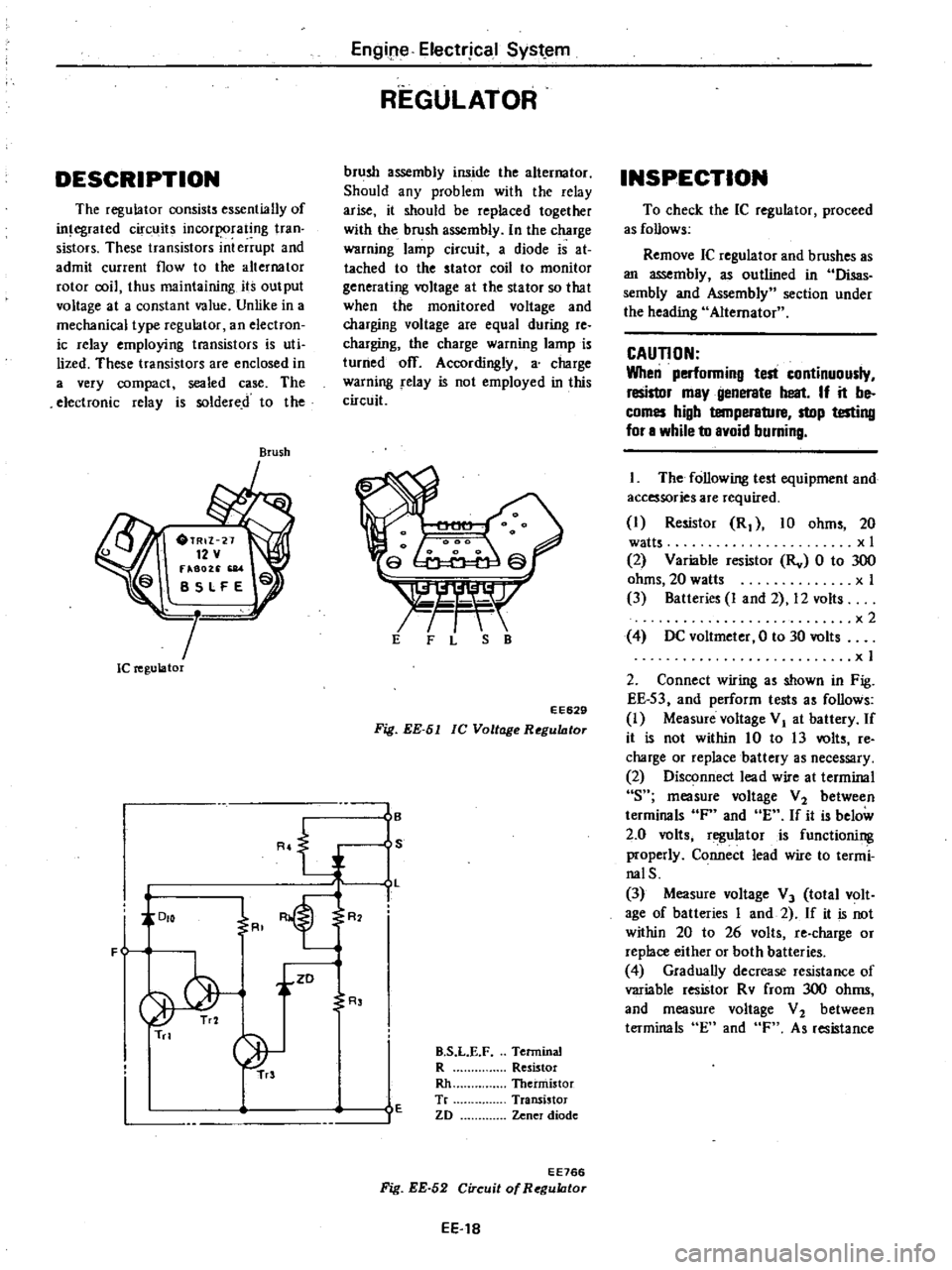
EE629
Fig
EE
51
lC
Voltage
RegultJtor
I
B
S
L
I
R
R
E
B
S
L
E
F
Terminal
R
Resistor
Rh
Thermistor
Tr
Transistor
ZD
Zener
diode
EE766
Fig
EE
52
Circuit
of
RegultJtor
EE
18
INSPECTION
To
check
the
IC
regulator
proceed
as
follows
Remove
IC
regulator
and
brushes
as
an
assembly
as
outlined
in
Disas
sembly
and
Assembly
section
under
the
heading
Alternator
CAUTION
When
performing
test
continuously
resistor
may
generate
heat
If
it
be
comes
high
temperature
stop
testing
for
a
while
to
avoid
burning
The
following
test
equipment
and
accessories
are
required
I
Resistor
R
10
ohms
20
watts
x
I
2
Variable
resistor
Rv
0
to
300
ohms
20
watts
x
I
3
Batteries
I
and
2
12
volts
x2
4
DC
voltmeter
0
to
30
volts
x
I
2
Connect
wiring
as
shown
in
Fig
EE
S3
and
perform
tests
as
follows
I
Measure
voltage
VI
at
battery
If
it
is
not
within
10
to
13
volts
re
charge
or
replace
battery
as
necessary
2
Disconnect
lead
wire
at
terminal
s
measure
voltage
V
2
between
terminals
F
and
E
If
it
is
below
2
0
volts
regulator
is
functioning
properly
Connect
lead
wire
to
termi
nalS
3
Measure
voltage
V
3
total
volt
age
of
batteries
I
and
2
If
it
is
not
within
20
to
26
volts
re
charge
or
replace
either
or
both
batteries
4
Gradually
decrease
resistance
of
variable
resistor
Rv
from
300
ohms
and
measure
voltage
V
2
between
terminals
En
and
F
As
resistance
Page 181 of 548

CHECKING
AND
ADJUSTMENT
CAP
AND
ROTOR
HEAD
Cap
and
rotor
head
should
be
in
spected
periodically
as
specified
in
the
Main
teoanee
Schedule
Remove
cap
and
clean
all
dust
and
carbon
deposits
from
cap
and
rotor
from
time
to
time
If
cap
is
cracked
or
is
leaking
replace
wi
th
a
new
one
ADVANCE
MECHANISMS
SpecHlcatlons
Refer
to
Service
Data
and
Specifica
tions
for
distributor
Vacuum
advance
mechanism
mechanical
parts
If
vacuum
advance
mechanism
fails
to
operate
properly
check
for
the
followin
B
items
and
correct
the
mal
function
as
required
I
Check
vacuum
inlet
for
signs
of
leakage
at
its
connection
If
necessary
retighten
or
replace
with
a
new
one
2
Check
vacuum
diaphragm
for
air
leak
If
leak
is
found
replace
vacuum
controUer
assembly
3
Inspect
breaker
plate
for
smooth
moving
If
plate
does
not
move
smoothly
this
condition
could
be
due
to
sticky
steel
balls
or
pivot
Apply
grease
to
steel
halls
or
if
necessary
replace
breaker
plate
as
an
assembly
Centrifugal
advance
mechanical
parts
When
cause
of
engine
malfunction
is
traced
to
centrifugal
advance
mecha
nical
parts
use
distributor
tester
to
check
its
characteristics
If
nothing
is
wrong
with
its
charac
teristics
conceivable
causes
are
faulty
or
abnormal
wear
of
driving
part
or
others
So
do
not
disassemble
it
In
the
event
of
improper
character
istics
check
closely
rotor
shaft
assem
bly
governor
weight
and
shaft
If
any
of
the
above
parts
are
mal
functioning
replace
the
parts
Engine
Electrical
System
DISASSEMBLY
AND
ASSEMBLY
DISASSEMBLY
I
Take
off
cap
and
remove
rotor
head
2
Remove
Ie
ignition
unit
Refer
to
IC
Ignition
Unit
for
removal
and
in
stallation
3
Remove
stator
and
magnet
by
removing
stator
securing
screws
4
Remove
vacuum
controller
by
removing
securing
screws
EE746
Fig
EE
59
Removing
Vacuum
Controller
5
Using
two
pry
bars
or
suitable
puller
pry
reluctor
from
shaft
CAUTION
When
removing
reluctor
be
careful
not
10
distort
or
damage
the
teeth
6
Remove
roll
pin
7
Remove
pick
up
coil
assembly
8
Remove
breaker
plate
setscrews
and
remove
breaker
plate
assembly
EE703
Fig
EE
60
Removing
Breaker
Plate
Setscrews
9
Punch
knock
pin
out
and
remove
pinion
EE
23
EE704
Fig
EE
61
Removing
Knock
Pin
10
Remove
rotor
shaft
and
drive
shaft
assembly
EE705
Fig
EE
62
Removing
Rotor
Shaft
and
Drive
Shaft
Assembly
11
Mark
rotor
shaft
and
drive
shaft
Remove
packing
from
the
top
of
rotor
shaft
and
unscrew
rotor
shaft
setscrew
Remove
rotor
shaft
EE706
Fig
EE
63
Removing
Rotor
Shaft
12
Mark
one
of
the
governor
springs
and
its
bracket
Also
mark
one
of
the
governor
weights
and
its
pivot
pins
13
Carerully
unhook
and
remove
governor
springs
14
Remove
governor
weights
A
r
ply
grease
to
guvernor
weights
after
disassembling
Page 182 of 548

ASSEMBLY
To
assemble
reverse
the
order
of
disassembly
Carefully
observe
the
fol
lowing
instructions
CAUTION
B
tfore
installi
lg
IC
ignition
unit
make
sure
mating
surfaces
of
IC
ignition
unit
and
distriblitor
are
clean
and
free
from
dust
sand
and
moisture
Align
match
marks
so
that
parts
are
assembled
to
their
original
posi
tions
2
Ensure
that
reluctor
is
properly
oriented
when
installing
on
shaft
Al
ways
drive
in
roll
pin
with
its
slit
toward
the
outer
end
of
shaft
See
Fig
EE
64
Be
sure
to
use
a
new
roll
pin
DESCRIPTION
The
IC
ignition
unit
utilizes
a
semi
conductor
IC
device
and
is
mounted
on
the
side
surface
of
the
distributor
The
IC
ignition
unit
has
the
fol
lOwing
circuits
Spark
timing
signal
monitoring
circuit
This
circuit
detects
the
ignition
signal
sent
from
the
distributor
pick
up
coil
and
amplifies
the
signal
2
Lock
preventing
circuit
This
circuit
cuts
off
the
ignition
coil
primary
current
when
the
ignition
switch
is
ON
and
the
engine
is
sta
tionary
If
the
ignition
coil
primary
current
is
allowed
to
flow
under
such
condi
tions
excessive
current
will
be
drawn
because
of
low
internal
resistance
of
the
ignition
coil
Engine
Electrical
System
r
5
EE747
Fig
EE
64
Driuing
in
Roll
Pin
3
When
installing
pinion
on
shaft
be
sure
to
install
pinion
gear
correctly
to
position
where
it
was
installed
4
Apply
grease
to
the
top
of
rotor
shaft
as
required
5
Check
the
operation
of
governor
before
installing
distributor
on
engine
Ie
IGNITION
UNIT
This
can
result
in
an
abnormal
temperature
rise
in
the
ignition
coil
or
discharged
battery
These
malfunc
tions
can
be
prevented
by
this
lock
preventing
circuit
3
Duty
control
circuit
This
circuit
controls
the
ratio
of
the
ignition
coil
primary
current
ON
OFF
time
periods
in
one
cycle
of
ignition
operation
111is
is
equivalent
to
the
dwell
angle
of
the
conventional
point
type
dis
tributor
In
order
to
provide
high
performance
spark
ruing
over
a
wide
range
of
driving
speeds
this
duty
can
be
controlled
by
the
source
voltage
and
the
ambient
temperature
as
well
as
by
the
engine
rpm
4
Power
switching
circuit
This
circuit
is
used
to
make
or
break
directly
the
primary
circuit
cur
EE
24
6
Properly
eenterstatOr
and
reluc
tor
before
tightening
Standard
air
gap
0
3
to
0
5
mm
0
012
to
0
020
in
0
3
to
0
5
mm
0
012
to
0
020
in
Fig
EE
65
EE748
Air
Gap
7
Adjust
ignition
timing
after
distri
butor
is
installed
on
engine
rent
of
the
ignition
coil
5
Current
limiting
circuit
This
circuit
controls
the
current
value
so
that
excessive
current
will
not
flow
through
the
power
switching
cir
cuit
To
ensure
efficient
operation
of
the
IC
ignition
unit
these
five
circuits
are
manufactured
in
one
assembly
as
shown
in
Fig
EE
66
The
semi
conductor
IC
is
utilized
for
all
these
circuits
except
the
power
switching
circuit
The
power
switching
circuit
uses
one
power
transistor
and
the
circuit
is
arranged
on
the
ceramic
substrate
together
with
resislors
capa
citors
and
diodes
Each
component
part
of
this
unit
is
highly
reliable
however
should
any
part
be
found
faulty
the
entire
as
sembly
musl
be
replaced
Page 183 of 548
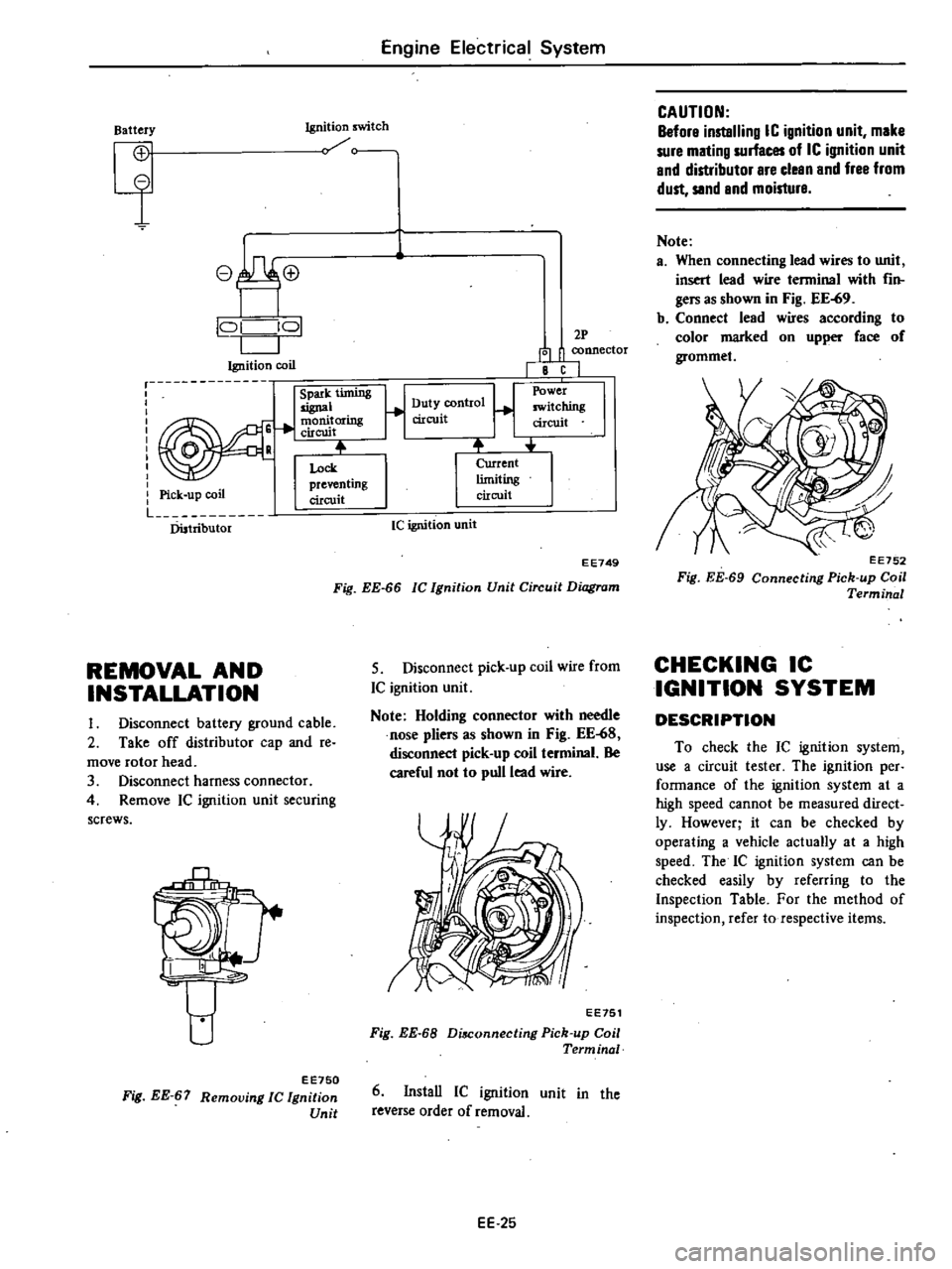
Engine
Electrical
System
Battery
Ignition
switch
CG
1
e
@
P
L
JO
L
J
Ignition
coil
r
Spark
timing
signal
I
oni
1oring
Clfcwt
0
R
Lock
Pi
k
il
preventing
c
up
co
circuit
Ln
n
Distributor
2P
fJ
1I
connector
8C
H
uty
control
ClICUlt
Power
switching
circuit
Current
limiting
circuit
Ie
ignition
unit
EE749
Fig
EE
66
Ie
Ignition
Unit
Circuit
Diagram
REMOVAL
AND
INSTALLATION
5
Disconnect
pick
up
coil
wire
from
IC
ignition
unit
Note
Holding
connector
with
needle
nose
pliers
as
shown
in
Fig
EE
68
disconnect
pick
up
coil
terminal
Be
careful
not
to
pull
lead
wire
I
Disconnect
battery
ground
cable
2
Take
off
distributor
cap
and
re
move
rotor
head
3
Disconnect
harness
connector
4
Remove
Ie
ignition
unit
securing
screws
rf
I
I
EE751
Fig
EE
68
Di
Connecting
Pick
up
Coil
Term
inal
eE750
Fig
EE
67
Removing
Ie
Ignition
Unit
6
InstaU
IC
ignition
unit
in
the
reverse
order
of
removal
EE
25
CAUTION
Before
instelling
IC
ignition
unit
mike
sure
mlting
surfaces
of
IC
ignition
unit
end
distributor
Ire
cleen
and
free
from
dust
sand
and
moisture
Note
a
When
connecting
lead
wires
to
unit
insert
lead
wire
terminal
with
fin
ger
as
shown
in
Fig
EE
69
b
Connect
lead
wires
according
to
color
marked
on
upper
face
of
grommet
EE752
Fig
EE
69
Connecting
Pick
up
Coil
Terminal
CHECKING
IC
IGNITION
SYSTEM
DESCRIPTION
To
check
the
IC
ignition
system
use
a
circuit
tester
The
ignition
per
fannance
of
the
ignition
system
at
a
high
speed
cannot
be
measured
direct
ly
However
it
can
be
checked
by
operating
a
vehicle
actually
at
a
high
speed
The
IC
ignition
system
can
be
checked
easily
by
referring
to
the
Inspection
Table
For
the
method
of
inspection
refer
to
respective
items
Page 184 of 548

INSPECTION
TABLE
I
No
spark
occur
Check
high
tension
cable
NG
OK
Repair
and
lor
replace
ngine
Electrical
System
START
Check
sparking
performance
J
J
Sparks
oci
1u
IC
IGNITION
SYSTEM
OK
Check
power
supply
circuit
NG
Repair
and
or
replace
OK
Check
primary
circuit
Proceed
to
A
Proceed
to
A
NG
epair
an
or
replace
OK
Proceed
to
A
DISTRIBUTOR
ASSEMBLY
NG
lC
IGNITION
UNIT
AND
OR
PICK
UP
COIL
NG
Mealure
pick
up
coil
resistance
as
a
distributor
assembly
Except
approx
4000
Measure
igilition
coii
8terminalvoltage
Battery
voltage
t
OV
Measure
pick
up
coil
resistance
I
Ie
IGNITION
UNIT
NG
Except
approx
400n
Approx
400n
PICK
UP
COIL
NG
1
PICK
UP
COIL
OK
Replace
IC
IGNITION
Replace
I
UNI
NG
l
Meuure
pick
up
coil
resistance
Except
approx
4000
I
Check
sparking
performance
I
Replace
I
r
PICK
UP
COIL
NG
1
No
spark
occun
Sparks
occur
I
IC
IGNITION
flc
IGNITION
Proceed
to
A
Replace
UNIT
NG
i
UNIT
OK
Proceed
to
A
Replace
Proceed
to
A
CHECKING
PROCEDURE
Sparking
performance
check
L
Turn
ignition
switch
to
OFF
position
2
Disconnect
anti
dieseling
solenoid
valve
connector
to
cut
off
supply
of
fuel
to
engine
3
Disconnect
high
tension
cable
from
spark
plug
4
Keeping
high
tension
cable
end
4
to
5
mm
0
16
to
0
20
in
away
from
engine
block
rotate
starter
motor
and
check
whether
sparks
occur
across
the
clearance
JUDGMENT
Sparks
occur
IC
ignition
system
OK
In
this
case
IC
ignition
system
and
component
parts
need
not
be
checked
beyond
this
No
spark
occurs
IC
ignition
system
NG
In
case
of
NG
check
High
Tension
Cables
Nole
This
check
is
designed
to
deter
mine
only
ignition
spark
perform
ance
when
cranking
engine
If
test
results
are
satisfactory
Ibis
does
EE
26
I
Approx
400n
PICK
UP
COIL
OK
1C
IGNITION
UNIT
NG
I
Repair
and
or
replace
I
Proceed
to
A
Approx
400n
l
PICK
UP
COIL
OK
1
not
alwaY
indicate
performance
sufrlcienl
for
high
speed
operation
IOgh
tension
cable
check
Refer
to
Engine
Tune
up
for
Check
ing
Ignition
Wiring
Distributor
Cap
and
Rotor
JUDGMENT
If
high
tension
cable
is
OK
check
Power
SupplY
Circuit
If
high
tension
cable
is
NG
replace
cable
assembly
Page 185 of 548

Power
suppl
circuit
check
Make
sure
that
ignition
switch
is
in
OFF
position
2
Disconnect
Ie
ignition
unit
con
nector
from
unit
3
Turn
ignition
switch
to
ON
position
4
Measure
voltage
at
the
terminal
as
shown
in
Fig
EE
70
I
I
1
Fig
EE
70
EE734
Checking
Power
Supply
Circuit
5
Turn
ignition
switch
to
OFF
position
JUDGMENT
Battery
voltage
is
indicated
OK
In
this
case
check
Primary
Circuit
Battery
voltage
is
not
indicated
NG
In
case
of
NG
check
power
supply
wirings
fusible
link
ignition
switch
and
connecto
s
for
condition
and
con
tinuity
Primer
circuit
check
I
Make
sure
that
ignition
switch
is
in
0
FF
position
2
Disconnect
IC
ignition
unit
con
nector
from
unit
3
Turn
ignition
switch
to
ON
position
4
Measure
voltage
at
the
terminal
as
shown
in
Fig
EE
7I
1
I
r
1
EE735
Fig
EE
7I
Checking
Primary
Circuit
Engine
Electrical
System
5
Turn
ignition
switch
to
OFF
position
JUDGMENT
Battery
voltage
is
indicated
OK
In
this
case
proceed
to
the
step
for
IC
Ignition
Unit
and
Pick
up
Coil
Check
Battery
voltage
is
not
indicated
NG
If
NG
check
condition
and
con
tinuity
of
primary
circuit
wirings
and
connectors
If
results
of
these
inspec
tions
are
satisfactory
check
Ignition
Coil
Ignition
coil
check
I
Make
sure
that
ignition
switch
is
in
OFF
position
2
Disconnect
harness
connector
from
ignition
coil8terminal
3
Measure
resistance
between
and
8terminals
Resistance
1
range
C2J
j
EE567
Fig
EE
72
Checking
Ignition
Coil
Assem
bly
JUDGMENT
If
resistance
value
is
0
84
to
1
02n
OK
If
resistance
value
is
other
than
the
specified
value
NG
Ie
Ignition
unit
end
pick
up
coli
check
If
power
supply
circuit
primary
circuit
and
high
tension
cables
are
in
good
order
IC
ignition
unit
and
or
pick
up
coil
are
malfunctioning
I
Make
sure
that
ignition
switch
is
in
OFF
position
2
Remove
distributor
cap
and
ro
tor
EE
27
3
Measure
resistance
between
two
terminals
of
pick
up
coil
as
a
distribu
tor
assembly
with
a
circuit
tester
1
Tester
probes
2
Grommet
3
Ie
ignition
urnt
EE736
Fig
EE
73
Measuring
Pick
up
Coil
Resistance
4
Measure
resistance
by
reversing
polarity
of
circuit
tester
probes
JUDGMENT
Approx
400n
are
indicated
Pick
up
coil
OK
IC
ignition
unit
NG
In
this
case
replace
faulty
IC
igni
tion
unit
with
new
one
Approx
400n
are
not
indicated
Condition
cannot
be
judged
Thus
proceed
to
item
5
Note
If
resistance
is
approx
4OOn
no
further
inspection
is
required
replace
IC
ignition
unit
5
Make
sure
2
pin
IC
ignition
unit
connector
is
securely
connected
to
unit
6
Turn
ignition
switch
to
ON
position
7
Measure
voltage
at
ignition
coil
8
terminal
8
Turn
ignition
switch
to
OFF
position
CAUTION
Turn
ignition
switch
off
after
releasing
test
probe
of
circuit
tester
from
nega
tive
terminal
of
ignition
coil
Failure
to
do
this
could
result
in
damage
to
circuit
tester
Page 186 of 548

JUDGMENT
OV
is
indicated
IC
ignition
unit
NG
But
condition
of
pick
up
coil
can
not
be
judged
Proceed
to
the
item
for
Pick
up
Coil
Check
Bat
tery
voltage
is
indicated
Condition
cannot
be
judged
Proceed
to
item
9
9
Remove
IC
ignition
unit
Refer
to
IC
ignition
Unit
for
re
moval
10
Measure
resistance
between
two
terminals
of
pick
up
coil
JUDGMENT
Approx
40011
are
indicated
The
ignition
coil
is
an
oil
filled
type
The
ignition
coil
case
is
filled
with
oil
which
has
good
insulating
and
heat
radiating
characteristics
The
ignition
coil
has
a
greater
ratio
between
the
primary
and
secondary
windings
to
step
up
battery
voltage
to
high
voltage
This
causes
stronger
sparks
to
jump
the
spark
plug
gap
The
cap
is
made
of
alkyd
resin
which
offers
high
resistance
to
electric
arc
and
increased
insulation
When
high
tension
cable
is
installed
to
ignition
coil
there
should
be
no
clearance
between
their
caps
Note
Do
not
disconnect
high
tension
cables
from
spark
plugs
during
en
gine
running
r
EE354
1
High
tension
cable
2
Rubber
cap
Fig
EE
74
Correct
Instalhltion
of
High
Tension
Cable
Engine
Electrical
System
Pick
up
coil
OK
IC
ignition
unit
NG
Approx
40011
are
not
indicated
Pick
up
coil
NG
Condition
of
IC
ignition
unit
can
not
be
judged
Proceed
to
item
11
II
Replace
faulty
pick
up
coil
with
new
one
12
Install
original
IC
ignition
unit
13
Check
parking
performance
JUDGMENT
Sparks
occur
IC
ignition
system
IC
ignition
unit
OK
No
spark
OCCUrs
IC
ignition
unit
NG
IGNITION
COIL
If
NG
replace
faulty
IC
ignition
unit
with
new
one
P1ck
up
coil
check
I
Make
sure
that
ignition
switch
is
in
OFF
position
2
Remove
IC
ignition
unit
Refer
to
IC
Ignition
Unit
for
removal
3
Measure
resistance
between
two
terminals
of
pick
up
coil
JUDGMENT
Approx
40011
are
indicated
OK
Approx
40011
are
not
indicated
NG
If
NG
replace
faulty
pick
up
coil
with
new
one
1
@
I
rJ
1
C
I
I
i
jllll
1
t
1
Rubber
cap
for
ignition
coil
2
Secondary
tenninal
3
Cap
4
Primary
terminal
5
Spring
6
Secondary
winding
EE
28
EE578
7
Primary
winding
8
Side
core
9
Insulator
10
Center
core
11
Segment
12
Case
Fig
EE
75
Ignition
Coit