check oil DATSUN 210 1979 Workshop Manual
[x] Cancel search | Manufacturer: DATSUN, Model Year: 1979, Model line: 210, Model: DATSUN 210 1979Pages: 548, PDF Size: 28.66 MB
Page 187 of 548
INSPECTION
I
Disconnect
high
tension
cables
from
spark
plugs
by
pulling
on
boot
not
on
cable
itself
2
Remove
spark
plugs
3
Check
electrodes
and
inner
and
outer
porcelains
of
plugs
noting
the
type
of
deposits
and
the
degree
of
electrode
erosion
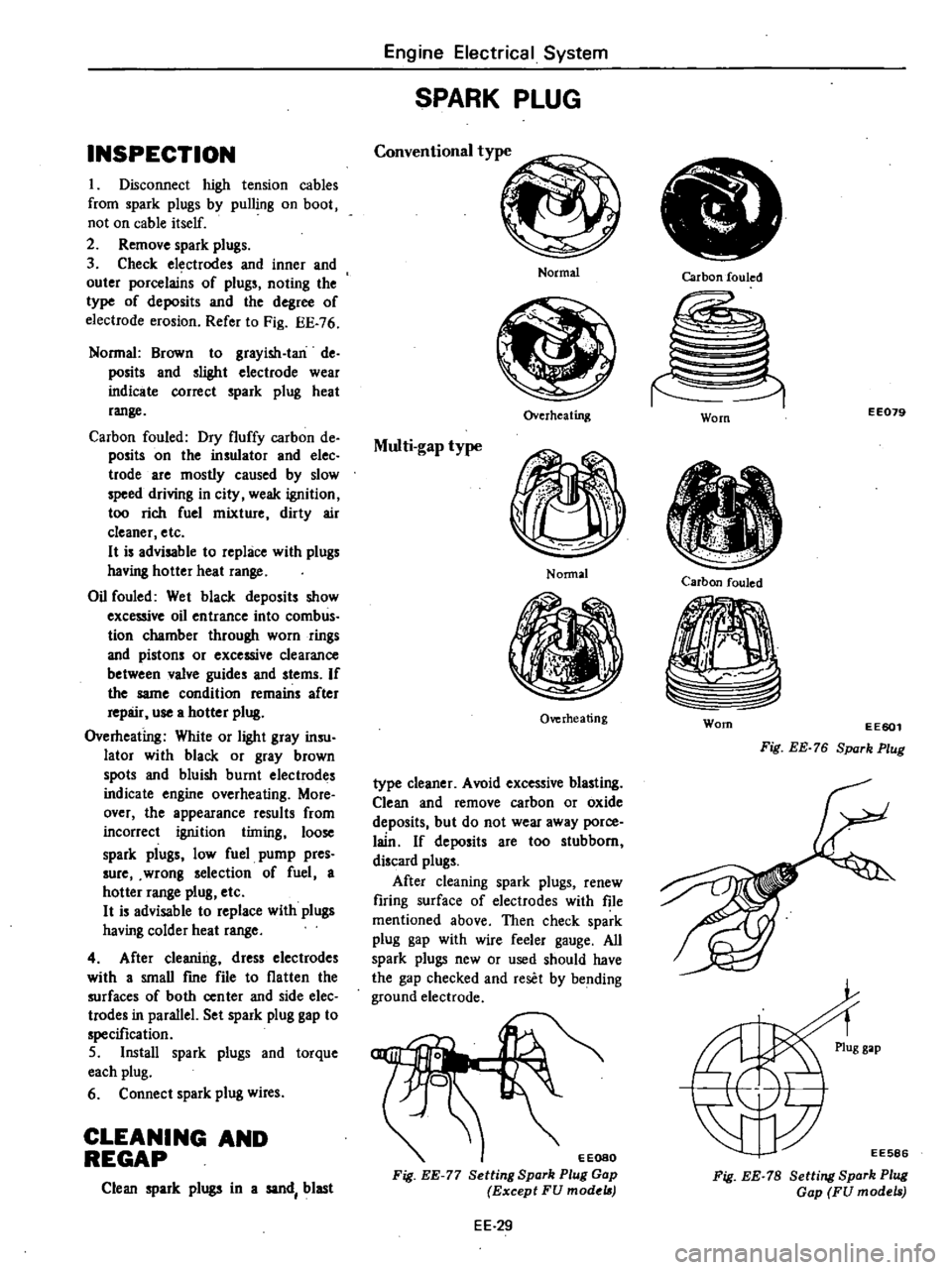
Refer
to
Fig
EE
76
Normal
Brown
to
grayish
Ian
de
posits
and
slighl
electrode
wear
indicate
correct
spark
plug
heat
range
Carbon
fouled
Dry
fluffy
carbon
de
posits
on
the
insulator
and
elec
trode
are
mostly
caused
by
slow
speed
driving
in
city
weak
ignition
too
rich
fuel
mixture
dirty
air
cleaner
etc
H
is
advisable
to
replace
with
plugs
having
hotter
heat
range
Oil
fouled
Wet
black
deposits
show
excessive
oil
entrance
into
comb
us
tion
chamber
through
worn
rings
and
pistons
or
excessive
clearance
between
valve
guides
and
stems
If
the
same
condition
remains
after
repair
use
a
hotter
plug
Overheating
White
or
light
gray
insu
lator
with
black
or
gray
brown
spots
and
bluish
burnt
electrodes
indicate
engine
overheating
More
over
the
appearance
results
from
incorrect
ignition
timing
loose
spark
plugs
low
fuel
pump
pres
sure
wrong
selection
of
fuel
a
hotter
range
plug
etc
H
is
advisable
to
replace
with
plugs
having
colder
heat
range
4
After
cleaning
dress
electrodes
with
a
smaU
fme
file
to
flatten
the
surfaces
of
both
center
and
side
elec
trodes
in
parallel
Set
spark
plug
gap
to
specification
5
Install
spark
plugs
and
torque
each
plug
6
Connect
spark
plug
wires
CLEANING
AND
REGAP
Clean
spark
plugs
in
a
sand
blast
Engine
Electrical
System
SPARK
PLUG
Conventional
type
Normal
Overheating
Multi
gap
type
Nonnal
Overheating
type
cleaner
Avoid
excessive
blasting
Clean
and
remove
carbon
or
oxide
deposits
but
do
not
wear
away
porce
lain
If
deposits
are
too
stubborn
discard
plugs
After
cleaning
spark
plugs
renew
firing
surface
of
electrodes
with
file
mentioned
above
Then
check
spark
plug
gap
with
wire
feeler
gauge
All
spark
plugs
new
or
used
should
have
the
gap
checked
and
reset
by
bending
ground
electrode
EEOSO
Fig
EE
77
Setting
Spark
Plug
Gap
Except
FU
model
EE
29
Carbon
fouled
EE079
Worn
Carbon
fouled
Worn
EE601
Fig
EE
76
Spark
Plug
EE586
Fig
EE
78
Setting
Spark
Plug
Gap
FU
models
Page 195 of 548

Engine
Electrical
System
IV
IGNITION
CIRCUIT
When
engine
does
not
start
If
there
is
no
problem
in
fuel
system
ignition
system
should
be
checked
This
can
be
easily
done
by
detaching
a
high
tension
cable
from
distributor
starting
engine
and
ob
serving
oondition
of
spark
that
occurs
between
high
tension
cable
and
engine
block
After
checking
this
repair
as
necessary
tery
and
anti
dieseliilg
wlenoid
valve
connector
to
cuI
off
supply
of
fuel
10
engine
Then
observe
the
condition
of
sparks
while
starter
motor
is
in
operation
Note
Turn
ignilion
switch
off
and
disconnect
ground
cable
from
bat
Condition
Location
Probable
cause
Corrective
action
No
spark
at
all
Distributor
Breakage
of
lead
wire
on
low
tension
side
Repair
Poor
insulation
of
cap
and
rotor
head
Replace
Open
pick
up
coil
Replace
Air
gap
wider
than
specification
Adjust
Ignition
coil
Wire
breakage
or
short
circuit
of
coil
Replace
with
new
one
High
tension
cable
Wire
coming
off
Repair
Faulty
insulation
Replace
IC
ignition
unit
Faulty
IC
ignition
unit
Replace
Breakage
of
circuit
Replace
Detached
connection
Repair
Spark
length
Spark
plugs
Spark
plug
gap
too
wide
Correct
or
replace
More
than
6
mm
Too
much
carbon
Clean
or
replace
0
24
in
Broken
neck
of
insulator
Replace
Expiration
of
plug
life
Replace
Distributor
Air
gap
too
wide
Correct
IC
ignition
unit
Faulty
IC
ignition
unit
Replace
Breakage
of
circuit
Replace
Detached
connection
Repair
EE
37
Page 206 of 548
INSPEctiON
Check
clutch
pedal
parts
for
the
following
items
correcting
neces
sary
I
Bent
pedal
2
Weakened
return
spring
3
Worn
or
deformed
clevis
pin
and
fulcrum
bwhings
4
Cracks
at
welded
part
INSTAl1
ATION
To
install
clutch
pedal
reverse
the
order
of
removal
Observe
the
follow
ing
I
Apply
coating
of
recommended
multi
purpose
grease
to
sliding
por
tions
and
return
spring
Lt
of
I
ii
CL352
Fig
CL
5
Lubricating
Point
2
Fit
return
spring
in
hole
in
pedal
bracket
and
securely
fit
E
ring
in
slit
of
fulcrum
pin
3
Insert
clevis
pin
through
clutch
pedal
from
left
to
right
side
4
After
installing
clutch
pedal
check
the
clutch
pedal
height
AdjUst
if
necessary
Refer
to
Adjwtment
CLUTCH
MASTER
CYLINDER
REMOVAL
I
Remove
snap
pin
from
clevis
pin
2
Pull
out
clevis
pin
3
Disconnect
clutch
tube
from
mas
ter
cylinder
4
Remove
master
cylinder
Clutch
CAUTION
When
disconnecting
clutch
tube
use
suitable
flare
nut
wrench
Never
use
an
open
end
wrench
or
adjus1able
wrench
DISASSEMBLY
Note
When
disconnecting
dutch
tube
be
sure
to
receive
draioillll
clutch
fluid
into
a
container
Use
of
rags
is
also
suggested
to
keep
adja
cent
parts
and
area
clean
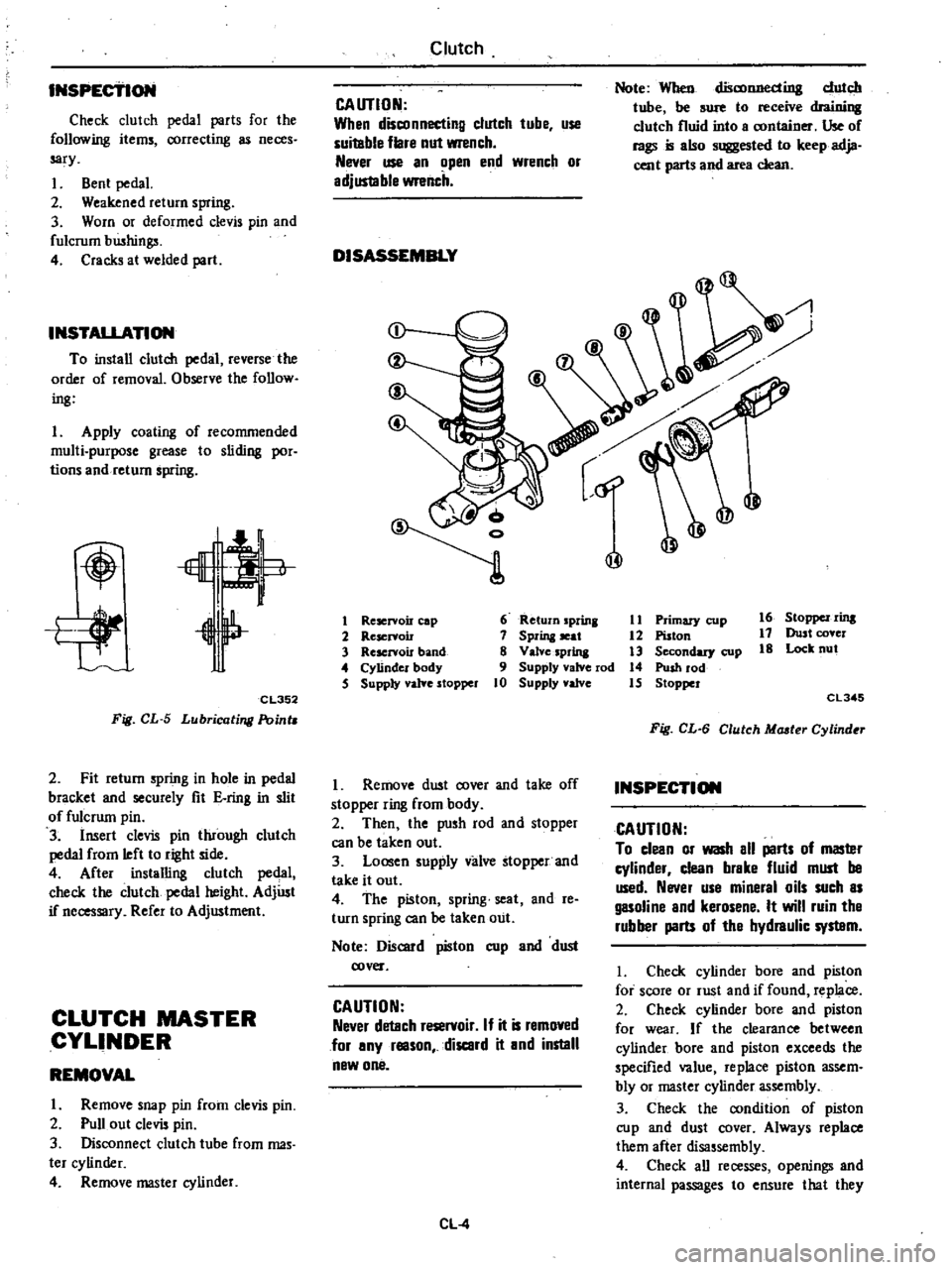
@
@
1
Reservoir
cap
6
Return
prina
11
Primary
cup
16
StOppel
rins
2
Reservoir
7
Sprina
seat
12
Piston
17
Dust
cover
3
Rescrvou
band
8
Valve
sprina
3
Secondary
cup
18
Lock
nut
4
Cylinder
body
9
Supply
valve
rod
14
Push
rod
5
Supply
yalYe
stopper
10
Supply
valve
15
Stopper
CL345
Fig
CL
6
Clutch
Mcuter
Cylind
r
I
Remove
dwt
cover
and
take
off
stopper
ring
from
body
2
Then
the
push
rod
and
stopper
can
be
taken
out
3
Loosen
supply
valve
stopper
and
take
it
out
4
The
piston
spring
seat
and
reo
turn
spring
can
be
taken
out
Note
Discard
piston
cup
and
dust
cover
CAUTION
Never
detach
reservoir
If
it
is
removed
for
any
reason
discard
it
and
instill
new
one
CL
4
INSPECTION
CAUTION
To
clean
or
wash
all
parts
of
masler
cylinder
clean
brake
fluid
must
be
used
Never
use
mineral
oils
such
as
gasoline
and
kerosene
It
will
ruin
tha
rubber
parts
of
tha
hydraulic
syslBm
I
Check
cylinder
bore
and
piston
for
score
or
rust
and
if
found
replace
2
Check
cylinder
bore
and
piston
for
wear
If
the
clearance
between
cylinder
bore
and
piston
exceeds
the
specified
value
replace
piston
assem
bly
or
master
cylinder
assembly
3
Check
the
condition
of
piston
cup
and
dust
cover
Always
replace
them
after
disassembly
4
Check
all
recesses
openings
and
internal
passages
to
ensure
that
they
Page 207 of 548
are
clean
and
free
from
foreign
matter
Cearance
between
cylinder
bore
and
piston
Leu
than
0
15
mm
0
0059
in
ASSEMBLY
Assemble
clutch
master
cylinder
in
the
reverse
order
of
disassembly
Ob
serve
the
following
I
Dip
piston
cup
in
brake
fluid
before
installing
Make
sure
that
it
is
correctly
faced
in
position
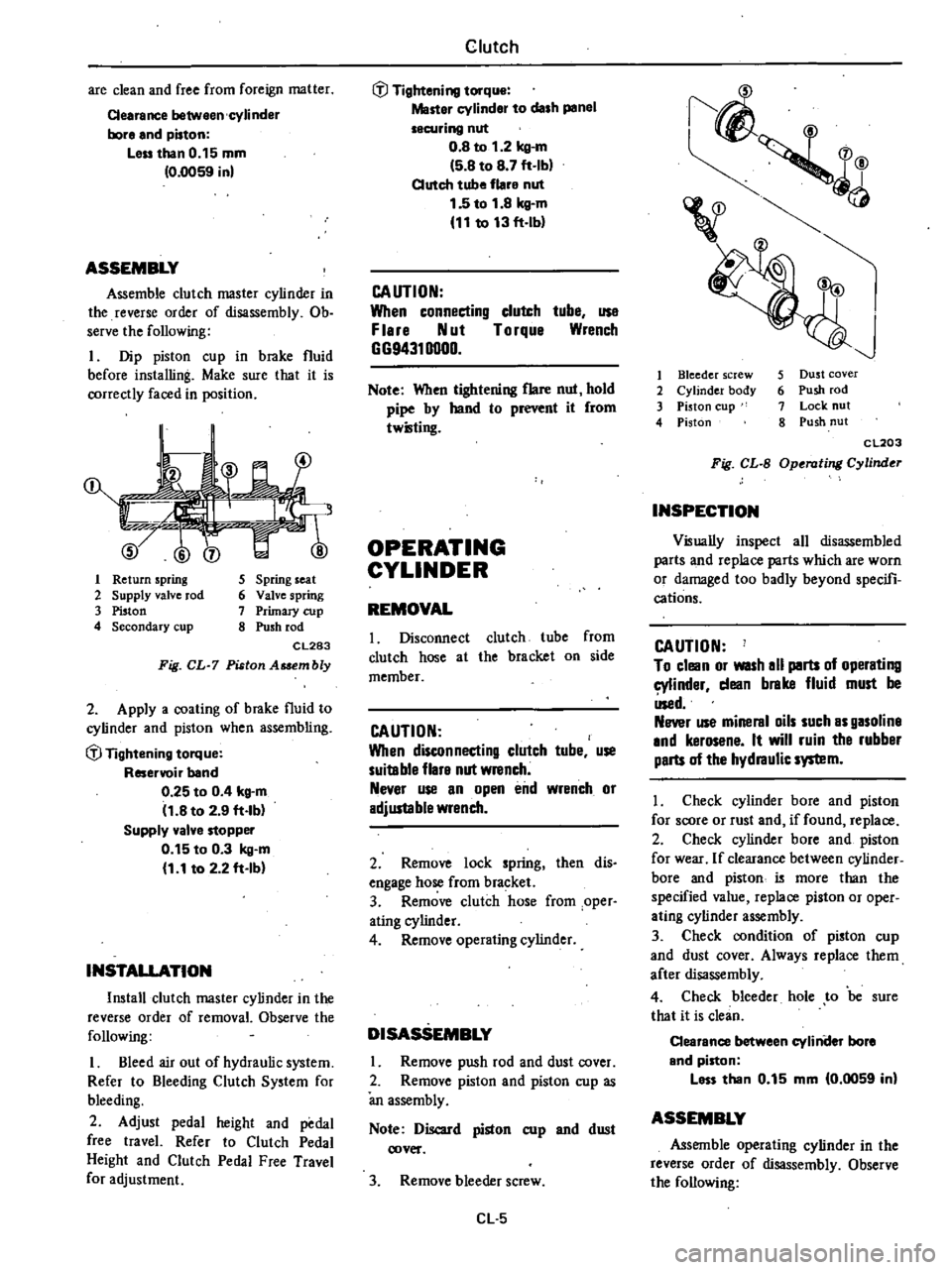
1
Return
spring
2
Supply
valve
rod
3
Piston
4
Secondary
cup
5
Spring
seat
6
Valve
spring
7
Primary
cup
8
Push
rod
CL283
Fig
CL
7
Piston
Asaembly
2
Apply
a
coating
of
brake
fluid
to
cylinder
and
piston
when
assembling
if
Tightening
torque
Reservoir
band
0
25
to
0
4
kg
m
11
8
to
2
9
ft
lb
Supply
valve
stopper
0
15
to
0
3
kg
m
1
1
to
2
2
ft
Ib
INSTALLATION
Install
clutch
master
cylinder
in
the
reverse
order
of
removal
Observe
the
following
I
Bleed
air
out
of
hydraulic
system
Refer
to
Bleeding
Clutch
System
for
bleeding
2
Adjust
pedal
height
and
pedal
free
travel
Refer
to
Clutch
Pedal
Height
and
Clutch
Pedal
Free
Travel
for
adjustment
Clutch
if
Tightening
torque
Master
cylinder
to
dash
panel
securing
nut
0
8
to
1
2
kg
m
5
8
to
8
7
ft
Ib
Clutch
tube
flare
nut
1
5
to
1
8
kg
m
11
to
13
ft
lb
CAUTION
When
connecting
clutch
tube
use
F
lere
Nut
Torque
Wrench
GG94310000
Note
When
tightening
flare
nut
hold
pipe
by
hand
to
r
it
from
twilling
OPERATING
CYLINDER
REMOVAL
I
Disconnect
clutch
tube
from
clutch
hose
at
the
bracket
on
side
member
CAUTION
When
disconnecting
clutch
tube
use
suitable
flare
nut
wrench
Never
use
an
open
end
wrench
or
adjustable
wrench
2
Remove
lock
spring
then
dis
engage
hose
from
bracket
3
Remove
clutch
hose
from
oper
ating
cylinder
4
Remove
operating
cylinder
DISASSEMBLY
Remove
push
rod
and
dust
cover
2
Remove
piston
and
piston
cup
as
an
assembly
Note
Discard
piston
cup
and
dust
cover
3
Remove
bleeder
screw
Cl
5
1
4
v
I
Bleeder
screw
2
Cylinder
body
3
Piston
cup
4
Piston
5
Dust
cover
6
Push
rod
7
Lock
nut
8
Push
nut
CL203
Fig
CL
B
Operating
Cylinder
INSPECTION
Visually
inspect
all
disassembled
parts
and
replace
parts
which
are
worn
or
damaged
too
badly
beyond
specifi
cations
CAUTION
To
clean
or
WISh
all
parts
of
operating
cylinder
dean
brake
fluid
must
be
Used
Never
use
mineral
oils
such
as
gasoline
and
kerosene
It
will
ruin
the
rubber
parts
of
the
hydraulic
system
I
Check
cylinder
bore
and
piston
for
score
or
rust
and
if
found
replace
2
Check
cylinder
bore
and
piston
for
wear
If
clearance
between
cylinder
bore
and
piston
i5
more
than
the
specified
value
replace
piston
or
oper
ating
cylinder
assembly
3
Check
condition
of
piston
cup
and
dust
cover
Always
replace
them
after
disassembly
4
Check
bleeder
hole
to
be
sure
that
it
is
clean
Clearance
between
cyliniler
bore
and
piston
less
than
0
15
mm
0
0059
in
ASSEMBLY
Assemble
operating
cylinder
in
the
reverse
order
of
disassembly
Observe
the
following
Page 209 of 548
CLUTCH
DISC
AND
COVER
REMOVAL
1
Remove
transmission
from
en
gine
Refer
to
Removal
Section
MT
2
Insert
Clutch
Aligning
Bar
ST20610000
4
speed
tranSmission
or
KV30100IOO
5
speed
transmission
into
clutch
disc
hub
until
it
will
no
longer
gd
It
is
important
to
support
weight
of
clutch
disc
in
the
steps
that
follow
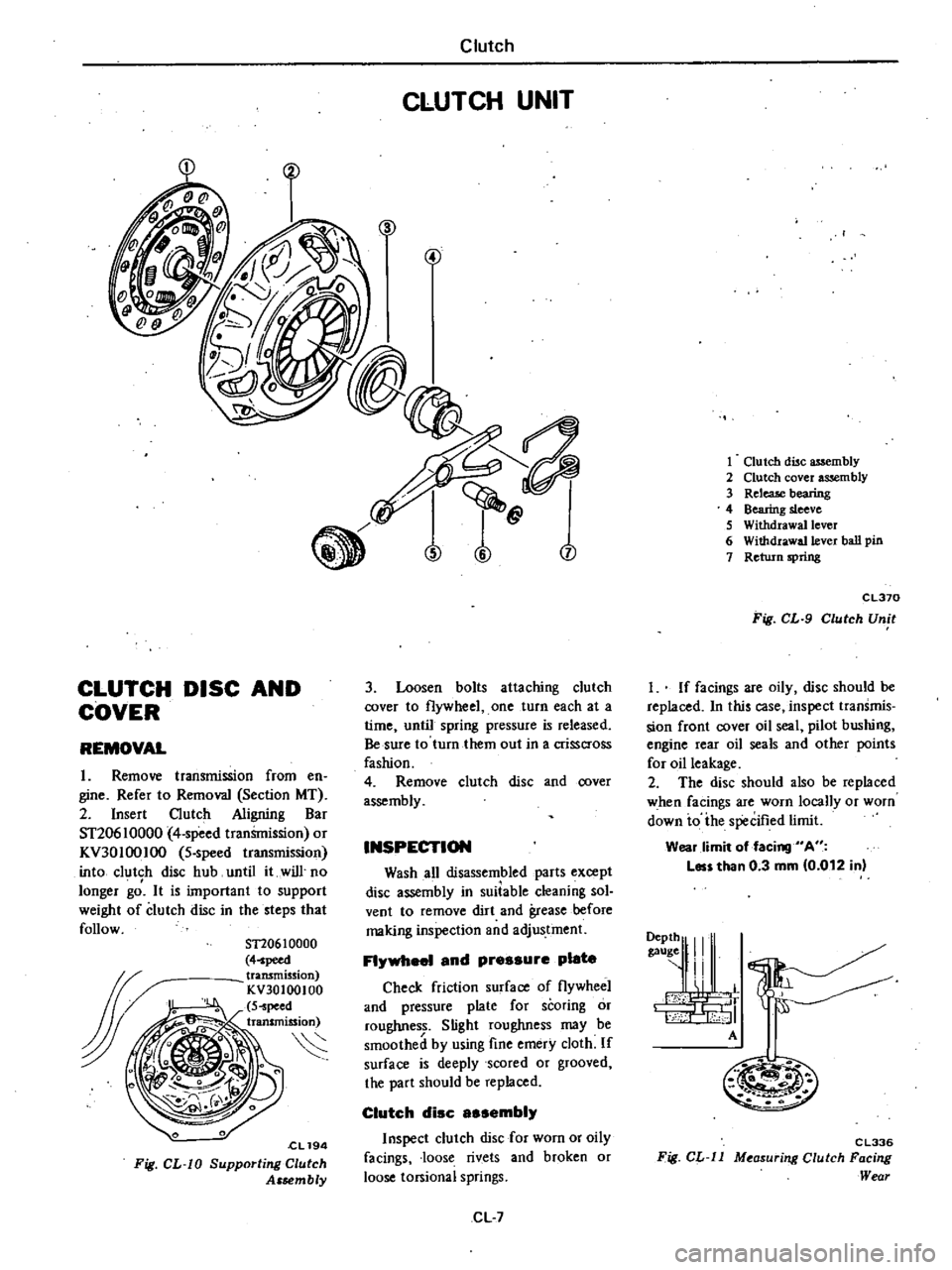
ST20610000
4
peed
transmission
KV30100100
S
peed
transmission
S
cL194
Fig
CL
W
Supporting
Clutch
Assembly
Clutch
CLUTCH
UNIT
n
j
3
Loosen
bolts
attaching
clutch
cover
to
flywheel
one
turn
each
at
a
time
until
spring
pressure
is
released
Be
sure
to
turn
them
out
in
a
crisscross
fashion
4
Remove
clutch
disc
and
cover
assembly
INSPECTION
Wash
all
disassembled
parts
except
disc
assembly
in
suiiable
cleaning
sol
vent
to
remove
dirt
and
grease
before
making
inspection
and
adjustment
FI
1
and
pressure
plate
Check
friction
surface
of
flywheel
and
pressure
plate
for
scoring
or
roughness
Slight
roughness
may
be
smoothed
by
using
fine
emery
cloth
If
surface
is
deeply
scored
or
grooved
the
part
should
be
replaced
Clutch
disc
sembi
Inspect
clutch
disc
for
worn
or
oily
facings
loose
rivets
and
broken
or
loose
torsional
springs
CL
7
1
Clutch
disc
assembly
2
Clutch
cover
assembly
3
ReleaJe
bearing
4
Bearing
sleeve
S
Withdrawal
lever
6
Withdrawa11ever
ball
pin
7
Return
spring
CL370
Fig
CL
9
Clutch
Unit
I
If
facings
are
oily
disc
should
be
replaced
In
this
case
inspect
transmis
sion
front
cover
oil
seal
pilot
bushing
engine
rear
oil
seals
and
other
points
for
oil
leakage
2
The
disc
should
also
be
replaced
when
facings
are
worn
locally
or
worn
down
io
ihe
specified
limit
Wear
limit
of
facing
A
Les
than
0
3
mm
0
012
in
9111
I
A
M
m
C
L336
Fig
CL
ll
M
asur
ng
Clutch
Facing
Wear
Page 210 of 548
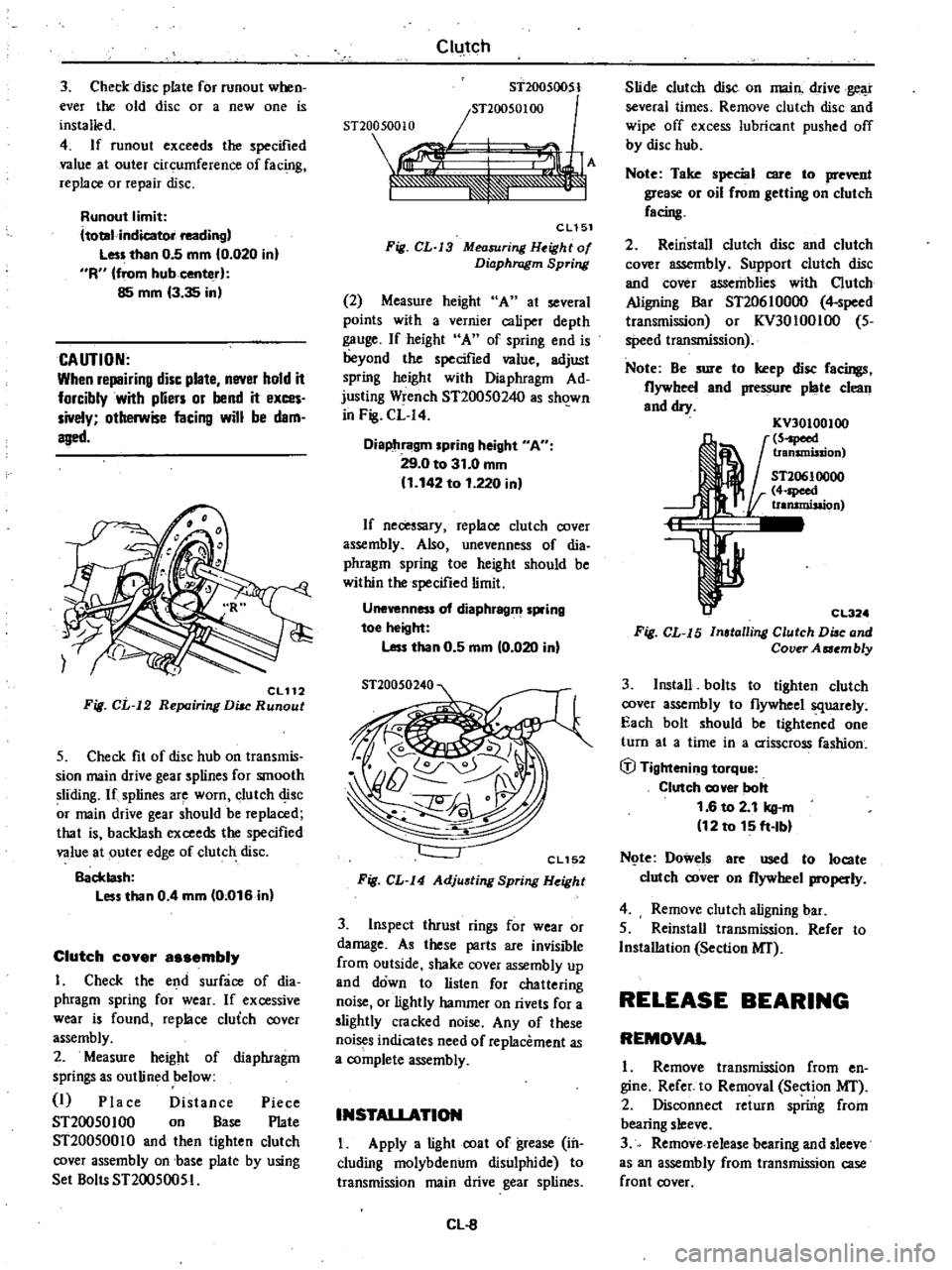
3
Check
disc
plate
for
runout
when
ever
the
old
disc
or
a
new
one
is
installed
4
If
runout
exceeds
the
specified
value
at
outer
circumference
of
fac
g
replace
or
repair
disc
Runout
limit
ltotal
indicator
reading
Less
than
0
5
mm
0
020
in
R
from
hub
center
85
mm
3
35
in
CAUTION
When
repairing
disc
plate
never
hold
it
forcibly
with
pUers
or
bend
it
exces
sively
otherwise
facing
will
be
dam
aged
CL112
Fig
CL
12
Repairing
DiM
Runout
5
Check
fit
of
disc
hub
on
transmis
sion
main
drive
gear
splines
for
smooth
sliding
If
splines
are
worn
clutch
disc
r
main
drive
gear
should
be
replaced
that
is
backlash
exceeds
the
specified
value
at
outer
edge
of
clutch
disc
Backlash
Less
than
0
4
mm
0
016
in
Clutch
cover
a
embly
I
Check
the
end
surface
of
dia
phragm
spring
for
wear
If
excessive
wear
is
found
replace
cluich
cover
assembly
2
Measure
height
of
diaphragm
springs
as
outlined
below
I
Place
Distance
Piece
ST20050100
on
Base
Plate
ST20050010
and
then
tighten
clutch
cover
assembly
on
base
plate
by
using
Set
Bolts
ST20050051
Clutch
ST200S0051
snOO50100
snoo
500
10
re1
F
A
J
eLlSl
Fig
CL
J3
Measuring
H
ight
of
Diaphragm
Spring
2
Measure
height
A
at
several
points
with
a
vernier
caliper
depth
gauge
If
height
A
of
spring
end
is
beyond
the
specified
value
adjust
spring
height
with
Diaphragm
Ad
justing
Wrench
ST20050240
as
sh
1wn
in
Fig
CL
I4
Diaphragm
spring
height
A
29
0
to
31
0
mm
1
142
to
1
220
in
If
necessary
replace
clutch
cover
assembly
Also
unevenness
of
dia
phragm
spring
toe
height
should
be
within
the
specified
limit
Unevenness
of
diaphragm
spring
toe
height
Less
than
0
5
mm
0
020
in
CL152
Fig
CL
I4
Adjusting
Spring
Height
3
Inspect
thrust
rings
for
wear
or
damage
As
these
parts
are
invisible
from
outside
shake
cover
assembly
up
and
down
to
listen
for
chattering
noise
or
lightly
hammer
on
rivets
for
a
slightly
cracked
noise
Any
of
these
noi
s
indicates
need
of
replacement
as
a
complete
assembly
INSTALlATION
I
Apply
a
light
coat
of
grease
in
cluding
molybdenum
disulphide
to
transmission
main
drive
gear
splines
Cl
8
Slide
clutch
disc
on
main
drive
gear
several
times
Remove
clutch
disc
and
wipe
off
excess
lubricant
pushed
off
by
disc
hub
Note
Take
special
care
to
prevent
grease
or
oil
rrom
getting
on
clutch
racing
2
Reinstall
clutch
disc
and
clutch
cover
assembly
Support
clutch
disc
and
cover
assemblies
with
Clutch
Aligning
Bar
ST20610000
4
speed
transmission
or
KV30100IOO
5
speed
transmission
Note
Be
sure
to
keep
disc
racings
flywheel
and
pressure
plate
clean
and
dry
KV30100100
5
peed
transmission
ST20610000
4
speed
trammisaion
CL32
Fig
CL
I5
Installing
Clutch
Diac
and
Cover
Aaembly
3
Install
bolts
to
tighten
clutch
cover
assembly
to
flywheel
squarely
Each
bolt
should
be
tightened
one
turn
at
a
time
in
a
crisscross
fashion
ifJ
Tightening
torque
Clutch
cover
bolt
1
6
to
2
1
kg
m
12
to
15
ft
Ibl
N
te
Dowels
are
used
to
locate
clutch
cover
on
flywheel
properly
4
Remove
clutch
aligning
bar
5
Reinstall
transmission
Refer
to
Installation
Section
MI
RELEASE
BEARING
REMOVAL
1
Remove
transmission
from
en
gine
Refer
to
Removal
Section
MI
2
Disconnect
return
spring
from
bearing
sleeve
3
Remove
release
bearing
and
sleeve
as
an
assembly
from
transmission
case
front
cover
Page 211 of 548

4
Take
clutch
release
bearing
out
from
bearing
sleeve
using
a
universal
puller
and
a
suitable
adapter
Fig
CL
16
Di8auembling
Release
Bearing
INSPECTION
Check
for
abnormal
wear
on
COD
tact
surface
of
withdrawal
lever
ball
pin
and
bearing
sleeve
Hold
bearing
inner
race
and
rotate
outer
race
while
applying
pressure
to
it
If
the
bearing
rotation
is
rough
or
noisy
replace
bearing
INSTALLATION
1
Assemble
release
bearing
on
sleeve
using
a
press
Note
Do
not
depress
outer
race
i
L
Cl117
Fig
CL
17
nstalling
Release
Bearing
2
Before
or
during
assembly
lubri
cate
the
following
points
with
a
light
coat
of
multi
purpose
grease
eve
nner
1groove
of
release
bearing
Pack
this
reces5
4
CL093
Fig
CL
IB
Lubricating
Rece
of
Bearing
Sleeve
Clutch
2
Contact
surfaces
of
withdrawal
lever
lever
ball
pin
and
bearing
sleeve
3
Bearing
sleeve
sliding
surface
of
transmission
case
front
cover
C1195
Fig
CL
19
Lubricating
Points
of
Withdrawal
Lever
Bearing
Sleeve
and
Front
Cover
4
Transmission
main
drive
gear
splines
Use
grease
including
molybde
num
disulphide
Note
A
small
amounl
of
grease
should
be
coated
to
the
above
points
If
too
much
lubricant
is
applied
it
will
n
out
on
the
friction
plates
when
hot
resulting
in
damaged
clutch
disc
facings
3
After
lubricating
install
with
drawallever
release
bearing
and
sleeve
assembly
in
position
Connect
them
with
return
spring
1
Return
spring
2
Release
bearing
3
Withdrawal1cver
CL196
Fig
CL
20
Installing
Release
Mechanism
4
Reinstall
transmission
Refer
to
Installation
Section
MT
PILOT
BUSHING
REMOVAL
1
Remove
transmission
from
en
gine
Refer
to
Removal
Section
MT
2
Remove
clutch
disc
and
cover
assembly
Refer
to
Clutch
Disc
and
Cover
for
removal
CL
9
3
Remove
pilot
bushing
in
shaft
by
Pilot
Bushing
KVI0102800
KV10t02800
crank
Puller
Fig
CL
21
Removing
Pilot
Bushing
INSPECTION
Check
pilot
bushing
for
fit
in
bore
of
crankshaft
Check
inner
surface
of
pilot
bush
ing
for
wear
roughness
or
bell
mouthed
condition
If
pilot
bushing
is
worn
or
damaged
replace
When
bush
ing
is
damaged
be
sure
to
check
transmission
main
drive
gear
at
the
same
time
INSTALLATION
1
Before
installing
a
new
bushing
thoroughly
clean
bushing
hole
2
Install
pilot
bushing
so
its
height
A
above
flange
end
is
the
specified
value
Bushing
need
not
be
oiled
Pilot
bushing
inserting
distance
A
2
8
mm
0
110
in
Note
When
inserting
pilot
bushing
be
careful
not
to
damage
edge
of
pilot
bushing
A
EM719
Fig
CL
22
Installing
Pilot
Bushing
3
Install
clutch
disc
and
clutch
cover
assembly
Refer
to
Clutch
Disc
and
Cover
for
installation
4
Install
transmission
Refer
to
In
stallation
Section
MT
Page 214 of 548

Condition
Clutch
slips
Clutch
drags
Clutch
TROUBLE
DIAGNOSES
AND
CORRECTIONS
Probable
cause
and
testing
Corrective
action
Slipping
of
clutch
may
be
noticeable
when
any
of
the
following
symptoms
is
encountered
during
operation
I
Car
will
not
respond
to
erigine
speed
during
acceleration
2
Insufficient
car
speed
3
Lack
of
power
during
uphill
driving
Some
of
the
above
conditions
may
also
be
attributable
to
engine
problem
First
determine
whether
engine
or
clutch
is
causing
the
problem
If
slipping
clutch
is
left
unheeded
wear
and
or
overheating
will
occur
on
clutch
facing
to
such
an
extent
that
it
is
no
longer
serviceable
TO
TEST
FOR
SLIPPING
CLurCH
proceed
as
follows
During
upgrade
havelling
run
engine
at
about
40
to
50
km
h
25
to
31
MPH
with
gear
shift
lever
in
3rd
speed
position
shift
into
highest
gear
and
t
the
same
time
rev
up
engine
If
clutch
is
slipping
car
willnot
readily
respond
to
depression
of
accelerator
pedal
Clutch
facing
warn
excessively
Oil
or
grease
on
clutch
facing
Warped
clutch
cover
or
pressure
plate
Replace
Replace
Repair
or
replace
Dragging
clu
tch
is
particularly
noticeable
when
shifting
gears
especially
into
low
gear
TO
TEST
FOR
DRAGGING
CLurCH
proceed
as
follows
I
Start
engine
Disengage
clutch
Shift
into
reverse
gear
and
then
into
Neutral
Gradually
increase
engine
speed
and
again
shift
into
reverse
gear
If
clutch
is
dragging
gear
grating
is
heard
when
shifting
gears
from
Neutral
into
Reverse
2
Stop
engine
and
shift
gears
Conduct
this
test
at
each
gear
position
3
In
step
2
gears
are
shifted
smoothly
except
1st
speed
position
at
idling
a
If
dragging
is
encountered
at
the
end
of
shifting
check
condition
of
synchro
mechanism
in
transmission
b
If
dragging
is
encountered
at
the
beginning
of
shifting
proceed
to
step
4
below
4
Push
change
lever
toward
Reverse
ide
depress
pedal
to
check
for
free
travel
of
pedal
a
If
pedal
can
be
depressed
further
check
clutch
for
condition
b
If
pedal
cannot
be
depressed
further
proceed
to
step
5
below
5
Check
clutch
control
pedal
height
pedal
free
play
free
travel
withdrawal
lever
play
etc
If
any
abnormal
condition
does
not
exist
and
if
pedal
cannot
be
depressed
further
check
clutch
for
condition
Clutch
disc
runout
or
warped
Wear
or
rust
on
hub
splines
in
clutch
disc
Diaphragm
spring
toe
height
out
of
adjustment
or
toe
tip
worn
Worn
or
improperly
installed
parts
Replace
Clean
and
lubricate
with
grease
or
replace
Adjust
or
replace
Repair
or
replace
CL12
Page 219 of 548
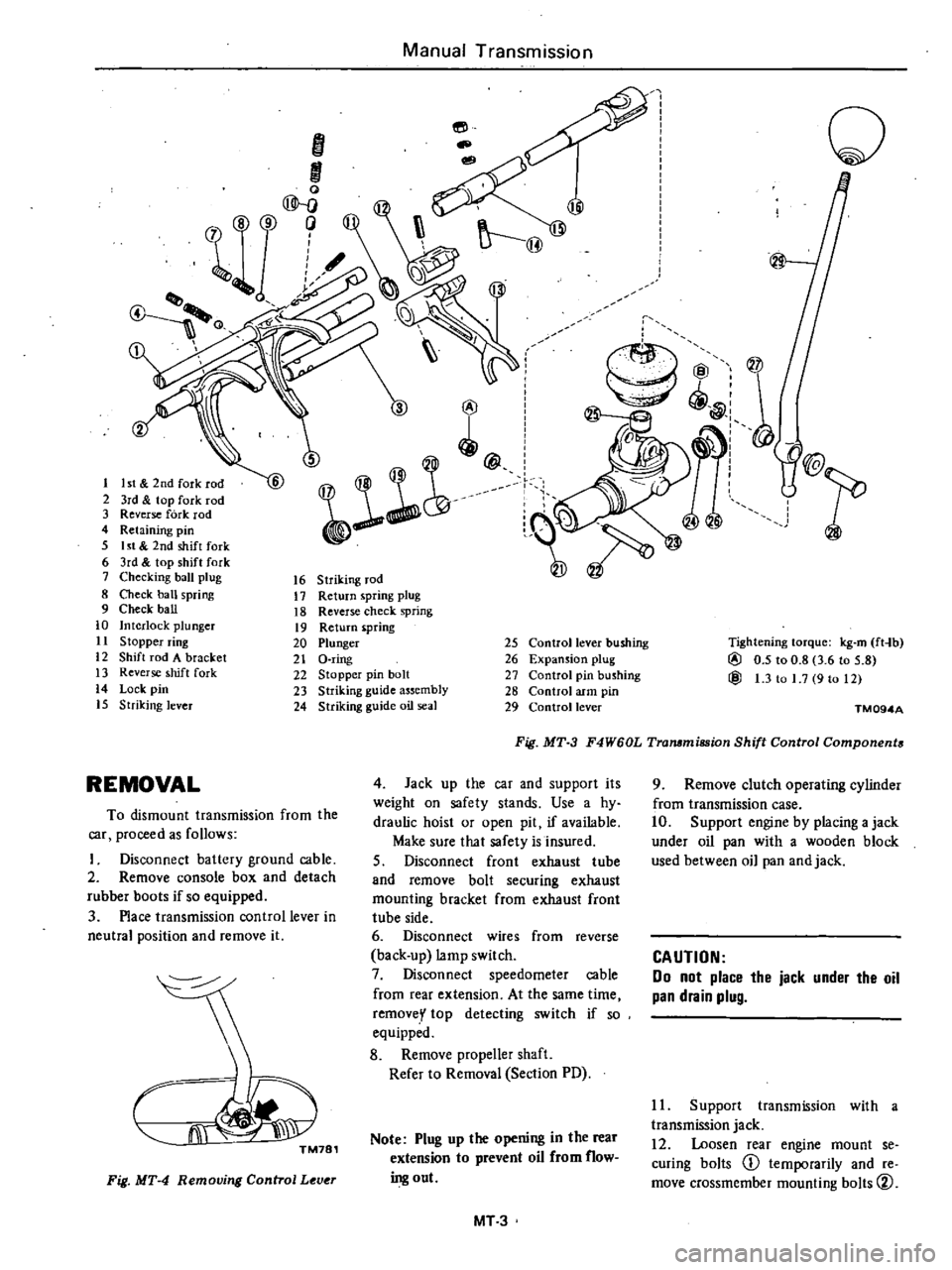
I
ht
2nd
fork
r
2
3rd
top
fork
rod
3
Reverse
fork
rod
4
Retaining
pin
5
I
t
2nd
shift
fork
6
3rd
top
shift
fork
7
Checking
ball
plug
8
Check
ban
spring
9
Check
ball
10
Interlock
plunger
11
S
topper
ring
12
Shift
rod
A
bracket
13
Reverse
shift
fork
14
Lock
pin
15
Striking
lever
Manual
Transmission
16
Striking
rod
17
Return
spring
plug
18
Reverse
check
spring
19
Return
pring
20
Plunger
21
D
ring
22
Stopper
pin
bolt
23
Striking
guide
assembly
24
Striking
guide
oil
seal
REMOVAL
To
dismount
transmission
from
the
car
proceed
as
follows
Disconnect
battery
ground
cable
2
Remove
console
box
and
detach
rubber
boots
if
so
equipped
3
Place
transmission
control
lever
in
neutral
position
and
remove
it
m
TM781
Fig
MT
4
Removing
Control
Lever
@
@
25
Control
lever
bushing
26
Expansion
plug
27
Control
pin
bushing
28
Control
arm
pin
29
Control
lever
o
Tightening
torque
kg
m
ft
lb
@
0
5
to
0
8
3
6
tn
5
8
@
1
3
to
1
7
9
to
12
Fig
MT
3
F4W60L
Tra11lmiBSion
Shift
Control
Components
TM094A
4
Jack
up
the
car
and
support
its
weight
on
safety
stands
Use
a
hy
draulic
hoist
or
open
pit
if
available
Make
sure
that
safety
is
insured
5
Disconnect
front
exhaust
tube
and
remove
bolt
securing
exhaust
mounting
bracket
from
exhaust
front
tube
side
6
Disconnect
wires
from
reverse
back
up
lamp
switch
7
Disconnect
speedometer
cable
from
rear
extension
At
the
same
time
removey
top
detecting
switch
if
so
equipped
8
Remove
propeller
shaft
Refer
to
Removal
Section
PO
Note
Plug
up
the
opening
in
the
rear
extension
to
prevent
oil
from
flow
ing
out
MT
3
9
Remove
clutch
operating
cylinder
from
transmission
case
10
Support
engine
by
placing
a
jack
under
oil
pan
with
a
wooden
block
used
between
oil
pan
and
jack
CAUTION
00
not
place
the
jack
under
the
oil
pan
drain
plug
11
Support
transmission
with
a
transmission
jack
12
Loosen
rear
engine
mount
se
curing
bolts
CD
temporarily
and
re
move
crossmember
mounting
bolts
V
Page 221 of 548
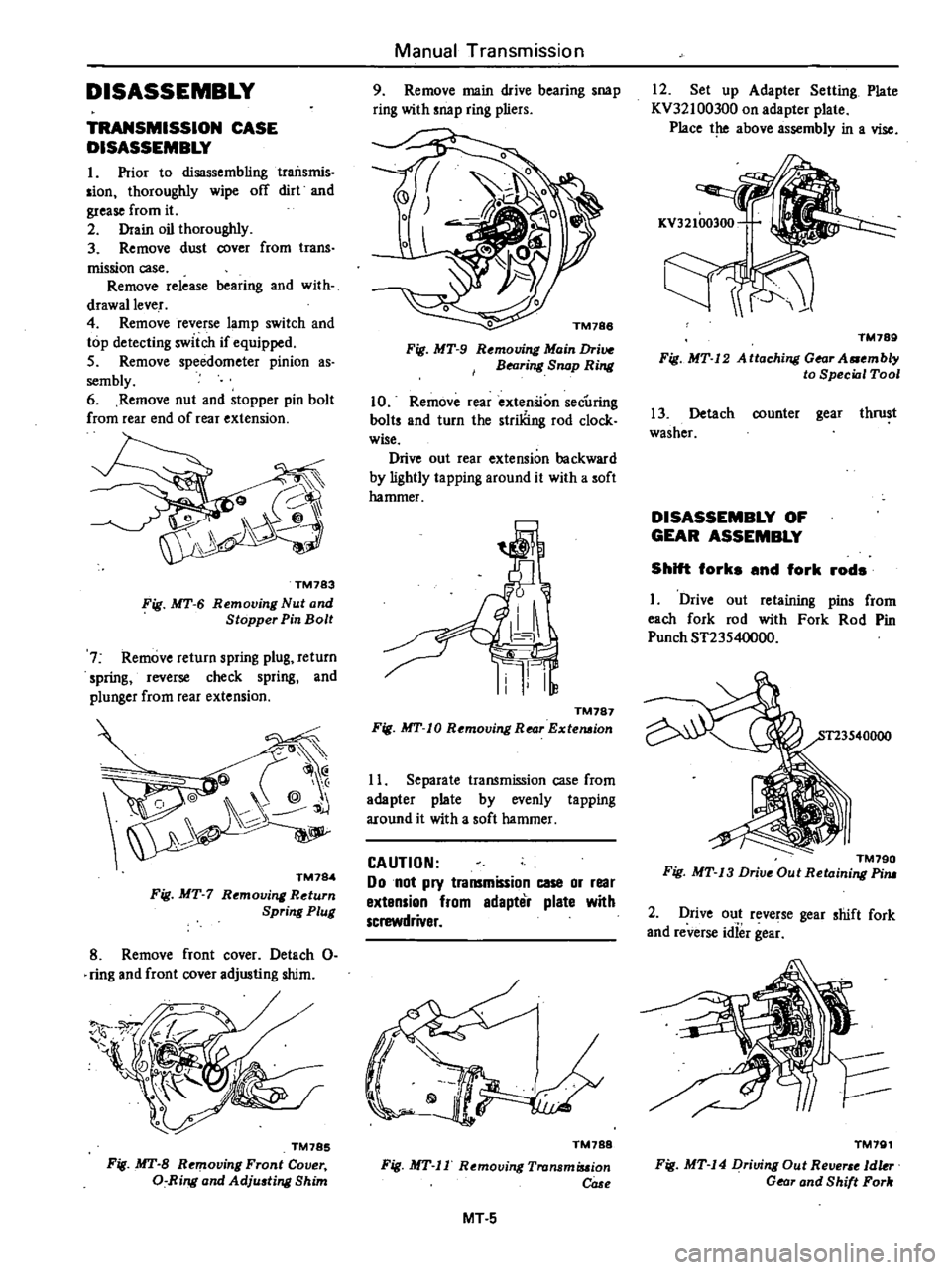
DISASSEMBLY
TRANSMISSION
CASE
DISASSEMBLY
I
Prior
to
disassembling
traiIsmis
sian
thoroughly
wipe
off
dirt
and
grease
from
it
2
Drain
oil
thoroughly
3
Remove
dust
cover
from
trans
mission
case
Remove
release
bearing
and
with
drawallever
4
Remove
reverse
lamp
switch
and
top
detecting
switch
if
equipped
5
Remove
speedometer
pinion
as
sembly
6
Remove
nut
and
stopper
pin
bolt
from
rear
end
of
rear
extension
TM783
Fig
MT
6
Removing
Nut
and
Stopper
Pin
Bolt
7
Remove
return
spring
plug
return
spring
reverse
check
spring
and
plunger
from
rear
extension
@
@
j
TM784
Fig
MT
7
Rt
moving
Return
Spring
Plug
8
Remove
front
cover
Detach
0
ring
and
front
cover
adjusting
shim
TM785
Fig
MT
B
Removing
Front
Cover
a
Ring
and
Adju
ting
Shim
Manual
Transmission
9
Remove
main
drive
bearing
snap
ring
with
snap
ring
pliers
o
TM188
Fig
MT
9
Rt
mouing
Main
Drive
BNring
Snap
Ring
10
Remove
rear
extenSion
secUring
baits
and
turn
the
striliing
rod
clock
wise
Drive
out
rear
extension
backward
by
lightly
ta
pping
around
it
with
a
soft
hammer
TM787
Fig
MT
10
Removing
Rear
Extemion
11
Separate
transmission
case
from
adapter
plate
by
evenly
tapping
around
it
with
a
soft
hammer
CAUTION
Do
not
pry
transmission
case
or
rear
extension
from
edapter
plate
with
screwdriver
TM788
Fig
MT
II
Removing
Tronsmiuion
COSf
MT
5
12
Set
up
Adapter
Setting
Plate
KV32100300
on
adapter
plate
Place
the
above
assembly
in
a
vise
TM789
Fig
MT
12
A
ttaching
Gear
A
mbly
to
Special
Tool
13
Detach
counter
gear
thrust
washer
DISASSEMBLY
OF
GEAR
ASSEMBLY
Shift
forks
and
fork
rods
I
Drive
out
retaining
pins
from
each
fork
rod
with
Fork
Rod
Pin
Punch
ST23540000
TM790
Fig
MT
13
Drive
Out
Retaining
Pim
2
Drive
out
reverse
gear
shift
fork
and
reverse
idief
gea
TM791
Fig
MT
14
Driving
Out
Re
1dkr
Gear
and
Shift
Fork