ABS DATSUN 210 1979 Service Manual
[x] Cancel search | Manufacturer: DATSUN, Model Year: 1979, Model line: 210, Model: DATSUN 210 1979Pages: 548, PDF Size: 28.66 MB
Page 4 of 548
FO
REWO
RD
TJili
service
manual
has
been
prepared
for
the
purpose
of
assisting
service
personnel
of
authorized
NISSAN
DATSUN
dealerS
in
providing
effective
service
and
maintenance
of
the
1979
DATSU
II210
Since
proper
maintenance
and
service
are
absolutely
essential
in
satisfying
the
DATSUN
owners
this
manu31
should
be
kept
in
a
handy
place
for
ready
reference
and
should
be
carefully
studied
t
This
manual
includes
procedures
for
maintenance
adjustments
minor
service
operations
removal
and
instaUation
and
for
rli
mblyand
assembly
of
components
Some
of
these
service
opemtions
require
the
of
Special
Tools
especially
designed
for
effective
performance
of
service
operations
The
special
tools
are
presented
at
the
end
of
each
section
As
you
read
through
the
l
lIintenance
procedures
inthis
service
m3
lual
y
lu
w
ll
occasionally
come
across
paragraphs
headed
NOTE
CAUTION
or
WARNING
A
NOTE
is
supplemental
information
that
is
important
to
a
particular
procedure
CAUTION
and
WARNING
warn
of
steps
that
must
be
fonowed
to
prevent
damage
to
some
part
of
the
car
and
or
personal
injury
The
Quick
Reference
Index
on
the
first
page
enables
the
user
to
quickly
locate
the
desired
section
At
the
beginning
of
each
individual
section
is
a
table
of
contents
which
gives
the
page
mimber
on
which
each
major
subject
begins
An
information
illustrations
and
specifications
contained
in
this
manual
are
based
on
the
latest
product
information
available
at
the
time
of
publication
approval
If
your
DATSUN
model
differs
from
the
specificationS
contained
in
this
manual
consult
your
NISSAN
DA
TSUN
dealer
for
information
Rights
for
alteration
at
any
time
of
specifications
and
methods
are
reserved
liability
for
any
personal
injury
or
property
damage
occasioned
by
the
use
of
this
service
manual
in
effecting
maintenance
or
repair
of
Y
1
r
DATSUN
is
in
no
way
assumed
by
Nissan
Motor
Co
td
Accordingly
anyone
using
a
service
procedure
or
tool
which
is
not
specifically
recommended
by
NISSAN
must
first
completely
satisfy
himself
that
neither
his
safety
nor
the
car
s
safety
will
be
jeopaiiliiedby
the
service
method
selected
NISSAN
MOTOR
Co
lTD
17
1
G11ZlI6
chomo
chuD
kil
TokyO
l04
J
n
@
1978
N1SSAN
MOTOR
CO
LTD
Printed
in
Japan
Not
to
be
reproduced
in
whole
or
in
part
without
the
prior
writtenpermisUon
of
Nissan
Motor
Company
Ltd
Tokyo
Japan
Page 155 of 548

OPERATION
Fuel
vapors
from
the
sealed
fuel
tank
are
led
into
the
carbon
canister
The
canister
is
filled
with
activated
charcoals
to
absorb
the
fuel
vapors
when
the
engine
is
at
rest
or
at
idling
t
Fuel
tank
2
Fuel
filler
cap
with
vacuum
re1ief
va1ve
3
Fuel
check
vslve
4
Vapor
t
line
5
Vacuum
signal
line
6
Canister
purge
line
Emission
Control
System
As
the
throttle
Valve
opens
and
car
speed
increases
vacuum
pressure
in
the
vacuum
signajline
forces
the
purge
control
valve
to
open
and
admits
an
orifice
to
intake
manifold
and
fuel
vapor
is
then
drawn
into
the
intake
manifold
through
the
canister
purge
line
Fuel
vapor
7
Throttle
valve
IZ
Filter
8
Engine
13
Purge
control
valve
9
Carbon
cani5t
14
DiaphraP
spring
10
Activated
carbon
IS
Diaphngm
II
Screen
16
Fixed
orifice
EC785
Fig
EC
JOS
Evaporative
Emiuion
Control
System
Fuel
vapor
flow
when
ngine
is
at
rest
or
running
REMOVAL
AND
INSTALLAtiON
CARBON
CANISTER
FILTER
Check
for
a
contantinated
element
Elemenl
can
be
removed
at
the
bottom
of
canister
installed
on
car
body
EF201
Fig
EC
I06
Replacing
Carbon
Canilttr
Filter
CHECK
VALVE
The
check
valve
is
located
behind
the
luggage
compartment
board
on
the
fuel
tank
Remove
the
luggage
compartment
board
and
disconnect
the
vapor
tube
The
check
valve
can
then
be
taken
out
EC315A
Fig
EC
I07
Removing
Check
Volve
EC
36
INSPECTION
FUEL
TANK
AND
VAPOR
VENT
LINE
1
Check
all
hoses
and
fuel
tank
filler
cap
2
Disconnect
the
vapor
vent
line
connecting
carbon
canister
to
check
valve
3
Connect
a
3
w
y
connector
a
manometer
and
a
cock
or
an
equi
valent
3
way
charge
cock
to
the
end
of
the
vent
line
EC183A
Fig
EC
IOB
Vent
Line
4
Supply
fresh
air
into
the
vapor
vent
line
through
the
cock
little
by
little
until
pressure
becomes
368
mmHZO
14
5
inHZO
S
Shut
the
cock
completely
and
leave
it
unattended
6
After
2
5
minutes
measure
the
height
of
the
liquid
in
the
manometer
7
Variation
in
height
should
remain
with
25
mmHZO
0
98
inH20
8
When
filler
cap
does
not
close
completely
the
height
should
drop
to
zero
in
a
short
time
9
If
the
height
does
not
drop
to
zero
in
a
short
time
when
ruler
cap
is
d
it
is
the
cause
of
a
stuffy
hose
Note
In
case
the
vent
line
is
stuffy
the
breathing
in
fuel
tank
is
not
thoroughly
IIIIIde
thus
causing
in
sufficient
delivery
of
feul
to
engine
or
vapor
lock
It
must
therefore
be
repaired
or
replaced
Page 215 of 548

Condition
Clutch
chatters
Noisy
clutch
Clutch
grabs
Clutch
Probable
cause
and
testing
Corr
ctive
action
Clutch
chattering
is
usually
noticeable
when
car
is
just
rolled
off
with
clutch
parlially
engaged
Weak
or
broken
clutch
disc
torsion
spring
Oil
or
grease
on
clutch
facing
Clutch
facing
out
of
proper
contact
or
clutch
disc
runout
Loose
rivets
Warped
pressure
plate
or
clutch
cover
surface
Unevenness
of
diaphragm
spring
toe
height
Loose
engine
mounting
or
deteriorated
rubber
A
noise
is
heard
after
clutch
is
disengaged
Damaged
release
bearing
A
noise
is
heard
when
clutch
is
disengaged
Insufficient
grease
on
the
sliding
surface
of
bearing
sleeve
Clutch
cover
and
bearing
are
not
in
stalled
correctly
Replace
Replace
Replace
Replace
Repair
or
replace
Adjust
or
replace
Retighten
or
replace
I
Replace
Apply
grease
Adjust
A
noise
is
heard
when
car
is
suddenly
rolled
off
with
clutch
partially
engaged
Damaged
pilot
bushing
I
Replace
When
grabbing
of
clutch
occurs
car
will
not
roll
off
smoothly
from
a
standing
start
or
clutch
will
be
engaged
before
clutch
pedal
is
fully
depressed
Oil
or
grease
on
clutch
facing
Clutch
facing
worn
or
loose
rivets
Wear
or
rust
on
splines
in
drive
shaft
and
clutch
disc
Warped
flywheel
or
pressure
plate
Loose
mountings
for
engine
or
power
train
units
CL13
Replace
Replace
Clean
or
replace
Repair
or
replace
Retighten
Page 297 of 548

JUDGEMENT
IN
MEASURING
LINE
PRESSURE
Low
idling
line
pressure
in
the
ranges
D
2
R
and
P
This
can
be
attributed
to
trouble
in
the
pressure
supply
system
or
too
low
output
of
power
caused
by
I
A
worn
oil
pump
2
An
oil
pressure
leak
in
the
oil
pump
valve
body
or
case
3
A
sticking
regulator
valve
2
Low
idling
line
pressure
i
n
cer
tain
ranges
only
This
is
presumably
caused
by
an
oil
leak
in
the
devices
or
circuits
con
nected
to
the
relevant
ranges
I
When
there
is
an
oil
leaJi
in
the
rear
clutch
and
governor
the
line
pressure
in
on
2
and
I
are
low
but
the
pressure
i
nonnal
in
R
2
When
an
oil
leak
occurs
in
the
low
and
reverse
brake
circuit
the
line
pressure
in
oR
and
P
are
low
b
t
the
pressure
is
normal
in
0
2
and
I
3
High
idling
line
pressure
Thi
is
presumably
caused
by
an
increased
aC
1ulT
t
rott
e
pr
ssure
owing
to
a
leak
in
the
vacuum
tube
or
diaphragin
or
by
an
increased
line
Automatic
Transmission
pressure
due
to
a
sticking
regulator
valve
Vacuum
leakage
is
checked
by
directly
measuring
the
negative
pres
sure
after
removing
the
vacuum
pipe
A
puncture
of
the
vacuum
dia
phragm
can
be
easily
ascertained
because
the
torque
converter
oil
is
absorbed
into
the
engine
and
the
exhaust
pipe
emits
white
smoke
4
Item
to
be
checked
when
the
Ii
e
pressure
is
increasing
In
this
c
1eck
the
line
pressure
should
be
measured
with
vacuums
of
300
mmHg
Il
SI
inHg
and
0
mmHg
0
inHg
in
accordance
with
the
staIl
test
procedure
i
If
the
line
pressure
does
not
in
crease
despite
the
vacuum
decrease
check
whether
the
vacuum
rod
is
i
corporated
2
If
the
line
pressure
does
not
meet
tile
standard
iUs
caused
mostly
by
a
sticking
pressure
regulating
valve
pres
sure
regulating
valve
plug
or
amplifier
TROUBLE
SHOOTING
CHART
INSPECTING
ITEMS
I
Inspection
with
automatic
trans
mission
on
vehicle
AT
45
A
Oil
level
B
Range
select
linkage
C
Inhibitor
switch
and
wiring
D
Vacuum
diaphragm
and
piping
E
Downshift
solenoid
kickdown
switch
and
wiring
F
Engine
idling
rpm
G
Oil
pressure
throttle
H
Engine
stall
rpm
I
Rear
lubrication
J
Control
valve
manual
K
Governor
valve
L
Band
servo
M
Transmission
air
check
N
Oil
quality
o
Ignition
switch
and
starter
motor
P
Engine
adjustment
and
brake
in
spection
2
Inspection
after
inspecting
auto
matic
transmission
on
vehicle
m
Rear
clutch
n
Front
clutch
q
Band
brake
r
Low
and
reverse
brake
s
Oil
pump
t
Leakage
of
oil
passage
u
One
way
clutch
of
troque
converter
v
One
way
clutch
of
transmission
w
Front
clutch
check
ball
x
Parking
linkage
y
Planetary
gear
Page 325 of 548
Fig
FA
3
Installing
Coller
Pin
II
Install
hub
cap
with
new
Q
ring
and
wheel
WHEEL
ALIGNMENT
Correct
front
wheel
alignment
as
sures
proper
car
handling
characteris
tics
and
minimum
steering
effort
with
the
least
amount
of
tire
wear
Before
adjusting
front
wheel
alignment
be
sure
to
make
preliminary
inspection
of
front
end
parts
Tire
pressure
and
balance
Wheel
bearings
and
wheel
bearing
nuts
Steering
gear
play
Steering
gear
housing
loose
at
frame
Steering
linkage
and
connections
Shock
absorber
operation
If
wrong
repair
or
replace
the
damaged
portion
or
parts
When
using
equipment
for
front
wheel
alignment
inspection
follow
the
instructions
furnished
with
equipment
Note
Inspection
should
be
made
with
the
car
set
Ievel
and
at
curb
weight
Cember
end
caster
Camber
and
caster
are
preset
at
factory
and
cannot
be
adjusted
The
car
requires
only
toe
in
and
car
posture
adjustment
Note
If
camber
or
caster
alignment
is
not
within
specifications
check
as
sociated
parts
Repair
or
replace
as
necessary
Front
Axle
Front
Suspension
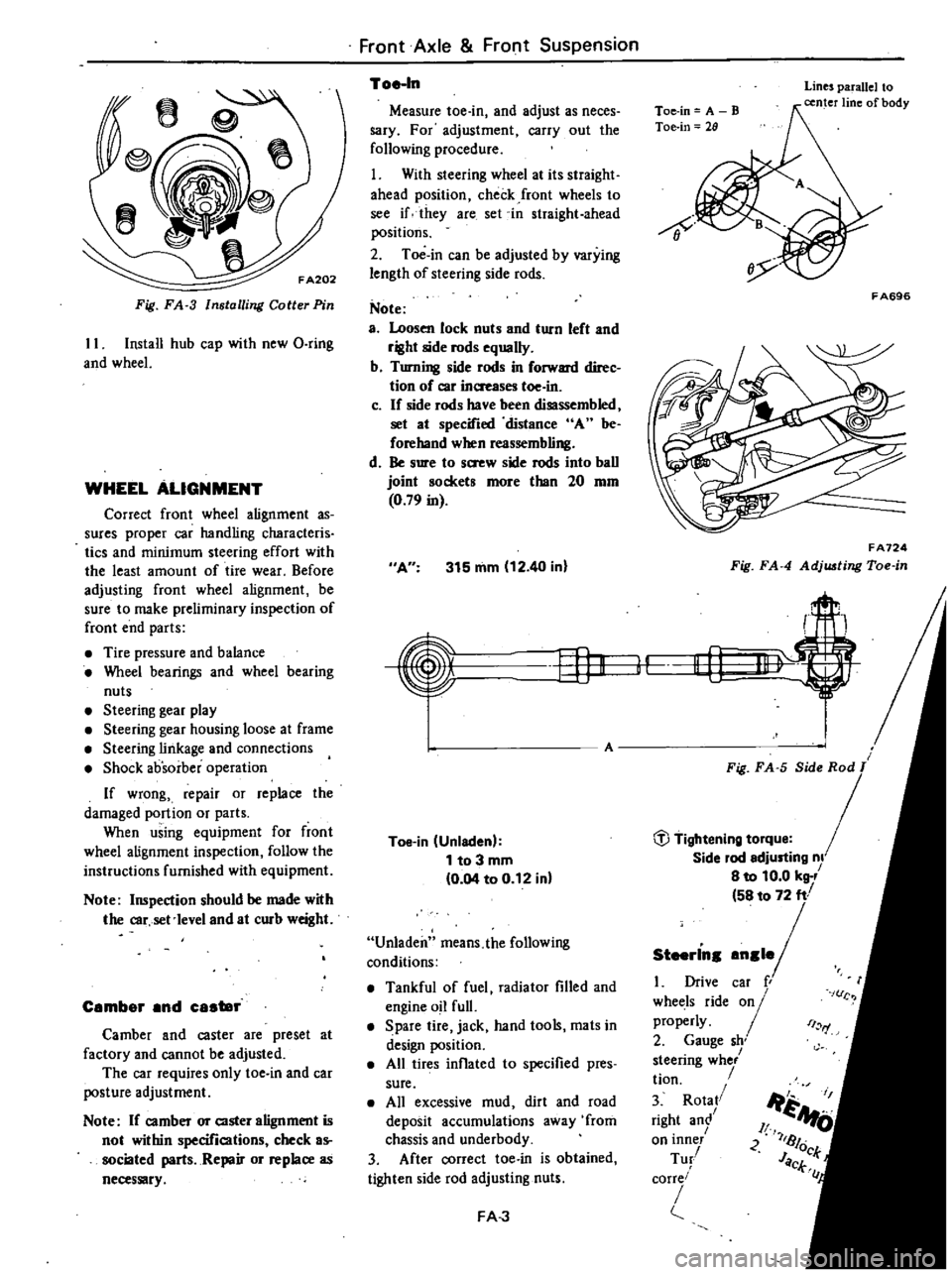
Toe
In
Measure
toe
in
and
adjust
as
neces
sary
For
adjustment
carry
out
the
following
procedure
1
With
steering
wheel
at
its
straight
ahead
position
check
front
wheels
to
see
if
they
are
set
in
straight
ahead
positions
2
Toe
in
can
be
adjusted
by
varying
length
of
steering
side
rods
Note
a
Loosen
lock
nuts
and
turn
left
and
right
side
rods
equally
b
Turning
side
rods
in
forward
direc
tion
of
car
inaeases
toe
in
c
If
side
rods
have
been
disassembled
set
at
specified
distance
A
be
forehand
when
reassembling
d
Be
sure
to
s
w
side
rods
into
ball
joint
sockets
more
than
20
mm
0
79
in
A
315
mm
12
40
in
EfJK
Toe
in
Unladen
1
to
3
mm
0
04
to
0
12
in
Unladen
means
the
following
conditions
Tankful
of
fuel
radiator
filled
and
engine
oil
full
Spare
tire
jack
hand
tools
mats
in
design
position
All
tires
inflated
to
specified
pres
sure
All
excessive
mud
dirt
and
road
deposit
accumulations
away
from
chassis
and
underbody
3
After
correct
toe
in
is
obtained
tighten
side
rod
adjusting
nuts
FA
J
Toe
in
A
B
Toe
in
28
Lines
parallel
to
center
line
of
body
8
F
A696
FA724
Fig
FA
4
Adj
ting
Toe
in
r
II
Li
1
t
Fig
FA
5
Side
Rod
T
Side
lod
edjusting
nl
8
to
10
0
kg
58
to
72
ft
1
Drive
caf
r
whet
ls
ride
01
properly
2
Gauge
sh
steenng
whe
tion
3
Rota
right
an
on
lOner
Tu
corre
i
I
rf
c
Ji
1
A
JI
U
2
7181
JOck
CL
C
Page 328 of 548
front
Ie
Front
Suspension
FRONT
SUSPENSION
e
@
@
c
@
09
@
@
t
@
f
Fff
@
t
i
Illi
tEl
1
iVI
G
A
@
v
G
e
I
O
@
cID
@
1
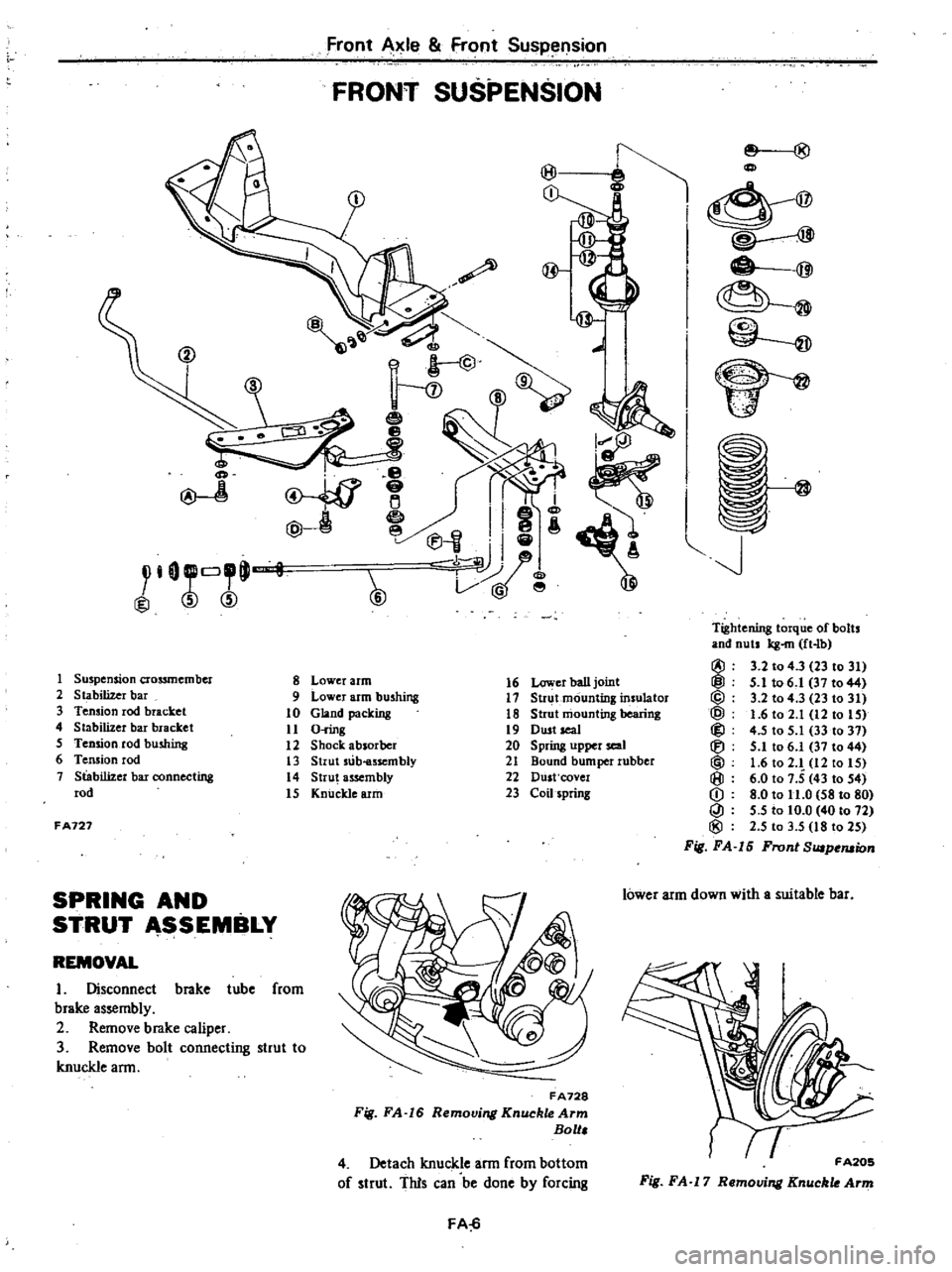
Suspension
crossmem
ber
2
Stabilizer
bar
3
Tension
rod
bracket
4
Stabilizer
bar
bracket
5
Tension
rod
bushing
6
Tension
rod
7
Stabilizer
bar
connecting
rod
FA727
SPRING
AND
STRUT
SSEMilLY
REMOVAL
L
Disconnect
brake
tube
from
brake
assembly
2
Remove
brake
caliper
3
Remove
bolt
connecting
strut
to
knuckle
ann
8
Lower
arm
9
Lower
arm
bushing
10
Gland
packing
II
O
ing
12
Shock
absorber
13
Strut
sub
e
ssembly
14
Stru
assembly
15
Knuc1cle
arm
Tightening
torque
of
bolts
and
nuts
kg
m
ft
lb
@
3
2
to
4
3
23
to
31
@
5
1
to
6
1
37
to
44
@
3
2
to
4
3
23
to
31
@
1
6
to
2
1
12
to
t5
@
4
5
to
5
1
33
to
37
5
1
to
6
1
37
to
44
@
1
6
to
2
1
12
to
15
I8i
6
0
to
7
5
43
to
54
CD
8
0
to
11
0
58
to
80
Ql
5
5
to
10
0
40
to
72
i8J
2
5
to
3
5
18
to
25
Fig
FA
16
Front
S
p
ion
16
erballjoint
17
Str
tmounting
insulator
18
Strut
mounting
bearing
19
Dust
20
Spring
upper
seal
21
Bound
bumper
rubber
22
Dust
cover
23
Coil
spring
FA728
Fig
FA
16
Removing
Knuckle
Arm
Bol
4
Detach
knuckle
ann
from
bottom
of
strut
This
can
be
done
by
forcing
FA
6
lower
arm
down
with
a
suitable
bac
FA205
Fig
FA
17
Removing
Knuckle
Arm
Page 329 of 548

S
Support
strut
assembly
with
a
jack
or
suitable
stand
and
remove
three
nuts
securing
strut
to
hoodledge
Strut
assembly
and
spring
can
then
be
removed
as
a
unit
DISASSEMBLY
When
disassembling
a
strut
extra
caution
should
be
exercised
to
avoid
dirt
and
dust
getting
inside
strut
This
dirt
and
dust
is
loaded
with
abrasive
which
if
enters
strut
causes
internal
leak
and
premature
wear
of
moving
parts
I
Secure
Strut
Steering
Gear
Housing
Attachment
KV48100300
in
a
vise
and
install
strut
on
attachment
2
Set
up
Spring
Compressor
ST3S6S
100
I
on
spring
Compress
spring
just
far
enough
to
permit
turn
ing
of
strut
mounting
insulator
by
hand
Remove
self
locking
nut
FA658
Fig
FA
18
Comprt
ingSpring
3
Remove
lock
nut
on
top
of
piston
rod
remove
mounting
insulator
strut
mounting
bearing
dust
seal
spring
seat
spring
and
bumper
rubber
CAUTION
Be
sure
to
hook
special
tool
8135651001
evenly
on
a
minimum
of
three
coils
Paying
attention
not
to
damage
piston
lod
Front
Axle
Front
Suspension
AJ
r
ST3565S001
F
A059
k
j
h
Fig
FA
19
Removing
Mounting
Insulator
4
Retract
piston
rod
by
pushing
it
down
until
it
bottoms
Remove
gland
packing
with
Gland
Packing
Wrench
ST3SS00001
A
ST35500001
1J
FA209
KV48
100300
Fig
FA
20
Removing
Gland
Packing
Note
Clean
gland
pecking
of
mud
and
other
foreign
perticles
accumu
lated
5
Remove
O
ring
from
top
of
pis
ton
rod
guide
bushing
6
Lift
out
piston
rod
together
with
cylinder
Note
Do
not
remove
pistion
rod
quickly
as
this
will
cause
oil
to
spurt
out
FA275
Fig
FA
21
Removing
Pi
ton
Rod
and
Cyliilder
FA
7
Note
Piston
rod
piston
rod
guide
and
cylinder
are
adjusted
to
provide
precision
mating
sutfeces
and
should
be
handled
as
a
matched
set
7
Drain
fluid
thoroughly
from
inner
cylinder
and
discard
8
Wash
aU
parts
in
suitable
solvent
9
Drain
fluid
thoroughly
from
outer
casing
Note
This
operation
is
very
im
portant
since
performance
of
strut
varies
with
amount
of
fluid
filled
within
strut
INSPECTION
I
Replace
gland
packing
O
ring
and
fluid
whenever
strut
is
disassembled
2
Wash
aU
perts
except
for
non
metallic
parts
with
suitable
solvent
and
dry
with
compressed
air
3
Blow
dirt
and
dust
off
of
non
metallic
parts
using
compressed
air
Note
a
Oil
oozing
out
at
and
around
gland
pecking
does
not
call
for
strut
maintenance
If
oil
leaks
past
pring
sest
check
piston
rod
and
gland
pecking
to
cxirrect
the
cause
of
problem
If
oil
leakage
occurs
on
welded
portion
of
outer
strut
casing
replace
strut
outer
casing
essembly
b
If
hock
absorber
itself
is
malfunc
tioning
replace
as
an
assembly
in
cluding
piston
rod
cylinder
bot
tom
valve
and
guide
bushing
Outer
ce
in
Check
outer
casing
for
evidences
of
deformation
cracking
or
other
dam
age
If
necessary
discard
Strut
mountln
In
uletor
Replace
if
cemented
rubber
to
metal
joints
are
melted
or
cracked
Rubber
parts
should
also
be
replaced
if
deteriorated
Strut
mountln
beerln
Replace
if
inspection
reveals
abnor
mal
noise
or
excessive
rattle
in
axial
direction
Page 330 of 548
Note
CbedI
dust
seal
forsaatcbes
or
aacb
on
lips
end
replace
if
neces
sary
ASSEMBLY
When
assembling
strut
be
careful
not
to
drop
or
scratch
parts
since
they
are
precisely
machined
to
very
close
tolerances
Before
assembly
clean
away
all
dirt
to
prevent
any
possible
entry
of
dirt
into
strut
Note
If
replacement
of
any
strut
compooent
parts
is
found
to
be
neoesaery
make
sure
tlllt
parta
ere
the
same
brand
as
thoee
used
in
the
strot
essemhly
I
Install
strut
outer
casing
on
Strut
Steering
Gear
Housing
Attachment
KV48
100300
See
Fig
FA
20
2
Install
cylinder
and
piston
rod
assembly
shock
absorber
kit
in
outer
casing
3
Remove
pistoo
rod
guide
from
cylinder
and
Pour
correct
amount
of
new
fluid
into
ylinder
and
strut
outer
casing
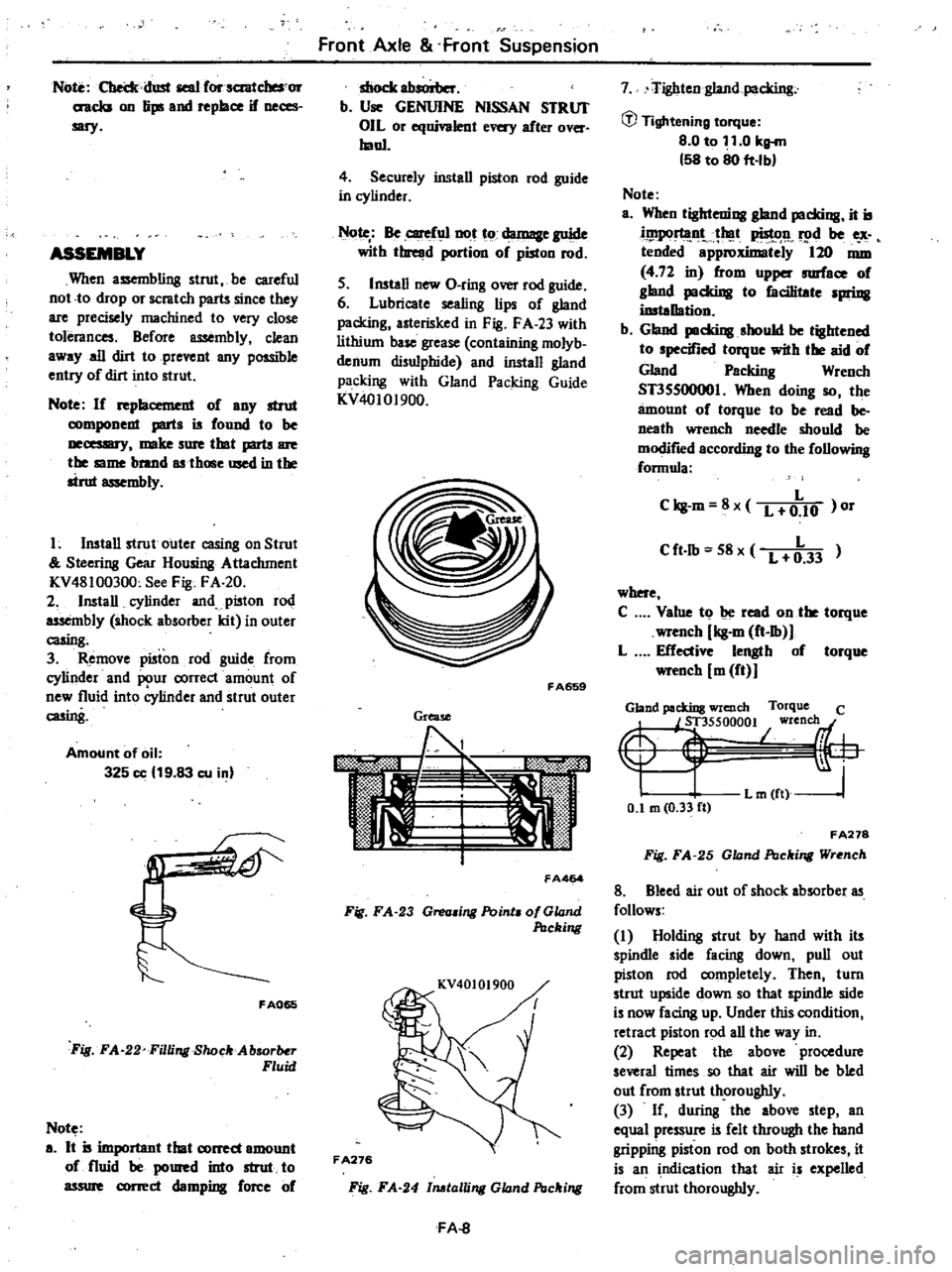
Amount
of
oil
325
cc
19
83
cu
in
1
FA065
Fig
FA
22
FillingShoelt
Absorber
Fluid
Note
e
It
i
important
that
correct
emount
of
fluid
be
poured
into
strut
to
assure
correct
damping
force
of
Front
Axle
Front
Suspension
mock
absorber
b
U
GENUINE
NISSAN
STRUT
OIL
or
equivalent
every
after
over
11101
4
Securely
install
piston
rod
guide
in
cylinder
Note
Be
c
aref
1l
t
to
damage
gujde
with
thread
portion
of
pistoo
rod
5
Install
new
O
ring
over
rod
guide
6
Lubricate
sealing
lips
of
gland
packing
uterisked
in
Fig
F
A
23
with
lithium
base
grease
containing
molyb
denum
disulphide
and
install
gland
packing
with
Gland
Packing
Guide
KV40101900
FA659
Grease
V
1
1
0
I
FA464
Fig
FA
23
Grea
ing
Point
of
Gland
lbelting
KV40101900
F
A276
Fig
F
A
24
t
lung
Gland
lbelting
FA
8
7
Tighten
gland
packing
fl
Tightening
torque
8
0
to
11
0
kg
m
58
to
80
ft
lb
Note
a
When
tightening
gland
packing
it
i
POrl
t
J
It
d
he
ttJI
teoded
epproximately
120
IDID
4
72
in
from
upper
surfece
of
gland
packing
to
faclli18te
spring
iosteIlatioo
b
Gland
packing
should
be
tighteoed
to
specified
torque
with
the
aid
of
Gland
Packing
Wreoch
ST35500001
When
doing
so
the
amouot
of
torque
to
be
read
be
neath
wrench
oeedle
should
be
modified
eccording
to
the
following
formula
L
Ckg
m
8x
L
O
IO
or
L
Cft
Ib
58x
L
0
33
where
C
Value
to
he
reed
on
the
torque
wrench
kg
m
ft
Ib
L
Effective
length
of
torque
wrench
m
ft
Gland
packing
WIcoch
Torque
C
Lm
ft
I
0
1
m
0
33
ft
FA278
Fig
FA
25
Gland
lbeltill
l
Wrench
8
Bleed
air
out
of
shock
absorber
as
follows
I
Holding
strut
by
hand
with
its
spindle
side
facing
down
pull
out
piston
f
d
completely
Then
turn
strut
upside
down
so
that
spindle
side
is
now
facing
up
Under
this
condition
retract
piston
rod
all
the
way
in
2
Repeat
the
above
procedure
several
times
so
that
air
will
be
bled
out
from
strut
th
oroughiy
3
If
during
the
above
step
en
equal
pressure
is
felt
through
the
hand
grippitig
piston
rod
on
both
strokes
it
is
an
indication
that
air
is
expelled
from
strut
thoroughly
Page 335 of 548
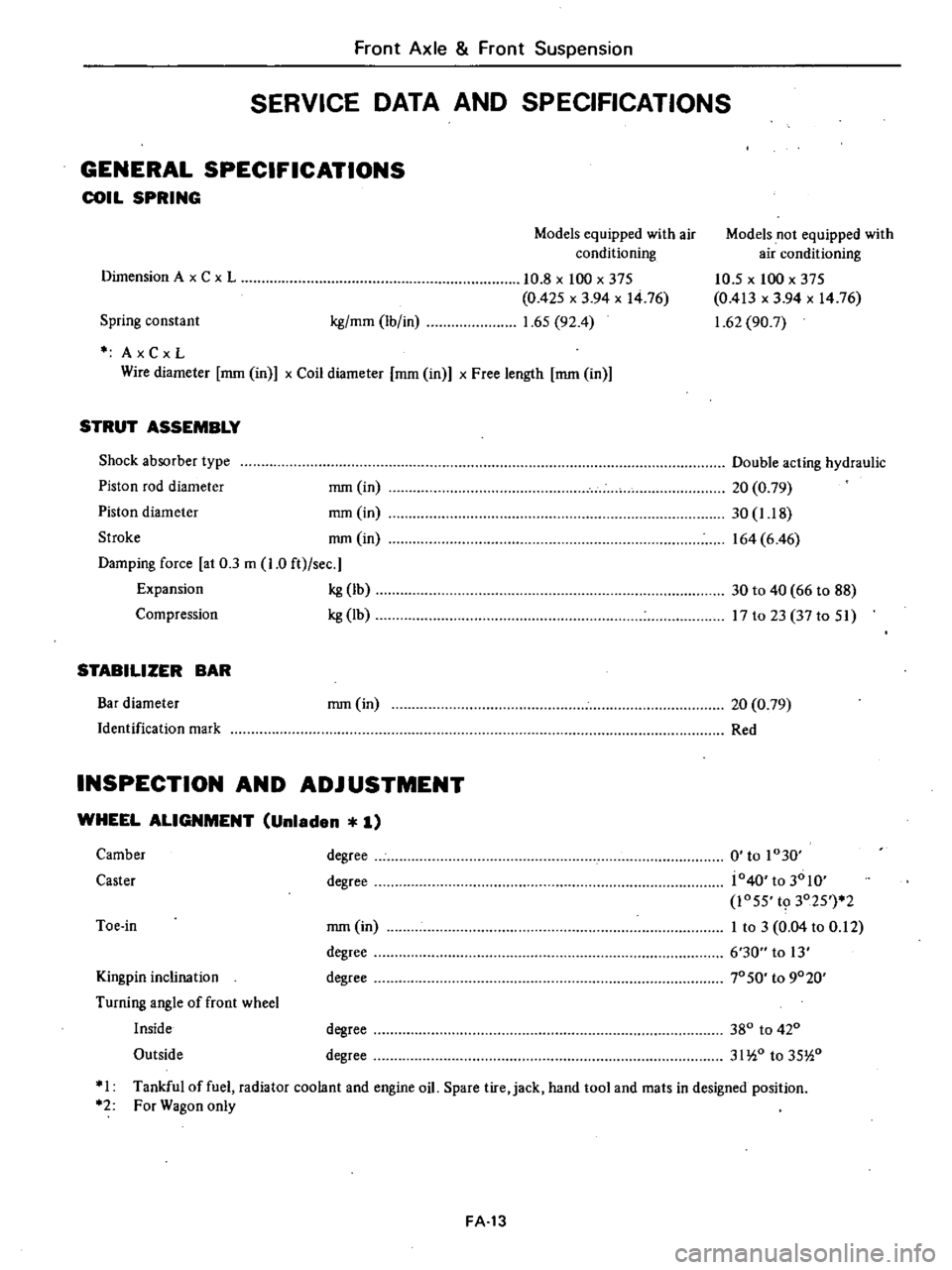
Front
Axle
Front
Suspension
SERVICE
DATA
AND
SPECIFICATIONS
GENERAL
SPECIFICATIONS
COIL
SPRING
Models
equipped
with
air
conditioning
Models
not
equipped
with
air
conditioning
10
5
x
100
x
375
0
413
x
3
94
x
1476
1
62
90
7
Spring
constant
kg
mm
Ib
in
10
8
x
100
x
375
0
425
x
3
94
x
1476
1
65
92
4
Dimension
A
x
C
x
L
AxCxL
Wire
diameter
mm
in
x
Coil
diameter
mm
in
x
Free
length
mm
in
STRUT
ASSEMBLY
Shock
absorber
type
Piston
rod
diameter
mm
in
Piston
diameter
mm
in
Stroke
nun
in
Damping
force
at
0
3
m
1
0
ft
sec
Expansion
kg
Ib
Compression
kg
Ib
Double
acting
hydraulic
20
0
79
30
1
18
164
6
46
30
to
40
66
to
88
17
to
23
37
to
51
STABILIZER
BAR
Bar
diameter
Identification
mark
mm
in
20
0
79
Red
INSPECTION
AND
ADJUSTMENT
WHEEL
ALIGNMENT
Unladen
1
Kingpin
inclination
Turning
angle
of
front
wheel
Inside
Outside
mm
in
degree
degree
0
to
1030
j040
to
3010
1055
t9
3025
2
I
to
3
0
04
to
0
12
6
30
to
13
70
SO
to
9020
Camber
Caster
degree
degree
Toe
in
degree
degree
380
to
420
31
io
to
35
i0
I
Tankful
of
fuel
radiator
coolant
and
engine
oil
Spare
tire
jack
hand
tool
and
mats
in
designed
position
2
For
Wagon
only
FA
13
Page 338 of 548
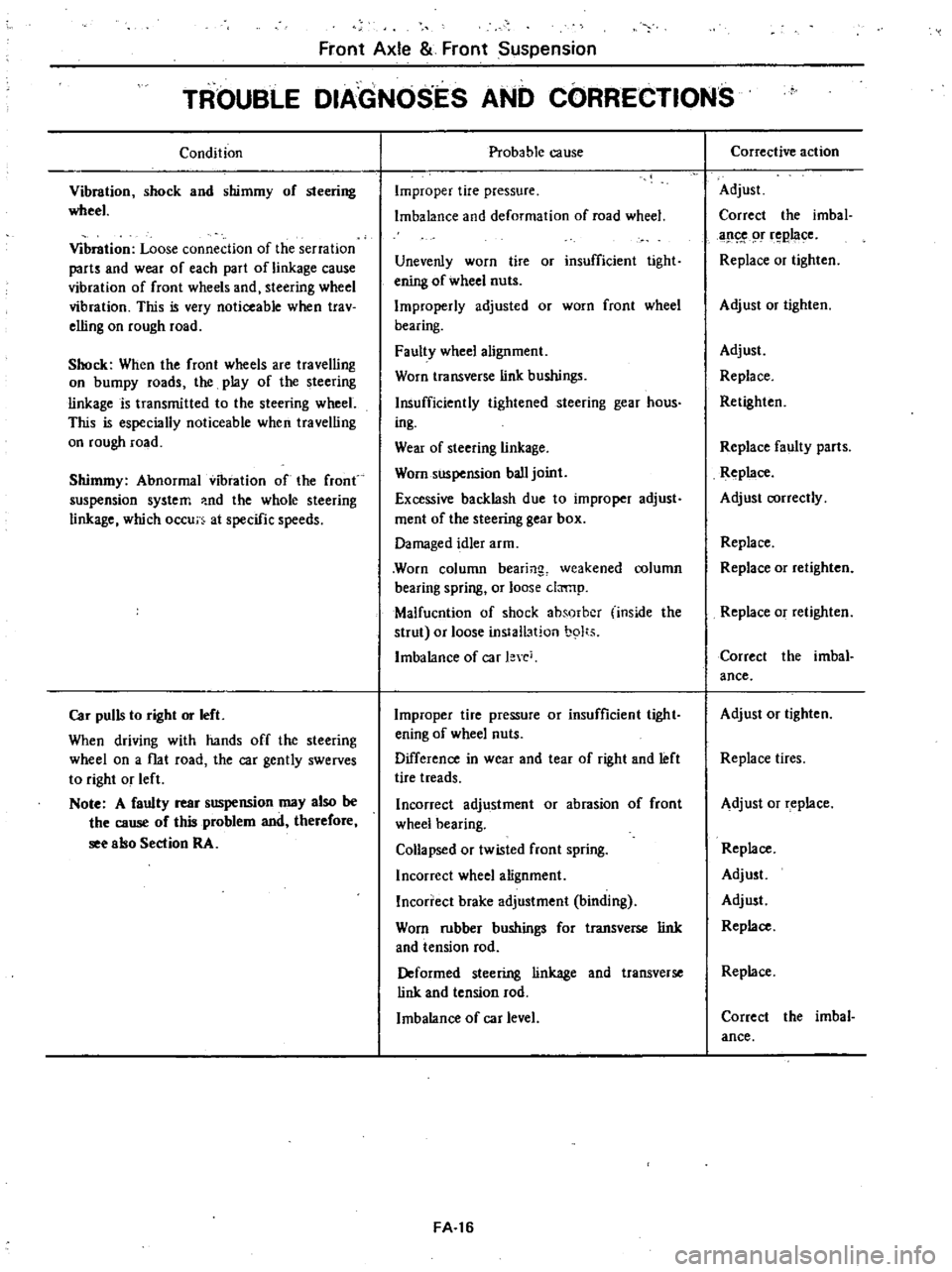
Front
Axle
Front
Suspension
TROUBLE
DIAGNOSES
AND
CORRECTIONS
Condition
Vibration
shock
and
shimmy
of
steering
wheel
Vibration
Loose
connection
of
the
serration
parts
and
wear
of
each
part
of
linkage
cause
vibration
of
front
wheels
and
steering
wheel
vibration
This
is
very
noticeable
when
trav
elling
on
rough
road
Shock
When
the
front
wheels
are
travelling
on
bumpy
roads
the
play
of
the
steering
linkage
is
transmitted
to
the
steering
wheel
This
is
especially
noticeable
when
travelling
on
rough
road
Shimmy
Abnormal
vibration
of
the
front
suspension
system
nd
the
whole
steering
linkage
which
occu
at
specific
speeds
Car
pulls
to
right
or
left
When
driving
with
hands
off
the
steering
wheel
on
a
flat
road
the
car
gently
swerves
to
right
or
left
Note
A
faulty
rear
suspension
may
also
be
the
cause
of
this
problem
and
therefore
see
ebo
Section
RA
Proba
b
Ie
ca
use
Improper
tire
pressure
Imbalance
and
deformation
of
road
wheel
Unevenly
worn
tire
or
insufficient
tight
ening
of
wheel
nuts
Improperly
adjusted
or
worn
front
wheel
bearing
Faulty
wheel
alignment
Worn
transverse
link
bushings
Insufficiently
tightened
steering
gear
hous
ing
Wear
of
steering
linkage
Worn
suspension
ball
joint
Excessive
backlash
due
to
improper
adjust
ment
of
the
steering
gear
box
Damaged
idler
arm
Worn
column
bearing
weakened
column
bearing
spring
or
loose
drmp
Malfucntion
of
shock
absorber
inside
the
strut
or
loose
install3t
on
b9
t5
Imbalance
of
car
l
e
Improper
tire
pressure
or
insufficient
tight
ening
of
wheel
nuts
Difference
in
wear
and
tear
of
right
and
left
tire
treads
Incorrect
adjustment
or
abrasion
of
front
wheel
bearing
Collapsed
or
twisted
front
spring
Incorrect
wheel
alignment
Incorrect
brake
adjustment
binding
Worn
rubber
bushings
for
transverse
link
and
tension
rod
Deformed
steering
linkage
and
transverse
link
and
tension
rod
Imbalance
of
car
level
FA
16
Corrective
action
Adjust
Correct
the
imbal
ap
9f
r
B4I
e
Replace
or
tighten
Adjust
or
tighten
Adjust
Replace
Retighten
Replace
faulty
parts
Replace
Adjust
correctly
Replace
Replace
or
retighten
Replace
or
retighten
Correct
the
imbal
ance
Adjust
or
tighten
Replace
tires
Adjust
or
replace
Replace
Adjust
Adjust
Replace
Replace
Correct
the
imbal
ance