ECU DATSUN B110 1973 Service Owner's Guide
[x] Cancel search | Manufacturer: DATSUN, Model Year: 1973, Model line: B110, Model: DATSUN B110 1973Pages: 513, PDF Size: 28.74 MB
Page 172 of 513
CHASSIS
The
sliding
block
is
secured
on
the
steering
post
bracket
with
bolts
upper
half
of
the
steering
column
is
supported
on
the
bracket
and
thus
the
steering
post
clamp
is
installed
on
the
body
When
a
large
impact
is
applied
from
the
driver
side
the
plastic
pins
are
cut
off
and
leaving
the
sliding
block
in
the
steering
post
bracket
side
the
clamp
proper
is
disengaged
downward
together
with
the
jacket
tube
For
any
force
applied
from
front
direction
of
the
vehicle
the
steering
post
clamp
sliding
block
does
not
move
rearward
This
construction
is
called
One
way
slide
system
and
with
this
construction
projection
of
the
column
shaft
toward
the
driver
is
prevented
completely
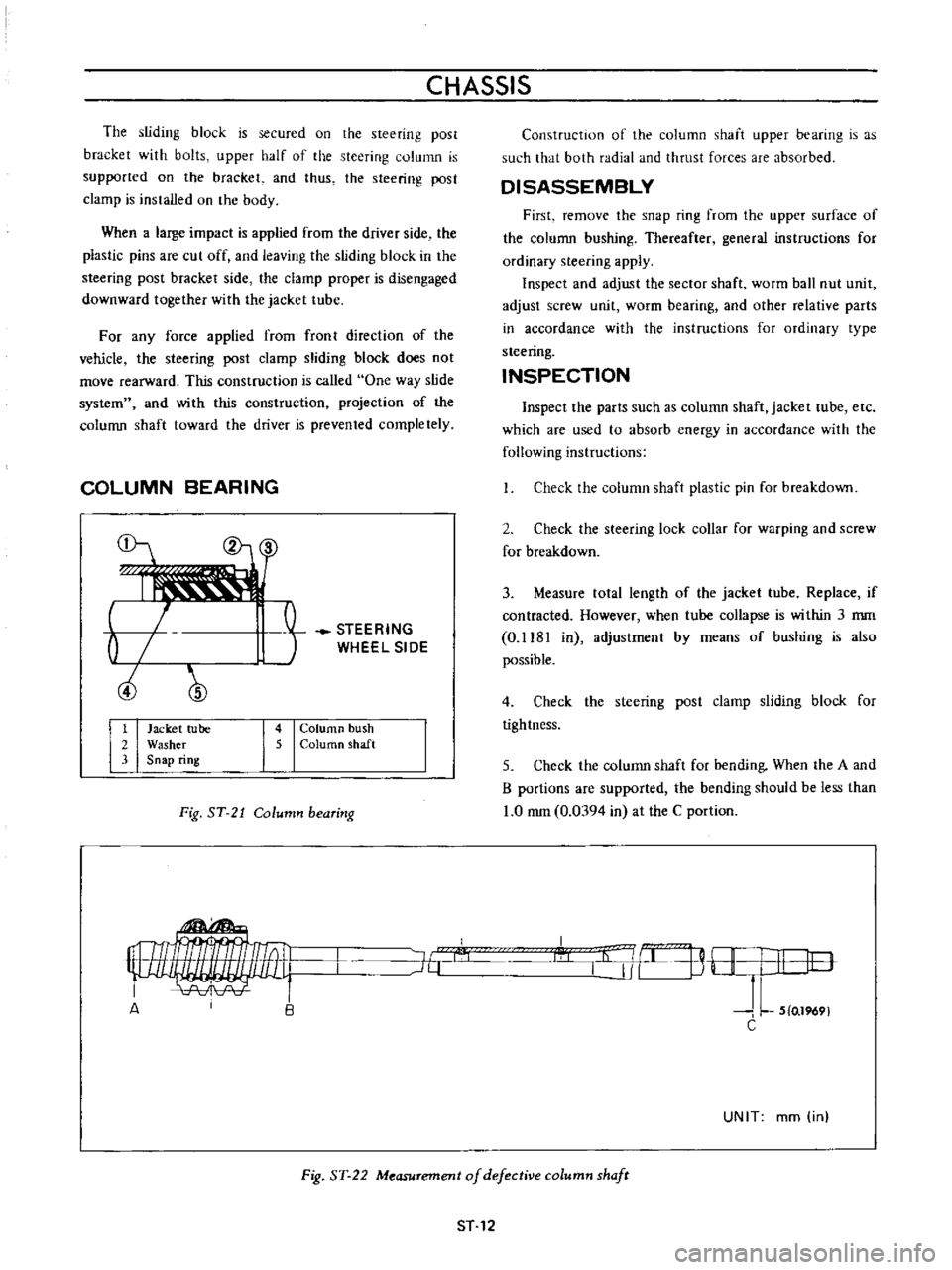
COLUMN
BEARING
b
ciJ
STEERING
WHEEL
SIDE
1
Jacket
tube
2
Washer
3
Snap
ring
4
Column
bush
5
ColurtlO
shaft
Fig
ST
21
Column
bearing
Construction
of
the
column
shaft
upper
bearing
is
as
such
that
both
radial
and
thrust
forces
are
absorbed
DISASSEMBLY
First
remove
the
snap
ring
from
the
upper
surface
of
the
column
bushing
Thereafter
general
instructions
for
ordinary
steering
apply
Inspect
and
adjust
the
sector
shaft
worm
ball
nut
unit
adjust
screw
unit
worm
bearing
and
other
relative
parts
in
accordance
with
the
instructions
for
ordinary
type
steering
INSPECTION
Inspect
the
parts
such
as
column
shaft
jacket
tube
etc
which
are
used
to
absorb
energy
in
accordance
with
the
following
instructions
Check
the
column
shaft
plastic
pin
for
breakdown
2
Check
the
steering
lock
collar
for
warping
and
screw
for
breakdown
3
Measure
tolal
length
of
the
jacket
tube
Replace
if
contracted
However
when
tube
collapse
is
within
3
mm
0
1181
in
adjustmenl
by
means
of
bushing
is
also
possible
4
Check
the
steering
post
clamp
sliding
block
for
tightness
5
Check
the
column
shaft
for
bending
When
the
A
and
B
portions
are
supported
the
bending
should
be
less
than
1
0
mm
0
0394
in
at
the
C
portion
I
l
j
B
H
I
I
lO
J
L
5
0
1969
C
J6
A
UNIT
mm
in
Fig
ST
22
Measurement
of
defective
column
shafr
ST
12
Page 173 of 513
STEERING
REASSEMBLY
Adjust
alignment
and
install
the
worm
shaft
and
jacket
tube
on
the
housing
2
Apply
bearing
grease
to
the
interior
sufficiently
and
screw
the
column
bushing
above
the
rated
position
3
Apply
washer
and
apply
the
snap
ring
to
the
groove
correctly
and
securely
4
Return
the
column
bushing
allowing
the
top
surface
of
the
bushing
coming
into
contact
wi
th
the
lower
surface
of
the
washer
adjust
the
clearance
to
less
than
1
0
mm
0
0394
in
and
adjust
the
bushing
position
correctly
so
that
column
shaft
turning
torque
is
the
rated
value
Note
If
the
clearance
is
too
small
the
steering
becomes
heavy
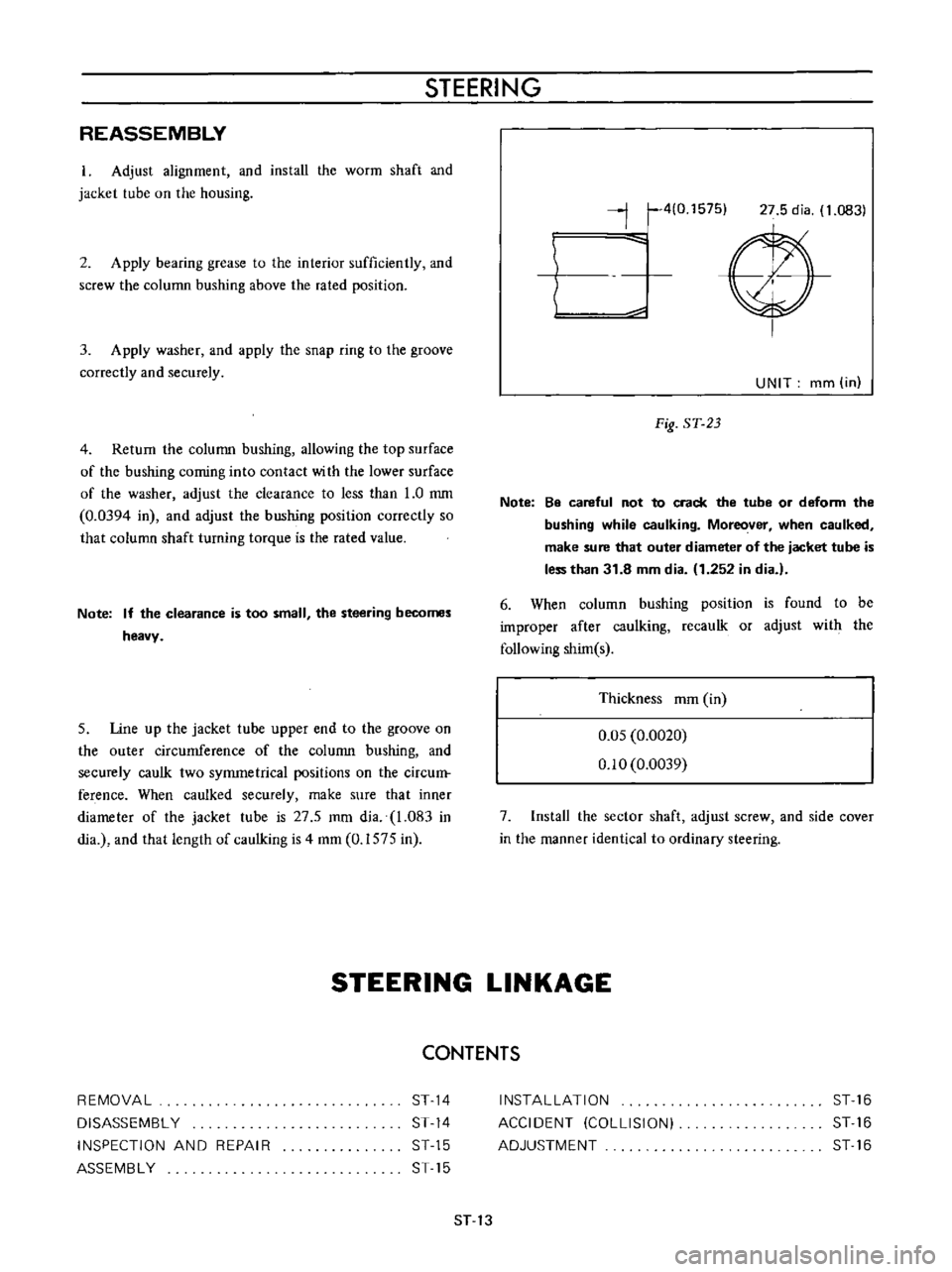
5
Line
up
the
jacket
tube
upper
end
to
the
groove
on
the
outer
circumference
of
the
column
bushing
and
securely
caulk
two
symmetrical
positions
on
the
circum
ference
When
caulked
securely
make
sure
that
inner
diameter
of
the
jacket
tube
is
27
5
mm
dia
1
083
in
dia
and
that
length
of
caulking
is
4
mm
0
1575
in
j
410
1575
27
5
dia
1
0831
V
UNIT
mm
in
Fig
ST
23
Note
Be
careful
not
to
crack
the
tube
or
deform
the
bushing
while
caulking
Moreover
when
caulked
make
sure
that
outer
diameter
of
the
jacket
tube
is
less
than
31
8
mm
dia
1
252
in
dia
6
When
column
bushing
position
is
found
to
be
improper
after
caulking
recaulk
or
adjust
with
the
following
shim
s
Thickness
mm
in
0
05
0
0020
0
10
0
0039
7
Install
the
sector
shaft
adjust
screw
and
side
cover
in
the
manner
identical
to
ordinary
steering
STEERING
LINKAGE
CONTENTS
REMOVAL
DISASSEMBl
Y
INSPECTION
AND
REPAIR
ASSEMBl
Y
ST
14
ST
14
ST
15
ST
15
INSTAllATION
ACCIDENT
COLLISION
ADJUSTMENT
ST
16
ST
16
ST
16
ST
13
Page 181 of 513
CHASSIS
Description
The
accelerator
linkage
is
lightv
eighL
and
onstfuction
is
such
that
the
linkage
operates
smoothly
and
is
unaffected
bv
engine
vibration
Adjustment
Play
of
accelerator
wire
I
Install
the
pedal
arm
side
securely
with
a
spring
clamp
2
Set
the
dash
board
side
Quter
case
stationarily
with
a
cap
nut
Do
not
set
the
carburetor
side
adjusting
unit
stationarily
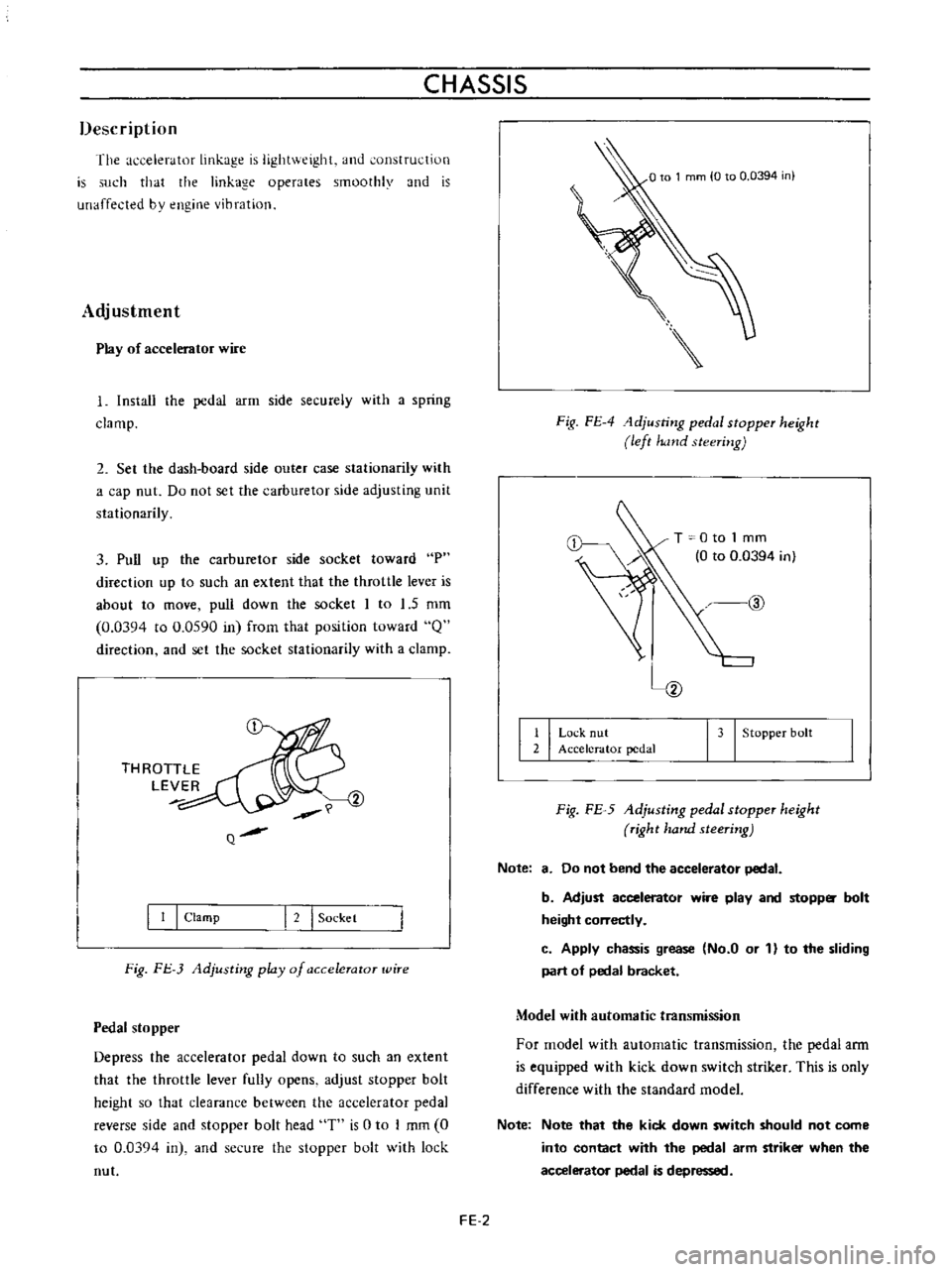
3
Pull
up
the
carburetor
side
socket
toward
P
direction
up
to
such
an
extent
that
the
throttle
lever
is
about
to
move
pull
down
the
socket
I
to
1
5
mm
0
0394
to
0
0590
in
frorn
that
position
toward
Q
direction
and
set
the
socket
stationarily
with
a
clamp
THROTTLE
LEVER
Q
I
I
I
Clamp
I
2
I
Sockel
Fig
FJ
3
Adjusting
play
of
a
ccelerator
wire
Pedal
stopper
Depress
the
accelerator
pedal
down
to
such
an
extent
that
the
throttle
lever
fully
opens
adjust
stopper
bolt
height
so
that
clearance
between
the
accelerator
pedal
reverse
side
and
stopper
bolt
head
T
is
0
to
I
mm
0
to
0
03Q4
in
and
secure
the
stopper
bolt
with
lock
nut
Fig
FE
4
1djusting
pedal
stopper
height
left
hand
steering
T
0
to
1
mm
0
to
0
0394
in
@
I
I
Lo
k
nut
2
Accelerator
pedal
I
3
I
Stopper
bolt
Fig
FE
5
Adjusting
pedal
stopper
height
right
hand
steering
Note
8
Do
not
bend
the
accelerator
pedal
b
Adjust
accelerator
wire
play
and
stopp
bolt
height
correctly
c
Apply
chassis
grease
No
a
or
1
to
the
sliding
part
of
pedal
bracket
Model
with
automatic
transmission
For
model
with
automatic
transmission
the
pedal
ann
is
equipped
with
kick
down
switch
striker
This
is
only
difference
with
the
standard
model
Note
Note
that
the
kick
down
switch
should
not
come
into
contact
with
the
pedal
arm
striker
when
the
accelerator
pedal
is
depressed
FE
2
Page 184 of 513
ENGINE
CONTROL
FUEL
EXHAUST
SYSTEM
For
all
models
fuel
tank
capacity
has
been
increased
in
response
to
the
increased
engine
output
Location
and
mounting
strength
are
improved
for
improvement
of
safety
Sedan
40
l
101
2
US
gal
8
3
4
Imp
gal
Van
38
l
10
US
gal
8
3
8
Imp
gal
Coupe
38
l
10
US
gal
8
3
8
Imp
gal
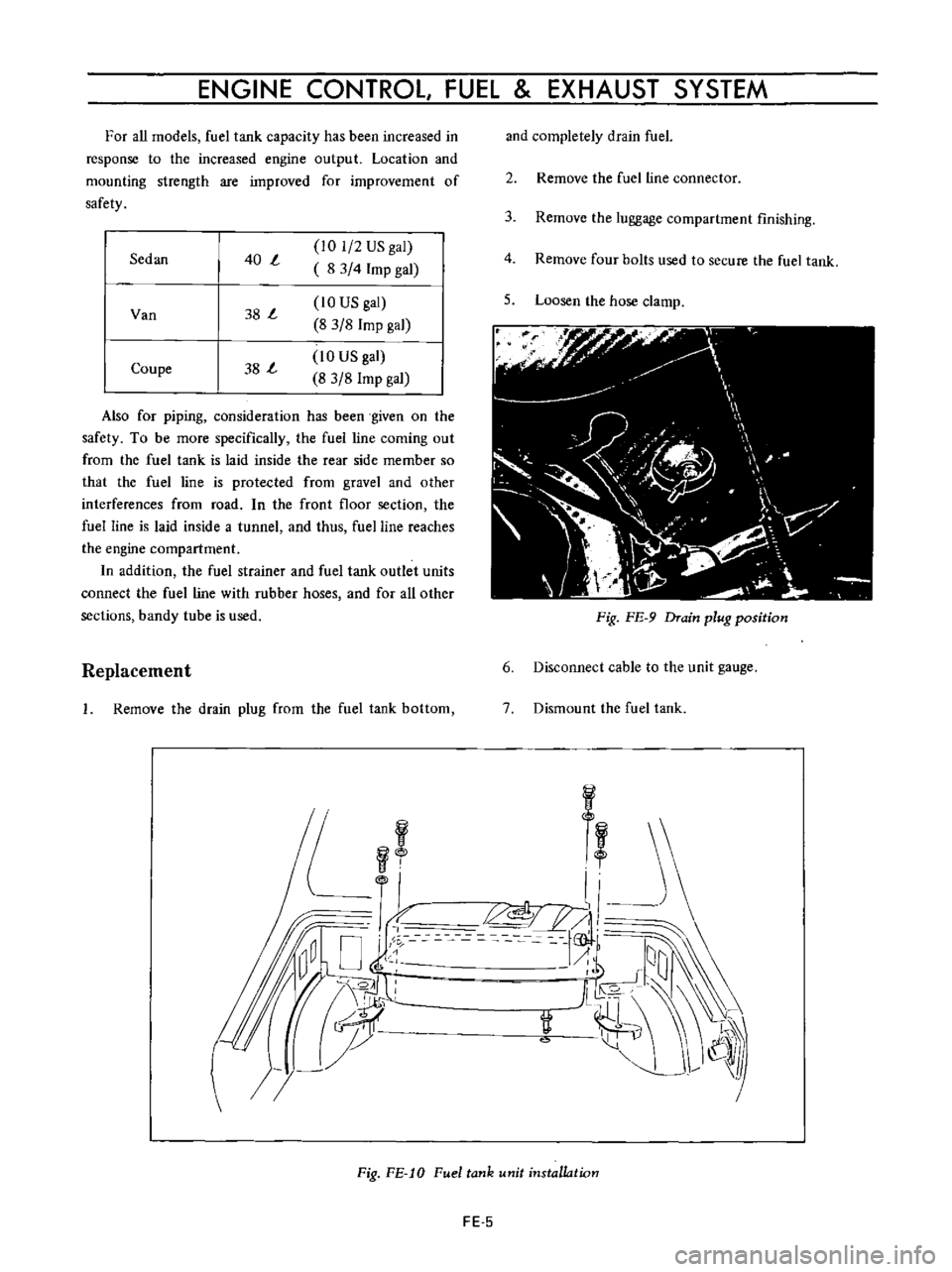
and
completely
drain
fuel
2
Remove
the
fuel
line
connector
3
Remove
the
luggage
compartment
finishing
4
Remove
four
bolts
used
to
secure
the
fuel
tank
5
Loosen
the
hose
clamp
f
r
II
J
y
I
0
I
V
Ii
i
iJb
Also
for
piping
consideration
has
been
given
on
the
safety
To
be
more
specifically
the
fuel
line
coming
out
from
the
fuel
tank
is
laid
inside
the
rear
side
member
so
that
the
fuel
line
is
protected
from
gravel
and
other
interferences
from
road
In
the
front
floor
section
the
fuel
line
is
laid
inside
a
tunnel
and
thus
fuel
line
reaches
the
engine
compartment
In
addition
the
fuel
strainer
and
fuel
tank
outlet
units
connect
the
fuel
line
with
rubber
hoses
and
for
aU
other
sections
bandy
tube
is
used
Fig
FE
9
Drain
plug
position
Replacement
Remove
the
drain
plug
from
the
fuel
tank
bottom
6
Disconnect
cable
to
the
unit
gauge
7
Dismount
the
fuel
tank
f
I
Y
L
ll
C
jjhrr
@
Fig
FE
10
Fuel
tank
14nit
installation
FE
5
Page 206 of 513
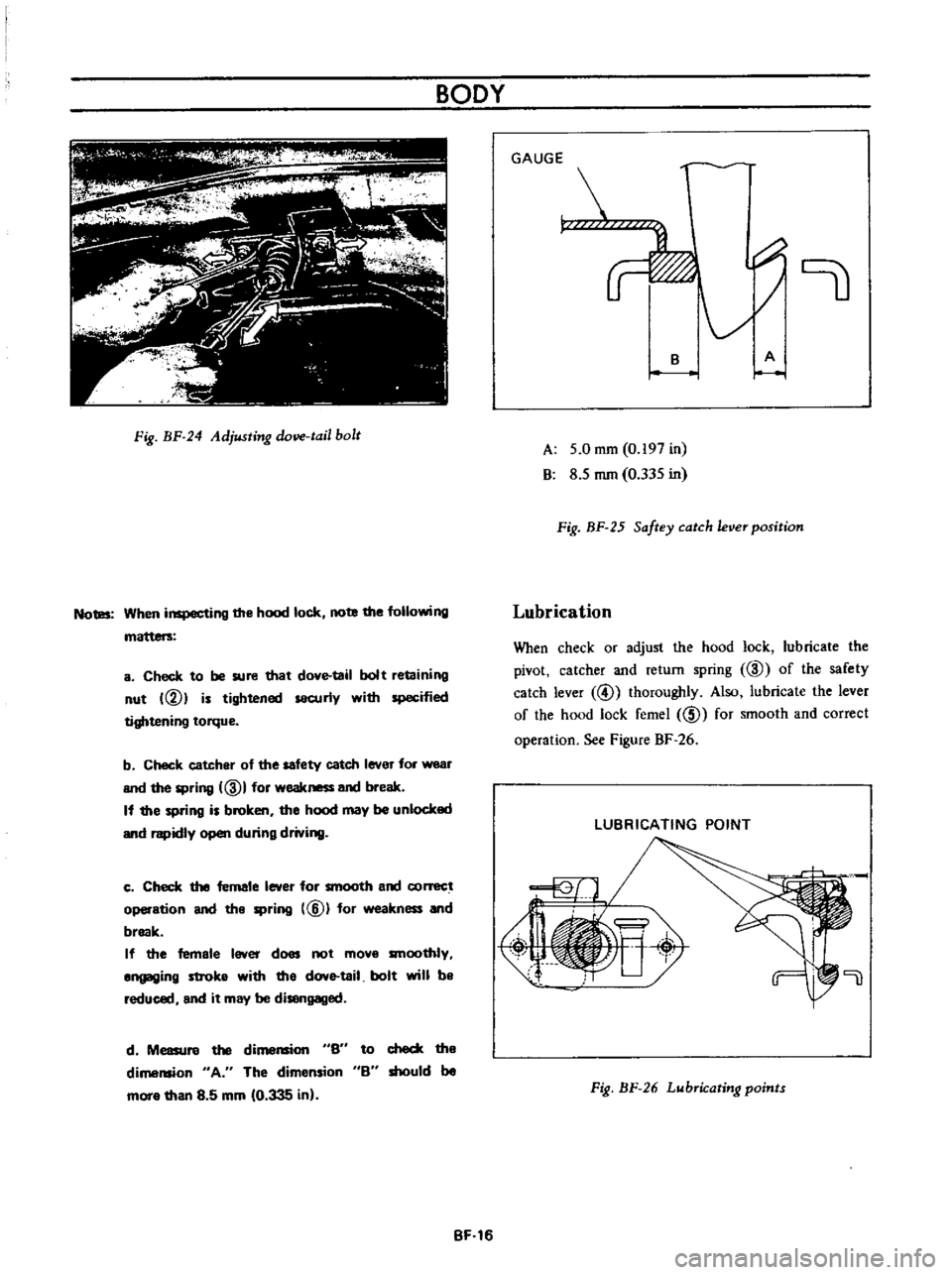
BODY
Fig
BF
24
Adjusting
dove
tail
bolt
Notes
When
inspecting
the
hood
lock
note
the
following
a
Check
to
be
sure
that
dove
tail
bolt
retaining
nut
VI
is
tightened
securly
with
specified
tightening
torque
b
Check
catcher
of
the
safety
catch
lever
for
wear
and
the
spring
ID
I
for
weakness
and
break
If
the
spring
is
broken
the
hood
may
be
unlocked
and
rapidly
open
during
driving
c
Check
the
female
lever
for
smooth
and
conect
operation
and
the
spring
@
for
weakness
and
break
If
the
female
lever
does
not
mova
smoothly
angaging
stroka
with
tha
dove
tail
bolt
will
ba
reduced
and
it
may
be
disengaged
d
Measure
the
di
S6
to
check
the
dimension
A
The
dimension
B
should
be
mora
than
8
5
mm
10
335
in
BF
16
GAUGE
r
B
A
A
5
0
mm
0
197
in
B
8
5
mm
0
335
in
Fig
BF
25
Saftey
catch
ever
position
Lubrication
When
check
or
adjust
the
hood
lock
lubricate
the
pivot
catcher
and
return
spring
ID
of
the
safety
catch
lever
@
thoroughly
Also
lubricate
the
lever
of
the
hood
lock
femel
ID
for
smooth
and
correct
operation
See
Figure
BF
26
LUBRICATING
POINT
Fig
BF
26
Lubricating
points
Page 210 of 513
BODY
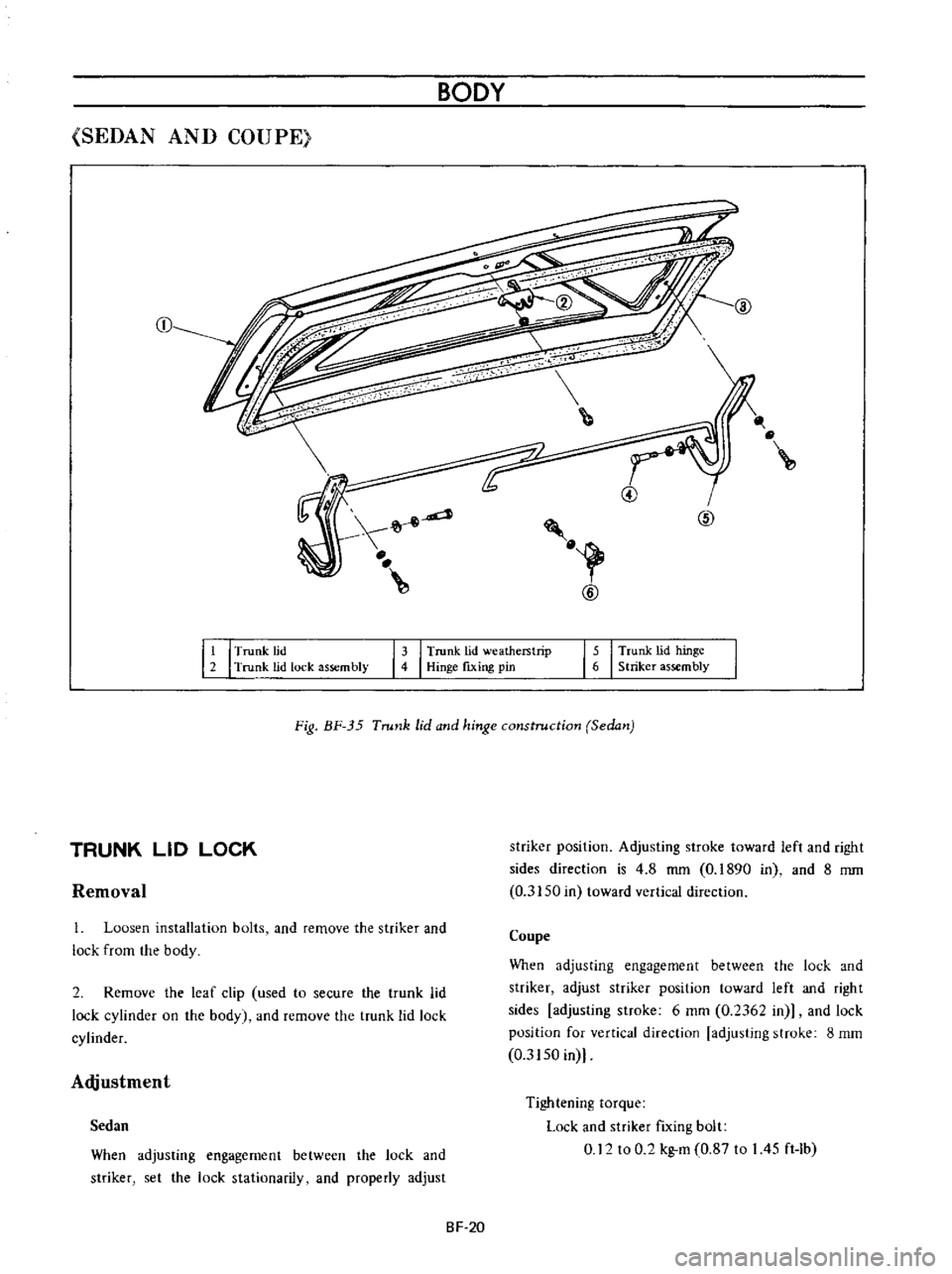
SEDAN
AND
COUPE
CD
@
h
r
1
@
@
II
I
Trunk
lid
2
Trunk
lid
lock
assembly
13
I
Trunk
lid
weatherstrip
4
Hinge
fixing
pin
15
I
Trunk
lid
hinge
6
Striker
assembly
Fig
BF
35
Trunk
lid
and
hinge
construction
Sedan
Removal
striker
position
Adjusting
stroke
toward
left
and
right
sides
direction
is
4
8
mm
0
1890
in
and
8
mm
0
3150
in
toward
vertical
direction
TRUNK
LID
LOCK
1
Loosen
installation
bolts
and
remove
the
striker
and
lock
from
the
body
Coupe
When
adjusting
engagement
between
the
lock
and
striker
adjust
striker
position
toward
left
and
right
sides
adjusting
stroke
6
mm
0
2362
in
and
lock
position
for
vertical
direction
adjusting
stroke
8
mm
0
3150
in
2
Remove
the
leaf
clip
used
to
secure
the
trunk
lid
lock
cylinder
on
the
body
and
remove
the
trunk
lid
lock
cylinder
Adjustment
When
adjusting
engagement
between
the
lock
and
striker
set
the
lock
stationarily
and
properly
adjust
Tightening
torque
Lock
and
striker
fIxing
bolt
0
12
to
0
2
kg
m
0
87
to
I
45
ft
Ib
Sedan
SF
20
Page 211 of 513
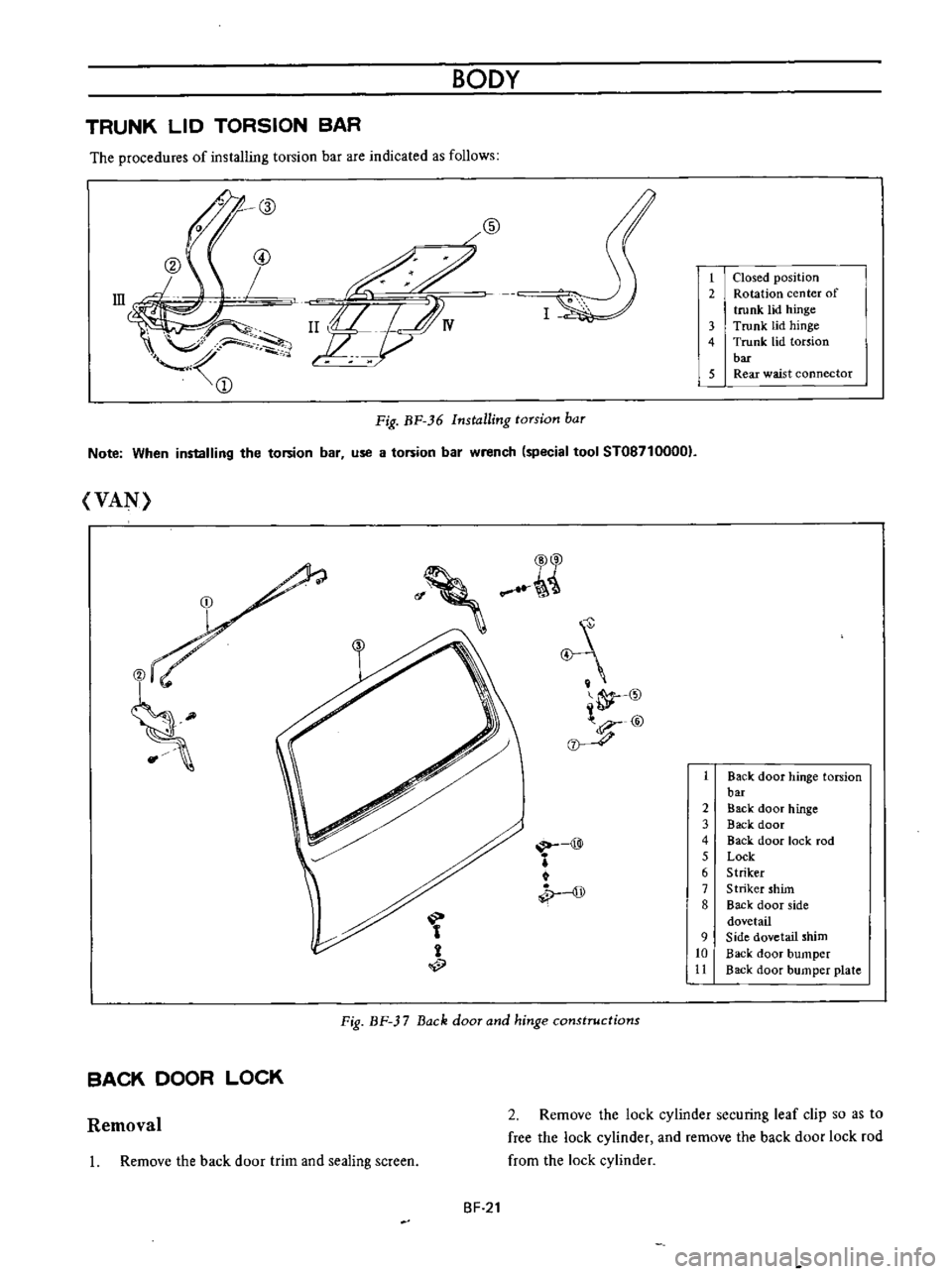
BODY
TRUNK
LID
TORSION
BAR
The
procedures
of
installing
torsion
bar
are
indicated
as
follows
ill
ID
f
Jw
V
@
@
Fig
BF
36
Installing
torsion
bar
1
Closed
position
2
Rotation
center
of
trunk
lid
hinge
3
Trunk
lid
hinge
4
Trunk
lid
torsion
bar
5
Rear
waist
connector
Note
When
installing
the
to
ion
bar
use
to
ion
bar
wrench
special
tool
ST087100001
VAN
t
9
@
i
Fig
BF
37
Back
door
and
hinge
constructions
BACK
DOOR
LOCK
1
Back
door
hinge
torsion
bar
2
Back
door
hinge
3
Back
door
4
Back
door
lock
rod
5
Lock
6
Striker
7
Striker
shim
8
Back
door
side
dovetail
9
Side
dovetail
shim
10
Back
door
bumper
11
Back
door
bumper
plate
Removal
2
Remove
the
lock
cylinder
securing
leaf
clip
so
as
to
free
the
lock
cylinder
and
remove
the
back
door
lock
rod
from
the
lock
cylinder
I
Remove
the
back
door
trim
and
sealing
screen
BF
21
Page 212 of 513
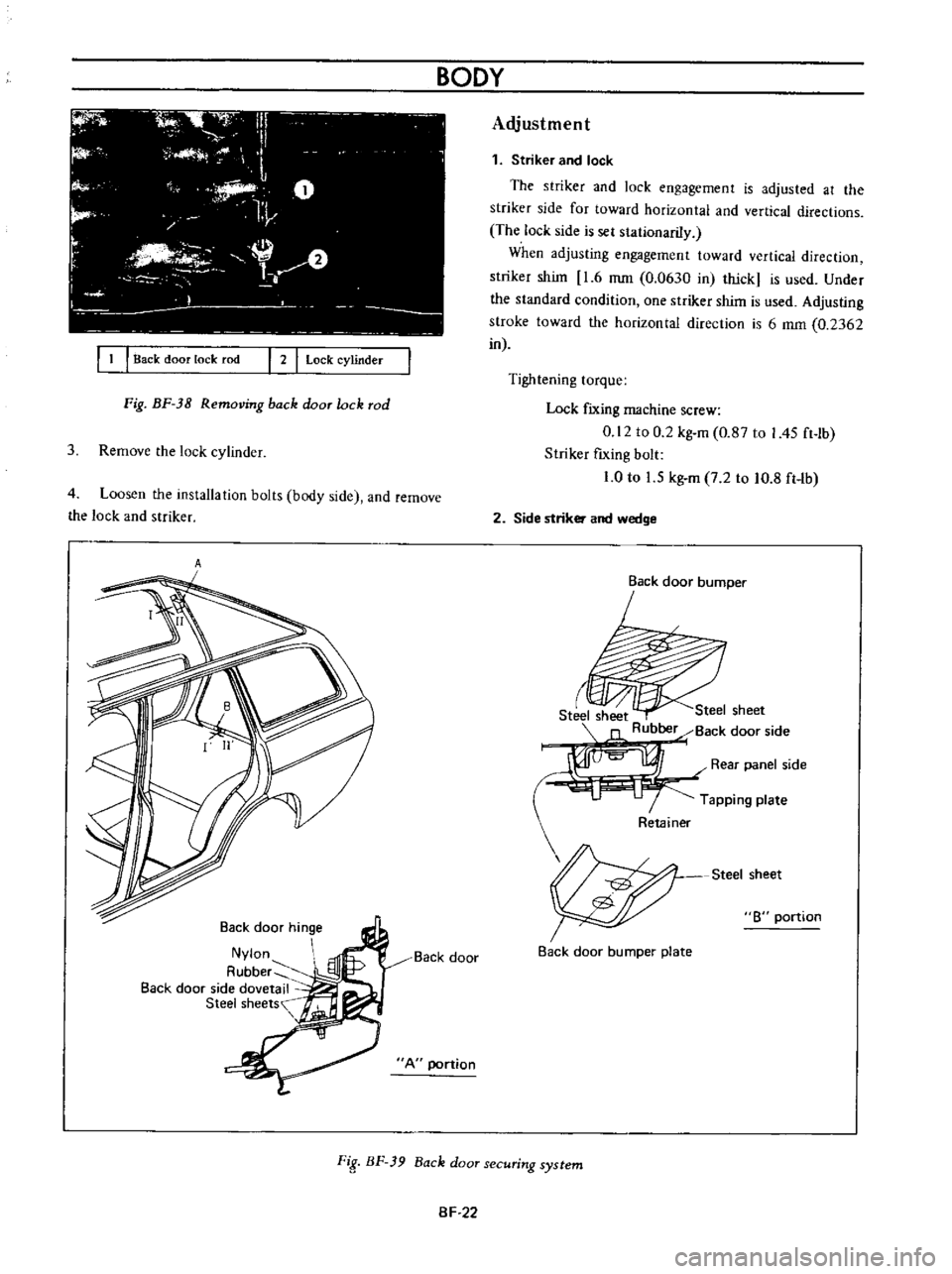
I
1
I
Back
door
lock
rod
I
2
I
Lock
cylinder
Fig
BF
38
Removing
back
door
lock
rod
3
Remove
the
lock
cylinder
4
Loosen
the
installation
bolts
body
side
and
remove
the
lock
and
striker
A
Back
door
hinge
Nylon
A
ubber
Back
door
side
dovetail
Steel
sheets
Back
door
A
portion
BODY
Adjustment
1
Striker
and
lock
The
striker
and
lock
engagement
is
adjusted
at
the
striker
side
for
toward
horizontal
and
vertical
directions
The
lock
side
is
sel
stationariIy
When
adjusting
engagement
toward
vertical
direction
striker
shim
1
6
mm
0
0630
in
thick
is
used
Under
the
standard
condition
one
striker
shim
is
used
Adjusting
stroke
toward
the
horizontal
direction
is
6
mm
0
2362
in
Tightening
torque
Lock
fIXing
machine
screw
0
12
to
0
2
kg
m
0
87
to
I
45
ft
lb
Striker
fIxing
bolt
1
0
to
1
5
kg
m
7
2
to
10
8
ft
Ib
2
Side
striker
and
wedge
Back
door
bumper
r
Steel
sheet
Steel
sheet
Rubber
Back
door
side
I
Rear
panel
side
Tapping
plate
Steel
sheet
8
portion
Back
door
bumper
plate
FiS
BF
39
Back
door
securing
system
SF
22
Page 213 of 513
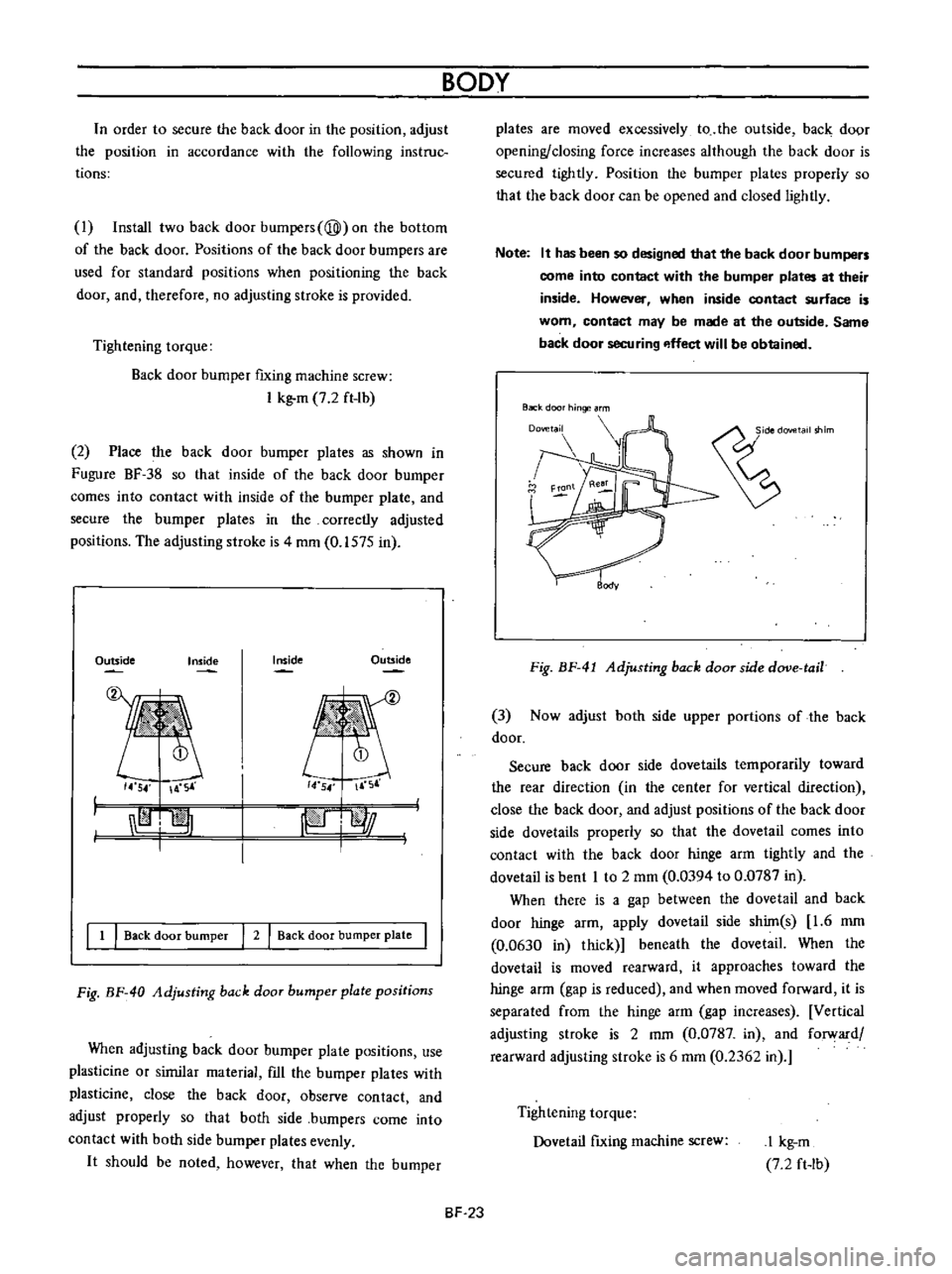
n
order
to
secure
the
back
door
in
the
position
adjust
the
position
in
accordance
with
the
following
instruc
tions
I
Install
two
back
door
bumpers
@
on
the
bottom
of
the
back
door
Positions
of
the
back
door
bumpers
are
used
for
standard
positions
when
positioning
the
back
door
and
therefore
no
adjusting
stroke
is
provided
Tightening
torque
Back
door
bumper
fixing
machine
screw
I
kg
m
7
2
ft
lb
2
Place
the
back
door
bumper
plates
as
shown
in
Fugure
BF
38
so
that
inside
of
the
back
door
bumper
comes
into
contact
with
inside
of
the
bumper
plate
and
secure
the
bumper
plates
in
the
correctly
adjusted
positions
The
adjusting
stroke
is
4
mm
0
1575
in
Outside
Inside
Outside
Inside
14
54
A
S
14
54
F
r
I
I
jpiJ
l
l
j
I
1
I
Back
door
bumper
I
2
I
Back
door
bumper
plate
I
Fig
BF
40
Adjusting
back
door
bumper
plate
positions
When
adjusting
back
door
burnper
plate
positions
use
plasticine
or
sirnilar
material
fIll
the
bumper
plates
with
plasticine
close
the
back
door
observe
contact
and
adjust
properly
so
that
both
side
bumpers
come
into
contact
with
both
side
bumper
plates
evenly
It
should
be
noted
however
that
when
the
bumper
BODY
BF
23
plates
are
moved
excessively
to
the
outside
back
door
opening
closing
force
increases
although
the
back
door
is
secured
tightly
Position
the
bumper
plates
properly
so
that
the
back
door
can
be
opened
and
closed
lightly
Note
It
has
been
so
designed
that
the
back
door
bumpers
come
into
contact
with
the
bumper
plates
at
their
inside
However
when
inside
contact
surface
is
worn
contact
may
be
made
at
the
outside
Same
back
door
securing
p
ffect
will
be
obtained
Back
door
hinge
rm
Fig
BF
41
Adjusting
back
door
side
dove
tail
3
Now
adjust
both
side
upper
portions
of
the
back
door
Secure
back
door
side
dovetails
temporarily
toward
the
rear
direction
in
the
center
for
vertical
direction
close
the
back
door
and
adjust
positions
of
the
back
door
side
dovetails
properly
so
that
the
dovetail
comes
into
contact
with
the
back
door
hinge
arm
tightly
and
the
dovetail
is
bent
I
to
2
mm
0
0394
to
0
0787
in
When
there
is
a
gap
between
the
dovetail
and
back
door
hinge
arm
apply
dovetail
side
shim
s
1
6
mm
0
0630
in
thick
beneath
the
dovetail
When
the
dovetail
is
moved
rearward
it
approaches
toward
the
hinge
arm
gap
is
reduced
and
when
moved
forward
it
is
separated
from
the
hinge
arrn
gap
increases
Vertical
adjusting
stroke
is
2
mm
0
0787
in
and
forward
rearward
adjusting
stroke
is
6
mm
0
2362
in
Tightening
torque
Dovetail
fIxing
machine
screw
I
kg
m
7
2
ft
Ib
Page 214 of 513
BACK
DOOR
TORSION
BAR
BODY
A
D
Installation
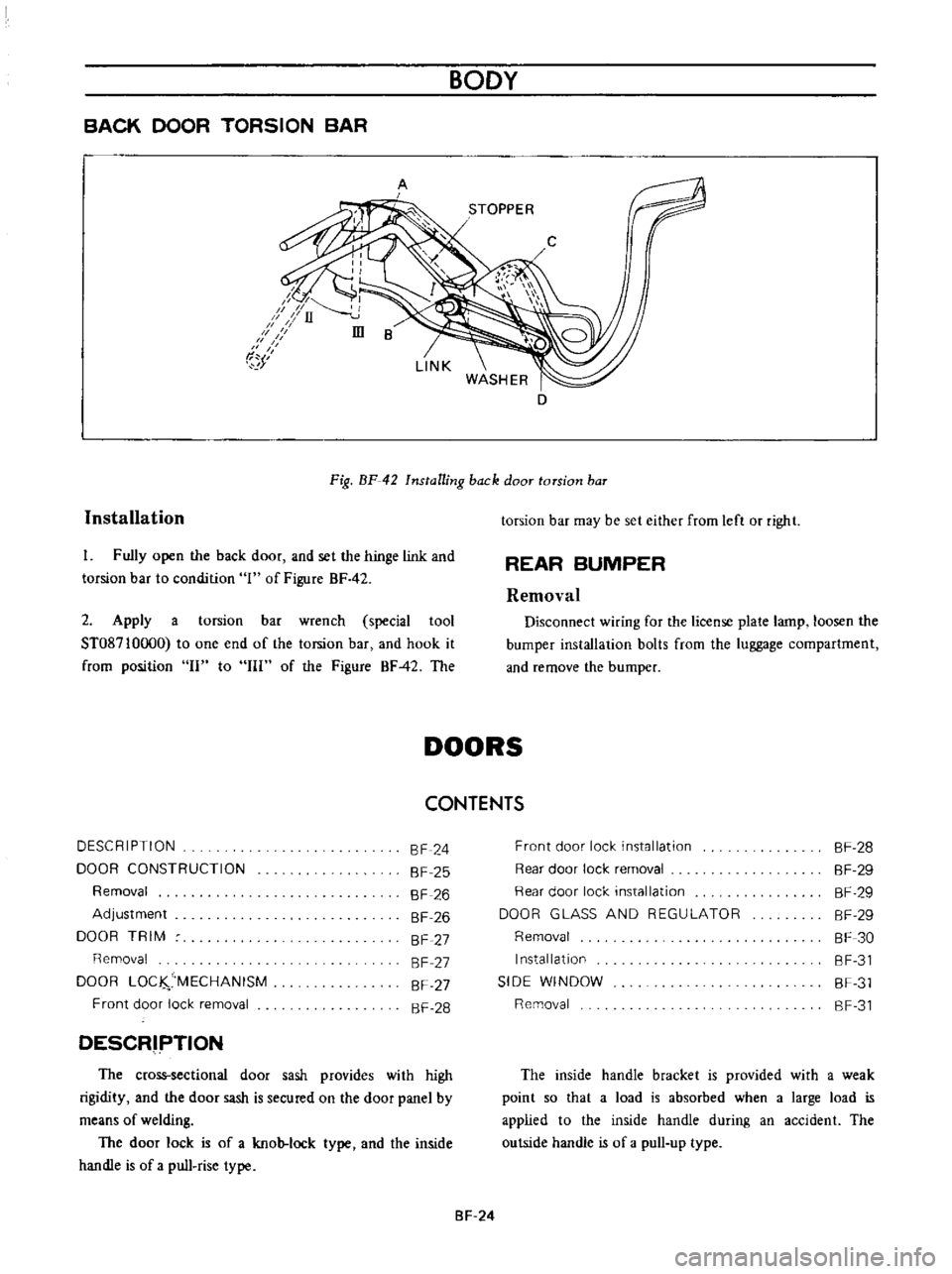
Fig
BF
42
Installing
back
door
torsion
baT
I
Fully
open
the
back
door
and
set
the
hinge
link
and
torsion
bar
to
condition
1
of
Figure
BF
42
2
Apply
a
torsion
bar
wrench
special
tool
ST08710oo0
to
one
end
of
the
torsion
bar
and
hook
it
from
position
II
to
III
of
the
Figure
BF42
The
torsion
bar
may
be
set
either
from
left
or
right
REAR
BUMPER
Removal
Disconnect
wiring
for
the
license
plate
lamp
loosen
the
bumper
installation
bolts
from
the
luggage
compartment
and
remove
the
bumper
DOORS
CONTENTS
DESCRIPTION
DOOR
CONSTRUCTION
Removal
Adjustment
DOOR
TRIM
Removal
DOOR
LOC
MECHANISM
Front
door
lock
removal
SF
24
SF
25
SF
26
SF
26
SF
27
SF
27
SF
27
SF
28
DESCRIPTION
The
cross
sectional
door
sash
provides
with
high
rigidity
and
the
door
sash
is
secured
on
the
door
panel
by
means
of
welding
The
door
lock
is
of
a
knob
lock
type
and
the
inside
handle
is
of
a
pull
rise
type
Front
door
lock
installation
Rear
door
lock
removal
Rear
door
lock
installation
DOOR
GLASS
AND
REGULATOR
Removal
Installation
SIDE
WINDOW
Removal
SF
28
SF
29
SF
29
SF
29
SF
30
SF
31
SF
31
SF
31
The
inside
handle
bracket
is
provided
with
a
weak
point
so
that
a
load
is
absorbed
when
a
large
load
is
applied
to
the
inside
handle
during
an
accident
The
outside
handle
is
of
a
pull
up
type
SF
24