ECU DATSUN B110 1973 Service Owner's Manual
[x] Cancel search | Manufacturer: DATSUN, Model Year: 1973, Model line: B110, Model: DATSUN B110 1973Pages: 513, PDF Size: 28.74 MB
Page 120 of 513
REAR
AXLE
REAR
SUSPENSION
DESCRIPTION
Rear
suspension
consists
of
semi
elliptic
leaf
springs
telescopic
hydraulic
shock
absorbers
and
rubber
bumpers
The
rear
spring
center
pin
is
off
set
110
mm
4
33
in
toward
the
front
from
the
center
of
the
spring
This
is
done
to
reduce
spring
wind
up
and
to
decrease
the
arc
while
the
rear
wheel
swings
through
Thereby
minimizing
the
possibility
of
the
rear
suspension
effecting
vehicle
stability
Iso
clamp
devices
are
used
for
attaching
the
axle
housing
to
the
spring
The
leaf
springs
shock
absorbers
and
rear
axle
housing
are
mounted
on
rubber
bushings
at
each
end
to
minimize
noise
and
vibration
of
the
transmission
to
the
car
body
and
passenger
compartment
REAR
SPRING
Removal
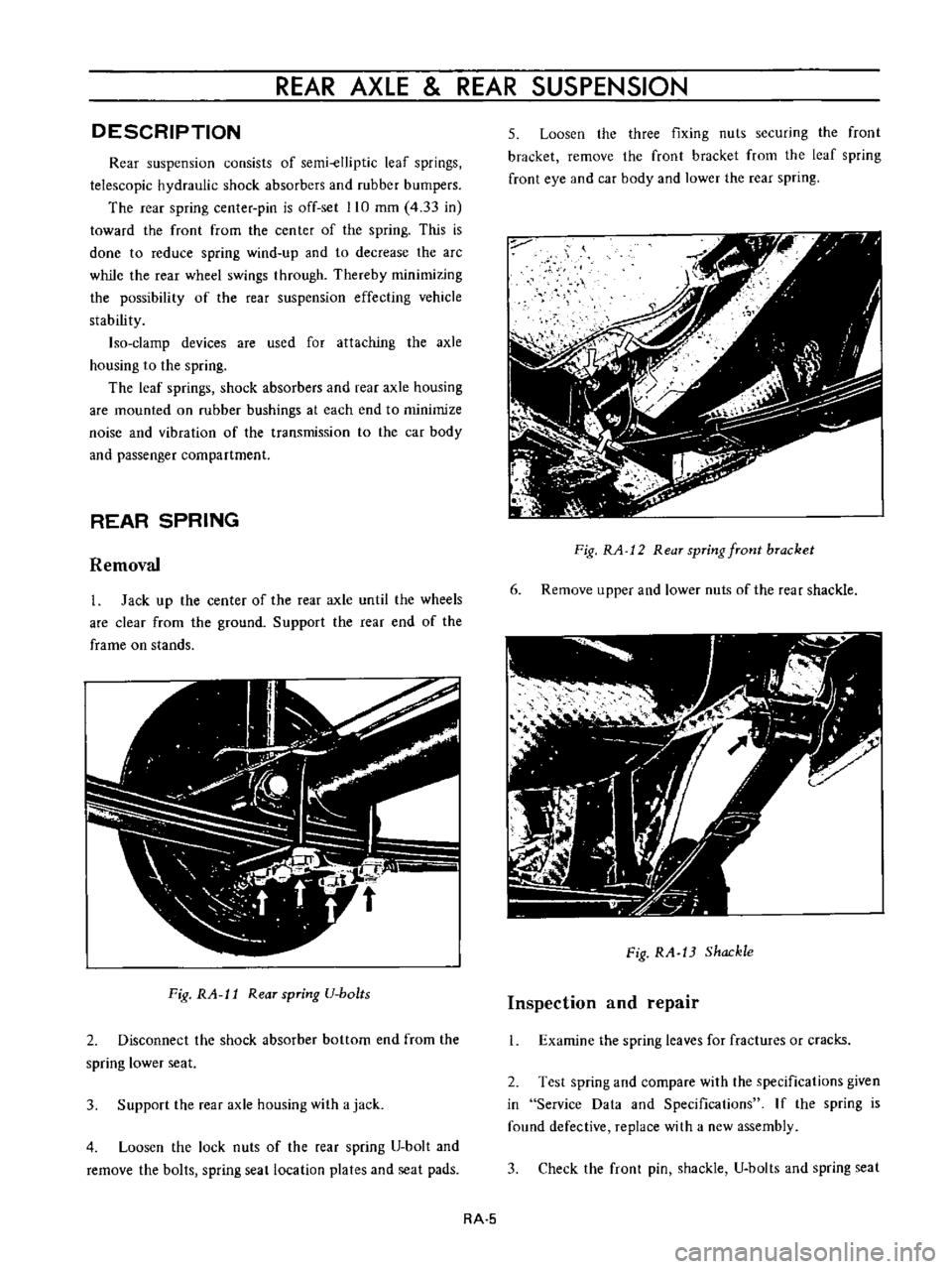
1
Jack
up
the
center
of
the
rear
axle
until
the
wheels
are
clear
from
the
ground
Support
the
rear
end
of
the
frame
on
stands
Fig
RA
l1
Rear
spring
U
bo
ts
2
Disconnect
the
shock
absorber
bottom
end
from
the
spring
lower
seat
3
Support
the
rear
axle
housing
with
a
jack
4
Loosen
the
lock
nuts
of
the
rear
spring
U
bolt
and
remove
the
bolts
spring
seat
location
plates
and
seat
pads
5
Loosen
the
three
fixing
nuts
securing
the
front
bracket
remove
the
front
bracket
from
the
leaf
spring
front
eye
and
car
body
and
lower
the
rear
spring
Fig
RA
12
Rear
spring
front
bracket
6
Remove
upper
and
lower
nuts
of
the
rear
shackle
Fig
RA
13
Shackle
Inspection
and
repair
1
Examine
the
spring
leaves
for
fractures
or
cracks
2
Test
spring
and
compare
with
the
specifications
given
in
Service
Data
and
Specifications
If
the
spring
is
found
defective
replace
with
a
new
assembly
3
Check
the
front
pin
shackle
U
bolts
and
spring
seat
RA
5
Page 121 of 513
CHASSIS
for
wear
cra
ks
straightness
and
damaged
thread
s
If
defective
parts
are
found
replace
with
new
ones
4
Inspect
all
rubber
pans
for
wear
damage
separation
and
deformation
Replace
them
if
necessary
Installation
Install
the
rear
spring
in
reverse
sequence
of
removal
noting
the
following
matters
Coat
the
front
bracket
pin
front
bracket
bushing
shackle
pin
and
shackle
bushing
with
a
soap
solution
prior
to
assembly
2
The
front
pin
securing
nut
and
shock
absorber
lower
end
securing
nut
should
be
tightened
with
the
vehicle
unladen
Note
Make
sure
that
the
flange
of
the
shackle
bushing
is
clamped
evenly
on
both
sides
REAR
SHOCK
ABSORBER
Replacement
lack
up
the
center
of
the
rear
axle
and
support
the
axle
housing
with
stands
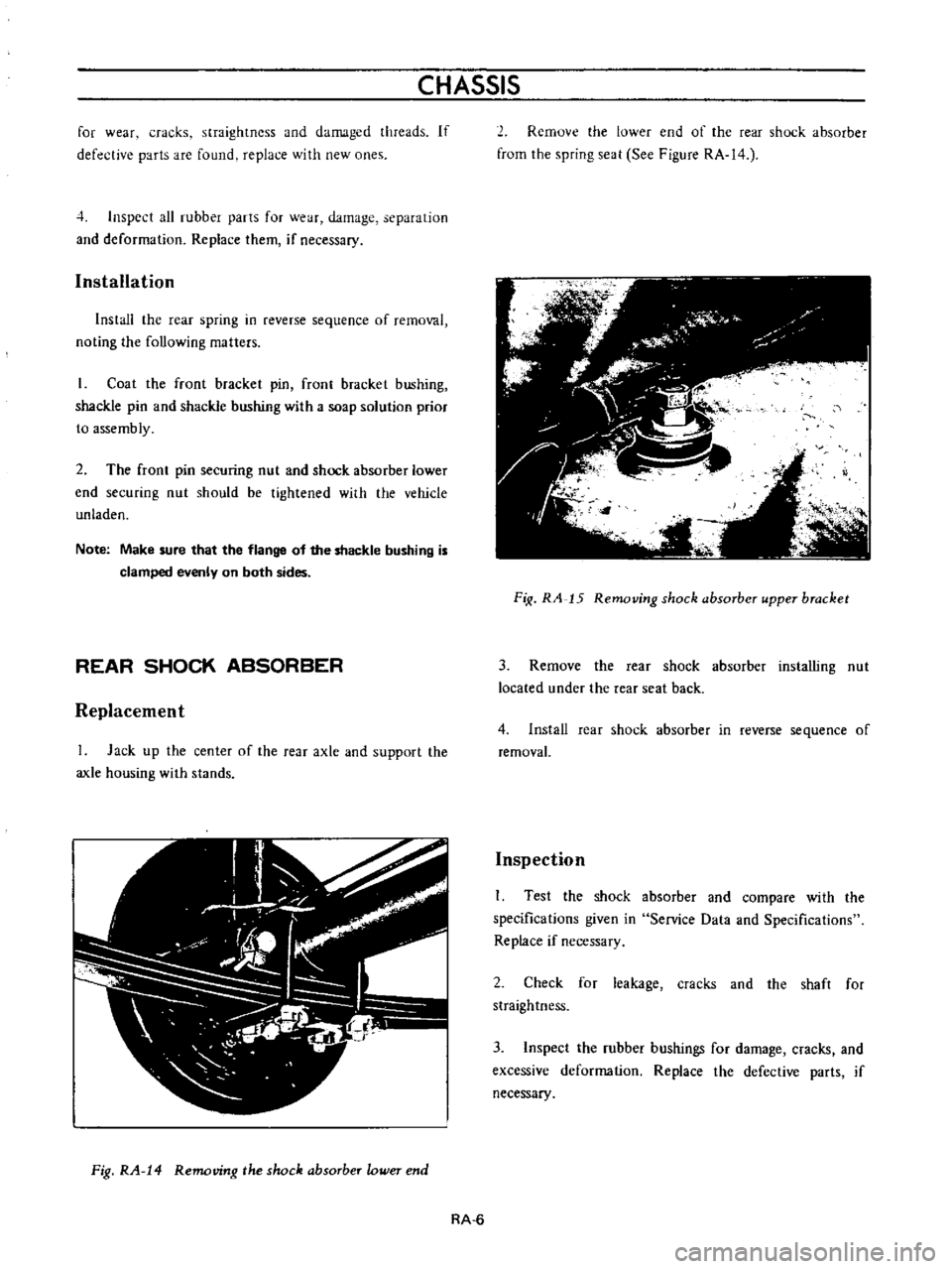
Fig
RA
14
Removing
the
shock
absorber
ower
end
2
Remove
the
lower
end
of
the
rear
shock
absorber
from
the
spring
seat
See
Figure
RA
14
FiK
RA
15
Removing
shock
absorber
upper
bracket
3
Remove
the
rear
shock
absorber
installing
nut
located
under
the
rear
seat
back
4
Install
rear
shock
absorber
in
reverse
sequence
of
removal
Inspection
Test
the
shock
absorber
and
compare
with
the
specifications
given
in
Service
Data
and
Specifications
Replace
if
necessary
2
Check
for
leakage
cracks
and
the
shafl
for
straightness
3
Inspect
the
rubber
bushings
for
damage
cracks
and
excessive
deformation
Replace
the
defective
parts
jf
necessary
RA
6
Page 129 of 513
Removal
and
disassembly
The
single
master
cylinder
is
removed
and
disassembled
in
the
same
manner
as
the
tandem
type
master
cylinder
Inspection
Refer
to
the
section
covering
Inspection
of
tandem
type
master
cylinder
Reassembly
and
reinstallation
The
single
master
cylinder
is
reassembled
and
re
BRAKE
installed
in
the
same
manner
as
the
tandem
type
master
cylinder
BRAKE
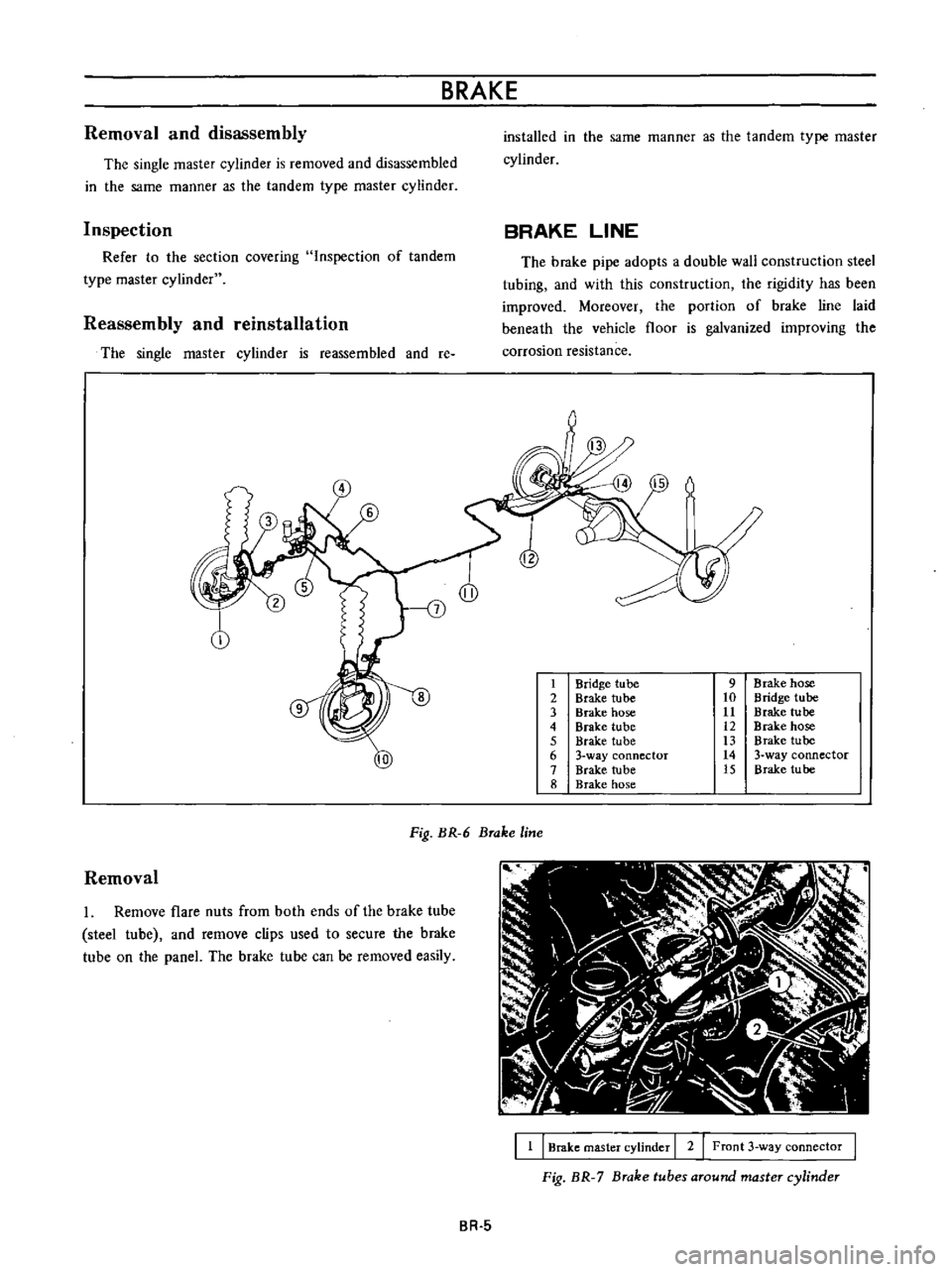
LINE
The
bl1lke
pipe
adopts
a
double
wall
construction
steel
tubing
and
with
this
construction
lhe
rigidily
has
been
improved
Moreover
the
portion
of
brake
line
laid
beneath
the
vehicle
floor
is
galvanized
improving
the
corrosion
resistance
1
Bridge
tube
9
Brake
hose
2
Brake
tube
10
Bridge
tube
3
Brake
hose
11
Brake
tube
4
Brake
tube
12
Brake
hose
5
Brake
tube
13
Brake
tube
10
6
3
way
connector
14
3
way
connector
7
Brake
tube
15
Brake
tu
be
8
Brake
hose
Fig
BR
6
Brake
line
Removal
1
Remove
flare
nuts
from
both
ends
of
the
brake
tube
steel
tube
and
remove
clips
used
to
secure
the
brake
tube
on
the
paneL
The
brake
tube
can
be
removed
easily
I
1
I
Brake
master
cylinder
I
2
Front
3
way
connector
Fig
BR
7
Brake
tubes
around
master
cylinder
BR
5
Page 136 of 513
CHASSIS
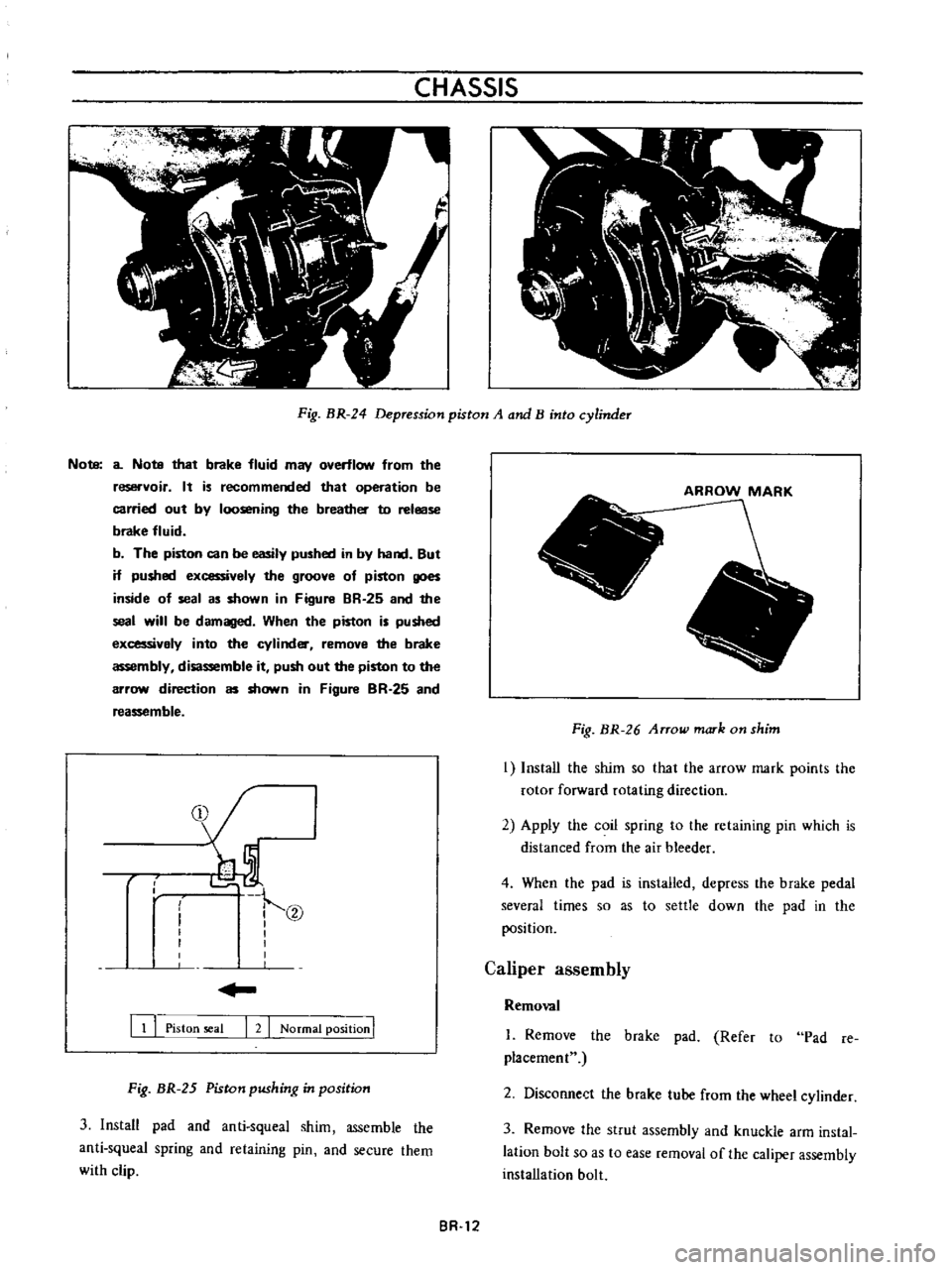
Fig
BR
24
Depression
piston
A
and
B
into
cylinder
Nota
a
Nota
that
brake
fluid
may
overflow
from
the
reservoir
It
is
recommeooed
that
operation
be
carried
out
by
loosening
the
breather
to
release
brake
fluid
b
The
piston
can
be
easily
pushed
in
by
hand
But
if
pushed
excessively
the
groove
of
piston
goes
inside
of
seal
as
shown
in
Figure
BR
25
and
the
seal
will
be
damaged
When
the
piston
is
pushed
excessively
into
the
cylinder
remove
the
brake
assembly
disassemble
it
push
out
the
piston
to
the
arrow
direction
as
shown
in
Figure
BR
25
and
reassemble
r
w
i
@
I
I
I
I
i
I
I
I
1
I
1
1
Piston
ieat
1
2
I
Normal
position
I
Fig
BR
25
Piston
pushing
in
position
3
Install
pad
and
anti
squeal
shim
assemble
the
anti
squeal
spring
and
retaining
pin
and
secure
them
with
clip
ARROW
MARK
Fig
BR
26
Arrow
mark
on
shim
I
Install
the
shim
so
that
the
arrow
mark
points
the
rotor
forward
rotating
direction
2
Apply
the
coil
spring
to
the
retaining
pin
which
is
distanced
from
the
air
bleeder
4
When
the
pad
is
installed
depress
the
brake
pedal
several
times
so
as
to
settle
down
the
pad
in
the
position
Caliper
assembly
Removal
L
Remove
the
brake
pad
Refer
to
Pad
re
placement
2
Disconnect
the
brake
tube
from
the
wheel
cylinder
3
Remove
the
strut
assembly
and
knuckie
arm
instal
lation
bolt
so
as
to
ease
removal
of
the
caliper
assembly
installation
bolt
BR
12
Page 137 of 513
BRAKE
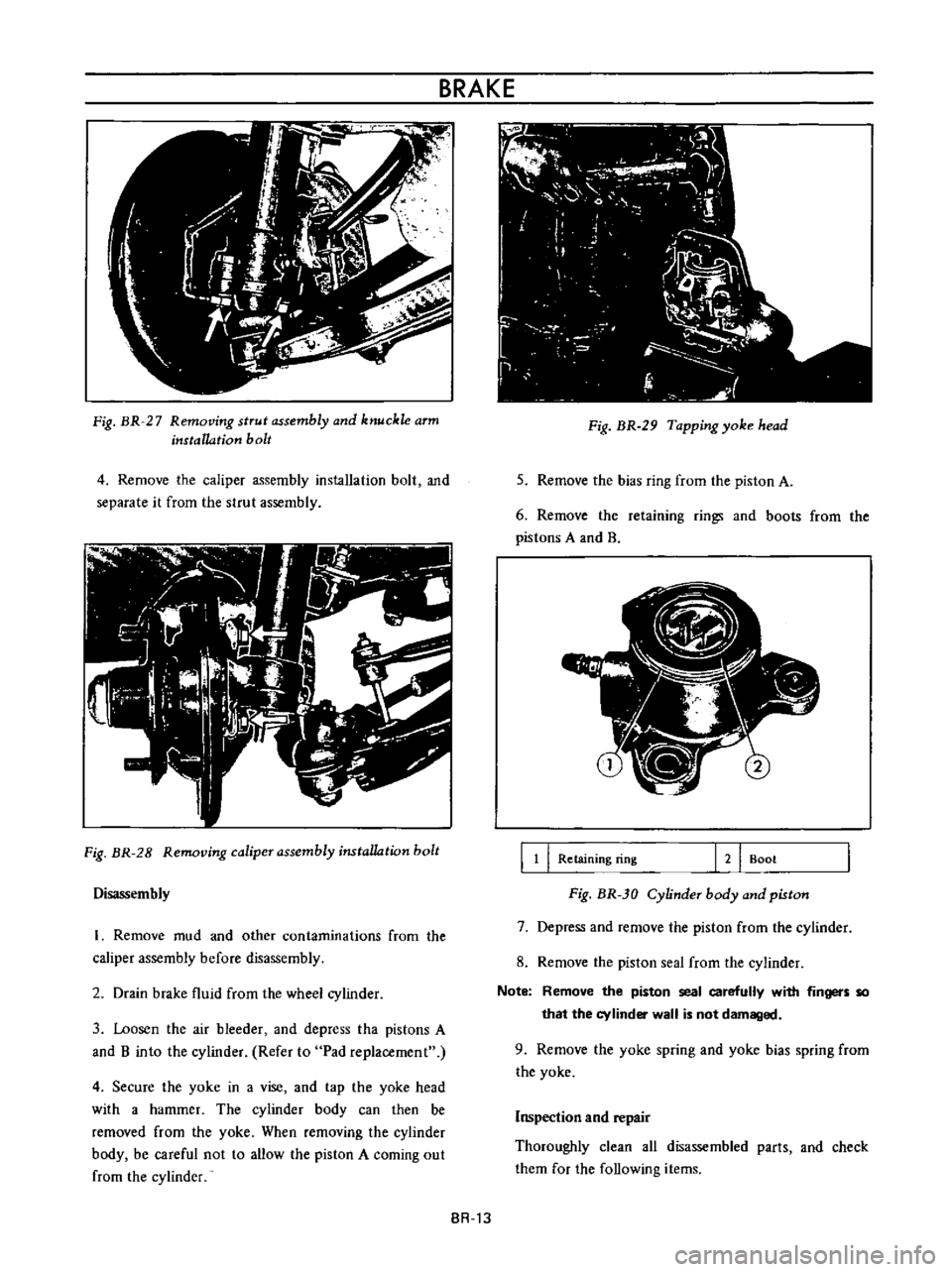
Fig
BR
27
Removing
strut
assembly
and
knuckle
arm
installation
bolt
4
Remove
the
caliper
assembly
installation
bolt
and
separate
it
from
the
strut
assembly
Fig
BR
28
Removing
caliper
assembly
instaUation
bolt
Disassembly
I
Remove
mud
and
other
contaminations
from
the
caliper
assembly
before
disassembly
2
Drain
brake
fluid
from
the
wheel
cylinder
3
Loosen
the
air
bleeder
and
depress
tha
pistons
A
and
B
into
the
cylinder
Refer
to
Pad
replacement
4
Secure
the
yoke
in
a
vise
and
tap
the
yoke
head
with
a
hammer
The
cylinder
body
can
then
be
removed
from
the
yoke
When
removing
the
cylinder
body
be
careful
not
to
allow
the
piston
A
coming
out
from
the
cylinder
BR
13
i
c
J
l
l
7
I
0
I
I
i
I
f
1
1
J
t
1
Fig
BR
29
Tapping
yoke
head
5
Remove
the
bias
ring
from
the
piston
A
6
Remove
the
retaining
rings
and
boots
from
the
pistons
A
and
B
J
l
lj
7
fI
II
l
j
B
11
I
Retaining
ring
121
Boot
Fig
BR
30
Cylinder
body
and
piston
7
Depress
and
remove
the
piston
from
the
cylinder
8
Remove
the
pislon
seal
from
the
cylinder
Note
Remove
the
piston
seal
carefully
with
fingers
so
that
the
cylinder
wall
is
not
damaged
9
Remove
the
yoke
spring
and
yoke
bias
spring
from
the
yoke
Inspection
and
repair
Thoroughly
clean
all
disassembled
parIs
and
check
them
for
the
following
items
Page 145 of 513
BRAKE
Brake
pedal
height
I
Fl
I
Jl
BRAKE
MASTER
CYllN
ADJU
SHI
1
I
195mm
001971011
THICKNESSIO
8
mm
00315
Inl
116mm
00630In
TOP
LAMP
SWrTCH
r
b
O
ZOlTlI
I
A
12
n
Y
1
O
09
ttr
i
l
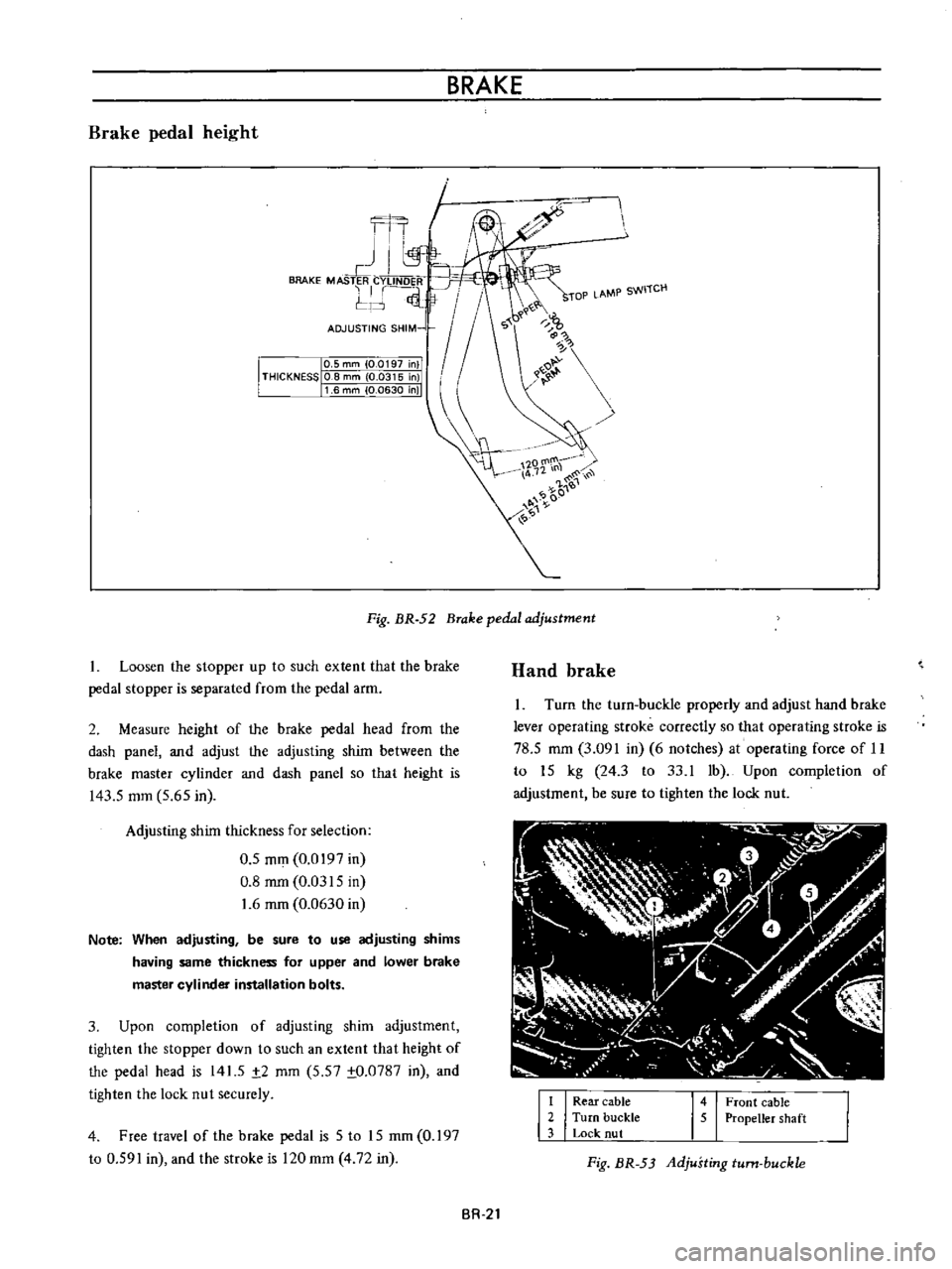
Fig
BR
52
Brake
pedal
adjustment
1
Loosen
the
stopper
up
to
such
extent
that
the
brake
pedal
stopper
is
separated
from
the
pedal
arm
2
Measure
height
of
the
brake
pedal
head
from
the
dash
panel
and
adjust
the
adjusting
shim
between
the
brake
master
cylinder
and
dash
panel
so
that
height
is
143
5
mm
5
65
in
Adjusting
shim
thickness
for
selection
0
5
mm
0
0197
in
0
8
mm
0
0315
in
1
6
mm
0
0630
in
Note
When
adjusting
be
sure
to
use
adjusting
shims
having
same
thickness
for
upper
and
lower
brake
master
cylinder
installation
bolts
3
Upon
completion
of
adjusting
shim
adjustment
tighten
the
stopper
down
to
such
an
extent
that
height
of
the
pedal
head
is
141
5
t2
mm
5
57
to
0787
in
and
tighten
the
lock
nut
securely
4
Free
travel
of
the
brake
pedal
is
5
to
15
mm
0
197
to
0
591
in
and
the
stroke
is
120
mm
4
72
in
Hand
brake
Turn
the
turn
buckle
properly
and
adjust
hand
brake
lever
operating
stroke
correctly
so
that
operating
stroke
is
78
5
mm
3
091
in
6
notches
at
operating
force
of
11
to
15
kg
24
3
to
33
1
1b
Upon
completion
of
adjustment
be
sure
to
tighten
the
lock
nut
I
I
Rear
cable
2
Turn
buckle
3
Lock
nut
1451
Front
cable
Propeller
shaft
Fig
BR
53
Adjusting
turn
buckle
BR
21
Page 155 of 513
CHASSIS
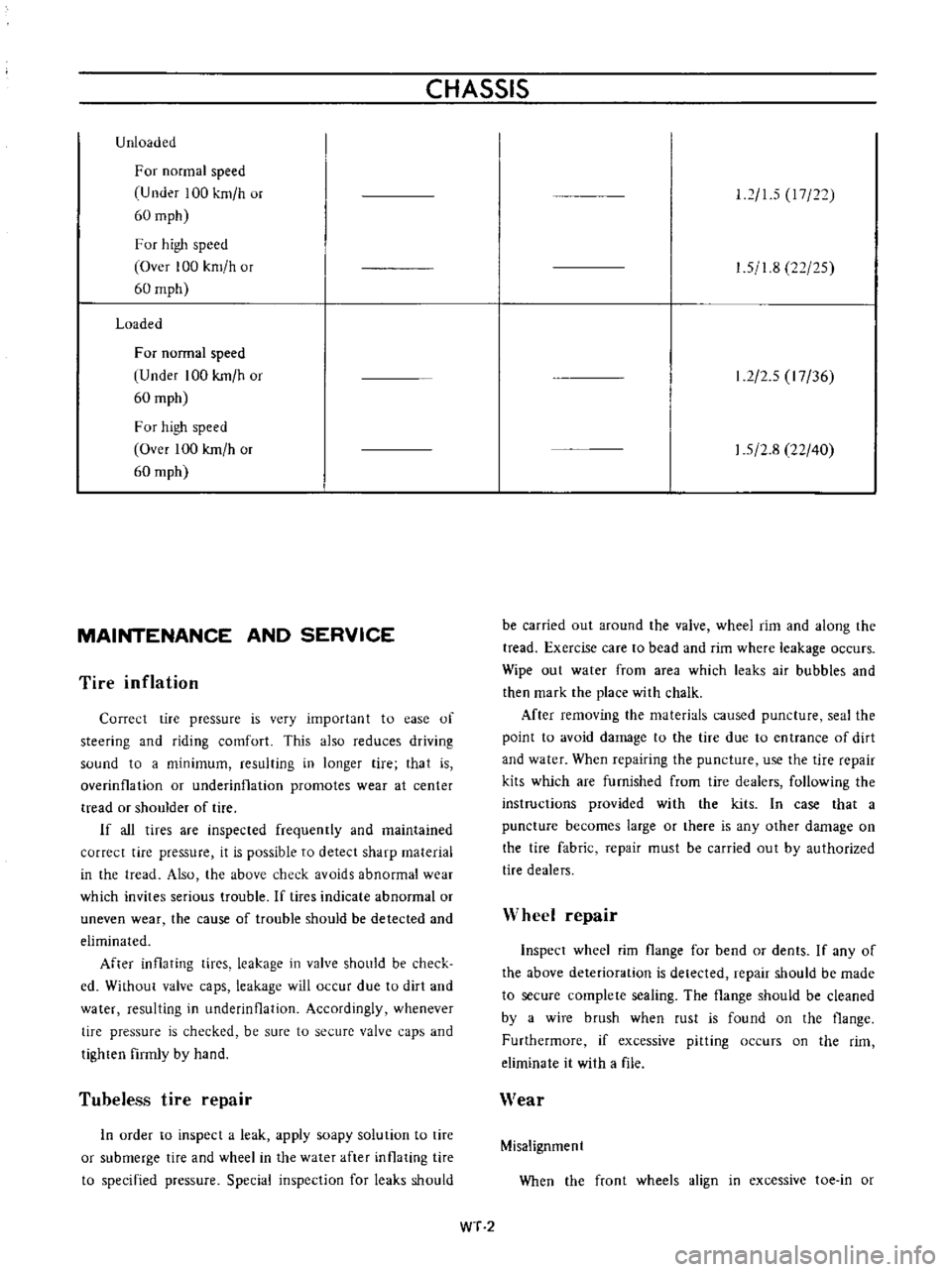
Unloaded
For
normal
speed
U
nder
100
km
h
or
60
mph
F
or
high
speed
Over
100
km
h
or
60
mph
Loaded
For
normal
speed
Under
100
kmlh
or
60
mph
For
high
speed
Over
100
kmlh
or
60
mph
MAINTENANCE
AND
SERVICE
Tire
inflation
Correct
tire
pressure
is
very
importan
t
to
ease
of
steering
and
riding
comfort
This
also
reduces
driving
sound
to
a
minimum
resulting
in
longer
tire
that
is
overinfla
lion
or
underinflation
promotes
wear
at
center
tread
or
shoulder
of
tire
If
all
tires
are
inspected
frequently
and
maintained
correct
tire
pressure
it
is
possible
to
detect
sharp
material
in
the
tread
Also
the
above
check
avoids
abnormal
wear
which
invites
serious
trouble
If
tires
indicate
abnormal
or
uneven
wear
the
cause
of
trouble
should
be
detected
and
eliminated
After
inflating
tices
leakage
in
valve
should
be
check
cd
Without
valve
caps
leakage
will
occur
due
to
dirt
and
water
resulting
in
underinOation
Accordingly
whenever
tire
pressure
is
checked
be
sure
to
secure
valve
caps
and
tighten
firmly
by
hand
Tubeless
tire
repair
In
urder
to
inspect
a
leak
apply
soapy
solution
to
tire
or
submerge
tire
and
wheel
in
the
water
after
inflating
tire
to
specified
pressure
Special
inspection
for
leaks
should
12
15
17
22
1
5
1
8
22
25
1
2
2
5
I
7
36
1
5
2
8
22
40
be
carried
out
around
the
valve
wheel
rim
and
along
the
tread
Exercise
care
to
bead
and
rim
where
leakage
occurs
Wipe
out
water
from
area
which
leaks
air
bubbles
and
then
mark
the
place
with
chalk
After
remuving
the
materials
caused
puncture
seal
the
point
to
avoid
damage
to
the
tire
due
to
entrance
of
dirt
and
water
When
repairing
the
puncture
use
the
tire
repair
kits
which
are
furnished
from
tire
dealers
following
the
instructions
provided
with
the
kits
In
case
that
a
puncture
becomes
large
or
there
is
any
other
damage
on
the
tire
fabric
repair
must
be
carried
out
by
authorized
tire
dealers
Wheel
repair
Inspect
wheel
rim
flange
for
bend
or
dents
If
any
of
the
above
deterioration
is
detected
repair
should
be
made
to
secure
complete
sealing
The
flange
should
be
cleaned
by
a
wire
brush
when
rust
is
found
on
the
flange
Furthermore
if
excessive
pitting
occurs
on
the
rim
eliminate
it
with
a
file
Wear
Misalignment
When
the
front
wheels
align
in
excessive
toe
in
or
WT
2
Page 162 of 513
Iii
I
o
t
I
I
CHASSIS
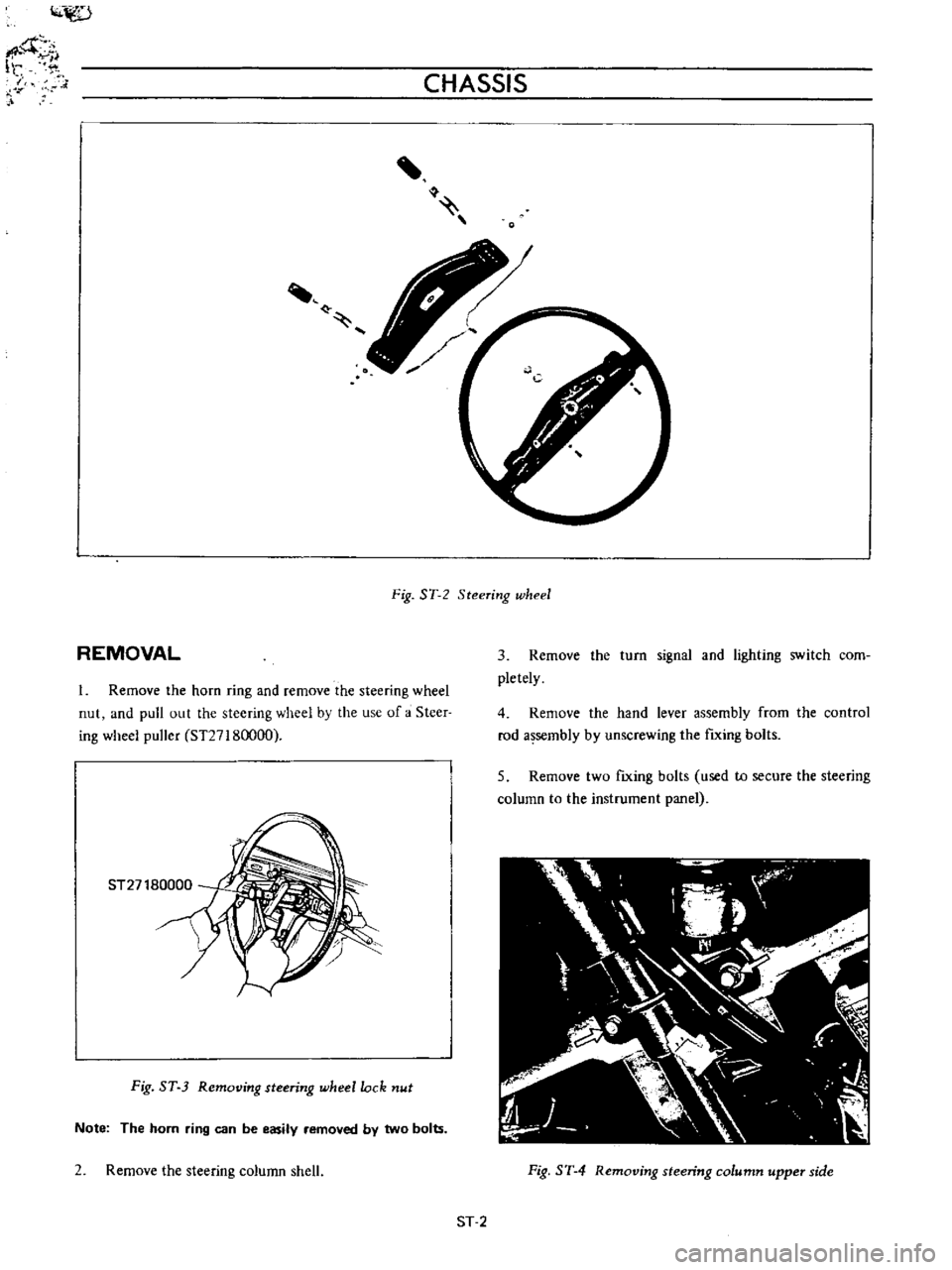
Fig
ST
2
Steering
wheel
REMOVAL
1
Remove
the
horn
ring
and
remove
the
steering
wheel
nut
and
pull
out
the
steering
wheel
by
the
use
of
a
Steer
ing
wheel
puller
ST27180000
3
Remove
the
turn
signal
and
lighting
switch
com
pletely
4
Remove
the
hand
lever
assembly
from
the
control
rod
assembly
by
unscrewing
the
fIxing
bolts
5
Remove
two
fIxing
bolts
used
to
secure
the
steering
column
to
the
instrument
panel
ST27180000
Fig
ST
3
Removing
steering
wheel
lock
nut
Note
The
horn
ring
can
be
easily
removed
by
two
bolts
2
Remove
the
steering
column
shell
Fig
ST
4
Removing
steering
column
upper
side
ST
2
Page 163 of 513
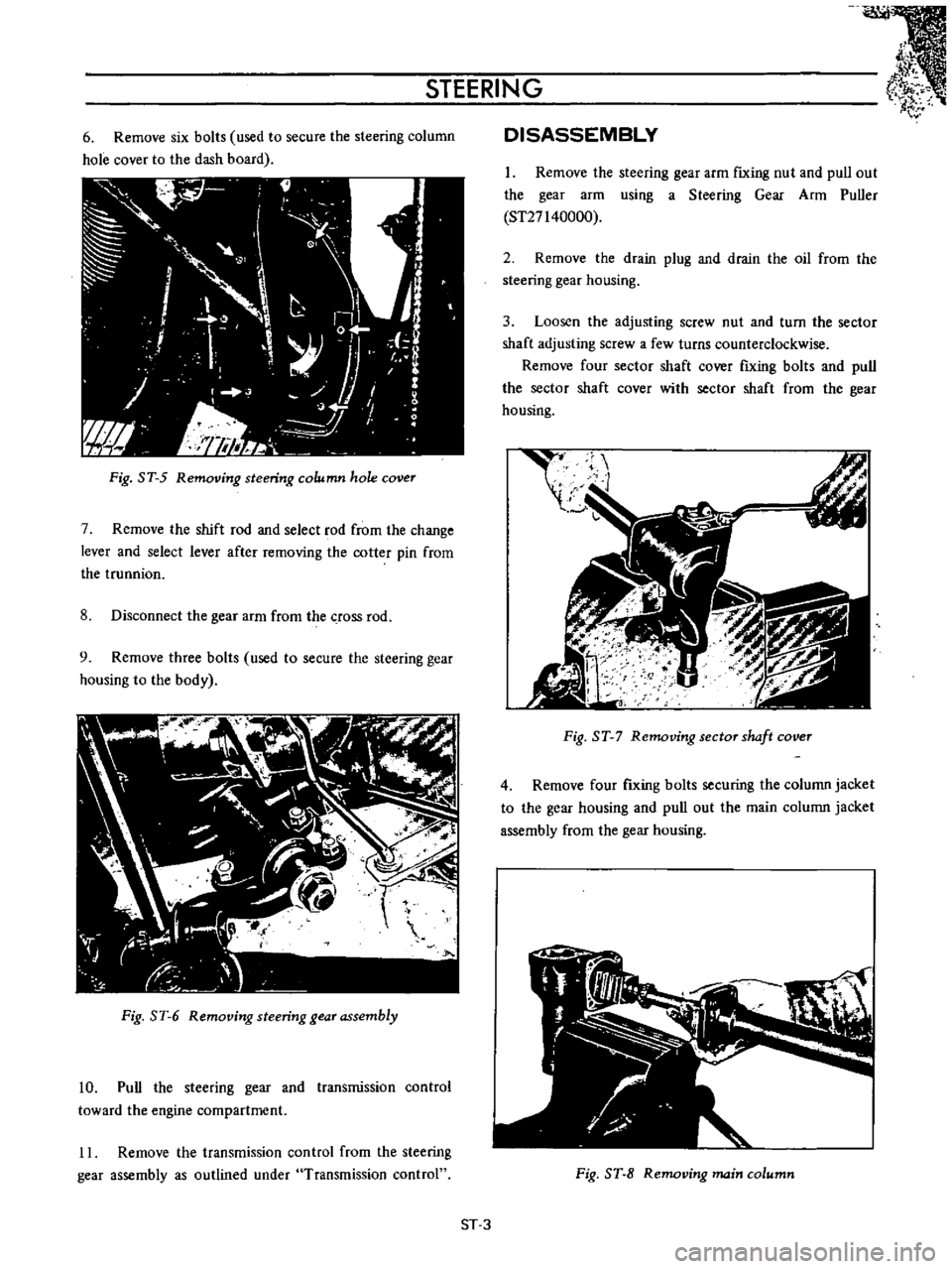
STEERING
6
Remove
six
bolts
used
to
secure
the
steering
column
hole
cover
to
the
dash
board
Fig
ST
5
Removing
steering
column
hole
cover
7
Remove
the
shift
rod
and
select
rod
from
the
change
lever
and
select
lever
after
removing
the
cotter
pin
from
the
trunnion
8
Disconnect
the
gear
arm
from
the
crOSS
rod
9
Remove
three
bolts
used
to
secure
the
steering
gear
housing
to
the
body
Fig
ST
6
Removing
steering
gear
assembly
10
Pull
the
steering
gear
and
transmission
control
toward
the
engine
compartment
11
Remove
the
transmission
control
from
the
steering
gear
assembly
as
outlined
under
Transmission
control
DISASSEMBLY
1
Remove
the
steering
gear
arm
fIxing
nut
and
pull
out
the
gear
arm
using
a
Steering
Gear
Arm
Puller
ST27140000
2
Remove
the
drain
plug
and
drain
the
oil
from
the
steering
gear
housing
3
Loosen
the
adjusting
screw
nut
and
turn
the
sector
shaft
adjusting
screw
a
few
turns
counterclockwise
Remove
four
sector
shaft
cover
fIxing
bolts
and
pull
the
sector
shaft
cover
with
sector
shaft
from
the
gear
housing
t
I
gJ
I
I
Fig
ST
7
Removing
sector
shaft
cover
4
Remove
four
fIxing
bolts
securing
the
column
jacket
to
the
gear
housing
and
pull
out
the
main
column
jacket
assembly
from
the
gear
housing
Fig
ST
8
Removing
main
column
ST
3
Page 171 of 513
STEERING
The
jacket
tube
is
of
a
mesh
and
a
part
of
which
is
punched
in
rhombus
forming
an
energy
absorbing
part
of
the
collapsible
steering
Upper
and
lower
guide
tubes
two
guide
tubes
joined
with
polyacetal
resin
are
inserted
into
the
mesh
tube
so
STEERING
POST
CLAMP
that
an
energy
generated
by
collision
can
be
absorbed
as
smoothly
as
possible
with
a
low
load
The
guide
tubes
function
as
a
guide
for
mesh
tube
while
the
mesh
tube
is
collapsed
and
improve
bending
rigidity
of
the
entire
jacket
tube
1
1
Plastic
pin
I
2
I
Clamp
1
3
I
Sliding
block
Fig
ST
19
Steering
post
clamp
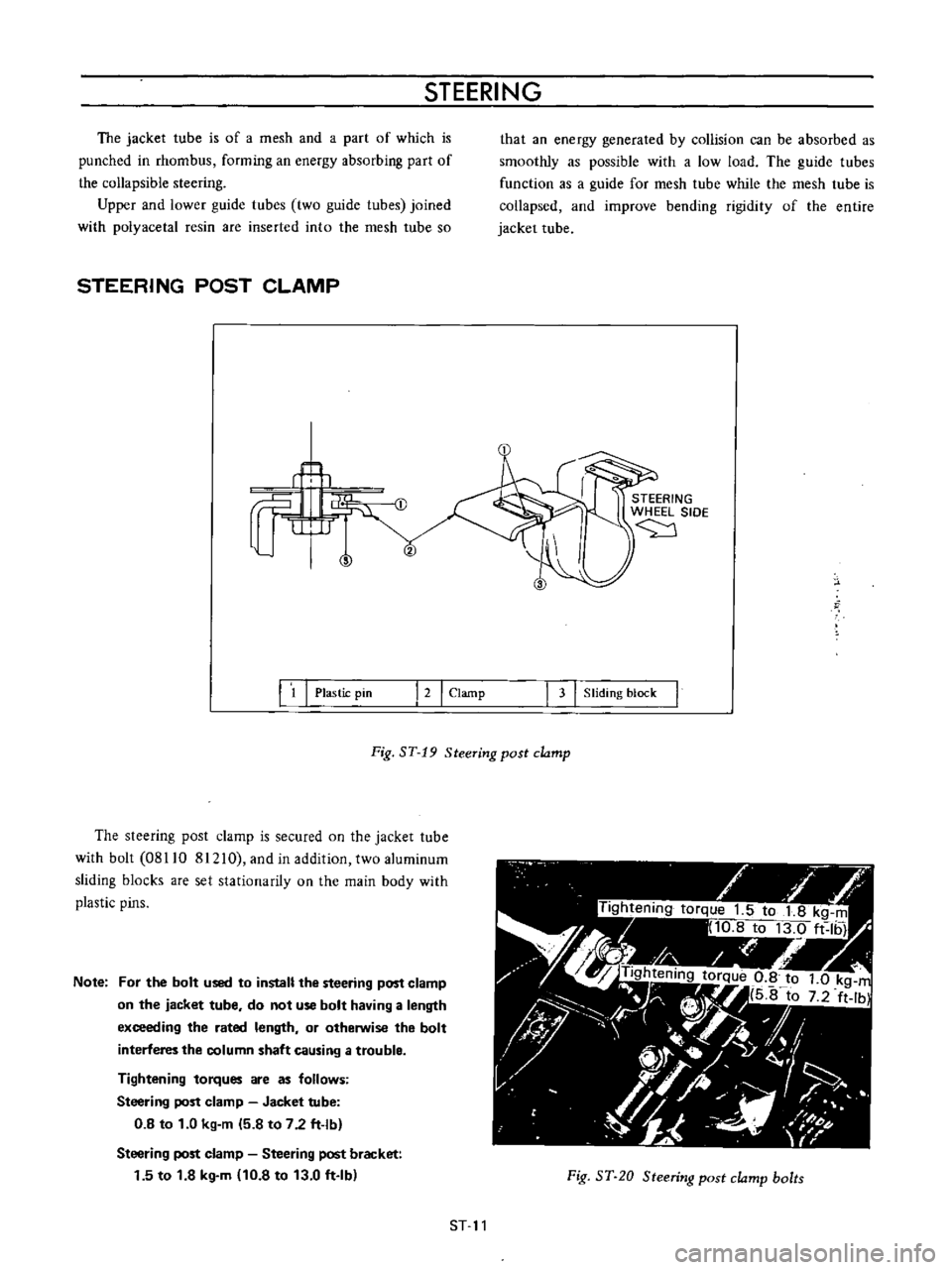
The
steering
post
clamp
is
secured
on
the
jacket
tube
with
bolt
08110
81210
and
in
addition
two
aluminum
sliding
blocks
are
set
stationarity
on
the
main
body
with
plastic
pins
Note
For
the
bolt
used
to
install
the
steering
post
clamp
on
the
jacket
tube
do
not
use
bolt
having
a
length
exceeding
the
rated
length
or
otherwise
the
bolt
interferes
the
column
shaft
causing
a
trouble
Tightening
torques
are
as
follows
Steering
post
clamp
Jacket
tube
0
8
to
1
0
kg
m
5
8
to
7
2
ft
lb
Steering
post
clamp
Steering
post
bracket
1
5
to
1
8
kg
m
10
8
to
13
0
ft
Ib
Fig
ST
20
Steering
post
clamp
bolts
ST
11