ECU DATSUN B110 1973 Service Workshop Manual
[x] Cancel search | Manufacturer: DATSUN, Model Year: 1973, Model line: B110, Model: DATSUN B110 1973Pages: 513, PDF Size: 28.74 MB
Page 300 of 513
GENERAL
INFORMATION
spring
etc
support
the
rear
cruss
member
with
stands
In
other
cases
support
both
ends
of
the
rear
axle
housing
with
stands
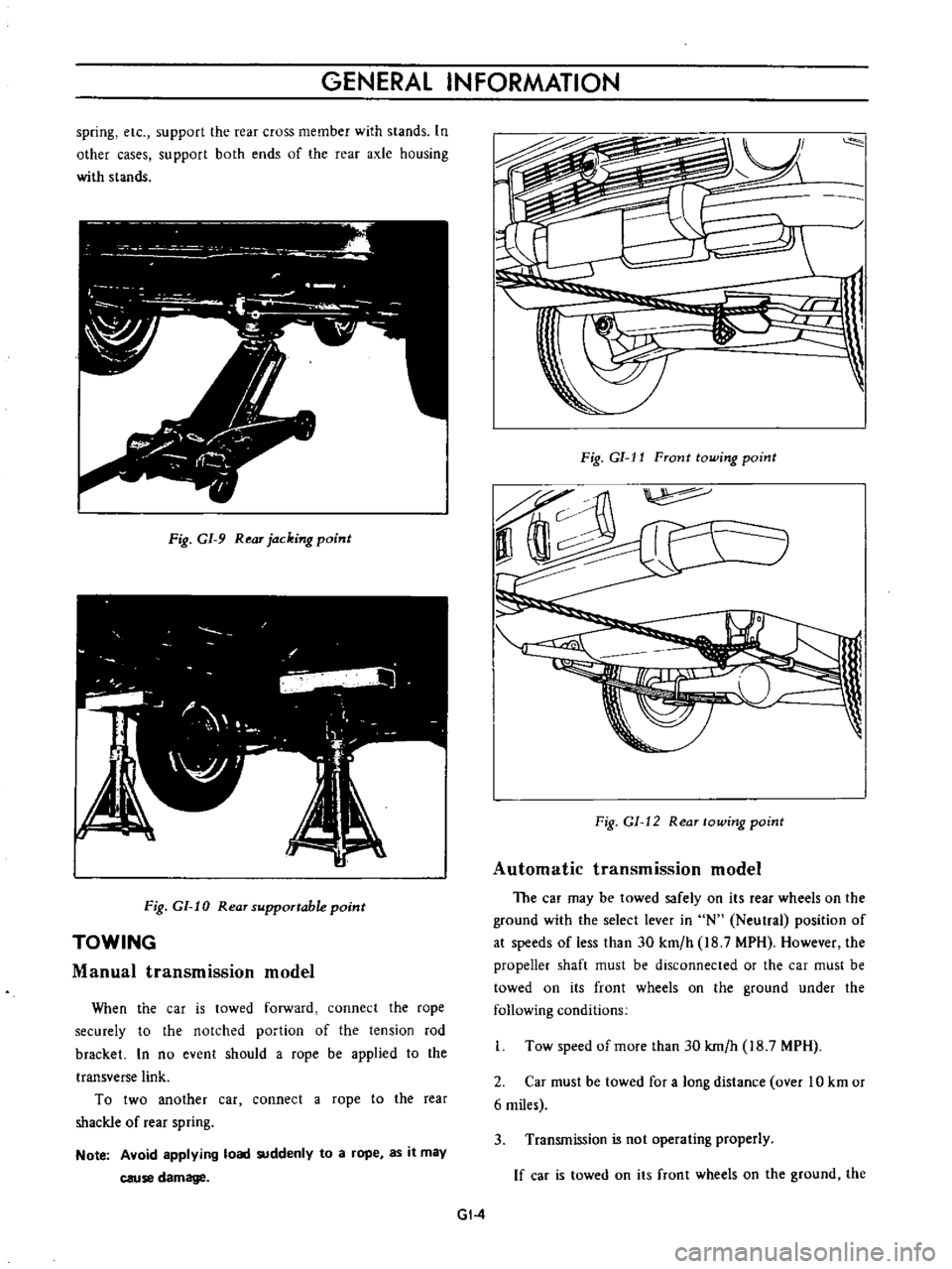
Fig
CI
9
Rear
jacking
point
Fig
C
J
0
Rear
supportable
point
TOWING
Manual
transmission
model
When
the
car
is
towed
forward
connect
the
rope
securely
to
the
notched
portion
of
the
tension
rod
bracket
In
no
event
should
a
rope
be
applied
to
the
transverse
link
To
two
another
car
connect
a
rope
to
the
rear
shackle
of
rear
spring
Note
Avoid
applying
load
suddenly
to
a
rope
as
it
may
cause
damage
Fig
GI
l1
Front
towing
point
Fig
GI
12
Rear
towing
point
Automatic
transmission
model
The
car
may
be
towed
safely
on
its
rear
wheels
on
the
ground
with
the
select
lever
in
N
Neutral
position
of
at
speeds
of
less
than
30
km
h
18
7
MPH
However
the
propeller
shaft
must
be
disconnected
or
the
car
must
be
towed
on
its
front
wheels
on
the
ground
under
the
following
conditions
Tow
speed
of
more
than
30
kro
h
18
7
MPH
2
Car
must
be
towed
for
a
long
distance
over
10
km
or
6
miles
3
Transmission
is
not
operating
properly
If
car
is
towed
on
its
front
wheels
on
the
ground
the
GI
4
Page 301 of 513
GENERAL
INFORMATION
steering
wheel
should
be
secured
to
maintain
a
straight
ahead
position
TIE
DOWN
The
front
tie
down
hook
is
used
the
both
front
end
of
tension
rod
Do
not
apply
the
hook
at
the
center
of
tension
rod
or
suspension
member
The
rear
tie
down
hook
is
used
the
both
front
shackle
of
rear
spring
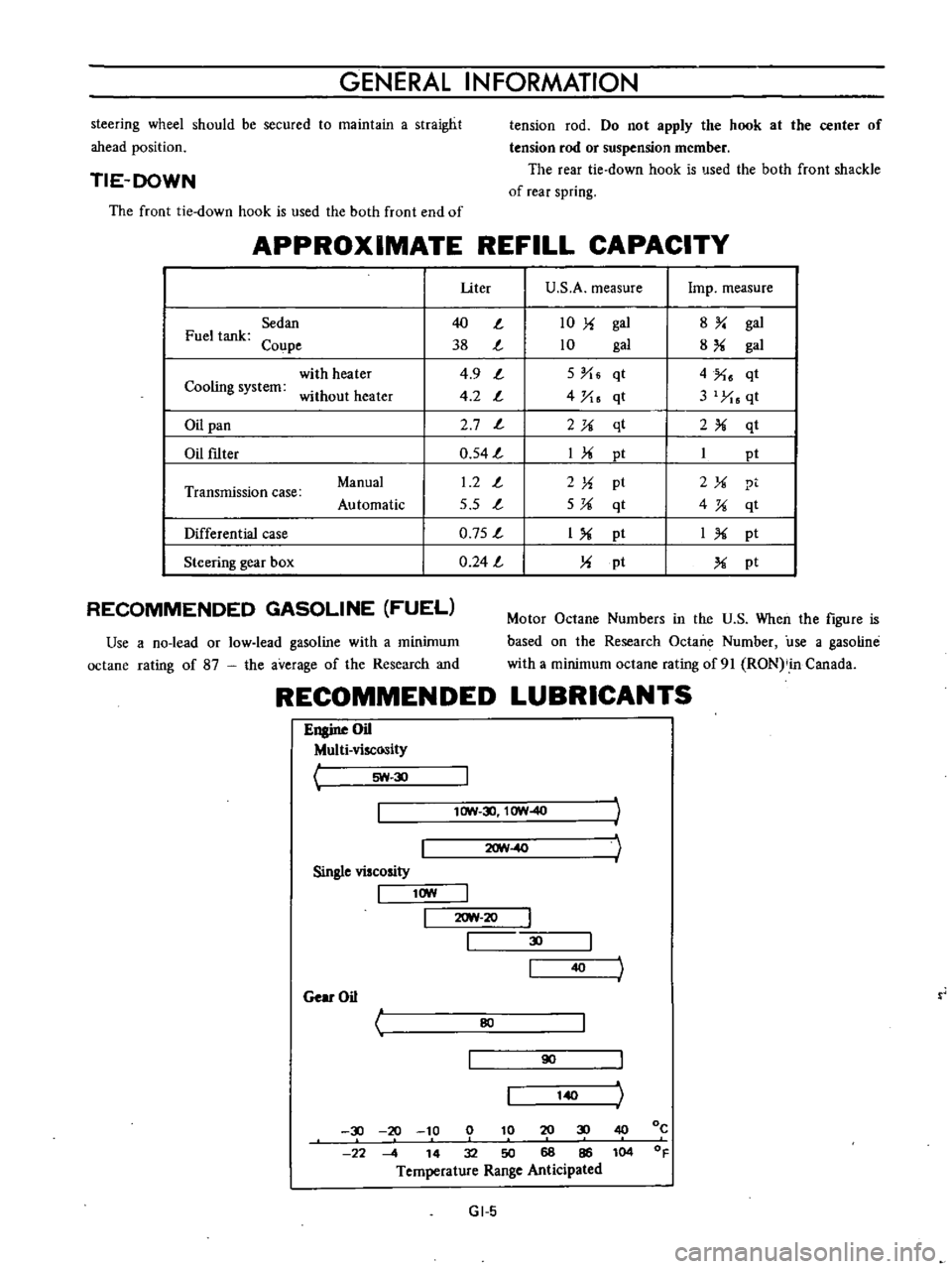
APPROXIMATE
REFILL
CAPACITY
Liter
U
S
A
measure
I
Imp
measure
Sedan
Fuel
tank
Coupe
with
heater
Cooling
system
without
heater
40
L
38
L
4
9
L
4
2
L
2
7
L
0
54
L
1
2
L
5
5
L
0
75
L
0
24
L
Oil
pan
Oilf1lter
Transmission
case
Manual
Automatic
Differential
case
Steering
gear
box
RECOMMENDED
GASOLINE
FUEL
Use
a
no
lead
or
low
lead
gasoline
with
a
minimum
octane
rating
of
87
the
average
of
the
Research
and
1O
gal
8Y
gal
10
gal
8
gal
5
v
qt
4
M
qt
4
Y
6
qt
3
Y
qt
2Ji
qt
2
qt
1
pt
I
pt
2
pt
2
pt
5Ji
qt
4
qt
1
pt
1
pt
pt
pi
Motor
Octane
Numbers
in
the
U
S
When
the
figure
is
based
on
the
Research
Octane
Number
use
a
gasoline
with
a
minimum
octane
rating
of
91
RON
in
Canada
RECOMMENDED
LUBRICANTS
GI
5
r
Page 306 of 513
EMISSION
CONTROL
AND
TUNE
UP
EMISSION
CONTROL
SYSTEM
AN
D
ENGINE
TUNE
UP
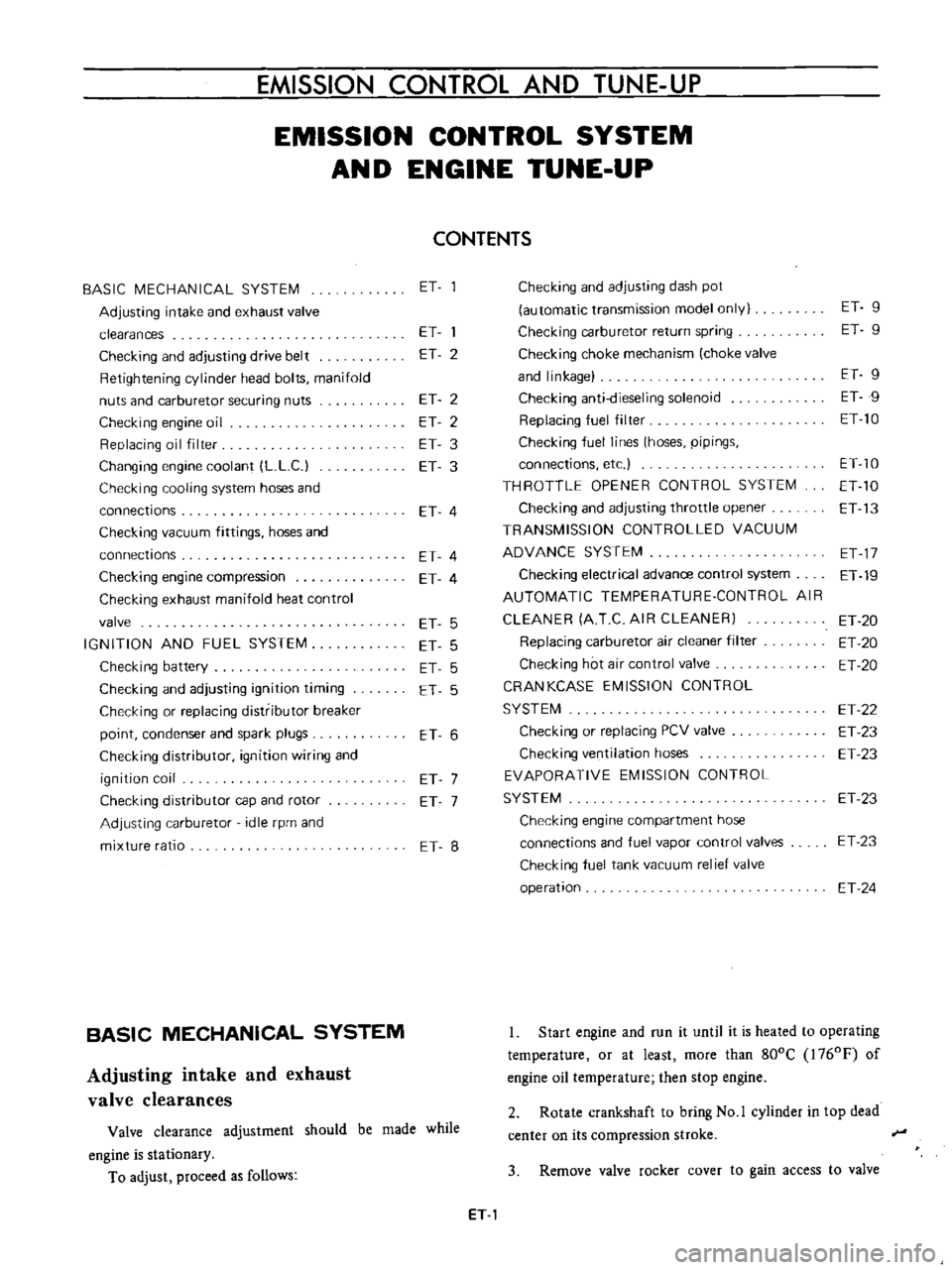
CONTENTS
BASIC
MECHANICAL
SYSTEM
ET
Checking
and
adjusting
dash
pot
Adjusting
intake
and
exhaust
valve
automatic
transmission
model
only
ET
9
clearances
ET
1
Checking
carburetor
return
spring
ET
9
Checking
and
adjustin9
drive
belt
ET
2
Checking
choke
mechanism
choke
valve
Retightening
cylinder
head
bolts
manifold
and
linkagel
ET
9
nuts
and
carburetor
securing
nuts
ET
2
Checking
anti
dieseling
solenoid
ET
9
Checking
engine
oil
ET
2
Replacing
fuel
filter
ET
10
Replacing
oil
filter
ET
3
Checking
fuel
lines
hoses
pipings
Changing
engine
coolant
L
L
C
ET
3
connections
etc
ET10
Checking
cooling
system
hoses
and
THROTTLE
OPENER
CONTROL
SYSTEM
ET
10
connections
ET
4
Checking
and
adjusting
throttle
opener
ET
13
Checking
vacuum
fittings
hoses
and
TRANSMISSION
CONTROLLED
VACUUM
connections
ET
4
ADVANCE
SYSTEM
ET
17
Checking
engine
compression
ET
4
Checking
electrical
advance
control
system
ET
19
Checking
exhaust
manifold
heat
control
AUTOMATIC
TEMPERATURE
CONTROL
AIR
valve
ET
5
CLEANER
A
T
C
AIR
CLEANER
ET
20
IGNITION
AND
FUEL
SYSTEM
ET
5
Replacing
carburetor
air
cleaner
filter
ET
20
Checking
battery
ET
5
Checking
hot
air
control
valve
ET
20
Checking
and
adjusting
ignition
timing
ET
5
CRANKCASE
EMISSION
CONTROL
Checking
or
replacing
distributor
breaker
SYSTEM
ET
22
point
condenser
and
spark
plugs
ET
6
Checking
or
replacing
PCV
valve
ET
23
Checking
distributor
ignition
wiring
and
Checking
ventilation
hoses
ET
23
ignition
coil
ET
7
EVAPORATIVE
EMISSION
CONTROL
Checking
distributor
cap
and
rotor
ET
7
SYSTEM
ET
23
Adjusting
carburetor
id
Ie
rpm
and
Checking
engine
compartment
hose
mixture
ratio
ET
8
connections
and
fuel
vapor
control
valves
ET
23
Checking
fuel
tank
vacuum
relief
valve
operation
ET
24
BASIC
MECHANICAL
SYSTEM
1
Start
engine
and
run
it
until
it
is
heated
to
operating
temperature
or
at
least
more
than
800C
I760F
of
engine
oil
temperature
then
stop
engine
Adjusting
intake
and
exhaust
valve
clearances
Valve
clearance
adjustment
should
be
made
while
engine
is
stationary
To
adjust
proceed
as
follows
2
Rotate
crankshaft
to
bring
No
1
cylinder
in
top
dead
center
on
its
compression
stroke
3
Remove
valve
rocker
cover
to
gain
access
to
valve
ET
1
Page 307 of 513
ENGINE
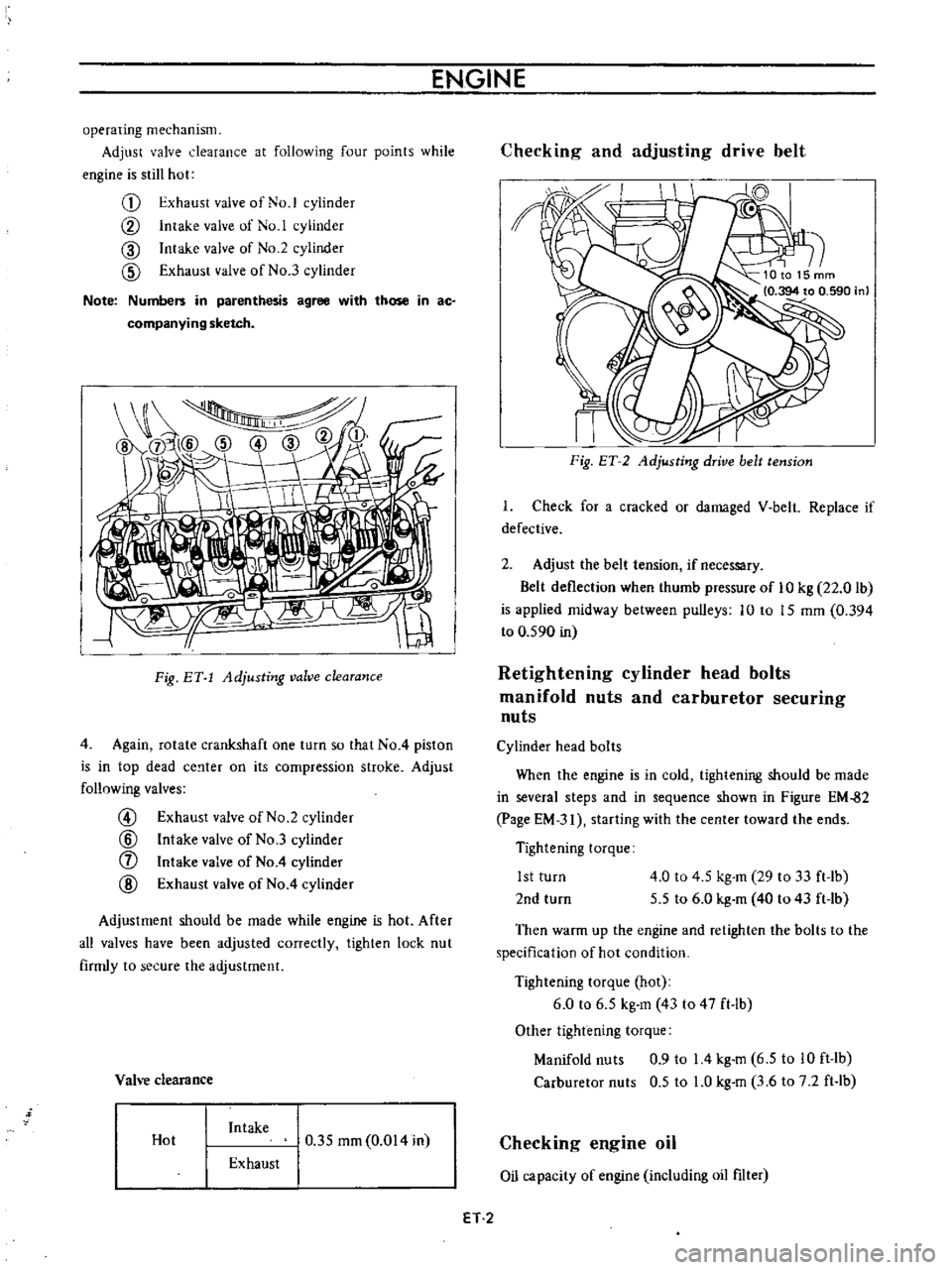
operating
mechanism
Adjust
valve
clearance
at
following
four
points
while
engine
is
still
hot
G
Exhaust
valve
of
No
1
cylinder
CV
Intake
valve
of
No
1
cylinder
CID
Intake
valve
of
No
2
cylinder
CID
Exhaust
valve
of
No
3
cylinder
Note
Numbers
in
parenthesis
agree
with
those
in
ac
companying
sketch
I
Fig
BY
1
Adjusting
valve
clearance
4
Again
rotate
crankshaft
one
turn
so
that
No
4
piston
is
in
top
dead
ce
lter
on
its
compression
stroke
Adjust
follnwing
valves
@
Exhaust
valve
of
No
2
cylinder
@
Intake
valve
of
No
3
cylinder
f
Intake
valve
of
No
4
cylinder
@
Exhaust
valve
of
No
4
cylinder
Adjustment
should
be
made
while
engine
is
hot
After
all
valves
have
been
adjusted
correctly
tighten
lock
nut
firmly
to
secure
the
adjustment
Vah
e
clearance
Hot
Intake
0
35
mm
0
014
in
Exhaust
Checking
and
adjusting
drive
belt
II
I
Fig
ET
2
Adjusting
drive
belt
tension
I
Check
for
a
cracked
or
damaged
V
belt
Replace
if
defective
2
Adjust
the
belt
tension
if
necessary
Belt
deflection
when
thumb
pressure
of
10
kg
22
0
lb
is
applied
midway
between
pulleys
10
to
15
mm
0
394
to
0
590
in
Retightening
cylinder
head
bolts
manifold
nuts
and
carburetor
securing
nuts
Cylinder
head
bolts
When
the
engine
is
in
cold
tightening
should
be
made
in
several
steps
and
in
sequence
shown
in
Figure
EM
82
page
EM
31
starting
with
the
center
toward
the
ends
Tightening
torque
1st
turn
2nd
turn
4
0
to
4
5
kg
m
29
to
33
ft
lb
5
5
to
6
0
kg
m
40
to
43
ft
lb
Then
warm
up
the
engine
and
retighten
the
bolts
to
the
specification
of
hot
condition
Tightening
torque
hot
6
0
to
6
5
kg
m
43
to
47
ft
lb
Other
tightening
torque
Manifold
nuts
0
9
to
14
kg
m
6
5
to
10
ft
lb
Carburetor
nuts
0
5
to
LO
kg
m
3
6
to
7
2
ft
lb
Checking
engine
oil
Oil
capacity
of
engine
including
oil
filter
ET
2
Page 348 of 513
ENGINE
J
I
r
I
I
J
fj
7
L
j
8
if
d1
I
ilfi
3
c
7
I
t
j
v
1
Ji
Fig
EM
27
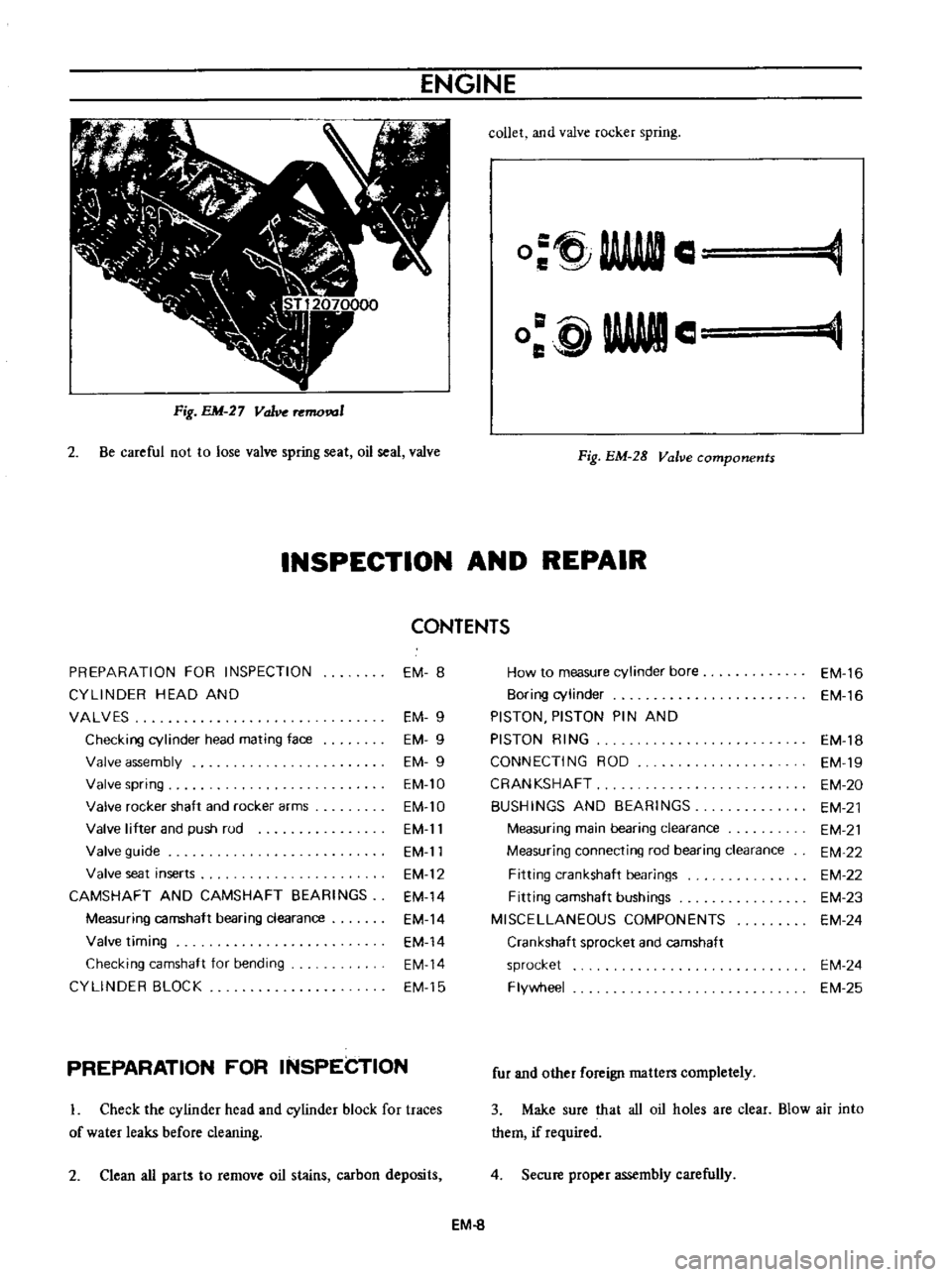
Valve
mo
1
2
Be
careful
not
to
lose
valve
spring
seat
oil
seal
valve
collet
and
valve
rocker
spring
O
tj
AAAftIl
C
e
WWII
o
glAWle
Fig
EM
28
Valve
components
INSPECTION
AND
REPAIR
CONTENTS
PREPARATION
FOR
INSPECTION
EM
8
How
to
measure
cylinder
bore
EM
16
CYLlNOER
HEAD
AND
80ring
cylinder
EM
16
VALVES
EM
9
PISTON
PISTON
PIN
AND
Checking
cylinder
head
mating
face
EM
9
PISTON
RING
EM
18
Valve
assembly
EM
9
CONNECTING
ROD
EM
19
Valve
spring
EM
10
CRANKSHAFT
EM
20
Valve
rocker
shaft
and
rockei
arms
EM
lO
BUSHINGS
AND
BEARINGS
EM
21
Valve
lifter
and
push
rud
EM
11
Measuring
main
bearing
clearance
EM
21
Valve
guide
EM
11
Measuring
connecting
rod
bearing
clearance
EM
22
Valve
seat
inserts
EM
12
Fitting
crankshaft
bearings
EM
22
CAMSHAFT
AND
CAMSHAFT
BEARINGS
EM
14
Fitting
camshaft
bushings
EM
23
Measuring
camshaft
bearing
clearance
EM
14
MISCELLANEOUS
COMPONENTS
EM
24
Valve
timing
EM
14
Crankshaft
sprocket
and
camshaft
Checking
camshaft
for
bending
EM
14
sprocket
EM
24
CYLlNOER
BLOCK
EM
15
Flywheel
EM
25
PREPARATION
FOR
INSPECTION
L
Check
the
cylinder
head
and
cylinder
block
for
traces
of
water
leaks
before
cleaning
2
Clean
all
parts
to
remove
oil
stains
carbon
deposits
fur
and
other
foreign
matters
completely
3
Make
sure
that
all
oil
holes
are
clear
Blow
air
into
them
if
required
4
Secure
proper
assembly
carefully
EM
8
Page 367 of 513
ENGINE
MECHANICAL
3
Apply
engine
oil
to
the
main
bearing
surfaces
on
both
sides
of
the
cylinder
block
and
cap
Install
the
crankshaft
4
Install
the
main
bearing
cap
and
tighten
the
bolts
with
specified
torque
Tightening
torque
5
0
to
6
0
kg
m
36
to
43
ft
lb
Notes
a
Arrange
the
parts
so
that
the
arrow
mark
on
the
bearing
cap
is
faced
toward
the
front
of
the
engine
b
Prior
to
tightening
the
bearing
cap
bolts
place
the
bearing
cap
at
a
proper
position
by
shifting
the
crankshaft
in
the
axial
direction
c
Tighten
the
bearing
cap
bolts
gradually
in
separating
two
to
three
stages
and
outwardly
from
the
center
beari
ng
d
After
securing
the
bearing
cap
bolts
ascertain
that
the
crankshaft
can
be
easily
rotated
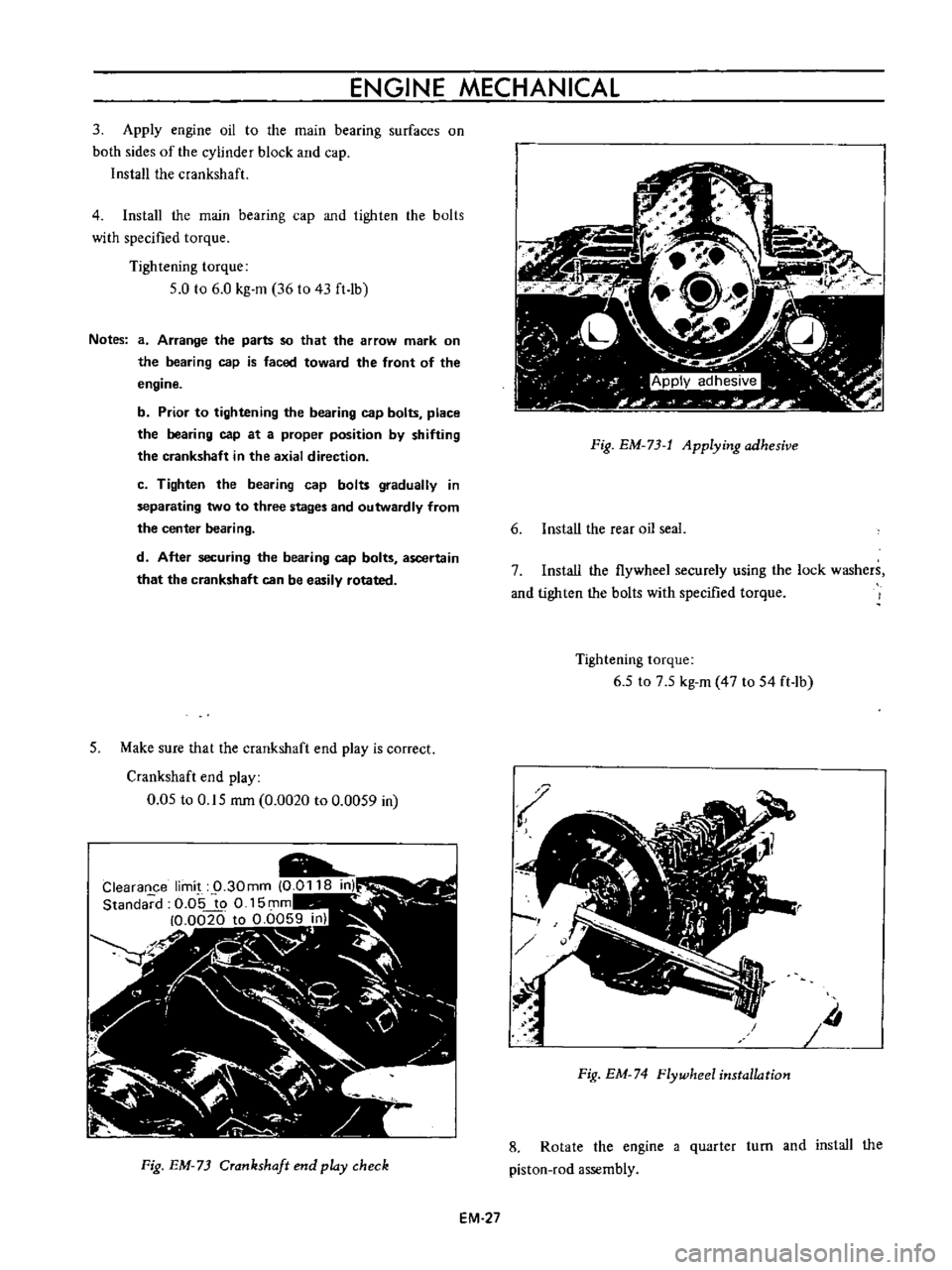
5
Make
sure
that
the
crankshaft
end
play
is
correct
Crankshaft
end
play
0
05
to
0
15
rom
0
0020
to
0
0059
in
Fig
EM
73
Crankshaft
end
play
check
EM
27
Fig
EM
73
t
Applying
adhesive
6
Install
the
rear
oil
seal
7
Install
the
flywheel
securely
using
the
lock
washers
and
tighten
the
bolts
with
specified
torque
Tightening
torque
6
5
to
7
5
kg
m
47
to
54
ft
lb
Iii
Fig
EM
74
Flywheel
installation
8
Rotate
the
engine
a
quarter
turn
and
install
the
piston
rod
assembly
Page 383 of 513
LUBRICATION
CIRCUIT
Oil
drawn
from
the
oil
pan
through
the
inlet
screen
and
tube
to
the
inlet
side
of
the
oil
pump
is
delivered
by
th
oil
pump
through
the
outlet
portion
of
the
oil
pump
and
the
oil
gallery
to
the
inlet
side
of
the
full
flow
oil
filter
and
to
the
main
oil
gallery
The
main
oil
gallery
supplies
oil
to
the
crankshaft
main
bearings
and
drilled
passages
in
the
crankshaft
and
thus
oil
is
fed
directly
from
the
main
bearings
to
the
connecting
rod
bearings
Oil
injected
from
jet
holes
on
connecting
rods
lubri
cates
the
cylinder
walls
and
pistion
pins
The
oil
distributed
from
the
main
gallery
enters
the
chain
teosioner
and
the
pad
is
held
against
the
chain
by
oil
pressure
and
spring
The
oil
also
lubricates
the
timing
chain
through
the
jet
hole
located
near
the
chain
Furthermore
lubricant
is
supplied
to
each
camshaft
bearing
through
each
crankshaft
main
bearing
and
finally
to
the
011
gallery
in
the
rocker
shaft
through
the
center
camshaft
bearing
The
rocker
arm
and
valve
are
lubricated
by
the
oil
through
the
oil
gallery
in
the
rockershaft
To
this
oil
gallery
lubricant
is
supplied
through
the
center
camshaft
bearing
as
shown
in
Figure
EL
I
OIL
PUMP
Description
The
oil
pump
assembly
is
installed
on
the
bottom
of
the
cylinder
block
and
driven
by
the
distributor
drive
shaft
assembly
The
oil
pump
is
of
a
rotor
type
The
oil
pressure
is
regulated
by
the
regulator
valve
camshaft
Removal
Engine
in
vehicle
Drain
engine
oil
2
Remove
the
frunt
stabilizer
3
Remove
the
splash
shield
board
4
Detach
the
oil
pump
body
together
with
drive
gear
spindle
ENGINE
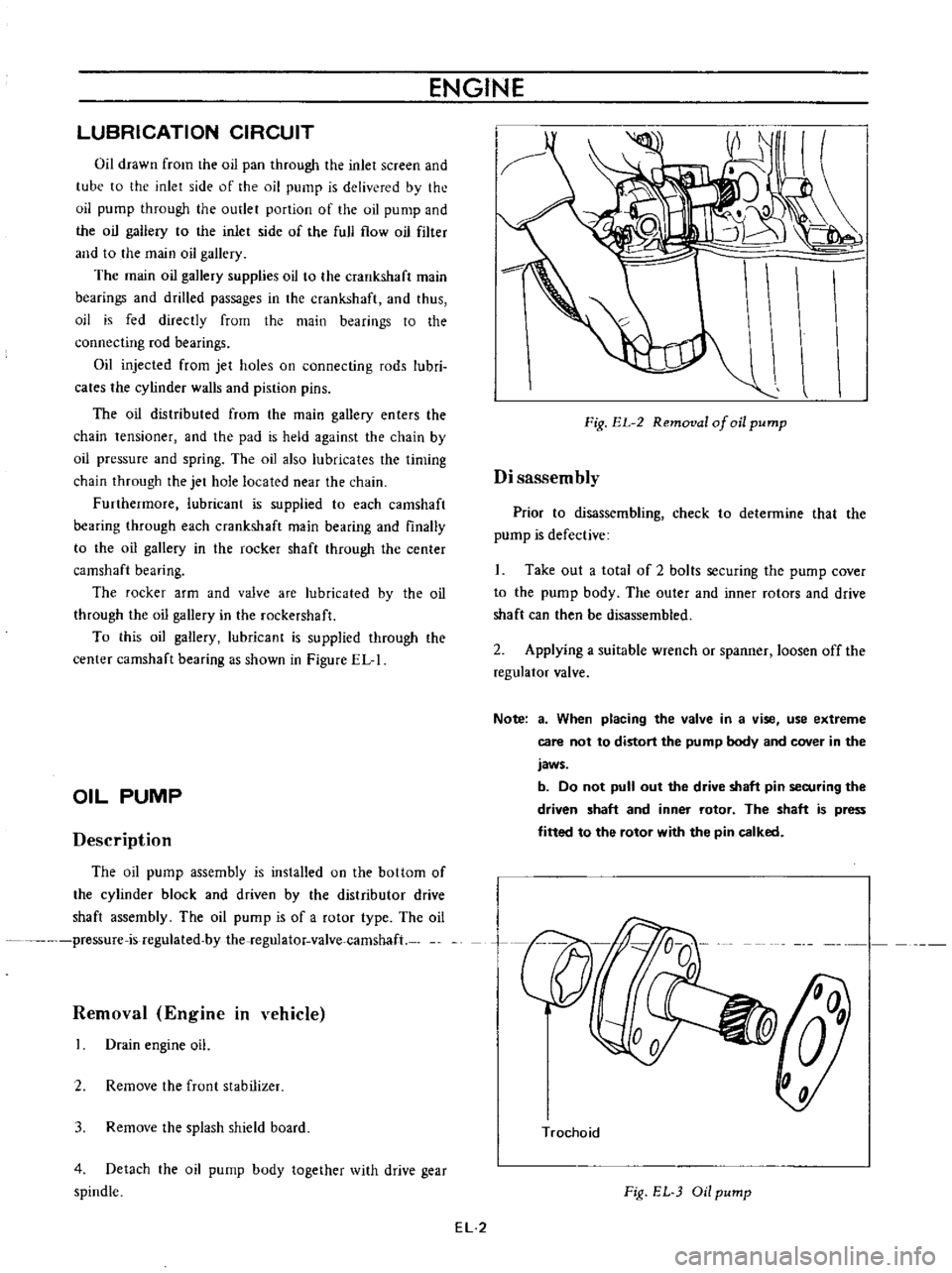
Fig
EL
2
Removal
of
oil
pump
Disassembly
Prior
to
disassembling
check
to
determine
that
the
pump
is
defective
Take
out
a
total
of
2
bolts
securing
the
pump
cover
to
the
pump
body
The
outer
and
inner
rotors
and
drive
shaft
can
then
be
disassembled
2
Applying
a
suitable
wrench
or
spanner
loosen
off
the
regulator
valve
Note
a
When
placing
the
valve
in
a
vise
use
extreme
care
not
to
distort
the
pump
body
and
cover
in
the
jaws
b
Do
not
pull
out
the
drive
shaft
pin
securing
the
driven
shaft
and
inner
rotor
The
shaft
is
press
fitted
to
the
rotor
with
the
pin
calked
n
Trochoid
Fig
EL
Oil
pump
EL
2
Page 410 of 513
FUEl
SYSTEM
MA
JOR
SERVICE
OPERATIONS
A
completely
adjusted
and
serviced
carburetor
will
provide
the
engine
with
proper
mixture
at
all
speeds
Periodical
overhauling
which
cleans
all
components
and
passages
will
recover
the
originally
designed
performance
producing
the
engine
with
proper
gasoline
and
air
ratio
at
all
speeds
Passages
and
holes
of
the
carburetor
must
be
cleaned
carefully
Use
only
carburetor
solvent
and
com
pressed
air
to
clean
aU
passages
and
discharge
holes
Never
use
wire
or
other
pointed
tool
otherwise
accurately
calibrated
carburetor
will
be
affected
Removal
Remove
the
air
cleaner
2
Disconnect
the
fuel
line
vacuum
line
automatic
choke
harness
and
anti
dieseling
solenoid
harness
from
carburetor
3
Remove
the
throttle
lever
4
Remove
four
nuts
and
washers
retaining
the
carbuTe
tor
to
the
manifold
if
necessary
5
Lift
the
carburetor
and
remove
from
the
manifold
6
Remove
and
discard
the
gasket
used
between
the
carburetor
and
manifold
Disassembly
The
main
jets
and
needle
valves
on
both
primary
and
secondary
sides
are
accessible
from
outside
of
the
carbure
tor
for
disassembly
2
Remove
throttle
return
spring
3
Remove
pump
lever
shaft
take
out
pump
lever
and
pump
connecting
rod
4
Remove
rubber
pipe
from
choke
piston
5
Loosen
off
bolts
securing
servo
diaphragm
in
posi
tion
take
out
diaphragm
6
Back
off
total
of
five
bolts
which
hold
choke
in
position
and
remove
rods
of
starter
system
take
out
choke
chamber
In
removing
chamber
exercise
care
to
avoid
damaging
float
EF
19
ilia
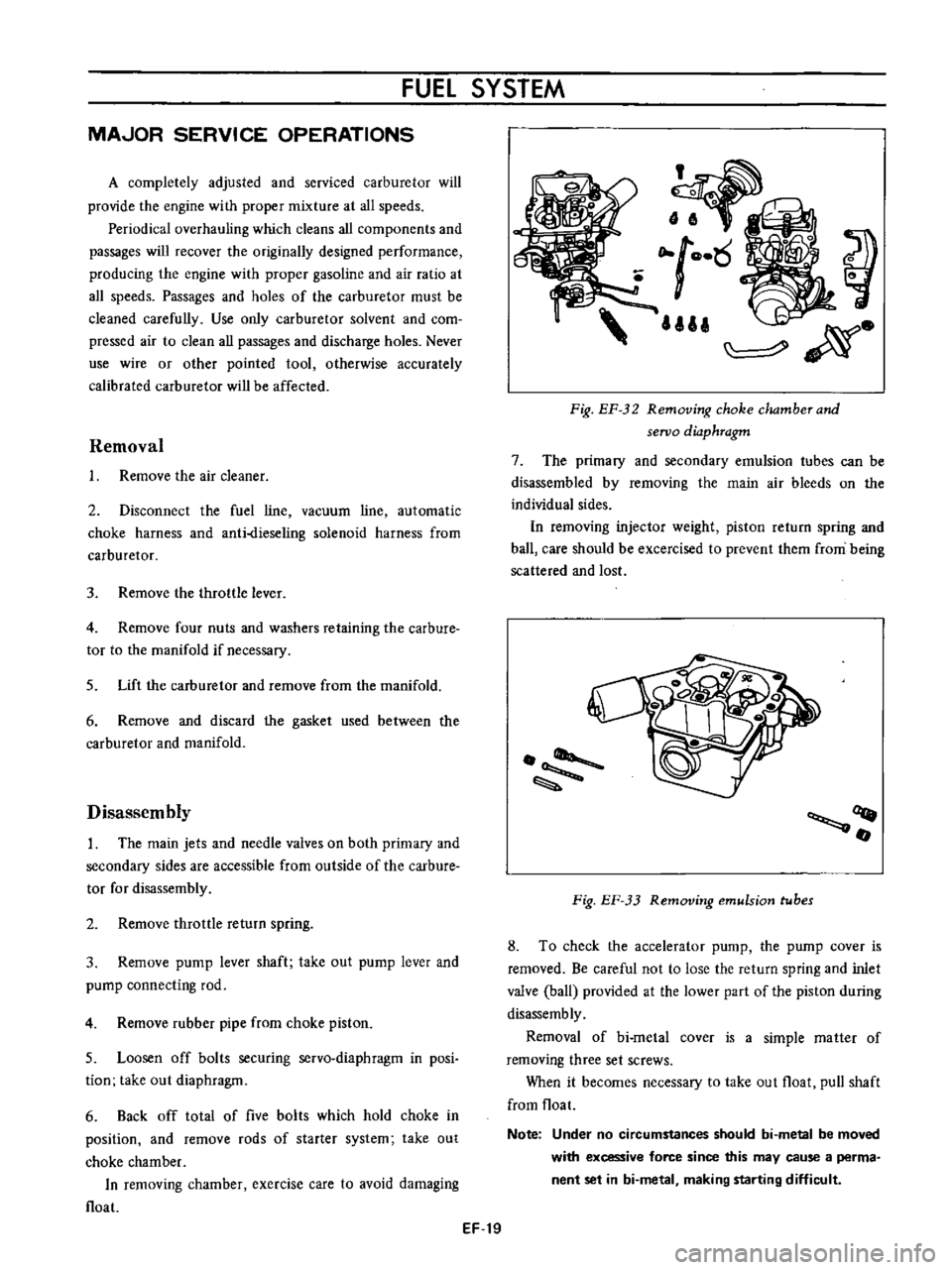
Fig
EF
32
Removing
choke
dwmherand
seroo
diaphragm
7
The
primary
and
secondary
emulsion
tubes
can
be
disassembled
by
removing
the
main
air
bleeds
on
the
individual
sides
In
removing
injector
weight
piston
return
spring
and
ball
care
should
be
excercised
to
prevent
them
from
being
scattered
and
lost
OQ
fI
Fig
EF
33
Removing
emulsion
tubes
8
To
check
the
accelerator
pump
the
pump
cover
is
removed
Be
careful
not
to
lose
the
return
spring
and
inlet
valve
ball
provided
at
the
lower
part
of
the
piston
during
disassemb
ly
Removal
of
bi
metal
cover
is
a
simple
matter
of
removing
three
set
screws
When
it
becomes
necessary
to
take
out
float
pull
shaft
from
float
Note
Under
no
circumstances
should
bi
metal
be
moved
with
excessive
force
since
this
may
cause
a
perma
nent
set
in
bi
metal
making
starting
difficult
Page 424 of 513
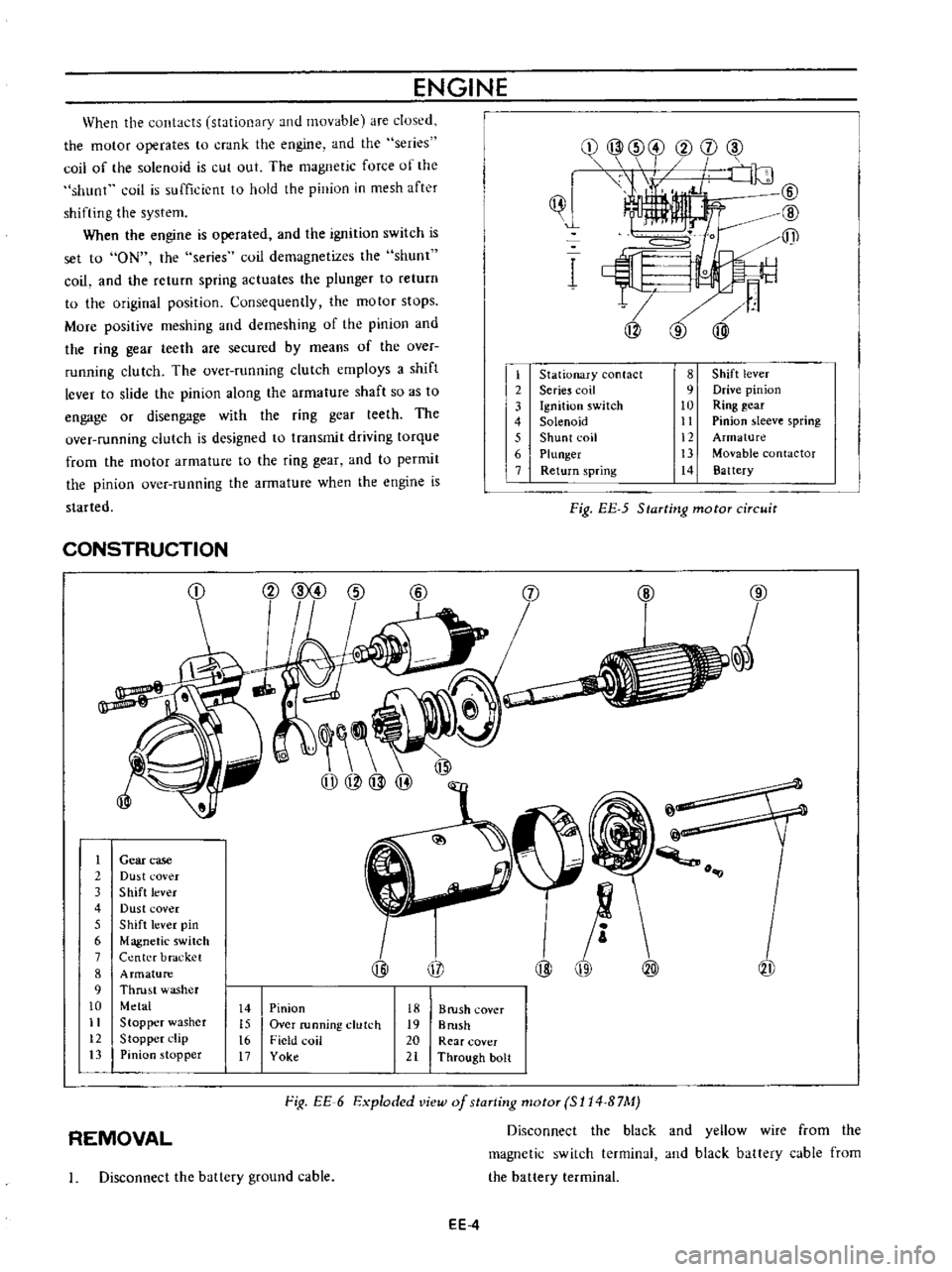
When
the
contacts
stationary
and
movable
are
dused
the
motor
operates
to
crank
the
engine
and
the
series
coil
of
the
solenoid
is
cut
out
The
magnetic
force
of
the
shunt
coil
is
sufficient
to
hold
the
pinion
in
mesh
after
shifting
the
system
When
the
engine
is
operated
and
the
ignition
switch
is
set
to
ON
the
series
coil
demagnetizes
the
shunt
coil
and
the
return
spring
actuates
the
plunger
to
return
to
the
original
position
Consequently
the
motor
stops
More
positive
meshing
and
demeshing
of
the
pinion
and
the
ring
gear
teeth
are
secured
by
means
of
the
over
running
clutch
The
over
running
clutch
employs
a
shift
lever
to
slide
the
pinion
along
the
armature
shaft
so
as
to
engage
or
disengage
with
the
ring
gear
teeth
The
over
running
clutch
is
designed
to
transmit
driving
torque
from
the
motor
armature
to
the
ring
gear
and
to
permit
the
pinion
over
running
the
armature
when
the
engine
is
started
ENGINE
ijJ
1
t
2
3
4
5
6
7
Stationary
contact
Serie
coil
Ignition
switch
Solenoid
Shunt
coil
Plunger
Return
spring
8
Shift
lever
9
Drive
pinion
10
Ring
gear
11
Pinion
sleeve
spring
12
Armature
13
Movable
contactor
14
Battery
Fig
EE
5
Starting
motor
circuit
CONSTRUCTION
1
2
3
4
5
6
7
8
9
10
11
12
13
j
@
Gear
case
Du
t
cover
Shift
lever
Dust
cover
Shift
lever
pin
Magnetic
switch
Center
bracket
Armature
Thrust
washer
Metal
Stopper
washer
Stopper
l
lip
Pinion
stopper
@
@
o
@
i
1I
@
@
@
14
15
t6
17
Pinion
Over
running
clutch
Field
coil
Yoke
18
B
rush
cover
19
Brush
20
Rear
cover
21
Through
bolt
Fig
EE
6
Exploded
view
of
staTting
motoT
SI14
B7M
Disconnect
the
black
and
yellow
wire
from
the
magnetic
switch
terminal
and
black
battery
cable
from
the
battery
terminal
REMOVAL
I
Disconnect
the
ballery
ground
cable
EE
4
Page 425 of 513
ENGINE
ELECTRICAL
SYSTEM
2
Remove
two
bolts
llsed
to
secure
the
starting
motor
on
the
clutch
housing
Pull
the
starter
assembly
forward
and
remove
the
starting
motor
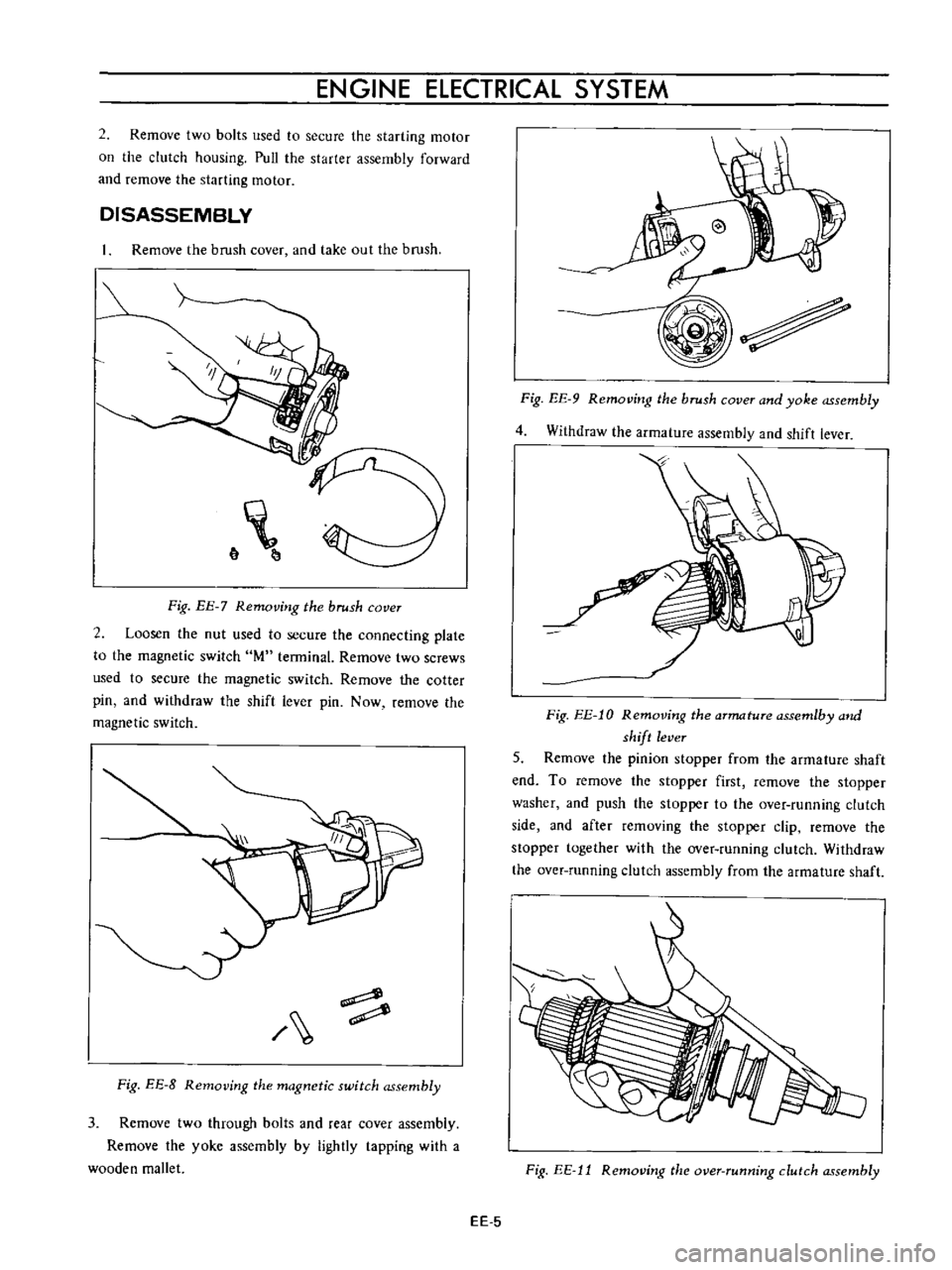
DISASSEMBLY
Remove
the
brush
cover
and
take
out
the
brush
6
Fig
EE
7
Removing
the
brush
cover
2
Loosen
the
nut
used
to
secure
the
connecting
plate
to
the
magnetic
switch
M
terminal
Remove
two
screws
used
to
secure
the
magnetic
switch
Remove
the
cotter
pin
and
withdraw
the
shift
lever
pin
Now
remove
the
magnetic
switch
Fig
EE
8
Removing
the
magnetic
switch
assembly
3
Remove
two
through
bolts
and
rear
cover
assembly
Remove
the
yoke
assembly
by
lightly
tapping
with
a
wooden
mallet
Fig
EE
9
Removing
the
brush
cover
and
yoke
assembly
4
Withdraw
the
armature
assembly
and
shift
lever
Fig
EE
l0
Removing
the
armature
assemlby
and
shift
lever
5
Remove
the
pinion
stopper
from
the
armature
shaft
end
To
remove
the
stopper
first
remove
the
stopper
washer
and
push
the
stopper
to
the
over
running
clutch
side
and
after
removing
the
stopper
clip
remove
the
stopper
together
with
the
over
running
clutch
Withdraw
the
over
running
clutch
assembly
from
the
armature
shaft
Fig
EE
11
Removing
the
over
running
clutch
assembly
EE
5