ECU DATSUN B110 1973 Service Manual PDF
[x] Cancel search | Manufacturer: DATSUN, Model Year: 1973, Model line: B110, Model: DATSUN B110 1973Pages: 513, PDF Size: 28.74 MB
Page 445 of 513
ENGINE
ElECTRICAL
SYSTEM
Ambient
temperature
Rated
regulating
voltage
roC
OF
V
10
14
14
6
to
15
6
0
32
14
45
to
15
45
10
50
14
3
to
15
3
20
68
14
15
to
15
15
30
86
14
0
to
15
0
40
104
13
85
to
14
85
Note
8
Do
not
measure
voltage
immediately
after
driv
ing
Do
this
while
regulator
is
cold
b
To
measure
voltage
raise
engine
speed
gradual
ly
from
idling
to
rated
speed
c
Voltage
may
be
approximately
O
3V
higher
than
the
rated
for
two
to
three
minutes
after
engine
is
started
or
more
specifically
when
regulator
becomes
self
heated
Measurements
should
then
be
made
within
one
minute
after
starting
engine
or
when
regulator
is
cold
d
The
regulator
is
of
a
temperature
compensating
type
Before
measuring
voltage
be
sure
to
meas
ure
surrounding
temperature
and
correct
measure
ments
according
to
the
table
in
the
left
hand
side
ADJUSTMENT
Voltage
regulator
As
the
result
of
above
measurement
when
the
regu
lating
voltage
is
deviated
from
the
rated
value
adjust
the
regulator
in
accordance
with
the
following
instructions
I
Inspect
contact
surface
and
if
rough
lightly
polish
the
surface
with
fine
emery
paper
500
or
600
2
Measure
each
gap
and
adjust
if
necessary
Adjust
the
core
gap
and
point
gap
in
that
order
No
adjustment
is
required
for
the
yoke
gap
J
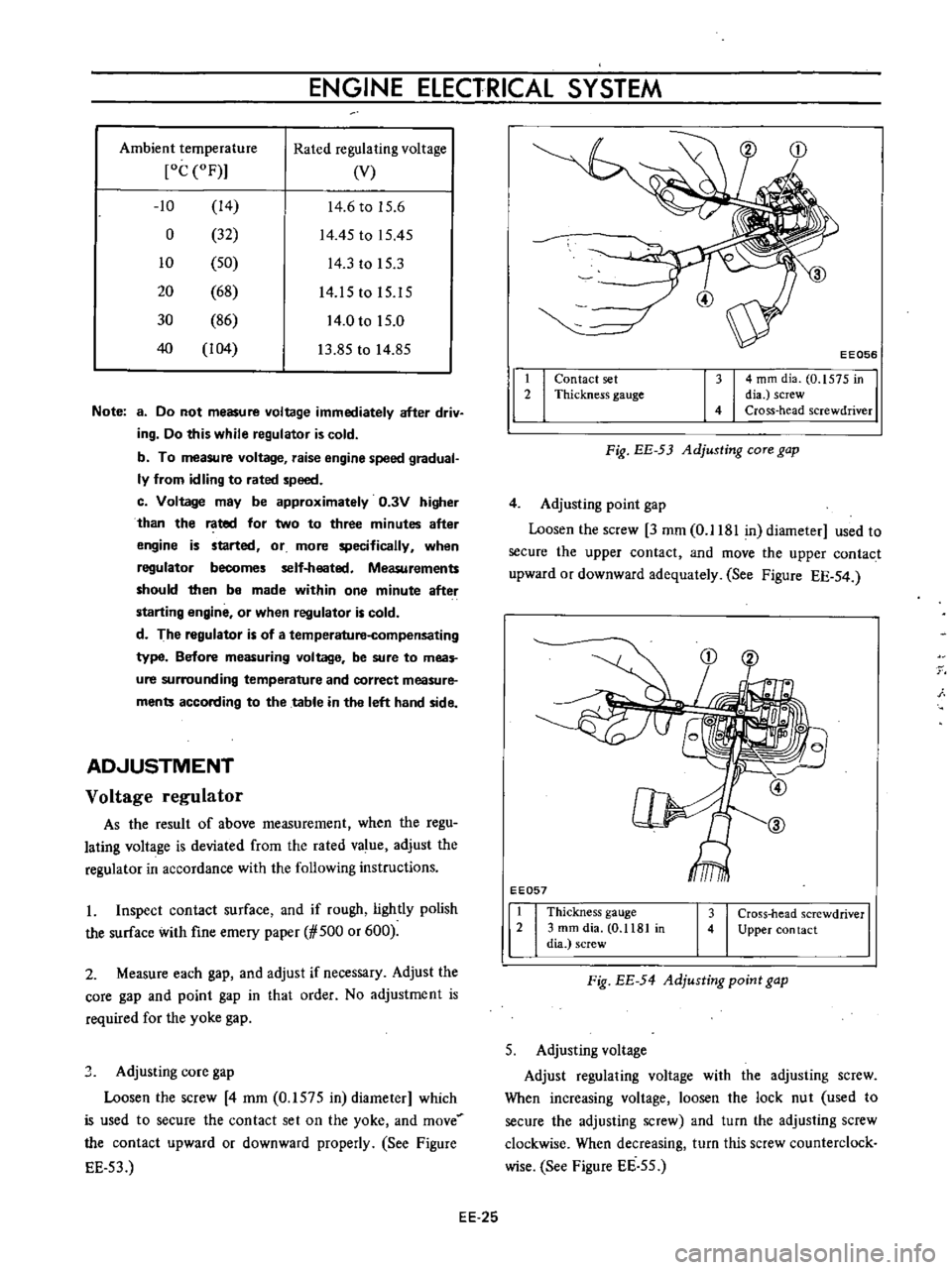
Adjusting
core
gap
Loosen
the
screw
4
mm
0
1575
in
diameter
which
is
used
to
secure
the
contact
set
on
the
yoke
and
move
the
contact
upward
or
downward
properly
See
Figure
EE
53
t
2
I
I
EE056
4
mm
dia
0
1575
in
dia
screw
Cross
head
screwdriver
Contact
set
Thickness
gauge
Fig
EE
53
Adjusting
COTe
gap
4
Adjusting
point
gap
Loosen
the
screw
3
mm
0
1181
in
diameter
used
to
secure
the
upper
contact
and
move
the
upper
contact
upward
or
downward
adequately
See
Figure
EE
54
EE057
1
Thickness
gauge
2
3
mm
dia
0
1181
in
dia
screw
3
Cross
head
screwdriver
4
Upper
con
tact
Fig
EE
54
Adjusting
point
gap
5
Adjusting
voltage
Adjust
regulating
voltage
with
the
adjusting
screw
When
increasing
voltage
loosen
the
lock
nut
used
to
secure
the
adjusting
screw
and
turn
the
adjusting
screw
clockwise
When
decreasing
turn
this
screw
counterclock
wise
See
Figure
EE
55
EE
25
Page 453 of 513
ENGINE
ElECTRICAL
SYSTEM
2
Leakage
due
to
defective
diaphragm
3
Stationary
side
and
moving
side
of
the
breaker
plate
are
sticked
Solution
for
1
is
to
make
complete
fastening
and
2
is
to
replace
it
with
a
new
one
Solution
for
3
is
as
follows
I
The
moving
side
of
the
breaker
plate
is
supported
by
three
steel
balls
at
upper
and
lower
sides
Make
sure
that
these
balls
work
smoothly
2
The
moving
side
of
the
breaker
plate
is
rotated
with
the
stationary
side
pivot
receiver
Make
sure
that
this
pivot
receiver
operates
correctly
When
assembling
be
sure
to
apply
three
steel
balls
to
the
upper
and
lower
sides
and
to
grease
them
DISASSEMBLY
AND
REASSEMBLY
Disassembly
When
the
distributor
is
disconnected
from
engine
position
of
distributor
and
rotor
head
for
housing
must
be
weB
remembered
or
marked
If
distributor
is
installed
incorrectly
it
does
not
operate
correctly
Disassembly
is
to
be
carried
out
in
the
following
sequence
I
Remove
cap
and
disconnect
rotor
head
2
When
removing
the
contact
set
first
unscrew
two
set
screws
one
to
one
and
a
half
of
full
turn
Remove
the
primary
lead
terminals
and
remove
the
contact
set
from
the
distributor
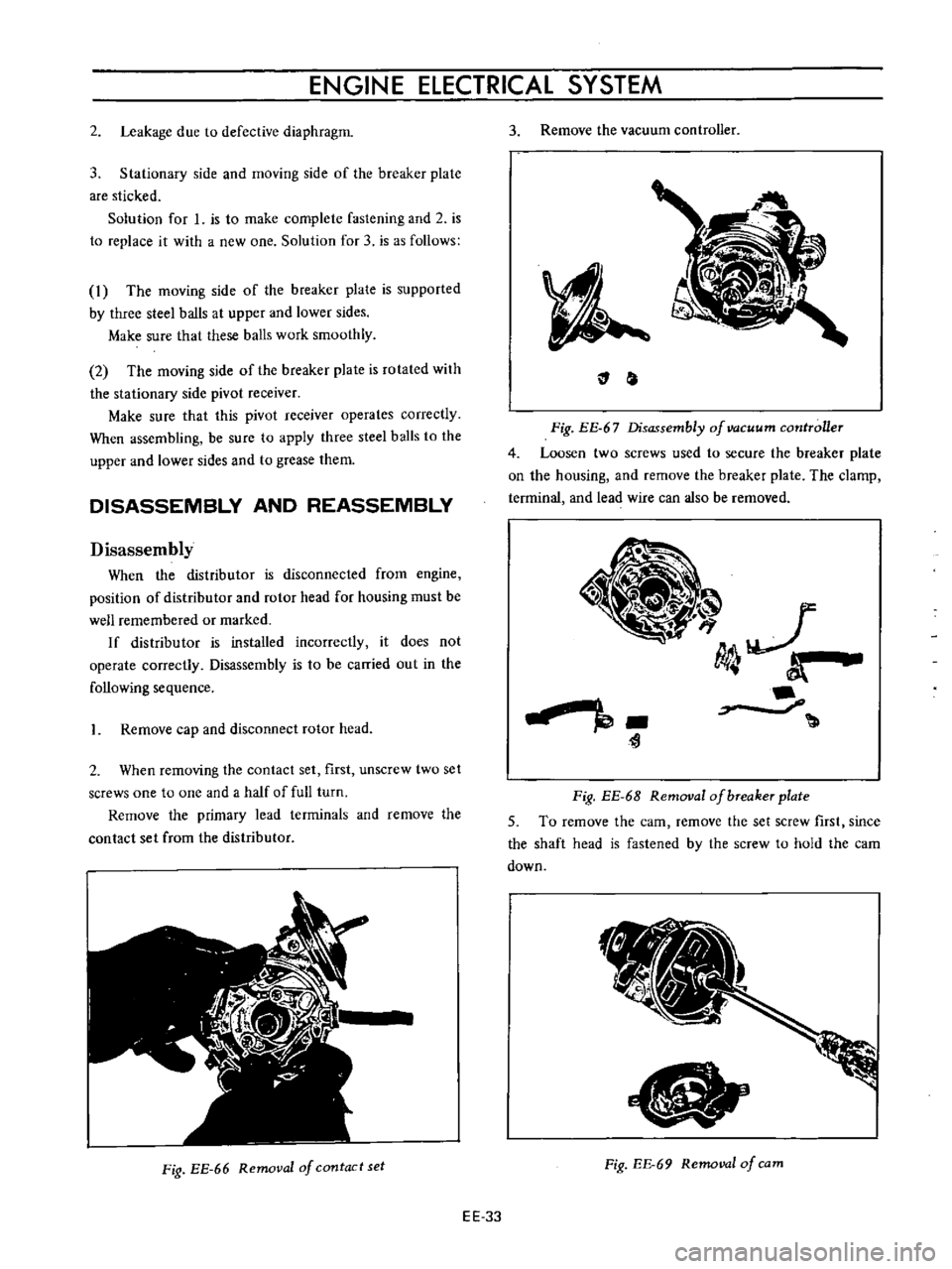
Fig
EE
66
Removal
of
contact
set
EE
33
3
Remove
the
vacuum
controller
Fig
EE
67
Disassembly
of
vacuum
controller
4
Loosen
two
screws
used
to
secure
the
breaker
plate
on
the
housing
and
remove
the
breaker
plate
The
clamp
terminal
and
lead
wire
can
also
be
removed
r
Fig
EE
6B
Removal
ofbTeaker
plate
5
To
remove
the
earn
remove
the
set
screw
first
since
the
shaft
head
is
fastened
by
the
screw
to
hold
the
cam
down
Fig
EE
69
Removal
of
cam
Page 465 of 513
CHASSIS
3
Make
sure
that
the
wire
or
chain
used
to
suspend
the
engine
is
positioned
properly
so
that
no
load
is
applied
to
the
insulators
and
remove
the
nuts
completely
4
Lift
up
the
engine
and
separate
the
insulators
from
the
engine
mounting
brackets
l
J
o
II
f
T
io
I
t
i
1
A
t
t
I
21
u
I
1
Qj
1
It
I
j
fi
I
I
lt
y
Ii
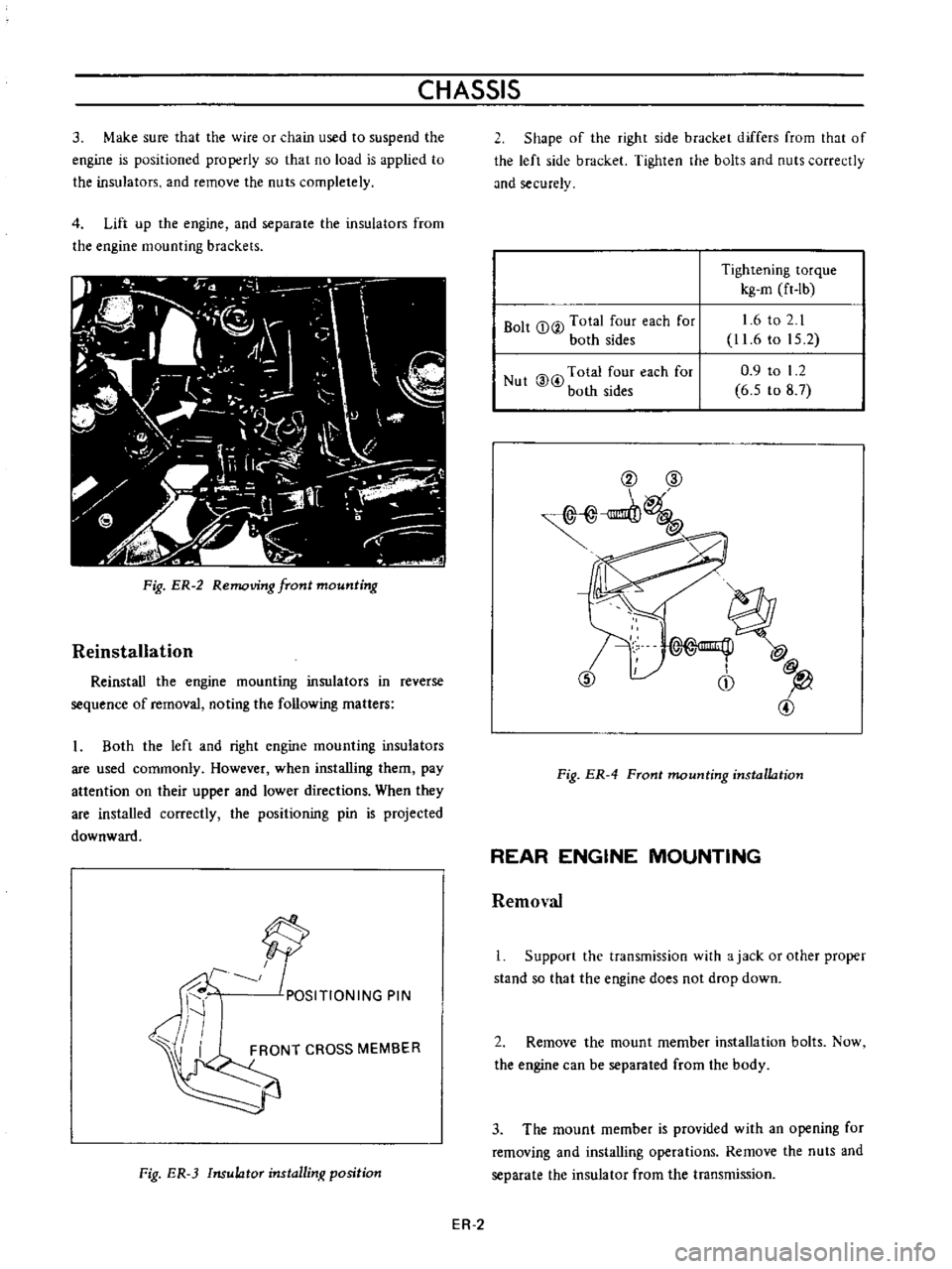
Fig
ER
2
Removing
front
mounting
Reinstallation
Reinstall
the
engine
mounting
insulators
in
reverse
sequence
of
removal
noting
the
following
matters
Both
the
left
and
right
engine
mounting
insulators
are
used
commonly
However
when
installing
them
pay
attention
on
their
upper
and
lower
directions
When
they
are
installed
correctly
the
positioning
pin
is
projected
downward
f
9
POSITIONING
PIN
I
FRONT
CROSS
MEMBER
Fig
ER
3
Insulator
installinx
position
2
Shape
of
the
right
side
bracket
differs
from
that
of
the
left
side
bracket
Tighten
the
bolts
and
nuts
correctly
md
securely
Bolt
CD
V
Total
four
each
for
both
sides
Tightening
torque
kg
m
ft
Ib
1
6
to
2
1
11
6
to
15
2
0
9
to
I
2
6
5
to
8
7
Nut
@
i
Total
four
each
for
both
sides
@
CID
1
@
CD
l
Fig
ER
4
Front
mounting
installation
REAR
ENGINE
MOUNTING
Removal
Support
the
transmission
with
ajack
or
other
proper
stand
so
that
the
engine
does
not
drop
down
2
Remove
the
mount
member
installation
bolts
Now
the
engine
can
be
separated
from
the
body
3
The
mount
member
is
provided
with
an
opening
for
removing
and
installing
operations
Remove
the
nuts
and
separate
the
insulator
from
the
transmission
ER
2
Page 466 of 513
ENGINE
REMOVAL
INSTAllATION
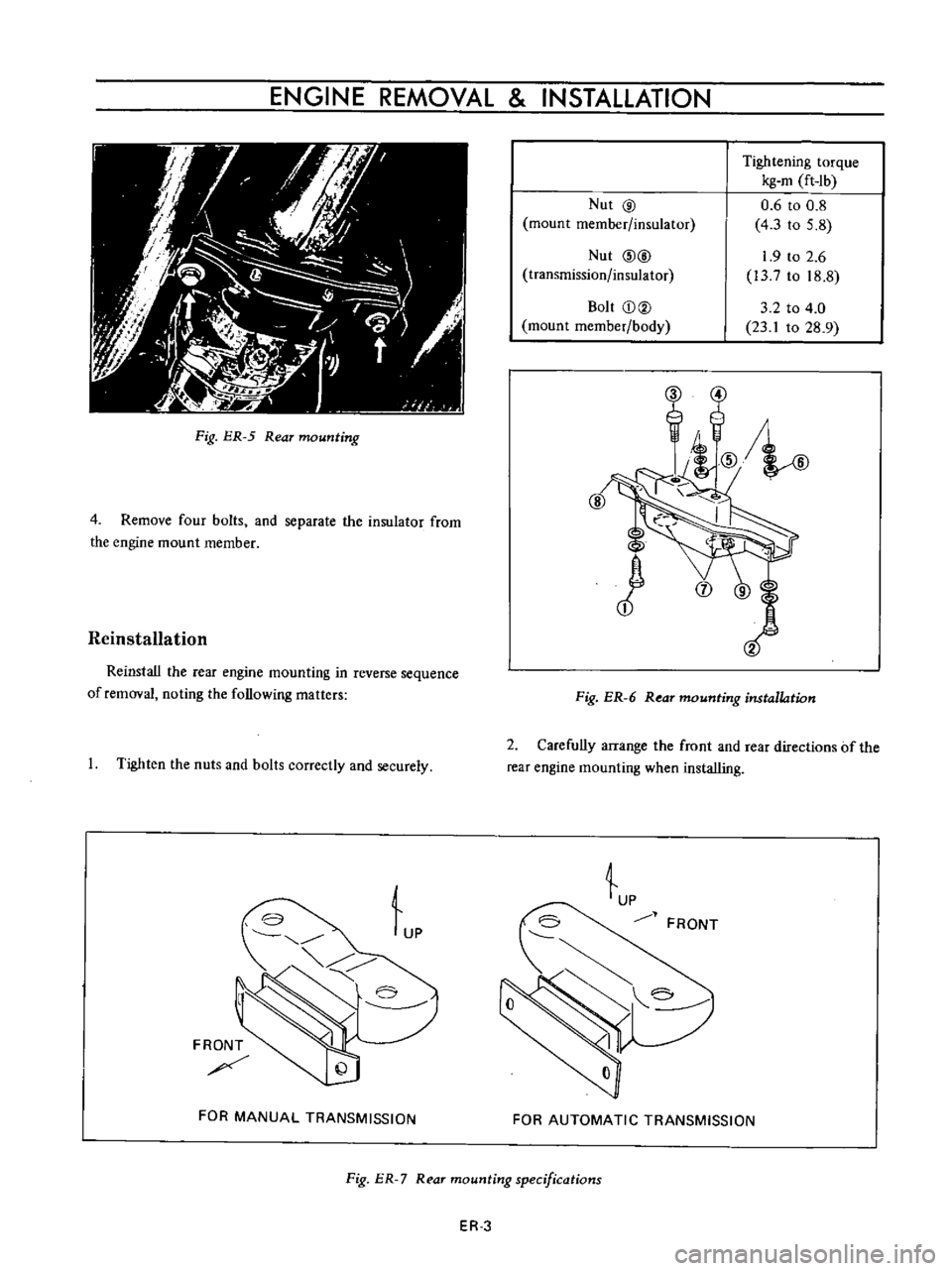
Fig
ER
5
Rear
mounting
4
Remove
four
bolts
and
separate
the
insulator
from
the
engine
mount
member
Reinstallation
Reinstall
the
rear
engine
mounting
in
reverse
sequence
of
removal
noting
the
following
matters
I
Tighten
the
nuts
and
bolts
correctly
and
securely
Lp
FRONT
FOR
MANUAL
TRANSMISSION
Nut
@
mount
member
insulator
Nut
@@
transmission
insulator
Bolt
CD@
mount
member
body
Tightening
torque
kg
m
ft
Ib
0
6
to
0
8
4
3
to
5
8
1
9
to
2
6
l3
to
18
8
3
2
to
4
0
23
1
to
28
9
Fig
ER
6
Rear
mounting
installation
2
Carefully
arrange
the
front
and
rear
directions
of
the
rear
engine
mounting
when
installing
tp
FRONT
FOR
AUTOMATIC
TRANSMISSION
Fig
ER
7
R
ar
mounting
specifications
ER
3
Page 471 of 513
CLUTCH
CLUTCH
CONTENTS
DESCRIPTION
REMOVAL
DISASSEMBL
Y
INSPECTION
AND
ADJUSTMENT
Clutch
assembly
Cll
CL
2
CL
2
CL
2
CL
2
DESCRIPTION
The
clutch
is
a
single
dty
disc
diaphragm
spring
type
clutch
The
major
components
are
clutch
cover
pressure
plate
diaphragm
spring
and
wire
rings
The
clutch
disc
is
provided
with
riveted
pia
tes
on
both
surfaces
and
coil
springs
arranged
in
a
link
The
coil
springs
absorb
shock
while
engaging
the
clutch
softening
and
smoothing
clutch
30
1181
I
4J
I
m
I
I
5
O
N
l
l
9
p
1L
oz
l
t
O
Ii
N
lt
o
O
Vf
I
1
I
t
I
0
tN
00
f
M
g
1
co
0
00
U
N
N
y
Disc
assembly
Release
bearing
and
sleeve
REASSEMBL
Y
CL
3
CL
4
CL
4
CL
4
CL
5
Release
mechanism
REINSTALLATION
engagement
Release
bearing
sleeve
and
withdrawal
lever
are
used
to
control
clutch
engagement
and
disengagement
Each
part
of
the
clutch
assembly
is
secured
with
rivets
Therefore
when
a
trouble
is
uncorrectable
replace
the
clutch
assembly
wHh
J
new
assembly
93
53
3
682
JOOD4
33
Unit
mm
in
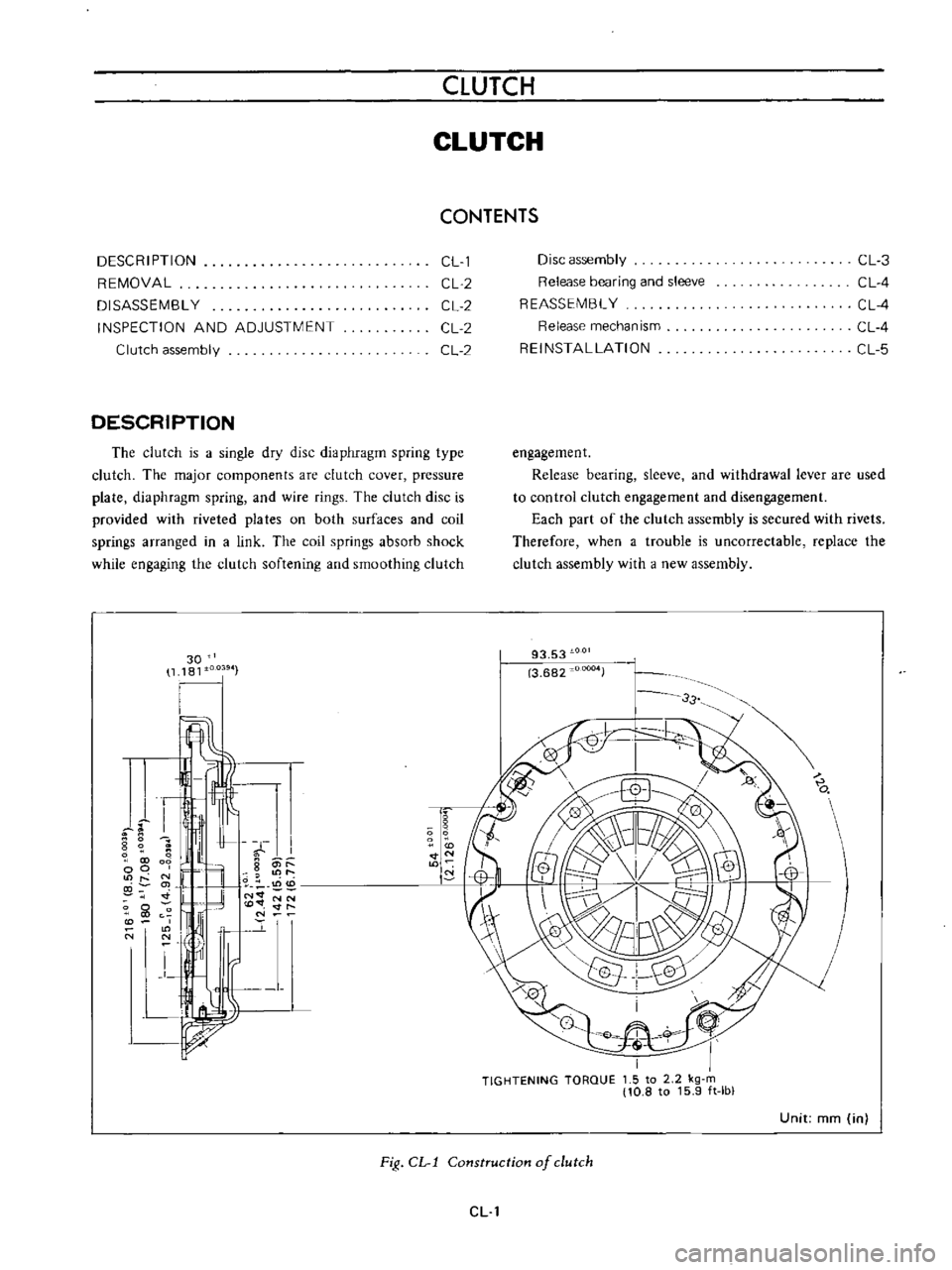
Fig
CL
l
Construction
of
clutch
ell
Page 476 of 513
CHASSIS
fulcrum
type
The
mechanical
type
clutch
control
system
consists
of
pendent
clutch
pedal
clutch
control
cable
and
with
drawallever
The
withdrawal
lever
is
of
an
outer
fulcrum
type
which
provides
a
great
lever
ratio
and
thus
force
required
in
depressing
clutch
pedal
is
reduced
CLUTCH
PEDAL
Hydraulic
clutch
Removal
Remove
the
return
spring
2
Loosen
the
lock
nut
of
the
master
cylinder
push
rod
and
disconnect
the
push
rod
end
3
Remove
the
lock
nut
and
washer
of
the
pedal
shaft
and
remove
the
pedal
lever
Inspection
Thoroughly
clean
all
disassembled
parts
indicated
below
and
carefully
check
them
for
wear
damage
and
other
abnormal
conditions
Repair
or
replace
them
with
new
ones
if
required
f
fS
C5
J
dJ
YII
10
1
@
c
i
@
j
1
4
K
Clutch
pedal
free
trrlel
30
mm
1
181
nl
00
@
P
IO
Pedal
head
rubber
2
Return
spring
3
Pedal
lever
bush
4
Fulcrum
pedal
pin
etc
Reinstallation
Reinstall
the
clutch
pedal
in
reverse
sequence
of
removal
Adjustment
I
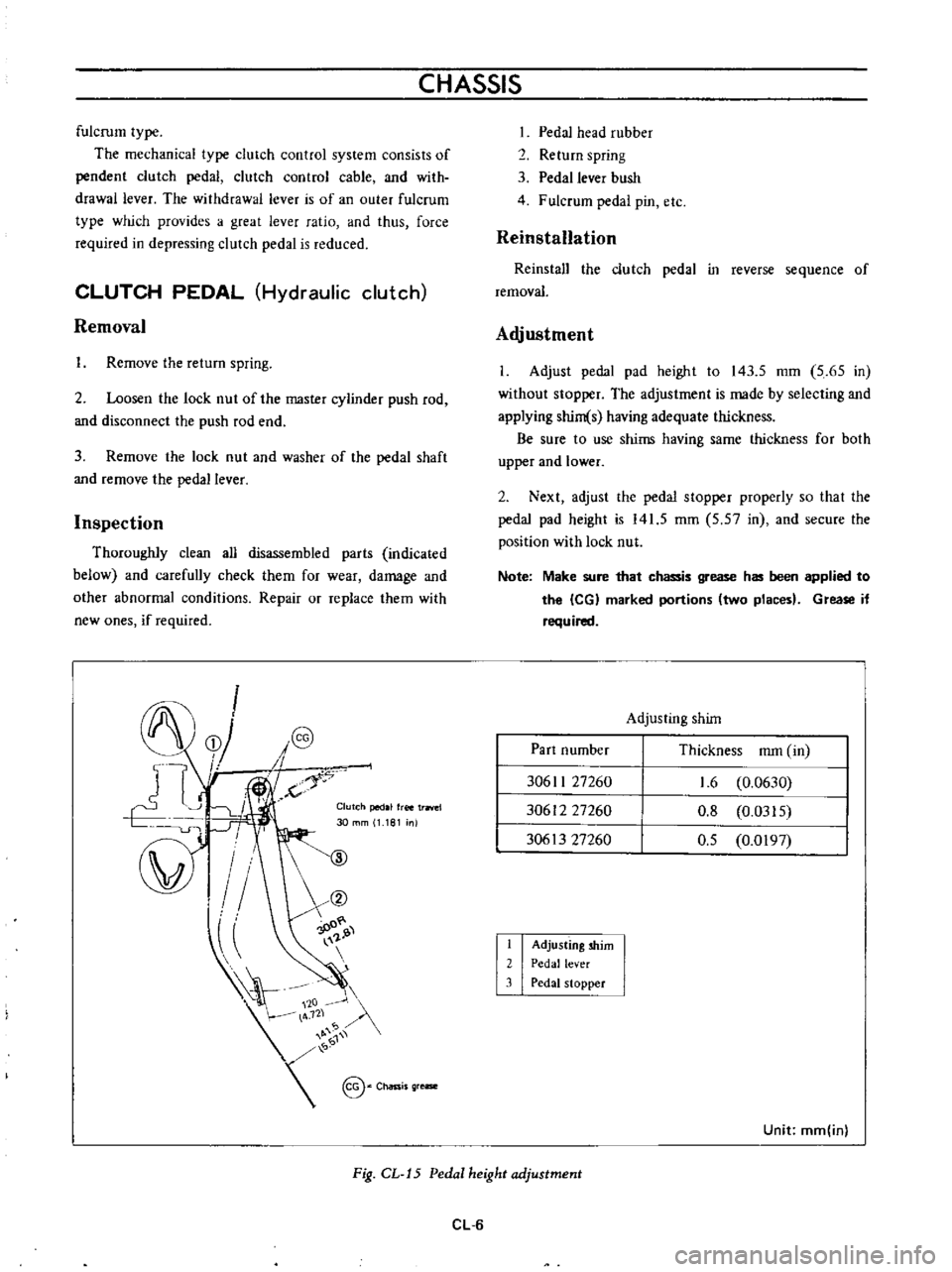
Adjust
pedal
pad
height
to
143
5
mm
5
65
in
without
stopper
The
adjustment
is
made
by
selecting
and
applying
shim
s
having
adequate
thickness
Be
sure
to
use
shims
having
same
thickness
for
both
upper
and
lower
2
Next
adjust
the
pedal
stopper
properly
so
that
the
pedal
pad
height
is
141
5
mm
5
57
in
and
secure
the
position
with
lock
nut
Note
Make
sure
that
chassis
grease
has
been
applied
to
the
leG
marked
portions
two
places
Grease
if
required
Adjusting
shim
Part
number
Thickness
mm
in
30611
27260
30612
27260
30613
27260
1
6
0
0630
0
8
0
0315
0
5
0
0197
I
2
3
Adjusting
shim
Pedal
lever
Pedal
stopper
Unit
mm
inl
Fig
CL
J5
Pedal
height
adjustment
CL
6
Page 477 of 513
CLUTCH
CLUTCH
PEDAL
AND
CLUTCH
CONTROL
CABLE
Mechanical
clutch
Removal
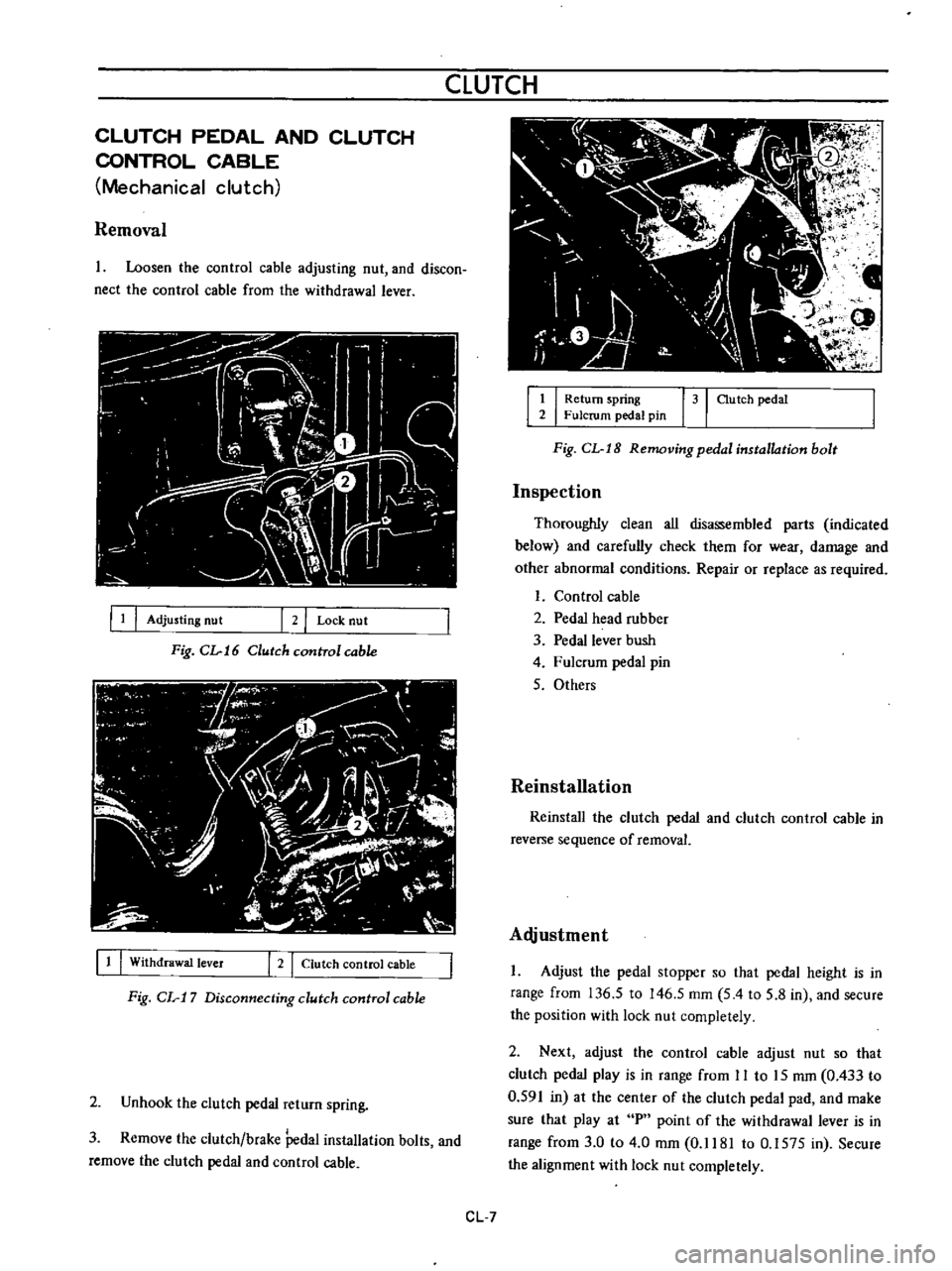
Loosen
the
control
cable
adjusting
nut
and
discon
nect
the
control
cable
from
the
withdrawal
lever
III
Adjusting
nut
2
I
Lock
nut
Fig
CL
16
Clutch
cunITol
cable
11
I
Withdrawal
lever
I
2
I
Clutch
control
cable
Fig
CL
17
Disconnecting
clutch
control
cable
2
Unhook
the
clutch
pedal
return
spring
3
Remove
the
clutch
brake
Pedal
installation
bolts
and
remove
the
clutch
pedal
and
control
cable
1
I
Return
spring
31
au
tch
pedal
2
Fulcrum
pedal
pin
Fig
CL
I8
Removing
pedal
installation
bolt
Inspection
Thoroughly
clean
all
disassembled
parts
indicated
below
and
carefully
check
them
for
wear
damage
and
other
abnormal
conditions
Repair
or
replace
as
required
Control
cable
2
Pedal
head
rubber
3
Pedal
lever
bush
4
Fulcrum
pedal
pin
5
Others
Reinstallation
Reinstall
the
clutch
pedal
and
clutch
control
cable
in
reverse
sequence
of
removal
Alljustment
Adjust
the
pedal
stopper
so
that
pedal
height
is
in
range
from
136
5
to
146
5
mm
5
4
to
5
8
in
and
secure
the
position
with
lock
nut
completely
2
Next
adjust
the
control
cable
adjust
nut
so
that
clutch
pedal
play
is
in
range
from
II
to
15
mm
0
433
to
0
591
in
at
the
center
of
the
clutch
pedal
pad
and
make
sure
that
play
at
P
point
of
the
withdrawal
lever
is
in
range
from
3
0
to
4
0
mm
0
1181
to
0
1575
in
Secure
the
alignment
with
lock
nut
completely
CL
7
Page 479 of 513
CLUTCH
CLUTCH
MASTER
CYLINDER
Hydraulic
clutch
3
V
t
2
3
4
5
6
7
8
9
10
tt
12
13
Snap
ring
Dust
cover
Push
rod
Clutch
piston
Piston
spring
Inlet
valve
spring
Inlet
valve
Spring
retainer
Shim
Inlet
valve
release
pin
Body
Oil
reservoir
Oil
reservoir
cap
6
D
ll
Q
6
i
0
l
Y
r@
cb
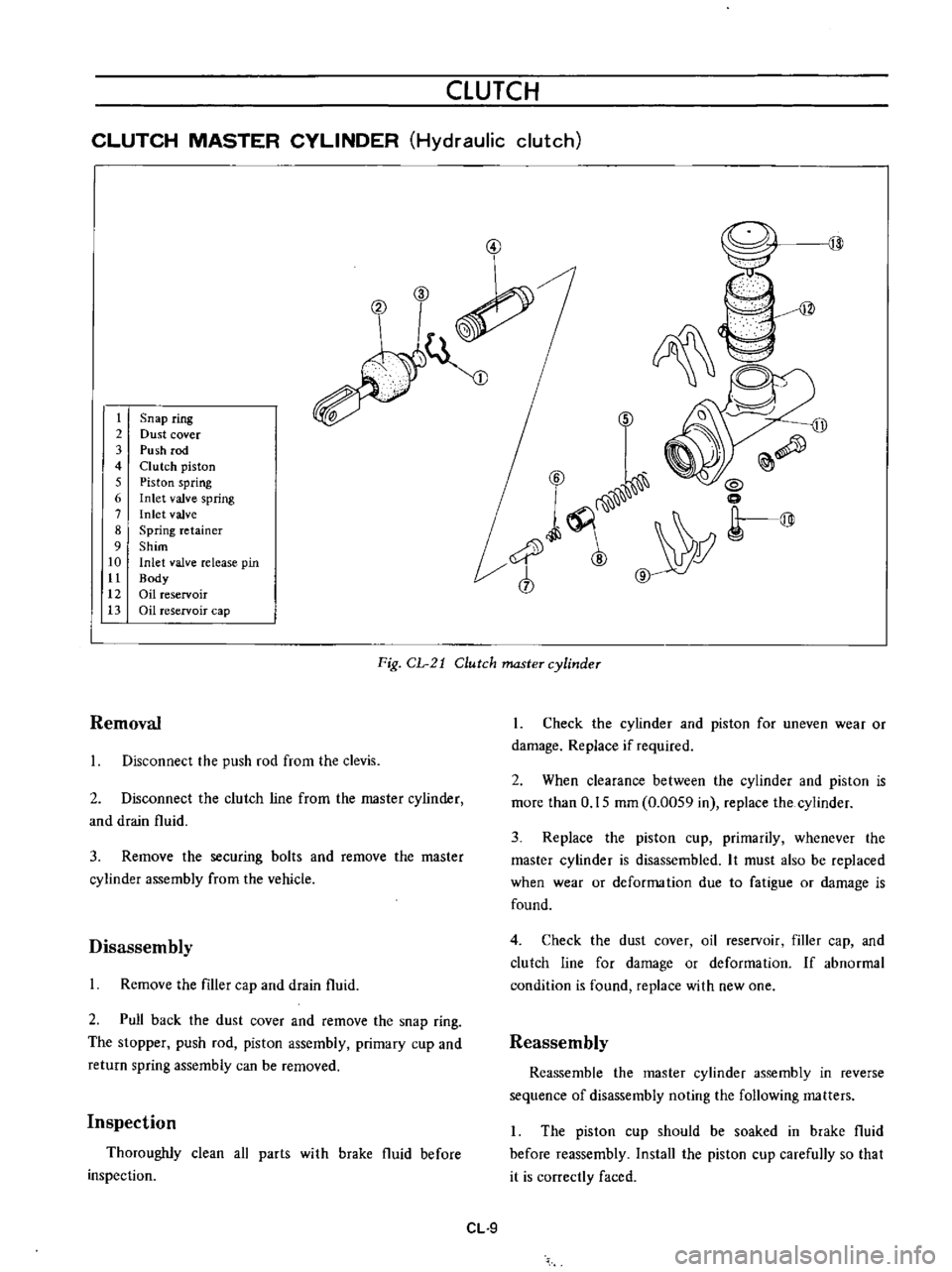
Fig
CL
21
Clutch
master
cylinder
Removal
Disconnect
the
push
rod
from
the
clevis
2
Disconnect
the
clutch
line
from
the
master
cylinder
and
drain
fluid
3
Remove
the
securing
bolts
and
remove
the
master
cylinder
assembly
from
the
vehicle
Disassembly
Remove
the
filler
cap
and
drain
fluid
2
Pull
back
the
dust
cover
and
remove
the
snap
ring
The
stopper
push
rod
piston
assembly
primary
cup
and
return
spring
assembly
can
be
removed
Inspection
Thoroughly
clean
all
parts
with
brake
fluid
before
inspection
CL
9
1
Check
the
cylinder
and
piston
for
uneven
wear
or
damage
Replace
if
required
2
When
clearance
between
the
cylinder
and
piston
is
more
than
0
15
mm
0
0059
in
replace
the
cylinder
3
Replace
the
piston
cup
primarily
whenever
the
master
cylinder
is
disassembled
It
must
also
be
replaced
when
wear
or
deforma
tion
due
to
fatigue
or
damage
is
found
4
Check
the
dust
cover
oil
reservoir
filler
cap
and
clutch
line
for
damage
or
deformation
If
abnormal
condition
is
found
replace
with
new
one
Reassembly
Reassemble
the
master
cylinder
assembly
in
reverse
sequence
of
disassembly
noting
the
following
matters
The
piston
cup
should
be
soaked
in
brake
fluid
before
reassembly
Install
the
piston
cup
carefully
so
that
it
is
correctly
faced
Page 481 of 513
CLUTCH
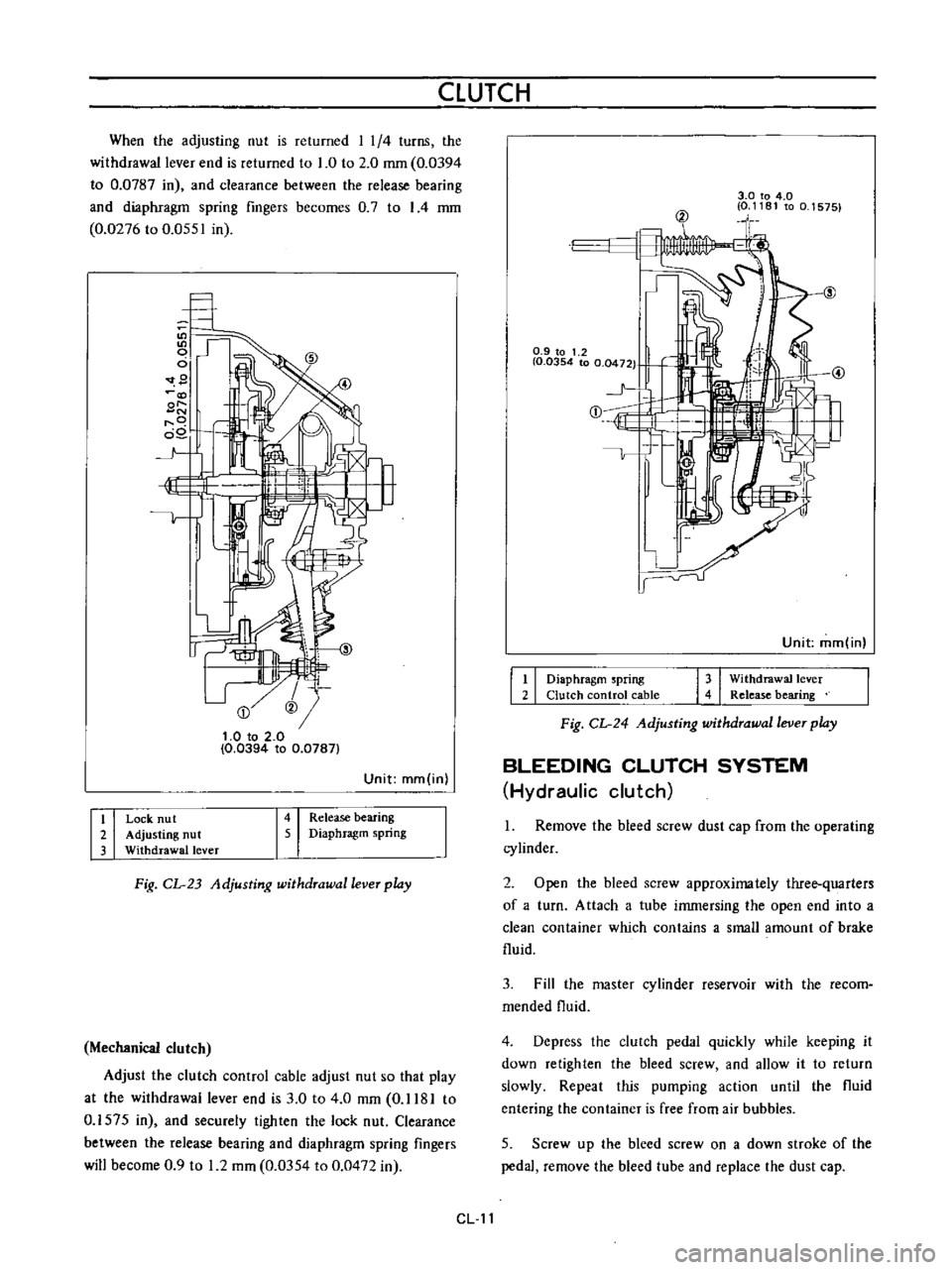
When
the
adjusting
nut
is
returned
I
1
4
turns
the
withdrawal
lever
end
is
returned
to
1
0
to
2
0
mm
0
0394
to
0
0787
in
and
clearance
between
the
release
bearing
and
diaphragm
spring
fingers
becomes
0
7
to
I
4
mm
0
0276
to
0
0551
in
9
@
t
O
to
2
0
0
0394
to
0
0787
Unit
mm
in
I
i
I
I
I
Release
bearing
Diaphragm
spring
Lock
nu
t
Adjusting
nut
Withdrawal
lever
Fig
CL
23
Adjusting
withdrawal
lever
play
Mechanical
clutch
Adjust
the
clutch
control
cable
adjust
nut
so
that
play
at
the
withdrawal
lever
end
is
3
0
to
4
0
mm
0
1181
to
0
1575
in
and
securely
tighten
the
lock
nut
Clearance
between
the
release
bearing
and
diaphragm
spring
fingers
will
become
0
9
to
1
2
mm
0
0354
to
0
0472
in
3
0
to
4
0
0
1181
to
0
1575
@
0
9
to
1
2
I
0
0354
to
0
0472
1
j
E
1
Unit
mm
in
I
I
I
I
Diaphragm
spring
Clutch
control
cable
Withdrawal
lever
Release
bearing
Fig
CL
24
Adjusting
withdrawal
lever
play
BLEEDING
CLUTCH
SYSTEM
Hydraulic
clutch
1
Remove
the
bleed
screw
dust
cap
from
the
operating
cylinder
2
Open
the
bleed
screw
approximately
three
quarters
of
a
turn
Attach
a
tube
immersing
the
open
end
into
a
clean
container
which
contains
a
small
amount
of
brake
fluid
3
Fill
the
master
cylinder
reservoir
with
the
recom
mended
fluid
4
Depress
the
clutch
pedal
quickly
while
keeping
it
down
retighten
the
bleed
screw
and
allow
it
to
return
slowly
Repeat
this
pumping
action
until
the
fluid
entering
the
container
is
free
from
air
bubbles
5
Screw
up
the
bleed
screw
on
a
down
stroke
of
the
pedal
remove
the
bleed
tube
and
replace
the
dust
cap
CL
11
Page 483 of 513
CLUTCH
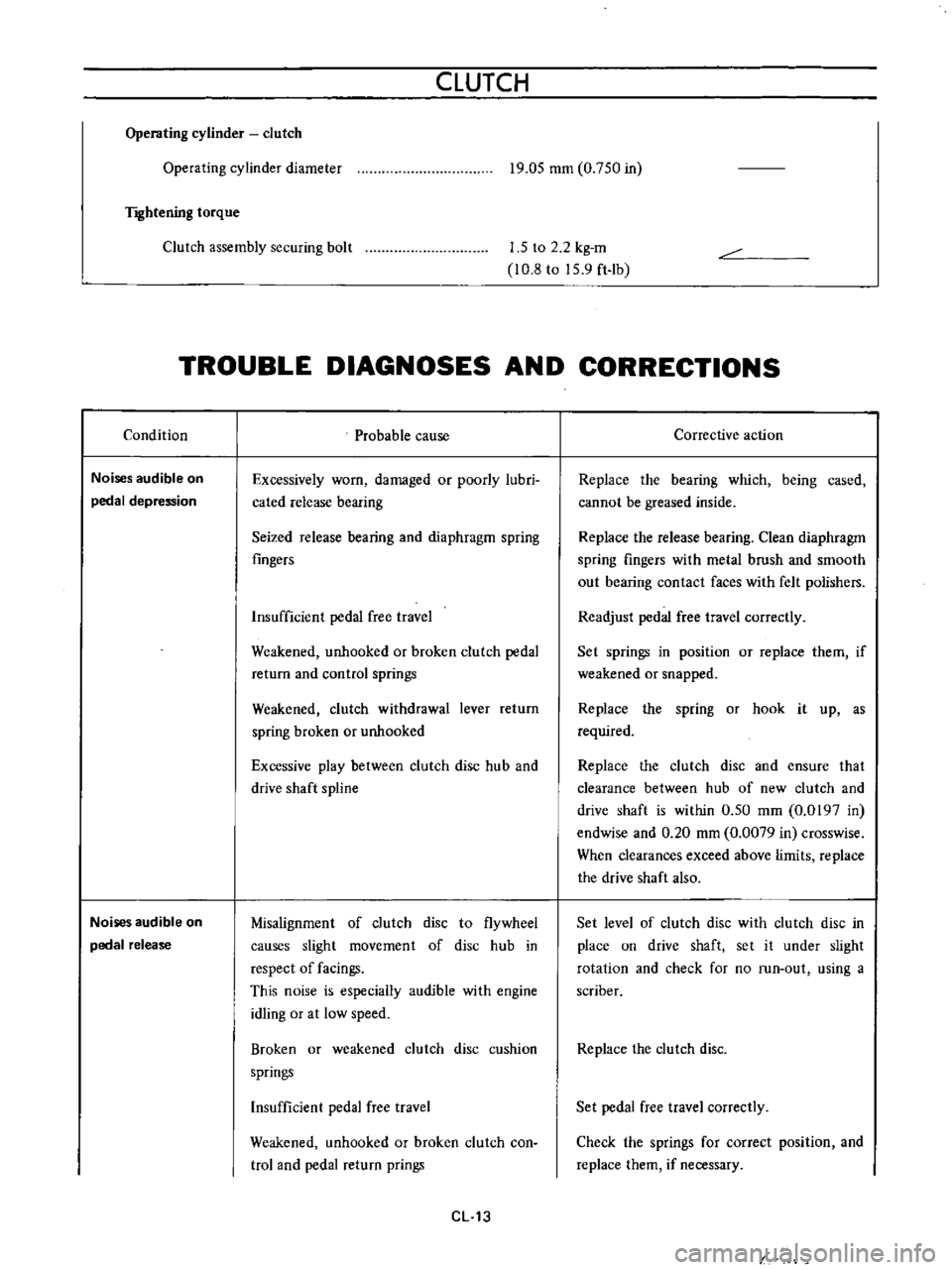
Operating
cylinder
clutch
Operating
cylinder
diameter
T
Ilhtening
torque
19
05
mm
0
750
in
Clutch
assembly
securing
bolt
1
5
to
2
2
kg
m
10
8
to
15
9
ft
Ib
TROUBLE
DIAGNOSES
AND
CORRECTIONS
Condition
Noises
audible
on
pedal
depression
Noises
audible
on
pedal
release
Probable
cause
Excessively
worn
damaged
or
poorly
lubri
cated
release
bearing
Seized
release
bearing
and
diaphragm
spring
fingers
Insufficient
pedal
free
travel
Weakened
unhooked
or
broken
clutch
pedal
return
and
control
springs
Weakened
clutch
withdrawal
lever
return
spring
broken
or
unhooked
Excessive
play
between
clutch
disc
hub
and
drive
shaft
spline
Misalignment
of
clutch
disc
to
flywheel
causes
slight
movement
of
disc
hub
in
respect
of
facings
This
noise
is
especially
audible
with
engine
idling
or
at
low
speed
Broken
or
weakened
clutch
disc
cushion
springs
Insufficient
pedal
free
travel
Weakened
unhooked
or
broken
clutch
con
trol
and
pedal
return
prings
CL
13
Corrective
action
Replace
the
bearing
which
being
cased
cannot
be
greased
inside
Replace
the
release
bearing
Clean
diaphragm
spring
fingers
with
metal
brush
and
smooth
out
bearing
contact
faces
with
felt
polishers
Readjust
pedal
free
travel
correctly
Set
springs
in
position
or
replace
them
if
weakened
or
snapped
Replace
the
spring
or
hook
it
up
as
required
Replace
the
clutch
disc
and
ensure
that
clearance
between
hub
of
new
clutch
and
drive
shaft
is
within
0
50
mm
0
0197
in
endwise
and
0
20
mm
0
0079
in
crosswise
When
clearances
exceed
above
limits
replace
the
drive
shaft
also
Set
level
of
clutch
disc
with
clutch
disc
in
place
on
drive
shaft
set
it
under
slight
rotation
and
check
for
no
run
out
using
a
scriber
Replace
the
clutch
disc
Set
pedal
free
travel
correctly
Check
the
springs
for
correct
position
and
replace
them
if
necessary