brake DATSUN PICK-UP 1977 User Guide
[x] Cancel search | Manufacturer: DATSUN, Model Year: 1977, Model line: PICK-UP, Model: DATSUN PICK-UP 1977Pages: 537, PDF Size: 35.48 MB
Page 162 of 537
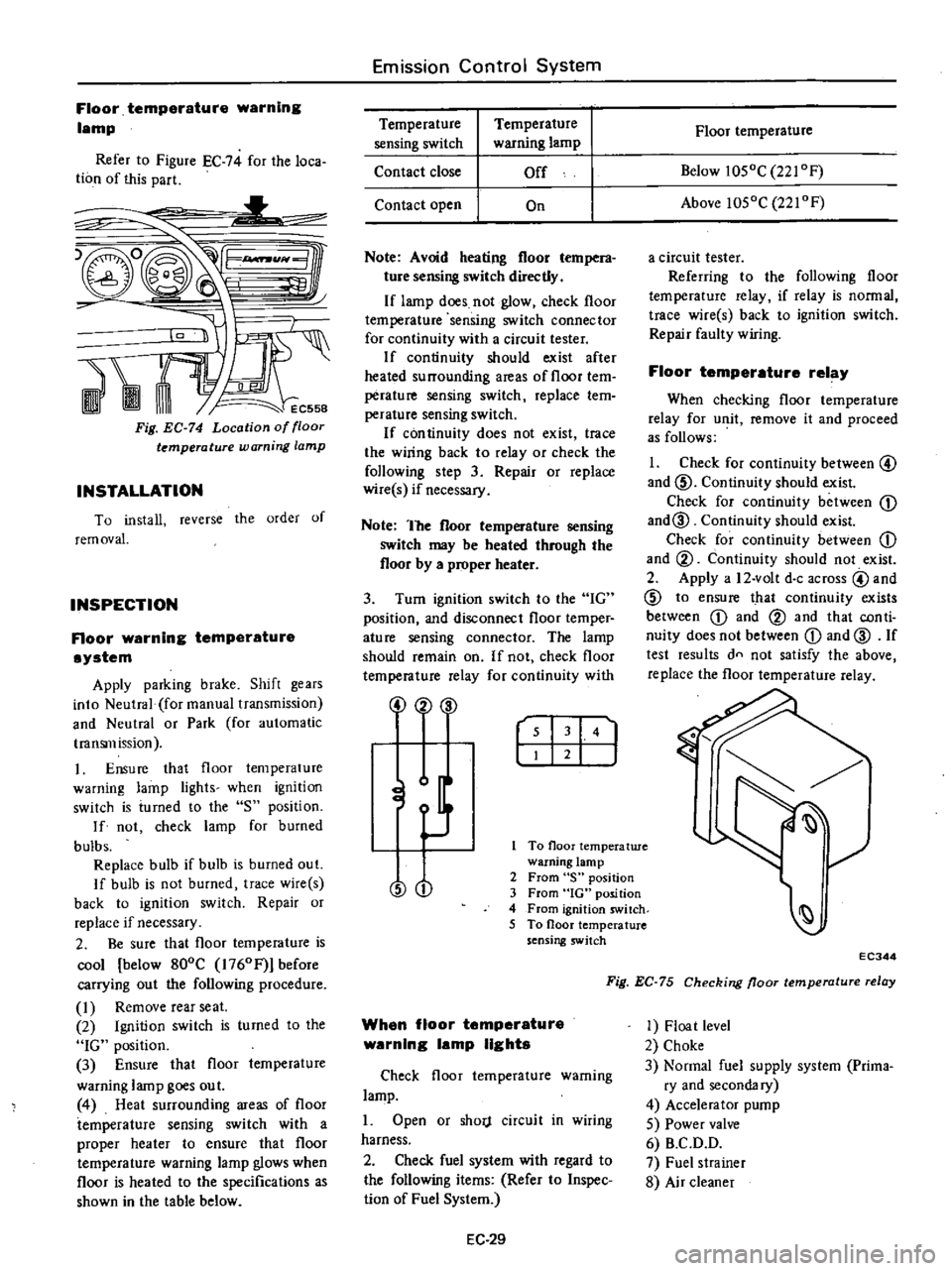
Floor
temparature
warning
lamp
Refer
to
Figure
EC
74
for
the
loca
tion
of
this
part
L
1t
1
RAt
Fig
EC
74
Location
of
floor
temperature
warning
lamp
INSTALLATION
To
install
reverse
the
order
of
rem
ovaL
INSPECTION
Floor
warning
temperature
system
Apply
parking
brake
Shift
gears
into
Neutral
foI
manual
transmission
and
Neutral
or
Park
for
automatic
transmission
1
Ensure
that
floor
temperature
warning
lamp
lights
when
ignition
switch
is
iumed
to
the
S
position
If
not
check
lamp
for
burned
bulbs
Replace
bulb
if
bulb
is
burned
out
If
bulb
is
not
burned
trace
wire
s
back
to
ignition
switch
Repair
or
replace
if
necessary
2
Be
sure
that
floor
temperature
is
cool
below
800C
1760Fj
before
carrying
out
the
following
procedure
I
Remove
rearseat
2
Ignition
switch
is
turned
to
the
IG
position
3
Ensure
that
floor
temperature
warning
lamp
goes
out
4
Heat
surrounding
areas
of
floor
temperature
sensing
switch
with
a
proper
heater
to
ensure
that
floor
temperature
warning
lamp
glows
when
floor
is
heated
to
the
specifications
as
shown
in
the
table
below
Emission
Control
System
Temperature
sensing
switch
Contact
close
Temperature
warning
lamp
Off
Contact
open
On
Note
Avoid
heating
floor
tempera
ture
sensing
switch
directly
If
lamp
does
not
glow
check
floor
temperature
sensing
switch
connector
for
continuity
with
a
circuit
tester
If
continuity
should
exist
after
heated
surrounding
areas
of
floor
tem
perature
sensing
switch
replace
tem
perature
sensing
switch
If
con
tinuity
does
not
exist
trace
the
wiring
back
to
relay
or
check
the
following
step
3
Repair
or
replace
wire
s
if
necessary
Note
The
floor
temperature
sensing
switch
may
be
heated
through
the
floor
by
a
proper
heater
3
Turn
ignition
switch
to
the
IG
position
and
disconnect
floor
temper
ature
sensing
connector
The
lamp
should
remain
on
If
not
check
floor
temperature
relay
for
continuity
with
2
00
r
I
141
J
To
floor
temperatwe
warning
lamp
2
From
S
position
3
From
IG
position
4
From
ignition
switch
5
To
floor
temperature
sensing
switch
O
When
floor
temperature
warning
lamp
lights
Check
floor
temperature
warning
lamp
1
Open
or
shorj
circuit
in
wiring
harness
2
Check
fuel
system
with
regard
to
the
following
items
Refer
to
Inspec
lion
of
Fuel
System
EC
29
Floor
temperature
Below
1050C
221
OF
Above
1050C
221
OF
a
circuit
tester
Referring
to
the
following
floor
temperature
relay
if
relay
is
normal
trace
wire
s
back
to
ignition
switch
Repair
faulty
wiring
Floor
temperature
relay
When
checking
floor
temperature
relay
for
unit
remove
it
and
proceed
as
follows
1
Check
for
continuity
between
@
and
ID
Continuity
should
exist
Check
for
continuity
between
CD
and@
Continuity
should
exist
Check
for
continuity
between
CD
and
@
Continuity
should
not
exist
2
Apply
a
12
volt
doc
across
@
and
ID
to
ensure
that
continuity
exists
between
CD
and
@
and
that
con
ti
nuity
does
not
between
CD
and
@
If
test
results
dn
not
satisfy
the
above
replace
the
floor
temperature
relay
EC344
Fig
EC
75
Checking
floor
temperature
relay
1
Float
level
2
Choke
3
Normal
fuel
supply
system
Prima
ry
and
secondary
4
Accelerator
pump
5
Power
valve
6
B
C
D
D
7
Fuel
strainer
8
Air
cleaner
Page 228 of 537
CLUTCH
CYLINDER
MASTER
Removal
and
installation
Removal
I
Remove
clcvis
pin
at
push
rod
2
Disconnect
clutch
tube
from
master
cylinder
and
drain
clutch
fluid
3
Remove
bolts
securing
master
Disassembly
and
assembly
CLUTCH
cylinder
to
the
vehicle
and
dismount
master
cylinder
Note
Remove
dust
cover
from
master
cylinder
body
on
the
side
of
driv
er
s
seat
Installation
To
install
reverse
the
order
of
removal
Closely
observe
the
following
instructions
1
Adjust
pedal
height
by
changing
pedal
stopper
length
Disassembly
1
Remove
dust
cover
and
remove
stopper
ring
from
body
2
Remove
push
rod
and
piston
as
sembly
3
Take
off
piston
cups
4
Remove
spiing
seat
from
piston
and
take
off
supply
valve
if
necessary
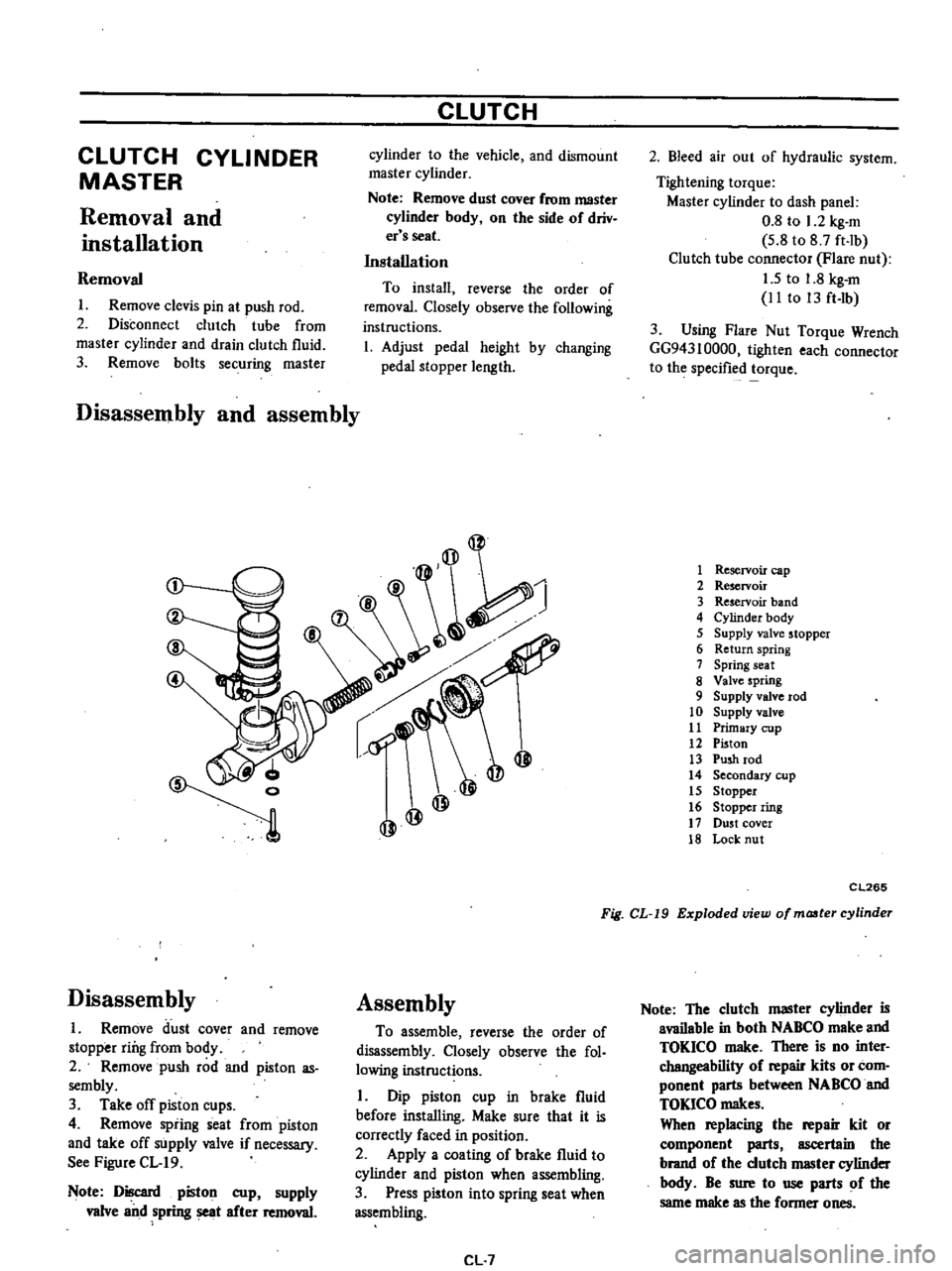
See
Figure
CL
19
Note
Discard
piston
cup
supply
valve
and
spring
seat
after
removal
Assembly
To
assemble
reverse
the
order
of
disassembly
Closely
observe
the
fol
lowing
instructions
I
Dip
piston
cup
in
brake
fluid
before
installing
Make
sure
that
it
is
correctly
faced
in
position
2
Apply
a
coating
of
brake
fluid
to
cylinder
and
piston
when
assembling
3
Press
piston
into
spring
seat
when
assembling
CL
7
2
Bleed
air
out
of
hydraulic
system
Tightening
torque
Master
cylinder
to
dash
panel
0
8
to
1
2
kg
m
5
8
to
8
7
ft
lb
Clutch
tube
connector
Flare
nut
1
5
to
1
8
kg
m
II
to
13
ft
lb
3
Using
Flare
Nut
Torque
Wrench
GG94310000
tighten
each
connector
to
the
specified
torque
1
Reservoir
cap
2
Reservoir
3
Reservoir
band
4
Cylinder
body
5
Supply
valve
stopper
6
Return
spring
7
Spring
seat
8
Valve
spring
9
Supply
valve
rod
10
Supply
valve
11
Primary
cup
12
Piston
13
Push
rod
14
Secondary
cup
15
Stopper
16
Stopper
ring
17
DU5t
cover
18
Lock
nut
CL265
Fig
CL
19
Exploded
view
of
maater
cylinder
Note
The
clutch
master
cylinder
is
available
in
both
NABCO
make
and
TOKICO
make
There
is
no
inter
changeability
of
repair
kits
or
com
ponent
parts
between
NABCO
and
TOKlCO
makes
When
replacing
the
repair
kit
or
component
parts
ascertain
the
brand
of
the
clutch
IIIBSter
cylinder
body
Be
sure
to
use
parts
of
the
same
make
as
the
former
ones
Page 229 of 537
Inspection
Note
To
clean
or
wash
all
parts
of
master
cylinder
operating
cylinder
and
piping
clean
brake
fluid
must
be
used
Never
use
minera10ils
llUch
as
gasoline
and
kerosene
It
will
ruin
the
rubber
parts
of
the
hydrau
lic
system
I
Check
cylinder
and
piston
for
uneven
wear
or
damage
and
if
neces
sary
replace
2
If
the
clearance
between
cylinder
and
piston
is
more
than
0
15
mm
0
0059
in
replace
cylinder
3
Renew
piston
cup
when
dis
assembled
It
must
also
be
replaced
when
wear
or
deformation
due
to
fatigue
or
damage
is
found
4
Damaged
dust
cover
oil
reservoir
or
cap
should
be
replaced
Return
spring
and
valve
spring
must
also
be
replaced
when
they
are
broken
or
weak
5
Replace
clutch
hose
and
tube
if
any
abnormal
sign
of
damage
or
de
fro
ti
n
is
found
OPERATING
CYLINDER
Removal
and
installation
Removal
1
Detach
clutch
hose
from
operat
ing
cylinder
2
Remove
two
bolts
securing
op
erating
cylinder
to
clutch
housing
Installation
Install
in
the
reverse
order
of
re
moval
Observe
the
following
instructions
Bleed
air
thoroughly
from
clutch
hydraulic
system
2
Do
not
install
return
spring
or
clutch
will
not
be
disengaged
properly
Tightening
torque
Operating
cylinder
securing
bolt
2
5
to
3
5
kg
m
18
to
25
ft
lb
Bleeder
screw
0
7
to
0
9
kg
m
5
1
to
6
5
ft
Ib
Clutch
hose
connector
1
7
to
2
0
kg
m
12
to
14
ft
b
CLUTCH
Disassembly
and
assembly
Disassembly
1
Remove
push
rod
with
dust
cover
2
Remove
piston
assembly
and
pis
ton
spring
3
Remove
bleeder
screw
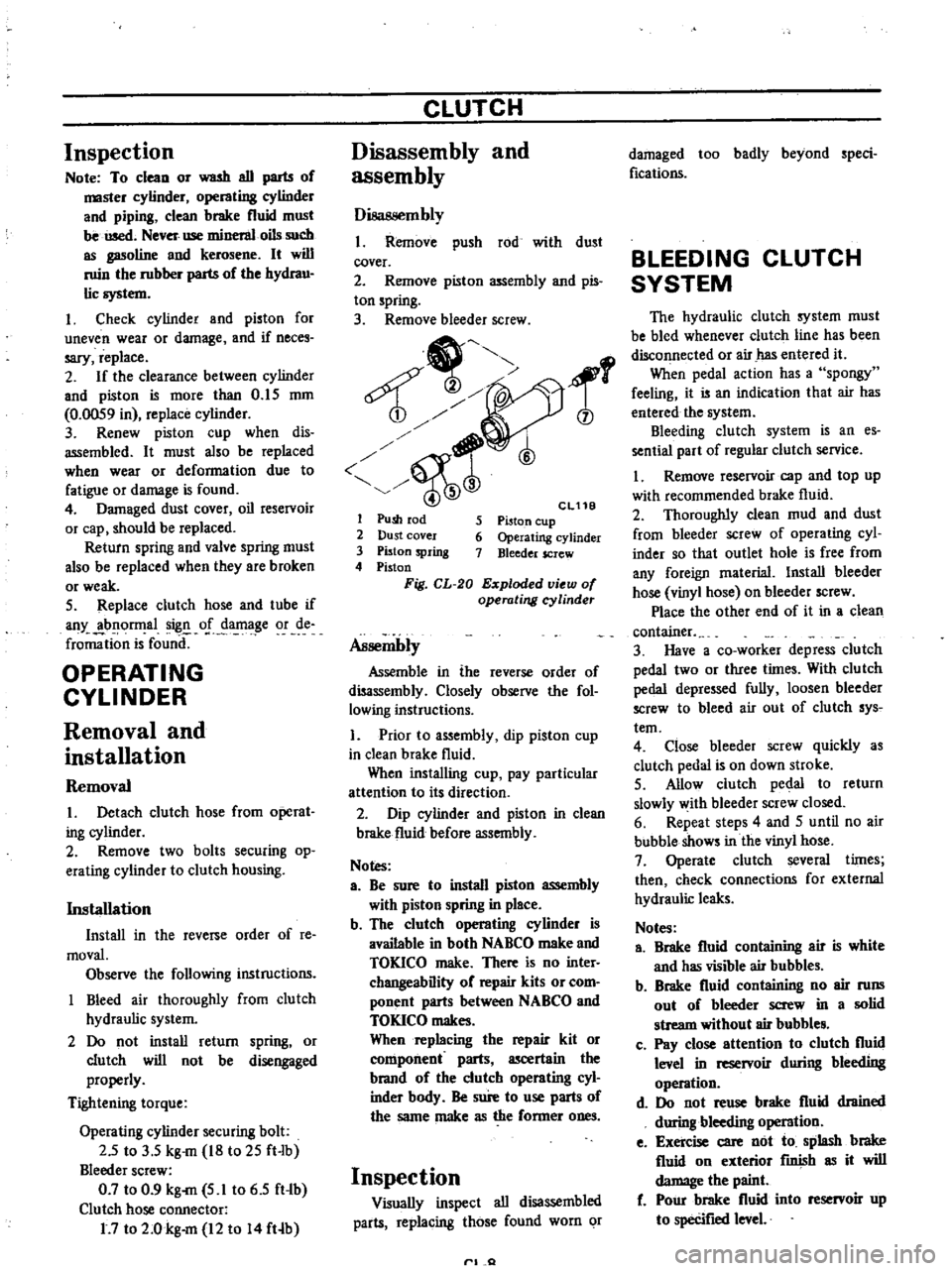
1
6
Cl11B
5
Piston
cup
6
Operating
cylinder
7
Bleeder
screw
1
Push
rod
2
Dust
cover
3
Piston
spring
4
Piston
Fig
CL
20
Exploded
view
of
operating
cyUnder
Assembly
Assemble
in
the
reverse
order
of
disassembly
Closely
observe
the
fol
lowing
instructions
1
Prior
to
assembly
dip
piston
cup
in
clean
brake
fluid
When
installing
cup
pay
particular
attention
to
its
direction
2
Dip
cylinder
and
piston
in
clean
brake
fluid
before
assembly
Notes
a
Be
sure
to
install
piston
assembly
with
piston
spring
in
place
b
The
clutch
operating
cylinder
is
available
in
both
NABCO
make
and
TOKICO
make
There
is
no
inter
changeability
of
repair
kits
or
com
ponent
parts
between
NABCO
and
TOKICO
makes
When
replacing
the
repair
kit
or
component
parts
ascertain
the
brand
of
the
clutch
operating
cyl
inder
bndy
Be
sure
to
use
parts
of
the
same
make
as
the
former
ones
Inspection
Visually
inspect
all
disassembled
parts
replacing
those
found
worn
or
rl
Q
damaged
too
badly
beyond
speci
fications
BLEEDING
CLUTCH
SYSTEM
The
hydraulic
clutch
system
must
be
bled
whenever
clutch
line
has
been
disconnected
or
air
has
entered
it
When
pedal
action
has
a
spongy
feeling
it
is
an
indication
that
air
has
entered
the
system
Bleeding
clutch
system
is
an
es
sential
part
of
regular
clutch
service
I
Remove
reservoir
cap
and
top
up
with
recommended
brake
fluid
2
Thoroughly
clean
mud
and
dust
from
bleeder
screw
of
operating
cyl
inder
so
that
outlet
hole
is
free
from
any
foreign
rnaterial
Install
bleeder
hose
vinyl
hose
on
bleeder
screw
Place
the
other
end
of
it
in
a
clean
container
3
Have
a
co
worker
depress
clutch
pedal
two
or
three
times
With
clu
tch
pedal
depressed
fully
loosen
bleeder
screw
to
bleed
air
out
of
clutch
sys
tern
4
Close
bleeder
screw
quickly
as
clutch
pedal
is
on
down
stroke
5
Allow
clutch
pedal
to
return
slowly
with
bleeder
screw
closed
6
Repeat
steps
4
and
5
until
no
air
bubble
shows
in
the
vinyl
hose
7
Operate
clutch
several
times
then
check
connections
for
external
hydraulic
leaks
Notes
a
Brake
fluid
containing
air
is
white
and
has
visible
air
bubbles
b
Brake
fluid
containing
no
air
runs
out
of
bleeder
screw
in
a
solid
stream
without
air
bubble
c
Pay
close
attention
to
clutch
fluid
level
in
reservoir
during
bleeding
operation
d
Do
not
reuse
brake
fluid
drained
during
bleeding
operation
e
Exercise
care
not
to
splash
brake
fluid
on
exterior
fInish
as
it
will
damage
the
paint
f
Pour
brake
fluid
into
reservoir
up
to
specifIed
level
Page 234 of 537
No
Tool
number
tool
name
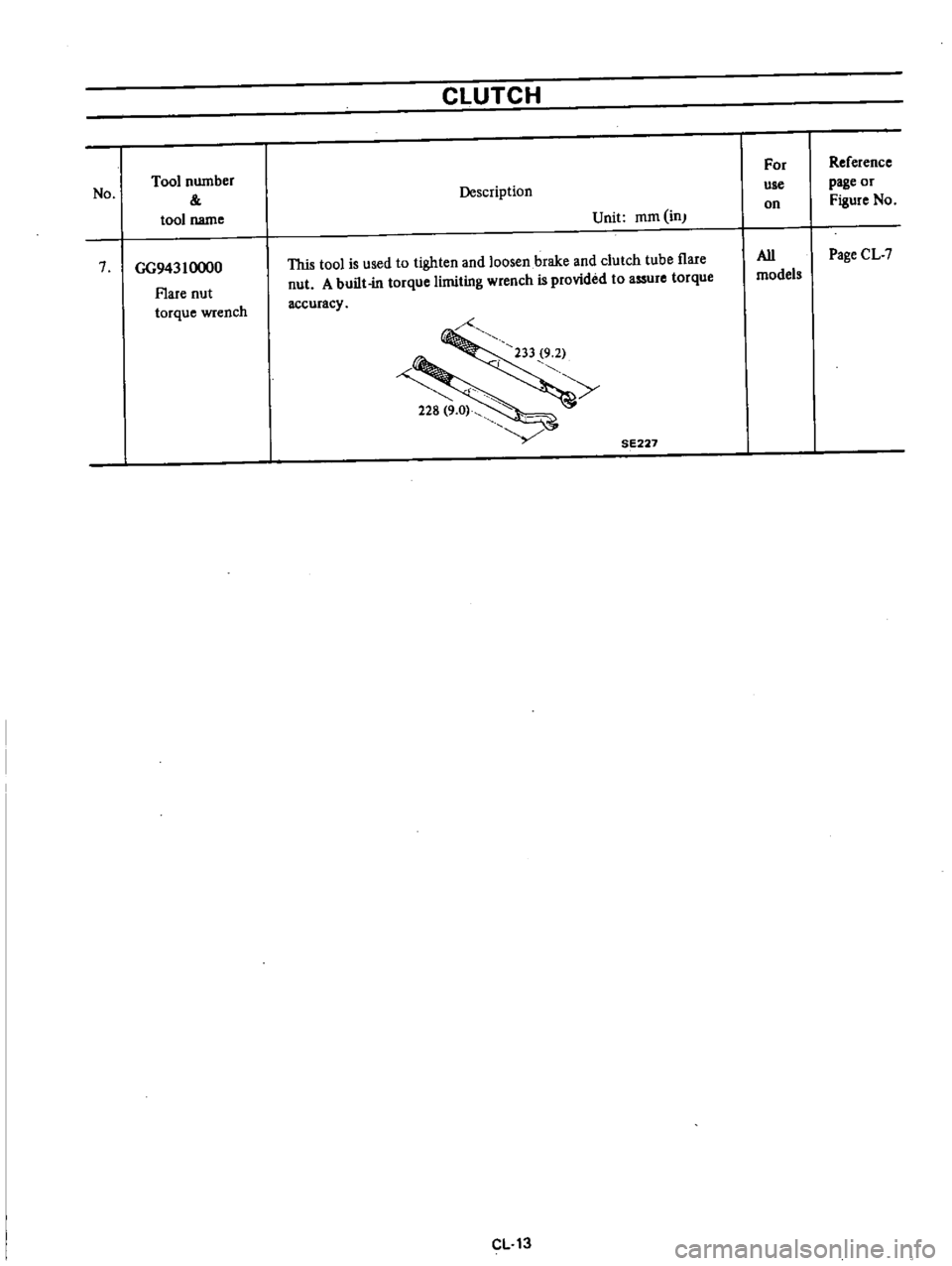
7
GG94310000
Flare
nut
torque
wrench
CLUTCH
Description
Unit
mm
in
This
tool
is
used
to
tighten
and
loosen
brake
and
clutch
tube
flare
nut
A
built
in
torque
limiting
wrench
is
provided
to
assure
torque
accuracy
y
SE227
CL
13
For
use
on
All
models
Reference
page
or
Figure
No
Page
CL
7
Page 250 of 537
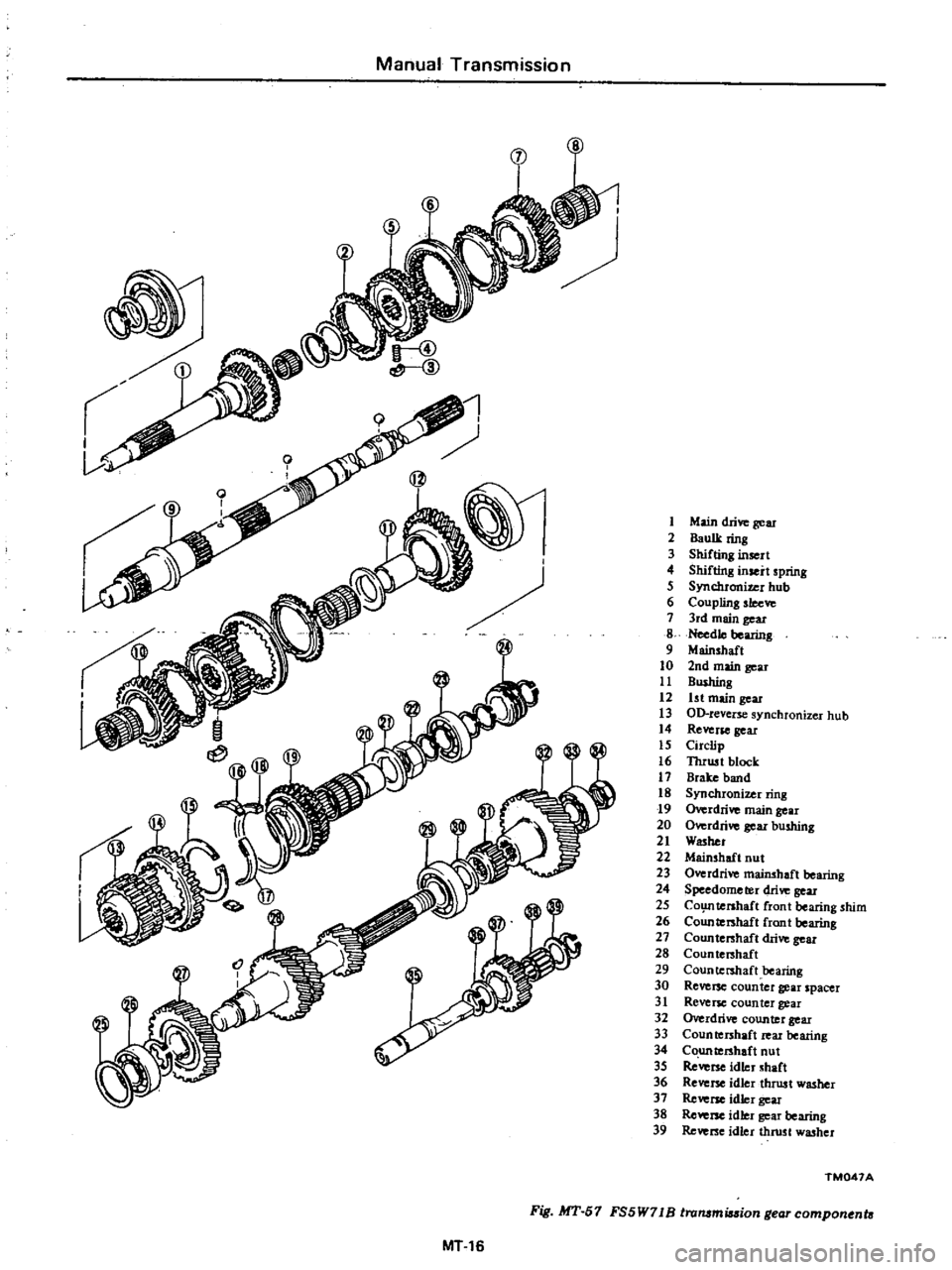
Manual
Transmission
j
W
h
I
l
1
Main
drive
gear
2
Baulk
ring
3
Shifting
insert
4
Shifting
insert
spring
5
Synchronir
c
r
hub
6
Coupling
slee
7
3rd
main
gear
g
Needle
bearing
9
Mainshaft
10
2nd
main
gear
11
Bushing
12
1st
main
gear
13
O
revcrse
synchronizer
hub
14
Rever
gear
15
Circlip
16
Thrwt
block
t
7
Brake
band
18
Synchronizer
ring
19
Overdrive
main
gear
20
Overdrive
gear
bushing
21
Washer
22
Mainshaft
nut
13
Overdrive
mainshaft
bearing
24
Speedometer
drive
gear
25
COlplteBhaft
fr
mt
bearing
shim
26
Countershaft
front
bearing
27
Countershaft
drive
gear
28
Coontcrshaft
29
Countershaft
bearing
30
Reverse
counter
gear
spacer
31
Rever
C
counter
gear
32
rdrive
counter
gear
33
Countershaft
zear
bearing
34
C
untershaft
nut
3S
Reverse
idler
lIhaCt
36
Reverse
idlcrthrust
washer
37
Reverse
idler
gear
38
Reye
nc
idler
gear
bearing
39
Reverse
idler
thrust
w8
her
TM041A
MT
16
Fig
MT
51
FS5W11B
tru
miasion
gear
componenta
Page 253 of 537
ADAPTER
PLATE
DISASSEMBLY
Same
as
for
the
F4W71
B
Fig
MT
67
Removing
screws
INSPECTION
Wash
all
parts
in
a
suitable
cleaning
solvent
and
check
for
wear
damage
or
other
faulty
conditions
Notes
a
Be
careful
not
to
damage
any
parts
with
scraper
b
Do
not
clean
wash
or
soak
oil
seals
in
solvent
TRANSMISSION
CASE
AND
REAR
EXTENSION
HOUSING
Same
as
for
the
F4W71
B
BEARING
Same
as
for
the
F4W7l
B
GEARS
AND
SHA
S
I
Check
all
gears
for
excessive
wear
chips
or
cracks
replace
as
required
2
Check
shaft
for
bending
crack
wear
and
worn
spline
if
necessary
replace
3
Measure
backlash
in
gears
Main
drive
and
counter
drive
gear
0
05
to
0
10
mm
0
0020
to
0
0039
in
1st
2nd
3rd
5th
and
reverse
gears
0
05
to
0
20
mm
0
0020
to
0
0040
in
Manual
Transmission
If
the
above
limits
are
exceeded
replace
drive
and
driven
gears
as
a
set
4
Measure
gear
end
play
1st
gear
0
32
to
0
39
mm
0
0126
to
0
0154
in
2nd
gear
0
12
to
0
19
mm
0
0047
to
0
0075
in
3rd
gear
0
13
to
0
37
mm
0
0051
to
0
0146
in
OD
gear
on
mainshaft
0
32
to
0
39
mm
0
0126
to
0
0154
in
BAULK
RING
Same
as
for
the
F4W7IB
OIL
SEAL
Same
as
for
the
F4W71
B
ASSEMBLY
To
assemble
reverse
the
order
of
disassembly
Observe
the
following
in
structions
FRONT
COVER
ASSEMBLY
Same
as
for
the
F4W7l
B
REAR
EXTENSION
ASSEMBLY
I
Wipe
clean
seal
seat
in
rear
exten
sion
housing
press
fit
oil
seal
in
place
Coat
oil
seal
and
bushing
with
gear
oil
for
initial
lubrication
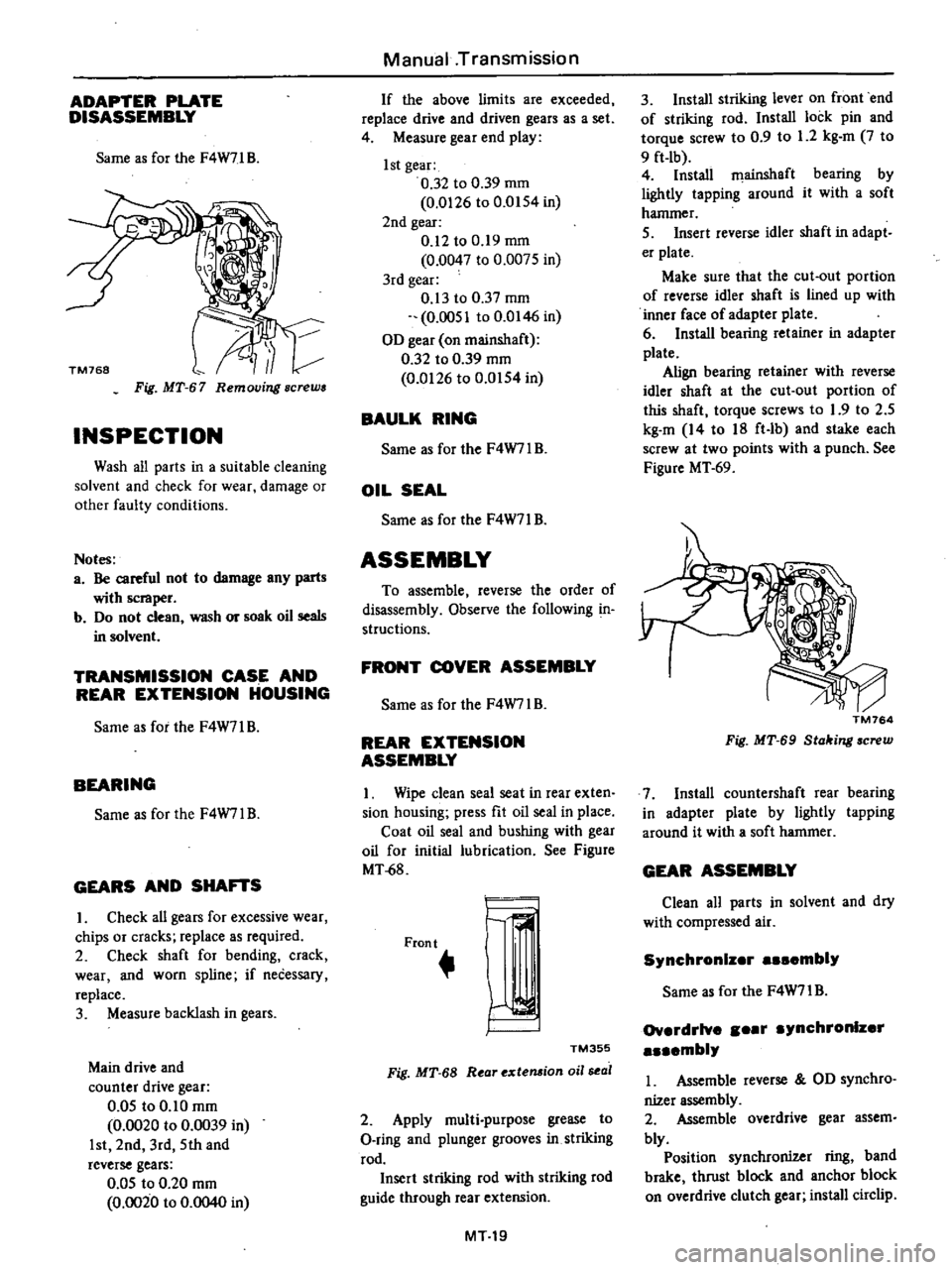
See
Figure
MT
68
Front
r
I
TM355
Fig
MT
68
R
ar
extemion
oil
sea
2
Apply
multi
purpose
grease
to
O
ring
and
plunger
grooves
in
striking
rod
Insert
striking
rod
with
striking
rod
guide
through
rear
extension
MT19
3
Install
striking
lever
on
front
end
of
striking
rod
Install
lock
pin
and
torque
screw
to
0
9
to
1
2
kg
m
7
to
9
ft
lb
4
Install
filainshaft
bearing
by
lightly
tapping
around
it
with
a
soft
hammer
5
Insert
reverse
idler
shaft
in
adapt
er
plate
Make
sure
that
the
cut
out
portion
of
reverse
idler
shaft
is
lined
up
with
inner
face
of
adapter
plate
6
Install
bearing
retainer
in
adapter
plate
Align
bearing
retainer
with
reverse
idler
shaft
at
the
cut
out
portion
of
this
shaft
torque
screws
to
1
9
to
2
5
kg
m
14
to
18
ft
lb
and
stake
each
screw
at
two
points
with
a
punch
See
Figure
MT
69
TM764
Fig
MT
69
Stahing
screw
7
Install
countershaft
rear
bearing
in
adapter
plate
by
lightly
tapping
around
it
with
a
soft
hammer
GEAR
ASSEMBLY
Clean
all
parts
in
solvent
and
dry
with
compressed
air
Synchronlz
r
embly
Same
as
for
the
F4W71
B
Ov
rdrlve
r
ynchronlz
r
mbly
I
Assemble
reverse
OD
synchro
nizer
assembly
2
Assemble
overdrive
gear
assem
bly
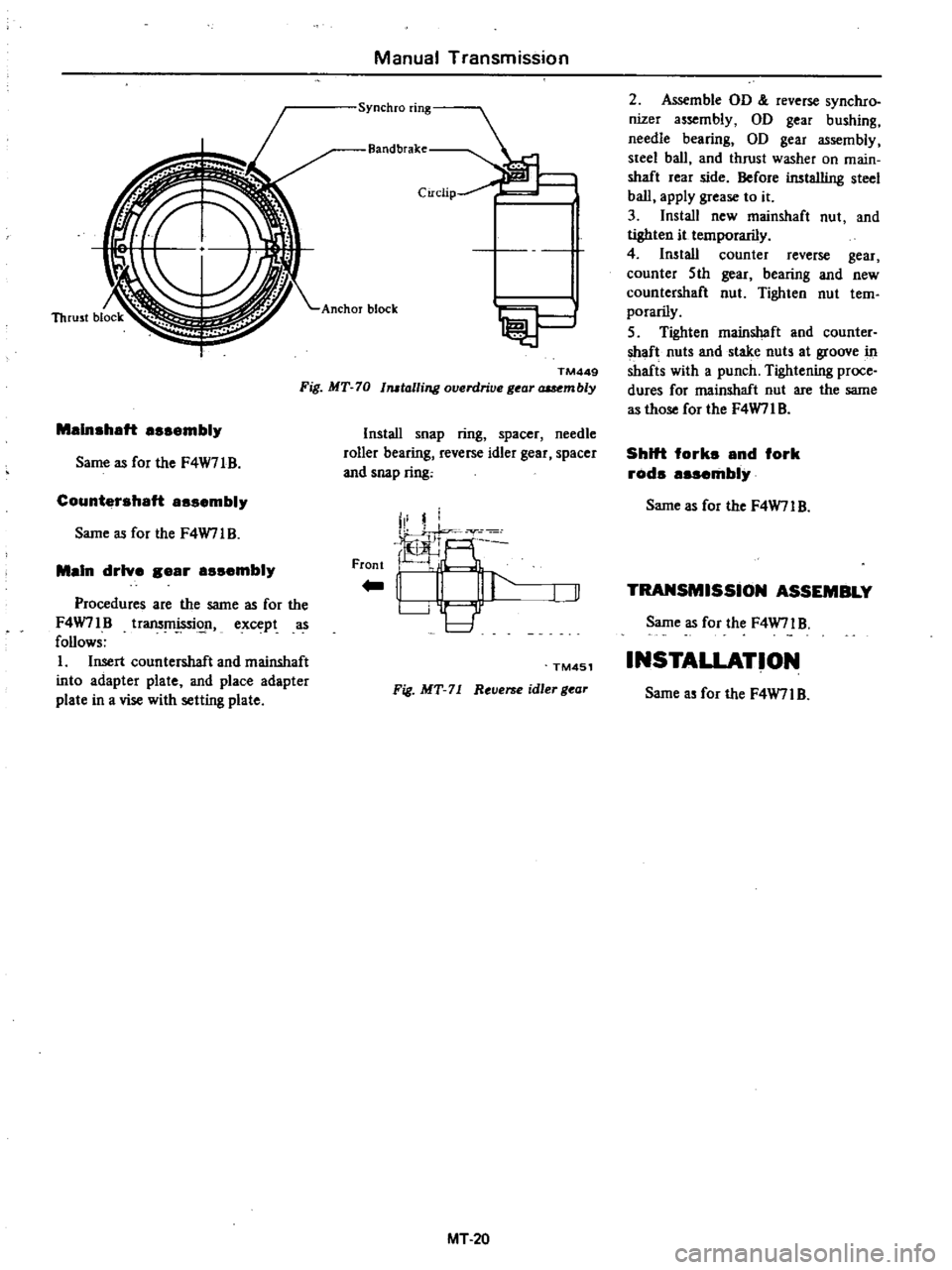
Position
synchronizer
ring
band
brake
thrust
block
and
anchor
block
on
overdrive
clutch
gear
install
circlip
Page 254 of 537
Malnshaft
assembly
Same
as
for
the
F4W7IB
Countershaft
assembly
Same
as
for
the
F4W71
B
Main
drive
gear
assembly
Procedures
are
the
same
as
for
the
F4W7IB
trans
i
n
except
as
follows
I
Insert
countershaft
and
mainshaft
into
adapter
plate
and
place
adapter
plate
in
a
vise
with
setting
plate
Manual
Transmission
Synchro
ring
8andbrake
Circlip
Anchor
block
TM449
Fig
MT
70
Imtalling
overdrive
gear
assembly
Install
snap
ring
spacer
needle
roller
bearing
reverse
idler
gear
spacer
and
snap
ring
h
I
L
TM4S1
Fig
MT
71
R
lJerse
idler
gear
MT
20
2
Assemble
OD
reverse
synchro
nizer
assembly
OD
gear
bushing
needle
bearing
OD
gear
assembly
sreel
ball
and
thrust
washer
on
main
shaft
rear
side
Before
installing
steel
ball
apply
grease
to
it
3
Install
new
mainshaft
nut
and
tighten
it
temporarily
4
Install
counter
reverse
gear
counter
5
th
gear
bearing
and
new
countershaft
nut
Tighten
nut
tem
porarily
5
Tighten
mainshafl
and
counter
shaft
nuts
and
stake
nuts
at
groove
in
shafts
with
a
punch
Tightening
proce
dures
for
mainshaft
nut
are
the
same
as
those
for
the
F4W7IB
Shift
forks
and
fork
rods
assembly
Same
as
for
the
F4W71
B
u
TRANSMISSION
ASSEMBLY
Same
as
for
the
F4W71
B
INSTALLATION
Same
as
for
the
F4W71
B
Page 262 of 537
The
model
3N7l
B
automatic
trans
mission
is
a
fully
automatic
unit
con
sisting
primarily
of
3
element
hydrau
lic
torque
converter
and
two
planetary
gear
sets
Two
multiple
disc
clutches
a
multiple
disc
brake
a
band
brake
and
a
one
way
sprag
clutch
provide
the
friction
elements
required
to
obtain
the
desir
d
function
of
lhe
two
plane
tary
gear
sets
The
two
planetary
gear
sets
give
three
forward
ratios
and
one
reverse
Changing
of
the
gear
ratios
is
fully
automatic
in
relation
to
vehicle
speed
and
engine
torque
input
V
chide
speed
and
engine
manifold
vacuum
signals
are
constantly
fed
to
the
transmission
to
provide
the
proper
gear
ralio
for
maximum
efficiency
and
performance
at
all
throttle
openings
The
model
3N71
B
has
six
selector
1
9sition
LP
R
N
D
2
1
I
Park
position
positively
locks
the
output
shaft
to
the
transmission
case
by
means
of
a
locking
pawl
to
prevent
the
vehicle
from
rolling
in
either
direction
This
position
should
be
selected
whenever
the
driver
leaves
Ihe
vehicle
Thc
engine
may
be
slarted
in
Park
position
R
Reverse
range
enables
the
vehicle
to
be
operated
in
a
reverse
direction
N
Neutral
position
enables
the
engine
to
be
started
and
run
without
driving
the
vehicle
0
Drive
range
is
used
for
all
normal
driving
conditions
Drive
range
has
three
gear
ratios
from
the
starting
ratio
to
direct
drive
Automatic
Transmission
DESCRIPTION
2
2
range
provides
performance
for
driving
on
slippery
surfaces
2
range
can
also
be
used
for
engine
braking
2
range
can
be
selected
at
any
vehicle
speed
and
prevents
the
trans
mission
from
shifting
out
of
second
gear
I
I
range
can
be
selected
at
any
vehicle
speed
and
the
transmission
will
shift
to
second
gear
and
remain
in
second
until
v
hicle
speed
is
reduced
10
approximately
40
to
50
kmfh
25
to
30
MPH
I
range
position
prevents
the
transmission
from
shifting
out
of
low
gear
This
is
particularly
beneficial
for
maintaining
maximum
engin
braking
when
continuous
low
gear
operation
is
desirable
The
torque
converter
assembly
is
of
welded
construction
and
can
nOlbe
disassembled
for
service
FLUID
RECOMMENDATION
Use
automatic
transmission
fluid
having
DEXRON
identifications
only
in
the
3N71
B
automatic
transmis
sion
IDENTIFICATioN
NUMBER
Stamped
position
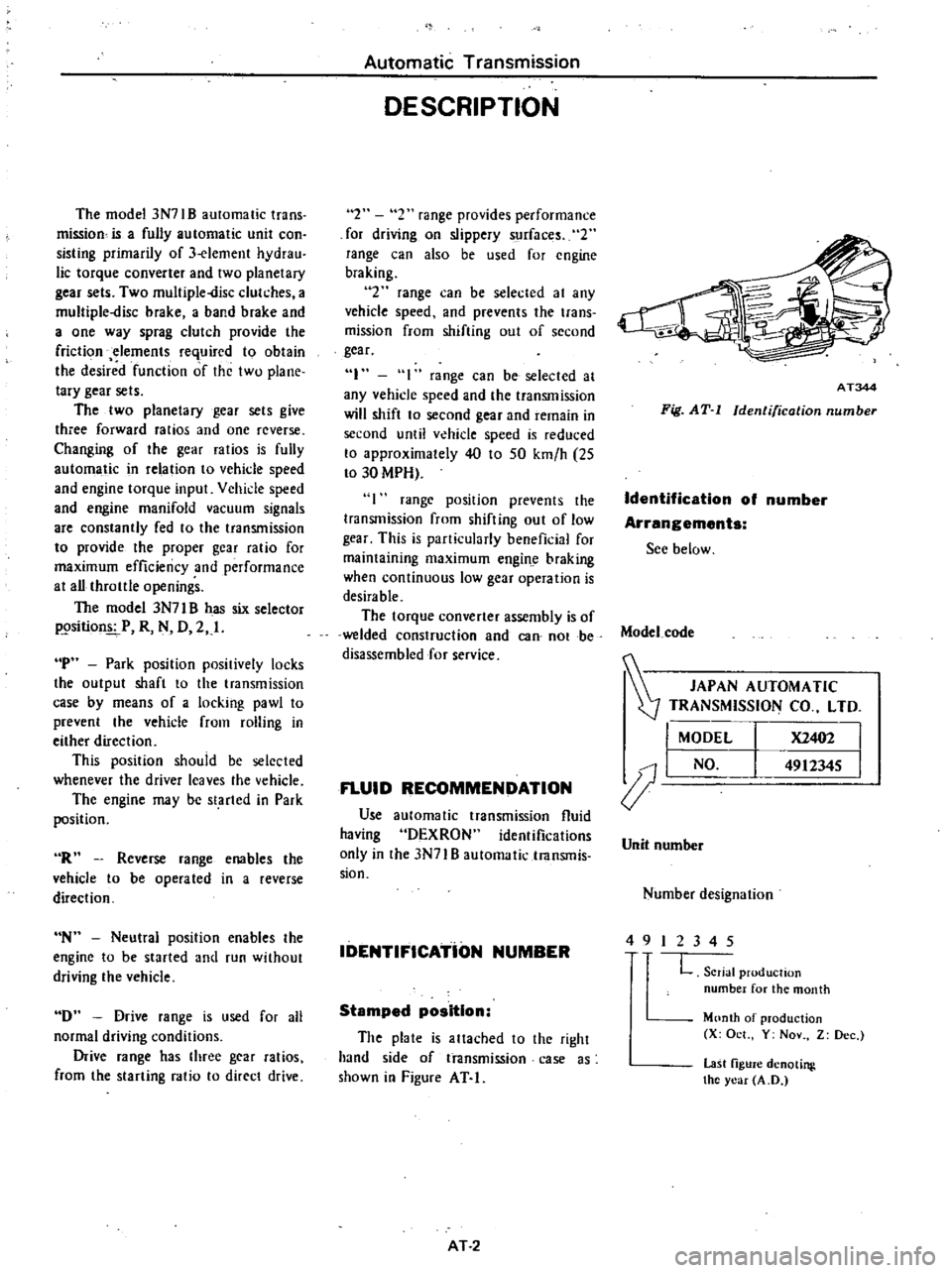
The
plate
is
attached
to
the
right
hand
side
of
transmission
case
as
shown
io
Figure
AT
I
AT
2
AT344
Fig
AT
I
Identification
number
Identification
of
number
Arrangements
See
below
Model
code
JAPAN
AUTOMATIC
0J
TRANSMISSION
CO
LTD
I
MODEL
X2402
I
J
I
NO
4912345
I
Unit
number
Number
designation
4
9
I
234
5
L
Serial
production
number
for
the
month
Month
of
production
X
Oct
Y
Nov
Z
Dec
last
figure
denoting
the
year
A
D
Page 263 of 537

Automatic
Transmission
o
J
II
IIlI
r
I
r
A
T288
I
Transmission
ca
e
2
Oil
pump
3
Front
clutch
4
Band
brake
5
Rear
clutch
6
Front
planetary
gear
7
Rear
planetary
gear
8
One
way
clutch
9
Low
Rever5e
brake
10
Oil
distributor
II
Governor
12
Output
shaft
13
Rear
extension
14
Oil
pan
IS
Control
valve
16
Input
Jlihafl
17
Torque
converter
t
8
Converter
housing
19
Drive
plate
Tightening
torque
T
of
bolts
and
nuts
kg
m
ft
lb
@
T
4105
29
10
36
@
T
141016
10110116
@
T
4
5
to
5
5
33
1040
@
T
0
6100
8
4
106
@
T
0
5
to
0
7
4
10
5
T
2
0102
5
14
10
18
@
T
1
3
10
1
8
9
10
13
T
0
55100
75
4
105
CD
T
0
25
10
0
35
2
to
3
Fig
AT
2
Cross
sectional
view
of
3N71B
automatic
transmission
AT3
Page 264 of 537

Automatic
Transmission
HYDRAULIC
CONTROL
SYSTEM
FUNCTIONS
OF
HYDRAULIC
CONTROL
UNIT
AND
VALVES
OIL
PUMP
MANUAL
LINKAGE
VACUUM
DIAPHRAGM
DOWNSHIFT
SOLENOID
GOVERNOR
VALVE
CONTROL
VALVE
ASSEMBLY
HYDRAULIC
SYSTEM
AND
MECHANICAL
OPERATION
FUNCTIONS
OF
HYDRAULIC
CONTROL
UNIT
AND
VALVES
The
hydraulic
control
system
con
CONTENTS
P
RANGE
PAR
K
R
RANGE
REVERSE
N
RANGE
NEUTRAL
D1
RANGE
LOW
GEAR
D2
RANGE
2ND
GEAR
D3
RANGE
TOP
GEAR
D
RANGE
KICK
DOWN
2
RANGE
2ND
GEAR
t
RANGE
LOW
GEAR
12
RANGE
2ND
GEAR
AT
4
AT
4
AT
4
AT
5
AT
5
AT
5
AT
6
AT13
tains
an
oil
pump
for
packing
p
oil
from
the
oil
pan
through
the
oil
strainer
A
shift
control
is
provided
by
two
centrifugally
operated
hydraulic
governors
on
the
output
shaft
vacuum
control
diaphragm
and
downshift
AT14
AT16
AT18
AT
20
AT
22
AT
24
AT
26
AT
28
AT
30
AT
32
solenoid
These
parts
work
in
conjunc
tion
with
valves
in
the
valve
body
assembly
located
in
the
base
of
the
transmission
The
valves
regulate
oil
pressure
and
direct
it
to
appropriate
transmission
components
Oil
pump
I
I
Control
valve
I
Torque
converter
1
I
I
I
Manual
linkage
Front
clutch
Vacuum
diaphragm
I
Rear
clutch
I
Low
and
reverse
brake
Downshift
solenoid
I
Band
brake
Governor
valve
r
I
Lubrication
OIL
PUMP
The
oil
pump
is
the
source
of
control
medium
i
e
oil
for
the
control
system
The
oil
pump
is
of
an
internal
involute
gear
type
The
drive
sleeve
is
a
part
of
the
torque
converter
pump
impeller
and
serves
to
drive
the
pump
inner
gear
with
the
drive
sleeve
direct
ly
coupled
with
the
engine
operation
The
oil
flows
through
the
following
route
Oil
pan
Oil
strainer
bottom
of
the
control
valve
Control
valve
lower
body
suction
port
Transmission
case
suction
port
Pump
housing
suction
port
Pump
gear
space
Pump
housing
delivery
port
Transmission
case
delivery
port
Lower
body
delivery
port
Control
valve
line
pressure
circuit
AT071
I
Housin
4
Inner
gear
2
Cover
5
Crescent
3
Ouler
gear
Fig
AT
3
Oil
pump
AT
4
MANUAL
LINKAGE
The
hand
lever
motion
the
hand
lever
is
localed
in
the
driver
s
compart
ment
mechanically
transmitted
from
lhe
remote
control
linkage
is
further
transmitted
to
the
inner
manual
lever
in
the
transmission
case
from
the
range
selector
lever
in
the
right
center
par
tion
of
the
transmission
case
through
the
manual
shaft
The
inner
manual
lever
is
thereby
turned
A
pin
installed
on
the
bottom
of
the
inner
manual
lever
slides
rhe
manu
al
valve
spool
of
the
conlrol
valve
thus
positioning
the
spool
opposite
rhe
appropriate
select
posilion
The
parking
rod
pin
is
held
in
rhe
groove
on
the
top
of
Ihe
inner
manual