belt DODGE NEON 1999 Service Owners Manual
[x] Cancel search | Manufacturer: DODGE, Model Year: 1999, Model line: NEON, Model: DODGE NEON 1999Pages: 1200, PDF Size: 35.29 MB
Page 801 of 1200
OIL PUMP
REMOVAL
(1) Disconnect negative cable from battery.
(2) Remove Timing Belt. Refer to procedure in this
section.
(3) Remove Oil Pan. Refer to procedure in this sec-
tion.
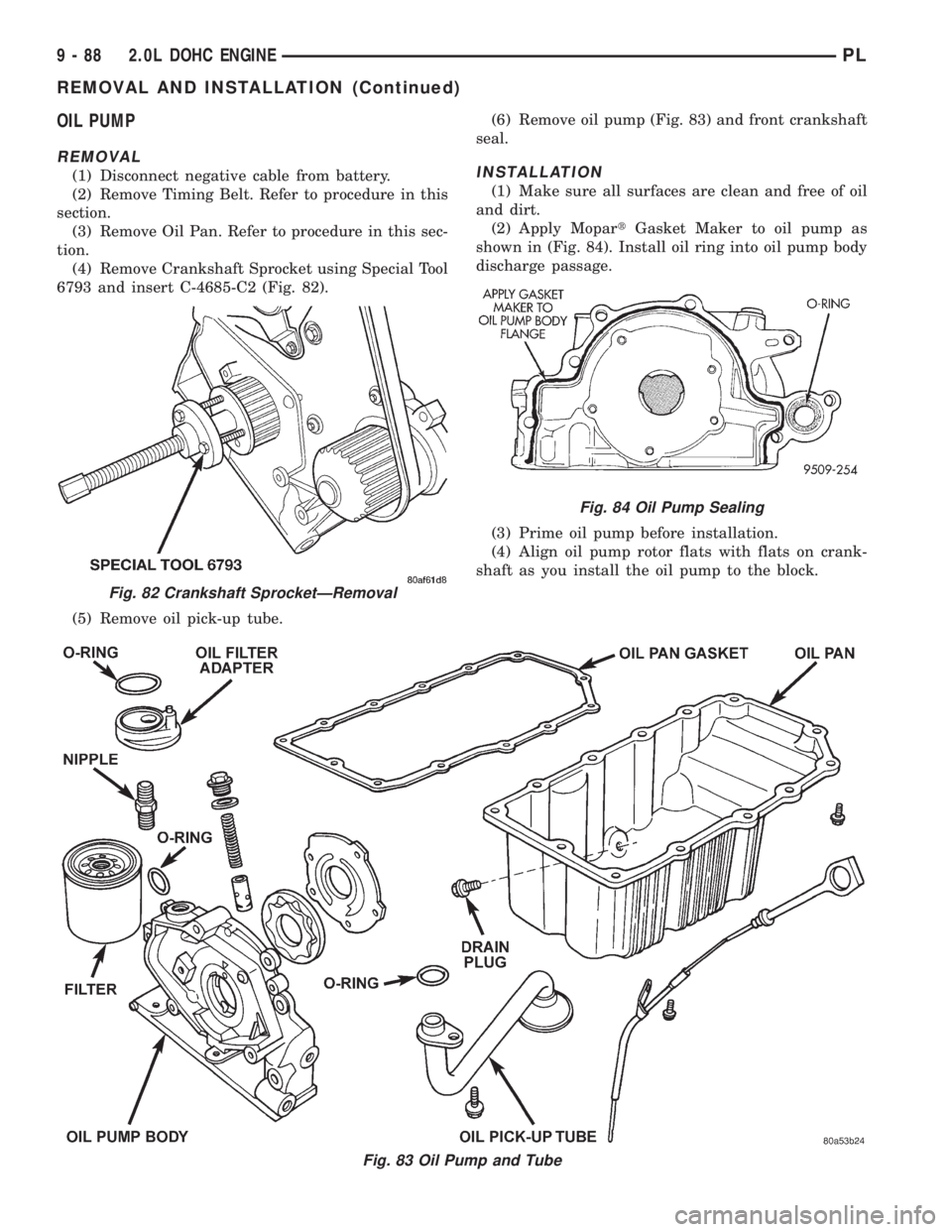
(4) Remove Crankshaft Sprocket using Special Tool
6793 and insert C-4685-C2 (Fig. 82).
(5) Remove oil pick-up tube.(6) Remove oil pump (Fig. 83) and front crankshaft
seal.INSTALLATION
(1) Make sure all surfaces are clean and free of oil
and dirt.
(2) Apply MopartGasket Maker to oil pump as
shown in (Fig. 84). Install oil ring into oil pump body
discharge passage.
(3) Prime oil pump before installation.
(4) Align oil pump rotor flats with flats on crank-
shaft as you install the oil pump to the block.
Fig. 83 Oil Pump and Tube
Fig. 82 Crankshaft SprocketÐRemoval
Fig. 84 Oil Pump Sealing
9 - 88 2.0L DOHC ENGINEPL
REMOVAL AND INSTALLATION (Continued)
Page 802 of 1200
NOTE: Front crankshaft seal MUST be out of pump
to align, or damage may result.
(5) Torque all oil pump attaching bolts to 28 N´m
(250 in. lbs.)
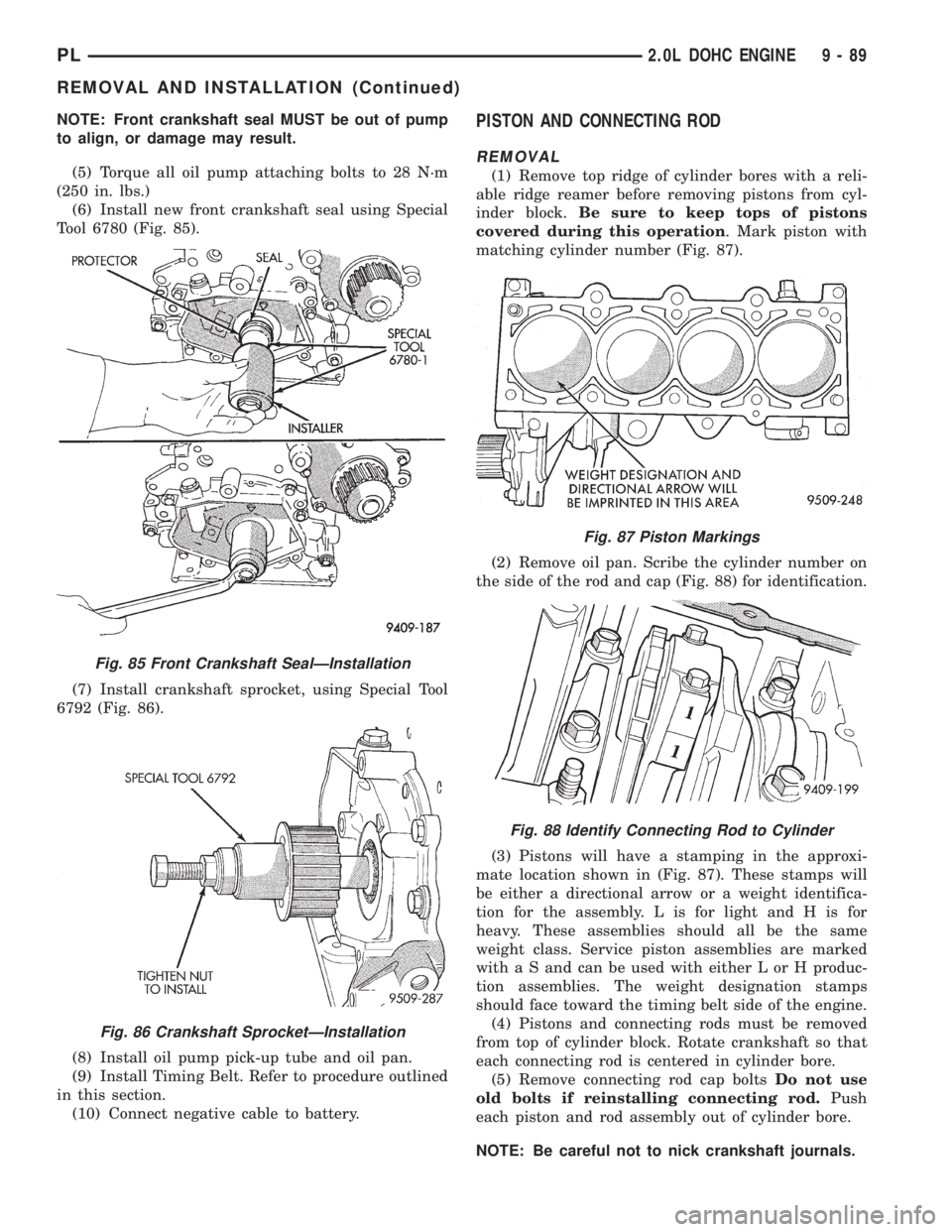
(6) Install new front crankshaft seal using Special
Tool 6780 (Fig. 85).
(7) Install crankshaft sprocket, using Special Tool
6792 (Fig. 86).
(8) Install oil pump pick-up tube and oil pan.
(9) Install Timing Belt. Refer to procedure outlined
in this section.
(10) Connect negative cable to battery.PISTON AND CONNECTING ROD
REMOVAL
(1) Remove top ridge of cylinder bores with a reli-
able ridge reamer before removing pistons from cyl-
inder block.Be sure to keep tops of pistons
covered during this operation. Mark piston with
matching cylinder number (Fig. 87).
(2) Remove oil pan. Scribe the cylinder number on
the side of the rod and cap (Fig. 88) for identification.
(3) Pistons will have a stamping in the approxi-
mate location shown in (Fig. 87). These stamps will
be either a directional arrow or a weight identifica-
tion for the assembly. L is for light and H is for
heavy. These assemblies should all be the same
weight class. Service piston assemblies are marked
with a S and can be used with either L or H produc-
tion assemblies. The weight designation stamps
should face toward the timing belt side of the engine.
(4) Pistons and connecting rods must be removed
from top of cylinder block. Rotate crankshaft so that
each connecting rod is centered in cylinder bore.
(5) Remove connecting rod cap boltsDo not use
old bolts if reinstalling connecting rod.Push
each piston and rod assembly out of cylinder bore.
NOTE: Be careful not to nick crankshaft journals.
Fig. 85 Front Crankshaft SealÐInstallation
Fig. 86 Crankshaft SprocketÐInstallation
Fig. 87 Piston Markings
Fig. 88 Identify Connecting Rod to Cylinder
PL2.0L DOHC ENGINE 9 - 89
REMOVAL AND INSTALLATION (Continued)
Page 811 of 1200
TORQUE CHART 2.0L DOHC
DESCRIPTION TORQUE
Camshaft Sensor Pick-Up
Bolts....................9.6 N´m (85 in. lbs.)
Camshaft Sprocket
Bolt.....................115N´m(85ft.lbs.)
Connecting Rod Cap
Bolts..........27N´m(20ft.lbs.) Plus 1/4 Turn
CollarÐOil Pan to Transaxle
Step 1: Collar to Oil Pan Bolts . .3 N´m (30 in. lbs.)
Step 2: Collar to Transaxle Bolts.108 N´m (80 ft. lbs.)
Step 3: Collar to Oil Pan Bolts .54 N´m (40 ft. lbs.)
Crankshaft Main Bearing Cap/Bedplate
M8 Bedplate Bolts...........30N´m(22ft.lbs.)
M11 Main Cap Bolts.........81N´m(60ft.lbs.)
Crankshaft Damper
Bolt....................142 N´m (105 ft. lbs.)
Cylinder Head
Bolts........Refer To Cylinder Head Installation
Cylinder Head Cover
Bolts....................12N´m(105 in. lbs.)
Drive Plate to Crankshaft
Bolts.....................95N´m(70ft.lbs.)
Engine Mount Bracket
Bolts.....................41N´m(30ft.lbs.)
Exhaust Manifold to Cylinder Head
Bolts....................23N´m(200 in. lbs.)
Exhaust Manifold Heat Shield
Bolts....................15N´m(130 in. lbs.)
Intake Manifold
Bolts....................28N´m(250 in. lbs.)
Oil Filter Adapter
Fastener..................80N´m(60ft.lbs.)
Oil Filter..................20N´m(15ft.lbs.)
Oil Pan
Bolts....................12N´m(105 in. lbs.)
Drain Plug.................34N´m(25ft.lbs.)
Oil Pump Attaching
Bolts....................28N´m(250 in. lbs.)
Oil Pump Cover Fastener. . . .12 N´m (105 in. lbs.)
Oil Pump Pick-up Tube Bolt . .28 N´m (250 in. lbs.)
Oil Pump Relief Valve Cap. . . .55 N´m (40 ft. lbs.)
Spark Plugs
Plug......................28N´m(20ft.lbs.)
Thermostat Housing
Bolts....................23N´m(200 in lbs.)
Timing Belt Tensioner AssemblyÐMechanical
Bolts....................28N´m(250 in. lbs.)
Timing Belt Tensioner AssemblyÐHydraulic
Bolts....................31N´m(275 in. lbs.)
Timing Belt TensionerÐHydraulic
Bolts....................31N´m(275 in. lbs.)DESCRIPTION TORQUE
Timing Belt Idler Pulley
Bolt........................61N´m(45ft.lbs.)
Timing Belt Cover
Bolts M6.................12N´m(105 in. lbs.)
Water Pump Mounting
Bolts....................12N´m(105 in. lbs.)
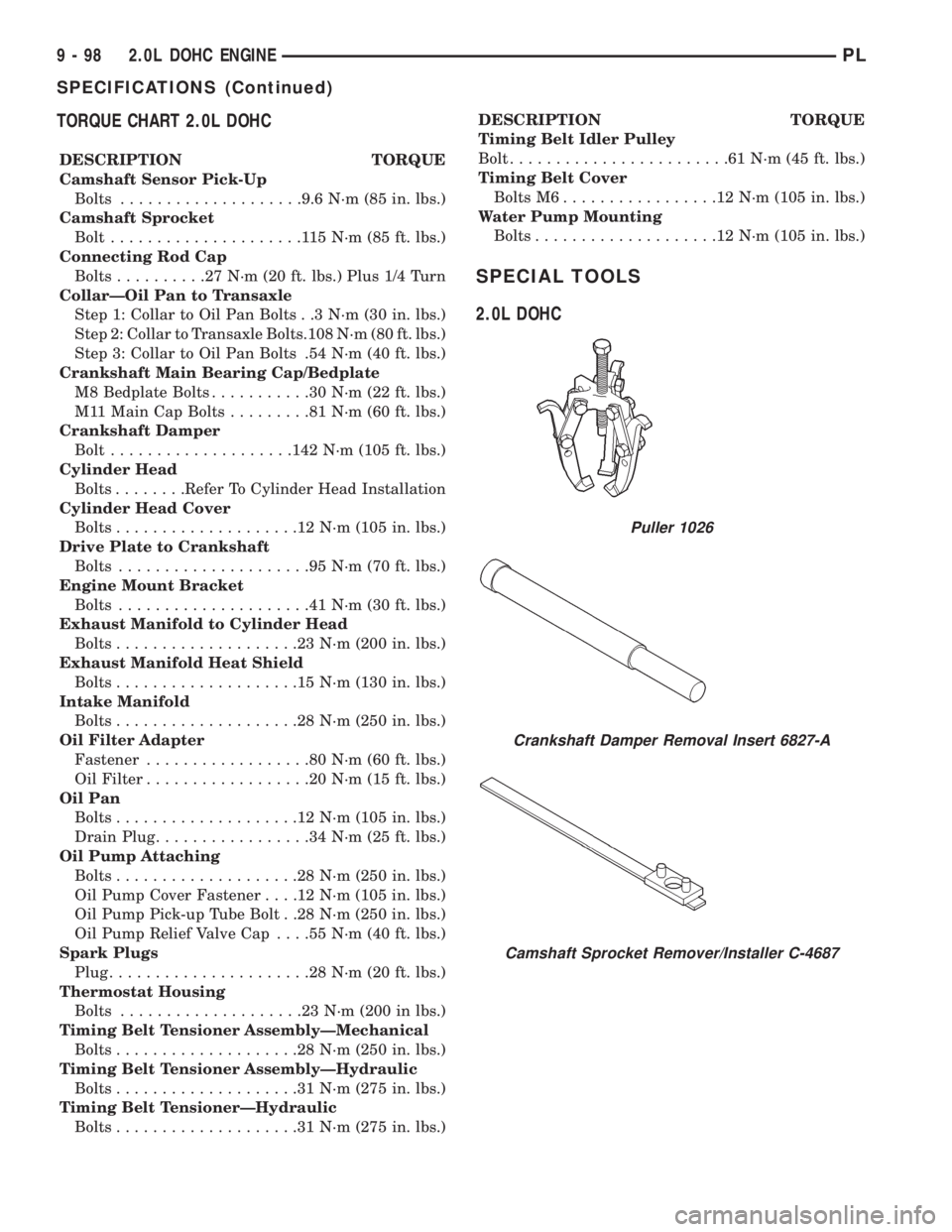
SPECIAL TOOLS
2.0L DOHC
Puller 1026
Crankshaft Damper Removal Insert 6827-A
Camshaft Sprocket Remover/Installer C-4687
9 - 98 2.0L DOHC ENGINEPL
SPECIFICATIONS (Continued)
Page 879 of 1200
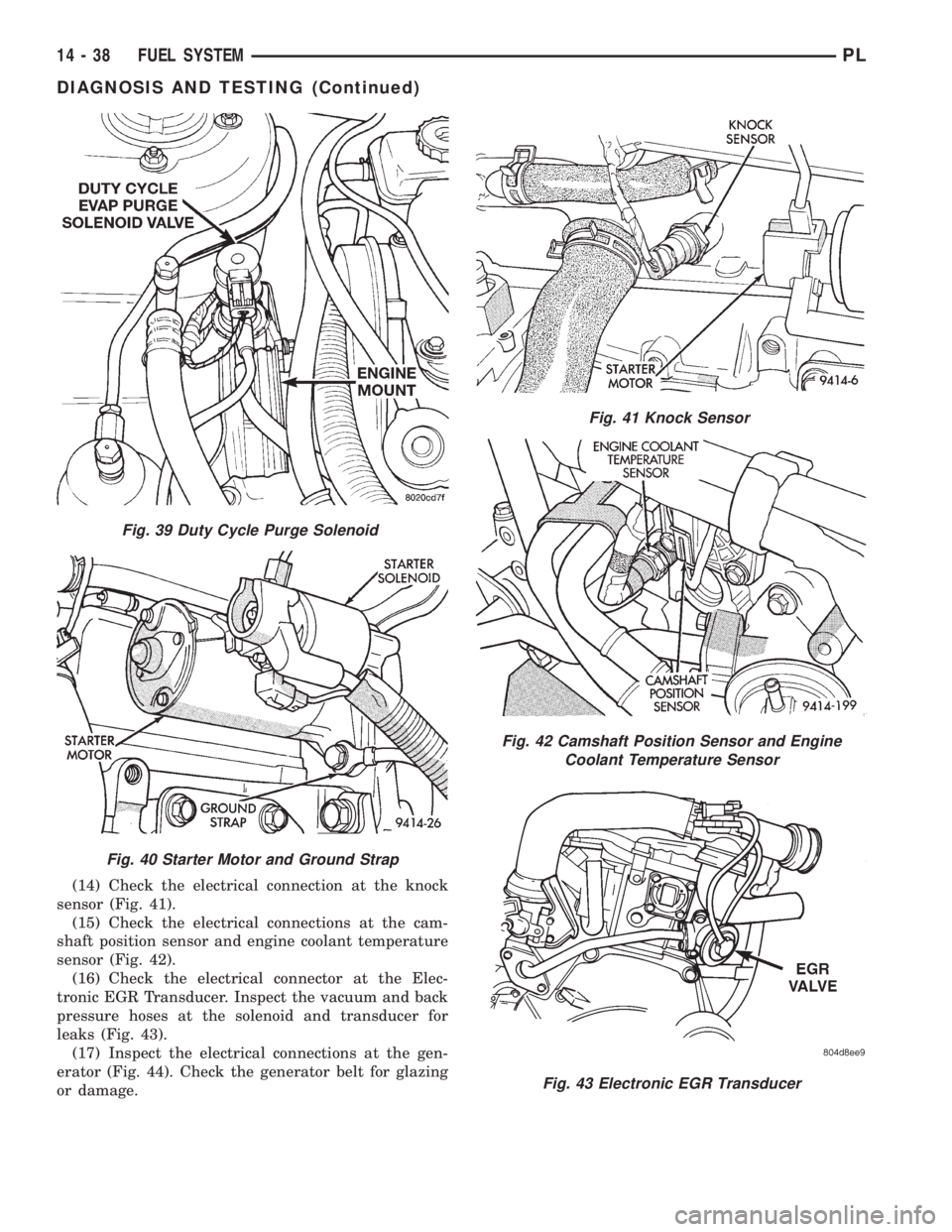
(14) Check the electrical connection at the knock
sensor (Fig. 41).
(15) Check the electrical connections at the cam-
shaft position sensor and engine coolant temperature
sensor (Fig. 42).
(16) Check the electrical connector at the Elec-
tronic EGR Transducer. Inspect the vacuum and back
pressure hoses at the solenoid and transducer for
leaks (Fig. 43).
(17) Inspect the electrical connections at the gen-
erator (Fig. 44). Check the generator belt for glazing
or damage.
Fig. 39 Duty Cycle Purge Solenoid
Fig. 40 Starter Motor and Ground Strap
Fig. 41 Knock Sensor
Fig. 42 Camshaft Position Sensor and Engine
Coolant Temperature Sensor
Fig. 43 Electronic EGR Transducer
14 - 38 FUEL SYSTEMPL
DIAGNOSIS AND TESTING (Continued)
Page 884 of 1200
(13) Inspect the air cleaner filter element. Replace
as necessary. Check the air induction system for
restrictions.
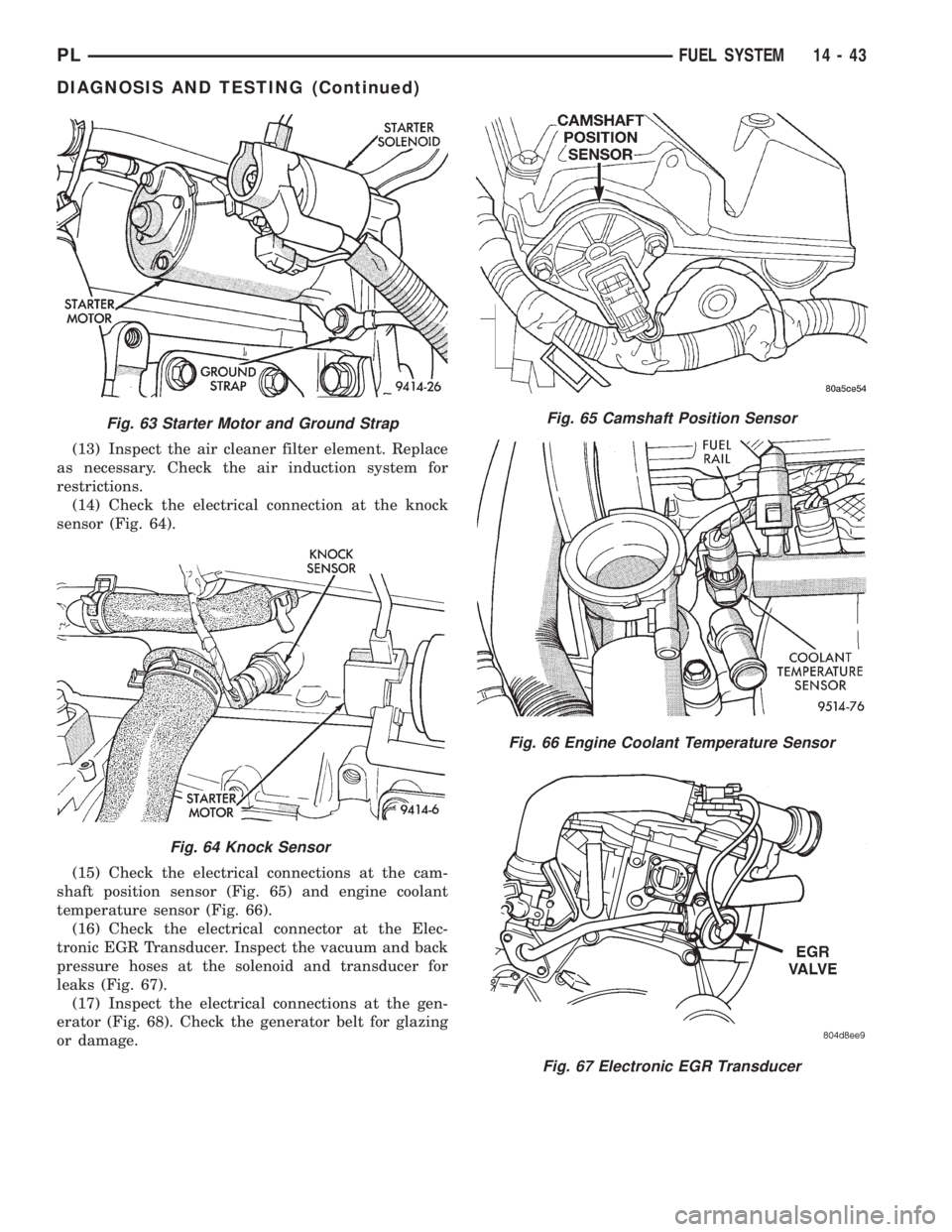
(14) Check the electrical connection at the knock
sensor (Fig. 64).
(15) Check the electrical connections at the cam-
shaft position sensor (Fig. 65) and engine coolant
temperature sensor (Fig. 66).
(16) Check the electrical connector at the Elec-
tronic EGR Transducer. Inspect the vacuum and back
pressure hoses at the solenoid and transducer for
leaks (Fig. 67).
(17) Inspect the electrical connections at the gen-
erator (Fig. 68). Check the generator belt for glazing
or damage.
Fig. 63 Starter Motor and Ground Strap
Fig. 64 Knock Sensor
Fig. 65 Camshaft Position Sensor
Fig. 66 Engine Coolant Temperature Sensor
Fig. 67 Electronic EGR Transducer
PLFUEL SYSTEM 14 - 43
DIAGNOSIS AND TESTING (Continued)
Page 903 of 1200
DIAGNOSIS AND TESTING
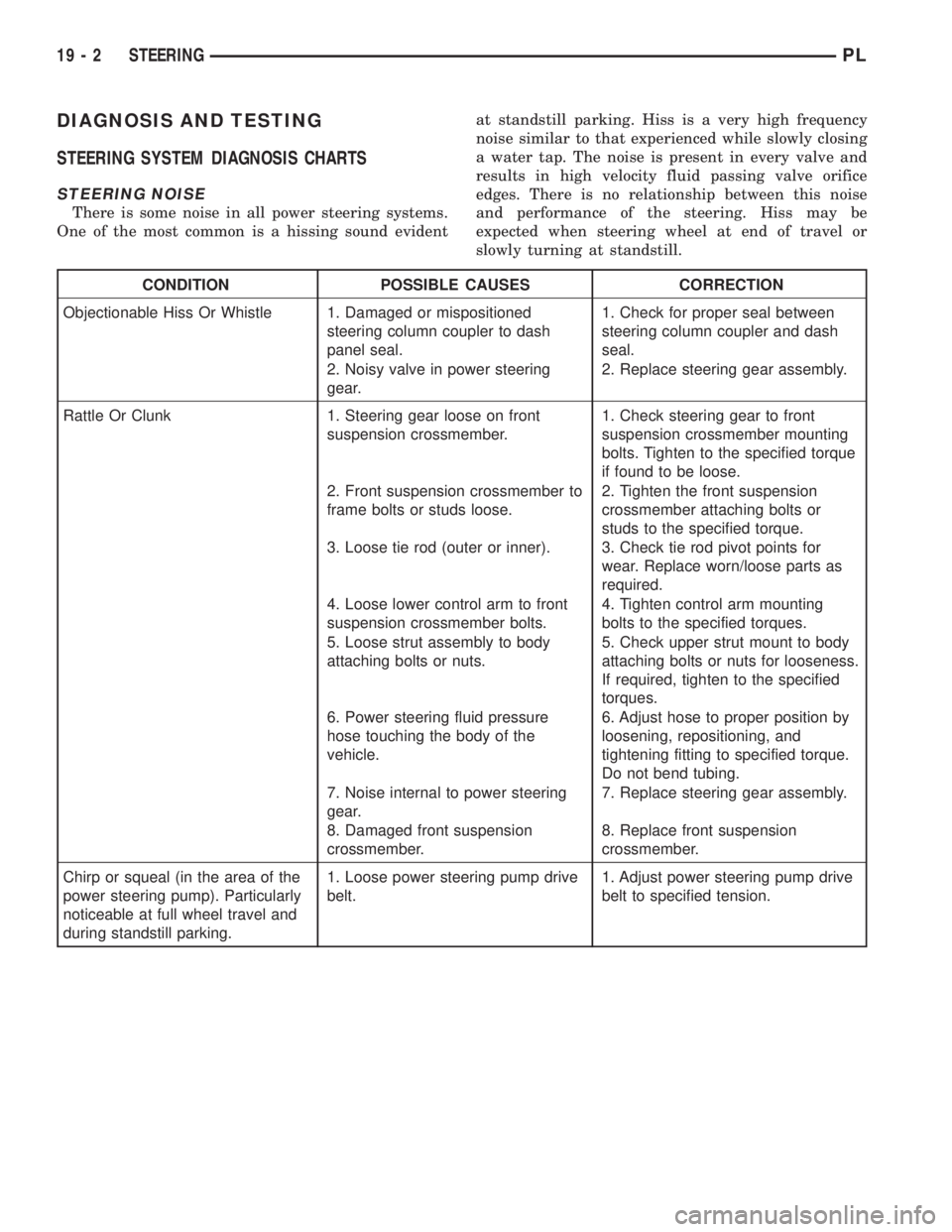
STEERING SYSTEM DIAGNOSIS CHARTS
STEERING NOISE
There is some noise in all power steering systems.
One of the most common is a hissing sound evidentat standstill parking. Hiss is a very high frequency
noise similar to that experienced while slowly closing
a water tap. The noise is present in every valve and
results in high velocity fluid passing valve orifice
edges. There is no relationship between this noise
and performance of the steering. Hiss may be
expected when steering wheel at end of travel or
slowly turning at standstill.
CONDITION POSSIBLE CAUSES CORRECTION
Objectionable Hiss Or Whistle 1. Damaged or mispositioned
steering column coupler to dash
panel seal.1. Check for proper seal between
steering column coupler and dash
seal.
2. Noisy valve in power steering
gear.2. Replace steering gear assembly.
Rattle Or Clunk 1. Steering gear loose on front
suspension crossmember.1. Check steering gear to front
suspension crossmember mounting
bolts. Tighten to the specified torque
if found to be loose.
2. Front suspension crossmember to
frame bolts or studs loose.2. Tighten the front suspension
crossmember attaching bolts or
studs to the specified torque.
3. Loose tie rod (outer or inner). 3. Check tie rod pivot points for
wear. Replace worn/loose parts as
required.
4. Loose lower control arm to front
suspension crossmember bolts.4. Tighten control arm mounting
bolts to the specified torques.
5. Loose strut assembly to body
attaching bolts or nuts.5. Check upper strut mount to body
attaching bolts or nuts for looseness.
If required, tighten to the specified
torques.
6. Power steering fluid pressure
hose touching the body of the
vehicle.6. Adjust hose to proper position by
loosening, repositioning, and
tightening fitting to specified torque.
Do not bend tubing.
7. Noise internal to power steering
gear.7. Replace steering gear assembly.
8. Damaged front suspension
crossmember.8. Replace front suspension
crossmember.
Chirp or squeal (in the area of the
power steering pump). Particularly
noticeable at full wheel travel and
during standstill parking.1. Loose power steering pump drive
belt.1. Adjust power steering pump drive
belt to specified tension.
19 - 2 STEERINGPL
Page 905 of 1200
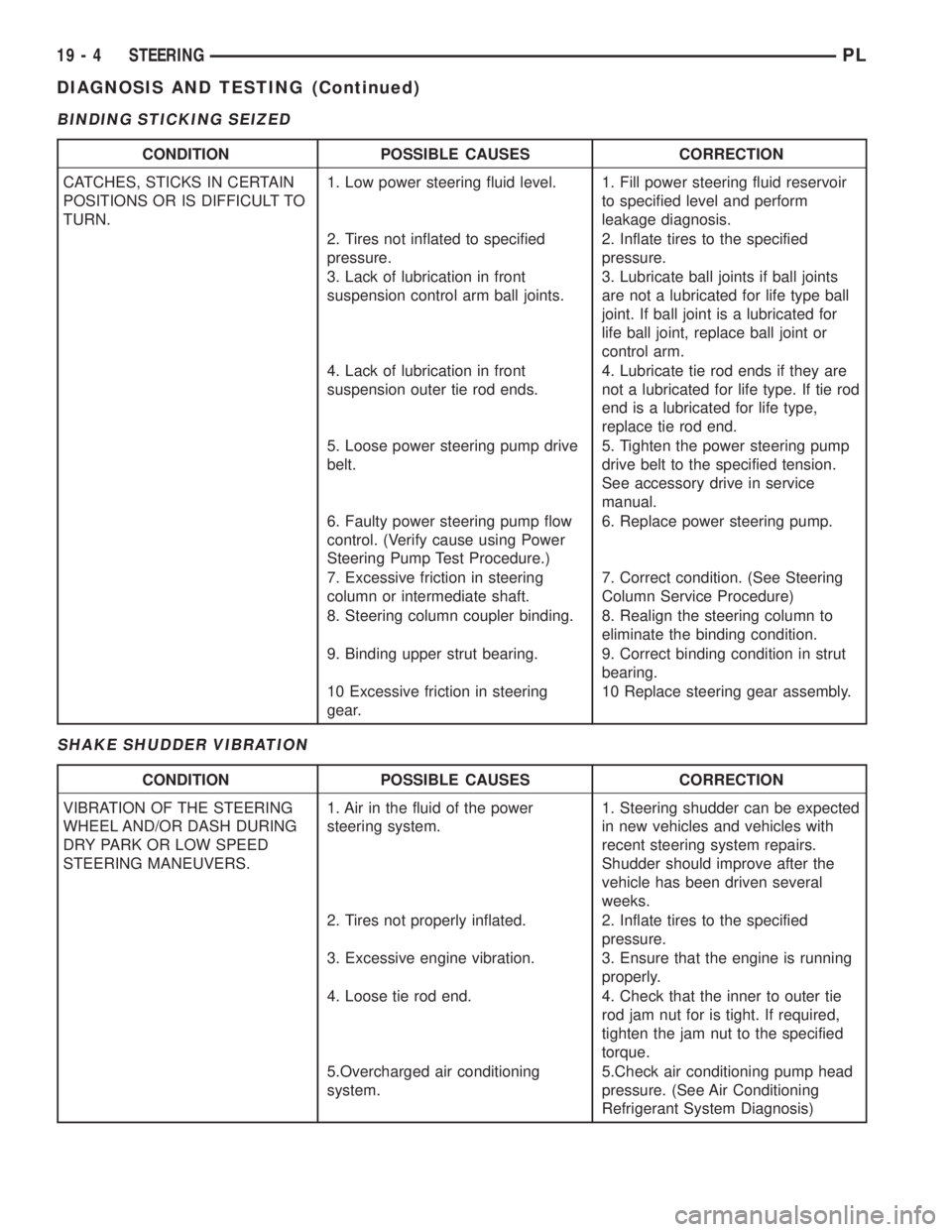
BINDING STICKING SEIZED
SHAKE SHUDDER VIBRATION
CONDITION POSSIBLE CAUSES CORRECTION
CATCHES, STICKS IN CERTAIN
POSITIONS OR IS DIFFICULT TO
TURN.1. Low power steering fluid level. 1. Fill power steering fluid reservoir
to specified level and perform
leakage diagnosis.
2. Tires not inflated to specified
pressure.2. Inflate tires to the specified
pressure.
3. Lack of lubrication in front
suspension control arm ball joints.3. Lubricate ball joints if ball joints
are not a lubricated for life type ball
joint. If ball joint is a lubricated for
life ball joint, replace ball joint or
control arm.
4. Lack of lubrication in front
suspension outer tie rod ends.4. Lubricate tie rod ends if they are
not a lubricated for life type. If tie rod
end is a lubricated for life type,
replace tie rod end.
5. Loose power steering pump drive
belt.5. Tighten the power steering pump
drive belt to the specified tension.
See accessory drive in service
manual.
6. Faulty power steering pump flow
control. (Verify cause using Power
Steering Pump Test Procedure.)6. Replace power steering pump.
7. Excessive friction in steering
column or intermediate shaft.7. Correct condition. (See Steering
Column Service Procedure)
8. Steering column coupler binding. 8. Realign the steering column to
eliminate the binding condition.
9. Binding upper strut bearing. 9. Correct binding condition in strut
bearing.
10 Excessive friction in steering
gear.10 Replace steering gear assembly.
CONDITION POSSIBLE CAUSES CORRECTION
VIBRATION OF THE STEERING
WHEEL AND/OR DASH DURING
DRY PARK OR LOW SPEED
STEERING MANEUVERS.1. Air in the fluid of the power
steering system.1. Steering shudder can be expected
in new vehicles and vehicles with
recent steering system repairs.
Shudder should improve after the
vehicle has been driven several
weeks.
2. Tires not properly inflated. 2. Inflate tires to the specified
pressure.
3. Excessive engine vibration. 3. Ensure that the engine is running
properly.
4. Loose tie rod end. 4. Check that the inner to outer tie
rod jam nut for is tight. If required,
tighten the jam nut to the specified
torque.
5.Overcharged air conditioning
system.5.Check air conditioning pump head
pressure. (See Air Conditioning
Refrigerant System Diagnosis)
19 - 4 STEERINGPL
DIAGNOSIS AND TESTING (Continued)
Page 906 of 1200
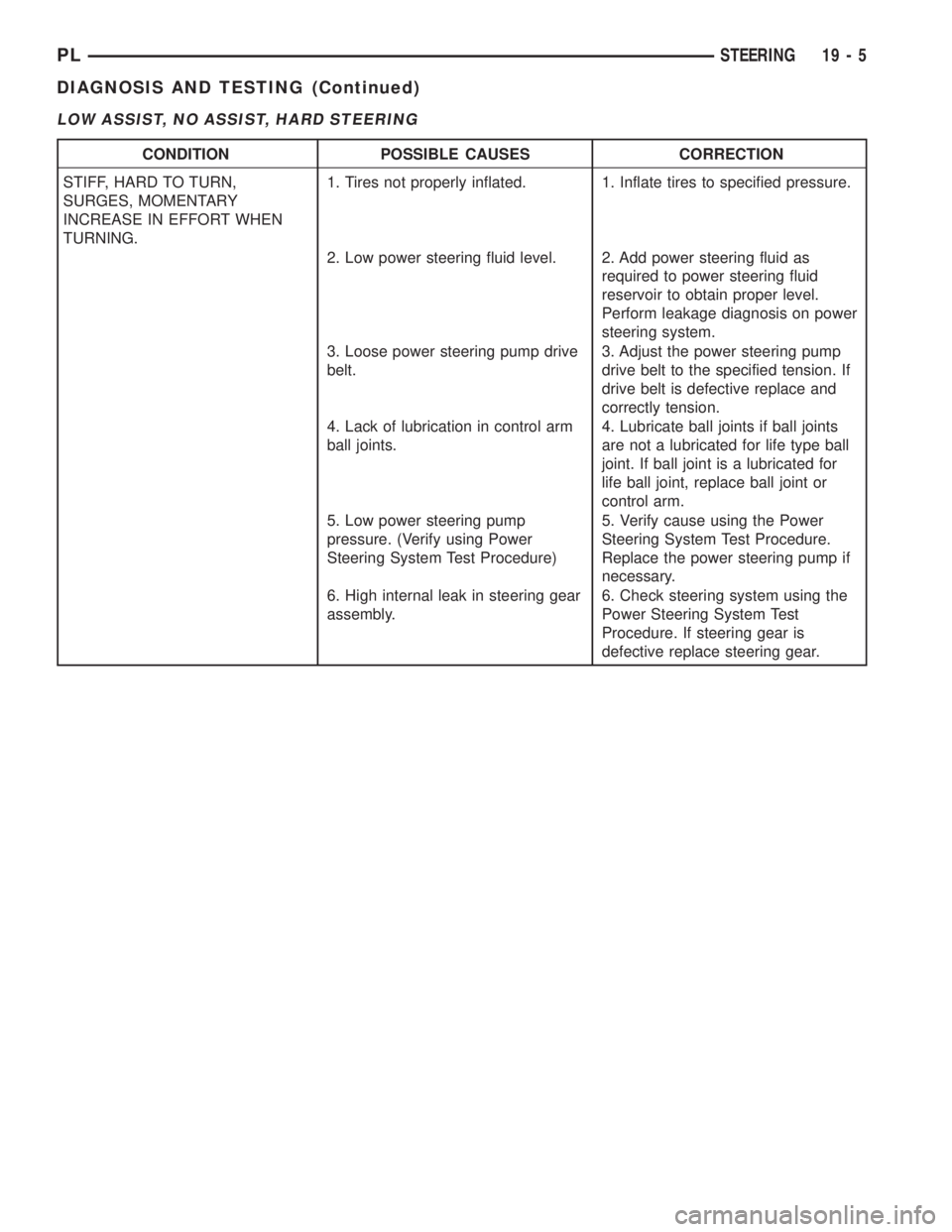
LOW ASSIST, NO ASSIST, HARD STEERING
CONDITION POSSIBLE CAUSES CORRECTION
STIFF, HARD TO TURN,
SURGES, MOMENTARY
INCREASE IN EFFORT WHEN
TURNING.1. Tires not properly inflated. 1. Inflate tires to specified pressure.
2. Low power steering fluid level. 2. Add power steering fluid as
required to power steering fluid
reservoir to obtain proper level.
Perform leakage diagnosis on power
steering system.
3. Loose power steering pump drive
belt.3. Adjust the power steering pump
drive belt to the specified tension. If
drive belt is defective replace and
correctly tension.
4. Lack of lubrication in control arm
ball joints.4. Lubricate ball joints if ball joints
are not a lubricated for life type ball
joint. If ball joint is a lubricated for
life ball joint, replace ball joint or
control arm.
5. Low power steering pump
pressure. (Verify using Power
Steering System Test Procedure)5. Verify cause using the Power
Steering System Test Procedure.
Replace the power steering pump if
necessary.
6. High internal leak in steering gear
assembly.6. Check steering system using the
Power Steering System Test
Procedure. If steering gear is
defective replace steering gear.
PLSTEERING 19 - 5
DIAGNOSIS AND TESTING (Continued)
Page 910 of 1200
POWER STEERING PUMP
INDEX
page page
DESCRIPTION AND OPERATION
POWER STEERING PUMP................. 9
DIAGNOSIS AND TESTING
POWER STEERING SYSTEM TEST
PROCEDURE......................... 10
SERVICE PROCEDURES
POWER STEERING PUMP
FLOW CONTROL VALVE SEAL............ 11
POWER STEERING PUMP
INITIAL OPERATION.................... 11
POWER STEERING PUMP
SUCTION PORT SEAL.................. 12
POWER STEERING SYSTEM
FLUID LEVEL CHECK................... 11
REMOVAL AND INSTALLATION
POWER STEERING FLUID PRESSURE HOSE . . 13
POWER STEERING FLUID RESERVOIR...... 21POWER STEERING FLUID RETURN HOSE.... 15
POWER STEERING FLUID SUPPLY HOSE
RESERVOIR TO POWER STEERING PUMP . . 17
POWER STEERING PRESSURE SWITCH..... 12
POWER STEERING PUMP (ALL ENGINES).... 18
DISASSEMBLY AND ASSEMBLY
POWER STEERING PUMP DRIVE PULLEY.... 22
POWER STEERING PUMP MOUNTING
BRACKET............................ 23
SPECIFICATIONS
POWER STEERING PUMP FASTENER
TORQUE SPECIFICATIONS.............. 25
POWER STEERING PUMP FLOW
SPECIFICATIONS...................... 25
SPECIAL TOOLS
POWER STEERING PUMP................. 25
DESCRIPTION AND OPERATION
POWER STEERING PUMP
On all vehicles equipped with power steering, the
hydraulic pressure for operation of the power steer-
ing gear is provided by a belt driven power steering
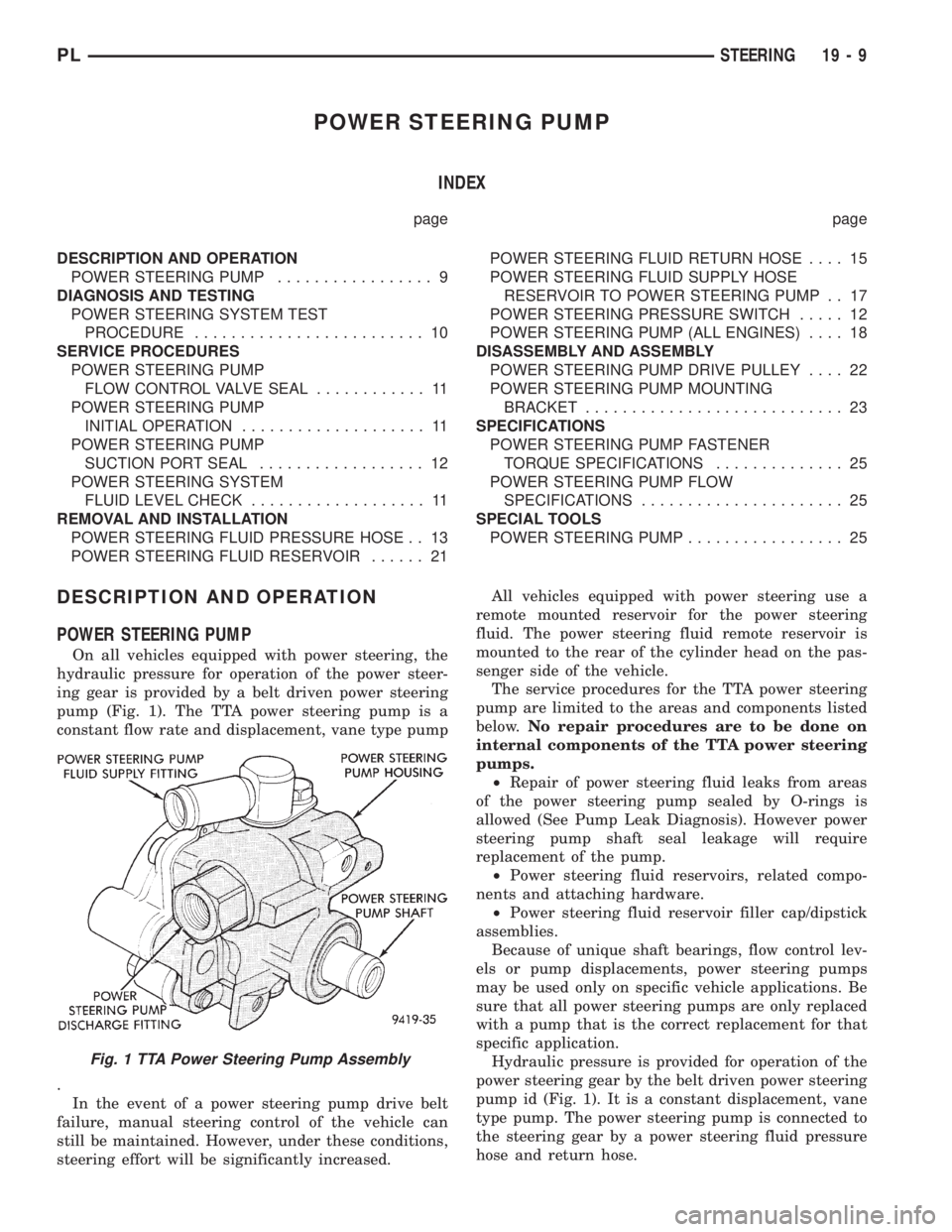
pump (Fig. 1). The TTA power steering pump is a
constant flow rate and displacement, vane type pump
.
In the event of a power steering pump drive belt
failure, manual steering control of the vehicle can
still be maintained. However, under these conditions,
steering effort will be significantly increased.All vehicles equipped with power steering use a
remote mounted reservoir for the power steering
fluid. The power steering fluid remote reservoir is
mounted to the rear of the cylinder head on the pas-
senger side of the vehicle.
The service procedures for the TTA power steering
pump are limited to the areas and components listed
below.No repair procedures are to be done on
internal components of the TTA power steering
pumps.
²Repair of power steering fluid leaks from areas
of the power steering pump sealed by O-rings is
allowed (See Pump Leak Diagnosis). However power
steering pump shaft seal leakage will require
replacement of the pump.
²Power steering fluid reservoirs, related compo-
nents and attaching hardware.
²Power steering fluid reservoir filler cap/dipstick
assemblies.
Because of unique shaft bearings, flow control lev-
els or pump displacements, power steering pumps
may be used only on specific vehicle applications. Be
sure that all power steering pumps are only replaced
with a pump that is the correct replacement for that
specific application.
Hydraulic pressure is provided for operation of the
power steering gear by the belt driven power steering
pump id (Fig. 1). It is a constant displacement, vane
type pump. The power steering pump is connected to
the steering gear by a power steering fluid pressure
hose and return hose.
Fig. 1 TTA Power Steering Pump Assembly
PLSTEERING 19 - 9
Page 911 of 1200
Rectangular pumping vanes in the shaft driven
rotor, move power steering fluid from the intake to
the cam ring pressure cavities of the power steering
pump. As the rotor begins to turn, centrifugal force
throws the vanes against the inside surface of the
cam ring to pickup residual oil. This oil is then forced
into the high pressure area. As more oil is picked up
by the vanes, the additional oil is forced into the cav-
ities of the thrust plate through two crossover holes
in the cam ring and pressure plate. The crossover
holes empty into the high pressure area between the
pressure plate and the housing end cover.
As the high pressure area is filled, oil flows under
the vanes in the rotor slots, forcing the vanes to fol-
low the inside surface of the cam ring. As the vanes
reach the restricted area of the cam ring, oil is forced
out from between the vanes. When excess oil flow is
generated during high-speed operation, a regulated
amount of oil returns to the pump intake side
through a flow control valve. The flow control valve
reduces the power required to drive the pump and
holds down temperature build-up.
When steering conditions exceed maximum pres-
sure requirements, such as when the wheels are
turned against the stops. The pressure built up in
the steering gear exerts pressure on the spring end of
the flow control valve. The high pressure lifts the
relief valve ball from its seat and allows oil to flow
through a trigger orifice located in the outlet fitting.
This reduces pressure on the spring end of the flow
control valve which then opens and allows the oil to
return to the intake side of the pump. This action
limits maximum pressure output of the pump to a
safe level.
Under normal power steering pump operating con-
ditions, pressure requirements of the pump are below
maximum, causing the pressure relief valve to
remain closed.
DIAGNOSIS AND TESTING
POWER STEERING SYSTEM TEST PROCEDURE
The following procedure can be used to test the
operation of the power steering system on the vehi-
cle. This test will provide the flow rate of the power
steering pump along with the maximum relief pres-
sure. This test is to be performed any time a power
steering system problem is present to determine if
the power steering pump or power steering gear is
not functioning properly. The following pressure and
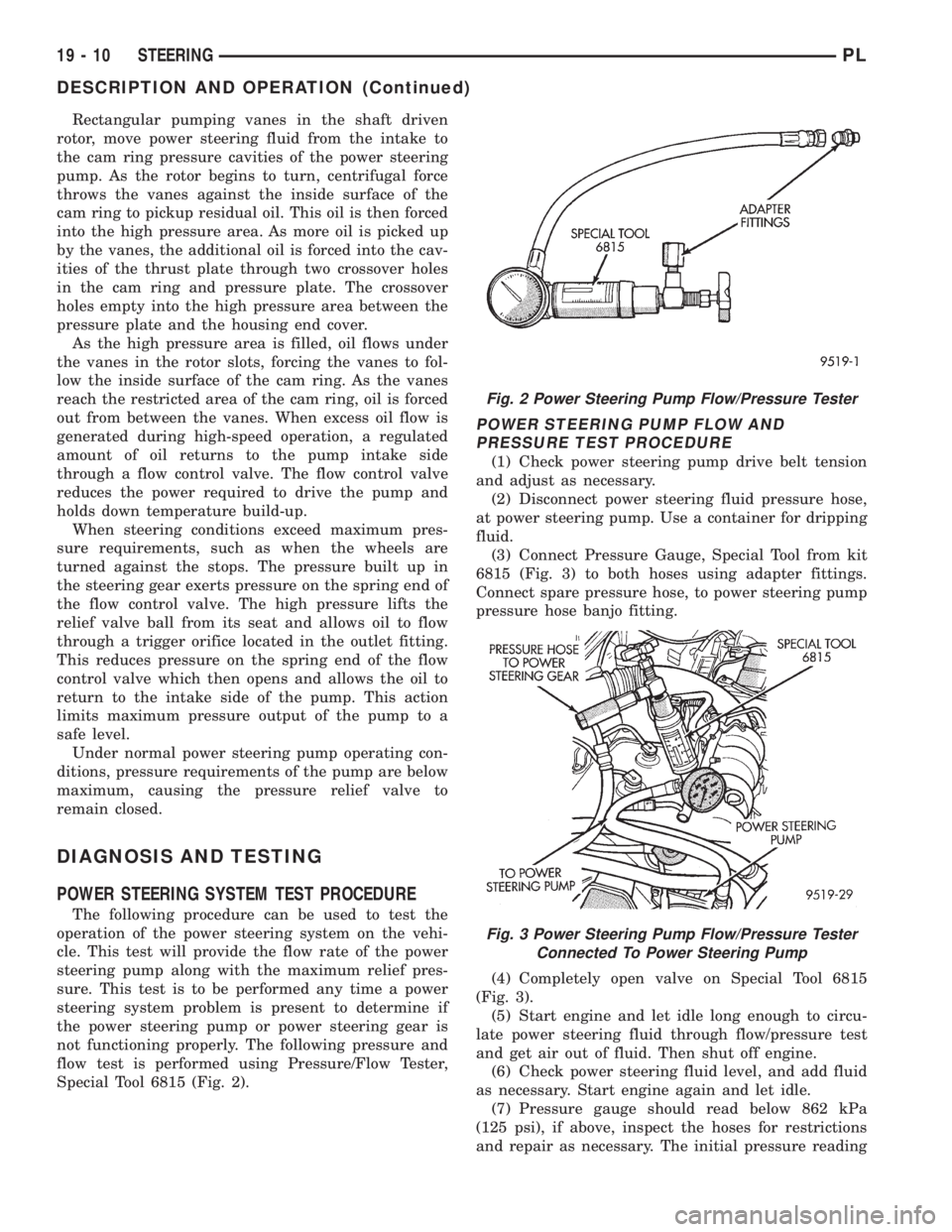
flow test is performed using Pressure/Flow Tester,
Special Tool 6815 (Fig. 2).
POWER STEERING PUMP FLOW AND
PRESSURE TEST PROCEDURE
(1) Check power steering pump drive belt tension
and adjust as necessary.
(2) Disconnect power steering fluid pressure hose,
at power steering pump. Use a container for dripping
fluid.
(3) Connect Pressure Gauge, Special Tool from kit
6815 (Fig. 3) to both hoses using adapter fittings.
Connect spare pressure hose, to power steering pump
pressure hose banjo fitting.
(4) Completely open valve on Special Tool 6815
(Fig. 3).
(5) Start engine and let idle long enough to circu-
late power steering fluid through flow/pressure test
and get air out of fluid. Then shut off engine.
(6) Check power steering fluid level, and add fluid
as necessary. Start engine again and let idle.
(7) Pressure gauge should read below 862 kPa
(125 psi), if above, inspect the hoses for restrictions
and repair as necessary. The initial pressure reading
Fig. 2 Power Steering Pump Flow/Pressure Tester
Fig. 3 Power Steering Pump Flow/Pressure Tester
Connected To Power Steering Pump
19 - 10 STEERINGPL
DESCRIPTION AND OPERATION (Continued)