lock DODGE NEON 1999 Service Repair Manual
[x] Cancel search | Manufacturer: DODGE, Model Year: 1999, Model line: NEON, Model: DODGE NEON 1999Pages: 1200, PDF Size: 35.29 MB
Page 779 of 1200
(18) Lower vehicle. Remove air cleaner assembly.
(19) Remove power steering pump and reservoir,
Set them aside.
(20) Remove A/C compressor.
(21) Remove ground straps to body.
(22) Raise vehicle enough to allow engine dolly
and cradle Special Tools 6135 and 6710 to be
installed under vehicle.
(23) Loosen engine support posts to allow move-
ment for positioning onto engine locating holes and
flange on the engine bedplate. Lower vehicle and
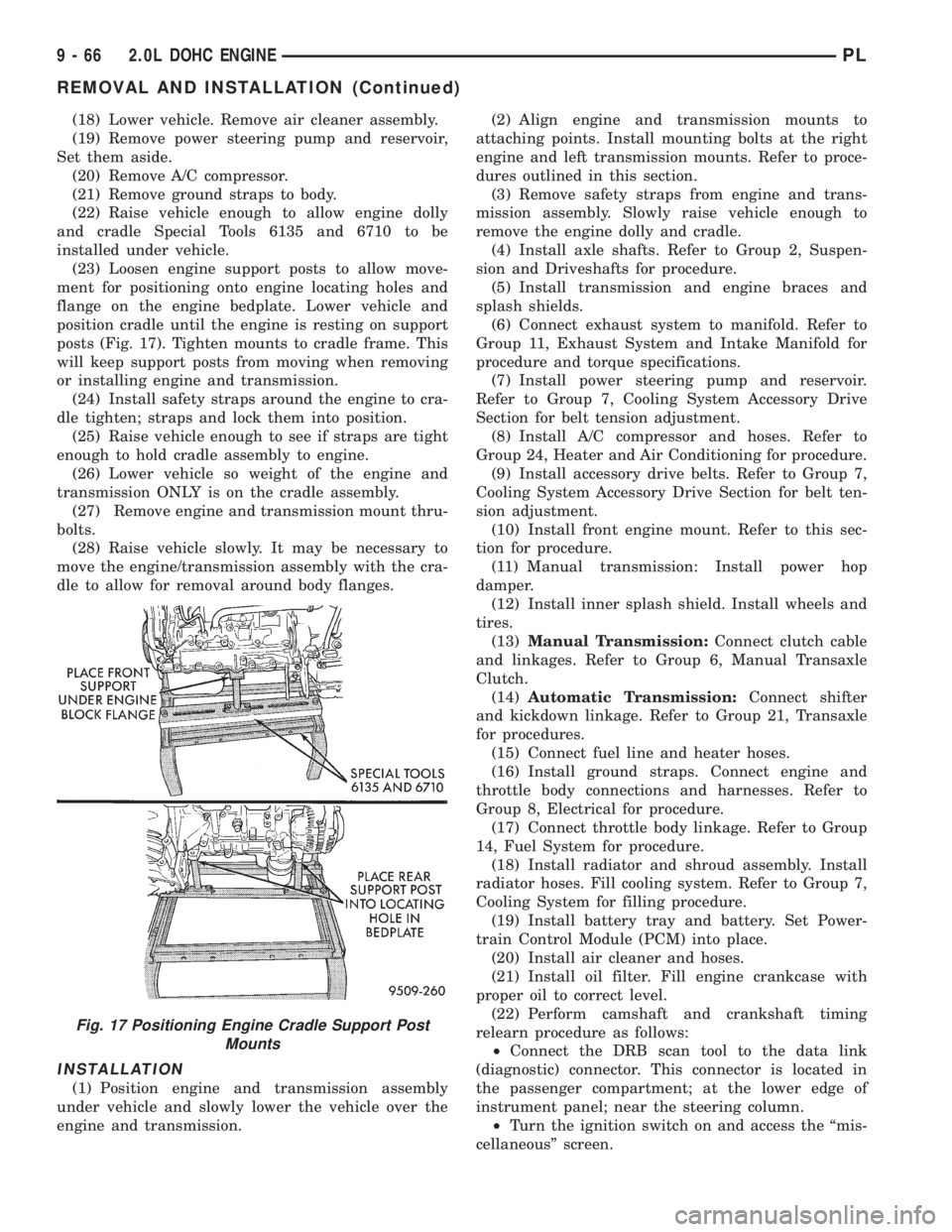
position cradle until the engine is resting on support
posts (Fig. 17). Tighten mounts to cradle frame. This
will keep support posts from moving when removing
or installing engine and transmission.
(24) Install safety straps around the engine to cra-
dle tighten; straps and lock them into position.
(25) Raise vehicle enough to see if straps are tight
enough to hold cradle assembly to engine.
(26) Lower vehicle so weight of the engine and
transmission ONLY is on the cradle assembly.
(27) Remove engine and transmission mount thru-
bolts.
(28) Raise vehicle slowly. It may be necessary to
move the engine/transmission assembly with the cra-
dle to allow for removal around body flanges.
INSTALLATION
(1) Position engine and transmission assembly
under vehicle and slowly lower the vehicle over the
engine and transmission.(2) Align engine and transmission mounts to
attaching points. Install mounting bolts at the right
engine and left transmission mounts. Refer to proce-
dures outlined in this section.
(3) Remove safety straps from engine and trans-
mission assembly. Slowly raise vehicle enough to
remove the engine dolly and cradle.
(4) Install axle shafts. Refer to Group 2, Suspen-
sion and Driveshafts for procedure.
(5) Install transmission and engine braces and
splash shields.
(6) Connect exhaust system to manifold. Refer to
Group 11, Exhaust System and Intake Manifold for
procedure and torque specifications.
(7) Install power steering pump and reservoir.
Refer to Group 7, Cooling System Accessory Drive
Section for belt tension adjustment.
(8) Install A/C compressor and hoses. Refer to
Group 24, Heater and Air Conditioning for procedure.
(9) Install accessory drive belts. Refer to Group 7,
Cooling System Accessory Drive Section for belt ten-
sion adjustment.
(10) Install front engine mount. Refer to this sec-
tion for procedure.
(11) Manual transmission: Install power hop
damper.
(12) Install inner splash shield. Install wheels and
tires.
(13)Manual Transmission:Connect clutch cable
and linkages. Refer to Group 6, Manual Transaxle
Clutch.
(14)Automatic Transmission:Connect shifter
and kickdown linkage. Refer to Group 21, Transaxle
for procedures.
(15) Connect fuel line and heater hoses.
(16) Install ground straps. Connect engine and
throttle body connections and harnesses. Refer to
Group 8, Electrical for procedure.
(17) Connect throttle body linkage. Refer to Group
14, Fuel System for procedure.
(18) Install radiator and shroud assembly. Install
radiator hoses. Fill cooling system. Refer to Group 7,
Cooling System for filling procedure.
(19) Install battery tray and battery. Set Power-
train Control Module (PCM) into place.
(20) Install air cleaner and hoses.
(21) Install oil filter. Fill engine crankcase with
proper oil to correct level.
(22) Perform camshaft and crankshaft timing
relearn procedure as follows:
²Connect the DRB scan tool to the data link
(diagnostic) connector. This connector is located in
the passenger compartment; at the lower edge of
instrument panel; near the steering column.
²Turn the ignition switch on and access the ªmis-
cellaneousº screen.
Fig. 17 Positioning Engine Cradle Support Post
Mounts
9 - 66 2.0L DOHC ENGINEPL
REMOVAL AND INSTALLATION (Continued)
Page 782 of 1200
(5) Install cylinder head cover using procedure out-
lined in this section.
(6) Perform camshaft and crankshaft timing
relearn procedure as follows:
²Step 1: Connect the DRB scan tool to the data
link (diagnostic) connector. This connector is located
in the passenger compartment; at the lower edge of
instrument panel; near the steering column.
²Step 2: Turn the ignition switch on and access
the ªmiscellaneousº screen.
²Step 3: Select re-learn cam/crank option and fol-
low directions on DRB screen.
CAM FOLLOWER AND HYDRAULIC LASH
ADJUSTER ASSEMBLY
REMOVAL
(1) Remove cylinder head cover using procedure
outlined in this section.
(2) Remove timing belt, sprockets and covers using
procedure outlined in this section.
(3) Remove camshaft. Refer to procedure previ-
ously outline this section.
(4) Remove cam follower assemblies from cylinder
head. Keep the cam followers in the order they have
been removed from the head for reassembly. Mark
hydraulic lash adjusters for reassembly in their orig-
inal position. Lash adjusters are serviced as an
assembly.
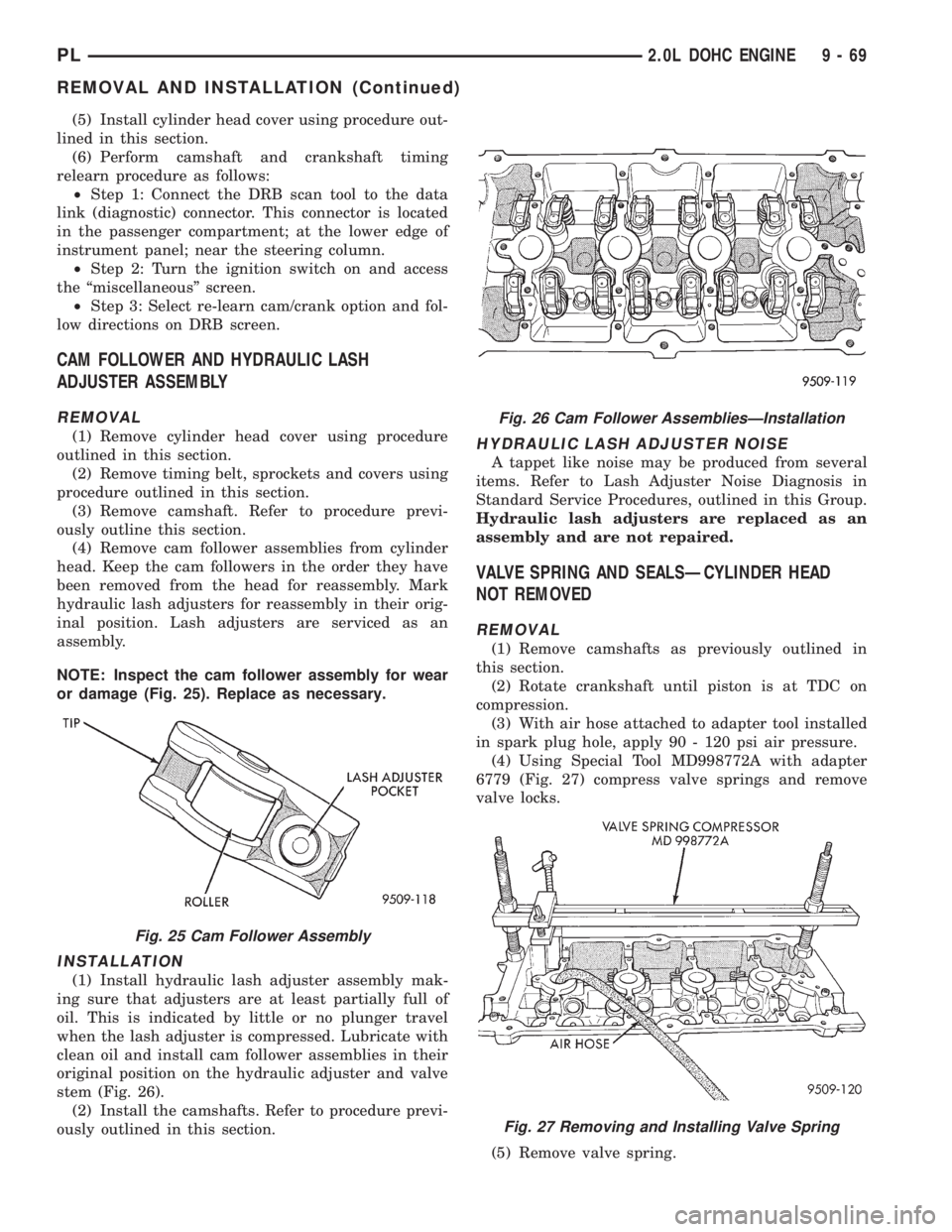
NOTE: Inspect the cam follower assembly for wear
or damage (Fig. 25). Replace as necessary.
INSTALLATION
(1) Install hydraulic lash adjuster assembly mak-
ing sure that adjusters are at least partially full of
oil. This is indicated by little or no plunger travel
when the lash adjuster is compressed. Lubricate with
clean oil and install cam follower assemblies in their
original position on the hydraulic adjuster and valve
stem (Fig. 26).
(2) Install the camshafts. Refer to procedure previ-
ously outlined in this section.
HYDRAULIC LASH ADJUSTER NOISE
A tappet like noise may be produced from several
items. Refer to Lash Adjuster Noise Diagnosis in
Standard Service Procedures, outlined in this Group.
Hydraulic lash adjusters are replaced as an
assembly and are not repaired.
VALVE SPRING AND SEALSÐCYLINDER HEAD
NOT REMOVED
REMOVAL
(1) Remove camshafts as previously outlined in
this section.
(2) Rotate crankshaft until piston is at TDC on
compression.
(3) With air hose attached to adapter tool installed
in spark plug hole, apply 90 - 120 psi air pressure.
(4) Using Special Tool MD998772A with adapter
6779 (Fig. 27) compress valve springs and remove
valve locks.
(5) Remove valve spring.
Fig. 25 Cam Follower Assembly
Fig. 26 Cam Follower AssembliesÐInstallation
Fig. 27 Removing and Installing Valve Spring
PL2.0L DOHC ENGINE 9 - 69
REMOVAL AND INSTALLATION (Continued)
Page 783 of 1200
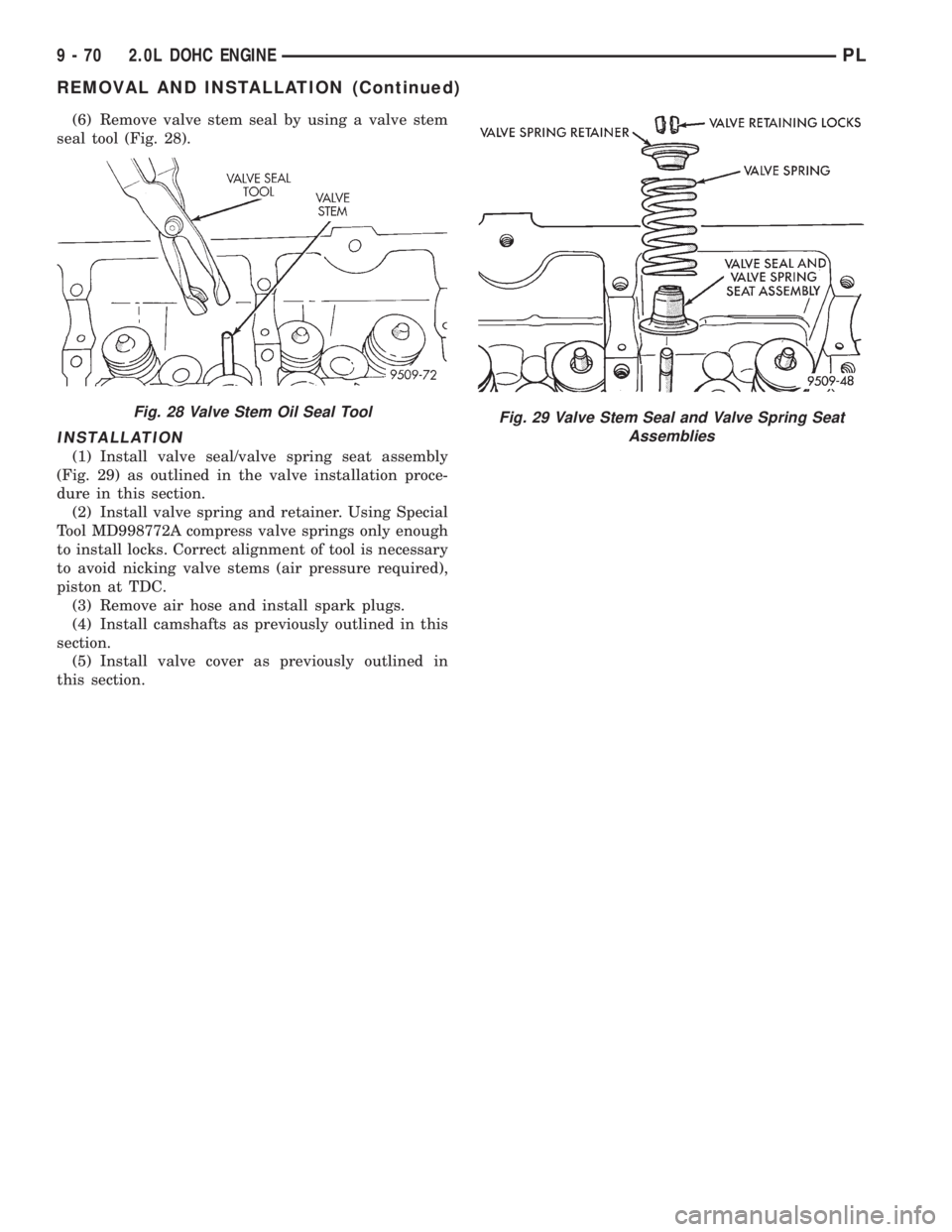
(6) Remove valve stem seal by using a valve stem
seal tool (Fig. 28).
INSTALLATION
(1) Install valve seal/valve spring seat assembly
(Fig. 29) as outlined in the valve installation proce-
dure in this section.
(2) Install valve spring and retainer. Using Special
Tool MD998772A compress valve springs only enough
to install locks. Correct alignment of tool is necessary
to avoid nicking valve stems (air pressure required),
piston at TDC.
(3) Remove air hose and install spark plugs.
(4) Install camshafts as previously outlined in this
section.
(5) Install valve cover as previously outlined in
this section.
Fig. 28 Valve Stem Oil Seal ToolFig. 29 Valve Stem Seal and Valve Spring Seat
Assemblies
9 - 70 2.0L DOHC ENGINEPL
REMOVAL AND INSTALLATION (Continued)
Page 785 of 1200
REMOVAL
(1) Perform fuel system pressure release procedure
before attempting any repairs.Refer to Group 14,
Fuel System.
(2) Disconnect negative battery cable. Drain cool-
ing system. Refer to Group 7, Cooling System.
(3) Remove air cleaner duct and air cleaner, dis-
connect all vacuum lines, electrical wiring and fuel
line from fuel rail and throttle body.
(4) Remove throttle linkage.
(5) Remove accessory drive belts. Refer to Group 7,
Cooling System for procedure.
(6) Remove power brake vacuum hose from intake
manifold.
(7) Raise vehicle and remove exhaust pipe from
manifold.
(8) Remove power steering pump assembly and set
aside.
(9) Disconnect coil pack wiring connector and
remove coil pack from engine.
(10) Remove cam sensor and fuel injectors wiring
connectors.
(11) Remove timing belt, timing belt tensioner, and
camshaft sprocket. Refer to procedure outlined in
this section.
(12) Remove inner timing belt cover.
(13) Remove cylinder head cover.
(14) Remove camshaft and cam follower assem-
blies. Refer to Camshaft Service for removal proce-
dure outlined in this section.
(15) Remove cylinder head bolts.
CAUTION: Use only a plastic scraper to remove
gasket material on the aluminum head sealing sur-
faces to prevent damage to cylinder head.
CYLINDER HEAD FLATNESS
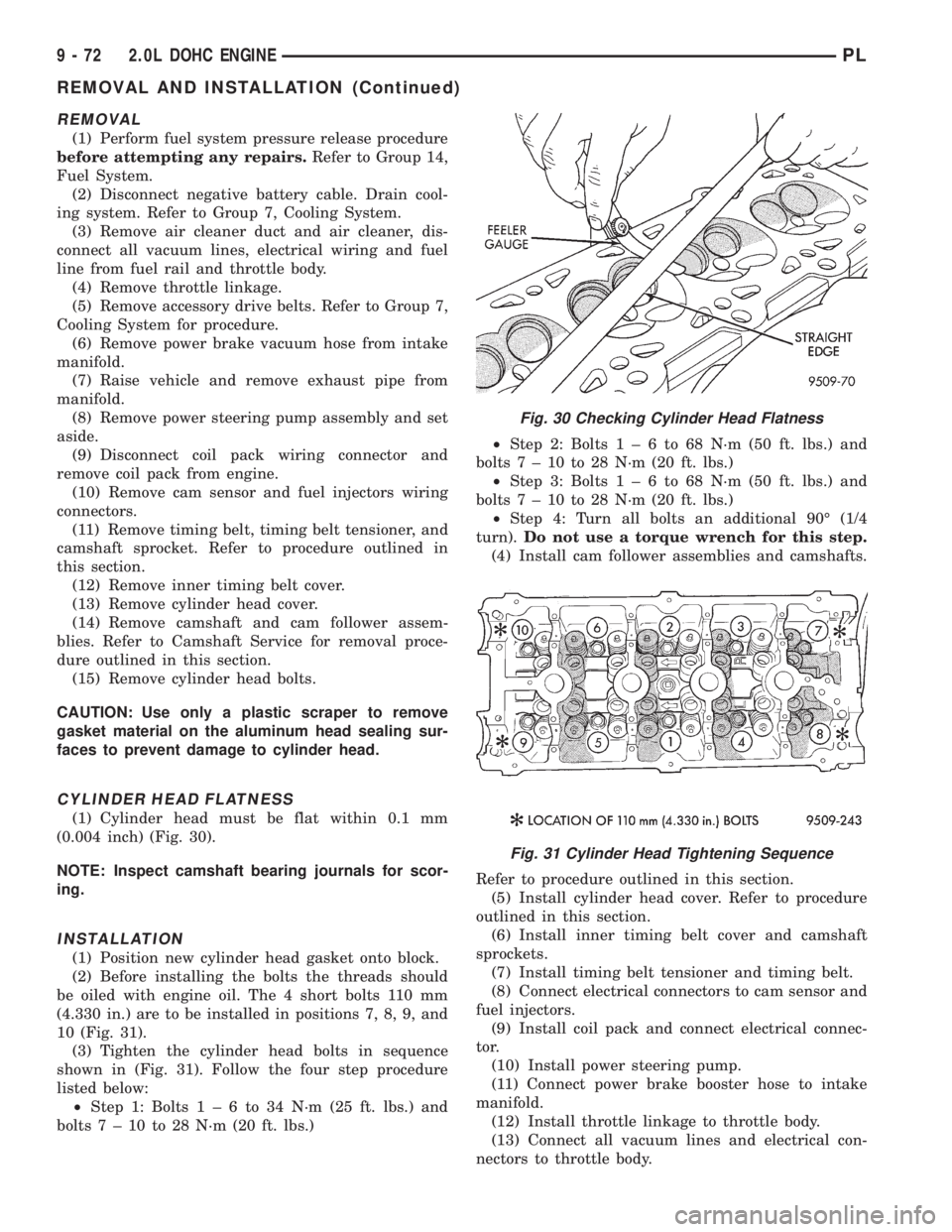
(1) Cylinder head must be flat within 0.1 mm
(0.004 inch) (Fig. 30).
NOTE: Inspect camshaft bearing journals for scor-
ing.
INSTALLATION
(1) Position new cylinder head gasket onto block.
(2) Before installing the bolts the threads should
be oiled with engine oil. The 4 short bolts 110 mm
(4.330 in.) are to be installed in positions 7, 8, 9, and
10 (Fig. 31).
(3) Tighten the cylinder head bolts in sequence
shown in (Fig. 31). Follow the four step procedure
listed below:
²Step 1: Bolts1±6to34N´m(25ft.lbs.) and
bolts7±10to28N´m(20ft.lbs.)²Step 2: Bolts1±6to68N´m(50ft.lbs.) and
bolts7±10to28N´m(20ft.lbs.)
²Step 3: Bolts1±6to68N´m(50ft.lbs.) and
bolts7±10to28N´m(20ft.lbs.)
²Step 4: Turn all bolts an additional 90É (1/4
turn).Do not use a torque wrench for this step.
(4) Install cam follower assemblies and camshafts.
Refer to procedure outlined in this section.
(5) Install cylinder head cover. Refer to procedure
outlined in this section.
(6) Install inner timing belt cover and camshaft
sprockets.
(7) Install timing belt tensioner and timing belt.
(8) Connect electrical connectors to cam sensor and
fuel injectors.
(9) Install coil pack and connect electrical connec-
tor.
(10) Install power steering pump.
(11) Connect power brake booster hose to intake
manifold.
(12) Install throttle linkage to throttle body.
(13) Connect all vacuum lines and electrical con-
nectors to throttle body.
Fig. 30 Checking Cylinder Head Flatness
Fig. 31 Cylinder Head Tightening Sequence
9 - 72 2.0L DOHC ENGINEPL
REMOVAL AND INSTALLATION (Continued)
Page 789 of 1200
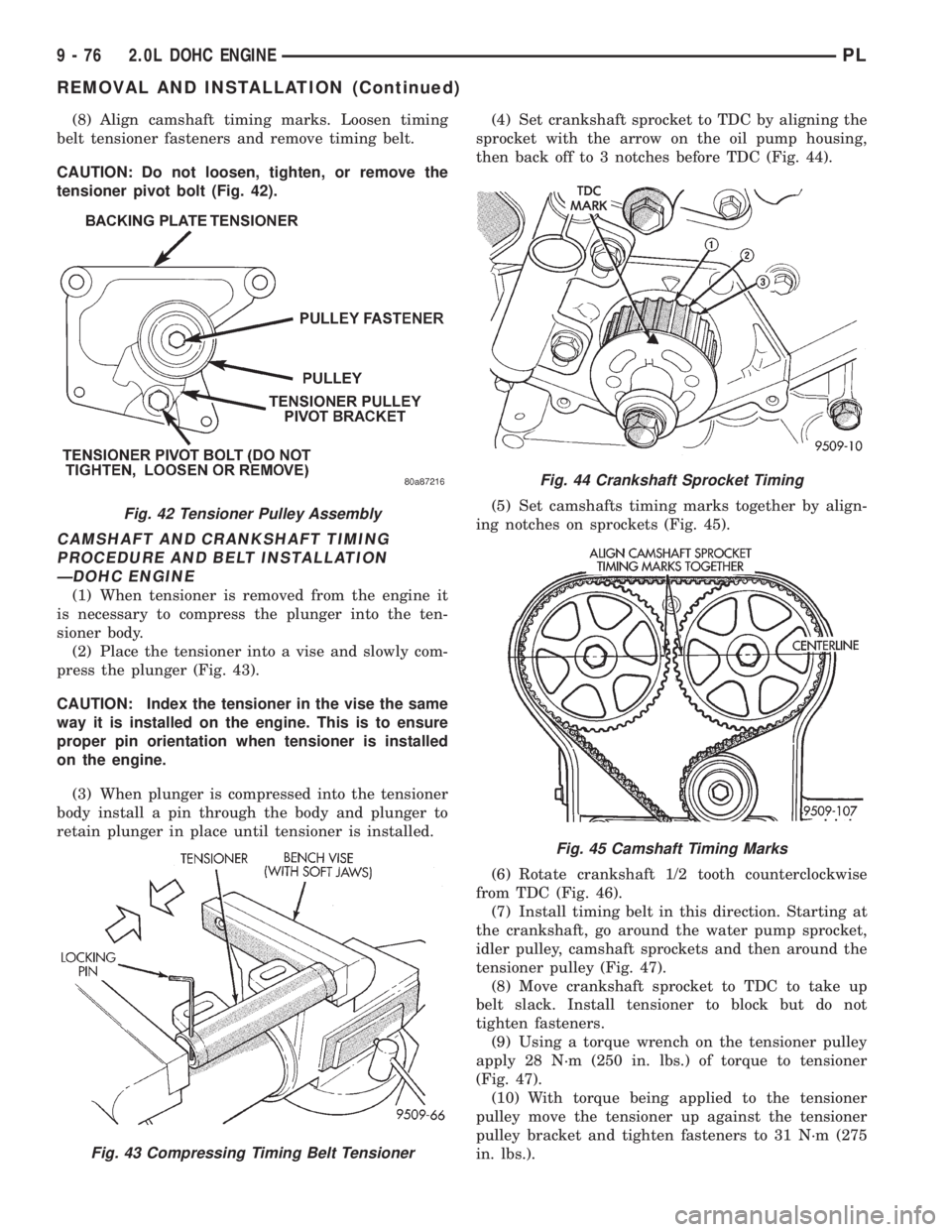
(8) Align camshaft timing marks. Loosen timing
belt tensioner fasteners and remove timing belt.
CAUTION: Do not loosen, tighten, or remove the
tensioner pivot bolt (Fig. 42).
CAMSHAFT AND CRANKSHAFT TIMING
PROCEDURE AND BELT INSTALLATION
ÐDOHC ENGINE
(1) When tensioner is removed from the engine it
is necessary to compress the plunger into the ten-
sioner body.
(2) Place the tensioner into a vise and slowly com-
press the plunger (Fig. 43).
CAUTION: Index the tensioner in the vise the same
way it is installed on the engine. This is to ensure
proper pin orientation when tensioner is installed
on the engine.
(3) When plunger is compressed into the tensioner
body install a pin through the body and plunger to
retain plunger in place until tensioner is installed.(4) Set crankshaft sprocket to TDC by aligning the
sprocket with the arrow on the oil pump housing,
then back off to 3 notches before TDC (Fig. 44).
(5) Set camshafts timing marks together by align-
ing notches on sprockets (Fig. 45).
(6) Rotate crankshaft 1/2 tooth counterclockwise
from TDC (Fig. 46).
(7) Install timing belt in this direction. Starting at
the crankshaft, go around the water pump sprocket,
idler pulley, camshaft sprockets and then around the
tensioner pulley (Fig. 47).
(8) Move crankshaft sprocket to TDC to take up
belt slack. Install tensioner to block but do not
tighten fasteners.
(9) Using a torque wrench on the tensioner pulley
apply 28 N´m (250 in. lbs.) of torque to tensioner
(Fig. 47).
(10) With torque being applied to the tensioner
pulley move the tensioner up against the tensioner
pulley bracket and tighten fasteners to 31 N´m (275
in. lbs.).
Fig. 42 Tensioner Pulley Assembly
Fig. 43 Compressing Timing Belt Tensioner
Fig. 44 Crankshaft Sprocket Timing
Fig. 45 Camshaft Timing Marks
9 - 76 2.0L DOHC ENGINEPL
REMOVAL AND INSTALLATION (Continued)
Page 792 of 1200
CAUTION: Align camshaft and crankshaft timing
marks before removing the timing belt by rotating
the engine with the crankshaft. Do not rotate the
camshaft once the timing belt has been removed as
damage to valve components may occur.
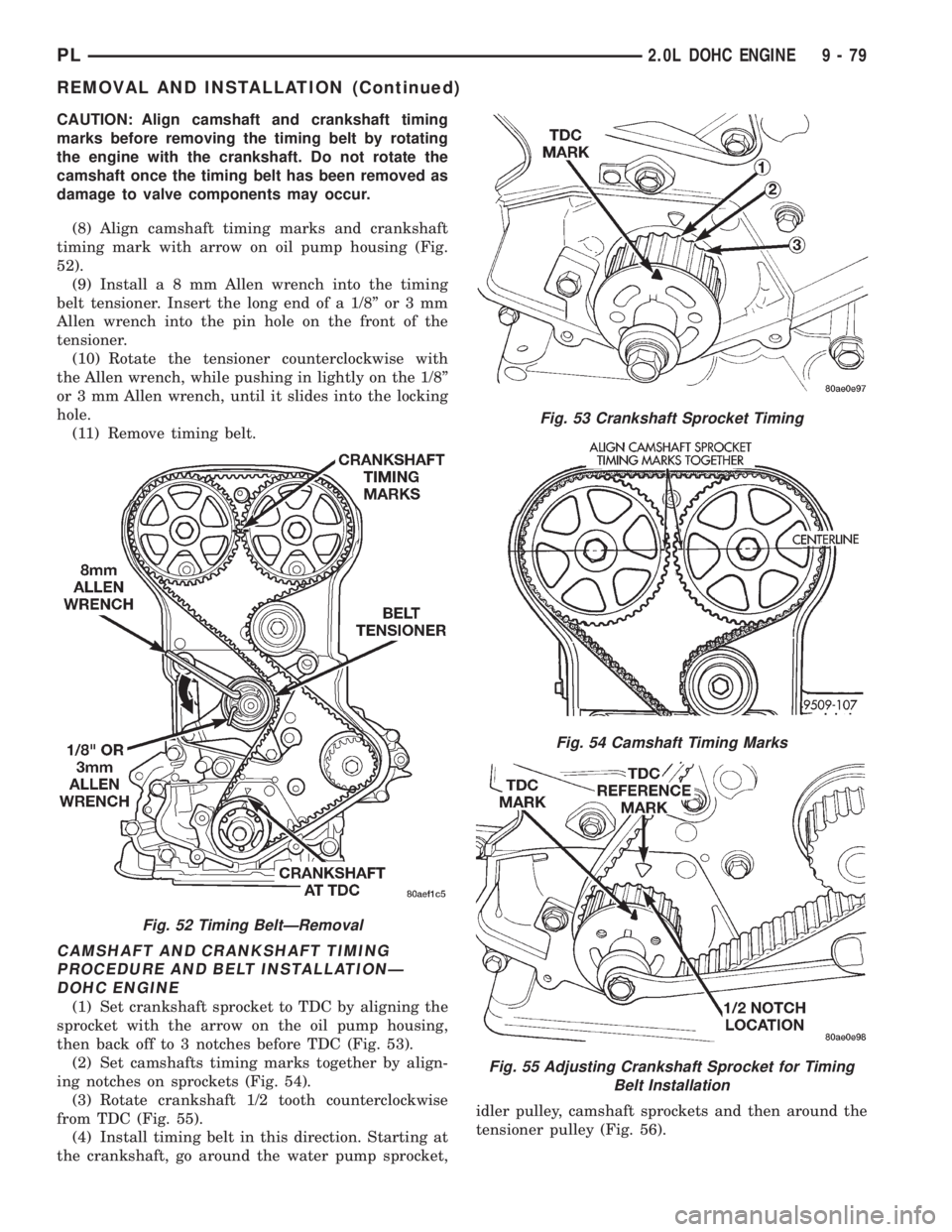
(8) Align camshaft timing marks and crankshaft
timing mark with arrow on oil pump housing (Fig.
52).
(9) Installa8mmAllen wrench into the timing
belt tensioner. Insert the long end of a 1/8º or 3 mm
Allen wrench into the pin hole on the front of the
tensioner.
(10) Rotate the tensioner counterclockwise with
the Allen wrench, while pushing in lightly on the 1/8º
or 3 mm Allen wrench, until it slides into the locking
hole.
(11) Remove timing belt.
CAMSHAFT AND CRANKSHAFT TIMING
PROCEDURE AND BELT INSTALLATIONÐ
DOHC ENGINE
(1) Set crankshaft sprocket to TDC by aligning the
sprocket with the arrow on the oil pump housing,
then back off to 3 notches before TDC (Fig. 53).
(2) Set camshafts timing marks together by align-
ing notches on sprockets (Fig. 54).
(3) Rotate crankshaft 1/2 tooth counterclockwise
from TDC (Fig. 55).
(4) Install timing belt in this direction. Starting at
the crankshaft, go around the water pump sprocket,idler pulley, camshaft sprockets and then around the
tensioner pulley (Fig. 56).
Fig. 52 Timing BeltÐRemoval
Fig. 53 Crankshaft Sprocket Timing
Fig. 54 Camshaft Timing Marks
Fig. 55 Adjusting Crankshaft Sprocket for Timing
Belt Installation
PL2.0L DOHC ENGINE 9 - 79
REMOVAL AND INSTALLATION (Continued)
Page 794 of 1200
INSTALLATION
(1) Install timing belt tensioner assembly. Tighten
attaching bolts to 28 N´m (250 in. lbs.).
(2) Install timing belt. Refer to procedure outlined
in this section.
OIL PAN
REMOVAL
(1) Drain engine oil.
(2) Remove front engine mount bracket. Refer to
Engine MountÐFront, in this section for procedures.
(3) Remove powertrain bending strut.
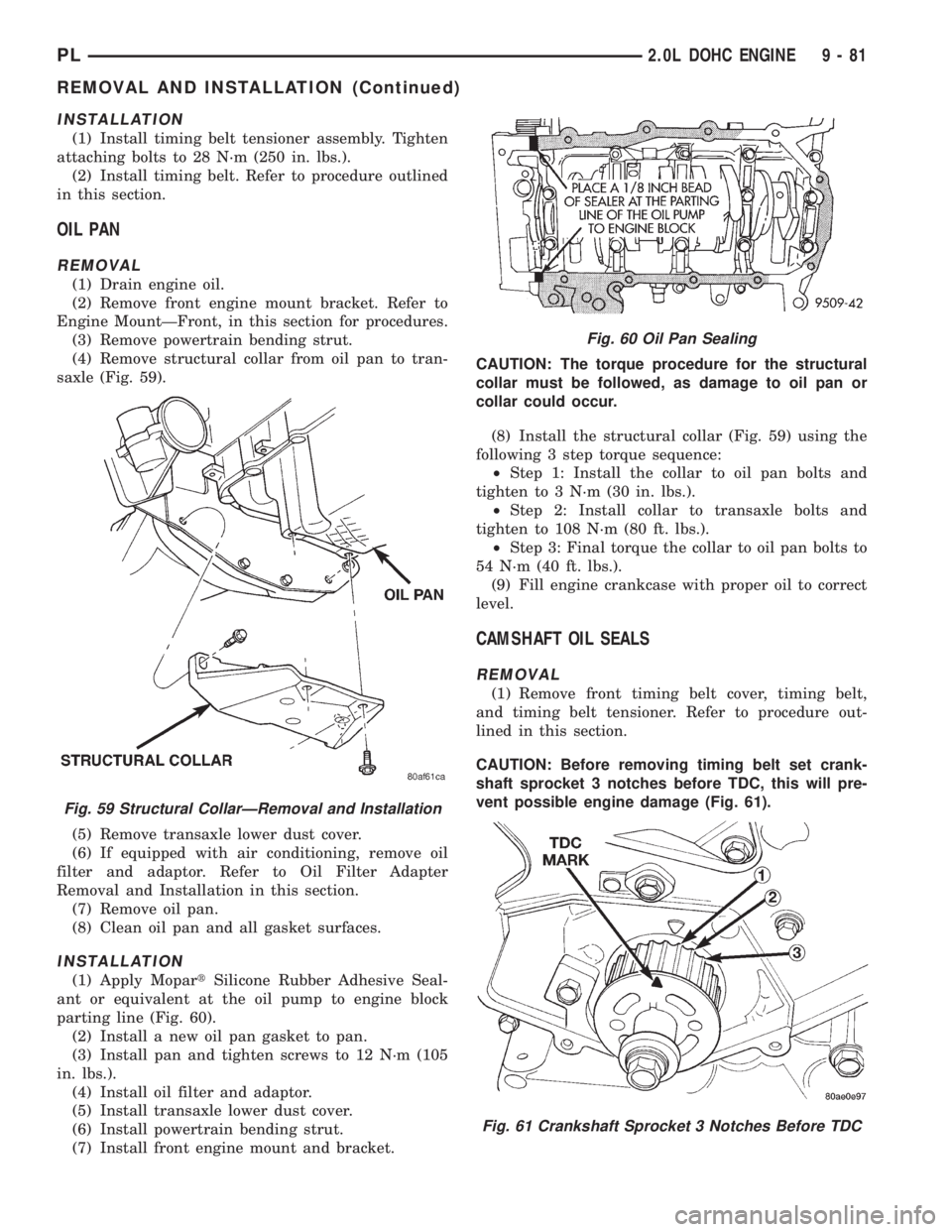
(4) Remove structural collar from oil pan to tran-
saxle (Fig. 59).
(5) Remove transaxle lower dust cover.
(6) If equipped with air conditioning, remove oil
filter and adaptor. Refer to Oil Filter Adapter
Removal and Installation in this section.
(7) Remove oil pan.
(8) Clean oil pan and all gasket surfaces.
INSTALLATION
(1) Apply MopartSilicone Rubber Adhesive Seal-
ant or equivalent at the oil pump to engine block
parting line (Fig. 60).
(2) Install a new oil pan gasket to pan.
(3) Install pan and tighten screws to 12 N´m (105
in. lbs.).
(4) Install oil filter and adaptor.
(5) Install transaxle lower dust cover.
(6) Install powertrain bending strut.
(7) Install front engine mount and bracket.CAUTION: The torque procedure for the structural
collar must be followed, as damage to oil pan or
collar could occur.
(8) Install the structural collar (Fig. 59) using the
following 3 step torque sequence:
²Step 1: Install the collar to oil pan bolts and
tighten to 3 N´m (30 in. lbs.).
²Step 2: Install collar to transaxle bolts and
tighten to 108 N´m (80 ft. lbs.).
²Step 3: Final torque the collar to oil pan bolts to
54 N´m (40 ft. lbs.).
(9) Fill engine crankcase with proper oil to correct
level.
CAMSHAFT OIL SEALS
REMOVAL
(1) Remove front timing belt cover, timing belt,
and timing belt tensioner. Refer to procedure out-
lined in this section.
CAUTION: Before removing timing belt set crank-
shaft sprocket 3 notches before TDC, this will pre-
vent possible engine damage (Fig. 61).
Fig. 59 Structural CollarÐRemoval and Installation
Fig. 60 Oil Pan Sealing
Fig. 61 Crankshaft Sprocket 3 Notches Before TDC
PL2.0L DOHC ENGINE 9 - 81
REMOVAL AND INSTALLATION (Continued)
Page 797 of 1200
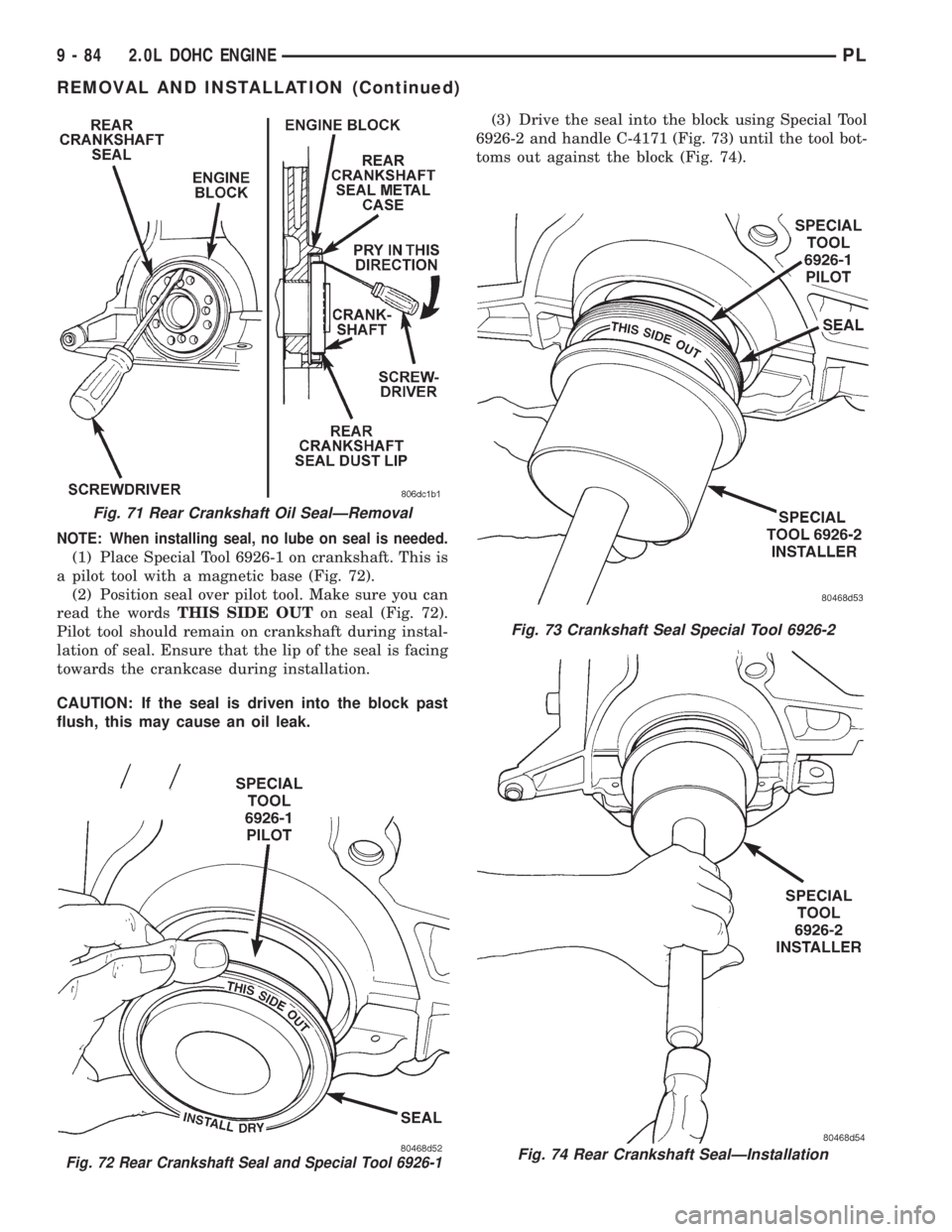
NOTE: When installing seal, no lube on seal is needed.
(1) Place Special Tool 6926-1 on crankshaft. This is
a pilot tool with a magnetic base (Fig. 72).
(2) Position seal over pilot tool. Make sure you can
read the wordsTHIS SIDE OUTon seal (Fig. 72).
Pilot tool should remain on crankshaft during instal-
lation of seal. Ensure that the lip of the seal is facing
towards the crankcase during installation.
CAUTION: If the seal is driven into the block past
flush, this may cause an oil leak.(3) Drive the seal into the block using Special Tool
6926-2 and handle C-4171 (Fig. 73) until the tool bot-
toms out against the block (Fig. 74).
Fig. 71 Rear Crankshaft Oil SealÐRemoval
Fig. 72 Rear Crankshaft Seal and Special Tool 6926-1
Fig. 73 Crankshaft Seal Special Tool 6926-2
Fig. 74 Rear Crankshaft SealÐInstallation
9 - 84 2.0L DOHC ENGINEPL
REMOVAL AND INSTALLATION (Continued)
Page 798 of 1200
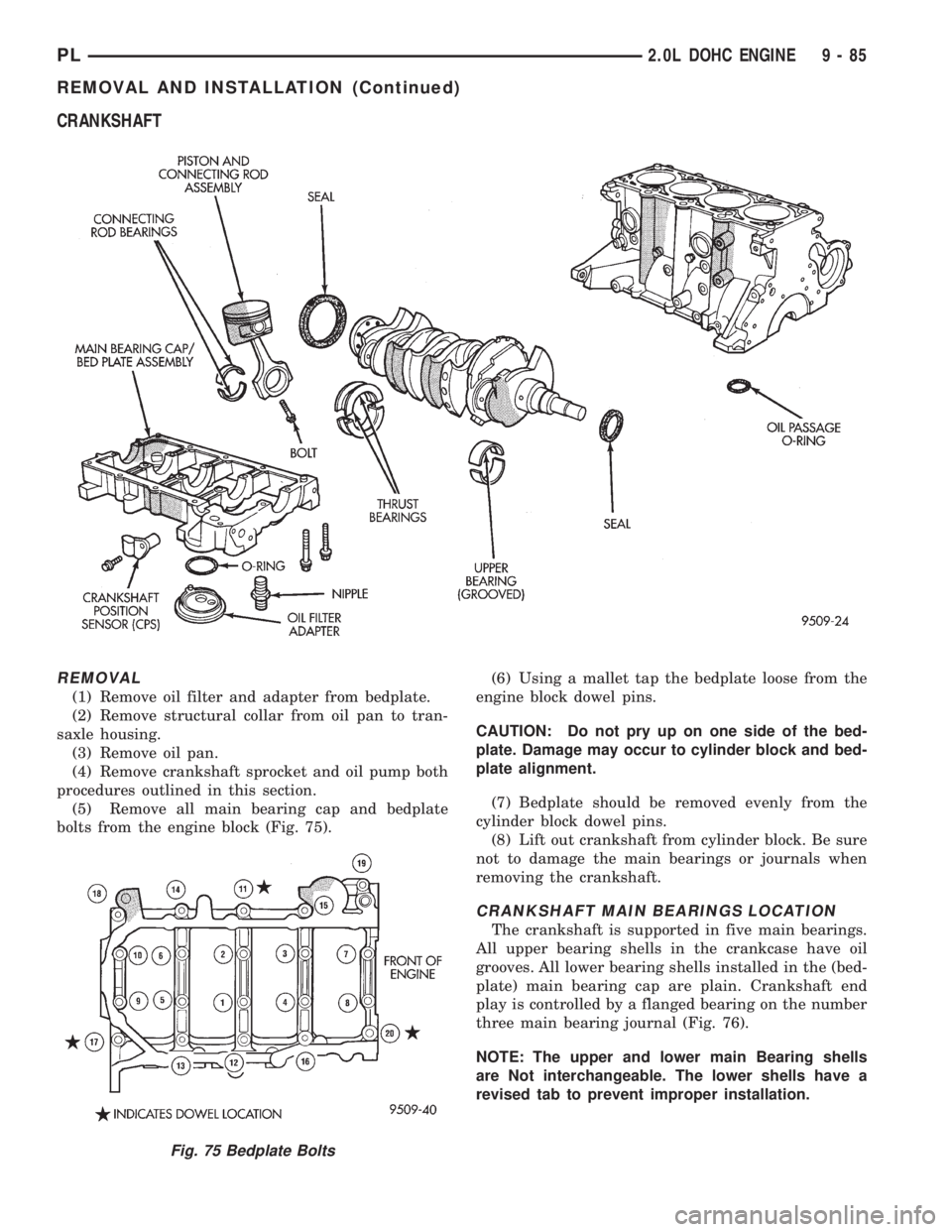
CRANKSHAFT
REMOVAL
(1) Remove oil filter and adapter from bedplate.
(2) Remove structural collar from oil pan to tran-
saxle housing.
(3) Remove oil pan.
(4) Remove crankshaft sprocket and oil pump both
procedures outlined in this section.
(5) Remove all main bearing cap and bedplate
bolts from the engine block (Fig. 75).(6) Using a mallet tap the bedplate loose from the
engine block dowel pins.
CAUTION: Do not pry up on one side of the bed-
plate. Damage may occur to cylinder block and bed-
plate alignment.
(7) Bedplate should be removed evenly from the
cylinder block dowel pins.
(8) Lift out crankshaft from cylinder block. Be sure
not to damage the main bearings or journals when
removing the crankshaft.
CRANKSHAFT MAIN BEARINGS LOCATION
The crankshaft is supported in five main bearings.
All upper bearing shells in the crankcase have oil
grooves. All lower bearing shells installed in the (bed-
plate) main bearing cap are plain. Crankshaft end
play is controlled by a flanged bearing on the number
three main bearing journal (Fig. 76).
NOTE: The upper and lower main Bearing shells
are Not interchangeable. The lower shells have a
revised tab to prevent improper installation.
Fig. 75 Bedplate Bolts
PL2.0L DOHC ENGINE 9 - 85
REMOVAL AND INSTALLATION (Continued)
Page 799 of 1200
CRANKSHAFT MAIN JOURNALS INSPECTION
The crankshaft journals should be checked for
excessive wear, taper and scoring. Limits of taper or
out-of-round on any crankshaft journals should be
held to 0.025 mm (0.001 inch). Journal grinding
should not exceed 0.305 mm (0.012 in.) under the
standard journal diameter. DO NOT grind thrust
faces of Number 3 main bearing. DO NOT nick crank
pin or bearing fillets. After grinding, remove rough
edges from crankshaft oil holes and clean out all pas-
sages.
CAUTION: With the nodular cast iron crankshafts
used it is important that the final paper or cloth pol-
ish after any journal regrind be in the same direc-
tion as normal rotation in the engine.
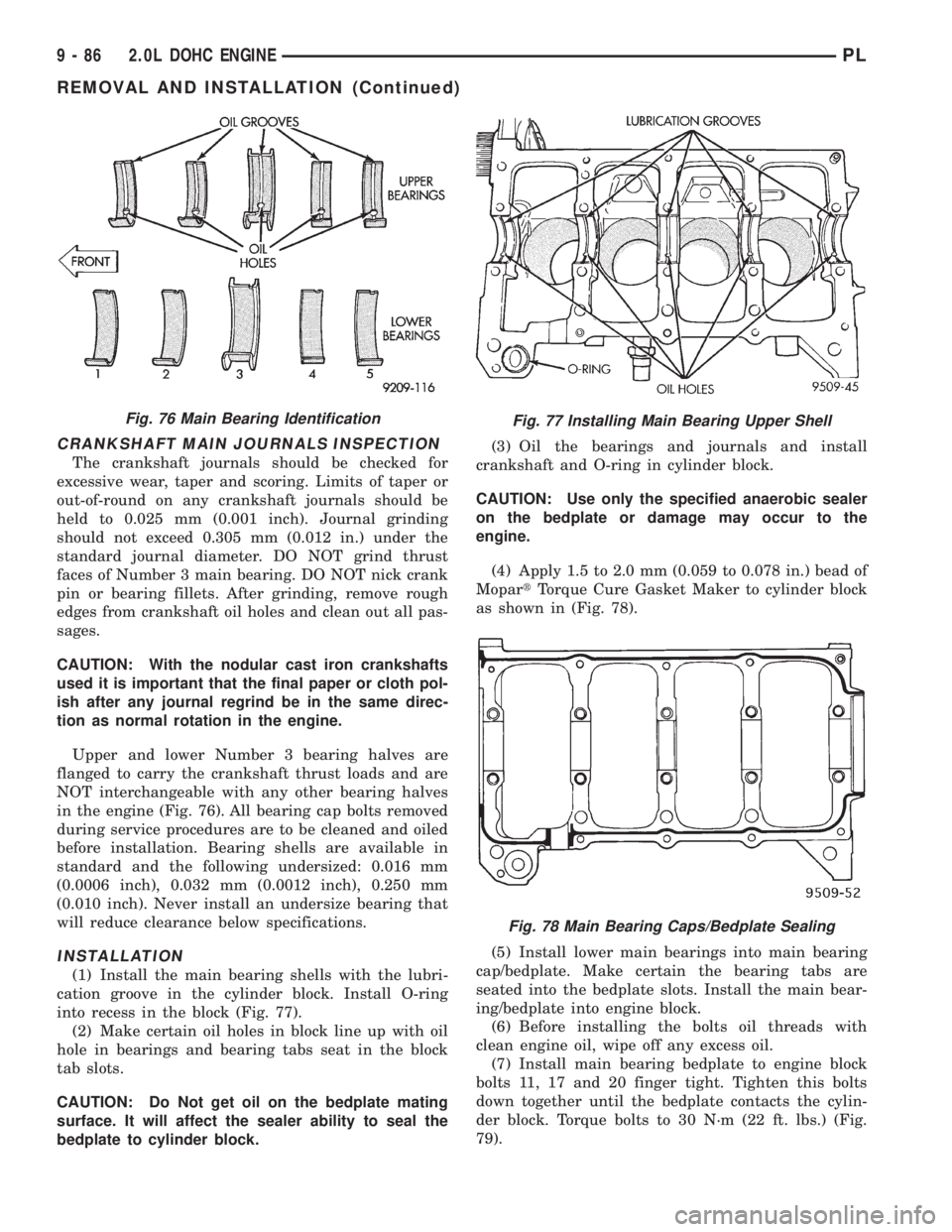
Upper and lower Number 3 bearing halves are
flanged to carry the crankshaft thrust loads and are
NOT interchangeable with any other bearing halves
in the engine (Fig. 76). All bearing cap bolts removed
during service procedures are to be cleaned and oiled
before installation. Bearing shells are available in
standard and the following undersized: 0.016 mm
(0.0006 inch), 0.032 mm (0.0012 inch), 0.250 mm
(0.010 inch). Never install an undersize bearing that
will reduce clearance below specifications.
INSTALLATION
(1) Install the main bearing shells with the lubri-
cation groove in the cylinder block. Install O-ring
into recess in the block (Fig. 77).
(2) Make certain oil holes in block line up with oil
hole in bearings and bearing tabs seat in the block
tab slots.
CAUTION: Do Not get oil on the bedplate mating
surface. It will affect the sealer ability to seal the
bedplate to cylinder block.(3) Oil the bearings and journals and install
crankshaft and O-ring in cylinder block.
CAUTION: Use only the specified anaerobic sealer
on the bedplate or damage may occur to the
engine.
(4) Apply 1.5 to 2.0 mm (0.059 to 0.078 in.) bead of
MopartTorque Cure Gasket Maker to cylinder block
as shown in (Fig. 78).
(5) Install lower main bearings into main bearing
cap/bedplate. Make certain the bearing tabs are
seated into the bedplate slots. Install the main bear-
ing/bedplate into engine block.
(6) Before installing the bolts oil threads with
clean engine oil, wipe off any excess oil.
(7) Install main bearing bedplate to engine block
bolts 11, 17 and 20 finger tight. Tighten this bolts
down together until the bedplate contacts the cylin-
der block. Torque bolts to 30 N´m (22 ft. lbs.) (Fig.
79).
Fig. 76 Main Bearing IdentificationFig. 77 Installing Main Bearing Upper Shell
Fig. 78 Main Bearing Caps/Bedplate Sealing
9 - 86 2.0L DOHC ENGINEPL
REMOVAL AND INSTALLATION (Continued)