ABS DODGE NEON 1999 Service Manual PDF
[x] Cancel search | Manufacturer: DODGE, Model Year: 1999, Model line: NEON, Model: DODGE NEON 1999Pages: 1200, PDF Size: 35.29 MB
Page 275 of 1200
(8) If all tests performed test good, replace the dial
and gauge assembly.
(9) If the tachometer continues to be inoperative,
replace the print circuit board.
TEMPERATURE GAUGE
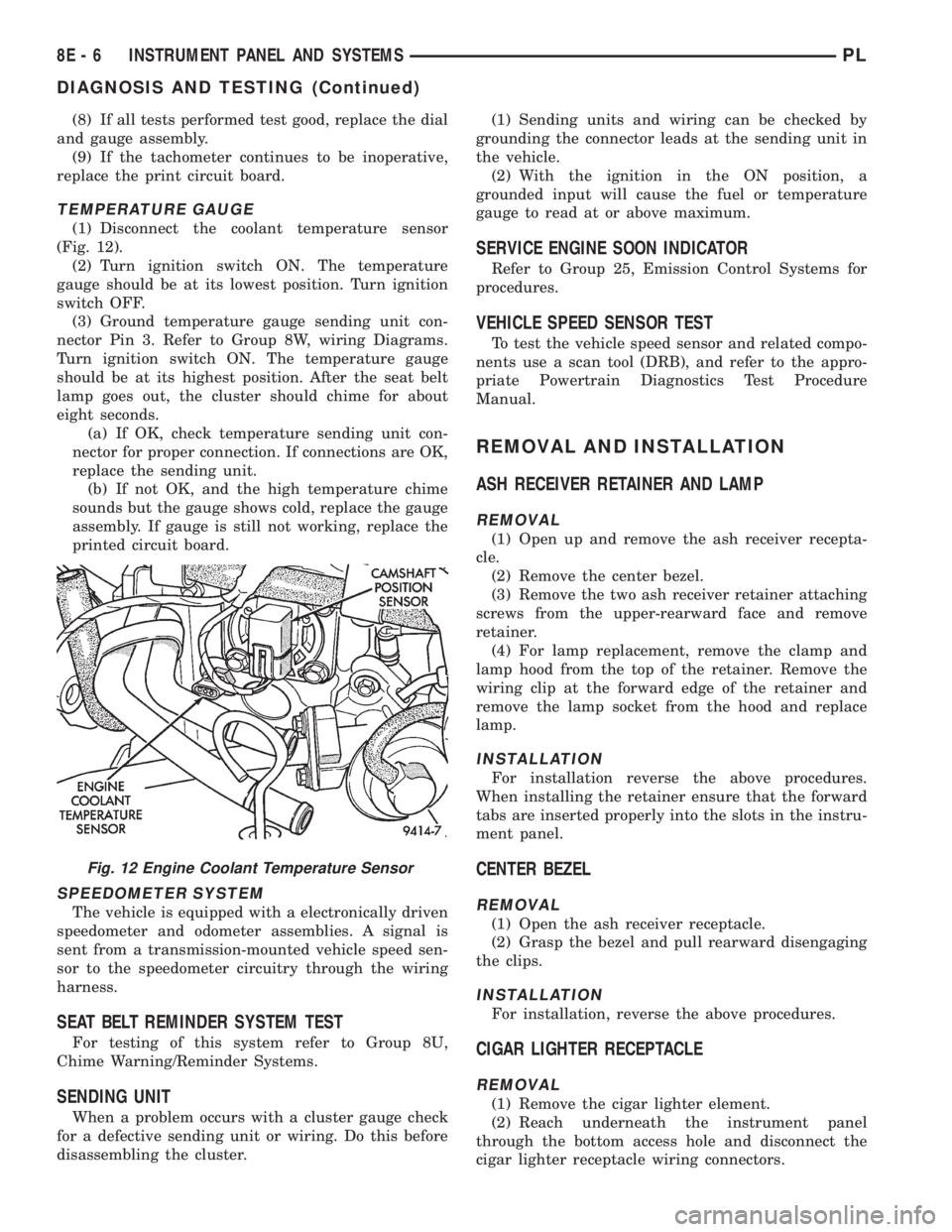
(1) Disconnect the coolant temperature sensor
(Fig. 12).
(2) Turn ignition switch ON. The temperature
gauge should be at its lowest position. Turn ignition
switch OFF.
(3) Ground temperature gauge sending unit con-
nector Pin 3. Refer to Group 8W, wiring Diagrams.
Turn ignition switch ON. The temperature gauge
should be at its highest position. After the seat belt
lamp goes out, the cluster should chime for about
eight seconds.
(a) If OK, check temperature sending unit con-
nector for proper connection. If connections are OK,
replace the sending unit.
(b) If not OK, and the high temperature chime
sounds but the gauge shows cold, replace the gauge
assembly. If gauge is still not working, replace the
printed circuit board.
SPEEDOMETER SYSTEM
The vehicle is equipped with a electronically driven
speedometer and odometer assemblies. A signal is
sent from a transmission-mounted vehicle speed sen-
sor to the speedometer circuitry through the wiring
harness.
SEAT BELT REMINDER SYSTEM TEST
For testing of this system refer to Group 8U,
Chime Warning/Reminder Systems.
SENDING UNIT
When a problem occurs with a cluster gauge check
for a defective sending unit or wiring. Do this before
disassembling the cluster.(1) Sending units and wiring can be checked by
grounding the connector leads at the sending unit in
the vehicle.
(2) With the ignition in the ON position, a
grounded input will cause the fuel or temperature
gauge to read at or above maximum.
SERVICE ENGINE SOON INDICATOR
Refer to Group 25, Emission Control Systems for
procedures.
VEHICLE SPEED SENSOR TEST
To test the vehicle speed sensor and related compo-
nents use a scan tool (DRB), and refer to the appro-
priate Powertrain Diagnostics Test Procedure
Manual.
REMOVAL AND INSTALLATION
ASH RECEIVER RETAINER AND LAMP
REMOVAL
(1) Open up and remove the ash receiver recepta-
cle.
(2) Remove the center bezel.
(3) Remove the two ash receiver retainer attaching
screws from the upper-rearward face and remove
retainer.
(4) For lamp replacement, remove the clamp and
lamp hood from the top of the retainer. Remove the
wiring clip at the forward edge of the retainer and
remove the lamp socket from the hood and replace
lamp.
INSTALLATION
For installation reverse the above procedures.
When installing the retainer ensure that the forward
tabs are inserted properly into the slots in the instru-
ment panel.
CENTER BEZEL
REMOVAL
(1) Open the ash receiver receptacle.
(2) Grasp the bezel and pull rearward disengaging
the clips.
INSTALLATION
For installation, reverse the above procedures.
CIGAR LIGHTER RECEPTACLE
REMOVAL
(1) Remove the cigar lighter element.
(2) Reach underneath the instrument panel
through the bottom access hole and disconnect the
cigar lighter receptacle wiring connectors.
Fig. 12 Engine Coolant Temperature Sensor
8E - 6 INSTRUMENT PANEL AND SYSTEMSPL
DIAGNOSIS AND TESTING (Continued)
Page 282 of 1200
the panel rearward to disengage the three locator
pins and remove.
(6) Reach in and disconnect the wiring connector(s)
for the rear window defogger and/or fog lamp
switch(s) as required.
INSTALLATION
For installation, reverse the above procedures.
SHIFTER KNOB
AUTOMATIC TRANSMISSION SHIFTER
REMOVAL
(1) Loosen the set screw at the left side under the
button area.
(2) Pull up until the knob slides off the shifter
shaft.
INSTALLATION
For installation, reverse the above procedures.
MANUAL TRANSMISSION SHIFTER
REMOVAL
(1) Pull the top part of the boot down until the two
tabs at the bottom of the knob are exposed.
(2) Release the locking tabs from the pins on the
shifter shaft.
(3) Pull up until the knob slides off the shifter
shaft.INSTALLATION
For installation, reverse the above procedures.
STEERING COLUMN COVER
REMOVAL
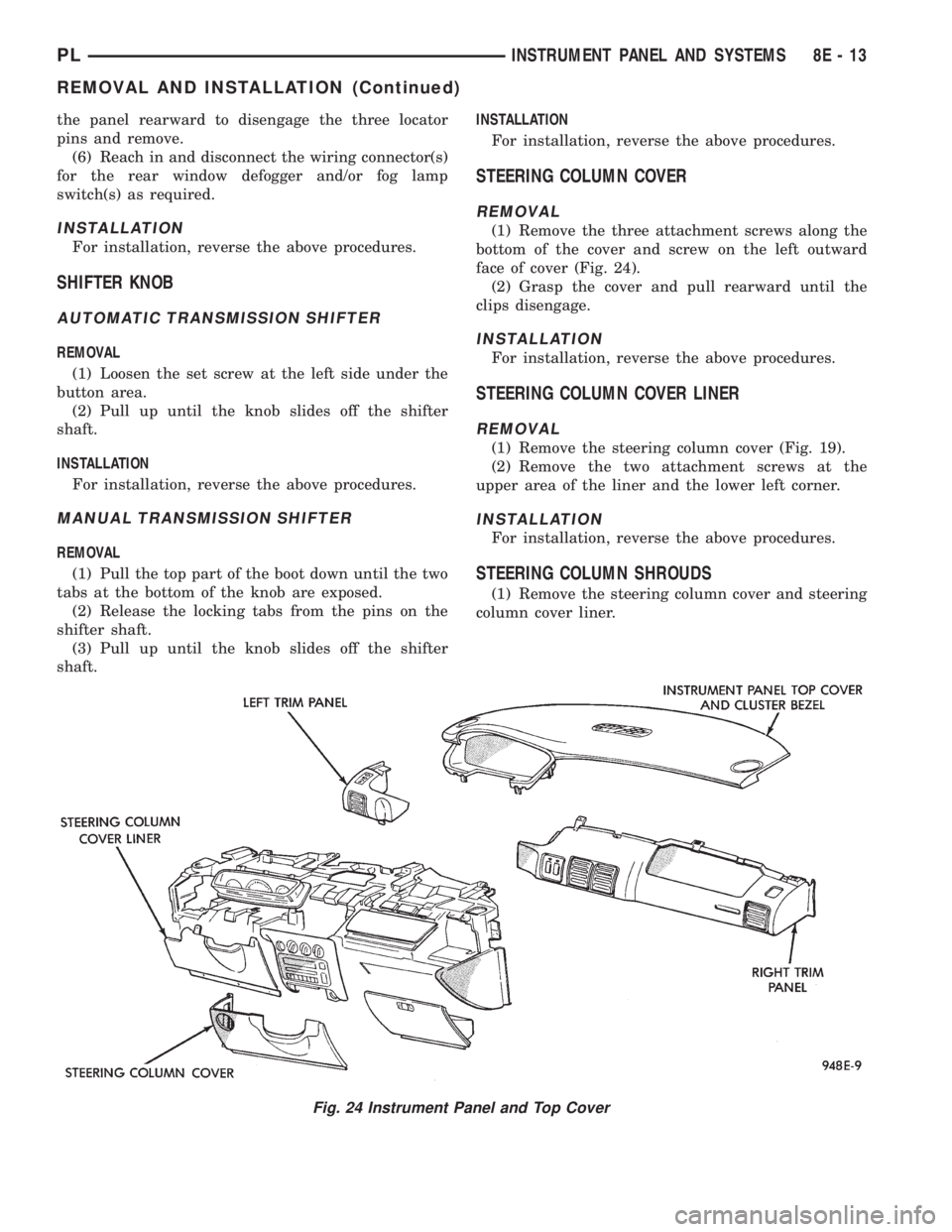
(1) Remove the three attachment screws along the
bottom of the cover and screw on the left outward
face of cover (Fig. 24).
(2) Grasp the cover and pull rearward until the
clips disengage.
INSTALLATION
For installation, reverse the above procedures.
STEERING COLUMN COVER LINER
REMOVAL
(1) Remove the steering column cover (Fig. 19).
(2) Remove the two attachment screws at the
upper area of the liner and the lower left corner.
INSTALLATION
For installation, reverse the above procedures.
STEERING COLUMN SHROUDS
(1) Remove the steering column cover and steering
column cover liner.
Fig. 24 Instrument Panel and Top Cover
PLINSTRUMENT PANEL AND SYSTEMS 8E - 13
REMOVAL AND INSTALLATION (Continued)
Page 306 of 1200
the plunger reaches the end of its travel. A ratchet-
ing sound will be heard during this procedure.
Connect the wiring harness to the switch. Mount
the switch into the bracket by holding the switch
with the plunger facing forward in car. There is an
index key on the switch that mates with the bracket
slot at the top of the square hole. Align key and push
switch into square hole in bracket while depressing
the brake pedal. Once the switch is seated in the
hole, rotate clockwise approximately 30 degrees to
lock into place. The switch will automatically adjust
when the pedal is released. Pull back on the pedal to
assure correct adjustment.
SPEED CONTROL SERVO CABLE
REMOVAL
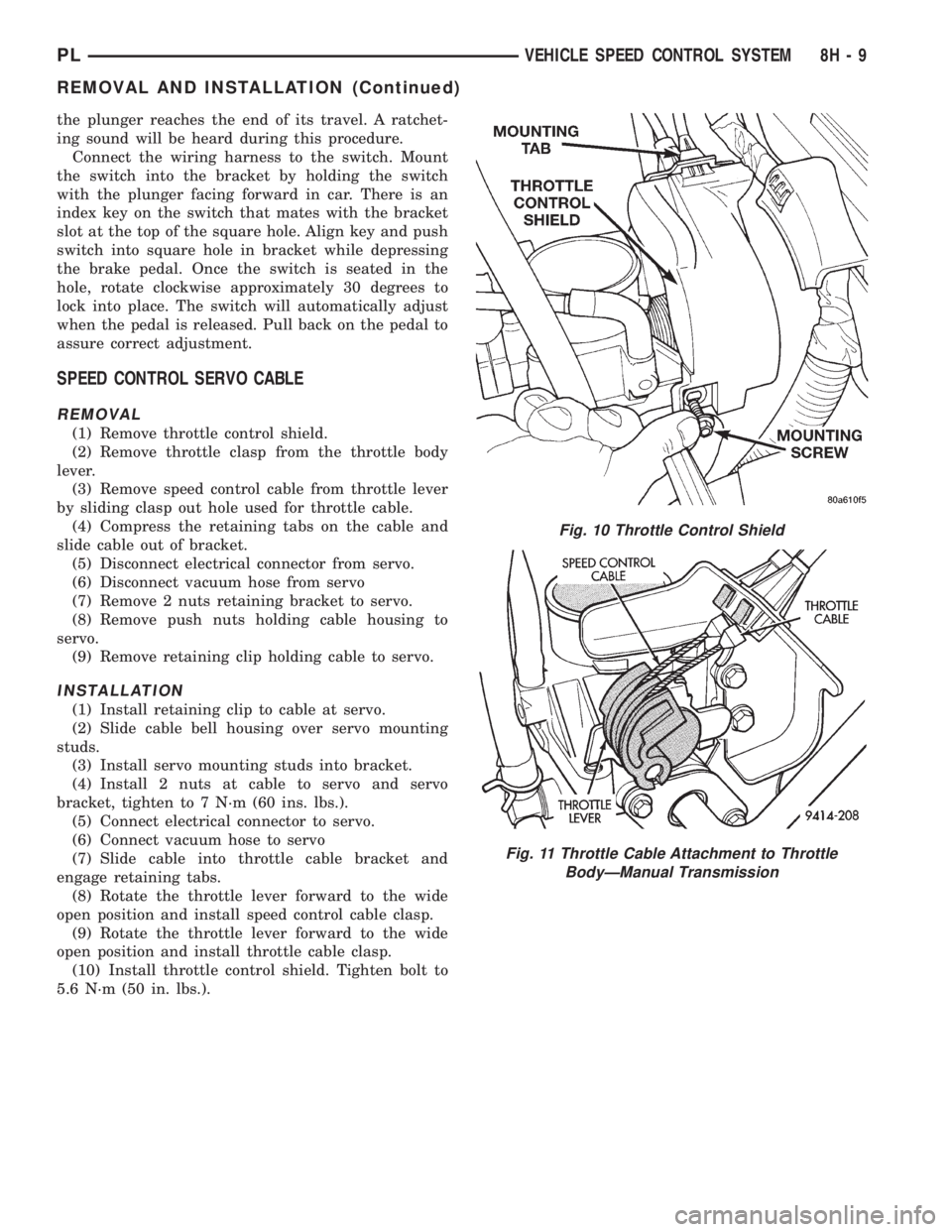
(1) Remove throttle control shield.
(2) Remove throttle clasp from the throttle body
lever.
(3) Remove speed control cable from throttle lever
by sliding clasp out hole used for throttle cable.
(4) Compress the retaining tabs on the cable and
slide cable out of bracket.
(5) Disconnect electrical connector from servo.
(6) Disconnect vacuum hose from servo
(7) Remove 2 nuts retaining bracket to servo.
(8) Remove push nuts holding cable housing to
servo.
(9) Remove retaining clip holding cable to servo.
INSTALLATION
(1) Install retaining clip to cable at servo.
(2) Slide cable bell housing over servo mounting
studs.
(3) Install servo mounting studs into bracket.
(4) Install 2 nuts at cable to servo and servo
bracket, tighten to 7 N´m (60 ins. lbs.).
(5) Connect electrical connector to servo.
(6) Connect vacuum hose to servo
(7) Slide cable into throttle cable bracket and
engage retaining tabs.
(8) Rotate the throttle lever forward to the wide
open position and install speed control cable clasp.
(9) Rotate the throttle lever forward to the wide
open position and install throttle cable clasp.
(10) Install throttle control shield. Tighten bolt to
5.6 N´m (50 in. lbs.).
Fig. 10 Throttle Control Shield
Fig. 11 Throttle Cable Attachment to Throttle
BodyÐManual Transmission
PLVEHICLE SPEED CONTROL SYSTEM 8H - 9
REMOVAL AND INSTALLATION (Continued)
Page 322 of 1200
REMOVAL AND INSTALLATION
WASHER NOZZLE
REMOVAL
(1) Disconnect washer fluid hose at the nozzle.
(2) Using a needle nose pliers, squeeze together
the locking tabs on the nozzle (Fig. 1).
(3) Remove nozzle.
INSTALLATION
(1) Place the nozzle in position and push down-
ward till locking tabs are securely snapped into posi-
tion.
(2) Connect the washer hose and ensure that the
hose is not kinked.
WASHER RESERVOIR
REMOVAL
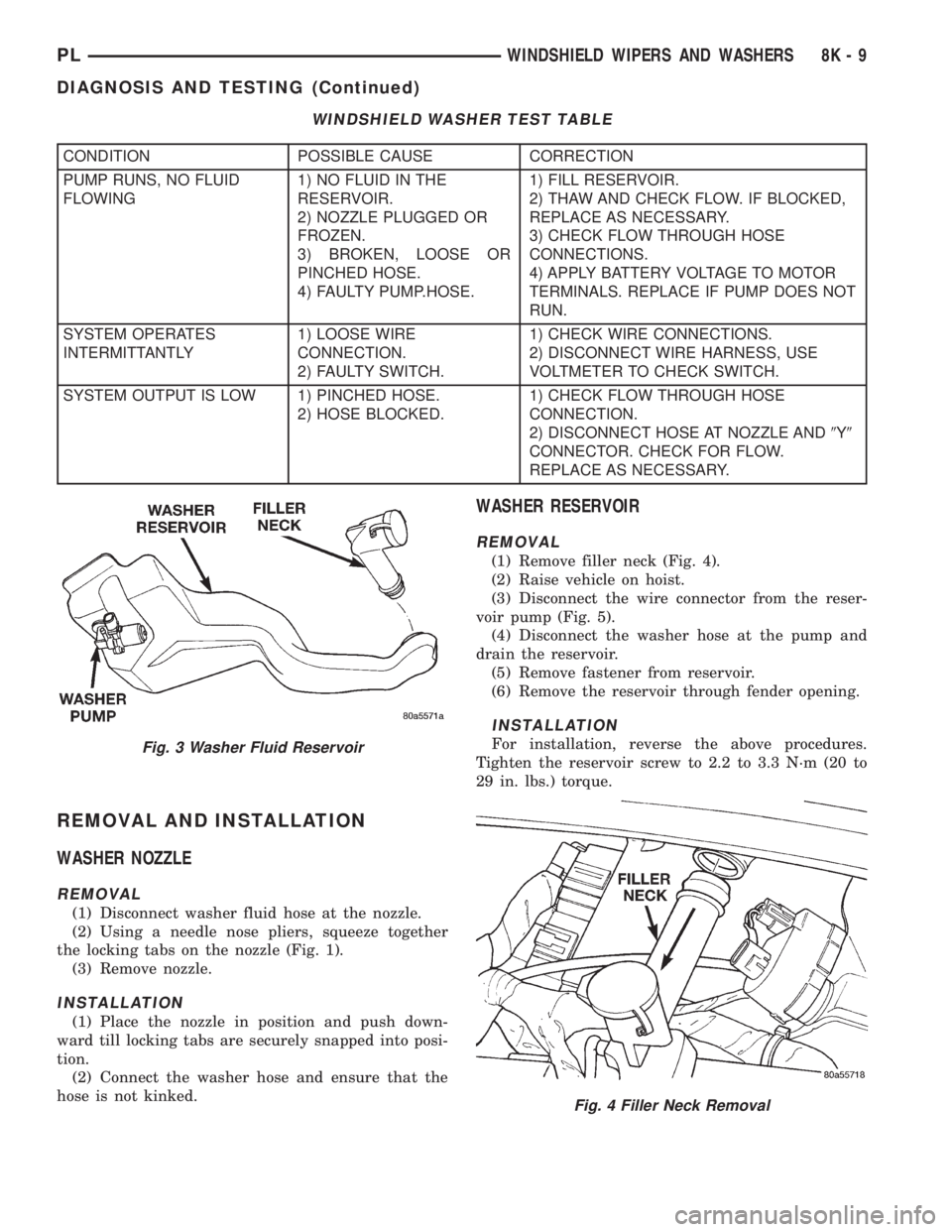
(1) Remove filler neck (Fig. 4).
(2) Raise vehicle on hoist.
(3) Disconnect the wire connector from the reser-
voir pump (Fig. 5).
(4) Disconnect the washer hose at the pump and
drain the reservoir.
(5) Remove fastener from reservoir.
(6) Remove the reservoir through fender opening.
INSTALLATION
For installation, reverse the above procedures.
Tighten the reservoir screw to 2.2 to 3.3 N´m (20 to
29 in. lbs.) torque.
WINDSHIELD WASHER TEST TABLE
CONDITION POSSIBLE CAUSE CORRECTION
PUMP RUNS, NO FLUID
FLOWING1) NO FLUID IN THE
RESERVOIR.
2) NOZZLE PLUGGED OR
FROZEN.
3) BROKEN, LOOSE OR
PINCHED HOSE.
4) FAULTY PUMP.HOSE.1) FILL RESERVOIR.
2) THAW AND CHECK FLOW. IF BLOCKED,
REPLACE AS NECESSARY.
3) CHECK FLOW THROUGH HOSE
CONNECTIONS.
4) APPLY BATTERY VOLTAGE TO MOTOR
TERMINALS. REPLACE IF PUMP DOES NOT
RUN.
SYSTEM OPERATES
INTERMITTANTLY1) LOOSE WIRE
CONNECTION.
2) FAULTY SWITCH.1) CHECK WIRE CONNECTIONS.
2) DISCONNECT WIRE HARNESS, USE
VOLTMETER TO CHECK SWITCH.
SYSTEM OUTPUT IS LOW 1) PINCHED HOSE.
2) HOSE BLOCKED.1) CHECK FLOW THROUGH HOSE
CONNECTION.
2) DISCONNECT HOSE AT NOZZLE AND9Y9
CONNECTOR. CHECK FOR FLOW.
REPLACE AS NECESSARY.
Fig. 3 Washer Fluid Reservoir
Fig. 4 Filler Neck Removal
PLWINDSHIELD WIPERS AND WASHERS 8K - 9
DIAGNOSIS AND TESTING (Continued)
Page 346 of 1200
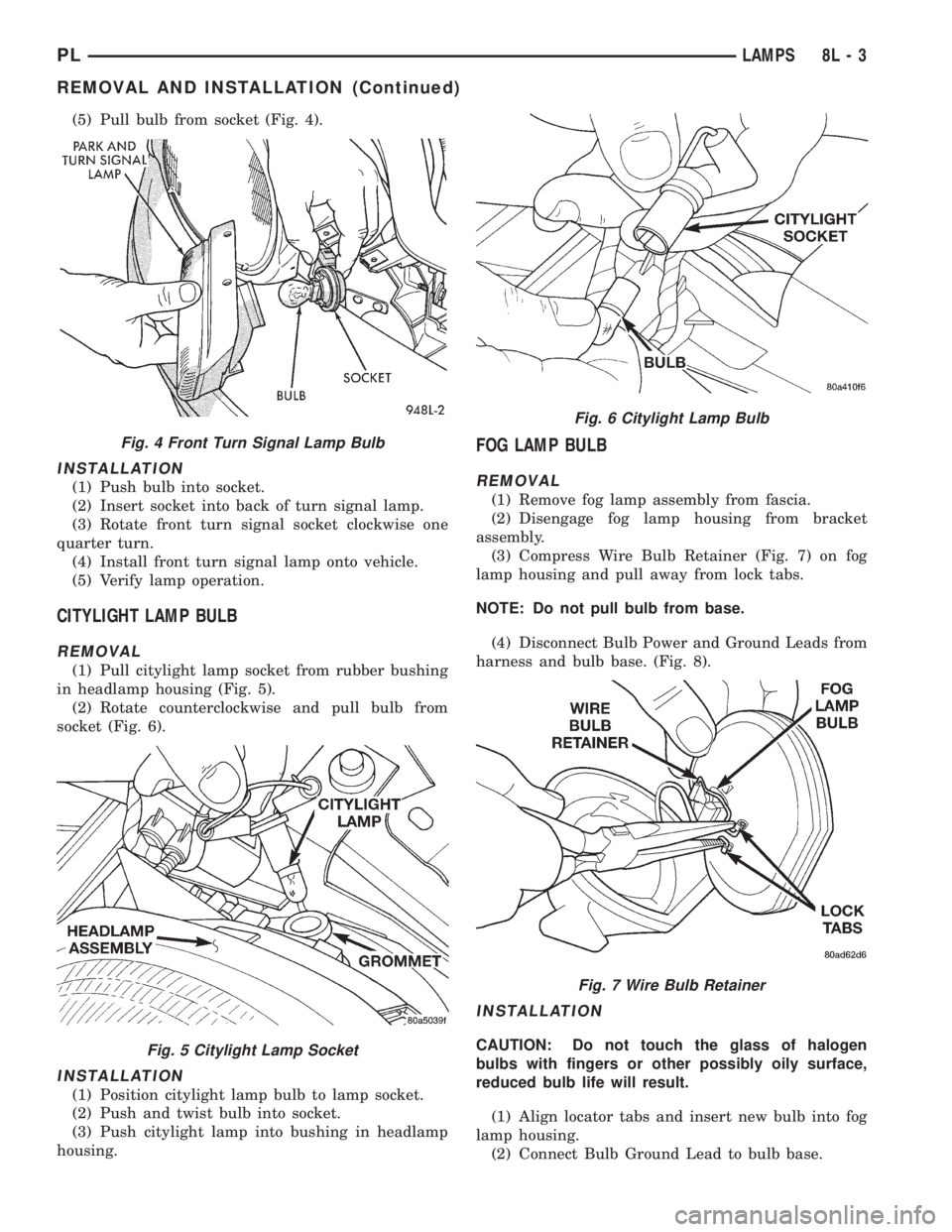
(5) Pull bulb from socket (Fig. 4).
INSTALLATION
(1) Push bulb into socket.
(2) Insert socket into back of turn signal lamp.
(3) Rotate front turn signal socket clockwise one
quarter turn.
(4) Install front turn signal lamp onto vehicle.
(5) Verify lamp operation.
CITYLIGHT LAMP BULB
REMOVAL
(1) Pull citylight lamp socket from rubber bushing
in headlamp housing (Fig. 5).
(2) Rotate counterclockwise and pull bulb from
socket (Fig. 6).
INSTALLATION
(1) Position citylight lamp bulb to lamp socket.
(2) Push and twist bulb into socket.
(3) Push citylight lamp into bushing in headlamp
housing.
FOG LAMP BULB
REMOVAL
(1) Remove fog lamp assembly from fascia.
(2) Disengage fog lamp housing from bracket
assembly.
(3) Compress Wire Bulb Retainer (Fig. 7) on fog
lamp housing and pull away from lock tabs.
NOTE: Do not pull bulb from base.
(4) Disconnect Bulb Power and Ground Leads from
harness and bulb base. (Fig. 8).
INSTALLATION
CAUTION: Do not touch the glass of halogen
bulbs with fingers or other possibly oily surface,
reduced bulb life will result.
(1) Align locator tabs and insert new bulb into fog
lamp housing.
(2) Connect Bulb Ground Lead to bulb base.
Fig. 4 Front Turn Signal Lamp Bulb
Fig. 5 Citylight Lamp Socket
Fig. 6 Citylight Lamp Bulb
Fig. 7 Wire Bulb Retainer
PLLAMPS 8L - 3
REMOVAL AND INSTALLATION (Continued)
Page 347 of 1200
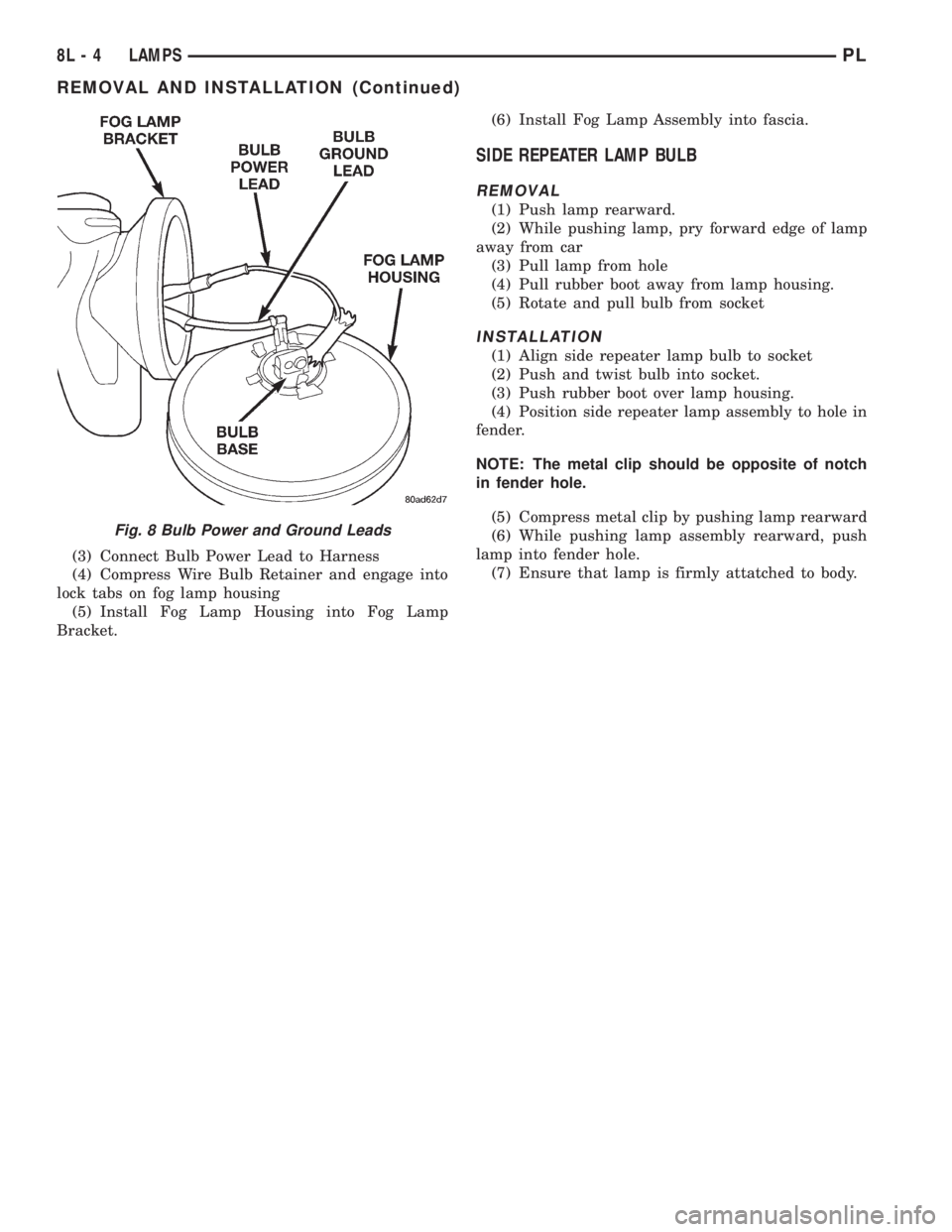
(3) Connect Bulb Power Lead to Harness
(4) Compress Wire Bulb Retainer and engage into
lock tabs on fog lamp housing
(5) Install Fog Lamp Housing into Fog Lamp
Bracket.(6) Install Fog Lamp Assembly into fascia.
SIDE REPEATER LAMP BULB
REMOVAL
(1) Push lamp rearward.
(2) While pushing lamp, pry forward edge of lamp
away from car
(3) Pull lamp from hole
(4) Pull rubber boot away from lamp housing.
(5) Rotate and pull bulb from socket
INSTALLATION
(1) Align side repeater lamp bulb to socket
(2) Push and twist bulb into socket.
(3) Push rubber boot over lamp housing.
(4) Position side repeater lamp assembly to hole in
fender.
NOTE: The metal clip should be opposite of notch
in fender hole.
(5) Compress metal clip by pushing lamp rearward
(6) While pushing lamp assembly rearward, push
lamp into fender hole.
(7) Ensure that lamp is firmly attatched to body.
Fig. 8 Bulb Power and Ground Leads
8L - 4 LAMPSPL
REMOVAL AND INSTALLATION (Continued)
Page 351 of 1200
BULB APPLICATION
INDEX
page page
GENERAL INFORMATION
INTRODUCTION......................... 8
SPECIFICATIONS
EXTERIOR LAMPS........................ 8INTERIOR LAMPS........................ 8
GENERAL INFORMATION
INTRODUCTION
The following Bulb Application Tables list the lamp
title on the left side of the column and trade number
or part number on the right.
CAUTION: Do not use bulbs that have a higher
candle power than the bulb listed in the Bulb Appli-
cation Table. Damage to lamp can result.
Do not touch halogen bulbs with fingers or other
possibly oily surfaces. Bulb life will be reduced.
If a halogen bulb is contaminated with oil, clean
bulb with denatured alcohol or ammonia based sol-
vent.
SPECIFICATIONS
EXTERIOR LAMPS
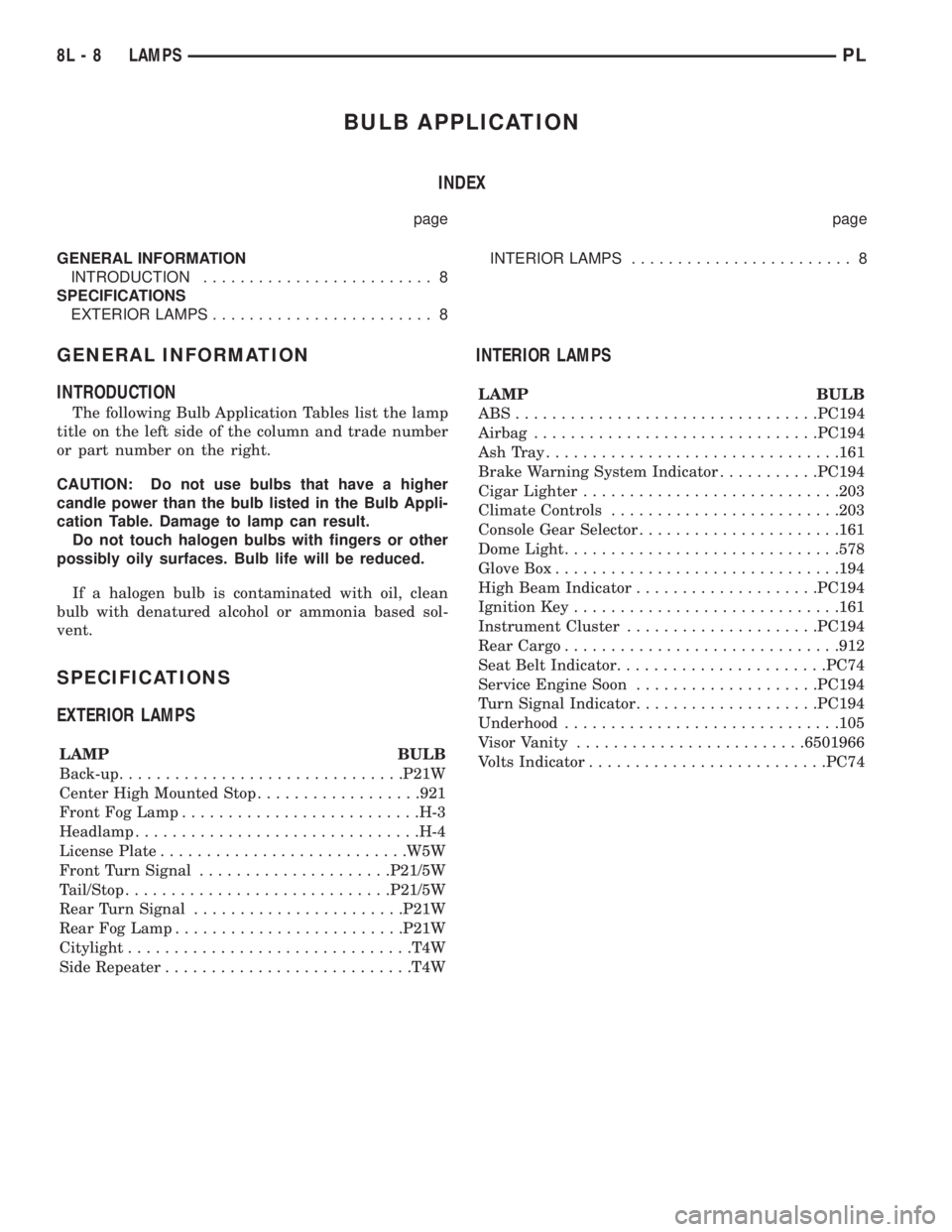
LAMP BULB
Back-up...............................P21W
Center High Mounted Stop..................921
Front Fog Lamp..........................H-3
Headlamp...............................H-4
License Plate...........................W5W
Front Turn Signal.....................P21/5W
Tail/Stop.............................P21/5W
Rear Turn Signal.......................P21W
Rear Fog Lamp.........................P21W
Citylight...............................T4W
Side Repeater...........................T4W
INTERIOR LAMPS
LAMP BULB
ABS.................................PC194
Airbag...............................PC194
AshTray................................161
Brake Warning System Indicator...........PC194
Cigar Lighter............................203
Climate Controls.........................203
Console Gear Selector......................161
Dome Light..............................578
Glove Box...............................194
High Beam Indicator....................PC194
Ignition Key.............................161
Instrument Cluster.....................PC194
Rear Cargo..............................912
Seat Belt Indicator.......................PC74
Service Engine Soon....................PC194
Turn Signal Indicator....................PC194
Underhood..............................105
Visor Vanity.........................6501966
Volts Indicator..........................PC74
8L - 8 LAMPSPL
Page 359 of 1200
CLOCKSPRING
REMOVAL
WARNING: DISCONNECT AND ISOLATE THE BAT-
TERY NEGATIVE (GROUND) CABLE BEFORE
BEGINNING ANY AIRBAG SYSTEM COMPONENT
REMOVAL OR INSTALLATION PROCEDURE. THIS
WILL DISABLE THE AIRBAG SYSTEM. FAILURE TO
DISCONNECT BATTERY COULD RESULT IN ACCI-
DENTAL AIRBAG DEPLOYMENT AND POSSIBLE
PERSONAL INJURY. ALLOW SYSTEM CAPACITOR
TO DISCHARGE FOR 2 MINUTES BEFORE REMOV-
ING ANY AIRBAG COMPONENTS.
(1) Place the front road wheels in the straight
ahead position then:
²Rotate the steering wheel half turn (180
degrees) to the right (clockwise)
²Lock column with ignition lock cylinder.
(2) Disconnect and isolate the battery negative
cable.
(3) Wait two minutes for the reserve capacitor to
discharge before removing non-deployed module.
(4) Remove speed control switch mounting screws,
switches and disconnect the wire connectors or
remove covers.
(5) Remove the Driver Airbag Module attaching
bolts from under the speed control switches or covers.
(6) Lift module and disconnect the airbag and horn
wire connectors.
(7) Remove the steering wheel, refer to Steering
Wheel removal procedures.
(8) Remove upper and lower steering column
shrouds to gain access to clockspring wiring.
(9) Disconnect the 2-way and 4-way connectors
between the clockspring and the instrument panel
wiring harness at the base of the clockspring (Fig.
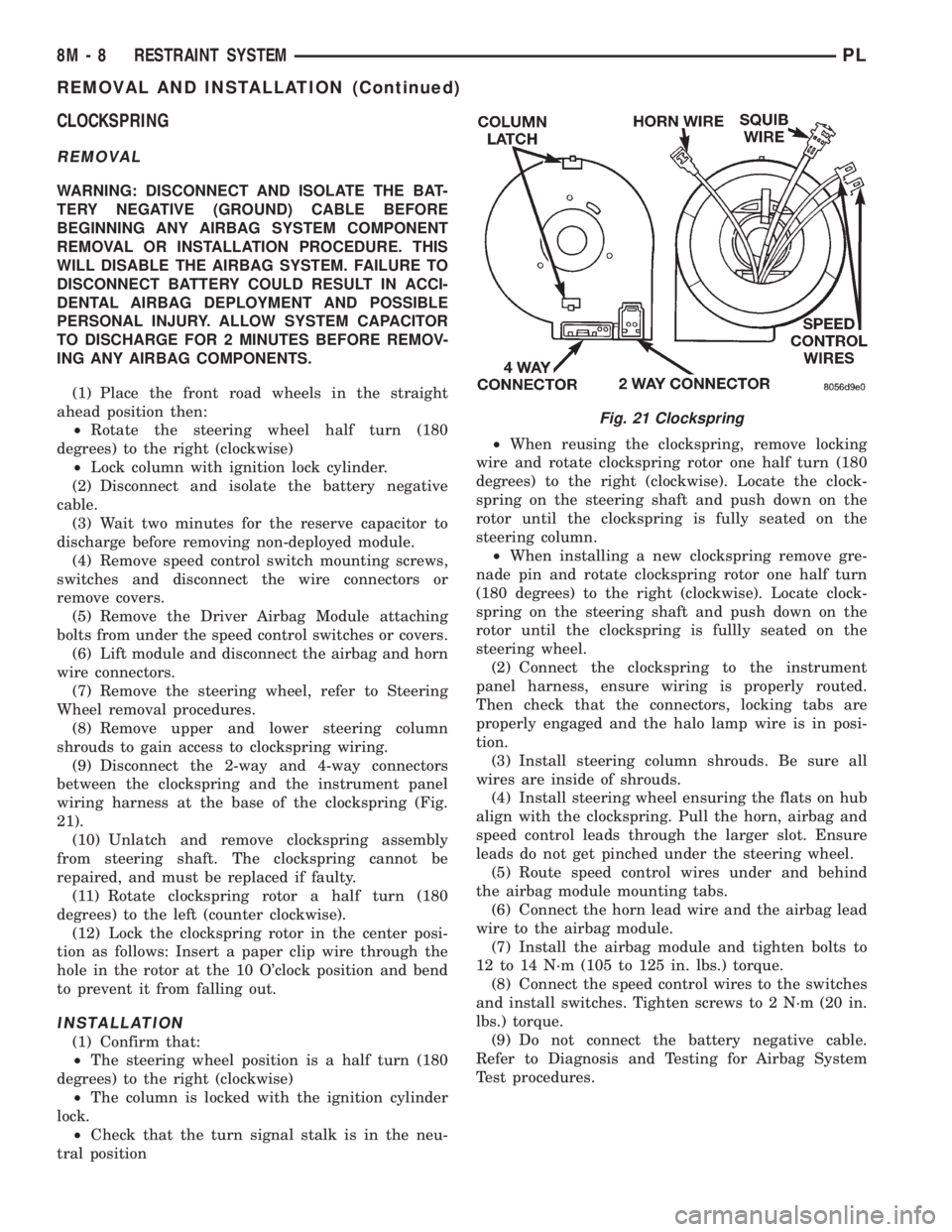
21).
(10) Unlatch and remove clockspring assembly
from steering shaft. The clockspring cannot be
repaired, and must be replaced if faulty.
(11) Rotate clockspring rotor a half turn (180
degrees) to the left (counter clockwise).
(12) Lock the clockspring rotor in the center posi-
tion as follows: Insert a paper clip wire through the
hole in the rotor at the 10 O'clock position and bend
to prevent it from falling out.
INSTALLATION
(1) Confirm that:
²The steering wheel position is a half turn (180
degrees) to the right (clockwise)
²The column is locked with the ignition cylinder
lock.
²Check that the turn signal stalk is in the neu-
tral position²When reusing the clockspring, remove locking
wire and rotate clockspring rotor one half turn (180
degrees) to the right (clockwise). Locate the clock-
spring on the steering shaft and push down on the
rotor until the clockspring is fully seated on the
steering column.
²When installing a new clockspring remove gre-
nade pin and rotate clockspring rotor one half turn
(180 degrees) to the right (clockwise). Locate clock-
spring on the steering shaft and push down on the
rotor until the clockspring is fullly seated on the
steering wheel.
(2) Connect the clockspring to the instrument
panel harness, ensure wiring is properly routed.
Then check that the connectors, locking tabs are
properly engaged and the halo lamp wire is in posi-
tion.
(3) Install steering column shrouds. Be sure all
wires are inside of shrouds.
(4) Install steering wheel ensuring the flats on hub
align with the clockspring. Pull the horn, airbag and
speed control leads through the larger slot. Ensure
leads do not get pinched under the steering wheel.
(5) Route speed control wires under and behind
the airbag module mounting tabs.
(6) Connect the horn lead wire and the airbag lead
wire to the airbag module.
(7) Install the airbag module and tighten bolts to
12 to 14 N´m (105 to 125 in. lbs.) torque.
(8) Connect the speed control wires to the switches
and install switches. Tighten screws to 2 N´m (20 in.
lbs.) torque.
(9) Do not connect the battery negative cable.
Refer to Diagnosis and Testing for Airbag System
Test procedures.
Fig. 21 Clockspring
8M - 8 RESTRAINT SYSTEMPL
REMOVAL AND INSTALLATION (Continued)
Page 381 of 1200
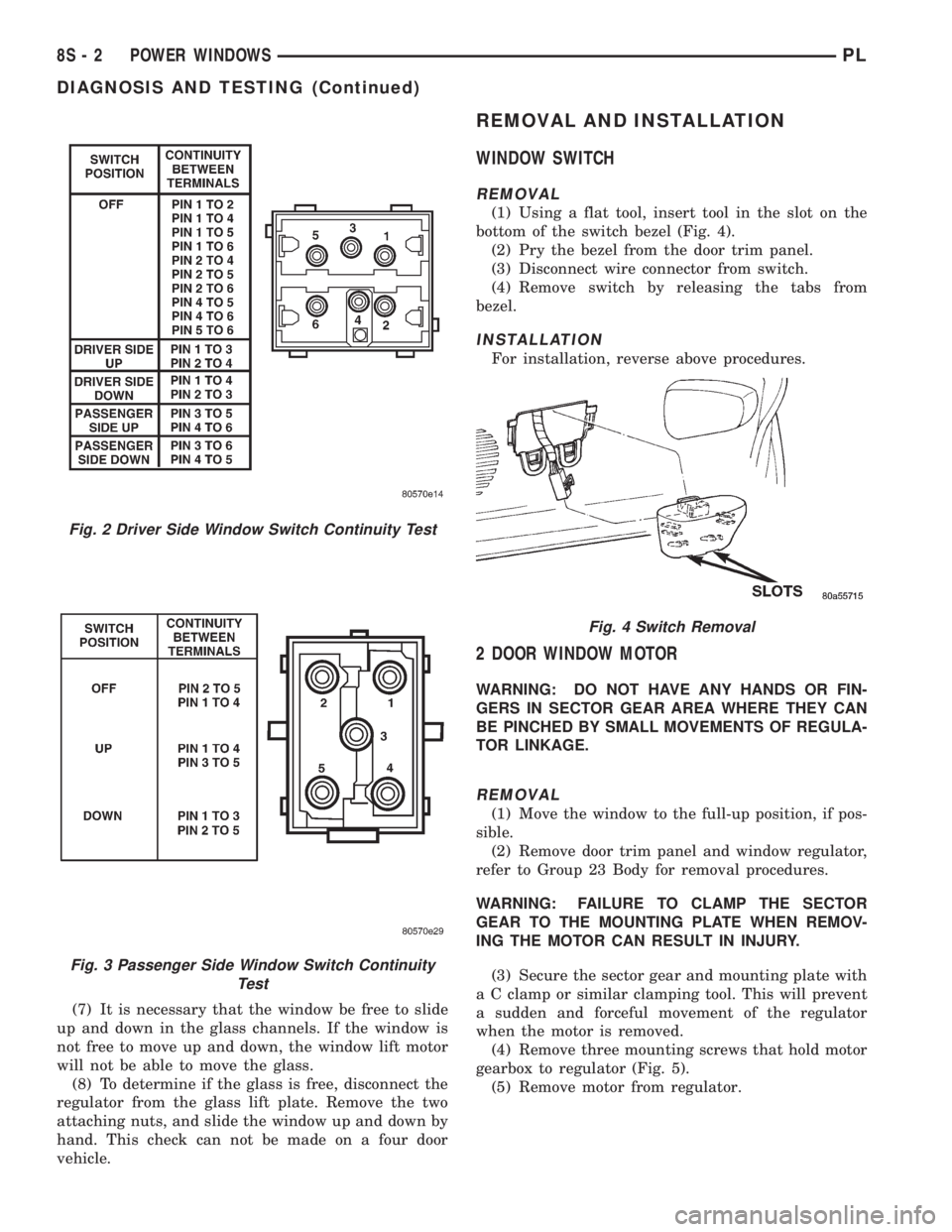
(7) It is necessary that the window be free to slide
up and down in the glass channels. If the window is
not free to move up and down, the window lift motor
will not be able to move the glass.
(8) To determine if the glass is free, disconnect the
regulator from the glass lift plate. Remove the two
attaching nuts, and slide the window up and down by
hand. This check can not be made on a four door
vehicle.
REMOVAL AND INSTALLATION
WINDOW SWITCH
REMOVAL
(1) Using a flat tool, insert tool in the slot on the
bottom of the switch bezel (Fig. 4).
(2) Pry the bezel from the door trim panel.
(3) Disconnect wire connector from switch.
(4) Remove switch by releasing the tabs from
bezel.
INSTALLATION
For installation, reverse above procedures.
2 DOOR WINDOW MOTOR
WARNING: DO NOT HAVE ANY HANDS OR FIN-
GERS IN SECTOR GEAR AREA WHERE THEY CAN
BE PINCHED BY SMALL MOVEMENTS OF REGULA-
TOR LINKAGE.
REMOVAL
(1) Move the window to the full-up position, if pos-
sible.
(2) Remove door trim panel and window regulator,
refer to Group 23 Body for removal procedures.
WARNING: FAILURE TO CLAMP THE SECTOR
GEAR TO THE MOUNTING PLATE WHEN REMOV-
ING THE MOTOR CAN RESULT IN INJURY.
(3) Secure the sector gear and mounting plate with
a C clamp or similar clamping tool. This will prevent
a sudden and forceful movement of the regulator
when the motor is removed.
(4) Remove three mounting screws that hold motor
gearbox to regulator (Fig. 5).
(5) Remove motor from regulator.
Fig. 2 Driver Side Window Switch Continuity Test
Fig. 3 Passenger Side Window Switch Continuity
Test
Fig. 4 Switch Removal
8S - 2 POWER WINDOWSPL
DIAGNOSIS AND TESTING (Continued)
Page 404 of 1200

(2) Disconnect the connector from its mating half/
component.
(3) Insert the terminal releasing special tool 6742
into the terminal end of the connector (Fig. 10).(4) Using special tool 6742 release the locking fin-
gers on the terminal (Fig. 11).
(5) Pull on the wire to remove it from the connec-
tor.
(6) Repair or replace the connector or terminal, as
necessary.TERMINAL/CONNECTOR REPAIRÐTHOMAS AND
BETTS CONNECTORS
(1) Disconnect battery.
(2) Disconnect the connector from its mating half/
component.
(3) Push in the two lock tabs on the side of the
connector (Fig. 12).
Fig. 9 Wire Repair
Fig. 10 Molex Connector Repair
Fig. 11 Using Special Tool 6742
Fig. 12 Thomas and Betts Connector Lock Release
Tabs
PL8W - 01 GENERAL INFORMATION 8W - 01 - 11
SERVICE PROCEDURES (Continued)