clock DODGE NEON 2000 Service Manual PDF
[x] Cancel search | Manufacturer: DODGE, Model Year: 2000, Model line: NEON, Model: DODGE NEON 2000Pages: 1285, PDF Size: 29.42 MB
Page 918 of 1285
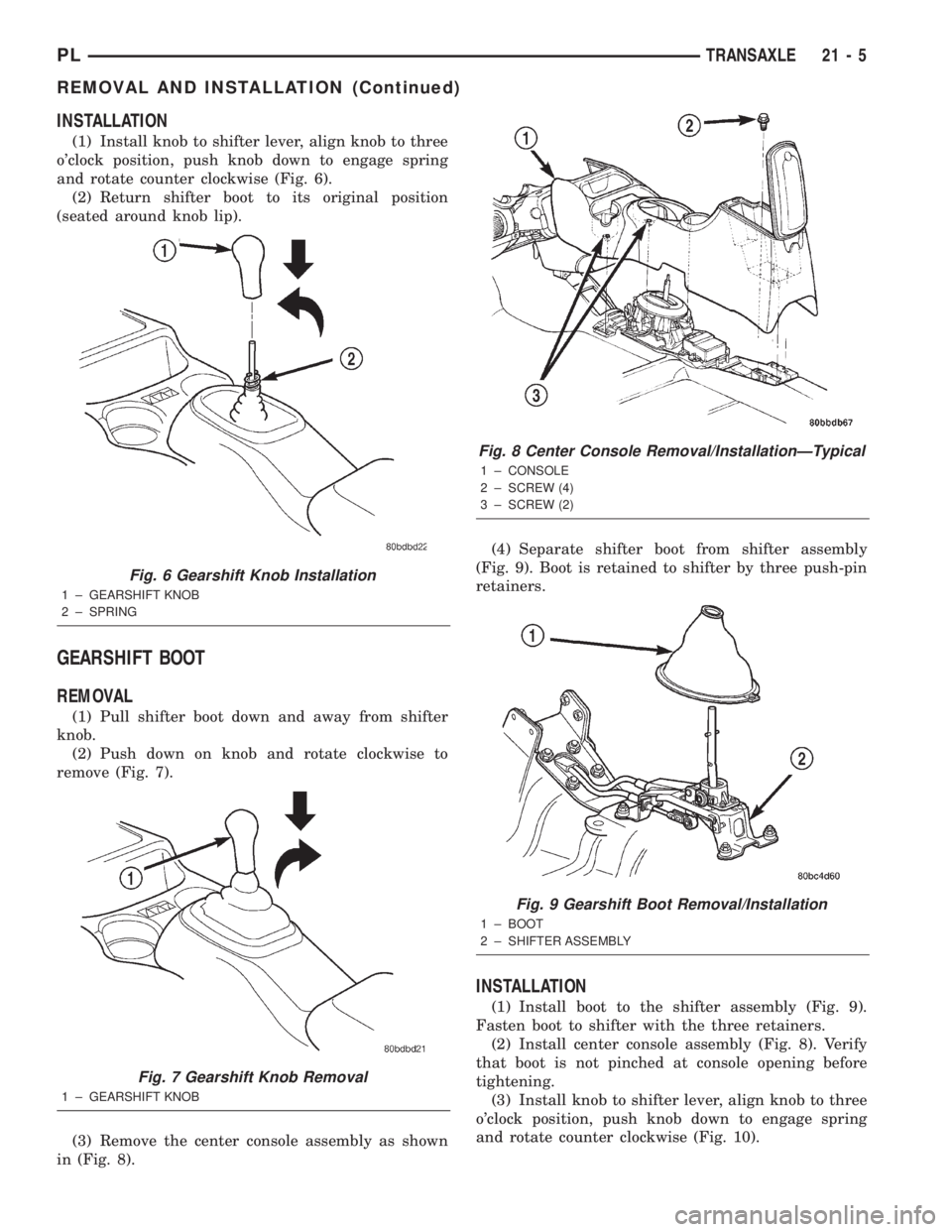
INSTALLATION
(1) Install knob to shifter lever, align knob to three
o'clock position, push knob down to engage spring
and rotate counter clockwise (Fig. 6).
(2) Return shifter boot to its original position
(seated around knob lip).
GEARSHIFT BOOT
REMOVAL
(1) Pull shifter boot down and away from shifter
knob.
(2) Push down on knob and rotate clockwise to
remove (Fig. 7).
(3) Remove the center console assembly as shown
in (Fig. 8).(4) Separate shifter boot from shifter assembly
(Fig. 9). Boot is retained to shifter by three push-pin
retainers.
INSTALLATION
(1) Install boot to the shifter assembly (Fig. 9).
Fasten boot to shifter with the three retainers.
(2) Install center console assembly (Fig. 8). Verify
that boot is not pinched at console opening before
tightening.
(3) Install knob to shifter lever, align knob to three
o'clock position, push knob down to engage spring
and rotate counter clockwise (Fig. 10).
Fig. 6 Gearshift Knob Installation
1 ± GEARSHIFT KNOB
2 ± SPRING
Fig. 7 Gearshift Knob Removal
1 ± GEARSHIFT KNOB
Fig. 8 Center Console Removal/InstallationÐTypical
1 ± CONSOLE
2 ± SCREW (4)
3 ± SCREW (2)
Fig. 9 Gearshift Boot Removal/Installation
1 ± BOOT
2 ± SHIFTER ASSEMBLY
PLTRANSAXLE 21 - 5
REMOVAL AND INSTALLATION (Continued)
Page 919 of 1285
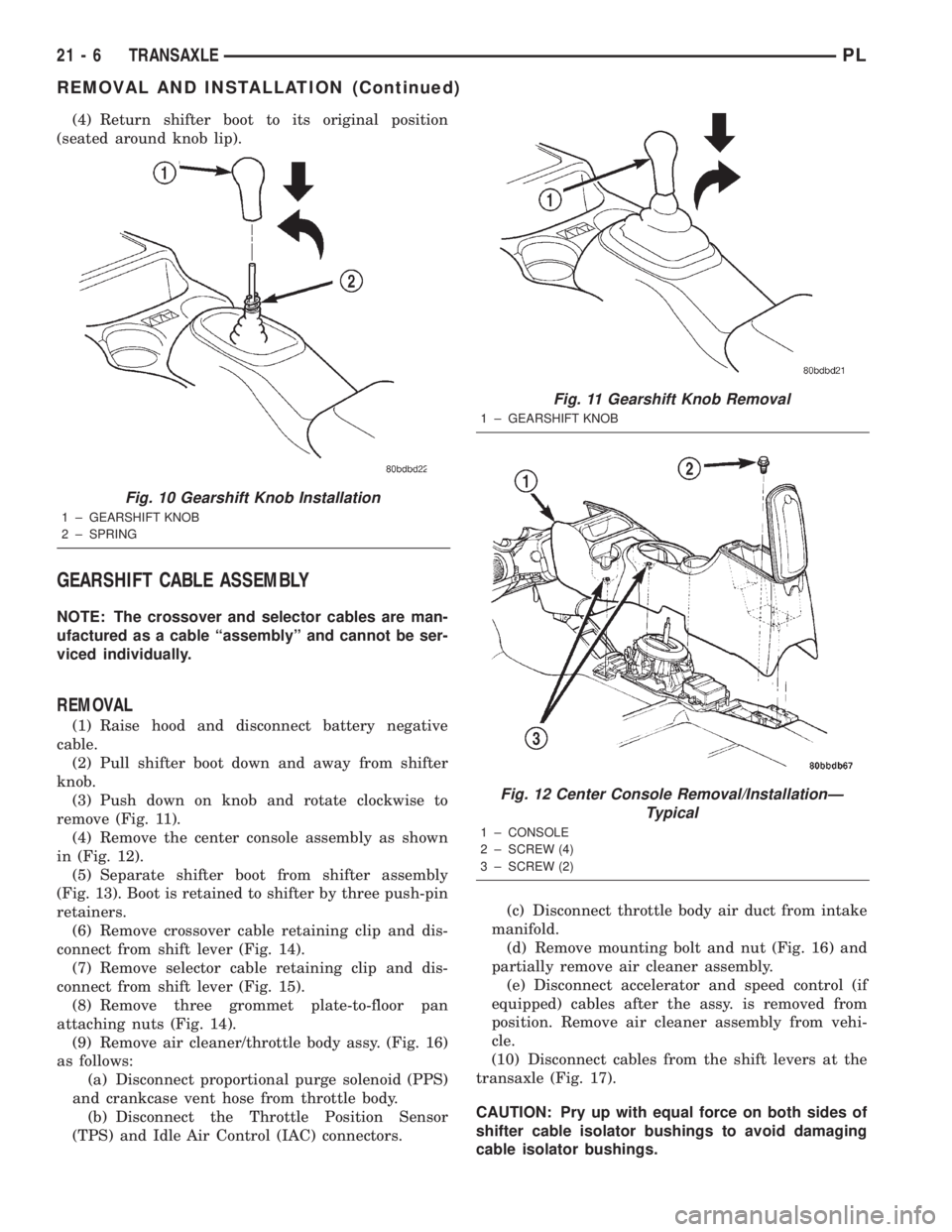
(4) Return shifter boot to its original position
(seated around knob lip).
GEARSHIFT CABLE ASSEMBLY
NOTE: The crossover and selector cables are man-
ufactured as a cable ªassemblyº and cannot be ser-
viced individually.
REMOVAL
(1) Raise hood and disconnect battery negative
cable.
(2) Pull shifter boot down and away from shifter
knob.
(3) Push down on knob and rotate clockwise to
remove (Fig. 11).
(4) Remove the center console assembly as shown
in (Fig. 12).
(5) Separate shifter boot from shifter assembly
(Fig. 13). Boot is retained to shifter by three push-pin
retainers.
(6) Remove crossover cable retaining clip and dis-
connect from shift lever (Fig. 14).
(7) Remove selector cable retaining clip and dis-
connect from shift lever (Fig. 15).
(8) Remove three grommet plate-to-floor pan
attaching nuts (Fig. 14).
(9) Remove air cleaner/throttle body assy. (Fig. 16)
as follows:
(a) Disconnect proportional purge solenoid (PPS)
and crankcase vent hose from throttle body.
(b) Disconnect the Throttle Position Sensor
(TPS) and Idle Air Control (IAC) connectors.(c) Disconnect throttle body air duct from intake
manifold.
(d) Remove mounting bolt and nut (Fig. 16) and
partially remove air cleaner assembly.
(e) Disconnect accelerator and speed control (if
equipped) cables after the assy. is removed from
position. Remove air cleaner assembly from vehi-
cle.
(10) Disconnect cables from the shift levers at the
transaxle (Fig. 17).
CAUTION: Pry up with equal force on both sides of
shifter cable isolator bushings to avoid damaging
cable isolator bushings.
Fig. 10 Gearshift Knob Installation
1 ± GEARSHIFT KNOB
2 ± SPRING
Fig. 11 Gearshift Knob Removal
1 ± GEARSHIFT KNOB
Fig. 12 Center Console Removal/InstallationÐ
Typical
1 ± CONSOLE
2 ± SCREW (4)
3 ± SCREW (2)
21 - 6 TRANSAXLEPL
REMOVAL AND INSTALLATION (Continued)
Page 921 of 1285
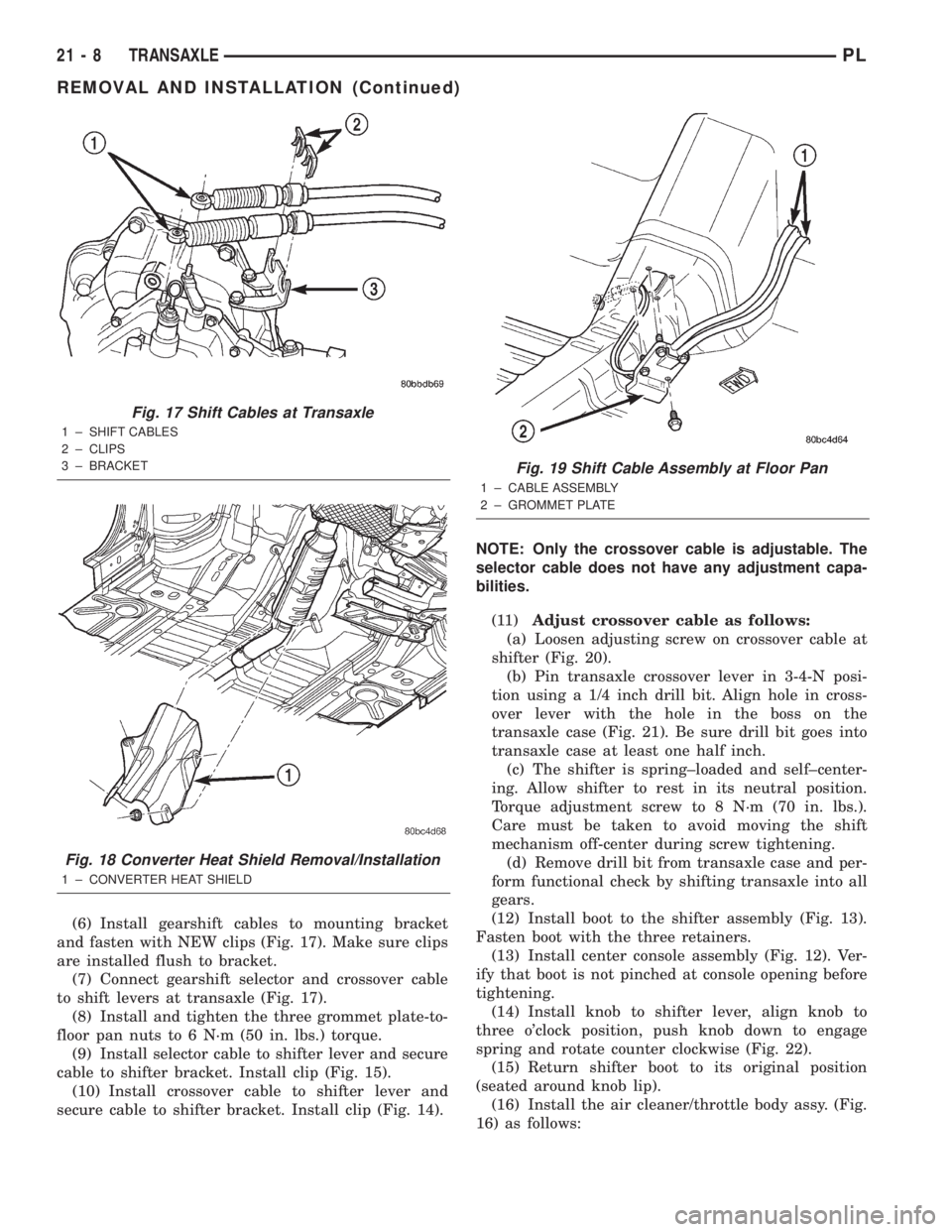
(6) Install gearshift cables to mounting bracket
and fasten with NEW clips (Fig. 17). Make sure clips
are installed flush to bracket.
(7) Connect gearshift selector and crossover cable
to shift levers at transaxle (Fig. 17).
(8) Install and tighten the three grommet plate-to-
floor pan nuts to 6 N´m (50 in. lbs.) torque.
(9) Install selector cable to shifter lever and secure
cable to shifter bracket. Install clip (Fig. 15).
(10) Install crossover cable to shifter lever and
secure cable to shifter bracket. Install clip (Fig. 14).NOTE: Only the crossover cable is adjustable. The
selector cable does not have any adjustment capa-
bilities.
(11)Adjust crossover cable as follows:
(a) Loosen adjusting screw on crossover cable at
shifter (Fig. 20).
(b) Pin transaxle crossover lever in 3-4-N posi-
tion using a 1/4 inch drill bit. Align hole in cross-
over lever with the hole in the boss on the
transaxle case (Fig. 21). Be sure drill bit goes into
transaxle case at least one half inch.
(c) The shifter is spring±loaded and self±center-
ing. Allow shifter to rest in its neutral position.
Torque adjustment screw to 8 N´m (70 in. lbs.).
Care must be taken to avoid moving the shift
mechanism off-center during screw tightening.
(d) Remove drill bit from transaxle case and per-
form functional check by shifting transaxle into all
gears.
(12) Install boot to the shifter assembly (Fig. 13).
Fasten boot with the three retainers.
(13) Install center console assembly (Fig. 12). Ver-
ify that boot is not pinched at console opening before
tightening.
(14) Install knob to shifter lever, align knob to
three o'clock position, push knob down to engage
spring and rotate counter clockwise (Fig. 22).
(15) Return shifter boot to its original position
(seated around knob lip).
(16) Install the air cleaner/throttle body assy. (Fig.
16) as follows:
Fig. 17 Shift Cables at Transaxle
1 ± SHIFT CABLES
2 ± CLIPS
3 ± BRACKET
Fig. 18 Converter Heat Shield Removal/Installation
1 ± CONVERTER HEAT SHIELD
Fig. 19 Shift Cable Assembly at Floor Pan
1 ± CABLE ASSEMBLY
2 ± GROMMET PLATE
21 - 8 TRANSAXLEPL
REMOVAL AND INSTALLATION (Continued)
Page 922 of 1285
(a) Connect the accelerator and speed control (if
equipped) cables to the air cleaner/throttle body
assy.
(b) Install assy into position, making sure the
air cleaner locating slot is engaged to the battery
bracket tab, and tighten fasteners to 14 N´m (120
in. lbs.) torque.
(c) Verify throttle body duct is fully seated to
intake manifold and tighten clamp to 5 N´m (40 in.
lbs.) torque.(d) Connect the Throttle Position Sensor (TPS)
and Idle Air Control (IAC) connectors.
(e) Connect proportional purge solenoid (PPS)
and crankcase vent hose from throttle body.
(17) Connect battery negative cable.
GEARSHIFT MECHANISM REPLACEMENT
REMOVAL
(1) Pull shifter boot down and away from shifter
knob.
(2) Push down on knob and rotate clockwise to
remove (Fig. 23).
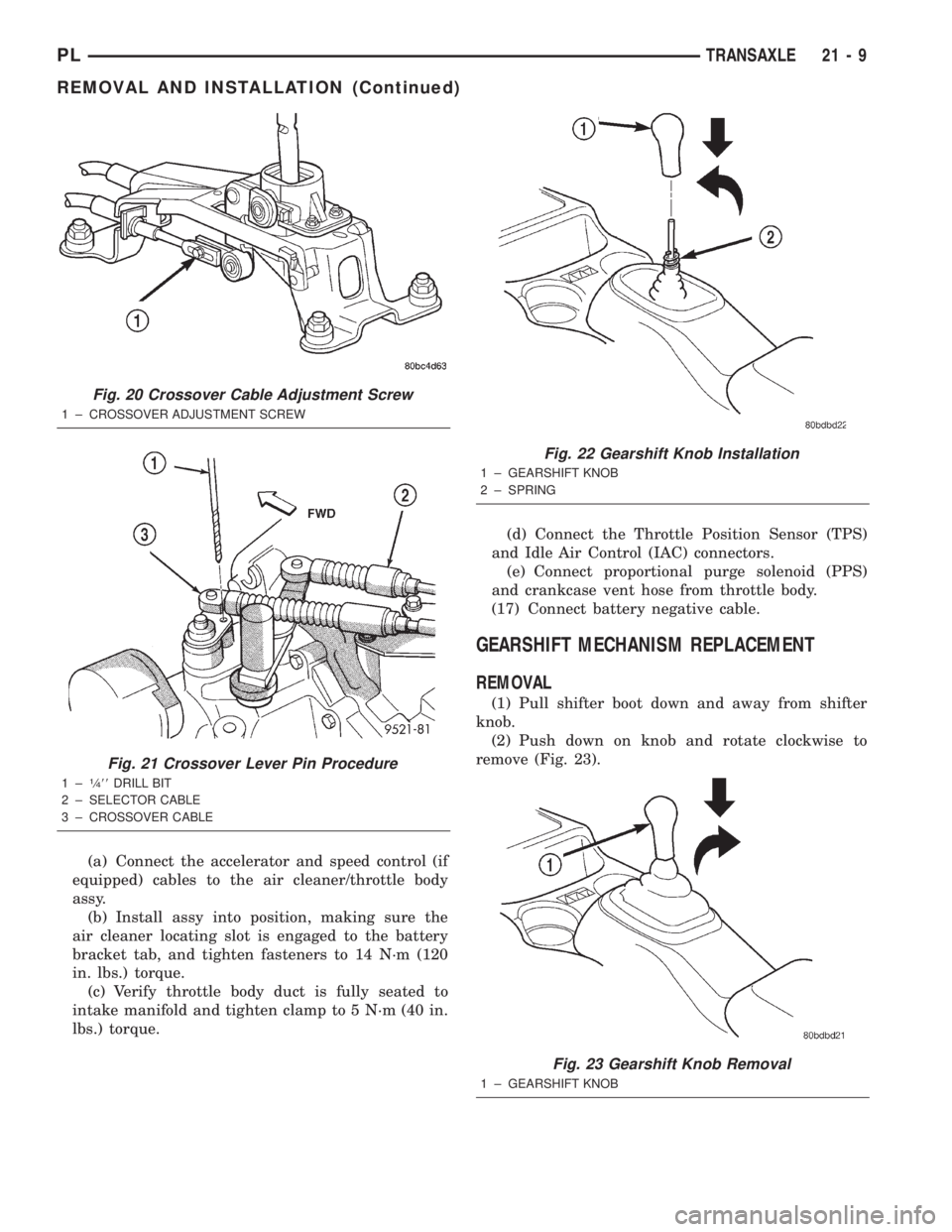
Fig. 20 Crossover Cable Adjustment Screw
1 ± CROSSOVER ADJUSTMENT SCREW
Fig. 21 Crossover Lever Pin Procedure
1±1¤488DRILL BIT
2 ± SELECTOR CABLE
3 ± CROSSOVER CABLE
Fig. 22 Gearshift Knob Installation
1 ± GEARSHIFT KNOB
2 ± SPRING
Fig. 23 Gearshift Knob Removal
1 ± GEARSHIFT KNOB
PLTRANSAXLE 21 - 9
REMOVAL AND INSTALLATION (Continued)
Page 924 of 1285
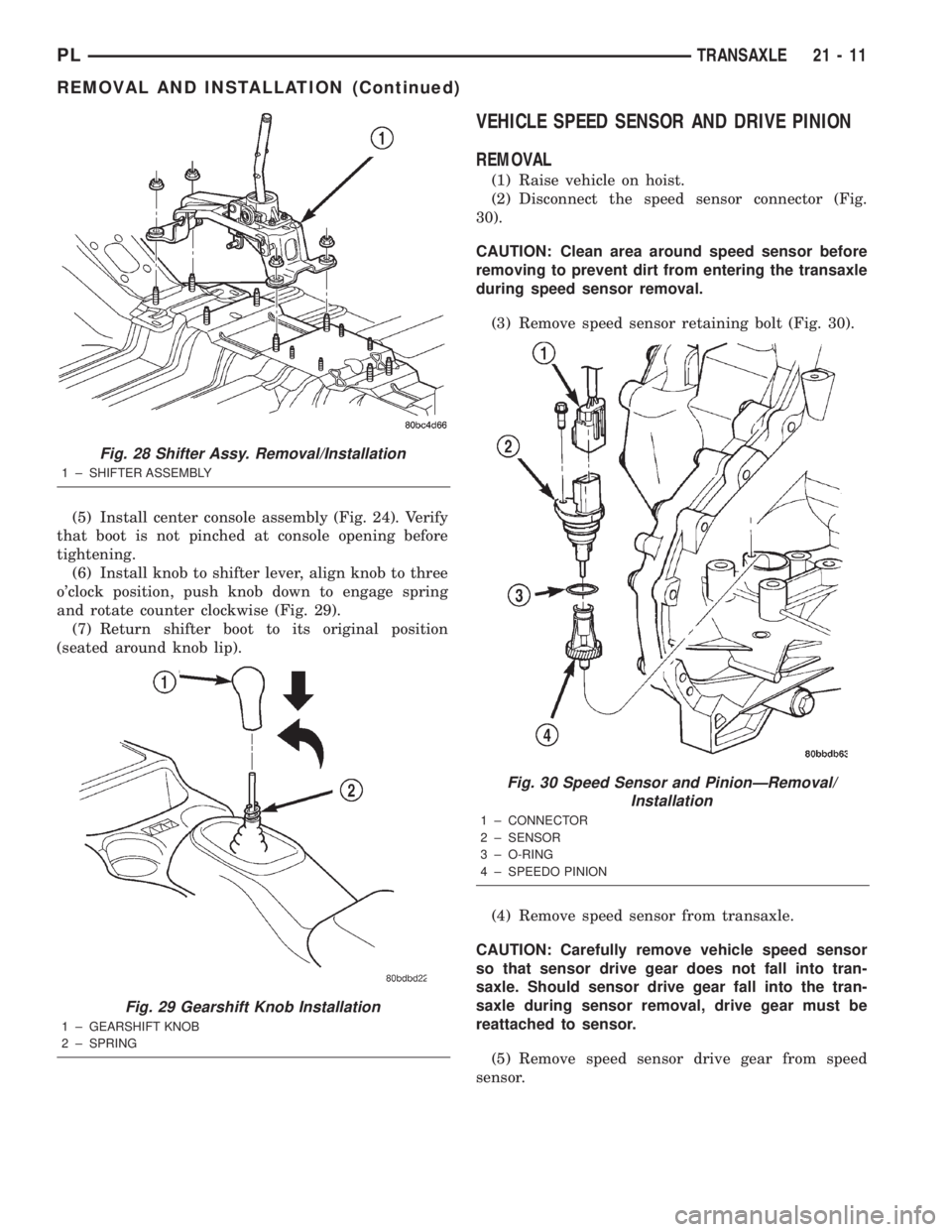
(5) Install center console assembly (Fig. 24). Verify
that boot is not pinched at console opening before
tightening.
(6) Install knob to shifter lever, align knob to three
o'clock position, push knob down to engage spring
and rotate counter clockwise (Fig. 29).
(7) Return shifter boot to its original position
(seated around knob lip).
VEHICLE SPEED SENSOR AND DRIVE PINION
REMOVAL
(1) Raise vehicle on hoist.
(2) Disconnect the speed sensor connector (Fig.
30).
CAUTION: Clean area around speed sensor before
removing to prevent dirt from entering the transaxle
during speed sensor removal.
(3) Remove speed sensor retaining bolt (Fig. 30).
(4) Remove speed sensor from transaxle.
CAUTION: Carefully remove vehicle speed sensor
so that sensor drive gear does not fall into tran-
saxle. Should sensor drive gear fall into the tran-
saxle during sensor removal, drive gear must be
reattached to sensor.
(5) Remove speed sensor drive gear from speed
sensor.
Fig. 28 Shifter Assy. Removal/Installation
1 ± SHIFTER ASSEMBLY
Fig. 29 Gearshift Knob Installation
1 ± GEARSHIFT KNOB
2 ± SPRING
Fig. 30 Speed Sensor and PinionÐRemoval/
Installation
1 ± CONNECTOR
2 ± SENSOR
3 ± O-RING
4 ± SPEEDO PINION
PLTRANSAXLE 21 - 11
REMOVAL AND INSTALLATION (Continued)
Page 954 of 1285
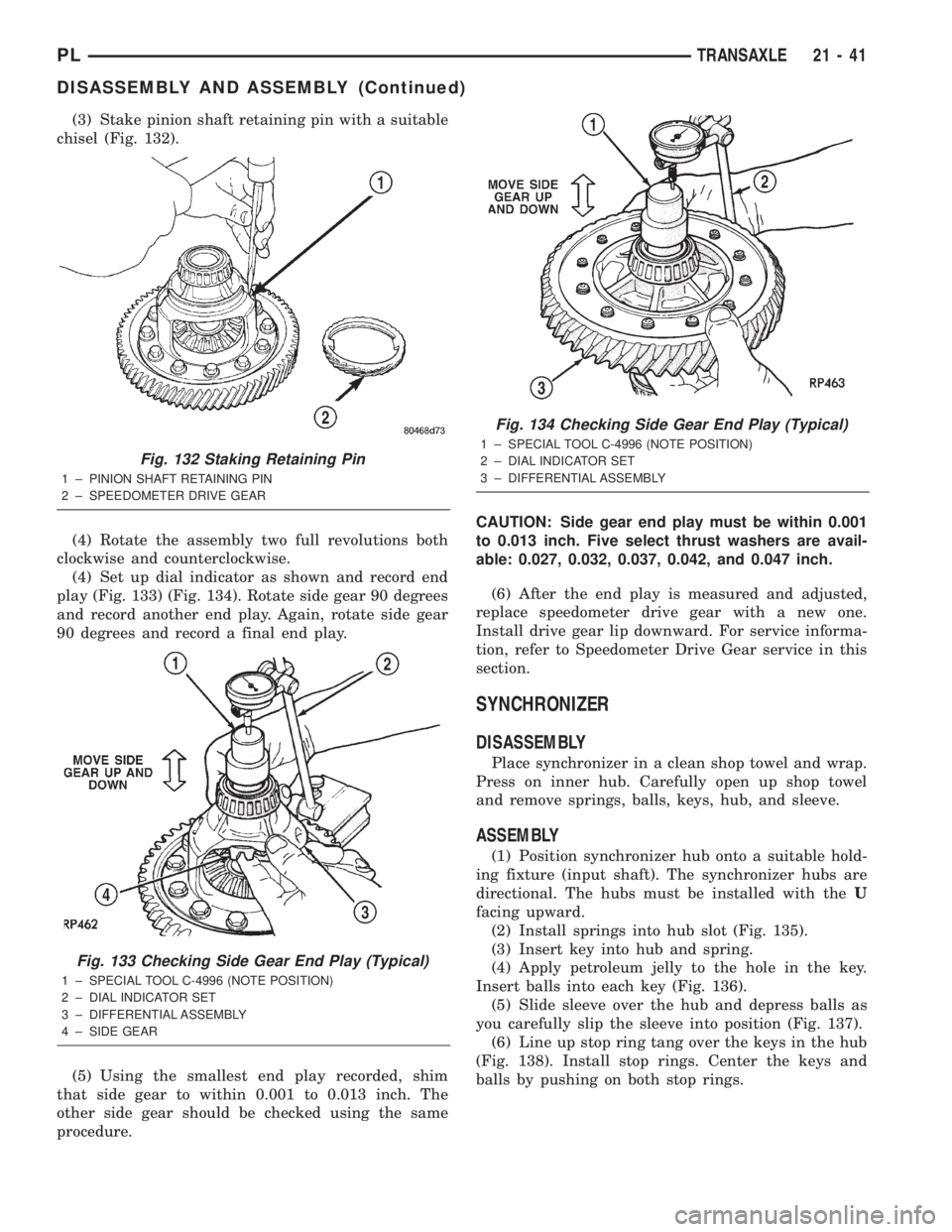
(3) Stake pinion shaft retaining pin with a suitable
chisel (Fig. 132).
(4) Rotate the assembly two full revolutions both
clockwise and counterclockwise.
(4) Set up dial indicator as shown and record end
play (Fig. 133) (Fig. 134). Rotate side gear 90 degrees
and record another end play. Again, rotate side gear
90 degrees and record a final end play.
(5) Using the smallest end play recorded, shim
that side gear to within 0.001 to 0.013 inch. The
other side gear should be checked using the same
procedure.CAUTION: Side gear end play must be within 0.001
to 0.013 inch. Five select thrust washers are avail-
able: 0.027, 0.032, 0.037, 0.042, and 0.047 inch.
(6) After the end play is measured and adjusted,
replace speedometer drive gear with a new one.
Install drive gear lip downward. For service informa-
tion, refer to Speedometer Drive Gear service in this
section.
SYNCHRONIZER
DISASSEMBLY
Place synchronizer in a clean shop towel and wrap.
Press on inner hub. Carefully open up shop towel
and remove springs, balls, keys, hub, and sleeve.
ASSEMBLY
(1) Position synchronizer hub onto a suitable hold-
ing fixture (input shaft). The synchronizer hubs are
directional. The hubs must be installed with theU
facing upward.
(2) Install springs into hub slot (Fig. 135).
(3) Insert key into hub and spring.
(4) Apply petroleum jelly to the hole in the key.
Insert balls into each key (Fig. 136).
(5) Slide sleeve over the hub and depress balls as
you carefully slip the sleeve into position (Fig. 137).
(6) Line up stop ring tang over the keys in the hub
(Fig. 138). Install stop rings. Center the keys and
balls by pushing on both stop rings.
Fig. 132 Staking Retaining Pin
1 ± PINION SHAFT RETAINING PIN
2 ± SPEEDOMETER DRIVE GEAR
Fig. 133 Checking Side Gear End Play (Typical)
1 ± SPECIAL TOOL C-4996 (NOTE POSITION)
2 ± DIAL INDICATOR SET
3 ± DIFFERENTIAL ASSEMBLY
4 ± SIDE GEAR
Fig. 134 Checking Side Gear End Play (Typical)
1 ± SPECIAL TOOL C-4996 (NOTE POSITION)
2 ± DIAL INDICATOR SET
3 ± DIFFERENTIAL ASSEMBLY
PLTRANSAXLE 21 - 41
DISASSEMBLY AND ASSEMBLY (Continued)
Page 962 of 1285
ADJUSTMENTS
GEARSHIFT CROSSOVER CABLE
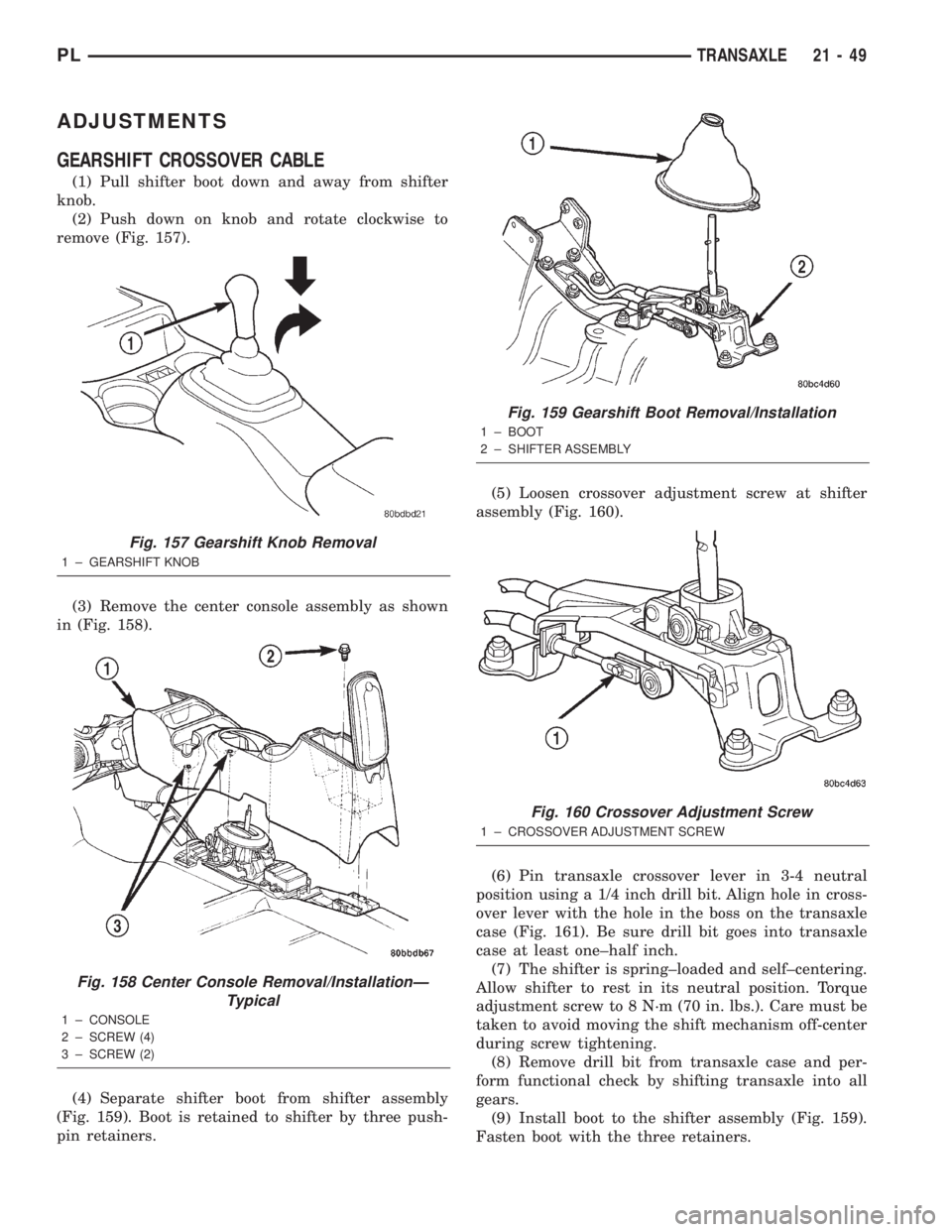
(1) Pull shifter boot down and away from shifter
knob.
(2) Push down on knob and rotate clockwise to
remove (Fig. 157).
(3) Remove the center console assembly as shown
in (Fig. 158).
(4) Separate shifter boot from shifter assembly
(Fig. 159). Boot is retained to shifter by three push-
pin retainers.(5) Loosen crossover adjustment screw at shifter
assembly (Fig. 160).
(6) Pin transaxle crossover lever in 3-4 neutral
position using a 1/4 inch drill bit. Align hole in cross-
over lever with the hole in the boss on the transaxle
case (Fig. 161). Be sure drill bit goes into transaxle
case at least one±half inch.
(7) The shifter is spring±loaded and self±centering.
Allow shifter to rest in its neutral position. Torque
adjustment screw to 8 N´m (70 in. lbs.). Care must be
taken to avoid moving the shift mechanism off-center
during screw tightening.
(8) Remove drill bit from transaxle case and per-
form functional check by shifting transaxle into all
gears.
(9) Install boot to the shifter assembly (Fig. 159).
Fasten boot with the three retainers.
Fig. 157 Gearshift Knob Removal
1 ± GEARSHIFT KNOB
Fig. 158 Center Console Removal/InstallationÐ
Typical
1 ± CONSOLE
2 ± SCREW (4)
3 ± SCREW (2)
Fig. 159 Gearshift Boot Removal/Installation
1 ± BOOT
2 ± SHIFTER ASSEMBLY
Fig. 160 Crossover Adjustment Screw
1 ± CROSSOVER ADJUSTMENT SCREW
PLTRANSAXLE 21 - 49
Page 963 of 1285
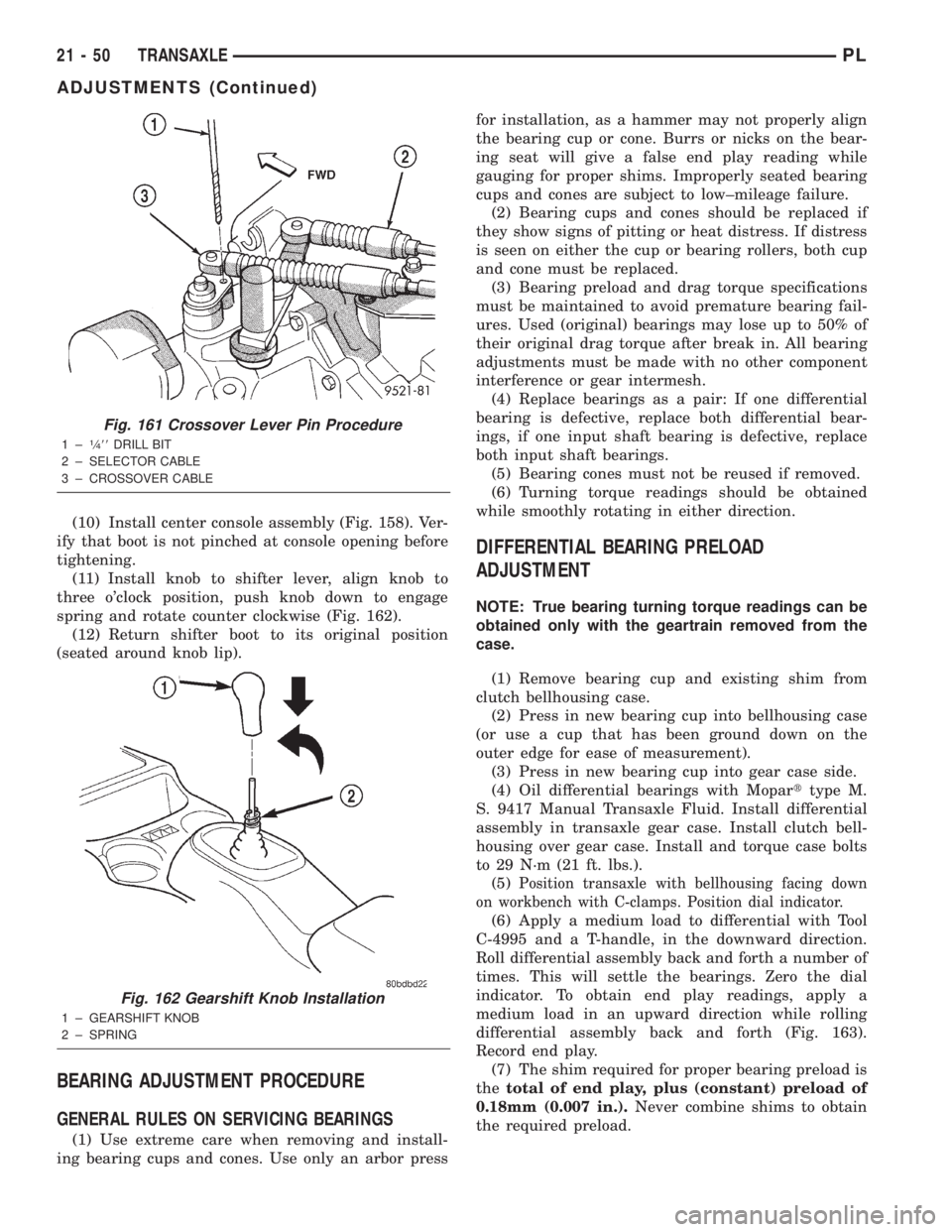
(10) Install center console assembly (Fig. 158). Ver-
ify that boot is not pinched at console opening before
tightening.
(11) Install knob to shifter lever, align knob to
three o'clock position, push knob down to engage
spring and rotate counter clockwise (Fig. 162).
(12) Return shifter boot to its original position
(seated around knob lip).
BEARING ADJUSTMENT PROCEDURE
GENERAL RULES ON SERVICING BEARINGS
(1) Use extreme care when removing and install-
ing bearing cups and cones. Use only an arbor pressfor installation, as a hammer may not properly align
the bearing cup or cone. Burrs or nicks on the bear-
ing seat will give a false end play reading while
gauging for proper shims. Improperly seated bearing
cups and cones are subject to low±mileage failure.
(2) Bearing cups and cones should be replaced if
they show signs of pitting or heat distress. If distress
is seen on either the cup or bearing rollers, both cup
and cone must be replaced.
(3) Bearing preload and drag torque specifications
must be maintained to avoid premature bearing fail-
ures. Used (original) bearings may lose up to 50% of
their original drag torque after break in. All bearing
adjustments must be made with no other component
interference or gear intermesh.
(4) Replace bearings as a pair: If one differential
bearing is defective, replace both differential bear-
ings, if one input shaft bearing is defective, replace
both input shaft bearings.
(5) Bearing cones must not be reused if removed.
(6) Turning torque readings should be obtained
while smoothly rotating in either direction.
DIFFERENTIAL BEARING PRELOAD
ADJUSTMENT
NOTE: True bearing turning torque readings can be
obtained only with the geartrain removed from the
case.
(1) Remove bearing cup and existing shim from
clutch bellhousing case.
(2) Press in new bearing cup into bellhousing case
(or use a cup that has been ground down on the
outer edge for ease of measurement).
(3) Press in new bearing cup into gear case side.
(4) Oil differential bearings with Moparttype M.
S. 9417 Manual Transaxle Fluid. Install differential
assembly in transaxle gear case. Install clutch bell-
housing over gear case. Install and torque case bolts
to 29 N´m (21 ft. lbs.).
(5)
Position transaxle with bellhousing facing down
on workbench with C-clamps. Position dial indicator.
(6) Apply a medium load to differential with Tool
C-4995 and a T-handle, in the downward direction.
Roll differential assembly back and forth a number of
times. This will settle the bearings. Zero the dial
indicator. To obtain end play readings, apply a
medium load in an upward direction while rolling
differential assembly back and forth (Fig. 163).
Record end play.
(7) The shim required for proper bearing preload is
thetotal of end play, plus (constant) preload of
0.18mm (0.007 in.).Never combine shims to obtain
the required preload.
Fig. 161 Crossover Lever Pin Procedure
1±1¤488DRILL BIT
2 ± SELECTOR CABLE
3 ± CROSSOVER CABLE
Fig. 162 Gearshift Knob Installation
1 ± GEARSHIFT KNOB
2 ± SPRING
21 - 50 TRANSAXLEPL
ADJUSTMENTS (Continued)
Page 979 of 1285
CLUTCHES BANDS
LEVER START PARK
FRONT REAR LOCKUPOVER-
RUNNING(KICK-
DOWN)LOW/
REV
POSITION SAFETY SPRAG
FRONT REAR
P Ð PARK X X
R Ð REVERSE X X
N Ð NEUTRAL X
D Ð DRIVE
First X X
Second X X
Third X X X
2 Ð SECOND
First X X
Second X X
1 Ð Low X X
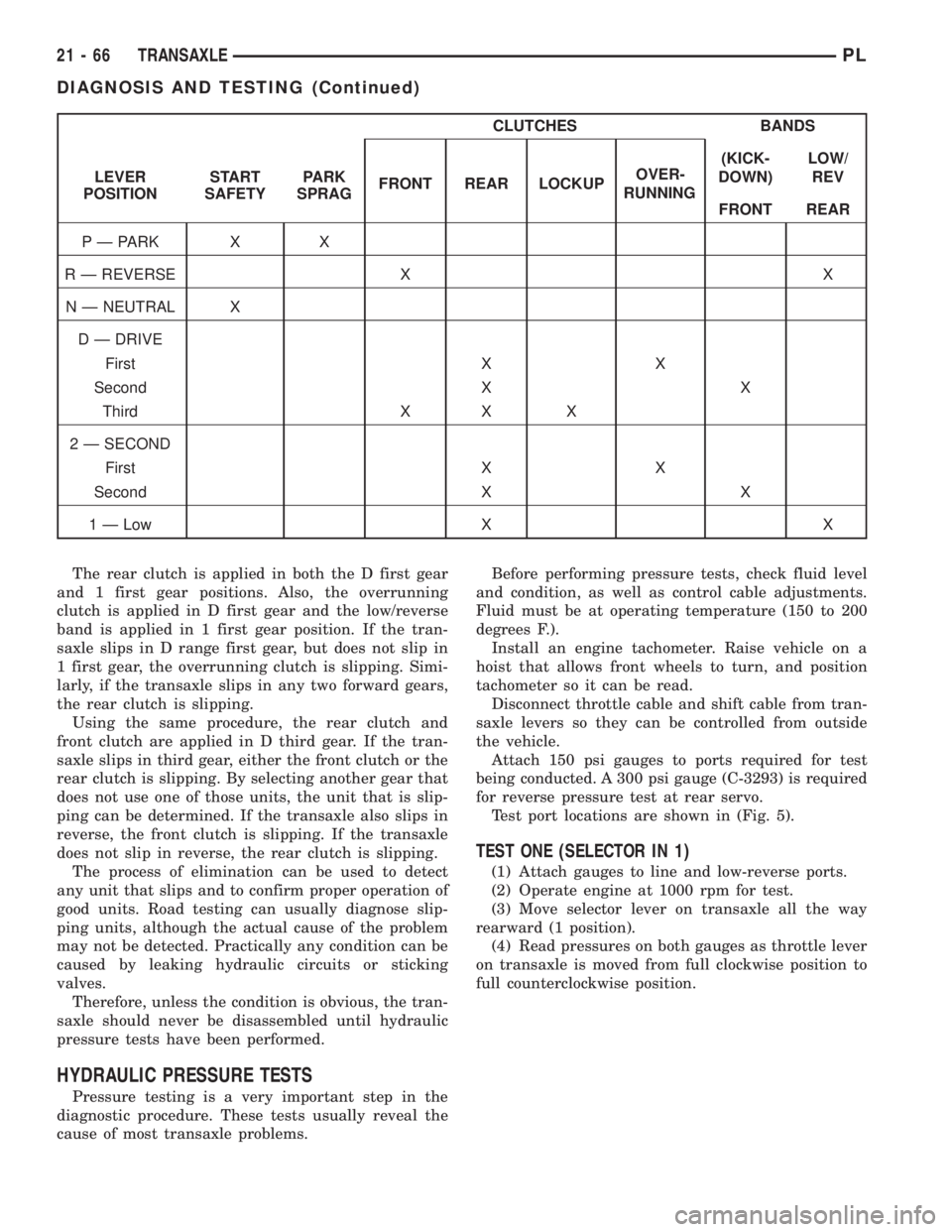
The rear clutch is applied in both the D first gear
and 1 first gear positions. Also, the overrunning
clutch is applied in D first gear and the low/reverse
band is applied in 1 first gear position. If the tran-
saxle slips in D range first gear, but does not slip in
1 first gear, the overrunning clutch is slipping. Simi-
larly, if the transaxle slips in any two forward gears,
the rear clutch is slipping.
Using the same procedure, the rear clutch and
front clutch are applied in D third gear. If the tran-
saxle slips in third gear, either the front clutch or the
rear clutch is slipping. By selecting another gear that
does not use one of those units, the unit that is slip-
ping can be determined. If the transaxle also slips in
reverse, the front clutch is slipping. If the transaxle
does not slip in reverse, the rear clutch is slipping.
The process of elimination can be used to detect
any unit that slips and to confirm proper operation of
good units. Road testing can usually diagnose slip-
ping units, although the actual cause of the problem
may not be detected. Practically any condition can be
caused by leaking hydraulic circuits or sticking
valves.
Therefore, unless the condition is obvious, the tran-
saxle should never be disassembled until hydraulic
pressure tests have been performed.
HYDRAULIC PRESSURE TESTS
Pressure testing is a very important step in the
diagnostic procedure. These tests usually reveal the
cause of most transaxle problems.Before performing pressure tests, check fluid level
and condition, as well as control cable adjustments.
Fluid must be at operating temperature (150 to 200
degrees F.).
Install an engine tachometer. Raise vehicle on a
hoist that allows front wheels to turn, and position
tachometer so it can be read.
Disconnect throttle cable and shift cable from tran-
saxle levers so they can be controlled from outside
the vehicle.
Attach 150 psi gauges to ports required for test
being conducted. A 300 psi gauge (C-3293) is required
for reverse pressure test at rear servo.
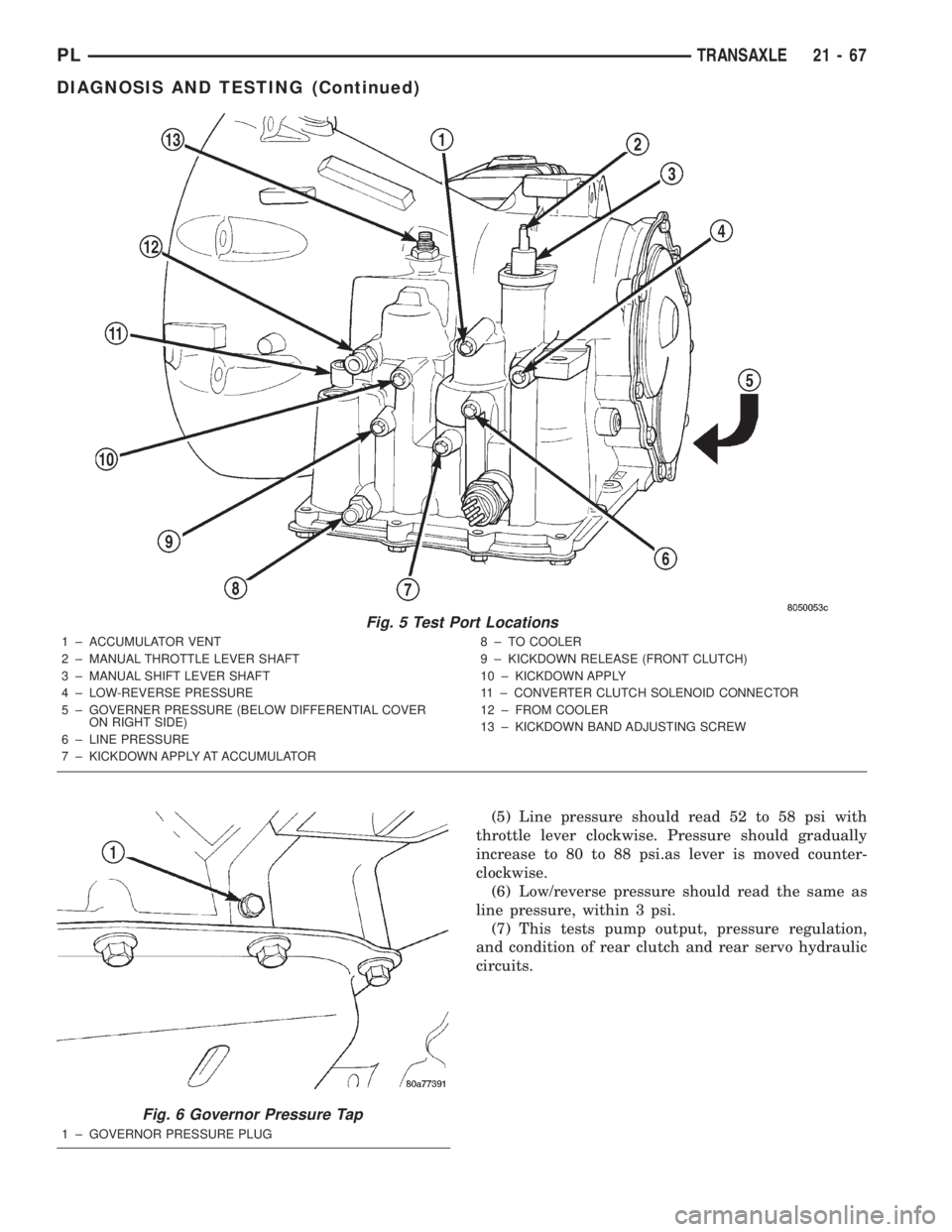
Test port locations are shown in (Fig. 5).
TEST ONE (SELECTOR IN 1)
(1) Attach gauges to line and low-reverse ports.
(2) Operate engine at 1000 rpm for test.
(3) Move selector lever on transaxle all the way
rearward (1 position).
(4) Read pressures on both gauges as throttle lever
on transaxle is moved from full clockwise position to
full counterclockwise position.
21 - 66 TRANSAXLEPL
DIAGNOSIS AND TESTING (Continued)
Page 980 of 1285
(5) Line pressure should read 52 to 58 psi with
throttle lever clockwise. Pressure should gradually
increase to 80 to 88 psi.as lever is moved counter-
clockwise.
(6) Low/reverse pressure should read the same as
line pressure, within 3 psi.
(7) This tests pump output, pressure regulation,
and condition of rear clutch and rear servo hydraulic
circuits.
Fig. 5 Test Port Locations
1 ± ACCUMULATOR VENT
2 ± MANUAL THROTTLE LEVER SHAFT
3 ± MANUAL SHIFT LEVER SHAFT
4 ± LOW-REVERSE PRESSURE
5 ± GOVERNER PRESSURE (BELOW DIFFERENTIAL COVER
ON RIGHT SIDE)
6 ± LINE PRESSURE
7 ± KICKDOWN APPLY AT ACCUMULATOR8 ± TO COOLER
9 ± KICKDOWN RELEASE (FRONT CLUTCH)
10 ± KICKDOWN APPLY
11 ± CONVERTER CLUTCH SOLENOID CONNECTOR
12 ± FROM COOLER
13 ± KICKDOWN BAND ADJUSTING SCREW
Fig. 6 Governor Pressure Tap
1 ± GOVERNOR PRESSURE PLUG
PLTRANSAXLE 21 - 67
DIAGNOSIS AND TESTING (Continued)