tow DODGE RAM 2001 Service Repair Manual
[x] Cancel search | Manufacturer: DODGE, Model Year: 2001, Model line: RAM, Model: DODGE RAM 2001Pages: 2889, PDF Size: 68.07 MB
Page 1650 of 2889
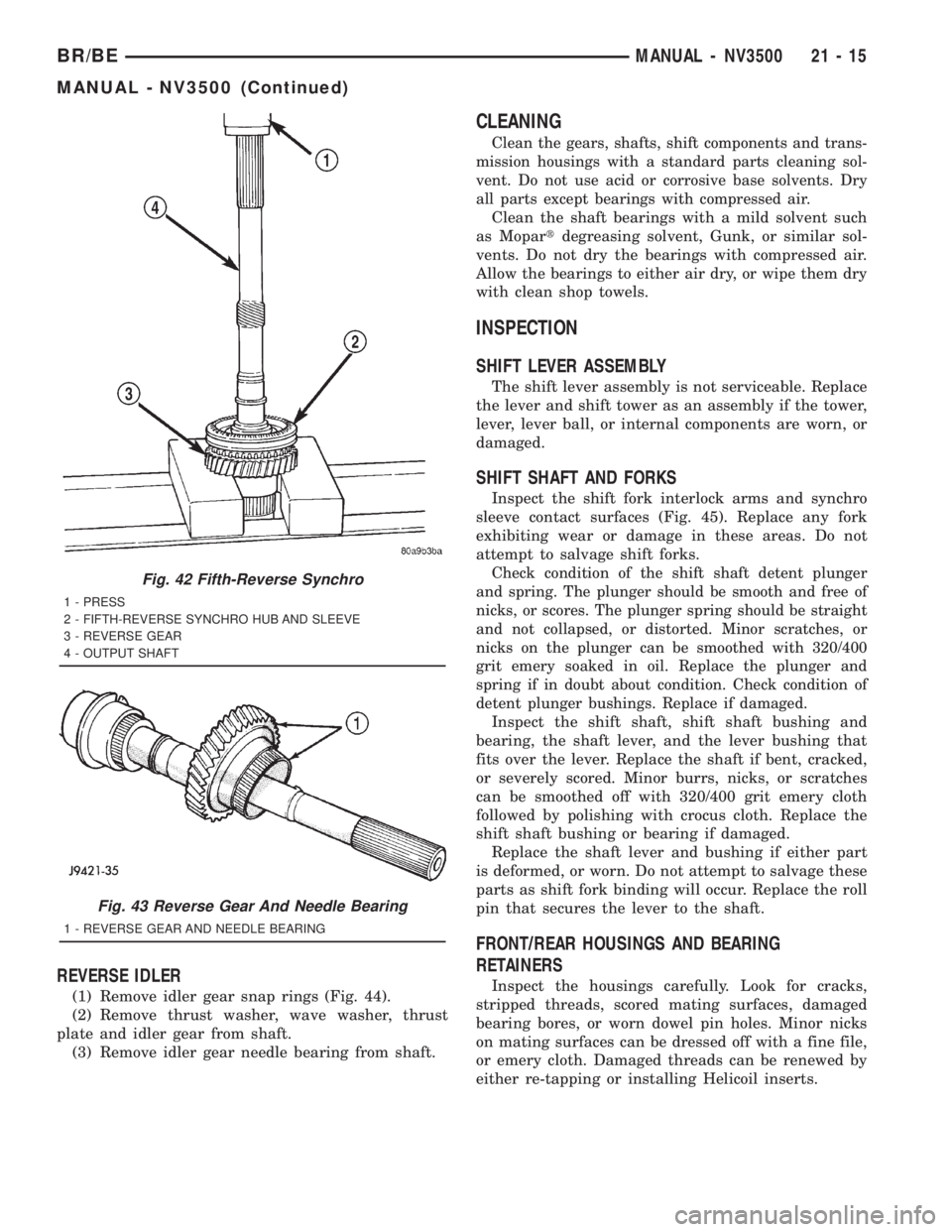
REVERSE IDLER
(1) Remove idler gear snap rings (Fig. 44).
(2) Remove thrust washer, wave washer, thrust
plate and idler gear from shaft.
(3) Remove idler gear needle bearing from shaft.
CLEANING
Clean the gears, shafts, shift components and trans-
mission housings with a standard parts cleaning sol-
vent. Do not use acid or corrosive base solvents. Dry
all parts except bearings with compressed air.
Clean the shaft bearings with a mild solvent such
as Mopartdegreasing solvent, Gunk, or similar sol-
vents. Do not dry the bearings with compressed air.
Allow the bearings to either air dry, or wipe them dry
with clean shop towels.
INSPECTION
SHIFT LEVER ASSEMBLY
The shift lever assembly is not serviceable. Replace
the lever and shift tower as an assembly if the tower,
lever, lever ball, or internal components are worn, or
damaged.
SHIFT SHAFT AND FORKS
Inspect the shift fork interlock arms and synchro
sleeve contact surfaces (Fig. 45). Replace any fork
exhibiting wear or damage in these areas. Do not
attempt to salvage shift forks.
Check condition of the shift shaft detent plunger
and spring. The plunger should be smooth and free of
nicks, or scores. The plunger spring should be straight
and not collapsed, or distorted. Minor scratches, or
nicks on the plunger can be smoothed with 320/400
grit emery soaked in oil. Replace the plunger and
spring if in doubt about condition. Check condition of
detent plunger bushings. Replace if damaged.
Inspect the shift shaft, shift shaft bushing and
bearing, the shaft lever, and the lever bushing that
fits over the lever. Replace the shaft if bent, cracked,
or severely scored. Minor burrs, nicks, or scratches
can be smoothed off with 320/400 grit emery cloth
followed by polishing with crocus cloth. Replace the
shift shaft bushing or bearing if damaged.
Replace the shaft lever and bushing if either part
is deformed, or worn. Do not attempt to salvage these
parts as shift fork binding will occur. Replace the roll
pin that secures the lever to the shaft.
FRONT/REAR HOUSINGS AND BEARING
RETAINERS
Inspect the housings carefully. Look for cracks,
stripped threads, scored mating surfaces, damaged
bearing bores, or worn dowel pin holes. Minor nicks
on mating surfaces can be dressed off with a fine file,
or emery cloth. Damaged threads can be renewed by
either re-tapping or installing Helicoil inserts.
Fig. 42 Fifth-Reverse Synchro
1 - PRESS
2 - FIFTH-REVERSE SYNCHRO HUB AND SLEEVE
3 - REVERSE GEAR
4 - OUTPUT SHAFT
Fig. 43 Reverse Gear And Needle Bearing
1 - REVERSE GEAR AND NEEDLE BEARING
BR/BEMANUAL - NV3500 21 - 15
MANUAL - NV3500 (Continued)
Page 1661 of 2889
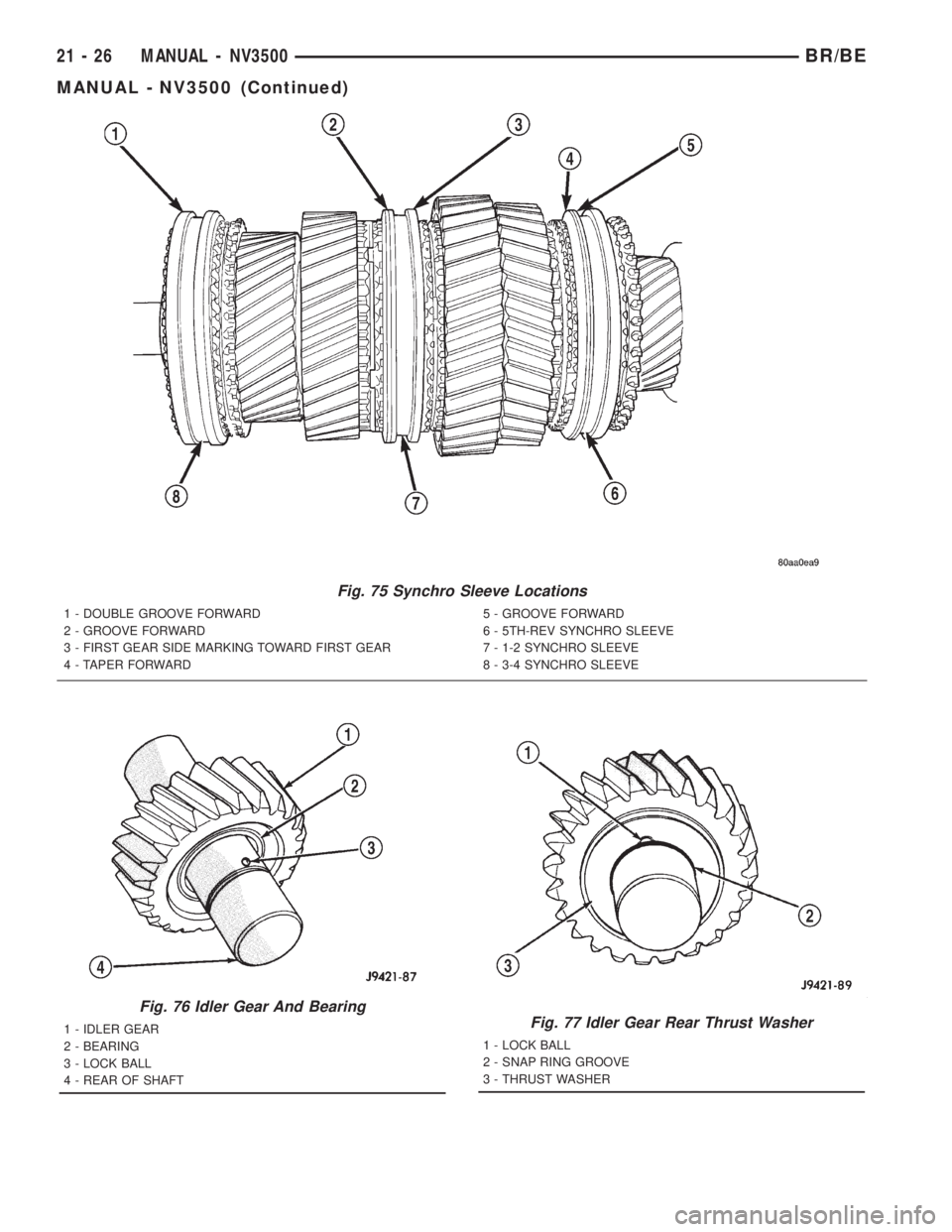
Fig. 75 Synchro Sleeve Locations
1 - DOUBLE GROOVE FORWARD
2 - GROOVE FORWARD
3 - FIRST GEAR SIDE MARKING TOWARD FIRST GEAR
4 - TAPER FORWARD5 - GROOVE FORWARD
6 - 5TH-REV SYNCHRO SLEEVE
7 - 1-2 SYNCHRO SLEEVE
8 - 3-4 SYNCHRO SLEEVE
Fig. 76 Idler Gear And Bearing
1 - IDLER GEAR
2 - BEARING
3 - LOCK BALL
4 - REAR OF SHAFTFig. 77 Idler Gear Rear Thrust Washer
1 - LOCK BALL
2 - SNAP RING GROOVE
3 - THRUST WASHER
21 - 26 MANUAL - NV3500BR/BE
MANUAL - NV3500 (Continued)
Page 1662 of 2889
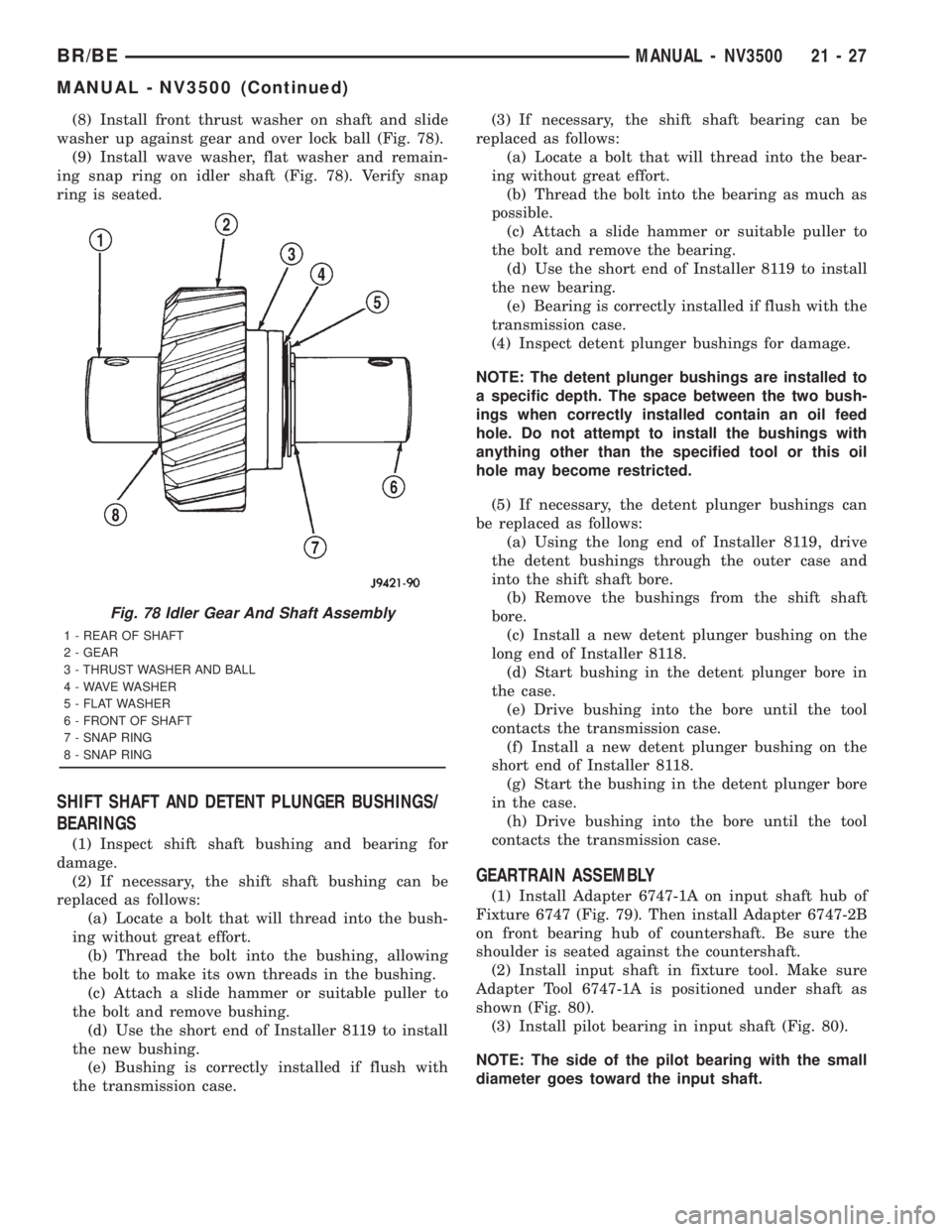
(8) Install front thrust washer on shaft and slide
washer up against gear and over lock ball (Fig. 78).
(9) Install wave washer, flat washer and remain-
ing snap ring on idler shaft (Fig. 78). Verify snap
ring is seated.
SHIFT SHAFT AND DETENT PLUNGER BUSHINGS/
BEARINGS
(1) Inspect shift shaft bushing and bearing for
damage.
(2) If necessary, the shift shaft bushing can be
replaced as follows:
(a) Locate a bolt that will thread into the bush-
ing without great effort.
(b) Thread the bolt into the bushing, allowing
the bolt to make its own threads in the bushing.
(c) Attach a slide hammer or suitable puller to
the bolt and remove bushing.
(d) Use the short end of Installer 8119 to install
the new bushing.
(e) Bushing is correctly installed if flush with
the transmission case.(3) If necessary, the shift shaft bearing can be
replaced as follows:
(a) Locate a bolt that will thread into the bear-
ing without great effort.
(b) Thread the bolt into the bearing as much as
possible.
(c) Attach a slide hammer or suitable puller to
the bolt and remove the bearing.
(d) Use the short end of Installer 8119 to install
the new bearing.
(e) Bearing is correctly installed if flush with the
transmission case.
(4) Inspect detent plunger bushings for damage.
NOTE: The detent plunger bushings are installed to
a specific depth. The space between the two bush-
ings when correctly installed contain an oil feed
hole. Do not attempt to install the bushings with
anything other than the specified tool or this oil
hole may become restricted.
(5) If necessary, the detent plunger bushings can
be replaced as follows:
(a) Using the long end of Installer 8119, drive
the detent bushings through the outer case and
into the shift shaft bore.
(b) Remove the bushings from the shift shaft
bore.
(c) Install a new detent plunger bushing on the
long end of Installer 8118.
(d) Start bushing in the detent plunger bore in
the case.
(e) Drive bushing into the bore until the tool
contacts the transmission case.
(f) Install a new detent plunger bushing on the
short end of Installer 8118.
(g) Start the bushing in the detent plunger bore
in the case.
(h) Drive bushing into the bore until the tool
contacts the transmission case.
GEARTRAIN ASSEMBLY
(1) Install Adapter 6747-1A on input shaft hub of
Fixture 6747 (Fig. 79). Then install Adapter 6747-2B
on front bearing hub of countershaft. Be sure the
shoulder is seated against the countershaft.
(2) Install input shaft in fixture tool. Make sure
Adapter Tool 6747-1A is positioned under shaft as
shown (Fig. 80).
(3) Install pilot bearing in input shaft (Fig. 80).
NOTE: The side of the pilot bearing with the small
diameter goes toward the input shaft.
Fig. 78 Idler Gear And Shaft Assembly
1 - REAR OF SHAFT
2 - GEAR
3 - THRUST WASHER AND BALL
4 - WAVE WASHER
5 - FLAT WASHER
6 - FRONT OF SHAFT
7 - SNAP RING
8 - SNAP RING
BR/BEMANUAL - NV3500 21 - 27
MANUAL - NV3500 (Continued)
Page 1664 of 2889
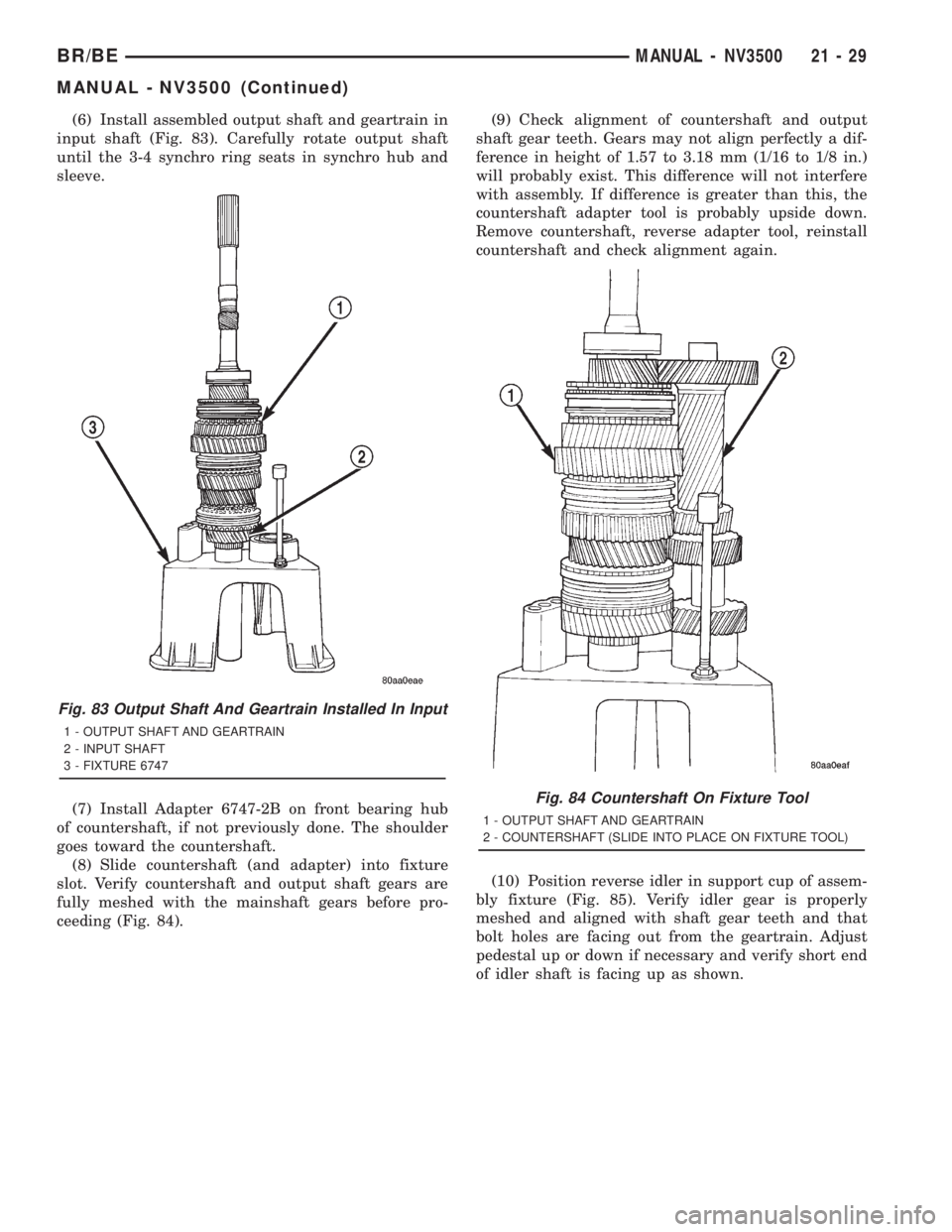
(6) Install assembled output shaft and geartrain in
input shaft (Fig. 83). Carefully rotate output shaft
until the 3-4 synchro ring seats in synchro hub and
sleeve.
(7) Install Adapter 6747-2B on front bearing hub
of countershaft, if not previously done. The shoulder
goes toward the countershaft.
(8) Slide countershaft (and adapter) into fixture
slot. Verify countershaft and output shaft gears are
fully meshed with the mainshaft gears before pro-
ceeding (Fig. 84).(9) Check alignment of countershaft and output
shaft gear teeth. Gears may not align perfectly a dif-
ference in height of 1.57 to 3.18 mm (1/16 to 1/8 in.)
will probably exist. This difference will not interfere
with assembly. If difference is greater than this, the
countershaft adapter tool is probably upside down.
Remove countershaft, reverse adapter tool, reinstall
countershaft and check alignment again.
(10) Position reverse idler in support cup of assem-
bly fixture (Fig. 85). Verify idler gear is properly
meshed and aligned with shaft gear teeth and that
bolt holes are facing out from the geartrain. Adjust
pedestal up or down if necessary and verify short end
of idler shaft is facing up as shown.
Fig. 83 Output Shaft And Geartrain Installed In Input
1 - OUTPUT SHAFT AND GEARTRAIN
2 - INPUT SHAFT
3 - FIXTURE 6747
Fig. 84 Countershaft On Fixture Tool
1 - OUTPUT SHAFT AND GEARTRAIN
2 - COUNTERSHAFT (SLIDE INTO PLACE ON FIXTURE TOOL)
BR/BEMANUAL - NV3500 21 - 29
MANUAL - NV3500 (Continued)
Page 1671 of 2889
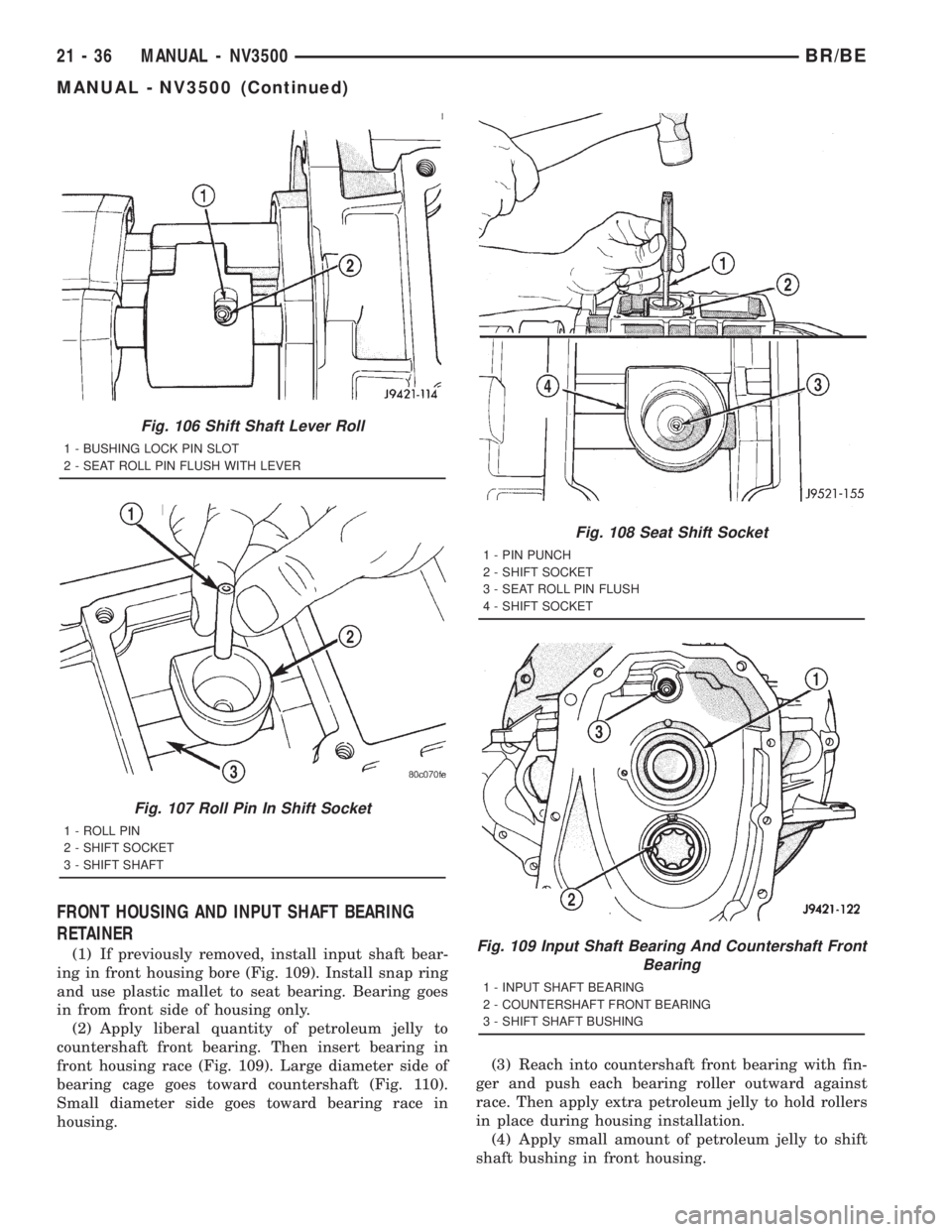
FRONT HOUSING AND INPUT SHAFT BEARING
RETAINER
(1) If previously removed, install input shaft bear-
ing in front housing bore (Fig. 109). Install snap ring
and use plastic mallet to seat bearing. Bearing goes
in from front side of housing only.
(2) Apply liberal quantity of petroleum jelly to
countershaft front bearing. Then insert bearing in
front housing race (Fig. 109). Large diameter side of
bearing cage goes toward countershaft (Fig. 110).
Small diameter side goes toward bearing race in
housing.(3) Reach into countershaft front bearing with fin-
ger and push each bearing roller outward against
race. Then apply extra petroleum jelly to hold rollers
in place during housing installation.
(4) Apply small amount of petroleum jelly to shift
shaft bushing in front housing.
Fig. 106 Shift Shaft Lever Roll
1 - BUSHING LOCK PIN SLOT
2 - SEAT ROLL PIN FLUSH WITH LEVER
Fig. 107 Roll Pin In Shift Socket
1 - ROLL PIN
2 - SHIFT SOCKET
3 - SHIFT SHAFT
Fig. 108 Seat Shift Socket
1 - PIN PUNCH
2 - SHIFT SOCKET
3 - SEAT ROLL PIN FLUSH
4 - SHIFT SOCKET
Fig. 109 Input Shaft Bearing And Countershaft Front
Bearing
1 - INPUT SHAFT BEARING
2 - COUNTERSHAFT FRONT BEARING
3 - SHIFT SHAFT BUSHING
21 - 36 MANUAL - NV3500BR/BE
MANUAL - NV3500 (Continued)
Page 1674 of 2889
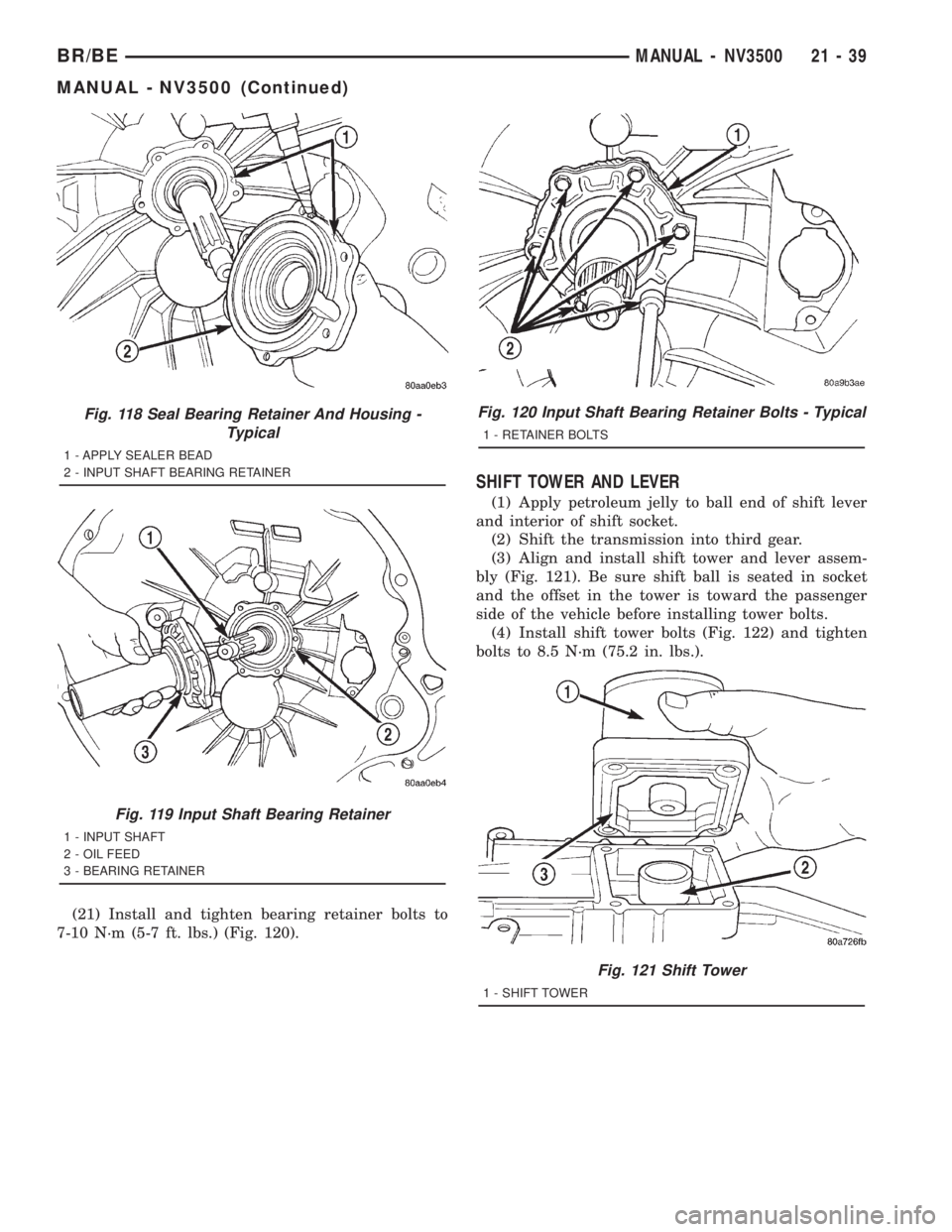
(21) Install and tighten bearing retainer bolts to
7-10 N´m (5-7 ft. lbs.) (Fig. 120).
SHIFT TOWER AND LEVER
(1) Apply petroleum jelly to ball end of shift lever
and interior of shift socket.
(2) Shift the transmission into third gear.
(3) Align and install shift tower and lever assem-
bly (Fig. 121). Be sure shift ball is seated in socket
and the offset in the tower is toward the passenger
side of the vehicle before installing tower bolts.
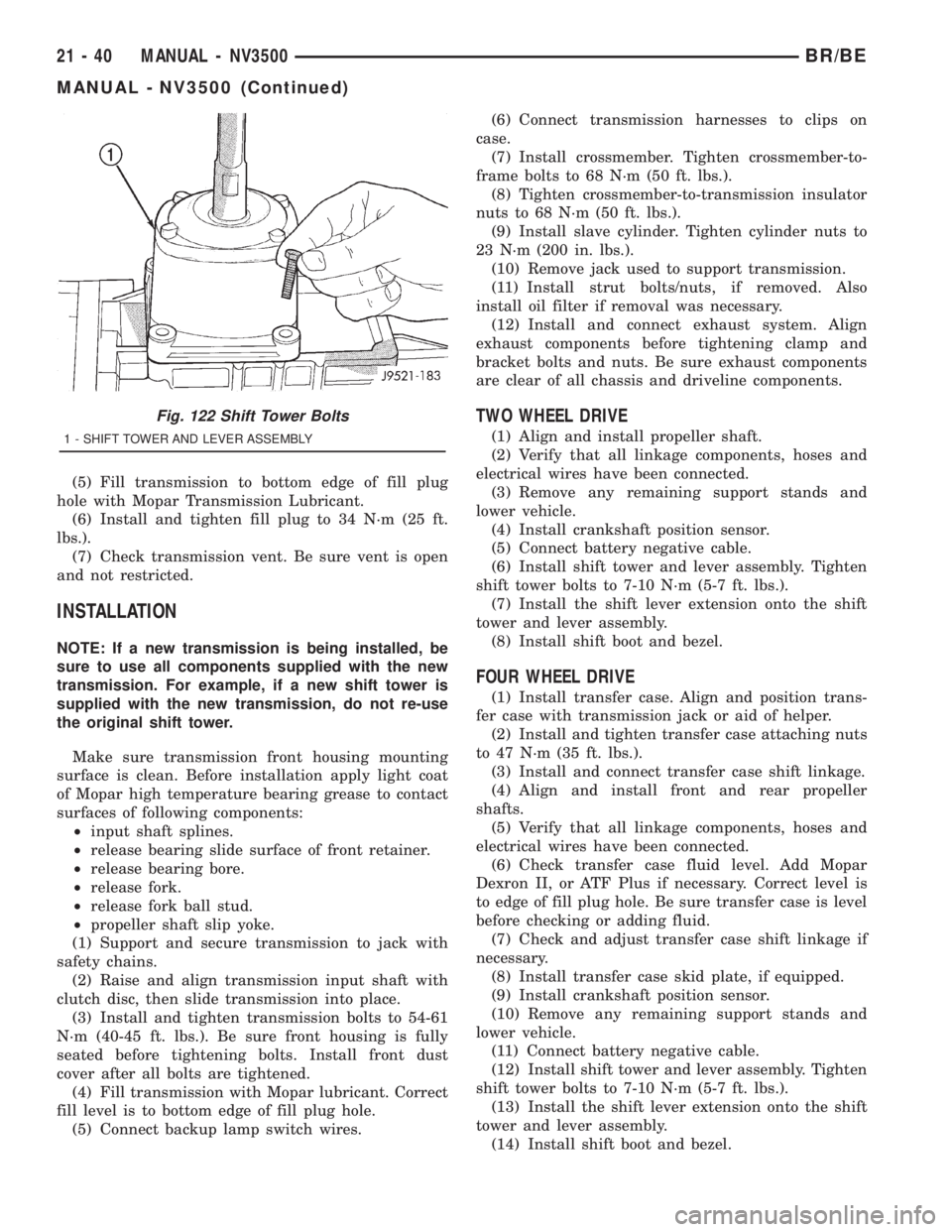
(4) Install shift tower bolts (Fig. 122) and tighten
bolts to 8.5 N´m (75.2 in. lbs.).
Fig. 118 Seal Bearing Retainer And Housing -
Typical
1 - APPLY SEALER BEAD
2 - INPUT SHAFT BEARING RETAINER
Fig. 119 Input Shaft Bearing Retainer
1 - INPUT SHAFT
2 - OIL FEED
3 - BEARING RETAINER
Fig. 120 Input Shaft Bearing Retainer Bolts - Typical
1 - RETAINER BOLTS
Fig. 121 Shift Tower
1 - SHIFT TOWER
BR/BEMANUAL - NV3500 21 - 39
MANUAL - NV3500 (Continued)
Page 1675 of 2889
(5) Fill transmission to bottom edge of fill plug
hole with Mopar Transmission Lubricant.
(6) Install and tighten fill plug to 34 N´m (25 ft.
lbs.).
(7) Check transmission vent. Be sure vent is open
and not restricted.
INSTALLATION
NOTE: If a new transmission is being installed, be
sure to use all components supplied with the new
transmission. For example, if a new shift tower is
supplied with the new transmission, do not re-use
the original shift tower.
Make sure transmission front housing mounting
surface is clean. Before installation apply light coat
of Mopar high temperature bearing grease to contact
surfaces of following components:
²input shaft splines.
²release bearing slide surface of front retainer.
²release bearing bore.
²release fork.
²release fork ball stud.
²propeller shaft slip yoke.
(1) Support and secure transmission to jack with
safety chains.
(2) Raise and align transmission input shaft with
clutch disc, then slide transmission into place.
(3) Install and tighten transmission bolts to 54-61
N´m (40-45 ft. lbs.). Be sure front housing is fully
seated before tightening bolts. Install front dust
cover after all bolts are tightened.
(4) Fill transmission with Mopar lubricant. Correct
fill level is to bottom edge of fill plug hole.
(5) Connect backup lamp switch wires.(6) Connect transmission harnesses to clips on
case.
(7) Install crossmember. Tighten crossmember-to-
frame bolts to 68 N´m (50 ft. lbs.).
(8) Tighten crossmember-to-transmission insulator
nuts to 68 N´m (50 ft. lbs.).
(9) Install slave cylinder. Tighten cylinder nuts to
23 N´m (200 in. lbs.).
(10) Remove jack used to support transmission.
(11) Install strut bolts/nuts, if removed. Also
install oil filter if removal was necessary.
(12) Install and connect exhaust system. Align
exhaust components before tightening clamp and
bracket bolts and nuts. Be sure exhaust components
are clear of all chassis and driveline components.
TWO WHEEL DRIVE
(1) Align and install propeller shaft.
(2) Verify that all linkage components, hoses and
electrical wires have been connected.
(3) Remove any remaining support stands and
lower vehicle.
(4) Install crankshaft position sensor.
(5) Connect battery negative cable.
(6) Install shift tower and lever assembly. Tighten
shift tower bolts to 7-10 N´m (5-7 ft. lbs.).
(7) Install the shift lever extension onto the shift
tower and lever assembly.
(8) Install shift boot and bezel.
FOUR WHEEL DRIVE
(1) Install transfer case. Align and position trans-
fer case with transmission jack or aid of helper.
(2) Install and tighten transfer case attaching nuts
to 47 N´m (35 ft. lbs.).
(3) Install and connect transfer case shift linkage.
(4) Align and install front and rear propeller
shafts.
(5) Verify that all linkage components, hoses and
electrical wires have been connected.
(6) Check transfer case fluid level. Add Mopar
Dexron II, or ATF Plus if necessary. Correct level is
to edge of fill plug hole. Be sure transfer case is level
before checking or adding fluid.
(7) Check and adjust transfer case shift linkage if
necessary.
(8) Install transfer case skid plate, if equipped.
(9) Install crankshaft position sensor.
(10) Remove any remaining support stands and
lower vehicle.
(11) Connect battery negative cable.
(12) Install shift tower and lever assembly. Tighten
shift tower bolts to 7-10 N´m (5-7 ft. lbs.).
(13) Install the shift lever extension onto the shift
tower and lever assembly.
(14) Install shift boot and bezel.
Fig. 122 Shift Tower Bolts
1 - SHIFT TOWER AND LEVER ASSEMBLY
21 - 40 MANUAL - NV3500BR/BE
MANUAL - NV3500 (Continued)
Page 1676 of 2889
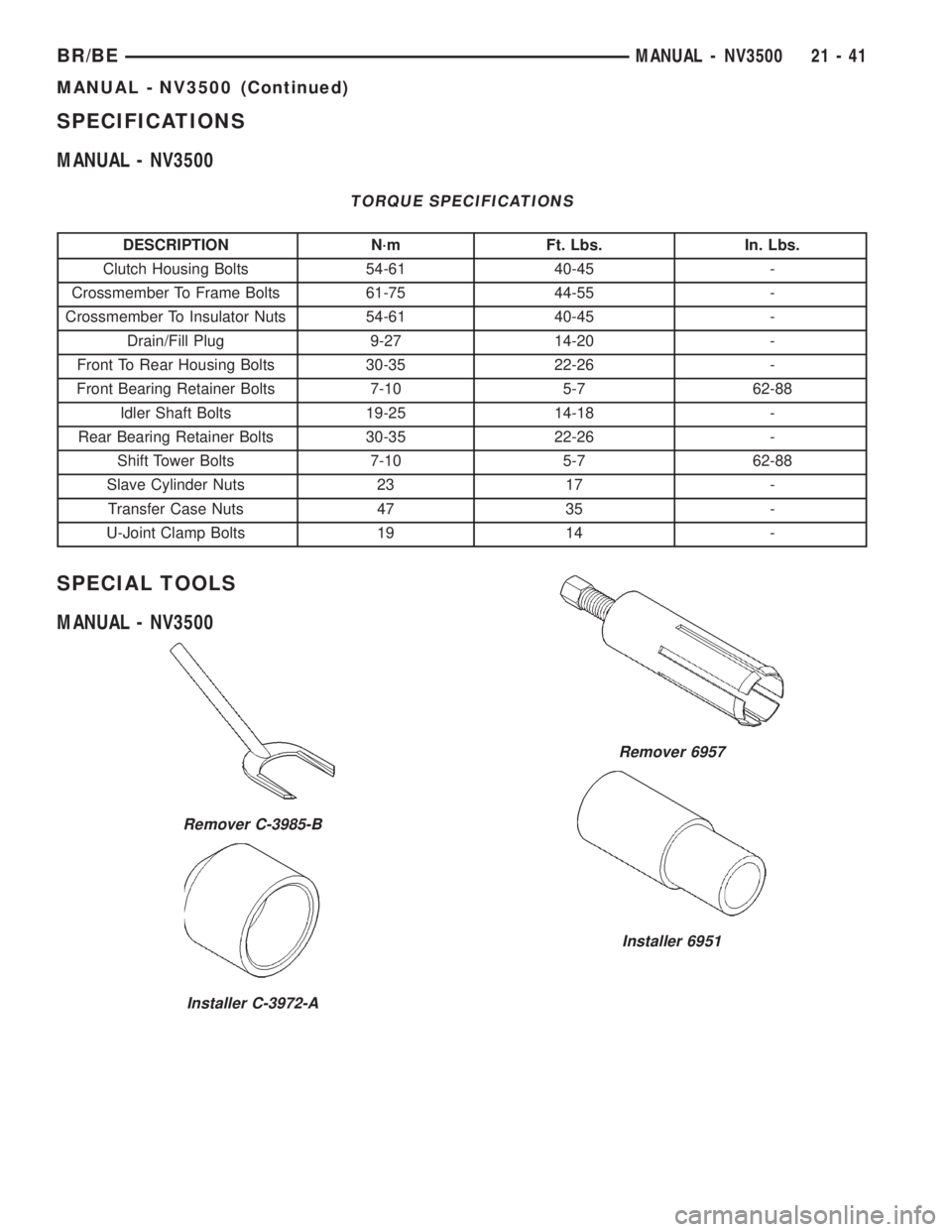
SPECIFICATIONS
MANUAL - NV3500
TORQUE SPECIFICATIONS
DESCRIPTION N´m Ft. Lbs. In. Lbs.
Clutch Housing Bolts 54-61 40-45 -
Crossmember To Frame Bolts 61-75 44-55 -
Crossmember To Insulator Nuts 54-61 40-45 -
Drain/Fill Plug 9-27 14-20 -
Front To Rear Housing Bolts 30-35 22-26 -
Front Bearing Retainer Bolts 7-10 5-7 62-88
Idler Shaft Bolts 19-25 14-18 -
Rear Bearing Retainer Bolts 30-35 22-26 -
Shift Tower Bolts 7-10 5-7 62-88
Slave Cylinder Nuts 23 17 -
Transfer Case Nuts 47 35 -
U-Joint Clamp Bolts 19 14 -
SPECIAL TOOLS
MANUAL - NV3500
Remover C-3985-B
Installer C-3972-A
Remover 6957
Installer 6951
BR/BEMANUAL - NV3500 21 - 41
MANUAL - NV3500 (Continued)
Page 1679 of 2889
MANUAL - NV4500
TABLE OF CONTENTS
page page
MANUAL - NV4500
DESCRIPTION...........................44
OPERATION.............................46
DIAGNOSIS AND TESTING.................46
MANUAL TRANSMISSION................46
REMOVAL..............................47
DISASSEMBLY...........................48
CLEANING..............................64
INSPECTION............................64
ASSEMBLY.............................65
INSTALLATION...........................82
SPECIFICATIONS........................83
SPECIAL TOOLS.........................83ADAPTER HOUSING SEAL
REMOVAL..............................87
INSTALLATION...........................87
EXTENSION HOUSING SEAL
REMOVAL..............................87
INSTALLATION...........................87
SHIFT MECHANISM
REMOVAL..............................88
INSTALLATION...........................89
SHIFT COVER
REMOVAL..............................90
INSTALLATION...........................90
MANUAL - NV4500
DESCRIPTION
The NV4500 is a five speed constant mesh manual
transmission (Fig. 1). All gear ranges including
reverse are synchronized. Fifth gear is an overdrive
range. The transmission has a cast iron gear case
and aluminum shift cover.
Two versions are used, a standard duty for 5.9L
applications and a heavy duty for V10 and Cummins
diesel applications. Main differences are the larger
diameter input shaft, output shaft, and mainshaft
fifth gear in the heavy duty model.Tapered roller bearings support the drive gear,
mainshaft and countershaft in the gear case. Roller
bearings in the drive gear support the forward end of
the mainshaft. The mainshaft gears are all supported
on caged type roller bearings. Drive gear thrust reac-
tion is controlled by a needle type thrust bearing.
The bearing is located at the forward end of the
mainshaft.
The transmission is a top loader style. The shift
lever is located in a shifter tower which is bolted to
the shift cover and operates the shift forks and rails
directly. The shift forks and rails are all located
within the aluminum cover which is bolted to the top
of the gear case.
21 - 44 MANUAL - NV4500BR/BE
Page 1682 of 2889
A leak at the front of the transmission will be from
either the front bearing retainer or retainer seal.
Lubricant may be seen dripping from the clutch
housing after extended operation. If the leak is
severe, it may also contaminate the clutch disc caus-
ing the disc to slip, grab and or chatter.
A correct lubricant level check can only be made
when the vehicle is level. Also allow the lubricant to
settle for a minute or so before checking. These rec-
ommendations will ensure an accurate check and
avoid an underfill or overfill condition. Always check
the lubricant level after any addition of fluid to avoid
an incorrect lubricant level condition.
HARD SHIFTING
Hard shifting is usually caused by a low lubricant
level, improper or contaminated lubricants. The con-
sequence of using non-recommended lubricants is
noise, excessive wear, internal bind and hard shift-
ing. Substantial lubricant leaks can result in gear,
shift rail, synchro, and bearing damage. If a leak
goes undetected for an extended period, the first indi-
cations of component damage are usually hard shift-
ing and noise.
Component damage, incorrect clutch adjustment or
damaged clutch pressure plate or disc are additional
probable causes of increased shift effort. Incorrect
adjustment or a worn/damaged pressure plate or disc
can cause incorrect release. If clutch problem is
advanced, gear clash during shifts can result. Worn
or damaged synchro rings can cause gear clash when
shifting into any forward gear. In some new or
rebuilt transmissions, new synchro rings may tend to
stick slightly causing hard or noisy shifts. In most
cases this condition will decline as the rings wear-in.
TRANSMISSION NOISE
Most manual transmissions make some noise dur-
ing normal operation. Rotating gears generate a mild
whine that is audible, but generally only at extreme
speeds.
Severe highly audible transmission noise is gener-
ally the initial indicator of a lubricant problem.
Insufficient, improper or contaminated lubricant will
promote rapid wear of gears, synchros, shift rails,
forks and bearings. The overheating caused by a
lubricant problem, can also lead to gear breakage.
REMOVAL
(1) Disconnect battery negative cable.
(2) Shift transmission into Neutral.
(3) Remove shift boot screws from floorpan and
slide boot upward on the shift lever.
(4) Remove shift lever extension from shift tower
and lever assembly.(5) Remove shift tower bolts holding tower to iso-
lator plate and transmission shift cover.
(6) Remove shift tower and isolator plate from
transmission shift cover.
(7) Raise and support vehicle.
(8) Remove skid plate, if equipped.
(9) Mark propeller shaft and axle yokes for instal-
lation reference and remove shaft/shafts.
(10) Remove exhaust system Y-pipe.
(11) Disconnect speed sensor and backup light
switch connectors.
(12) Support engine with safety stand and a wood
block.
(13) If transmission is to be disassembled for,
remove drain bolt at bottom of PTO cover and drain
lubricant (Fig. 4).
TWO WHEEL DRIVE
(1) Remove nuts/bolts attaching transmission to
rear mount.
(2) Support and secure transmission with safety
chains to a transmission jack.
(3) Remove rear crossmember.
(4) Remove clutch slave cylinder bolts and move
cylinder aside for clearance.
(5) Remove transmission harness wires from clips
on transmission shift cover.
(6) Remove transmission to clutch housing bolts.
(7) Slide transmission and jack rearward until
input shaft clears clutch housing.
(8) Lower transmission jack and remove transmis-
sion from under vehicle.
FOUR WHEEL DRIVE
(1) Disconnect transfer case shift linkage at trans-
fer case range lever. Then remove transfer case shift
mechanism from transmission (Fig. 5).
(2) Support and secure transfer case to transmis-
sion jack with safety chains.
(3) Remove transfer case mounting nuts.
Fig. 4 NV4500 Drain Bolt
1 - PTO COVER
2 - DRAIN BOLT
3 - FILL PLUG
BR/BEMANUAL - NV4500 21 - 47
MANUAL - NV4500 (Continued)