reset DODGE RAM SRT-10 2006 Service Repair Manual
[x] Cancel search | Manufacturer: DODGE, Model Year: 2006, Model line: RAM SRT-10, Model: DODGE RAM SRT-10 2006Pages: 5267, PDF Size: 68.7 MB
Page 3702 of 5267
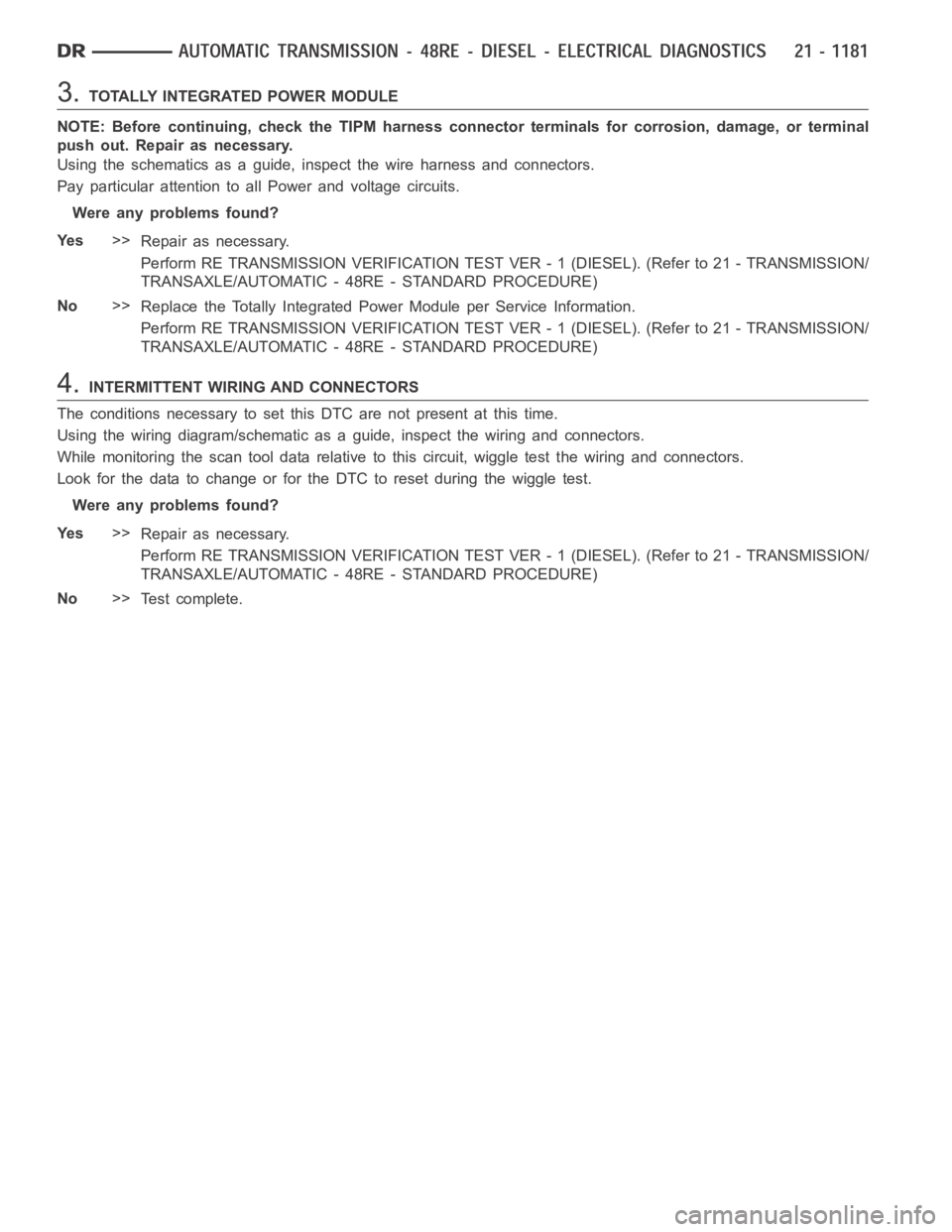
3.TOTALLY INTEGRATED POWER MODULE
NOTE: Before continuing, check the TIPM harness connector terminals for corrosion, damage, or terminal
push out. Repair as necessary.
Using the schematics as a guide, inspect the wire harness and connectors.
Pay particular attention to allPower and voltage circuits.
Were any problems found?
Ye s>>
Repair as necessary.
Perform RE TRANSMISSION VERIFICATION TEST VER - 1 (DIESEL). (Refer to 21 - TRANSMISSION/
TRANSAXLE/AUTOMATIC - 48RE - STANDARD PROCEDURE)
No>>
Replace the Totally Integrated Power Module per Service Information.
Perform RE TRANSMISSION VERIFICATION TEST VER - 1 (DIESEL). (Refer to 21 - TRANSMISSION/
TRANSAXLE/AUTOMATIC - 48RE - STANDARD PROCEDURE)
4.INTERMITTENT WIRING AND CONNECTORS
The conditions necessary to set this DTC are not present at this time.
Using the wiring diagram/schematic as a guide, inspect the wiring and connectors.
While monitoring the scan tool data relative to this circuit, wiggle test the wiring and connectors.
Look for the data to change or for the DTC to reset during the wiggle test.
Were any problems found?
Ye s>>
Repair as necessary.
Perform RE TRANSMISSION VERIFICATION TEST VER - 1 (DIESEL). (Refer to 21 - TRANSMISSION/
TRANSAXLE/AUTOMATIC - 48RE - STANDARD PROCEDURE)
No>>
Te s t c o m p l e t e .
Page 3705 of 5267
4.INTERMITTENT WIRING AND CONNECTORS
The conditions necessary to set this DTC are not present at this time.
Using the wiring diagram/schematic as a guide, inspect the wiring and connectors.
While monitoring the scan tool data relative to this circuit, wiggle test the wiring and connectors.
Look for the data to change or for the DTC to reset during the wiggle test.
Were any problems found?
Ye s>>
Repair as necessary.
Perform RE TRANSMISSION VERIFICATION TEST VER - 1 (DIESEL). (Refer to 21 - TRANSMISSION/
TRANSAXLE/AUTOMATIC - 48RE - STANDARD PROCEDURE)
No>>
Te s t c o m p l e t e .
Page 3711 of 5267
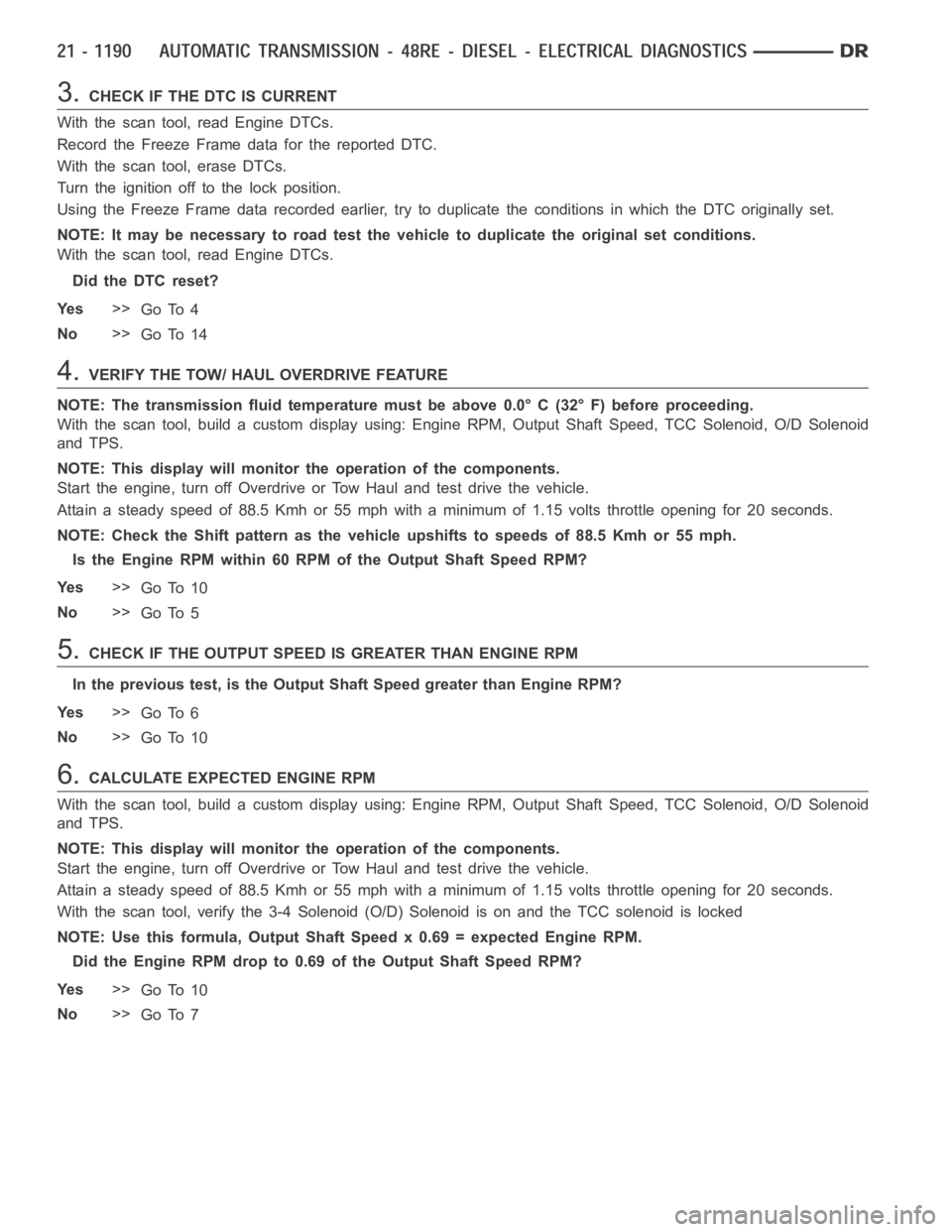
3.CHECK IF THE DTC IS CURRENT
With the scan tool, read Engine DTCs.
Record the Freeze Frame data for the reported DTC.
With the scan tool, erase DTCs.
Turn the ignition off to the lock position.
Using the Freeze Frame data recorded earlier, try to duplicate the conditions in which the DTC originally set.
NOTE: It may be necessary to road test the vehicle to duplicate the originalset conditions.
With the scan tool, read Engine DTCs.
Did the DTC reset?
Ye s>>
Go To 4
No>>
Go To 14
4.VERIFY THE TOW/ HAUL OVERDRIVE FEATURE
NOTE: The transmission fluid temperature must be above 0.0° C (32° F) before proceeding.
With the scan tool, build a custom display using: Engine RPM, Output Shaft Speed, TCC Solenoid, O/D Solenoid
and TPS.
NOTE: This display will monitor the operation of the components.
Start the engine, turn off Overdrive or Tow Haul and test drive the vehicle.
Attain a steady speed of 88.5 Kmh or 55 mph with a minimum of 1.15 volts throttle opening for 20 seconds.
NOTE: Check the Shift pattern as the vehicle upshifts to speeds of 88.5 Kmh or55mph.
Is the Engine RPM within 60 RPM of the Output Shaft Speed RPM?
Ye s>>
Go To 10
No>>
Go To 5
5.CHECK IF THE OUTPUT SPEED IS GREATER THAN ENGINE RPM
In the previous test, is the Output Shaft Speed greater than Engine RPM?
Ye s>>
Go To 6
No>>
Go To 10
6.CALCULATE EXPECTED ENGINE RPM
With the scan tool, build a custom display using: Engine RPM, Output Shaft Speed, TCC Solenoid, O/D Solenoid
and TPS.
NOTE: This display will monitor the operation of the components.
Start the engine, turn off Overdrive or Tow Haul and test drive the vehicle.
Attain a steady speed of 88.5 Kmh or 55 mph with a minimum of 1.15 volts throttle opening for 20 seconds.
With the scan tool, verify the 3-4 Solenoid (O/D) Solenoid is on and the TCC solenoid is locked
NOTE: Use this formula, Output Shaft Speed x 0.69 = expected Engine RPM.
Did the Engine RPM drop to 0.69 of the Output Shaft Speed RPM?
Ye s>>
Go To 10
No>>
Go To 7
Page 3722 of 5267
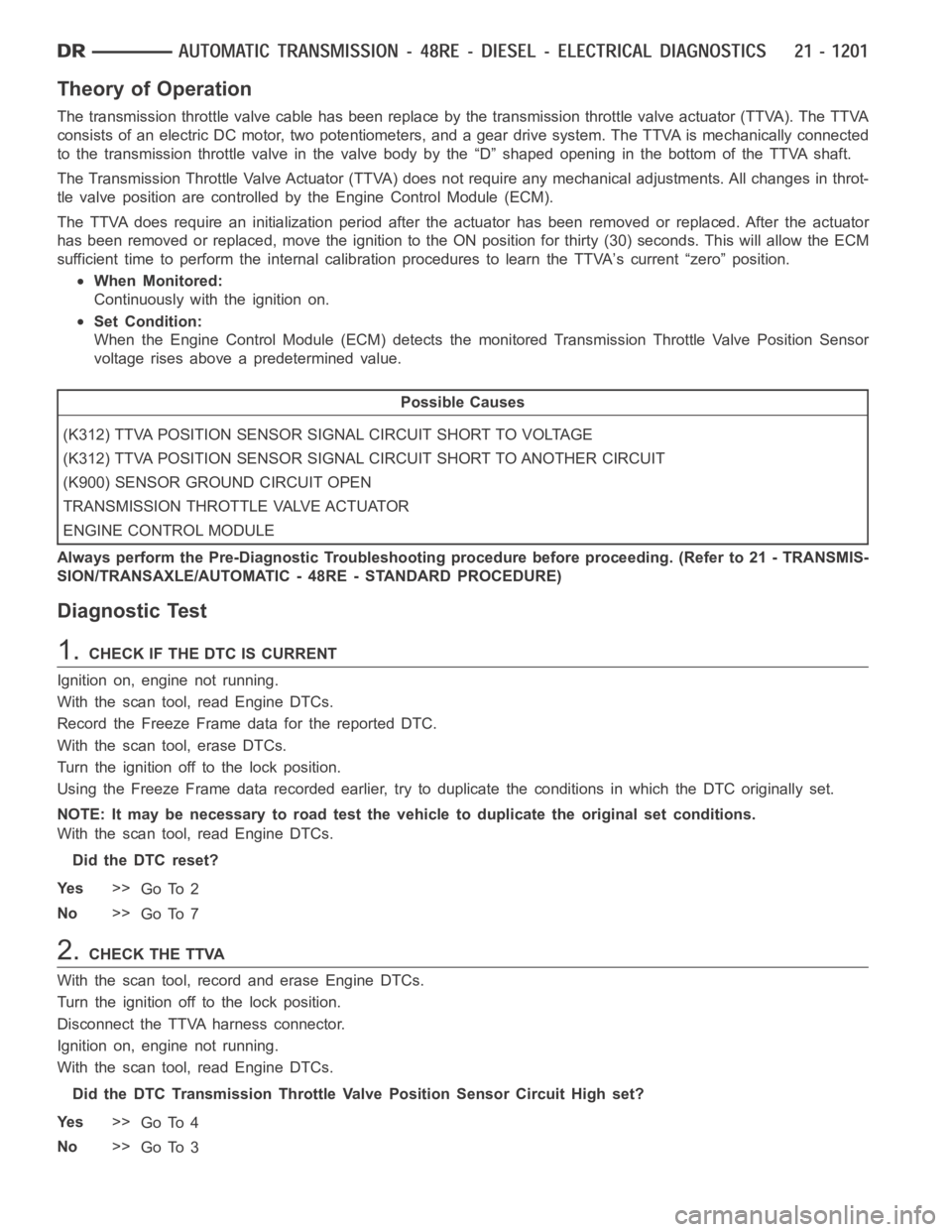
Theory of Operation
The transmission throttle valve cable has been replace by the transmission throttle valve actuator (TTVA). The TTVA
consists of an electric DC motor, two potentiometers, and a gear drive system. The TTVA is mechanically connected
to the transmission throttle valve in the valve body by the “D” shaped opening in the bottom of the TTVA shaft.
The Transmission Throttle Valve Actuator (TTVA) does not require any mechanical adjustments. All changes in throt-
tle valve position are controlled by the Engine Control Module (ECM).
The TTVA does require an initialization period after the actuator has beenremoved or replaced. After the actuator
has been removed or replaced, move the ignition to the ON position for thirty (30) seconds. This will allow the ECM
sufficient time to perform the internal calibration procedures to learn the TTVA’s current “zero” position.
When Monitored:
Continuously with the ignition on.
Set Condition:
When the Engine Control Module (ECM) detects the monitored Transmission Throttle Valve Position Sensor
voltage rises above a predetermined value.
Possible Causes
(K312) TTVA POSITION SENSOR SIGNAL CIRCUIT SHORT TO VOLTAGE
(K312) TTVA POSITION SENSOR SIGNAL CIRCUIT SHORT TO ANOTHER CIRCUIT
(K900) SENSOR GROUND CIRCUIT OPEN
TRANSMISSION THROTTLE VALVE ACTUATOR
ENGINE CONTROL MODULE
Always perform the Pre-Diagnostic Troubleshooting procedure before proceeding. (Refer to 21 - TRANSMIS-
SION/TRANSAXLE/AUTOMATIC - 48RE - STANDARD PROCEDURE)
Diagnostic Test
1.CHECK IF THE DTC IS CURRENT
Ignition on, engine not running.
With the scan tool, read Engine DTCs.
Record the Freeze Frame data for the reported DTC.
With the scan tool, erase DTCs.
Turn the ignition off to the lock position.
Using the Freeze Frame data recorded earlier, try to duplicate the conditions in which the DTC originally set.
NOTE: It may be necessary to road test the vehicle to duplicate the originalset conditions.
With the scan tool, read Engine DTCs.
Did the DTC reset?
Ye s>>
Go To 2
No>>
Go To 7
2.CHECK THE TTVA
With the scan tool, record and erase Engine DTCs.
Turn the ignition off to the lock position.
Disconnect the TTVA harness connector.
Ignition on, engine not running.
With the scan tool, read Engine DTCs.
Did the DTC Transmission Throttle Valve Position Sensor Circuit High set?
Ye s>>
Go To 4
No>>
Go To 3
Page 3727 of 5267
For a complete wiring diagramRefer to Section 8W
Theory of Operation
The transmission throttle valve cable has been replace by the transmission throttle valve actuator (TTVA). The TTVA
consists of an electric DC motor, two potentiometers, and a gear drive system. The TTVA is mechanically connected
to the transmission throttle valve in the valve body by the “D” shaped opening in the bottom of the TTVA shaft.
The Transmission Throttle Valve Actuator (TTVA) does not require any mechanical adjustments. All changes in throt-
tle valve position are controlled by the Engine Control Module (ECM).
The TTVA does require an initialization period after the actuator has beenremoved or replaced. After the actuator
has been removed or replaced, move the ignition to the ON position for thirty (30) seconds. This will allow the ECM
sufficient time to perform the internal calibration procedures to learn the TTVA’s current “zero” position.
When Monitored:
Ignition on and with or without engine running with transmission in the park or neutral position. Note: Not mon-
itored when either the engine is cranking or while vehicle is moving.
Set Condition:
Each time the ignition is cycled to the on position, the ECM commands a TTVA internal calibration procedure
(autozero) to determine the zero position. If the TTVA does not reach a calibrated minimum position in a pre-
determined amount of time, the DTC will set.
Possible Causes
TRANSMISSION THROTTLE VALVE ACTUATOR BINDING
TRANSMISSION THROTTLE VALVE COMPONENTS
TRANSMISSION THROTTLE VALVE ACTUATOR
Always perform the Pre-Diagnostic Troubleshooting procedure before proceeding. (Refer to 21 - TRANSMIS-
SION/TRANSAXLE/AUTOMATIC - 48RE - STANDARD PROCEDURE)
Diagnostic Test
1.CHECK IF THE DTC IS CURRENT
Ignition on, engine not running.
With the scan tool, read Engine DTCs.
Record the Freeze Frame data for the reported DTC.
With the scan tool, erase DTCs.
Turn the ignition off to the lock position.
Using the Freeze Frame data recorded earlier, try to duplicate the conditions in which the DTC originally set.
NOTE: It may be necessary to road test the vehicle to duplicate the originalset conditions.
With the scan tool, read Engine DTCs.
Did the DTC reset?
Ye s>>
Go To 2
No>>
Go To 5
Page 3730 of 5267
Theory of Operation
The transmission throttle valve cable has been replace by the transmission throttle valve actuator (TTVA). The TTVA
consists of an electric DC motor, two potentiometers, and a gear drive system. The TTVA is mechanically connected
to the transmission throttle valve in the valve body by the “D” shaped opening in the bottom of the TTVA shaft.
The Transmission Throttle Valve Actuator (TTVA) does not require any mechanical adjustments. All changes in throt-
tle valve position are controlled by the Engine Control Module (ECM).
The TTVA does require an initialization period after the actuator has beenremoved or replaced. After the actuator
has been removed or replaced, move the ignition to the ON position for thirty (30) seconds. This will allow the ECM
sufficient time to perform the internal calibration procedures to learn the TTVA’s current “zero” position.
When Monitored:
Ignition on and with or without engine running with transmission in the park or neutral position. Note: Not mon-
itored when either the engine is cranking or while vehicle is moving.
Set Condition:
Each time the ignition is cycled to the on position, the ECM commands a TTVA internal calibration procedure
(autozero) to determine the zero position. After completion of the autozero procedure, the TTVA is instructed to
perform a span check to record the minimum and maximum span positions. ThisDTC will set if the minimum
total span is not achieved.
Possible Causes
TRANSMISSION THROTTLE VALVE ACTUATOR BINDING
TRANSMISSION THROTTLE VALVE
INTERNAL TRANSMISSION
Always perform the Pre-Diagnostic Troubleshooting procedure before proceeding. (Refer to 21 - TRANSMIS-
SION/TRANSAXLE/AUTOMATIC - 48RE - STANDARD PROCEDURE)
Diagnostic Test
1.CHECK IF THE DTC IS CURRENT
Ignition on, engine not running.
With the scan tool, read Engine DTCs.
Record the Freeze Frame data for the reported DTC.
With the scan tool, erase DTCs.
Turn the ignition off to the lock position.
Using the Freeze Frame data recorded earlier, try to duplicate the conditions in which the DTC originally set.
NOTE: It may be necessary to road test the vehicle to duplicate the originalset conditions.
With the scan tool, read Engine DTCs.
Did the DTC reset?
Ye s>>
Go To 2
No>>
Go To 5
2.CHECK TTVA FOR SIGNS OF DAMAGE
Turn the ignition off to the lock position.
Visually inspect the TTVA shaft for any signs of external damage or improperly mounted.
NOTE: It is not necessary to remove the TTVA to perform this procedure.
Is the TTVA damaged or improperly mounted?
Ye s>>
Repair as necessary.
Perform RE TRANSMISSION VERIFICATION TEST VER - 1 (DIESEL). (Refer to 21 - TRANSMISSION/
TRANSAXLE/AUTOMATIC - 48RE - STANDARD PROCEDURE)
No>>
Go To 3
Page 3736 of 5267
Theory of Operation
The transmission throttle valve cable has been replace by the transmission throttle valve actuator (TTVA). The TTVA
consists of an electric DC motor, two potentiometers, and a gear drive system. The TTVA is mechanically connected
to the transmission throttle valve in the valve body by the “D” shaped opening in the bottom of the TTVA shaft.
The Transmission Throttle Valve Actuator (TTVA) does not require any mechanical adjustments. All changes in throt-
tle valve position are controlled by the Engine Control Module (ECM).
The TTVA does require an initialization period after the actuator has beenremoved or replaced. After the actuator
has been removed or replaced, move the ignition to the ON position for thirty (30) seconds. This will allow the ECM
sufficient time to perform the internal calibration procedures to learn the TTVA’s current “zero” position.
When Monitored:
Continuously with the ignition on.
Set Condition:
The monitored TTVA position sensor does not indicate a change in position when the TTVA is commanded to
change the position.
Possible Causes
(F856) 5 VOLT SUPPLY CIRCUIT OPEN
(K314) TTVA MOTOR (+) CIRCUIT OPEN
(K315) TTVA MOTOR (-) CIRCUIT OPEN
(K314) TTVA MOTOR (+) CIRCUIT SHORT TO GROUND
(K315) TTVA MOTOR (-) CIRCUIT SHORT TO GROUND
(K314) TTVA MOTOR (+) CIRCUIT SHORT TO VOLTAGE
(K315) TTVA MOTOR (-) CIRCUIT SHORT TO VOLTAGE
(K314) TTVA MOTOR (+) CIRCUIT SHORT TO ANOTHER CIRCUIT
(K315) TTVA MOTOR (-) CIRCUIT SHORT TO ANOTHER CIRCUIT
TRANSMISSION THROTTLE VALVE COMPONENTS
TRANSMISSION THROTTLE VALVE ACTUATOR
ENGINE CONTROL MODULE
Always perform the Pre-Diagnostic Troubleshooting procedure before proceeding. (Refer to 21 - TRANSMIS-
SION/TRANSAXLE/AUTOMATIC - 48RE - STANDARD PROCEDURE)
Diagnostic Test
1.CHECK IF THE DTC IS CURRENT
Ignition on, engine not running.
With the scan tool, read Engine DTCs.
Record the Freeze Frame data for the reported DTC.
With the scan tool, erase DTCs.
Turn the ignition off to the lock position.
Using the Freeze Frame data recorded earlier, try to duplicate the conditions in which the DTC originally set.
NOTE: It may be necessary to road test the vehicle to duplicate the originalset conditions.
With the scan tool, read Engine DTCs.
Did the DTC reset?
Ye s>>
Go To 2
No>>
Go To 16
Page 3743 of 5267
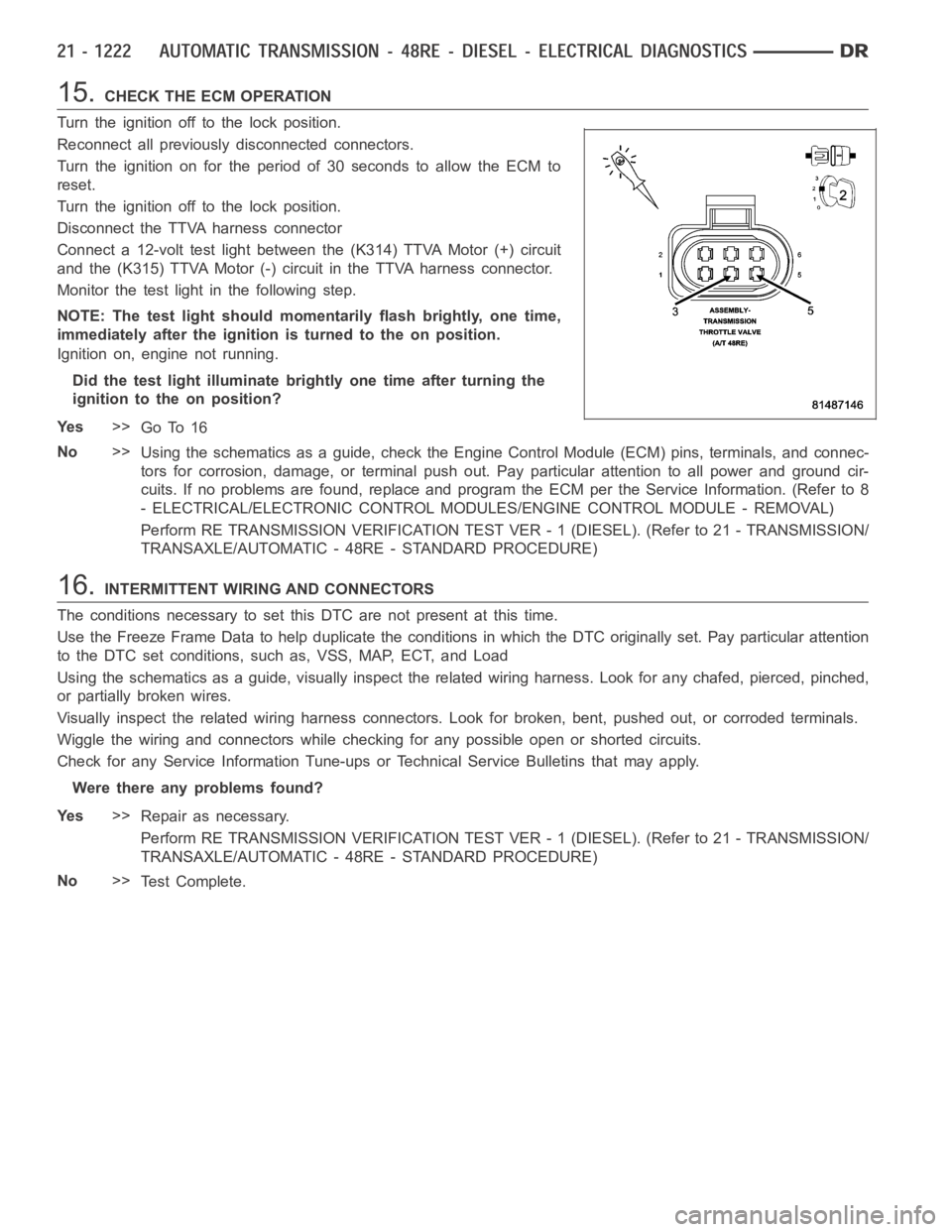
15.CHECK THE ECM OPERATION
Turn the ignition off to the lock position.
Reconnect all previously disconnected connectors.
Turntheignitiononfortheperiodof30secondstoallowtheECMto
reset.
Turn the ignition off to the lock position.
Disconnect the TTVA harness connector
Connect a 12-volt test light between the (K314) TTVA Motor (+) circuit
and the (K315) TTVA Motor (-) circuit in the TTVA harness connector.
Monitor the test light in the following step.
NOTE: The test light should momentarily flash brightly, one time,
immediately after the ignition is turned to the on position.
Ignition on, engine not running.
Did the test light illuminate brightly one time after turning the
ignition to the on position?
Ye s>>
Go To 16
No>>
Using the schematics as a guide, check the Engine Control Module (ECM) pins, terminals, and connec-
tors for corrosion, damage, or terminal push out. Pay particular attentiontoallpowerandgroundcir-
cuits. If no problems are found, replace and program the ECM per the ServiceInformation. (Refer to 8
- ELECTRICAL/ELECTRONIC CONTROL MODULES/ENGINE CONTROL MODULE - REMOVAL)
Perform RE TRANSMISSION VERIFICATION TEST VER - 1 (DIESEL). (Refer to 21 - TRANSMISSION/
TRANSAXLE/AUTOMATIC - 48RE - STANDARD PROCEDURE)
16.INTERMITTENT WIRING AND CONNECTORS
The conditions necessary to set this DTC are not present at this time.
Use the Freeze Frame Data to help duplicate the conditions in which the DTC originally set. Pay particular attention
to the DTC set conditions, such as, VSS, MAP, ECT, and Load
Using the schematics as a guide, visually inspect the related wiring harness. Look for any chafed, pierced, pinched,
or partially broken wires.
Visually inspect the related wiring harness connectors. Look for broken,bent, pushed out, or corroded terminals.
Wiggle the wiring and connectors while checking for any possible open or shorted circuits.
Check for any Service Information Tune-ups or Technical Service Bulletins that may apply.
Were there any problems found?
Ye s>>
Repair as necessary.
Perform RE TRANSMISSION VERIFICATION TEST VER - 1 (DIESEL). (Refer to 21 - TRANSMISSION/
TRANSAXLE/AUTOMATIC - 48RE - STANDARD PROCEDURE)
No>>
Te s t C o m p l e t e .
Page 3745 of 5267
Theory of Operation
The transmission throttle valve cable has been replace by the transmission throttle valve actuator (TTVA). The TTVA
consists of an electric DC motor, two potentiometers, and a gear drive system. The TTVA is mechanically connected
to the transmission throttle valve in the valve body by the “D” shaped opening in the bottom of the TTVA shaft.
The Transmission Throttle Valve Actuator (TTVA) does not require any mechanical adjustments. All changes in throt-
tle valve position are controlled by the Engine Control Module (ECM).
The TTVA does require an initialization period after the actuator has beenremoved or replaced. After the actuator
has been removed or replaced, move the ignition to the ON position for thirty (30) seconds. This will allow the ECM
sufficient time to perform the internal calibration procedures to learn the TTVA’s current “zero” position.
When Monitored:
Continuously with the ignition on.
Set Condition:
The current detected on the TTVA circuit is greater than a threshold for a calibrated amount of time or the
feedback to the controller does not match the intended state.
Possible Causes
(F856) 5 VOLT SUPPLY CIRCUIT OPEN
(K314) TTVA MOTOR (+) CIRCUIT OPEN
(K315) TTVA MOTOR (-) CIRCUIT OPEN
(K314) TTVA MOTOR (+) CIRCUIT SHORT TO GROUND
(K315) TTVA MOTOR (-) CIRCUIT SHORT TO GROUND
(K314) TTVA MOTOR (+) CIRCUIT SHORT TO VOLTAGE
(K315) TTVA MOTOR (-) CIRCUIT SHORT TO VOLTAGE
(K314) TTVA MOTOR (+) CIRCUIT SHORT TO ANOTHER CIRCUIT
(K315) TTVA MOTOR (-) CIRCUIT SHORT TO ANOTHER CIRCUIT
INTERNAL TRANSMISSION
TRANSMISSION THROTTLE VALVE ACTUATOR
ENGINE CONTROL MODULE
Always perform the Pre-Diagnostic Troubleshooting procedure before proceeding. (Refer to 21 - TRANSMIS-
SION/TRANSAXLE/AUTOMATIC - 48RE - STANDARD PROCEDURE)
Diagnostic Test
1.CHECK IF THE DTC IS CURRENT
Ignition on, engine not running.
With the scan tool, read Engine DTCs.
Record the Freeze Frame data for the reported DTC.
With the scan tool, erase DTCs.
Turn the ignition off to the lock position.
Using the Freeze Frame data recorded earlier, try to duplicate the conditions in which the DTC originally set.
NOTE: It may be necessary to road test the vehicle to duplicate the originalset conditions.
With the scan tool, read Engine DTCs.
Did the DTC reset?
Ye s>>
Go To 2
No>>
Go To 12
Page 3750 of 5267
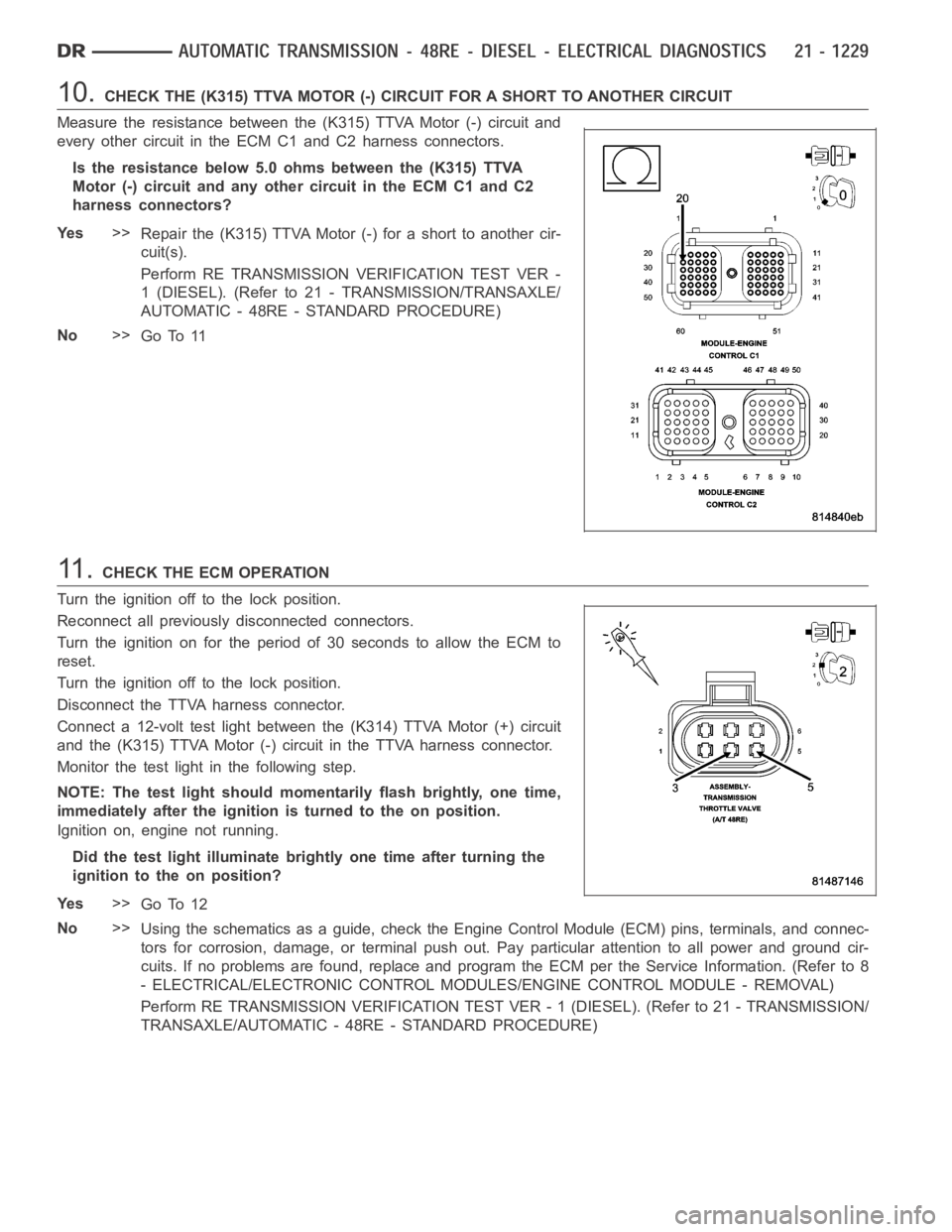
10.CHECK THE (K315) TTVA MOTOR (-) CIRCUIT FOR A SHORT TO ANOTHER CIRCUIT
Measure the resistance between the (K315) TTVA Motor (-) circuit and
every other circuit in the ECM C1 and C2 harness connectors.
Is the resistance below 5.0 ohms between the (K315) TTVA
Motor (-) circuit and any other circuit in the ECM C1 and C2
harness connectors?
Ye s>>
Repair the (K315) TTVA Motor (-) for a short to another cir-
cuit(s).
Perform RE TRANSMISSION VERIFICATION TEST VER -
1 (DIESEL). (Refer to 21 - TRANSMISSION/TRANSAXLE/
AUTOMATIC - 48RE - STANDARD PROCEDURE)
No>>
Go To 11
11 .CHECK THE ECM OPERATION
Turn the ignition off to the lock position.
Reconnect all previously disconnected connectors.
Turntheignitiononfortheperiodof30secondstoallowtheECMto
reset.
Turn the ignition off to the lock position.
Disconnect the TTVA harness connector.
Connect a 12-volt test light between the (K314) TTVA Motor (+) circuit
and the (K315) TTVA Motor (-) circuit in the TTVA harness connector.
Monitor the test light in the following step.
NOTE: The test light should momentarily flash brightly, one time,
immediately after the ignition is turned to the on position.
Ignition on, engine not running.
Did the test light illuminate brightly one time after turning the
ignition to the on position?
Ye s>>
Go To 12
No>>
Using the schematics as a guide, check the Engine Control Module (ECM) pins, terminals, and connec-
tors for corrosion, damage, or terminal push out. Pay particular attentiontoallpowerandgroundcir-
cuits. If no problems are found, replace and program the ECM per the ServiceInformation. (Refer to 8
- ELECTRICAL/ELECTRONIC CONTROL MODULES/ENGINE CONTROL MODULE - REMOVAL)
Perform RE TRANSMISSION VERIFICATION TEST VER - 1 (DIESEL). (Refer to 21 - TRANSMISSION/
TRANSAXLE/AUTOMATIC - 48RE - STANDARD PROCEDURE)