ECU DODGE RAM SRT-10 2006 Service Owner's Manual
[x] Cancel search | Manufacturer: DODGE, Model Year: 2006, Model line: RAM SRT-10, Model: DODGE RAM SRT-10 2006Pages: 5267, PDF Size: 68.7 MB
Page 903 of 5267
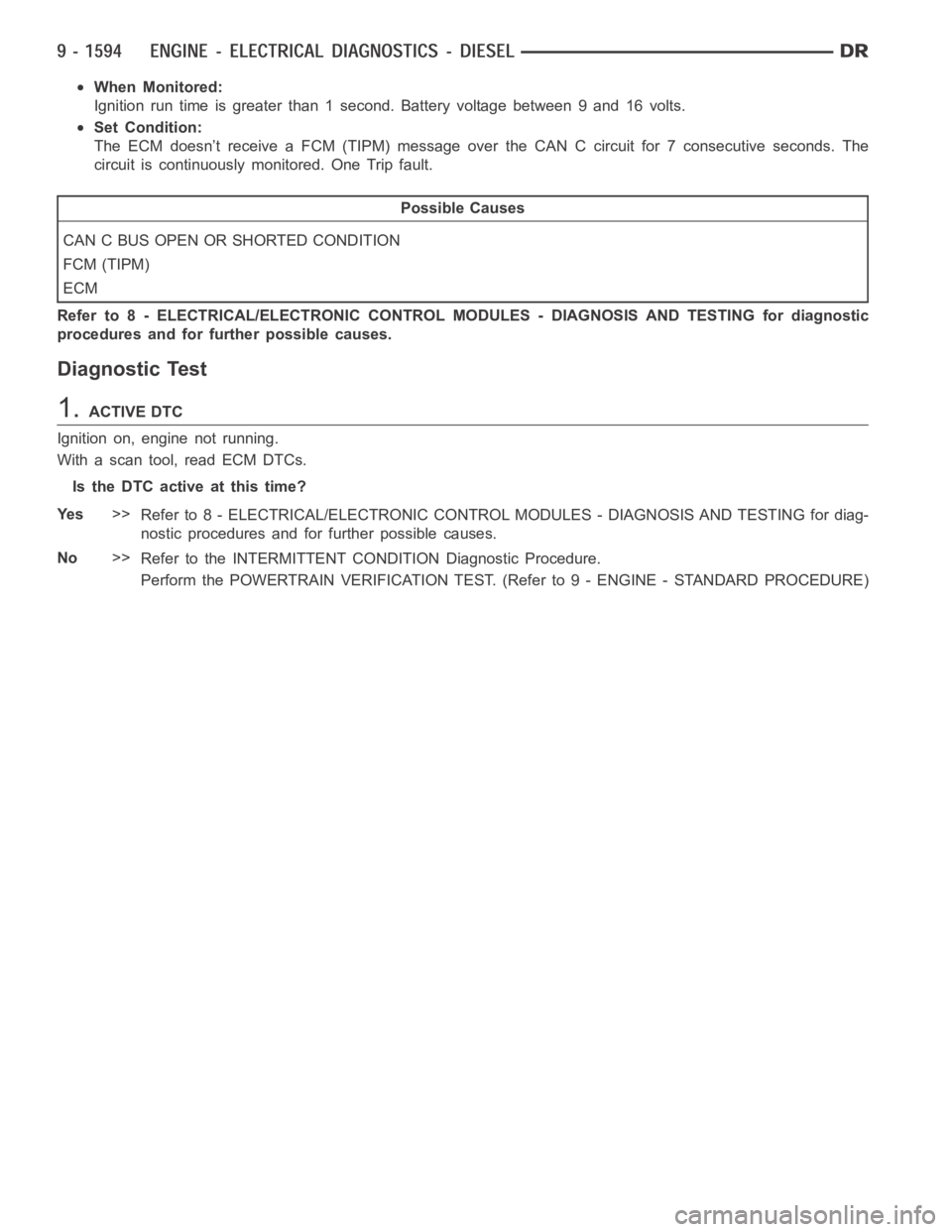
When Monitored:
Ignition run time is greater than 1 second. Battery voltage between 9 and 16volts.
Set Condition:
TheECMdoesn’treceiveaFCM(TIPM)message over the CAN C circuit for 7 consecutive seconds. The
circuit is continuously monitored. One Trip fault.
Possible Causes
CAN C BUS OPEN OR SHORTED CONDITION
FCM (TIPM)
ECM
Refer to 8 - ELECTRICAL/ELECTRONIC CONTROL MODULES - DIAGNOSIS AND TESTING for diagnostic
procedures and for further possible causes.
Diagnostic Test
1.ACTIVE DTC
Ignition on, engine not running.
With a scan tool, read ECM DTCs.
Is the DTC active at this time?
Ye s>>
Refer to 8 - ELECTRICAL/ELECTRONIC CONTROL MODULES - DIAGNOSIS AND TESTING for diag-
nostic procedures and for further possible causes.
No>>
Refer to the INTERMITTENT CONDITION Diagnostic Procedure.
Perform the POWERTRAIN VERIFICATION TEST. (Refer to 9 - ENGINE - STANDARD PROCEDURE)
Page 905 of 5267
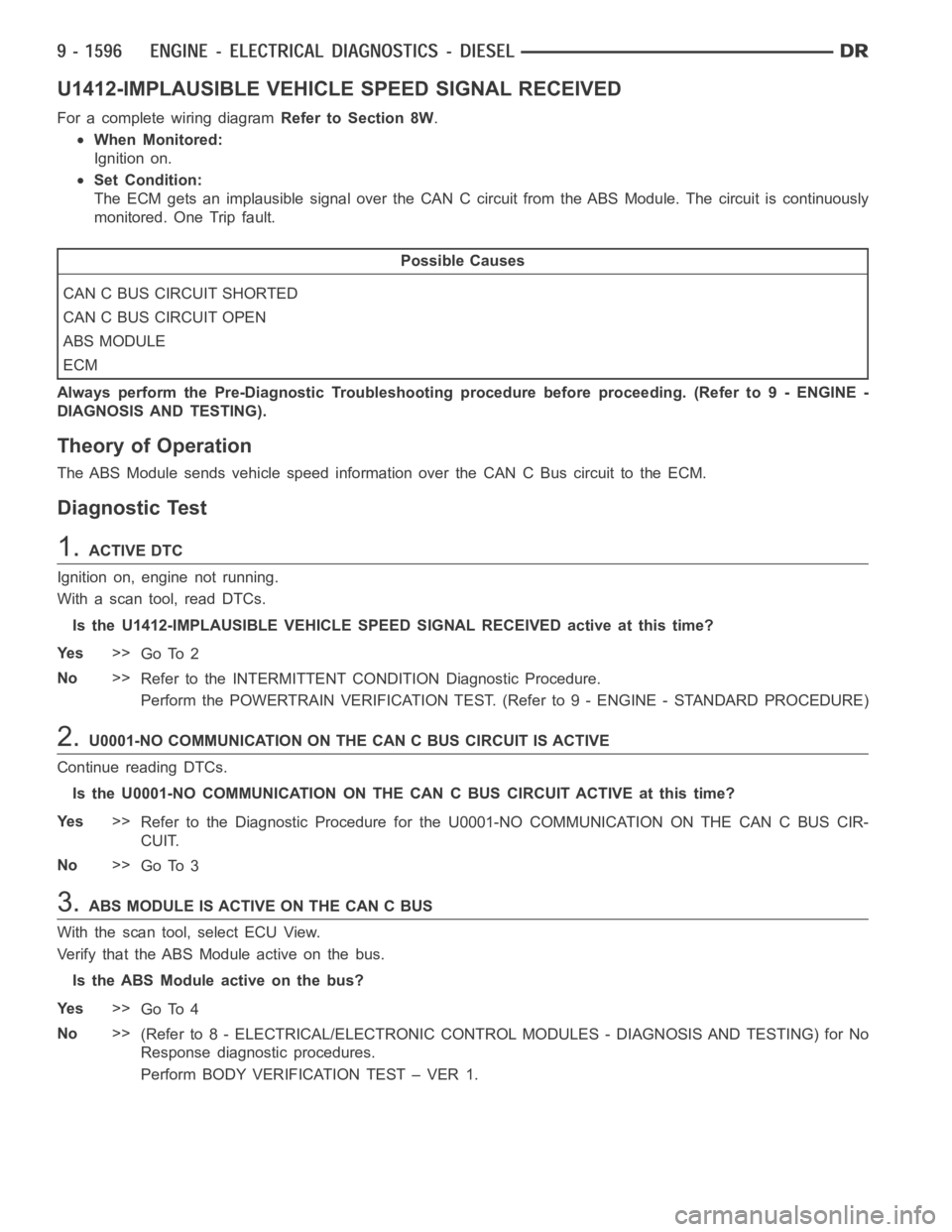
U1412-IMPLAUSIBLE VEHICLE SPEED SIGNAL RECEIVED
For a complete wiring diagramRefer to Section 8W.
When Monitored:
Ignition on.
Set Condition:
The ECM gets an implausible signal over the CAN C circuit from the ABS Module. The circuit is continuously
monitored. One Trip fault.
Possible Causes
CAN C BUS CIRCUIT SHORTED
CAN C BUS CIRCUIT OPEN
ABS MODULE
ECM
Always perform the Pre-Diagnostic Troubleshooting procedure before proceeding. (Refer to 9 - ENGINE -
DIAGNOSIS AND TESTING).
Theory of Operation
The ABS Module sends vehicle speed information over the CAN C Bus circuit tothe ECM.
Diagnostic Test
1.ACTIVE DTC
Ignition on, engine not running.
With a scan tool, read DTCs.
Is the U1412-IMPLAUSIBLE VEHICLE SPEED SIGNAL RECEIVED active at this time?
Ye s>>
Go To 2
No>>
Refer to the INTERMITTENT CONDITION Diagnostic Procedure.
Perform the POWERTRAIN VERIFICATION TEST. (Refer to 9 - ENGINE - STANDARD PROCEDURE)
2.U0001-NO COMMUNICATION ON THE CAN C BUS CIRCUIT IS ACTIVE
Continue reading DTCs.
Is the U0001-NO COMMUNICATION ON THE CAN C BUS CIRCUIT ACTIVE at this time?
Ye s>>
Refer to the Diagnostic Procedure for the U0001-NO COMMUNICATION ON THE CANCBUSCIR-
CUIT.
No>>
Go To 3
3.ABS MODULE IS ACTIVE ON THE CAN C BUS
With the scan tool, select ECU View.
Verify that the ABS Module active on the bus.
Is the ABS Module active on the bus?
Ye s>>
Go To 4
No>>
(Refer to 8 - ELECTRICAL/ELECTRONIC CONTROL MODULES - DIAGNOSIS AND TESTING) for No
Response diagnostic procedures.
Perform BODY VERIFICATION TEST – VER 1.
Page 906 of 5267
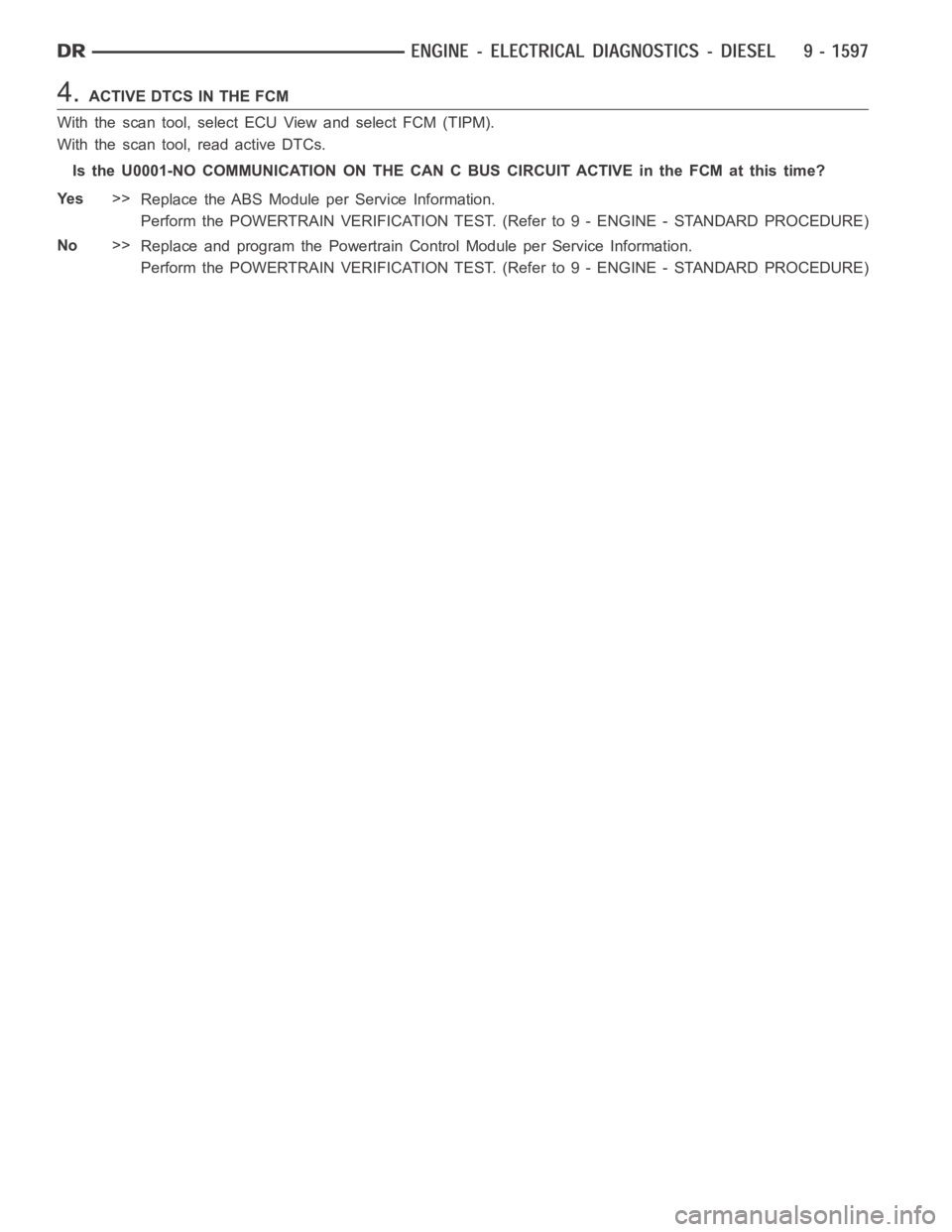
4.ACTIVE DTCS IN THE FCM
With the scan tool, select ECU View and select FCM (TIPM).
With the scan tool, read active DTCs.
Is the U0001-NO COMMUNICATION ON THE CAN C BUS CIRCUIT ACTIVE in the FCM at this time?
Ye s>>
Replace the ABS Module per Service Information.
Perform the POWERTRAIN VERIFICATION TEST. (Refer to 9 - ENGINE - STANDARD PROCEDURE)
No>>
Replace and program the Powertrain Control Module per Service Information.
Perform the POWERTRAIN VERIFICATION TEST. (Refer to 9 - ENGINE - STANDARD PROCEDURE)
Page 907 of 5267
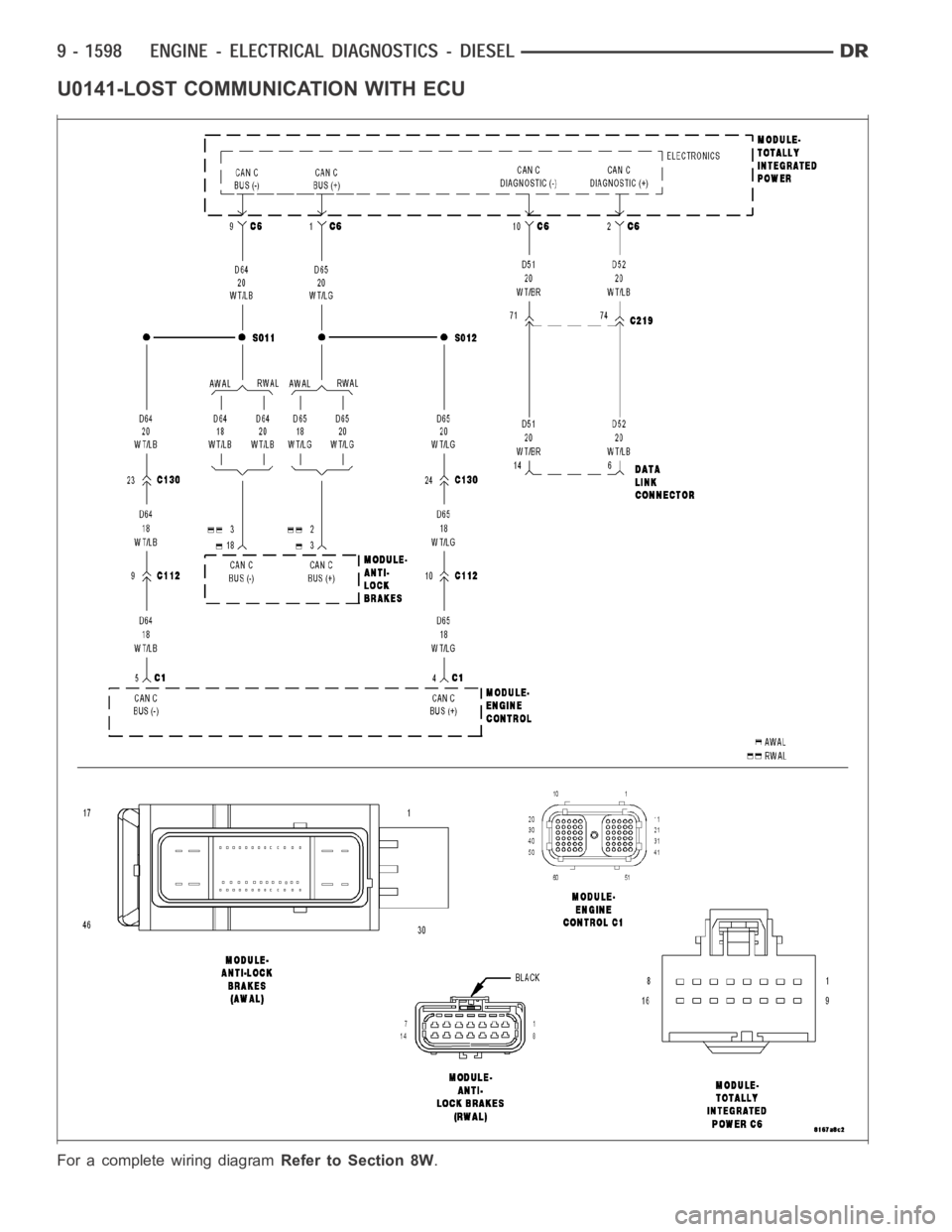
U0141-LOST COMMUNICATION WITH ECU
For a complete wiring diagramRefer to Section 8W.
Page 908 of 5267
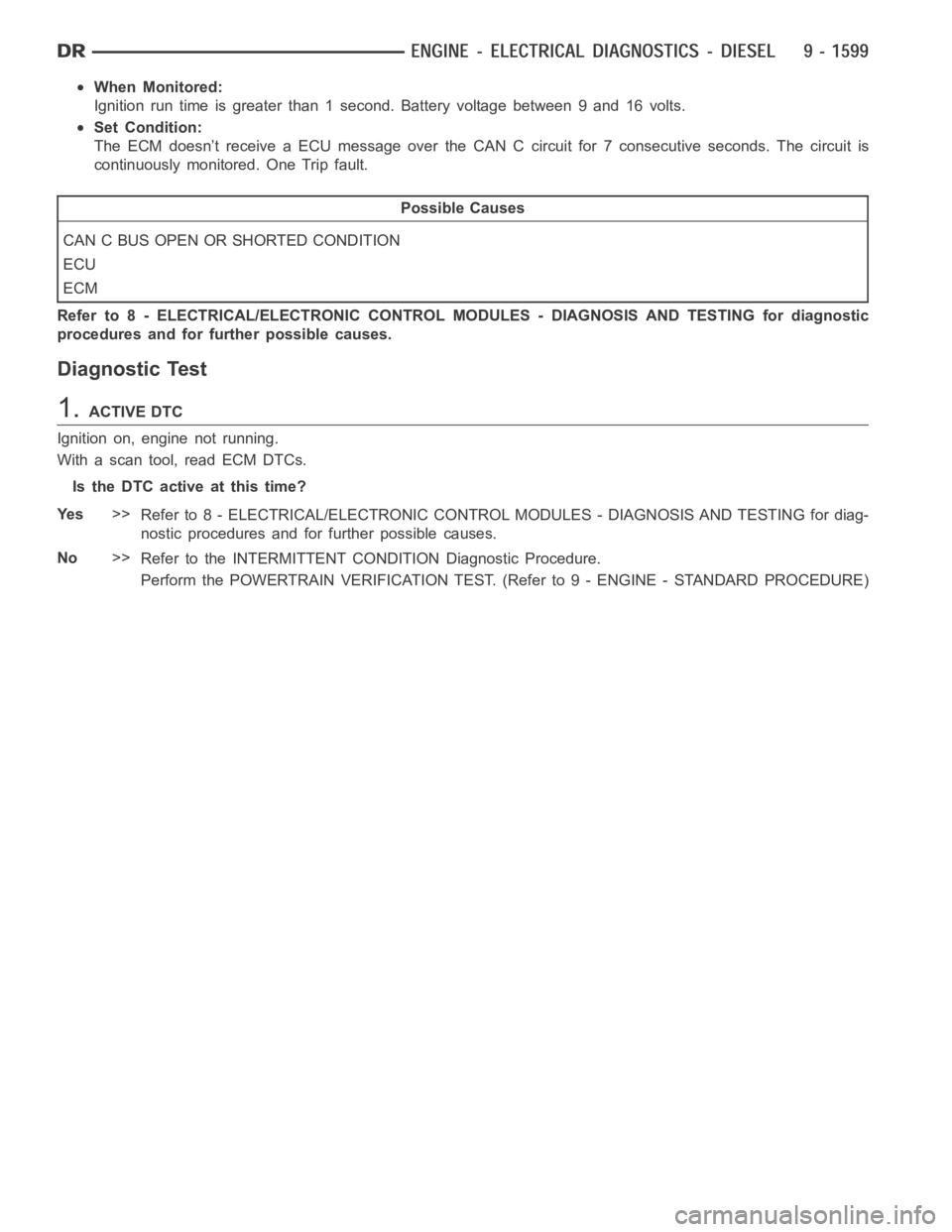
When Monitored:
Ignition run time is greater than 1 second. Battery voltage between 9 and 16volts.
Set Condition:
The ECM doesn’t receive a ECU message over the CAN C circuit for 7 consecutive seconds. The circuit is
continuously monitored. One Trip fault.
Possible Causes
CAN C BUS OPEN OR SHORTED CONDITION
ECU
ECM
Refer to 8 - ELECTRICAL/ELECTRONIC CONTROL MODULES - DIAGNOSIS AND TESTING for diagnostic
procedures and for further possible causes.
Diagnostic Test
1.ACTIVE DTC
Ignition on, engine not running.
With a scan tool, read ECM DTCs.
Is the DTC active at this time?
Ye s>>
Refer to 8 - ELECTRICAL/ELECTRONIC CONTROL MODULES - DIAGNOSIS AND TESTING for diag-
nostic procedures and for further possible causes.
No>>
Refer to the INTERMITTENT CONDITION Diagnostic Procedure.
Perform the POWERTRAIN VERIFICATION TEST. (Refer to 9 - ENGINE - STANDARD PROCEDURE)
Page 913 of 5267
U0002–CAN C BUS PERFORMANCE
(GATEWAY).............................. 2172
U0100–LOST COMMUNICATION WITH
ECM/PCM (GATEWAY).................... 2172
U0121–LOST COMMUNICATION WITH
ANTI-LOCK BRAKE MODULE (GATEWAY). . 2172
U0155–LOST COMMUNICATION WITH
CLUSTER/CCN (GATEWAY)............... 2173U0168–LOST COMMUNICATION WITH
VEHICLE SECURITY CONTROL MODULE -
SKREEM/WCM (GATEWAY)................ 2173
STANDARD PROCEDURE
POWERTRAIN VERIFICATION TEST ....... 2174
Page 915 of 5267
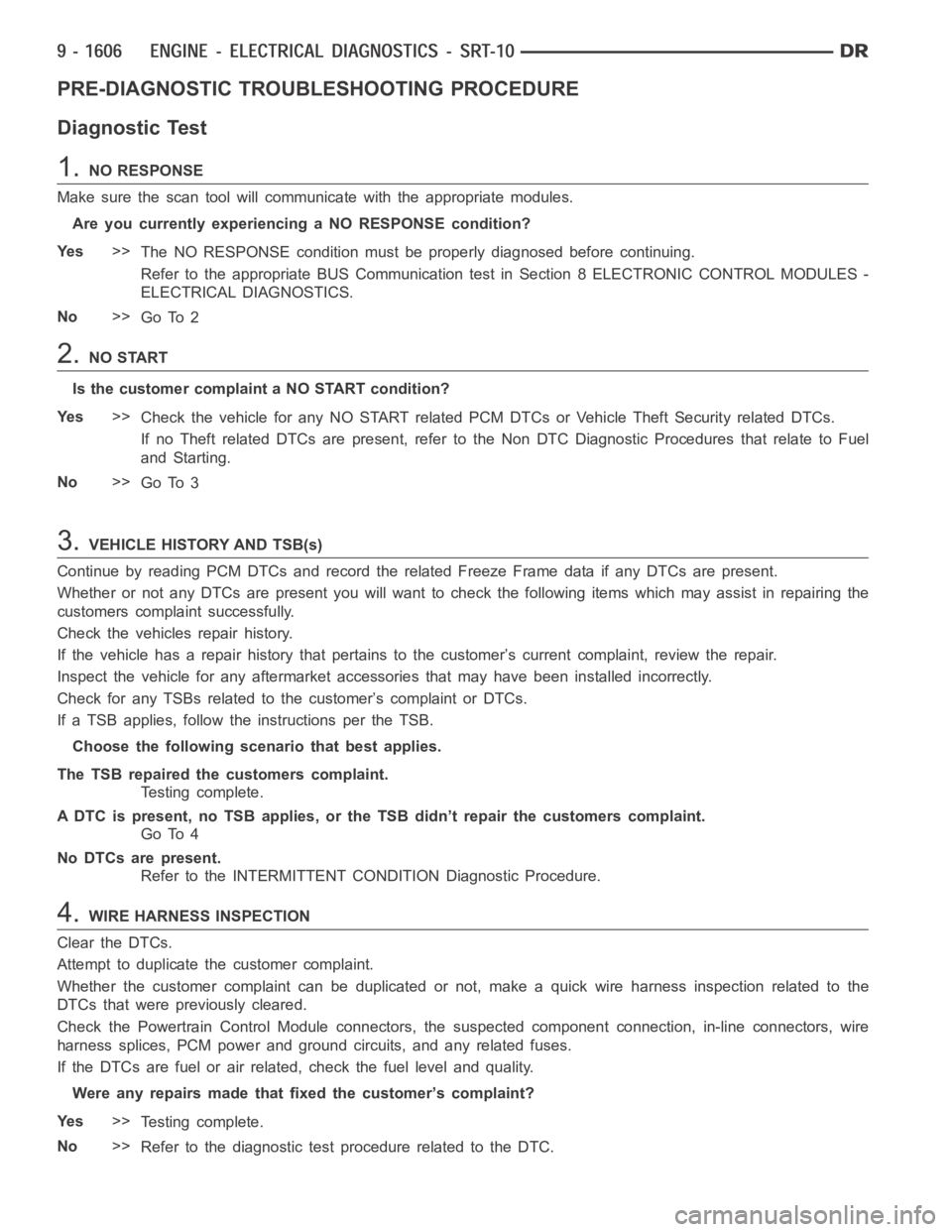
PRE-DIAGNOSTIC TROUBLESHOOTING PROCEDURE
Diagnostic Test
1.NO RESPONSE
Make sure the scan tool will communicate with the appropriate modules.
Are you currently experiencing a NO RESPONSE condition?
Ye s>>
The NO RESPONSE condition must be properly diagnosed before continuing.
Refer to the appropriate BUS Communication test in Section 8 ELECTRONIC CONTROL MODULES -
ELECTRICAL DIAGNOSTICS.
No>>
Go To 2
2.NO START
Is the customer complaint a NO START condition?
Ye s>>
Check the vehicle for any NO START related PCM DTCs or Vehicle Theft Security related DTCs.
If no Theft related DTCs are present, refer to the Non DTC Diagnostic Procedures that relate to Fuel
and Starting.
No>>
Go To 3
3.VEHICLE HISTORY AND TSB(s)
Continue by reading PCM DTCs and record the related Freeze Frame data if anyDTCs are present.
Whether or not any DTCs are present you will want to check the following items which may assist in repairing the
customers complaint successfully.
Check the vehicles repair history.
If the vehicle has a repair history that pertains to the customer’s currentcomplaint, review the repair.
Inspect the vehicle for any aftermarket accessories that may have been installed incorrectly.
Check for any TSBs related to thecustomer’s complaint or DTCs.
If a TSB applies, follow the instructions per the TSB.
Choose the following scenario that best applies.
The TSB repaired the customers complaint.
Testing complete.
A DTC is present, no TSB applies, or the TSB didn’t repair the customers complaint.
Go To 4
No DTCs are present.
Refer to the INTERMITTENT CONDITION Diagnostic Procedure.
4.WIRE HARNESS INSPECTION
Clear the DTCs.
Attempt to duplicate the customer complaint.
Whether the customer complaint can be duplicated or not, make a quick wire harness inspection related to the
DTCs that were previously cleared.
Check the Powertrain Control Module connectors, the suspected componentconnection, in-line connectors, wire
harness splices, PCM power and ground circuits, and any related fuses.
If the DTCs are fuel or air related, check the fuel level and quality.
Were any repairs made that fixed the customer’s complaint?
Ye s>>
Testing complete.
No>>
Refer to the diagnostic test procedure related to the DTC.
Page 1278 of 5267
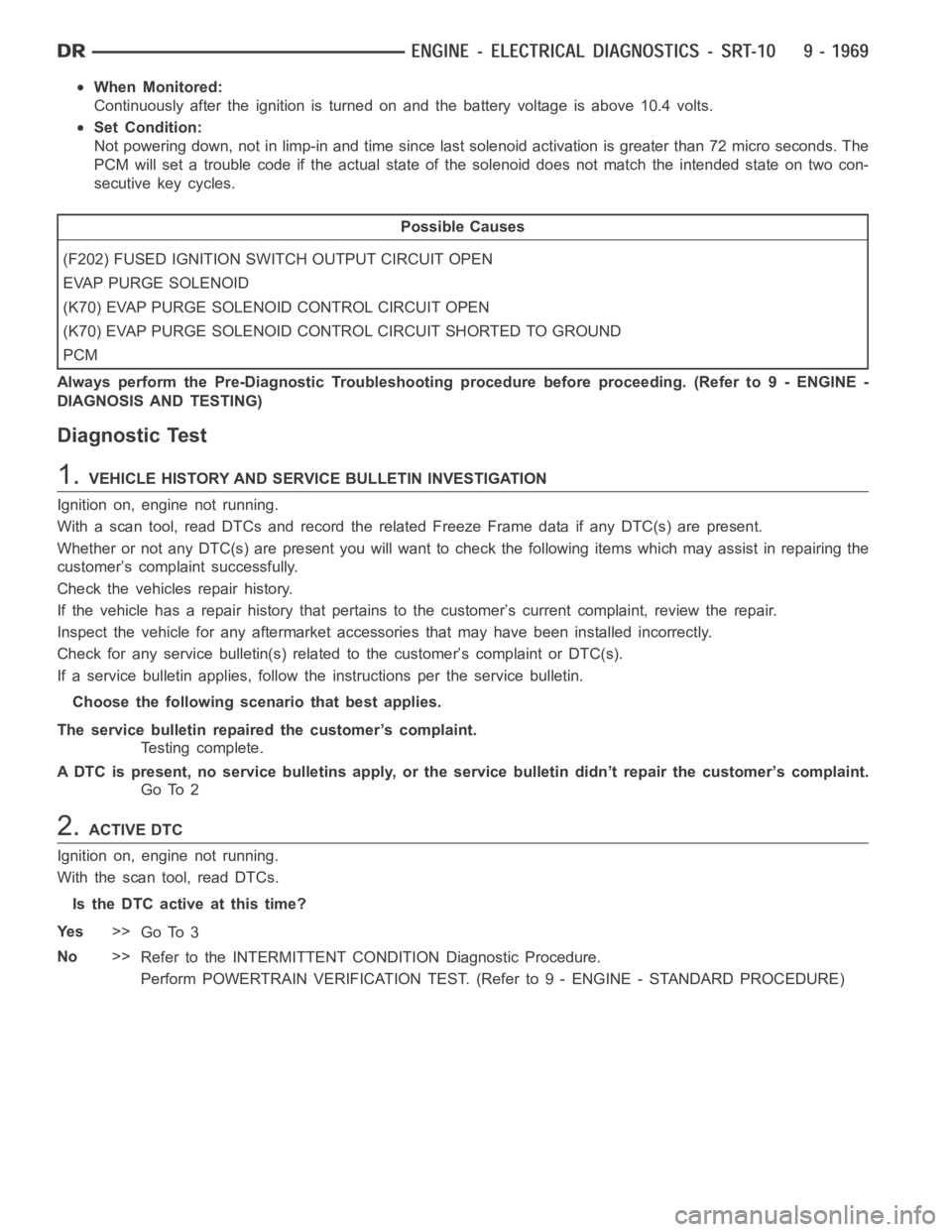
When Monitored:
Continuously after the ignition is turned on and the battery voltage is above 10.4 volts.
Set Condition:
Not powering down, not in limp-in and time since last solenoid activation is greater than 72 micro seconds. The
PCM will set a trouble code if the actual state of the solenoid does not matchthe intended state on two con-
secutive key cycles.
Possible Causes
(F202) FUSED IGNITION SWITCH OUTPUT CIRCUIT OPEN
EVAP PURGE SOLENOID
(K70) EVAP PURGE SOLENOID CONTROL CIRCUIT OPEN
(K70) EVAP PURGE SOLENOID CONTROL CIRCUIT SHORTED TO GROUND
PCM
Always perform the Pre-Diagnostic Troubleshooting procedure before proceeding. (Refer to 9 - ENGINE -
DIAGNOSIS AND TESTING)
Diagnostic Test
1.VEHICLE HISTORY AND SERVICE BULLETIN INVESTIGATION
Ignition on, engine not running.
With a scan tool, read DTCs and record the related Freeze Frame data if any DTC(s) are present.
Whether or not any DTC(s) are present you will want to check the following items which may assist in repairing the
customer’s complaint successfully.
Check the vehicles repair history.
If the vehicle has a repair history that pertains to the customer’s currentcomplaint, review the repair.
Inspect the vehicle for any aftermarket accessories that may have been installed incorrectly.
Check for any service bulletin(s) related to the customer’s complaint or DTC(s).
If a service bulletin applies, follow the instructions per the service bulletin.
Choose the following scenario that best applies.
The service bulletin repaired the customer’s complaint.
Testing complete.
A DTC is present, no service bulletins apply, or the service bulletin didn’t repair the customer’s complaint.
Go To 2
2.ACTIVE DTC
Ignition on, engine not running.
With the scan tool, read DTCs.
Is the DTC active at this time?
Ye s>>
Go To 3
No>>
Refer to the INTERMITTENT CONDITION Diagnostic Procedure.
Perform POWERTRAIN VERIFICATION TEST. (Refer to 9 - ENGINE - STANDARD PROCEDURE)
Page 1296 of 5267
When Monitored:
Engine Temperature greater than 104 Deg F, MAP vacuum approximately 15
to 16inches of mercury and
Engine RPM between 1400 and 3000 rpm.
Set Condition:
No Vehicle Speed Signal for more than 15 seconds on two consecutive trips.
Possible Causes
(B22) VEHICLE SPEED SIGNAL CIRCUIT SHORTED TO VOLTAGE
(B22) VEHICLE SPEED SIGNAL CIRCUIT OPEN BETWEEN CAB AND PCM
(B22) VEHICLE SPEED SIGNAL CIRCUIT SHORTED TO GROUND
PCM
Always perform the Pre-Diagnostic Troubleshooting procedure before proceeding. (Refer to 9 - ENGINE -
DIAGNOSIS AND TESTING)
1.GOOD TRIP EQUAL TO ZERO
Ignition on, engine not running.
NOTE: With the scan tool check for any related DTCs that may be present in theABS/RWAL Module or TCM,
diagnose any ABS/RWAL Module DTC’s before continuing.
With the scan tool, read DTCs and record the related Freeze Frame data.
Is the Good Trip Counter displayed and equal to zero?
Ye s>>
Go To 2
No>>
Refer to the INTERMITTENT CONDTION Diagnostic Procedure.
Perform POWERTRAIN VERIFICATION TEST. (Refer to 9 - ENGINE - STANDARD PROCEDURE)
2.(B22) VEHICLE SPEED SENSOR SIGNAL CIRCUIT SHORT TO VOLTAGE
Turn the ignition off.
Disconnect the PCM harness connectors.
Disconnect the CAB Module harness connector.
Ignition on, engine not running.
Measure the voltage of the (B22) Vehicle Speed Signal circuit in the
CAB Module or PCM harness connector.
Is the voltage above 4.9 volts?
Ye s>>
Repair the short to voltage in the (B22) Vehicle Speed Sig-
nal circuit between the CAB and PCM.
Perform POWERTRAIN VERIFICATION TEST. (Refer to 9 -
ENGINE - STANDARD PROCEDURE)
No>>
Go To 3
Page 1303 of 5267
P0513-INVALID SKREEM KEY
For a complete wiring diagramRefer to Section 8W.
When Monitored:
Ignition on.
Set Condition:
The Gateway detects that the Secret Key message is invalid or missing. One Trip Fault.
Possible Causes
WCM/SKREEM
POWERTRAIN CONTROL MODULE
GATEWAY MODULE
COMMUNICATION PROBLEM
Always perform the Pre-Diagnostic Troubleshooting procedure before proceeding. (Refer to 9 - ENGINE -
DIAGNOSIS AND TESTING).
Diagnostic Test
1.ACTIVE DTC
Ignition on, engine not running.
With the scan tool, read the Gateway Module DTCs.
Is the DTC active at this time?
Ye s>>
Go To 2
No>>
Refer to the INTERMITTENT CONDITION Diagnostic Procedure.
Perform the POWERTRAIN VERIFICATION TEST. (Refer to 9 - ENGINE - STANDARD PROCEDURE)
2.COMMUNICATION (CAN BUS or J1850)
NOTE: For vehicle communication problems, use the scan tool to refer to theNetwork Review Screen. The
screen depicts a high level view of the vehicle network. Fault and problem areas appear in red. Selecting
any of the network components allows access to the source of the problem.
Does the scan tool display a Vehicle Network problem or NO RESPONSE condition?
Ye s>>
Refer to the appropriate BUS Communication test in the Section 8 ELECTRONIC CONTROL MODULE
- ELECTRICAL DIAGNOSTICS.
No>>
Go To 3
3.SKREEM/SKIM TROUBLE CODES SET
With the scan tool, check for SKREEM/SKIM DTCs.
Are any DTCs present in the SKREEM/SKIM?
Ye s>>
Refer to Section 8 - Electrical VEHICLE THEFT SECURITY - ELECTRICAL DIAGNOSTICS and perform
the appropriate Diagnostic Procedure.
No>>
Go To 4