tire type DODGE SPRINTER 2008 2.G User Guide
[x] Cancel search | Manufacturer: DODGE, Model Year: 2008, Model line: SPRINTER, Model: DODGE SPRINTER 2008 2.GPages: 666, PDF Size: 14.11 MB
Page 386 of 666
384 OperationTires and wheels
4
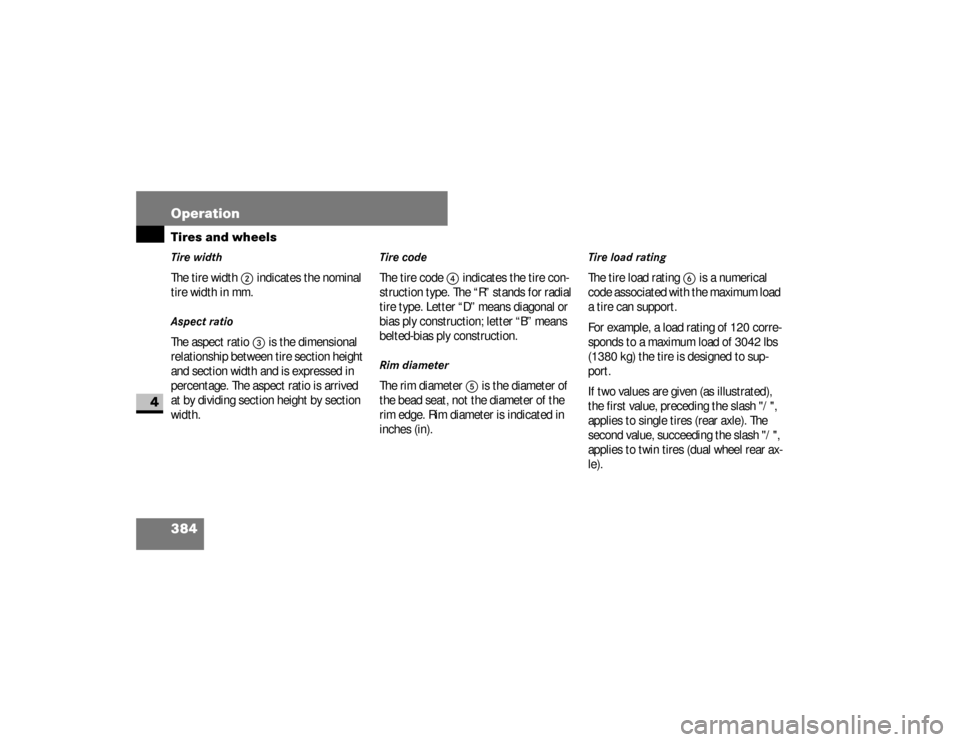
Tire widthThe tire width
2
indicates the nominal
tire width in mm.
Aspect ratioThe aspect ratio
3
is the dimensional
relationship between tire section height
and section width and is expressed in
percentage. The aspect ratio is arrived
at by dividing section height by section
width.
Tire codeThe tire code
4
indicates the tire con-
struction type. The “R” stands for radial
tire type. Letter “D” means diagonal or
bias ply construction; letter “B” means
belted-bias ply construction.
Rim diameterThe rim diameter
5
is the diameter of
the bead seat, not the diameter of the
rim edge. Rim diameter is indicated in
inches (in).
Tire load ratingThe tire load rating
6
is a numerical
code associated with the maximum load
a tire can support.
For example, a load rating of 120 corre-
sponds to a maximum load of 3042 lbs
(1380 kg) the tire is designed to sup-
port.
If two values are given (as illustrated),
the first value, preceding the slash "/",
applies to single tires (rear axle). The
second value, succeeding the slash "/",
applies to twin tires (dual wheel rear ax-
le).
nf_BA.book Page 384 Friday, January 25, 2008 3:53 PM
Page 387 of 666
385 Operation
Tires and wheels
4
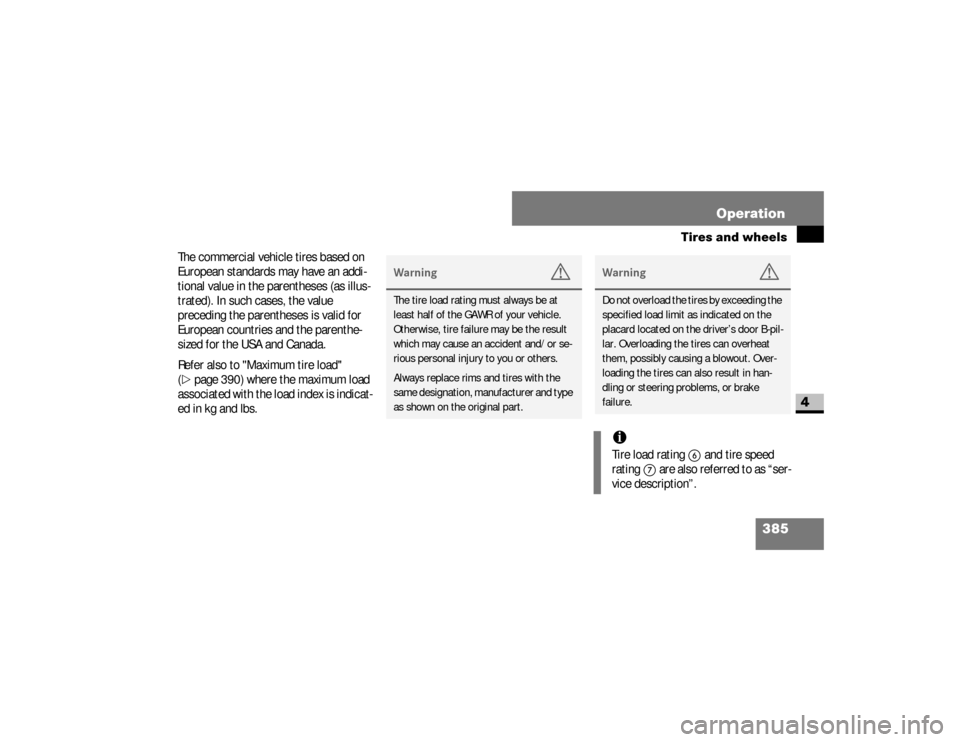
The commercial vehicle tires based on
European standards may have an addi-
tional value in the parentheses (as illus-
trated). In such cases, the value
preceding the parentheses is valid for
European countries and the parenthe-
sized for the USA and Canada.
Refer also to "Maximum tire load"
(\2
page 390) where the maximum load
associated with the load index is indicat-
ed in kg and lbs.
Warning
G
The tire load rating must always be at
least half of the GAWR of your vehicle.
Otherwise, tire failure may be the result
which may cause an accident and/or se-
rious personal injury to you or others.
Always replace rims and tires with the
same designation, manufacturer and type
as shown on the original part.
Warning
G
Do not overload the tires by exceeding the
specified load limit as indicated on the
placard located on the driver’s door B-pil-
lar. Overloading the tires can overheat
them, possibly causing a blowout. Over-
loading the tires can also result in han-
dling or steering problems, or brake
failure.iTire load rating
6
and tire speed
rating
7
are also referred to as “ser-
vice description”.
nf_BA.book Page 385 Friday, January 25, 2008 3:53 PM
Page 389 of 666
387 Operation
Tires and wheels
4
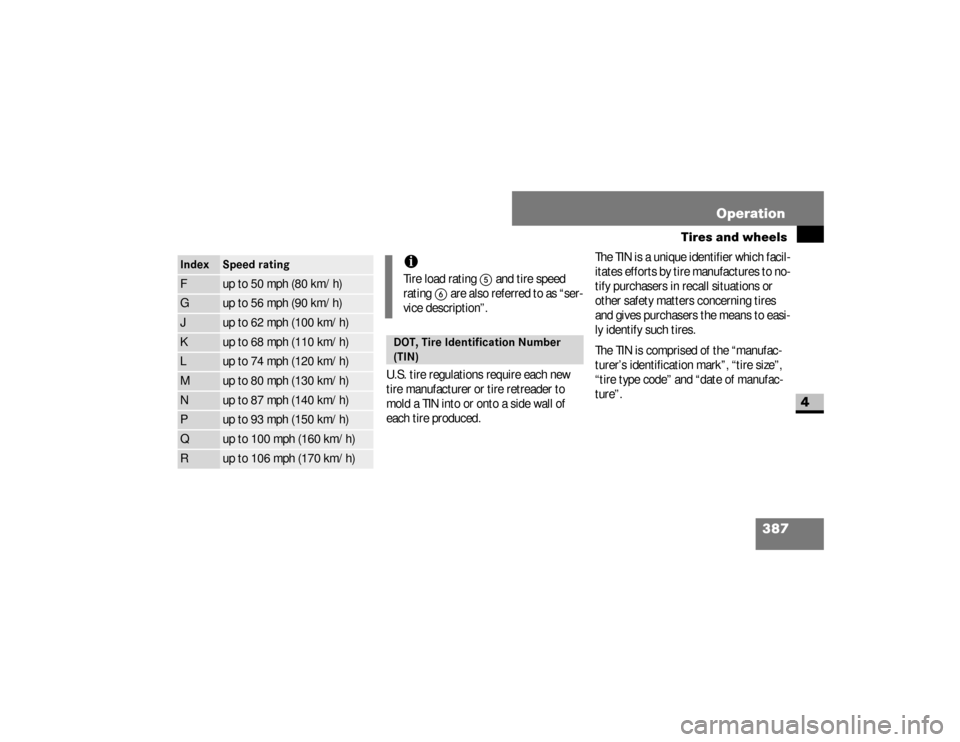
U.S. tire regulations require each new
tire manufacturer or tire retreader to
mold a TIN into or onto a side wall of
each tire produced.The TIN is a unique identifier which facil-
itates efforts by tire manufactures to no-
tify purchasers in recall situations or
other safety matters concerning tires
and gives purchasers the means to easi-
ly identify such tires.
The TIN is comprised of the “manufac-
turer’s identification mark”, “tire size”,
“tire type code” and “date of manufac-
ture”.
Index
Speed rating
F
up to 50 mph (80 km/h)
G
up to 56 mph (90 km/h)
J
up to 62 mph (100 km/h)
K
up to 68 mph (110 km/h)
L
up to 74 mph (120 km/h)
M
up to 80 mph (130 km/h)
N
up to 87 mph (140 km/h)
P
up to 93 mph (150 km/h)
Q
up to 100 mph (160 km/h)
R
up to 106 mph (170 km/h)
iTire load rating
5
and tire speed
rating
6
are also referred to as “ser-
vice description”.
DOT, Tire Identification Number
(TIN)
nf_BA.book Page 387 Friday, January 25, 2008 3:53 PM
Page 390 of 666
388 OperationTires and wheels
4
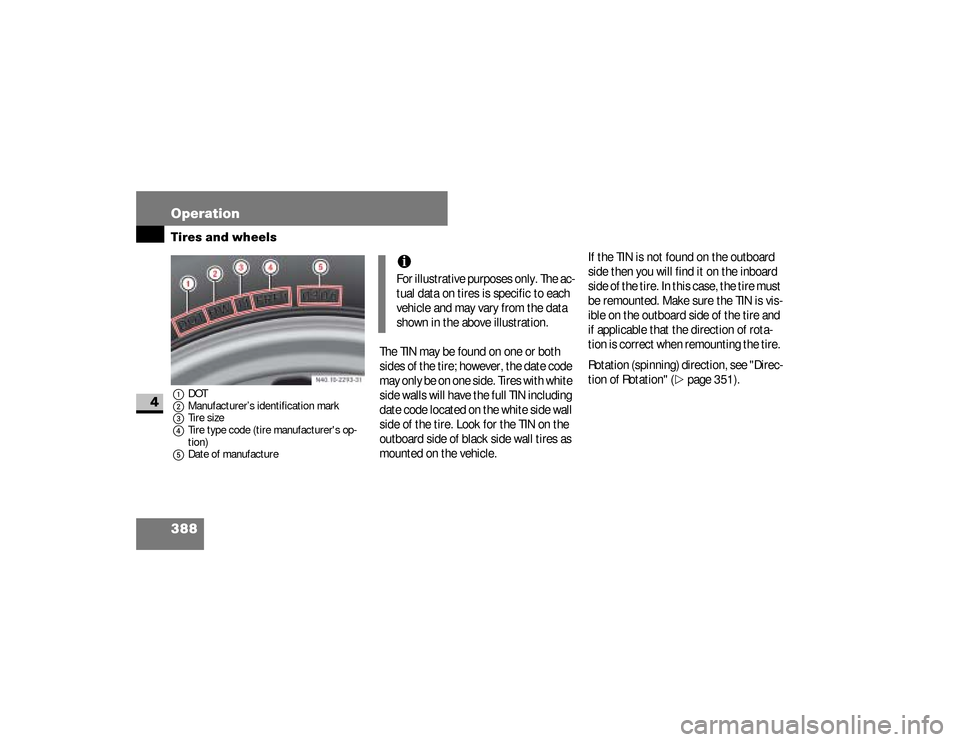
1DOT
2Manufacturer’s identification mark
3Tire size
4Tire type code (tire manufacturer's op-
tion)
5Date of manufacture
The TIN may be found on one or both
sides of the tire; however, the date code
may only be on one side. Tires with white
side walls will have the full TIN including
date code located on the white side wall
side of the tire. Look for the TIN on the
outboard side of black side wall tires as
mounted on the vehicle.If the TIN is not found on the outboard
side then you will find it on the inboard
side of the tire. In this case, the tire must
be remounted. Make sure the TIN is vis-
ible on the outboard side of the tire and
if applicable that the direction of rota-
tion is correct when remounting the tire.
Rotation (spinning) direction, see "Direc-
tion of Rotation" (
\2
page 351).
iFor illustrative purposes only. The ac-
tual data on tires is specific to each
vehicle and may vary from the data
shown in the above illustration.
nf_BA.book Page 388 Friday, January 25, 2008 3:53 PM
Page 391 of 666
389 Operation
Tires and wheels
4
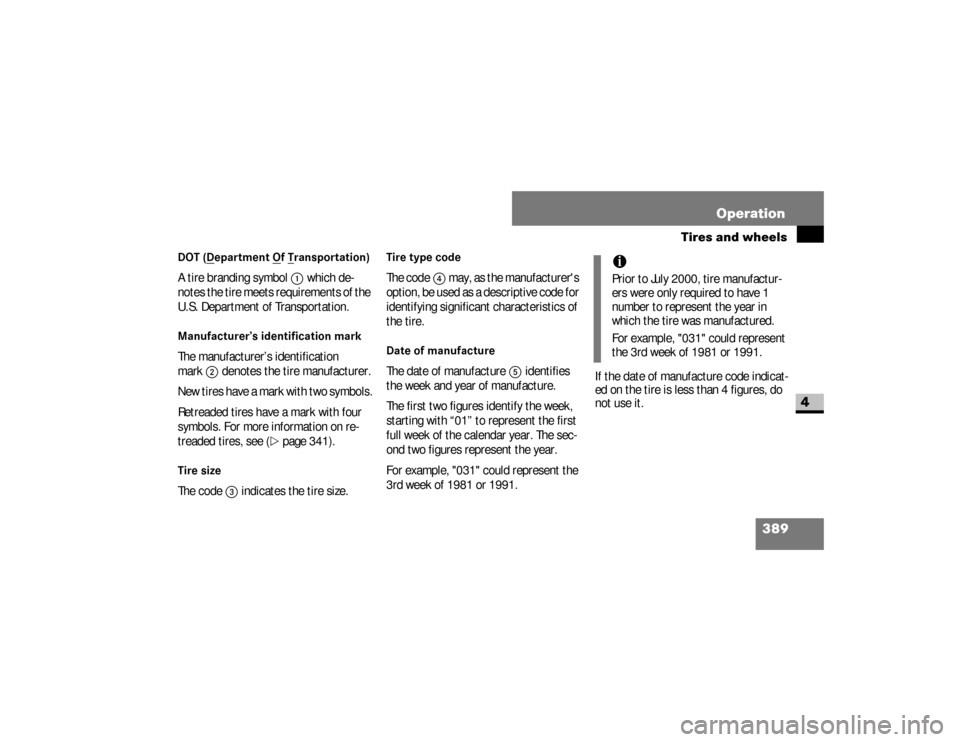
DOT (D
epartment O
f T
ransportation)
A tire branding symbol
1
which de-
notes the tire meets requirements of the
U.S. Department of Transportation.
Manufacturer’s identification markThe manufacturer’s identification
mark
2
denotes the tire manufacturer.
New tires have a mark with two symbols.
Retreaded tires have a mark with four
symbols. For more information on re-
treaded tires, see (
\2
page 341).
Tire sizeThe code
3
indicates the tire size.
Tire type codeThe code
4
may, as the manufacturer's
option, be used as a descriptive code for
identifying significant characteristics of
the tire.
Date of manufactureThe date of manufacture
5
identifies
the week and year of manufacture.
The first two figures identify the week,
starting with “01” to represent the first
full week of the calendar year. The sec-
ond two figures represent the year.
For example, "031" could represent the
3rd week of 1981 or 1991.If the date of manufacture code indicat-
ed on the tire is less than 4 figures, do
not use it.
iPrior to July 2000, tire manufactur-
ers were only required to have 1
number to represent the year in
which the tire was manufactured.
For example, "031" could represent
the 3rd week of 1981 or 1991.
nf_BA.book Page 389 Friday, January 25, 2008 3:53 PM
Page 395 of 666
393 Operation
Tires and wheels
4
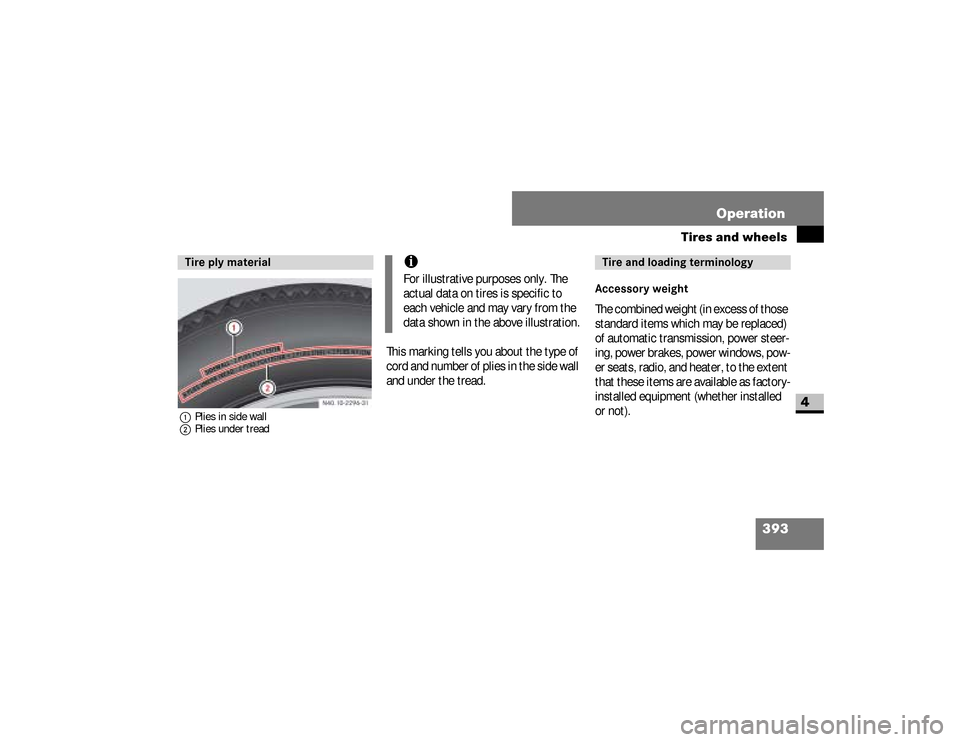
1Plies in side wall
2Plies under tread
This marking tells you about the type of
cord and number of plies in the side wall
and under the tread.
Accessory weightThe combined weight (in excess of those
standard items which may be replaced)
of automatic transmission, power steer-
ing, power brakes, power windows, pow-
er seats, radio, and heater, to the extent
that these items are available as factory-
installed equipment (whether installed
or not).
Tire ply material
iFor illustrative purposes only. The
actual data on tires is specific to
each vehicle and may vary from the
data shown in the above illustration.
Tire and loading terminology
nf_BA.book Page 393 Friday, January 25, 2008 3:53 PM
Page 399 of 666
397 Operation
Tires and wheels
4
Production options weightThe combined weight of those installed
regular production options weighing
over 5 lbs (2.3 kg) in excess of those
standard items which they replace, not
previously considered in curb weight or
accessory weight, including heavy duty
brakes, ride levelers, roof rack, heavy
duty battery, and special trim.PSI (P
ounds per S
quare I
nch)
A standard unit of measure for air pres-
sure. Another metric unit for air pres-
sure is bar or kilopascal (kPa).
Recommended tire inflation pressureRecommended tire inflation pressure for
normal driving conditions listed on the
tire and loading information placard
1 or
on the tire inflation pressure placard lo-
cated on the driver’s door B-pillar.
Provides best handling, tread life and
riding comfort.
RimA metal support for a tire or a tire and
tube assembly upon which the tire
beads are seated.
Side wallThe portion of a tire between the tread
and the bead.TIN (T
ire I
dentification N
umber)
Unique identifier which facilitates efforts
by tire manufacturers to notify purchas-
ers in recall situations or other safety
matters concerning tires and gives pur-
chases the means to easily identify such
tires. The TIN is comprised of the “man-
ufacturer’s identification mark”, “tire
size”, “tire type code” and “date of man-
ufacture”.
1. For vehicles with a gross weight capacity less
than 10 000 lbs (4 536 kg) (USA only).
nf_BA.book Page 397 Friday, January 25, 2008 3:53 PM
Page 402 of 666
400 OperationTires and wheels
4
Tires on the front and rear axles of vehi-
cles operate at different loads and per-
form different steering, driving and
braking functions. For these reasons,
they wear at unequal rates, and develop
irregular wear patterns. These effects
can be reduced by timely rotation of
tires.
The benefits of rotation are especially
worthwhile with aggressive tread de-
signs such as those on On/Off Road
type tires. Rotation will increase tread
life, help to maintain mud, snow, and wet
traction levels, and contribute to a
smooth ride. If applicable to your vehicle’s tire config-
uration, tires can be rotated according
to the tire manufacturer’s recommend-
ed intervals in the tire manufacturer’s
warranty pamphlet located in your vehi-
cle literature portfolio. If none is avail-
able, tires should be rotated every
10 000 miles (16 000 km), or sooner if
necessary, according to the degree of
tire wear.
The same rotation (spinning) direction
must be maintained when mounted, see
"Direction of rotation" (
\2
page 351).
Warning (Continued)
G
could result in changes to steering, han-
dling, and braking of your Sprinter vehicle.
This can cause unpredictable handling
and stress to steering and suspension
components. You could lose control and
have an accident resulting in serious inju-
ry or death.could result in tire overloading and failure,
if the tires' load index are not identical.
You could lose control and have an acci-
dent.
nf_BA.book Page 400 Friday, January 25, 2008 3:53 PM
Page 405 of 666
403 Operation
Tires and wheels
4
\1
Make sure that on one axle just one
type of tire (same size, type con-
struction, load and speed rating) is
used.
Dual rear wheels:
\1
Rotate front tires by axle and the out-
er rear tire side to side if there is no
approved direction of rotation.
The tires used on dual wheel assem-
blies should be matched for wear to
prevent overloading one tire in a set.
\1
To check if tires are even, lay a
straight edge across all four tires.
For information on wheel change, see
the “Practical hints” section
(
\2
page 548).
!
CAUTION
3500 dual rear tires have only one
approved direction of rotation. This is
to accommodate the asymmetrical
design (tread pattern) of the ON/OFF
road tire and the use of Outline White
Letter (OWL) tires.
When replacing a flat tire, the spare
tire may have to be remounted on the
rim or installed at a different location
to maintain the correct placement of
the tire on the wheel relative to the
tire/wheel position on the vehicle.
For example, if the spare is used to
replace an outer rear tire it will have
to remounted on the rim so that the
wheel is dished inward.
That way the tread design of asym-
metrical tires and the white writing of
the OWL tires will maintain proper
position.
nf_BA.book Page 403 Friday, January 25, 2008 3:53 PM
Page 407 of 666
405 Operation
Winter driving
4
For safe handling, make sure all winter
tires mounted are of the same make and
have the same tread design.
Always observe the speed rating of the
winter tires installed on your vehicle. If
the maximum speed for which your tires
are rated is below the speed rating of
your vehicle, you must place a notice to
this effect where it will be seen by the driver. Such notices are available at your
tire dealer or any authorized Sprinter
Dealer.
\1
Reactivate the tire pressure monitor.
While studded tires improve perfor-
mance on ice, skid and traction capabil-
ity on wet or dry surfaces may be poorer
than that of non-studded tires. Some
states prohibit studded tires; therefore,
local laws should be checked before us-
ing these tire types.
Warning
G
Winter tires with a tread depth under
1/6 in (4 mm) must be replaced. They are
no longer suitable for winter operation.
Warning
G
If you use your spare tire when winter
tires are fitted on the other wheels, be
aware that the difference in tire charac-
teristics may impair turning stability and
overall driving stability may be reduced.
Adapt your driving style accordingly.
Have the spare tire replaced with a winter
tire at the nearest authorized Sprinter
Dealer.
nf_BA.book Page 405 Friday, January 25, 2008 3:53 PM