coolant temperature DODGE TRUCK 1993 Service Manual PDF
[x] Cancel search | Manufacturer: DODGE, Model Year: 1993, Model line: TRUCK, Model: DODGE TRUCK 1993Pages: 1502, PDF Size: 80.97 MB
Page 1440 of 1502
•
HEATING
AND AIR
CONDITIONING
24 - 3
DIAGNOSTIC
PROCEDURES
INDEX
page
page ..
7
General Information
3
.
. 3
Heating System Output
3
Air
Conditioning System
Blower
Motor
GENERAL
INFORMATION
The reason for owner dissatisfaction must be thor
oughly understood before any attempt is made to re
pair or replace any parts. It must be determined if
the condition is the heater system, the refrigerant system, air conditioning air flow or related to the
compressor. After confirming the condition, a func
tional test is suggested using the diagnostic charts.
After the condition has been properly diagnosed and corrected, check out the complete system to assure
that it is performing satisfactorily. The following charts have been developed for quick
reference. If the step by step method used is not com pletely understood, refer to the correct section of the Service Manual for detailed explanations.
HEATING
SYSTEM
OUTPUT
WARNING:
IF
VEHICLE
HAS
BEEN
RUN
RECENTLY,
WAIT
15
MINUTES
BEFORE
REMOVING
CAP, THEN
PLACE
A RAG
OVER
THE CAP AND
TURN
IT TO
THE
FIRST
STOP.
ALLOW
PRESSURE
TO
ESCAPE
THROUGH
THE
OVERFLOW
TUBE
AND
WHEN
THE
SYSTEM
STABILIZES,
REMOVE
THE CAP
COM
PLETELY.
Check the radiator coolant level, drive belt tension,
engine vacuum line connections, radiator air flow and radiator fan operation. Start engine and bring to
normal operating temperature (refer to Group 7,
Cooling System).
Engine coolant is provided to the heater system by
2 heater hoses. With engine idling at normal operat
ing temperature, set the heater control to maximum
heat, defrost and high blower setting. Using a test
thermometer, check the air temperature coming from
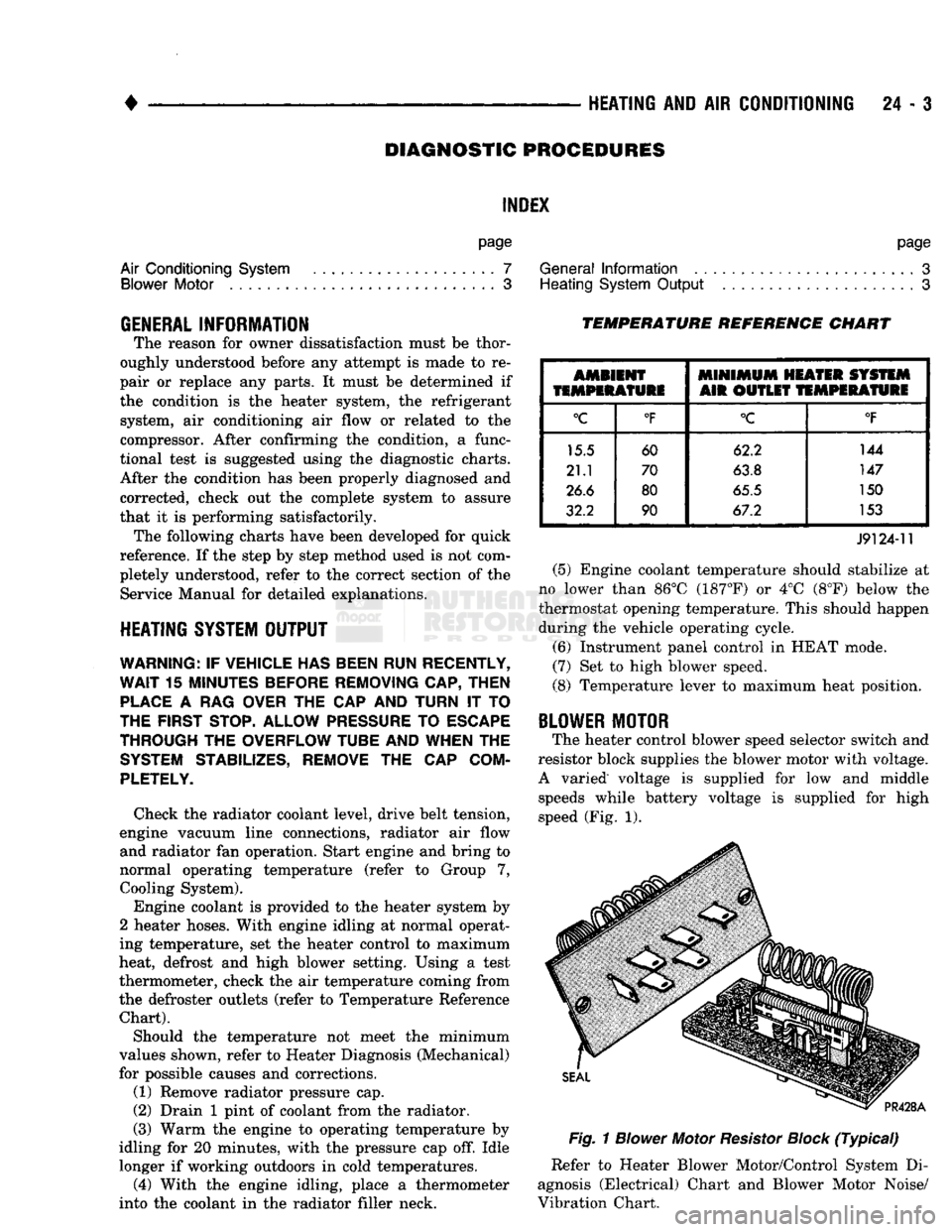
the defroster outlets (refer to Temperature Reference Chart).
Should the temperature not meet the minimum
values shown, refer to Heater Diagnosis (Mechanical)
for possible causes and corrections.
(1) Remove radiator pressure cap.
(2) Drain 1 pint of coolant from the radiator.
(3) Warm the engine to operating temperature by
idling for 20 minutes, with the pressure cap off. Idle longer if working outdoors in cold temperatures. (4) With the engine idling, place a thermometer
into the coolant in the radiator filler neck.
TEMPERATURE REFERENCE CHART
AMBIENT
MINIMUM
HEATER SYSTEM
TEMPERATURE
AIR OUTLET
TEMPERATURE
°C
°F
°C
°F
15.5 60 62.2 144
21.1 70
63.8 147
26.6 80
65.5 150
32.2 90 67.2 153
J9124-11
(5) Engine coolant temperature should stabilize at
no lower than 86°C (187°F) or 4°C (8°F) below the
thermostat opening temperature. This should happen during the vehicle operating cycle.
(6) Instrument panel control in HEAT mode.
(7) Set to high blower speed.
(8) Temperature lever to maximum heat position.
BLOWER
MOTOR
The heater control blower speed selector switch and
resistor block supplies the blower motor with voltage.
A varied voltage is supplied for low and middle speeds while battery voltage is supplied for high
speed (Fig. 1).
Fig.
1
Blower
Motor
Resistor
Block
(Typical)
Refer to Heater Blower Motor/Control System Di
agnosis (Electrical) Chart and Blower Motor Noise/
Vibration Chart.
Page 1441 of 1502
24
- 4
HEATING
AND
AIR
CONDITIONING
•
(1) Possible location or cause of blower motor vi
bration are as follows:
(a) Blower motor assembly loose in heater A/C
housing.
(b) Blower wheel loose on motor shaft.
(c) Blower wheel out of balance or bent.
(d) Blower motor defective.
(2) Possible location or cause of blower motor noise
are as follows: (To verify blower noise disconnect blower motor wire lead connector and operate heater
or A/C system. If noise goes away, proceed with pro
cedure.)
(a) Refer to vibration section of this procedure.
(b) Foreign material in Heater-A/C housing
around blower wheel.
(c) Blower wheel rubbing Heater-A/C housing.
(d) Blower motor defective.
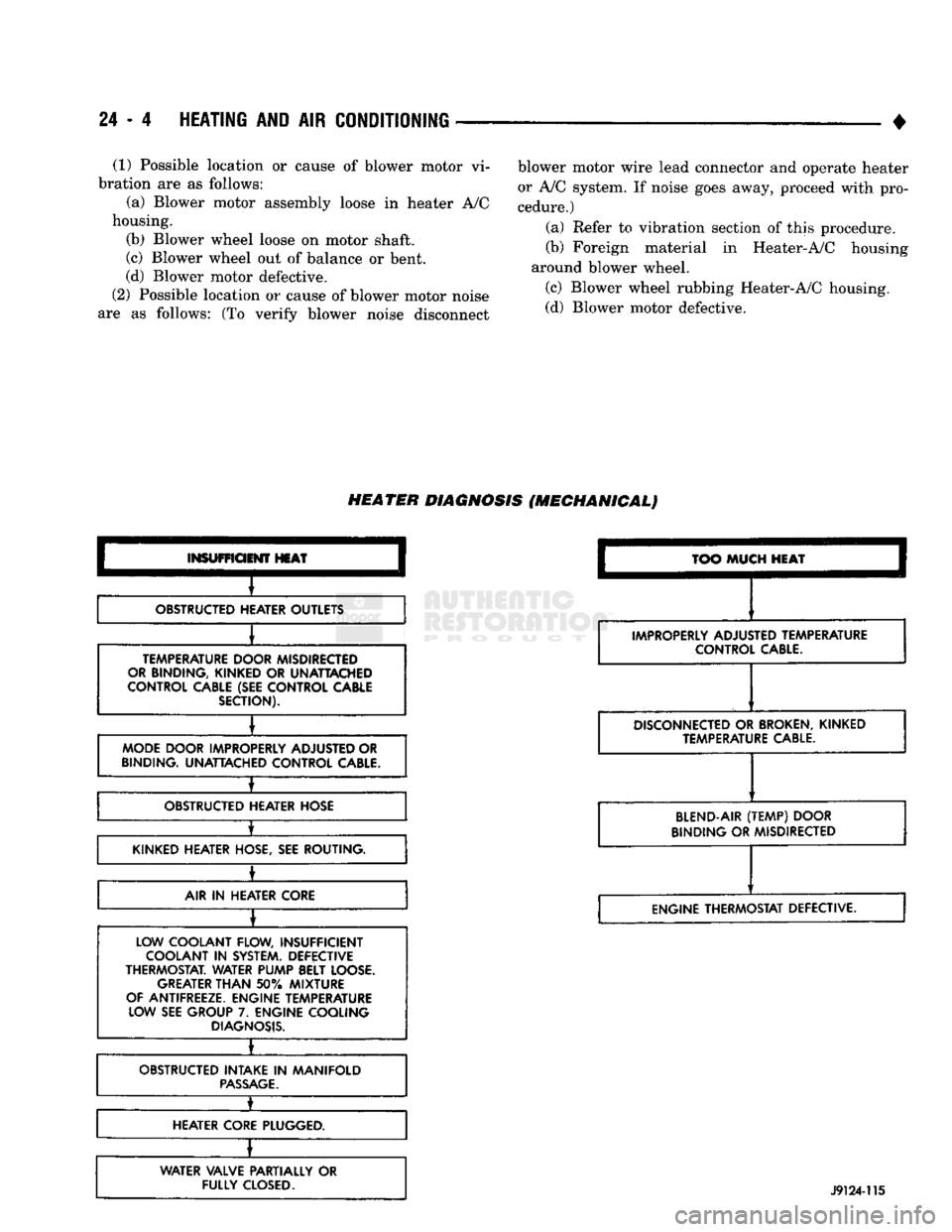
HEATER
DIAGNOSIS
(MECHANICAL)
INSUFFICIENT
HEAT
OBSTRUCTED HEATER OUTLETS
TEMPERATURE DOOR MISDIRECTED
OR BINDING, KINKED
OR
UNATTACHED
CONTROL CABLE (SEE CONTROL CABLE SECTION).
MODE DOOR IMPROPERLY ADJUSTED OR
BINDING. UNATTACHED CONTROL
CABLE.
±
OBSTRUCTED HEATER HOSE
•
KINKED HEATER HOSE, SEE ROUTING.
±
AIR
IN
HEATER CORE
LOW COOLANT FLOW, INSUFFICIENT COOLANT
IN
SYSTEM. DEFECTIVE
THERMOSTAT. WATER PUMP BELT LOOSE. GREATER
THAN
50%
MIXTURE
OF ANTIFREEZE. ENGINE TEMPERATURE LOW SEE GROUP
7.
ENGINE COOLING
DIAGNOSIS.
•
OBSTRUCTED INTAKE
IN
MANIFOLD
PASSAGE.
1_
HEATER CORE PLUGGED.
WATER VALVE PARTIALLY
OR
FULLY
CLOSED.
TOO
MUCH
HEAT
IMPROPERLY ADJUSTED TEMPERATURE CONTROL
CABLE.
DISCONNECTED
OR
BROKEN,
KINKED TEMPERATURE
CABLE.
BLEND-AIR
(TEMP)
DOOR
BINDING OR MISDIRECTED
ENGINE THERMOSTAT DEFECTIVE.
J9124-115
Page 1467 of 1502
24 - 30
HEATING
AND AIR
CONDITIONING
•
up,
down or to either side and can be shut off by
pushing the vanes up. Floor air is delivered through
the lower outlets.
VACUUM CONTROLS
AND
CIRCUITS
For an explanation of the vacuum and electrical
logic that controls the operation of the unit (Fig. 1
and Control Chart). MODES—The vacuum and electrical logic is deter
mined by the push button switch. The vacuum por
tion of the switch controls the water valve and
positions all doors in the unit except the blend air
door. The electrical portion of the switch controls the compressor and blower operation. The following is a
breakdown of the vacuum and electrical logic for each mode. Refer to Control Chart in this section.
OFF Vacuum application is as indicated in Fig. 1. The
inlet air door is closed to outside, open to recirculat
ing air. The mode door is in the A/C position. The
Heat/Defrost door is in the Heat position. The heater core coolant flow is
shut-off.
No air flows through the unit and the compressor
is idle because the blower and compressor clutch cir
cuits are open.
MAX A/C All of the doors are in the same position as they
are in Off. The Max. A/C mode merely closes the
electrical circuits to the blower motor and the com
pressor clutch. This mode is recommended for initial cool down, extreme outside humidity or high ambient
temperature.
A/C
This mode is recommended for use after the vehicle
has been cooled to the desired temperature. The vac
uum application at the outside-recirculating air door actuator is transferred to the rod side. This moves
the door away from the outside-air inlet and closes
the recirculating inlet. The water valve is open. All
other vacuum applications and door positions are the
same for the Max. A/C position. The blower motor and compressor are on.
VENT The vacuum circuit remains the same as in the
A/C position but the compressor clutch electrical cir
cuit is opened, preventing the compressor from oper ating. The blower motor is used to force outside air
into the passenger compartment through the A/C
outlets in the instrument panel.
HEAT
In the Heat mode the outside air door is open same
as A/C mode. Vacuum is applied to the top side of the air condi
tioning door actuator. This will close off the passage
to the air conditioning distribution duct and open the
passage to the heater/defroster duct. Since the heat er-defroster door is in the heat position, the full flow
of heated air goes through the heater outlets. A
small amount of heated air will bleed through the
defroster outlets. The water valve is open, the blower
switch is activated and the compressor is off.
DEFROST When the defrost mode is selected all conditions
are the same as for heater operation, except that no
vacuum is applied to the defrost door actuator. The defrost door is spring loaded to the defrost position.
The door opens the defroster outlets and partially closes off the heater outlets. The heater outlets are
left open far enough to direct about 30 percent of the
air to the floor. The other 70% is defrost air directed
to the windshield area. The compressor clutch will be engaged.
ELECTRICAL CONTROLS AND CIRCUITS
The electrical feed for the air conditioning circuit is
from 2 fuses in the fuse block. A 20 ampere fuse pro
tects the compressor clutch circuit, and a 30 ampere fuse protects the blower motor control circuit.
CONTROL TEST
Test operation of controls in the following manner.
(1) Inspect compressor drive belt. Adjust, if neces
sary. (2) Start engine. (3) Move temperature lever to extreme left (cool)
position. (4) Push A/C button.
(5)
Refer to Control Chart. Check position of doors,
operation of compressor clutch, blower motor and wa
ter valve. The water valve is open when there is no
vacuum to valve. (6) Check blower switch by moving it to all 4 posi
tions and noting air flow change. In case of malfunc
tion refer to Electrical Control Circuit. (7) Check operation of blend air door by moving
temperature lever from full warm toward cool posi
tion. Discharge air temperature should change with lever movement if the engine coolant is warm. (8) Repeat steps 5 and 6 in each push-button posi
tion. If actuation of the doors is slow or incomplete,
check for mechanical misalignment, binding or vac uum leaks. The air conditioning door has a seven
second vacuum delay in mode switching from Off,
Max A/C, A/C, or Vent to Heat or Defrost. Check
temperature control cable for correct adjustment.
Page 1487 of 1502
25-10
EMISSION
CONTROL
SYSTEMS
EXHAUST
EMISSION
CONTROLS
INDEX
page
Air Inlet—5.9L Diesel
Engine
13
Exhaust
Gas Recirculation (EGR)
Systems
10
HEATED
INLET
AIR
SYSTEM
The air filter housing mounted-heated inlet air sys
tem is no longer used on any Dodge Truck gas pow ered engine.
EXHAUST
GAS
RECIRCULATION
(EGR)
SYSTEMS
GENERAL INFORMATION The EGR system reduces oxides of nitrogen (NOx)
in the engine exhaust and helps prevent spark
knock. This is accomplished by allowing a predeter
mined amount of hot exhaust gas to recirculate and
dilute the incoming fuel/air mixture. This dilution
reduces peak flame temperature during combustion.
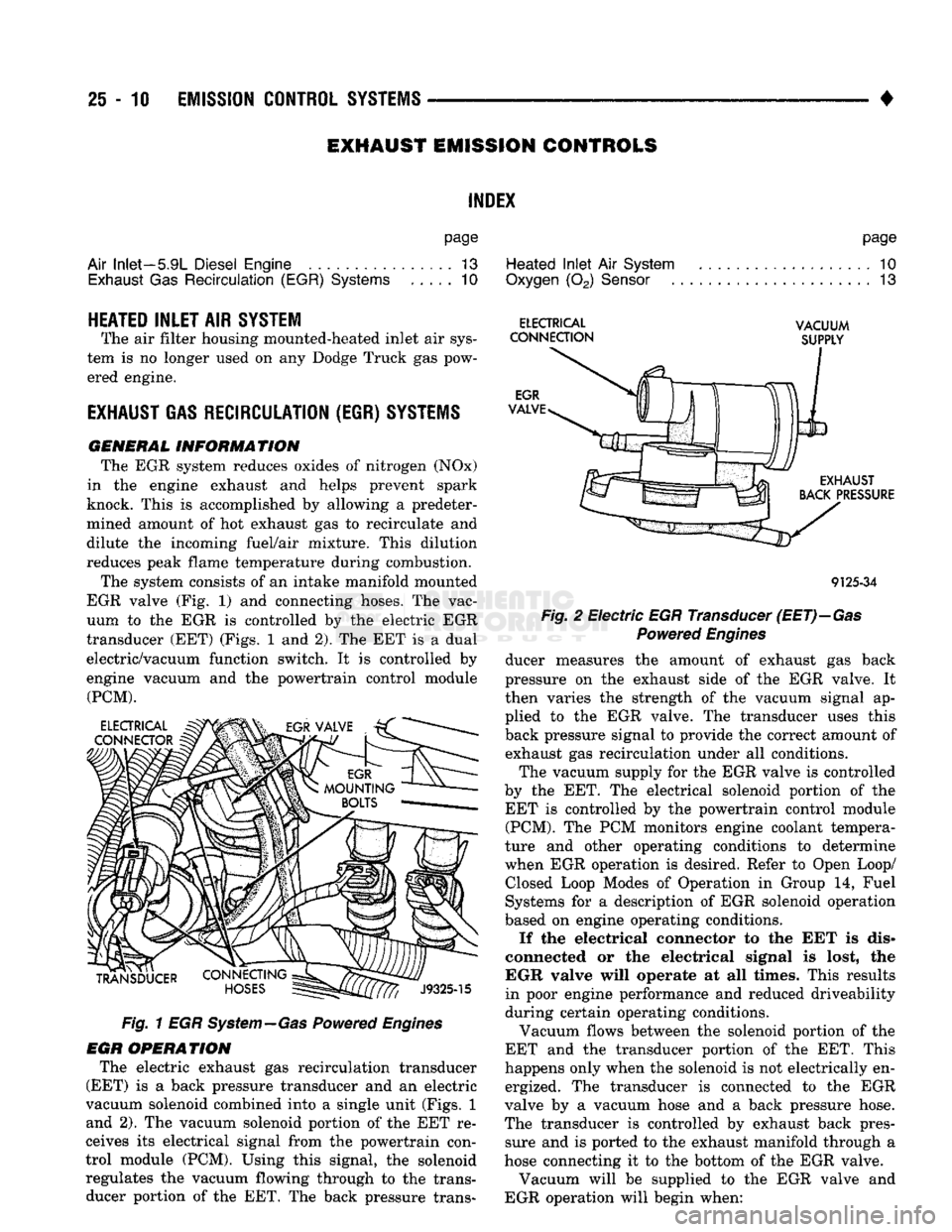
The system consists of an intake manifold mounted
EGR valve (Fig. 1) and connecting hoses. The vac
uum to the EGR is controlled by the electric EGR
transducer (EET) (Figs. 1 and 2). The EET is a dual
electric/vacuum function switch. It is controlled by
engine vacuum and the powertrain control module (PCM).
Fig. 1 EGR System—Gas Powered Engines
EGR OPERATION The electric exhaust gas recirculation transducer
(EET) is a back pressure transducer and an electric
vacuum solenoid combined into a single unit (Figs. 1 and 2). The vacuum solenoid portion of the EET re
ceives its electrical signal from the powertrain con
trol module (PCM). Using this signal, the solenoid regulates the vacuum flowing through to the trans ducer portion of the EET. The back pressure trans-
page
Heated
Inlet
Air
System
. 10
Oxygen
(02)
Sensor
13
ELECTRICAL
VACUUM
CONNECTION
SUPPLY
9125-34
Fig.
2 Electric EGR Transducer
(EET)—Gas
Powered
Engines
ducer measures the amount of exhaust gas back
pressure on the exhaust side of the EGR valve. It
then varies the strength of the vacuum signal ap
plied to the EGR valve. The transducer uses this
back pressure signal to provide the correct amount of exhaust gas recirculation under all conditions.
The vacuum supply for the EGR valve is controlled
by the EET. The electrical solenoid portion of the EET is controlled by the powertrain control module (PCM). The PCM monitors engine coolant tempera
ture and other operating conditions to determine
when EGR operation is desired. Refer to Open Loop/ Closed Loop Modes of Operation in Group 14, Fuel
Systems for a description of EGR solenoid operation
based on engine operating conditions.
If the electrical connector to the EET is dis
connected or the electrical signal is lost, the
EGR valve will operate at all times. This results
in poor engine performance and reduced driveability
during certain operating conditions.
Vacuum flows between the solenoid portion of the
EET and the transducer portion of the EET. This
happens only when the solenoid is not electrically en ergized. The transducer is connected to the EGR
valve by a vacuum hose and a back pressure hose.
The transducer is controlled by exhaust back pres sure and is ported to the exhaust manifold through a
hose connecting it to the bottom of the EGR valve.
Vacuum will be supplied to the EGR valve and
EGR operation will begin when:
Page 1494 of 1502

•
EMISSION
CONTROL SYSTEMS
25 - 17
COMPONENT REMOVAL/INSTALLATION
INDEI
page
Air
Filter/Filter
Housing—Diesel Engines
17
Air
Filter/Filter
Housing—Gas Engines
17
Air
Injection
Pump
17
Air
Injection
Pump Relief Valve
18
Check
Valve—Air
Injection
Tube
18
Coolant Temperature
Sensor
. 18
EGR
Tube—Gas Powered Engines
19
EGR
Valve
19
AIR FILTER/FILTER HOUSING-GAS ENGINES
REMOVAL/INSTALLATION Remove crankcase breather/filter hose at side of air
filter housing. Remove wingnut (Fig. 1) and remove
housing from engine. Check condition of gasket at
throttle body and replace as necessary. To replace air filter element only: Remove wingnut
and air filter housing cover (Fig. 1). Clean inside of
housing before replacing filter. Housing removal is not necessary for filter replacement.
^
WING NUT
COVER
:
GASKET
| I
MOUNTING
STUD
Fig.
1 Air
Filter
Housing—Gas
Powered
Engines—Typical
page
Electric
EGR Transducer (EET)
20
EVAP
Canister
20
EVAP
Canister Purge Solenoid
20
Fuel Tank
Filler
Tube
Cap . 21
Oxygen
(02)
Sensor
21
Powertrain Control Module (PCM)
21
Pressure
Relief/Rollover Valve
21
If housing-to-throttle body mounting stud is being
installed, tighten to 10 N»m (90 in. lbs.) torque. In stall housing to engine and tighten wingnut to 1.5
N»m (15 in. lbs.) torque.
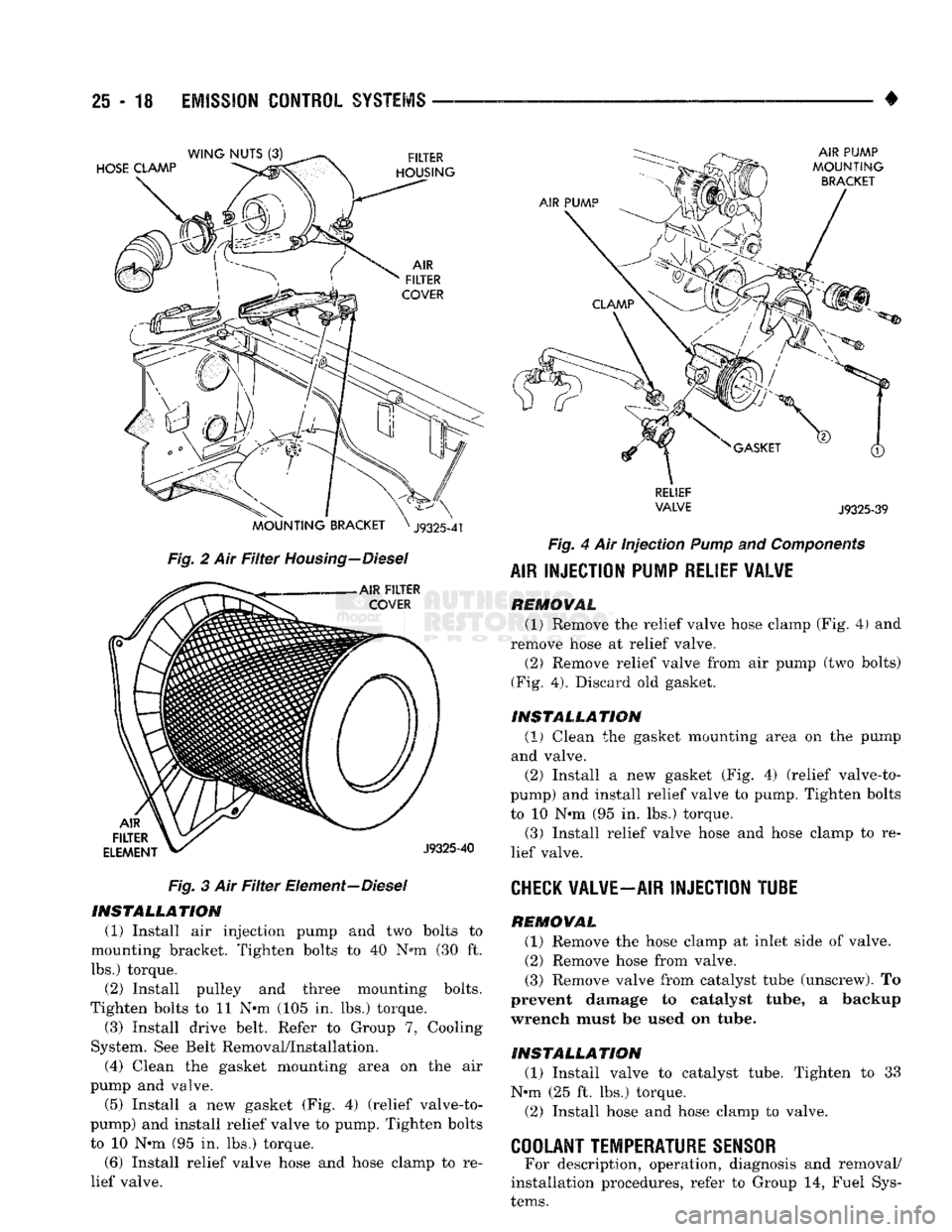
AIR FILTER/FILTER HOUSING-DIESEL ENGINES
REMO
VAL/INSTALLA
TION Remove the hose clamp at air filter housing (Fig.
2).
Remove mounting nuts and remove air filter
housing from vehicle.
To replace air filter element only: Remove hose clamp
and hose at air filter housing inlet tube. Remove three
wingnuts and air filter housing cover (Figs. 2 and 3). Clean inside of housing before replacing filter. Housing
removal is not necessary for filter replacement.
When installing a new air filter element, push el
ement into cover. Be sure it is pushed into tabs in
back of filter housing. Install wing nuts.
If housing had been removed, install mounting
nuts and tighten to 10 N»m (95 in. lbs.) torque.
AIR INJECTION PUMP
REMOVAL (1) Remove the relief valve hose clamp (Fig. 4) and
remove hose at relief valve.
(2) Remove relief valve from air pump (two bolts)
(Fig. 4). (3) Loosen (but do not remove at this time) the
three air pump pulley mounting bolts (number 2—figure 4).
(4) Relax the automatic belt tensioner and remove
the engine accessory drive belt. Refer to Group 7, Cooling System. See Belt Removal/Installation.
(5) Remove the three air pump pulley bolts and re
move pulley from pump.
(6) Remove the two air pump mounting bolts
(number
1—figure
4) and remove pump from mount
ing bracket.
Page 1495 of 1502
25
- 18
EMISSION
CONTROL
SYSTEMS
Fig. 2 Air Filter Housing—Diesel Fig. 3 Air Filter Element—Diesel INSTALLATION
(1) Install air injection pump and two bolts to
mounting bracket. Tighten bolts to 40 N*m (30 ft.
lbs.) torque. (2) Install pulley and three mounting bolts.
Tighten bolts to 11 N*m (105 in. lbs.) torque.
(3) Install drive belt. Refer to Group 7, Cooling
System. See Belt Removal/Installation.
(4) Clean the gasket mounting area on the air
pump and valve. (5) Install a new gasket (Fig. 4) (relief valve-to-
pump) and install relief valve to pump. Tighten bolts to 10 N*m (95 in. lbs.) torque.
(6) Install relief valve hose and hose clamp to re
lief valve. •
RELIEF
VALVE
J9325-39
Fig. 4 Air Injection
Pump
and
Components
AIR
INJECTION PUMP RELIEF VALVE REMOVAL
(1) Remove the relief valve hose clamp (Fig. 4) and
remove hose at relief valve.
(2) Remove relief valve from air pump (two bolts)
(Fig. 4). Discard old gasket.
INSTALLATION (1)
Clean the gasket mounting area on the pump
and valve. (2) Install a new gasket (Fig. 4) (relief valve-to-
pump) and install relief valve to pump. Tighten bolts
to 10 N*m (95 in. lbs.) torque. (3) Install relief valve hose and hose clamp to re
lief valve.
CHECK
VALVE—AIR INJECTION TUBE REMOVAL
(1) Remove the hose clamp at inlet side of valve.
(2) Remove hose from valve.
(3) Remove valve from catalyst tube (unscrew). To
prevent damage to catalyst tube, a backup
wrench must be used on tube.
INSTALLATION
(1) Install valve to catalyst tube. Tighten to 33
N«m (25 ft. lbs.) torque.
(2) Install hose and hose clamp to valve.
COOLANT TEMPERATURE SENSOR
For description, operation, diagnosis and removal/
installation procedures, refer to Group 14, Fuel Sys
tems.