Window FIAT PANDA 2009 169 / 2.G User Guide
[x] Cancel search | Manufacturer: FIAT, Model Year: 2009, Model line: PANDA, Model: FIAT PANDA 2009 169 / 2.GPages: 226, PDF Size: 5.29 MB
Page 46 of 226
45KNOW YOUR
VEHICLESAFETY
CORRECT USE
OF THE CAR
WARNING LIGHTS
AND MESSAGES
IN
AN EMERGENCY
CAR
MAINTENANCE
TECHNICAL
SPECIFICATIONS
INDEX
Button
T
– D
Air recirculation on/off
It is advisable to switch the internal air recirculation on
while standing in queues or in tunnels to prevent the in-
troduction of polluted air.
Led on button ON = recirculation ON.
Led on button OFF = recirculation OFF.
At low temperatures or if the compressor is off, the re-
circulation is forced to off to avoid misting.
IMPORTANT It is inadvisable to use air recirculation on
cold days as it would considerably increase the possibility
of windows misting up inside.
During
AUTO
operation, due to safety reasons and to refresh
air flow, after long recirculation activation (over 25 minutes)
the system will deactivate automatically air recirculation for
1 minute.
Buttons
ÕÔ
– E
Temperature setting
Pressing the button
Õ
the temperature in the passen-
ger compartment will rise until the value HI is reached
(maximum heating).
Pressing the button
Ô
the temperature in the passenger
compartment will decrease until the value LO is reached
(maximum cooling).
HI function
This function can be switched on to heat the passenger
compartment as quickly as possible; air distribution and fan
speed are controlled by the system.
To turn this function off, set the required temperature.
❒
it is not possible to convey air to the passenger com-
partment with a temperature below the outside tem-
perature (the displayed temperature value will flash
when the system cannot guarantee the required com-
fort conditions);
❒
the fan speed can be manually reset (with compressor
enabled, ventilation cannot go below a bar shown on
the display).
Button OFF – C
System switching off
Pressing the
OFF
button the system is switched off.
With the system off, the climate control system conditions
are as follows:
❒
all LEDs off;
❒
set temperature display off;
❒
air recirculation off;
❒
compressor off;
❒
fan off.
Under this condition, air recirculation can be turned on
or off without activating the system.
IMPORTANT The system will store the settings (except
recirculation) performed before turning off and will re-
sume them when pressing any button (if the function cor-
responding to the button pressed is off, it will be turned
on; if on it will be kept active). Press
AUTO
to start the
system automatically.
031-064 PANDA EN 7-10-2009 13:43 Pagina 45
Page 47 of 226
μ
air flow towards the front seat feet area. Due to the
natural tendency of heat to spread upwards, this type
of distribution warms the passenger compartment
up as quickly as possible, providing an immediate
feeling of warmth.
w+μ
distribution between feet area vents (warmest air)
and dashboard vents (coolest air).
¥+μ
distribution between feet area vents and wind-
screen/side front window vents. This type of distri-
bution achieves an adequate warming of the pas-
senger compartment and prevents the windows
from misting up.
The set air distribution is shown by the LEDs on the
selected buttons.
To restore the automatic air distribution control, press
the AUTO button.
During automatic operation, under particular climate con-
ditions, the system can send air to the windscreen although
the relevant LED does not turn on.
Button
-
- L
Fast front window demisting/defrosting
Pressing the button
-
the system activates all the functions
required for fast demisting/defrosting, that is:
❒
compressor switching-on (if the weather conditions are
suitable);
❒
air recirculation switching-off;
❒
maximum air temperature setting (HI); IMPORTANT If the heating fluid is not sufficiently hot, max-
imum fan speed will not be activated immediately to pre-
vent air not warm enough from entering the passenger
compartment.
LO function
This function can be switched on to cool the passenger
compartment as quickly as possible; with this function
switched on the compressor will be engaged whereas air
distribution and fan speed are controlled by the system.
To turn this function off, set the required temperature.
IMPORTANT With the function switched on, however, all
the manual settings can be made.
Buttons
ÕÔ
– F
Fan speed adjustment
Pressing the buttons
Õ
or
Ôrespectively, the fan speed
shown on the display bars increases or decreases.
The fan can be cut off only if the compressor has been
switched off (B button).
To restore automatic fan speed control, press the
AUTO
button.
Buttons
¥wμ
– G H I
Air distribution manual selection
Pressing the buttons, one of the five possible air flow
distribution patterns can be selected:
¥
air flow to the windscreen and front side window
vents to demist or defrost them.
w
air flow to the central and side dashboard vents to ven-
tilate the chest and the face during the hot season.
46
KNOW YOUR
VEHICLE
SAFETY
CORRECT USE
OF THE CAR
WARNING LIGHTS
AND MESSAGES
IN
AN EMERGENCY
CAR
MAINTENANCE
TECHNICAL
SPECIFICATIONS
INDEX
031-064 PANDA EN 7-10-2009 13:43 Pagina 46
Page 48 of 226
47KNOW YOUR
VEHICLESAFETY
CORRECT USE
OF THE CAR
WARNING LIGHTS
AND MESSAGES
IN
AN EMERGENCY
CAR
MAINTENANCE
TECHNICAL
SPECIFICATIONS
INDEX
❒
fan speed enabling depending on the coolant
temperature;
❒
air flow conveying to the windscreen and front side win-
dows;
❒
heated rear window switching-on.
IMPORTANT This function stays on for about 3 minutes,
since engine coolant temperature exceeds 50 °C (petrol
versions) or 35 °C (Diesel versions).
When the function is on, the LEDs on button
-
and those
on the heated rear window button
(
turn on, whereas
the AUTO button LED will turn off; when this function is
on, the only operations possible are fan speed adjustment
and heated rear window switching-off.
To turn the function off, press the button
-
again or
the AUTO button.
USING THE CLIMATE CONTROL SYSTEM The system can be turned on in different ways, it is how-
ever advisable to set the required temperature and then
to press the AUTO button. In this way, the system starts
to work fully automatically to reach the required com-
fort conditions as soon as possible.
During automatic operation it is possible:❒
to select the required temperature (buttons
ÔÕ
– E);
❒
to activate or deactivate air recirculation
(button
T
– D);
❒
to activate fast window demisting/defrosting
(button
-
– L);
❒
to select air distribution (buttons
¥wμ
– G H I);
❒
to select the fan speed (buttons
ÕÔ
– F).
The system will automatically modify its settings accord-
ing to set changes and the button LED will turn off.
To restore automatic operation press again the
AUTO
button.
SYSTEM SERVICING
In winter, the climate control system must be turned on
at least once a month for about 10 minutes.
Before summer, have the system inspected at a Fiat
Dealership.
The system uses R134a refrigerant fluid
which does not pollute the environment in
the event of accidental leakage. Under no
circumstances should R12 fluid be used as it is in-
compatible with the system components.
031-064 PANDA EN 7-10-2009 13:43 Pagina 47
Page 51 of 226
,
F0Z0127m
fig. 50
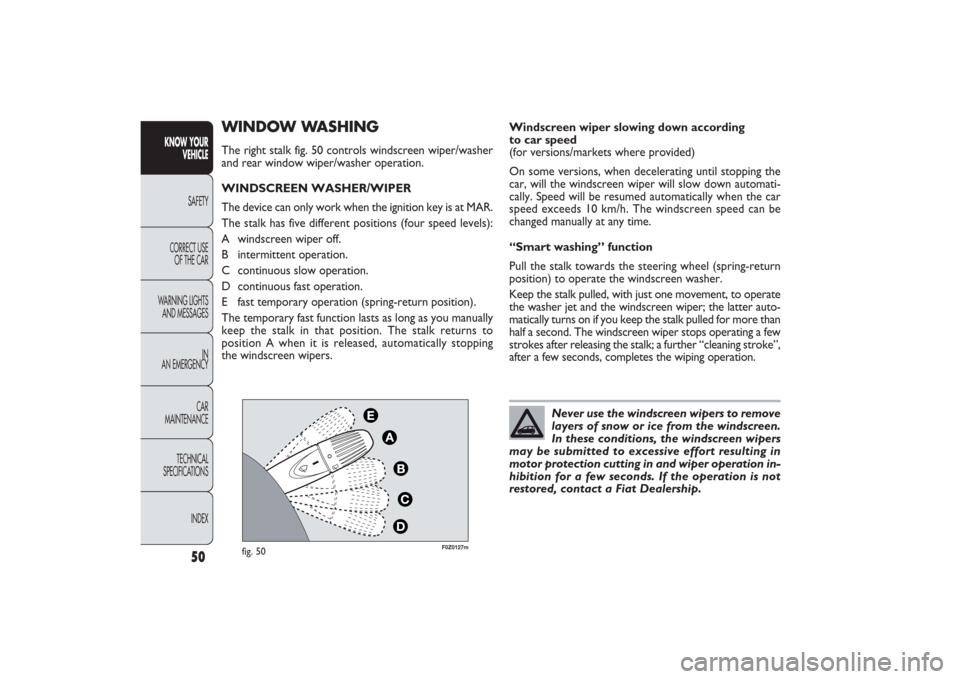
WINDOW WASHINGThe right stalk fig. 50 controls windscreen wiper/washer
and rear window wiper/washer operation.
WINDSCREEN WASHER/WIPER
The device can only work when the ignition key is at MAR.
The stalk has five different positions (four speed levels):
A windscreen wiper off.
B intermittent operation.
C continuous slow operation.
D continuous fast operation.
E fast temporary operation (spring-return position).
The temporary fast function lasts as long as you manually
keep the stalk in that position. The stalk returns to
position A when it is released, automatically stopping
the windscreen wipers.
50
KNOW YOUR
VEHICLE
SAFETY
CORRECT USE
OF THE CAR
WARNING LIGHTS
AND MESSAGES
IN
AN EMERGENCY
CAR
MAINTENANCE
TECHNICAL
SPECIFICATIONS
INDEX
Windscreen wiper slowing down according
to car speed
(for versions/markets where provided)
On some versions, when decelerating until stopping the
car, will the windscreen wiper will slow down automati-
cally. Speed will be resumed automatically when the car
speed exceeds 10 km/h. The windscreen speed can be
changed manually at any time.
“Smart washing” function
Pull the stalk towards the steering wheel (spring-return
position) to operate the windscreen washer.
Keep the stalk pulled, with just one movement, to operate
the washer jet and the windscreen wiper; the latter auto-
matically turns on if you keep the stalk pulled for more than
half a second. The windscreen wiper stops operating a few
strokes after releasing the stalk; a further “cleaning stroke”,
after a few seconds, completes the wiping operation.
Never use the windscreen wipers to remove
layers of snow or ice from the windscreen.
In these conditions, the windscreen wipers
may be submitted to excessive effort resulting in
motor protection cutting in and wiper operation in-
hibition for a few seconds. If the operation is not
restored, contact a Fiat Dealership.
031-064 PANDA EN 7-10-2009 13:43 Pagina 50
Page 52 of 226
51KNOW YOUR
VEHICLESAFETY
CORRECT USE
OF THE CAR
WARNING LIGHTS
AND MESSAGES
IN
AN EMERGENCY
CAR
MAINTENANCE
TECHNICAL
SPECIFICATIONS
INDEX
REAR WINDOW WASHER/WIPER
The device can only work when the ignition key is at MAR.
Turn the knurled ring to
'
to operate the rear window
wiper.
With the windscreen wiper on, turn the knurled ring to
'
to turn on the rear window wiper. In this case the wiper
works (in the different positions) timed with the wind-
screen wiper, but at half speed.
With the windscreen wiper on, engaging reverse gear will
automatically turn the rear window wiper on, in continu-
ous slow operation.
Operation stops by disengaging reverse.
“Smart washing” function
Pushing the stalk towards the dashboard (spring-return
position) will activate the rear window washer.
Keep the stalk pressed, with just one movement, to op-
erate the rear window washer jet and the rear window
wiper itself; the latter automatically turns on if you keep
the stalk pressed for more than half a second.
The rear window wiper stops operating a few strokes af-
ter releasing the stalk; a further “cleaning stroke”, after
a few seconds, completes the wiping operation.
Do not use the rear window wiper to re-
move layers of snow or ice from the wind-
screen. In these conditions, the rear window
wipers may be submitted to excessive effort result-
ing in motor protection cutting in and wiper oper-
ation inhibition for a few seconds. If the operation
is not restored, contact a Fiat Dealership.
031-064 PANDA EN 7-10-2009 13:43 Pagina 51
Page 55 of 226
F0Z0028m
fig. 54
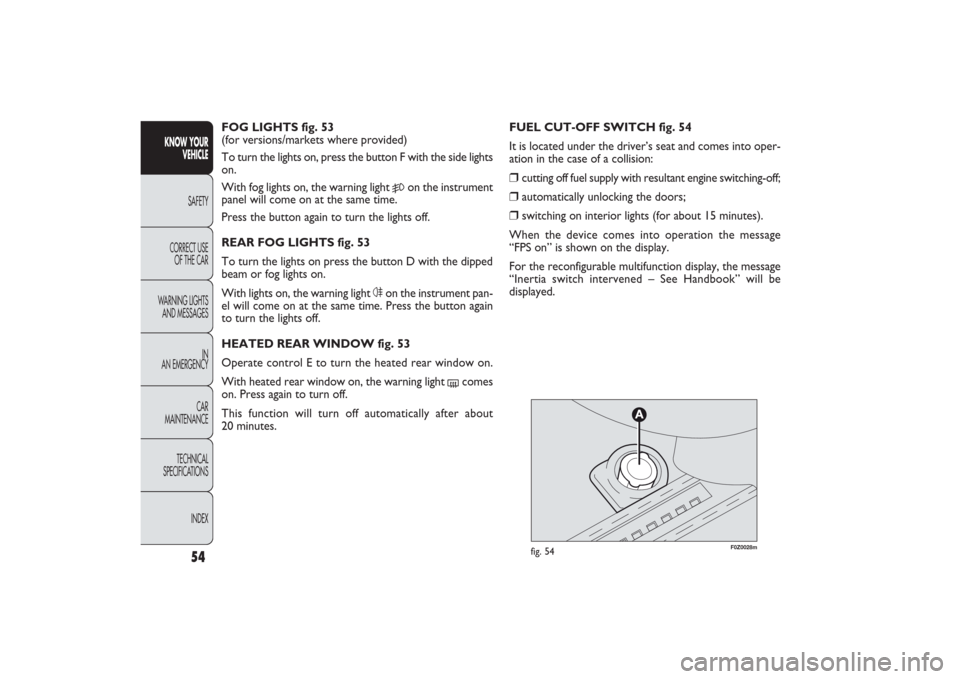
FUEL CUT-OFF SWITCH fig. 54
It is located under the driver’s seat and comes into oper-
ation in the case of a collision:❒
cutting off fuel supply with resultant engine switching-off;
❒
automatically unlocking the doors;
❒
switching on interior lights (for about 15 minutes).
When the device comes into operation the message
“FPS on” is shown on the display.
For the reconfigurable multifunction display, the message
“Inertia switch intervened – See Handbook” will be
displayed. FOG LIGHTS fig. 53
(for versions/markets where provided)
To turn the lights on, press the button F with the side lights
on.
With fog lights on, the warning light
5
on the instrument
panel will come on at the same time.
Press the button again to turn the lights off.
REAR FOG LIGHTS fig. 53
To turn the lights on press the button D with the dipped
beam or fog lights on.
With lights on, the warning light 4on the instrument pan-
el will come on at the same time. Press the button again
to turn the lights off.
HEATED REAR WINDOW fig. 53
Operate control E to turn the heated rear window on.
With heated rear window on, the warning light
(
comes
on. Press again to turn off.
This function will turn off automatically after about
20 minutes.
54
KNOW YOUR
VEHICLE
SAFETY
CORRECT USE
OF THE CAR
WARNING LIGHTS
AND MESSAGES
IN
AN EMERGENCY
CAR
MAINTENANCE
TECHNICAL
SPECIFICATIONS
INDEX
031-064 PANDA EN 7-10-2009 13:43 Pagina 54
Page 64 of 226
F0Z0025m
fig. 70
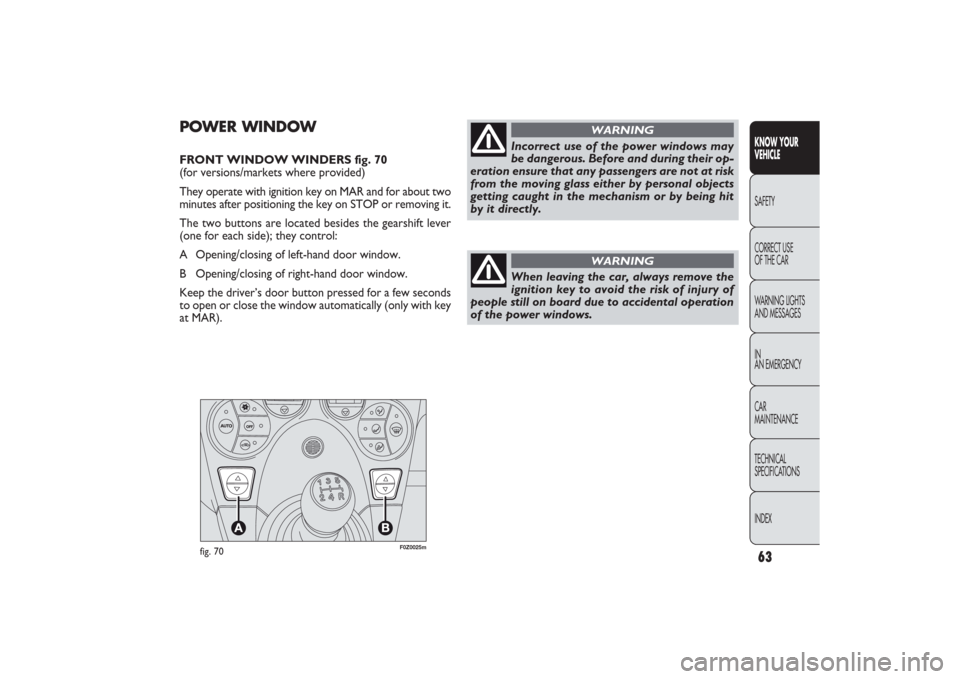
POWER WINDOW FRONT WINDOW WINDERS fig. 70
(for versions/markets where provided)
They operate with ignition key on MAR and for about two
minutes after positioning the key on STOP or removing it.
The two buttons are located besides the gearshift lever
(one for each side); they control:
A Opening/closing of left-hand door window.
B Opening/closing of right-hand door window.
Keep the driver’s door button pressed for a few seconds
to open or close the window automatically (only with key
at MAR).
Incorrect use of the power windows may
be dangerous. Before and during their op-
eration ensure that any passengers are not at risk
from the moving glass either by personal objects
getting caught in the mechanism or by being hit
by it directly.
WARNING
When leaving the car, always remove the
ignition key to avoid the risk of injury of
people still on board due to accidental operation
of the power windows.
WARNING
63KNOW YOUR
VEHICLESAFETY
CORRECT USE
OF THE CAR
WARNING LIGHTS
AND MESSAGES
IN
AN EMERGENCY
CAR
MAINTENANCE
TECHNICAL
SPECIFICATIONS
INDEX
031-064 PANDA EN 7-10-2009 13:43 Pagina 63
Page 65 of 226
64
KNOW YOUR
VEHICLE
SAFETY
CORRECT USE
OF THE CAR
WARNING LIGHTS
AND MESSAGES
IN
AN EMERGENCY
CAR
MAINTENANCE
TECHNICAL
SPECIFICATIONS
INDEX
F0Z0064m
fig. 71
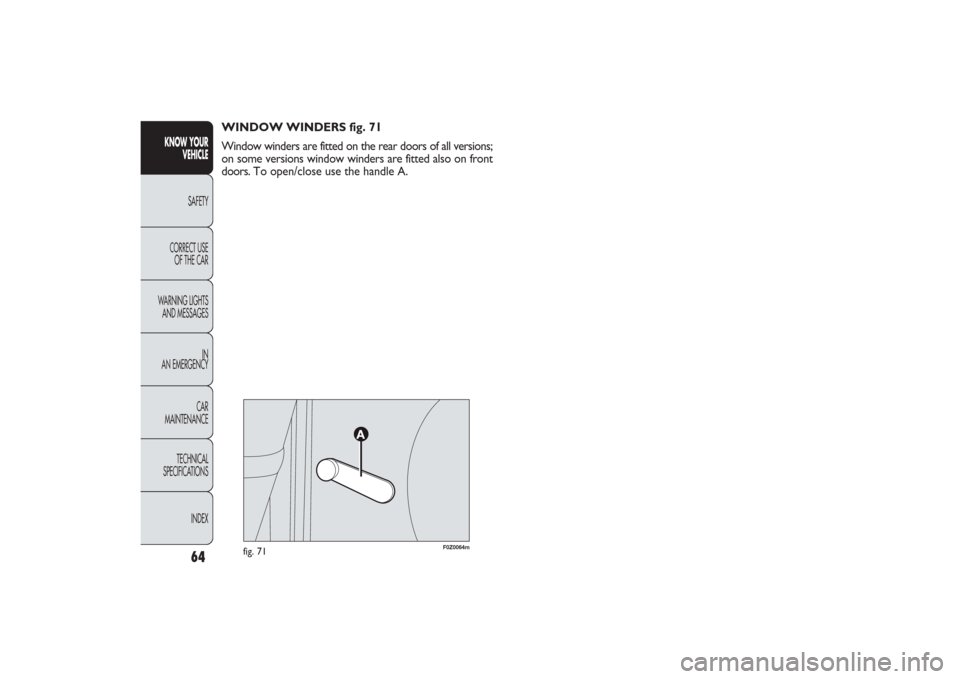
WINDOW WINDERS fig. 71
Window winders are fitted on the rear doors of all versions;
on some versions window winders are fitted also on front
doors. To open/close use the handle A.
031-064 PANDA EN 7-10-2009 13:43 Pagina 64
Page 105 of 226
104
KNOW YOUR
VEHICLE
SAFETY
CORRECT USE
OF THE CAR
WARNING LIGHTS
AND MESSAGES
IN AN EMERGENCY
CAR
MAINTENANCE
TECHNICAL
SPECIFICATIONS
INDEX
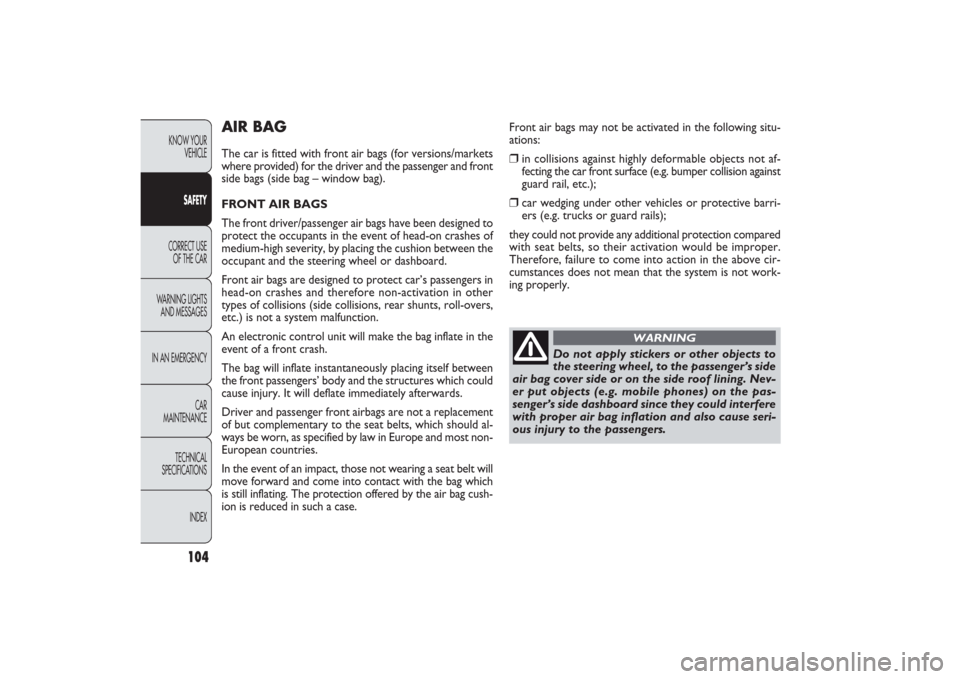
AIR BAGThe car is fitted with front air bags (for versions/markets
where provided) for the driver and the passenger and front
side bags (side bag – window bag).
FRONT AIR BAGS
The front driver/passenger air bags have been designed to
protect the occupants in the event of head-on crashes of
medium-high severity, by placing the cushion between the
occupant and the steering wheel or dashboard.
Front air bags are designed to protect car’s passengers in
head-on crashes and therefore non-activation in other
types of collisions (side collisions, rear shunts, roll-overs,
etc.) is not a system malfunction.
An electronic control unit will make the bag inflate in the
event of a front crash.
The bag will inflate instantaneously placing itself between
the front passengers’ body and the structures which could
cause injury. It will deflate immediately afterwards.
Driver and passenger front airbags are not a replacement
of but complementary to the seat belts, which should al-
ways be worn, as specified by law in Europe and most non-
European countries.
In the event of an impact, those not wearing a seat belt will
move forward and come into contact with the bag which
is still inflating. The protection offered by the air bag cush-
ion is reduced in such a case.Front air bags may not be activated in the following situ-
ations:
❒
in collisions against highly deformable objects not af-
fecting the car front surface (e.g. bumper collision against
guard rail, etc.);
❒
car wedging under other vehicles or protective barri-
ers (e.g. trucks or guard rails);
they could not provide any additional protection compared
with seat belts, so their activation would be improper.
Therefore, failure to come into action in the above cir-
cumstances does not mean that the system is not work-
ing properly.
Do not apply stickers or other objects to
the steering wheel, to the passenger’s side
air bag cover side or on the side roof lining. Nev-
er put objects (e.g. mobile phones) on the pas-
senger’s side dashboard since they could interfere
with proper air bag inflation and also cause seri-
ous injury to the passengers.
WARNING
091-110 PANDA EN 7-10-2009 13:46 Pagina 104
Page 108 of 226
107KNOW YOUR
VEHICLESAFETYCORRECT USE
OF THE CAR
WARNING LIGHTS
AND MESSAGES
IN AN EMERGENCY
CAR
MAINTENANCE
TECHNICAL
SPECIFICATIONS
INDEX
F0Z0058m
fig. 114
F0Z0059m
fig. 115
IMPORTANT In the event of side crash, you can obtain
the best protection by the system keeping a correct po-
sition on the seat, allowing thus a correct window bag
deployment.
IMPORTANT The front air bags and/or side bags may be de-
ployed if the car is subject to heavy collisions or accidents
involving the underbody area, such as for example violent
shocks against steps, kerbs or low obstacles, falling of the car
in big holes or sags in the road.
IMPORTANT A small amount of dust will be released
when the air bags are deployed. The dust is harmless
and does not indicate the beginning of a fire. Furthermore,
the surface of the deployed bag and the interior of the
car may be covered with residual dust. This dust can irri-
tate skin and eyes.
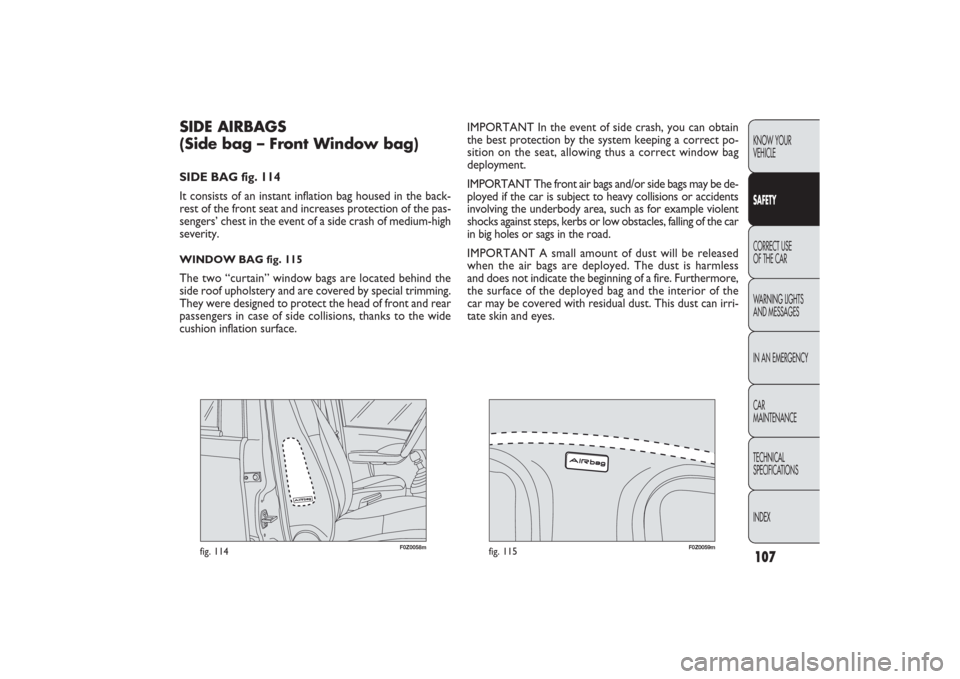
SIDE AIRBAGS
(Side bag – Front Window bag)SIDE BAG fig. 114
It consists of an instant inflation bag housed in the back-
rest of the front seat and increases protection of the pas-
sengers’ chest in the event of a side crash of medium-high
severity.WINDOW BAG fig. 115The two “curtain” window bags are located behind the
side roof upholstery and are covered by special trimming.
They were designed to protect the head of front and rear
passengers in case of side collisions, thanks to the wide
cushion inflation surface.
091-110 PANDA EN 7-10-2009 13:46 Pagina 107