alternator FIAT UNO 1983 Service Owner's Manual
[x] Cancel search | Manufacturer: FIAT, Model Year: 1983, Model line: UNO, Model: FIAT UNO 1983Pages: 303, PDF Size: 10.36 MB
Page 103 of 303
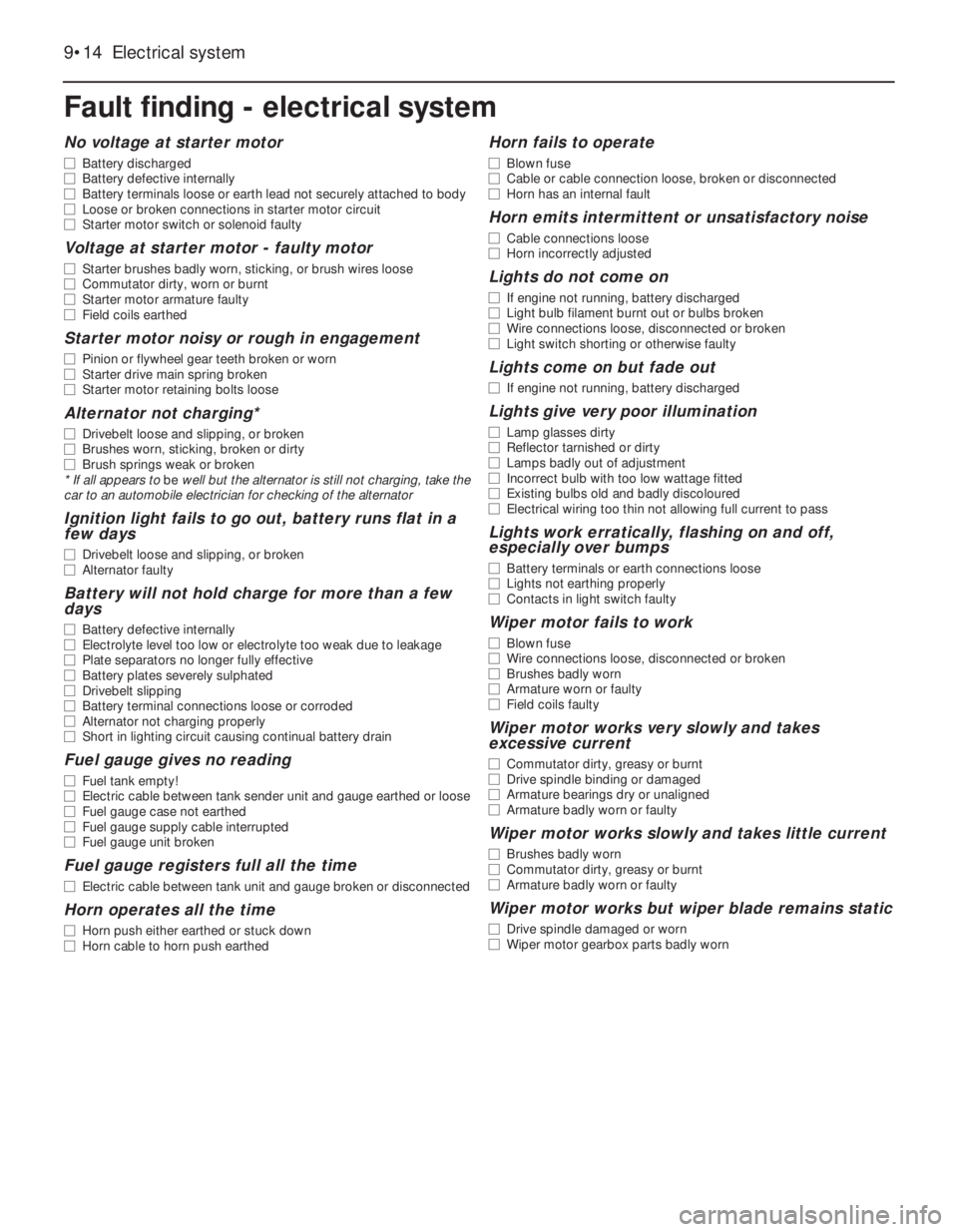
9•14 Electrical system
Fault finding - electrical system
No voltage at starter motor
m mBattery discharged
m mBattery defective internally
m mBattery terminals loose or earth lead not securely attached to body
m mLoose or broken connections in starter motor circuit
m mStarter motor switch or solenoid faulty
Voltage at starter motor - faulty motor
m
mStarter brushes badly worn, sticking, or brush wires loose
m mCommutator dirty, worn or burnt
m mStarter motor armature faulty
m mField coils earthed
Starter motor noisy or rough in engagement
m
mPinion or flywheel gear teeth broken or worn
m mStarter drive main spring broken
m mStarter motor retaining bolts loose
Alternator not charging*
m
mDrivebelt loose and slipping, or broken
m mBrushes worn, sticking, broken or dirty
m mBrush springs weak or broken
* If all appears to be well but the alternator is still not charging, take the
car to an automobile electrician for checking of the alternator
Ignition light fails to go out, battery runs flat in a
few days
m mDrivebelt loose and slipping, or broken
m mAlternator faulty
Battery will not hold charge for more than a few
days
m mBattery defective internally
m mElectrolyte level too low or electrolyte too weak due to leakage
m mPlate separators no longer fully effective
m mBattery plates severely sulphated
m mDrivebelt slipping
m mBattery terminal connections loose or corroded
m mAlternator not charging properly
m mShort in lighting circuit causing continual battery drain
Fuel gauge gives no reading
m
mFuel tank empty!
m mElectric cable between tank sender unit and gauge earthed or loose
m mFuel gauge case not earthed
m mFuel gauge supply cable interrupted
m mFuel gauge unit broken
Fuel gauge registers full all the time
m
mElectric cable between tank unit and gauge broken or disconnected
Horn operates all the time
m
mHorn push either earthed or stuck down
m mHorn cable to horn push earthed
Horn fails to operate
m
mBlown fuse
m mCable or cable connection loose, broken or disconnected
m mHorn has an internal fault
Horn emits intermittent or unsatisfactory noise
m
mCable connections loose
m mHorn incorrectly adjusted
Lights do not come on
m
mIf engine not running, battery discharged
m mLight bulb filament burnt out or bulbs broken
m mWire connections loose, disconnected or broken
m mLight switch shorting or otherwise faulty
Lights come on but fade out
m
mIf engine not running, battery discharged
Lights give very poor illumination
m
mLamp glasses dirty
m mReflector tarnished or dirty
m mLamps badly out of adjustment
m mIncorrect bulb with too low wattage fitted
m mExisting bulbs old and badly discoloured
m mElectrical wiring too thin not allowing full current to pass
Lights work erratically, flashing on and off,
especially over bumps
m mBattery terminals or earth connections loose
m mLights not earthing properly
m mContacts in light switch faulty
Wiper motor fails to work
m
mBlown fuse
m mWire connections loose, disconnected or broken
m mBrushes badly worn
m mArmature worn or faulty
m mField coils faulty
Wiper motor works very slowly and takes
excessive current
m mCommutator dirty, greasy or burnt
m mDrive spindle binding or damaged
m mArmature bearings dry or unaligned
m mArmature badly worn or faulty
Wiper motor works slowly and takes little current
m
mBrushes badly worn
m mCommutator dirty, greasy or burnt
m mArmature badly worn or faulty
Wiper motor works but wiper blade remains static
m
mDrive spindle damaged or worn
m mWiper motor gearbox parts badly worn
Page 127 of 303
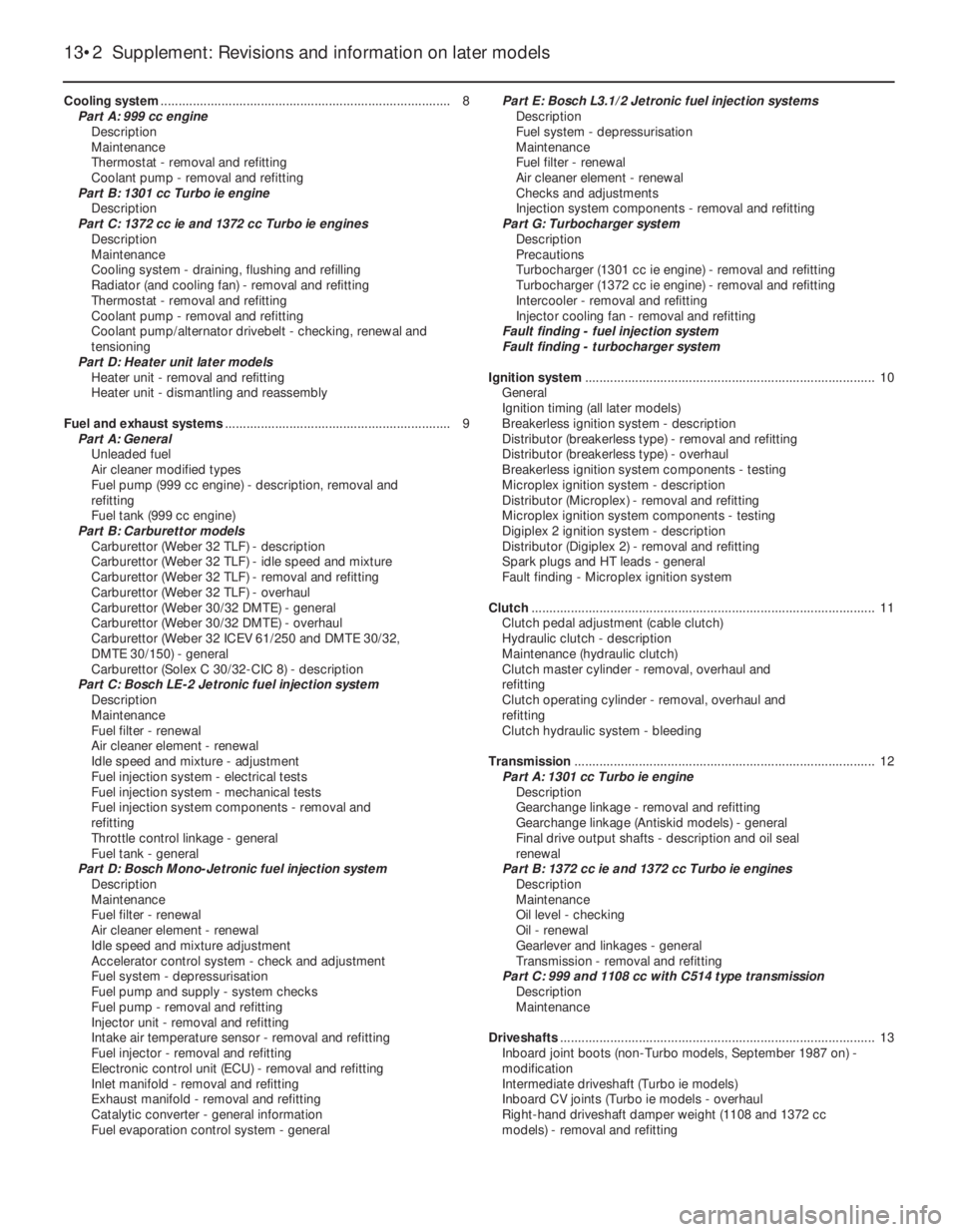
Cooling system................................................................................. 8
Part A: 999 cc engine
Description
Maintenance
Thermostat - removal and refitting
Coolant pump - removal and refitting
Part B: 1301 cc Turbo ie engine
Description
Part C: 1372 cc ie and 1372 cc Turbo ie engines
Description
Maintenance
Cooling system - draining, flushing and refilling
Radiator (and cooling fan) - removal and refitting
Thermostat - removal and refitting
Coolant pump - removal and refitting
Coolant pump/alternator drivebelt - checking, renewal and
tensioning
Part D: Heater unit later models
Heater unit - removal and refitting
Heater unit - dismantling and reassembly
Fuel and exhaust systems............................................................... 9
Part A: General
Unleaded fuel
Air cleaner modified types
Fuel pump (999 cc engine) - description, removal and
refitting
Fuel tank (999 cc engine)
Part B: Carburettor models
Carburettor (Weber 32 TLF) - description
Carburettor (Weber 32 TLF) - idle speed and mixture
Carburettor (Weber 32 TLF) - removal and refitting
Carburettor (Weber 32 TLF) - overhaul
Carburettor (Weber 30/32 DMTE) - general
Carburettor (Weber 30/32 DMTE) - overhaul
Carburettor (Weber 32 ICEV 61/250 and DMTE 30/32,
DMTE 30/150) - general
Carburettor (Solex C 30/32-CIC 8) - description
Part C: Bosch LE-2 Jetronic fuel injection system
Description
Maintenance
Fuel filter - renewal
Air cleaner element - renewal
Idle speed and mixture - adjustment
Fuel injection system - electrical tests
Fuel injection system - mechanical tests
Fuel injection system components - removal and
refitting
Throttle control linkage - general
Fuel tank - general
Part D: Bosch Mono-Jetronic fuel injection system
Description
Maintenance
Fuel filter - renewal
Air cleaner element - renewal
Idle speed and mixture adjustment
Accelerator control system - check and adjustment
Fuel system - depressurisation
Fuel pump and supply - system checks
Fuel pump - removal and refitting
Injector unit - removal and refitting
Intake air temperature sensor - removal and refitting
Fuel injector - removal and refitting
Electronic control unit (ECU) - removal and refitting
Inlet manifold - removal and refitting
Exhaust manifold - removal and refitting
Catalytic converter - general information
Fuel evaporation control system - generalPart E: Bosch L3.1/2 Jetronic fuel injection systems
Description
Fuel system - depressurisation
Maintenance
Fuel filter - renewal
Air cleaner element - renewal
Checks and adjustments
Injection system components - removal and refitting
Part G: Turbocharger system
Description
Precautions
Turbocharger (1301 cc ie engine) - removal and refitting
Turbocharger (1372 cc ie engine) - removal and refitting
Intercooler - removal and refitting
Injector cooling fan - removal and refitting
Fault finding - fuel injection system
Fault finding - turbocharger system
Ignition system................................................................................. 10
General
Ignition timing (all later models)
Breakerless ignition system - description
Distributor (breakerless type) - removal and refitting
Distributor (breakerless type) - overhaul
Breakerless ignition system components - testing
Microplex ignition system - description
Distributor (Microplex) - removal and refitting
Microplex ignition system components - testing
Digiplex 2 ignition system - description
Distributor (Digiplex 2) - removal and refitting
Spark plugs and HT leads - general
Fault finding - Microplex ignition system
Clutch................................................................................................ 11
Clutch pedal adjustment (cable clutch)
Hydraulic clutch - description
Maintenance (hydraulic clutch)
Clutch master cylinder - removal, overhaul and
refitting
Clutch operating cylinder - removal, overhaul and
refitting
Clutch hydraulic system - bleeding
Transmission.................................................................................... 12
Part A: 1301 cc Turbo ie engine
Description
Gearchange linkage - removal and refitting
Gearchange linkage (Antiskid models) - general
Final drive output shafts - description and oil seal
renewal
Part B: 1372 cc ie and 1372 cc Turbo ie engines
Description
Maintenance
Oil level - checking
Oil - renewal
Gearlever and linkages - general
Transmission - removal and refitting
Part C: 999 and 1108 cc with C514 type transmission
Description
Maintenance
Driveshafts........................................................................................ 13
Inboard joint boots (non-Turbo models, September 1987 on) -
modification
Intermediate driveshaft (Turbo ie models)
Inboard CV joints (Turbo ie models - overhaul
Right-hand driveshaft damper weight (1108 and 1372 cc
models) - removal and refitting
13•2 Supplement: Revisions and information on later models
Page 128 of 303
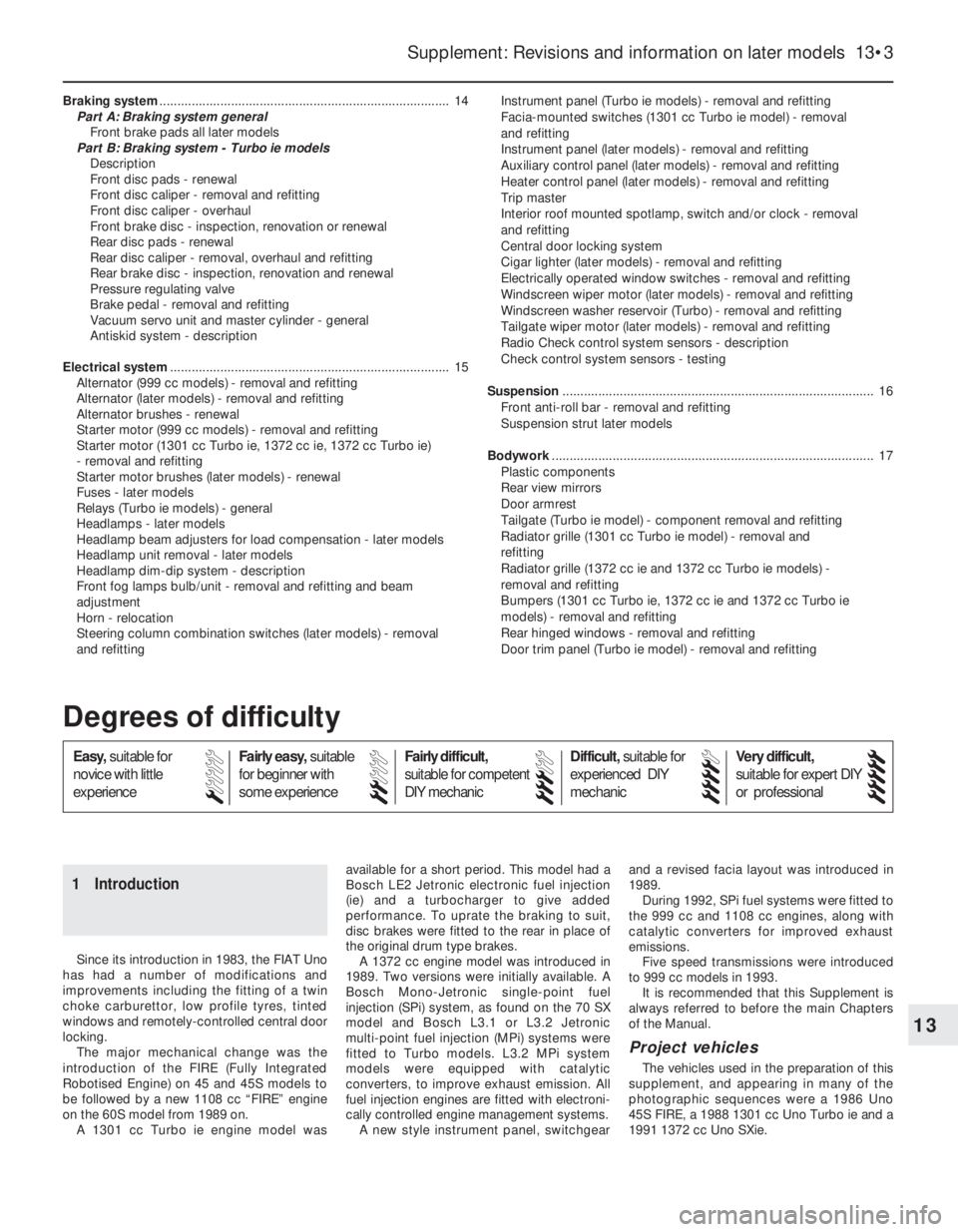
Braking system................................................................................. 14
Part A: Braking system general
Front brake pads all later models
Part B: Braking system - Turbo ie models
Description
Front disc pads - renewal
Front disc caliper - removal and refitting
Front disc caliper - overhaul
Front brake disc - inspection, renovation or renewal
Rear disc pads - renewal
Rear disc caliper - removal, overhaul and refitting
Rear brake disc - inspection, renovation and renewal
Pressure regulating valve
Brake pedal - removal and refitting
Vacuum servo unit and master cylinder - general
Antiskid system - description
Electrical system.............................................................................. 15
Alternator (999 cc models) - removal and refitting
Alternator (later models) - removal and refitting
Alternator brushes - renewal
Starter motor (999 cc models) - removal and refitting
Starter motor (1301 cc Turbo ie, 1372 cc ie, 1372 cc Turbo ie)
- removal and refitting
Starter motor brushes (later models) - renewal
Fuses - later models
Relays (Turbo ie models) - general
Headlamps - later models
Headlamp beam adjusters for load compensation - later models
Headlamp unit removal - later models
Headlamp dim-dip system - description
Front fog lamps bulb/unit - removal and refitting and beam
adjustment
Horn - relocation
Steering column combination switches (later models) - removal
and refittingInstrument panel (Turbo ie models) - removal and refitting
Facia-mounted switches (1301 cc Turbo ie model) - removal
and refitting
Instrument panel (later models) - removal and refitting
Auxiliary control panel (later models) - removal and refitting
Heater control panel (later models) - removal and refitting
Trip master
Interior roof mounted spotlamp, switch and/or clock - removal
and refitting
Central door locking system
Cigar lighter (later models) - removal and refitting
Electrically operated window switches - removal and refitting
Windscreen wiper motor (later models) - removal and refitting
Windscreen washer reservoir (Turbo) - removal and refitting
Tailgate wiper motor (later models) - removal and refitting
Radio Check control system sensors - description
Check control system sensors - testing
Suspension....................................................................................... 16
Front anti-roll bar - removal and refitting
Suspension strut later models
Bodywork.......................................................................................... 17
Plastic components
Rear view mirrors
Door armrest
Tailgate (Turbo ie model) - component removal and refitting
Radiator grille (1301 cc Turbo ie model) - removal and
refitting
Radiator grille (1372 cc ie and 1372 cc Turbo ie models) -
removal and refitting
Bumpers (1301 cc Turbo ie, 1372 cc ie and 1372 cc Turbo ie
models) - removal and refitting
Rear hinged windows - removal and refitting
Door trim panel (Turbo ie model) - removal and refitting
Supplement: Revisions and information on later models 13•3
13
1 Introduction
Since its introduction in 1983, the FIAT Uno
has had a number of modifications and
improvements including the fitting of a twin
choke carburettor, low profile tyres, tinted
windows and remotely-controlled central door
locking.
The major mechanical change was the
introduction of the FIRE (Fully Integrated
Robotised Engine) on 45 and 45S models to
be followed by a new 1108 cc “FIRE” engine
on the 60S model from 1989 on.
A 1301 cc Turbo ie engine model wasavailable for a short period. This model had a
Bosch LE2 Jetronic electronic fuel injection
(ie) and a turbocharger to give added
performance. To uprate the braking to suit,
disc brakes were fitted to the rear in place of
the original drum type brakes.
A 1372 cc engine model was introduced in
1989. Two versions were initially available. A
Bosch Mono-Jetronic single-point fuel
injection (SPi) system, as found on the 70 SX
model and Bosch L3.1 or L3.2 Jetronic
multi-point fuel injection (MPi) systems were
fitted to Turbo models. L3.2 MPi system
models were equipped with catalytic
converters, to improve exhaust emission. All
fuel injection engines are fitted with electroni-
cally controlled engine management systems.
A new style instrument panel, switchgearand a revised facia layout was introduced in
1989.
During 1992, SPi fuel systems were fitted to
the 999 cc and 1108 cc engines, along with
catalytic converters for improved exhaust
emissions.
Five speed transmissions were introduced
to 999 cc models in 1993.
It is recommended that this Supplement is
always referred to before the main Chapters
of the Manual.
Project vehicles
The vehicles used in the preparation of this
supplement, and appearing in many of the
photographic sequences were a 1986 Uno
45S FIRE, a 1988 1301 cc Uno Turbo ie and a
1991 1372 cc Uno SXie.
Easy,suitable for
novice with little
experienceFairly easy,suitable
for beginner with
some experienceFairly difficult,
suitable for competent
DIY mechanic
Difficult,suitable for
experienced DIY
mechanicVery difficult,
suitable for expert DIY
or professional
Degrees of difficulty
54321
Page 131 of 303
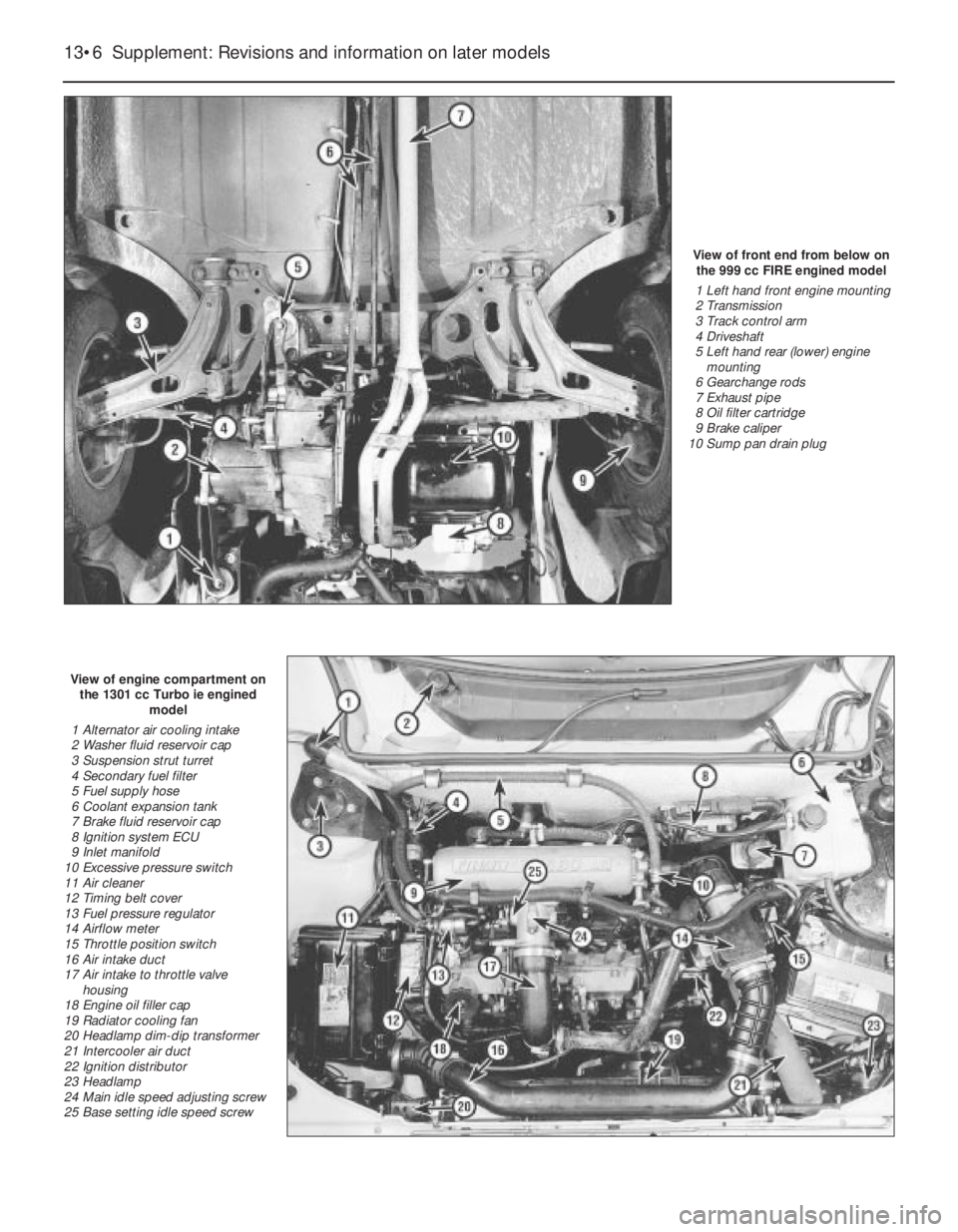
View of front end from below on
the 999 cc FIRE engined model
1 Left hand front engine mounting
2 Transmission
3 Track control arm
4 Driveshaft
5 Left hand rear (lower) engine
mounting
6 Gearchange rods
7 Exhaust pipe
8 Oil filter cartridge
9 Brake caliper
10 Sump pan drain plug
View of engine compartment on
the 1301 cc Turbo ie engined
model
1 Alternator air cooling intake
2 Washer fluid reservoir cap
3 Suspension strut turret
4 Secondary fuel filter
5 Fuel supply hose
6 Coolant expansion tank
7 Brake fluid reservoir cap
8 Ignition system ECU
9 Inlet manifold
10 Excessive pressure switch
11 Air cleaner
12 Timing belt cover
13 Fuel pressure regulator
14 Airflow meter
15 Throttle position switch
16 Air intake duct
17 Air intake to throttle valve
housing
18 Engine oil filler cap
19 Radiator cooling fan
20 Headlamp dim-dip transformer
21 Intercooler air duct
22 Ignition distributor
23 Headlamp
24 Main idle speed adjusting screw
25 Base setting idle speed screw
13•6 Supplement: Revisions and information on later models
Page 135 of 303
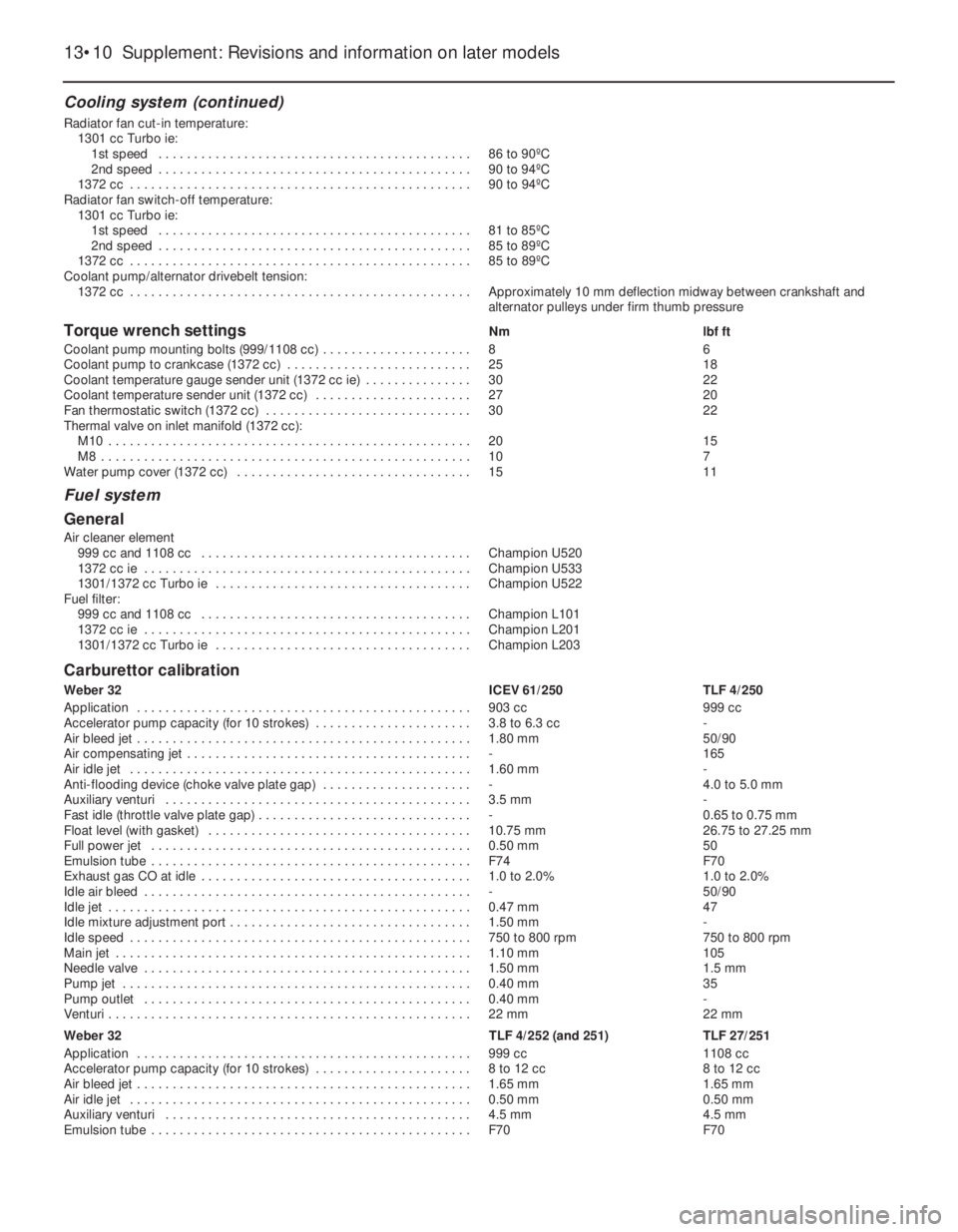
Cooling system (continued)
Radiator fan cut-in temperature:
1301 cc Turbo ie:
1st speed . . . . . . . . . . . . . . . . . . . . . . . . . . . . . . . . . . . . . . . . . . . . 86 to 90ºC
2nd speed . . . . . . . . . . . . . . . . . . . . . . . . . . . . . . . . . . . . . . . . . . . . 90 to 94ºC
1372 cc . . . . . . . . . . . . . . . . . . . . . . . . . . . . . . . . . . . . . . . . . . . . . . . . 90 to 94ºC
Radiator fan switch-off temperature:
1301 cc Turbo ie:
1st speed . . . . . . . . . . . . . . . . . . . . . . . . . . . . . . . . . . . . . . . . . . . . 81 to 85ºC
2nd speed . . . . . . . . . . . . . . . . . . . . . . . . . . . . . . . . . . . . . . . . . . . . 85 to 89ºC
1372 cc . . . . . . . . . . . . . . . . . . . . . . . . . . . . . . . . . . . . . . . . . . . . . . . . 85 to 89ºC
Coolant pump/alternator drivebelt tension:
1372 cc . . . . . . . . . . . . . . . . . . . . . . . . . . . . . . . . . . . . . . . . . . . . . . . . Approximately 10 mm deflection midway between crankshaft and
alternator pulleys under firm thumb pressure
Torque wrench settingsNm lbf ft
Coolant pump mounting bolts (999/1108 cc) . . . . . . . . . . . . . . . . . . . . . 8 6
Coolant pump to crankcase (1372 cc) . . . . . . . . . . . . . . . . . . . . . . . . . . 25 18
Coolant temperature gauge sender unit (1372 cc ie) . . . . . . . . . . . . . . . 30 22
Coolant temperature sender unit (1372 cc) . . . . . . . . . . . . . . . . . . . . . . 27 20
Fan thermostatic switch (1372 cc) . . . . . . . . . . . . . . . . . . . . . . . . . . . . . 30 22
Thermal valve on inlet manifold (1372 cc):
M10 . . . . . . . . . . . . . . . . . . . . . . . . . . . . . . . . . . . . . . . . . . . . . . . . . . . 20 15
M8 . . . . . . . . . . . . . . . . . . . . . . . . . . . . . . . . . . . . . . . . . . . . . . . . . . . . 10 7
Water pump cover (1372 cc) . . . . . . . . . . . . . . . . . . . . . . . . . . . . . . . . . 15 11
Fuel system
General
Air cleaner element
999 cc and 1108 cc . . . . . . . . . . . . . . . . . . . . . . . . . . . . . . . . . . . . . . Champion U520
1372 cc ie . . . . . . . . . . . . . . . . . . . . . . . . . . . . . . . . . . . . . . . . . . . . . . Champion U533
1301/1372 cc Turbo ie . . . . . . . . . . . . . . . . . . . . . . . . . . . . . . . . . . . . Champion U522
Fuel filter:
999 cc and 1108 cc . . . . . . . . . . . . . . . . . . . . . . . . . . . . . . . . . . . . . . Champion L101
1372 cc ie . . . . . . . . . . . . . . . . . . . . . . . . . . . . . . . . . . . . . . . . . . . . . . Champion L201
1301/1372 cc Turbo ie . . . . . . . . . . . . . . . . . . . . . . . . . . . . . . . . . . . . Champion L203
Carburettor calibration
Weber 32 ICEV 61/250 TLF 4/250
Application . . . . . . . . . . . . . . . . . . . . . . . . . . . . . . . . . . . . . . . . . . . . . . . 903 cc 999 cc
Accelerator pump capacity (for 10 strokes) . . . . . . . . . . . . . . . . . . . . . . 3.8 to 6.3 cc -
Air bleed jet . . . . . . . . . . . . . . . . . . . . . . . . . . . . . . . . . . . . . . . . . . . . . . . 1.80 mm 50/90
Air compensating jet . . . . . . . . . . . . . . . . . . . . . . . . . . . . . . . . . . . . . . . . - 165
Air idle jet . . . . . . . . . . . . . . . . . . . . . . . . . . . . . . . . . . . . . . . . . . . . . . . . 1.60 mm -
Anti-flooding device (choke valve plate gap) . . . . . . . . . . . . . . . . . . . . . - 4.0 to 5.0 mm
Auxiliary venturi . . . . . . . . . . . . . . . . . . . . . . . . . . . . . . . . . . . . . . . . . . . 3.5 mm -
Fast idle (throttle valve plate gap) . . . . . . . . . . . . . . . . . . . . . . . . . . . . . . - 0.65 to 0.75 mm
Float level (with gasket) . . . . . . . . . . . . . . . . . . . . . . . . . . . . . . . . . . . . . 10.75 mm 26.75 to 27.25 mm
Full power jet . . . . . . . . . . . . . . . . . . . . . . . . . . . . . . . . . . . . . . . . . . . . . 0.50 mm 50
Emulsion tube . . . . . . . . . . . . . . . . . . . . . . . . . . . . . . . . . . . . . . . . . . . . . F74 F70
Exhaust gas CO at idle . . . . . . . . . . . . . . . . . . . . . . . . . . . . . . . . . . . . . . 1.0 to 2.0% 1.0 to 2.0%
Idle air bleed . . . . . . . . . . . . . . . . . . . . . . . . . . . . . . . . . . . . . . . . . . . . . . - 50/90
Idle jet . . . . . . . . . . . . . . . . . . . . . . . . . . . . . . . . . . . . . . . . . . . . . . . . . . . 0.47 mm 47
Idle mixture adjustment port . . . . . . . . . . . . . . . . . . . . . . . . . . . . . . . . . . 1.50 mm -
Idle speed . . . . . . . . . . . . . . . . . . . . . . . . . . . . . . . . . . . . . . . . . . . . . . . . 750 to 800 rpm 750 to 800 rpm
Main jet . . . . . . . . . . . . . . . . . . . . . . . . . . . . . . . . . . . . . . . . . . . . . . . . . . 1.10 mm 105
Needle valve . . . . . . . . . . . . . . . . . . . . . . . . . . . . . . . . . . . . . . . . . . . . . . 1.50 mm 1.5 mm
Pump jet . . . . . . . . . . . . . . . . . . . . . . . . . . . . . . . . . . . . . . . . . . . . . . . . . 0.40 mm 35
Pump outlet . . . . . . . . . . . . . . . . . . . . . . . . . . . . . . . . . . . . . . . . . . . . . . 0.40 mm -
Venturi . . . . . . . . . . . . . . . . . . . . . . . . . . . . . . . . . . . . . . . . . . . . . . . . . . . 22 mm 22 mm
Weber 32 TLF 4/252 (and 251) TLF 27/251
Application . . . . . . . . . . . . . . . . . . . . . . . . . . . . . . . . . . . . . . . . . . . . . . . 999 cc 1108 cc
Accelerator pump capacity (for 10 strokes) . . . . . . . . . . . . . . . . . . . . . . 8 to 12 cc 8 to 12 cc
Air bleed jet . . . . . . . . . . . . . . . . . . . . . . . . . . . . . . . . . . . . . . . . . . . . . . . 1.65 mm 1.65 mm
Air idle jet . . . . . . . . . . . . . . . . . . . . . . . . . . . . . . . . . . . . . . . . . . . . . . . . 0.50 mm 0.50 mm
Auxiliary venturi . . . . . . . . . . . . . . . . . . . . . . . . . . . . . . . . . . . . . . . . . . . 4.5 mm 4.5 mm
Emulsion tube . . . . . . . . . . . . . . . . . . . . . . . . . . . . . . . . . . . . . . . . . . . . . F70 F70
13•10 Supplement: Revisions and information on later models
Page 145 of 303
mounted on the front end of the crankshaft
and driven by it.
11The flexible toothed timing belt drives thecamshaft and the coolant pump from a
sprocket on the front end of the crankshaft.
The belt is tensioned by an
eccentrically-mounted pulley.
12The distributor and the fuel pump
(carburettor models) are driven from the
flywheel end of the camshaft. The fuel pump
on fuel injection models is an integral unit
combined with the fuel gauge sender unit and
immersed in the fuel tank.
PART B:
OPERATIONS POSSIBLE
WITH ENGINE IN CAR
Valve clearances - adjustment
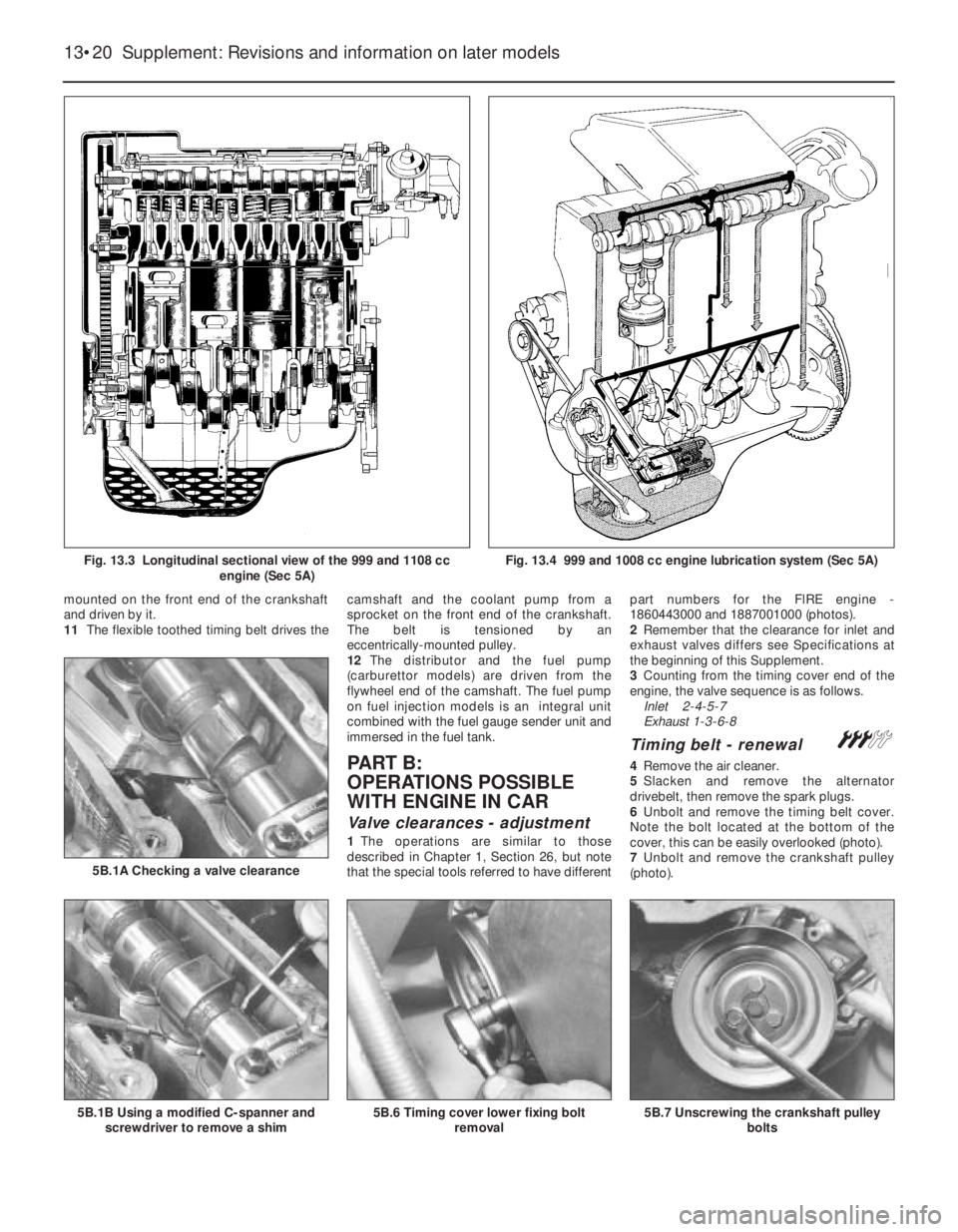
1The operations are similar to those
described in Chapter 1, Section 26, but note
that the special tools referred to have differentpart numbers for the FlRE engine -
1860443000 and 1887001000 (photos).
2Remember that the clearance for inlet and
exhaust valves differs see Specifications at
the beginning of this Supplement.
3Counting from the timing cover end of the
engine, the valve sequence is as follows.
Inlet 2-4-5-7
Exhaust 1-3-6-8
Timing belt - renewal #
4Remove the air cleaner.
5Slacken and remove the alternator
drivebelt, then remove the spark plugs.
6Unbolt and remove the timing belt cover.
Note the bolt located at the bottom of the
cover, this can be easily overlooked (photo).
7Unbolt and remove the crankshaft pulley
(photo).
13•20 Supplement: Revisions and information on later models
5B.7 Unscrewing the crankshaft pulley
bolts5B.6 Timing cover lower fixing bolt
removal5B.1B Using a modified C-spanner and
screwdriver to remove a shim
5B.1A Checking a valve clearance
Fig. 13.3 Longitudinal sectional view of the 999 and 1108 cc
engine (Sec 5A)Fig. 13.4 999 and 1008 cc engine lubrication system (Sec 5A)
Page 146 of 303
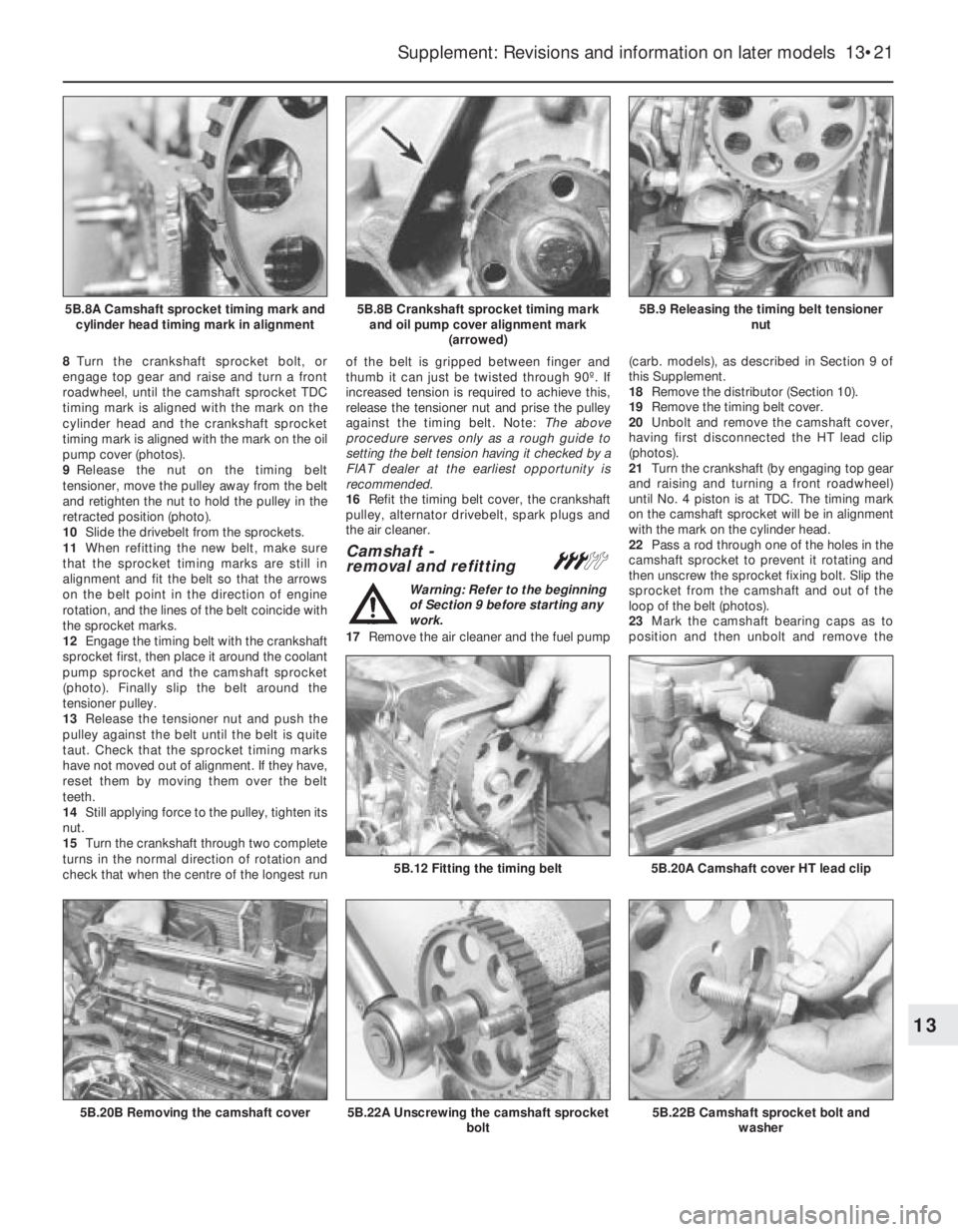
8Turn the crankshaft sprocket bolt, or
engage top gear and raise and turn a front
roadwheel, until the camshaft sprocket TDC
timing mark is aligned with the mark on the
cylinder head and the crankshaft sprocket
timing mark is aligned with the mark on the oil
pump cover (photos).
9Release the nut on the timing belt
tensioner, move the pulley away from the belt
and retighten the nut to hold the pulley in the
retracted position (photo).
10Slide the drivebelt from the sprockets.
11When refitting the new belt, make sure
that the sprocket timing marks are still in
alignment and fit the belt so that the arrows
on the belt point in the direction of engine
rotation, and the lines of the belt coincide with
the sprocket marks.
12Engage the timing belt with the crankshaft
sprocket first, then place it around the coolant
pump sprocket and the camshaft sprocket
(photo). Finally slip the belt around the
tensioner pulley.
13Release the tensioner nut and push the
pulley against the belt until the belt is quite
taut. Check that the sprocket timing marks
have not moved out of alignment. If they have,
reset them by moving them over the belt
teeth.
14Still applying force to the pulley, tighten its
nut.
15Turn the crankshaft through two complete
turns in the normal direction of rotation and
check that when the centre of the longest runof the belt is gripped between finger and
thumb it can just be twisted through 90º. If
increased tension is required to achieve this,
release the tensioner nut and prise the pulley
against the timing belt. Note: The above
procedure serves only as a rough guide to
setting the belt tension having it checked by a
FIAT dealer at the earliest opportunity is
recommended.
16Refit the timing belt cover, the crankshaft
pulley, alternator drivebelt, spark plugs and
the air cleaner.
Camshaft -
removal and refitting#
Warning: Refer to the beginning
of Section 9 before starting any
work.
17Remove the air cleaner and the fuel pump(carb. models), as described in Section 9 of
this Supplement.
18Remove the distributor (Section 10).
19Remove the timing belt cover.
20Unbolt and remove the camshaft cover,
having first disconnected the HT lead clip
(photos).
21Turn the crankshaft (by engaging top gear
and raising and turning a front roadwheel)
until No. 4 piston is at TDC. The timing mark
on the camshaft sprocket will be in alignment
with the mark on the cylinder head.
22Pass a rod through one of the holes in the
camshaft sprocket to prevent it rotating and
then unscrew the sprocket fixing bolt. Slip the
sprocket from the camshaft and out of the
loop of the belt (photos).
23Mark the camshaft bearing caps as to
position and then unbolt and remove the
Supplement: Revisions and information on later models 13•21
5B.9 Releasing the timing belt tensioner
nut5B.8B Crankshaft sprocket timing mark
and oil pump cover alignment mark
(arrowed)5B.8A Camshaft sprocket timing mark and
cylinder head timing mark in alignment
5B.22B Camshaft sprocket bolt and
washer5B.22A Unscrewing the camshaft sprocket
bolt
5B.20A Camshaft cover HT lead clip5B.12 Fitting the timing belt
5B.20B Removing the camshaft cover
13
Page 152 of 303
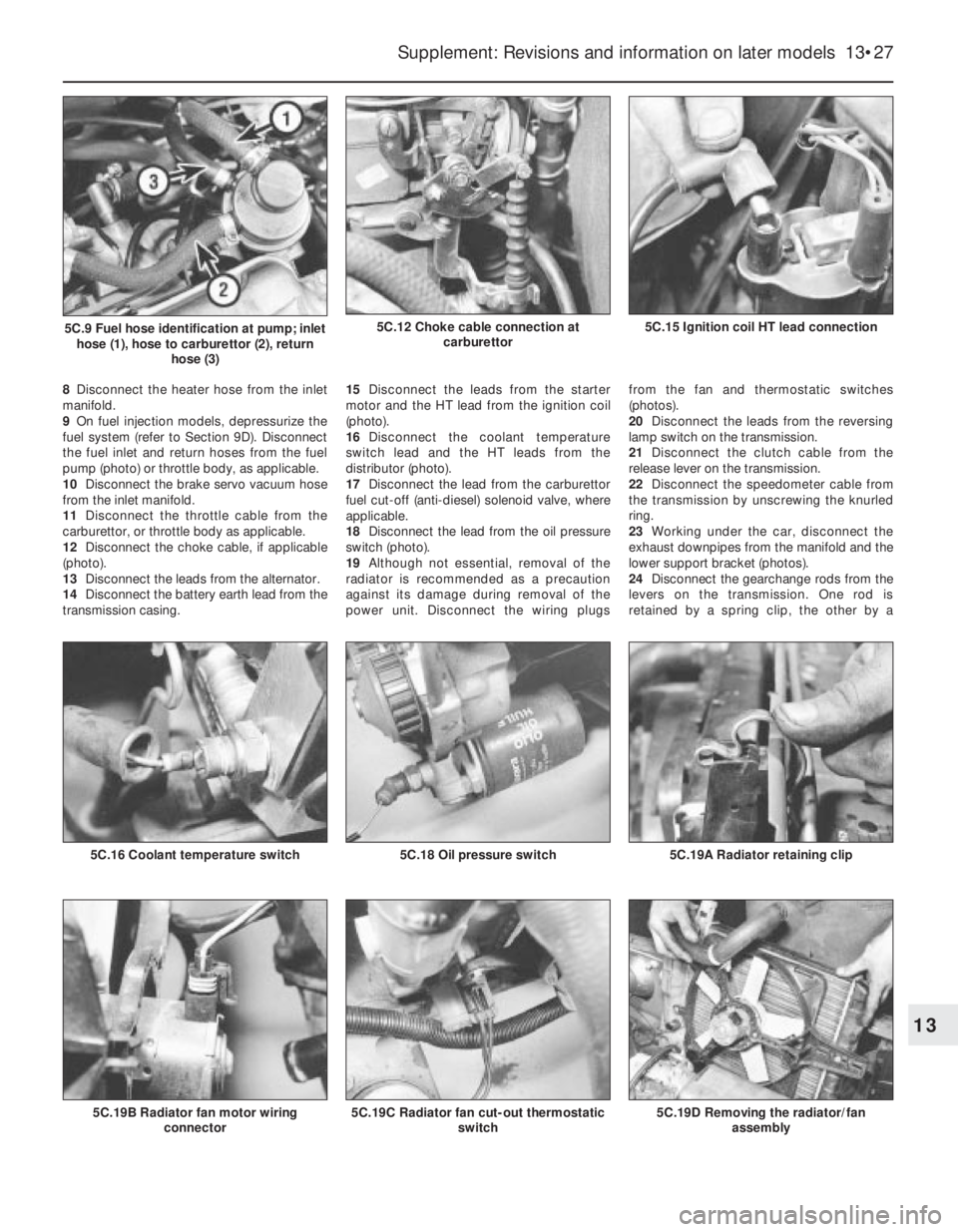
8Disconnect the heater hose from the inlet
manifold.
9On fuel injection models, depressurize the
fuel system (refer to Section 9D). Disconnect
the fuel inlet and return hoses from the fuel
pump (photo) or throttle body, as applicable.
10Disconnect the brake servo vacuum hose
from the inlet manifold.
11Disconnect the throttle cable from the
carburettor, or throttle body as applicable.
12Disconnect the choke cable, if applicable
(photo).
13Disconnect the leads from the alternator.
14Disconnect the battery earth lead from the
transmission casing.15Disconnect the leads from the starter
motor and the HT lead from the ignition coil
(photo).
16Disconnect the coolant temperature
switch lead and the HT leads from the
distributor (photo).
17Disconnect the lead from the carburettor
fuel cut-off (anti-diesel) solenoid valve, where
applicable.
18Disconnect the lead from the oil pressure
switch (photo).
19Although not essential, removal of the
radiator is recommended as a precaution
against its damage during removal of the
power unit. Disconnect the wiring plugs from the fan and thermostatic switches
(photos).
20Disconnect the leads from the reversing
lamp switch on the transmission.
21Disconnect the clutch cable from the
release lever on the transmission.
22Disconnect the speedometer cable from
the transmission by unscrewing the knurled
ring.
23Working under the car, disconnect the
exhaust downpipes from the manifold and the
lower support bracket (photos).
24Disconnect the gearchange rods from the
levers on the transmission. One rod is
retained by a spring clip, the other by a
Supplement: Revisions and information on later models 13•27
5C.15 Ignition coil HT lead connection5C.12 Choke cable connection at
carburettor5C.9 Fuel hose identification at pump; inlet
hose (1), hose to carburettor (2), return
hose (3)
5C.19D Removing the radiator/fan
assembly5C.19C Radiator fan cut-out thermostatic
switch5C.19B Radiator fan motor wiring
connector
5C.19A Radiator retaining clip5C.18 Oil pressure switch5C.16 Coolant temperature switch
13
Page 154 of 303
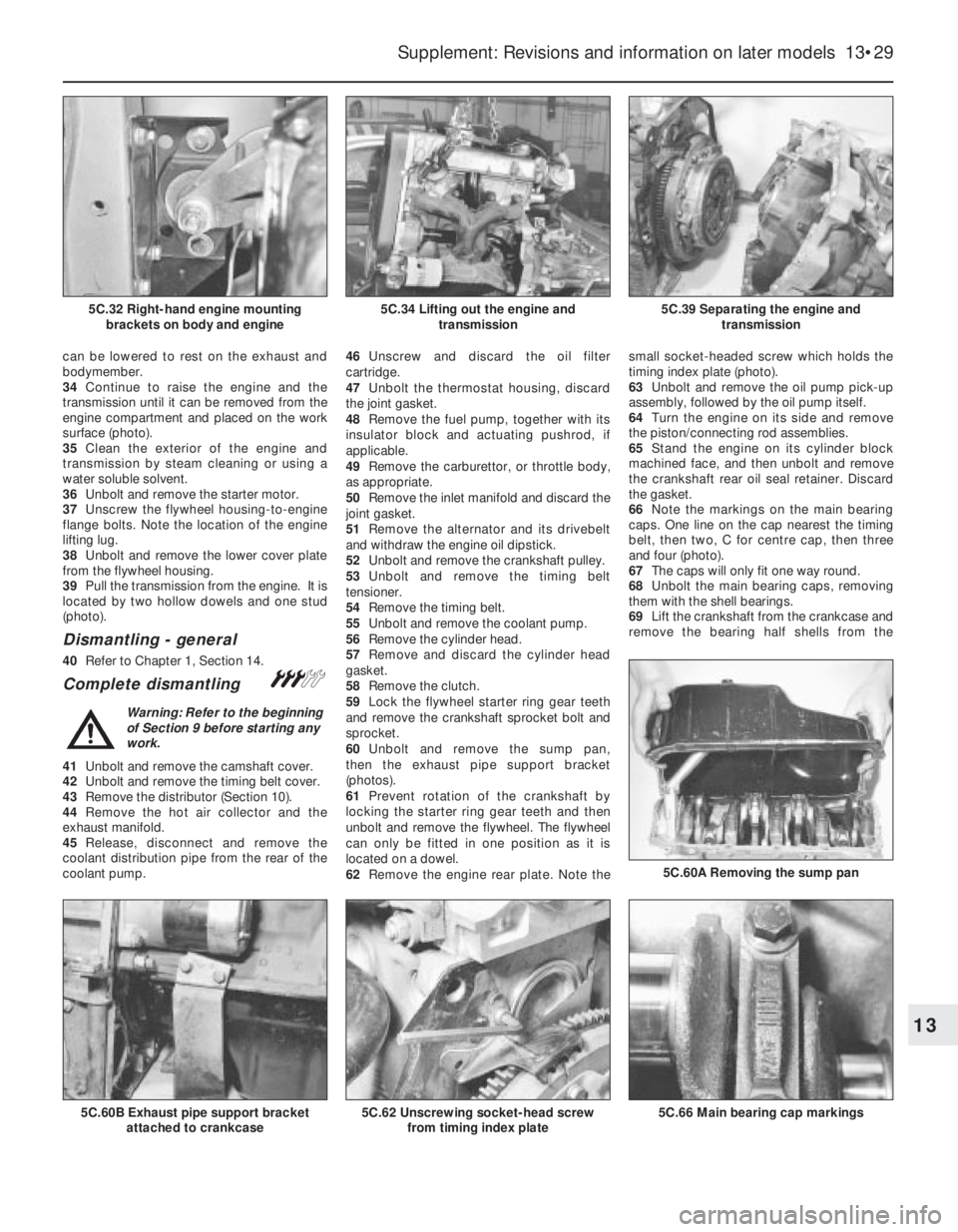
can be lowered to rest on the exhaust and
bodymember.
34Continue to raise the engine and the
transmission until it can be removed from the
engine compartment and placed on the work
surface (photo).
35Clean the exterior of the engine and
transmission by steam cleaning or using a
water soluble solvent.
36Unbolt and remove the starter motor.
37Unscrew the flywheel housing-to-engine
flange bolts. Note the location of the engine
lifting lug.
38Unbolt and remove the lower cover plate
from the flywheel housing.
39Pull the transmission from the engine. It is
located by two hollow dowels and one stud
(photo).
Dismantling - general
40Refer to Chapter 1, Section 14.
Complete dismantling#
Warning: Refer to the beginning
of Section 9 before starting any
work.
41Unbolt and remove the camshaft cover.
42Unbolt and remove the timing belt cover.
43Remove the distributor (Section 10).
44Remove the hot air collector and the
exhaust manifold.
45Release, disconnect and remove the
coolant distribution pipe from the rear of the
coolant pump.46Unscrew and discard the oil filter
cartridge.
47Unbolt the thermostat housing, discard
the joint gasket.
48Remove the fuel pump, together with its
insulator block and actuating pushrod, if
applicable.
49Remove the carburettor, or throttle body,
as appropriate.
50Remove the inlet manifold and discard the
joint gasket.
51Remove the alternator and its drivebelt
and withdraw the engine oil dipstick.
52Unbolt and remove the crankshaft pulley.
53Unbolt and remove the timing belt
tensioner.
54Remove the timing belt.
55Unbolt and remove the coolant pump.
56Remove the cylinder head.
57Remove and discard the cylinder head
gasket.
58Remove the clutch.
59Lock the flywheel starter ring gear teeth
and remove the crankshaft sprocket bolt and
sprocket.
60Unbolt and remove the sump pan,
then the exhaust pipe support bracket
(photos).
61Prevent rotation of the crankshaft by
locking the starter ring gear teeth and then
unbolt and remove the flywheel. The flywheel
can only be fitted in one position as it is
located on a dowel.
62Remove the engine rear plate. Note thesmall socket-headed screw which holds the
timing index plate (photo).
63Unbolt and remove the oil pump pick-up
assembly, followed by the oil pump itself.
64Turn the engine on its side and remove
the piston/connecting rod assemblies.
65Stand the engine on its cylinder block
machined face, and then unbolt and remove
the crankshaft rear oil seal retainer. Discard
the gasket.
66Note the markings on the main bearing
caps. One line on the cap nearest the timing
belt, then two, C for centre cap, then three
and four (photo).
67The caps will only fit one way round.
68Unbolt the main bearing caps, removing
them with the shell bearings.
69Lift the crankshaft from the crankcase and
remove the bearing half shells from the
Supplement: Revisions and information on later models 13•29
5C.39 Separating the engine and
transmission5C.34 Lifting out the engine and
transmission5C.32 Right-hand engine mounting
brackets on body and engine
5C.66 Main bearing cap markings
5C.60A Removing the sump pan
5C.62 Unscrewing socket-head screw
from timing index plate5C.60B Exhaust pipe support bracket
attached to crankcase
13
Page 157 of 303
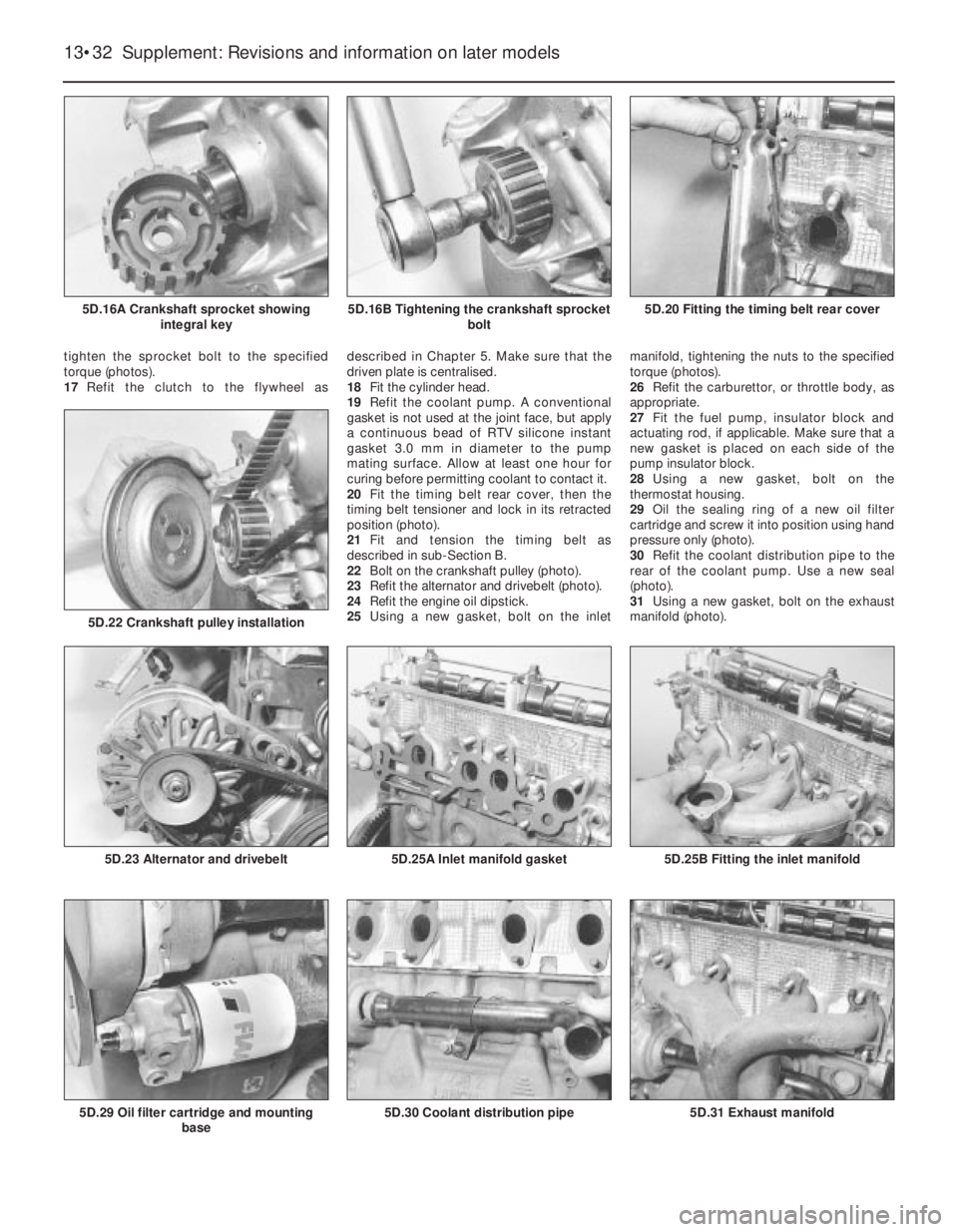
tighten the sprocket bolt to the specified
torque (photos).
17Refit the clutch to the flywheel asdescribed in Chapter 5. Make sure that the
driven plate is centralised.
18Fit the cylinder head.
19Refit the coolant pump. A conventional
gasket is not used at the joint face, but apply
a continuous bead of RTV silicone instant
gasket 3.0 mm in diameter to the pump
mating surface. Allow at least one hour for
curing before permitting coolant to contact it.
20Fit the timing belt rear cover, then the
timing belt tensioner and lock in its retracted
position (photo).
21Fit and tension the timing belt as
described in sub-Section B.
22Bolt on the crankshaft pulley (photo).
23Refit the alternator and drivebelt (photo).
24Refit the engine oil dipstick.
25Using a new gasket, bolt on the inletmanifold, tightening the nuts to the specified
torque (photos).
26Refit the carburettor, or throttle body, as
appropriate.
27Fit the fuel pump, insulator block and
actuating rod, if applicable. Make sure that a
new gasket is placed on each side of the
pump insulator block.
28Using a new gasket, bolt on the
thermostat housing.
29Oil the sealing ring of a new oil filter
cartridge and screw it into position using hand
pressure only (photo).
30Refit the coolant distribution pipe to the
rear of the coolant pump. Use a new seal
(photo).
31Using a new gasket, bolt on the exhaust
manifold (photo).
13•32 Supplement: Revisions and information on later models
5D.31 Exhaust manifold5D.30 Coolant distribution pipe5D.29 Oil filter cartridge and mounting
base
5D.25B Fitting the inlet manifold5D.25A Inlet manifold gasket5D.23 Alternator and drivebelt
5D.22 Crankshaft pulley installation
5D.20 Fitting the timing belt rear cover5D.16B Tightening the crankshaft sprocket
bolt5D.16A Crankshaft sprocket showing
integral key