lock FORD MUSTANG 1969 Volume One Chassis
[x] Cancel search | Manufacturer: FORD, Model Year: 1969, Model line: MUSTANG, Model: FORD MUSTANG 1969Pages: 413, PDF Size: 75.81 MB
Page 214 of 413
04-02-17
Rear Axle
—
Removable Carrier Type
04-02-17
Too/-T53L-200-A
L-462S-A
4625-K
or
4625-KA
>:
M
E 1726-A
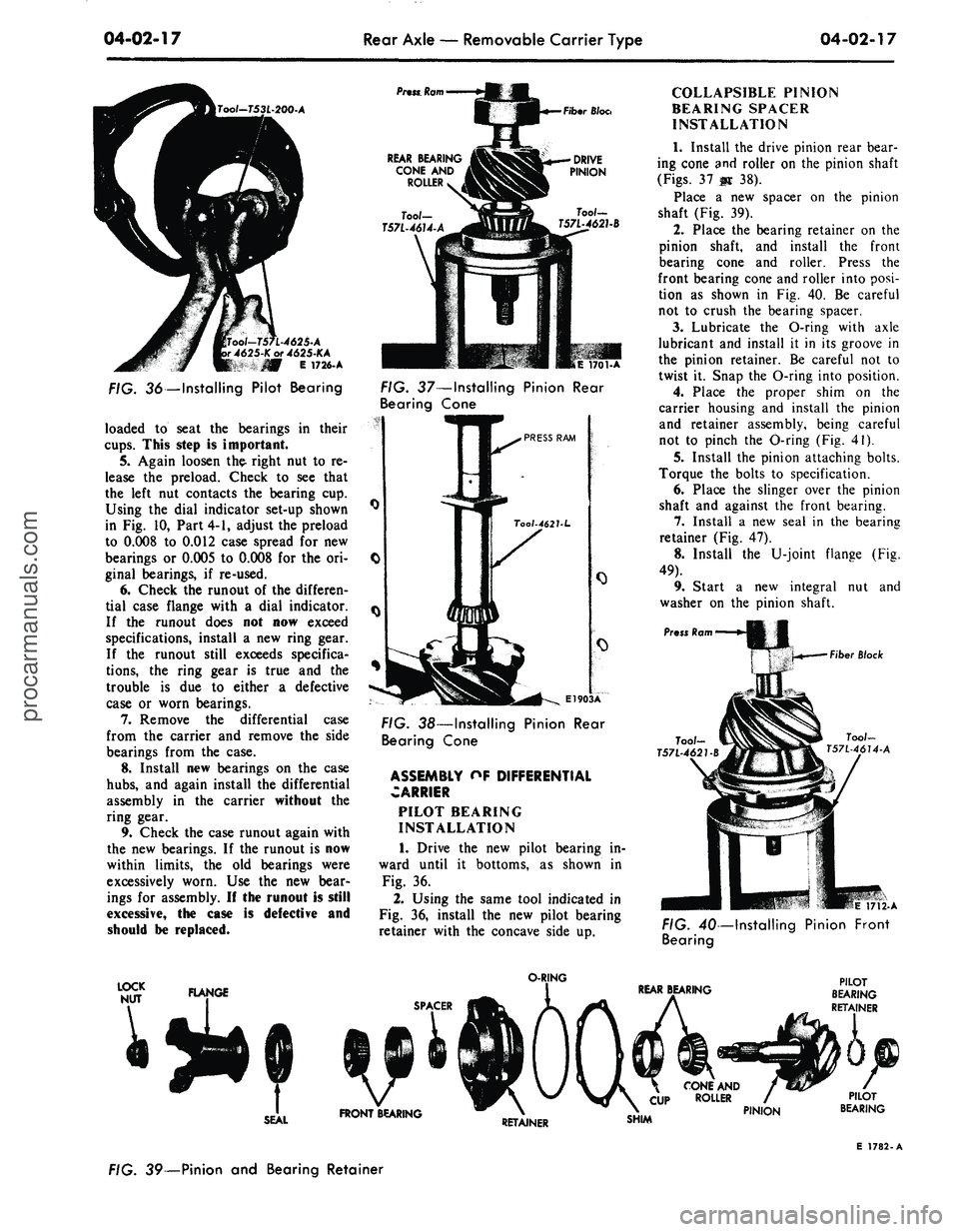
FIG. 36—Installing Pilot Bearing
loaded
to
seat
the
bearings
in
their
cups.
This step
is
important.
5. Again loosen the- right
nut to re-
lease
the
preload. Check
to see
that
the left
nut
contacts
the
bearing
cup.
Using
the
dial indicator set-up shown
in Fig.
10,
Part 4-1, adjust the preload
to 0.008
to
0.012 case spread
for new
bearings
or
0.005
to
0.008
for the ori-
ginal bearings,
if
re-used.
6. Check
the
runout
of
the differen-
tial case flange with
a
dial indicator.
If
the
runout does
not now
exceed
specifications, install
a new
ring gear.
If
the
runout still exceeds specifica-
tions,
the
ring gear
is
true
and the
trouble
is due to
either
a
defective
case
or
worn bearings.
7. Remove
the
differential case
from
the
carrier
and
remove
the
side
bearings from
the
case.
8. Install
new
bearings
on the
case
hubs,
and
again install
the
differential
assembly
in the
carrier without
the
ring gear.
9. Check the case runout again with
the new bearings.
If the
runout
is
now
within limits,
the old
bearings were
excessively worn.
Use the new
bear-
ings
for
assembly.
If the
runout
is
still
excessive,
the
case
is
defective
and
should
be
replaced.
Press,
Ram
REAR BEARING
CONE
AND
ROLLER
Too/-
T57L-46U-A
Fiber B/oc.
DRIVE
PINION
Too/-
T57L-4621-B
1701-A
FIG. 37—Installing Pinion Rear
Bearing Cone
PRESS RAM
Tool - 4621
L
E1903A
FIG. 38—Installing Pinion Rear
Bearing Cone
ASSEMBLY
OF
DIFFERENTIAL
CARRIER
PILOT BEARING
INSTALLATION
1.
Drive
the new
pilot bearing
in-
ward until
it
bottoms,
as
shown
in
Fig.
36.
2.
Using
the
same tool indicated
in
Fig.
36,
install
the new
pilot bearing
retainer with
the
concave side
up.
COLLAPSIBLE PINION
BEARING SPACER
INSTALLATION
1.
Install
the
drive pinion rear bear-
ing cone and roller
on the
pinion shaft
(Figs.
37
m 38).
Place
a new
spacer
on the
pinion
shaft (Fig.
39).
2.
Place
the
bearing retainer
on the
pinion shaft,
and
install
the
front
bearing cone
and
roller. Press
the
front bearing cone and roller into posi-
tion
as
shown
in Fig. 40. Be
careful
not
to
crush
the
bearing spacer.
3.
Lubricate
the
O-ring with axle
lubricant and install
it in its
groove
in
the pinion retainer.
Be
careful
not to
twist
it.
Snap
the
O-ring into position.
4.
Place
the
proper shim
on the
carrier housing
and
install
the
pinion
and retainer assembly, being careful
not
to
pinch
the
O-ring (Fig.
41).
5. Install
the
pinion attaching bolts.
Torque
the
bolts
to
specification.
6. Place
the
slinger over
the
pinion
shaft
and
against
the
front bearing.
7.
Install
a new
seal
in the
bearing
retainer (Fig.
47).
8. Install
the
U-joint flange
(Fig.
49).
9. Start
a new
integral
nut and
washer
on the
pinion shaft.
Press
Ram
L*
Fiber Block
Tool-
T57L-4621
E 1712-A
FIG. 40—Installing Pinion Front
Bearing
FLANGE
O-RING
REAR BEARING
SPACER
SEAL
FRONT BEARING
RETAINER
SHIM
PINION
FIG. 39—Pinion
and
Bearing Retainer
PILOT
BEARING
RETAINER
PILOT
BEARING
E 1782-Aprocarmanuals.com
Page 216 of 413
04-02-19
Rear Axle — Removable Carrier Type
04-02-19
POINTER RESTING ON
PINION NUT
E 1505-B
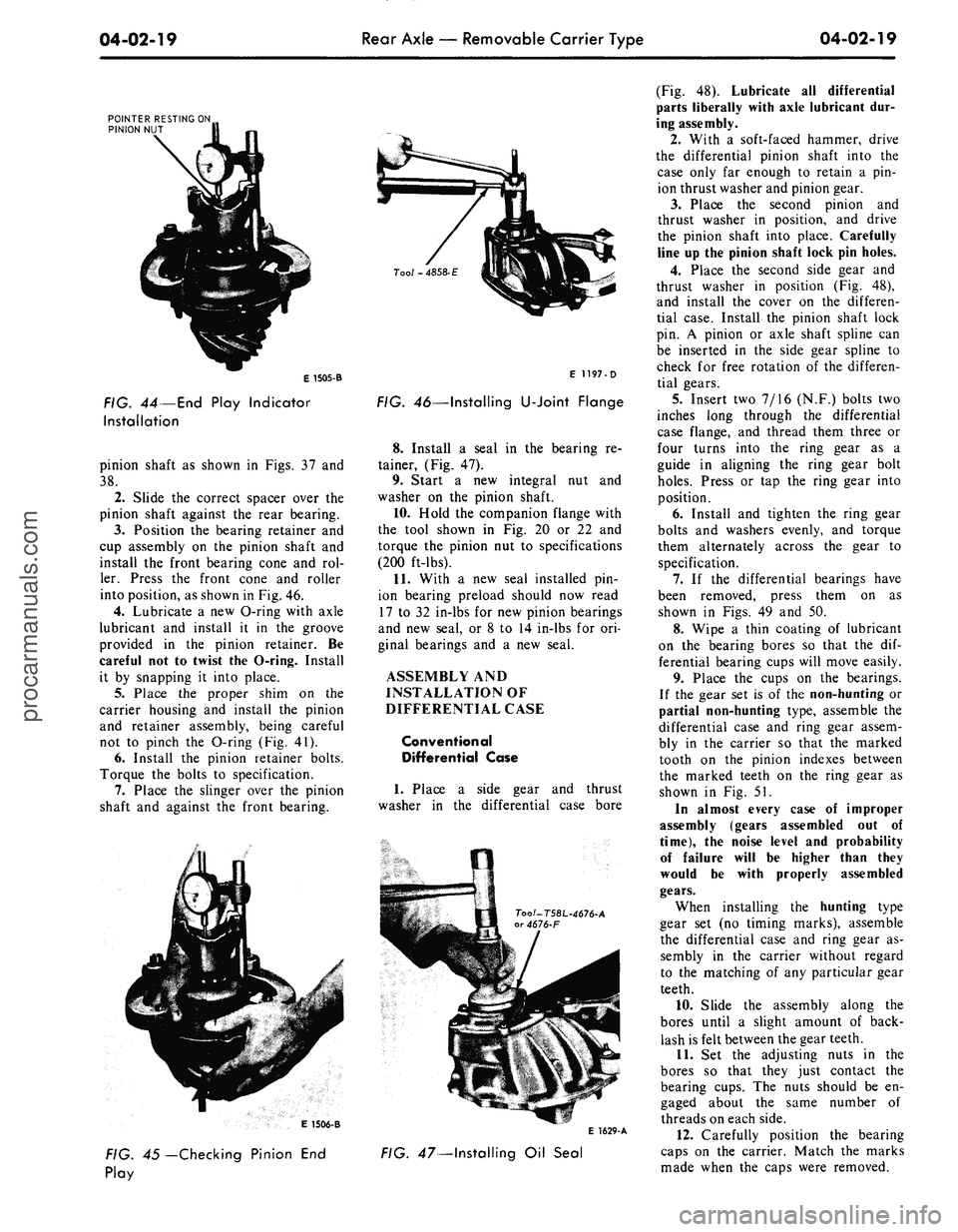
FIG.
44
— End Play Indicator
Installation
pinion shaft as shown in Figs. 37 and
38.
2.
Slide the correct spacer over the
pinion shaft against the rear bearing.
3.
Position the bearing retainer and
cup assembly on the pinion shaft and
install the front bearing cone and rol-
ler. Press the front cone and roller
into position, as shown in Fig. 46.
4.
Lubricate a new O-ring with axle
lubricant and install it in the groove
provided in the pinion retainer. Be
careful not to twist the O-ring. Install
it by snapping it into place.
5.
Place the proper shim on the
carrier housing and install the pinion
and retainer assembly, being careful
not to pinch the O-ring (Fig. 41).
6. Install the pinion retainer bolts.
Torque the bolts to specification.
7.
Place the slinger over the pinion
shaft and against the front bearing.
Tool - 4858-
E
E 1197-D
FIG. 46—Installing
U-Joint
Flange
8. Install a seal in the bearing re-
tainer, (Fig. 47).
9. Start a new integral nut and
washer on the pinion shaft.
10.
Hold the companion flange with
the tool shown in Fig. 20 or 22 and
torque the pinion nut to specifications
(200 ft-lbs).
11.
With a new seal installed pin-
ion bearing preload should now read
17 to 32 in-lbs for new pinion bearings
and new seal, or 8 to 14 in-lbs for ori-
ginal bearings and a new seal.
ASSEMBLY AND
INSTALLATION OF
DIFFERENTIAL CASE
Conventional
Differential Case
1.
Place a side gear and thrust
washer in the differential case bore
E 1506-B
E 1629-A
FIG. 45— Checking Pinion End
Play
FIG. 47—Installing Oil Seal
(Fig. 48). Lubricate all differential
parts liberally with axle lubricant dur-
ing assembly.
2.
With a soft-faced hammer, drive
the differential pinion shaft into the
case only far enough to retain a pin-
ion thrust washer and pinion gear.
3.
Place the second pinion and
thrust washer in position, and drive
the pinion shaft into place. Carefully
line up the pinion shaft lock pin holes.
4.
Place the second side gear and
thrust washer in position (Fig. 48),
and install the cover on the differen-
tial case. Install the pinion shaft lock
pin. A pinion or axle shaft spline can
be inserted in the side gear spline to
check for free rotation of the differen-
tial gears.
5.
Insert two 7/16 (N.F.) bolts two
inches long through the differential
case flange, and thread them three or
four turns into the ring gear as a
guide in aligning the ring gear bolt
holes.
Press or tap the ring gear into
position.
6. Install and tighten the ring gear
bolts and washers evenly, and torque
them alternately across the gear to
specification.
7.
If the differential bearings have
been removed, press them on as
shown in Figs. 49 and 50.
8. Wipe a thin coating of lubricant
on the bearing bores so that the dif-
ferential bearing cups will move easily.
9. Place the cups on the bearings.
If the gear set is of the non-hunting or
partial non-hunting type, assemble the
differential case and ring gear assem-
bly in the carrier so that the marked
tooth on the pinion indexes between
the marked teeth on the ring gear as
shown in Fig. 51.
In almost every case of improper
assembly (gears assembled out of
time),
the noise level and probability
of failure will be higher than they
would be with properly assembled
gears.
When installing the hunting type
gear set (no timing marks), assemble
the differential case and ring gear as-
sembly in the carrier without regard
to the matching of any particular gear
teeth.
10.
Slide the assembly along the
bores until a slight amount of back-
lash is felt between the gear teeth.
11.
Set the adjusting nuts in the
bores so that they just contact the
bearing cups. The nuts should be en-
gaged about the same number of
threads on each side.
12.
Carefully position the bearing
caps on the carrier. Match the marks
made when the caps were removed.procarmanuals.com
Page 217 of 413
04-02-20
Rear Axle — Removable Carrier Type
0402-20
THRUST WASHER
E1175-B
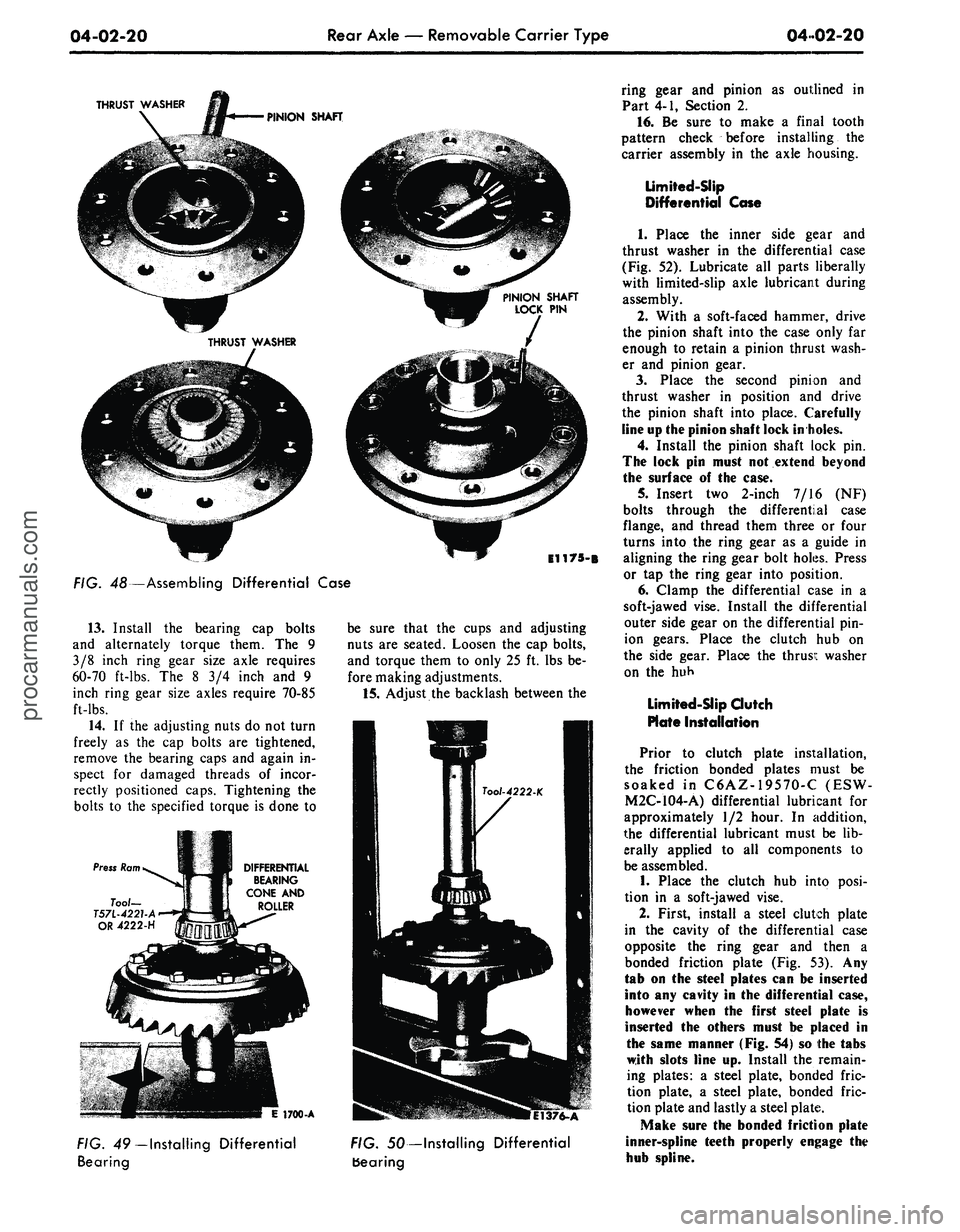
FIG. 48—Assembling Differential Case
13.
Install the bearing cap bolts
and alternately torque them. The 9
3/8 inch ring gear size axle requires
60-70 ft-lbs. The 8 3/4 inch and 9
inch ring gear size axles require 70-85
ft-lbs.
14.
If the adjusting nuts do not turn
freely as the cap bolts are tightened,
remove the bearing caps and again in-
spect for damaged threads of incor-
rectly positioned caps. Tightening the
bolts to the specified torque is done to
be sure that the cups and adjusting
nuts are seated. Loosen the cap bolts,
and torque them to only 25 ft. lbs be-
fore making adjustments.
15.
Adjust the backlash between the
DIFFERENTIAL
BEARING
CONE AND
ROLLER
E 1700-A
FIG. 49—
Installing
Differential
Bearing
1376-A
FIG. 50—Installing Differential
bearing
ring gear and pinion as outlined in
Part 4-1, Section 2.
16.
Be sure to make a final tooth
pattern check before installing the
carrier assembly in the axle housing.
Limited-Slip
Differential Case
1.
Place the inner side gear and
thrust washer in the differential case
(Fig. 52). Lubricate all parts liberally
with limited-slip axle lubricant during
assembly.
2.
With a soft-faced hammer, drive
the pinion shaft into the case only far
enough to retain a pinion thrust wash-
er and pinion gear.
3.
Place the second pinion and
thrust washer in position and drive
the pinion shaft into place. Carefully
line up the pinion shaft lock in holes.
4.
Install the pinion shaft lock pin.
The lock pin must not extend beyond
the surface of the case.
5. Insert two 2-inch 7/16 (NF)
bolts through the differential case
flange, and thread them three or four
turns into the ring gear as a guide in
aligning the ring gear bolt holes. Press
or tap the ring gear into position.
6. Clamp the differential case in a
soft-jawed vise. Install the differential
outer side gear on the differential pin-
ion gears. Place the clutch hub on
the side gear. Place the thrusi: washer
on the huh
Limited-Slip dutch
Plate Installation
Prior to clutch plate installation,
the friction bonded plates must be
soaked in C6AZ-19570-C (ESW-
M2C-104-A) differential lubricant for
approximately 1/2 hour. In addition,
the differential lubricant must be lib-
erally applied to all components to
be assembled.
1.
Place the clutch hub into posi-
tion in a soft-jawed vise.
2.
First, install a steel clutch plate
in the cavity of the differential case
opposite the ring gear and then a
bonded friction plate (Fig. 53). Any
tab on the steel plates can be inserted
into any cavity in the differential case,
however when the first steel plate is
inserted the others must be placed in
the same manner (Fig. 54) so the tabs
with slots line up. Install the remain-
ing plates: a steel plate, bonded fric-
tion plate, a steel plate, bonded fric-
tion plate and lastly a steel plate.
Make sure the bonded friction plate
inner-spline teeth properly engage the
hub spline.procarmanuals.com
Page 218 of 413
04-02-21
Rear Axle
—
Removable Carrier Type
04-02-21
SITION IN WHICH GEARS WERE LAPPED
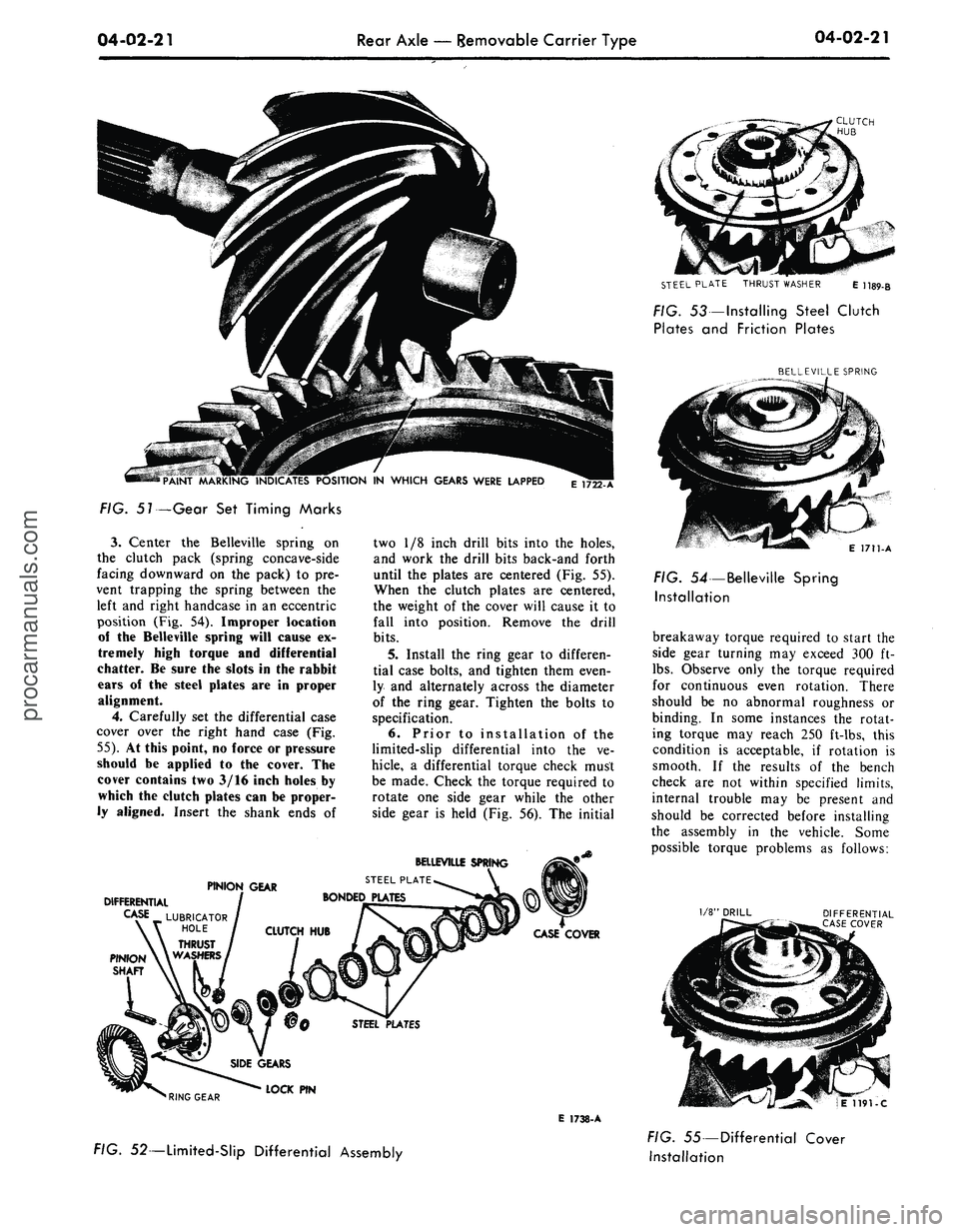
FIG. 51—Gear
Set
Timing Marks
3.
Center
the
Belleville spring
on
the clutch pack (spring concave-side
facing downward
on the
pack)
to pre-
vent trapping
the
spring between
the
left
and
right handcase
in an
eccentric
position
(Fig. 54).
Improper location
of
the
Belleville spring will cause
ex-
tremely high torque
and
differential
chatter.
Be
sure
the
slots
in the
rabbit
ears
of the
steel plates
are in
proper
alignment.
4.
Carefully
set the
differential case
cover over
the
right hand case
(Fig.
55).
At
this point,
no
force
or
pressure
should
be
applied
to the
cover.
The
cover contains
two 3/16
inch holes
by
which
the
clutch plates
can be
proper-
ly aligned. Insert
the
shank ends
of
two
1/8
inch drill bits into
the
holes,
and work
the
drill bits back-and forth
until
the
plates
are
centered
(Fig. 55).
When
the
clutch plates
are
centered,
the weight
of the
cover will cause
it to
fall into position. Remove
the
drill
bits.
5.
Install
the
ring gear
to
differen-
tial case bolts,
and
tighten them even-
ly
and
alternately across
the
diameter
of
the
ring gear. Tighten
the
bolts
to
specification.
6. Prior
to
installation
of the
limited-slip differential into
the ve-
hicle,
a
differential torque check must
be made. Check
the
torque required
to
rotate
one
side gear while
the
other
side gear
is
held
(Fig. 56). The
initial
PINION GEAR
DIFFERENTIAL
CASE
_
LUBRICATOR
HOLE / CLUTCH HUB
THRUST /
PINION \\WASHERS/
SHAFT
BELLEVILLE SPRING
STEEL
PLATE.
BONDED PLATES
CASE COVER
STEEL PLATES
RING GEAR
SIDE GEARS
LOCK
PIN
E 1738-A
STEEL PLATE THRUST WASHER
E 1189-
FIG. 53—Installing Steel Clutch
Plates
and
Friction Plates
BELLEVILLE SPRING
E 1711-A
FIG.
54
— Belleville
Spring
Installation
breakaway torque required
to
start
the
side gear turning
may
exceed
300 ft-
lbs.
Observe only
the
torque required
for continuous even rotation. There
should
be no
abnormal roughness
or
binding.
In
some instances
the
rotat-
ing torque
may
reach
250
ft-lbs, this
condition
is
acceptable,
if
rotation
is
smooth.
If the
results
of the
bench
check
are not
within specified limits,
internal trouble
may be
present
and
should
be
corrected before installing
the assembly
in the
vehicle. Some
possible torque problems
as
follows:
1/8" DRILL
DIFFERENTIAL
CASE COVER
E 1191-C
FIG. 52—Limited-Slip Differential Assembly
FIG.
55—
Differential Cover
Installationprocarmanuals.com
Page 219 of 413
04-02-22
Rear Axle — Removable Carrier Type
04-02-22
Too/-T59L-4204-A
or
44211
and
44211-A
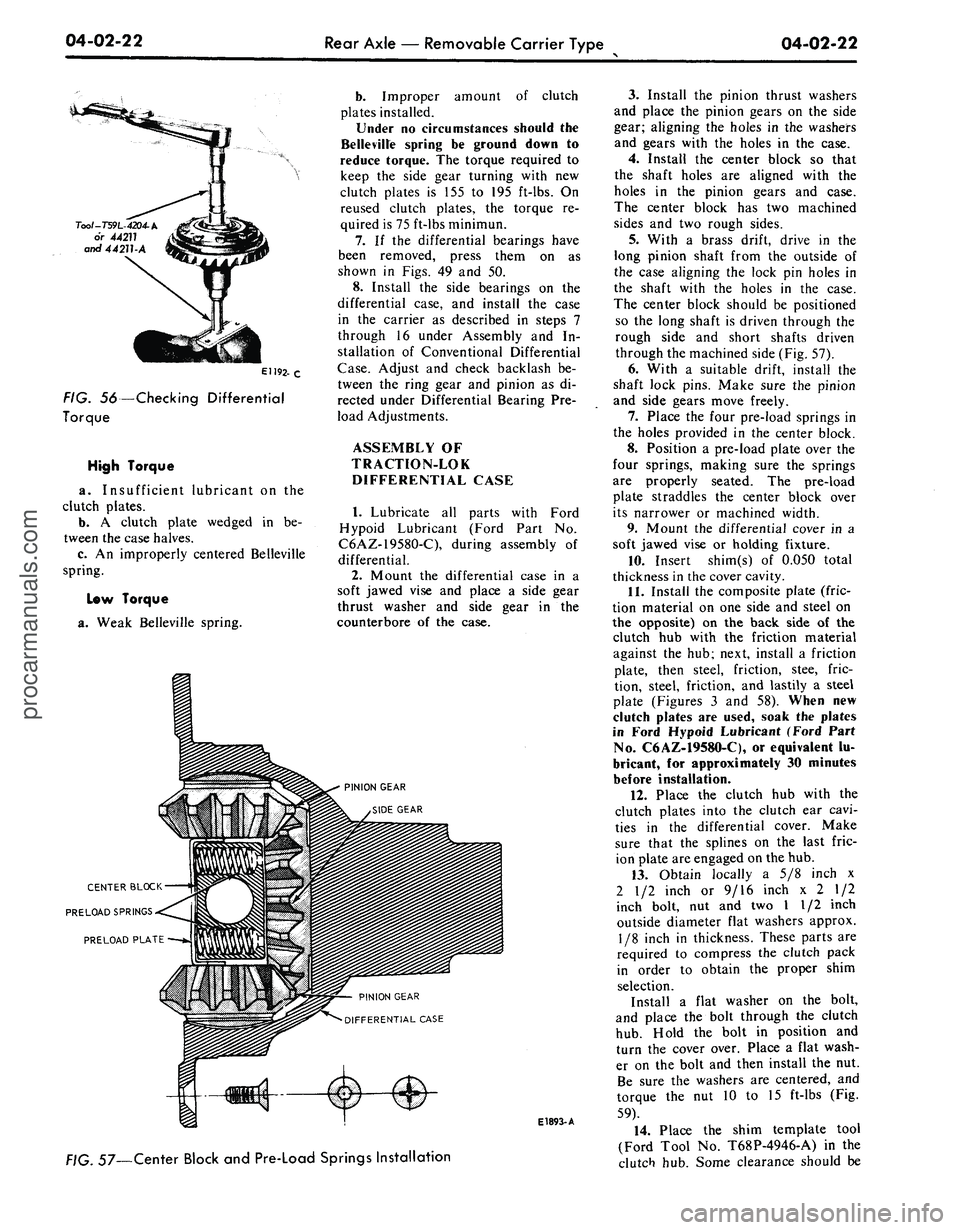
EH92-C
FIG. 56—Checking Differential
Torque
High Torque
a. Insufficient lubricant on the
clutch plates.
b.
A clutch plate wedged in be-
tween the case halves.
c. An improperly centered Belleville
spring.
Low Torque
a. Weak Belleville spring.
b.
Improper amount of clutch
plates installed.
Under no circumstances should the
Belleville spring be ground down to
reduce torque. The torque required to
keep the side gear turning with new
clutch plates is 155 to 195 ft-lbs. On
reused clutch plates, the torque re-
quired is 75 ft-lbs minimun.
7.
If the differential bearings have
been removed, press them on as
shown in Figs. 49 and 50.
8. Install the side bearings on the
differential case, and install the case
in the carrier as described in steps 7
through 16 under Assembly and In-
stallation of Conventional Differential
Case. Adjust and check backlash be-
tween the ring gear and pinion as di-
rected under Differential Bearing Pre-
load Adjustments.
ASSEMBLY OF
TRACTION-LOK
DIFFERENTIAL CASE
1.
Lubricate all parts with Ford
Hypoid Lubricant (Ford Part No.
C6AZ-19580-C), during assembly of
differential.
2.
Mount the differential case in a
soft jawed vise and place a side gear
thrust washer and side gear in the
counterbore of the case.
CENTER BLOCK
PRELOAD SPRINGS
PRELOAD PLATE
PINION GEAR
DIFFERENTIAL CASE
E1893-
A
. 57—Center Block and Pre-Load Springs Installation
3.
Install the pinion thrust washers
and place the pinion gears on the side
gear; aligning the holes in the washers
and gears with the holes in the case.
4.
Install the center block so that
the shaft holes are aligned with the
holes in the pinion gears and case.
The center block has two machined
sides and two rough sides.
5.
With a brass drift, drive in the
long pinion shaft from the outside of
the case aligning the lock pin holes in
the shaft with the holes in the case.
The center block should be positioned
so the long shaft is driven through the
rough side and short shafts driven
through the machined side (Fig. 57).
6. With a suitable drift, install the
shaft lock pins. Make sure the pinion
and side gears move freely.
7.
Place the four pre-load springs in
the holes provided in the center block.
8. Position a pre-load plate over the
four springs, making sure the springs
are properly seated. The pre-load
plate straddles the center block over
its narrower or machined width.
9. Mount the differential cover in a
soft jawed vise or holding fixture.
10.
Insert shim(s) of 0.050 total
thickness in the cover cavity.
11.
Install the composite plate (fric-
tion material on one side and steel on
the opposite) on the back side of the
clutch hub with the friction material
against the hub; next, install a friction
plate, then steel, friction, stee, fric-
tion, steel, friction, and lastily a steel
plate (Figures 3 and 58). When new
clutch plates are used, soak the plates
in Ford Hypoid Lubricant (Ford Part
No.
C6AZ-19580-C), or equivalent lu-
bricant, for approximately 30 minutes
before installation.
12.
Place the clutch hub with the
clutch plates into the clutch ear cavi-
ties in the differential cover. Make
sure that the splines on the last fric-
ion plate are engaged on the hub.
13.
Obtain locally a 5/8 inch x
2 1/2 inch or 9/16 inch x 2 1/2
inch bolt, nut and two I 1/2 inch
outside diameter flat washers approx.
1/8 inch in thickness. These parts are
required to compress the clutch pack
in order to obtain the proper shim
selection.
Install a flat washer on the bolt,
and place the bolt through the clutch
hub.
Hold the bolt in position and
turn the cover over. Place a flat wash-
er on the bolt and then install the nut.
Be sure the washers are centered, and
torque the nut 10 to 15 ft-lbs (Fig.
59).
14.
Place the shim template tool
(Ford Tool No. T68P-4946-A) in the
clutch hub. Some clearance should beprocarmanuals.com
Page 220 of 413
04-02-23
Rear Axle — Removable Carrier Type
04-02-23
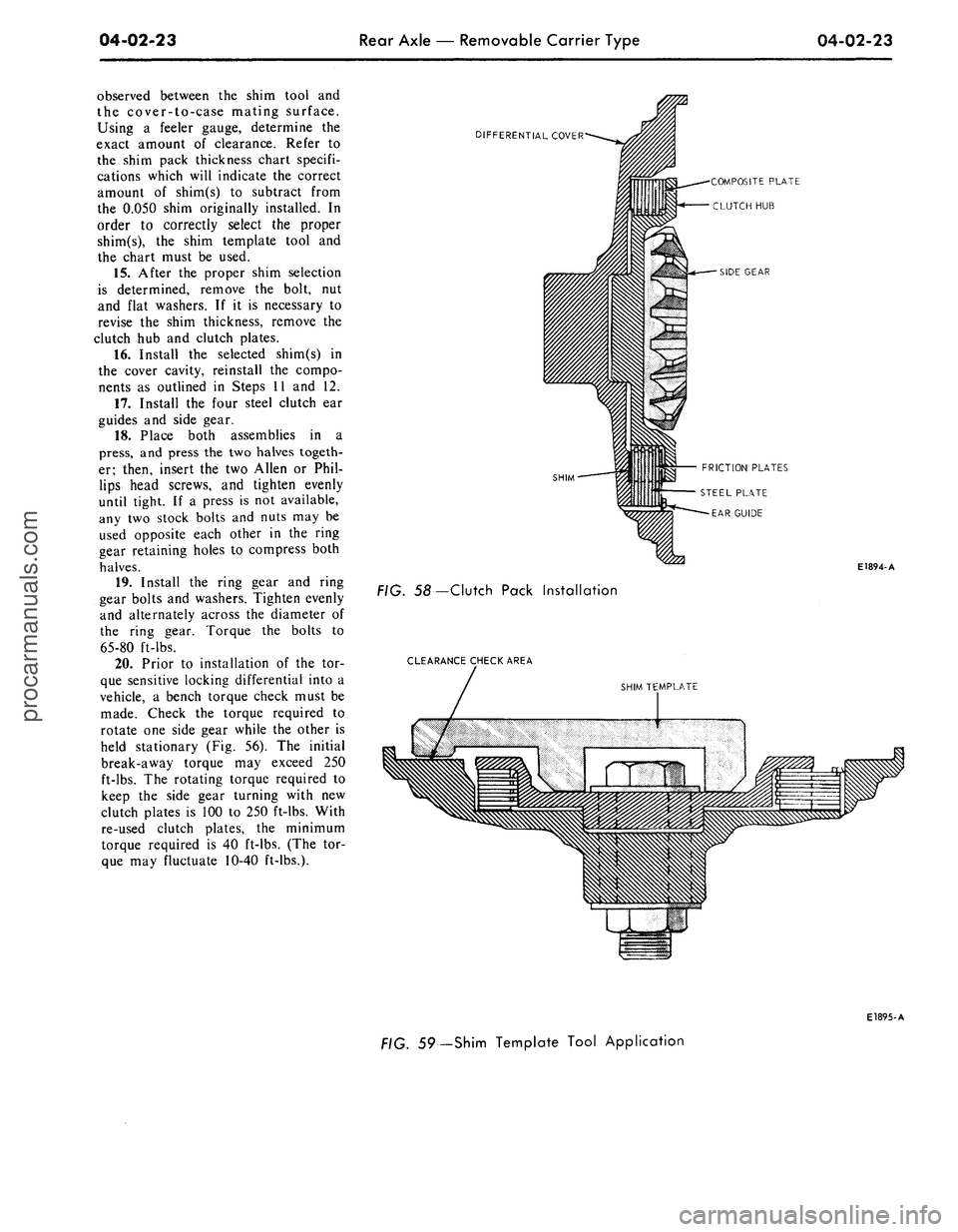
observed between the shim tool and
the cover-to-case mating surface.
Using a feeler gauge, determine the
exact amount of clearance. Refer to
the shim pack thickness chart specifi-
cations which will indicate the correct
amount of shim(s) to subtract from
the 0.050 shim originally installed. In
order to correctly select the proper
shim(s), the shim template tool and
the chart must be used.
15.
After the proper shim selection
is determined, remove the bolt, nut
and flat washers. If it is necessary to
revise the shim thickness, remove the
clutch hub and clutch plates.
16.
Install the selected shim(s) in
the cover cavity, reinstall the compo-
nents as outlined in Steps 11 and 12.
17.
Install the four steel clutch ear
guides and side gear.
18.
Place both assemblies in a
press,
and press the two halves togeth-
er; then, insert the two Allen or Phil-
lips head screws, and tighten evenly
until tight. If a press is not available,
any two stock bolts and nuts may be
used opposite each other in the ring
gear retaining holes to compress both
halves.
19.
Install the ring gear and ring
gear bolts and washers. Tighten evenly
and alternately across the diameter of
the ring gear. Torque the bolts to
65-80 ft-lbs.
20.
Prior to installation of the tor-
que sensitive locking differential into a
vehicle, a bench torque check must be
made. Check the torque required to
rotate one side gear while the other is
held stationary (Fig. 56). The initial
break-away torque may exceed 250
ft-lbs.
The rotating torque required to
keep the side gear turning with new
clutch plates is 100 to 250 ft-lbs. With
re-used clutch plates, the minimum
torque required is 40 ft-lbs. (The tor-
que may fluctuate 10-40 ft-lbs.).
DIFFERENTIAL COVER
SHIM
-COMPOSITE PLATE
CLUTCH HUB
SIDE GEAR
FRICTION PLATES
E1894-A
FIG. 58— Clutch Pack Installation
CLEARANCE CHECK AREA
SHIM TEMPLATE
E1895-A
59—Shim Template Tool Applicationprocarmanuals.com
Page 227 of 413
04-03-07
Rear Axles — Integral Carrier Type
04-03-07
junction and install vent hose to vent
tube.
7.
Raise the axle housing and con-
nect the shock absorbers.
8. Connect the rear end of the drive
shaft to the axle U-joint flange, align-
ing the scribe marks made on the
drive shaft end yoke and the axle U-
joint flange (Fig. 14).
9. Fill the axle with the proper
grade and amount of lubricant.
10.
Road test the vehicle.
MAJOR REPAIR OPERATIONS
DISASSEMBLY
All service operations on the differ-
ential case assembly and the drive pin-
ion assembly can be performed with
the housing in the vehicle.
REMOVAL OF
DIFFERENTIAL
CASE AND DRIVE PINION
1.
Raise the vehicle and support it
on the underbody, so that the rear
axle drops down as far as the springs
and shock absorbers permit.
2.
Remove the cover from the car-
rier casting rear face, and drain the
lubricant.
3.
Perform the Inspection Before
Disassembly of Carrier in Part 4-1,
Section 3.
4.
Remove both rear wheels.
5.
Remove the brake drums.
6. Working through the hole pro-
vided in the axle shaft flange, remove
the nuts that attach the wheel bearing
retainers to the axle housing.
7.
Pull the axle shafts with the tool
shown in Fig. 2. Care must be exer-
cised to prevent damage to the oil
seals.
Install a nut on one of the brake
backing plate attaching bolts to hold
the plate to the axle housing after the
shaft has been removed. Remove both
seals with the tool shown in Fig. 8.
8. Make scribe marks on the drive
shaft end yoke and the axle U-joint
flange to insure proper position of the
drive shaft at assembly (Fig. 14). Dis-
connect the drive shaft from the axle
U-joint flange. Be careful to avoid
dropping the loose universal joint
bearing cups. Hold the cups on the
spider with tape. Mark the cups so
that they will be in their original posi-
tion in relation to the flange when
they are assembled. Remove the drive
shaft from the transmission extension
housing. Install an oil seal replacer
tool in the transmission extension
housing to prevent transmission leak-
age.
Refer to the transmission group
for the appropriate tool.
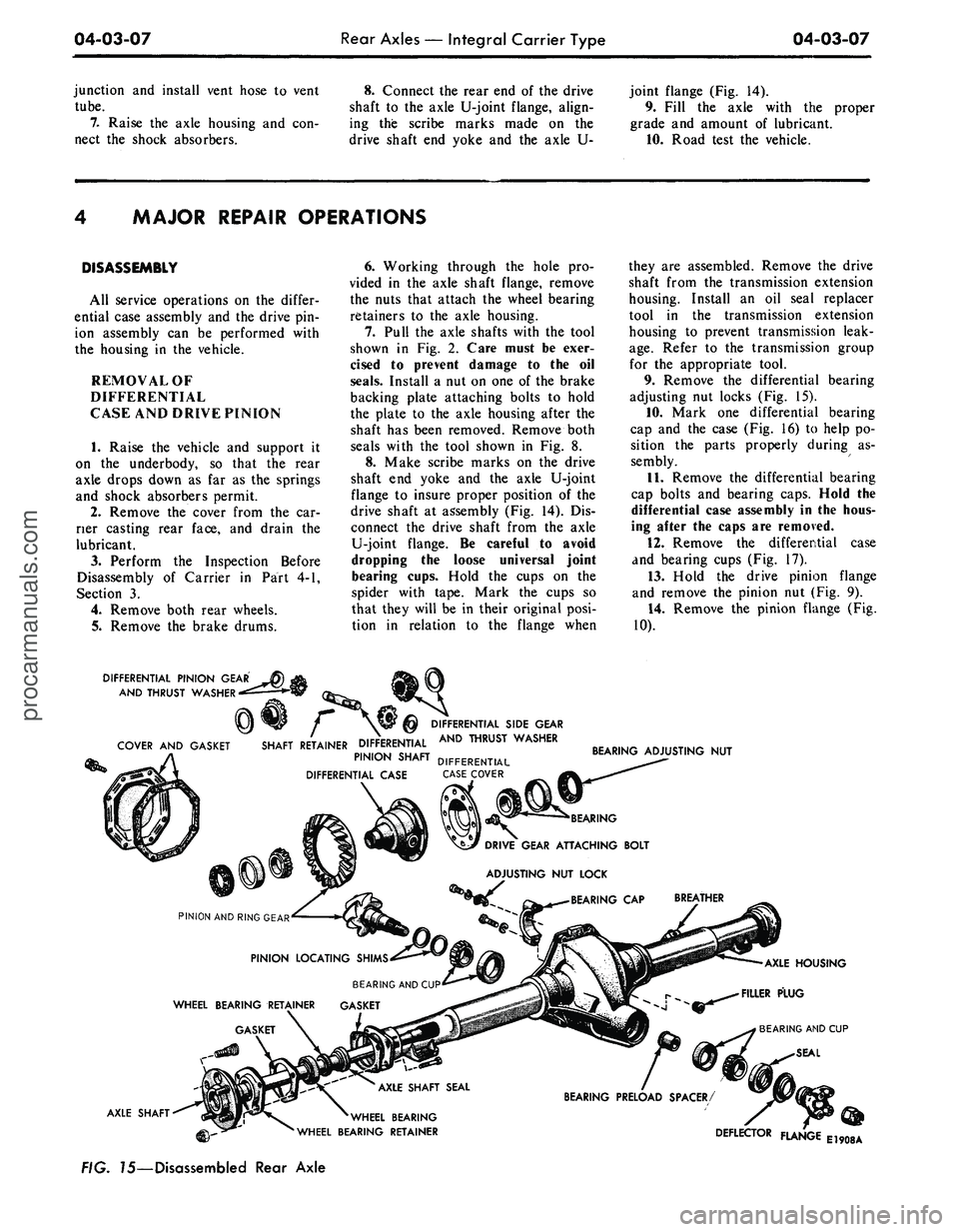
9. Remove the differential bearing
adjusting nut locks (Fig. 15).
10.
Mark one differential bearing
cap and the case (Fig. 16) to help po-
sition the parts properly during as-
sembly.
11.
Remove the differential bearing
cap bolts and bearing caps. Hold the
differential case assembly in the hous-
ing after the caps are removed.
12.
Remove the differential case
and bearing cups (Fig. 17).
13.
Hold the drive pinion flange
and remove the pinion nut (Fig. 9).
14.
Remove the pinion flange (Fig.
10).
DIFFERENTIAL PINION GEAR
AND THRUST WASHER
COVER AND GASKET
DIFFERENTIAL SIDE GEAR
AND THRUST WASHER
SHAFT RETAINER DIFFERENTIAL
PINION SHAFT DIFFERENT|AL
DIFFERENTIAL CASE CASE COVER
BEARING ADJUSTING NUT
PINION AND RING GEAR
AXLE SHAFT
BEARING
DRIVE GEAR ATTACHING BOLT
ADJUSTING NUT LOCK
BEARING CAP
PINION LOCATING SHIMS
BEARING AND CUP
WHEEL BEARING RETAINER
GASKET
BEARING AND CUP
SEAL
AXLE SHAFT SEAL
BEARING PRELOAD SPACER/
AXLE HOUSING
FILLER PLUG
'WHEEL BEARING
WHEEL BEARING RETAINER
DEFLECTOR FLANGE
E1908A
FIG. 75—Disassembled Rear Axleprocarmanuals.com
Page 228 of 413
04-03-08
Rear Axles — Integral Carrier Type
04-03-08
15.
With
a
soft-faced hammer,
drive
the
pinion
out of the
front bear-
ing cone
and
remove
it
through
the
rear
of the
carrier casting.
16.
Drive against
the
pinion front
bearing cone
and
drive
the
pinion
flange seal
and the
bearing cone
out
of
the
front
of the
carrier casting.
17.
To
remove
and
install
the pin-
ion rear bearing cone
use the
tools
in
Fig.
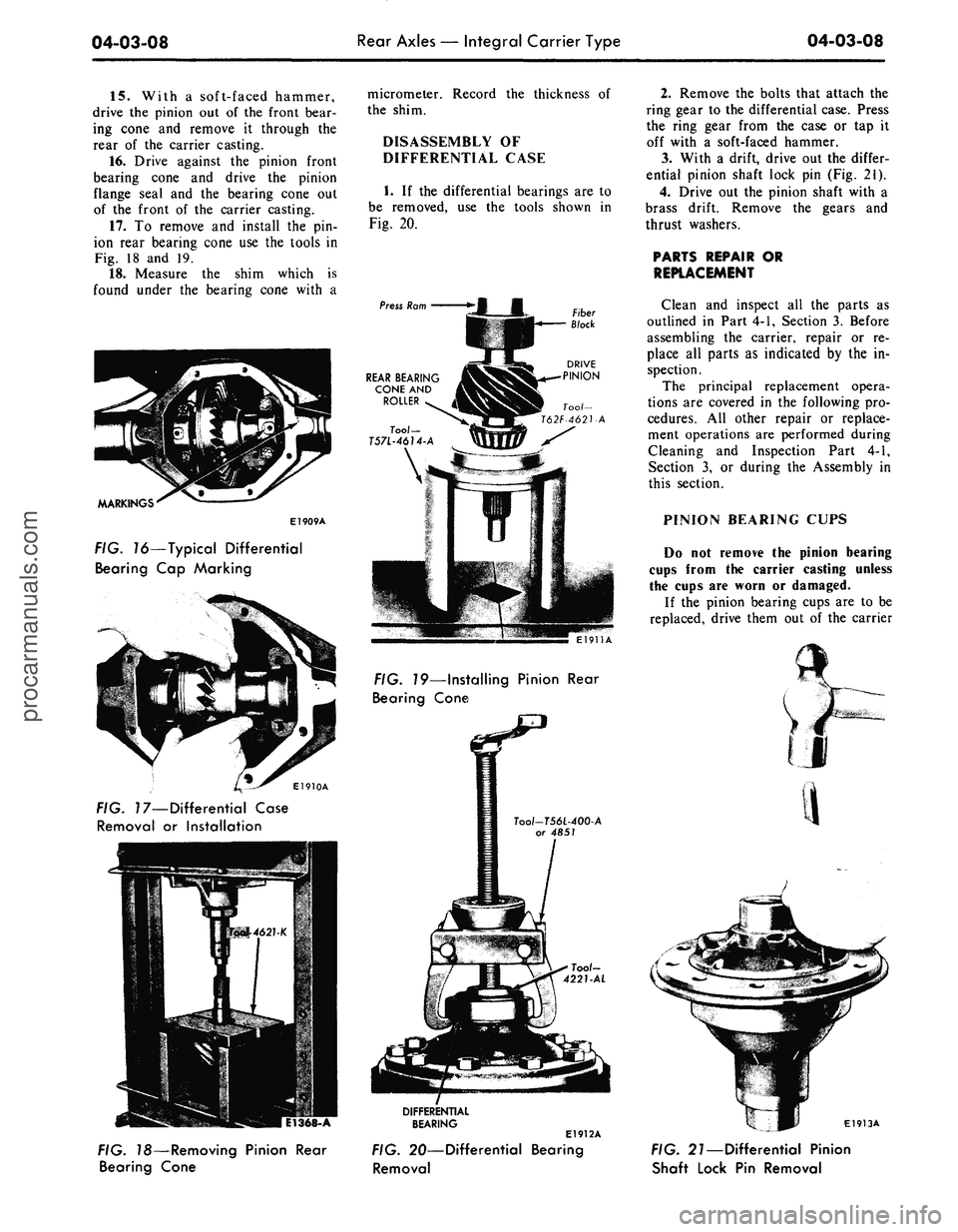
18 and 19.
18.
Measure
the
shim which
is
found under
the
bearing cone with
a
MARKINGS
E1909A
FIG. 16—Typical Differential
Bearing Cap Marking
E1910A
FIG. 77—Differential Case
Removal or Installation
1368-A
micrometer. Record
the
thickness
of
the shim.
DISASSEMBLY
OF
DIFFERENTIAL CASE
1.
If the
differential bearings
are to
be removed,
use the
tools shown
in
Fig.
20.
Press
Ram
REAR BEARING
CONE
AND
ROLLER
Fiber
Block
E1911A
FIG. 79—Installing Pinion Rear
Bearing Cone
Tool-
4221-AL
FIG. 18—Removing Pinion Rear
Bearing Cone
DIFFERENTIAL
BEARING
E1912A
FIG. 20—Differential Bearing
Removal
2.
Remove
the
bolts that attach
the
ring gear
to the
differential case. Press
the ring gear from
the
case
or tap it
off with
a
soft-faced hammer.
3.
With
a
drift, drive
out the
differ-
ential pinion shaft lock
pin (Fig. 21).
4.
Drive
out the
pinion shaft with
a
brass drift. Remove
the
gears
and
thrust washers.
PARTS REPAIR
OR
REPLACEMENT
Clean
and
inspect
all the
parts
as
outlined
in
Part 4-1, Section
3.
Before
assembling
the
carrier, repair
or re-
place
all
parts
as
indicated
by the in-
spection.
The principal replacement opera-
tions
are
covered
in the
following
pro-
cedures.
All
other repair
or
replace-
ment operations
are
performed during
Cleaning
and
Inspection Part
4-1,
Section
3, or
during
the
Assembly
in
this section.
PINION BEARING CUPS
Do
not
remove
the
pinion bearing
cups from
the
carrier casting unless
the cups
are
worn
or
damaged.
If
the
pinion bearing cups
are to be
replaced, drive them
out of the
carrier
E1913A
FIG. 21—Differential Pinion
Shaft Lock Pin Removalprocarmanuals.com
Page 229 of 413

04-03-09
Rear Axles — Integral Carrier Type
04-03-09
E1914A
FIG. 22—Pinion Bearing Cup Removal or Installation
\
MATCHED
GEAR SET
IDENTIFICATION
E 1628-A
FIG. 23—Pinion and Ring
Gear Marking
casting with a drift. Install the new
cups with the tool shown in Fig. 22.
Make sure the cups are properly seat-
ed in their bores. If a 0.0015-inch feel-
er gauge can be inserted between a
cup and the bottom of its bore at any
point around the cup the cup is not
properly seated.
Whenever the cups are replaced, the
cone and roller assemblies should also
be replaced.
DRIVE PINION AND GEAR
SET
Individual differences in machining
the carrier casting and the gear set re-
quire a shim between the pinion rear
bearing cone and the pinion gear to
locate the pinion for correct tooth
contact with the ring gear.
When replacing a ring gear and pin-
ion it should be noted that the original
factory installed shim is of the correct
thickness to adjust for individual vari-
ations in both the carrier casting di-
mension and in the original gear set
dimension; therefore, to select the cor-
rect shim thickness for the new gear
set to be installed, follow these steps:
1.
With a micrometer, measure the
thickness of the original shim removed
from the axle and use the same thick-
ness upon installation of the replace-
ment carrier assembly or drive pinion.
2.
If further shim change is neces-
sary, it will be indicated in the tooth
pattern check.
3.
If the original shim is lost, sub-
stitute a nominal shim for the original
and use the tooth pattern check to de-
termine if further shim changes are re-
quired. Nominal shim thickness is in-
dicated in Part 4-5, Specifications.
A new ring gear and pinion should
always be installed in an axle as a
matched set (never separately). Be
sure the same identifying (matching)
number, painted in white, appears on
the bolt hole face of the ring gear and
on the head of the drive pinion
(Fig. 23).
4.
After determining the correct
shim thickness as explained in the
foregoing steps, install the new pinion
and ring gear as outlined under As-
sembly.
DIFFERENTIAL CASE,
BEARINGS, AND RING
GEAR
If the ring gear runout checK (be-
fore disassembly) exceeded specifica-
tions,
the condition may be caused by
a warped gear, a defective case, or ex-
cessively worn differential bearings.
To determine the cause of excessive
runout proceed as follows:
1.
Assemble the two halves of the
differential case together without the
ring gear, and press the two differen-
tial side bearings on the case hubs.
2.
Place the cups on the bearings
and set the differential case in the car-
rier.
3.
Install the bearing caps and ad-
justing nuts as outlined in steps 11
thru 14 under Installation of Drive
Pinion and Differential Case in this
section.
4.
Tighten the right nut two notches
beyond the position where it first con-
tacts the bearing cup. Rotate the dif-
ferential case several revolutions in
each direction while the bearings are
loaded to seat the bearings in their
cups.
This step is important.,
5.
Again loosen the right nut to re-
lease the preload. Check to see that
the left nut contacts the bearing cup.
Using the dial indicator set-up shown
in Fig. 10, Part 4-1, adjust the preload
to 0.008 to 0.012 case spread for new
bearings or 0.005 to 0.008 for the
original bearings, if reused.
6. Check the runout of the differen-
tial case flange with a dial indicator.
If the runout does not now exceed
specifications, install a new ring gear.
If the runout still exceeds specifica-
tions,
the ring gear is true and the
trouble is due to either a defective
case or worn bearings.
7.
Remove the differential case
from the carrier and remove the side
bearings from the case.
8. Install new bearings on the case
hubs,
and again install the differential
assembly in the carrier without the
ring gear.
9. Check the case runout again with
the new bearings. If the runout is now
within limits, the old bearings were
excessively worn. Use the new bear-
ings for assembly. If the runout is still
excessive, the case is defective and
should be replaced.
ASSEMBLY
Refer to Part 4-1 for Cleaning and
Inspection before starting assembly
operations.
ASSEMBLY OF
DIFFERENTIAL CASE
1.
Lubricate all the differential
parts with axle lubricant, before they
are installed in the case.
2.
Place the side gears and thrust
washers in the case.
3.
Place the two pinion gears and
thrust washers exactly opposite each
other in the case openings and in
mesh with the side gears.
4.
Turn the pinions and thrust
washers until the holes in the pinion
gears align with the pinion shaft holes
in the case.
5.
Start the pinion shaft into the
differential case. Carefully align the
shaft lock pin hole with the pin holeprocarmanuals.com
Page 230 of 413
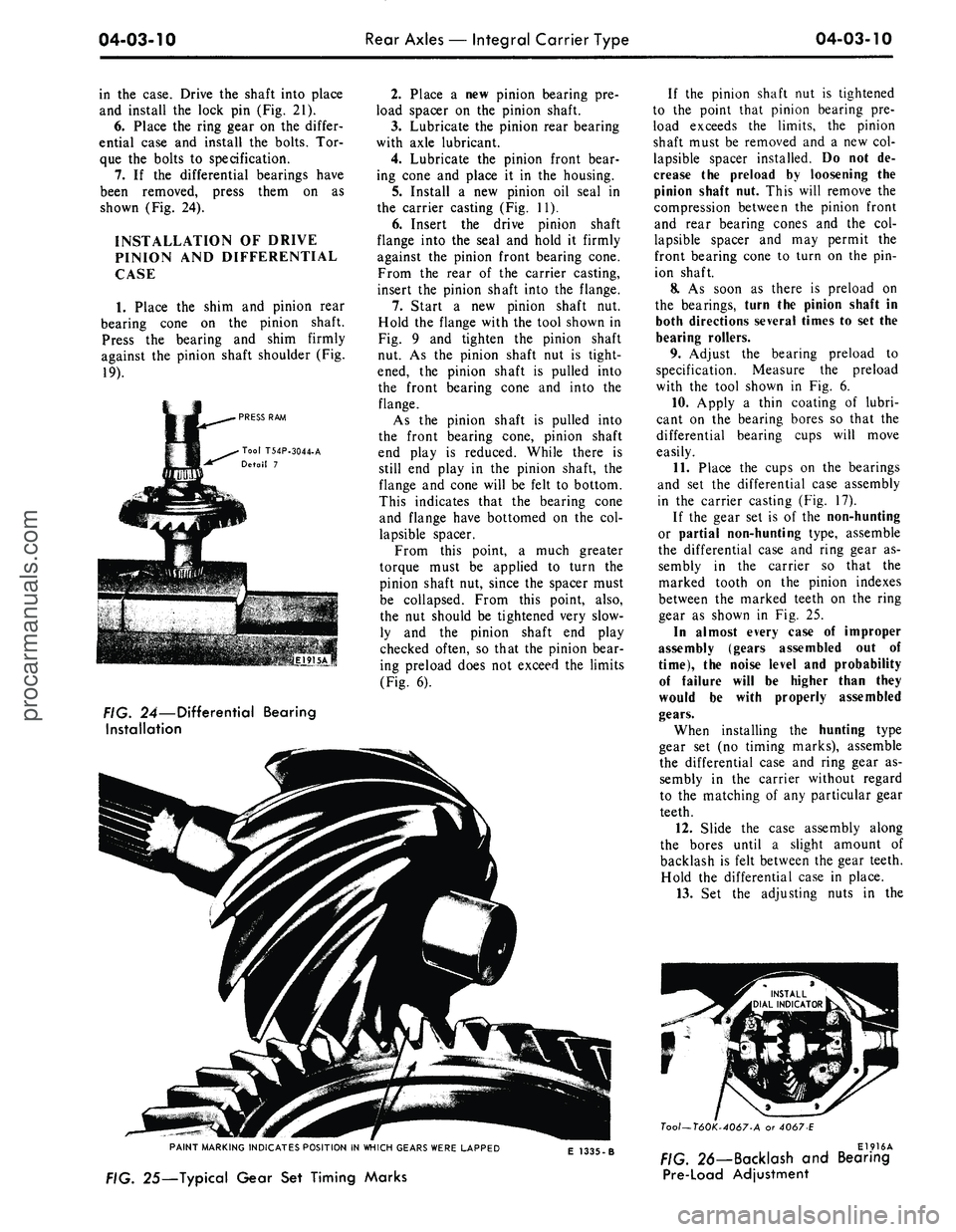
04-03-10
Rear Axles
—
Integral Carrier Type
04-03-10
in
the
case. Drive
the
shaft into place
and install
the
lock
pin
(Fig.
21).
6. Place
the
ring gear
on the
differ-
ential case
and
install
the
bolts.
Tor-
que
the
bolts
to
specification.
7.
If the
differential bearings have
been removed, press them
on as
shown (Fig.
24).
INSTALLATION
OF
DRIVE
PINION
AND
DIFFERENTIAL
CASE
1.
Place
the
shim
and
pinion rear
bearing cone
on the
pinion shaft.
Press
the
bearing
and
shim firmly
against
the
pinion shaft shoulder (Fig.
19).
PRESS RAM
Tool T54P-3044-A
Detail
7
2.
Place
a new
pinion bearing
pre-
load spacer
on the
pinion shaft.
3.
Lubricate
the
pinion rear bearing
with axle lubricant.
4.
Lubricate
the
pinion front bear-
ing cone
and
place
it in the
housing.
5.
Install
a new
pinion
oil
seal
in
the carrier casting (Fig.
11).
6. Insert
the
drive pinion shaft
flange into
the
seal
and
hold
it
firmly
against
the
pinion front bearing cone.
From
the
rear
of the
carrier casting,
insert
the
pinion shaft into
the
flange.
7.
Start
a new
pinion shaft
nut.
Hold
the
flange with
the
tool shown
in
Fig.
9 and
tighten
the
pinion shaft
nut.
As the
pinion shaft
nut is
tight-
ened,
the
pinion shaft
is
pulled into
the front bearing cone
and
into
the
flange.
As
the
pinion shaft
is
pulled into
the front bearing cone, pinion shaft
end play
is
reduced. While there
is
still
end
play
in the
pinion shaft,
the
flange
and
cone will
be
felt
to
bottom.
This indicates that
the
bearing cone
and flange have bottomed
on the col-
lapsible spacer.
From this point,
a
much greater
torque must
be
applied
to
turn
the
pinion shaft
nut,
since
the
spacer must
be collapsed. From this point, also,
the
nut
should
be
tightened very slow-
ly
and the
pinion shaft
end
play
checked often,
so
that
the
pinion bear-
ing preload does
not
exceed
the
limits
(Fig.
6).
FIG. 24—Differential Bearing
Installation
If
the
pinion shaft
nut is
tightened
to
the
point that pinion bearing
pre-
load exceeds
the
limits,
the
pinion
shaft must
be
removed
and a
new
col-
lapsible spacer installed.
Do not de-
crease
the
preload
by
loosening
the
pinion shaft
nut.
This will remove
the
compression between
the
pinion front
and rear bearing cones
and the col-
lapsible spacer
and may
permit
the
front bearing cone
to
turn
on the pin-
ion shaft.
&
As
soon
as
there
is
preload
on
the bearings, turn
the
pinion shaft
in
both directions several times
to set the
bearing rollers.
9. Adjust
the
bearing preload
to
specification. Measure
the
preload
with
the
tool shown
in Fig. 6.
10.
Apply
a
thin coating
of
lubri-
cant
on the
bearing bores
so
that
the
differential bearing cups will move
easily.
11.
Place
the
cups
on the
bearings
and
set the
differential case assembly
in
the
carrier casting (Fig.
17).
If
the
gear
set is of the
non-hunting
or partial non-hunting type, assemble
the differential case
and
ring gear
as-
sembly
in the
carrier
so
that
the
marked tooth
on the
pinion indexes
between
the
marked teeth
on the
ring
gear
as
shown
in Fig. 25.
In almost every case
of
improper
assembly (gears assembled
out of
time),
the
noise level
and
probability
of failure will
be
higher than they
would
be
with properly assembled
gears.
When installing
the
hunting type
gear
set (no
timing marks), assemble
the differential case
and
ring gear
as-
sembly
in the
carrier without regard
to
the
matching
of any
particular gear
teeth.
12.
Slide
the
case assembly along
the bores until
a
slight amount
of
backlash
is
felt between
the
gear teeth.
Hold
the
differential case
in
place.
13.
Set the
adjusting nuts
in the
PAINT MARKING INDICATES POSITION
IN
WHICH GEARS WERE LAPPED
E 1335-B
FIG. 25—Typical Gear
Set
Timing Marks
7oo/—T60K-4067-A or 4067 E
E1916A
FIG. 26—Backlash
and
Bearing
Pre-Load Adjustmentprocarmanuals.com