automatic transmission FORD MUSTANG 1969 Volume One Chassis
[x] Cancel search | Manufacturer: FORD, Model Year: 1969, Model line: MUSTANG, Model: FORD MUSTANG 1969Pages: 413, PDF Size: 75.81 MB
Page 164 of 413
03-10-03
Ford-Thompson Power Steering Pump
03-10-03
EIGHT CYLINDER WITH
AIR CONDITIONER
1.
Remove the power steering fluid
from the pump reservoir by discon-
necting the fluid return hose from the
reservoir and allow the fluid to drain
in a suitable container.
2.
Disconnect the pressure hose
from the pump.
3.
Remove 3 bolts from the front of
the pump and the one nut at the rear
that attach the pump to the mounting
bracket and remove the drive belt
from the pump pulley.
4.
Loosen the upper pump bracket-
to-engine attaching bolt and remove
the bolt in the belt adjusting slot. Re-
move the pump.
5.
Position the pump to the bracket
and install the bracket-to-pump at-
taching bolts and nuts. Tighten to spe-
cifications.
6. Place the belt on the pump pul-
ley. Adjust the belt tension as outlined
in Section 2 and tighten the bolts and
nut to specification.
7.
Torque the pressure hose fitting
hex nut to specification. Then, connect
the pressure hose to the fitting and
torque the hose nut to specification.
8. Connect the return hose to the
power steering pump and tighten the
clamp.
9. Fill the pump with automatic
transmission fluid C1AZ-19582-A.
Bleed the air from the system (Part
3-1) and check for leaks and again
check the fluid level. Add fluid as re-
quired.
POWER STEERING PUMP
PULLEY REPLACEMENT
REMOVAL
1.
Drain as much of the fluid as
possible from the pump through filler
pipe.
2.
Install a 3/8-16 inch capscrew in
the end of the pump shaft to prevent
damage to the shaft end by the tool
screw.
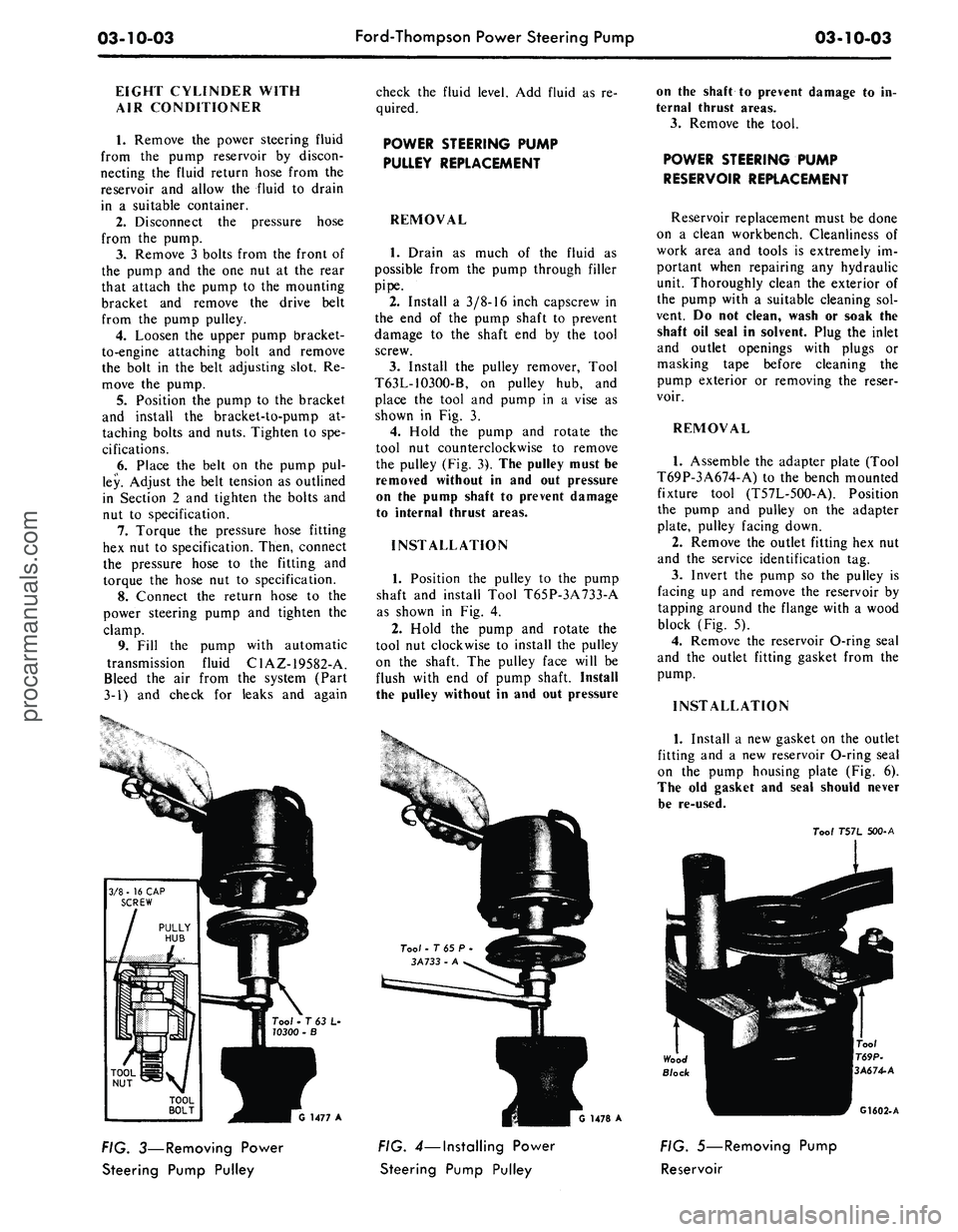
3.
Install the pulley remover, Tool
T63L-1O3OO-B, on pulley hub, and
place the tool and pump in a vise as
shown in Fig. 3.
4.
Hold the pump and rotate the
tool nut counterclockwise to remove
the pulley (Fig. 3). The pulley must be
removed without in and out pressure
on the pump shaft to prevent damage
to internal thrust areas.
INSTALLATION
1.
Position the pulley to the pump
shaft and install Tool T65P-3A733-A
as shown in Fig. 4.
2.
Hold the pump and rotate the
tool nut clockwise to install the pulley
on the shaft. The pulley face will be
flush with end of pump shaft. Install
the pulley without in and out pressure
on the shaft to prevent damage to in-
ternal thrust areas.
3.
Remove the tool.
POWER STEERING PUMP
RESERVOIR REPLACEMENT
Reservoir replacement must be done
on a clean workbench. Cleanliness of
work area and tools is extremely im-
portant when repairing any hydraulic
unit. Thoroughly clean the exterior of
the pump with a suitable cleaning sol-
vent. Do not clean, wash or soak the
shaft oil seal in solvent. Plug the inlet
and outlet openings with plugs or
masking tape before cleaning the
pump exterior or removing the reser-
voir.
REMOVAL
1.
Assemble the adapter plate (Tool
T69P-3A674-A) to the bench mounted
fixture tool (T57L-5OO-A). Position
the pump and pulley on the adapter
plate, pulley facing down.
2.
Remove the outlet fitting hex nut
and the service identification tag.
3.
Invert the pump so the pulley is
facing up and remove the reservoir by
tapping around the flange with a wood
block (Fig. 5).
4.
Remove the reservoir O-ring seal
and the outlet fitting gasket from the
pump.
INSTALLATION
Tool • T 63 L-
10300 -
G 1477 A
FIG. 3—Removing Power
Steering Pump Pulley
1478 A
FIG. 4—Installing Power
Steering Pump Pulley
1.
Install a new gasket on the outlet
fitting and a new reservoir O-ring seal
on the pump housing plate (Fig. 6).
The old gasket and seal should never
be re-used.
Too/
T57L 500-A
G1602-A
FIG. 5—Removing Pump
Reservoirprocarmanuals.com
Page 170 of 413
03-11-02
Eaton Power Steering Pump
03-11-02
gasket. Withdraw the fluid with a suc-
tion gun.
2.
Remove the reservoir bracket-
to-cylinder block upper cap screw and
the lower cap screw and spacer.
3.
Disconnect the reservoir infet line
and the outlet line at the reservoir,
and remove the reservoir.
Installation
1.
Connect the reservoir-to-pump
line (outlet line) at the reservoir, but
do not tighten the clamp.
2.
Attach the reservoir and bracket
to the cylinder block with the upper
cap screw and the lower cap screw
and spacer. Tighten the cap screws.
3.
Tighten the outlet line clamp at
the reservoir. Connect the reservoir
inlet line to the reservoir.
4.
Fill the reservoir with the speci-
fied automatic transmission fluid. Run
the engine, and bleed the system by
cycling the steering gear with the
windshield wipers turned on. Check
for leaks, and recheck the fluid level.
WITH AIR CONDITIONING
Removal
1. Raise the front of the vehicle.
Remove the reservoir-to-pump line
(outlet line) clamp at the reservoir,
but do not disconnect the line at this
time.
2.
Disconnect the reservoir inlet line
at the reservoir.
3.
Remove the reservoir bracket to
the cylinder block upper cap screw.
Support the reservoir and remove the
lower cap screw and spacer.
4.
With a drain pan under the res-
ervoir, disconnect the outlet line hose
from the reservoir tube and allow the
fluid to drain.
5.
Remove the reservoir cover re-
taining nut and the cover. Position the
cover and the reservoir out of the way
and allow them to rest in the engine
compartment.
6. Lower the front of the vehicle.
Remove the fan shroud.
7.
Remove the reservoir and the
cover by manipulating them through
the opening between the radiator and
the compressor drive belt.
Installation
1.
Position the reservoir in the en-
gine compartment. Loosely attach the
reservoir and bracket to the cylinder
block with the upper cap screw.
2.
Install the fan shroud, then raise
the front of the vehicle.
3.
Connect the reservoir-to-pump
line (outlet line) at the reservoir.
4.
Install the reservoir bracket-
to-cylinder block lower cap screw and
spacer. Tighten both the upper and
the lower cap screws.
5.
Connect the reservoir inlet line at
the reservoir. Install the clamps on
both lines. Lower the car, and install
the reservoir cover and attaching nut.
6. Fill the reservoir with the speci-
fied automatic transmission fluid. Run
the engine, and bleed the system by
cycling the steering gear with the
windshield wipers turned on. Check
for leaks, and recheck the fluid level.
3 MAJOR REPAIR OPERATIONS
INSULATOR (2)
WASHER (2)
MOUNTING BOLT (2)
COVER
BOLT (7)
DOWEL
PIN (2)
ROTOR
ROTOR
SHAFT
COVER
SEAL
PLUG
O RING
VALVE
ASSEMBLY
VALVE
SPRING
INSULATOR
HOUSING
CAM RING
PRESSURE
PLATE
,
PUMP
i
HOUSING
SEAL
ROLL
PIN
INSULATOR
RETAINER
RING
TUBE SEAT
O RING
SCREW
(2)
G12O8-B
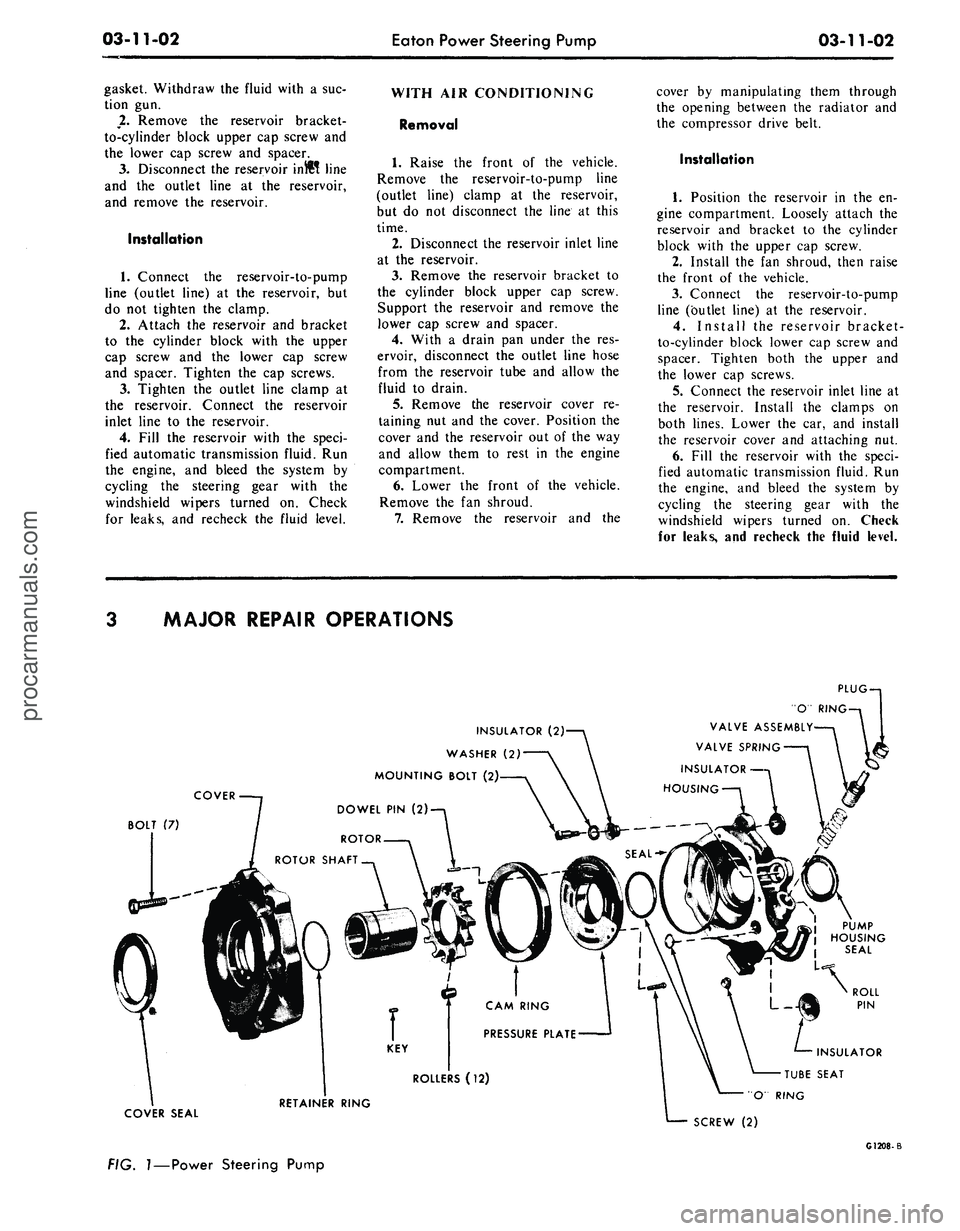
FIG.
1
— Power Steering Pumpprocarmanuals.com
Page 171 of 413
03-11-03
Eaton Power Steering Pump
03-11-03
POWER STEERING PUMP
DISASSEMBLY
A clean working area should be
used when overhauling the power
steering pump. Foreign matter picked
up on working parts may cause dam-
age or failure of the unit. Clean con-
tainers should be used for parts.
1.
Drain the fluid from the pump.
Remove the pump cover-to-housing
cap screws (Fig. 1). Place the pump
on the bench, cover side down. Lift
the housing from the cover.
2.
Remove the large and the small
O-rings from the pump cover. Remove
the O-ring from the pressure plate
hub.
3.
Remove the pressure plate-
to-cover screws, and remove the plate.
Lift the cam ring off the dowel pins.
4.
Remove the rollers. Lift the
rotor off the shaft, and remove the
drive key from the shaft. Remove the
dowel pins from the cover.
5.
Remove the rotor shaft from the
cover. Do not remove the snap ring
from the shaft unless it, or the shaft,
is damaged.
6. Pry the rotor shaft seals out of
the cover and the housing.
7. Do not disturb the control valve
unless diagnosis indicated a control
valve problem or foreign matter in the
valve. To remove the valve, drive the
roll pin out of the housing. Remove
the plug and O-ring, control valve,
and the spring. If the plug or valve is
stuck, tap the end of the housing on a
piece of wood or tap it with a soft-
faced hammer. Remove the O-ring
from the plug.
ASSEMBLY
Apply automatic transmission fluid
to all parts as they are assembled. Al-
ways use new seals and O-rings.
1.
Install the control valve spring in
the housing. Install the valve with the
small sensing hole in the end of the
valve toward the spring. Install a new
O-ring on the plug. The plug O-ring is
1/8 inch smaller in diameter than the
bypass O-ring. Make sure the proper
O-ring is used. Install the plug and a
new roll pin (Fig. 1).
2.
The rotor shaft oil seals are in-
stalled in the cover and the housing
with Tool 3583-J, which consists of a
driver and an adapter. The procedure
is as follows:
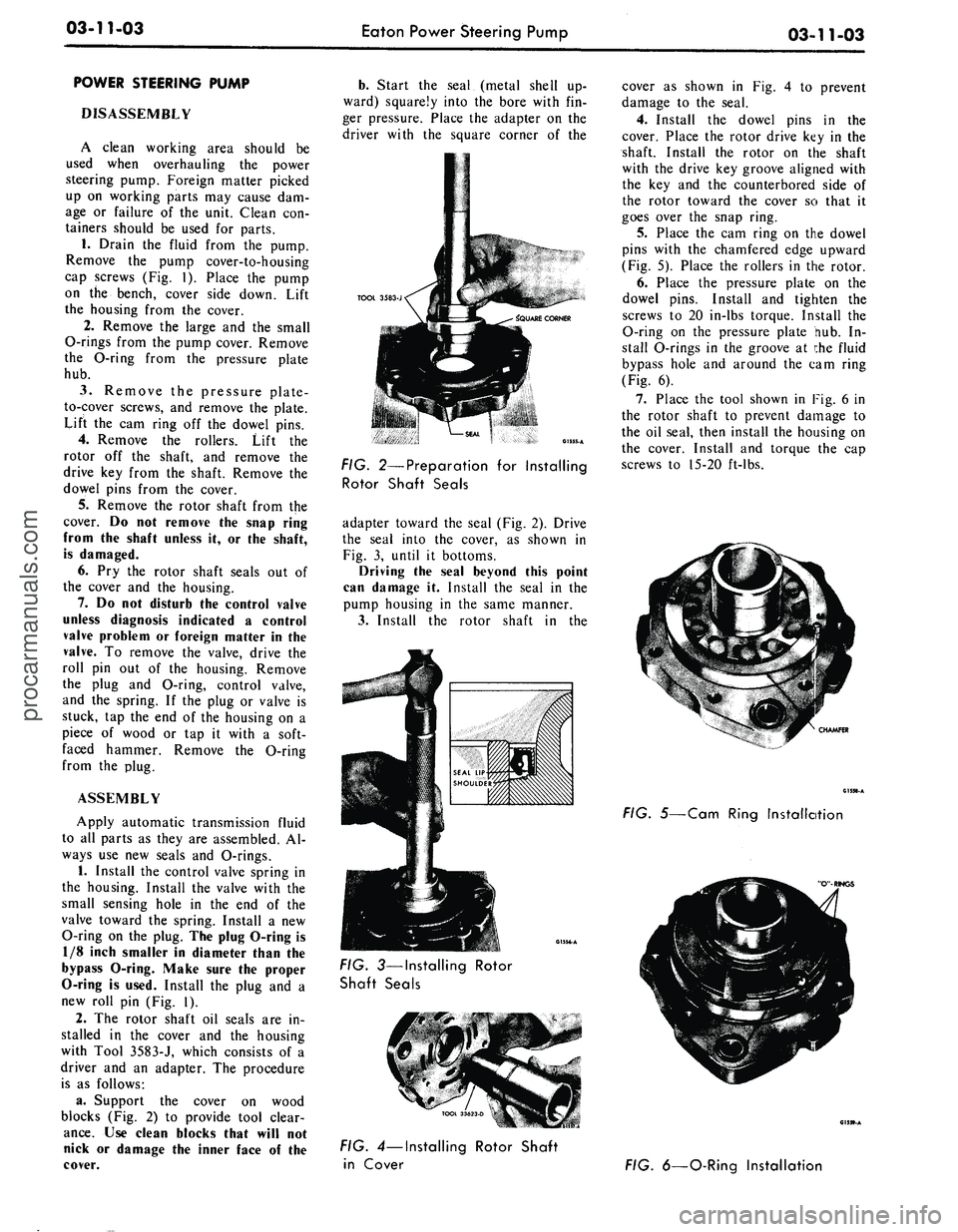
a. Support the cover on wood
blocks (Fig. 2) to provide tool clear-
ance.
Use clean blocks that will not
nick or damage the inner face of the
cover.
b.
Start the seal (metal shell up-
ward) square!y into the bore with fin-
ger pressure. Place the adapter on the
driver with the square corner of the
FIG. 2—Preparation for Installing
Rotor Shaft Seals
adapter toward the seal (Fig. 2). Drive
the seal into the cover, as shown in
Fig. 3, until it bottoms.
Driving the seal beyond this point
can damage it. Install the seal in the
pump housing in the same manner.
3.
Install the rotor shaft in the
FIG. 3—Installing Rotor
Shaft Seals
cover as shown in Fig. 4 to prevent
damage to the seal.
4.
Install the dowel pins in the
cover. Place the rotor drive key in the
shaft. Install the rotor on the shaft
with the drive key groove aligned with
the key and the counterbored side of
the rotor toward the cover so that it
goes over the snap ring.
5.
Place the cam ring on the dowel
pins with the chamfered edge upward
(Fig. 5). Place the rollers in the rotor.
6. Place the pressure plate on the
dowel pins. Install and tighten the
screws to 20 in-lbs torque. Install the
O-ring on the pressure plate hub. In-
stall O-rings in the groove at the fluid
bypass hole and around the cam ring
(Fig. 6).
7.
Place the tool shown in Fig. 6 in
the rotor shaft to prevent damage to
the oil seal, then install the housing on
the cover. Install and torque the cap
screws to 15-20 ft-lbs.
FIG. 5—Cam Ring Installation
FIG. 4—Installing Rotor Shaft
in Cover
FIG. 6—O-Ring Installationprocarmanuals.com
Page 250 of 413

05-01-03
Drive Shaft
05-01-03
DUST SEAL-4859
BALL SOCKET-4A031
UNIVERSAL
JOINT KIT-4635
WASHER
BALL SEAT i \ SPRING
BEARING \\ RETAINER
SEAL
0 \ X \
CENTER
\ \ RETAINER \ YOKE-47R4
SPRING \
BALL SOCKET-4A031
SLIP YOKE-4841
C1770-A
FIG.
3—Drive Shaft and Universal Joints Disassembled —Thunderbird, Continental Mark
REMOVAL AND INSTALLATION
REMOVAL
1.
To maintain drive line balance,
mark the relationship of the rear drive
shaft yoke and the drive pinion flange
of the axle (if the yellow alignment
marks are not visible) with the shaft
so that they may be installed in their
original positions.
2.
Disconnect the rear U-joint or
rear double cardan joint from the
companion flange. Wrap tape around
the loose bearing caps to prevent
them from falling off the spider. Pull
the drive shaft toward the rear of the
vehicle until the slip yoke clears the
transmission extension housing and
the seal. On Lincoln Continental
models, remove the three roller bear-
ing assemblies off the spline teeth in-
side the slip yoke (Fig. 3). Install the
appropriate tool in the extension
housing to prevent lubricant leakage.
INSTALLATION
1.
If either the rubber seal on the
output shaft or the seal in the end of
the transmission extension housing is
damaged in any manner, replace the
seal or seals as required. Also, if the
lugs on the axle pinion flange are
shaved or distorted so that the bear-
ings slide, replace the flange.
2.
On Lincoln Continental models,
install the bearing assemblies over the
spline teeth in the slip yoke. Lubricate
the yoke spline with B8A-19589-A lu-
bricant. This spline is sealed so that
the transmission fluid does not
"wash" away the spline lubricant
(Figs.
4 and 5). Remove the tool from
the extension housing. Install the yoke
on the transmission output shaft. Do
not allow the yoke assembly to bot-
tom on the output shaft with excessive
force.
Install the drive shaft so that the
index marks or the yellow mark (if
visible) on the yoke (light side) is in
line with the yellow mark on the com-
panion flange. This prevents vibration
which occurs when the balance of the
shaft and balance of the axle pinion
flange become additive instead of neu-
01L SEAL (AUTOMATIC TRANSMISSION ONLY)
YOKE
SNAP RING (WRAP TYPE)
. 4—Output Shaft Spline Seal — All except Continental
Mark III and Thunderbird
E U73-Cprocarmanuals.com
Page 292 of 413
07-01-01
07-01-01
*.v:;V*>
-"^g&ly-
'y.y... -4^*:
GROUP
7
PART
7-1
PAGE
General Transmission Service
07-01-01
PART
7-2
C4 Automatic Transmission
07-02-01
PART
7-3
FMX Transmission
07-03-01
PART
7-4
C6 Automatic Transmission
....
PART
7-5
Specifications
PAGE
07-04-01
07-05-01
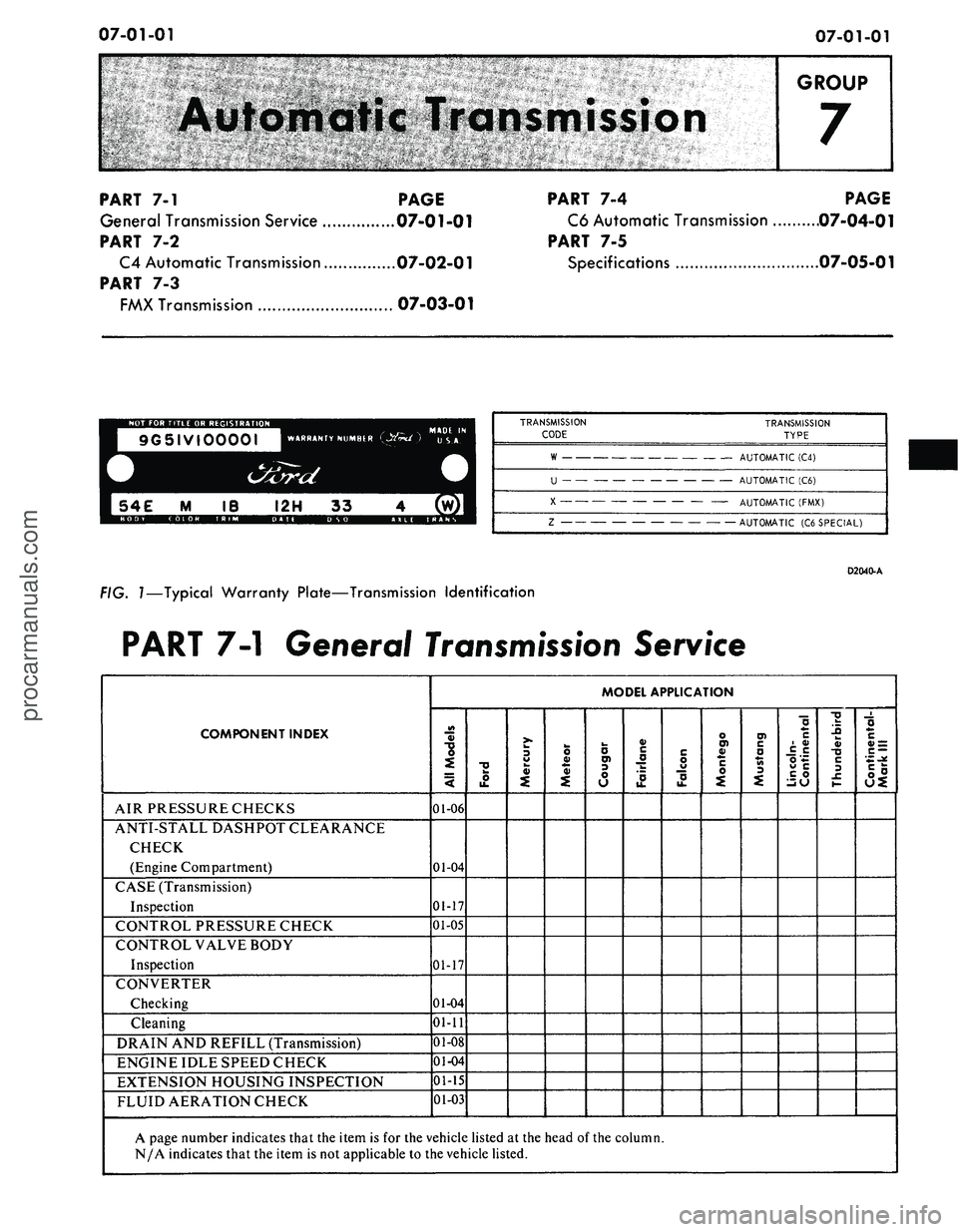
TRANSMISSION
CODE
TRANSMISSION
TYPE
AUTOMATIC
(C4)
U AUTOMATIC
(C6)
X AUTOMATIC
(FMX)
Z AUTOMATIC
(C6
SPECIAL)
D2040-A
FIG. 1—Typical Warranty Plate—Transmission Identification
PART
7-1
General
Transmission
Service
COMPONENT INDEX
AIR PRESSURE CHECKS
ANTI-STALL DASHPOT CLEARANCE
CHECK
(Engine Compartment)
CASE (Transmission)
Inspection
CONTROL PRESSURE CHECK
CONTROL VALVE BODY
Inspection
CONVERTER
Checking
Cleaning
DRAIN AND REFILL (Transmission)
ENGINE IDLE SPEED CHECK
EXTENSION HOUSING INSPECTION
FLUID AERATION CHECK
MODEL APPLICATION
All
Models
01-06
01-04
01-17
01-05
01-17
01-04
01-11
01-08
01-04
01-15
01-03
Ford
Mercury
Meteor
Cougar
Fairiane
Falcon
Montego
Mustang
Lincoln-
Continental
Thunderbird
Continental-
Mark
III
A page number indicates that the item
is for
the vehicle listed
at
the head
of
the column.
N/A indicates that the item
is not
applicable
to
the vehicle listed.
procarmanuals.com
Page 294 of 413
07-01-03
General Transmission Service
07-01-03
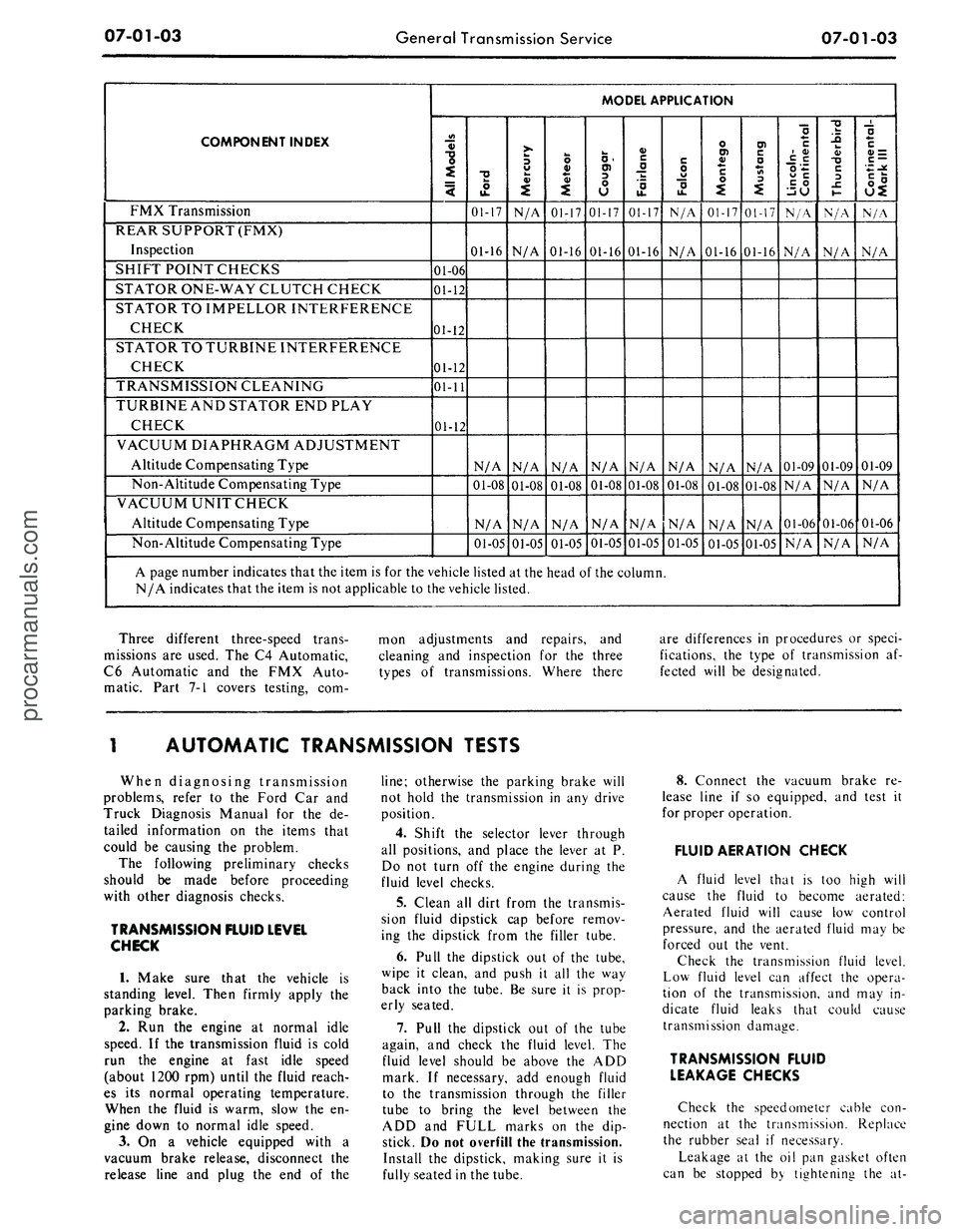
COMPONENT INDEX
FMX Transmission
REAR SUPPORT (FMX)
Inspection
SHIFT POINT CHECKS
STATOR ONE-WAY CLUTCH CHECK
STATOR TO IMPELLOR INTERFERENCE
CHECK
STATOR TO TURBINE INTERFERENCE
CHECK
TRANSMISSION CLEANING
TURBINE AND STATOR END PLAY
CHECK
VACUUM DIAPHRAGM ADJUSTMENT
Altitude Compensating Type
Non-Altitude Compensating Type
VACUUM UNIT CHECK
Altitude Compensating Type
Non-Altitude Compensating Type
MODEL APPLICATION
All
Models
01-06
01-12
01-12
01-12
01-11
01-12
Ford
01-17
01-16
N/A
01-08
N/A
01-05
Mercury
N/A
N/A
N/A
01-08
N/A
01-05
Meteor
01-17
01-16
N/A
01-08
N/A
01-05
Cougar
01-17
01-16
N/A
01-08
N/A
01-05
Fairlane
01-17
01-16
N/A
01-08
N/A
01-05
Falcon
N/A
N/A
N/A
01-08
N/A
01-05
Montego
01-17
01-16
N/A
01-08
N/A
01-05
Mustang
01-17
01-16
N/A
01-08
N/A
01-05
Lincoln-
Continental
N/A
N/A
01-09
N/A
01-06
N/A
Thunderbird
N/A
N/A
01-09
N/A
01-06
N/A
Continental-
Mark
III
N/A
N/A
01-09
N/A
01-06
N/A
A page number indicates that the item is for the vehicle listed at the head of the column.
N/A indicates that the item is not applicable to the vehicle listed.
Three different three-speed trans-
missions are used. The C4 Automatic,
C6 Automatic and the FMX Auto-
matic. Part 7-1 covers testing, com-
mon adjustments and repairs, and
cleaning and inspection for the three
types of transmissions. Where there
are differences in procedures or speci-
fications, the type of transmission af-
fected will be designated.
l
AUTOMATIC TRANSMISSION TESTS
When diagnosing transmission
problems, refer to the Ford Car and
Truck Diagnosis Manual for the de-
tailed information on the items that
could be causing the problem.
The following preliminary checks
should be made before proceeding
with other diagnosis checks.
TRANSMISSION FLUID LEVEL
CHECK
1.
Make sure that the vehicle is
standing level. Then firmly apply the
parking brake.
2.
Run the engine at normal idle
speed. If the transmission fluid is cold
run the engine at fast idle speed
(about 1200 rpm) until the fluid reach-
es its normal operating temperature.
When the fluid is warm, slow the en-
gine down to normal idle speed.
3.
On a vehicle equipped with a
vacuum brake release, disconnect the
release line and plug the end of the
line;
otherwise the parking brake will
not hold the transmission in any drive
position.
4.
Shift the selector lever through
all positions, and place the lever at P.
Do not turn off the engine during the
fluid level checks.
5.
Clean all dirt from the transmis-
sion fluid dipstick cap before remov-
ing the dipstick from the filler tube.
6. Pull the dipstick out of the tube,
wipe it clean, and push it all the way
back into the tube. Be sure it is prop-
erly seated.
7.
Pull the dipstick out of the tube
again, and check the fluid level. The
fluid level should be above the ADD
mark. If necessary, add enough fluid
to the transmission through the filler
tube to bring the level between the
ADD and FULL marks on the dip-
stick. Do not overfill the transmission.
Install the dipstick, making sure it is
fully seated in the tube.
8. Connect the vacuum brake re-
lease line if so equipped, and test it
for proper operation.
FLUID AERATION CHECK
A fluid level that is too high will
cause the fluid to become aerated:
Aerated fluid will cause low control
pressure, and the aerated fluid may be
forced out the vent.
Check the transmission fluid level.
Low fluid level can affect the opera-
tion of the transmission, and may in-
dicate fluid leaks that could cause
transmission damage.
TRANSMISSION FLUID
LEAKAGE CHECKS
Check the speedometer cable con-
nection at the transmission. Replace
the rubber seal if necessary.
Leakage at the oil pan gasket often
can be stopped by tightening the at-
procarmanuals.com
Page 296 of 413
07-01-05
General Transmission Service
07-01-05
linkage may cause crossleakage and
subsequent transmission failure. Refer
to Linkage Adjustments in Part 7-2,
7-3 or 7-4 for detailed manual linkage
adjustment procedures.
CONTROL PRESSURE
CHECK
When the vacuum diaphragm unit is
operating properly and the downshift
linkage is adjusted properly, all the
transmission shifts (automatic and
kickdown) should occur within the
road speed limits specified in Part 7-5.
If the shifts do not occur within
limits or the transmission slips during
shift point, the following procedure is
suggested to determine engine, trans-
mission, linkage, vacuum diaphragm
unit or valve body problems.
1.
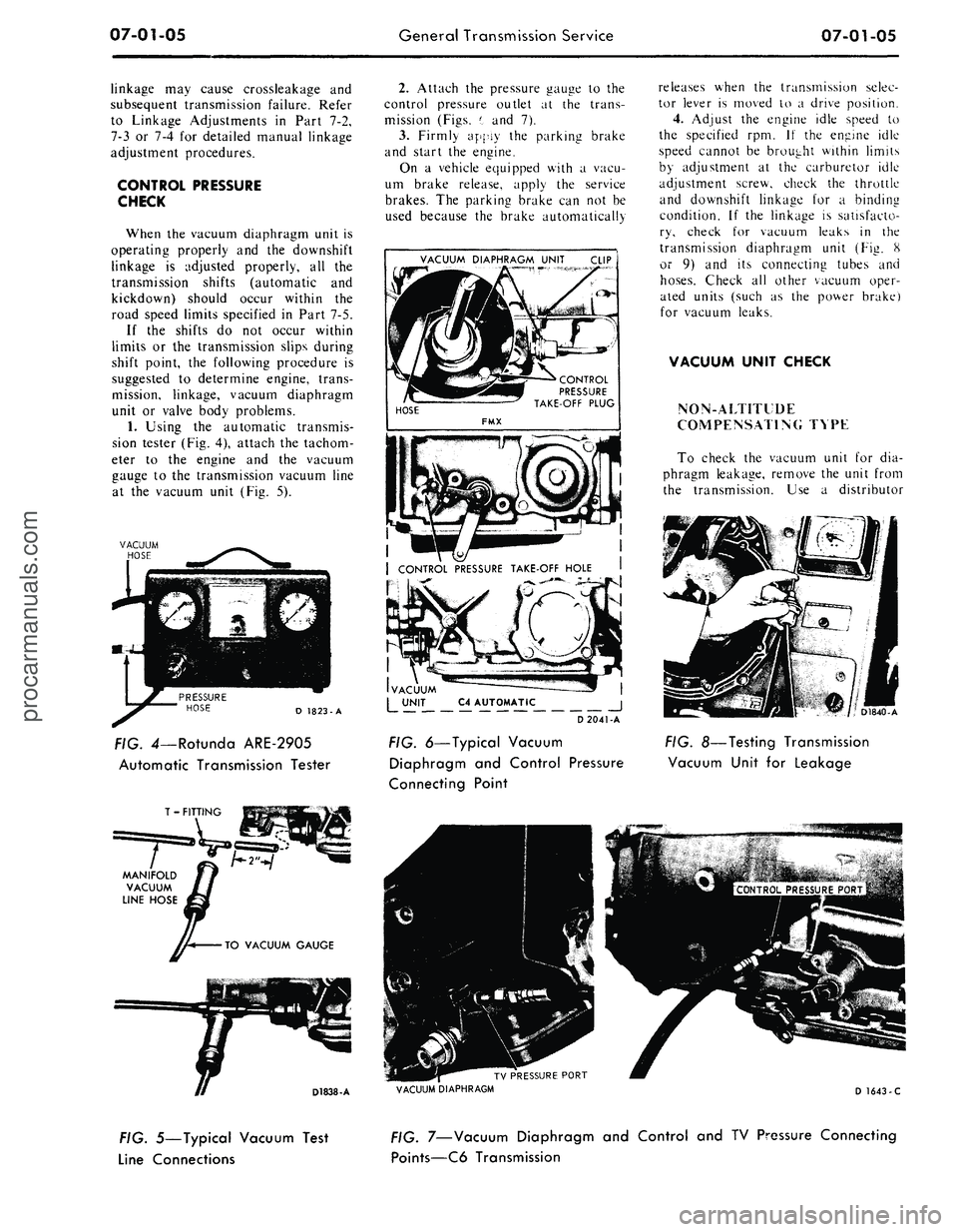
Using the automatic transmis-
sion tester (Fig. 4), attach the tachom-
eter to the engine and the vacuum
gauge to the transmission vacuum line
at the vacuum unit (Fig. 5).
D 1823-A
. 4—Rotunda ARE-2905
Automatic Transmission Tester
T - FITTING
2.
Attach the pressure gauge to the
control pressure outlet at the trans-
mission (Figs. '., and 7).
3.
Firmly apply the parking brake
and start the engine.
On a vehicle equipped with a vacu-
um brake release, apply the service
brakes. The parking brake can not be
used because the brake automatically
VACUUM DIAPHRAGM UNIT
CLIP
I
| CONTROL PRESSURE TAKE-OFF HOLE
D2041-A
FIG. 6—Typical Vacuum
Diaphragm and Control Pressure
Connecting Point
releases when the transmission selec-
tor lever is moved to a drive position.
4.
Adjust the engine idle speed lo
the specified rpm. If the engine idle
speed cannot be brought within limits
by adjustment at the carburetor idle
adjustment screw, check the throttle
and downshift linkage for a binding
condition. If the linkage is satisfacto-
ry, check for vacuum leaks in the
transmission diaphragm unit (Fig. 8
or 9) and its connecting tubes and
hoses.
Check all other vacuum oper-
ated units (such as the power brake)
for vacuum leaks.
VACUUM UNIT CHECK
NON-ALTITIDE
COMPENSATING TYPE
To check the vacuum unit for dia-
phragm leakage, remove the unit from
the transmission. Use a distributor
D1840-A
FIG. 8—Testing Transmission
Vacuum Unit for Leakage
VACUUM DIAPHRAGM
D 1643 -C
FIG. 5—Typical Vacuum Test
Line Connections
FIG.
7—Vacuum
Diaphragm and Control and TV Pressure Connecting
Points—C6 Transmissionprocarmanuals.com
Page 298 of 413
07-01-07
General Transmission Service
07-01-07
PUMP IN
INTERMEDIATE
SERVO RELEASE
REVERSE AND
HIGH CLUTCH
INTERMEDIATE
SERVO APPLY
GOVERNOR PRESSURE
TO VALVE BODY
FORWARD
CLUTCH
PUMP OUT
CONVERTER IN
CONTROL
PRESSURE
TO PRIMARY
THROTTLE VALVE
PRIMARY THROTTLE
PRESSURE-TO-VALVE
BODY
PRIMARY THROTTLE
VALVE EXHAUST
LOW AND
REVERSE SERVO
CONTROL PRESSURE
TO GOVERNOR
D1841-A
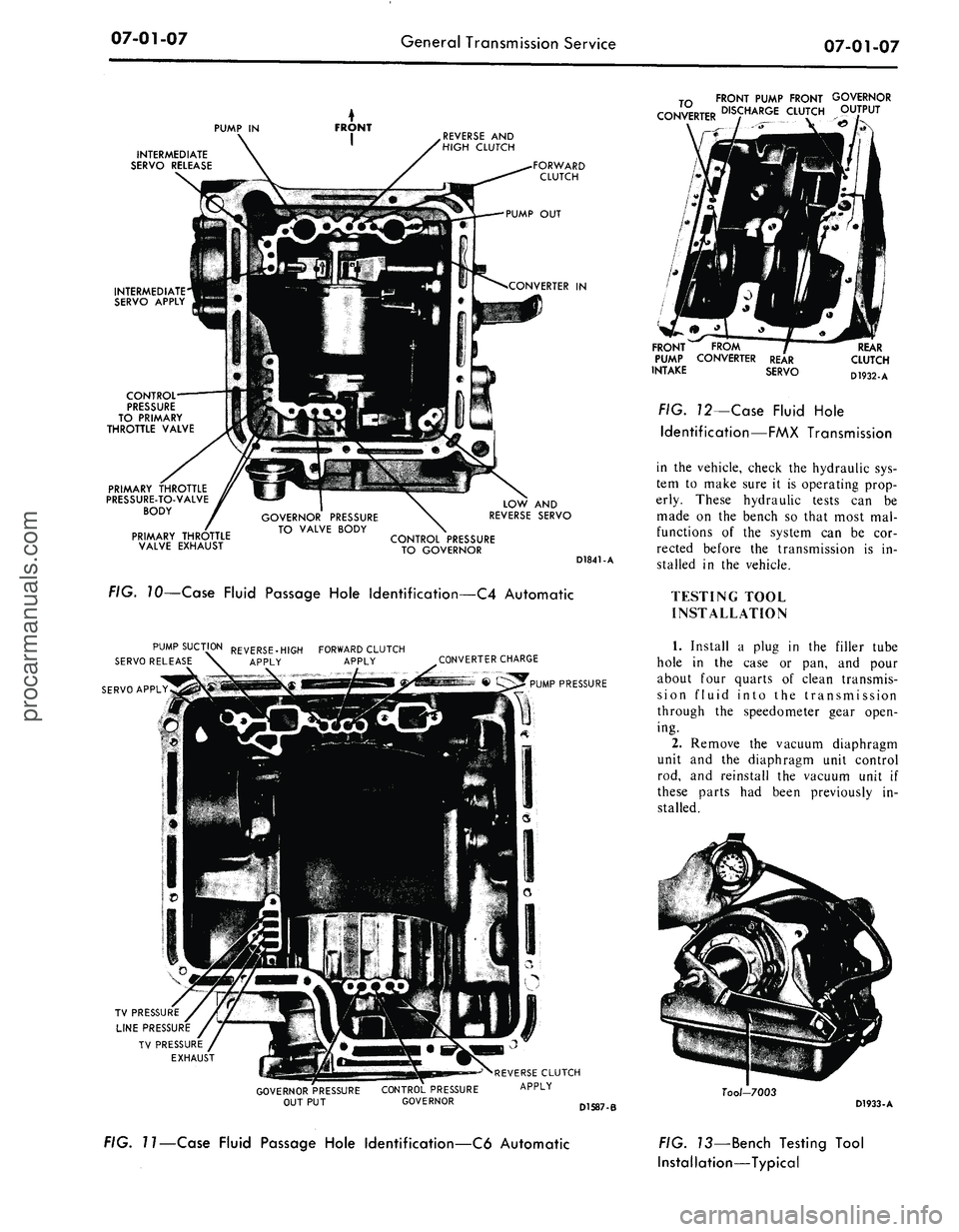
FIG. 70—Case Fluid Passage Hole Identification—C4 Automatic
FRONT PUMP FRONT GOVERNOR
DISCHARGE CLUTCH OUTPUT
FRONT FROM
PUMP CONVERTER REAR
INTAKE SERVO
REAR
CLUTCH
D1932-A
FIG. 12—Case Fluid Hole
Identification—FMX Transmission
in the vehicle, check the hydraulic sys-
tem to make sure it is operating prop-
erly. These hydraulic tests can be
made on the bench so that most mal-
functions of the system can be cor-
rected before the transmission is in-
stalled in the vehicle.
TESTING TOOL
INSTALLATION
SERVO RELEASE
SERVO APPLY
PUMP SUCTION REVERSE-HIGH FORWARD CLUTCH
APPLY APPLY
CONVERTER CHARGE
PUMP PRESSURE
TV PRESSURE
LINE PRESSURE
TV PRESSURE
EXHAUST
-S>*REVERSE CLUTCH
GOVERNOR PRESSURE CONTROL PRESSURE
OUT PUT GOVERNOR
APPLY
1.
Install a plug in the filler tube
hole in the case or pan, and pour
about four quarts of clean transmis-
sion fluid into the transmission
through the speedometer gear open-
ing.
2.
Remove the vacuum diaphragm
unit and the diaphragm unit control
rod, and reinstall the vacuum unit if
these parts had been previously in-
stalled.
Tool-7003
D1587-B
D1933-A
FIG.
7
7—Case
Fluid Passage Hole Identification—C6 Automatic
FIG. 73—Bench Testing Tool
Installation—Typicalprocarmanuals.com
Page 299 of 413
07-01-08
General Transmission Service
07-01-08
3.
Install the bench testing tool on
the transmission.
4.
Remove the
1/8-inch
pipe plug
at the transmission case. Turn the
front pump in a clockwise direction at
75-100 rpm until a regular flow of
transmission fluid leaves the hole in
the transmission case. This operation
bleeds the air from the pump.
5.
Install the pressure gauge (77820
or T57L-77820-A) as shown in Fig.
13.
PRESSURE TESTS
Turn the front pump at 75-100 rpm
and note the gauge readings. The
pressure readings on the bench test
must be within the limits as outlined
in Figure 13, for the engine idle check.
If pressure gauge readings are with-
in limits in all selector lever positions,
install the vacuum diaphragm control
rod unit.
COMMON ADJUSTMENTS AND REPAIRS
TRANSMISSION FLUID DRAIN
AND REFILL
Normal maintenance and lubrica-
tion requirements do not necessitate
periodic automatic transmission fluid
changes.
If a major repair, such as a clutch
band, bearing, etc., is required in the
transmission, it will have to be re-
moved for service. At this time the
converter, transmission cooler and
cooler lines must be thoroughly
flushed to remove any dirt.
When filling a dry transmission and
converter, install five quarts of fluid.
Start the engine, shift the selector
lever as outlined below, and check and
add fluid as necessary.
Following are the procedures for
partial drain and refill due to in-
vehicle repair operation.
C4 TRANSMISSION
1.
On PEA models, disconnect the
fluid filler tube from the transmission
oil pan to drain the fluid.
On PEB and PEE models, loosen
the pan attaching bolts to drain the
fluid from the transmission.
2.
When the fluid has stopped
draining from the transmission, re-
move and thoroughly clean the pan
and the screen. Discard the pan gas-
ket.
3.
Place a new gasket on the pan,
and install the pan on the transmis-
sion.
4.
On PEA models, connect the
filler tube to the pan and tighten the
fitting securely.
5.
Add three quarts of fluid to the
transmission through the filler tube.
6. Run the engine at idle speed for
about two minutes, and then run it at
fast idle speed (about 1200 rpm) until
it reaches it's normal operating temp-
erature. Do not race the engine.
7.
Shift the selector lever through
all the positions, place it at P, and
check the fluid level. The fluid level
should be above the ADD mark. If
necessary, add enough fluid io the
transmission to bring the level be-
tween the ADD and FULL marks on
che dipstick. Do not overfill the trans-
mission.
FMX OK C6
TRANSMISSION
1.
Raise the vehicle on a hoist or
jack stands.
2.
Place a drain pan under the
transmission.
3.
Loosen the pan attaching bolts
to drain the fluid from the transmis-
sion.
4.
After the fluid has drained to the
level of the pan flange, remove the
rest of the pan bolts working from the
rear and both sides of the pan to
allow it to drop and drain slowly.
5.
When the fluid has stopped
draining from the transmission, re-
move and thoroughly clean the pan
and the screen. Discard the pan gas-
ket.
6. Place a new gasket on the pan,
and install the pan on the transmis-
sion.
7.
Add three quarts of fluid to the
transmission through the filler tube.
8. Run the engine at idle speed for
about two minutes, and then run it at
fast idle speed (about 1200 rpm) until
it reaches normal operating tempera-
ture.
Do not race the engine.
9. Shift the selector lever through
all the positions, place it at P, and
check the fluid level. The fluid level
should be above the ADD mark. If
necessary, add enough fluid to the
transmission to bring the level be-
tween the ADD and FULL marks on
the dipstick. Do not overfill the trans-
mission.
OIL COOLER TUBE
REMOVAL AND INSTALLATION
When fluid leakage is found at the
oil cooler, the cooler must be re-
placed. Cooler replacement is de-
scribed in the Cooling System Section
of Group 11.
When one or more of the fluid
cooler steel tubes must be replaced,
each replacement tube must be fabri-
cated from the same size steel tubing
as the original line.
Using the old tube as a guide, bend
the new tube as required. Add the
necessary fittings, and install the tube.
After the fittings have been tight-
ened, add fluid as needed, and check
for fluid leaks.
VACUUM DIAPHRAGM
ADJUSTMENT NON-ALTITUDE
COMPENSATING TYPE
The C4 and C6 transmissions are
equipped with an adjustable vacuum
diaphragm assembly. A similar ad-
justable diaphragm has been released
for service with the FMX transmis-
sion. However, the FMX service dia-
phragm is not interchangeable with
that used on C4 and C6 models.
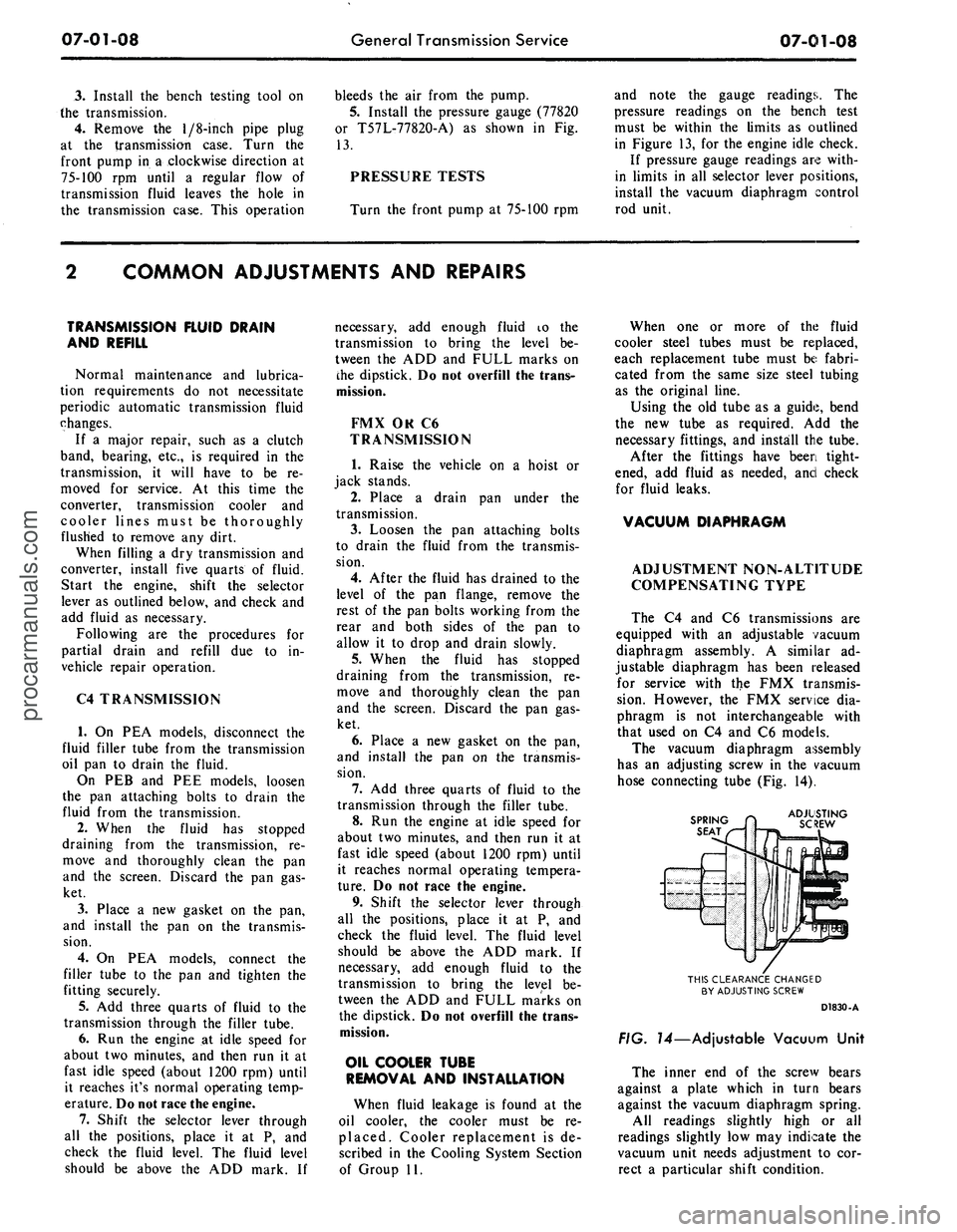
The vacuum diaphragm assembly
has an adjusting screw in the vacuum
hose connecting tube (Fig. 14).
SPRING
SEAT
THIS CLEARANCE CHANGED
BY ADJUSTING SCREW
D1830-A
FIG. 14—Adjustable Vacuum Unit
The inner end of the screw bears
against a plate which in turn bears
against the vacuum diaphragm spring.
All readings slightly high or all
readings slightly low may indicate the
vacuum unit needs adjustment to cor-
rect a particular shift condition.procarmanuals.com
Page 302 of 413
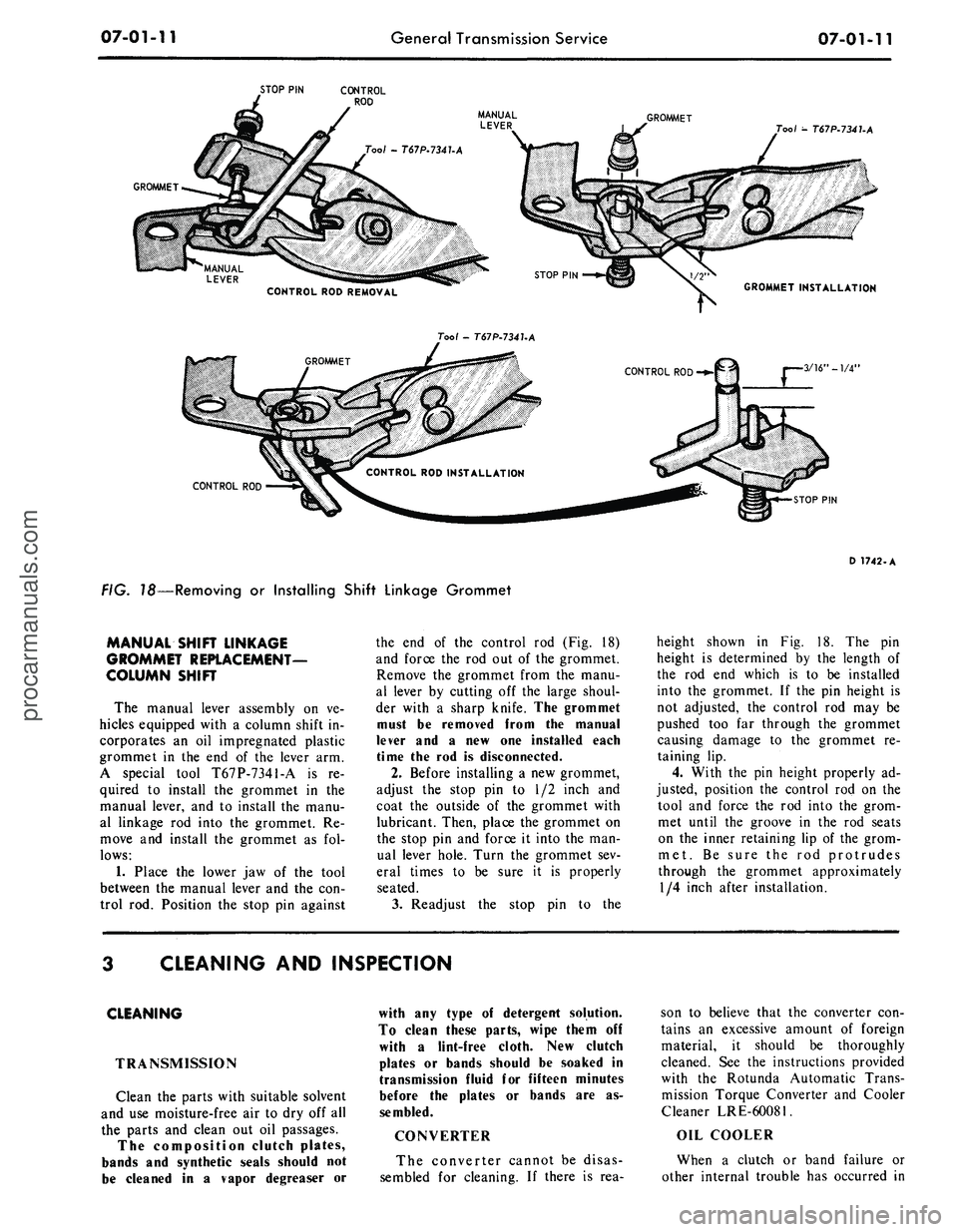
07-01-11
General Transmission Service
07-01-11
STOP
PIN
GROMMET
Tool - T67P-734LA
GROMMET
LEVER
CONTROL ROD REMOVAL
GROMMET INSTALLATION
Tool - T67P-734LA
r
CONTROL ROD INSTALLATION
3/16"-1/4'
CONTROL ROD
STOP
PIN
FIG. 18—Removing
or
Installing Shift Linkage Grommet
D 1742-A
MANUAL SHIFT LINKAGE
GROMMET REPLACEMENT-
COLUMN SHIFT
The manual lever assembly
on ve-
hicles equipped with
a
column shift
in-
corporates
an oil
impregnated plastic
grommet
in the end of the
lever
arm.
A special tool T67P-7341-A
is re-
quired
to
install
the
grommet
in the
manual lever,
and to
install
the
manu-
al linkage
rod
into
the
grommet.
Re-
move
and
install
the
grommet
as fol-
lows:
1.
Place
the
lower
jaw of the
tool
between
the
manual lever
and the con-
trol
rod.
Position
the
stop
pin
against
the
end of the
control
rod (Fig. 18)
and force
the rod out of the
grommet.
Remove
the
grommet from
the
manu-
al lever
by
cutting
off the
large shoul-
der with
a
sharp knife.
The
grommet
must
be
removed from
the
manual
lever
and a new one
installed each
time
the rod is
disconnected.
2.
Before installing
a
new grommet,
adjust
the
stop
pin to 1/2
inch
and
coat
the
outside
of the
grommet with
lubricant. Then, place
the
grommet
on
the stop
pin and
force
it
into
the
man-
ual lever hole. Turn
the
grommet
sev-
eral times
to be
sure
it is
properly
seated.
3.
Readjust
the
stop
pin to the
height shown
in Fig. 18. The pin
height
is
determined
by the
length
of
the
rod end
which
is to be
installed
into
the
grommet.
If the pin
height
is
not adjusted,
the
control
rod may be
pushed
too far
through
the
grommet
causing damage
to the
grommet
re-
taining
lip.
4.
With
the pin
height properly
ad-
justed, position
the
control
rod on the
tool
and
force
the rod
into
the
grom-
met until
the
groove
in the rod
seats
on
the
inner retaining
lip of the
grom-
met.
Be
sure
the rod
protrudes
through
the
grommet approximately
1/4 inch after installation.
CLEANING
AND
INSPECTION
CLEANING
TRANSMISSION
Clean
the
parts with suitable solvent
and
use
moisture-free
air to dry off all
the parts
and
clean
out oil
passages.
The composition clutch plates,
bands
and
synthetic seals should
not
be cleaned
in a
vapor degreaser
or
with
any
type
of
detergent solution.
To clean these parts, wipe them
off
with
a
lint-free cloth.
New
clutch
plates
or
bands should
be
soaked
in
transmission fluid
for
fifteen minutes
before
the
plates
or
bands
are as-
sembled.
CONVERTER
The converter cannot
be
disas-
sembled
for
cleaning.
If
there
is rea-
son
to
believe that
the
converter
con-
tains
an
excessive amount
of
foreign
material,
it
should
be
thoroughly
cleaned.
See the
instructions provided
with
the
Rotunda Automatic Trans-
mission Torque Converter
and
Cooler
Cleaner LRE-60081.
OIL COOLER
When
a
clutch
or
band failure
or
other internal trouble
has
occurred
inprocarmanuals.com