seat adjustment FORD MUSTANG 1969 Volume One Chassis
[x] Cancel search | Manufacturer: FORD, Model Year: 1969, Model line: MUSTANG, Model: FORD MUSTANG 1969Pages: 413, PDF Size: 75.81 MB
Page 155 of 413
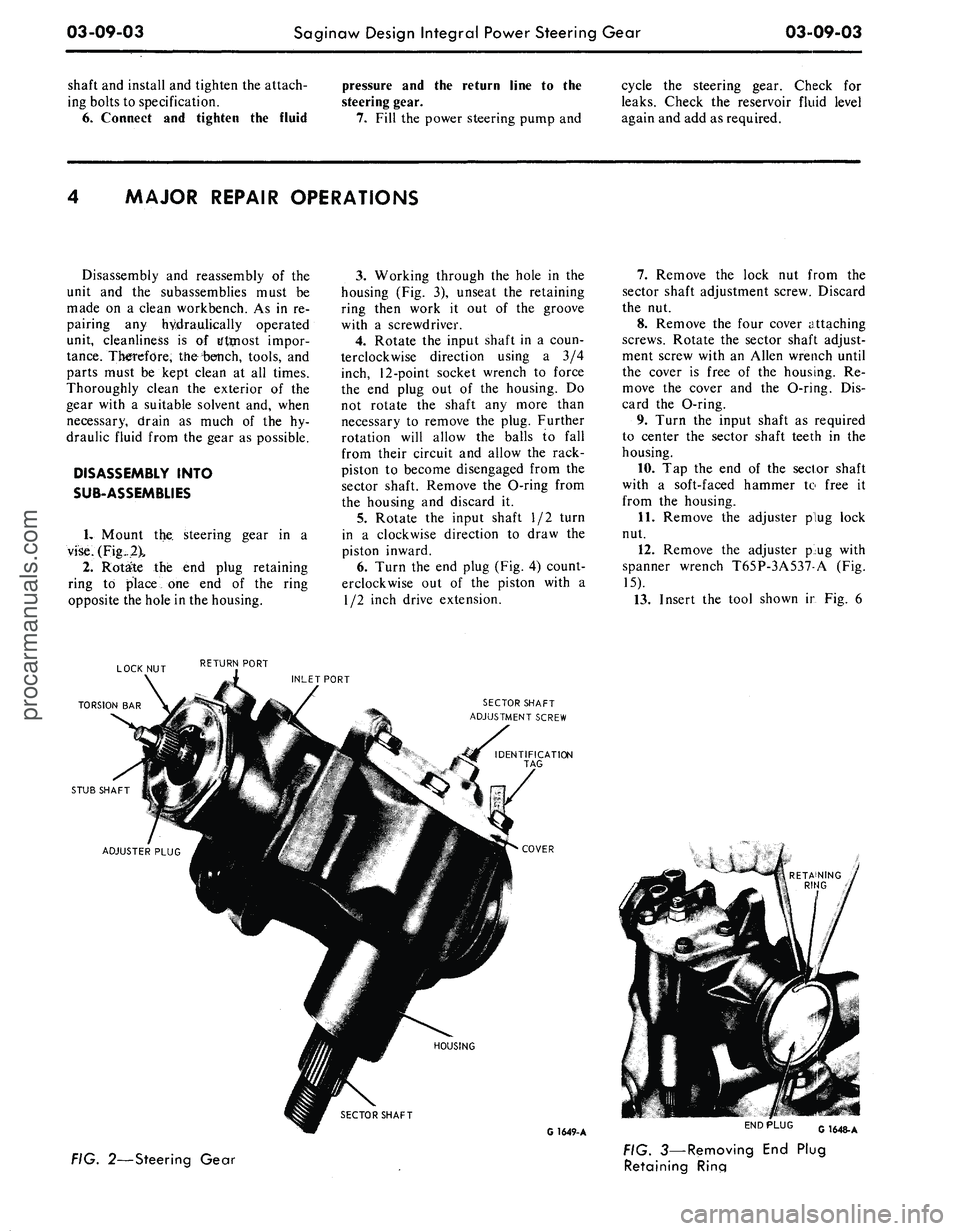
03-09-03
Saginaw Design Integral Power Steering Gear
03-09-03
shaft and install and tighten the attach-
ing bolts to specification.
6. Connect and tighten the fluid
pressure and the return line to the
steering gear.
7. Fill the power steering pump and
cycle the steering gear. Check for
leaks.
Check the reservoir fluid level
again and add as required.
MAJOR REPAIR OPERATIONS
Disassembly and reassembly of the
unit and the subassemblies must be
made on a clean workbench. As in re-
pairing any hyldraulically operated
unit, cleanliness is of tftfiiost impor-
tance. Therefore, the bench, tools, and
parts must be kept clean at all times.
Thoroughly clean the exterior of the
gear with a suitable solvent and, when
necessary, drain as much of the hy-
draulic fluid from the gear as possible.
DISASSEMBLY INTO
SUB-ASSEMBLIES
1,
Mount the steering gear in a
vise.
(Fig..
2\
2.
Rotate the end plug retaining
ring to place one end of the ring
opposite the hole in the housing.
3.
Working through the hole in the
housing (Fig. 3), unseat the retaining
ring then work it out of the groove
with a screwdriver.
4.
Rotate the input shaft in a coun-
terclockwise direction using a 3/4
inch, 12-point socket wrench to force
the end plug out of the housing. Do
not rotate the shaft any more than
necessary to remove the plug. Further
rotation will allow the balls to fall
from their circuit and allow the rack-
piston to become disengaged from the
sector shaft. Remove the O-ring from
the housing and discard it.
5.
Rotate the input shaft 1/2 turn
in a clockwise direction to draw the
piston inward.
6. Turn the end plug (Fig. 4) count-
erclockwise out of the piston with a
1/2 inch drive extension.
7.
Remove the lock nut from the
sector shaft adjustment screw. Discard
the nut.
8. Remove the four cover attaching
screws. Rotate the sector shaft adjust-
ment screw with an Allen wrench until
the cover is free of the housing. Re-
move the cover and the O-ring. Dis-
card the O-ring.
9. Turn the input shaft as required
to center the sector shaft teeth in the
housing.
10.
Tap the end of the sector shaft
with a soft-faced hammer to free it
from the housing.
11.
Remove the adjuster plug lock
nut.
12.
Remove the adjuster p>ug with
spanner wrench T65P-3A537-A (Fig.
15).
13.
Insert the tool shown ir Fig. 6
LOCK NUT RETUF™ P0RT
INLET PORT
TORSION BAR
STUB SHAFT
SECTOR SHAFT
ADJUSTMENT SCREW
ADJUSTER PLUG
HOUSING
SECTOR SHAFT
G
1649-
A
FIG. 2—Steering Gear
END PLUG
G1648-A
FIG. 3—Removing End Plug
Retaining Rinaprocarmanuals.com
Page 173 of 413
03-12-02
Wheels
And
Tires
03-12-02
LIFE GUARD TIRE
The Goodyear Power Cushion Tire
(available
on
Thunderbird, Lincoln
and Continental Mark
III
models)
fit-
ted with
the
Life Guard Safety Spare
provides
a
tire within
a
tire with
two
separate
air
chambers
(Fig.
3). If the
outer tire casing should
be
punctured
or otherwise damaged causing
it to go
flat,
the
Life Guard Safety Spare will
carry
the
load
of the
vehicle
and
will
allow driving
at
speeds
up to 40 mph
with good control
up to a
distance
of
40 miles.
A
Safety-Signal built into
the Life Guard tread produces
a
lope
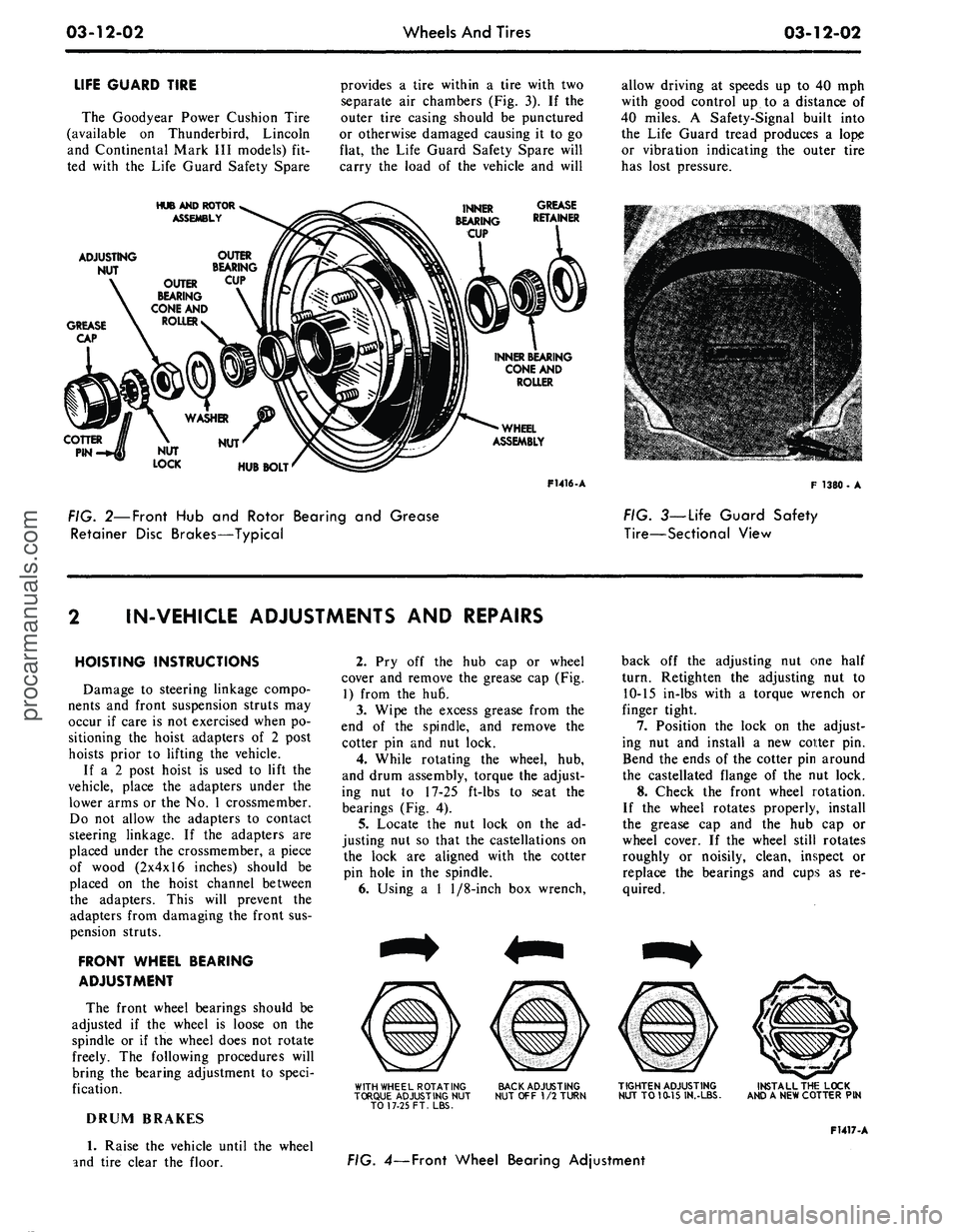
or vibration indicating
the
outer tire
has lost pressure.
HUB AND ROTOR
ASSEMBLY
INNER
BEARING
CUP
GREASE
RETAINER
ADJUSTING
NUT
OUTER
BEARING
CONE
AND
ROLLER
INNER BEARING
CONE
AND
ROLLER
WHEEL
ASSEMBLY
F1416-A
F- 1380 •
A
FIG. 2—Front
Hub and
Rotor Bearing
and
Grease
Retainer Disc Brakes—Typical
FIG. 3—Life Guard Safety
Tire—Sectional View
IN-VEHICLE ADJUSTMENTS AND REPAIRS
HOISTING INSTRUCTIONS
Damage
to
steering linkage compo-
nents
and
front suspension struts
may
occur
if
care
is
not
exercised when
po-
sitioning
the
hoist adapters
of 2
post
hoists prior
to
lifting
the
vehicle.
If
a 2
post hoist
is
used
to
lift
the
vehicle, place
the
adapters under
the
lower arms
or
the No. 1
crossmember.
Do
not
allow
the
adapters
to
contact
steering linkage.
If the
adapters
are
placed under
the
crossmember,
a
piece
of wood (2x4x16 inches) should
be
placed
on the
hoist channel between
the adapters. This will prevent
the
adapters from damaging
the
front
sus-
pension struts.
FRONT WHEEL BEARING
ADJUSTMENT
The front wheel bearings should
be
adjusted
if the
wheel
is
loose
on the
spindle
or if the
wheel does
not
rotate
freely.
The
following procedures will
bring
the
bearing adjustment
to
speci-
fication.
DRUM BRAKES
1.
Raise
the
vehicle until
the
wheel
and tire clear
the
floor.
2.
Pry off the hub cap or
wheel
cover
and
remove
the
grease
cap (Fig.
1) from
the hu6.
3.
Wipe
the
excess grease from
the
end
of the
spindle,
and
remove
the
cotter
pin and nut
lock.
4.
While rotating
the
wheel,
hub,
and drum assembly, torque
the
adjust-
ing
nut to 17-25
ft-lbs
to
seat
the
bearings
(Fig.
4).
5.
Locate
the nut
lock
on the ad-
justing
nut so
that
the
castellations
on
the lock
are
aligned with
the
cotter
pin hole
in the
spindle.
6. Using
a 1
1/8-inch
box
wrench,
WITH WHEEL ROTATING
TORQUE ADJUSTING
NUT
TO 17-25 FT. LBS.
BACK ADJUSTING
NUT
OFF
1/2
TURN
back
off the
adjusting
nut one
half
turn. Retighten
the
adjusting
nut to
10-15 in-lbs with
a
torque wrench
or
finger tight.
7.
Position
the
lock
on the
adjust-
ing
nut and
install
a new
cotter
pin.
Bend
the
ends
of
the
cotter
pin
around
the castellated flange
of the nut
lock.
8. Check
the
front wheel rotation.
If
the
wheel rotates properly, install
the grease
cap and the hub cap or
wheel cover.
If the
wheel still rotates
roughly
or
noisily, clean, inspect
or
replace
the
bearings
and
cups
as re-
quired.
TIGHTEN ADJUSTING
NUT
TO
10-15 IN.-LBS.
INSTALL THE LOCK
AND
A
NEW COTTER
PIN
F1417-A
FIG. 4— Front Wheel Bearing Adjustmentprocarmanuals.com
Page 176 of 413
03-12-05
Wheels
And
Tires
03-12-05
and sharp edges from valve hole
in
rim.
8. Mount first tire bead exercising
care
not to
pinch
air
container.
9. Start valve through hole
in rim.
Do
not
pull valve housing into place
at this time.
10.
Mount
the
second bead starting
just past
the
valve
so the
last portion
of
the
bead goes over
the rim at the
valve.
11.
Rotate
the
tire back
and
forth
to center
the
valve housing.
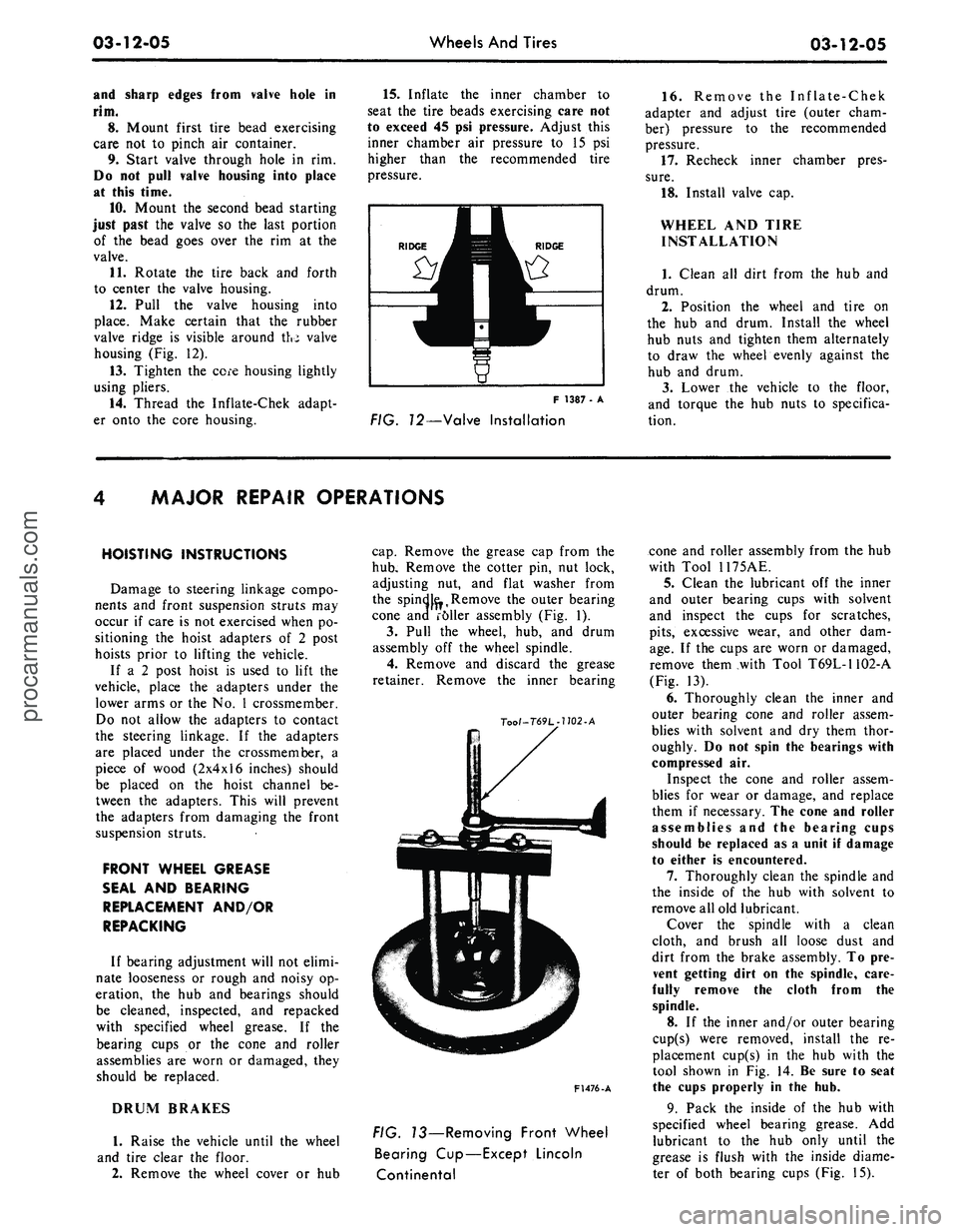
12.
Pull
the
valve housing into
place. Make certain that
the
rubber
valve ridge
is
visible around
thi
valve
housing
(Fig.
12).
13.
Tighten
the
core housing lightly
using pliers.
14.
Thread
the
Inflate-Chek adapt-
er onto
the
core housing.
15.
Inflate
the
inner chamber
to
seat
the
tire beads exercising care
not
to exceed
45 psi
pressure. Adjust this
inner chamber
air
pressure
to 15 psi
higher than
the
recommended tire
pressure.
F 1387
- A
FIG. 12—Valve Installation
16.
Remove
the
Inflate-Chek
adapter
and
adjust tire (outer cham-
ber) pressure
to the
recommended
pressure.
17.
Recheck inner chamber pres-
sure.
18.
Install valve
cap.
WHEEL
AND
TIRE
INSTALLATION
1.
Clean
all
dirt from
the hub and
drum.
2.
Position
the
wheel
and
tire
on
the
hub and
drum. Install
the
wheel
hub nuts
and
tighten them alternately
to draw
the
wheel evenly against
the
hub
and
drum.
3.
Lower
the
vehicle
to the
floor,
and torque
the hub
nuts
to
specifica-
tion.
MAJOR REPAIR OPERATIONS
HOISTING INSTRUCTIONS
Damage
to
steering linkage compo-
nents
and
front suspension struts
may
occur
if
care
is
not
exercised when
po-
sitioning
the
hoist adapters
of 2
post
hoists prior
to
lifting
the
vehicle.
If
a 2
post hoist
is
used
to
lift
the
vehicle, place
the
adapters under
the
lower arms
or the
No.
1
crossmember.
Do
not
allow
the
adapters
to
contact
the steering linkage.
If the
adapters
are placed under
the
crossmember,
a
piece
of
wood (2x4x16 inches) should
be placed
on the
hoist channel
be-
tween
the
adapters. This will prevent
the adapters from damaging
the
front
suspension struts.
FRONT WHEEL GREASE
SEAL
AND
BEARING
REPLACEMENT AND/OR
REPACKING
If bearing adjustment will
not
elimi-
nate looseness
or
rough
and
noisy
op-
eration,
the hub and
bearings should
be cleaned, inspected,
and
repacked
with specified wheel grease.
If the
bearing cups
or the
cone
and
roller
assemblies
are
worn
or
damaged, they
should
be
replaced.
DRUM BRAKES
1.
Raise
the
vehicle until
the
wheel
and tire clear
the
floor.
2.
Remove
the
wheel cover
or hub
cap.
Remove
the
grease
cap
from
the
hub.
Remove
the
cotter
pin,
nut
lock,
adjusting
nut, and
flat washer from
the spindjej, Remove
the
outer bearing
cone
and
roller assembly
(Fig.
1).
3.
Pull
the
wheel,
hub, and
drum
assembly
off the
wheel spindle.
4.
Remove
and
discard
the
grease
retainer. Remove
the
inner bearing
Too/-T69L-J102-A
F1476-A
FIG. 13—Removing Front Wheel
Bearing Cup—Except Lincoln
Continental
cone
and
roller assembly from
the hub
with Tool 1175AE.
5.
Clean
the
lubricant
off the
inner
and outer bearing cups with solvent
and inspect
the
cups
for
scratches,
pits,
excessive wear,
and
other
dam-
age.
If
the
cups
are
worn
or
damaged,
remove them with Tool T69L-1102-A
(Fig.
13).
6. Thoroughly clean
the
inner
and
outer bearing cone
and
roller assem-
blies with solvent
and dry
them thor-
oughly.
Do not
spin
the
bearings with
compressed
air.
Inspect
the
cone
and
roller assem-
blies
for
wear
or
damage,
and
replace
them
if
necessary.
The
cone
and
roller
assemblies
and the
bearing cups
should
be
replaced
as a
unit
if
damage
to either
is
encountered.
7. Thoroughly clean
the
spindle
and
the inside
of the hub
with solvent
to
remove
all old
lubricant.
Cover
the
spindle with
a
clean
cloth,
and
brush
all
loose dust
and
dirt from
the
brake assembly.
To
pre-
vent getting dirt
on the
spindle, care-
fully remove
the
cloth from
the
spindle.
8.
If the
inner and/or outer bearing
cup(s) were removed, install
the re-
placement cup(s)
in the hub
with
the
tool shown
in Fig.
14.
Be
sure
to
seat
the cups properly
in the hub.
9. Pack
the
inside
of the hub
with
specified wheel bearing grease.
Add
lubricant
to the hub
only until
the
grease
is
flush with
the
inside diame-
ter
of
both bearing cups
(Fig.
15).procarmanuals.com
Page 201 of 413
04-02-04
Rear Axle — Removable Carrier Type
04-02-04
IN-VEHICLE ADJUSTMENTS AND REPAIRS
REAR AXLE SHAFT, WHEEL
BEARING AND OIL SEAL
REPLACEMENT
The rear axle shafts, wheel bear-
ings,
and oil seal can be replaced
without removing the differential as-
sembly from the axle housing.
REMOVAL OF
AXLE SHAFT
Synthetic wheel bearing seals are
used in production only. Removal and
insertion of rear axle shafts must be
performed with caution. The entire
length of the shaft (including spline)
up to the seal journal must pass
through the seal without cutting of the
seal element during axle removal or
installation will result in early seal fai-
lure.
Leather seals only will be used as
service replacement for synthetic
wheel bearing seals.
1.
Remove the wheel cover, wheel
and tire from the brake drum.
2.
Remove the nuts that secure the
brake drum to the axle shaft flange,
then remove the drum from flange.
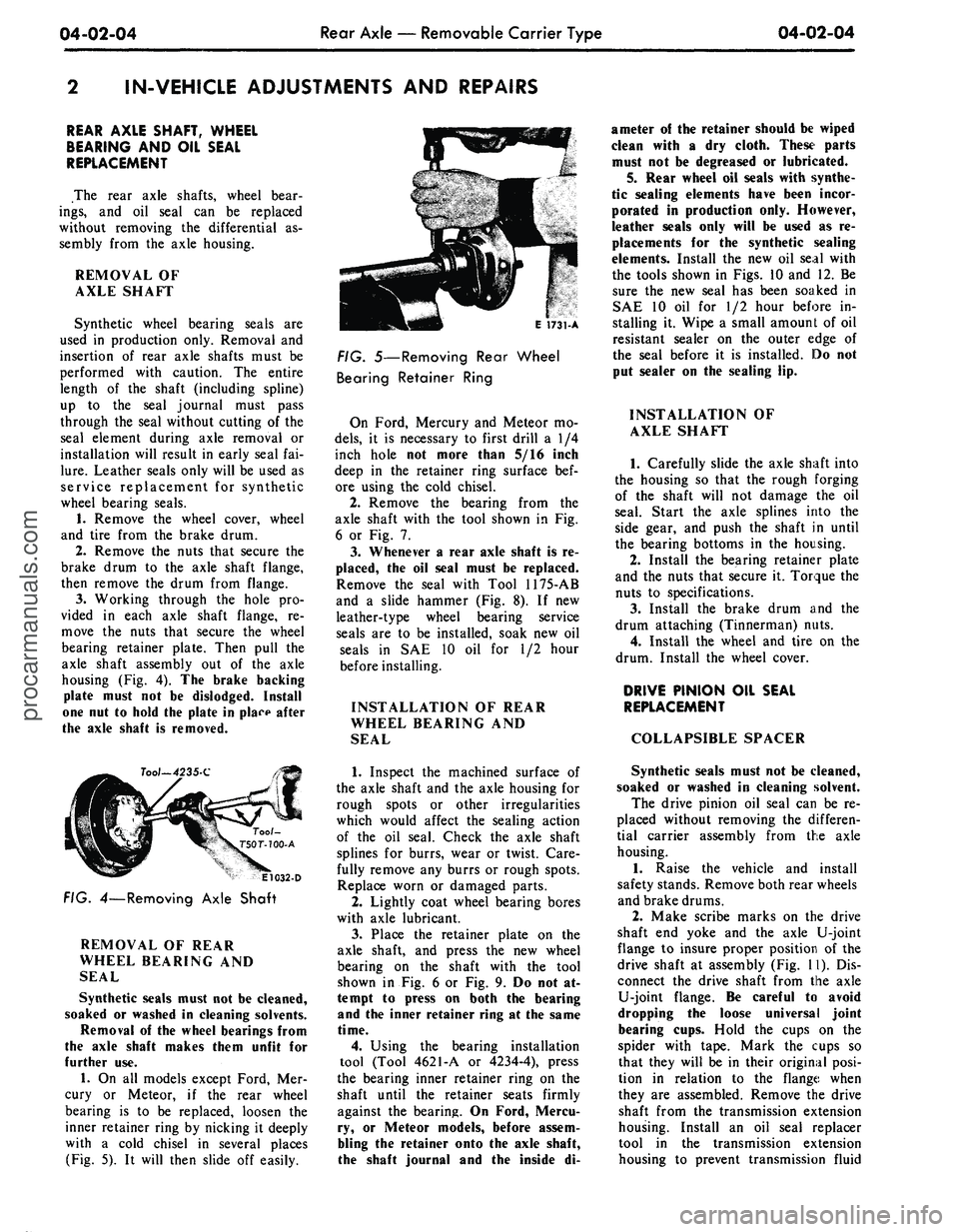
3.
Working through the hole pro-
vided in each axle shaft flange, re-
move the nuts that secure the wheel
bearing retainer plate. Then pull the
axle shaft assembly out of the axle
housing (Fig. 4). The brake backing
plate must not be dislodged. Install
one nut to hold the plate in place after
the axle shaft is removed.
Too/-4235-C
E1032-D
FIG. 4—Removing Axle Shaft
REMOVAL OF REAR
WHEEL BEARING AND
SEAL
Synthetic seals must not be cleaned,
soaked or washed in cleaning solvents.
Removal of the wheel bearings from
the axle shaft makes them unfit for
further use.
1.
On all models except Ford, Mer-
cury or Meteor, if the rear wheel
bearing is to be replaced, loosen the
inner retainer ring by nicking it deeply
with a cold chisel in several places
(Fig. 5). It will then slide off easily.
E 1731-A
FIG. 5—Removing Rear Wheel
Bearing Retainer Ring
On Ford, Mercury and Meteor mo-
dels,
it is necessary to first drill a 1/4
inch hole not more than 5/16 inch
deep in the retainer ring surface bef-
ore using the cold chisel.
2.
Remove the bearing from the
axle shaft with the tool shown in Fig.
6 or Fig. 7.
3.
Whenever a rear axle shaft is re-
placed, the oil seal must be replaced.
Remove the seal with Tool 1175-AB
and a slide hammer (Fig. 8). If new
leather-type wheel bearing service
seals are to be installed, soak new oil
seals in SAE 10 oil for 1/2 hour
before installing.
INSTALLATION OF REAR
WHEEL BEARING AND
SEAL
1.
Inspect the machined surface of
the axle shaft and the axle housing for
rough spots or other irregularities
which would affect the sealing action
of the oil seal. Check the axle shaft
splines for burrs, wear or twist. Care-
fully remove any burrs or rough spots.
Replace worn or damaged parts.
2.
Lightly coat wheel bearing bores
with axle lubricant.
3.
Place the retainer plate on the
axle shaft, and press the new wheel
bearing on the shaft with the tool
shown in Fig. 6 or Fig. 9. Do not at-
tempt to press on both the bearing
and the inner retainer ring at the same
time.
4.
Using the bearing installation
tool (Tool 4621-A or 4234-4), press
the bearing inner retainer ring on the
shaft until the retainer seats firmly
against the bearing. On Ford, Mercu-
ry, or Meteor models, before assem-
bling the retainer onto the axle shaft,
the shaft journal and the inside di-
ameter of the retainer should be wiped
clean with a dry cloth. These parts
must not be degreased or lubricated.
5. Rear wheel oil seals with synthe-
tic sealing elements have been incor-
porated in production only. However,
leather seals only will be used as re-
placements for the synthetic sealing
elements. Install the new oil seal with
the tools shown in Figs. 10 and 12. Be
sure the new seal has been soaked in
SAE 10 oil for 1/2 hour before in-
stalling it. Wipe a small amount of oil
resistant sealer on the outer edge of
the seal before it is installed. Do not
put sealer on the sealing lip.
INSTALLATION OF
AXLE SHAFT
1.
Carefully slide the axle shaft into
the housing so that the rough forging
of the shaft will not damage the oil
seal. Start the axle splines into the
side gear, and push the shaft in until
the bearing bottoms in the housing.
2.
Install the bearing retainer plate
and the nuts that secure it. Torque the
nuts to specifications.
3.
Install the brake drum and the
drum attaching (Tinnerman) nuts.
4.
Install the wheel and tire on the
drum. Install the wheel cover.
DRIVE PINION OIL SEAL
REPLACEMENT
COLLAPSIBLE SPACER
Synthetic seals must not be cleaned,
soaked or washed in cleaning solvent.
The drive pinion oil seal can be re-
placed without removing the differen-
tial carrier assembly from the axle
housing.
1.
Raise the vehicle and install
safety stands. Remove both rear wheels
and brake drums.
2.
Make scribe marks on the drive
shaft end yoke and the axle U-joint
flange to insure proper position of the
drive shaft at assembly (Fig. 11). Dis-
connect the drive shaft from the axle
U-joint flange. Be careful to avoid
dropping the loose universal joint
bearing cups. Hold the cups on the
spider with tape. Mark the cups so
that they will be in their original posi-
tion in relation to the flange when
they are assembled. Remove the drive
shaft from the transmission extension
housing. Install an oil seal replacer
tool in the transmission extension
housing to prevent transmission fluidprocarmanuals.com
Page 204 of 413
04-02-07
Rear Axle — Removable Carrier Type
04-02-07
burrs are evident, remove them with a
fine crocus cloth, working in a rota-
tional motion, then wipe clean. Apply
a small quantity of lubricant to U-
joint splines.
9. Install the U-joint flange using
the tool shown in Fig. 46.
10.
Install a new integral attaching
nut and washer on the pinion shaft.
11.
Tighten the pinion attaching
nut, rotating the pinion several times
to seat the bearing, then torque the pin-
ion nut to 180-200 ft-lbs. Hold the
flange with the tool shown in Fig. 22
or Fig. 23 while the nut is being tight-
ened.
12.
Remove the oil seal replacer
tool from the transmission extension
housing. Install the front end of the
drive shaft on the transmission output
shaft.
13.
Connect the rear end of the
drive shaft to the axle U-joint flange,
aligning the scribe marks made on the
drive shaft end yoke and the axle U-
joint flange.
14.
Check the lubricant level, and
add whatever amount of specified lu-
bricant is necessary to reach the lower
edge of the filler plug hole. Make sure
the axle is in running position when
the level is checked
ORIGINAL U-JOINT FLANGE
(IN VEHICLE REPLACEMENT)
Use procedure as outlined under
Drive Pinion Oil Seal Replacement.
Synthetic seals must not be cleaned,
soaked or washed in cleaning solvent.
INSTALLATION OF A NEW
UNIVERSAL JOINT FLANGE
COLLAPSIBLE SPACER
1.
Raise the vehicle and install
safety stands. Remove both rear wheels
and brake drums.
2.
Disconnect the drive shaft from
the axle U-joint flange. Be careful to
avoid dropping the loose universal
joint bearing cups. Hold the cups on
the spider with tape. Mark the cups so
that they will be in their original posi-
tion in relation to the flange when
they are assembled. Remove the drive
shaft from the transmission extension
housing. Install an oil seal replacer
tool in the transmission extension
housing to prevent transmission fluid
leakage. Refer to the transmission
group for the appropriate tool.
3.
Install an in-lb torque wrench on
the pinion nut. Record the torque re-
quired to maintain rotation of the pin-
ion shaft through several revolutions.
4.
While holding the flange with the
tool shown in Fig. 23 or Fig. 24, re-
move the integral pinion nut and
washer.
5.
Clean the pinion bearing retainer
around the oil seal. Place a drain pan
under the seal, or raise the front of
the vehicle higher than the rear. Syn-
thetic seals must not be cleaned,
soaked or washed in cleaning solvent.
6. Using the tool shown in Fig. 23
or Fig. 24, remove the U-joint flange.
7.
Check splines on the pinion shaft
to be sure they are free of burrs. If
burrs are evident, remove them by
using a fine crocus cloth, working in a
rotational motion, then wipe clean.
Apply a small amount of lubricant
to U-joint splines.
8. Install the U-joint flange using
the tool shown in Fig. 46.
9. Install a new integral nut and
washer on the pinion shaft. (Apply a
small amount of lubricant on the
washer side of the nut.)
10.
Hold the flange with the tool
shown in Fig. 23 or Fig. 24 while the
nut is being tightened.
11.
Tighten the pinion shaft nut,
rotating the pinion occasionally to in-
sure proper bearing seating, and take
frequent preload readings until the
preload is at the original recorded
reading established in step 3.
12.
After original preload has been
reached, tighten the pinion nut slowly,
until an additional preload of 8 to 14
in-lb over the original reading is
reached. (The preload should not ex-
ceed 8 to 14 in-lb over the original
reading, or bearing failure may result.
Under no circumstances should the
pinion nut be backed off to lessen pre-
load. If this is done, a new pinion
bearing spacer must be installed. In
addition, the U-joint flange must
never be hammered on, or power tools
used.
13.
Remove the oil seal replacer
tool from the transmission extension
housing. Install the front end of the
drive shaft on the transmission output
shaft.
14.
Connect the rear end of the
drive shaft to the axle U-joint flange,
aligning the scribe marks made on the
drive shaft end yoke and the axle U-
joint flange.
15.
Check the lubricant level. Make
sure the axle is in running position.
Add whatever amount of specified lu-
bricant is required to reach the lower
edge of the filler plug hole.
SOLID SPACER
1.
Disconnect the drive shaft from
the axle U-joint flange. Be careful to
avoid dropping the loose universal
joint bearing cups. Hold the cups on
the spider with tape. Mark the cups so
that they will be in their original posi-
tion in relation to the flange when
they are assembled. Remove the drive
shaft from the transmission extension
housing. Install an oil seal replacer
tool in the transmission extension
housing to prevent transmission leak-
age.
Refer to the transmission group
for the appropriate tool.
2.
While holding the flange with the
tool shown in Fig. 23 or Fig. 24, re-
move the integral pinion nut and
washer.
3.
Clean the pinion bearing retainer
around the oil seal. Place a drain pan
under the seal, or raise the front of
the vehicle higher than the rear.
4.
Using the tool shown in Fig. 23
or Fig. 24, remove the U-joint flange.
5.
Check splines on the pinion shaft
to be sure they are free of burrs. If
burrs are evident, remove them by
using a fine crocus cloth, working in a
rotational motion, then wipe clean.
Apply a small amount of lubricant to
U-joint splines.
6. Install the U-joint flange using
the tool shown in Fig. 46.
7.
Install integral attaching nut and
washer on the pinion shaft.
8. Tighten the pinion attaching nut,
rotating the pinion several times to
seat the bearing, then torque the pin-
ion attaching nut to 180-220 ft-lbs.
Hold the flange with the tool shown in
Fig. 23 or Fig. 24 while the nut is
being tightened.
9. Remove the oil seal replacer tool
from the transmission extension hous-
ing. Install the front end of the drive
shaft on the transmission output shaft.
10.
Connect the rear end of the
drive shaft to the axle U-joint flange.
11.
Check the lubricant level, and
add whatever amount of specified lu-
bricant is necessary to reach the lower
edge of the filler plug hole. Make sure
the axle is in running position when
the level is checked.
DRIVE SHAFT PINION ANGLE
ADJUSTMENT
Refer to Group 3, Part 3-2 for this
procedure.procarmanuals.com
Page 217 of 413
04-02-20
Rear Axle — Removable Carrier Type
0402-20
THRUST WASHER
E1175-B
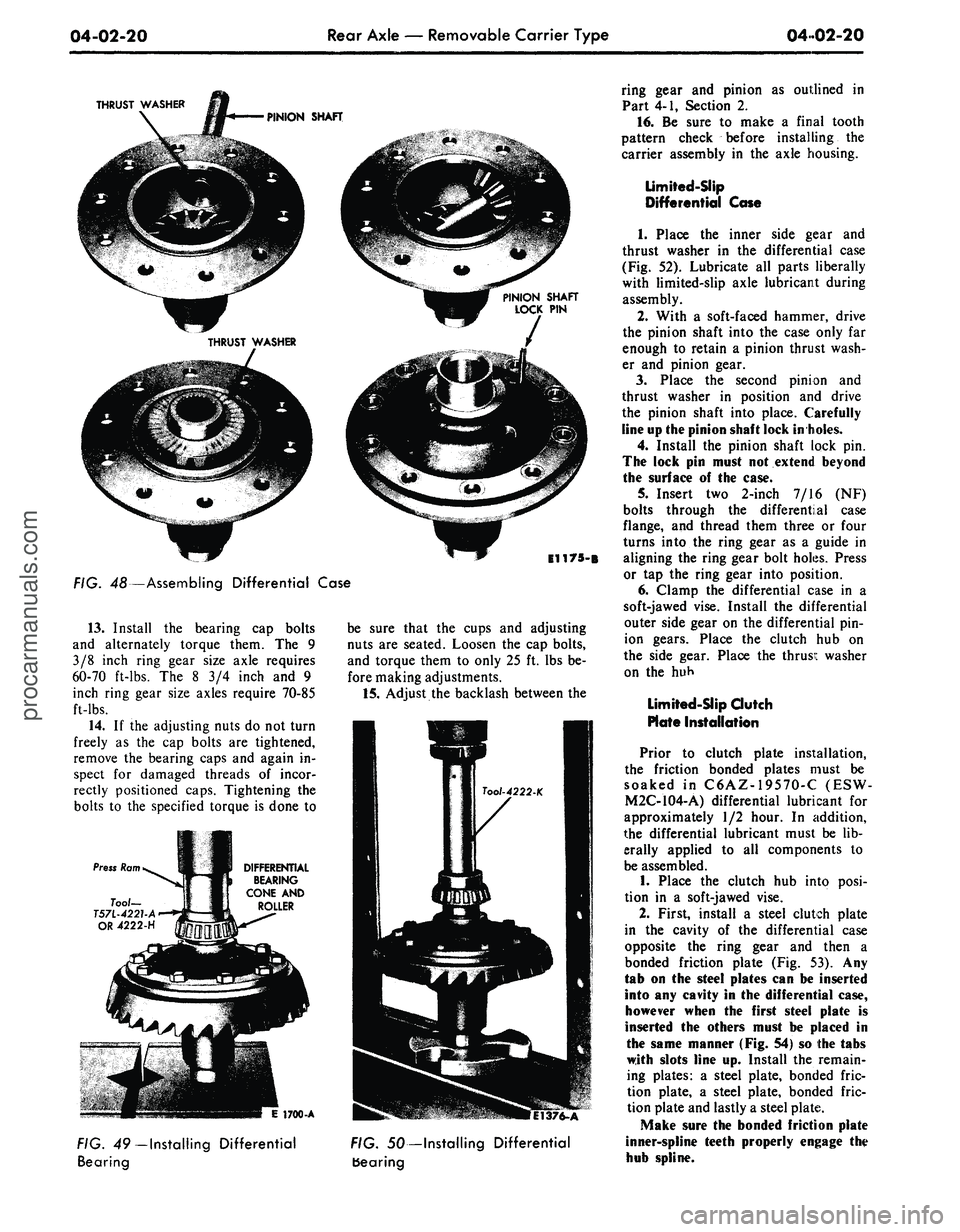
FIG. 48—Assembling Differential Case
13.
Install the bearing cap bolts
and alternately torque them. The 9
3/8 inch ring gear size axle requires
60-70 ft-lbs. The 8 3/4 inch and 9
inch ring gear size axles require 70-85
ft-lbs.
14.
If the adjusting nuts do not turn
freely as the cap bolts are tightened,
remove the bearing caps and again in-
spect for damaged threads of incor-
rectly positioned caps. Tightening the
bolts to the specified torque is done to
be sure that the cups and adjusting
nuts are seated. Loosen the cap bolts,
and torque them to only 25 ft. lbs be-
fore making adjustments.
15.
Adjust the backlash between the
DIFFERENTIAL
BEARING
CONE AND
ROLLER
E 1700-A
FIG. 49—
Installing
Differential
Bearing
1376-A
FIG. 50—Installing Differential
bearing
ring gear and pinion as outlined in
Part 4-1, Section 2.
16.
Be sure to make a final tooth
pattern check before installing the
carrier assembly in the axle housing.
Limited-Slip
Differential Case
1.
Place the inner side gear and
thrust washer in the differential case
(Fig. 52). Lubricate all parts liberally
with limited-slip axle lubricant during
assembly.
2.
With a soft-faced hammer, drive
the pinion shaft into the case only far
enough to retain a pinion thrust wash-
er and pinion gear.
3.
Place the second pinion and
thrust washer in position and drive
the pinion shaft into place. Carefully
line up the pinion shaft lock in holes.
4.
Install the pinion shaft lock pin.
The lock pin must not extend beyond
the surface of the case.
5. Insert two 2-inch 7/16 (NF)
bolts through the differential case
flange, and thread them three or four
turns into the ring gear as a guide in
aligning the ring gear bolt holes. Press
or tap the ring gear into position.
6. Clamp the differential case in a
soft-jawed vise. Install the differential
outer side gear on the differential pin-
ion gears. Place the clutch hub on
the side gear. Place the thrusi: washer
on the huh
Limited-Slip dutch
Plate Installation
Prior to clutch plate installation,
the friction bonded plates must be
soaked in C6AZ-19570-C (ESW-
M2C-104-A) differential lubricant for
approximately 1/2 hour. In addition,
the differential lubricant must be lib-
erally applied to all components to
be assembled.
1.
Place the clutch hub into posi-
tion in a soft-jawed vise.
2.
First, install a steel clutch plate
in the cavity of the differential case
opposite the ring gear and then a
bonded friction plate (Fig. 53). Any
tab on the steel plates can be inserted
into any cavity in the differential case,
however when the first steel plate is
inserted the others must be placed in
the same manner (Fig. 54) so the tabs
with slots line up. Install the remain-
ing plates: a steel plate, bonded fric-
tion plate, a steel plate, bonded fric-
tion plate and lastly a steel plate.
Make sure the bonded friction plate
inner-spline teeth properly engage the
hub spline.procarmanuals.com
Page 219 of 413
04-02-22
Rear Axle — Removable Carrier Type
04-02-22
Too/-T59L-4204-A
or
44211
and
44211-A
EH92-C
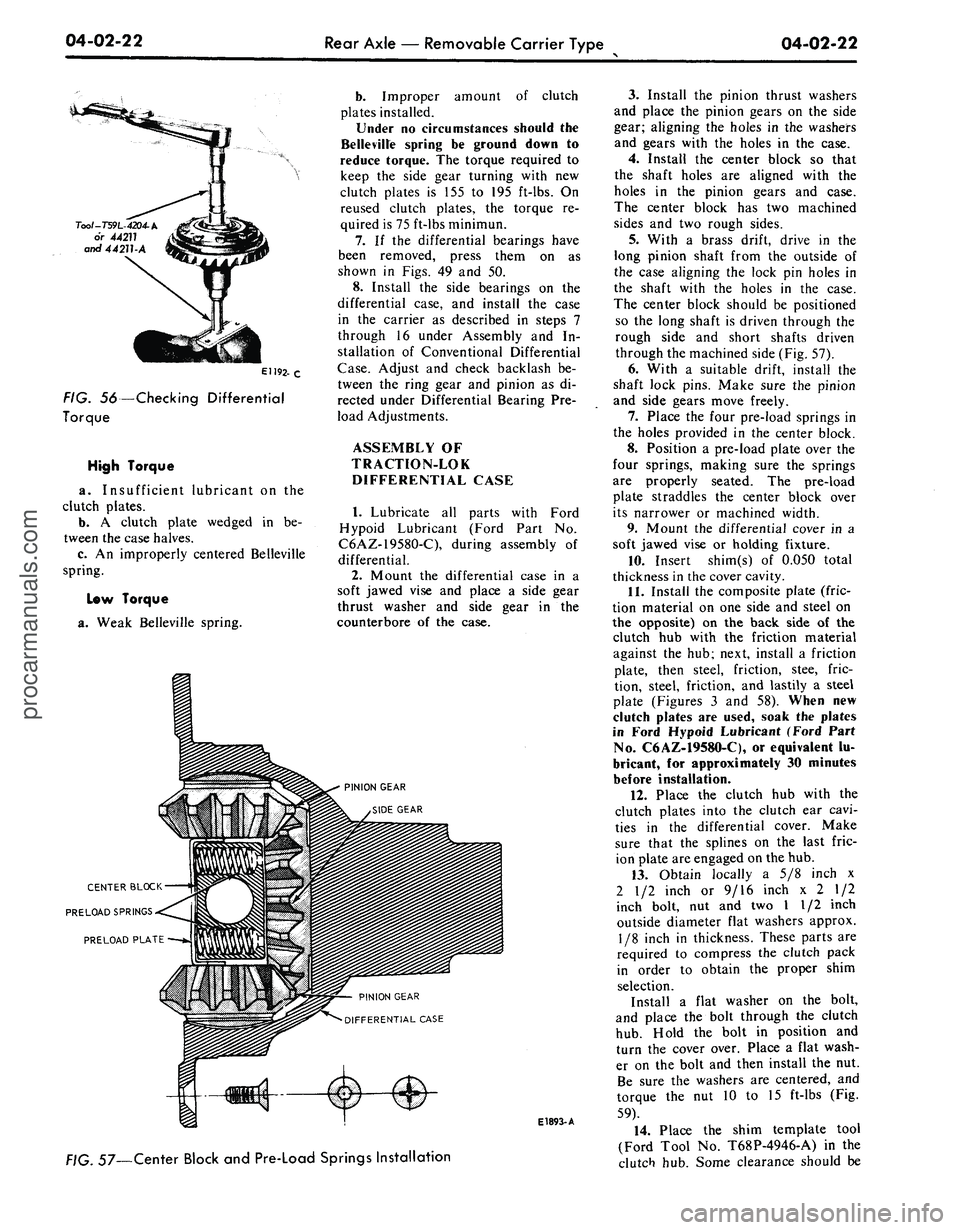
FIG. 56—Checking Differential
Torque
High Torque
a. Insufficient lubricant on the
clutch plates.
b.
A clutch plate wedged in be-
tween the case halves.
c. An improperly centered Belleville
spring.
Low Torque
a. Weak Belleville spring.
b.
Improper amount of clutch
plates installed.
Under no circumstances should the
Belleville spring be ground down to
reduce torque. The torque required to
keep the side gear turning with new
clutch plates is 155 to 195 ft-lbs. On
reused clutch plates, the torque re-
quired is 75 ft-lbs minimun.
7.
If the differential bearings have
been removed, press them on as
shown in Figs. 49 and 50.
8. Install the side bearings on the
differential case, and install the case
in the carrier as described in steps 7
through 16 under Assembly and In-
stallation of Conventional Differential
Case. Adjust and check backlash be-
tween the ring gear and pinion as di-
rected under Differential Bearing Pre-
load Adjustments.
ASSEMBLY OF
TRACTION-LOK
DIFFERENTIAL CASE
1.
Lubricate all parts with Ford
Hypoid Lubricant (Ford Part No.
C6AZ-19580-C), during assembly of
differential.
2.
Mount the differential case in a
soft jawed vise and place a side gear
thrust washer and side gear in the
counterbore of the case.
CENTER BLOCK
PRELOAD SPRINGS
PRELOAD PLATE
PINION GEAR
DIFFERENTIAL CASE
E1893-
A
. 57—Center Block and Pre-Load Springs Installation
3.
Install the pinion thrust washers
and place the pinion gears on the side
gear; aligning the holes in the washers
and gears with the holes in the case.
4.
Install the center block so that
the shaft holes are aligned with the
holes in the pinion gears and case.
The center block has two machined
sides and two rough sides.
5.
With a brass drift, drive in the
long pinion shaft from the outside of
the case aligning the lock pin holes in
the shaft with the holes in the case.
The center block should be positioned
so the long shaft is driven through the
rough side and short shafts driven
through the machined side (Fig. 57).
6. With a suitable drift, install the
shaft lock pins. Make sure the pinion
and side gears move freely.
7.
Place the four pre-load springs in
the holes provided in the center block.
8. Position a pre-load plate over the
four springs, making sure the springs
are properly seated. The pre-load
plate straddles the center block over
its narrower or machined width.
9. Mount the differential cover in a
soft jawed vise or holding fixture.
10.
Insert shim(s) of 0.050 total
thickness in the cover cavity.
11.
Install the composite plate (fric-
tion material on one side and steel on
the opposite) on the back side of the
clutch hub with the friction material
against the hub; next, install a friction
plate, then steel, friction, stee, fric-
tion, steel, friction, and lastily a steel
plate (Figures 3 and 58). When new
clutch plates are used, soak the plates
in Ford Hypoid Lubricant (Ford Part
No.
C6AZ-19580-C), or equivalent lu-
bricant, for approximately 30 minutes
before installation.
12.
Place the clutch hub with the
clutch plates into the clutch ear cavi-
ties in the differential cover. Make
sure that the splines on the last fric-
ion plate are engaged on the hub.
13.
Obtain locally a 5/8 inch x
2 1/2 inch or 9/16 inch x 2 1/2
inch bolt, nut and two I 1/2 inch
outside diameter flat washers approx.
1/8 inch in thickness. These parts are
required to compress the clutch pack
in order to obtain the proper shim
selection.
Install a flat washer on the bolt,
and place the bolt through the clutch
hub.
Hold the bolt in position and
turn the cover over. Place a flat wash-
er on the bolt and then install the nut.
Be sure the washers are centered, and
torque the nut 10 to 15 ft-lbs (Fig.
59).
14.
Place the shim template tool
(Ford Tool No. T68P-4946-A) in the
clutch hub. Some clearance should beprocarmanuals.com
Page 231 of 413
04-03-11
Rear Axles — Integral Carrier Type
04-03-11
bores so that they just contact the
bearing cups.
14.
Carefully position the bearing
caps on the carrier casting. Match the
marks made when the caps were re-
moved.
15.
Install the bearing cap bolts
and lockwashers. As the bolts are
tightened, turn the adjusting nut with
the tool shown in Fig. 26.
16.
If the adjusting nuts do not turn
freely as the cap bolts are tightened,
remove the bearing caps and again in-
spect for damaged threads or incor-
rectly positioned caps. Tightening the
bolts to the specified torcfue is done to
be sure that the cups and adjusting
nuts are seated. Loosen the cap bolts,
and torque them to only 5 ft-lbs be-
fore making adjustments. Refer to
Part 4-1 for backlash and bearing pre-
load adjustment procedures.
LIMITED-SLIP DIFFERENTIAL
For integral carrier limited-slip dif-
ferentials see the repair procedures for
removable carrier limited-slip differen-
tials,
Part 4-2. These procedures are
good for the differential case only.
When the limited slip differential case
has been repaired replace the case
using the procedure for the conven-
tional intergral carrier differendal case
in this part.procarmanuals.com
Page 241 of 413
04-04-10
Rear Axle — Ford Light-Duty (WER)
04-04-10
the differential case and ring gear as-
sembly in the carrier without regard
to the matching of any particular gear
teeth.
12.
Slide the case assembly along
the bores until a slight amount of
backlash is felt between the gear teeth.
Hold the differential case in place.
13.
Set the adjusting nuts in the
bores so that they just contact the
bearing cups.
14.
Carefully position the bearing
caps on the carrier casting. Match the
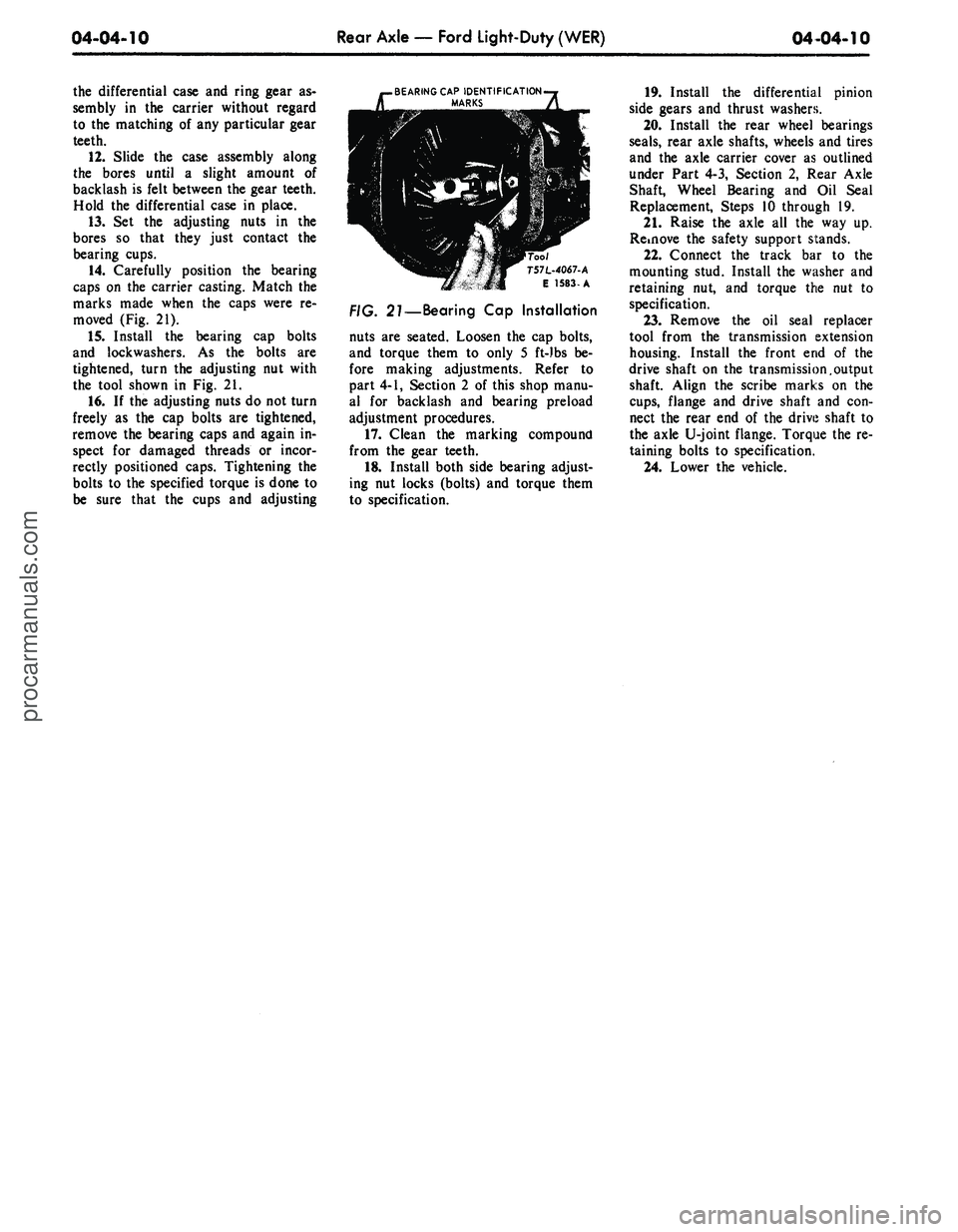
marks made when the caps were re-
moved (Fig. 21).
15.
Install the bearing cap bolts
and lockwashers. As the bolts are
tightened, turn the adjusting nut with
the tool shown in Fig. 21.
16.
If the adjusting nuts do not turn
freely as the cap bolts are tightened,
remove the bearing caps and again in-
spect for damaged threads or incor-
rectly positioned caps. Tightening the
bolts to the specified torque is done to
be sure that the cups and adjusting
.BEARING CAP IDENTIFICATION-j
MARKS
A
T57L-4067-A
E 1583-A
27—Bearing Cap Installation
nuts are seated. Loosen the cap bolts,
and torque them to only 5 ft-)bs be-
fore making adjustments. Refer to
part 4-1, Section 2 of this shop manu-
al for backlash and bearing preload
adjustment procedures.
17.
Clean the marking compound
from the gear teeth.
18.
Install both side bearing adjust-
ing nut locks (bolts) and torque them
to specification.
19.
Install the differential pinion
side gears and thrust washers.
20.
Install the rear wheel bearings
seals,
rear axle shafts, wheels and tires
and the axle carrier cover as outlined
under Part 4-3, Section 2, Rear Axle
Shaft, Wheel Bearing and Oil Seal
Replacement, Steps 10 through 19.
21.
Raise the axle all the way up.
Rdnove the safety support stands.
22.
Connect the track bar to the
mounting stud. Install the washer and
retaining nut, and torque the nut to
specification.
23.
Remove the oil seal replacer
tool from the transmission extension
housing. Install the front end of the
drive shaft on the transmission.output
shaft. Align the scribe marks on the
cups,
flange and drive shaft and con-
nect the rear end of the drive shaft to
the axle U-joint flange. Torque the re-
taining bolts to specification.
24.
Lower the vehicle.procarmanuals.com
Page 261 of 413
05-03-03
Clutch
05-03-03
CLUTCH PEDAL
ADJUSTMENTS
Adjust
the
clutch pedal free travel
whenever
the
clutch does
not
disen-
gage properly,
or
when
new
clutch
parts
are
installed. Improper adjust-
ment
of the
clutch pedal
is one of the
most frequent causes
of
clutch failure
and
can be a
contributing factor
in
some transmission failures.
FREE TRAVEL
1.
Disconnect
the
clutch return
spring from
the
release lever.
2.
Loosen
the
release lever
rod
locknut
and
adjusting
nut
(Figs.
1, 2
and
3).
3.
Move
the
clutch release lever
rearward until
the
release bearing
lightly contacts
the
clutch pressure
plate release fingers.
4.
Adjust
the rod
length until
the
rod seats
in the
release lever pocket.
5.
Insert
the
specified feeler gauge
between
the
adjusting
nut and the
swivel sleeve. Then tighten
the
adjust-
ing
nut
against
the
gauge finger tight.
6. Tighten
the
locknut against
the
adjusting
nut,
being careful
not to di-
sturb
the
adjustment. Torque
the
lock-
nut
to
specification
and
remove
the
feeler gauge.
7.
Install
the
clutch return spring.
8. Check
the
free travel
at the
pedal
for conformance
to
specification.
Re-
adjust
if
necessary.
9.
As a
final check, measure
the
pedal free travel with
the
transmission
in neutral
and the
engine running
at
about 3000
rpm. If the
pedal free
travel
at
this speed
is not a
minimum
of
1/2
inch, readjust
the
clutch pedal
free travel. Otherwise,
the
release
fin-
gers
may
contact
the
release bearing
continuously, resulting
in
premature
bearing
and
clutch failure. Free travel
must
be
exactly
to
specification.
CLUTCH ASSIST
SPRING REPLACEMENT
(FAIRLANE, FALCON,
MONTEGO)
1.
Remove
the
cotter
pin
from
the
clutch
rod at the
clutch pedal lever
as-
sembly inside
the
passenger compart-
ment.
2.
Grasp
the
clutch pedal lever
firmly
to
prevent slipping
and
remove
the clutch
rod
from
the
lever. Allow
the clutch pedal lever
to
rest
on the
floor panel.
3.
Remove
the
forward bolt secur-
ing
the
assist spring bracket
to the
brake pedal bracket
and
loosen
the
rear bolt
two or
three turns.
Do not
remove
the
rear bolt.
4.
Grasp
the
assist spring bracket
with pliers
and
rotate upward until
the
spring
can be
separated from
the
bracket.
BRAKE PEDAL
BRACKET
CLUTCH ASSIST SPRING
BRACKET
-
7535
CLUTCH PEDAL
7519
5.
Position
the
assist spring
in the
clutch pedal spring bracket
and the
assist spring bracket. Rotate
the
spring bracket downward until
the
forward bolt holes
in the
assist spring
bracket line
up
with
the
holes
in the
brake pedal bracket
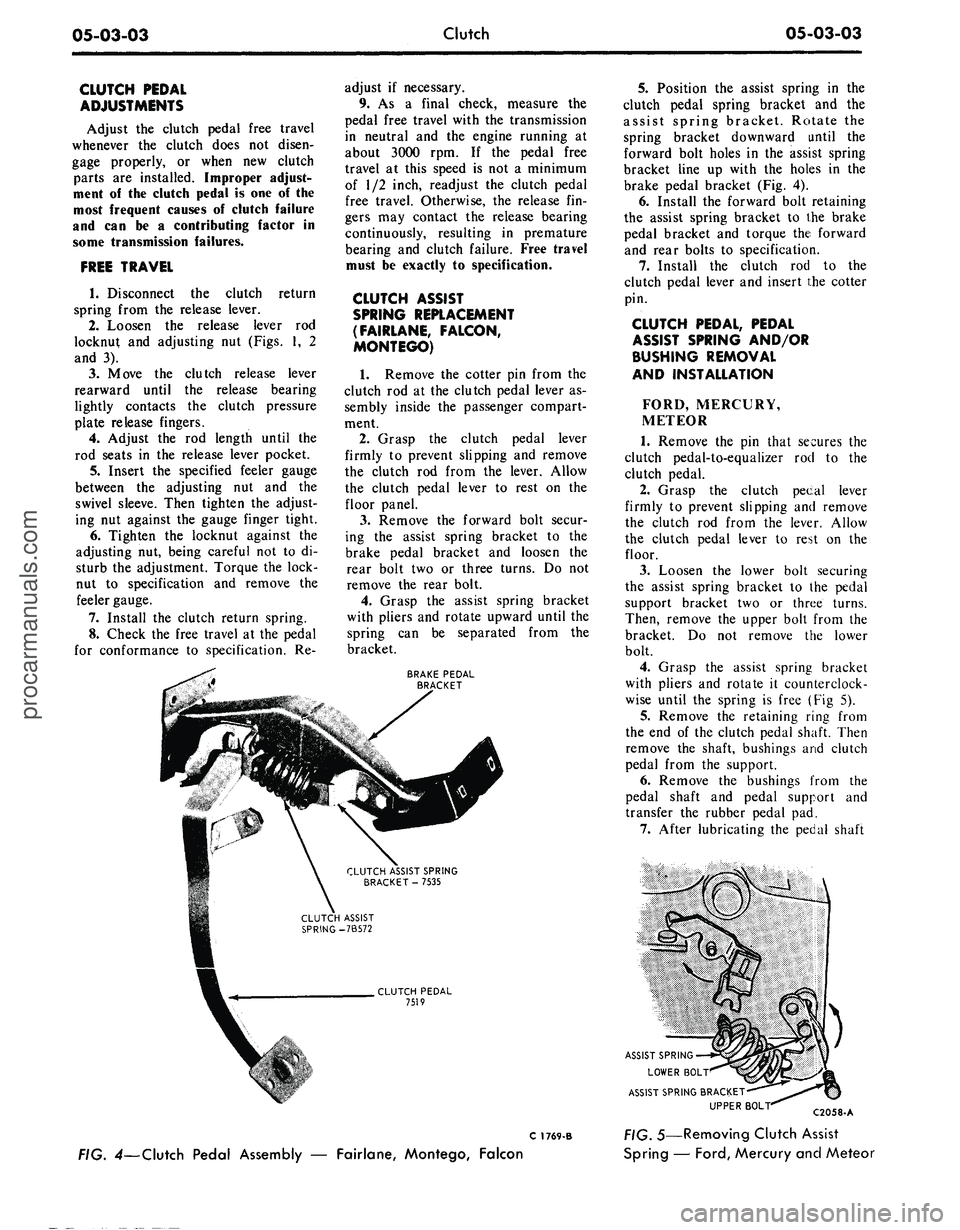
(Fig. 4).
6. Install
the
forward bolt retaining
the assist spring bracket
to the
brake
pedal bracket
and
torque
the
forward
and rear bolts
to
specification.
7.
Install
the
clutch
rod to the
clutch pedal lever
and
insert
the
cotter
pin.
CLUTCH PEDAL, PEDAL
ASSIST SPRING AND/OR
BUSHING REMOVAL
AND INSTALLATION
FORD, MERCURY,
METEOR
1.
Remove
the pin
that secures
the
clutch pedal-to-equalizer
rod to the
clutch pedal.
2.
Grasp
the
clutch pecal lever
firmly
to
prevent slipping
and
remove
the clutch
rod
from
the
lever. Allow
the clutch pedal lever
to
rest
on the
floor.
3.
Loosen
the
lower bolt securing
the assist spring bracket
to the
pedal
support bracket
two or
three turns.
Then, remove
the
upper bolt from
the
bracket.
Do not
remove
the
lower
bolt.
4.
Grasp
the
assist spring bracket
with pliers
and
rotate
it
counterclock-
wise until
the
spring
is
free
(Fig 5).
5.
Remove
the
retaining ring from
the
end of the
clutch pedal shaft. Then
remove
the
shaft, bushings
and
clutch
pedal from
the
support.
6. Remove
the
bushings from
the
pedal shaft
and
pedal support
and
transfer
the
rubber pedal
pad.
7.
After lubricating
the
pedal shaft
ASSIST SPRING
LOWER BOLT
ASSIST SPRING BRACKET-
UPPER
BOL"
C 1769-B
FIG. 4—Clutch Pedal Assembly
—
Fairlane, Montego, Falcon
C2058-A
;. 5—Removing Clutch Assist
Spring
—
Ford,
Mercury and Meteorprocarmanuals.com