check transmission fluid FORD MUSTANG 1969 Volume One Chassis
[x] Cancel search | Manufacturer: FORD, Model Year: 1969, Model line: MUSTANG, Model: FORD MUSTANG 1969Pages: 413, PDF Size: 75.81 MB
Page 299 of 413
07-01-08
General Transmission Service
07-01-08
3.
Install the bench testing tool on
the transmission.
4.
Remove the
1/8-inch
pipe plug
at the transmission case. Turn the
front pump in a clockwise direction at
75-100 rpm until a regular flow of
transmission fluid leaves the hole in
the transmission case. This operation
bleeds the air from the pump.
5.
Install the pressure gauge (77820
or T57L-77820-A) as shown in Fig.
13.
PRESSURE TESTS
Turn the front pump at 75-100 rpm
and note the gauge readings. The
pressure readings on the bench test
must be within the limits as outlined
in Figure 13, for the engine idle check.
If pressure gauge readings are with-
in limits in all selector lever positions,
install the vacuum diaphragm control
rod unit.
COMMON ADJUSTMENTS AND REPAIRS
TRANSMISSION FLUID DRAIN
AND REFILL
Normal maintenance and lubrica-
tion requirements do not necessitate
periodic automatic transmission fluid
changes.
If a major repair, such as a clutch
band, bearing, etc., is required in the
transmission, it will have to be re-
moved for service. At this time the
converter, transmission cooler and
cooler lines must be thoroughly
flushed to remove any dirt.
When filling a dry transmission and
converter, install five quarts of fluid.
Start the engine, shift the selector
lever as outlined below, and check and
add fluid as necessary.
Following are the procedures for
partial drain and refill due to in-
vehicle repair operation.
C4 TRANSMISSION
1.
On PEA models, disconnect the
fluid filler tube from the transmission
oil pan to drain the fluid.
On PEB and PEE models, loosen
the pan attaching bolts to drain the
fluid from the transmission.
2.
When the fluid has stopped
draining from the transmission, re-
move and thoroughly clean the pan
and the screen. Discard the pan gas-
ket.
3.
Place a new gasket on the pan,
and install the pan on the transmis-
sion.
4.
On PEA models, connect the
filler tube to the pan and tighten the
fitting securely.
5.
Add three quarts of fluid to the
transmission through the filler tube.
6. Run the engine at idle speed for
about two minutes, and then run it at
fast idle speed (about 1200 rpm) until
it reaches it's normal operating temp-
erature. Do not race the engine.
7.
Shift the selector lever through
all the positions, place it at P, and
check the fluid level. The fluid level
should be above the ADD mark. If
necessary, add enough fluid io the
transmission to bring the level be-
tween the ADD and FULL marks on
che dipstick. Do not overfill the trans-
mission.
FMX OK C6
TRANSMISSION
1.
Raise the vehicle on a hoist or
jack stands.
2.
Place a drain pan under the
transmission.
3.
Loosen the pan attaching bolts
to drain the fluid from the transmis-
sion.
4.
After the fluid has drained to the
level of the pan flange, remove the
rest of the pan bolts working from the
rear and both sides of the pan to
allow it to drop and drain slowly.
5.
When the fluid has stopped
draining from the transmission, re-
move and thoroughly clean the pan
and the screen. Discard the pan gas-
ket.
6. Place a new gasket on the pan,
and install the pan on the transmis-
sion.
7.
Add three quarts of fluid to the
transmission through the filler tube.
8. Run the engine at idle speed for
about two minutes, and then run it at
fast idle speed (about 1200 rpm) until
it reaches normal operating tempera-
ture.
Do not race the engine.
9. Shift the selector lever through
all the positions, place it at P, and
check the fluid level. The fluid level
should be above the ADD mark. If
necessary, add enough fluid to the
transmission to bring the level be-
tween the ADD and FULL marks on
the dipstick. Do not overfill the trans-
mission.
OIL COOLER TUBE
REMOVAL AND INSTALLATION
When fluid leakage is found at the
oil cooler, the cooler must be re-
placed. Cooler replacement is de-
scribed in the Cooling System Section
of Group 11.
When one or more of the fluid
cooler steel tubes must be replaced,
each replacement tube must be fabri-
cated from the same size steel tubing
as the original line.
Using the old tube as a guide, bend
the new tube as required. Add the
necessary fittings, and install the tube.
After the fittings have been tight-
ened, add fluid as needed, and check
for fluid leaks.
VACUUM DIAPHRAGM
ADJUSTMENT NON-ALTITUDE
COMPENSATING TYPE
The C4 and C6 transmissions are
equipped with an adjustable vacuum
diaphragm assembly. A similar ad-
justable diaphragm has been released
for service with the FMX transmis-
sion. However, the FMX service dia-
phragm is not interchangeable with
that used on C4 and C6 models.
The vacuum diaphragm assembly
has an adjusting screw in the vacuum
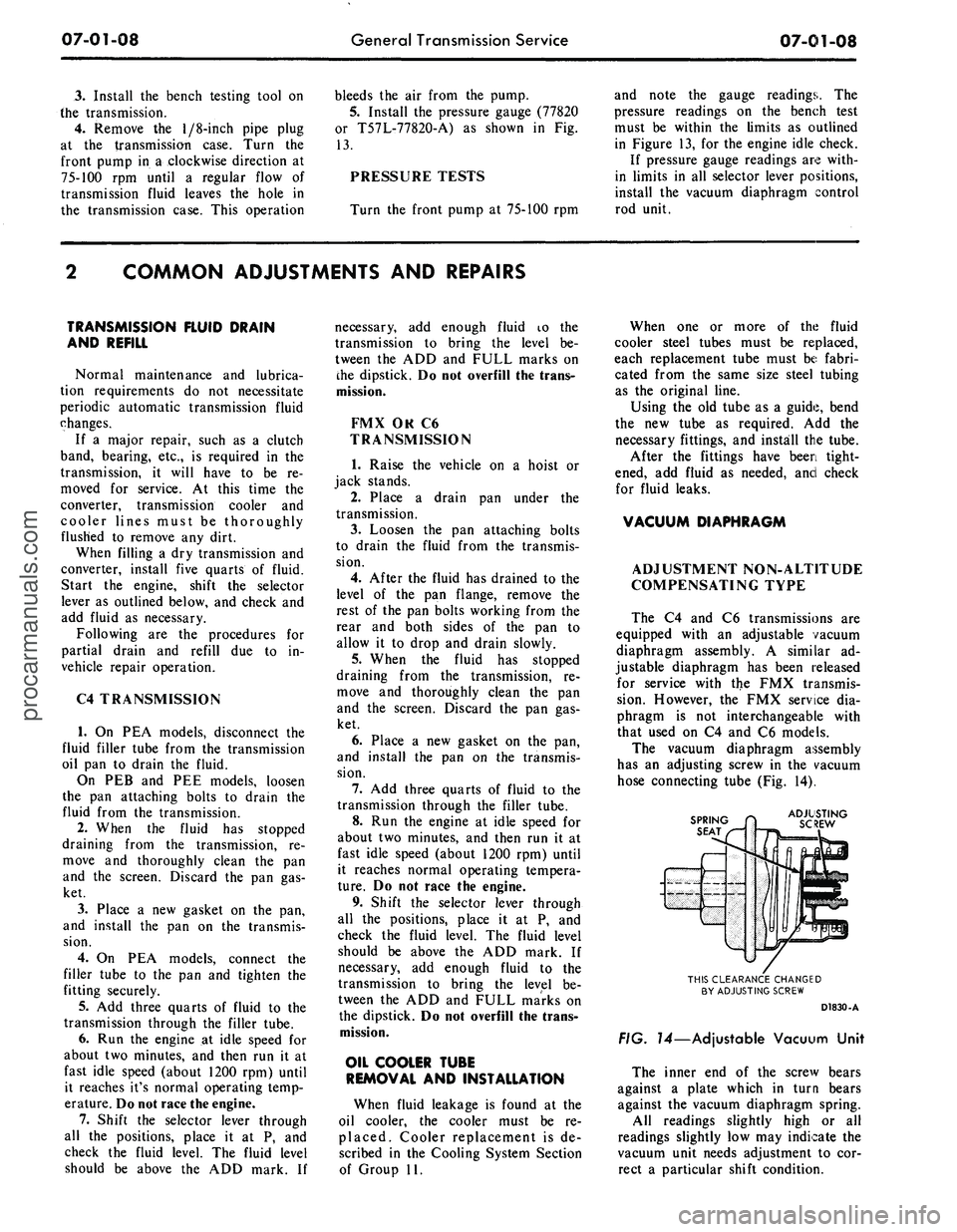
hose connecting tube (Fig. 14).
SPRING
SEAT
THIS CLEARANCE CHANGED
BY ADJUSTING SCREW
D1830-A
FIG. 14—Adjustable Vacuum Unit
The inner end of the screw bears
against a plate which in turn bears
against the vacuum diaphragm spring.
All readings slightly high or all
readings slightly low may indicate the
vacuum unit needs adjustment to cor-
rect a particular shift condition.procarmanuals.com
Page 303 of 413
07-01-12
General Transmission Service
07-01-12
the transmission,
any
metal particles
or clutch plate
or
band material that
may have been carried into
the
cooler
should
be
removed from
the
system
by
flushing
the
cooler
and
lines before
the transmission
is put
back into serv-
ice.
In no
case should
an
automatic
transmission having
a
clutch
or
band
failure
or
other internal trouble result-
ing
in
fluid contamination,
be put
back into service without first flushing
the transmission
oil
cooler.
To flush
the oil
cooler, follow
the
instruct!
on >
provided with
the
Rotun-
da Automatic Transmission Torque
Converter
and
Cooler Cleaner
LRE-
60081.
INSPECTION
TURBINE
AND
STATOR
END
PLAY CHECK
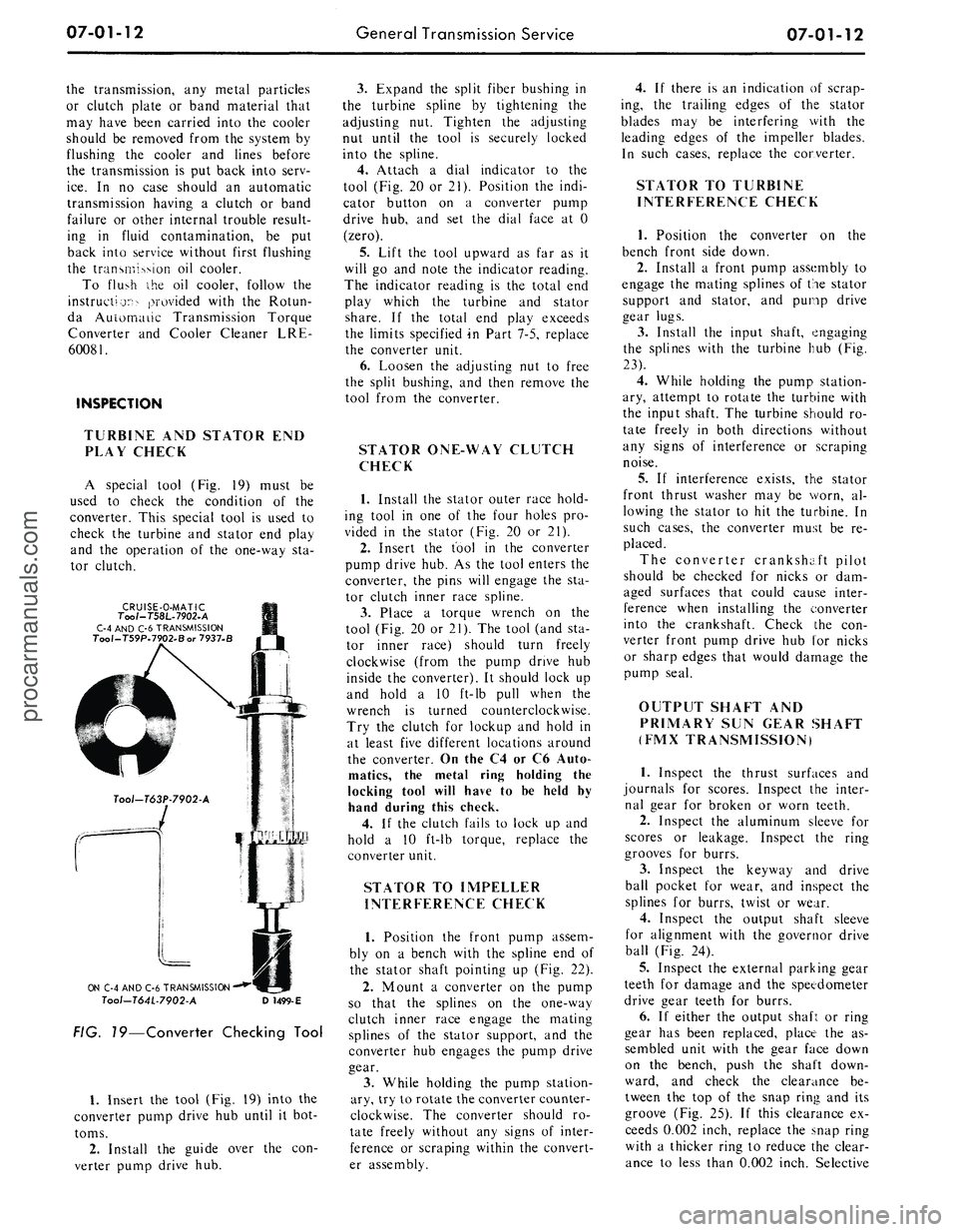
A special tool
(Fig. 19)
must
be
used
to
check
the
condition
of the
converter. This special tool
is
used
to
check
the
turbine
and
stator
end
play
and
the
operation
of the
one-way
sta-
tor clutch.
CRUISE-O-MATIC
Too/-T58L-7902-A
C-4 AND C-6 TRANSMISSION
Tool-T59P.7902.Bor 7937-B
ON C-4 AND C-6 TRANSMISSION
Tool-T64L-7902-A
D
1499-E
FIG. 19—Converter Checking Tool
1.
Insert
the
tool (Fig.
19)
into
the
converter pump drive
hub
until
it
bot-
toms.
2.
Install
the
guide over
the con-
verter pump drive
hub.
3.
Expand
the
split fiber bushing
in
the turbine spline
by
tightening
the
adjusting
nut.
Tighten
the
adjusting
nut until
the
tool
is
securely locked
into
the
spline.
4.
Attach
a
dial indicator
to the
tool (Fig.
20 or
21). Position
the
indi-
cator button
on a
converter pump
drive
hub, and set the
dial face
at 0
(zero).
5.
Lift
the
tool upward
as far as it
will
go and
note
the
indicator reading.
The indicator reading
is the
total
end
play which
the
turbine
and
stator
share.
If the
total
end
play exceeds
the limits specified
in
Part 7-5, replace
the converter unit.
6. Loosen
the
adjusting
nut to
free
the split bushing,
and
then remove
the
tool from
the
converter.
STATOR ONE-WAY CLUTCH
CHECK
1.
Install
the
stator outer race hold-
ing tool
in one of the
four holes
pro-
vided
in the
stator (Fig.
20 or 21).
2.
Insert
the
tool
in the
converter
pump drive hub.
As the
tool enters
the
converter,
the
pins will engage
the sta-
tor clutch inner race spline.
3.
Place
a
torque wrench
on the
tool (Fig.
20 or
21).
The
tool (and
sta-
tor inner race) should turn freely
clockwise (from
the
pump drive
hub
inside
the
converter).
It
should lock
up
and hold
a 10
ft-lb pull when
the
wrench
is
turned counterclockwise.
Try
the
clutch
for
lockup
and
hold
in
at least five different locations around
the converter.
On
the
C4
or C6
Auto-
matics,
the
metal ring holding
the
locking tool will have
to be
held
by
hand during this check.
4.
If the
clutch fails
to
lock
up and
hold
a 10
ft-lb torque, replace
the
converter unit.
STATOR
TO
IMPELLER
INTERFERENCE CHECK
1.
Position
the
front pump assem-
bly
on a
bench with
the
spline
end of
the stator shaft pointing
up
(Fig.
22).
2.
Mount
a
converter
on the
pump
so that
the
splines
on the
one-way
clutch inner race engage
the
mating
splines
of the
stator support,
and the
converter
hub
engages
the
pump drive
gear.
3.
While holding
the
pump station-
ary, try
to
rotate the converter counter-
clockwise.
The
converter should
ro-
tate freely without
any
signs
of
inter-
ference
or
scraping within
the
convert-
er assembly.
4.
If
there
is an
indication
of
scrap-
ing,
the
trailing edges
of the
stator
blades
may be
interfering with
the
leading edges
of the
impeller blades.
In such cases, replace
the
converter.
STATOR
TO
TURBINE
INTERFERENCE CHECK
1.
Position
the
converter
on the
bench front side down.
2.
Install
a
front pump assembly
to
engage
the
mating splines
of
the
stator
support
and
stator,
and
pump drive
gear lugs.
3.
Install
the
input shaft, engaging
the splines with
the
turbine
hub (Fig.
23).
4.
While holding
the
pump station-
ary, attempt
to
rotate
the
turbine with
the input shaft.
The
turbine should
ro-
tate freely
in
both directions without
any signs
of
interference
or
scraping
noise.
5.
If
interference exists,
the
stator
front thrust washer
may be
worn,
al-
lowing
the
stator
to hit the
turbine.
In
such cases,
the
converter must
be re-
placed.
The converter crankshaft pilot
should
be
checked
for
nicks
or dam-
aged surfaces that could cause inter-
ference when installing
the
converter
into
the
crankshaft. Check
the con-
verter front pump drive
hub for
nicks
or sharp edges that would damage
the
pump seal.
OUTPUT SHAFT
AND
PRIMARY
SUN
GEAR SHAFT
(FMX TRANSMISSION)
1.
Inspect
the
thrust surfaces
and
journals
for
scores. Inspect
the
inter-
nal gear
for
broken
or
worn teeth.
2.
Inspect
the
aluminum sleeve
for
scores
or
leakage. Inspect
the
ring
grooves
for
burrs.
3.
Inspect
the
keyway
and
drive
ball pocket
for
wear,
and
inspect
the
splines
for
burrs, twist
or
wear.
4.
Inspect
the
output shaft sleeve
for alignment with
the
governor drive
ball (Fig.
24).
5.
Inspect
the
external parking gear
teeth
for
damage
and the
speedometer
drive gear teeth
for
burrs.
6.
If
either
the
output shaft
or
ring
gear
has
been replaced, place
the as-
sembled unit with
the
gear face down
on
the
bench, push
the
shaft down-
ward,
and
check
the
clearance
be-
tween
the top of the
snap ring
and its
groove
(Fig. 25).
If
this clearance
ex-
ceeds 0.002 inch, replace
the
snap ring
with
a
thicker ring
to
reduce
the
clear-
ance
to
less than 0.002 inch. Selectiveprocarmanuals.com
Page 306 of 413
07-01-15
General Transmission Service
07-01-15
GOVERNOR
DRIVE BALL
POCKET
FRONT PUMP AND STATOR
SUPPORT SHAFT
D1922-A
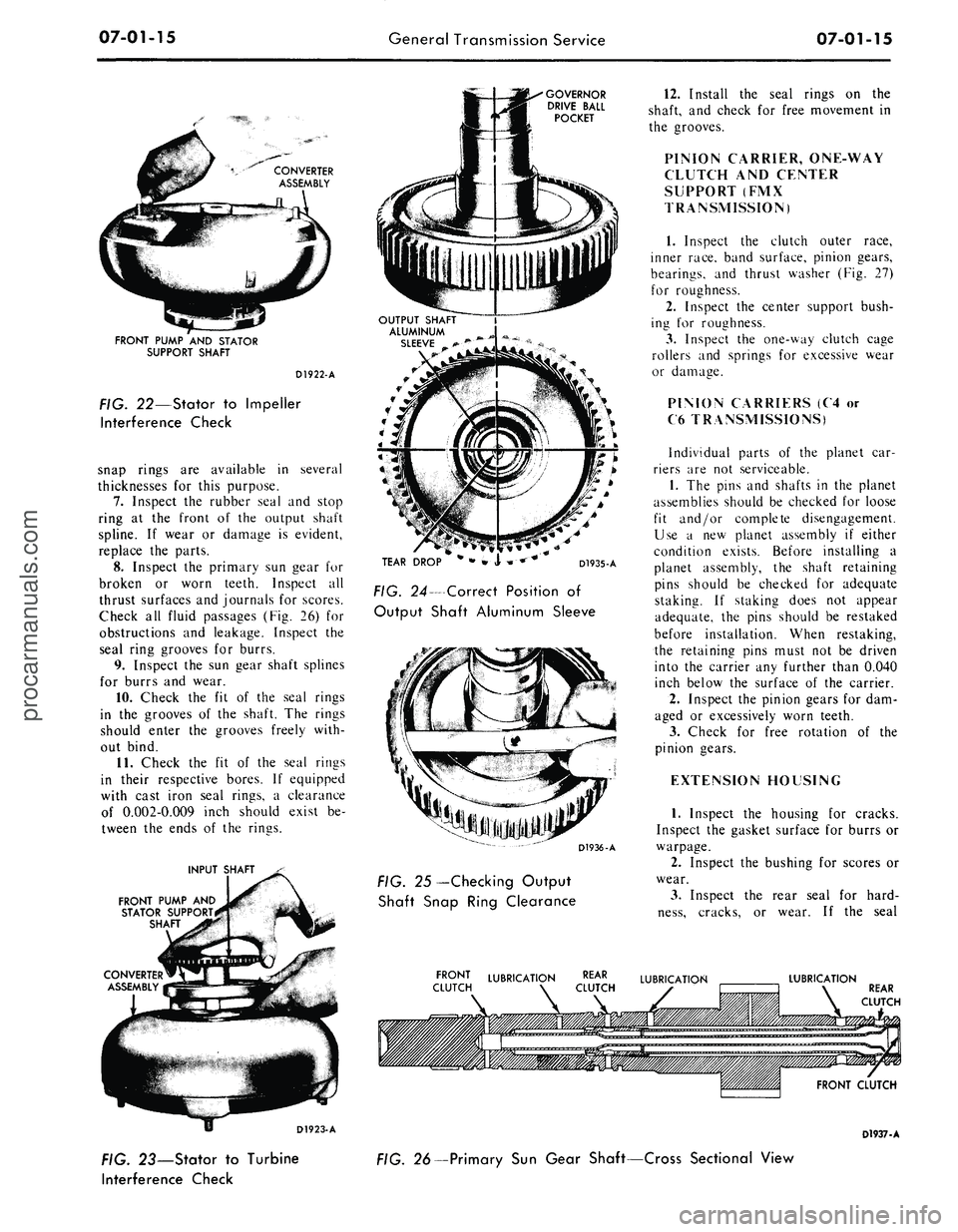
FIG. 22—Stator to Impeller
Interference Check
snap rings are available in several
thicknesses for this purpose.
7.
Inspect the rubber seal and stop
ring at the front of the output shaft
spline. If wear or damage is evident,
replace the parts.
8. Inspect the primary sun gear for
broken or worn teeth. Inspect all
thrust surfaces and journals for scores.
Check all fluid passages (Fig. 26) for
obstructions and leakage. Inspect the
seal ring grooves for burrs.
9. Inspect the sun gear shaft splines
for burrs and wear.
10.
Check the fit of the seal rings
in the grooves of the shaft. The rings
should enter the grooves freely with-
out bind.
11.
Check the fit of the seal rings
in their respective bores. If equipped
with cast iron seal rings, a clearance
of 0.002-0.009 inch should exist be-
tween the ends of the rings.
INPUT SHAFT
FRONT PUMP AND
STATOR SUPPORT
SHAFT
CONVERTER
ASSEMBLY
D1923-A
TEAR DROP
D1935-A
FIG. 24—Correct Position of
Output Shaft Aluminum Sleeve
D1936-A
FIG. 25—Checking Output
Shaft Snap Ring Clearance
12.
Install the seal rings on the
shaft, and check for free movement in
the grooves.
PINION CARRIER, ONE-WAY
CLUTCH AND CENTER
SUPPORT (FMX
TRANSMISSION)
1.
Inspect the clutch outer race,
inner race, band surface, pinion gears,
bearings, and thrust washer (Fig. 27)
for roughness.
2.
Inspect the center support bush-
ing for roughness.
3.
Inspect the one-way clutch cage
rollers and springs for excessive wear
or damage.
PINION CARRIERS (C4 or
C6 TRANSMISSIONS)
Individual parts of the planet car-
riers are not serviceable.
1.
The pins and shafts in the planet
assemblies should be checked for loose
fit and/or complete disengagement.
Use a new planet assembly if either
condition exists. Before installing a
planet assembly, the shaft retaining
pins should be checked for adequate
staking. If staking does not appear
adequate, the pins should be restaked
before installation. When restaking,
the retaining pins must not be driven
into the carrier any further than 0.040
inch below the surface of the carrier.
2.
Inspect the pinion gears for dam-
aged or excessively worn teeth.
3.
Check for free rotation of the
pinion gears.
EXTENSION HOUSING
1.
Inspect the housing for cracks.
Inspect the gasket surface for burrs or
warpage.
2.
Inspect the bushing for scores or
wear.
3.
Inspect the rear seal for hard-
ness,
cracks, or wear. If the seal
FRONT LUBRICATION REAR LUBRICATION
CLUTCH \ CLUTCH
LUBRICATION
FRONT CLUTCH
D1937-A
FIG. 23—Stator to Turbine
Interference Check
FIG. 26—Primary Sun Gear Shaft—Cross Sectional Viewprocarmanuals.com
Page 307 of 413
07-01-16
General Transmission bervice
07-01-16
CENTER SUPPORT
PLANETARY CLUTCH
"CAM TYPE" CLUTCH RACE
CHAMFER ON PRODUCTION
PART, ONLY-SERVICE PART NOT CHAMFERED
PLANET CARRIER
D1938-A
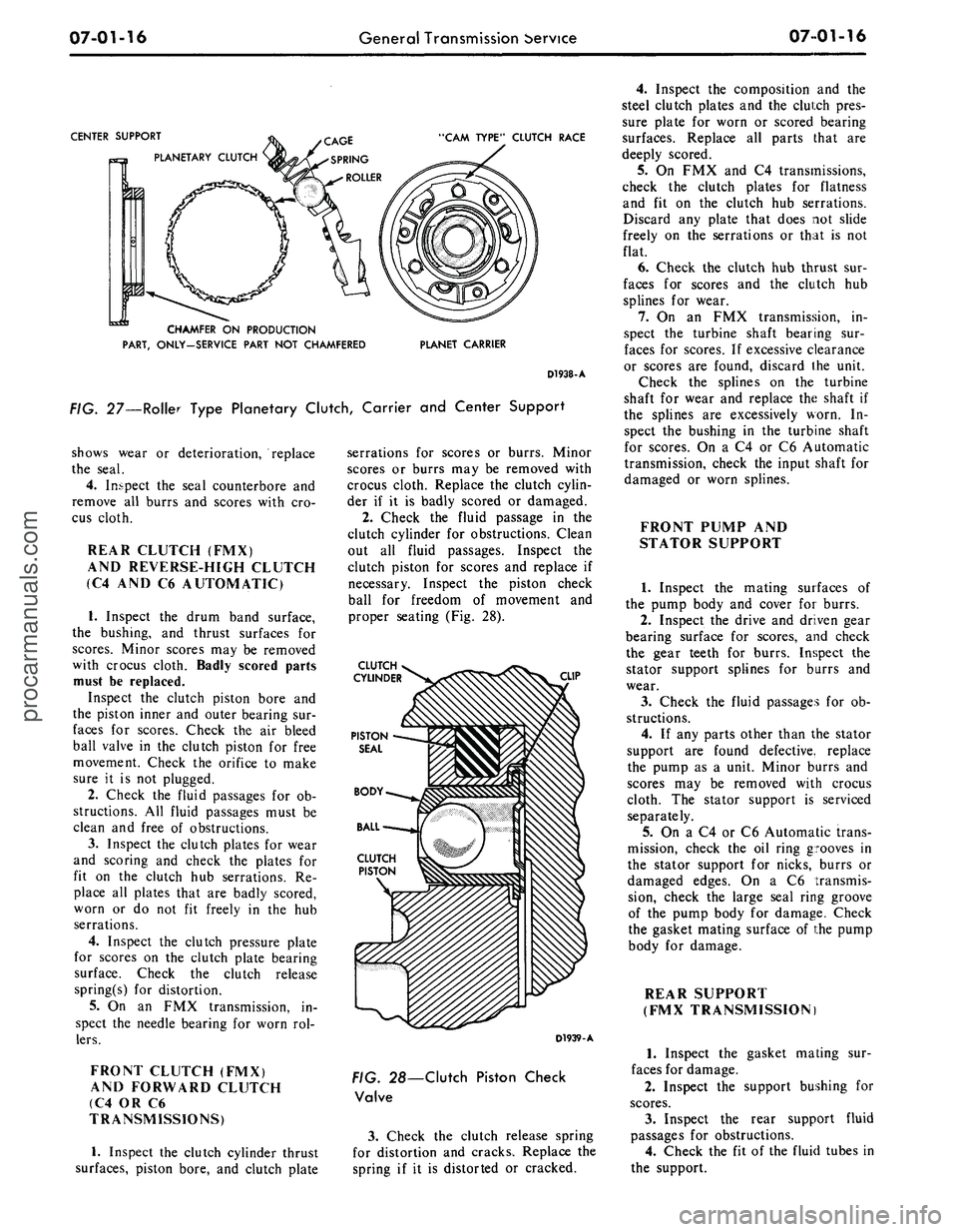
FIG. 27—Roller Type Planetary Clutch, Carrier and Center Support
shows wear or deterioration, replace
the seal.
4.
Inspect the seal counterbore and
remove all burrs and scores with cro-
cus cloth.
REAR CLUTCH (FMX)
AND REVERSE-HIGH CLUTCH
(C4 AND C6 AUTOMATIC)
1.
Inspect the drum band surface,
the bushing, and thrust surfaces for
scores. Minor scores may be removed
with crocus cloth. Badly scored parts
must be replaced.
Inspect the clutch piston bore and
the piston inner and outer bearing sur-
faces for scores. Check the air bleed
ball valve in the clutch piston for free
movement. Check the orifice to make
sure it is not plugged.
2.
Check the fluid passages for ob-
structions. All fluid passages must be
clean and free of obstructions.
3.
Inspect the clutch plates for wear
and scoring and check the plates for
fit on the clutch hub serrations. Re-
place all plates that are badly scored,
worn or do not fit freely in the hub
serrations.
4.
Inspect the clutch pressure plate
for scores on the clutch plate bearing
surface. Check the clutch release
spring(s) for distortion.
5.
On an FMX transmission, in-
spect the needle bearing for worn rol-
lers.
FRONT CLUTCH (FMX)
AND FORWARD CLUTCH
(C4 OR C6
TRANSMISSIONS)
1.
Inspect the clutch cylinder thrust
surfaces, piston bore, and clutch plate
serrations for scores or burrs. Minor
scores or burrs may be removed with
crocus cloth. Replace the clutch cylin-
der if it is badly scored or damaged.
2.
Check the fluid passage in the
clutch cylinder for obstructions. Clean
out all fluid passages. Inspect the
clutch piston for scores and replace if
necessary. Inspect the piston check
ball for freedom of movement and
proper seating (Fig. 28).
CLUTCH
CYLINDER
PISTON
SEAL
CLIP
D1939-A
. 28—Clutch Piston Check
Valve
3.
Check the clutch release spring
for distortion and cracks. Replace the
spring if it is distorted or cracked.
4.
Inspect the composition and the
steel clutch plates and the clutch pres-
sure plate for worn or scored bearing
surfaces. Replace all parts that are
deeply scored.
5.
On FMX and C4 transmissions,
check the clutch plates for flatness
and fit on the clutch hub serrations.
Discard any plate that does not slide
freely on the serrations or that is not
flat.
6. Check the clutch hub thrust sur-
faces for scores and the clutch hub
splines for wear.
7.
On an FMX transmission, in-
spect the turbine shaft bearing sur-
faces for scores. If excessive clearance
or scores are found, discard the unit.
Check the splines on the turbine
shaft for wear and replace the shaft if
the splines are excessively worn. In-
spect the bushing in the turbine shaft
for scores. On a C4 or C6 Automatic
transmission, check the input shaft for
damaged or worn splines.
FRONT PUMP AND
STATOR SUPPORT
1.
Inspect the mating surfaces of
the pump body and cover for burrs.
2.
Inspect the drive and driven gear
bearing surface for scores, and check
the gear teeth for burrs. Inspect the
stator support splines for burrs and
wear.
3.
Check the fluid passages for ob-
structions.
4.
If any parts other than the stator
support are found defective, replace
the pump as a unit. Minor burrs and
scores may be removed with crocus
cloth. The stator support is serviced
separately.
5.
On a C4 or C6 Automatic trans-
mission, check the oil ring grooves in
the stator support for nicks, burrs or
damaged edges. On a C6 transmis-
sion, check the large seal ring groove
of the pump body for damage. Check
the gasket mating surface of the pump
body for damage.
REAR SUPPORT
(FMX TRANSMISSION)
1.
Inspect the gasket mating sur-
faces for damage.
2.
Inspect the support bushing for
scores.
3.
Inspect the rear support fluid
passages for obstructions.
4.
Check the fit of the fluid tubes in
the support.procarmanuals.com
Page 308 of 413
07-01-17
General Transmission Service
07-01-17
PRESSURE REGULATOR
(FMX TRANSMISSION)
1.
Inspect the regulator body and
cover mating surface for burrs.
2.
Check all fluid passages for ob-
structions.
3.
Inspect the control pressure and
converter pressure valves and bores for
burrs and scores. Remove all burrs
carefully with crocus cloth.
4.
Check free movement of the
valves in their bores. The valves
should fall freely into the bores when
both the valve and bore are dry.
5.
Inspect the valve springs and
spacers for distortion.
CONTROL VALVE BODY
1.
Clean all parts thoroughly in
clean solvent, and then blow them dry
with moisture-free compressed air.
2.
Inspect all valve and plug bores
for scores. Check all fluid passages for
obstructions. Inspect the check valve
for free movement. Inspect all mating
surfaces for burrs or distortion. In-
spect all plugs and valves for burrs
and scores. Crocus cloth can be used
to polish valves and plugs if care is
taken to avoid rounding the sharp
edges of the valves and plugs.
3.
Inspect all springs for distortion.
Check all valves and plugs for free
movement in their respective bores.
Valves and plugs, when dry, must fall
from their own weight in their respec-
tive bores.
4.
Roll the manual valve on a flat
surface to check it for a bent condi-
tion.
GOVERNOR
1.
Inspect the governor valves and
bores for scores. Minor scores may be
removed from the valves with crocus
cloth. Replace the governor if the
valves or body is deeply scored.
2.
Check for free movement of the
valves in the bores. The valves should
slide freely of their own weight in the
bores when dry. Inspect fluid passages
in the valve body and counterweight
for obstructions. All fluid passages
must be clean.
3.
Inspect the mating surfaces of
the governor body and governor dis-
tributor (C4 or C6 Automatic) for
burrs and distortion. Mating surfaces
must be smooth and flat.
4.
Check the mating surface of the
governor valve and the counterweight
on a FMX transmission for burrs or
scratches.
5.
When cleaning the governor as-
sembly (C4 Automatic), the oil screen
should be removed from the collector
body and thoroughly blown out with
compressed air.
FRONT SERVO (FMX)
AND INTERMEDIATE
SERVO (C4 AND C6
AUTOMATIC)
1.
Inspect the servo bore for cracks
and the piston bore and the servo pis-
ton stem for scores. Check fluid pas-
sages for obstructions. Replace seals
that are damaged.
2.
On an FMX transmission, check
the actuating lever for free movement,
and inspect it for wear. If necessary to
replace the actuating lever or shaft,
remove the retaining pin and push the
shaft out of the bracket.
Inspect the adjusting screw threads
and the threads in the lever for dam-
age.
3.
Check the servo spring and servo
band strut(s) for distortion.
4.
Inspect the cover seal and gasket
cover sealing surface for defects.
REAR SERVO (FMX)
AND LOW-REVERSE SERVO
(C4 TRANSMISSION)
1.
Inspect the servo body for cracks
and the piston bore for scores.
2.
Check the fluid passages for ob-
structions.
3.
Inspect the band and the struts
for distortion. Inspect the band ends
for cracks.
4.
Inspect the servo spring for dis-
tortion.
5.
Inspect the band lining for exces-
sive wear and bonding to the metal
band.
6. On an FMX transmission, check
the servo body to case mating surface
for burrs. Check the accumulator pis-
ton and the check valve for freedom
of movement. Check the actuating
lever socket for scores.
7.
Replace seals that are damaged.
CASE
Inspect the case for cracks and
stripped threads. Inspect the gasket
surfaces and mating surfaces for
burrs.
Check the vent for obstructions,
and check all fluid passages for ob-
structions and leakage (Figs. 10, 11
and 12).
Inspect the case bushing for scores.
Check all parking linkage parts for
wear or damage.
ONE-WAY CLUTCH
1.
Inspect the outer and inner races
for scores or damaged surface area
where the rollers contact the races. If
the outer race on the C6 transmission
is damaged, the low-reverse clutch hub
must be replaced.
2.
Inspect the rollers and springs
for excessive wear or damage.
3.
Inspect the spring and roller case
for bent or damaged spring retainers.procarmanuals.com
Page 317 of 413
07-02-09
C4 Automatic Transmission
07-02-09
11.
Remove the handle from the se-
lector lever.
12.
Install the selector housing and
lever assembly as shown in Figure 8.
Torque the attaching bolts 4-6 ft-lbs.
13.
Connect the dial indicator light.
14.
Install the pointer back-up
shield on the housing and lever assem-
bly.
15.
Install the dial housing and
tighten the attaching screws.
16.
Install the selector lever handle
and tighten the attaching screw.
17.
Position the selector lever in the
D position.
18.
Raise the vehicle. Install the
transmission manual lever rod to the
selector lever. Adjust the manual link-
age.
19.
Lower the vehicle and check the
transmission operation in each selo:c-
tor lever detent position.
BAND ADJUSTMENT
INTERMEDIATE BAND
1.
Clean all the dirt from the band
adjusting screw area. Remove and dis-
card the locknut.
2.
Install a new locknut on the ad-
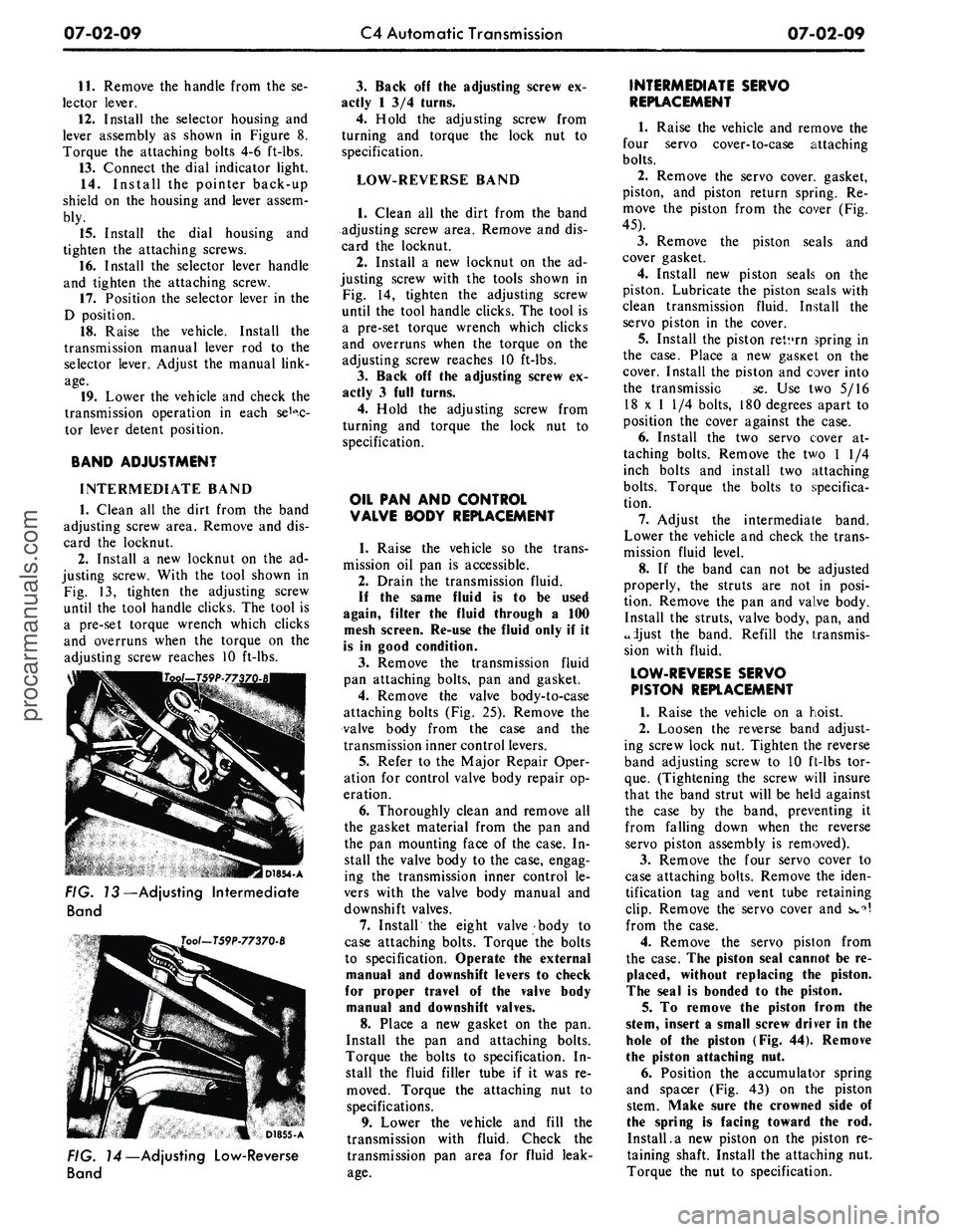
justing screw. With the tool shown in
Fig. 13, tighten the adjusting screw
until the tool handle clicks. The tool is
a pre-set torque wrench which clicks
and overruns when the torque on the
adjusting screw reaches 10 ft-lbs.
I D1854-A
FIG. 13—Adjusting Intermediate
Band
Tool-T59P-77370-B
D1855-A
FIG. 14—Adjusting Low-Reverse
Band
3.
Back off the adjusting screw ex-
actly 1 3/4 turns.
4.
Hold the adjusting screw from
turning and torque the lock nut to
specification.
LOW-REVERSE BAND
1.
Clean all the dirt from the band
adjusting screw area. Remove and dis-
card the locknut.
2.
Install a new locknut on the ad-
justing screw with the tools shown in
Fig. 14, tighten the adjusting screw
until the tool handle clicks. The tool is
a pre-set torque wrench which clicks
and overruns when the torque on the
adjusting screw reaches 10 ft-lbs.
3.
Back off the adjusting screw ex-
actly 3 full turns.
4.
Hold the adjusting screw from
turning and torque the lock nut to
specification.
OIL PAN AND CONTROL
VALVE BODY REPLACEMENT
1.
Raise the vehicle so the trans-
mission oil pan is accessible.
2.
Drain the transmission fluid.
If the same fluid is to be used
again, filter the fluid through a 100
mesh screen. Re-use the fluid only if it
is in good condition.
3.
Remove the transmission fluid
pan attaching bolts, pan and gasket.
4.
Remove the valve body-to-case
attaching bolts (Fig. 25). Remove the
valve body from the case and the
transmission inner control levers.
5.
Refer to the Major Repair Oper-
ation for control valve body repair op-
eration.
6. Thoroughly clean and remove all
the gasket material from the pan and
the pan mounting face of the case. In-
stall the valve body to the case, engag-
ing the transmission inner control le-
vers with the valve body manual and
downshift valves.
7.
Install the eight valve body to
case attaching bolts. Torque the bolts
to specification. Operate the external
manual and downshift levers to check
for proper travel of the valve body
manual and downshift valves.
8. Place a new gasket on the pan.
Install the pan and attaching bolts.
Torque the bolts to specification. In-
stall the fluid filler tube if it was re-
moved. Torque the attaching nut to
specifications.
9. Lower the vehicle and fill the
transmission with fluid. Check the
transmission pan area for fluid leak-
age.
INTERMEDIATE SERVO
REPLACEMENT
1.
Raise the vehicle and remove the
four servo cover-to-case attaching
bolts.
2.
Remove the servo cover, gasket,
piston, and piston return spring. Re-
move the piston from the cover (Fig.
45).
3.
Remove the piston seals and
cover gasket.
4.
Install new piston seals on the
piston. Lubricate the piston seals with
clean transmission fluid. Install the
servo piston in the cover.
5.
Install the piston retvrn spring in
the case. Place a new gasicet on the
cover. Install the piston and cover into
the transmissic se. Use two 5/16
18 x 1 1/4 bolts, 180 degrees apart to
position the cover against the case.
6. Install the two servo cover at-
taching bolts. Remove the two 1 1/4
inch bolts and install two attaching
bolts.
Torque the bolts to specifica-
tion.
7.
Adjust the intermediate band.
Lower the vehicle and check the trans-
mission fluid level.
8. If the band can not be adjusted
properly, the struts are not in posi-
tion. Remove the pan and valve body.
Install the struts, valve body, pan, and
adjust the band. Refill the transmis-
sion with fluid.
LOW-REVERSE SERVO
PISTON REPLACEMENT
1.
Raise the vehicle on a hoist.
2.
Loosen the reverse band adjust-
ing screw lock nut. Tighten the reverse
band adjusting screw to 10 ft-lbs tor-
que.
(Tightening the screw will insure
that the band strut will be held against
the case by the band, preventing it
from falling down when the reverse
servo piston assembly is removed).
3.
Remove the four servo cover to
case attaching bolts. Remove the iden-
tification tag and vent tube retaining
clip.
Remove the servo cover and s»»^
from the case.
4.
Remove the servo piston from
the case. The piston seal cannot be re-
placed, without replacing the piston.
The seal is bonded to the piston.
5. To remove the piston from the
stem, insert a small screw driver in the
hole of the piston (Fig. 44). Remove
the piston attaching nut.
6. Position the accumulator spring
and spacer (Fig. 43) on the piston
stem. Make sure the crowned side of
the spring is facing toward the rod.
Install.a new piston on the piston re-
taining shaft. Install the attaching nut.
Torque the nut to specification.procarmanuals.com
Page 318 of 413
07-02-10
C4 Automatic Transmission
07-02-10
7.
Install
the
piston into
the
case.
Install
a new
seal
on the
cover. Install
the cover
by
using
two
5/16—18 bolts,
1
1/4
inch long,
at
180
degrees apart
to position
the
servo cover
on the
case.
Install
the
vent tube retaining
clip
and
identification
tag.
Install
two
cover attaching bolts. Remove
the two
installing bolts
and
install
the
last
two
attaching bolts. Torque
the
cover-
to-case attaching bolts
to
specifica-
tion.
8. Adjust
the
low-reverse band.
Lower
the
vehicle
and
check
the
trans-
mission fluid level.
9.
If the
band
can not be
adjusted
properly,
the
struts
are not in
posi-
tion. Remove
the
fluid
pan and
valve
body. Install
the
struts, valve body,
pan
and
adjust
the
band. Refill
the
transmission with fluid.
EXTENSION HOUSING
BUSHING
AND
REAR
SEAL REPLACEMENT
1.
Disconnect
the
drive shaft from
the transmission.
2.
When only
the
rear seal needs
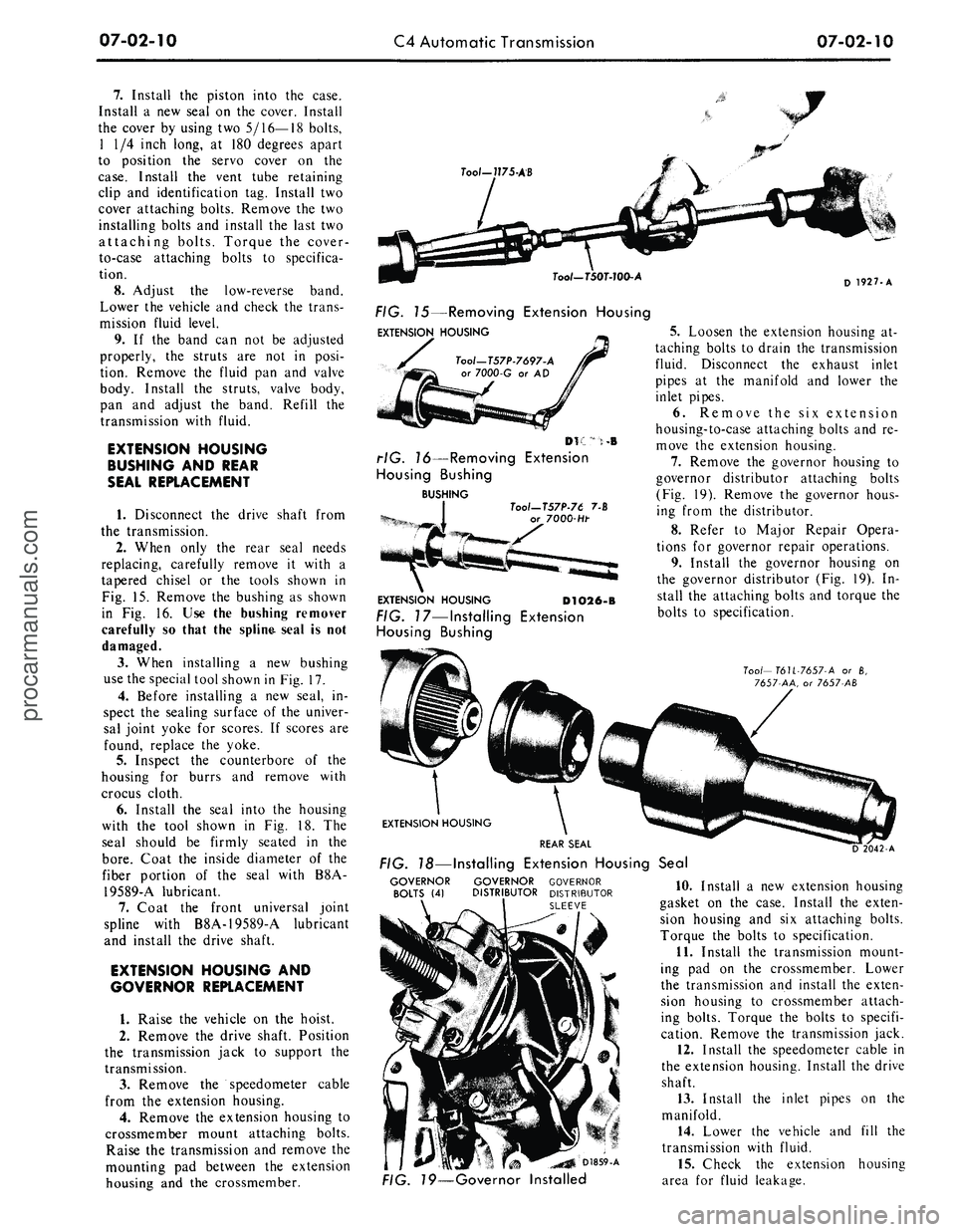
replacing, carefully remove
it
with
a
tapered chisel
or the
tools shown
in
Fig.
15.
Remove
the
bushing
as
shown
in
Fig. 16. Use the
bushing remover
carefully
so
that
the
spline- seal
is not
damaged.
3.
When installing
a new
bushing
use
the
special tool shown
in
Fig.
17.
4.
Before installing
a new
seal,
in-
spect
the
sealing surface
of the
univer-
sal joint yoke
for
scores.
If
scores
are
found, replace
the
yoke.
5.
Inspect
the
counterbore
of the
housing
for
burrs
and
remove with
crocus cloth.
6. Install
the
seal into
the
housing
with
the
tool shown
in Fig. 18. The
seal should
be
firmly seated
in the
bore.
Coat
the
inside diameter
of the
fiber portion
of the
seal with
B8A-
19589-A lubricant.
7.
Coat
the
front universal joint
spline with B8A-19589-A lubricant
and install
the
drive shaft.
EXTENSION HOUSING
AND
GOVERNOR REPLACEMENT
1.
Raise
the
vehicle
on the
hoist.
2.
Remove
the
drive shaft. Position
the transmission jack
to
support
the
transmission.
3.
Remove
the
speedometer cable
from
the
extension housing.
4.
Remove
the
extension housing
to
crossmember mount attaching bolts.
Raise
the
transmission
and
remove
the
mounting
pad
between
the
extension
housing
and the
crossmember.
Tool—
I775-AB
Tool—
T50T-100-A
FIG. 15—Removing Extension Housing
EXTENSION HOUSING
rIG. 16—Removing Extension
Housing Bushing
BUSHING
I Tool—T57P-76 7-B
^mmmfm^
0^7000-Ht
EXTENSION HOUSING
D1O26-B
FIG. 17—Installing Extension
Housing Bushing
D 1927-A
5.
Loosen
the
extension housing
at-
taching bolts
to
drain
the
transmission
fluid. Disconnect
the
exhaust inlet
pipes
at the
manifold
and
lower
the
inlet pipes.
6. Remove
the six
extension
housing-to-case attaching bolts
and re-
move
the
extension housing.
7.
Remove
the
governor housing
to
governor distributor attaching bolts
(Fig.
19).
Remove
the
governor hous-
ing from
the
distributor.
8. Refer
to
Major Repair Opera-
tions
for
governor repair operations.
9. Install
the
governor housing
on
the governor distributor
(Fig.
19). In-
stall
the
attaching bolts
and
torque
the
bolts
to
specification.
Tool—
T6
U-7657-A
or B,
7657AA,
or
7657-AB
EXTENSION HOUSING
REAR SEAL
FIG. 18—Installing Extension Housing Seal
D 2042-A
GOVERNOR GOVERNOR GOVERNOR
BOLTS
(4)
DISTRIBUTOR DISTRIBUTOR
SLEEVE
I
D1859-A
FIG. 79—Governor Installed
10.
Install
a new
extension housing
gasket
on the
case. Install
the
exten-
sion housing
and six
attaching bolts.
Torque
the
bolts
to
specification.
11.
Install
the
transmission mount-
ing
pad on the
crossmember. Lower
the transmission
and
install
the
exten-
sion housing
to
crossmember attach-
ing bolts. Torque
the
bolts
to
specifi-
cation. Remove
the
transmission jack.
12.
Install
the
speedometer cable
in
the extension housing. Install
the
drive
shaft.
13.
Install
the
inlet pipes
on the
manifold.
14.
Lower
the
vehicle
and
fill
the
transmission with fluid.
15.
Check
the
extension housing
area
for
fluid leakage.procarmanuals.com
Page 333 of 413
07-02-25
C4 Automatic Transmission
07-02-25
7oo/-
7000-
FIG. 75—Removing Forward
Clutch Piston
move the piston from the clutch hub.
5.
Remove the clutch piston outer
seal and the inner seal from the clutch
hub (Fig. 73).
Assembly
1.
Install new clutch piston seals on
the clutch piston and drum. Lubricate
the seals with clean transmission fluid.
2.
Install the clutch piston into the
clutch hub. Install the disc spring and
retaining snap ring (Fig. 73).
3.
Install the lower pressure plate
with the flat side up and the radius
side downward. Install one non-
metallic clutch plate and alternately
install the drive and driven plates. Be-
fore installing new composition clutch
plates,
soak them in transmission fluid
for fifteen minutes. The last plate in-
stalled will be the upper pressure
plate. Refer to Part 7-5 for the correct
number of clutch plates for the appli-
cable model transmission.
4.
Install the pressure plate retain-
ing snap ring (Fig. 73). Make sure the
snap ring is fully seated in the ring
groove of the clutch hub.
5.
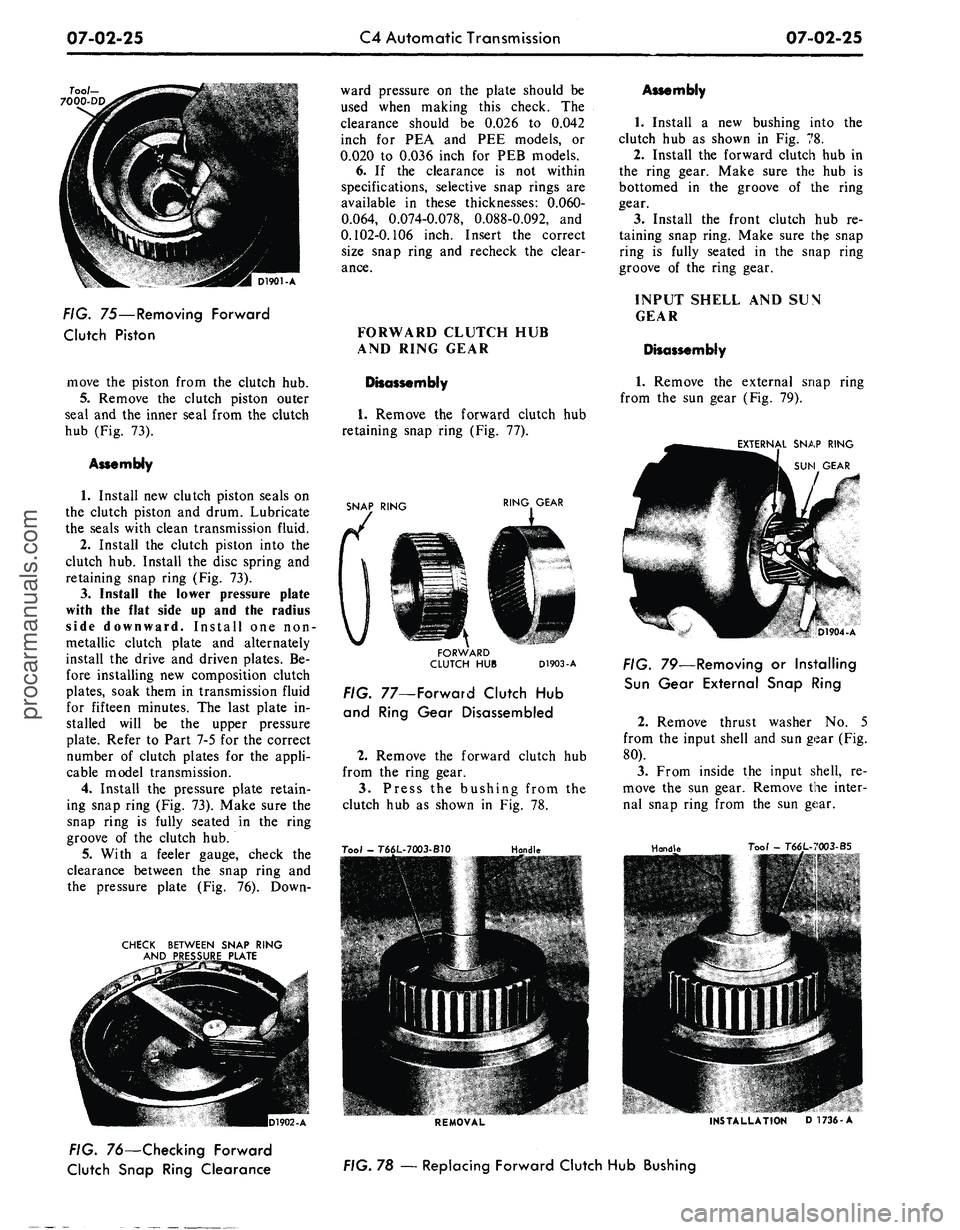
With a feeler gauge, check the
clearance between the snap ring and
the pressure plate (Fig. 76). Down-
CHECK BETWEEN SNAP RING
AND PRESSURE PLATE
FIG. 76—Checking Forward
Clutch Snap Ring Clearance
ward pressure on the plate should be
used when making this check. The
clearance should be 0.026 to 0.042
inch for PEA and PEE models, or
0.020 to 0.036 inch for PEB models.
6. If the clearance is not within
specifications, selective snap rings are
available in these thicknesses: 0.060-
0.064, 0.074-0.078, 0.088-0.092, and
0.102-0.106 inch. Insert the correct
size snap ring and recheck the clear-
ance.
FORWARD CLUTCH HUB
AND RING GEAR
Disassembly
1.
Remove the forward clutch hub
retaining snap ring (Fig. 77).
SNAP RING
RING GEAR
FORWARD
CLUTCH HUB
D1903-A
FIG. 77—Forward Clutch Hub
and Ring Gear Disassembled
2.
Remove the forward clutch hub
from the ring gear.
3.
Press the bushing from the
clutch hub as shown in Fig. 78.
Tool - T66L-7003-B10
Handle
REMOVAL
Assembly
1.
Install a new bushing into the
clutch hub as shown in Fig. 78.
2.
Install the forward clutch hub in
the ring gear. Make sure the hub is
bottomed in the groove of the ring
gear.
3.
Install the front clutch hub re-
taining snap ring. Make sure the snap
ring is fully seated in the snap ring
groove of the ring gear.
INPUT SHELL AND SUN
GEAR
Disassembly
1.
Remove the external snap
from the sun gear (Fig. 79).
ring
EXTERNAL SNAP RING
SUN GEAR
D1904-A
FIG. 79—Removing or Installing
Sun Gear External Snap Ring
2.
Remove thrust washer No. 5
from the input shell and sun gear (Fig.
80).
3.
From inside the input shell, re-
move the sun gear. Remove the inter-
nal snap ring from the sun gear.
Handle
Tool - T66L-V003-B5
INSTALLATION D 1736-A
FIG. 78 — Replacing Forward Clutch Hub Bushingprocarmanuals.com
Page 335 of 413
07-02-27
C4 Automatic Transmission
07-02-27
'OIL RINGS
SNAP RING
SECONDARY
GOVERNOR VALVE
1 v s
GOVERNOR HOUSING
D1907-A
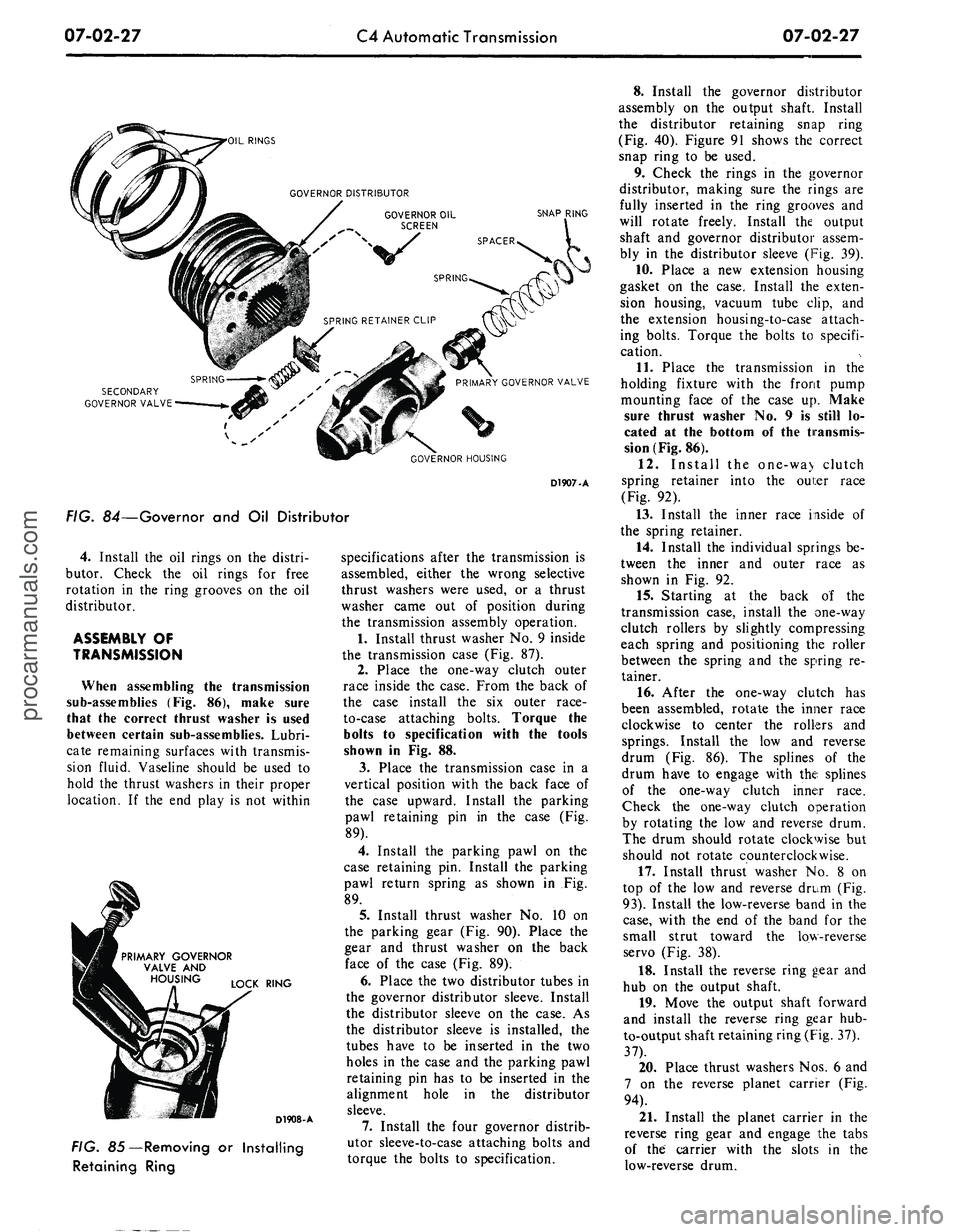
FIG. 84—Governor and Oil Distributor
4.
Install the oil rings on the distri-
butor. Check the oil rings for free
rotation in the ring grooves on the oil
distributor.
ASSEMBLY OF
TRANSMISSION
When assembling the transmission
sub-assemblies (Fig. 86), make sure
that the correct thrust washer is used
between certain sub-assemblies. Lubri-
cate remaining surfaces with transmis-
sion fluid. Vaseline should be used to
hold the thrust washers in their proper
location. If the end play is not within
PRIMARY GOVERNOR
VALVE AND
LOCK RING
D1908-A
FIG. 85—Removing or Installing
Retaining Ring
specifications after the transmission is
assembled, either the wrong selective
thrust washers were used, or a thrust
washer came out of position during
the transmission assembly operation.
1.
Install thrust washer No. 9 inside
the transmission case (Fig. 87).
2.
Place the one-way clutch outer
race inside the case. From the back of
the case install the six outer race-
to-case attaching bolts. Torque the
bolts to specification with the tools
shown in Fig. 88.
3.
Place the transmission case in a
vertical position with the back face of
the case upward. Install the parking
pawl retaining pin in the case (Fig.
89).
4.
Install the parking pawl on the
case retaining pin. Install the parking
pawl return spring as shown in Fig.
89.
5.
Install thrust washer No. 10 on
the parking gear (Fig. 90). Place the
gear and thrust washer on the back
face of the case (Fig. 89).
6. Place the two distributor tubes in
the governor distributor sleeve. Install
the distributor sleeve on the case. As
the distributor sleeve is installed, the
tubes have to be inserted in the two
holes in the case and the parking pawl
retaining pin has to be inserted in the
alignment hole in the distributor
sleeve.
7.
Install the four governor distrib-
utor sleeve-to-case attaching bolts and
torque the bolts to specification.
8. Install the governor distributor
assembly on the output shaft. Install
the distributor retaining snap ring
(Fig. 40). Figure 91 shows the correct
snap ring to be used.
9. Check the rings in the governor
distributor, making sure the rings are
fully inserted in the ring grooves and
will rotate freely. Install the output
shaft and governor distributor assem-
bly in the distributor sleeve (Fig. 39).
10.
Place a new extension housing
gasket on the case. Install the exten-
sion housing, vacuum tube clip, and
the extension housing-to-case attach-
ing bolts. Torque the bolts to specifi-
cation.
11.
Place the transmission in the
holding fixture with the front pump
mounting face of the case up. Make
sure thrust washer No. 9 is still lo-
cated at the bottom of the transmis-
sion (Fig. 86).
12.
Install the one-wa> clutch
spring retainer into the oui:er race
(Fig. 92).
13.
Install the inner race inside of
the spring retainer.
14.
Install the individual springs be-
tween the inner and outer race as
shown in Fig. 92.
15.
Starting at the back of the
transmission case, install the one-way
clutch rollers by slightly compressing
each spring and positioning the roller
between the spring and the spring re-
tainer.
16.
After the one-way clutch has
been assembled, rotate the inner race
clockwise to center the rollers and
springs. Install the low and reverse
drum (Fig. 86). The splines of the
drum have to engage with the splines
of the one-way clutch inner race.
Check the one-way clutch operation
by rotating the low and reverse drum.
The drum should rotate clockwise but
should not rotate counterclockwise.
17.
Install thrust washer No. 8 on
top of the low and reverse drum (Fig.
93).
Install the low-reverse band in the
case,
with the end of the band for the
small strut toward the low-reverse
servo (Fig. 38).
18.
Install the reverse ring gear and
hub on the output shaft.
19.
Move the output shaft forward
and install the reverse ring gear hub-
to-output shaft retaining ring (Fig. 37).
37).
20.
Place thrust washers Nos. 6 and
7 on the reverse planet carrier (Fig.
94).
21.
Install the planet carrier in the
reverse ring gear and engage the tabs
of the carrier with the slots in the
low-reverse drum.procarmanuals.com
Page 337 of 413
07-02-29
C4 Automatic Transmission
07-02-29
THRUST WASHER
NO. 9
PARKING GEAR
BOTTOM
OF CASE
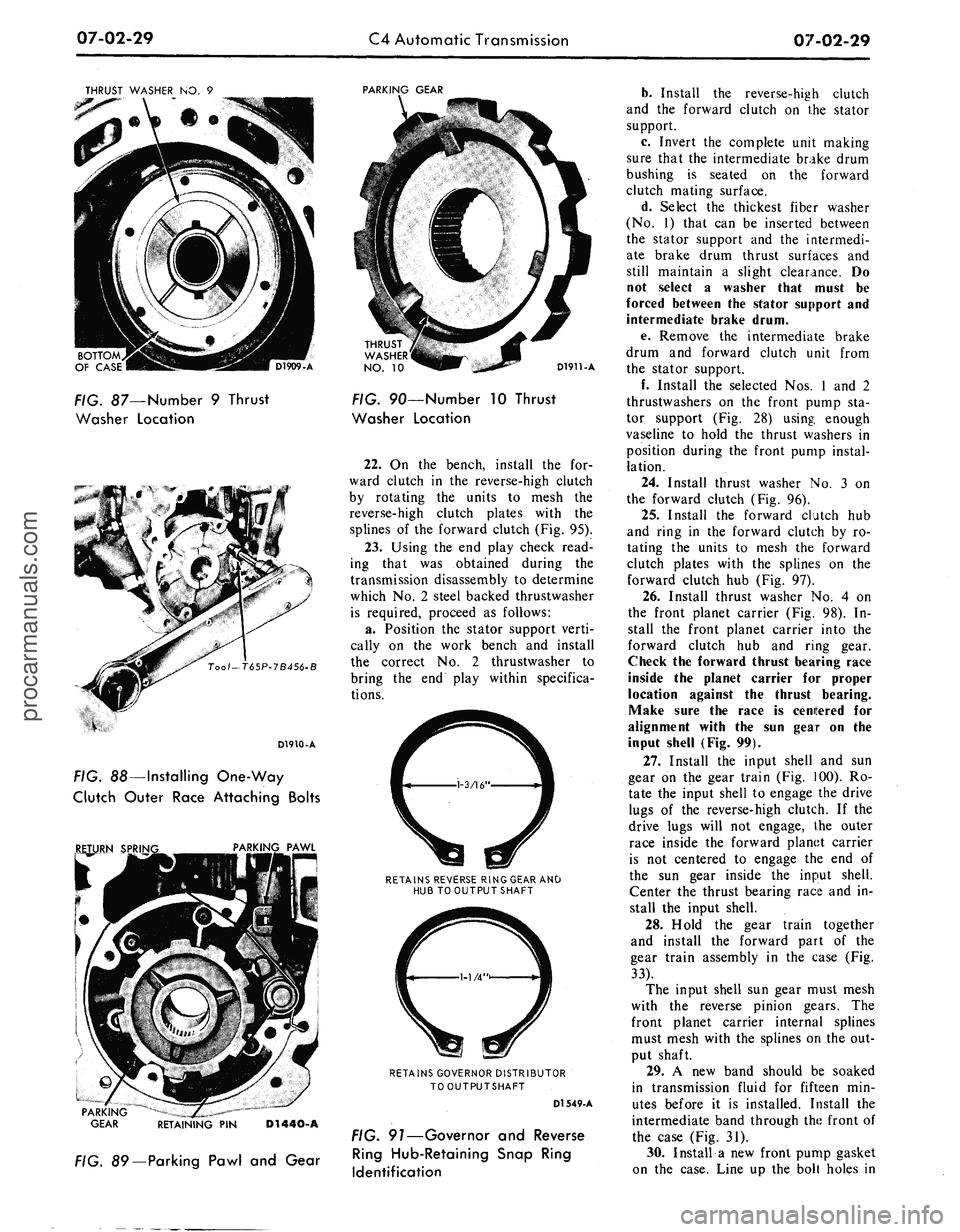
FIG. 87—Number
9
Thrust
Washer Location
Tool-T65P-7B456-B
D1910-A
FIG. 88—Installing One-Way
Clutch Outer Race Attaching Bolts
REJURN
S
PAWL
PARKING
GEAR RETAINING
PIN
D1440-A
FIG. 89— Parking Pawl
and
Gear
THRUST
WASHER
NO.
10
D1911-A
FIG. 90—Number
10
Thrust
Washer Location
22.
On the
bench, install
the for-
ward clutch
in the
reverse-high clutch
by rotating
the
units
to
mesh
the
reverse-high clutch plates with
the
splines
of
the
forward clutch
(Fig. 95).
23.
Using
the end
play check read-
ing that
was
obtained during
the
transmission disassembly
to
determine
which
No.
2
steel backed thrustwasher
is required, proceed
as
follows:
a.
Position
the
stator support verti-
cally
on the
work bench
and
install
the correct
No. 2
thrustwasher
to
bring
the end
play within specifica-
tions.
RETAINS REVERSE RING GEAR
AND
HUB
TO
OUTPUT SHAFT
RETAINS GOVERNOR DISTRIBUTOR
TOOUTPUTSHAFT
D1549-A
FIG. 91—Governor
and
Reverse
Ring Hub-Retaining Snap Ring
Identification
b.
Install
the
reverse-high clutch
and
the
forward clutch
on the
stator
support.
c. Invert
the
complete unit making
sure that
the
intermediate brake drum
bushing
is
seated
on the
forward
clutch mating surface.
d.
Select
the
thickest fiber washer
(No.
1)
that
can be
inserted between
the stator support
and the
intermedi-
ate brake drum thrust surfaces
and
still maintain
a
slight clearance.
Do
not select
a
washer that must
be
forced between
the
stator support
and
intermediate brake drum.
e. Remove
the
intermediate brake
drum
and
forward clutch unit from
the stator support.
f.
Install
the
selected
Nos.
1 and 2
thrustwashers
on the
front pump
sta-
tor support
(Fig.
28)
using enough
vaseline
to
hold
the
thrust washers
in
position during
the
front pump instal-
lation.
24.
Install thrust washer
No.
3 on
the forward clutch
(Fig. 96).
25.
Install
the
forward clutch
hub
and ring
in the
forward clutch
by ro-
tating
the
units
to
mesh
the
forward
clutch plates with
the
splines
on the
forward clutch
hub (Fig. 97).
26.
Install thrust washer
No.
4 on
the front planet carrier
(Fig. 98).
In-
stall
the
front planet carrier into
the
forward clutch
hub and
ring gear.
Check
the
forward thrust bearing race
inside
the
planet carrier
for
proper
location against
the
thrust bearing.
Make sure
the
race
is
centered
for
alignment with
the sun
gear
on the
input shell
(Fig. 99).
27.
Install
the
input shell
and sun
gear
on
the
gear train
(Fig. 100). Ro-
tate
the
input shell
to
engage
the
drive
lugs
of the
reverse-high clutch.
If the
drive lugs will
not
engage,
the
outer
race inside
the
forward planet carrier
is
not
centered
to
engage
the end of
the
sun
gear inside
the
input shell.
Center
the
thrust bearing race
and
in-
stall
the
input shell.
28.
Hold
the
gear train together
and install
the
forward part
of the
gear train assembly
in the
case
(Fig.
33).
The input shell
sun
gear must mesh
with
the
reverse pinion gears.
The
front planet carrier internal splines
must mesh with
the
splines
on the out-
put shaft.
29.
A
new
band should
be
soaked
in transmission fluid
for
fifteen
min-
utes before
it is
installed. Install
the
intermediate band through
the
front
of
the case
(Fig. 31).
30.
Install
a
new
front pump gasket
on
the
case. Line
up
the
bolt holes
inprocarmanuals.com