oil FORD MUSTANG 1969 Volume One Chassis
[x] Cancel search | Manufacturer: FORD, Model Year: 1969, Model line: MUSTANG, Model: FORD MUSTANG 1969Pages: 413, PDF Size: 75.81 MB
Page 165 of 413
03-10-04
Ford-Thompson Power Steering Pump
03-10-04
OUTLET FITTING
GASKET
Wood Block
0-RING SEAL
G1345-
-500-
A
G1603- A
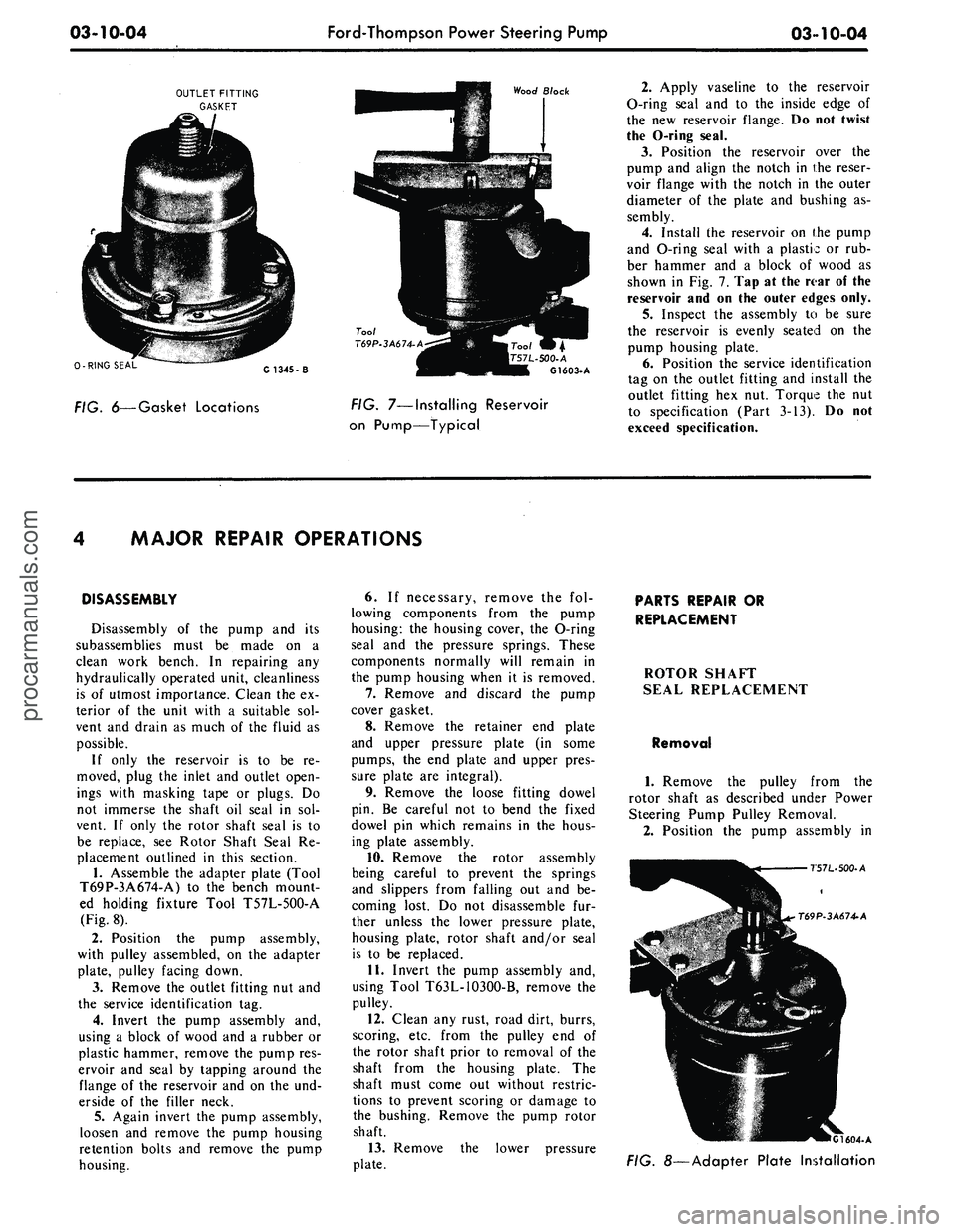
FIG. 6—Gasket Locations
FIG.
7—Installing
Reservoir
on Pump—Typical
2.
Apply vaseline to the reservoir
O-ring seal and to the inside edge of
the new reservoir flange. Do not twist
the O-ring seal.
3.
Position the reservoir over the
pump and align the notch in the reser-
voir flange with the notch in the outer
diameter of the plate and bushing as-
sembly.
4.
Install the reservoir on the pump
and O-ring seal with a plastic or rub-
ber hammer and a block of wood as
shown in Fig. 7. Tap at the rear of the
reservoir and on the outer edges only.
5.
Inspect the assembly to be sure
the reservoir is evenly seated on the
pump housing plate.
6. Position the service identification
tag on the outlet fitting and install the
outlet fitting hex nut. Torque the nut
to specification (Part 3-13). Do not
exceed specification.
MAJOR REPAIR OPERATIONS
DISASSEMBLY
Disassembly of the pump and its
subassemblies must be made on a
clean work bench. In repairing any
hydraulically operated unit, cleanliness
is of utmost importance. Clean the ex-
terior of the unit with a suitable sol-
vent and drain as much of the fluid as
possible.
If only the reservoir is to be re-
moved, plug the inlet and outlet open-
ings with masking tape or plugs. Do
not immerse the shaft oil seal in sol-
vent. If only the rotor shaft seal is to
be replace, see Rotor Shaft Seal Re-
placement outlined in this section.
1.
Assemble the adapter plate (Tool
T69P-3A674-A) to the bench mount-
ed holding fixture Tool T57L-5OO-A
(Fig. 8).
2.
Position the pump assembly,
with pulley assembled, on the adapter
plate, pulley facing down.
3.
Remove the outlet fitting nut and
the service identification tag.
4.
Invert the pump assembly and,
using a block of wood and a rubber or
plastic hammer, remove the pump res-
ervoir and seal by tapping around the
flange of the reservoir and on the und-
erside of the filler neck.
5.
Again invert the pump assembly,
loosen and remove the pump housing
retention bolts and remove the pump
housing.
6. If necessary, remove the fol-
lowing components from the pump
housing: the housing cover, the O-ring
seal and the pressure springs. These
components normally will remain in
the pump housing when it is removed.
7.
Remove and discard the pump
cover gasket.
8. Remove the retainer end plate
and upper pressure plate (in some
pumps, the end plate and upper pres-
sure plate are integral).
9. Remove the loose fitting dowel
pin. Be careful not to bend the fixed
dowel pin which remains in the hous-
ing plate assembly.
10.
Remove the rotor assembly
being careful to prevent the springs
and slippers from falling out and be-
coming lost. Do not disassemble fur-
ther unless the lower pressure plate,
housing plate, rotor shaft and/or seal
is to be replaced.
11.
Invert the pump assembly and,
using Tool T63L-1O3OO-B, remove the
pulley.
12.
Clean any rust, road dirt, burrs,
scoring, etc. from the pulley end of
the rotor shaft prior to removal of the
shaft from the housing plate. The
shaft must come out without restric-
tions to prevent scoring or damage to
the bushing. Remove the pump rotor
shaft.
13.
Remove the lower pressure
plate.
PARTS REPAIR OR
REPLACEMENT
ROTOR SHAFT
SEAL REPLACEMENT
Removal
1.
Remove the pulley from the
rotor shaft as described under Power
Steering Pump Pulley Removal.
2.
Position the pump assembly in
T57L-500-A
T69P-3A674-A
•
G1604-A
FIG. 8—Adapter Plate Installationprocarmanuals.com
Page 171 of 413
03-11-03
Eaton Power Steering Pump
03-11-03
POWER STEERING PUMP
DISASSEMBLY
A clean working area should be
used when overhauling the power
steering pump. Foreign matter picked
up on working parts may cause dam-
age or failure of the unit. Clean con-
tainers should be used for parts.
1.
Drain the fluid from the pump.
Remove the pump cover-to-housing
cap screws (Fig. 1). Place the pump
on the bench, cover side down. Lift
the housing from the cover.
2.
Remove the large and the small
O-rings from the pump cover. Remove
the O-ring from the pressure plate
hub.
3.
Remove the pressure plate-
to-cover screws, and remove the plate.
Lift the cam ring off the dowel pins.
4.
Remove the rollers. Lift the
rotor off the shaft, and remove the
drive key from the shaft. Remove the
dowel pins from the cover.
5.
Remove the rotor shaft from the
cover. Do not remove the snap ring
from the shaft unless it, or the shaft,
is damaged.
6. Pry the rotor shaft seals out of
the cover and the housing.
7. Do not disturb the control valve
unless diagnosis indicated a control
valve problem or foreign matter in the
valve. To remove the valve, drive the
roll pin out of the housing. Remove
the plug and O-ring, control valve,
and the spring. If the plug or valve is
stuck, tap the end of the housing on a
piece of wood or tap it with a soft-
faced hammer. Remove the O-ring
from the plug.
ASSEMBLY
Apply automatic transmission fluid
to all parts as they are assembled. Al-
ways use new seals and O-rings.
1.
Install the control valve spring in
the housing. Install the valve with the
small sensing hole in the end of the
valve toward the spring. Install a new
O-ring on the plug. The plug O-ring is
1/8 inch smaller in diameter than the
bypass O-ring. Make sure the proper
O-ring is used. Install the plug and a
new roll pin (Fig. 1).
2.
The rotor shaft oil seals are in-
stalled in the cover and the housing
with Tool 3583-J, which consists of a
driver and an adapter. The procedure
is as follows:
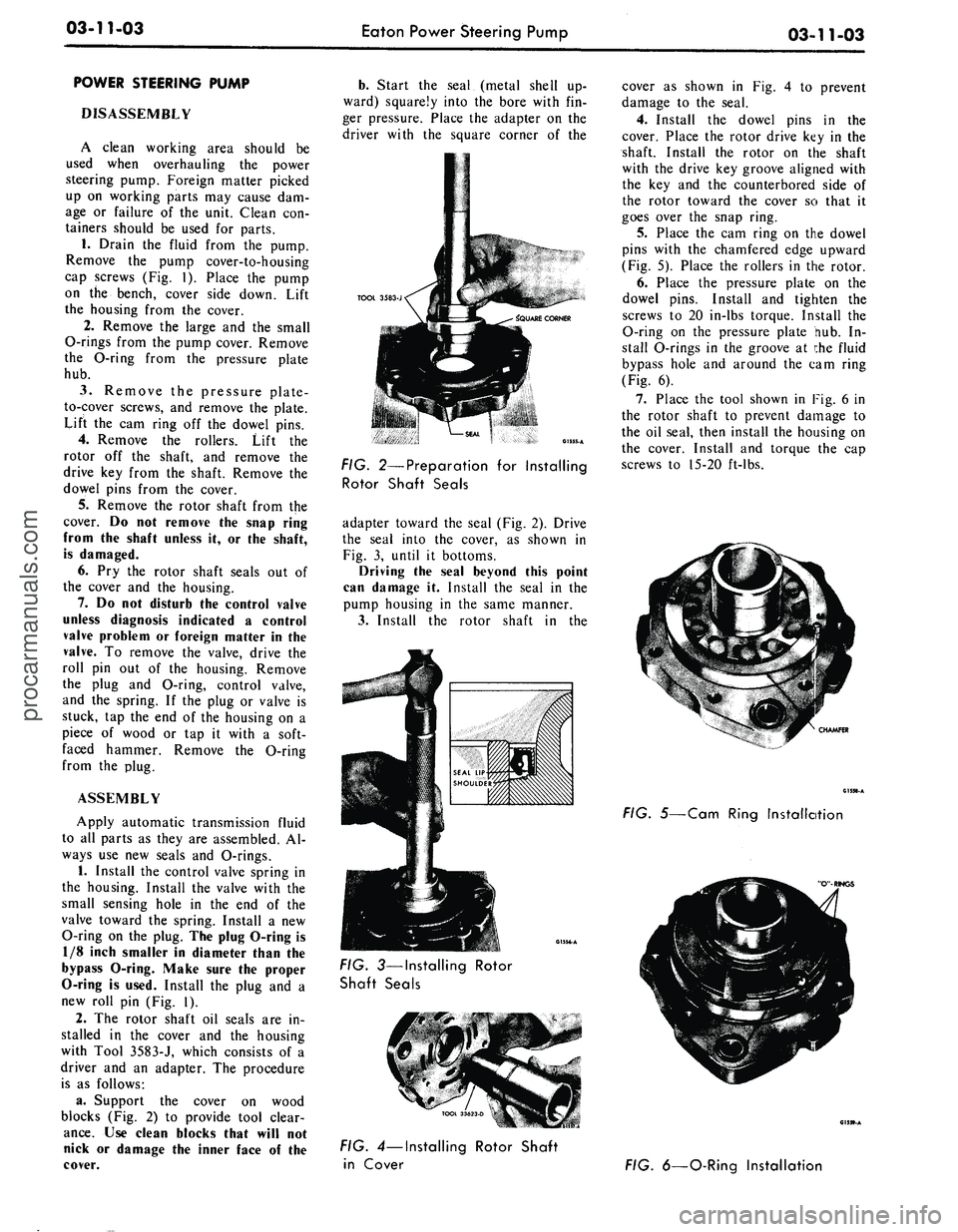
a. Support the cover on wood
blocks (Fig. 2) to provide tool clear-
ance.
Use clean blocks that will not
nick or damage the inner face of the
cover.
b.
Start the seal (metal shell up-
ward) square!y into the bore with fin-
ger pressure. Place the adapter on the
driver with the square corner of the
FIG. 2—Preparation for Installing
Rotor Shaft Seals
adapter toward the seal (Fig. 2). Drive
the seal into the cover, as shown in
Fig. 3, until it bottoms.
Driving the seal beyond this point
can damage it. Install the seal in the
pump housing in the same manner.
3.
Install the rotor shaft in the
FIG. 3—Installing Rotor
Shaft Seals
cover as shown in Fig. 4 to prevent
damage to the seal.
4.
Install the dowel pins in the
cover. Place the rotor drive key in the
shaft. Install the rotor on the shaft
with the drive key groove aligned with
the key and the counterbored side of
the rotor toward the cover so that it
goes over the snap ring.
5.
Place the cam ring on the dowel
pins with the chamfered edge upward
(Fig. 5). Place the rollers in the rotor.
6. Place the pressure plate on the
dowel pins. Install and tighten the
screws to 20 in-lbs torque. Install the
O-ring on the pressure plate hub. In-
stall O-rings in the groove at the fluid
bypass hole and around the cam ring
(Fig. 6).
7.
Place the tool shown in Fig. 6 in
the rotor shaft to prevent damage to
the oil seal, then install the housing on
the cover. Install and torque the cap
screws to 15-20 ft-lbs.
FIG. 5—Cam Ring Installation
FIG. 4—Installing Rotor Shaft
in Cover
FIG. 6—O-Ring Installationprocarmanuals.com
Page 178 of 413
03-12-07
Wheels And Tires
03-12-07
Tool - 7277- K
F 1263-A
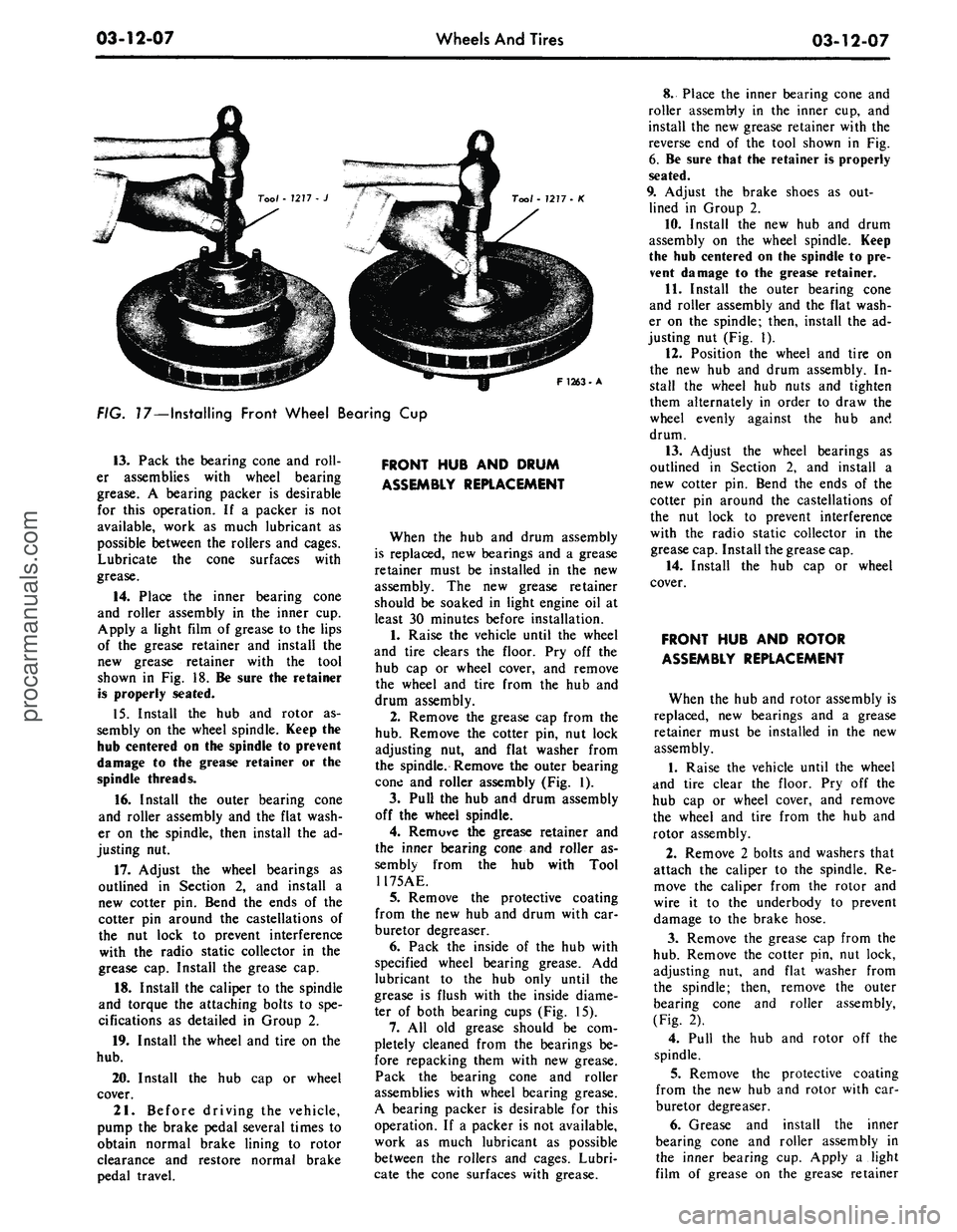
FIG. 17—Installing Front Wheel Bearing Cup
13.
Pack the bearing cone and roll-
er assemblies with wheel bearing
grease. A bearing packer is desirable
for this operation. If a packer is not
available, work as much lubricant as
possible between the rollers and cages.
Lubricate the cone surfaces with
grease.
14.
Place the inner bearing cone
and roller assembly in the inner cup.
Apply a light film of grease to the lips
of the grease retainer and install the
new grease retainer with the tool
shown in Fig. 18. Be sure the retainer
is properly seated.
15.
Install the hub and rotor as-
sembly on the wheel spindle. Keep the
hub centered on the spindle to prevent
damage to the grease retainer or the
spindle threads.
16.
Install the outer bearing cone
and roller assembly and the flat wash-
er on the spindle, then install the ad-
justing nut.
17.
Adjust the wheel bearings as
outlined in Section 2, and install a
new cotter pin. Bend the ends of the
cotter pin around the castellations of
the nut lock to prevent interference
with the radio static collector in the
grease cap. Install the grease cap.
18.
Install the caliper to the spindle
and torque the attaching bolts to spe-
cifications as detailed in Group 2.
19.
Install the wheel and tire on the
hub.
20.
Install the hub cap or wheel
cover.
21.
Before driving the vehicle,
pump the brake pedal several times to
obtain normal brake lining to rotor
clearance and restore normal brake
pedal travel.
FRONT HUB AND DRUM
ASSEMBLY REPLACEMENT
When the hub and drum assembly
is replaced, new bearings and a grease
retainer must be installed in the new
assembly. The new grease retainer
should be soaked in light engine oil at
least 30 minutes before installation.
1.
Raise the vehicle until the wheel
and tire clears the floor. Pry off the
hub cap or wheel cover, and remove
the wheel and tire from the hub and
drum assembly.
2.
Remove the grease cap from the
hub.
Remove the cotter pin, nut lock
adjusting nut, and flat washer from
the spindle. Remove the outer bearing
cone and roller assembly (Fig. 1).
3.
Pull the hub and drum assembly
off the wheel spindle.
4.
Remuve the grease retainer and
the inner bearing cone and roller as-
sembly from the hub with Tool
1175AE.
5.
Remove the protective coating
from the new hub and drum with car-
buretor degreaser.
6. Pack the inside of the hub with
specified wheel bearing grease. Add
lubricant to the hub only until the
grease is flush with the inside diame-
ter of both bearing cups (Fig. 15).
7.
All old grease should be com-
pletely cleaned from the bearings be-
fore repacking them with new grease.
Pack the bearing cone and roller
assemblies with wheel bearing grease.
A bearing packer is desirable for this
operation. If a packer is not available,
work as much lubricant as possible
between the rollers and cages. Lubri-
cate the cone surfaces with grease.
8. Place the inner bearing cone and
roller assembly in the inner cup, and
install the new grease retainer with the
reverse end of the tool shown in Fig.
6. Be sure that the retainer is properly
seated.
9. Adjust the brake shoes as out-
lined in Group 2.
10.
Install the new hub and drum
assembly on the wheel spindle. Keep
the hub centered on the spindle to pre-
vent damage to the grease retainer.
11.
Install the outer bearing cone
and roller assembly and the flat wash-
er on the spindle; then, install the ad-
justing nut (Fig. 1).
12.
Position the wheel and tire on
the new hub and drum assembly. In-
stall the wheel hub nuts and tighten
them alternately in order to draw the
wheel evenly against the hub and
drum.
13.
Adjust the wheel bearings as
outlined in Section 2, and install a
new cotter pin. Bend the ends of the
cotter pin around the castellations of
the nut lock to prevent interference
with the radio static collector in the
grease cap. Install the grease cap.
14.
Install the hub cap or wheel
cover.
FRONT HUB AND ROTOR
ASSEMBLY REPLACEMENT
When the hub and rotor assembly is
replaced, new bearings and a grease
retainer must be installed in the new
assembly.
1.
Raise the vehicle until the wheel
and tire clear the floor. Pry off the
hub cap or wheel cover, and remove
the wheel and tire from the hub and
rotor assembly.
2.
Remove 2 bolts and washers that
attach the caliper to the spindle. Re-
move the caliper from the rotor and
wire it to the underbody to prevent
damage to the brake hose.
3.
Remove the grease cap from the
hub.
Remove the cotter pin, nut lock,
adjusting nut, and flat washer from
the spindle; then, remove the outer
bearing cone and roller assembly,
(Fig. 2).
4.
Pull the hub and rotor off the
spindle.
5.
Remove the protective coating
from the new hub and rotor with car-
buretor degreaser.
6. Grease and install the inner
bearing cone and roller assembly in
the inner bearing cup. Apply a light
film of grease on the grease retainerprocarmanuals.com
Page 187 of 413
03-13-08
Specifications
03-13-08
SPECIAL SERVICE TOOLS
Tool No.
T50T-100-A
T59L-100-B
T58L-101-A
T53L-200-A
T62L-201-A
OTC-462
T57L-500-A
T69L-1102-A
Tool 1175-AB
Tool 1175-AH
T56P-1217-A
T60K-1217-A
Tool 1217-J
Tool 1217-K
Tool
1217- L
Tool 1217-M
T65P-3000-A, D
T65P-3000-B, C, E, F
T57P-3006-A
T60K-3005-A
T62F-3006-A
Tool 3044-A
T54P-3044-A
T60K-3044-A
T65P-3044-A
Tool 3068
Tool 3069-AA
Tool
3069-
M
Tool 3290-C
T65P-3524-A
T66P-3553-A, B
T66P-3553-C
T65P-3548-A
T62F-3576-A
T64K-3576-A
T64K-3576-B
T65P-3576-A, B
T65P-3576-C
Tool 3583-J
T65P-3590-F
T67L-3600-A
T65P-3805-A
T63P-5310-A
T64K-5310-A, B
T66P-5310-A, B
T64N-5781-A
T64K-5781-B
Tool 6306-AG
T63L-8620-A
T63L-10300-B
T65P-10300-B
T56L-33610-D
T68L-33610-A
Tool 33623-D
T65P-3A537-A
T65P-3A537-B
T69P-3A674-A
T65P-3A733-A
T65T-3B177-A
T68P-3B586-A
T68P-3B592-A
T68P-3B592-B
T64B-3C716-A
T65P-3C732-A
T65P-3D517-A
T65P-3D525-A
T65P-3D525-B
T65P-3D526-A
T69P-3D608-A
T69P-3D608-B
T65P-3D642-A
T67P-3D739-A
Description
Slide Hammer-Long
Slide Hammer-Short
Puller Attachment
Handle Adapter
Input Shaft Seal Installer
Tie Rod Separator (Owatonna Tool Co.)
Bench Mounted Holding Fixture
Front Wheel Bearing Remover
Grease Seal Remover (Head Only)
Grease Seal Replacer
Front Hub Bearing Cup and Grease Seal Replacer
Front Hub Bearing Cup and Grease Seal Replacer
Front Hub Outer Bearing Cup Replacer
Front Hub Inner Bearing Cup Replacer
Front Hub Outer Bearing Cup Remover
Front Hub Inner Bearing Cup Remover
Adjusting Bars-Caster and Camber
Alignment Spacers
Spindle Ball Joint Remover Press
Spindle Ball Joint Press Adapter Screw
Spindle Ball Joint Press Adapter Screw
Front Suspension Upper Arm Bushing Remover
Front Suspension Upper and Lower Arm Overhaul Kit
Front Suspension Lower Arm Bushing Remover and Replacer
Upper Arm Bushing Overhaul Kit
Front Suspension Upper Arm Bushing Adapter
Front Suspension Lower Arm Bushing Remover
Lower Arm Bushings-Remover and Replacer Kit
Tie Rod Ball Ends and Control Valve Ball Stud Remover
Input Shaft Bearing Remover and Installer
Spanner Wrench
Spacer
Oil Line Connector Seal Installer
Sector Shaft Bushing Remover and Replacer
Sector Shaft Needle Bearings and Seal Remover and Replacer
Sector Shaft Needle Bearings and Seal Remover and Replacer Adapter
Sector Shaft Bushing Remover and Installer
Remover and Installer Adapter
Control Valve Bearing and Seal Remover and Replacer
Steering Pitman Arm Remover
Steering Wheel Remover
Ring Compressor-Rack Piston
Front Coil Spring Remover and Replacer
Adapters
Adapters
Rear Spring Front Bushing Remover and Installer
Rear Spring Bushing Adapter
Crankshaft Damper Remover and Power Steering Pump Sprocket Replacer
Bent Tension Gauge
Pulley Remover
Alternator Pulley Replacer
Pressure Testing Gauge Assembly
Bypass and Orifice Gauge
Pump Oil Seal Pilot
Bearing Preload Spanner Wrench
Adjuster Plug Seal Protector
Fixture Adapter Plate
Power Steering Pump Pulley Remover
Front Suspension Bushings Remover and Replacer
Pump Housing Hole Plugging Tool
Pump Shaft Seal Replacer
Pump Shaft Seal Protector
Insulator Remover and Replacer Socket
Lock Spring Installing Hook
Rack Piston Arbor
Adjuster Plug Bearing Remover and Installer
Thrust Bearing Retainer Installer Adapter
Adjuster Plug Seal Installer
Pin Straightness Checking Block
Pin Guide Support
Sector Shaft Seal Installer
Pivot Pin Removerprocarmanuals.com
Page 194 of 413
04-01-07
General Axle Service
04-01-07
Tool-4201-
C
Tool-6565 USED WITH BRACKET
FROM Too/^*207-C
FLANGE
E1743-A
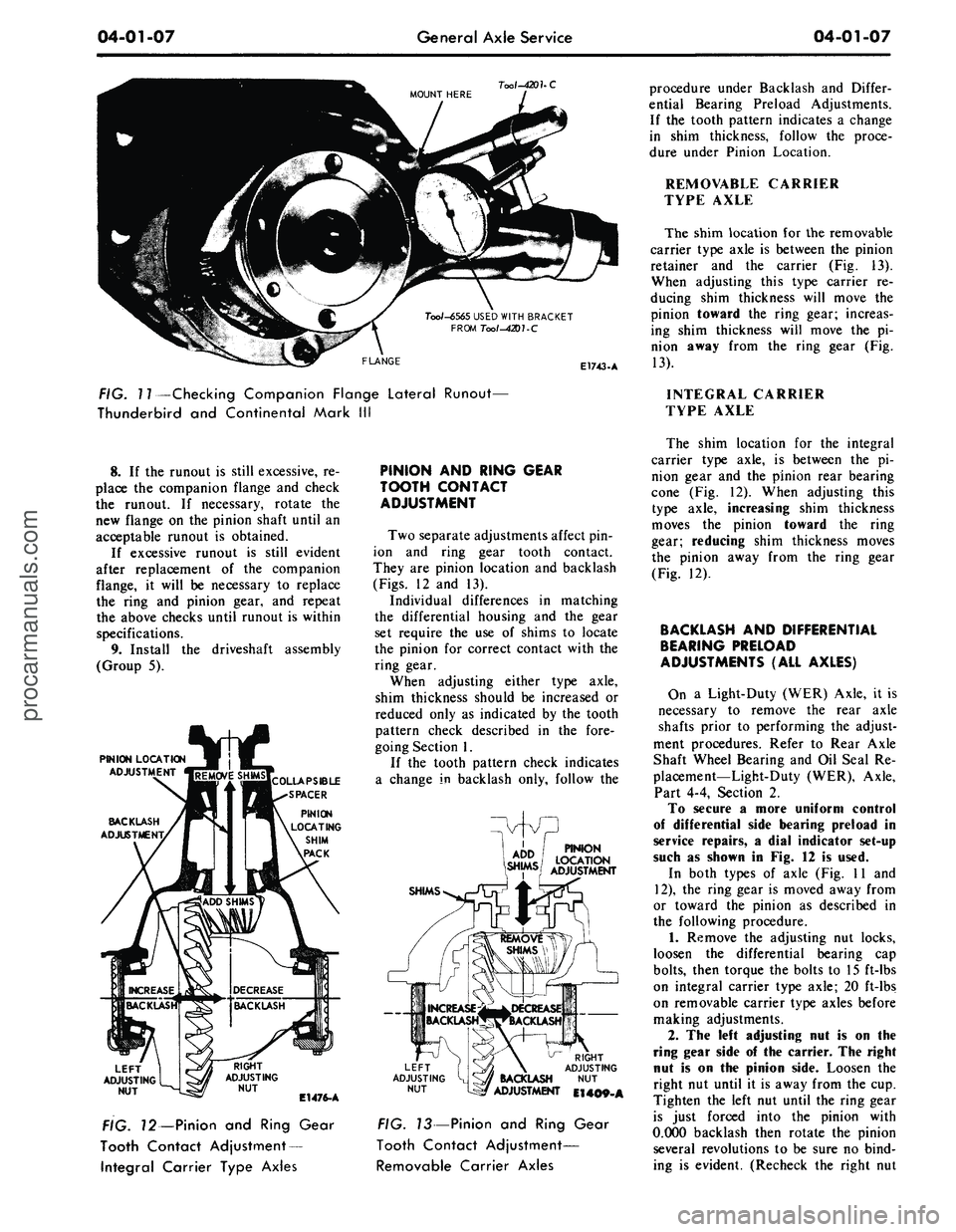
procedure under Backlash and Differ-
ential Bearing Preload Adjustments.
If the tooth pattern indicates a change
in shim thickness, follow the proce-
dure under Pinion Location.
REMOVABLE CARRIER
TYPE AXLE
The shim location for the removable
carrier type axle is between the pinion
retainer and the carrier (Fig. 13).
When adjusting this type carrier re-
ducing shim thickness will move the
pinion toward the ring gear; increas-
ing shim thickness will move the pi-
nion away from the ring gear (Fig.
13).
FIG. 11—Checking Companion Flange Lateral Runout—
Thunderbird and Continental Mark III
INTEGRAL CARRIER
TYPE AXLE
8. If the runout is still excessive, re-
place the companion flange and check
the runout. If necessary, rotate the
new flange on the pinion shaft until an
acceptable runout is obtained.
If excessive runout is still evident
after replacement of the companion
flange, it will be necessary to replace
the ring and pinion gear, and repeat
the above checks until runout is within
specifications.
9. Install the driveshaft assembly
(Group 5).
PINION LOCATION
ADJUSTMENT
BACKLASH
ADJUSTMENT,
LEFT
ADJUSTING
NUT
E1476-A
FIG. 12—Pinion and Ring Gear
Tooth Contact Adjustment
—
Integral Carrier Type Axles
PINION AND RING GEAR
TOOTH CONTACT
ADJUSTMENT
Two separate adjustments affect pin-
ion and ring gear tooth contact.
They are pinion location and backlash
(Figs.
12 and 13).
Individual differences in matching
the differential housing and the gear
set require the use of shims to locate
the pinion for correct contact with the
ring gear.
When adjusting either type axle,
shim thickness should be increased or
reduced only as indicated by the tooth
pattern check described in the fore-
going Section 1.
If the tooth pattern check indicates
a change in backlash only, follow the
PINION
LOCATION
ADJUSTMENT
SHIMS
LEFT
ADJUSTING
NUT
RIGHT
ADJUSTING
BACKLASH NUT
ADJUSTMENT El 409-A
FIG. 13—Pinion and Ring Gear
Tooth Contact Adjustment—
Removable Carrier Axles
The shim location for the integral
carrier type axle, is between the pi-
nion gear and the pinion rear bearing
cone (Fig. 12). When adjusting this
type axle, increasing shim thickness
moves the pinion toward the ring
gear; reducing shim thickness moves
the pinion away from the ring gear
(Fig. 12).
BACKLASH AND DIFFERENTIAL
BEARING PRELOAD
ADJUSTMENTS (ALL AXLES)
On a Light-Duty (WER) Axle, it is
necessary to remove the rear axle
shafts prior to performing the adjust-
ment procedures. Refer to Rear Axle
Shaft Wheel Bearing and Oil Seal Re-
placement—Light-Duty (WER), Axle,
Part 4-4, Section 2.
To secure a more uniform control
of differential side bearing preload in
service repairs, a dial indicator set-up
such as shown in Fig. 12 is used.
In both types of axle (Fig. 11 and
12),
the ring gear is moved away from
or toward the pinion as described in
the following procedure.
1.
Remove the adjusting nut locks,
loosen the differential bearing cap
bolts,
then torque the bolts to 15 ft-lbs
on integral carrier type axle; 20 ft-lbs
on removable carrier type axles before
making adjustments.
2.
The left adjusting nut is on the
ring gear side of the carrier. The right
nut is on the pinion side. Loosen the
right nut until it is away from the cup.
Tighten the left nut until the ring gear
is just forced into the pinion with
0.000 backlash then rotate the pinion
several revolutions to be sure no bind-
ing is evident. (Recheck the right nutprocarmanuals.com
Page 196 of 413
04-01-09
General Axle Service
04-01-09
CLEANING AND INSPECTION
INSPECTION BEFORE
DISASSEMBLY OF CARRIER
(ALL AXLES)
The differential case or carrier
should be inspected before any parts
are removed from it. These inspec-
tions can help to find the cause of the
trouble and to determine the correc-
tions needed.
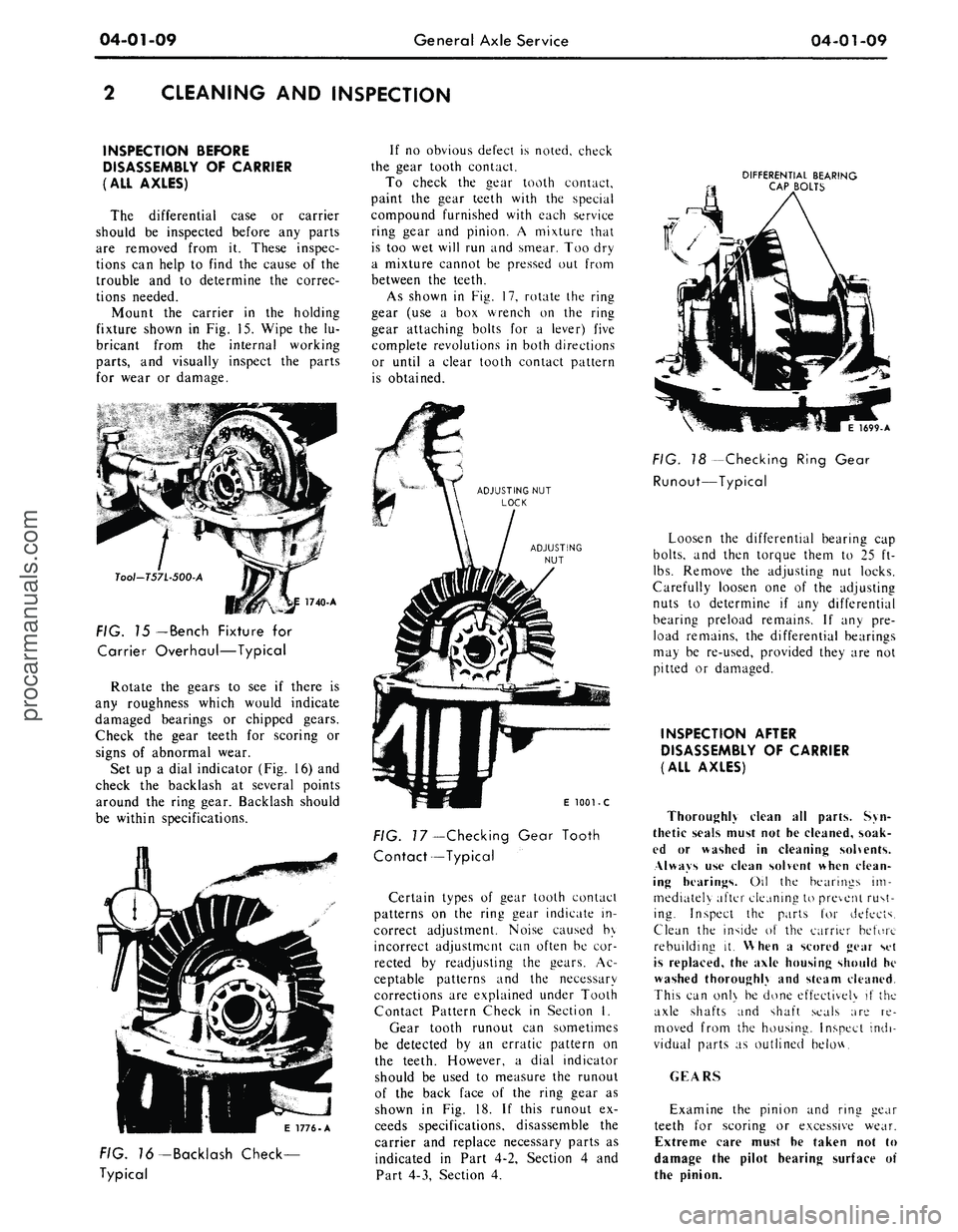
Mount the carrier in the holding
fixture shown in Fig. 15. Wipe the lu-
bricant from the internal working
parts,
and visually inspect the parts
for wear or damage.
Tool-T57L-500-A
FIG. 15
— Bench
Fixture for
Carrier Overhaul—Typical
Rotate the gears to see if there is
any roughness which would indicate
damaged bearings or chipped gears.
Check the gear teeth for scoring or
signs of abnormal wear.
Set up a dial indicator (Fig. 16) and
check the backlash at several points
around the ring gear. Backlash should
be within specifications.
If no obvious defect is noted, check
the gear tooth contact.
To check the gear tooth contact,
paint the gear teeth with the special
compound furnished with each service
ring gear and pinion. A mixture that
is too wet will run and smear. Too dry
a mixture cannot be pressed out from
between the teeth.
As shown in Fig. 17, rotate the ring
gear (use a box wrench on the ring
gear attaching bolts for a lever) five
complete revolutions in both directions
or until a clear tooth contact pattern
is obtained.
DIFFERENTIAL BEARING
CAP BOLTS
E 1776-A
FIG. 76-Backlash Check-
Typical
E
1001 - C
FIG.
7
7—Checking Gear Tooth
Contact—Typical
Certain types of gear tooth contact
patterns on the ring gear indicate in-
correct adjustment. Noise caused by
incorrect adjustment can often be cor-
rected by readjusting the gears. Ac-
ceptable patterns and the necessary
corrections are explained under Tooth
Contact Pattern Check in Section I.
Gear tooth runout can sometimes
be detected by an erratic pattern on
the teeth. However, a dial indicator
should be used to measure the runout
of the back face of the ring gear as
shown in Fig. 18. If this runout ex-
ceeds specifications, disassemble the
carrier and replace necessary parts as
indicated in Part 4-2, Section 4 and
Part 4-3, Section 4.
1699-A
FIG. 18 -Checking Ring Gear
Runout—Typical
Loosen the differential bearing cap
bolts,
and then torque them to 25 ft-
lbs.
Remove the adjusting nut locks.
Carefully loosen one of the adjusting
nuts to determine if any differential
bearing preload remains. If any pre-
load remains, the differential bearings
may be re-used, provided they are not
pitted or damaged.
INSPECTION AFTER
DISASSEMBLY OF CARRIER
(ALL AXLES)
Thoroughly clean all parts. Syn-
thetic seals must not he cleaned, soak-
ed or washed in cleaning solvents.
Always use clean solvent when clean-
ing hearings. Oil the bearings im-
mediately after cleaning to prevent rust-
ing. Inspect the parts for defects.
Clean the inside of the carrier before
rebuilding it. When a scored gear set
is replaced, the axle housing should he
washed thoroughly and steam cleaned.
This can onl\ be done effectively if the
axle shafts and shaft seals are re-
moved from the housing. Inspect indi-
vidual parts as outlined below.
GEARS
Examine the pinion and ring gear
teeth for scoring or excessive wear.
Extreme care must he taken not to
damage the pilot hearing surface of
the pinion.procarmanuals.com
Page 198 of 413
04-02-01
Rear Axle
—
Removable Carrier Type
04-02-01
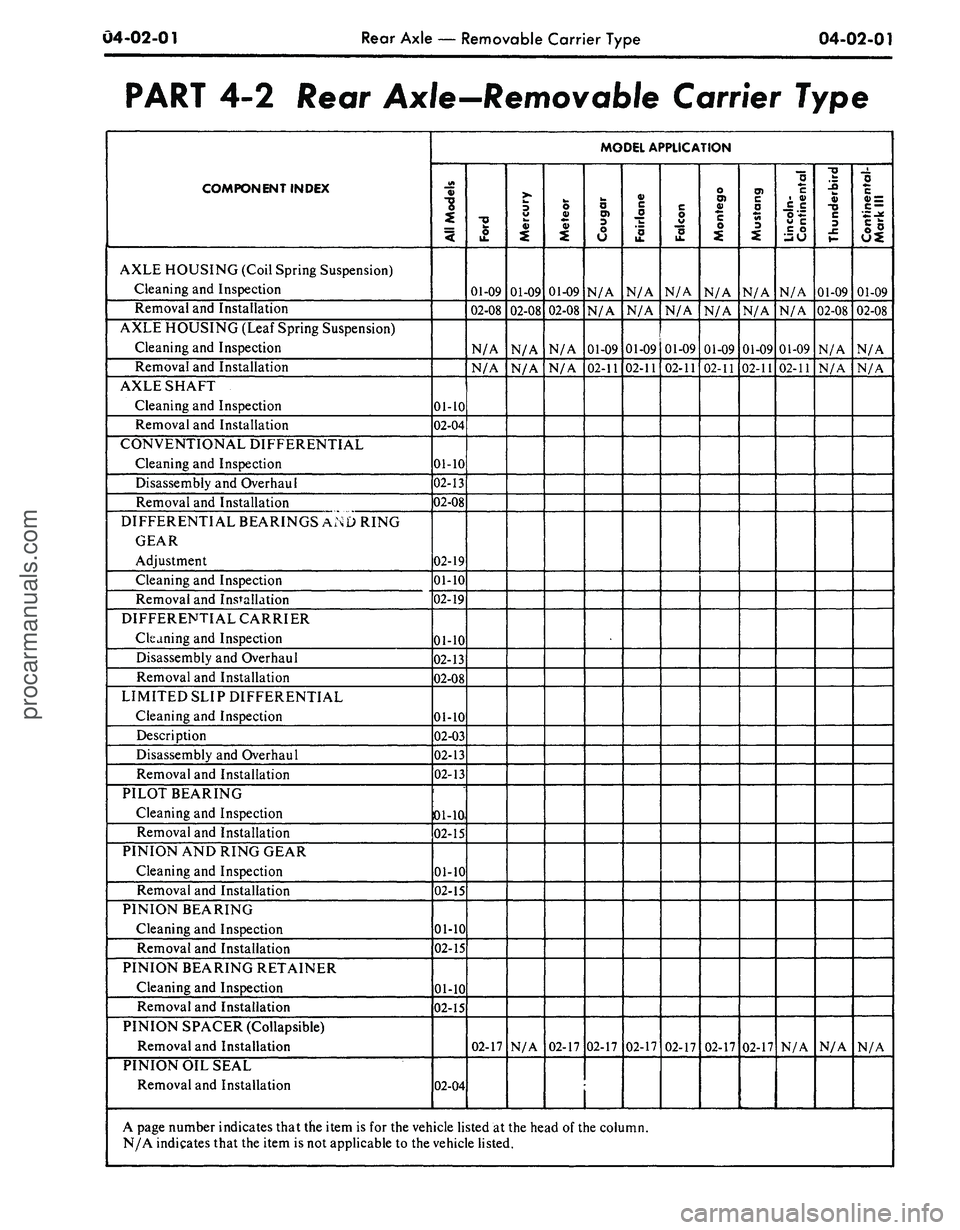
PART
4-2
Rear Axle—Removable Carrier Type
COMPONENT INDEX
AXLE HOUSING (Coil Spring Suspension)
Cleaning and Inspection
Removal and Installation
AXLE HOUSING (Leaf Spring Suspension)
Cleaning and Inspection
Removal and Installation
AXLE SHAFT
Cleaning and Inspection
Removal and Installation
CONVENTIONAL DIFFERENTIAL
Cleaning and Inspection
Disassembly and Overhaul
Removal and Installation
DIFFERENTIAL BEARINGS AND RING
GEAR
Adjustment
Cleaning and Inspection
Removal and Installation
DIFFERENTIAL CARRIER
Cleaning and Inspection
Disassembly and Overhaul
Removal and Installation
LIMITED SLIP DIFFERENTIAL
Cleaning and Inspection
Description
Disassembly and Overhaul
Removal and Installation
PILOT BEARING
Cleaning and Inspection
Removal and Installation
PINION AND RING GEAR
Cleaning and Inspection
Removal and Installation
PINION BEARING
Cleaning and Inspection
Removal and Installation
PINION BEARING RETAINER
Cleaning and Inspection
Removal and Installation
PINION SPACER (Collapsible)
Removal and Installation
PINION OIL SEAL
Removal and Installation
MODEL APPLICATION
All
Models
01-10
02-04
01-10
02-13
02-08
02-19
01-10
02-19
01-10
02-13
02-08
01-10
02-03
02-13
02-13
01-10
02-15
01-10
02-15
01-10
02-15
01-10
02-15
02-04
J
01-09
02-08
N/A
N/A
02-17
Mercury
01-09
02-08
N/A
N/A
N/A
Meteor
01-09
02-08
N/A
N/A
02-17
Cougar
N/A
N/A
01-09
02-11
02-17
Fairlane
N/A
N/A
01-09
02-11
02-17
Falcon
N/A
N/A
01-09
02-11
02-17
Montego
N/A
N/A
01-09
02-11
02-17
Mustang
N/A
N/A
01-09
02-11
02-17
Lincoln-
Continental
N/A
N/A
01-09
02-11
N/A
Thunderbird
01-09
02-08
N/A
N/A
N/A
Continental-
Mark
III
01-09
02-08
N/A
N/A
N/A
A page number indicates that the item is
for
the vehicle listed
at
the head
of
the column.
N/A indicates that the item is not applicable
to
the vehicle listed.
procarmanuals.com
Page 201 of 413
04-02-04
Rear Axle — Removable Carrier Type
04-02-04
IN-VEHICLE ADJUSTMENTS AND REPAIRS
REAR AXLE SHAFT, WHEEL
BEARING AND OIL SEAL
REPLACEMENT
The rear axle shafts, wheel bear-
ings,
and oil seal can be replaced
without removing the differential as-
sembly from the axle housing.
REMOVAL OF
AXLE SHAFT
Synthetic wheel bearing seals are
used in production only. Removal and
insertion of rear axle shafts must be
performed with caution. The entire
length of the shaft (including spline)
up to the seal journal must pass
through the seal without cutting of the
seal element during axle removal or
installation will result in early seal fai-
lure.
Leather seals only will be used as
service replacement for synthetic
wheel bearing seals.
1.
Remove the wheel cover, wheel
and tire from the brake drum.
2.
Remove the nuts that secure the
brake drum to the axle shaft flange,
then remove the drum from flange.
3.
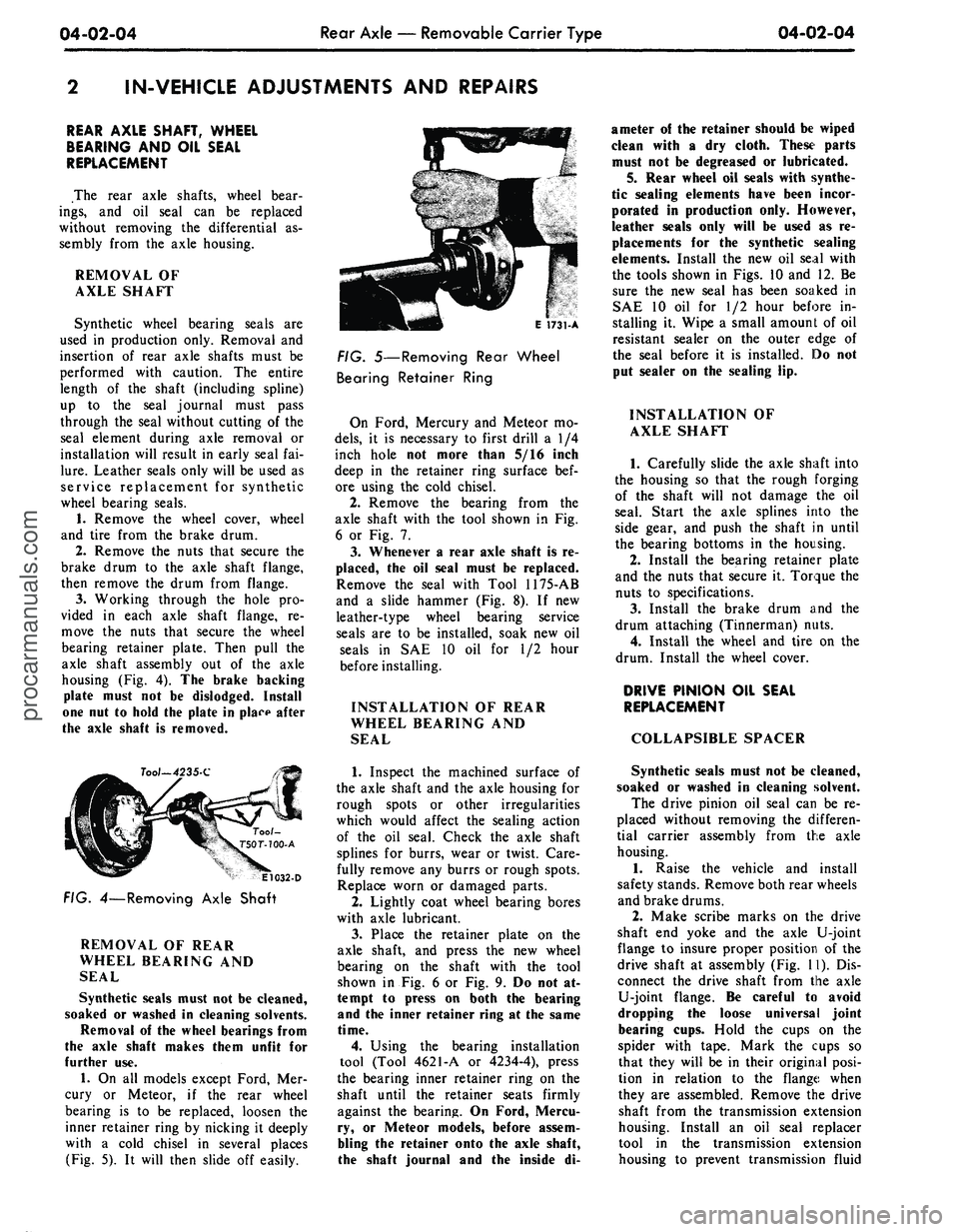
Working through the hole pro-
vided in each axle shaft flange, re-
move the nuts that secure the wheel
bearing retainer plate. Then pull the
axle shaft assembly out of the axle
housing (Fig. 4). The brake backing
plate must not be dislodged. Install
one nut to hold the plate in place after
the axle shaft is removed.
Too/-4235-C
E1032-D
FIG. 4—Removing Axle Shaft
REMOVAL OF REAR
WHEEL BEARING AND
SEAL
Synthetic seals must not be cleaned,
soaked or washed in cleaning solvents.
Removal of the wheel bearings from
the axle shaft makes them unfit for
further use.
1.
On all models except Ford, Mer-
cury or Meteor, if the rear wheel
bearing is to be replaced, loosen the
inner retainer ring by nicking it deeply
with a cold chisel in several places
(Fig. 5). It will then slide off easily.
E 1731-A
FIG. 5—Removing Rear Wheel
Bearing Retainer Ring
On Ford, Mercury and Meteor mo-
dels,
it is necessary to first drill a 1/4
inch hole not more than 5/16 inch
deep in the retainer ring surface bef-
ore using the cold chisel.
2.
Remove the bearing from the
axle shaft with the tool shown in Fig.
6 or Fig. 7.
3.
Whenever a rear axle shaft is re-
placed, the oil seal must be replaced.
Remove the seal with Tool 1175-AB
and a slide hammer (Fig. 8). If new
leather-type wheel bearing service
seals are to be installed, soak new oil
seals in SAE 10 oil for 1/2 hour
before installing.
INSTALLATION OF REAR
WHEEL BEARING AND
SEAL
1.
Inspect the machined surface of
the axle shaft and the axle housing for
rough spots or other irregularities
which would affect the sealing action
of the oil seal. Check the axle shaft
splines for burrs, wear or twist. Care-
fully remove any burrs or rough spots.
Replace worn or damaged parts.
2.
Lightly coat wheel bearing bores
with axle lubricant.
3.
Place the retainer plate on the
axle shaft, and press the new wheel
bearing on the shaft with the tool
shown in Fig. 6 or Fig. 9. Do not at-
tempt to press on both the bearing
and the inner retainer ring at the same
time.
4.
Using the bearing installation
tool (Tool 4621-A or 4234-4), press
the bearing inner retainer ring on the
shaft until the retainer seats firmly
against the bearing. On Ford, Mercu-
ry, or Meteor models, before assem-
bling the retainer onto the axle shaft,
the shaft journal and the inside di-
ameter of the retainer should be wiped
clean with a dry cloth. These parts
must not be degreased or lubricated.
5. Rear wheel oil seals with synthe-
tic sealing elements have been incor-
porated in production only. However,
leather seals only will be used as re-
placements for the synthetic sealing
elements. Install the new oil seal with
the tools shown in Figs. 10 and 12. Be
sure the new seal has been soaked in
SAE 10 oil for 1/2 hour before in-
stalling it. Wipe a small amount of oil
resistant sealer on the outer edge of
the seal before it is installed. Do not
put sealer on the sealing lip.
INSTALLATION OF
AXLE SHAFT
1.
Carefully slide the axle shaft into
the housing so that the rough forging
of the shaft will not damage the oil
seal. Start the axle splines into the
side gear, and push the shaft in until
the bearing bottoms in the housing.
2.
Install the bearing retainer plate
and the nuts that secure it. Torque the
nuts to specifications.
3.
Install the brake drum and the
drum attaching (Tinnerman) nuts.
4.
Install the wheel and tire on the
drum. Install the wheel cover.
DRIVE PINION OIL SEAL
REPLACEMENT
COLLAPSIBLE SPACER
Synthetic seals must not be cleaned,
soaked or washed in cleaning solvent.
The drive pinion oil seal can be re-
placed without removing the differen-
tial carrier assembly from the axle
housing.
1.
Raise the vehicle and install
safety stands. Remove both rear wheels
and brake drums.
2.
Make scribe marks on the drive
shaft end yoke and the axle U-joint
flange to insure proper position of the
drive shaft at assembly (Fig. 11). Dis-
connect the drive shaft from the axle
U-joint flange. Be careful to avoid
dropping the loose universal joint
bearing cups. Hold the cups on the
spider with tape. Mark the cups so
that they will be in their original posi-
tion in relation to the flange when
they are assembled. Remove the drive
shaft from the transmission extension
housing. Install an oil seal replacer
tool in the transmission extension
housing to prevent transmission fluidprocarmanuals.com
Page 203 of 413
04-02-06
Rear Axle — Removable Carrier Type
04-02-06
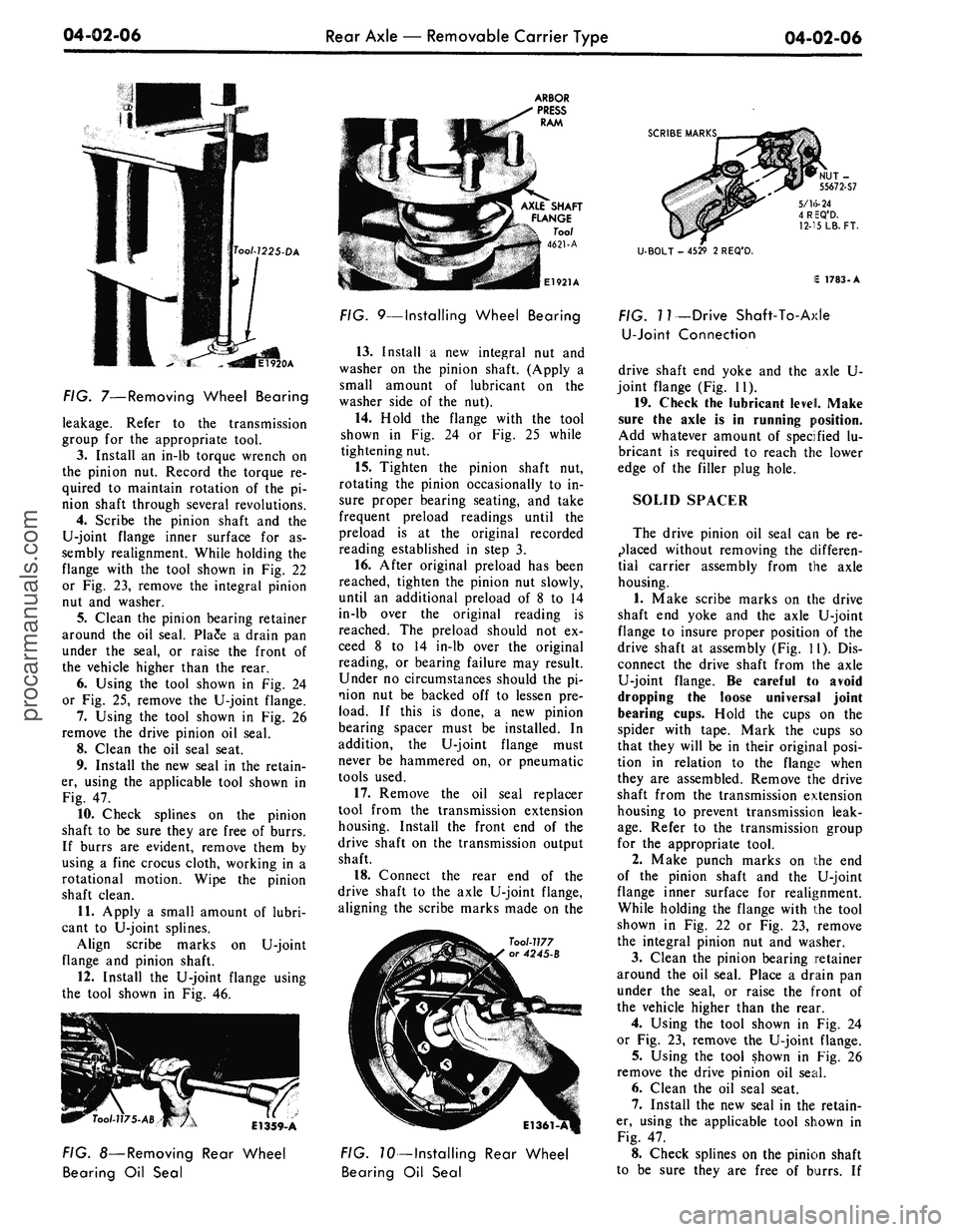
FIG. 7—Removing Wheel Bearing
leakage. Refer to the transmission
group for the appropriate tool.
3.
Install an in-lb torque wrench on
the pinion nut. Record the torque re-
quired to maintain rotation of the pi-
nion shaft through several revolutions.
4.
Scribe the pinion shaft and the
U-joint flange inner surface for as-
sembly realignment. While holding the
flange with the tool shown in Fig. 22
or Fig. 23, remove the integral pinion
nut and washer.
5.
Clean the pinion bearing retainer
around the oil seal. PlaSe a drain pan
under the seal, or raise the front of
the vehicle higher than the rear.
6. Using the tool shown in Fig. 24
or Fig. 25, remove the U-joint flange.
7.
Using the tool shown in Fig. 26
remove the drive pinion oil seal.
8. Clean the oil seal seat.
9. Install the new seal in the retain-
er, using the applicable tool shown in
Fig. 47.
10.
Check splines on the pinion
shaft to be sure they are free of burrs.
If burrs are evident, remove them by
using a fine crocus cloth, working in a
rotational motion. Wipe the pinion
shaft clean.
11.
Apply a small amount of lubri-
cant to U-joint splines.
Align scribe marks on U-joint
flange and pinion shaft.
12.
Install the U-joint flange using
the tool shown in Fig. 46.
SCRIBE MARKS
AXLE SHAFT
FLANGE
Tool
4621-A
E1921A
FIG. 9—Installing Wheel Bearing
13.
Install a new integral nut and
washer on the pinion shaft. (Apply a
small amount of lubricant on the
washer side of the nut).
14.
Hold the flange with the tool
shown in Fig. 24 or Fig. 25 while
tightening nut.
15.
Tighten the pinion shaft nut,
rotating the pinion occasionally to in-
sure proper bearing seating, and take
frequent preload readings until the
preload is at the original recorded
reading established in step 3.
16.
After original preload has been
reached, tighten the pinion nut slowly,
until an additional preload of 8 to 14
in-lb over the original reading is
reached. The preload should not ex-
ceed 8 to 14 in-lb over the original
reading, or bearing failure may result.
Under no circumstances should the pi-
nion nut be backed off to lessen pre-
load. If this is done, a new pinion
bearing spacer must be installed. In
addition, the U-joint flange must
never be hammered on, or pneumatic
tools used.
17.
Remove the oil seal replacer
tool from the transmission extension
housing. Install the front end of the
drive shaft on the transmission output
shaft.
18.
Connect the rear end of the
drive shaft to the axle U-joint flange,
aligning the scribe marks made on the
Tool-1177
or 4245-B
E1359-A
U-BOLT-4529 2 REQ'D.
5/l<>-24
4 REQ'D.
12-15
LB.
FT.
IE 1783-A
FIG. 8—
Removing
Rear Wheel
Bearing Oil Seal
FIG. 70—Installing Rear Wheel
Bearing Oil Seal
FIG. 11
— Drive
Shaft-To-Axle
U-Joint Connection
drive shaft end yoke and the axle U-
joint flange (Fig. 11).
19.
Check the lubricant level Make
sure the axle is in running position.
Add whatever amount of specified lu-
bricant is required to reach the lower
edge of the filler plug hole.
SOLID SPACER
The drive pinion oil seal can be re-
placed without removing the differen-
tial carrier assembly from the axle
housing.
1.
Make scribe marks on the drive
shaft end yoke and the axle U-joint
flange to insure proper position of the
drive shaft at assembly (Fig. 11). Dis-
connect the drive shaft from the axle
U-joint flange. Be careful to avoid
dropping the loose universal joint
bearing cups. Hold the cups on the
spider with tape. Mark the cups so
that they will be in their original posi-
tion in relation to the flange when
they are assembled. Remove the drive
shaft from the transmission extension
housing to prevent transmission leak-
age.
Refer to the transmission group
for the appropriate tool.
2.
Make punch marks on the end
of the pinion shaft and the U-joint
flange inner surface for realignment.
While holding the flange with the tool
shown in Fig. 22 or Fig. 23, remove
the integral pinion nut and washer.
3.
Clean the pinion bearing retainer
around the oil seal. Place a drain pan
under the seal, or raise the front of
the vehicle higher than the rear.
4.
Using the tool shown in Fig. 24
or Fig. 23, remove the U-joint flange.
5.
Using the tool shown in Fig. 26
remove the drive pinion oil seal.
6. Clean the oil seal seat.
7.
Install the new seal in the retain-
er, using the applicable tool shown in
Fig. 47.
8. Check splines on the pinion shaft
to be sure they are free of burrs. Ifprocarmanuals.com
Page 204 of 413
04-02-07
Rear Axle — Removable Carrier Type
04-02-07
burrs are evident, remove them with a
fine crocus cloth, working in a rota-
tional motion, then wipe clean. Apply
a small quantity of lubricant to U-
joint splines.
9. Install the U-joint flange using
the tool shown in Fig. 46.
10.
Install a new integral attaching
nut and washer on the pinion shaft.
11.
Tighten the pinion attaching
nut, rotating the pinion several times
to seat the bearing, then torque the pin-
ion nut to 180-200 ft-lbs. Hold the
flange with the tool shown in Fig. 22
or Fig. 23 while the nut is being tight-
ened.
12.
Remove the oil seal replacer
tool from the transmission extension
housing. Install the front end of the
drive shaft on the transmission output
shaft.
13.
Connect the rear end of the
drive shaft to the axle U-joint flange,
aligning the scribe marks made on the
drive shaft end yoke and the axle U-
joint flange.
14.
Check the lubricant level, and
add whatever amount of specified lu-
bricant is necessary to reach the lower
edge of the filler plug hole. Make sure
the axle is in running position when
the level is checked
ORIGINAL U-JOINT FLANGE
(IN VEHICLE REPLACEMENT)
Use procedure as outlined under
Drive Pinion Oil Seal Replacement.
Synthetic seals must not be cleaned,
soaked or washed in cleaning solvent.
INSTALLATION OF A NEW
UNIVERSAL JOINT FLANGE
COLLAPSIBLE SPACER
1.
Raise the vehicle and install
safety stands. Remove both rear wheels
and brake drums.
2.
Disconnect the drive shaft from
the axle U-joint flange. Be careful to
avoid dropping the loose universal
joint bearing cups. Hold the cups on
the spider with tape. Mark the cups so
that they will be in their original posi-
tion in relation to the flange when
they are assembled. Remove the drive
shaft from the transmission extension
housing. Install an oil seal replacer
tool in the transmission extension
housing to prevent transmission fluid
leakage. Refer to the transmission
group for the appropriate tool.
3.
Install an in-lb torque wrench on
the pinion nut. Record the torque re-
quired to maintain rotation of the pin-
ion shaft through several revolutions.
4.
While holding the flange with the
tool shown in Fig. 23 or Fig. 24, re-
move the integral pinion nut and
washer.
5.
Clean the pinion bearing retainer
around the oil seal. Place a drain pan
under the seal, or raise the front of
the vehicle higher than the rear. Syn-
thetic seals must not be cleaned,
soaked or washed in cleaning solvent.
6. Using the tool shown in Fig. 23
or Fig. 24, remove the U-joint flange.
7.
Check splines on the pinion shaft
to be sure they are free of burrs. If
burrs are evident, remove them by
using a fine crocus cloth, working in a
rotational motion, then wipe clean.
Apply a small amount of lubricant
to U-joint splines.
8. Install the U-joint flange using
the tool shown in Fig. 46.
9. Install a new integral nut and
washer on the pinion shaft. (Apply a
small amount of lubricant on the
washer side of the nut.)
10.
Hold the flange with the tool
shown in Fig. 23 or Fig. 24 while the
nut is being tightened.
11.
Tighten the pinion shaft nut,
rotating the pinion occasionally to in-
sure proper bearing seating, and take
frequent preload readings until the
preload is at the original recorded
reading established in step 3.
12.
After original preload has been
reached, tighten the pinion nut slowly,
until an additional preload of 8 to 14
in-lb over the original reading is
reached. (The preload should not ex-
ceed 8 to 14 in-lb over the original
reading, or bearing failure may result.
Under no circumstances should the
pinion nut be backed off to lessen pre-
load. If this is done, a new pinion
bearing spacer must be installed. In
addition, the U-joint flange must
never be hammered on, or power tools
used.
13.
Remove the oil seal replacer
tool from the transmission extension
housing. Install the front end of the
drive shaft on the transmission output
shaft.
14.
Connect the rear end of the
drive shaft to the axle U-joint flange,
aligning the scribe marks made on the
drive shaft end yoke and the axle U-
joint flange.
15.
Check the lubricant level. Make
sure the axle is in running position.
Add whatever amount of specified lu-
bricant is required to reach the lower
edge of the filler plug hole.
SOLID SPACER
1.
Disconnect the drive shaft from
the axle U-joint flange. Be careful to
avoid dropping the loose universal
joint bearing cups. Hold the cups on
the spider with tape. Mark the cups so
that they will be in their original posi-
tion in relation to the flange when
they are assembled. Remove the drive
shaft from the transmission extension
housing. Install an oil seal replacer
tool in the transmission extension
housing to prevent transmission leak-
age.
Refer to the transmission group
for the appropriate tool.
2.
While holding the flange with the
tool shown in Fig. 23 or Fig. 24, re-
move the integral pinion nut and
washer.
3.
Clean the pinion bearing retainer
around the oil seal. Place a drain pan
under the seal, or raise the front of
the vehicle higher than the rear.
4.
Using the tool shown in Fig. 23
or Fig. 24, remove the U-joint flange.
5.
Check splines on the pinion shaft
to be sure they are free of burrs. If
burrs are evident, remove them by
using a fine crocus cloth, working in a
rotational motion, then wipe clean.
Apply a small amount of lubricant to
U-joint splines.
6. Install the U-joint flange using
the tool shown in Fig. 46.
7.
Install integral attaching nut and
washer on the pinion shaft.
8. Tighten the pinion attaching nut,
rotating the pinion several times to
seat the bearing, then torque the pin-
ion attaching nut to 180-220 ft-lbs.
Hold the flange with the tool shown in
Fig. 23 or Fig. 24 while the nut is
being tightened.
9. Remove the oil seal replacer tool
from the transmission extension hous-
ing. Install the front end of the drive
shaft on the transmission output shaft.
10.
Connect the rear end of the
drive shaft to the axle U-joint flange.
11.
Check the lubricant level, and
add whatever amount of specified lu-
bricant is necessary to reach the lower
edge of the filler plug hole. Make sure
the axle is in running position when
the level is checked.
DRIVE SHAFT PINION ANGLE
ADJUSTMENT
Refer to Group 3, Part 3-2 for this
procedure.procarmanuals.com