torque FORD MUSTANG 1969 Volume One Chassis
[x] Cancel search | Manufacturer: FORD, Model Year: 1969, Model line: MUSTANG, Model: FORD MUSTANG 1969Pages: 413, PDF Size: 75.81 MB
Page 159 of 413
03-09-07
Saginaw Design Integral Power Steering Gear
03-09-07
VALVE SPOOL
DAMP EN
ERO-RING
TORSION BAR
G 1633-A
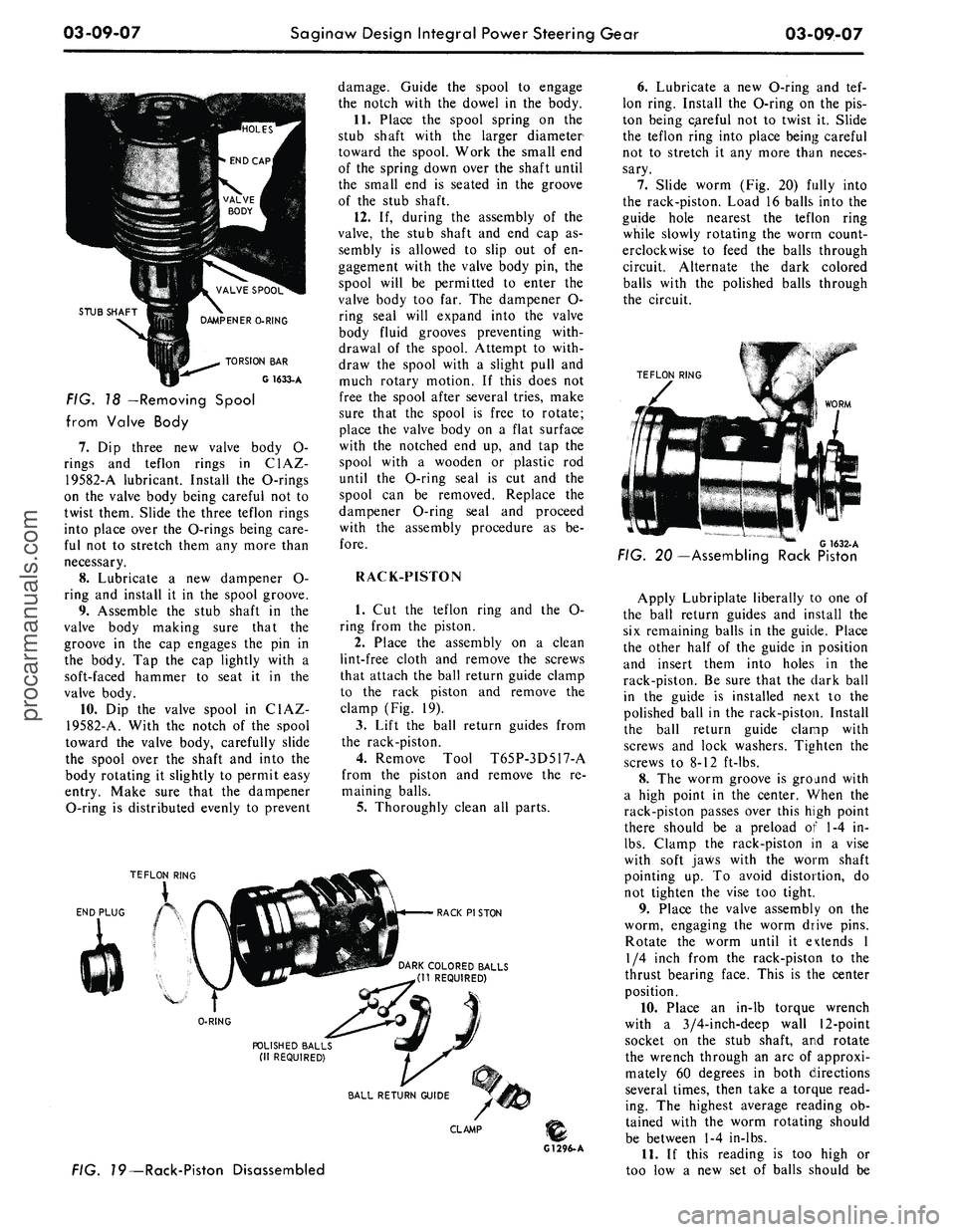
FIG. 18 —Removing Spool
from Valve Body
7.
Dip three new valve body O-
rings and teflon rings in C1AZ-
19582-A lubricant. Install the O-rings
on the valve body being careful not to
twist them. Slide the three teflon rings
into place over the O-rings being care-
ful not to stretch them any more than
necessary.
8. Lubricate a new dampener O-
ring and install it in the spool groove.
9. Assemble the stub shaft in the
valve body making sure that the
groove in the cap engages the pin in
the body. Tap the cap lightly with a
soft-faced hammer to seat it in the
valve body.
10.
Dip the valve spool in C1AZ-
19582-A. With the notch of the spool
toward the valve body, carefully slide
the spooi over the shaft and into the
body rotating it slightly to permit easy
entry. Make sure that the dampener
O-ring is distributed evenly to prevent
TEFLON RING
damage. Guide the spool to engage
the notch with the dowel in the body.
11.
Place the spool spring on the
stub shaft with the larger diameter
toward the spool. Work the small end
of the spring down over the shaft until
the small end is seated in the groove
of the stub shaft.
12.
If, during the assembly of the
valve, the stub shaft and end cap as-
sembly is allowed to slip out of en-
gagement with the valve body pin, the
spool will be permitted to enter the
valve body too far. The dampener O-
ring seal will expand into the valve
body fluid grooves preventing with-
drawal of the spool. Attempt to with-
draw the spool with a slight pull and
much rotary motion. If this does not
free the spool after several tries, make
sure that the spool is free to rotate;
place the valve body on a flat surface
with the notched end up, and tap the
spool with a wooden or plastic rod
until the O-ring seal is cut and the
spool can be removed. Replace the
dampener O-ring seal and proceed
with the assembly procedure as be-
fore.
RACK-PISTON
1.
Cut the teflon ring and the O-
ring from the piston.
2.
Place the assembly on a clean
lint-free cloth and remove the screws
that attach the ball return guide clamp
to the rack piston and remove the
clamp (Fig. 19).
3.
Lift the ball return guides from
the rack-piston.
4.
Remove Tool T65P-3D517-A
from the piston and remove the re-
maining balls.
5.
Thoroughly clean all parts.
END PLUG
RACK PI STON
DARK COLORED BALLS
(11 REQUIRED)
V
0-RING
POLISHED BALLS
(II REQUIRED)
BALL RETURN GUIDE
CLAMP
B
G1296. A
6. Lubricate a new O-ring and tef-
lon ring. Install the O-ring on the pis-
ton being qareful not to twist it. Slide
the teflon ring into place being careful
not to stretch it any more than neces-
sary.
7.
Slide worm (Fig. 20) fully into
the rack-piston. Load 16 balls into the
guide hole nearest the teflon ring
while slowly rotating the worm count-
erclockwise to feed the balls through
circuit. Alternate the dark colored
balls with the polished balls through
the circuit.
TEFLON RING
FIG. 19—Rack-Piston Disassembled
G 1632-A
FIG. 20—Assembling Rack Piston
Apply Lubriplate liberally to one of
the ball return guides and install the
six remaining balls in the guide. Place
the other half of the guide in position
and insert them into holes in the
rack-piston. Be sure that the dark ball
in the guide is installed next to the
polished ball in the rack-piston. Install
the ball return guide clamp with
screws and lock washers. Tighten the
screws to 8-12 ft-lbs.
8. The worm groove is ground with
a high point in the center. V/hen the
rack-piston passes over this high point
there should be a preload of 1-4 in-
lbs.
Clamp the rack-piston in a vise
with soft jaws with the worm shaft
pointing up. To avoid distortion, do
not tighten the vise too tight.
9. Place the valve assembly on the
worm, engaging the worm drive pins.
Rotate the worm until it extends 1
1/4 inch from the rack-piston to the
thrust bearing face. This is the center
position.
10.
Place an in-lb torque wrench
with a 3/4-inch-deep wall 12-point
socket on the stub shaft, and rotate
the wrench through an arc of approxi-
mately 60 degrees in both directions
several times, then take a torque read-
ing. The highest average reading ob-
tained with the worm rotating should
be between 1-4 in-lbs.
11.
If this reading is too high or
too low a new set of balls should beprocarmanuals.com
Page 160 of 413
03-09-08
Saginaw Design Integral Power Steering Gear
03-09-08
Code
Size
6
7
8
9
10
11
Diameter
Mean
0.28117
0.28125
0.28133
0.28141
0.28149
0.28157
Size Range of Ball
(Inch)
0.28112-0.28122
0.28120-0.28130
0.28128-0.28138
0.28136-0.28146
0.28144-0.28154
0.28152-0.28162
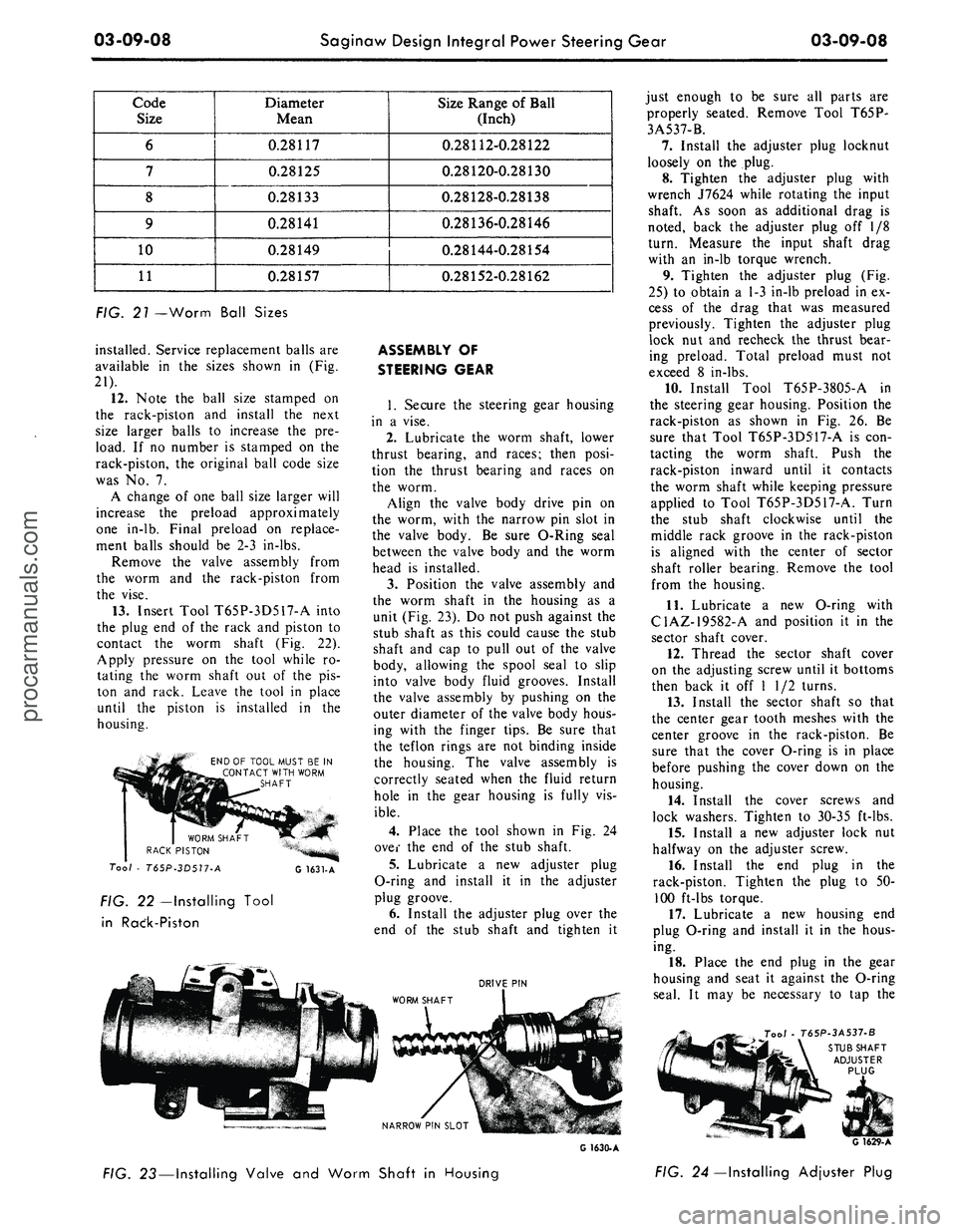
FIG. 21 —Worm Ball Sizes
installed. Service replacement balls are
available in the sizes shown in (Fig.
21).
12.
Note the ball size stamped on
the rack-piston and install the next
size larger balls to increase the pre-
load. If no number is stamped on the
rack-piston, the original ball code size
was No. 7.
A change of one ball size larger will
increase the preload approximately
one in-lb. Final preload on replace-
ment balls should be 2-3 in-lbs.
Remove the valve assembly from
the worm and the rack-piston from
the vise.
13.
Insert Tool T65P-3D517-A into
the plug end of the rack and piston to
contact the worm shaft (Fig. 22).
Apply pressure on the tool while ro-
tating the worm shaft out of the pis-
ton and rack. Leave the tool in place
until the piston is installed in the
housing.
END OF TOOL MUST BE IN
CONTACT WITH WORM
SHAFT
Tool * T65P-3D517-A
FIG. 22—Installing Tool
in Raek-Piston
G 1631-A
ASSEMBLY OF
STEERING GEAR
1.
Secure the steering gear housing
in a vise.
2.
Lubricate the worm shaft, lower
thrust bearing, and races; then posi-
tion the thrust bearing and races on
the worm.
Align the valve body drive pin on
the worm, with the narrow pin slot in
the valve body. Be sure O-Ring seal
between the valve body and the worm
head is installed.
3.
Position the valve assembly and
the worm shaft in the housing as a
unit (Fig. 23). Do not push against the
stub shaft as this could cause the stub
shaft and cap to pull out of the valve
body, allowing the spool seal to slip
into valve body fluid grooves. Install
the valve assembly by pushing on the
outer diameter of the valve body hous-
ing with the finger tips. Be sure that
the teflon rings are not binding inside
the housing. The valve assembly is
correctly seated when the fluid return
hole in the gear housing is fully vis-
ible.
4.
Place the tool shown in Fig. 24
over the end of the stub shaft.
5.
Lubricate a new adjuster plug
O-ring and install it in the adjuster
plug groove.
6. Install the adjuster plug over the
end of the stub shaft and tighten it
DRIVE PIN
just enough to be sure all parts are
properly seated. Remove Tool T65P-
3A537-B.
7.
Install the adjuster plug locknut
loosely on the plug.
8. Tighten the adjuster plug with
wrench J7624 while rotating the input
shaft. As soon as additional drag is
noted, back the adjuster plug off 1/8
turn. Measure the input shaft drag
with an in-lb torque wrench.
9. Tighten the adjuster plug (Fig.
25) to obtain a 1-3 in-lb preload in ex-
cess of the drag that was measured
previously. Tighten the adjuster plug
lock nut and recheck the thrust bear-
ing preload. Total preload must not
exceed 8 in-lbs.
10.
Install Tool T65P-3805-A in
the steering gear housing. Position the
rack-piston as shown in Fig. 26. Be
sure that Tool T65P-3D517-A is con-
tacting the worm shaft. Push the
rack-piston inward until it contacts
the worm shaft while keeping pressure
applied to Tool T65P-3D517-A. Turn
the stub shaft clockwise until the
middle rack groove in the rack-piston
is aligned with the center of sector
shaft roller bearing. Remove the tool
from the housing.
11.
Lubricate a new O-ring with
C1AZ-19582-A and position it in the
sector shaft cover.
12.
Thread the sector shaft cover
on the adjusting screw until it bottoms
then back it off 1 1/2 turns.
13.
Install the sector shaft so that
the center gear tooth meshes with the
center groove in the rack-piston. Be
sure that the cover O-ring is in place
before pushing the cover down on the
housing.
14.
Install the cover screws and
lock washers. Tighten to 30-35 ft-lbs.
15.
Install a new adjuster lock nut
halfway on the adjuster screw.
16.
Install the end plug in the
rack-piston. Tighten the plug to 50-
100 ft-lbs torque.
17.
Lubricate a new housing end
plug O-ring and install it in the hous-
ing.
18.
Place the end plug in the gear
housing and seat it against the O-ring
seal. It may be necessary to tap the
Tool
T65P-3A537-B
STUB SHAFT
ADJUSTER
PLUG
G 1630-A
FIG. 23—Installing Valve and Worm Shaft in Housing
G 1629-A
FIG. 24 —Installing Adjuster Plugprocarmanuals.com
Page 161 of 413
03-09-09
Saginaw Design Integral Power Steering Gear
03-09-09
Tool • T65P-3D517-A
LOCK NUT
ADJUSTER PLUG
G1628-A
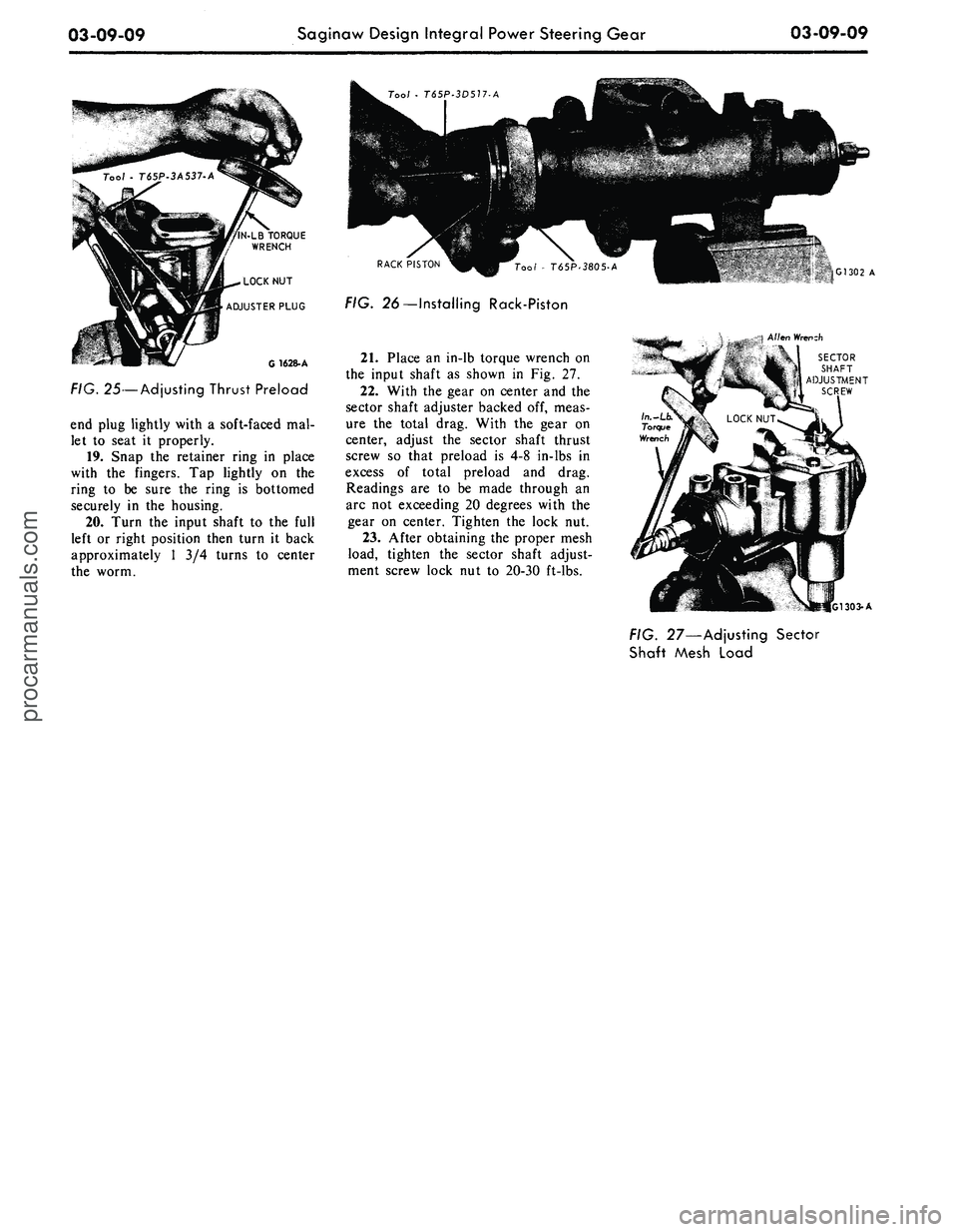
FIG. 25
—
Adjusting Thrust Preload
end plug lightly with
a
soft-faced mal-
let
to
seat
it
properly.
19.
Snap
the
retainer ring
in
place
with
the
fingers.
Tap
lightly
on the
ring
to be
sure
the
ring
is
bottomed
securely
in the
housing.
20.
Turn
the
input shaft
to the
full
left
or
right position then turn
it
back
approximately
1 3/4
turns
to
center
the worm.
RACK PISTON
Tool - T65P.3805-A
FIG. 26—Installing Rack-Piston
21.
Place
an
in-lb torque wrench
on
the input shaft
as
shown
in Fig. 27.
22.
With
the
gear
on
center
and the
sector shaft adjuster backed
off,
meas-
ure
the
total drag. With
the
gear
on
center, adjust
the
sector shaft thrust
screw
so
that preload
is 4-8
in-lbs
in
excess
of
total preload
and
drag.
Readings
are to be
made through
an
arc
not
exceeding
20
degrees with
the
gear
on
center. Tighten
the
lock
nut.
23.
After obtaining
the
proper mesh
load, tighten
the
sector shaft adjust-
ment screw lock
nut to
20-30 ft-lbs.
jG1302
A
G1303-A
FIG. 27—Adjusting Sector
Shaft Mesh Loadprocarmanuals.com
Page 163 of 413
03-10-02
Ford-Thompson Power Steering Pump
03-10-02
LOWER PRESSURE
PLATE 3D590
SPRING-3D601
UPPER PRESSURE
PLATE -3A645
RETAINER END
PLATE-3D589
CAM AND ROTOR
ASSEMBLY-
-3D607
SCREW AND WASHER
ASSEMBLY-379376-S
PULLEY-3D673
PUMP SHAFT
SEAL 3B592
PLATE AND BUSHING
ASSEMBLY-3D643
0-RING
382744-S
HOUSING GASKET
3A760
G1343-B
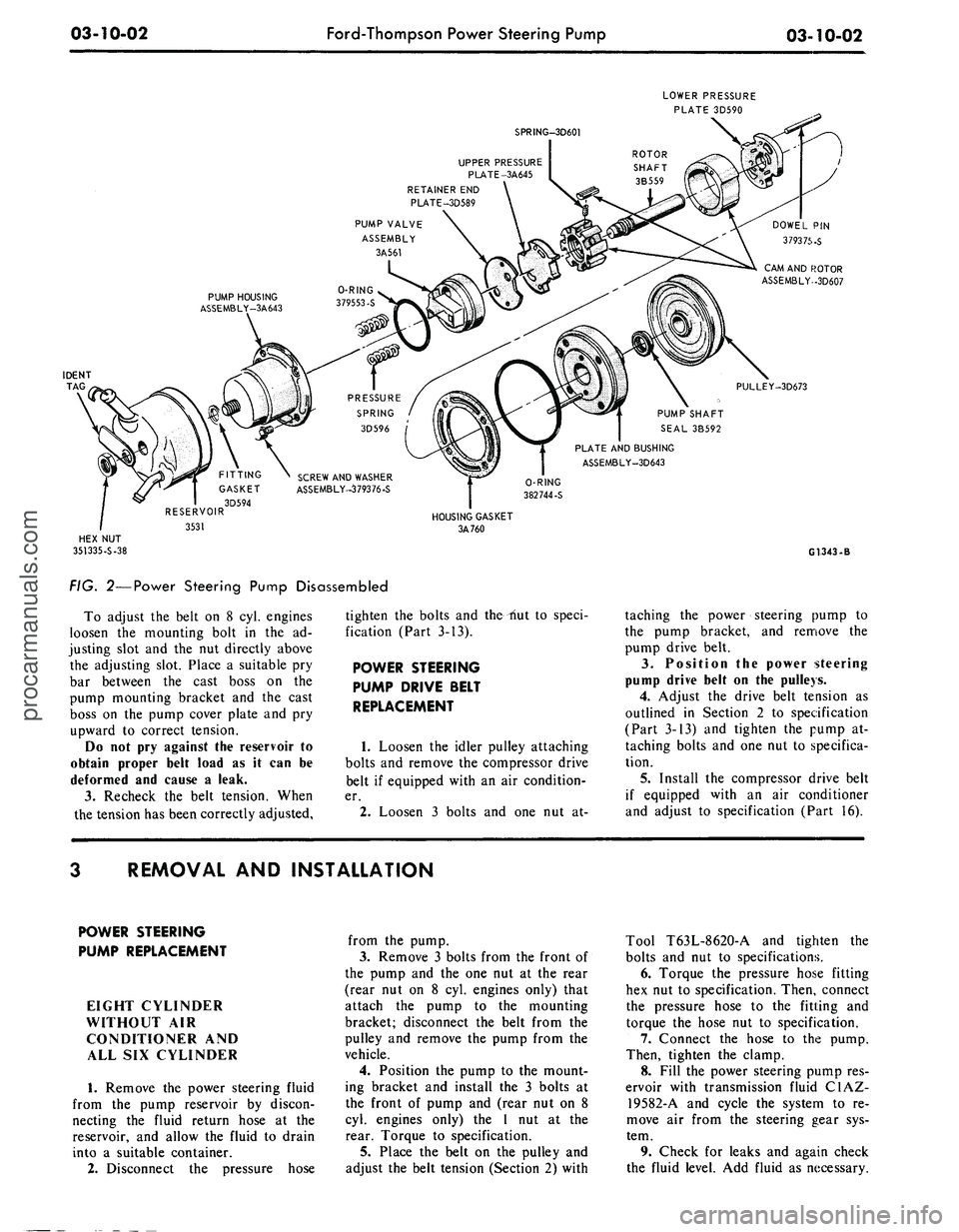
FIG. 2—Power Steering Pump Disassembled
To adjust the belt on 8 cyl. engines
loosen the mounting bolt in the ad-
justing slot and the nut directly above
the adjusting slot. Place a suitable pry
bar between the cast boss on the
pump mounting bracket and the cast
boss on the pump cover plate and pry
upward to correct tension.
Do not pry against the reservoir to
obtain proper belt load as it can be
deformed and cause a leak.
3.
Recheck the belt tension. When
the tension has been correctly adjusted,
tighten the bolts and the fiut to speci-
fication (Part 3-13).
POWER STEERING
PUMP DRIVE BELT
REPLACEMENT
1.
Loosen the idler pulley attaching
bolts and remove the compressor drive
belt if equipped with an air condition-
er.
2.
Loosen 3 bolts and one nut at-
taching the power steering pump to
the pump bracket, and remove the
pump drive belt.
3.
Position the power steering
pump drive belt on the pulleys.
4.
Adjust the drive belt tension as
outlined in Section 2 to specification
(Part 3-13) and tighten the pump at-
taching bolts and one nut to specifica-
tion.
5.
Install the compressor drive belt
if equipped with an air conditioner
and adjust to specification (Part 16).
REMOVAL AND INSTALLATION
POWER STEERING
PUMP REPLACEMENT
EIGHT CYLINDER
WITHOUT AIR
CONDITIONER AND
ALL SIX CYLINDER
1.
Remove the power steering fluid
from the pump reservoir by discon-
necting the fluid return hose at the
reservoir, and allow the fluid to drain
into a suitable container.
2.
Disconnect the pressure hose
from the pump.
3.
Remove 3 bolts from the front of
the pump and the one nut at the rear
(rear nut on 8 cyl. engines only) that
attach the pump to the mounting
bracket; disconnect the belt from the
pulley and remove the pump from the
vehicle.
4.
Position the pump to the mount-
ing bracket and install the 3 bolts at
the front of pump and (rear nut on 8
cyl.
engines only) the 1 nut at the
rear. Torque to specification.
5.
Place the belt on the pulley and
adjust the belt tension (Section 2) with
Tool T63L-8620-A and tighten the
bolts and nut to specifications.
6. Torque the pressure hose fitting
hex nut to specification. Then, connect
the pressure hose to the fitting and
torque the hose nut to specification.
7.
Connect the hose to the pump.
Then, tighten the clamp.
8. Fill the power steering pump res-
ervoir with transmission fluid C1AZ-
19582-A and cycle the system to re-
move air from the steering gear sys-
tem.
9. Check for leaks and again check
the fluid level. Add fluid as necessary.procarmanuals.com
Page 164 of 413
03-10-03
Ford-Thompson Power Steering Pump
03-10-03
EIGHT CYLINDER WITH
AIR CONDITIONER
1.
Remove the power steering fluid
from the pump reservoir by discon-
necting the fluid return hose from the
reservoir and allow the fluid to drain
in a suitable container.
2.
Disconnect the pressure hose
from the pump.
3.
Remove 3 bolts from the front of
the pump and the one nut at the rear
that attach the pump to the mounting
bracket and remove the drive belt
from the pump pulley.
4.
Loosen the upper pump bracket-
to-engine attaching bolt and remove
the bolt in the belt adjusting slot. Re-
move the pump.
5.
Position the pump to the bracket
and install the bracket-to-pump at-
taching bolts and nuts. Tighten to spe-
cifications.
6. Place the belt on the pump pul-
ley. Adjust the belt tension as outlined
in Section 2 and tighten the bolts and
nut to specification.
7.
Torque the pressure hose fitting
hex nut to specification. Then, connect
the pressure hose to the fitting and
torque the hose nut to specification.
8. Connect the return hose to the
power steering pump and tighten the
clamp.
9. Fill the pump with automatic
transmission fluid C1AZ-19582-A.
Bleed the air from the system (Part
3-1) and check for leaks and again
check the fluid level. Add fluid as re-
quired.
POWER STEERING PUMP
PULLEY REPLACEMENT
REMOVAL
1.
Drain as much of the fluid as
possible from the pump through filler
pipe.
2.
Install a 3/8-16 inch capscrew in
the end of the pump shaft to prevent
damage to the shaft end by the tool
screw.
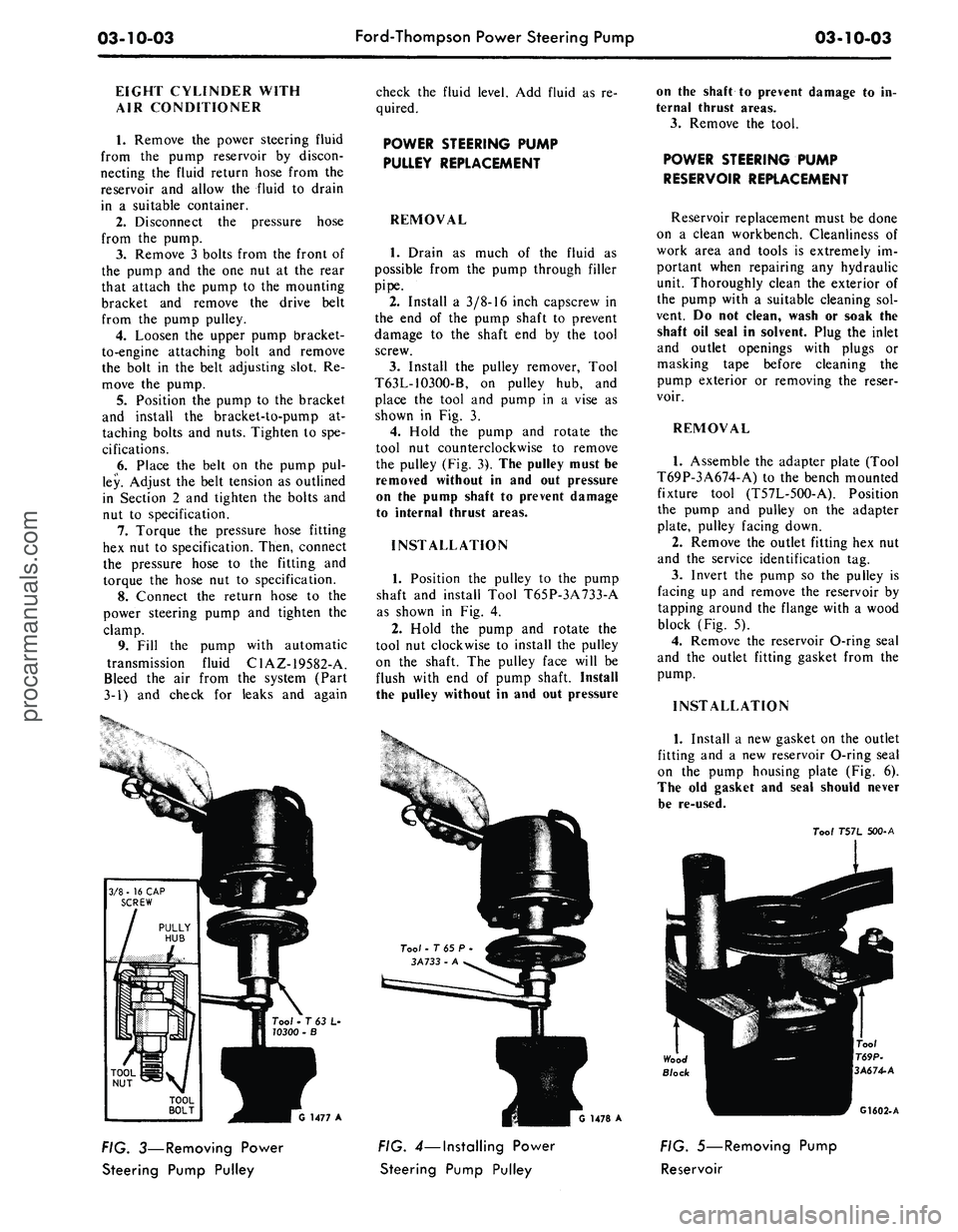
3.
Install the pulley remover, Tool
T63L-1O3OO-B, on pulley hub, and
place the tool and pump in a vise as
shown in Fig. 3.
4.
Hold the pump and rotate the
tool nut counterclockwise to remove
the pulley (Fig. 3). The pulley must be
removed without in and out pressure
on the pump shaft to prevent damage
to internal thrust areas.
INSTALLATION
1.
Position the pulley to the pump
shaft and install Tool T65P-3A733-A
as shown in Fig. 4.
2.
Hold the pump and rotate the
tool nut clockwise to install the pulley
on the shaft. The pulley face will be
flush with end of pump shaft. Install
the pulley without in and out pressure
on the shaft to prevent damage to in-
ternal thrust areas.
3.
Remove the tool.
POWER STEERING PUMP
RESERVOIR REPLACEMENT
Reservoir replacement must be done
on a clean workbench. Cleanliness of
work area and tools is extremely im-
portant when repairing any hydraulic
unit. Thoroughly clean the exterior of
the pump with a suitable cleaning sol-
vent. Do not clean, wash or soak the
shaft oil seal in solvent. Plug the inlet
and outlet openings with plugs or
masking tape before cleaning the
pump exterior or removing the reser-
voir.
REMOVAL
1.
Assemble the adapter plate (Tool
T69P-3A674-A) to the bench mounted
fixture tool (T57L-5OO-A). Position
the pump and pulley on the adapter
plate, pulley facing down.
2.
Remove the outlet fitting hex nut
and the service identification tag.
3.
Invert the pump so the pulley is
facing up and remove the reservoir by
tapping around the flange with a wood
block (Fig. 5).
4.
Remove the reservoir O-ring seal
and the outlet fitting gasket from the
pump.
INSTALLATION
Tool • T 63 L-
10300 -
G 1477 A
FIG. 3—Removing Power
Steering Pump Pulley
1478 A
FIG. 4—Installing Power
Steering Pump Pulley
1.
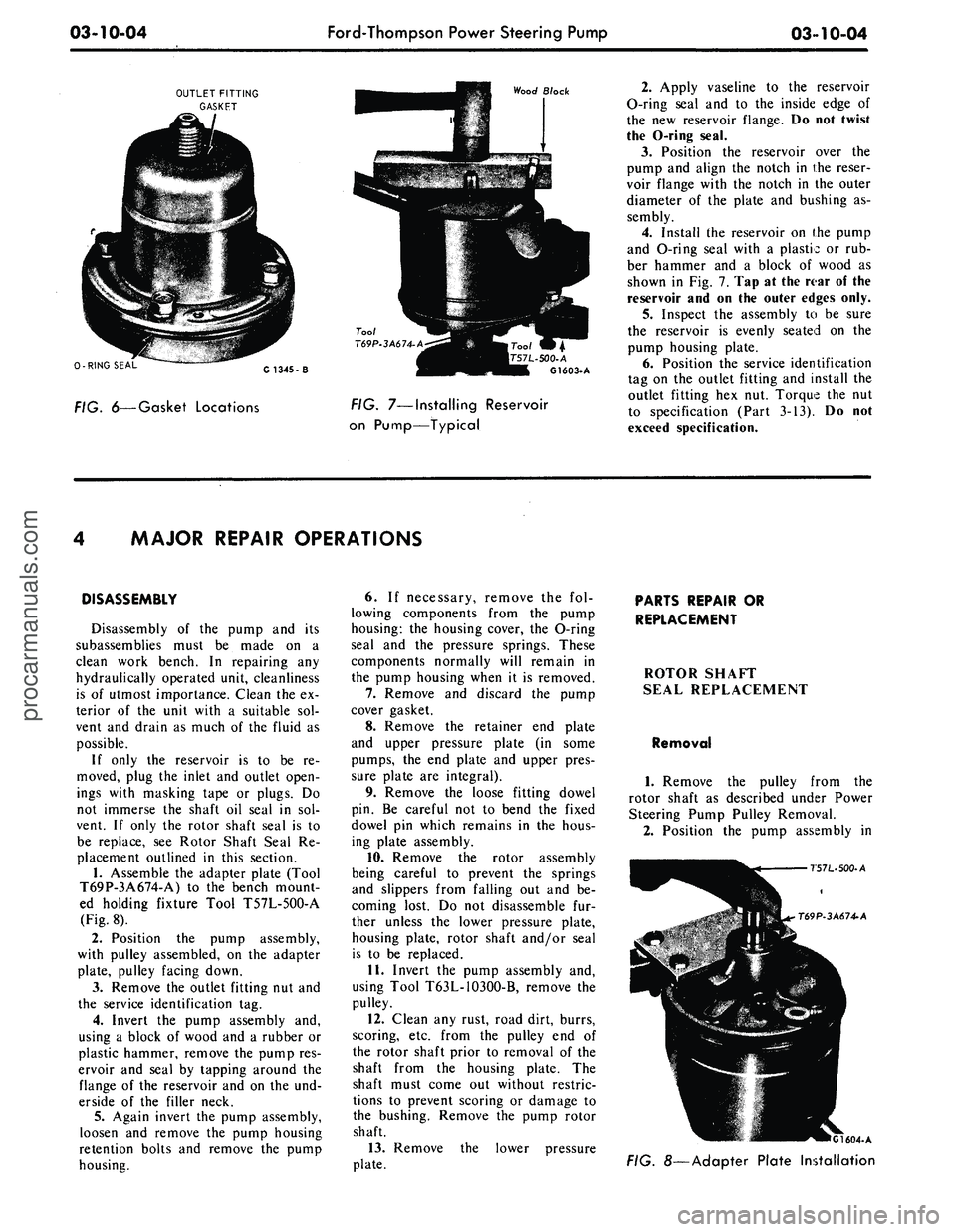
Install a new gasket on the outlet
fitting and a new reservoir O-ring seal
on the pump housing plate (Fig. 6).
The old gasket and seal should never
be re-used.
Too/
T57L 500-A
G1602-A
FIG. 5—Removing Pump
Reservoirprocarmanuals.com
Page 165 of 413
03-10-04
Ford-Thompson Power Steering Pump
03-10-04
OUTLET FITTING
GASKET
Wood Block
0-RING SEAL
G1345-
-500-
A
G1603- A
FIG. 6—Gasket Locations
FIG.
7—Installing
Reservoir
on Pump—Typical
2.
Apply vaseline to the reservoir
O-ring seal and to the inside edge of
the new reservoir flange. Do not twist
the O-ring seal.
3.
Position the reservoir over the
pump and align the notch in the reser-
voir flange with the notch in the outer
diameter of the plate and bushing as-
sembly.
4.
Install the reservoir on the pump
and O-ring seal with a plastic or rub-
ber hammer and a block of wood as
shown in Fig. 7. Tap at the rear of the
reservoir and on the outer edges only.
5.
Inspect the assembly to be sure
the reservoir is evenly seated on the
pump housing plate.
6. Position the service identification
tag on the outlet fitting and install the
outlet fitting hex nut. Torque the nut
to specification (Part 3-13). Do not
exceed specification.
MAJOR REPAIR OPERATIONS
DISASSEMBLY
Disassembly of the pump and its
subassemblies must be made on a
clean work bench. In repairing any
hydraulically operated unit, cleanliness
is of utmost importance. Clean the ex-
terior of the unit with a suitable sol-
vent and drain as much of the fluid as
possible.
If only the reservoir is to be re-
moved, plug the inlet and outlet open-
ings with masking tape or plugs. Do
not immerse the shaft oil seal in sol-
vent. If only the rotor shaft seal is to
be replace, see Rotor Shaft Seal Re-
placement outlined in this section.
1.
Assemble the adapter plate (Tool
T69P-3A674-A) to the bench mount-
ed holding fixture Tool T57L-5OO-A
(Fig. 8).
2.
Position the pump assembly,
with pulley assembled, on the adapter
plate, pulley facing down.
3.
Remove the outlet fitting nut and
the service identification tag.
4.
Invert the pump assembly and,
using a block of wood and a rubber or
plastic hammer, remove the pump res-
ervoir and seal by tapping around the
flange of the reservoir and on the und-
erside of the filler neck.
5.
Again invert the pump assembly,
loosen and remove the pump housing
retention bolts and remove the pump
housing.
6. If necessary, remove the fol-
lowing components from the pump
housing: the housing cover, the O-ring
seal and the pressure springs. These
components normally will remain in
the pump housing when it is removed.
7.
Remove and discard the pump
cover gasket.
8. Remove the retainer end plate
and upper pressure plate (in some
pumps, the end plate and upper pres-
sure plate are integral).
9. Remove the loose fitting dowel
pin. Be careful not to bend the fixed
dowel pin which remains in the hous-
ing plate assembly.
10.
Remove the rotor assembly
being careful to prevent the springs
and slippers from falling out and be-
coming lost. Do not disassemble fur-
ther unless the lower pressure plate,
housing plate, rotor shaft and/or seal
is to be replaced.
11.
Invert the pump assembly and,
using Tool T63L-1O3OO-B, remove the
pulley.
12.
Clean any rust, road dirt, burrs,
scoring, etc. from the pulley end of
the rotor shaft prior to removal of the
shaft from the housing plate. The
shaft must come out without restric-
tions to prevent scoring or damage to
the bushing. Remove the pump rotor
shaft.
13.
Remove the lower pressure
plate.
PARTS REPAIR OR
REPLACEMENT
ROTOR SHAFT
SEAL REPLACEMENT
Removal
1.
Remove the pulley from the
rotor shaft as described under Power
Steering Pump Pulley Removal.
2.
Position the pump assembly in
T57L-500-A
T69P-3A674-A
•
G1604-A
FIG. 8—Adapter Plate Installationprocarmanuals.com
Page 167 of 413
03-10-06
Ford-Thompson Power Steering Pump
03-10-06
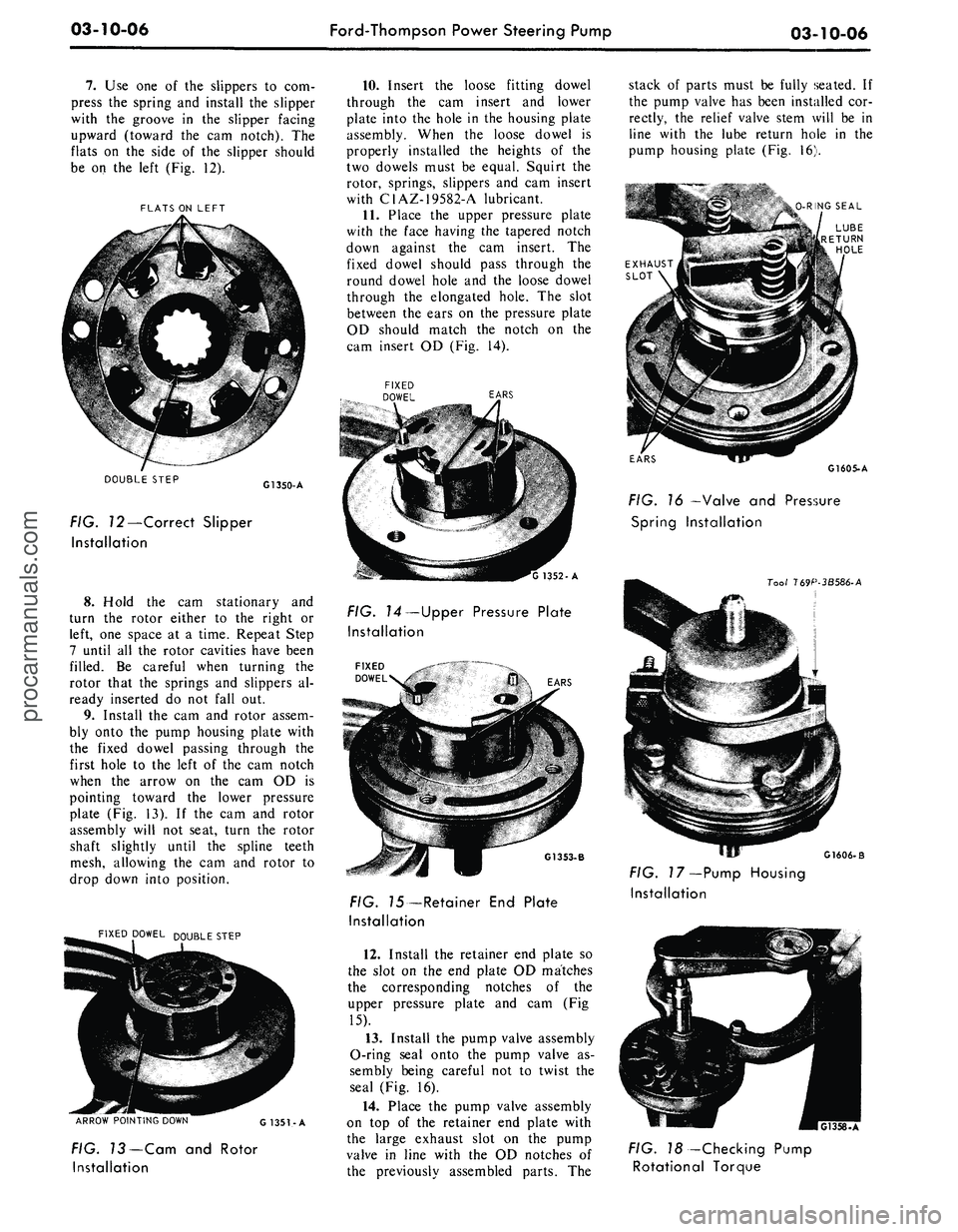
7.
Use one of the slippers to com-
press the spring and install the slipper
with the groove in the slipper facing
upward (toward the cam notch). The
flats on the side of the slipper should
be on the left (Fig. 12).
FLATS ON LEFT
DOUBLE STEP
G1350-A
FIG. 72—Correct Slipper
Installation
8. Hold the cam stationary and
turn the rotor either to the right or
left, one space at a time. Repeat Step
7 until all the rotor cavities have been
filled. Be careful when turning the
rotor that the springs and slippers al-
ready inserted do not fall out.
9. Install the cam and rotor assem-
bly onto the pump housing plate with
the fixed dowel passing through the
first hole to the left of the cam notch
when the arrow on the cam OD is
pointing toward the lower pressure
plate (Fig. 13). If the cam and rotor
assembly will not seat, turn the rotor
shaft slightly until the spline teeth
mesh, allowing the cam and rotor to
drop down into position.
FIXED DOWEL D0|JBLE STEP
ARROW POINTING DOWN
G 1351-A
FIG. 13—Cam and Rotor
Installation
10.
Insert the loose fitting dowel
through the cam insert and lower
plate into the hole in the housing plate
assembly. When the loose dowel is
properly installed the heights of the
two dowels must be equal. Squirt the
rotor, springs, slippers and cam insert
with C1AZ-19582-A lubricant.
11.
Place the upper pressure plate
with the face having the tapered notch
down against the cam insert. The
fixed dowel should pass through the
round dowel hole and the loose dowel
through the elongated hole. The slot
between the ears on the pressure plate
OD should match the notch on the
cam insert OD (Fig. 14).
EARS
'G 1352-A
FIG. 74—Upper Pressure Plate
Installation
\ EARS
G1353-B
FIG. 75—Retainer End Plate
Installation
12.
Install the retainer end plate so
the slot on the end plate OD matches
the corresponding notches of the
upper pressure plate and cam (Fig
15).
13.
Install the pump valve assembly
O-ring seal onto the pump valve as-
sembly being careful not to twist the
seal (Fig. 16).
14.
Place the pump valve assembly
on top of the retainer end plate with
the large exhaust slot on the pump
valve in line with the OD notches of
the previously assembled parts. The
stack of parts must be fully seated. If
the pump valve has been installed cor-
rectly, the relief valve stem will be in
line with the lube return hole in the
pump housing plate (Fig. 16).
O-RING SEAL
EARS
G1605-A
FIG. 16 —Valve and Pressure
Spring Installation
Tool 169P-3B586-A
G1606-B
FIG. 17—Pump Housing
Installation
FIG. 18 -Checking Pump
Rotational Torqueprocarmanuals.com
Page 168 of 413
03-10-07
Ford-Thompson Power Steering Pump
03-10-07
15.
Place small amounts of vaseline
on the pump housing plate to hold the
cover gasket in place. Install the gas-
ket on the pump housing plate.
16.
Insert the pressure plate springs
into the pockets in the pump valve as-
sembly. Vaseline may be placed in the
spring pockets to hold the springs in
position (Fig. 17).
17.
Using Tool T69P-3B586-A,
plug the intake hole in the housing
(Fig. 17).
18.
Lubricate the inside of the
housing and the housing cover seal
with C1AZ-19582-A lubricant. Fabri-
cate two studs (3/8-16x1.55 ) to be
used as positioning guides. Install one
in the housing plate bolt hole closest
to the drain hole and one in the bolt
hole diametrically opposite.
19.
Align the small diameter lube
hole in the housing rim with the lube
hole in the housing plate.
20.
Install the housing, applying an
even, downward pressure. The pres-
sure plate springs must not be jarred
and moved out of position. Remove
the guide studs.
21.
Install the housing retaining
bolts finger tight.
22.
Remove Tool T69P-3B586-A.
23.
Torque the retaining bolts even-
ly to 28-32 ft-lbs until the housing
flange contacts the gasket.
24.
Install a 3/8x16 hex head
screw, finger tight, into the end of the
rotor shaft. Using a torque wrench,
check the input torque of the shaft
(Fig. 18). The torque should not ex-
ceed 15 in-lbs. If it does, loosen the
retaining bolts slightly, rotate the
rotor shaft, retorque the bolts evenly
and again check the shaft torque. The
pump must not be used if the shaft
torque exceeds 15 in-lbs.
25.
Release the pin in the bench
holding fixture and agitate the pump
assembly back and forth. If there is a
rattle, the pressure plate springs have
fallen out of their seats and must be
reinstalled.
26.
Install the reservoir O-ring on
the housing plate being careful not to
twist the O-ring. Apply vaseline to the
seal and to the ID of the reservoir
flange.
27.
Install the reservoir, aligning
the notch in the reservoir flange with
the notch in the OD of the pump
housing plate and bushing assembly.
Using only a plastic or rubber ham-
mer, tap at the rear on the outer cor-
ners of the reservoir to avoid damage.
28.
Inspect the assembly to deter-
mine if the reservoir is seated on the
housing plate.
29.
Install the service identification
tag on the outlet valve fitting.
30.
Install the outlet valve fitting
nut and torque to 43-47 ft-lbs.
31.
Invert the pump assembly.
32.
If the pulley was removed, in-
stall the correct pulley using Tool
T65P-3A733-A.procarmanuals.com
Page 169 of 413
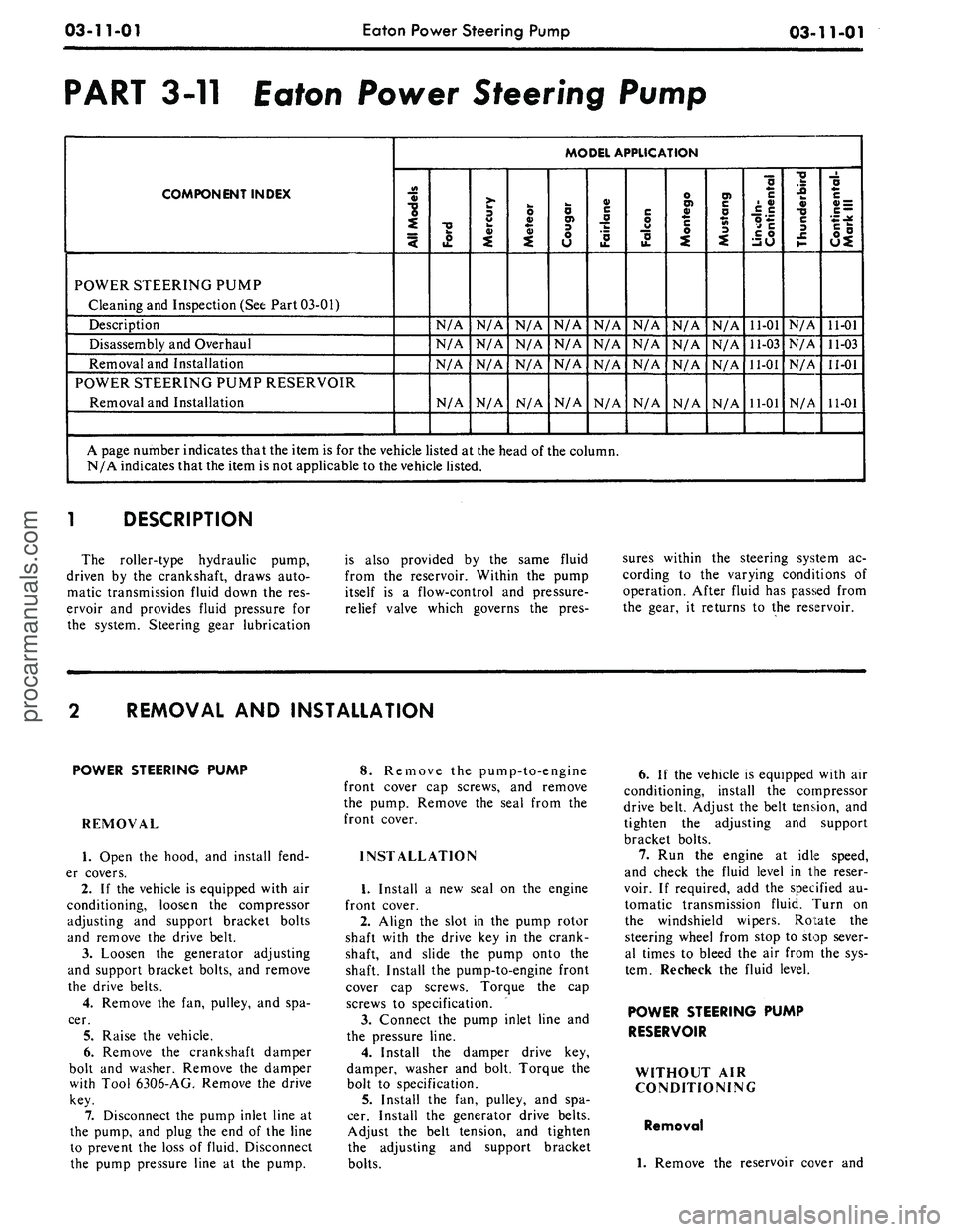
03-11-01
Eaton Power Steering Pump
03-11-01
PART 3-11 Eaton Power Steering Pump
COMPONENT INDEX
MODEL APPLICATION
3
§>
"o
4
POWER STEERING PUMP
Cleaning and Inspection (See Part 03-01)
Description
N/A
N/A
N/A
N/A
N/A
N/A
N/A
N/A
11-01
N/A
11-01
Disassembly and Overhaul
N/A
N/A
N/A
N/A
N/A
N/A
N/A
N/A
11-03
N/A
11-03
Removal and Installation
N/A
N/A
N/A
N/A
N/A
N/A
N/A
N/A
11-01
N/A
11-01
POWER STEERING PUMP RESERVOIR
Removal and Installation
N/A
N/A
N/A
N/A
N/A
N/A
N/A
N/A
11-01
N/A
11-01
A page number indicates that the item is for the vehicle listed at the head of the column.
N/A indicates that the item is not applicable to the vehicle listed.
l
DESCRIPTION
The roller-type hydraulic pump,
driven by the crankshaft, draws auto-
matic transmission fluid down the res-
ervoir and provides fluid pressure for
the system. Steering gear lubrication
is also provided by the same fluid
from the reservoir. Within the pump
itself is a flow-control and pressure-
relief valve which governs the pres-
sures within the steering system ac-
cording to the varying conditions of
operation. After fluid has passed from
the gear, it returns to the reservoir.
REMOVAL AND INSTALLATION
POWER STEERING PUMP
REMOVAL
1.
Open the hood, and install fend-
er covers.
2.
If the vehicle is equipped with air
conditioning, loosen the compressor
adjusting and support bracket bolts
and remove the drive belt.
3.
Loosen the generator adjusting
and support bracket bolts, and remove
the drive belts.
4.
Remove the fan, pulley, and spa-
cer.
5.
Raise the vehicle.
6. Remove the crankshaft damper
bolt and washer. Remove the damper
with Tool 6306-AG. Remove the drive
key.
7.
Disconnect the pump inlet line at
the pump, and plug the end of the line
to prevent the loss of fluid. Disconnect
the pump pressure line at the pump.
8. Remove the pump-to-engine
front cover cap screws, and remove
the pump. Remove the seal from the
front cover.
INSTALLATION
1.
Install a new seal on the engine
front cover.
2.
Align the slot in the pump rotor
shaft with the drive key in the crank-
shaft, and slide the pump onto the
shaft. Install the pump-to-engine front
cover cap screws. Torque the cap
screws to specification.
3.
Connect the pump inlet line and
the pressure line.
4.
Install the damper drive key,
damper, washer and bolt. Torque the
bolt to specification.
5.
Install the fan, pulley, and spa-
cer. Install the generator drive belts.
Adjust the belt tension, and tighten
the adjusting and support bracket
bolts.
6. If the vehicle is equipped with air
conditioning, install the compressor
drive belt. Adjust the belt tension, and
tighten the adjusting and support
bracket bolts.
7.
Run the engine at idle speed,
and check the fluid level in the reser-
voir. If required, add the specified au-
tomatic transmission fluid. Turn on
the windshield wipers. Rotate the
steering wheel from stop to stop sever-
al times to bleed the air from the sys-
tem. Recheck the fluid level.
POWER STEERING PUMP
RESERVOIR
WITHOUT AIR
CONDITIONING
Removal
1.
Remove the reservoir cover andprocarmanuals.com
Page 171 of 413
03-11-03
Eaton Power Steering Pump
03-11-03
POWER STEERING PUMP
DISASSEMBLY
A clean working area should be
used when overhauling the power
steering pump. Foreign matter picked
up on working parts may cause dam-
age or failure of the unit. Clean con-
tainers should be used for parts.
1.
Drain the fluid from the pump.
Remove the pump cover-to-housing
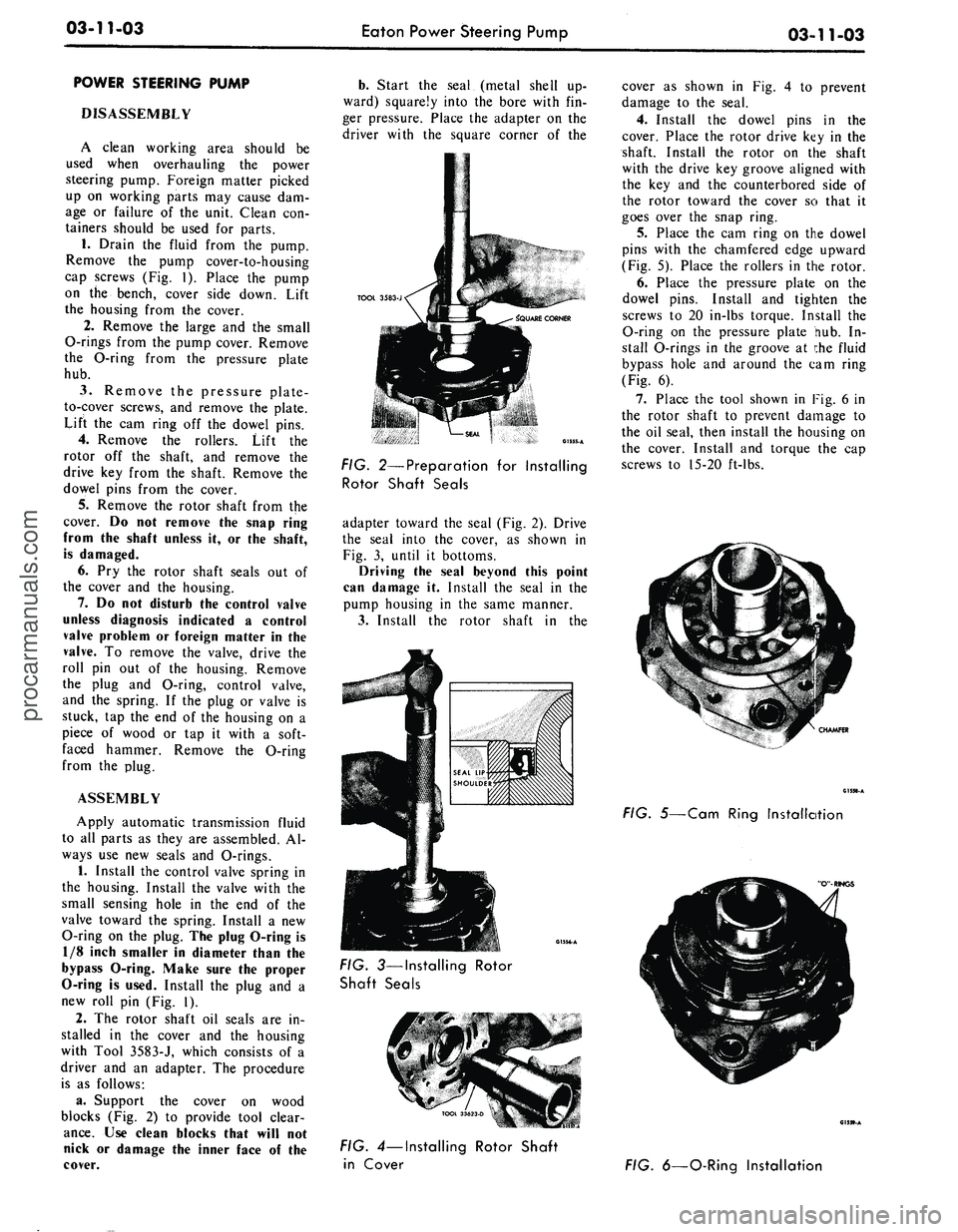
cap screws (Fig. 1). Place the pump
on the bench, cover side down. Lift
the housing from the cover.
2.
Remove the large and the small
O-rings from the pump cover. Remove
the O-ring from the pressure plate
hub.
3.
Remove the pressure plate-
to-cover screws, and remove the plate.
Lift the cam ring off the dowel pins.
4.
Remove the rollers. Lift the
rotor off the shaft, and remove the
drive key from the shaft. Remove the
dowel pins from the cover.
5.
Remove the rotor shaft from the
cover. Do not remove the snap ring
from the shaft unless it, or the shaft,
is damaged.
6. Pry the rotor shaft seals out of
the cover and the housing.
7. Do not disturb the control valve
unless diagnosis indicated a control
valve problem or foreign matter in the
valve. To remove the valve, drive the
roll pin out of the housing. Remove
the plug and O-ring, control valve,
and the spring. If the plug or valve is
stuck, tap the end of the housing on a
piece of wood or tap it with a soft-
faced hammer. Remove the O-ring
from the plug.
ASSEMBLY
Apply automatic transmission fluid
to all parts as they are assembled. Al-
ways use new seals and O-rings.
1.
Install the control valve spring in
the housing. Install the valve with the
small sensing hole in the end of the
valve toward the spring. Install a new
O-ring on the plug. The plug O-ring is
1/8 inch smaller in diameter than the
bypass O-ring. Make sure the proper
O-ring is used. Install the plug and a
new roll pin (Fig. 1).
2.
The rotor shaft oil seals are in-
stalled in the cover and the housing
with Tool 3583-J, which consists of a
driver and an adapter. The procedure
is as follows:
a. Support the cover on wood
blocks (Fig. 2) to provide tool clear-
ance.
Use clean blocks that will not
nick or damage the inner face of the
cover.
b.
Start the seal (metal shell up-
ward) square!y into the bore with fin-
ger pressure. Place the adapter on the
driver with the square corner of the
FIG. 2—Preparation for Installing
Rotor Shaft Seals
adapter toward the seal (Fig. 2). Drive
the seal into the cover, as shown in
Fig. 3, until it bottoms.
Driving the seal beyond this point
can damage it. Install the seal in the
pump housing in the same manner.
3.
Install the rotor shaft in the
FIG. 3—Installing Rotor
Shaft Seals
cover as shown in Fig. 4 to prevent
damage to the seal.
4.
Install the dowel pins in the
cover. Place the rotor drive key in the
shaft. Install the rotor on the shaft
with the drive key groove aligned with
the key and the counterbored side of
the rotor toward the cover so that it
goes over the snap ring.
5.
Place the cam ring on the dowel
pins with the chamfered edge upward
(Fig. 5). Place the rollers in the rotor.
6. Place the pressure plate on the
dowel pins. Install and tighten the
screws to 20 in-lbs torque. Install the
O-ring on the pressure plate hub. In-
stall O-rings in the groove at the fluid
bypass hole and around the cam ring
(Fig. 6).
7.
Place the tool shown in Fig. 6 in
the rotor shaft to prevent damage to
the oil seal, then install the housing on
the cover. Install and torque the cap
screws to 15-20 ft-lbs.
FIG. 5—Cam Ring Installation
FIG. 4—Installing Rotor Shaft
in Cover
FIG. 6—O-Ring Installationprocarmanuals.com