torque FORD MUSTANG 1969 Volume One Chassis
[x] Cancel search | Manufacturer: FORD, Model Year: 1969, Model line: MUSTANG, Model: FORD MUSTANG 1969Pages: 413, PDF Size: 75.81 MB
Page 173 of 413
03-12-02
Wheels
And
Tires
03-12-02
LIFE GUARD TIRE
The Goodyear Power Cushion Tire
(available
on
Thunderbird, Lincoln
and Continental Mark
III
models)
fit-
ted with
the
Life Guard Safety Spare
provides
a
tire within
a
tire with
two
separate
air
chambers
(Fig.
3). If the
outer tire casing should
be
punctured
or otherwise damaged causing
it to go
flat,
the
Life Guard Safety Spare will
carry
the
load
of the
vehicle
and
will
allow driving
at
speeds
up to 40 mph
with good control
up to a
distance
of
40 miles.
A
Safety-Signal built into
the Life Guard tread produces
a
lope
or vibration indicating
the
outer tire
has lost pressure.
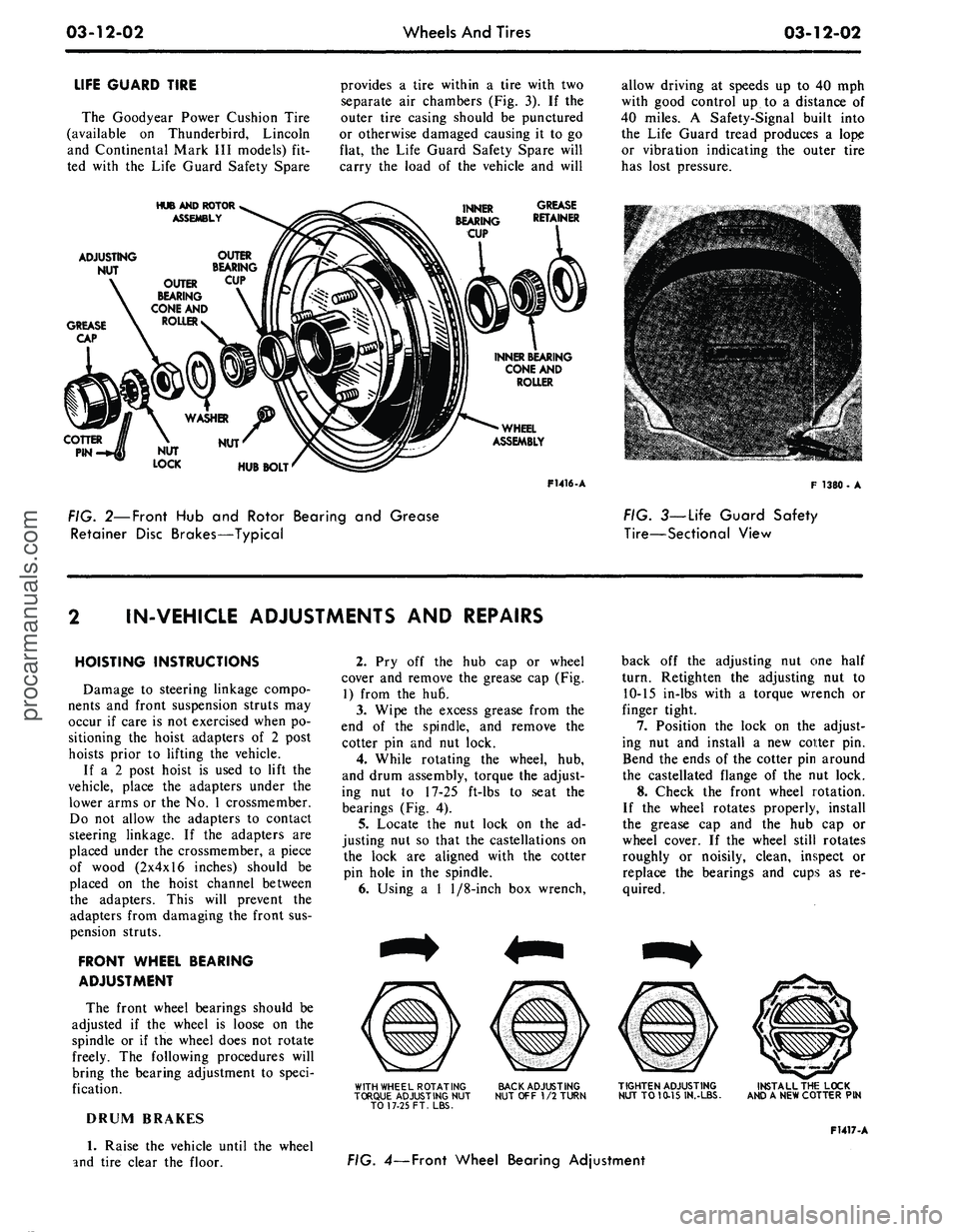
HUB AND ROTOR
ASSEMBLY
INNER
BEARING
CUP
GREASE
RETAINER
ADJUSTING
NUT
OUTER
BEARING
CONE
AND
ROLLER
INNER BEARING
CONE
AND
ROLLER
WHEEL
ASSEMBLY
F1416-A
F- 1380 •
A
FIG. 2—Front
Hub and
Rotor Bearing
and
Grease
Retainer Disc Brakes—Typical
FIG. 3—Life Guard Safety
Tire—Sectional View
IN-VEHICLE ADJUSTMENTS AND REPAIRS
HOISTING INSTRUCTIONS
Damage
to
steering linkage compo-
nents
and
front suspension struts
may
occur
if
care
is
not
exercised when
po-
sitioning
the
hoist adapters
of 2
post
hoists prior
to
lifting
the
vehicle.
If
a 2
post hoist
is
used
to
lift
the
vehicle, place
the
adapters under
the
lower arms
or
the No. 1
crossmember.
Do
not
allow
the
adapters
to
contact
steering linkage.
If the
adapters
are
placed under
the
crossmember,
a
piece
of wood (2x4x16 inches) should
be
placed
on the
hoist channel between
the adapters. This will prevent
the
adapters from damaging
the
front
sus-
pension struts.
FRONT WHEEL BEARING
ADJUSTMENT
The front wheel bearings should
be
adjusted
if the
wheel
is
loose
on the
spindle
or if the
wheel does
not
rotate
freely.
The
following procedures will
bring
the
bearing adjustment
to
speci-
fication.
DRUM BRAKES
1.
Raise
the
vehicle until
the
wheel
and tire clear
the
floor.
2.
Pry off the hub cap or
wheel
cover
and
remove
the
grease
cap (Fig.
1) from
the hu6.
3.
Wipe
the
excess grease from
the
end
of the
spindle,
and
remove
the
cotter
pin and nut
lock.
4.
While rotating
the
wheel,
hub,
and drum assembly, torque
the
adjust-
ing
nut to 17-25
ft-lbs
to
seat
the
bearings
(Fig.
4).
5.
Locate
the nut
lock
on the ad-
justing
nut so
that
the
castellations
on
the lock
are
aligned with
the
cotter
pin hole
in the
spindle.
6. Using
a 1
1/8-inch
box
wrench,
WITH WHEEL ROTATING
TORQUE ADJUSTING
NUT
TO 17-25 FT. LBS.
BACK ADJUSTING
NUT
OFF
1/2
TURN
back
off the
adjusting
nut one
half
turn. Retighten
the
adjusting
nut to
10-15 in-lbs with
a
torque wrench
or
finger tight.
7.
Position
the
lock
on the
adjust-
ing
nut and
install
a new
cotter
pin.
Bend
the
ends
of
the
cotter
pin
around
the castellated flange
of the nut
lock.
8. Check
the
front wheel rotation.
If
the
wheel rotates properly, install
the grease
cap and the hub cap or
wheel cover.
If the
wheel still rotates
roughly
or
noisily, clean, inspect
or
replace
the
bearings
and
cups
as re-
quired.
TIGHTEN ADJUSTING
NUT
TO
10-15 IN.-LBS.
INSTALL THE LOCK
AND
A
NEW COTTER
PIN
F1417-A
FIG. 4— Front Wheel Bearing Adjustmentprocarmanuals.com
Page 174 of 413
03-12-03
Wheels And Tires
03-12-03
DISC BRAKES
1.
Raise the vehicle until the wheel
and tire clear the floor.
2.
Pry off the wheel cover and re-
move the grease cap (Fig. 2) from the
hub.
3.
Wipe the excess grease from the
end of the spindle, and remove the ad-
justing nut cotter pin and nut lock.
4.
Loosen the bearing adjusting nut
three turns. Then, rock the wheel,
hub,
and rotor assembly in and out
several times to push the shoe and lin-
ings away from the rotor.
5.
While rotating the wheel, hub,
and rotor assembly, torque the adjust-
ing nut to 17-25 ft-lbs to seat the
bearings (Fig. 4).
6. Back the adjusting nut off one
half turn. Then, retighten the adjust-
ing nut to 10-15 in-lbs with a torque
wrench or finger tight.
7.
Locate the nut lock on the ad-
justing nut so that the castellations on
the lock are aligned with the cotter
pin hole in the spindle.
8. Install a new cotter pin, and
bend the ends of the cotter pin around
the castellated flange of the nut lock.
9. Check the front wheel rotation.
If the wheel rotates properly, install
the grease cap and the hub cap or
wheel cover. If the wheel still rotates
roughly or noisily, clean or replace the
bearings and cups as required.
10.
Before driving the vehicle,
pump the brake pedal several times to
obtain normal brake lining to rotor
clearance and restore normal brake
pedal travel.
BALANCING LIFE
GUARD TIRE
Tires fitted with the Life Guard
Safety Spare are balanced in the same
manner as conventional tires. If an ex-
cessive out of balance condition exists
the following procedure can be used to
correct the condition:
1.
Remove the core housing and de-
flate both air chambers.
2.
Install the core housing.
3.
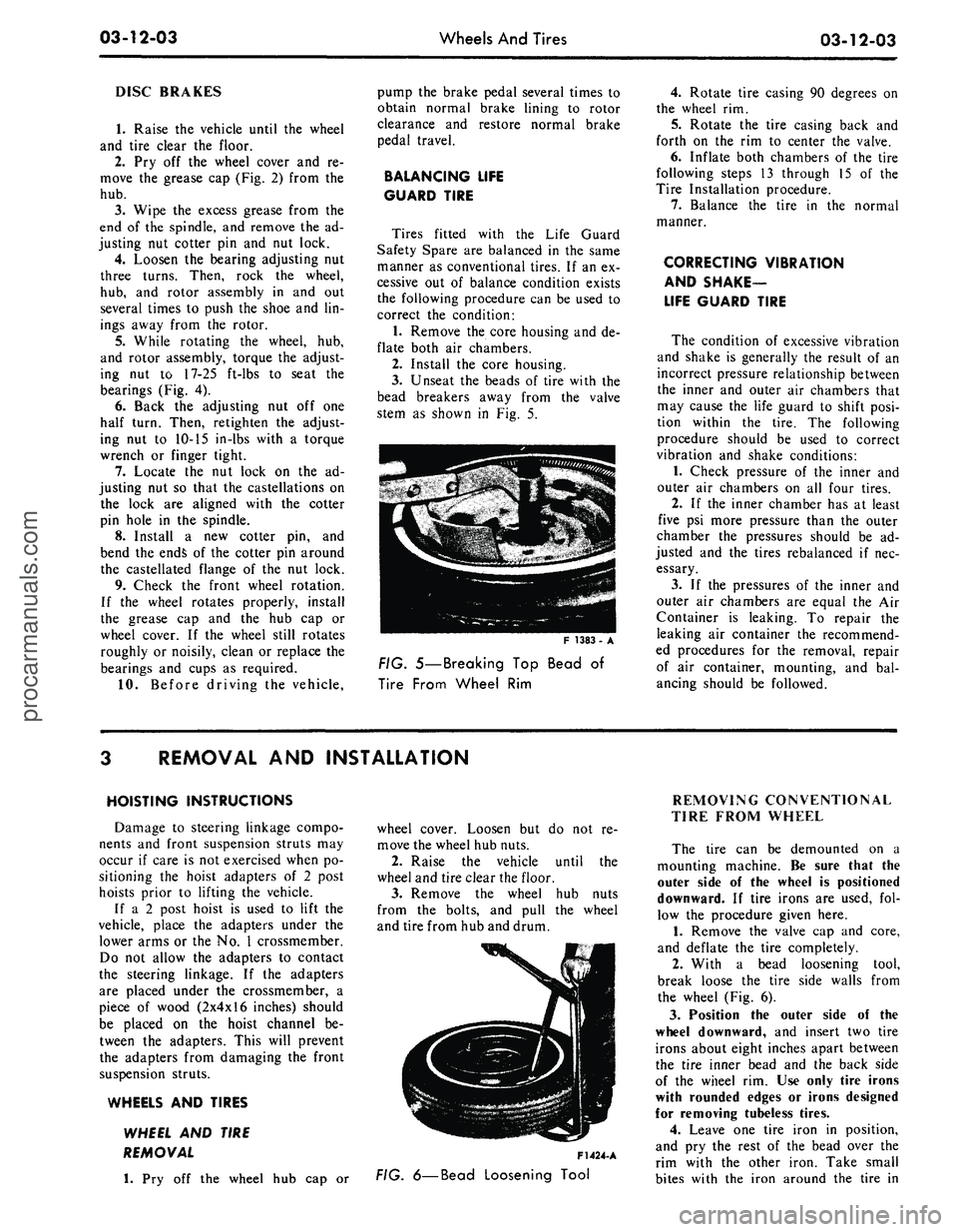
Unseat the beads of tire with the
bead breakers away from the valve
stem as shown in Fig. 5.
F 1383
FIG. 5—Breaking Top Bead of
Tire From Wheel Rim
4.
Rotate tire casing 90 degrees on
the wheel rim.
5.
Rotate the tire casing back and
forth on the rim to center the valve.
6. Inflate both chambers of the tire
following steps 13 through 15 of the
Tire Installation procedure.
7.
Balance the tire in the normal
manner.
CORRECTING VIBRATION
AND SHAKE-
LIFE GUARD TIRE
The condition of excessive vibration
and shake is generally the result of an
incorrect pressure relationship between
the inner and outer air chambers that
may cause the life guard to shift posi-
tion within the tire. The following
procedure should be used to correct
vibration and shake conditions:
1.
Check pressure of the inner and
outer air chambers on all four tires.
2.
If the inner chamber has at least
five psi more pressure than the outer
chamber the pressures should be ad-
justed and the tires rebalanced if nec-
essary.
3.
If the pressures of the inner and
outer air chambers are equal the Air
Container is leaking. To repair the
leaking air container the recommend-
ed procedures for the removal, repair
of air container, mounting, and bal-
ancing should be followed.
REMOVAL AND INSTALLATION
HOISTING INSTRUCTIONS
Damage to steering linkage compo-
nents and front suspension struts may
occur if care is not exercised when po-
sitioning the hoist adapters of 2 post
hoists prior to lifting the vehicle.
If a 2 post hoist is used to lift the
vehicle, place the adapters under the
lower arms or the No. 1 crossmember.
Do not allow the adapters to contact
the steering linkage. If the adapters
are placed under the crossmember, a
piece of wood (2x4x16 inches) should
be placed on the hoist channel be-
tween the adapters. This will prevent
the adapters from damaging the front
suspension struts.
WHEELS AND TIRES
WHEEL AND TIRE
REMOVAL
1.
Pry off the wheel hub cap or
wheel cover. Loosen but do not re-
move the wheel hub nuts.
2.
Raise the vehicle until the
wheel and tire clear the floor.
3.
Remove the wheel hub nuts
from the bolts, and pull the wheel
and tire from hub and drum.
F1424-
A
FIG.
6—Bead
Loosening Tool
REMOVING CONVENTIONAL
TIRE FROM WHEEL
The tire can be demounted on a
mounting machine. Be sure that the
outer side of the wheel is positioned
downward. If tire irons are used, fol-
low the procedure given here.
1.
Remove the valve cap and core,
and deflate the tire completely.
2.
With a bead loosening tool,
break loose the tire side walls from
the wheel (Fig. 6).
3.
Position the outer side of the
wheel downward, and insert two tire
irons about eight inches apart between
the tire inner bead and the back side
of the wheel rim. Use only tire irons
with rounded edges or irons designed
for removing tubeless tires.
4.
Leave one tire iron in position,
and pry the rest of the bead over the
rim with the other iron. Take small
bites with the iron around the tire inprocarmanuals.com
Page 176 of 413
03-12-05
Wheels
And
Tires
03-12-05
and sharp edges from valve hole
in
rim.
8. Mount first tire bead exercising
care
not to
pinch
air
container.
9. Start valve through hole
in rim.
Do
not
pull valve housing into place
at this time.
10.
Mount
the
second bead starting
just past
the
valve
so the
last portion
of
the
bead goes over
the rim at the
valve.
11.
Rotate
the
tire back
and
forth
to center
the
valve housing.
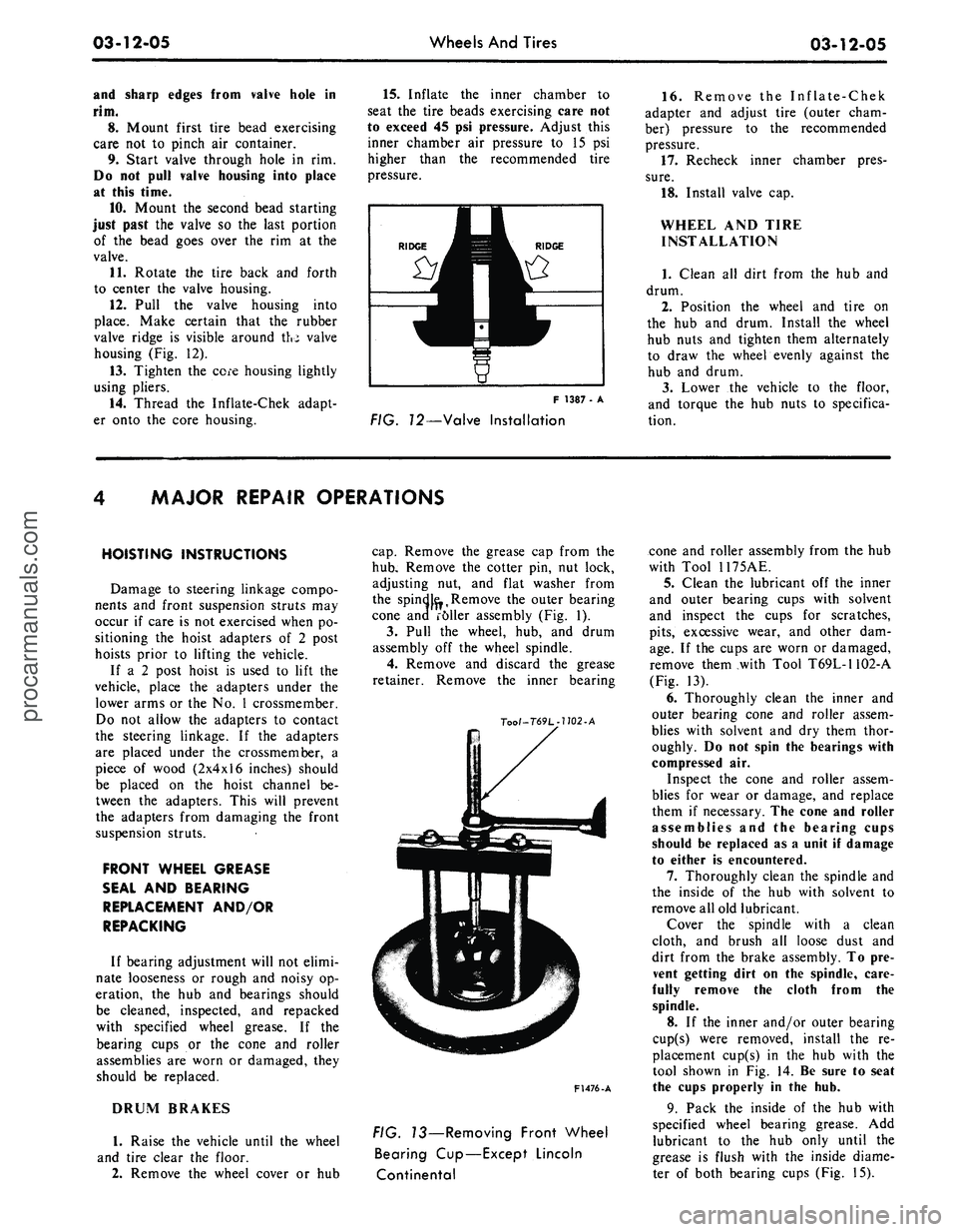
12.
Pull
the
valve housing into
place. Make certain that
the
rubber
valve ridge
is
visible around
thi
valve
housing
(Fig.
12).
13.
Tighten
the
core housing lightly
using pliers.
14.
Thread
the
Inflate-Chek adapt-
er onto
the
core housing.
15.
Inflate
the
inner chamber
to
seat
the
tire beads exercising care
not
to exceed
45 psi
pressure. Adjust this
inner chamber
air
pressure
to 15 psi
higher than
the
recommended tire
pressure.
F 1387
- A
FIG. 12—Valve Installation
16.
Remove
the
Inflate-Chek
adapter
and
adjust tire (outer cham-
ber) pressure
to the
recommended
pressure.
17.
Recheck inner chamber pres-
sure.
18.
Install valve
cap.
WHEEL
AND
TIRE
INSTALLATION
1.
Clean
all
dirt from
the hub and
drum.
2.
Position
the
wheel
and
tire
on
the
hub and
drum. Install
the
wheel
hub nuts
and
tighten them alternately
to draw
the
wheel evenly against
the
hub
and
drum.
3.
Lower
the
vehicle
to the
floor,
and torque
the hub
nuts
to
specifica-
tion.
MAJOR REPAIR OPERATIONS
HOISTING INSTRUCTIONS
Damage
to
steering linkage compo-
nents
and
front suspension struts
may
occur
if
care
is
not
exercised when
po-
sitioning
the
hoist adapters
of 2
post
hoists prior
to
lifting
the
vehicle.
If
a 2
post hoist
is
used
to
lift
the
vehicle, place
the
adapters under
the
lower arms
or the
No.
1
crossmember.
Do
not
allow
the
adapters
to
contact
the steering linkage.
If the
adapters
are placed under
the
crossmember,
a
piece
of
wood (2x4x16 inches) should
be placed
on the
hoist channel
be-
tween
the
adapters. This will prevent
the adapters from damaging
the
front
suspension struts.
FRONT WHEEL GREASE
SEAL
AND
BEARING
REPLACEMENT AND/OR
REPACKING
If bearing adjustment will
not
elimi-
nate looseness
or
rough
and
noisy
op-
eration,
the hub and
bearings should
be cleaned, inspected,
and
repacked
with specified wheel grease.
If the
bearing cups
or the
cone
and
roller
assemblies
are
worn
or
damaged, they
should
be
replaced.
DRUM BRAKES
1.
Raise
the
vehicle until
the
wheel
and tire clear
the
floor.
2.
Remove
the
wheel cover
or hub
cap.
Remove
the
grease
cap
from
the
hub.
Remove
the
cotter
pin,
nut
lock,
adjusting
nut, and
flat washer from
the spindjej, Remove
the
outer bearing
cone
and
roller assembly
(Fig.
1).
3.
Pull
the
wheel,
hub, and
drum
assembly
off the
wheel spindle.
4.
Remove
and
discard
the
grease
retainer. Remove
the
inner bearing
Too/-T69L-J102-A
F1476-A
FIG. 13—Removing Front Wheel
Bearing Cup—Except Lincoln
Continental
cone
and
roller assembly from
the hub
with Tool 1175AE.
5.
Clean
the
lubricant
off the
inner
and outer bearing cups with solvent
and inspect
the
cups
for
scratches,
pits,
excessive wear,
and
other
dam-
age.
If
the
cups
are
worn
or
damaged,
remove them with Tool T69L-1102-A
(Fig.
13).
6. Thoroughly clean
the
inner
and
outer bearing cone
and
roller assem-
blies with solvent
and dry
them thor-
oughly.
Do not
spin
the
bearings with
compressed
air.
Inspect
the
cone
and
roller assem-
blies
for
wear
or
damage,
and
replace
them
if
necessary.
The
cone
and
roller
assemblies
and the
bearing cups
should
be
replaced
as a
unit
if
damage
to either
is
encountered.
7. Thoroughly clean
the
spindle
and
the inside
of the hub
with solvent
to
remove
all old
lubricant.
Cover
the
spindle with
a
clean
cloth,
and
brush
all
loose dust
and
dirt from
the
brake assembly.
To
pre-
vent getting dirt
on the
spindle, care-
fully remove
the
cloth from
the
spindle.
8.
If the
inner and/or outer bearing
cup(s) were removed, install
the re-
placement cup(s)
in the hub
with
the
tool shown
in Fig.
14.
Be
sure
to
seat
the cups properly
in the hub.
9. Pack
the
inside
of the hub
with
specified wheel bearing grease.
Add
lubricant
to the hub
only until
the
grease
is
flush with
the
inside diame-
ter
of
both bearing cups
(Fig.
15).procarmanuals.com
Page 178 of 413
03-12-07
Wheels And Tires
03-12-07
Tool - 7277- K
F 1263-A
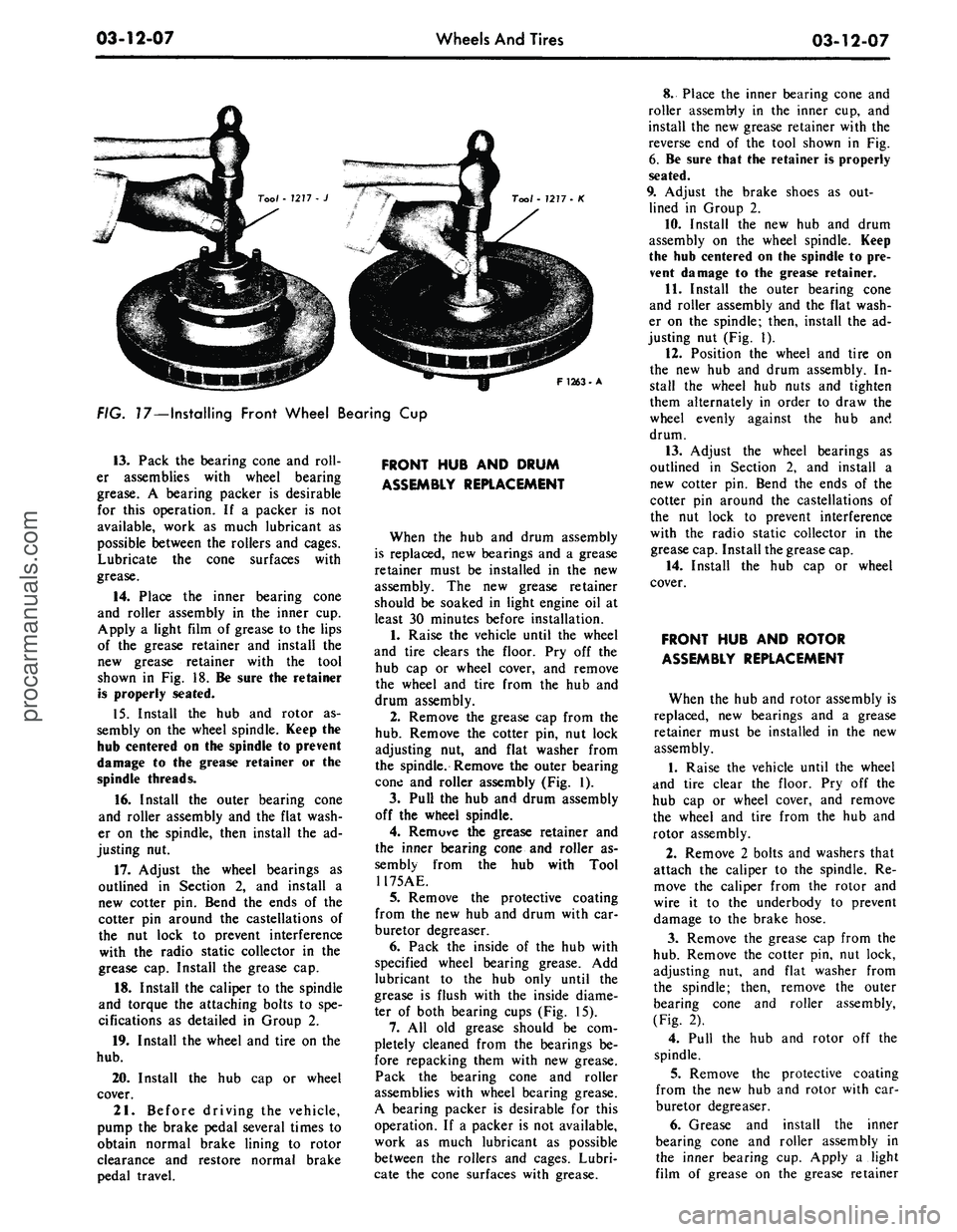
FIG. 17—Installing Front Wheel Bearing Cup
13.
Pack the bearing cone and roll-
er assemblies with wheel bearing
grease. A bearing packer is desirable
for this operation. If a packer is not
available, work as much lubricant as
possible between the rollers and cages.
Lubricate the cone surfaces with
grease.
14.
Place the inner bearing cone
and roller assembly in the inner cup.
Apply a light film of grease to the lips
of the grease retainer and install the
new grease retainer with the tool
shown in Fig. 18. Be sure the retainer
is properly seated.
15.
Install the hub and rotor as-
sembly on the wheel spindle. Keep the
hub centered on the spindle to prevent
damage to the grease retainer or the
spindle threads.
16.
Install the outer bearing cone
and roller assembly and the flat wash-
er on the spindle, then install the ad-
justing nut.
17.
Adjust the wheel bearings as
outlined in Section 2, and install a
new cotter pin. Bend the ends of the
cotter pin around the castellations of
the nut lock to prevent interference
with the radio static collector in the
grease cap. Install the grease cap.
18.
Install the caliper to the spindle
and torque the attaching bolts to spe-
cifications as detailed in Group 2.
19.
Install the wheel and tire on the
hub.
20.
Install the hub cap or wheel
cover.
21.
Before driving the vehicle,
pump the brake pedal several times to
obtain normal brake lining to rotor
clearance and restore normal brake
pedal travel.
FRONT HUB AND DRUM
ASSEMBLY REPLACEMENT
When the hub and drum assembly
is replaced, new bearings and a grease
retainer must be installed in the new
assembly. The new grease retainer
should be soaked in light engine oil at
least 30 minutes before installation.
1.
Raise the vehicle until the wheel
and tire clears the floor. Pry off the
hub cap or wheel cover, and remove
the wheel and tire from the hub and
drum assembly.
2.
Remove the grease cap from the
hub.
Remove the cotter pin, nut lock
adjusting nut, and flat washer from
the spindle. Remove the outer bearing
cone and roller assembly (Fig. 1).
3.
Pull the hub and drum assembly
off the wheel spindle.
4.
Remuve the grease retainer and
the inner bearing cone and roller as-
sembly from the hub with Tool
1175AE.
5.
Remove the protective coating
from the new hub and drum with car-
buretor degreaser.
6. Pack the inside of the hub with
specified wheel bearing grease. Add
lubricant to the hub only until the
grease is flush with the inside diame-
ter of both bearing cups (Fig. 15).
7.
All old grease should be com-
pletely cleaned from the bearings be-
fore repacking them with new grease.
Pack the bearing cone and roller
assemblies with wheel bearing grease.
A bearing packer is desirable for this
operation. If a packer is not available,
work as much lubricant as possible
between the rollers and cages. Lubri-
cate the cone surfaces with grease.
8. Place the inner bearing cone and
roller assembly in the inner cup, and
install the new grease retainer with the
reverse end of the tool shown in Fig.
6. Be sure that the retainer is properly
seated.
9. Adjust the brake shoes as out-
lined in Group 2.
10.
Install the new hub and drum
assembly on the wheel spindle. Keep
the hub centered on the spindle to pre-
vent damage to the grease retainer.
11.
Install the outer bearing cone
and roller assembly and the flat wash-
er on the spindle; then, install the ad-
justing nut (Fig. 1).
12.
Position the wheel and tire on
the new hub and drum assembly. In-
stall the wheel hub nuts and tighten
them alternately in order to draw the
wheel evenly against the hub and
drum.
13.
Adjust the wheel bearings as
outlined in Section 2, and install a
new cotter pin. Bend the ends of the
cotter pin around the castellations of
the nut lock to prevent interference
with the radio static collector in the
grease cap. Install the grease cap.
14.
Install the hub cap or wheel
cover.
FRONT HUB AND ROTOR
ASSEMBLY REPLACEMENT
When the hub and rotor assembly is
replaced, new bearings and a grease
retainer must be installed in the new
assembly.
1.
Raise the vehicle until the wheel
and tire clear the floor. Pry off the
hub cap or wheel cover, and remove
the wheel and tire from the hub and
rotor assembly.
2.
Remove 2 bolts and washers that
attach the caliper to the spindle. Re-
move the caliper from the rotor and
wire it to the underbody to prevent
damage to the brake hose.
3.
Remove the grease cap from the
hub.
Remove the cotter pin, nut lock,
adjusting nut, and flat washer from
the spindle; then, remove the outer
bearing cone and roller assembly,
(Fig. 2).
4.
Pull the hub and rotor off the
spindle.
5.
Remove the protective coating
from the new hub and rotor with car-
buretor degreaser.
6. Grease and install the inner
bearing cone and roller assembly in
the inner bearing cup. Apply a light
film of grease on the grease retainerprocarmanuals.com
Page 181 of 413
03-13-02
Specifications
03-13-02
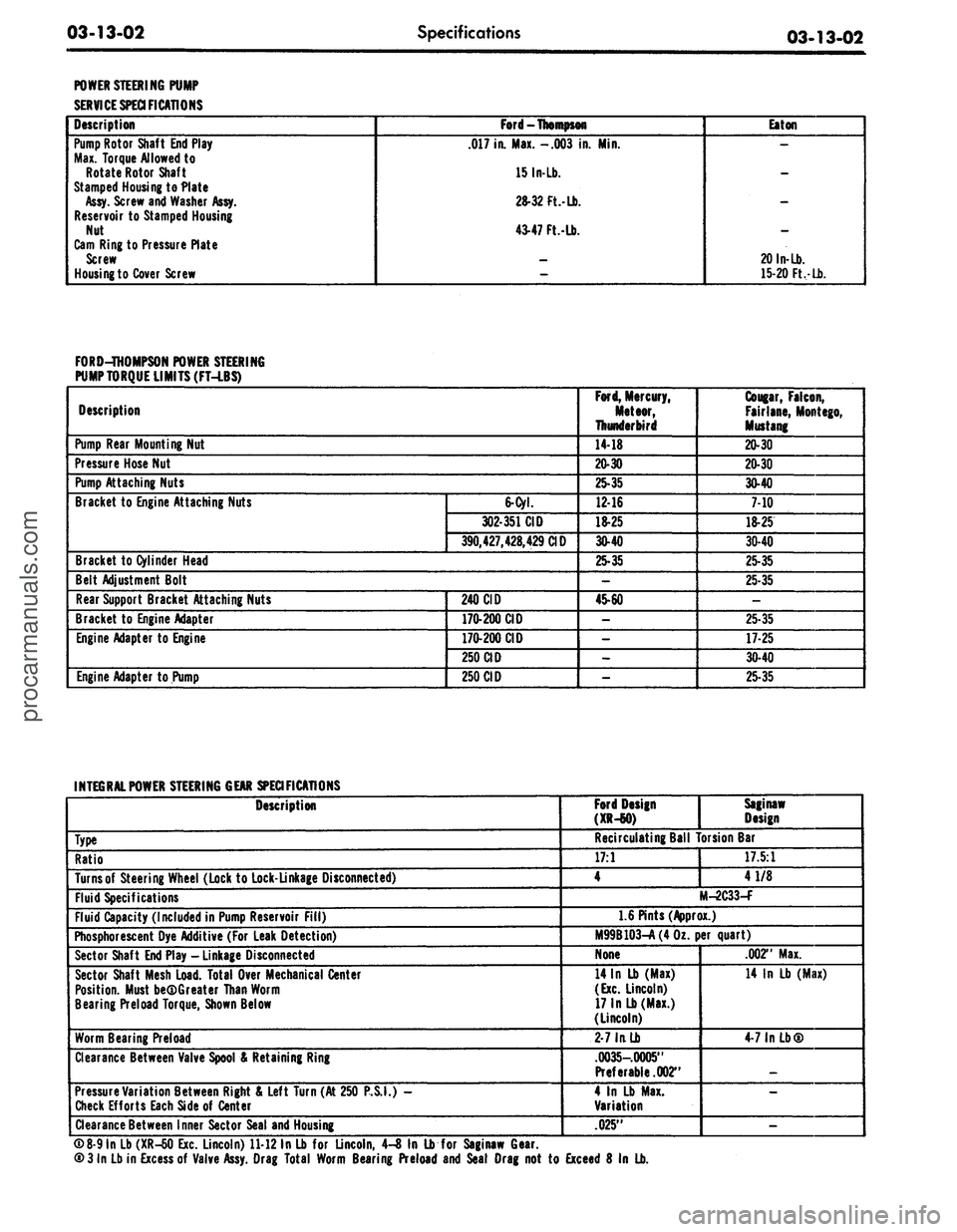
POWER STEERING PUMP
SERVICE
SPECIFICATIONS
Description
Pump Rotor Shaft End Play
Max. Torque Allowed
to
Rotate Rotor Shaft
Stamped Housing to Plate
Assy. Screw and Washer Assy.
Reservoir
to
Stamped Housing
Nut
Cam Ring to Pressure Plate
Screw
Housing to Cover Screw
Ford-Thompson
.017 in. Max.-.003 in. Min.
15 In-Lb.
28-32 Ft.-Lb.
43-47 Ft.-Lb.
_
-
Eaton
—
_
-
—
20 In-Lb.
15-20 Ft,-Lb.
FORD-THOMPSON POWER STEERING
PUMP
TORQUE
LIMITS (FT-LBS)
Description
Pump Rear Mounting Nut
Pressure Hose Nut
Pump Attaching Nuts
Bracket
to
Engine Attaching Nuts
6-Cyl.
302-351 CID
390,427,428,429 CID
Bracket
to
Cylinder Head
Belt Adjustment Bolt
Rear Support Bracket Attaching Nuts
Bracket
to
Engine Adapter
Engine Adapter
to
Engine
Engine Adapter
to
Pump
240 CID
170-200 CID
170-200 CID
250 CID
250 CID
Ford,
Mercury,
Meteor,
Thunderbird
14-18
20-30
25-35
1216
18-25
30-40
25-35
-
45-60
-
-
-
-
Cougar, Falcon,
Fairlane, Montego,
Mustang
20-30
20-30
30-40
7-10
18-25
30-40
25-35
25-35
-
25-35
17-25
30-40
25-35
INTEGRAL
POWER
STEERING GEAR SPECIFICATIONS
Description
Type
Ratio
Turns of Steering Wheel (Lock
to
Lock-Linkage Disconnected)
Fluid Specifications
Fluid Capacity (Included in Pump Reservoir Fill)
Phosphorescent Dye Additive (For Leak Detection)
Sector Shaft End Play -Linkage Disconnected
Sector Shaft Mesh Load. Total Over Mechanical Center
Position.
Must beCDGreater Than Worm
Bearing Preload Torque, Shown Below
Worm Bearing Preload
Clearance Between Valve Spool
&
Retaining Ring
Pressure Variation Between Right
&
Left Turn (At 250
P.S.I.)
-
Check Efforts Each Side
of
Center
Clearance Between Inner Sector Seal and Housing
Ford Design
(XR-«0)
Saginaw
Design
Recirculating Ball Torsion Bar
17:1
4
17.5:1
41/8
M-2C33-F
1.6 Pints (Approx.)
M99B103-A(4 0z. per quart)
None
14 In Lb (Max)
(Exc. Lincoln)
17
In
Lb (Max.)
(Lincoln)
2-7 la
U)
.0035-.0005"
Preferable .002"
4
In
Lb Max.
Variation
.025"
.002"
Max.
14
In
Lb (Max)
4-7 In Lb®
_
—
-
©8-9 In Lb (XR-50 Exc. Lincoln) 11-12 In Lb
for
Uncoln,
4-8 In
Lb
for
Saginaw Gear.
® 3 In Lb in Excess of Valve Assy. Drag Total Worm Bearing Preload and Seal Drag
not to
Exceed
8 In
Lb.procarmanuals.com
Page 182 of 413
03-13-03
Specifications
03-13-03
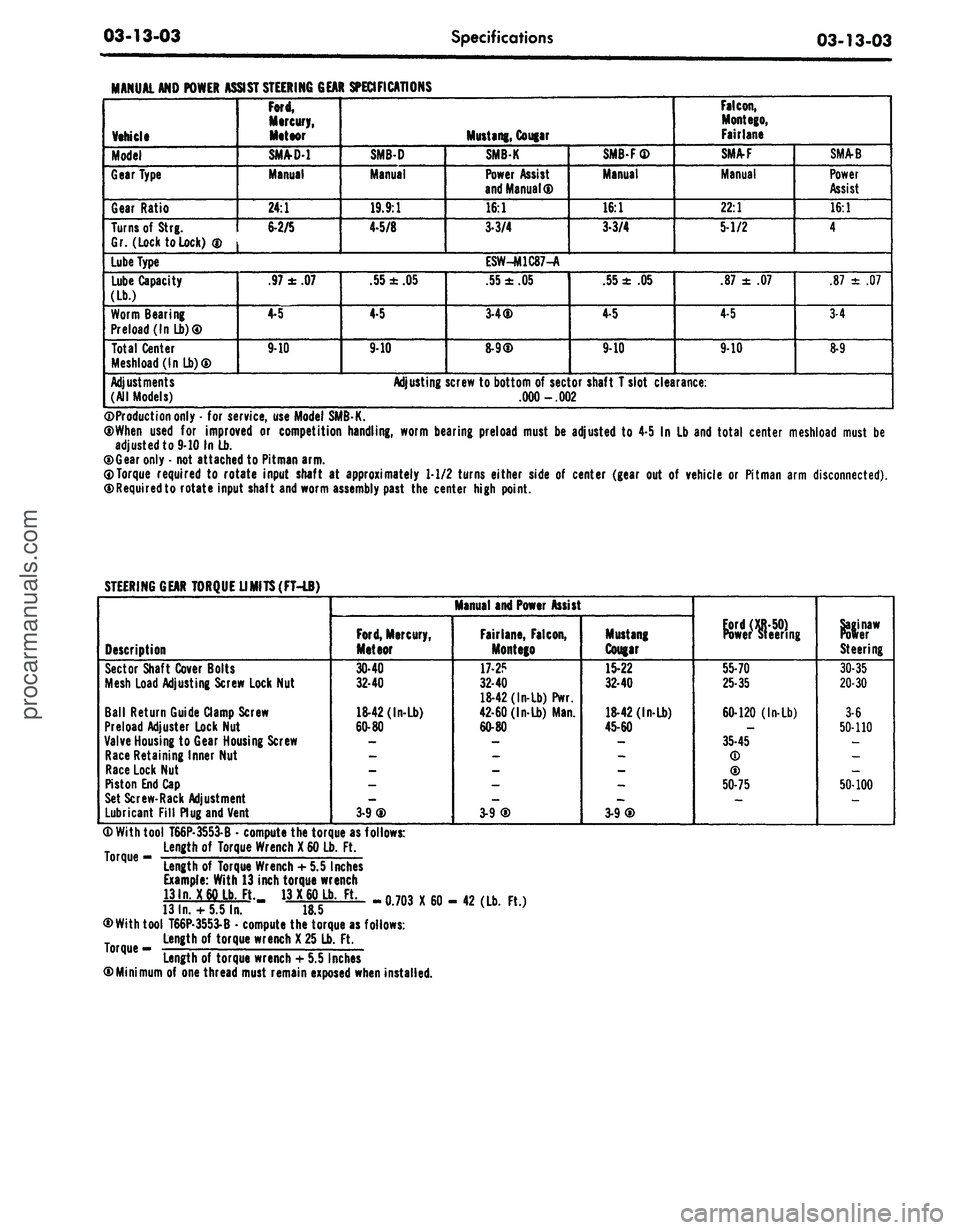
MANUAL AND POWER
Vehicle
Model
Gear Type
Gear Ratio
Turns of
Strg.
Gr. (Lock to Lock)
®
Lube Type
Lube Capacity
(Lb.)
Worm Bearing
Preload (In Lb)®
Total Center
Meshload(lnLb)®
Adjustments
(All Models)
ASSIST STEERING GEAR SPECIFICATIONS
Ford,
Mercury,
Meteor
SM/VD-1
Manual
24:1
6-2/5
.97
±
.07
4-5
9-10
SMB-D
Manual
19.9:1
4-5/8
.55
±
.05
4-5
9-10
Adjusting
Mustang, Cougar
SMBK
Power Assist
and Manual®
16:1
3-3/4
ESW-M1C87-A
.55
±
.05
3-4®
8-9®
screw to bottom
of
sector
.000 -.002
SMB-F®
Manual
16:1
3-3/4
.55
±
.05
4-5
9-10
shaft T slot clearance:
Falcon,
Mont ego,
Fairlane
SMA-F
Manual
22:1
5-1/2
.87
±
.07
4-5
9-10
SMA-B
Power
Assist
16:1
4
.87
±
.07
3-4
8-9
©Production only
-
for service, use Model SMB-K.
®When used
for
improved
or
competition handling, worm bearing preload must
be
adjusted
to
4-5
In
Lb and total center meshload must
be
adjusted to 9-10 In Lb.
®Gear only
-
not attached to Pitman arm.
0Torque required
to
rotate input shaft
at
approximately 1-1/2 turns either side
of
center (gear
out of
vehicle
or
Pitman arm disconnected).
©Requiredto rotate input shaft and worm assembly past
the
center high point.
STEERING GEAR TORQUE UMITS(FT-LB)
Description
Sector Shaft Cover Bolts
Mesh Load Adjusting Screw Lock Nut
Ball Return Guide Clamp Screw
Preload Adjuster Lock Nut
Valve Housing
to
Gear Housing Screw
Race Retaining Inner Nut
Race Lock Nut
Piston End Cap
Set Screw-Rack Adjustment
Lubricant Fill Plug and Vent
Manual and Power Assist
Ford,
Mercury,
Meteor
30-40
32-40
18-42 (In-Lb)
60-80
3-9®
Fairlane, Falcon,
Montego
17-2?
32-40
18-42 (In-Lb) Pwr.
42-60 (In-Lb) Man.
60-80
3-9®
Mustang
Cougar
15-22
32-40
18-42 (In-Lb)
45-60
3-9®
Power steering
55-70
25-35
60-120 (In-Lb)
35-45
(D
®
50-75
Steering
30-35
20-30
3-6
50-110
50-100
® With tool T66P-3553-B
•
compute the torque as follows:
Length
of
Torque Wrench
X
60 Lb.
Ft.
°rque
"
Length
of
Torque Wrench
+
5.5 Inches
Example: With 13 inch torque wrench
13ln.
X
60 Lb. Ft. 13
X
60 Lb.
Ft.
13
In.
+
5.5 In.
18.5
®With tool T66P-3553-B
•
compute the torque as follows:
Length
of
torque wrench
X
25 Lb.
Ft.
Length of torque wrench
+
5.5 Inches
©Minimum
of
one thread must remain exposed when installed.
-0.703 X60- 42 (Lb.
Ft.)procarmanuals.com
Page 183 of 413
03-13-04
Specifications
03-13-04
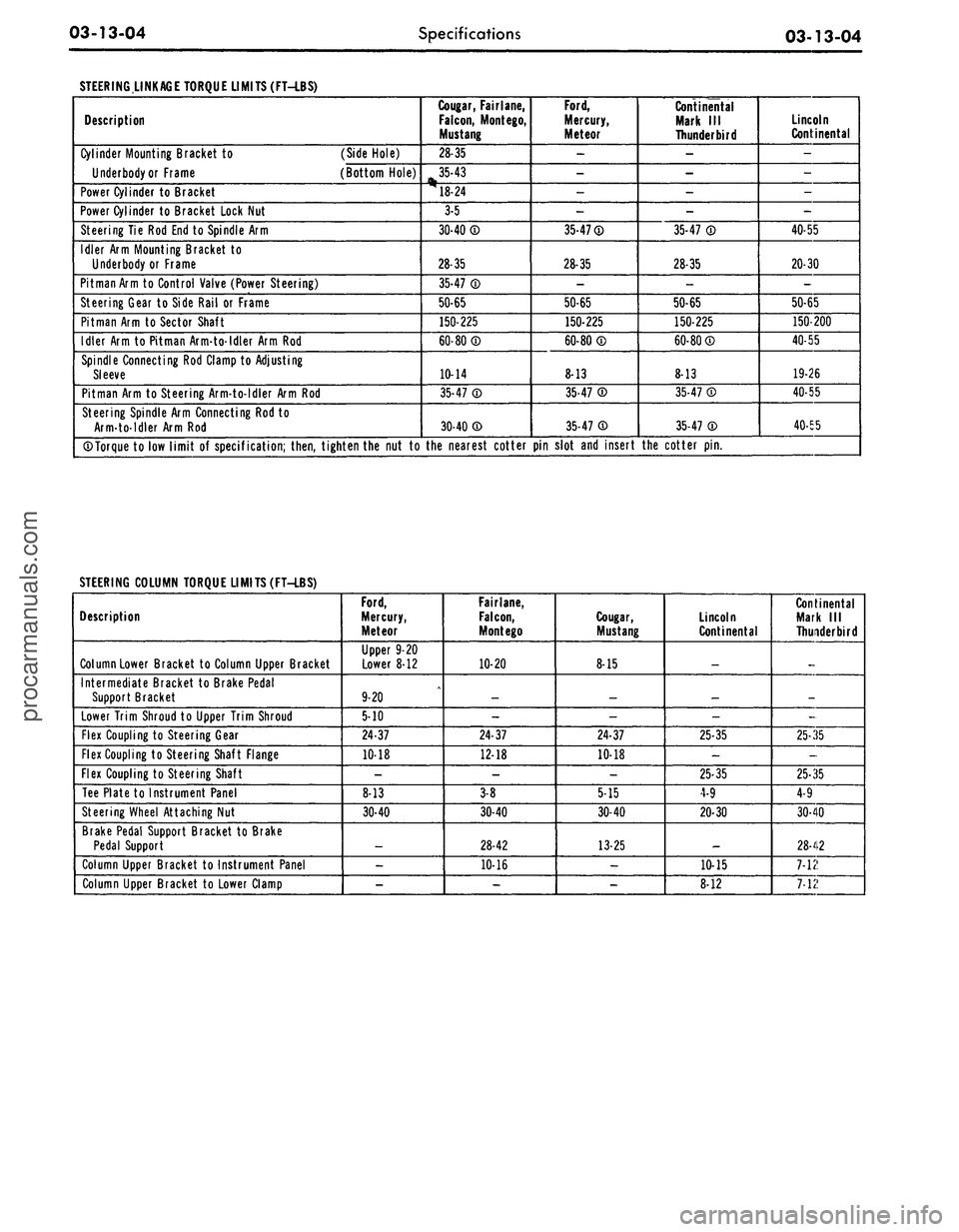
STEERING LINKAGE TORQUE LIMITS (FT-LBS)
Description
Cylinder Mounting Bracket
to
(Side Hole)
Underbodyor Frame (Bottom Hole)
Power Cylinder
to
Bracket
Power Cylinder
to
Bracket Lock
Nut
Steering
Tie Rod End to
Spindle
Arm
Idler
Arm
Mounting Bracket
to
Underbody
or
Frame
Pitman Arm
to
Control Valve (Power Steering)
Steering Gear
to
Side Rail
or
Frame
Pitman
Arm to
Sector Shaft
Idler
Arm to
Pitman Arm-to-ldler
Arm Rod
Spindle Connecting
Rod
Clamp
to
Adjusting
Sleeve
Pitman
Arm to
Steering Arm-to-ldler
Arm Rod
Steering Spindle
Arm
Connecting
Rod to
Arm-to-ldler
Arm Rod
Cougar, Fairlane,
Falcon,
Mont
ego,
Mustang
28-35
35-43
18-24
3-5
30-40
©
28-35
35-47
©
50-65
150-225
60-80®
10-14
35-47
©
30-40
©
Ford,
Mercury,
Meteor
-
-
-
-
35-47®
28-35
-
50-65
150-225
60-80
®
8-13
35-47
©
35-47
®
Continental
Mark
III
Thunder bird
-
-
-
-
35-47
©
28-35
-
50-65
150-225
60-80
©
8-13
35-47
©
35-47
©
Lincoln
Continental
-
-
-
-
40-55
20-30
-
50-65
150-200
40-55
19-26
40-55
40-55
CD
Torque
to low
limit
of
specification;
then,
tighten
the nut to the
nearest cotter
pin
slot
and
insert
the
cotter
pin.
STEERING COLUMN TORQUE LIMITS (FT-LBS)
Description
Column Lower Bracket
to
Column Upper Bracket
Intermediate Bracket
to
Brake Pedal
Support Bracket
Lower Trim Shroud
to
Upper Trim Shroud
Flex Coupling
to
Steering Gear
Flex Coupling
to
Steering Shaft Flange
Flex Coupling
to
Steering Shaft
Tee Plate
to
Instrument Panel
Steering Wheel Attaching
Nut
Brake Pedal Support Bracket
to
Brake
Pedal Support
Column Upper Bracket
to
Instrument Panel
Column Upper Bracket
to
Lower Clamp
Ford,
Mercury,
Meteor
Upper
9-20
Lower
8-12
9-20
5-10
24-37
10-18
-
8-13
30-40
_
-
-
Fairlane,
Falcon,
Mont
ego
10-20
_
-
24-37
12-18
-
3-8
30-40
28-42
10-16
-
Cougar,
Mustang
8-15
_
-
24-37
10-18
-
5-15
30-40
13-25
-
-
Lincoln
Continental
_
_
-
25-35
-
25-35
4-9
20-30
_
10-15
8-12
Continental
Mark
III
Thunder bird
_
_
-
25-35
-
25-35
4-9
30-40
28-42
7-12
7-1?procarmanuals.com
Page 184 of 413
03-13-05
Specifications
03-13-05
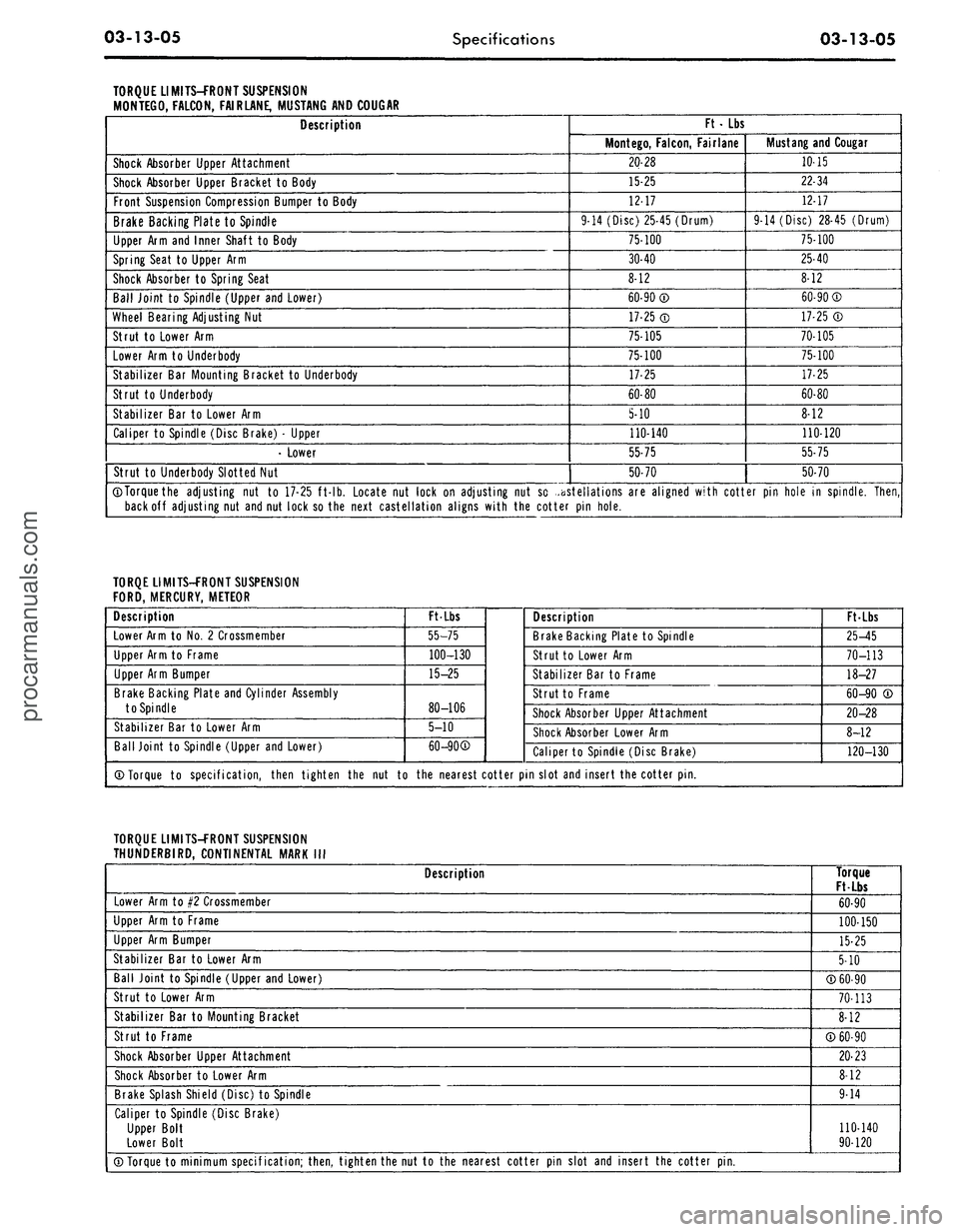
TORQUE LIMITS-FRONT SUSPENSION
MONTEGO, FALCON,
FAIR
LANE,
MUSTANG AND COUGAR
Description
Shock Absorber Upper Attachment
Shock Absorber Upper Bracket to Body
Front Suspension Compression Bumper to Body
Brake Backing Plate to Spindle
Upper Arm and Inner Shaft to Body
Spring Seat to Upper Arm
Shock Absorber to Spring Seat
Ball Joint to Spindle (Upper and Lower)
Wheel Bearing Adjusting Nut
Strut to Lower Arm
Lower Arm to Underbody
Stabilizer Bar Mounting Bracket to Underbody
Strut to Underbody
Stabilizer Bar to Lower Arm
Caliper to Spindle (Disc Brake) • Upper
- Lower
Strut to Underbody Slotted Nut
Ft • Lbs
Montego, Falcon, Fairlane
20-28
15-25
12-17
9-14 (Disc) 25-45 (Drum)
75-100
30-40
8-12
60-90 ©
17-25 ©
75-105
75-100
17-25
60-80
5-10
110-140
55-75
Mustang and Cougar
10-15
22-34
12-17
9-14 (Disc) 28-45 (Drum)
75-100
25-40
8-12
60-90 ©
17-25 ©
70-105
75-100
17-25
60-80
8-12
110-120
55-75
50-70 | 50-70
©Torquethe adjusting nut to 17-25 ft-lb. Locate nut lock on adjusting nut so ,ctstellations are aligned with cotter pin hole in spindle. Then,
backoff adjusting nut and nut lock so the next castellation aligns with the cotter pin hole.
TORQE LIMITS-fRONT SUSPENSION
FORD,
MERCURY, METEOR
Description
Lower Arm to No. 2 Crossmember
Upper Arm to Frame
Upper Arm Bumper
Brake Backing Plate and Cylinder Assembly
to Spindle
Stabilizer Bar to Lower Arm
Ball Joint to Spindle (Upper and Lower)
Ft Lbs
55-75
100-130
15-25
80-106
5-10
60-90®
Description
Brake Backing Plate to Spindle
Strut to Lower Arm
Stabilizer Bar to Frame
Strut to Frame
Shock Absorber Upper Attachment
Shock Absorber Lower Arm
Caliper to Spindle (Disc Brake)
Ft-Lbs
25-45
70-113
18-27
60-90 ©
20-28
8 12
120-130
©Torque to specification, then tighten the nut to the nearest cotter pin slot and insert the cotter pin.
TORQUE LIMITS-FRONT SUSPENSION
THUNDERBIRD, CONTINENTAL MARK
Description
Lower Arm to #2 Crossmember
Upper Arm to Frame
Upper Arm Bumper
Stabilizer Bar to Lower Arm
Ball Joint to Spindle (Upper and Lower)
Strut to Lower Arm
Stabilizer Bar to Mounting Bracket
Strut to Frame
Shock Absorber Upper Attachment
Shock Absorber to Lower Arm
Brake Splash Shield (Disc) to Spindle
Caliper to Spindle (Disc Brake)
Upper Bolt
Lower Bolt
Torque
Ft-Lbs
60-90
100-150
15-25
5-10
©60-90
70-113
8-12
©60-90
20-23
8-12
9-14
110-140
90-120
©Torque to minimum specification;
then,
tighten the nut to the nearest cotter pin slot and insert the cotter pin.procarmanuals.com
Page 185 of 413
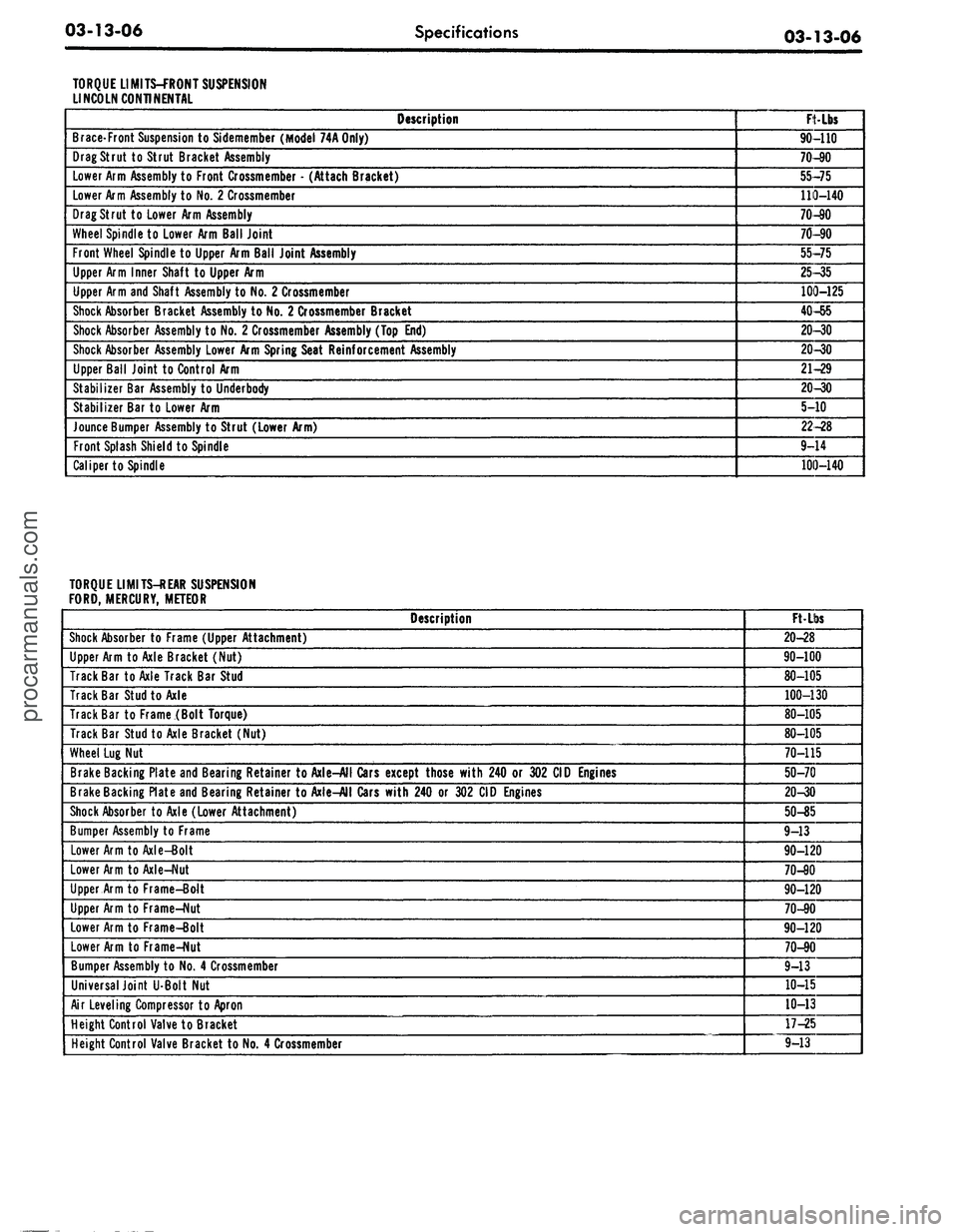
03-13-06
Specifications
03-13-06
TORQUE LIMITS-FRONT SUSPENSION
LINCOLN CONTINENTAL
Description
Brace-Front Suspension to Sidemember (Model 74A Only)
Drag Strut
to
Strut Bracket Assembly
Lower Arm Assembly to Front Crossmember
-
(Attach Bracket)
Lower Arm Assembly to No. 2 Crossmember
Drag Strut
to
Lower Arm Assembly
Wheel Spindle to Lower Arm Ball Joint
Front Wheel Spindle to Upper Arm Ball Joint Assembly
Upper Arm Inner Shaft
to
Upper Arm
Upper Arm and Shaft Assembly to No. 2 Crossmember
Shock Absorber Bracket Assembly to No. 2 Crossmember Bracket
Shock Absorber Assembly to No. 2 Crossmember Assembly (Top End)
Shock Absorber Assembly Lower Arm Spring Seat Reinforcement Assembly
Upper Ball Joint
to
Control Arm
Stabilizer Bar Assembly
to
Underbody
Stabilizer Bar
to
Lower Arm
Jounce Bumper Assembly
to
Strut (Lower Arm)
Front Splash Shield to Spindle
Caliper to Spindle
FtLbs
90-110
70-90
55-75
110-140
70-90
70-90
55-75
25-35
100-125
40-55
20-30
20-30
21-29
20-30
5-10
22-28
9-14
100-140
TORQUE LIMITS-REAR SUSPENSION
FORD, MERCURY, METEOR
Description
Shock Absorber
to
Frame (Upper Attachment)
Upper Arm to Axle Bracket (Nut)
Track Bar to Axle Track Bar Stud
Track Bar Stud to Axle
Track Bar
to
Frame (Bolt Torque)
Track Bar Stud to Axle Bracket (Nut)
Wheel Lug Nut
Brake Backing Plate and Bearing Retainer to Axle-All Cars except those with 240
or
302 CID Engines
Brake Backing Plate and Bearing Retainer to Axle-All Cars with 240
or
302 CID Engines
Shock Absorber to Axle (Lower Attachment)
Bumper Assembly
to
Frame
Lower Arm to Axle-Bolt
Lower Arm to Axle-Nut
Upper Arm
to
Frame-BoU
Upper Arm
to
Frame-Nut
Lower Arm
to
Frame-Bolt
Lower Arm
to
Frame-Nut
Bumper Assembly to No. 4 Crossmember
Universal Joint
U-Bolt
Nut
Air Leveling Compressor
to
Apron
Height Control Valve to Bracket
Height Control Valve Bracket to No. 4 Crossmember
FtLbs
20-28
90-100
80-105
100-130
80-105
80-105
70-115
50-70
20-30
50-35
9-13
90-120
70-90
90-120
70-90
90-120
70-90
9-13
10-15
10-13
17-25
9-13procarmanuals.com
Page 186 of 413
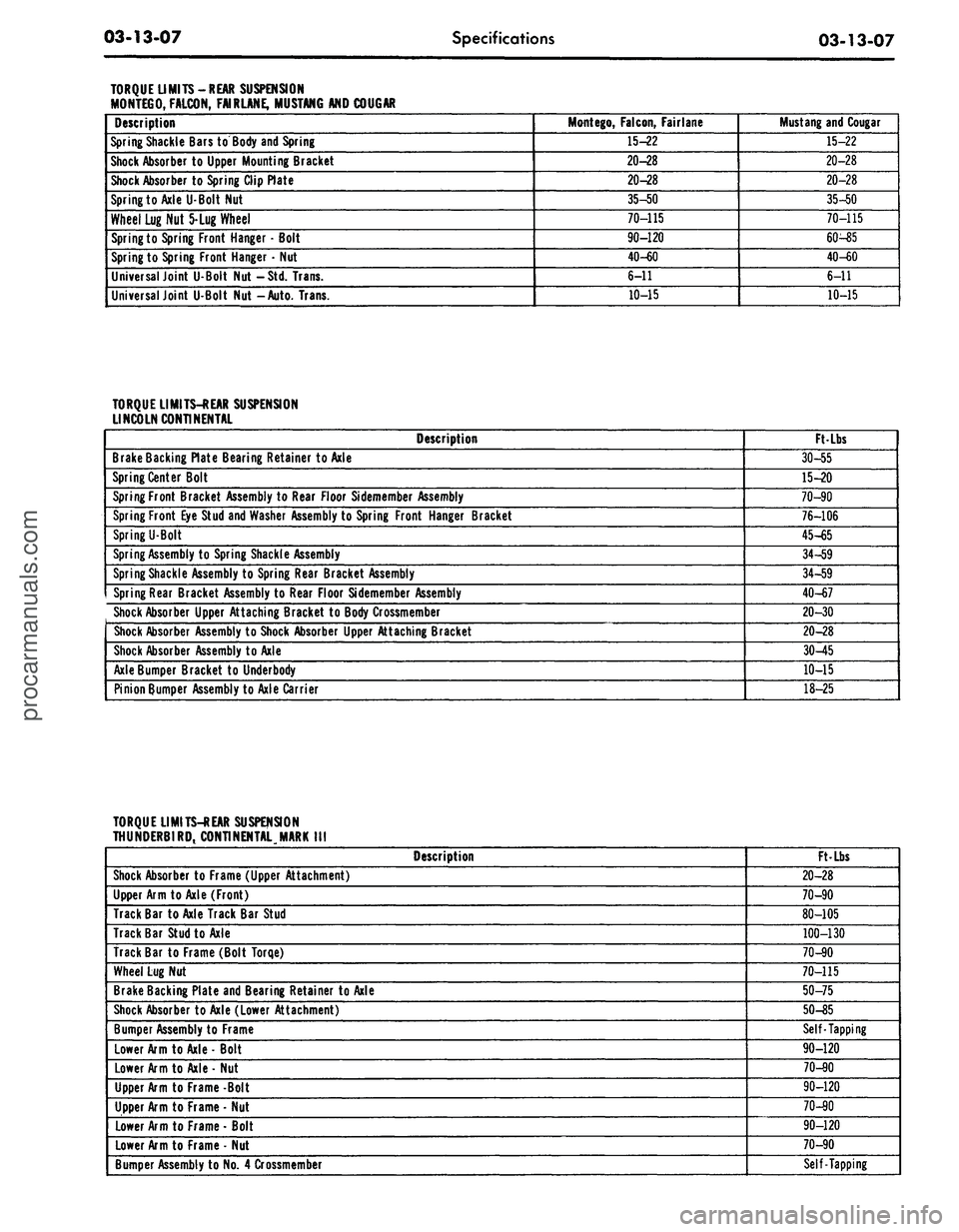
03-13-07
Specifications
03-13-07
TORQUE LIMITS-REAR SUSPENSION
MONTEGO, FALCON, FAIR LANE, MUSTANG AND COUGAR
Description
Spring Shackle Bars to Body and Spring
Shock Absorber
to
Upper Mounting Bracket
Shock Absorber to Spring Clip Plate
Spring to Axle U-Bolt Nut
Wheel Lug Nut 5-Lug Wheel
Spring to Spring Front Hanger
•
Bolt
Spring to Spring Front Hanger
•
Nut
Universal Joint U-Bolt Nut -Std. Trans.
Universal Joint U-Bolt Nut -Auto. Trans.
Mont
ego,
Falcon, Fair lane
15-22
20-28
20-28
35-50
70-115
90-120
40-60
6-11
10-15
Mustang and Cougar
15-22
20-28
20-28
35-50
70-115
60-85
40-60
6-11
10-15
TORQUE LIMITS-REAR SUSPENSION
LINCOLN CONTINENTAL
Description
Brake Backing Plate Bearing Retainer to Axle
Spring Center Bolt
Spring Front Bracket Assembly to Rear Floor Sidemember Assembly
Spring Front Eye Stud and Washer Assembly to Spring Front Hanger Bracket
Spring U-Bolt
Spring Assembly
to
Spring Shackle Assembly
Spring Shackle Assembly
to
Spring Rear Bracket Assembly
Spring Rear Bracket Assembly
to
Rear Floor Sidemember Assembly
Shock Absorber Upper Attaching Bracket
to
Body Crossmember
Shock Absorber Assembly
to
Shock Absorber Upper Attaching Bracket
Shock Absorber Assembly to Axle
Axle Bumper Bracket
to
Underbody
Pinion Bumper Assembly to Axle Carrier
Ft Lbs
30-55
15-20
70-90
76-106
45-65
34-59
34-59
40-67
20-30
20-28
30-45
10-15
18-25
TORQUE LIMITS-REAR SUSPENSION
THUNDERBIRD, CONTINENTAL.MARK
III
Description
Shock Absorber
to
Frame (Upper Attachment)
Upper Arm
to
Axle (Front)
Track Bar to Axle Track Bar Stud
Track Bar Stud to Axle
Track Bar
to
Frame (Bolt Torqe)
Wheel Lug Nut
Brake Backing Plate and Bearing Retainer
to
Axle
Shock Absorber to Axle (Lower Attachment)
Bumper Assembly to Frame
Lower Arm
to
Axle - Bolt
Lower Arm
to
Axle- Nut
Upper Arm
to
Frame -Bolt
Upper Arm
to
Frame
•
Nut
Lower Arm
to
Frame • Bolt
Lower Arm to Frame
-
Nut
Bumper Assembly to No. 4 Crossmember
Ft-Lbs
20-28
70-90
80-105
100-130
70-90
70-115
50-75
50-85
Self-Tapping
90-120
70-80
90-120
70-90
90-120
70-90
Self-Tappingprocarmanuals.com