light FORD MUSTANG 2001 4.G Owner's Manual
[x] Cancel search | Manufacturer: FORD, Model Year: 2001, Model line: MUSTANG, Model: FORD MUSTANG 2001 4.GPages: 240, PDF Size: 2.11 MB
Page 71 of 240
INTERIOR LUGGAGE COMPARTMENT
RELEASE
Your vehicle is equipped with a mechanical interior
luggage compartment release handle that provides a
means of escape for children and adults in the event
they become locked inside the luggage compartment.
Adults are advised to familiarize themselves with the
operation and location of the release handle.
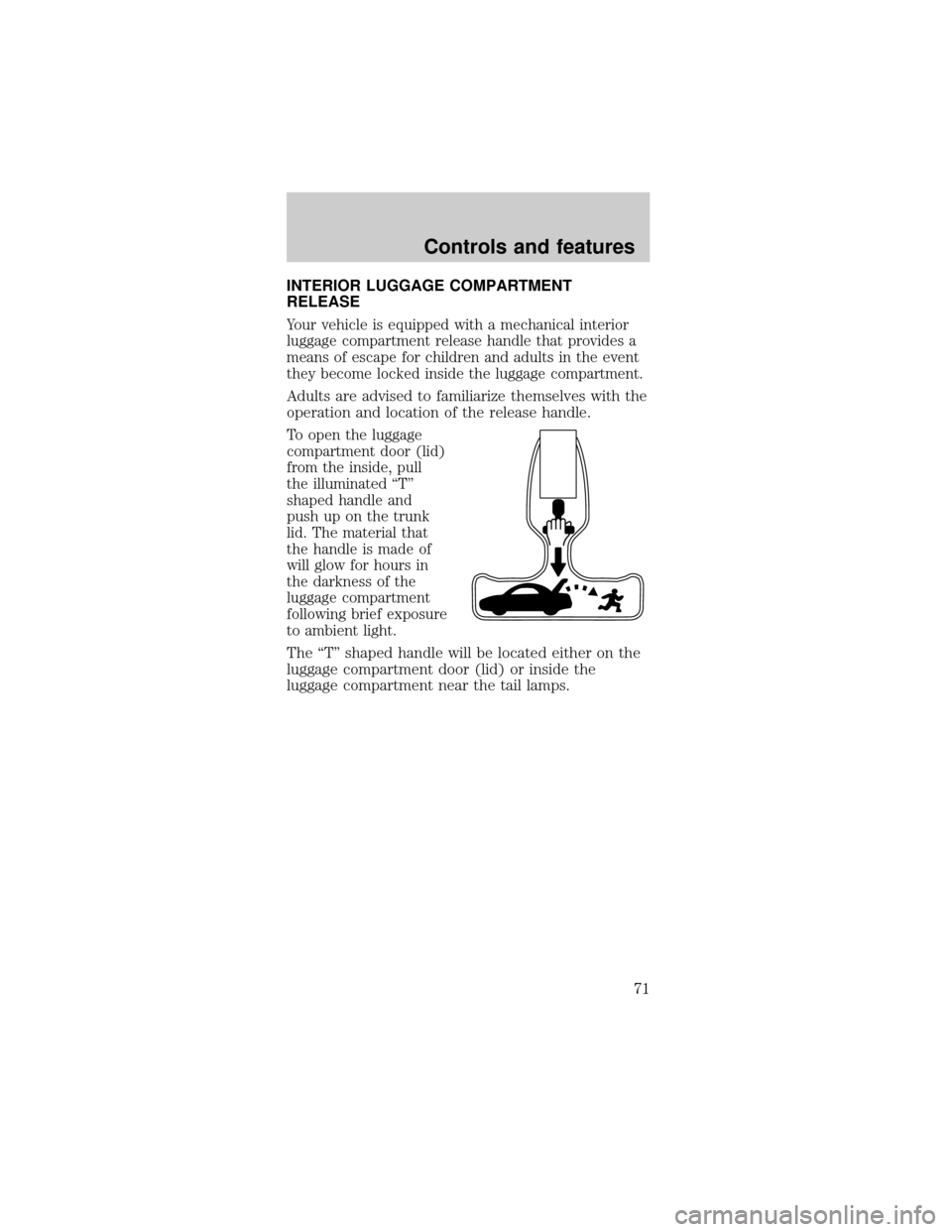
To open the luggage
compartment door (lid)
from the inside, pull
the illuminated ªTº
shaped handle and
push up on the trunk
lid. The material that
the handle is made of
will glow for hours in
the darkness of the
luggage compartment
following brief exposure
to ambient light.
The ªTº shaped handle will be located either on the
luggage compartment door (lid) or inside the
luggage compartment near the tail lamps.
Controls and features
71
Page 82 of 240
BELT AND RETRACTOR ASSEMBLY MUST
BE REPLACED if the seat belt assembly
ªautomatic locking retractorº feature or any other
seat belt function is not operating properly when
checked according to the procedures in Workshop
Manual.
Failure to replace the Belt and Retractor
assembly could increase the risk of injury in
collisions.
Safety belt extension assembly
If the safety belt is too short when fully extended,
there is a 20 cm (8 inch) safety belt extension
assembly that can be added (part number 611C22).
This assembly can be obtained from your dealer at
no cost.
Use only extensions manufactured by the same
supplier as the safety belt. Manufacturer
identification is located at the end of the webbing on
the label. Also, use the safety belt extension only if
the safety belt is too short for you when fully
extended. Do not use extensions to change the fit of
the shoulder belt across the torso.
Safety belt warning light and indicator
chime
The seat belt warning light illuminates in the
instrument cluster and a chime sounds to remind
the occupants to fasten their safety belts.
Seating and safety restraints
82
Page 83 of 240
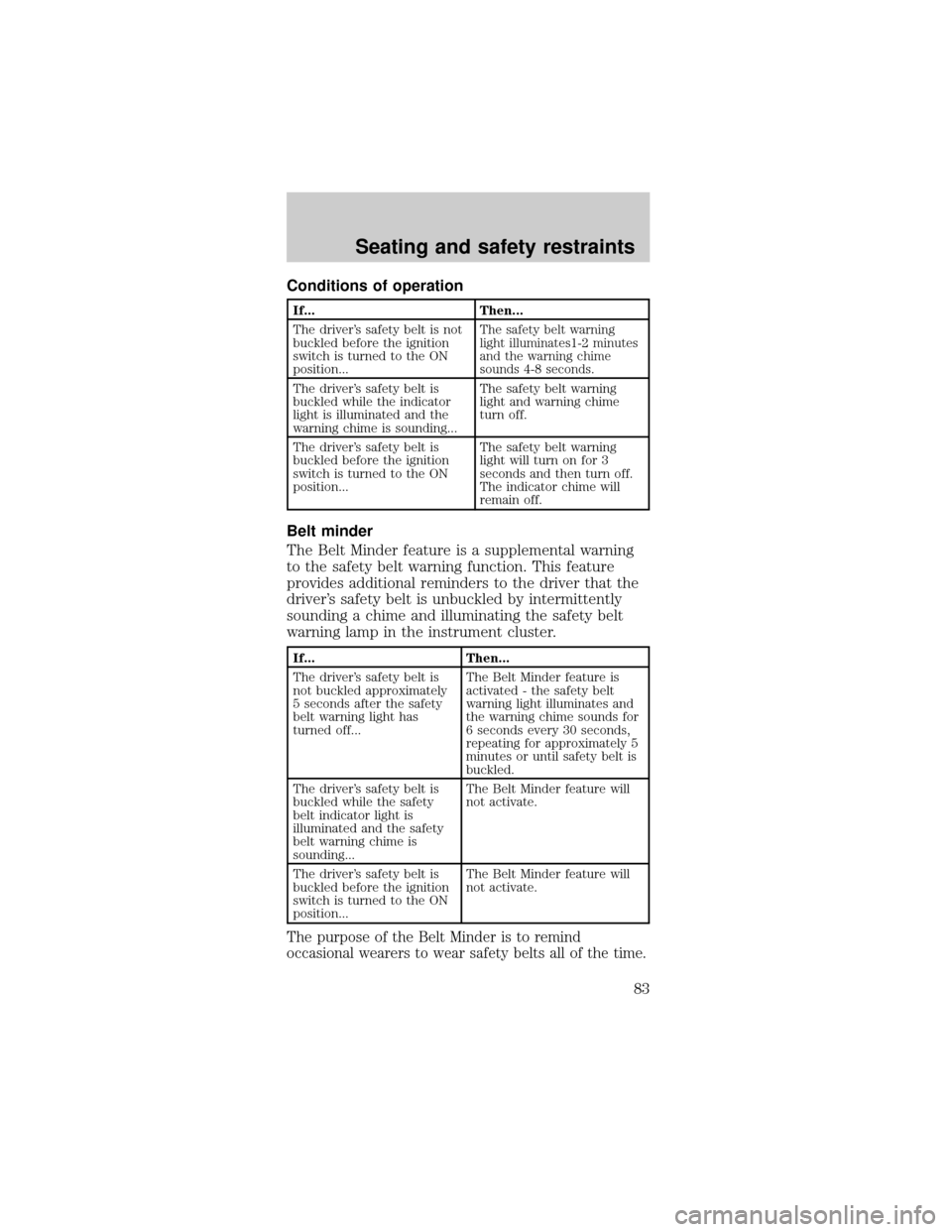
Conditions of operation
If... Then...
The driver's safety belt is not
buckled before the ignition
switch is turned to the ON
position...
The safety belt warning
light illuminates1-2 minutes
and the warning chime
sounds 4-8 seconds.
The driver's safety belt is
buckled while the indicator
light is illuminated and the
warning chime is sounding...The safety belt warning
light and warning chime
turn off.
The driver's safety belt is
buckled before the ignition
switch is turned to the ON
position...The safety belt warning
light will turn on for 3
seconds and then turn off.
The indicator chime will
remain off.
Belt minder
The Belt Minder feature is a supplemental warning
to the safety belt warning function. This feature
provides additional reminders to the driver that the
driver's safety belt is unbuckled by intermittently
sounding a chime and illuminating the safety belt
warning lamp in the instrument cluster.
If... Then...
The driver's safety belt is
not buckled approximately
5 seconds after the safety
belt warning light has
turned off...The Belt Minder feature is
activated - the safety belt
warning light illuminates and
the warning chime sounds for
6 seconds every 30 seconds,
repeating for approximately 5
minutes or until safety belt is
buckled.
The driver's safety belt is
buckled while the safety
belt indicator light is
illuminated and the safety
belt warning chime is
sounding...The Belt Minder feature will
not activate.
The driver's safety belt is
buckled before the ignition
switch is turned to the ON
position...The Belt Minder feature will
not activate.
The purpose of the Belt Minder is to remind
occasional wearers to wear safety belts all of the time.
Seating and safety restraints
83
Page 84 of 240
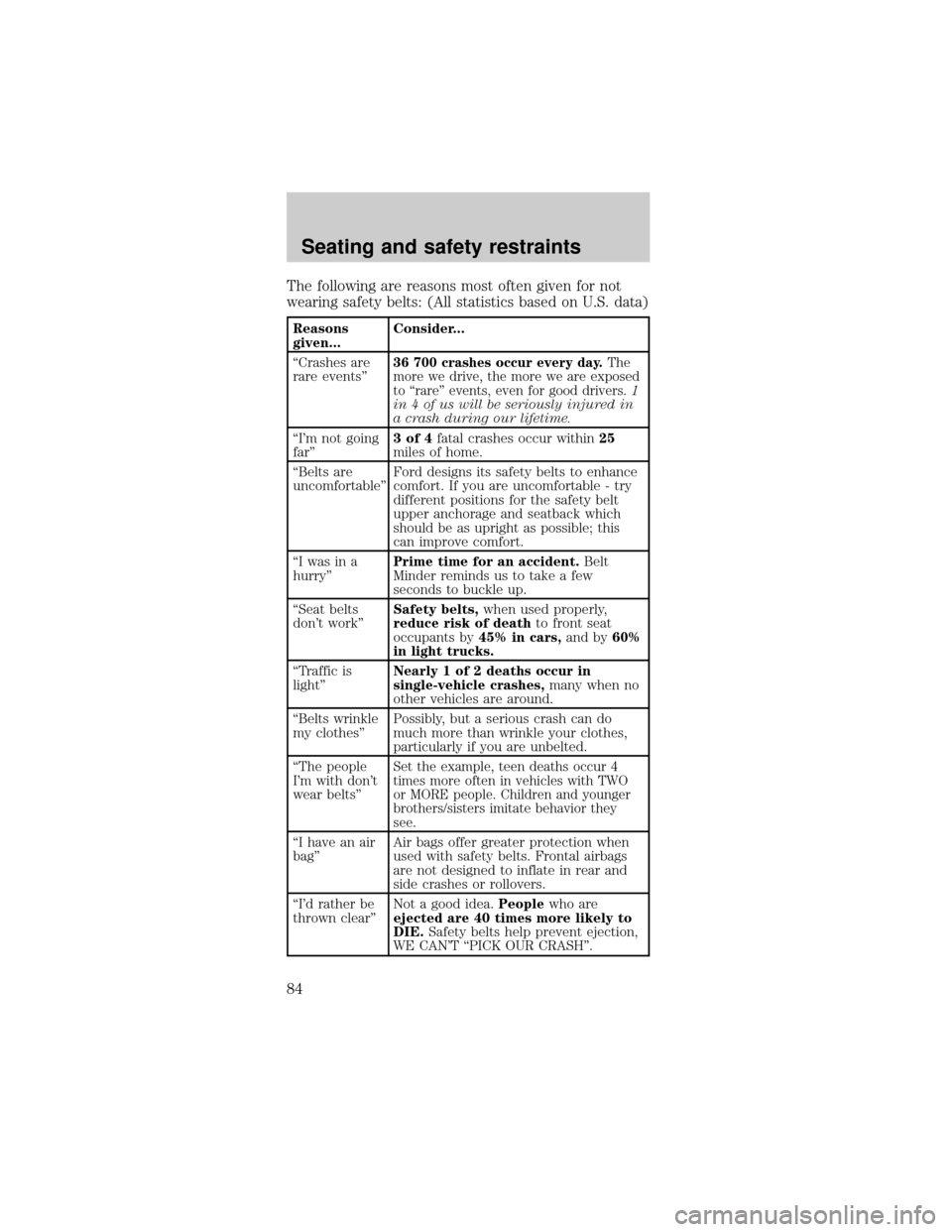
The following are reasons most often given for not
wearing safety belts: (All statistics based on U.S. data)
Reasons
given...Consider...
ªCrashes are
rare eventsº
36 700 crashes occur every day.The
more we drive, the more we are exposed
to ªrareº events, even for good drivers.1
in 4 of us will be seriously injured in
a crash during our lifetime.
ªI'm not going
farº3of4fatal crashes occur within25
miles of home.
ªBelts are
uncomfortableºFord designs its safety belts to enhance
comfort. If you are uncomfortable - try
different positions for the safety belt
upper anchorage and seatback which
should be as upright as possible; this
can improve comfort.
ªI was in a
hurryºPrime time for an accident.Belt
Minder reminds us to take a few
seconds to buckle up.
ªSeat belts
don't workºSafety belts,when used properly,
reduce risk of deathto front seat
occupants by45% in cars,and by60%
in light trucks.
ªTraffic is
lightºNearly 1 of 2 deaths occur in
single-vehicle crashes,many when no
other vehicles are around.
ªBelts wrinkle
my clothesºPossibly, but a serious crash can do
much more than wrinkle your clothes,
particularly if you are unbelted.
ªThe people
I'm with don't
wear beltsº
Set the example, teen deaths occur 4
times more often in vehicles with TWO
or MORE people. Children and younger
brothers/sisters imitate behavior they
see.
ªI have an air
bagºAir bags offer greater protection when
used with safety belts. Frontal airbags
are not designed to inflate in rear and
side crashes or rollovers.
ªI'd rather be
thrown clearºNot a good idea.Peoplewho are
ejected are 40 times more likely to
DIE.Safety belts help prevent ejection,
WE CAN'T ªPICK OUR CRASHº.
Seating and safety restraints
84
Page 86 of 240

2. Wait until the safety belt warning light turns off.
(Approximately 1±2 minutes)
²Steps 3±5 must be completed within 60 seconds
or the procedure will have to be repeated
3. Buckle then unbuckle the safety belt three times,
ending with the safety belt unbuckled. This can be
done before or during Belt Minder warning
activation.
4. Turn on the parklamps/headlamps, turn off the
parklamps/headlamps.
5. Buckle then unbuckle the safety belt three times,
ending with the safety belt unbuckled.
²After step 5 the safety belt warning light will be
turned on for three seconds
6. Within seven seconds of the safety belt warning
light turning off, buckle then unbuckle the safety
belt.
²This will disable Belt Minder if it is currently
enabled, or enable Belt Minder if it is currently
disabled
7. Confirmation of disabling Belt Minder is provided
by the safety belt warning light flashing four times
per second for three seconds.
8. Confirmation of enabling Belt Minder is provided
by:
²The safety belt warning light flashing four times
per second for three seconds
²Followed by three seconds with the safety belt
warning light off
²Once again, the safety belt warning light will flash
four times per second for three seconds.
9. After receiving confirmation, the
deactivation/activation procedure is complete.
Seating and safety restraints
86
Page 89 of 240
All occupants of the vehicle, including the
driver, should always properly wear their
safety belts, even when an air bag SRS is provided.
Always transport children 12 years old and
under in the back seat and always properly
use appropriate child restraints.
National Highway Traffic Safety
Administration (NHTSA) recommends a
minimum distance of at least 25 cm (10 inches)
between an occupant's chest and the driver air bag
module.
Never place your arm over the air bag
module as a deploying air bag can result in
serious arm fractures or other injuries.
Steps you can take to properly position yourself
away from the air bag:
²Move your seat to the rear as far as you can while
still reaching the pedals comfortably.
²Recline the seat slightly (one or two degrees)
from the upright position.
Do not put anything on or over the air bag
module. Placing objects on or over the air
bag inflation area may cause those objects to be
propelled by the air bag into your face and torso
causing serious injury.
Do not attempt to service, repair, or modify
the Air Bag Supplemental Restraint System
or its fuses. See your Ford or Lincoln Mercury
dealer.
Seating and safety restraints
89
Page 92 of 240
considerable force, there is the risk of death or
serious injuries such as fractures, facial and eye
injuries or internal injuries, particularly to occupants
who are not properly restrained or are otherwise out
of position at the time of air bag deployment. Thus,
it is extremely important that occupants be properly
restrained as far away from the air bag module as
possible while maintaining vehicle control.
The SRS consists of:
²driver and passenger air bag modules (which
include the inflators and air bags),
²one or more impact and safing sensors,
²a readiness light and tone
²a diagnostic module
²and the electrical wiring which connects the
components.
The diagnostic module monitors its own internal
circuits and the supplemental air bag electrical
system warning (including the impact sensors), the
system wiring, the air bag system readiness light, the
air bag back up power and the air bag ignitors.
Several air bag system components get hot
after inflation. Do not touch them after
inflation.
If the air bag has deployed,the air bag will
not function again and must be replaced
immediately.If the air bag is not replaced, the
unrepaired area will increase the risk of injury in a
collision.
Determining if the system is operational
The SRS uses a readiness light in the instrument
cluster or a tone to indicate the condition of the
system. Refer to theAir bag readinesssection in
theInstrumentationchapter. Routine maintenance
of the air bag is not required.
Seating and safety restraints
92
Page 93 of 240

A difficulty with the system is indicated by one or
more of the following:
²The readiness light
will either flash or
stay lit.
²The readiness light will not illuminate immediately
after ignition is turned on.
²A series of five beeps will be heard. The tone
pattern will repeat periodically until the problem
and/or light are repaired.
If any of these things happen, even intermittently,
have the SRS serviced at your dealership or by a
qualified technician immediately. Unless serviced,
the system may not function properly in the event of
a collision.
Disposal of air bags and air bag equipped
vehicles (including pretensioners)
For disposal of air bags or air bag equipped vehicles,
see your local dealership or qualified technician. Air
bags MUST BE disposed of by qualified personnel.
SAFETY RESTRAINTS FOR CHILDREN
See the following sections for directions on how to
properly use safety restraints for children. Also see
Air Bag Supplemental Restraint System (SRS)in
this chapter for special instructions about using air
bags.
Important child restraint precautions
You are required by law to use safety restraints for
children in the U.S. and Canada. If small children
ride in your vehicle (generally children who are four
years old or younger and who weigh 18 kg [40 lbs]
or less), you must put them in safety seats made
especially for children. Check your local and state or
provincial laws for specific requirements regarding
the safety of children in your vehicle.
AIR
BAG
Seating and safety restraints
93
Page 105 of 240
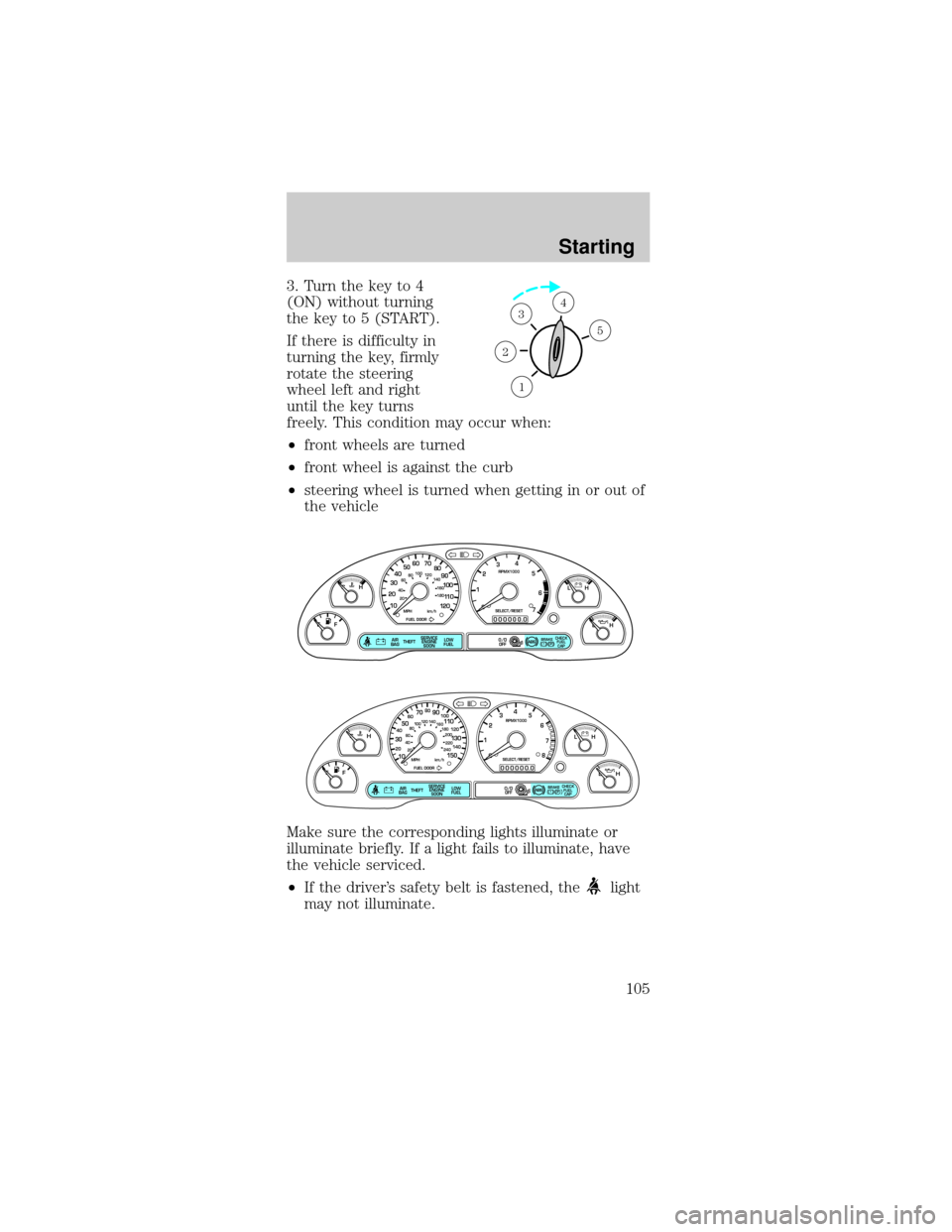
3. Turn the key to 4
(ON) without turning
the key to 5 (START).
If there is difficulty in
turning the key, firmly
rotate the steering
wheel left and right
until the key turns
freely. This condition may occur when:
²front wheels are turned
²front wheel is against the curb
²steering wheel is turned when getting in or out of
the vehicle
Make sure the corresponding lights illuminate or
illuminate briefly. If a light fails to illuminate, have
the vehicle serviced.
²If the driver's safety belt is fastened, the
light
may not illuminate.
1
2
34
5
P! BRAKE
L
0
00000 00
C
E
FH
LH
10 203020 406080100
120
140
160
180
405060 70
80
90
100
11 0
1204
5
6
7 3
2
1
H
THEFT
RPMX1000
FUEL DOORSELECT/RESET
LOW
FUELO/D
OFF AIR
BAGSERVICE
ENGINE
SOON
MPH km/h
ABS
.
CHECK
FUEL
CAP
P! BRAKE
L
0
00000 00
C
E
FH
LH
102040608020 40608010 012 0 14 0
160
180
200
220
240
100
120
140
305070 90
110
13 0
1504
5
6
7
8 3
2
1
H
THEFT
RPMX1000
FUEL DOORSELECT/RESET
LOW
FUELO/D
OFF AIR
BAGSERVICE
ENGINE
SOON
MPH km/h
ABS
.
CHECK
FUEL
CAP
Starting
105
Page 108 of 240

BRAKES
Your service brakes are self-adjusting. Refer to the
scheduled maintenance guide for scheduled
maintenance.
Occasional brake noise is normal and often does not
indicate a performance concern with the vehicle's
brake system. In normal operation, automotive brake
systems may emit occasional or intermittent squeal
or groan noises when the brakes are applied. Such
noises are usually heard during the first few brake
applications in the morning; however, they may be
heard at any time while braking and can be
aggravated by environmental conditions such as
cold, heat, moisture, road dust, salt or mud. If a
ªmetal-to-metal,º ªcontinuous grindingº or
ªcontinuous squealº sound is present while braking,
the brake linings may be worn-out and should be
inspected by a qualified service technician.
Anti-lock brake system (ABS)
On vehicles equipped with an anti-lock braking
system (ABS), a noise from the hydraulic pump
motor and pulsation in the pedal may be observed
during ABS braking events. Pedal pulsation coupled
with noise while braking under panic conditions or
on loose gravel, bumps, wet or snowy roads is
normal and indicates proper functioning of the
vehicle's anti-lock brake system. The ABS performs a
self-check after you start the engine and begin to
drive away. A brief mechanical noise may be heard
during this test. This is normal. If a malfunction is
found, the ABS warning light will come on. If the
vehicle has continuous vibration or shudder in the
steering wheel while braking, the vehicle should be
inspected by a qualified service technician.
Driving
108