wheel torque FORD MUSTANG 2013 5.G Shelby GT500 Supplement Manual
[x] Cancel search | Manufacturer: FORD, Model Year: 2013, Model line: MUSTANG, Model: FORD MUSTANG 2013 5.GPages: 63, PDF Size: 0.9 MB
Page 1 of 63
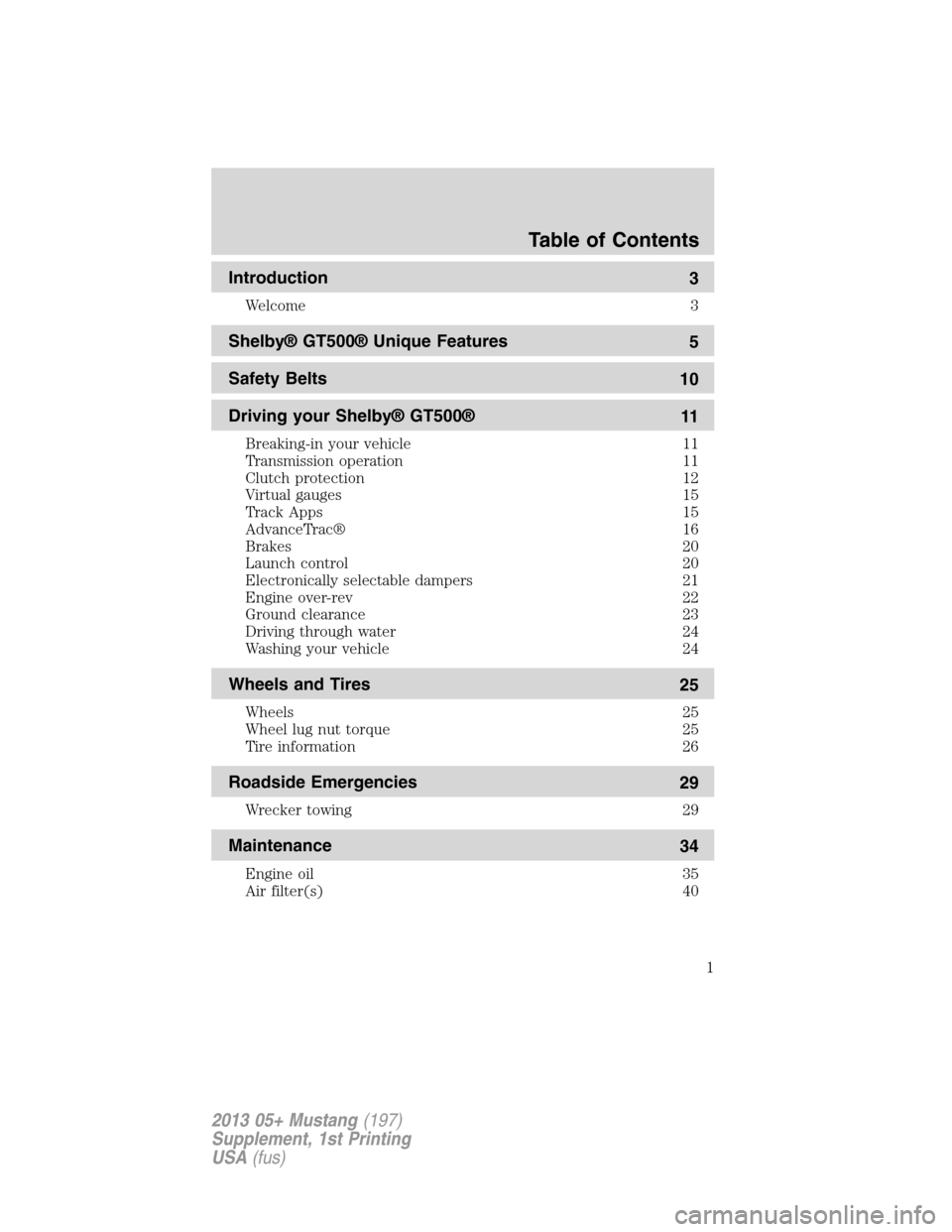
Introduction
3
Welcome 3
Shelby® GT500® Unique Features
5
Safety Belts
10
Driving your Shelby® GT500®
11
Breaking-in your vehicle 11
Transmission operation 11
Clutch protection 12
Virtual gauges 15
Track Apps 15
AdvanceTrac® 16
Brakes 20
Launch control 20
Electronically selectable dampers 21
Engine over-rev 22
Ground clearance 23
Driving through water 24
Washing your vehicle 24
Wheels and Tires
25
Wheels 25
Wheel lug nut torque 25
Tire information 26
Roadside Emergencies
29
Wrecker towing 29
Maintenance
34
Engine oil 35
Air filter(s) 40
Table of Contents
1
2013 05+ Mustang(197)
Supplement, 1st Printing
USA(fus)
Page 12 of 63
4. Move the gearshift lever to first gear, then slowly release the clutch
pedal while slowly pressing on the accelerator.
Note:During each shift, the clutch pedal must be fully pressed to the
floor and the accelerator fully released. Failure to follow this may cause
increased shift efforts, prematurely wear transmission components, or
cause gear clash or damage to the transmission. Make sure the floor mat
is properly positioned so it doesn’t interfere with the full extension of the
clutch pedal.
Note:If you attempt to shift when the drive wheels are spinning with a
loss of traction, it is possible to cause damage to the transmission. Do
not attempt to shift when the drive wheels do not have traction.
Do not drive with your foot resting on the clutch pedal or use the clutch
pedal to hold your vehicle at a standstill while waiting on a hill. These
actions will reduce the life of the clutch.
Your vehicle is equipped with a twin disc clutch. Due to the high
performance of the powertrain, a certain amount of noise from the
transmission is normal.
Clutch Protection
Your vehicle is equipped with an electronic powertrain feature to reduce
clutch damage. When excessive clutch slip is detected at a high power
level, the powertrain control module will limit torque to reduce damage
to the clutch. Full power is restored as soon as the clutch is fully
engaged. This feature is calibrated in a way that does not interfere with
normal driving and does not impede maximum acceleration capability.
Driving your Shelby® GT500®
12
2013 05+ Mustang(197)
Supplement, 1st Printing
USA(fus)
Page 22 of 63
STEERING
Your vehicle is equipped with an electric power-assisted steering system.
The system’s settings are tuned by SVT and integrated with the vehicle
dynamics.
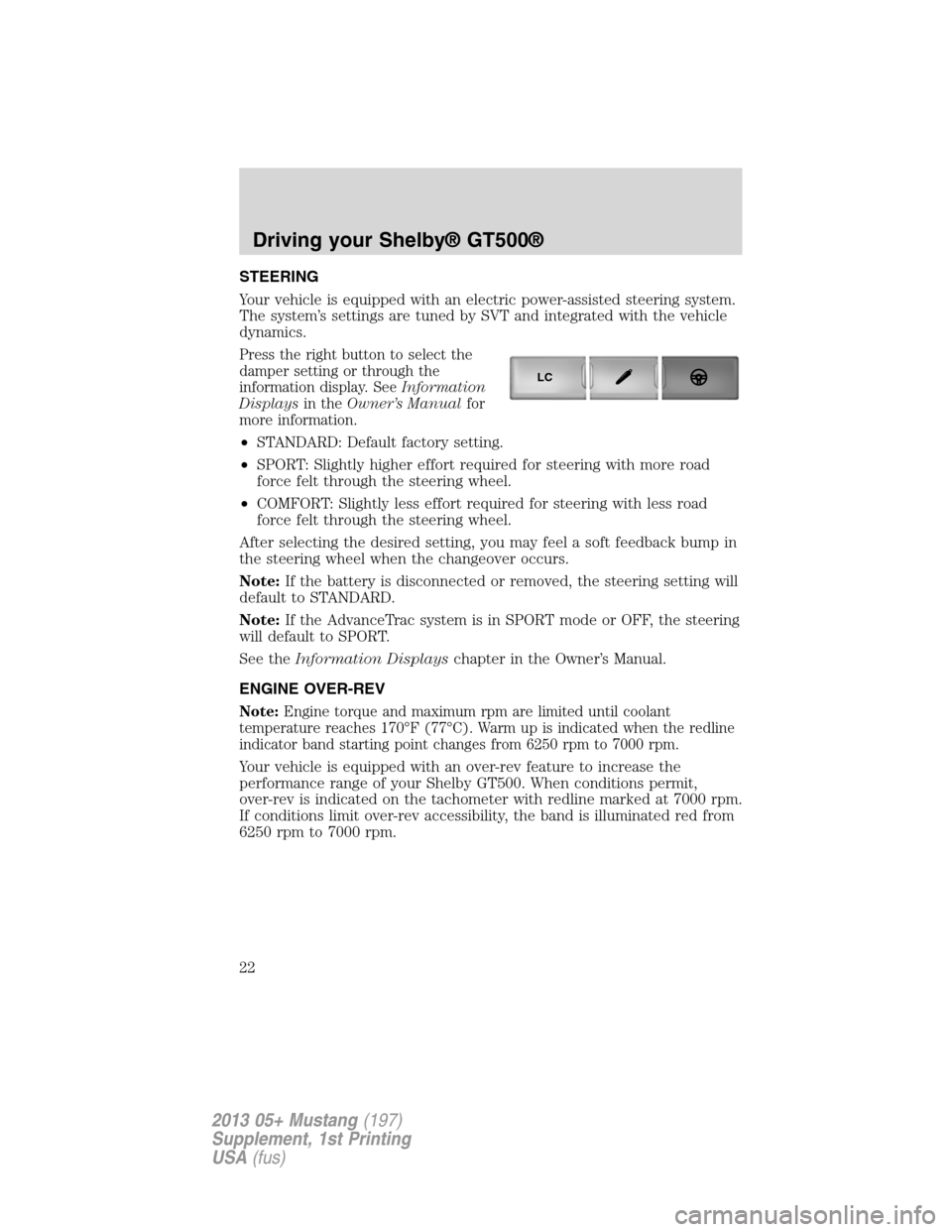
Press the right button to select the
damper setting or through the
information display. SeeInformation
Displaysin theOwner’s Manualfor
more information.
•STANDARD: Default factory setting.
•SPORT: Slightly higher effort required for steering with more road
force felt through the steering wheel.
•COMFORT: Slightly less effort required for steering with less road
force felt through the steering wheel.
After selecting the desired setting, you may feel a soft feedback bump in
the steering wheel when the changeover occurs.
Note:If the battery is disconnected or removed, the steering setting will
default to STANDARD.
Note:If the AdvanceTrac system is in SPORT mode or OFF, the steering
will default to SPORT.
See theInformation Displayschapter in the Owner’s Manual.
ENGINE OVER-REV
Note:Engine torque and maximum rpm are limited until coolant
temperature reaches 170°F (77°C). Warm up is indicated when the redline
indicator band starting point changes from 6250 rpm to 7000 rpm.
Your vehicle is equipped with an over-rev feature to increase the
performance range of your Shelby GT500. When conditions permit,
over-rev is indicated on the tachometer with redline marked at 7000 rpm.
If conditions limit over-rev accessibility, the band is illuminated red from
6250 rpm to 7000 rpm.
LC
Driving your Shelby® GT500®
22
2013 05+ Mustang(197)
Supplement, 1st Printing
USA(fus)
Page 25 of 63
WHEELS
Your SVT vehicle is equipped with unique wheels matched to the tires.
These wheels are more susceptible to damage due to their diameter,
width and low profile tires. To avoid damage to your wheels:
•Maintain proper tire pressure (seeTiresin this supplement).
•Do not drive your vehicle through an automated, commercial car wash
due to the vehicle’s low ground clearance, tire width and track. Wash
your vehicle by hand, or by using a touchless commercial wash with
no mechanical tracks on the floor. Do not use a commercial or high
pressure wand on the striped surfaces.
•When installing wheels, always torque lug nuts to specification with a
torque wrench.
•Inspect your wheels for damage on a regular basis. If a wheel is
damaged, replace it immediately.
•In the event that you encounter an abnormally harsh impact, inspect
the outer diameter of your wheels, both inside and out, for damage.
Wheel Lug Nut Torque Specifications
WARNING:When a wheel is installed, always remove any
corrosion, dirt or foreign materials present on the mounting
surfaces of the wheel or the surface of the wheel hub, brake drum or
brake disc that contacts the wheel. Make sure that any fasteners that
attach the rotor to the hub are secured so they do not interfere with
the mounting surfaces of the wheel. Installing wheels without correct
metal-to-metal contact at the wheel mounting surfaces can cause the
wheel nuts to loosen and the wheel to come off while the vehicle is in
motion, resulting in loss of control.
Retighten the lug nuts to the specified torque at 500 miles (800 km)
after any wheel disturbance (tire rotation, changing a flat tire, wheel
removal, etc.).
Bolt size Wheel lug nut torque*
ft-lb N•m
12x 20 100 135
* Torque specifications are for nut and bolt threads free of dirt and
rust. Use only Ford recommended replacement fasteners.
Wheels and Tires
25
2013 05+ Mustang(197)
Supplement, 1st Printing
USA(fus)