diesel FORD SUPER DUTY 2023 User Guide
[x] Cancel search | Manufacturer: FORD, Model Year: 2023, Model line: SUPER DUTY, Model: FORD SUPER DUTY 2023Pages: 738, PDF Size: 18.49 MB
Page 143 of 738
WHAT ARE THE INSTRUMENT
CLUSTER WARNING LAMPS
Warning lamps alert you to a vehiclecondition that could become serious.Some lamps illuminate when you startyour vehicle to make sure they work. If anylamps remain on after starting your vehicle,refer to the respective system warninglamp for further information.
INSTRUMENT CLUSTER
WARNING LAMPS
Depending on your vehicle options, somewarning lamps can appear different or notat all.
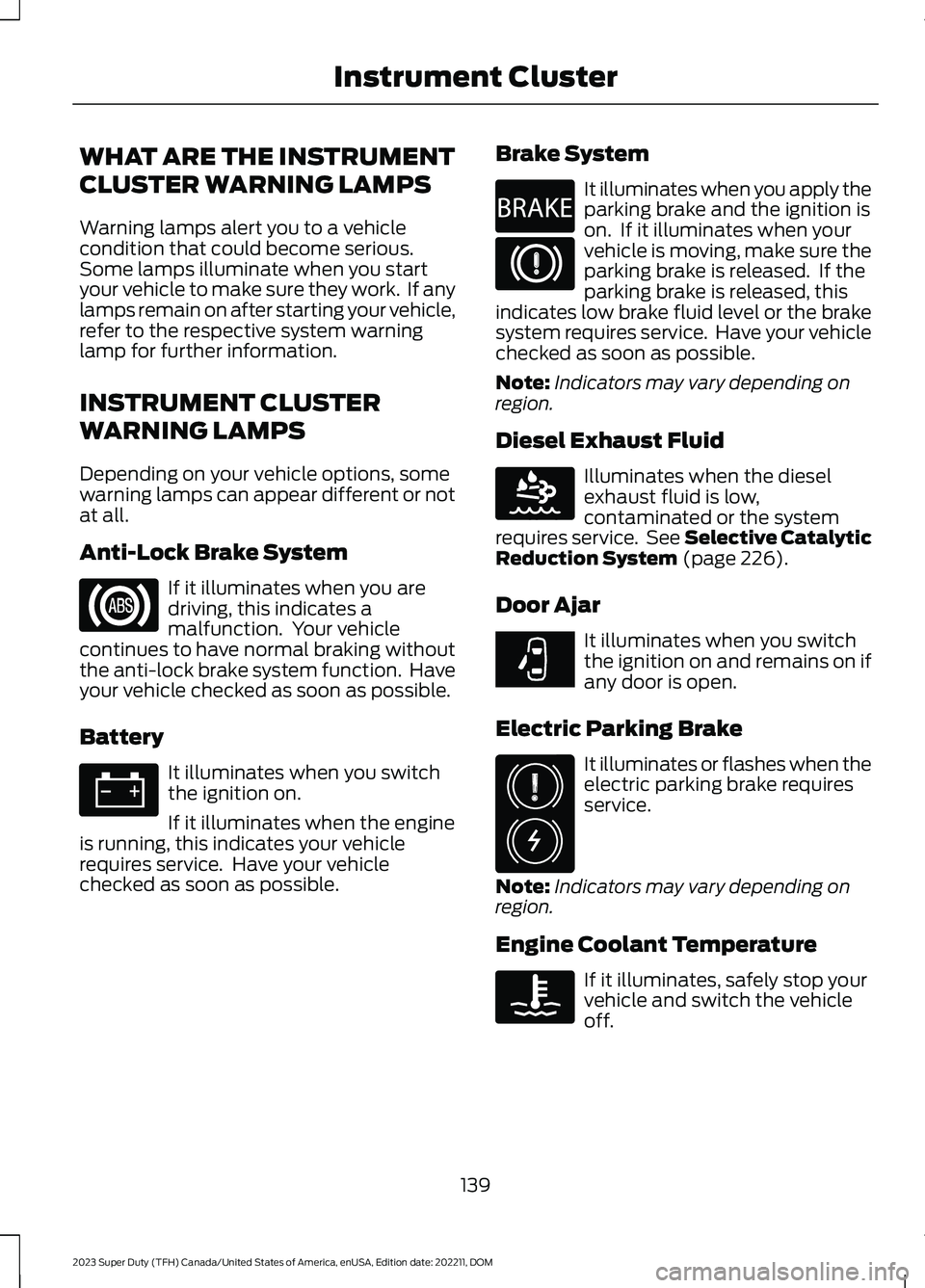
Anti-Lock Brake System
If it illuminates when you aredriving, this indicates amalfunction. Your vehiclecontinues to have normal braking withoutthe anti-lock brake system function. Haveyour vehicle checked as soon as possible.
Battery
It illuminates when you switchthe ignition on.
If it illuminates when the engineis running, this indicates your vehiclerequires service. Have your vehiclechecked as soon as possible.
Brake System
It illuminates when you apply theparking brake and the ignition ison. If it illuminates when yourvehicle is moving, make sure theparking brake is released. If theparking brake is released, thisindicates low brake fluid level or the brakesystem requires service. Have your vehiclechecked as soon as possible.
Note:Indicators may vary depending onregion.
Diesel Exhaust Fluid
Illuminates when the dieselexhaust fluid is low,contaminated or the systemrequires service. See Selective CatalyticReduction System (page 226).
Door Ajar
It illuminates when you switchthe ignition on and remains on ifany door is open.
Electric Parking Brake
It illuminates or flashes when theelectric parking brake requiresservice.
Note:Indicators may vary depending onregion.
Engine Coolant Temperature
If it illuminates, safely stop yourvehicle and switch the vehicleoff.
139
2023 Super Duty (TFH) Canada/United States of America, enUSA, Edition date: 202211, DOMInstrument ClusterE67020 E67021 E270480 E67024 E163176 E249859 E325775 E103308
Page 145 of 738
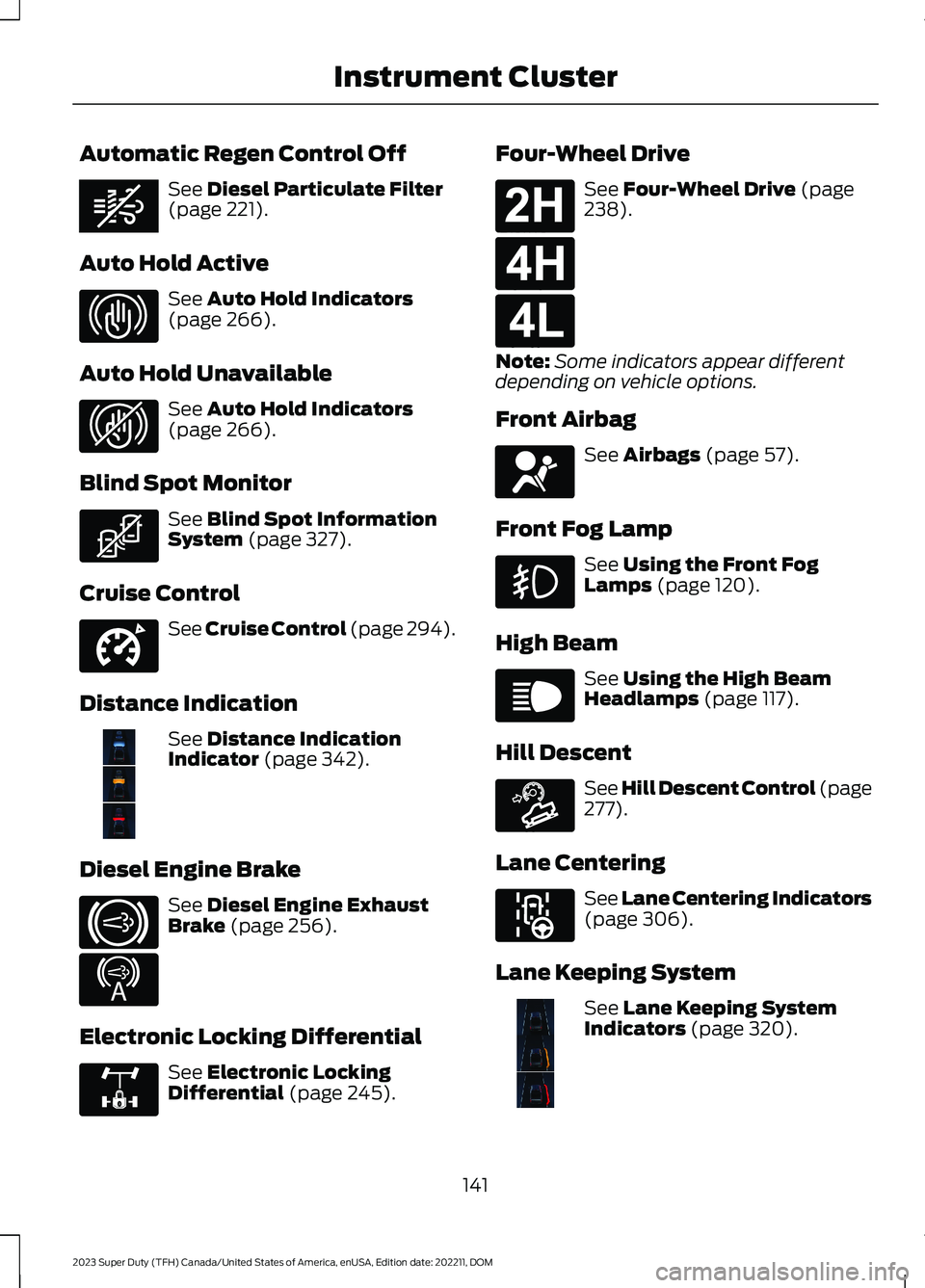
Automatic Regen Control Off
See Diesel Particulate Filter(page 221).
Auto Hold Active
See Auto Hold Indicators(page 266).
Auto Hold Unavailable
See Auto Hold Indicators(page 266).
Blind Spot Monitor
See Blind Spot InformationSystem (page 327).
Cruise Control
See Cruise Control (page 294).
Distance Indication
See Distance IndicationIndicator (page 342).
Diesel Engine Brake
See Diesel Engine ExhaustBrake (page 256).
Electronic Locking Differential
See Electronic LockingDifferential (page 245).
Four-Wheel Drive
See Four-Wheel Drive (page238).
Note:Some indicators appear differentdepending on vehicle options.
Front Airbag
See Airbags (page 57).
Front Fog Lamp
See Using the Front FogLamps (page 120).
High Beam
See Using the High BeamHeadlamps (page 117).
Hill Descent
See Hill Descent Control (page277).
Lane Centering
See Lane Centering Indicators(page 306).
Lane Keeping System
See Lane Keeping SystemIndicators (page 320).
141
2023 Super Duty (TFH) Canada/United States of America, enUSA, Edition date: 202211, DOMInstrument ClusterE362285 E323448 E323449 E323542 E332905 E381968 E171217 E234452 E325779 E181778 E181779 E181780 E67017 E67019 E163171 E297977 E382218
Page 146 of 738
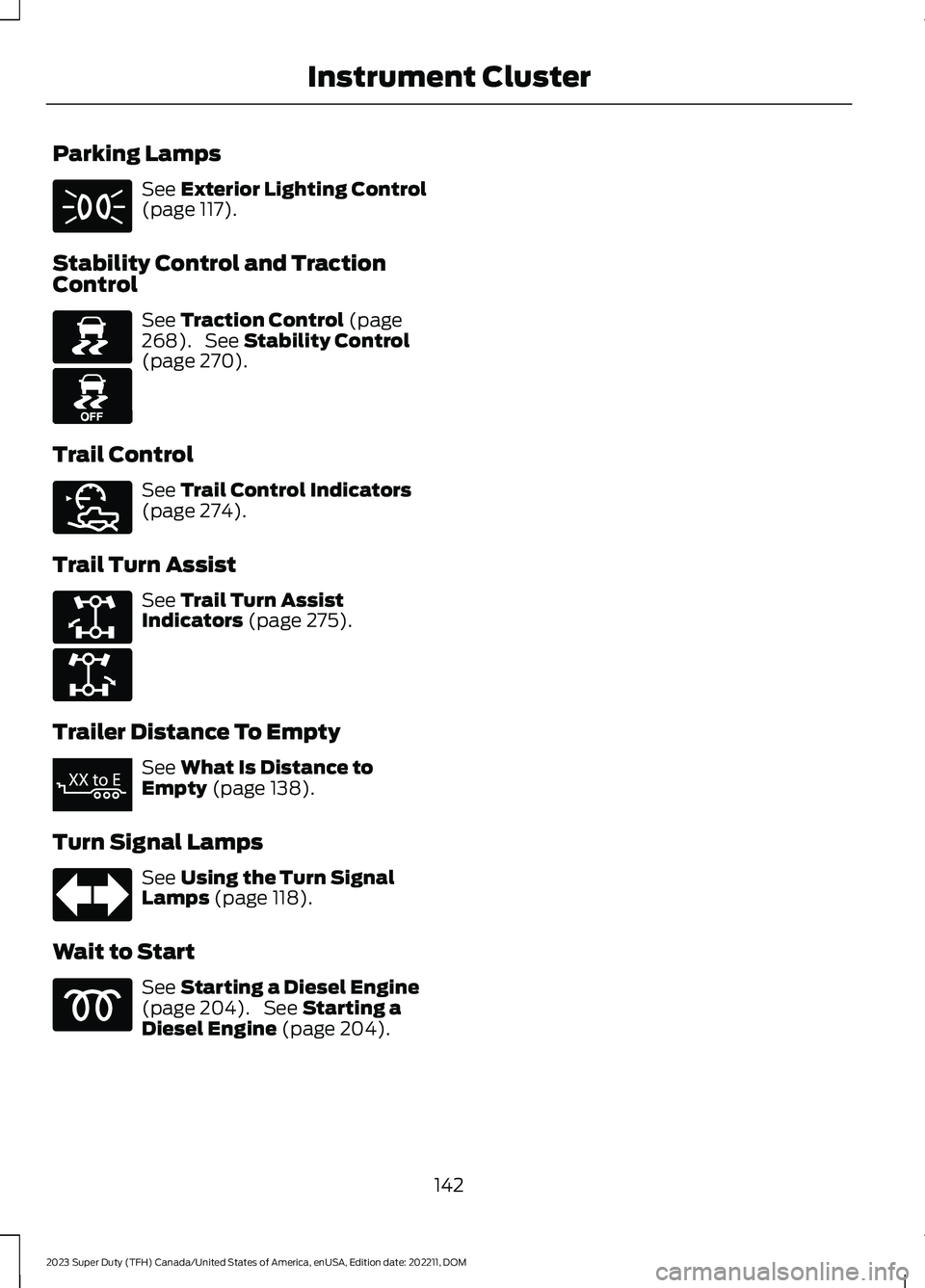
Parking Lamps
See Exterior Lighting Control(page 117).
Stability Control and TractionControl
See Traction Control (page268). See Stability Control(page 270).
Trail Control
See Trail Control Indicators(page 274).
Trail Turn Assist
See Trail Turn AssistIndicators (page 275).
Trailer Distance To Empty
See What Is Distance toEmpty (page 138).
Turn Signal Lamps
See Using the Turn SignalLamps (page 118).
Wait to Start
See Starting a Diesel Engine(page 204). See Starting aDiesel Engine (page 204).
142
2023 Super Duty (TFH) Canada/United States of America, enUSA, Edition date: 202211, DOMInstrument ClusterE71341 E138639 E130458 E272858 E338899 E338900 E383473 E67018
Page 208 of 738
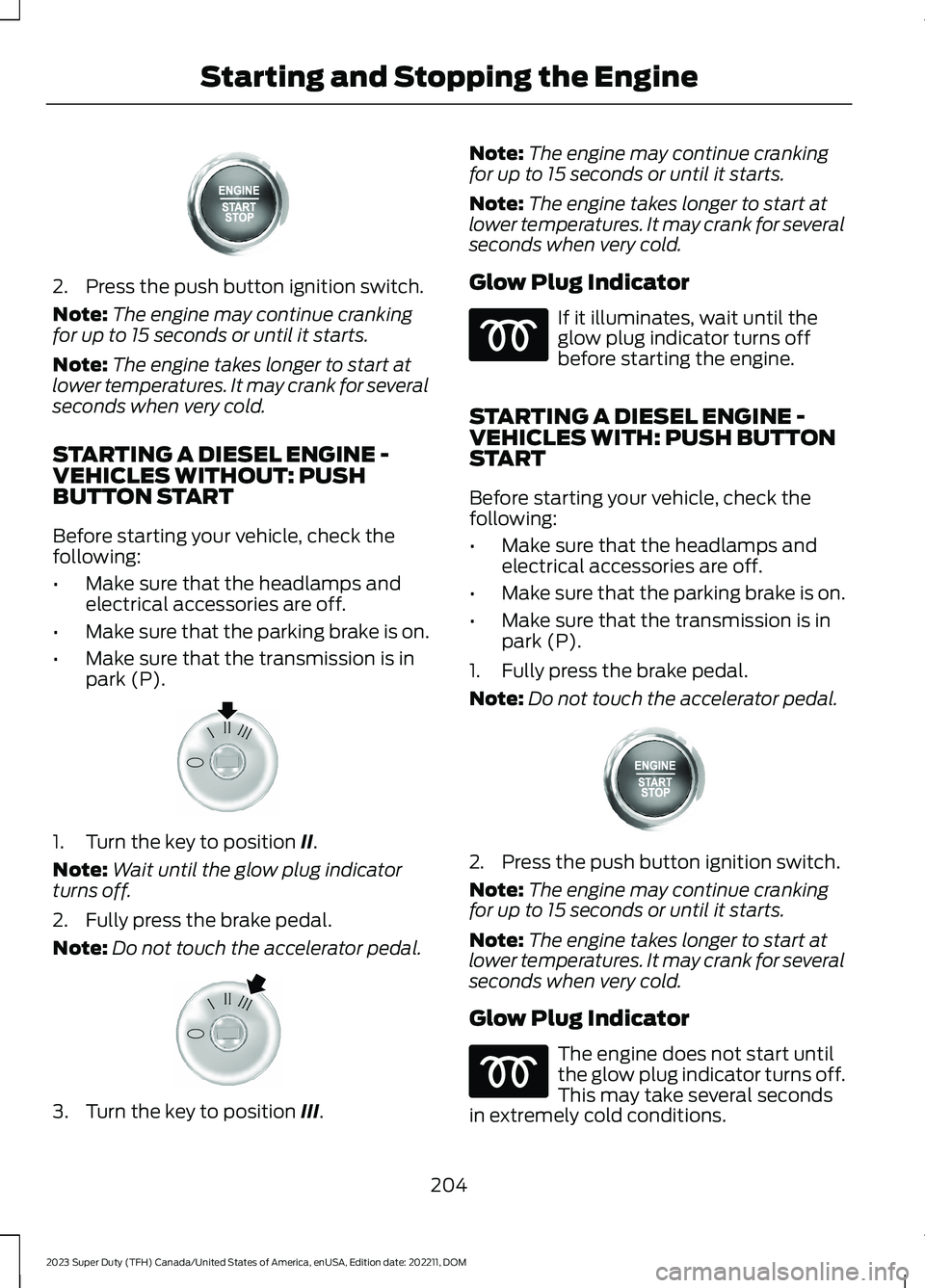
2.Press the push button ignition switch.
Note:The engine may continue crankingfor up to 15 seconds or until it starts.
Note:The engine takes longer to start atlower temperatures. It may crank for severalseconds when very cold.
STARTING A DIESEL ENGINE -VEHICLES WITHOUT: PUSHBUTTON START
Before starting your vehicle, check thefollowing:
•Make sure that the headlamps andelectrical accessories are off.
•Make sure that the parking brake is on.
•Make sure that the transmission is inpark (P).
1.Turn the key to position II.
Note:Wait until the glow plug indicatorturns off.
2.Fully press the brake pedal.
Note:Do not touch the accelerator pedal.
3.Turn the key to position III.
Note:The engine may continue crankingfor up to 15 seconds or until it starts.
Note:The engine takes longer to start atlower temperatures. It may crank for severalseconds when very cold.
Glow Plug Indicator
If it illuminates, wait until theglow plug indicator turns offbefore starting the engine.
STARTING A DIESEL ENGINE -VEHICLES WITH: PUSH BUTTONSTART
Before starting your vehicle, check thefollowing:
•Make sure that the headlamps andelectrical accessories are off.
•Make sure that the parking brake is on.
•Make sure that the transmission is inpark (P).
1.Fully press the brake pedal.
Note:Do not touch the accelerator pedal.
2.Press the push button ignition switch.
Note:The engine may continue crankingfor up to 15 seconds or until it starts.
Note:The engine takes longer to start atlower temperatures. It may crank for severalseconds when very cold.
Glow Plug Indicator
The engine does not start untilthe glow plug indicator turns off.This may take several secondsin extremely cold conditions.
204
2023 Super Duty (TFH) Canada/United States of America, enUSA, Edition date: 202211, DOMStarting and Stopping the EngineE357998 E322357 E322354 E357998
Page 215 of 738
STARTING AND STOPPING THEENGINE – FREQUENTLY ASKEDQUESTIONS - DIESEL, VEHICLESWITHOUT: PUSH BUTTON START
Why is the engine idle speed highwhen I am starting the engine?
•The speed at which the engine idlesimmediately after starting is optimizedto minimize vehicle emissions andmaximize cabin comfort and fueleconomy.
Why does the engine not crank?
•You can only attempt to start theengine for a limited amount of timebefore the starting system temporarilydisables. If you exceed the starting timelimit, a message may appear and youcannot attempt to start the engine forat least 15 minutes.
Why do I experience differentdriving characteristics?
•If you disconnect the battery, yourvehicle may exhibit some unusualdriving characteristics forapproximately 5 mi (8 km) after youreconnect it. This is because the enginemanagement system must realignitself with the engine. You candisregard any unusual drivingcharacteristics during this period.
Why can I not start the engine?
•If you cannot start the engine, do thefollowing:
1.Fully press the brake pedal or theclutch pedal.
Note:Make sure that the parking brake isapplied.
Note:Make sure that the transmission is inpark (P) or neutral (N).
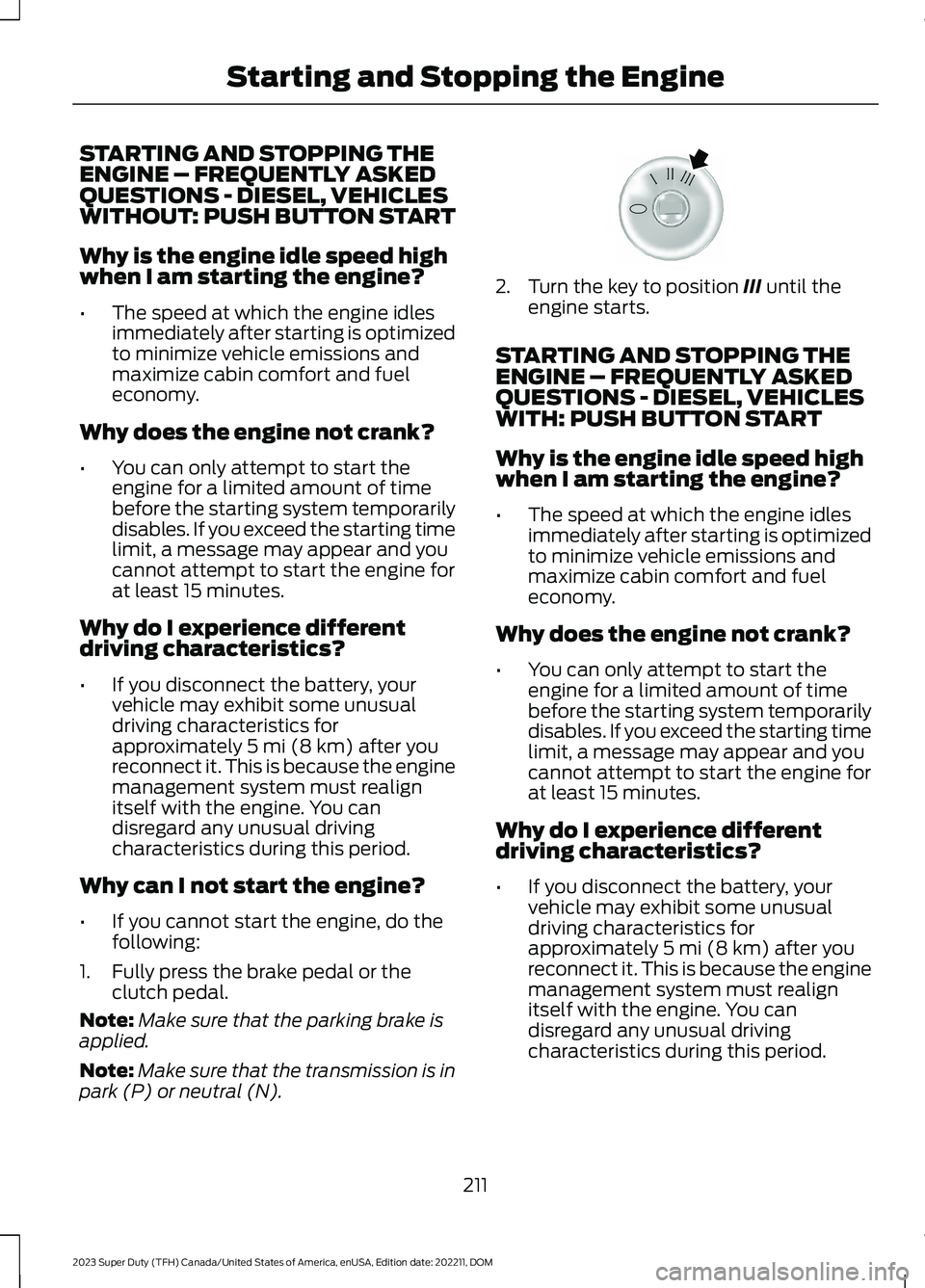
2.Turn the key to position III until theengine starts.
STARTING AND STOPPING THEENGINE – FREQUENTLY ASKEDQUESTIONS - DIESEL, VEHICLESWITH: PUSH BUTTON START
Why is the engine idle speed highwhen I am starting the engine?
•The speed at which the engine idlesimmediately after starting is optimizedto minimize vehicle emissions andmaximize cabin comfort and fueleconomy.
Why does the engine not crank?
•You can only attempt to start theengine for a limited amount of timebefore the starting system temporarilydisables. If you exceed the starting timelimit, a message may appear and youcannot attempt to start the engine forat least 15 minutes.
Why do I experience differentdriving characteristics?
•If you disconnect the battery, yourvehicle may exhibit some unusualdriving characteristics forapproximately 5 mi (8 km) after youreconnect it. This is because the enginemanagement system must realignitself with the engine. You candisregard any unusual drivingcharacteristics during this period.
211
2023 Super Duty (TFH) Canada/United States of America, enUSA, Edition date: 202211, DOMStarting and Stopping the EngineE322354
Page 217 of 738
STARTING AND STOPPING THEENGINE – FREQUENTLY ASKEDQUESTIONS - GASOLINE,VEHICLES WITH: PUSH BUTTONSTART
Why is the engine speed high whenI am starting the engine?
•The speed at which the engine idlesimmediately after starting is optimizedto minimize vehicle emissions andmaximize cabin comfort and fueleconomy.
Why does the engine not crank?
•You can only attempt to start theengine for a limited amount of timebefore the starting system temporarilydisables. If you exceed the starting timelimit, a message may appear and youcannot attempt to start the engine forat least 15 minutes.
Why do I experience differentdriving characteristics?
•If you disconnect the battery, yourvehicle may exhibit some unusualdriving characteristics forapproximately 5.0 mi (8 km) after youreconnect it. This is because the enginemanagement system must realignitself with the engine. You candisregard any unusual drivingcharacteristics during this period.
Why can I not start the engine?
If you cannot start the engine after 3attempts, wait 10 seconds and do thefollowing:
1.Fully press the brake pedal or theclutch pedal.
Note:Make sure that the parking brake isapplied.
Note:Make sure that the transmission is inpark (P) or neutral (N).
2.Fully press the accelerator pedal andhold it there.
3.Press the push button ignition switch.
Note:The engine cranks for a short periodof time and then it stops.
4.Release the accelerator pedal.
5.Press the push button ignition switch.
Why does the system not detect apassive key?
•If the system does not detect a passivekey and you are unable to start theengine, insert the passive key into thebackup position and press the pushbutton ignition switch to start theengine. See Accessing the PassiveKey Backup Position (page 209).
STARTING AND STOPPING
THE ENGINE VIDEOS
Push-Button Start: F-Series Diesel
213
2023 Super Duty (TFH) Canada/United States of America, enUSA, Edition date: 202211, DOMStarting and Stopping the EngineE357998
Page 219 of 738
For best overall vehicle and engineperformance, premium fuel with an octanerating of 91 or higher is recommended. Theperformance gained by using premium fuelis most noticeable in hot weather as wellas other conditions, for example whentowing a trailer. See Towing a Trailer(page 365).
Do not be concerned if the enginesometimes knocks lightly. However, if theengine knocks heavily while using fuel withthe recommended octane rating, contactan authorized dealer to prevent any enginedamage.
We recommend Top Tier detergentgasolines, where available to help minimizeengine deposits and maintain optimalvehicle and engine performance.
For additional information, visitwww.toptiergas.com.
Note:Use of any fuel for which the vehiclewas not designed can impair the emissioncontrol system, cause loss of vehicleperformance, and cause damage to theengine which may not be covered by thevehicle Warranty.
Do not use:
•Diesel fuel.
•Fuels containing kerosene or paraffin.
•Fuel containing more than 15% ethanolor E85 fuel.
•Fuels containing methanol.
•Fuels containing metallic-basedadditives, including manganese-basedcompounds.
•Fuels containing the octane boosteradditive, methylcyclopentadienylmanganese tricarbonyl (MMT).
•Leaded fuel, using leaded fuel isprohibited by law.
The use of fuels with metallic compoundssuch as methylcyclopentadienylmanganese tricarbonyl, which is amanganese-based fuel additive, will impairengine performance and affect theemission control system.
SELECTING THE CORRECT FUELFOR COLD WEATHER
Choosing the Right Fuel: VehiclesOperated Where Ultra Low SulfurDiesel Fuel Is Required (UnitedStates/Canada/Puerto Rico/U.S.Virgin Islands And Other Locales)
Note:Your Warranty will not cover damagecaused by using an improper type of fuel orfuel additive.
Note:Do not blend used engine oil withdiesel fuel under any circumstances.Blending used oil with the fuel significantlyincreases your vehicle’s exhaust emissionsand reduce engine life due to increasedinternal wear.
We recommend Top Tier diesel fuel whereavailable to help minimize engine depositsand maintain optimal vehicle and engineperformance.
For additional information, visitwww.toptiergas.com.
You should use ultra-low sulfur diesel fueldesignated as number 1-D or 2-D with amaximum of 15-ppm sulfur in your dieselvehicle. You can operate your vehicle ondiesel fuels containing up to 20%biodiesel, also known as B20. These fuelsshould meet the ASTM D975 diesel or theASTM D7467 B6-B20 biodiesel industryspecifications. Outside of North America,use fuels meeting EN590 or equivalentlocal market standard.
215
2023 Super Duty (TFH) Canada/United States of America, enUSA, Edition date: 202211, DOMFuel and Refueling
Page 220 of 738
Using low-sulfur diesel fuel(16-500 ppm) or high-sulfurdiesel fuel (greater than 500ppm) in your diesel engine will causecertain emission components tomalfunction which could also cause theservice engine soon light to illuminateindicating an emissions-related concern.
Diesel fuel is adjusted seasonally for coldtemperature. For best results attemperatures below 19°F (-7°C), werecommend using a diesel fuel which hasbeen seasonally adjusted for the ambientconditions.
Choosing the Right Fuel: VehiclesOperated Where Ultra Low SulfurDiesel Fuel Is Not Required
For the engine to operate reliably onlow-sulfur or high-sulfur diesel fuel, theengine must be a factory-built high-sulfurengine (available as a dealer order optionfor select markets) or an ultra-low sulfurdiesel fuel configured engine that has beenretrofitted for high-sulfur diesel fuel usingauthorized dealer service parts. Failure touse retrofit components other than thoseavailable through your authorized dealerresults in coolant system damage, engineoverheating, selective catalyst reductionsystem or diesel particulate filter damageand possible base engine damage.
Use only a diesel engine configured for usewith high-sulfur diesel fuel in markets withdiesel fuel that has sulfur content greaterthan 15 ppm. Using low-sulfur diesel fuel(16–500 ppm) or high-sulfur diesel fuel(greater than 500 ppm) in a diesel enginedesigned to use only ultra-low sulfur dieselfuel could result in damage to engineemission control devices and the aftertreatment system, potentially renderingthe vehicle inoperable.
Vehicles with engines configured for usewith high-sulfur diesel fuel are onlyavailable for sale in countries whereultra-low sulfur diesel fuel is generally notavailable or mandated by the government.Vehicles originally sold in an ultra-lowsulfur diesel fuel market that aresubsequently exported to non-ultra lowsulfur diesel fuel markets will need to beretrofitted at the customer’s expense usingFord authorized dealer service parts inorder to be reliably operated on non-ultralow sulfur diesel fuel.
Biodiesel
WARNING: Do not mix diesel withgasoline, gasohol or alcohol. This couldcause an explosion.
Note:Do not use home heating oil,agricultural fuel, raw fats and oils, wastecooking greases, biodiesel greater than 20%or any diesel not intended for highway use.Damage to the fuel injection system, engineand exhaust catalyst, and diesel particulatefilter can occur if you use an improper fuel.Red dye is used to identify fuels intendedfor agricultural and non-highway use.
You can operate your vehicle on dieselfuels containing up to 20% biodiesel, alsoknown as B20.
Biodiesel fuel is a chemically convertedproduct from renewable fuel sources, suchas vegetable oils, animal fats and wastecooking greases.
To help achieve acceptable engineperformance and durability when usingbiodiesel in your vehicle:
•Confirm the biodiesel content of thefuel to be B20 (20% biodiesel) or less.
•Only use biodiesel fuel of good qualitythat complies with industry standards.
216
2023 Super Duty (TFH) Canada/United States of America, enUSA, Edition date: 202211, DOMFuel and RefuelingE67028
Page 221 of 738
•Follow the recommended servicemaintenance intervals. See GeneralMaintenance Information (page 594).
•Do not store biodiesel fuel in the fueltank for more than 1 month.
•Consider changing brands or reducingbiodiesel content if you have coldtemperature fuel gelling issues or afrequently appearing LOW FUELPRESSURE message.
Use of biodiesel in concentrations greaterthan 20% can cause damage to yourvehicle, including engine and/or exhaustafter-treatment hardware (exhaustcatalyst and particulate filter) failures.Concentrations greater than 20% can alsocause fuel filter restrictions that couldresult in a lack of power or damage to fuelsystem components, including fuel pumpand fuel injector failures.
We recommend SAE 5W-40 oil for fuelswith greater than 5% biodiesel (B5). Formore information about oil changeintervals and other maintenance whenoperating on biodiesel. See SpecialOperating Conditions ScheduledMaintenance (page 603).
Look for a label on the fuel pump toconfirm the amount of biodiesel containedin diesel fuel. Ask the service stationattendant to confirm the biodiesel contentof diesel fuel, if you do not see a label onthe fuel pump.
If you plan to park or store your vehicle formore than 1 month, then you should emptyyour vehicle fuel tank of biodiesel fuel. Youshould fill the tank with a purepetroleum-based diesel fuel and run yourvehicle for a minimum of 30 minutes.
Note:Degraded or oxidized biodiesel candamage fuel system seals and plastics andcorrode steel parts.
During cold weather, if you have problemsoperating on biodiesel, you may need touse diesel fuel with lower biodieselcontent, try another brand or discontinuethe use of biodiesel.
Diesel Fuel Additives
It should not be necessary to add anyaftermarket additives to your fuel if youuse a high-quality diesel fuel that conformsto ASTM industry specifications.Aftermarket additives can damage the fuelinjector system or engine.
Use Motorcraft® cetane booster or anequivalent cetane booster additive if yoususpect fuel has low cetane. UseMotorcraft® anti-gel and performanceimprover or an equivalent additive if thereis fuel gelling.
Do not use alcohol-based additives toimprove cetane quality, to prevent fuelgelling or any other use. The use of alcoholadditives could result in damage to the fuelinjectors and system.
Your Warranty may not cover repairsneeded to correct the effects of using anaftermarket product that does not meetour specifications in your fuel.
RUNNING OUT OF FUEL
FILLING A PORTABLE FUELCONTAINER
WARNING: Flow of fuel through afuel pump nozzle can produce staticelectricity. This can cause a fire if you arefilling an ungrounded fuel container.
217
2023 Super Duty (TFH) Canada/United States of America, enUSA, Edition date: 202211, DOMFuel and Refueling
Page 225 of 738
WHAT IS THE DIESEL
PARTICULATE FILTER
The diesel particulate filter is part of yourvehicle's emissions system and filtersharmful diesel particulates from theexhaust gas.
HOW DOES THE DIESEL
PARTICULATE FILTER WORK
The diesel particulate filter reducesemissions by trapping exhaust particlesbefore they reach the tailpipe. The systemmust periodically clean the exhaustparticles that gather inside the filter. Thisis carried out in three ways, passiveregeneration, active regeneration andmanual regeneration.
Passive Regeneration
In passive regeneration, the normalexhaust system temperature cleans thefilter by oxidizing the soot. Cleaning occursduring normal vehicle operating conditionsdue to driving patterns.
Active Regeneration
Once the diesel particulate filter is full,active regeneration raises the exhausttemperature to eliminate the particles.
When the engine control module detectsthat the diesel particulate filter is nearlyfull of particulates, and you are notoperating your vehicle in a manner to alloweffective regeneration, messages appearin the information display as a reminderfor you to drive your vehicle in order toclean the diesel particulate filter. If youdrive your vehicle in a manner to alloweffective regeneration, the informationdisplay shows a cleaning exhaust filtermessage.
DIESEL PARTICULATE FILTER
PRECAUTIONS
WARNING: Do not park or idle yourvehicle over dry leaves, dry grass or othercombustible materials. The regenerationprocess creates very high exhaust gastemperatures and the exhaust willradiate a considerable amount of heatduring and after regeneration and afteryou have switched the engine off. This isa potential fire hazard.
WARNING: When the ExhaustFilter Cleaning message appears in theinformation display, do not park nearflammable materials, vapors orstructures until filter cleaning iscomplete.
WARNING: The normal operatingtemperature of the exhaust system isvery high. Never work around or attemptto repair any part of the exhaust systemuntil it has cooled. Use special care whenworking around the diesel oxidationcatalytic converter or the dieselparticulate filter. The diesel oxidationcatalytic converter and the dieselparticulate filter heat up to very hightemperatures after only a short periodof engine operation and remain hot afteryou switch the engine off.
Note:Avoid running out of fuel.
Note: During regeneration at low speed orengine idle, you may smell a hot metallicodor and could notice a clicking metallicsound. This is due to high temperaturesreached during regeneration and is normal.
Note:Changes in the engine or exhaustsound may be heard during the regenerationprocess.
221
2023 Super Duty (TFH) Canada/United States of America, enUSA, Edition date: 202211, DOMDiesel Particulate Filter (If Equipped)