drive shaft HONDA INTEGRA 1994 4.G Owner's Guide
[x] Cancel search | Manufacturer: HONDA, Model Year: 1994, Model line: INTEGRA, Model: HONDA INTEGRA 1994 4.GPages: 1413, PDF Size: 37.94 MB
Page 395 of 1413
The Automatic Transmission is a combination of a 3-e,ement torque convefter and triple-shaft electfonically controlled
automatic transmission which provides 4 speeds forward and 1 speed reverse. The entire unit is positioned in line with
the engine.
Torque Converter, Gears and Clutches
The torque converter consists of a pump, turbine and stator assembly in a single unit, The torque converter is connected
to the engine crankshaft so they turn together as a unit as the engine turns. Around the outside of the torque converter
is a ring gear which meshes with the starter pinion when the engine is being staned. The entire torque converter assem-
bly serves as a flywheel while transmitting power to the transmission mainshaft.
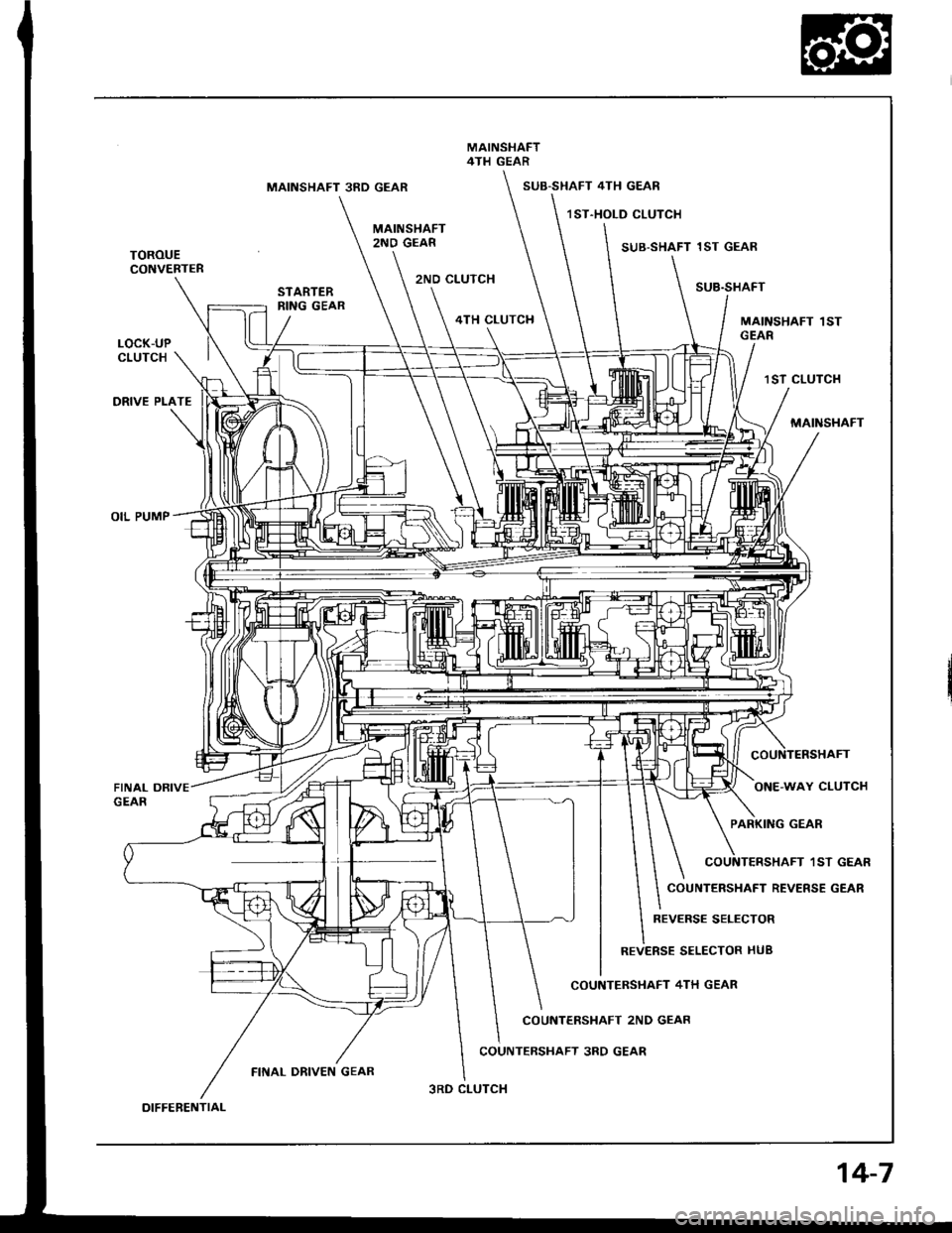
The transmission has three parallel shafts, the mainshaft. countershaft and sub-shaft. The mainshatt is in line with the
engine crankshaft.
The mainshaft includes the clutches for 1 st, and 2ndl4th, and gears for 3rd. 2nd, 4th, reverse and l st (3rd gear is in-
tegral with the mainshaft, while reverse gear is integral with the 4th gear).
The countershaft includes the 3rd clutch and gears Ior 3rd, 2nd,4th, reverse, lst and parking. Reverse and 4th gears
can be locked to the countershaft at its center, providing 4th gear or reverse, depending on which way the selector is moved.
The sub-shaft includes the lst-hold clutch and gears for 1st and 4th
The gears on the mainshait are in constant mesh with those on the countershaft and sub-shaft. When certain combina-
tions of gears in the transmission are engaged by the clutches, power is transmitted from the mainshaft to the counter-
shaft via the sub-shatt to provide @, E, tr. tr and @ position.
Electronic Control
The electronic control system consists of the Transmission Control Module {TCM), sensors, and 4 solenoid valves. Shift-
ing and lock-up are electronically controlled for comfortable driving under all conditions.
The TCM is located below the dashboard, behind the left side kick panel on the driver's side.
Hydraulic Control
The valve bodies include the main valve body, secondary valve body, regulator valve body. servo body, and lock-up valve
body throuqh the respective separator plates.
They are bolted on the torque converter housing.
The main valve body contains the manual valve, 1-2 shift valve, 2-3 shift valve, Clutch Pressure Cont.ol (CPC) valve,
4th exhaust valve, relief valve, and oil pump gears.
The secondary valve body contains the 4-3 kick-down valve,3-2 kick-down valve,2-3 orifice cont.ol valve, 3-4 shitt
valve, orifice control valve. modulator valve, and servo control valve
The regulator valve body contains the pressure regulator valve. lock-up control valve, torque converter check valve, and
cooler check valve.
The servo bodv contains the servo valve which is integrated with the reverse shift fork, throttle valve B, and accumulators.
The lock-ug valve bodv contains the lock-up shift valve and lock-up timing B valve. and is bolted on the secondary valve
body.
Fluid from the regulator passes through the manual valve to the various control valves.
Shitt Control Mochanism
Input to the TCM i.om various sensors located throughout the car determines which shift control solenoid valve should
be activated.
Activating a shift control solenoid valve changes modulator pressure, causing a shift valve to move. This pressurizes
a line to one of the clutches. engaging that clutch and its corresponding gear.
Lock-up Mechanism
In @ position. in 2nd, 3rd and 4th, and E position in 3rd, pressurized tluid can be drained from the back of the tor-
que converter through an oil passage, causing the lock-up piston to be held against the torque converter cover. As this
takes Dlace, the mainshaft rotates at the same speed as the engine crankshatt. Together with hydraulic control, the TCM
optimizes the timing ol the lock-up mechanism.
The lock-up valves control the range of lock-up according to lock-up control solenoid valves A and B, and throttle valve B
When lock-up control solenoid valves A and B activate, modulator pressure changes. Lock-up control solenoid valves
A and B are mounted on the torque converter housing, and are controlled by the TCM.
(cont'd)
14-3
Page 399 of 1413
MAINSHAFT4TH GEAR
MAINSHAFT 3RD GEARSUB.SHAFT 4TH GEAR
lST,HOLD CLUTCHMAINSHAFT2ND GEARTOROUECONVERTER
SUB-SHAFT 1ST GEAR
SUB.SHAFT2ND CLUTCHSTARTERNING GEAR
LOCK-UPCLUTCH
4TH CLUTCHMAINSHAFT 1STGEAR
DRIVE PLATE
1ST CLUTCH
MAINSHAFT
ONE-WAY CLUTCH
PARKING GEAR
,I ST GEAR
COUNTERSHAFT REVERSE GEAR
REVERSE SELECTOR
REVERSE SELECTOR HU8
COUNTERSHAFT 4TH GEAR
COUNTERSHAFT 2ND GEAR
COUNTERSHAFT 3RD GEAR
DIFFERENTIAL
FINAL DRIVEN GEAR
3RD CLUTCH
14-7
Page 402 of 1413
Description
Power Flow lcont'dl
Lll Position Acceloration
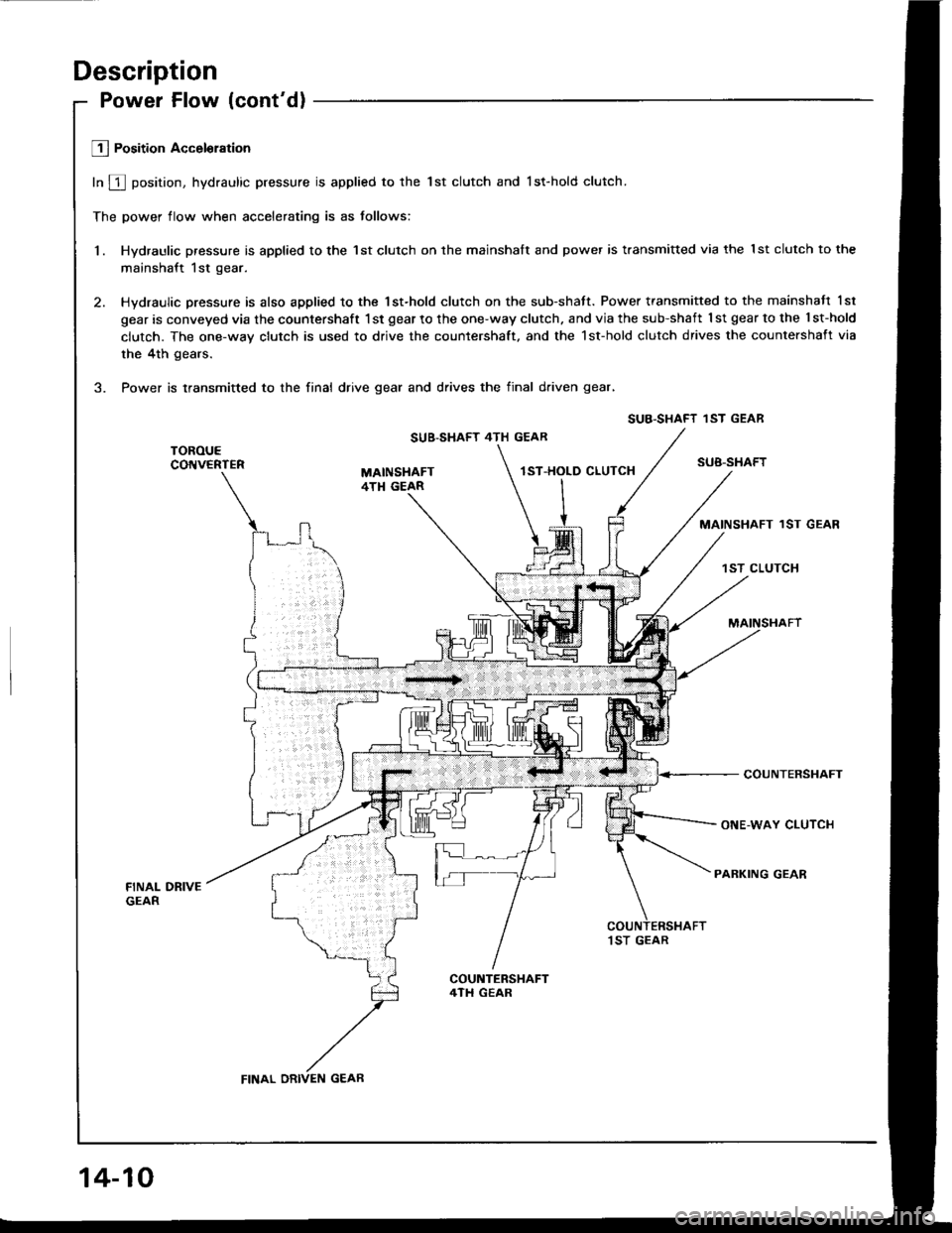
In f position, hydraulic pressure is applied to the lst clutch and lst-hold clutch.
The power flow when accelerating is as tollows:
1. Hydraulic pressure is applied to the 1st clutch on the mainshalt and power is transmitted via the lst clutch to the
mainshaft 1st gear.
2. Hydraulic pressure is also applied to the 1st-hold clutch on the sub-shatt. Power transmitted to the mainshaft 1sl
gear is conveyed via the countershaft 1st gear to the one-way clutch. and via the sub-shaft 1 st gear to the l st-hold
clutch. The one-way clutch is used to drive the countershaft. and the 1st-hold clutch drives the countershaft via
the 4th gears.
3. Power is transmitted to the finai drive gear and drives the final d.iven gear,
SUB-SHAFT 4TH GEAR
SUB-SHAFTlST-HOLD CLUTCH
MAINSHAFT 1ST GEAR
1ST CLUTCH
COUNTERSHAFT
ONE-WAY CLUTCH
PARKING GEAR
,I ST GEAR
SUB.SHAFT 'IST GEAR
FINAL DRIVEN GEAR
14-10
Page 403 of 1413
L!_j Position Deceleration
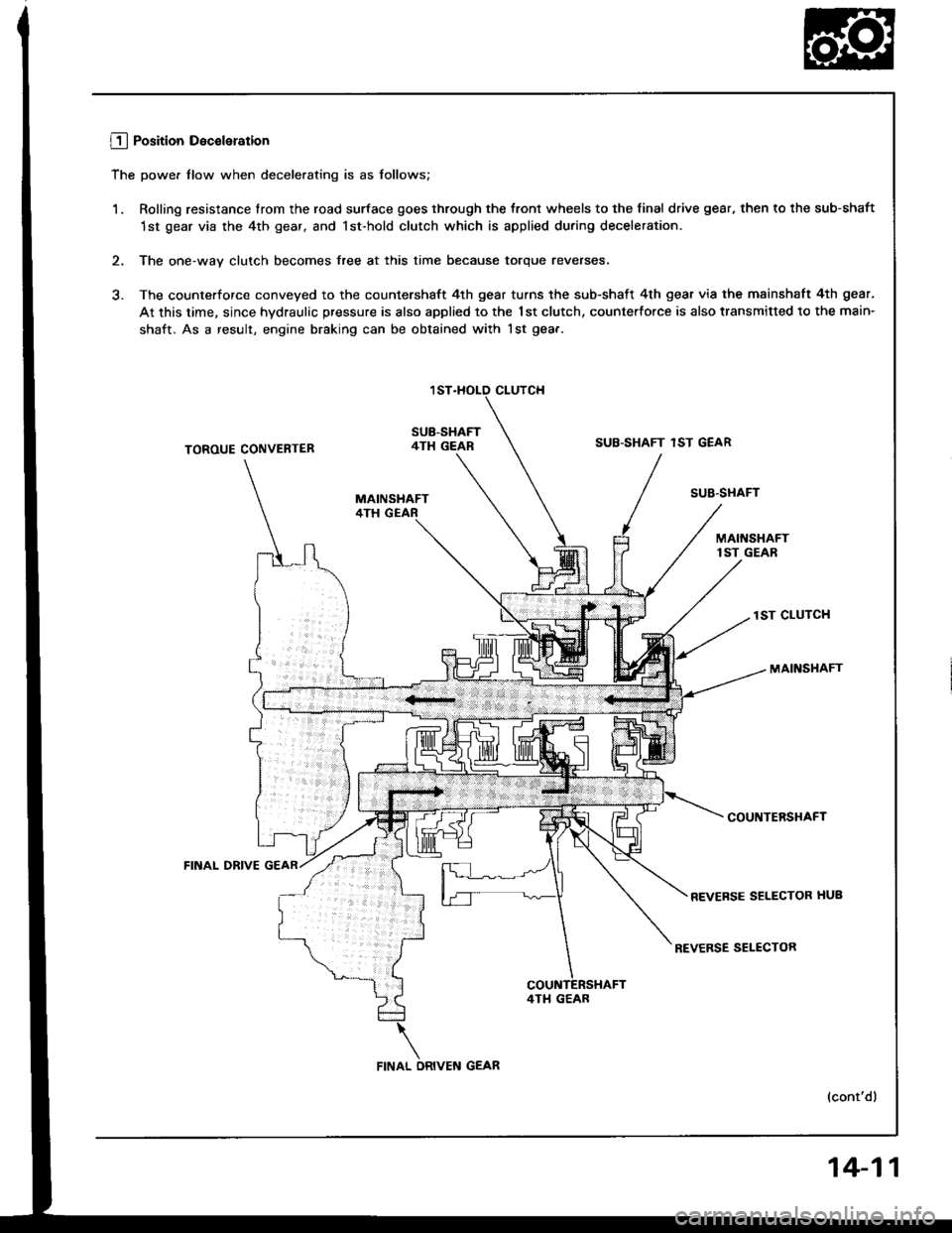
The power tlow when decelerating is as follows;
1. Rolling resistance lrom the road surface goes through the tront wheels to the final drive gear, then to the sub-shaft
1st gear via the 4th gear, and lst-hold clutch which is applied during deceleration.
2. The one-way clutch becomes free at this time because torque reverses.
3. The counterforce conveyed to the countershaft 4th gear turns the sub-shaft 4th gear via the mainshaft 4th gear.
At this time, since hydraulic pressure is also applied to the 1st clutch, counterfo.ce is also transmitted to the main-
shaft. As a result, engine braking can be obtained with lst gea.-
CLUTCH
SUB-SHAFT4TH GEARSUB-SHAFT 1ST GEARTOROUE CONVENTER
FINAL DRIVE
SUB'STIAFT
lST CLUTCH
MAINSHAFT
COUNTERSHAFT
REVEFSE SELECTOR HUB
REVERSE SELECTOR
(cont'dl
4TI1 GEAB
14-11
Page 404 of 1413
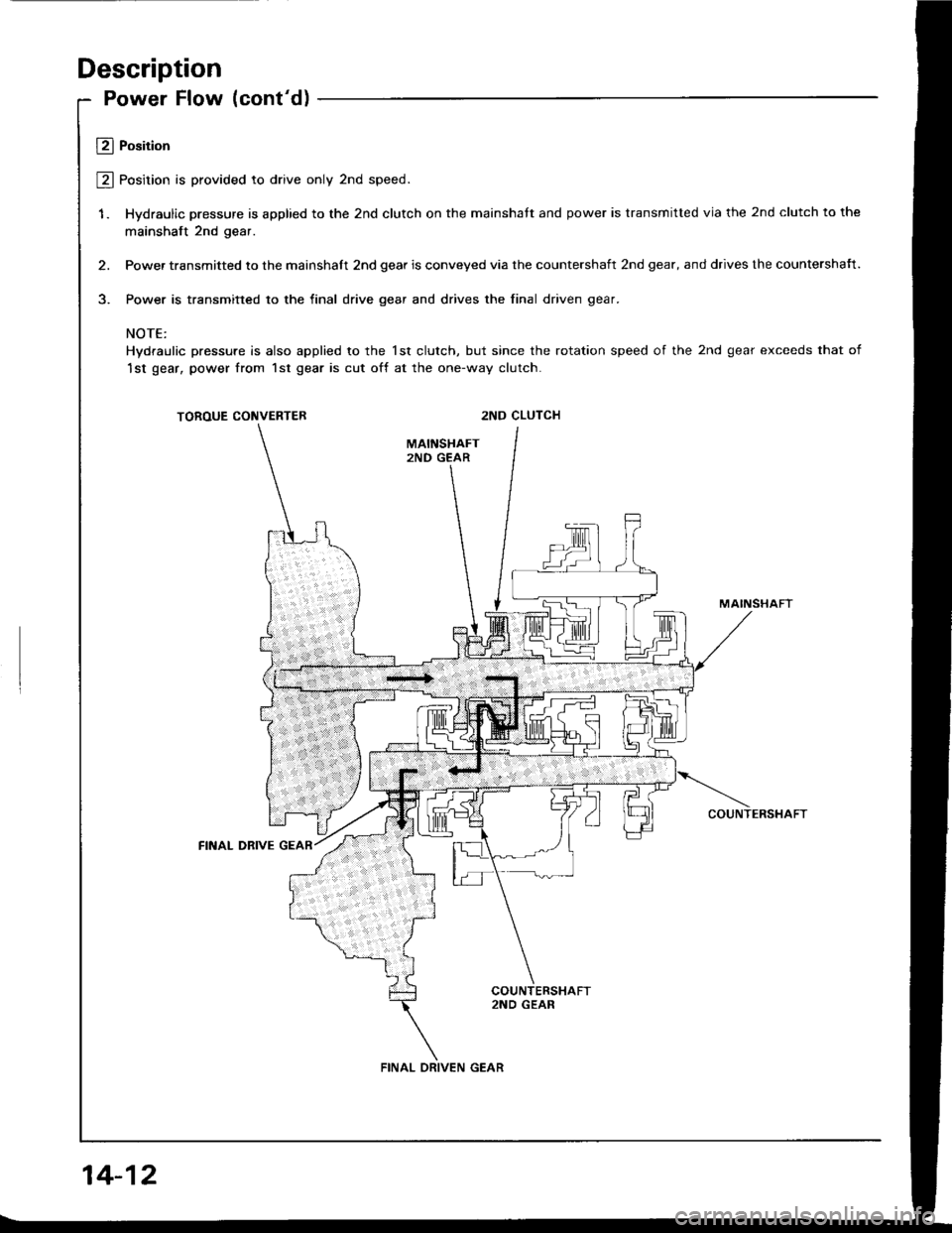
Description
Power Flow (cont'd)
Ll Position
@ Position is provided to drive only 2nd speed.
1. Hydraulic pressure is applied to the 2nd clutch on the mainshatt and power is transmitted via the 2nd clutch to the
mainshaft 2nd gear.
2. Power transmitted to the mainshalt 2nd gear is conveyed via the countershaft 2nd gear, and drives the countersha{t.
3. Power is transmitted to the final drive gear and drives the final driven gear.
NOTE:
Hydraulic pressure is also applied to the lst clutch, but since the rotation speed of the 2nd gear exceeds that of
1st gear, power from 1st gear is cut off at the one-way clutch.
TOROUE CONVERTER2ND CLUTCH
MAINSHAFT
COUNTERSHAFT
FINAL DBIVE
2ND GEAR
FINAL DRIVEN GEAR
14-12
Page 405 of 1413
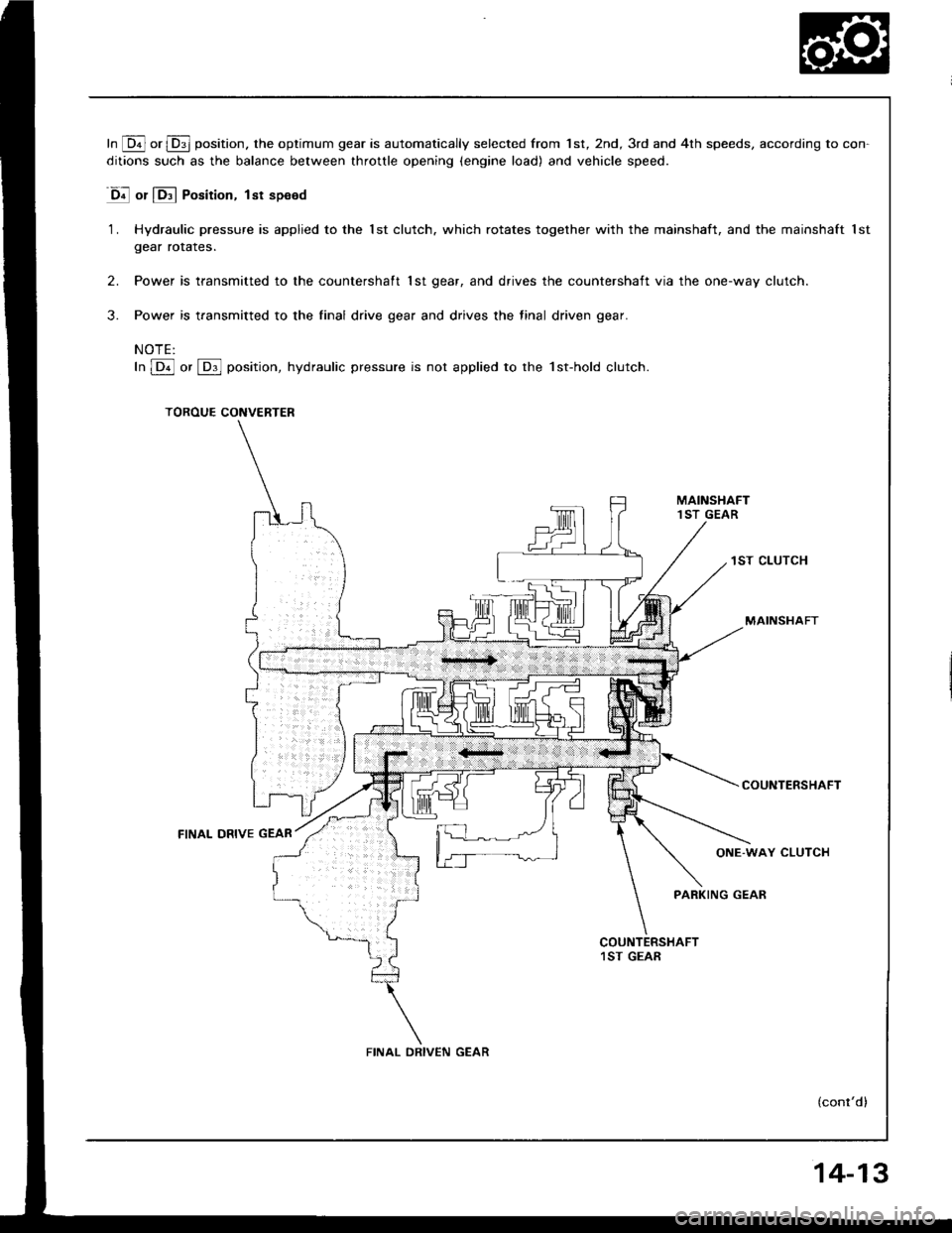
In [Q! or l!31 position. the optimum gear is automatically selected from 1st, 2nd, 3rd and 4th speeds, according to con-
ditions such as the balance between throttle opening (engine load) and vehicle speed.
D! or lE.l Position, lst speed
1. Hydraulic pressure is applied to the lst clutch. which rotates together with the mainshaft, and the mainshaft lst
gear rorares.
2. Power is transmitted to the countershaft 1st gear, and drives the countershaft via the one-way clutch.
3. Power is transmitted to the final drive gear and drives the final driven gear.
NOTE:
In lDil or [Dl]l position, hydraulic pressure is not applied to the 1st-hold clutch.
TOROUE CONVERTER
1ST CLUTCH
MAINSHAFT
COUNTERSHAFT
(cont'd)
FINAL DRIVE GEAR
FINAL DRIVEN GEAR
14-13
Page 406 of 1413
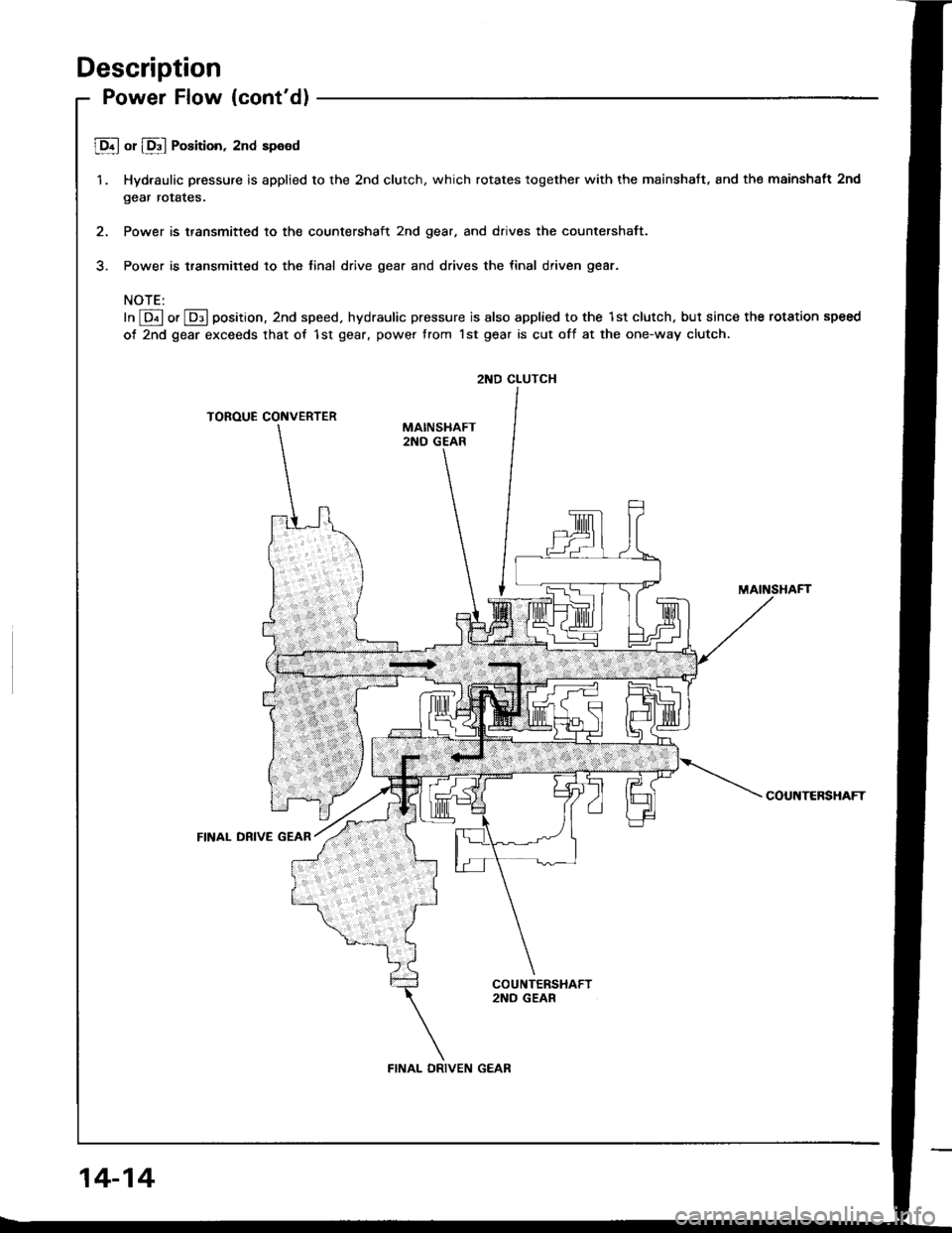
Description
Power Flow (cont'd)
JD.l or lD"l Position, 2nd speed
1. Hydraulic pressure is applied to the 2nd clutch, which rotates together with the mainshaft, and the mainshatt 2nd
gear rotates.
2. Power is transmitted to the countershaft 2nd gear, and drives the countershaft.
3. Power is transmitted to the tinal drive gear and drives the final driven gear.
NOTE:
In @ or @ position, 2nd speed, hydraulic pressure is also applied to the lst clutch. but since the rotation speed
of 2nd gear exceeds that of 1st gear. power trom lst gear is cut off at the one-way clutch.
TOROUE CONVERTER
MAINSHAFT
COUNTERSHAFT
FINAL DRIVE GEAR
2ND CLUTCH
FINAL DRIVEN GEAR
14-14
Page 407 of 1413
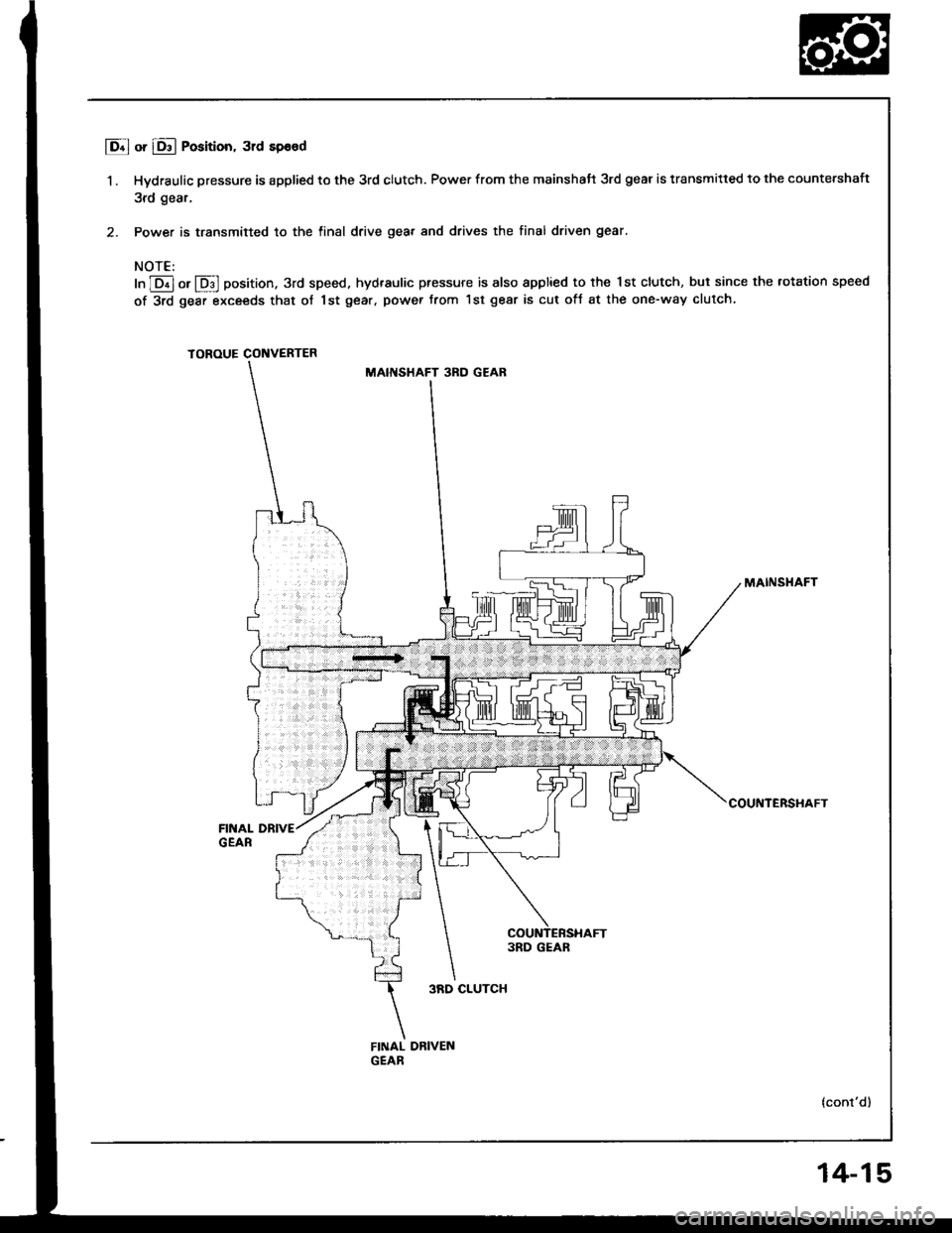
I o.l or 16ll Position, 31d sp€od
1 . Hydraulic pressure is applied to the 3rd clutch. Power from the mainshatt 3rd gear is transmitted to the countershaft
3rd gear,
2. Power is transmitted to the tinal drive geat and drives the final driven gear.
NOTE:
In ]Dil or lDJl position. 3rd speed. hydraulic pressure is also applied to the Ist clutch, but since the rotation speed
of 3rd gear exceeds that of 1st gear, power trom lst gear is cut ofJ at the one-way clutch,
TOROUE CONVERTER
MAINSHAFT 3RD GEAR
MAINSHAFT
COUNTERSHAFT
FINAL DRIVEGEAR
3RD CLUTCH
FINAL DBIVENGEAR
14-15
Page 408 of 1413
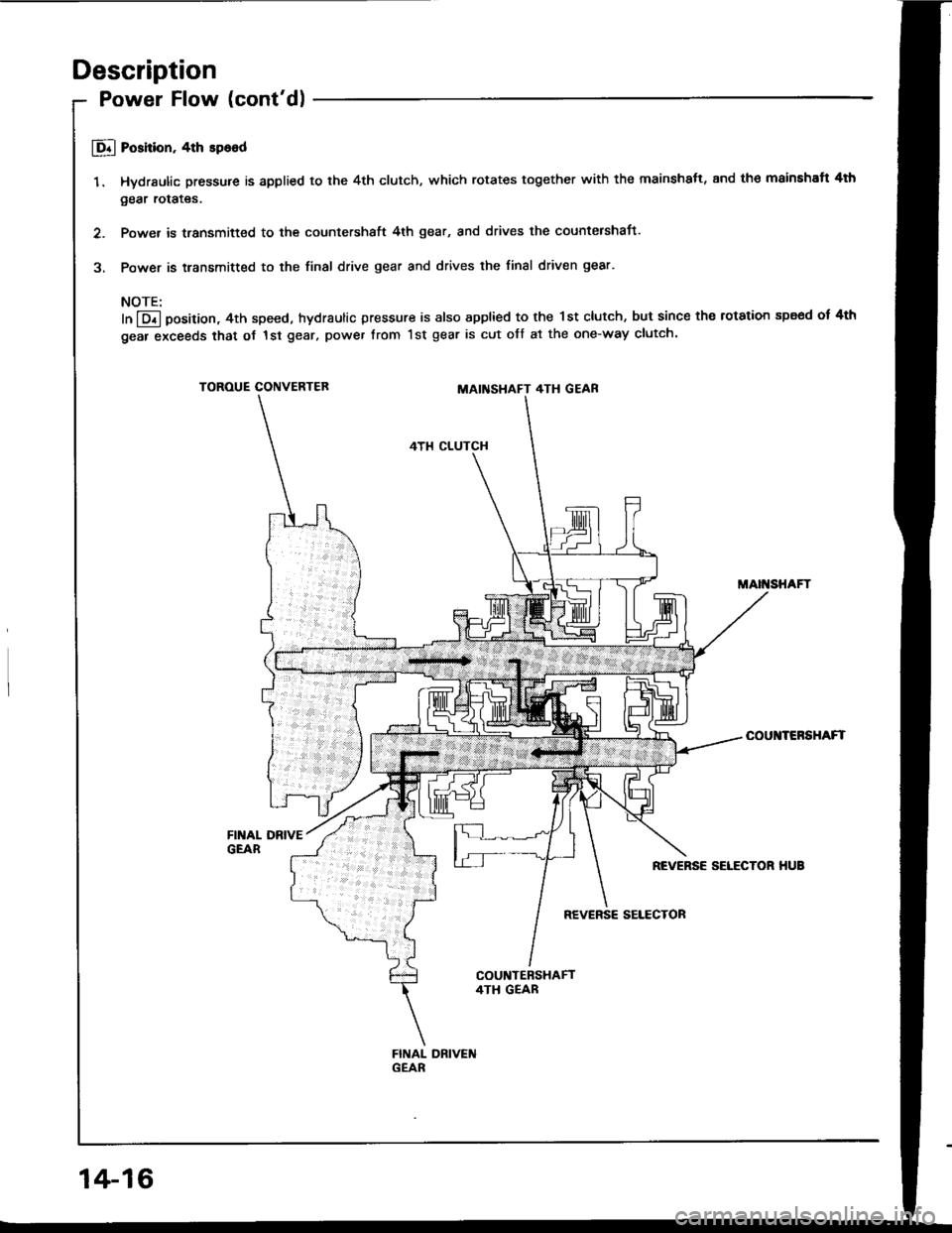
Description
Power Flow (cont'dl
E Poshion. 4th sp6od
1. Hydraulic pressure is applied to the 4th clutch, which rotates together with the mainshatt, and th€ mainshaft 4th
gear rotates.
2. Power is transmifted to the countershaft 4th gear, and drives the countershaj-t.
3. Power is transmitted to the final drive gear and drives the final driven gear.
NOTE:
In @ Oosition, 4th speed, hydraulic pressure is also applied to the 1st clutch, but since the rotation spe€d of 4th
gear exceeds that oJ 1st gear, power from 1st gear is cut off at the one-way clutch.
TOROUE CONVERTEBMAINSHAFT 4TH GEAR
4TH CLUTCH
MAII{SHAFT
COUI{TERSHAFT
REVERSE SELECTOR HUB
REVERSE SELECTOR
14-16
Page 409 of 1413
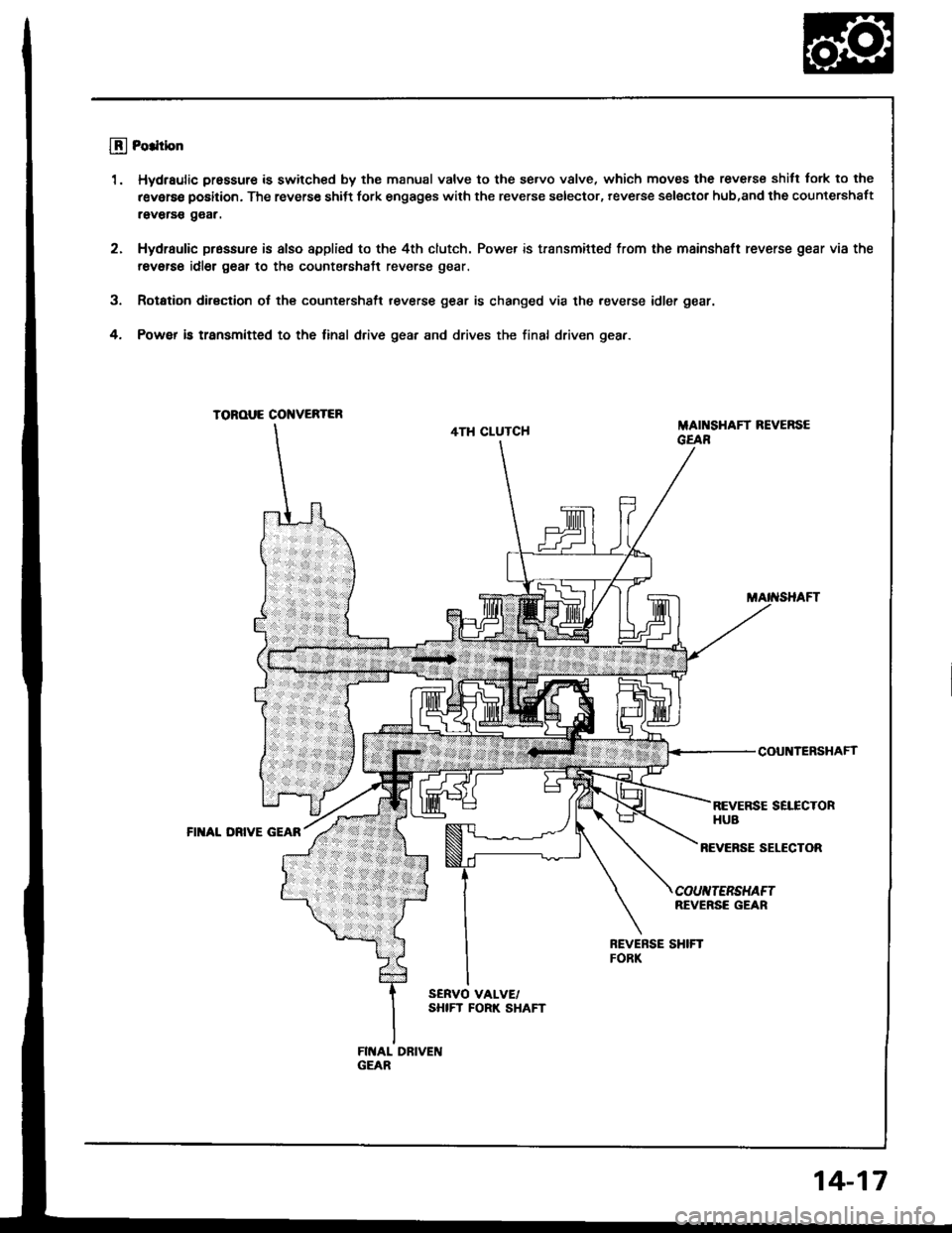
llj Po.ltbn
1. Hydraulic pressure is swilched by the manual valve to the se.vo v8lve, which moves the reverse shilt tork to the
r€verse position. The reverse shiJt fork engages with the reverse selector, reverse selsctor hub,and the countershaft
raverss g€ar.
2. Hydraulic pr6ssure is also appli€d to the 4th clutch. Power is transmifted from the mainshaft reverse gear via the
revetse idler g6ar to the countershaft reverse gear.
3. Rotation dirsction ol the countershsft reverse gear is changed via the .everse idler gear.
4. Powef b transmitted to the linal drive gear and drives the final driven gear.
TOROUE CONVEBTER
4TH CLUTCHMAI SHAFT REVERSEGEAR
COUNTERSHAFf
REVERSE SELECTORHUBFII{AL DRIVE GEAR
REVEFSE SELECTOR
COUIITERSHAFTREVERSE GEAR
14-17