clutch HONDA INTEGRA 1998 4.G Workshop Manual
[x] Cancel search | Manufacturer: HONDA, Model Year: 1998, Model line: INTEGRA, Model: HONDA INTEGRA 1998 4.GPages: 1681, PDF Size: 54.22 MB
Page 900 of 1681
)
Troubleshooting
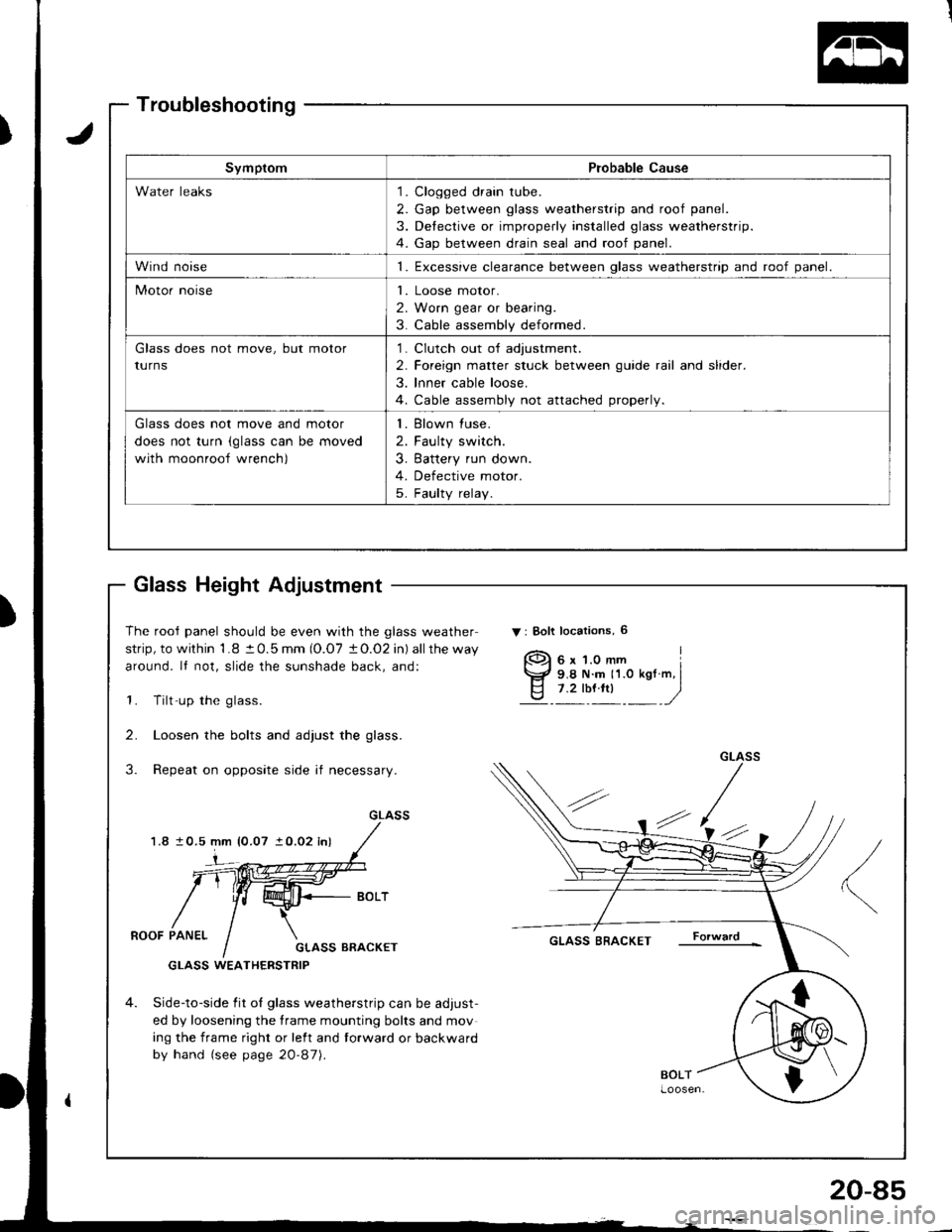
Glass Height Adjustment
The rooJ panel should be even with the glass weather
strip, to within 1.8 t 0.5 mm (O.O7 tO.O2 in) allthe way
around. It not, slide the sunshade back, and:
1. Tilt-up the glass.
2. Loosen the bolts and adjust the glass.
3. Repeat on opposite side if necessary.
1.810.5 mm {0.07 } 0.02 inl
Gr_ASS
4-(.'
ROOF PANELGLASS BRACKET
GLASS WEATHERSTRIP
4. Side-to-side fit oI glass weatherstrip can be adjust-
ed by loosening the frame mounting bolts and mov
ing the frame right or left and forward or backward
by hand (see page 20-87).
GLASS BRACKET
SymptomProbable Cause
Water leaks1. Clogged drain tube.
2. Gap between glass weatherstrip and roof panel.
3. Detective or improperly installed glass weatherstrip.
4. Gap between drain seal and roof panel.
Wind noise1. Excessive clearance between qlass weatherstriD and roof oanel.
Motor noiseI
2
3
Loose motor.
Worn gear or bearing.
Cable assembly deformed.
Glass does not move, but motor
turnS
1
2
3
Clutch out of adjustment.
Foreign matter stuck between guide rail and slider.
lnner cable loose.
Cable assembly not attached properly.
Glass does not move and motor
does not turn (glass can be moved
with moonroof wrench)
I
2
3
Blown fuse.
Faulty switch.
Battery run down.
Defective motor.
Faulty relay.5
{
s
I
20-85
Page 905 of 1681
Moonroof
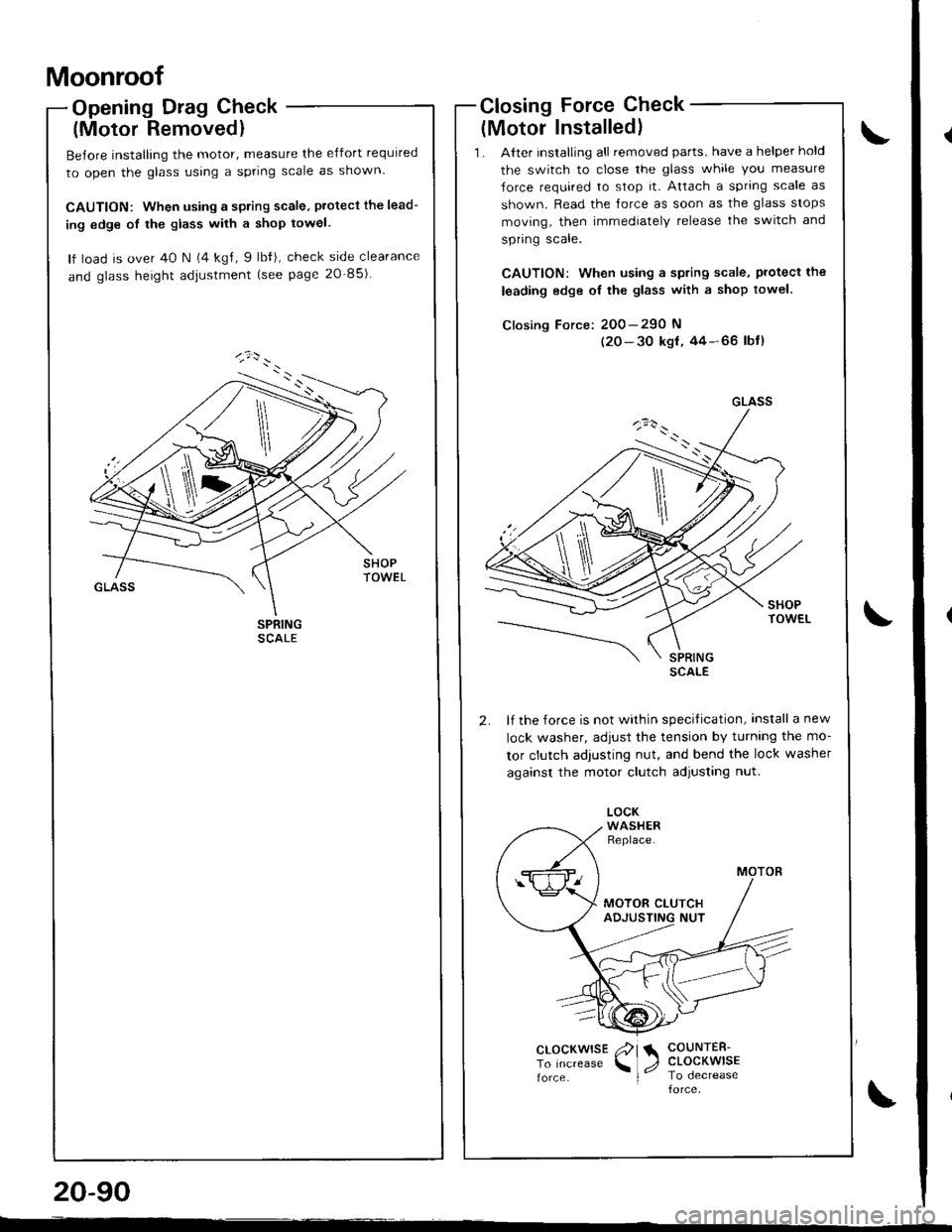
Opening Drag Check
(Motor Removedl
Before installing the motor, measure the effort required
to open the glass using a spring scale as shown.
CAUTION: When using a spring scale, protecl the lead-
ing edge ot the glass with a shop towel.
lf load is over 40 N (4 kgl, 9 lbfi, check side clearance
and glass height adjustment (see page 20-85)
Closing Force Check
{Motor Installed}
'1 . Alter installing all removed parts, have a helper hold
the switch to close the glass while you measure
Jorce required to stop it. Attach a spring scale as
shown. Read the lorce as soon as the glass stops
moving, then immediately release the switch and
spring scale.
CAUTION: when using a spring scale, protecl the
leading edge oI the glass with a shop towel.
Closing Force: 200-290 N
(20-30 ksf,44-66 lbtl
lf the force is not within specitication, install a new
lock washer, adiust the tension by turnlng the mo-
tor clutch adjusting nut, and bend the lock washer
against the motor clutch adjusting nut.
GLASS
\
clocKwrsE /?l a COUNTER-
To Increase \1, CLOCKWISE
force I lo oecreaseforce
20-90
--
Page 1022 of 1681
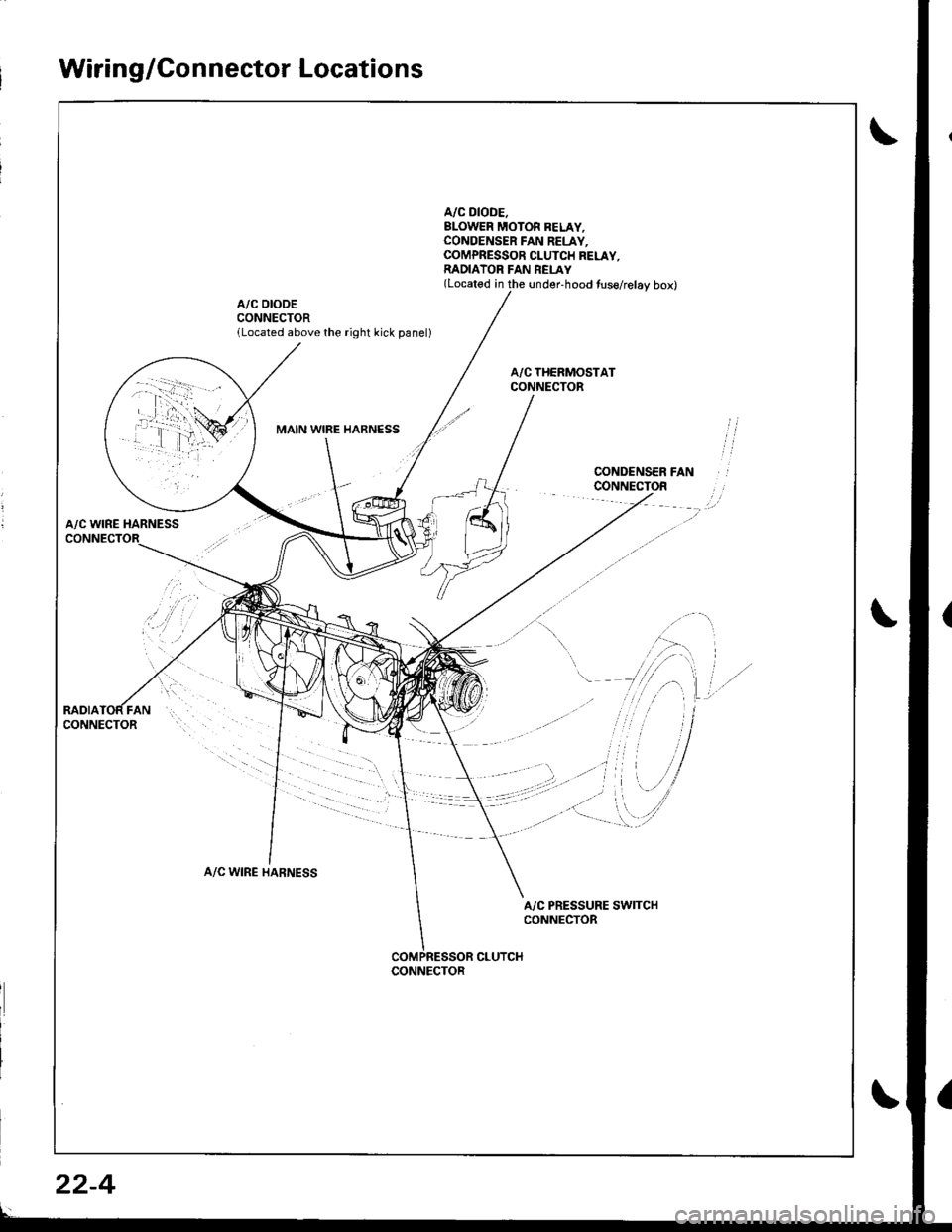
Wiring/Connector Locations
A/C DIODE.BLOWER MOTOR BELAY,CONOENSER FAN RELAY.COMPRESSOR CLUTCH RELAY,RADIATOR FAN REI-AY(Located in the under-hood tuse/relay box)
A/C DIODECONNECTORlLocated above the right kick panel)
MAIN WIBE HARNESS
A/C WINE HARNESS
A/C WIRE HARNESS
A/C PRESSURE SWITCHCONNECTOR
CLUTCHCONNECTOR
22-4
Page 1025 of 1681
J
Troubleshooting
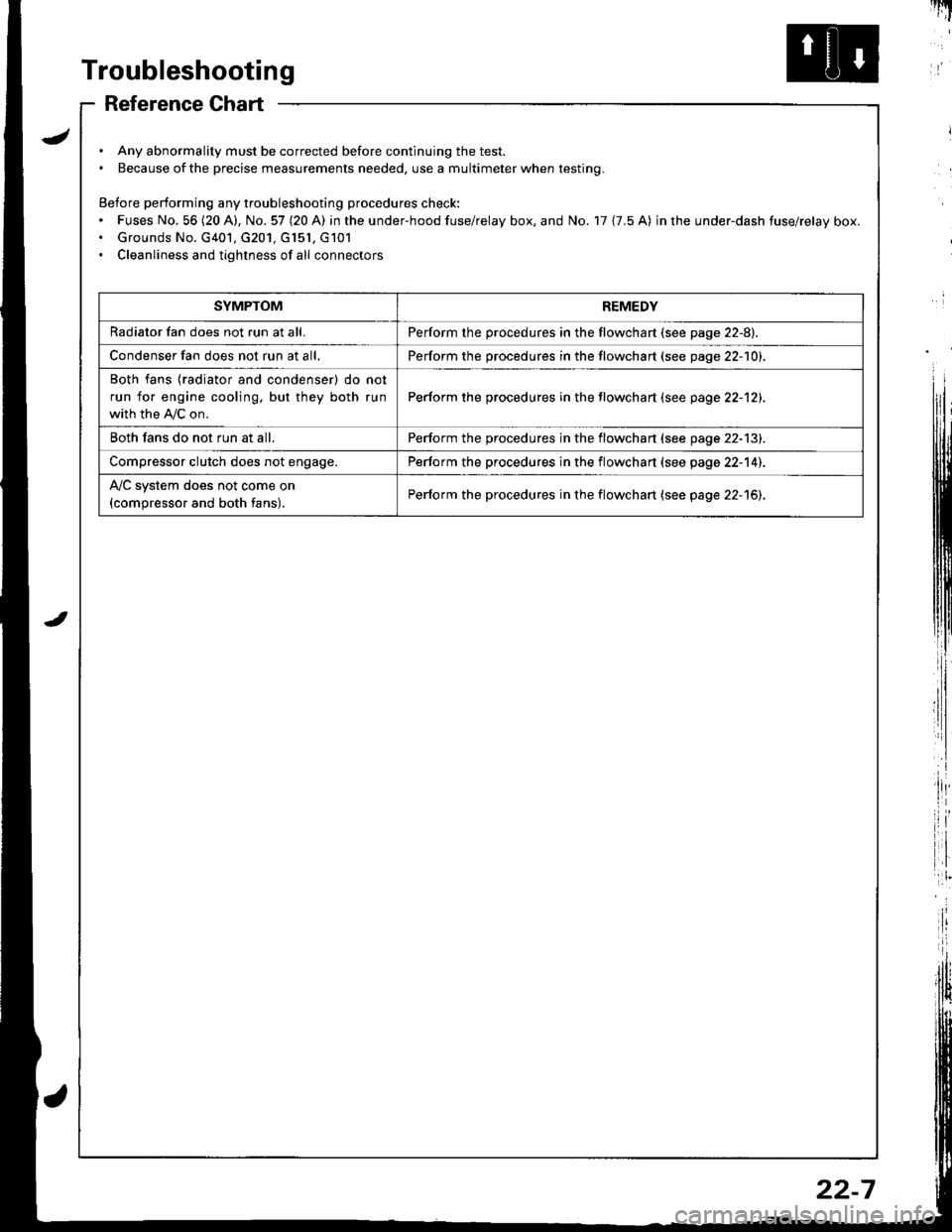
Reference Chart
. Any abnormality must be corrected before continuing the test.. Because of the precise measurements needed, use a multimeter when testing.
Before performing any troubleshooting procedures check:. Fuses No, 56 (20 A), No. 57 (20 A) in the under-hood fuse/relay box, and No. 17 {7.5 A) in rhe under-dash fuse/relay box.. Grounds No. G401, G201, G151, G101. Cleanliness and tightness of all connectors
I'IT
I
I
SYMPTOMREMEDY
Radiator fan does not run at all.Perform the procedures in the flowchart {see page 22-8).
Condenser fan does not run at all,Perform the procedures in the flowchart (see page 22-1O1.
Both fans {radiator and condenser) do not
run for engine cooling, but they both run
with the IVC on.
Perform the procedures in the tlowchart (see page 22-12).
Both fans do not run at all.Perform the procedures in the flowchart (see page 22-13).
Compressor clutch does not engage.Perform the procedures in the flowchart (see page 22-14).
l'lc system does not come on
{compressor and both fans).Perform the procedures in the flowchart (see page 22-15).
22-7
Page 1032 of 1681
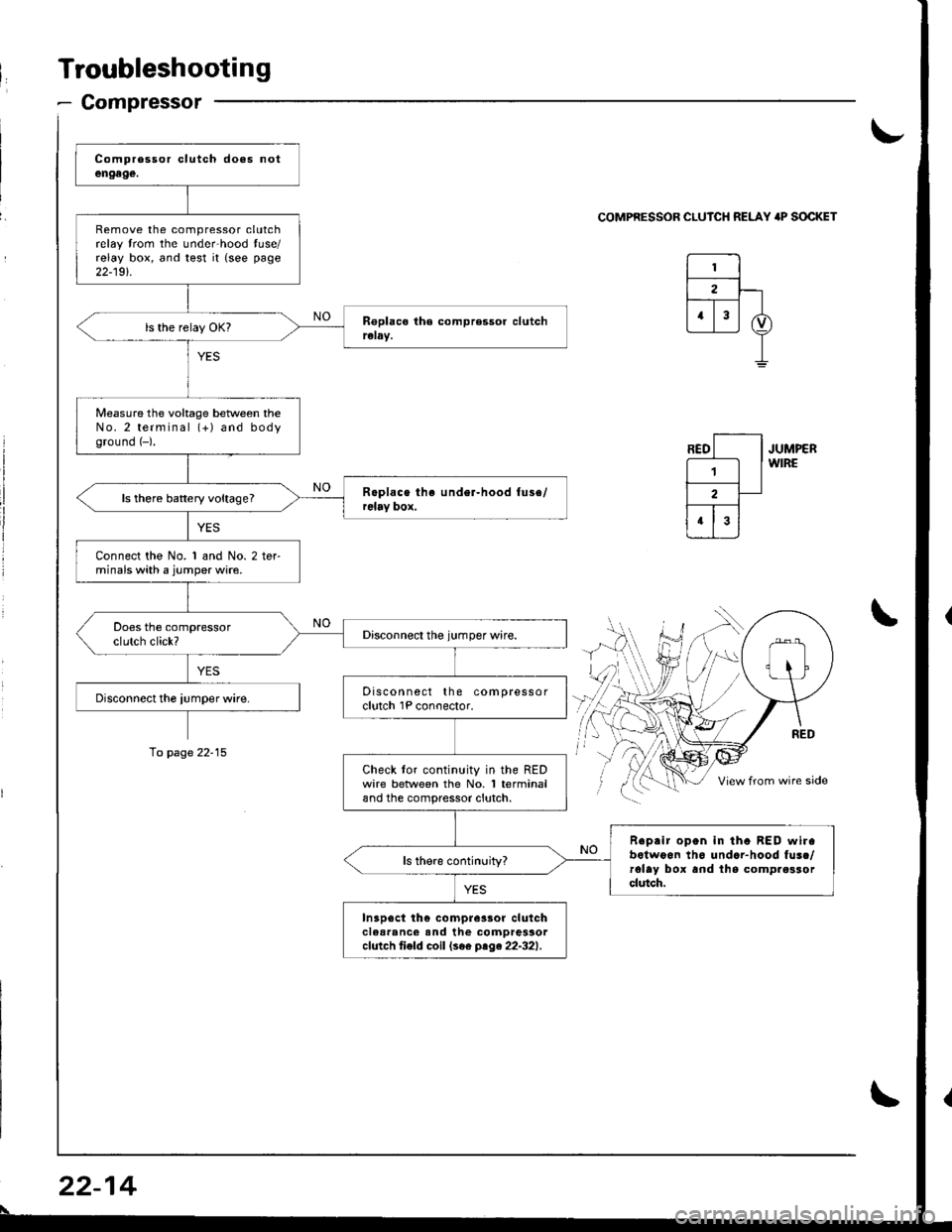
Troubleshooting
- Compressor
Remove the compressor clutchrelay trom the unde.hood tuse/relay box, and test it {see page
22-19t.
Measure the voltage beNveen theNo.2 terminal (+) and bodyground (-).
ls there battery voltage?
Connect the No. 1 and No. 2 terminals with a jumper wire.
Discon nect the compressorclutch 1P conoector.
Check lor continuity in the REDwire betlveen the No. 1 terminaland the compressor clutch.
Reprir open in tha BED wirabotwoon th6 undar-hood fusc/rolay box and lhs comp.osrorclutch.
In3p6ct th€ compre3sor clulchclear'nc€ and the comDressorcfutch ti€fd coil (se€ ptge22-321.
\-
COMPRESSOR CLUICH RELAY 'P SOCKET
JUMPERWIRE
\
To page 22-15
22-14
\
Page 1033 of 1681
![HONDA INTEGRA 1998 4.G Workshop Manual COMPRESSOR CLUTCH RELAY P SOCIGT
I
,l
I
i:]
lll
i
ll
rl.
,i
lil
ECM CONNECTOR A (32PI
BLK/f,ED
WIRE SIDE OF FEMALE TERMINALS
ECM CONNECTOR C {31P}
BLU/RED
Connect the backprobe adapters to the stacki](/img/13/6069/w960_6069-1032.png "HONDA INTEGRA 1998 4.G Workshop Manual COMPRESSOR CLUTCH RELAY P SOCIGT
I
,l
I
i:]
lll
i
ll
rl.
,i
lil
ECM CONNECTOR A (32PI
BLK/f,ED
WIRE SIDE OF FEMALE TERMINALS
ECM CONNECTOR C {31P}
BLU/RED
Connect the backprobe adapters to the stacki")
COMPRESSOR CLUTCH RELAY 'P SOCIGT
I
,l
I
i:]
lll
i
ll
rl.
,i
lil
ECM CONNECTOR A (32PI
BLK/f,ED
WIRE SIDE OF FEMALE TERMINALS
ECM CONNECTOR C {31P}
BLU/RED
Connect the backprobe adapters to the stacking patch cords, and connect the cords to a mul-timeter. Using the wire insulation as a guide lor the contoured tip oI the backprobe adapter,gently slide the tip into the connector trom the wire side until it comes in contact with the ter-minalend ofthe wire {see section l1).
From page 22-14
*How to use the backprobe sets
Turn the ignition switch ON {11}.
i/leasure the voltage between theNo. 4 wire terminal (+) and bodyground {-).
Rcp.ir opon in tho BLK/YEL wirobetwsen tha undor.dash tu3a/rehy box rnd the undor.hoodfw6/i6lry box.
Turn tho ignition switch OFF, andreinstall the compressor clutch
Make suro the !y'C and heater fanswitches are OFF.
Turn the ignition switch ON {l1).
Using a *Backprobe Set (T/N
07SAZ - 001000A), measure th€voltage between the No. 17 termi-nal oI the ECM connocror A (32P)
and body ground wirh the ECMconnectors connected.
R.pair op.n in tho BLK/R€O wirobgtweon thg undor-hood fu!a/relly box 6nd th. ECM.
Using a *Backprobe Set (T/N
07SM - 001000A), moasure thevoltage betwe€n the No. 5 termi-nal of the ECM connector C (31P)
and body ground with the ECMconnectors connected.
Ropair op6n in tho BLU/RED wircbctwccn tho A/C diodc rnd theECM,
Subiiituto . known-good ECMrnd rochock. lt symptom/indicr-tion 90o3 away, .6placc the origi-n.l ECM.
WIRE SIOE OF FEMALE TERMINALS
22-15
Page 1035 of 1681
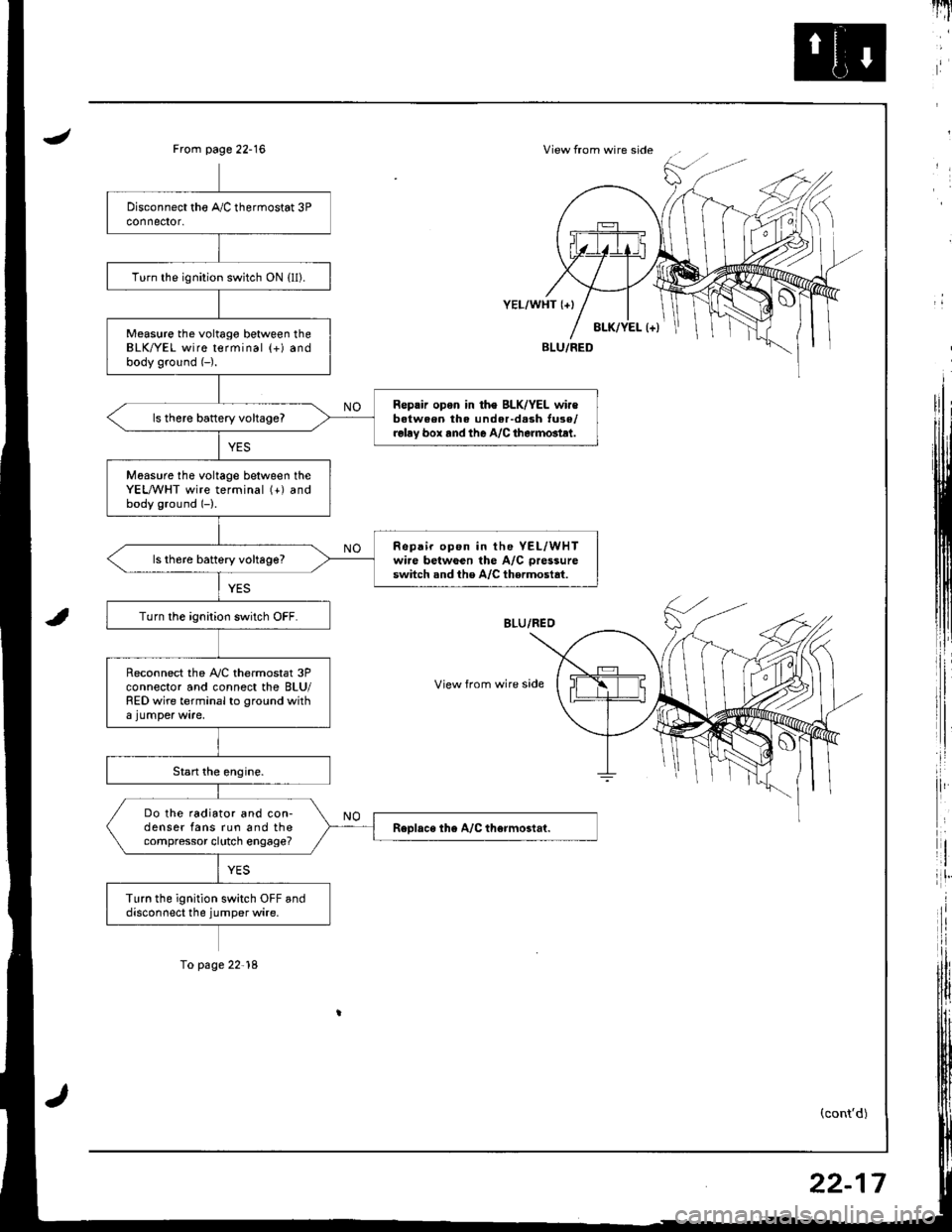
JView from wire sideFrom page 22-16
i,:,
il
rlt'
8LK/YEL l+)
YEL/WHT {+}
View from wire side
BLU/FED
(cont'd)
Turn the ignition switch ON {ll).
Measure the voltago between theBLK/YEL wire terminal (+) andbody ground (-).
Reprir opon in th€ BLK/YEL wir€batween the under-d.sh tuse/relay box rnd the A/C therm6tlt.
ls there battery vohageT
Moasure tho voltage between theYEL,A/VHT wire terminal (+) andbody ground (-).
Repair op6n in the YEL/WHTwire betwGen the A/C pressure
switch snd the A/C thermostat.ls th6re battery voltage?
Turn the ignition switch OFF.
Reconnect the A,/C thermostat 3Pconnector and connect the BLU/RED wire terminal to ground with
Do the radiator and con-denser fans run and thecompressor clutch engage?
Turn the ignition switch OFF anddisconnect the jumper wire.
To page 22'18
22-17
Page 1037 of 1681
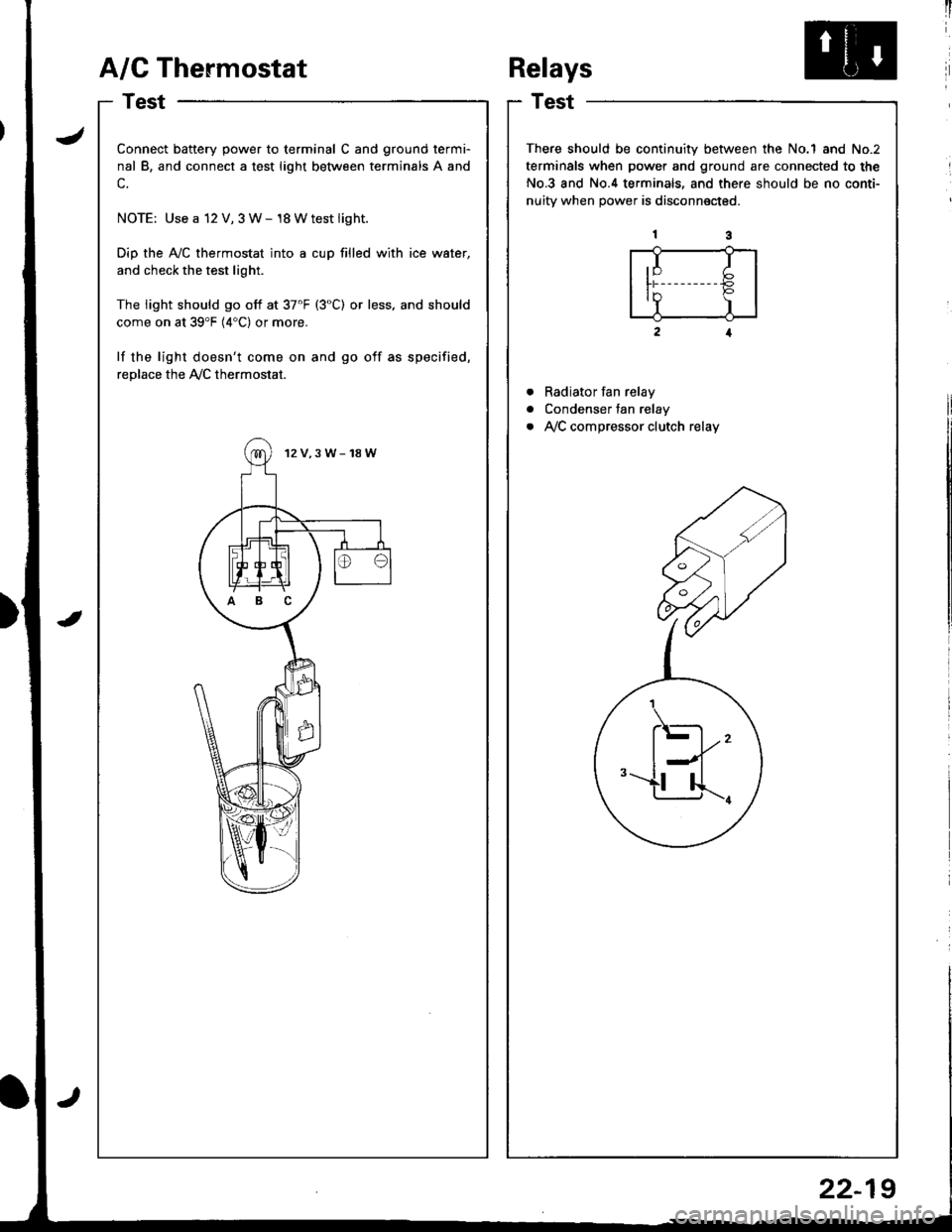
A/G Thermostat
I
I
a
a
a
t)
Connect battery power to terminal C and ground termi-
nal B, and connect a test light between terminals A and
c.
NOTE: Use a 12 V, 3 W- 18 Wtest light.
Dip the Ay'C thermostat into a cup filled with ice water,
and check the test light.
The light should go off at 37'F (3"C) or less. and should
come on at 39'F (4"C) or more.
lf the light doesn't come on and go off as specified,
replace the Ay'C thermostat.
12V,3W-18W
ABC
Relays
Test
There should be continuity between the No.1 and No.2
terminals when power and ground are connected to the
No.3 and No.4 terminals, and there should be no conti-
nuitv when Dower is disconnected.
Radiator fan relay
Condenser fan relay
Ay'C compressor clutch relay
,I I
ln P'Y )
.\-
l--l''-u...r.
22-19
Page 1041 of 1681
J
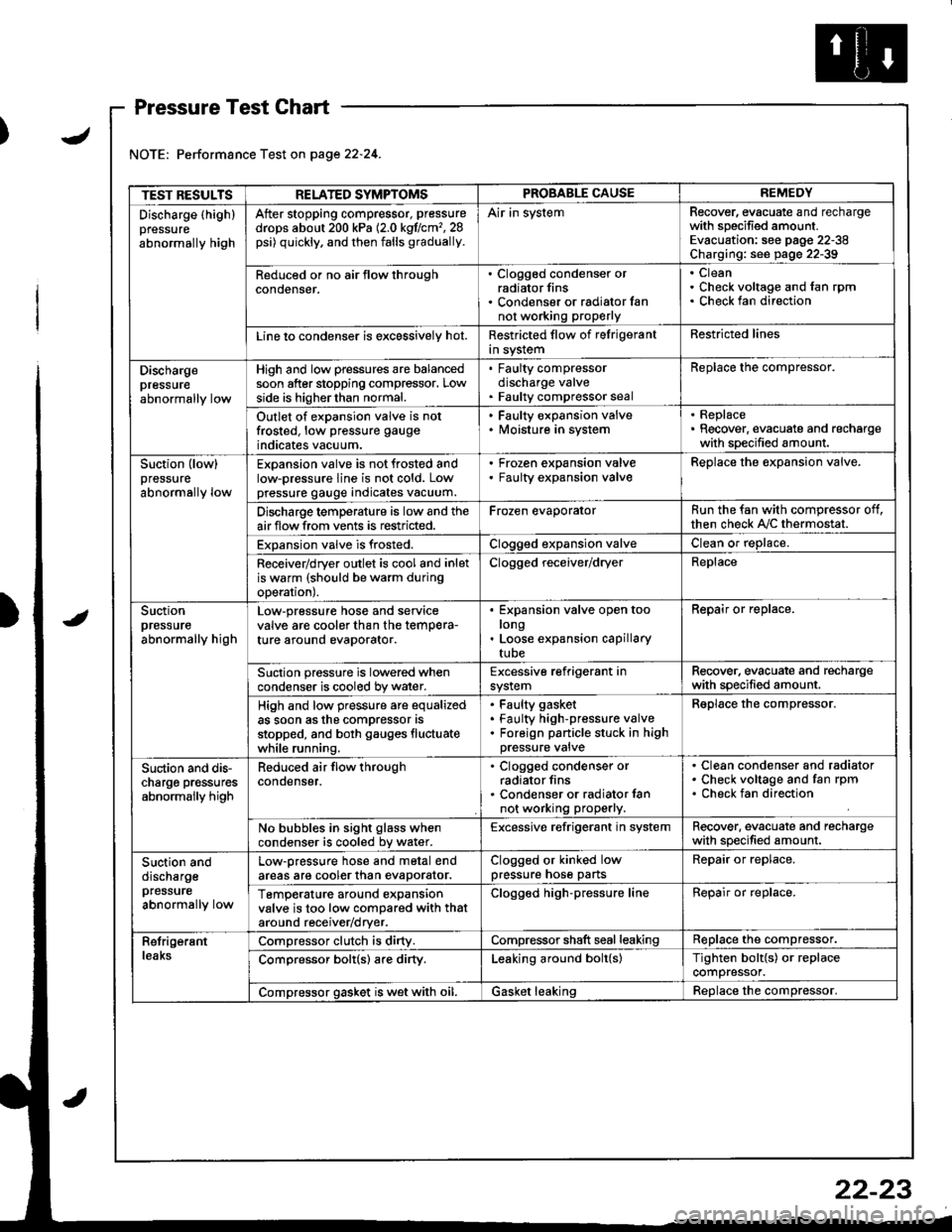
Pressure Test Chart
Performance Test on page 22.24.
TEST RESULTSRELATED SYMPTOMSPROBABLE CAUSEREMEDY
Discharge (highlpressure
abnormally high
After stopping compressor, pressure
drops about 200 kPa (2.0 kgflcm',28psi) quickly, and then falls gradually.
Air in systemRecover, evacuate and rechargewith specified amount.Evacuation: see pag€ 22-38Charging: see page 22-39
Reduced or no air tlow throughconoenser.
. Clogged condenser orradiator fins. Condenser or radialor fannot working proPerly
CleanCheck voltage and fan rpmCheck fan direction
Line lo condenser is excessively hot.Restricted flow of felrigerantin systemRestricted lines
Dischargepressureabnormally low
High and low pressures are balancedsoon after stopping compressor. Lowside is higherthan normal.
. Faulty compressordischarge valve. Faulty compressor seal
Replace the compressor.
Outlet of expansion valve is notfrosted, low pressure gauge
indicates vacuum.
. Faulty expansion valve. lvloisture in system
. Replace. Recover, evacuate and rechargewith specified amount.
Suction (low)pressure
abnormally low
Expansion valve is not frosted andlow-pressure line is not cold. Lowpressure gauge indicates vacuum.
Frozen expansion valveFaulty expansion valveReplace the expansion valve.
Discharge temperature is low and theairflow from vents is restricted.Frozen evaporatorRun the fan with compressor off,then check A,/C thermostat.
Expansion valve is frosted.Clogged expansion valveClean or replace.
Receiver/dryer outlet is cool and inletis warm (should be warm duringoperal|onJ.
Clogged receiver/dryerReplace
Suctionpressureabnormally high
Low-pressure hose and seryicevalve are cooler than the temPera-ture around evaporator.
Expansion valve open toolongLoose expansion capillarytube
Repair or replace.
Suction pressure is lowered whencondenser is cooled by water.Excessive refrigerant insystemRecover. evacuate and rechargewith specified amount.
High and low pressure are equalizedas soon asthe compressor asstopped, and both gauges fluctuatewhile running.
Faulty gasket
Faulty high-pressure valveForeign panicle stuck in highpressure valve
Reolace the comDressor.
Suction and dis-charge pr€ssuresabnormally high
Reduced air flow throughcondenser.
. Clogged condenser orradiator fins. Condenser or radiator lannot working properly.
Clean condenser and radiatorCheck voltage and fan rpmCheck fan direction
No bubbles in sight glass whencondenser is cooled bv water.Excessive refrigerant in systemRecover. evacuate and rechargewith specified amount.
Suction anddischargepfessure
abnormally low
Low-pressure hose and metal endareas are cooler than evaDorator.Clogged or kinked lowpressure hose partsRepair or replace.
TemP€rature around expansionvalve is too low compared with thataround receiv€r/dryer.
Clogged high-pressure lineRepair or replace.
RetrigerantleaksCompressor clutch is dirty.Compressor shaft seal leakingReplace the compressor.
Comoressor bolt(s) are dirty.Leaking around bolt(s)Tighten bolt{s) or replacecompressor.
Compressor gasket is wet with oil.Gasket leakingReolace the comoressor.
22-23
Page 1047 of 1681
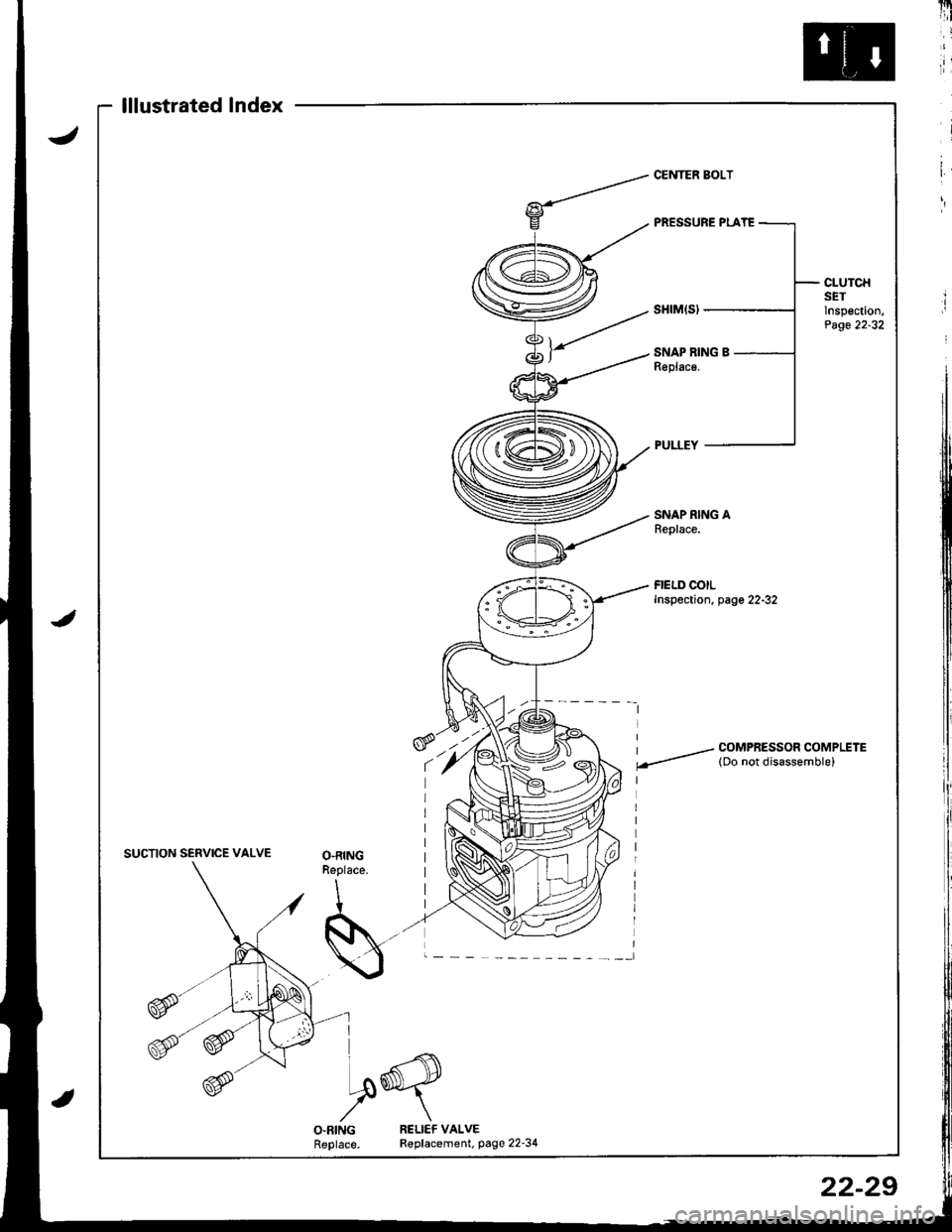
lllustratedlndex
CLUTCHSETlnspection,Page 22-32
SNAP RING AReplace.
FIELD COILInspection, page 22-32
I / COMPRESSOR COMPLETE
.-- lDo not disassemble)
SUCTION SERVICE VALVEO.RINGReplace.
I
S..-
VX
I
I ^.-{\
I.ory
O.RINGReplace.RELICF VALVER€placement. page 22-34
22-29