clock ISUZU KB P190 2007 Workshop Owners Manual
[x] Cancel search | Manufacturer: ISUZU, Model Year: 2007, Model line: KB P190, Model: ISUZU KB P190 2007Pages: 6020, PDF Size: 70.23 MB
Page 4280 of 6020
CONSTRUCTION AND FUNCTION 7A1-41
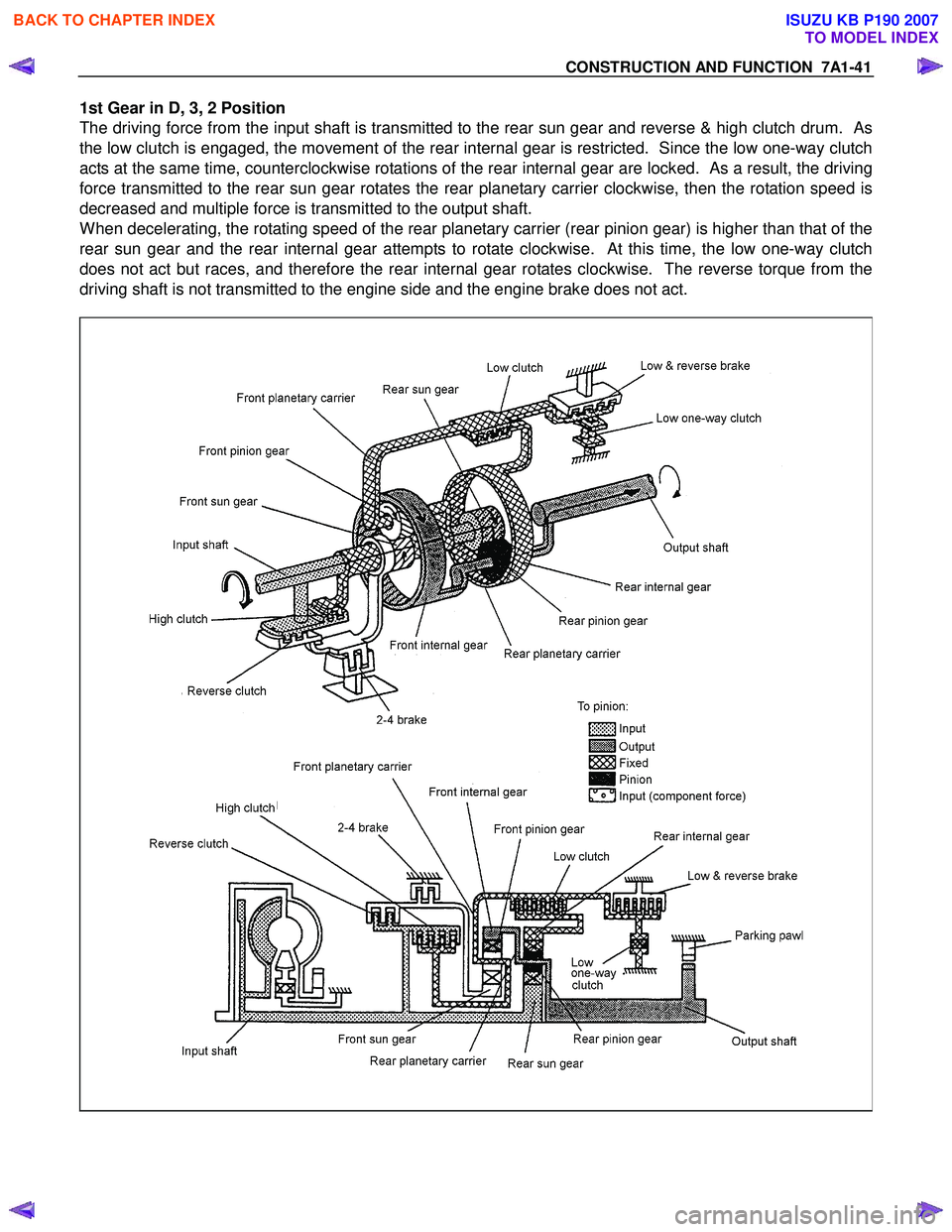
1st Gear in D, 3, 2 Position
The driving force from the input shaft is transmitted to the rear sun gear and reverse & high clutch drum. As
the low clutch is engaged, the movement of the rear internal gear is restricted. Since the low one-way clutch
acts at the same time, counterclockwise rotations of the rear internal gear are locked. As a result, the driving
force transmitted to the rear sun gear rotates the rear planetary carrier clockwise, then the rotation speed is
decreased and multiple force is transmitted to the output shaft.
When decelerating, the rotating speed of the rear planetary carrier (rear pinion gear) is higher than that of the
rear sun gear and the rear internal gear attempts to rotate clockwise. At this time, the low one-way clutch
does not act but races, and therefore the rear internal gear rotates clockwise. The reverse torque from the
driving shaft is not transmitted to the engine side and the engine brake does not act.
BACK TO CHAPTER INDEX
TO MODEL INDEX
ISUZU KB P190 2007
Page 4282 of 6020
CONSTRUCTION AND FUNCTION 7A1-43
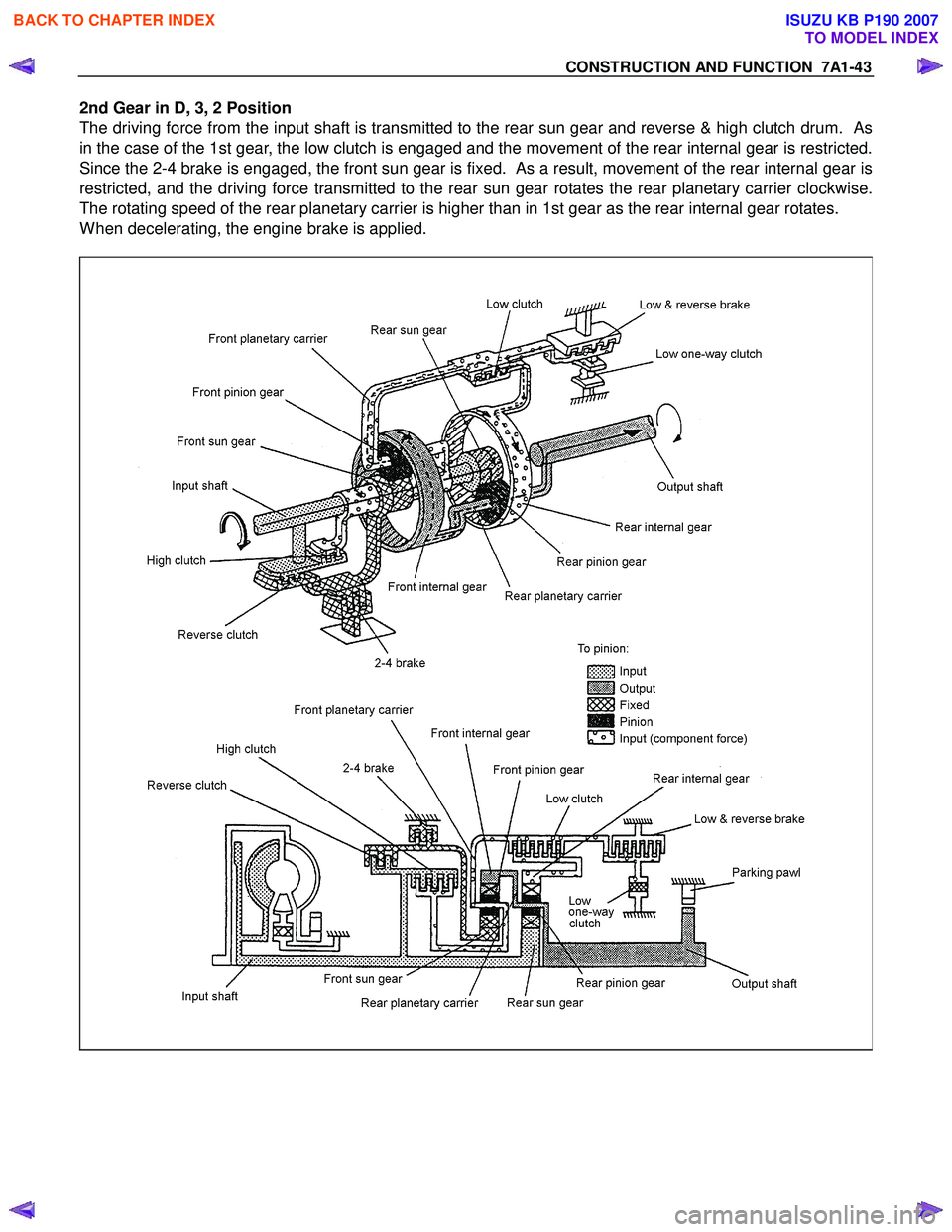
2nd Gear in D, 3, 2 Position
The driving force from the input shaft is transmitted to the rear sun gear and reverse & high clutch drum. As
in the case of the 1st gear, the low clutch is engaged and the movement of the rear internal gear is restricted.
Since the 2-4 brake is engaged, the front sun gear is fixed. As a result, movement of the rear internal gear is
restricted, and the driving force transmitted to the rear sun gear rotates the rear planetary carrier clockwise.
The rotating speed of the rear planetary carrier is higher than in 1st gear as the rear internal gear rotates.
When decelerating, the engine brake is applied.
BACK TO CHAPTER INDEX
TO MODEL INDEX
ISUZU KB P190 2007
Page 4284 of 6020
CONSTRUCTION AND FUNCTION 7A1-45
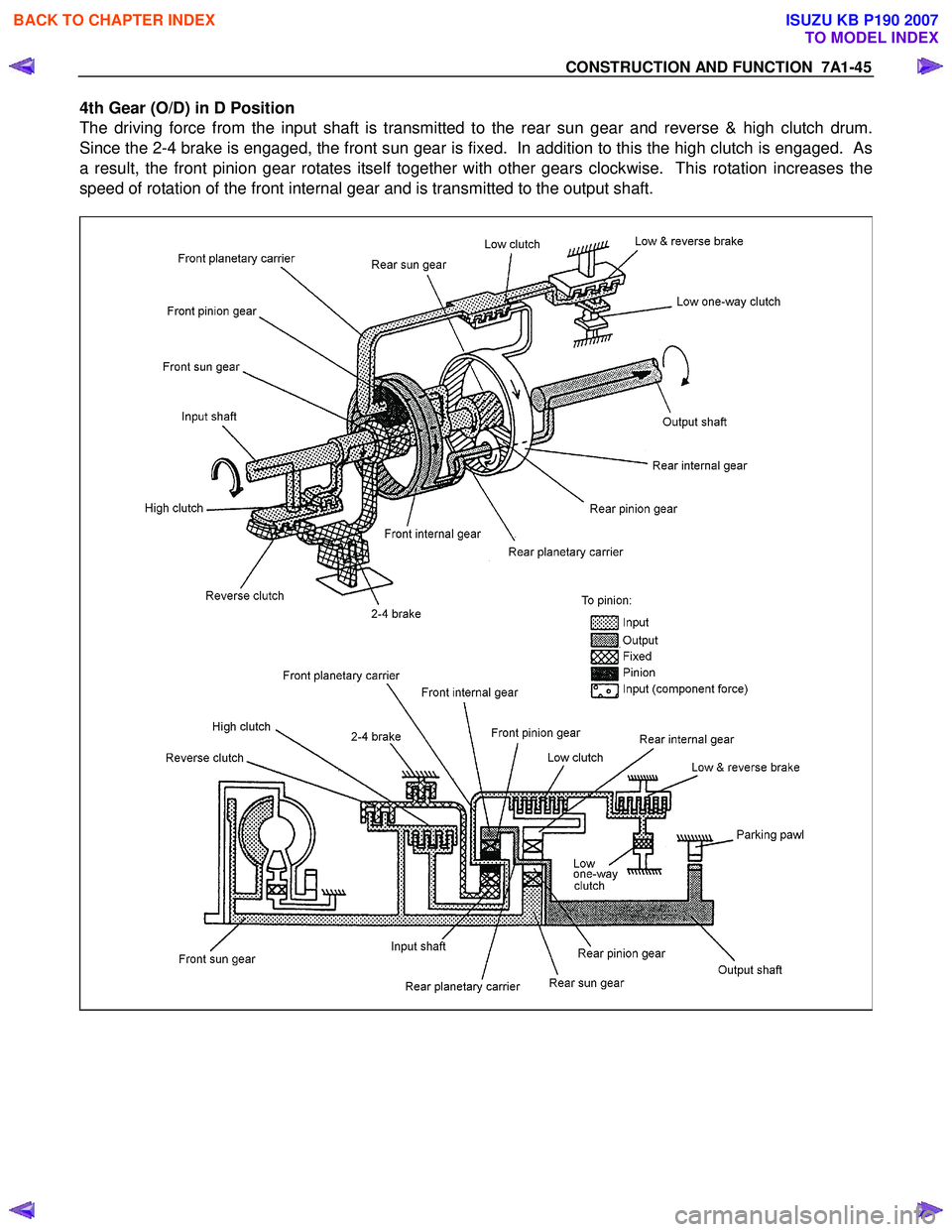
4th Gear (O/D) in D Position
The driving force from the input shaft is transmitted to the rear sun gear and reverse & high clutch drum.
Since the 2-4 brake is engaged, the front sun gear is fixed. In addition to this the high clutch is engaged. As
a result, the front pinion gear rotates itself together with other gears clockwise. This rotation increases the
speed of rotation of the front internal gear and is transmitted to the output shaft.
BACK TO CHAPTER INDEX
TO MODEL INDEX
ISUZU KB P190 2007
Page 4431 of 6020
TRANSMISSION CONTROL SYSTEM (JR405E) 7A2-147
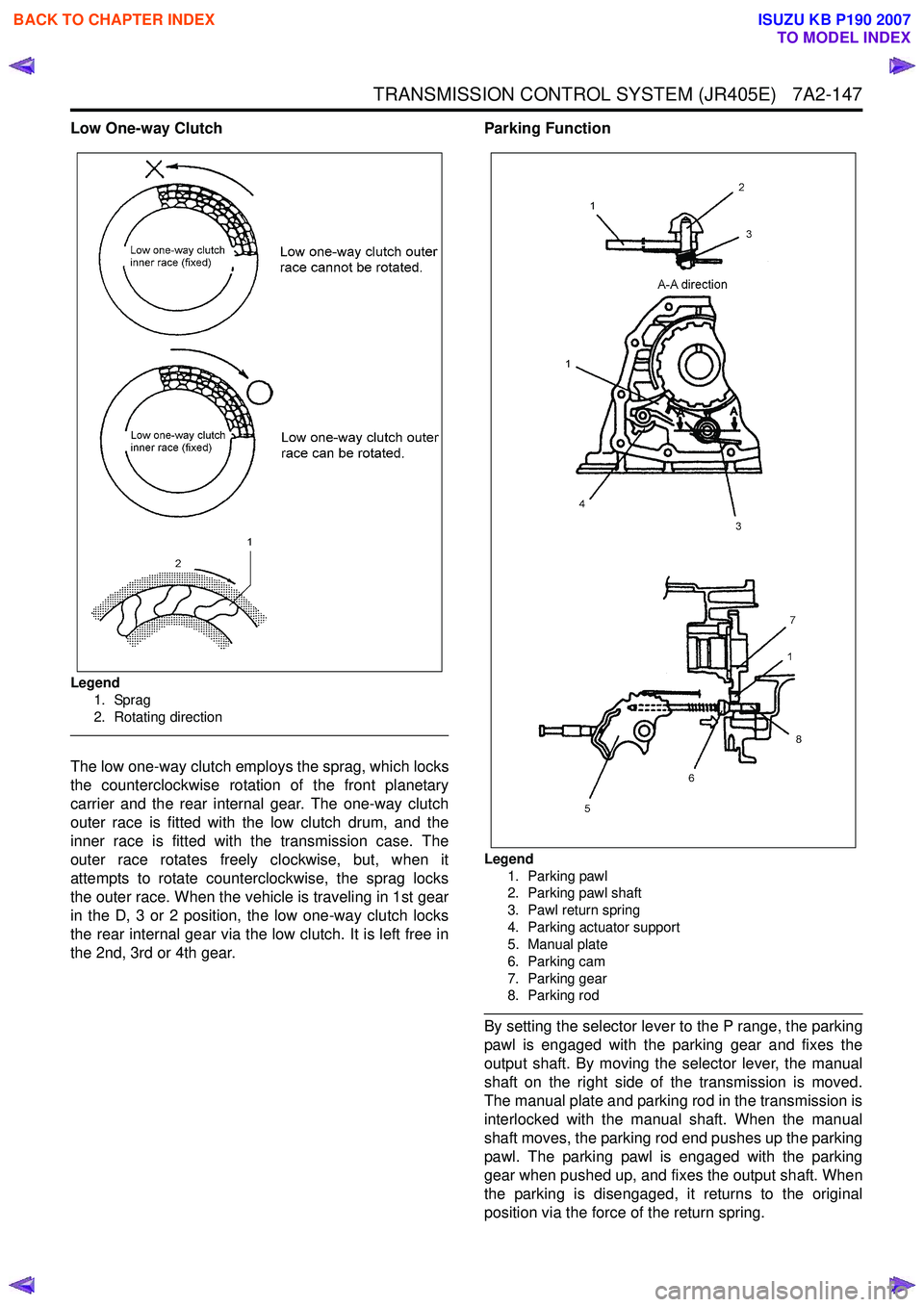
Low One-way Clutch
Legend1. Sprag
2. Rotating direction
The low one-way clutch employs the sprag, which locks
the counterclockwise rotation of the front planetary
carrier and the rear internal gear. The one-way clutch
outer race is fitted with the low clutch drum, and the
inner race is fitted with the transmission case. The
outer race rotates freely clockwise, but, when it
attempts to rotate counterclockwise, the sprag locks
the outer race. When the vehicle is traveling in 1st gear
in the D, 3 or 2 position, the low one-way clutch locks
the rear internal gear via the low clutch. It is left free in
the 2nd, 3rd or 4th gear. Parking Function
Legend
1. Parking pawl
2. Parking pawl shaft
3. Pawl return spring
4. Parking actuator support
5. Manual plate
6. Parking cam
7. Parking gear
8. Parking rod
By setting the selector lever to the P range, the parking
pawl is engaged with the parking gear and fixes the
output shaft. By moving the selector lever, the manual
shaft on the right side of the transmission is moved.
The manual plate and parking rod in the transmission is
interlocked with the manual shaft. When the manual
shaft moves, the parking rod end pushes up the parking
pawl. The parking pawl is engaged with the parking
gear when pushed up, and fixes the output shaft. When
the parking is disengaged, it returns to the original
position via the force of the return spring.
BACK TO CHAPTER INDEX
TO MODEL INDEX
ISUZU KB P190 2007
Page 4445 of 6020
TRANSMISSION CONTROL SYSTEM (JR405E) 7A2-161
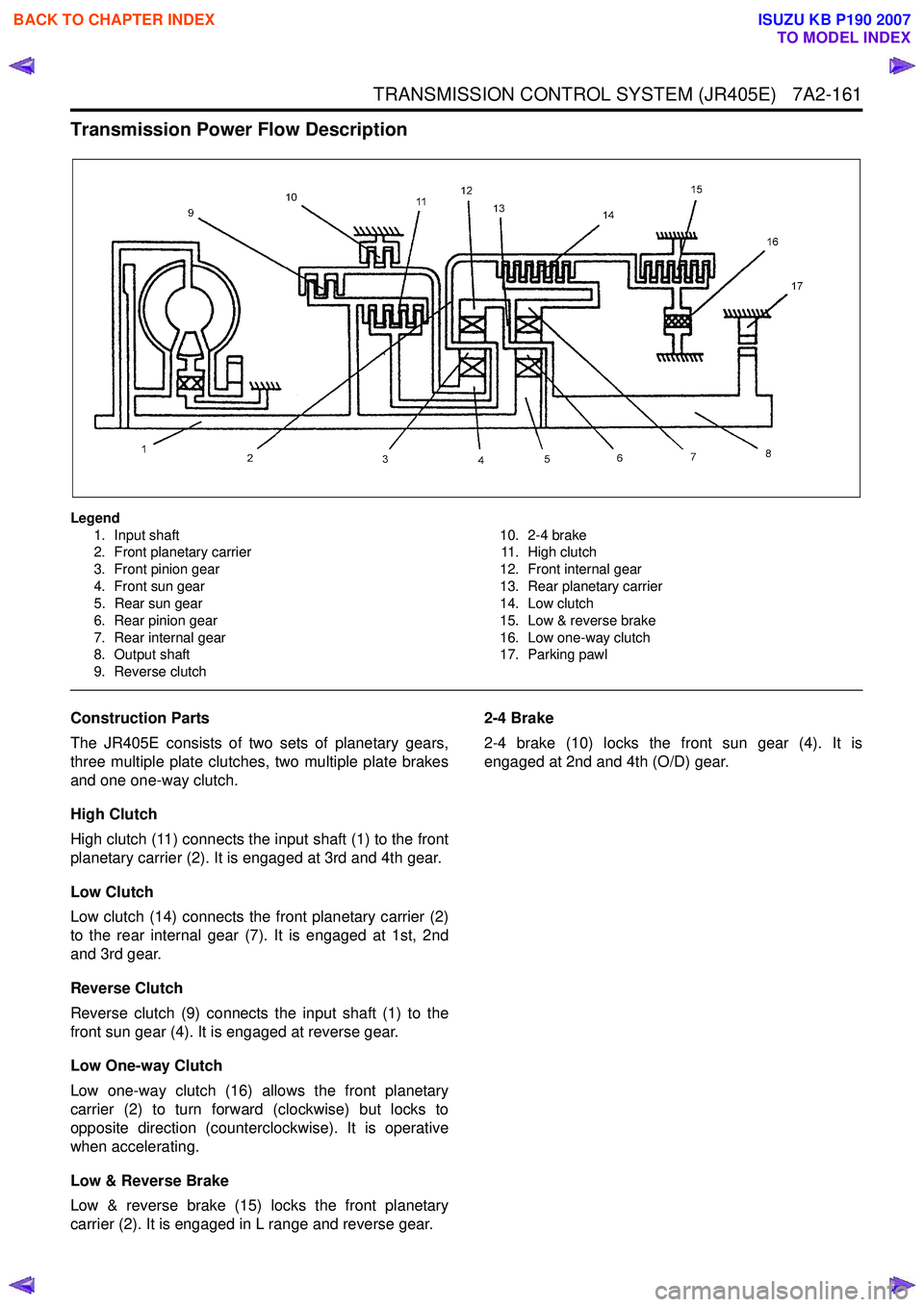
Transmission Power Flow Description
Legend1. Input shaft
2. Front planetary carrier
3. Front pinion gear
4. Front sun gear
5. Rear sun gear
6. Rear pinion gear
7. Rear internal gear
8. Output shaft
9. Reverse clutch 10. 2-4 brake
11. High clutch
12. Front internal gear
13. Rear planetary carrier
14. Low clutch
15. Low & reverse brake
16. Low one-way clutch
17. Parking pawl
Construction Parts
The JR405E consists of two sets of planetary gears,
three multiple plate clutches, two multiple plate brakes
and one one-way clutch.
High Clutch
High clutch (11) connects the input shaft (1) to the front
planetary carrier (2). It is engaged at 3rd and 4th gear.
Low Clutch
Low clutch (14) connects the front planetary carrier (2)
to the rear internal gear (7). It is engaged at 1st, 2nd
and 3rd gear.
Reverse Clutch
Reverse clutch (9) connects the input shaft (1) to the
front sun gear (4). It is engaged at reverse gear.
Low One-way Clutch
Low one-way clutch (16) allows the front planetary
carrier (2) to turn forward (clockwise) but locks to
opposite direction (counterclockwise). It is operative
when accelerating.
Low & Reverse Brake
Low & reverse brake (15) locks the front planetary
carrier (2). It is engaged in L range and reverse gear. 2-4 Brake
2-4 brake (10) locks the front sun gear (4). It is
engaged at 2nd and 4th (O/D) gear.
BACK TO CHAPTER INDEX
TO MODEL INDEX
ISUZU KB P190 2007
Page 4448 of 6020
7A2-164 TRANSMISSION CONTROL SYSTEM (JR405E)
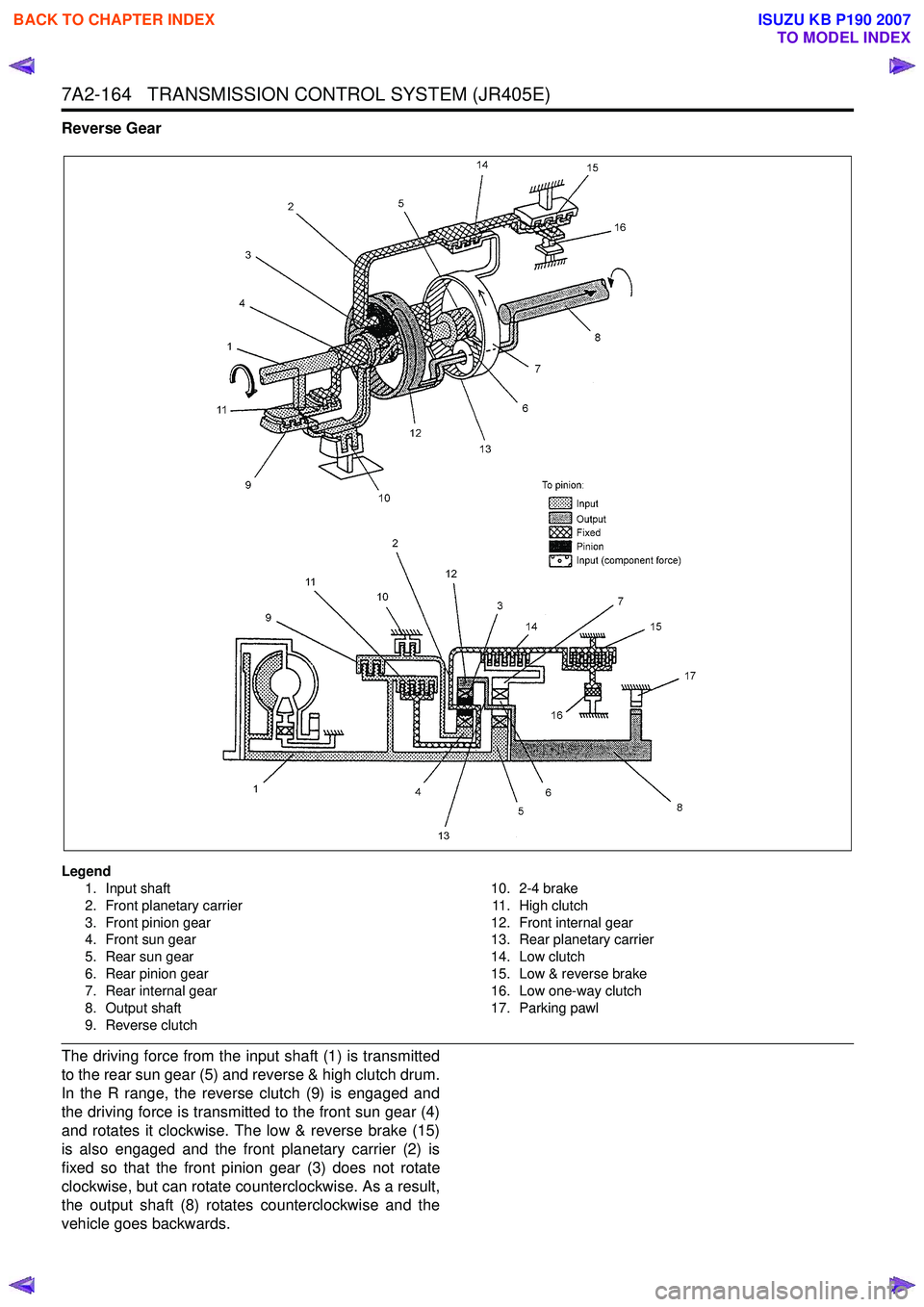
Reverse Gear
Legend1. Input shaft
2. Front planetary carrier
3. Front pinion gear
4. Front sun gear
5. Rear sun gear
6. Rear pinion gear
7. Rear internal gear
8. Output shaft
9. Reverse clutch 10. 2-4 brake
11 . H i g h c l u t c h
12. Front internal gear
13. Rear planetary carrier
14. Low clutch
15. Low & reverse brake
16. Low one-way clutch
17. Parking pawl
The driving force from the input shaft (1) is transmitted
to the rear sun gear (5) and reverse & high clutch drum.
In the R range, the reverse clutch (9) is engaged and
the driving force is transmitted to the front sun gear (4)
and rotates it clockwise. The low & reverse brake (15)
is also engaged and the front planetary carrier (2) is
fixed so that the front pinion gear (3) does not rotate
clockwise, but can rotate counterclockwise. As a result,
the output shaft (8) rotates counterclockwise and the
vehicle goes backwards.
BACK TO CHAPTER INDEX
TO MODEL INDEX
ISUZU KB P190 2007
Page 4449 of 6020
TRANSMISSION CONTROL SYSTEM (JR405E) 7A2-165
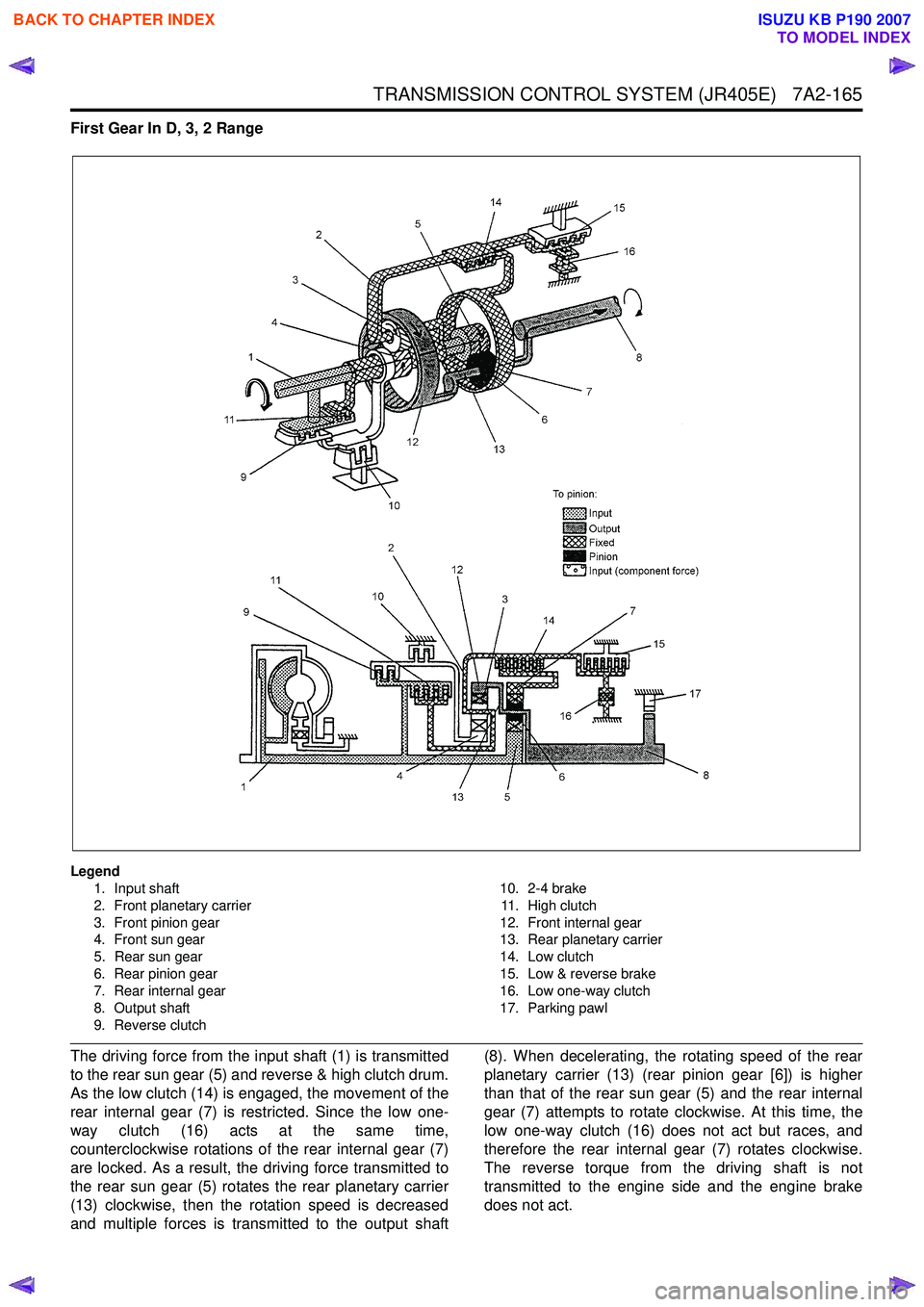
First Gear In D, 3, 2 Range
Legend1. Input shaft
2. Front planetary carrier
3. Front pinion gear
4. Front sun gear
5. Rear sun gear
6. Rear pinion gear
7. Rear internal gear
8. Output shaft
9. Reverse clutch 10. 2-4 brake
11. High clutch
12. Front internal gear
13. Rear planetary carrier
14. Low clutch
15. Low & reverse brake
16. Low one-way clutch
17. Parking pawl
The driving force from the input shaft (1) is transmitted
to the rear sun gear (5) and reverse & high clutch drum.
As the low clutch (14) is engaged, the movement of the
rear internal gear (7) is restricted. Since the low one-
way clutch (16) acts at the same time,
counterclockwise rotations of the rear internal gear (7)
are locked. As a result, the driving force transmitted to
the rear sun gear (5) rotates the rear planetary carrier
(13) clockwise, then the rotation speed is decreased
and multiple forces is transmitted to the output shaft (8). When decelerating, the rotating speed of the rear
planetary carrier (13) (rear pinion gear [6]) is higher
than that of the rear sun gear (5) and the rear internal
gear (7) attempts to rotate clockwise. At this time, the
low one-way clutch (16) does not act but races, and
therefore the rear internal gear (7) rotates clockwise.
The reverse torque from the driving shaft is not
transmitted to the engine side and the engine brake
does not act.
BACK TO CHAPTER INDEX
TO MODEL INDEX
ISUZU KB P190 2007
Page 4451 of 6020
TRANSMISSION CONTROL SYSTEM (JR405E) 7A2-167
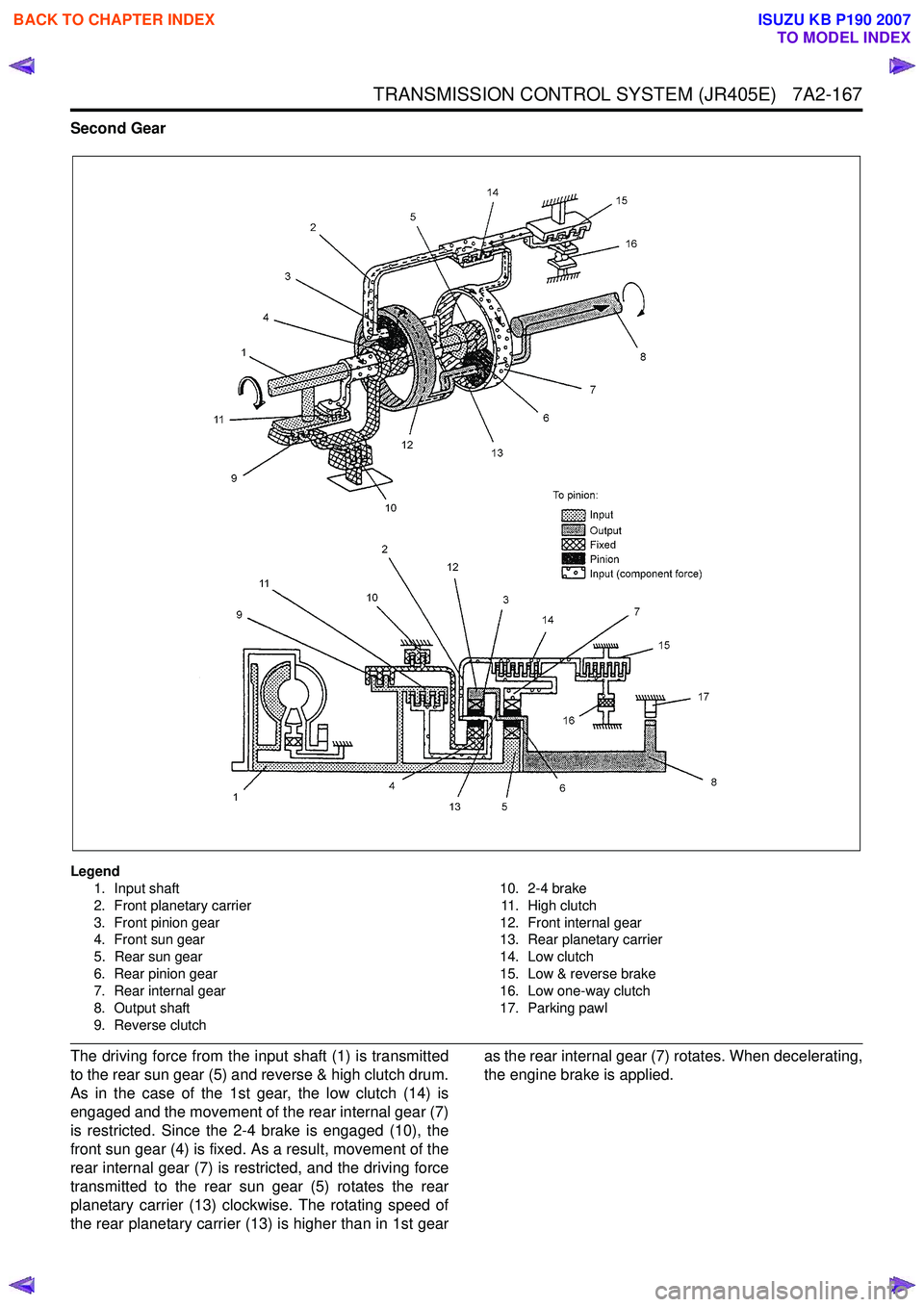
Second Gear
Legend1. Input shaft
2. Front planetary carrier
3. Front pinion gear
4. Front sun gear
5. Rear sun gear
6. Rear pinion gear
7. Rear internal gear
8. Output shaft
9. Reverse clutch 10. 2-4 brake
11. High clutch
12. Front internal gear
13. Rear planetary carrier
14. Low clutch
15. Low & reverse brake
16. Low one-way clutch
17. Parking pawl
The driving force from the input shaft (1) is transmitted
to the rear sun gear (5) and reverse & high clutch drum.
As in the case of the 1st gear, the low clutch (14) is
engaged and the movement of the rear internal gear (7)
is restricted. Since the 2-4 brake is engaged (10), the
front sun gear (4) is fixed. As a result, movement of the
rear internal gear (7) is restricted, and the driving force
transmitted to the rear sun gear (5) rotates the rear
planetary carrier (13) clockwise. The rotating speed of
the rear planetary carrier (13) is higher than in 1st gear as the rear internal gear (7) rotates. When decelerating,
the engine brake is applied.
BACK TO CHAPTER INDEX
TO MODEL INDEX
ISUZU KB P190 2007
Page 4453 of 6020
TRANSMISSION CONTROL SYSTEM (JR405E) 7A2-169
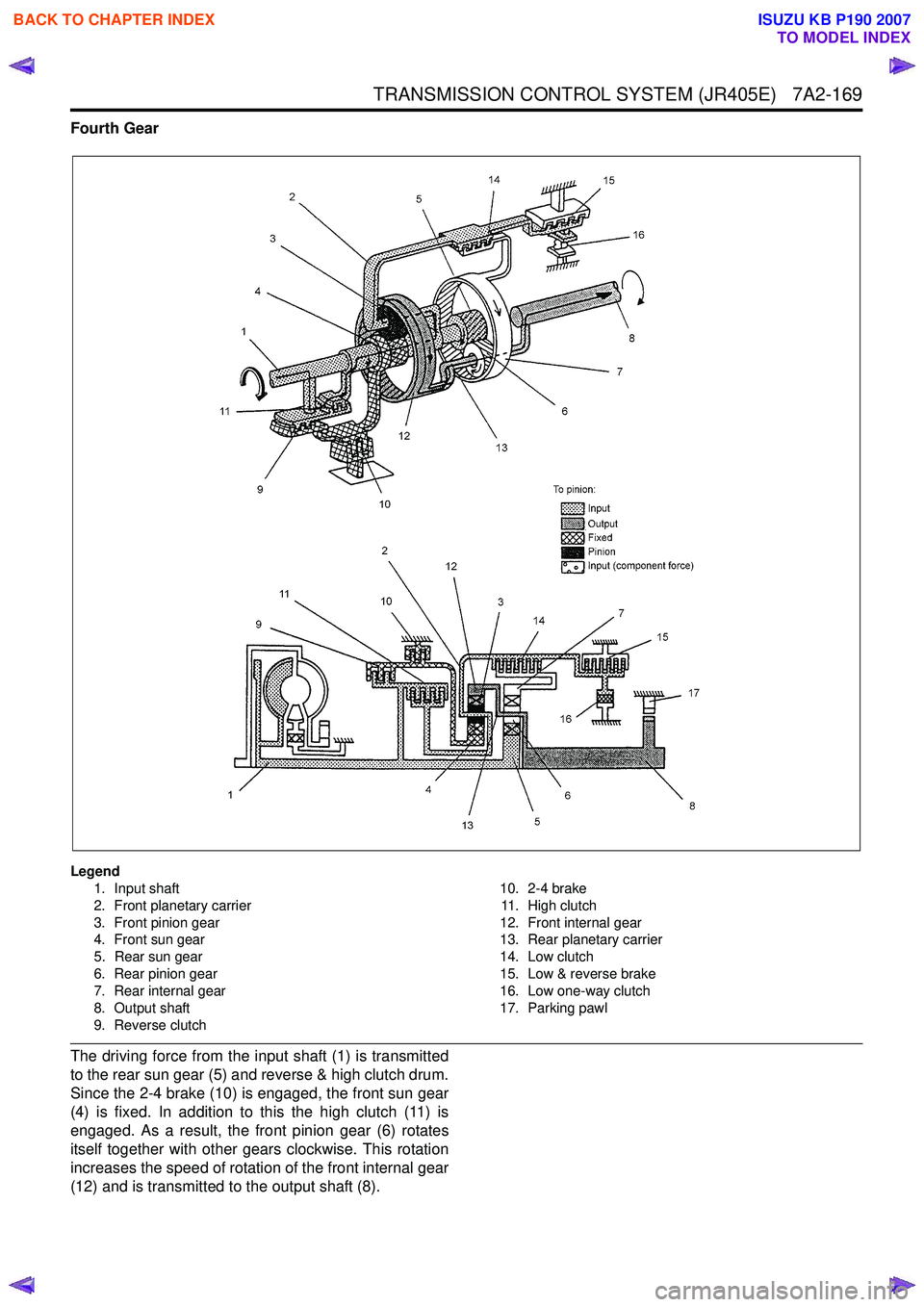
Fourth Gear
Legend1. Input shaft
2. Front planetary carrier
3. Front pinion gear
4. Front sun gear
5. Rear sun gear
6. Rear pinion gear
7. Rear internal gear
8. Output shaft
9. Reverse clutch 10. 2-4 brake
11. High clutch
12. Front internal gear
13. Rear planetary carrier
14. Low clutch
15. Low & reverse brake
16. Low one-way clutch
17. Parking pawl
The driving force from the input shaft (1) is transmitted
to the rear sun gear (5) and reverse & high clutch drum.
Since the 2-4 brake (10) is engaged, the front sun gear
(4) is fixed. In addition to this the high clutch (11) is
engaged. As a result, the front pinion gear (6) rotates
itself together with other gears clockwise. This rotation
increases the speed of rotation of the front internal gear
(12) and is transmitted to the output shaft (8).
BACK TO CHAPTER INDEX
TO MODEL INDEX
ISUZU KB P190 2007
Page 4465 of 6020
ON-VEHICLE SERVICE (JR405E) 7A3-11
Remove or Disconnect
1. Block the wheels.
2. Disconnect the negative battery cable.
3. Remove the rear console and the front console.
4. Remove the 2 screws fixing the select lever knob.
5. Remove the knob together with the knob button and spring from the lever.
6. Turn the sleeve counterclockwise to remove it. Make a note of the number of turns required to free
the sleeve.
7. Remove the harness connectors from the base plate.
8. Remove the upper housing (held in place by 4 latched fasteners).
9. Remove the lamp assembly by turning it counterclockwise.
10. Remove the spring plate.
11. Remove the grooved pin.
12. Disconnect the shift cable from the select lever.
13. Remove the lever assembly by pressing the rod down (lever in N position).
14. Remove the harness connectors from the shift lock unit, then remove the shift lock unit.
15. Remove the interlock controller.
16. If the replacement of shift lock release button o
r
shift lock button spring is required, remove the
position indicator housing, the shift lock button
spring and shift lock release button can be
removed.
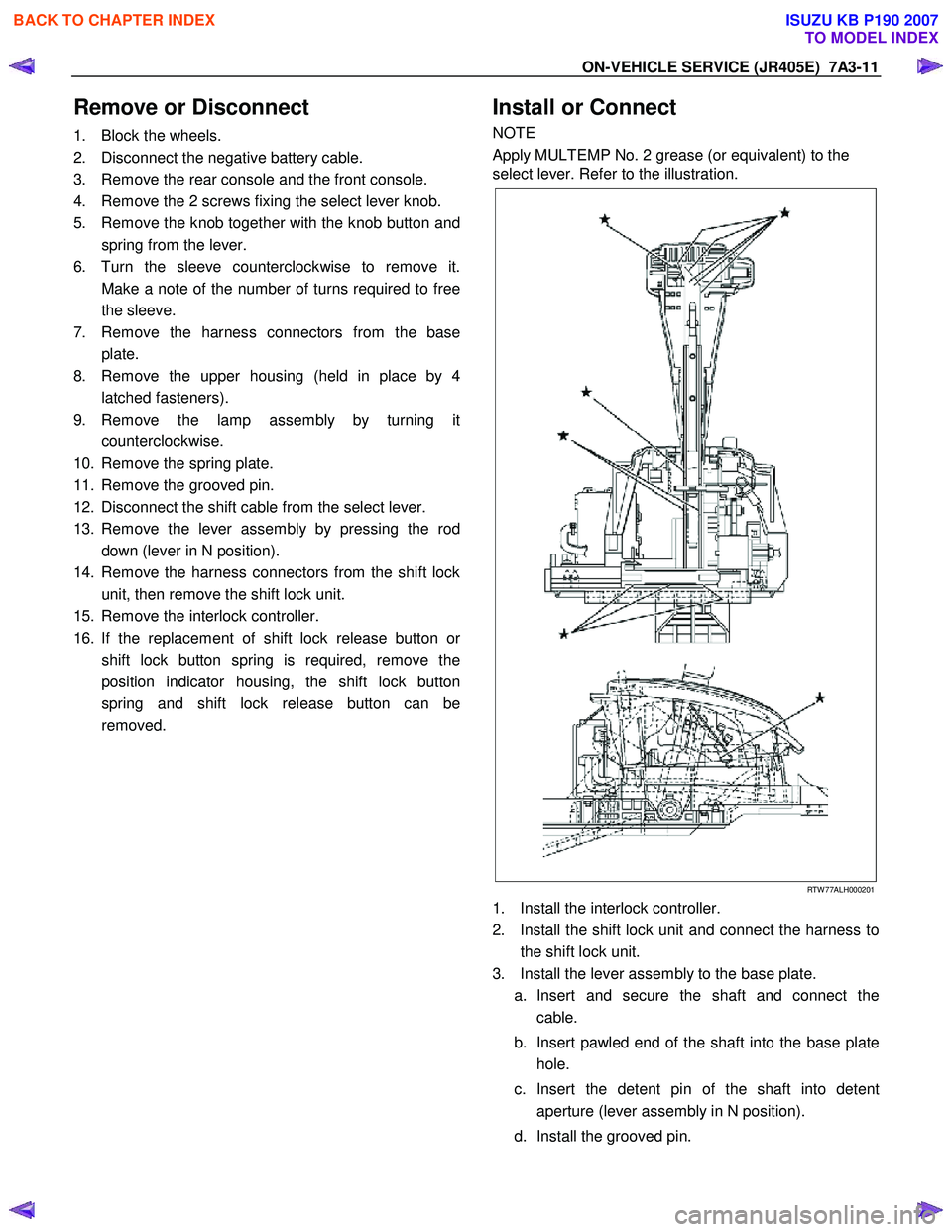
Install or Connect
NOTE
Apply MULTEMP No. 2 grease (or equivalent) to the
select lever. Refer to the illustration.
RTW 77ALH000201
1. Install the interlock controller.
2. Install the shift lock unit and connect the harness to the shift lock unit.
3. Install the lever assembly to the base plate. a. Insert and secure the shaft and connect the cable.
b. Insert pawled end of the shaft into the base plate hole.
c. Insert the detent pin of the shaft into detent aperture (lever assembly in N position).
d. Install the grooved pin.
BACK TO CHAPTER INDEX
TO MODEL INDEX
ISUZU KB P190 2007