start ISUZU KB P190 2007 Workshop Repair Manual
[x] Cancel search | Manufacturer: ISUZU, Model Year: 2007, Model line: KB P190, Model: ISUZU KB P190 2007Pages: 6020, PDF Size: 70.23 MB
Page 5545 of 6020
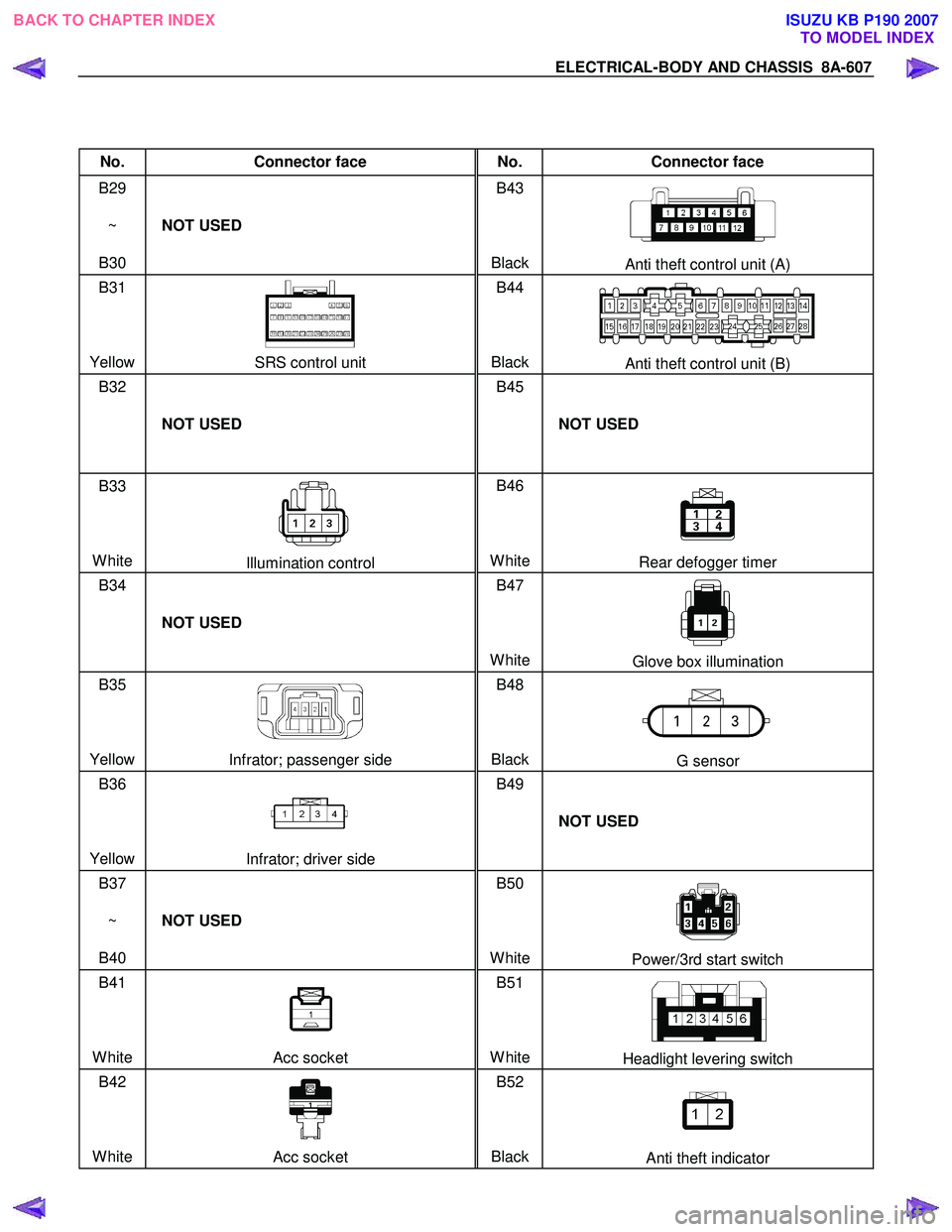
ELECTRICAL-BODY AND CHASSIS 8A-607
No. Connector face No. Connector face
B29
~
B30 NOT USED B43
Black
Anti theft control unit (A)
B31
Yellow
SRS control unit B44
BlackAnti theft control unit (B)
B32
NOT USED B45
NOT USED
B33
White
Illumination control B46
WhiteRear defogger timer
B34
NOT USED B47
White
Glove box illumination
B35
Yellow
Infrator; passenger side B48
BlackG sensor
B36
Yellow
Infrator; driver side B49
NOT USED
B37
~
B40 NOT USED B50
White
Power/3rd start switch
B41
White
Acc socket B51
WhiteHeadlight levering switch
B42
White
Acc socket B52
BlackAnti theft indicator
BACK TO CHAPTER INDEX TO MODEL INDEXISUZU KB P190 2007
Page 5568 of 6020

8A-630 ELECTRICAL-BODY AND CHASSIS
No. Connector face No. Connector face
P1
Silver
Battery (+) P9
(4JA1T- (L))
SilverACG (B)
P2
Silver
Relay & Fuse box P9
(4JH1-TC)
Silver
ACG (B)
P3
Black
Starter (S) P10
SilverEngine ground
P4
(HFV6)
Silver
Starter (B) P11
SilverFuse & relay box
P4
Silver
Starter (B) P12
NOT USED
P5
Silver
Battery (-) P13
Gray Shift on the fly actuator
P6
Silver
Body earth (Ground) P14
NOT USED
P7
Battery (ALT) P15
Silver2nd battery (+)
P8
Green
ACG (L)
P9
(HFV6)
Silver
ACG (B)
BACK TO CHAPTER INDEX
TO MODEL INDEXISUZU KB P190 2007
Page 5571 of 6020
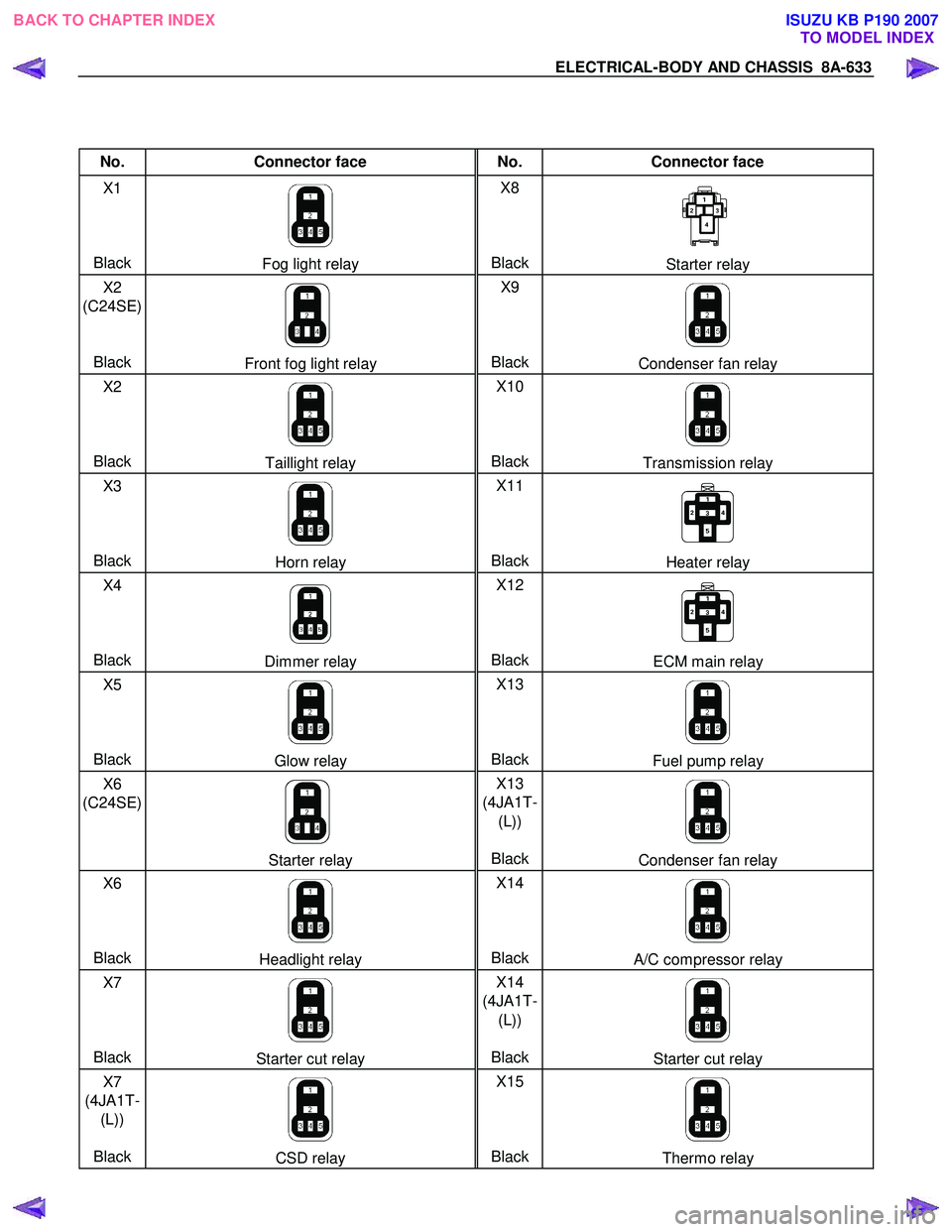
ELECTRICAL-BODY AND CHASSIS 8A-633
No. Connector face No. Connector face
X1
Black
Fog light relay X8
BlackStarter relay
X2
(C24SE)
Black
Front fog light relay X9
BlackCondenser fan relay
X2
Black
Taillight relay X10
BlackTransmission relay
X3
Black
Horn relay X11
BlackHeater relay
X4
Black
Dimmer relay X12
BlackECM main relay
X5
Black
Glow relay X13
BlackFuel pump relay
X6
(C24SE)
Starter relay X13
(4JA1T- (L))
BlackCondenser fan relay
X6
Black
Headlight relay X14
BlackA/C compressor relay
X7
Black
Starter cut relay X14
(4JA1T- (L))
BlackStarter cut relay
X7
(4JA1T- (L))
Black
CSD relay X15
BlackThermo relay
BACK TO CHAPTER INDEX TO MODEL INDEXISUZU KB P190 2007
Page 5573 of 6020
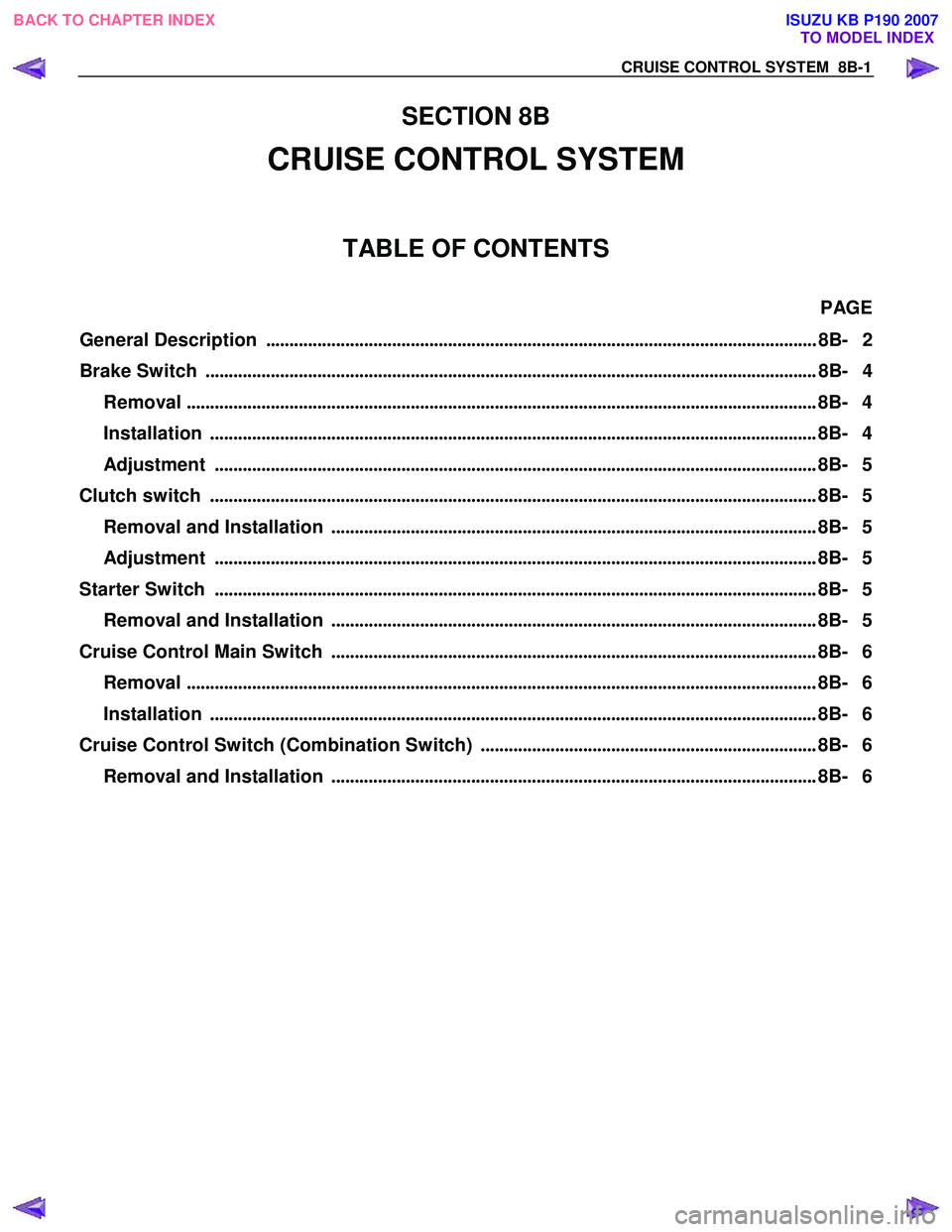
CRUISE CONTROL SYSTEM 8B-1
SECTION 8B
CRUISE CONTROL SYSTEM
TABLE OF CONTENTS
PAGE
General Description ...................................................................................................................... 8B- 2
Brake Switch ................................................................................................................................... 8B- 4
Removal ....................................................................................................................................... 8B- 4
Installation .................................................................................................................................. 8B- 4
Adjustment ................................................................................................................................. 8B- 5
Clutch switch .................................................................................................................................. 8B- 5
Removal and Installation ........................................................................................................ 8B- 5
Adjustment ................................................................................................................................. 8B- 5
Starter Switch ................................................................................................................................. 8B- 5
Removal and Installation ........................................................................................................ 8B- 5
Cruise Control Main Switch ........................................................................................................ 8B- 6
Removal ....................................................................................................................................... 8B- 6
Installation .................................................................................................................................. 8B- 6
Cruise Control Switch (Combination Switch) ........................................................................8B- 6
Removal and Installation ........................................................................................................ 8B- 6
BACK TO CHAPTER INDEX
TO MODEL INDEXISUZU KB P190 2007
Page 5575 of 6020
CRUISE CONTROL SYSTEM 8B-3
3. CANCEL Function
1. Temporary Cancellation:
• Brake pedal is pressed.
• Clutch pedal is pressed. (M/T)
• Select lever is shifted to any position other than “D”, “3”, “2” or “L”. (A/T)
• Cancel switch is operated.
• Vehicle speed exceeds about 20 km/h over the vehicle speed stored in the memory.
Turning the RESUME/ACCEL switch will return the vehicle to the speed stored in the cruise control memory.
2. Complete Cancellation:
• Starter switch or the main switch is turned off.
• Fail-safe function is activated.
• Vehicle speed is about 38 km/h.
• Speed becomes 20 km/h or less form the speed memorized by control unit.
BACK TO CHAPTER INDEX TO MODEL INDEXISUZU KB P190 2007
Page 5577 of 6020

CRUISE CONTROL SYSTEM 8B-5
Adjustment
1. Check to be sure that the brake pedal has been completely
returned by the return spring.
2. Disconnect the switch connector.
RTW 780SH003301
3. Release the lock 2 by turning the switch 1 counter-clock-
wise.
4. After doing so, pull the pedal arm
3 to you a little so that
the pedal arm is not pushed in.
5. Making the pedal arm not movable with one hand, push in
the whole switch with the other hand until the plunger of the
switch is pushed in and the switch itself hits the rubber o
f
the pedal arm.
In the condition, turn the switch clock-wise until "click"
sound is made and lock it.
By doing this, the switch is adjusted at 0.2 to 1.2mm (0.01-
0.06 in) clearance.
Clutch Switch
Removal and Installation
Refer to the Clutch Control removal and installation procedure
in Clutch section.
Adjustment
1. Turn the clutch switch or stopper bolt 1 until the switch bolt
or stopper bolt just touches the clutch pedal arm.
2.
Adjust clutch switch or stopper bolt by backing it out half a
turn, and measure the clearance (L) between the clutch
pedal arm and the clutch switch bolt end or stopper bolt.
3. Lock the lock nut
2.
4. Connect the clutch switch connector.
Clutch switch and clutch pedal clearance
mm (in)
Clearance 0.5-1.5 (0.020-0.059)
Starter Switch
431R300001
Removal and Installation
Refer to the Starter Switch removal and installation procedure
of Start and Charging in Body and Chassis section.
BACK TO CHAPTER INDEX
TO MODEL INDEXISUZU KB P190 2007
Page 5586 of 6020
Cruise Control – HFV6 Page 8C–8
Pressing the Cruise ON–OFF Button
Pressing the cruise control switch assembly ON–OFF button will send a signal via the PIM to the ECM to deactivate the
cruise control.
Rotating the Cruise Control Switch Assembly
Rotating the cruise control switch assembly to the CANCEL position will send a signal via the PIM to the ECM to
deactivate the cruise control.
Pressing the Clutch Pedal (Manual Vehicles Only)
When the clutch pedal is pressed, the cruise control cancel circuit will open (normally closed) thus removing the supply
voltage from the ECM connector C – 56 pin 53. The ECM then deactivates the cruise control.
Decelerating While Cruise Control is Activated
When the cruise control is activated, the speed can be reduced by pressing and holding the cruise control switch
assembly to SET–COAST. When this is done, 12 V is applied to PIM connector B – 97 pin 15. The PIM will then translate
the command to GM LAN protocol and sends the request to the ECM to reduce the speed. The ECM will then
temporarily disable the cruise control and close the throttle plate. The vehicle should then start to decelerate. Once the
operator releases the cruise control switch assembly, the ECM will receive this signal through the PIM and will then set
the speed according to the current VSS and maintain that speed.
Resuming a Speed After Cruise Control Has Been Deactivated
If the cruise control system is engaged but deactivated, the last speed at which it was activated can be resumed. Turning
the cruise control switch assembly to RES–ACC will apply 12 V to the PIM at connector B – 97 pin 16. The PIM will then
translate the command to GM LAN protocol and transmit the request to the ECM. The ECM will then recall the last stored
speed at which the cruise control was activated and increase or reduce engine RPM to maintain that speed.
Accelerating While Cruise Control is Activated
Using the Cruise Control Switch Assembly
When the cruise control is active, rotating the cruise control switch assembly to RES–ACC will accelerate the vehicle.
The cruise control switch assembly will supply a 12 V signal to the PIM connector B – 97 pin 16, which is continuous as
long as the switch is held. While the PIM is receiving the 12 V signal, it will continuously transmit to the ECM to
accelerate the vehicle. The ECM will open the throttle plate to accelerate the vehicle. When the desired speed is
achieved and the cruise control switch assembly is released, the ECM will maintain the vehicle at that speed.
Pressing the Accelerator Pedal
When the cruise control is active, pressing the accelerator pedal will accelerate the vehicle.
Once pressure is removed from the accelerator pedal, the vehicle will return to the last stored speed at which the cruise
control was activated and control the throttle plate to maintain that speed.
BACK TO CHAPTER INDEX TO MODEL INDEXISUZU KB P190 2007
Page 5649 of 6020

9A-14 SUPPLEMENTAL RESTRAINT SYSTEM
Component Description
SRS Control Unit
WARNING: DURING SERVICE PROCEDURES, BE
VERY CAREFUL WHEN HANDLING A SRS
CONTROL UNIT. NEVER STRIKE OR JAR THE SRS
CONTORL UNIT. NEVER POWER UP THE SRS
WHEN THE SRS CONTROL UNIT IS NOT RIGIDLY
ATTACHED TO THE VEHICLE. ALL SRS CONTROL
UNIT AND MOUNTING BRACKET FASTENERS
MUST BE CAREFULLY TORQUED AND THE
ARROW MUST BE POINTED TOWARD THE FRONT
OF THE VEHICLE TO ENSURE PROPER
OPERATION OF THE SRS. THE SRS CONTROL
UNIT COULD BE ACTIVATED WHEN POWERED
WHILE NOT RIGIDLY ATTACHED TO THE
VEHICLE WHICH COULD CAUSE DEPLOYMENT
AND RESULT IN PERSONAL INJURY.
The SRS control unit is designed to perform the
following functions in the SRS:
1. Energy Reserve — The SRS control unit maintains 30–Volt Loop Reserve (30VLR) energy supply to
provide deployment energy when ignition voltage is
lost in a frontal crash.
2. Frontal Crash Detection — The SRS control unit monitors vehicle velocity changes to detect frontal
crashes which are severe enough to warrant
deployment.
3. Air Bag Deployment — W hen a frontal crash o
f
sufficient force is detected, the SRS control unit
will cause enough current to flow through the ai
r
bag assembly to deploy the air bag.
4. Malfunction Detection — The SRS control unit performs diagnostic monitoring of SRS electrical
components and sets a diagnostic trouble code
when a malfunction is detected.
5. Frontal Crash Recording — The SRS control unit records information regarding SRS status during
frontal crash.
6. Malfunction Diagnosis — The SRS control unit displays SRS diagnostic trouble codes and system
status information through the use of a scan tool.
7. Driver Notification — The SRS control unit warns the vehicle driver of SRS malfunctions b
y
controlling the “SRS” warning lamp.
The SRS control unit is connected to the SRS wiring
harness by a 52–pin connector. This harness
connector uses a shorting clip across certain terminals
in the contact area. This shorting clip connects the
“SRS” warning lamp to ground when the SRS control
unit harness connector is disconnected or CP
A
(Connector Position Assurance) is not inserted even i
f
completely connected. This will cause the “SRS”
warning lamp to come “ON” steady whenever the
ignition switch is at the ON or START positions with
the SRS control unit disconnected.
RTW 79ASH000401
Legend
(1) SRS Control Unit
(2) SRS Harness
“SRS” Warning Lamp
Ignition voltage is applied to the “SRS” warning lamp
when the ignition switch is at the ON or START
positions. The SRS control unit controls the lamp b
y
providing ground with a lamp driver. The “SRS”
warning lamp is used in the SRS to do the following:
1. Verify lamp and SRS control unit operation b
y
flashing SEVEN (7) times when the ignition switch
is first turned “ON”.
2. W arn the vehicle driver of SRS electrical system malfunctions which could potentially affect the
operation of the SRS. These malfunctions could
result in nondeployment in case of a frontal crash
or deployment for conditions less severe than
intended.
The “SRS “ warning lamp is the key to drive
r
notification of SRS malfunctions. For proper lamp
operation, refer to the “SRS Diagnostic System Check”
in this section.
BACK TO CHAPTER INDEX TO MODEL INDEXISUZU KB P190 2007
Page 5652 of 6020
SUPPLEMENTAL RESTRAINT SYSTEM 9A-17
“Continuous Monitoring”
Tests are performed by the SRS control unit on the
SRS every 100 milliseconds while “Ignition 1” voltage
is in the normal operating voltage range at the SRS
control unit.
Data Link Connector (DLC)
Formerly “DLC”, a connector which allows
communication with an external computer, such as a
scan tool.
Datum Line
A base line parallel to the plane of the underbody or
frame from which all vertical measurements originate.
Deploy
To inflate the air bag.
Deployment Loops
The circuits which supply current to the air bag
assemblies to deploy the air bag.
Diagnostic Trouble Code (DTC)
Formerly “Code”, a numerical designator used by the
SRS control unit to indicate specific SRS malfunctions.
Driver Current Source
An output of the SRS control unit which applies current
into the driver air bag assembly circuit during the
“Initiator Assembly Resistance Test”.
Driver Air Bag Assembly
An assembly located in the steering wheel hub
consisting of an inflatable bag, an inflator and an
initiator.
EEPROM
Electrically Erasable Programmable Read Onl
y
Memory. Memory which retains its contents when
power is removed from the SRS control unit.
Ignition Cycle
The voltage at the SRS control unit “Ignition 1” input,
with ignition switch “ON”, is within the normal operating
voltage range for at least ten seconds before turning
the ignition switch “OFF”.
Ignition 1
A battery voltage (B+) circuit which is only powered
when the ignition switch is in the ON, or START
position.
Initiator
The electrical component inside the air bag assembl
y
which, when sufficient current flows, sets off the
chemical reaction that inflates the air bag.
“Initiator Assembly Resistance Test”
Tests are performed once for each ignition cycle when
no malfunctions are detected during “Turn–ON” o
r
“Continuous Monitoring”. This test checks for the
correct SRS control unit configuration for the vehicle,
shorts to “Ignition 1” in the deployment loops, high
resistance or opens in the “Driver Side” and
“Passenger Side” circuits and measures the resistance
of the inflator assembly consisting of 1) Initiators, 2)
SRS coil assembly (driver side only), 3) Connectors
and associated wiring.
Normal Operating Voltage Range
The voltage measured between the SRS control unit
“Ignition 1” terminals and “Ground” terminals is
between 9 and 16 volts.
Passenger Current Source
An output of the SRS control unit which applies current
into the passenger air bag assembly circuit during the
“Initiator Assembly Resistance Test”.
Passenger Air Bag Assembly
An assembly located in the front of the passenger side
of the instrument panel consisting of an inflatable bag,
an inflator and an initiator.
Scan Tool
An external computer used to read diagnostic
information from on–board computers via the data link
connector.
SRS control unit
SRS control unit which provides reserve energy to the
deployment loops, deploys the air bags when required
and performs diagnostic monitoring of all SRS
components.
Serial Data
Information representing the status of the SRS.
SRS
Supplemental Restraint System.
SRS Coil Assembly
An assembly of two current–carrying coils in the drive
r
deployment loop that allows the rotation of the steering
wheel while maintaining the continuous contact of the
driver deployment loop to the driver air bag assembly.
SRS Wiring Harness
The wires and connectors that electrically connect the
components in the SRS.
“Turn–ON”
Test which the SRS control unit performs on the SRS
once during each ignition cycle immediately afte
r
“Ignition 1” voltage is applied to the SRS control unit
and before “Continuous Monitoring”.
BACK TO CHAPTER INDEX TO MODEL INDEXISUZU KB P190 2007
Page 5653 of 6020
9A-18 SUPPLEMENTAL RESTRAINT SYSTEM
Diagnosis
WARNING: TO AVOID DEPLOYMENT WHEN
TROUBLESHOOTING THE SRS, DO NOT USE
ELECTRICAL TEST EQUIPMENT SUCH AS
A
BATTERY–POWERED OR AC–POWERED
VOLTMETER, OHMMETER, ETC., OR ANY TYPE
OF ELECTRICAL EQUIPMENT OTHER THAN THAT
SPECIFIED IN THIS MANUAL. DO NOT USE
A
NON-POWERED PROBE–TYPE TESTER.
INSTRUCTIONS IN THIS MANUAL MUST BE
FOLLOWED CAREFULLY, OTHERWISE
PERSONAL INJURY MAY RESULT.
Diagnostic Trouble Codes
The “SRS Diagnostic System Check” must always be
the starting point of any SRS diagnosis. The “SRS
Diagnostic System Check” checks for proper “SRS”
warning lamp operation and checks for SRS
diagnostic trouble codes using the scan tool.
1. Current diagnostic trouble codes – Malfunctions that are presently being detected. Current
diagnostic trouble codes are stored in RAM
(Random Access Memory).
2. History diagnostic trouble codes – All malfunctions detected since the last time the history memor
y
was cleared. History diagnostic trouble codes are
stored in EEPROM.
Scan Tool Diagnostics
A scan tool is used to read current and history
diagnostic trouble codes and to clear all diagnostic
trouble codes after a repair is completed. The scan
tool must be updated to communicate with the SRS
through a replaceable cartridge before it can be used
for SRS diagnostics. To use the scan tool, connect it
to the data link connector and turn the ignition switch
“ON”. The scan tool reads serial data from the SRS
control unit “Serial Data” line terminal “21” to the data
link connector terminal “2”.
Use Of Special Tools
WARNING: TO AVOID DEPLOYMENT WHEN
TROUBLESHOOTING THE SRS, DO NOT USE
ELECTRICAL TEST EQUIPMENT SUCH AS
A
BATTERY–POWERED OR AC–POWERED
VOLTMETER, OHMMETER, ETC, OR ANY TYPE OF
ELECTRICAL EQUIPMENT OTHER THAN THAT
SPECIFIED IN THIS MANUAL. DO NOT USE
A
NON-POWERED PROBE–TYPE TESTER.
INSTRUCTIONS IN THIS MANUAL MUST BE
FOLLOWED CAREFULLY, OTHERWISE
PERSONAL INJURY MAY RESULT. YOU SHOULD
BE FAMILIAR WITH THE TOOLS LISTED IN THIS
SECTION UNDER THE HANDLING SRS SPECIAL
TOOLS.
You should be able to measure voltage and
resistance. You should be familiar with proper use o
f
a scan tool such as the Tech 2 Diagnostic Computer,
SRS Driver/Passenger Load Tool 5-8840-2421-0,
Connector Test Adapter Kit 5-8840-2835-0 and the
DMM (Digital Multimeter) 5-8840-0366-0.
BACK TO CHAPTER INDEX TO MODEL INDEXISUZU KB P190 2007