engine mount ISUZU KB P190 2007 Workshop Repair Manual
[x] Cancel search | Manufacturer: ISUZU, Model Year: 2007, Model line: KB P190, Model: ISUZU KB P190 2007Pages: 6020, PDF Size: 70.23 MB
Page 1880 of 6020

ENGINE CONTROL SYSTEM (4JK1/4JJ1) 6E-263
DTC P2122 or P2123 (Flash Code 121)
Circuit Description
The accelerator pedal position (APP) sensor is
mounted on the accelerator pedal control assembly.
The sensor is made up of three individual sensors
within one housing. The ECM uses the APP sensors to
determine the amount of acceleration or deceleration
that is desired. The APP sensor 1 has the following
circuits.
• 5 volts reference circuit
• Low reference circuit
• APP sensor 1 signal circuit
The APP sensor 1 provides a signal to the ECM on the
signal circuit, which is relative to the position changes
of the accelerator pedal angle. If the ECM detects an
excessively low or high signal voltage, DTC P2122 or
P2123 will set.
Condition for Running the DTC • DTCs P0642 and P0643 are not set.
• The battery voltage is more than 9 volts.
• The ignition switch is ON.
Condition for Setting the DTC • The ECM detects that the APP sensor 1 signal voltage is less than 0.15 volts. (DTC P2122)
• The ECM detects that the APP sensor 1 signal voltage is more than 4.85 volts. (DTC P2123) Action Taken When the DTC Sets
• The ECM illuminates the SVS lamp when the diagnostic runs and fails. Refer to DTC Type
Definitions for Action Taken When the DTC Sets -
Type C. (Euro 4 Specification)
• The ECM illuminates the MIL when the diagnostic runs and fails. Refer to DTC Type Definitions for
Action Taken When the DTC Sets - Type A.
(Except Euro 4 Specification)
• The ECM limits fuel injection quantity
• The ECM inhibits cruise control.
Condition for Clearing the DTC • Refer to DTC Type Definitions for Condition for Clearing the SVS Lamp/ DTC - Type C. (Euro 4
Specification)
• Refer to DTC Type Definitions for Condition for Clearing the MIL/ DTC - Type A. (Except Euro 4
Specification)
Diagnostic Aids • If an intermittent condition is suspected, refer to Intermittent Conditions in this section.
• APP sensor 1 may have an intermittent open somewhere in the pedal range.
Schematic Reference: Engine Controls Schematics
Connector End View Reference: Engine Controls
Connector End Views or ECM Connector End Views
Circuit/ System Testing DTC P2122
Step Action Value(s)Yes No
1 Did you perform the Diagnostic System Check -
Engine Controls? —
Go to Step 2 Go to Diagnostic
System Check -
Engine Controls
2 1. Install a scan tool.
2. Turn OFF the ignition for 30 seconds.
3. Start the engine.
4. Monitor the DTC Information with a scan tool.
Is DTC P0642 also set? —
Go to DTC P0642 Go to Step 3
3 Fully depress and release the accelerator pedal
while observing the Accelerator Pedal Position
(APP) Sensor 1 parameter with a scan tool.
Does the scan tool indicate less than the specified
value during depressing or releasing the pedal? 0.2 volts
Go to Step 4 Go to Diagnostic
Aids
BACK TO CHAPTER INDEX
TO MODEL INDEX
ISUZU KB P190 2007
Page 1884 of 6020

ENGINE CONTROL SYSTEM (4JK1/4JJ1) 6E-267
DTC P2127 or P2128 (Flash Code 122)
Circuit Description
The accelerator pedal position (APP) sensor is
mounted on the accelerator pedal control assembly.
The sensor is made up of three individual sensors
within one housing. The ECM uses the APP sensors to
determine the amount of acceleration or deceleration
that is desired. The APP sensor 2 has the following
circuits.
• 5 volts reference circuit
• Low reference circuit
• APP sensor 2 signal circuit
The APP sensor 2 provides a signal to the ECM on the
signal circuit, which is relative to the position changes
of the accelerator pedal angle. If the ECM detects an
excessively low or high signal voltage, DTC P2127 or
P2128 will set.
Condition for Running the DTC • DTCs P0652 and P0653 are not set.
• The battery voltage is more than 9 volts.
• The ignition switch is ON.
Condition for Setting the DTC • The ECM detects that the APP sensor 2 signal voltage is less than 0.15 volts. (DTC P2127)
• The ECM detects that the APP sensor 2 signal voltage is more than 4.85 volts. (DTC P2128) Action Taken When the DTC Sets
• The ECM illuminates the SVS lamp when the diagnostic runs and fails. Refer to DTC Type
Definitions for Action Taken When the DTC Sets -
Type C. (Euro 4 Specification)
• The ECM illuminates the MIL when the diagnostic runs and fails. Refer to DTC Type Definitions for
Action Taken When the DTC Sets - Type A.
(Except Euro 4 Specification)
• The ECM limits fuel injection quantity.
• The ECM inhibits cruise control.
Condition for Clearing the DTC • Refer to DTC Type Definitions for Condition for Clearing the SVS Lamp/ DTC - Type C. (Euro 4
Specification)
• Refer to DTC Type Definitions for Condition for Clearing the MIL/ DTC - Type A. (Except Euro 4
Specification)
Diagnostic Aids • If an intermittent condition is suspected, refer to Intermittent Conditions in this section.
• APP sensor 2 may have an intermittent open somewhere in the pedal range.
Schematic Reference: Engine Controls Schematics
Connector End View Reference: Engine Controls
Connector End Views or ECM Connector End Views
Circuit/ System Testing DTC P2127
Step Action Value(s)Yes No
1 Did you perform the Diagnostic System Check -
Engine Controls? —
Go to Step 2 Go to Diagnostic
System Check -
Engine Controls
2 1. Install a scan tool.
2. Turn OFF the ignition for 30 seconds.
3. Start the engine.
4. Monitor the DTC Information with a scan tool.
Is DTC P0652 also set? —
Go to DTC P0652 Go to Step 3
3 Fully depress and release the accelerator pedal
while observing the Accelerator Pedal Position
(APP) Sensor 2 parameter with a scan tool.
Does the scan tool indicate less than the specified
value during depressing or releasing the pedal? 0.2 volts
Go to Step 4 Go to Diagnostic
Aids
4 1. Turn OFF the ignition.
2. Disconnect the APP sensor harness connector.
3. Turn ON the ignition, with the engine OFF.
Is the APP Sensor 2 parameter more than the
specified value? 4.7 volts
Go to Step 5 Go to Step 6
BACK TO CHAPTER INDEX
TO MODEL INDEX
ISUZU KB P190 2007
Page 1888 of 6020

ENGINE CONTROL SYSTEM (4JK1/4JJ1) 6E-271
DTC P2132 or P2133 (Flash Code 123)
Circuit Description
The accelerator pedal position (APP) sensor is
mounted on the accelerator pedal control assembly.
The sensor is made up of three individual sensors
within one housing. The ECM uses the APP sensors to
determine the amount of acceleration or deceleration
that is desired. The APP sensor 3 has the following
circuits.
• 5 volts reference circuit
• Low reference circuit
• APP sensor 3 signal circuit
The APP sensor 3 provides a signal to the ECM on the
signal circuit, which is relative to the position changes
of the accelerator pedal angle. If the ECM detects an
excessively low or high signal voltage, DTC P2132 or
P2133 will set.
Condition for Running the DTC • DTCs P0698 and P0699 are not set.
• The battery voltage is more than 9 volts.
• The ignition switch is ON.
Condition for Setting the DTC • The ECM detects that the APP sensor 3 signal voltage is less than 1.2 volts. (DTC P2132)
• The ECM detects that the APP sensor 3 signal voltage is more than 4.85 volts. (DTC P2133)
Action Taken When the DTC Sets
DTC P2132 • The ECM illuminates the SVS lamp when the diagnostic runs and fails. Refer to DTC Type
Definitions for Action Taken When the DTC Sets -
Type C. (Euro 4 Specification) • The ECM illuminates the MIL when the diagnostic
runs and fails. Refer to DTC Type Definitions for
Action Taken When the DTC Sets - Type A.
(Except Euro 4 Specification)
• The ECM limits fuel injection quantity.
• The ECM inhibits cruise control.
DTC P2133
• The ECM illuminates the MIL when the diagnostic runs and fails. Refer to DTC Type Definitions for
Action Taken When the DTC Sets - Type A.
• The ECM limits fuel injection quantity.
• The ECM inhibits cruise control.
Condition for Clearing the DTC
DTC P2132 • Refer to DTC Type Definitions for Condition for Clearing the SVS Lamp/ DTC - Type C. (Euro 4
Specification)
• Refer to DTC Type Definitions for Condition for Clearing the MIL/ DTC - Type A. (Except Euro 4
Specification)
DTC P2133
• Refer to DTC Type Definitions for Condition for Clearing the MIL/ DTC - Type A.
Diagnostic Aids • If an intermittent condition is suspected, refer to Intermittent Conditions in this section.
• APP sensor 3 may have an intermittent open somewhere in the pedal range.
Schematic Reference: Engine Controls Schematics
Connector End View Reference: Engine Controls
Connector End Views or ECM Connector End Views
Circuit/ System Testing DTC P2132
Step Action Value(s)Yes No
1 Did you perform the Diagnostic System Check -
Engine Controls? —
Go to Step 2 Go to Diagnostic
System Check -
Engine Controls
2 1. Install a scan tool.
2. Turn OFF the ignition for 30 seconds.
3. Start the engine.
4. Monitor the DTC Information with a scan tool.
Is DTC P0698 also set? —
Go to DTC P0698 Go to Step 3
3 Fully depress and release the accelerator pedal
while observing the Accelerator Pedal Position
(APP) Sensor 3 parameter with a scan tool.
Does the scan tool indicate less than the specified
value during depressing or releasing the pedal? 1.2 volts
Go to Step 4 Go to Diagnostic
Aids
BACK TO CHAPTER INDEX
TO MODEL INDEX
ISUZU KB P190 2007
Page 1893 of 6020

6E-276 ENGINE CONTROL SYSTEM (4JK1/4JJ1)
DTC P2138, P2139 or P2140 (Flash Code 124, 125 or 126)
Circuit Description
The accelerator pedal position (APP) sensor is
mounted on the accelerator pedal control assembly.
The sensor is made up of three individual sensors
within one housing. The APP sensor 1, APP sensor 2
and APP sensor 3 are potentiometer type sensors,
each with the following circuits.
• 5 volts reference circuit
• Low reference circuit
• Signal circuit
The APP sensor provides a signal to the ECM on the
signal circuits, which is relative to the position changes
of the accelerator pedal angle. The APP sensor 1
signal voltage is low at rest and increases as the pedal
is depressed. The APP sensor 2 and APP sensor 3
signal voltage is high at rest and decreases as the
pedal is depressed. If the ECM detects that each APP
sensor signal voltage is out of the correlation, DTC
P2138, P2139 or P2140 will set.
Condition for Running the DTC • The battery voltage is more than 9 volts.
• The ignition switch is ON.
• The APP sensor 1 signal voltage is between 0.15 to 4.85 volt. (DTC P2138 or P2139)
• The APP sensor 2 signal voltage is between 0.15 to 4.85 volt. (DTC P2138 or P2140)
• The APP sensor 3 signal voltage is between 1.20 to 4.85 volt. (DTC P2139 or P2140)
Condition for Setting the DTC • The ECM detects that the APP sensor 1 and 2 are more than 40% out of range of each other. (DTC
P2138) • The ECM detects that the APP sensor 1 and 3 are
more than 40% out of range of each other. (DTC
P2139)
• The ECM detects that the APP sensor 2 and 3 are more than 40% out of range of each other. (DTC
P2140)
Action Taken When the DTC Sets • The ECM illuminates the SVS lamp when the diagnostic runs and fails. Refer to DTC Type
Definitions for Action Taken When the DTC Sets -
Type C. (Euro 4 Specification)
• The ECM illuminates the MIL when the diagnostic runs and fails. Refer to DTC Type Definitions for
Action Taken When the DTC Sets - Type A.
(Except Euro 4 Specification)
• The ECM limits fuel injection quantity.
• The ECM inhibits cruise control.
Condition for Clearing the DTC • Refer to DTC Type Definitions for Condition for Clearing the SVS Lamp/ DTC - Type C. (Euro 4
Specification)
• Refer to DTC Type Definitions for Condition for Clearing the MIL/ DTC - Type A. (Except Euro 4
Specification)
Diagnostic Aids • If an intermittent condition is suspected, refer to Intermittent Conditions in this section.
Schematic Reference: Engine Controls Schematics
Connector End View Reference: Engine Controls
Connector End Views or ECM Connector End Views
Circuit/ System Testing DTC P2138
Step Action Value(s)Yes No
1 Did you perform the Diagnostic System Check -
Engine Controls? —
Go to Step 2 Go to Diagnostic
System Check -
Engine Controls
2 1. Install a scan tool.
2. Turn OFF the ignition for 30 seconds.
3. Start the engine.
4. Monitor the DTC Information with a scan tool.
Is DTC P0642, P0643, P0652, P0653, P0698,
P0699, P2132 or P2133 also set? —
Go to Applicable DTC Go to Step 3
3 Fully depress and release the accelerator pedal
while observing the DTC Information with a scan
tool.
Does the DTC fail this ignition? —
Go to Step 4 Go to Diagnostic
Aids
4 Is DTC P2140 also set? —Go to Step 6 Go to Step 5
5 Is DTC P2139 also set? —Go to Step 7 Go to Step 8
BACK TO CHAPTER INDEX
TO MODEL INDEX
ISUZU KB P190 2007
Page 1907 of 6020

6E-290 ENGINE CONTROL SYSTEM (4JK1/4JJ1)
DTC P2227 (Flash Code 71)
Circuit Description
The barometric pressure (BARO) sensor is located on
the intake manifold. The BARO sensor is a transducer
that varies voltage according to changes the barometric
pressure. Within the ECM, the diagnostic compares the
BARO sensor input to the boost pressure sensor input.
If the ECM detects that the inputs are not within a
specified amount of each other, this DTC will set.
Condition for Running the DTC • DTCs P0101, P0102, P0103, P0107, P0108, P0116, P0117, P0118, P0122, P0123, P0500,
P0501, P0638, P0652, P0653, P0698, P0699,
P2100, P2101, P2103, P2228 and P2229 are not
set.
AND following conditions are met for longer than 3
seconds.
• The ignition switch is ON.
• The engine coolant temperature is more than 5 °C
(41 °F).
• The engine speed is less than 800 RPM.
• The fuel injection quantity is less than a predetermined value.
• The accelerator pedal is not depressed.
• The vehicle is not running.
• The engine run time is longer than 5 seconds. Condition for Setting the DTC
• The ECM detects that the differential pressure between the barometric pressure and the boost
pressure is more than 10 kPa (1.5 psi) for 10
seconds.
Action Taken When the DTC Sets • The ECM illuminates the MIL when the diagnostic runs and fails. Refer to DTC Type Definitions for
Action Taken When the DTC Sets - Type A.
• The ECM limits fuel injection quantity.
• The ECM inhibits EGR control.
• The ECM inhibits cruise control.
Condition for Clearing the DTC • Refer to DTC Type Definitions for Condition for Clearing the MIL/ DTC - Type A.
Diagnostic Aids • If an intermittent condition is suspected, refer to Intermittent Conditions in this section.
Schematic Reference: Engine Controls Schematics
Connector End View Reference: Engine Controls
Connector End Views or ECM Connector End Views
Circuit/ System Testing DTC P2227
Step Action Value(s)Yes No
1 Did you perform the Diagnostic System Check -
Engine Controls? —
Go to Step 2 Go to Diagnostic
System Check -
Engine Controls
2 1. Install a scan tool.
2. Turn OFF the ignition for 30 seconds.
3. Start the engine.
4. Monitor the DTC Information with a scan tool.
Is DTC P0107, P0108, P2228 or P2229 also set? —
Go to Applicable DTC Go to Step 3
3 1. Turn ON the ignition, with the engine OFF.
2. Compare the Boost Pressure parameter to the Barometric Pressure (BARO) parameter with
a scan tool.
Are both parameter within the range specified of
each other? 10 kPa (1.5
psi)
Go to Diagnostic Aids Go to Step 4
4 Determine the outside barometric pressure from
your location specified in the altitude vs barometric
pressure table. Refer to Altitude vs Barometric
Pressure.
Is the BARO parameter on the scan tool close to
the outside barometric pressure? —
Go to Step 5 Go to Step 7
BACK TO CHAPTER INDEX
TO MODEL INDEX
ISUZU KB P190 2007
Page 1914 of 6020

ENGINE CONTROL SYSTEM (4JK1/4JJ1) 6E-297
DTC P2621 or P2622 (Flash Code 94)
Circuit Description
The accelerator pedal position (APP) sensor is
mounted on the accelerator pedal control assembly.
The analogue APP signals are converted by the ECM
into a pulse width modulation (PWM) signal. This
converted signal is sent from the ECM to the TCM to
determine appropriate shift points depending on the
accelerator pedal pressing amount. If the ECM detects
an improper voltage level on the APP PWM signal
circuit, DTC P2621 or P2622 will set.
Condition for Running the DTC • The battery voltage is more than 9 volts.
• The ignition switch is ON.
Condition for Setting the DTC • The ECM detects a low voltage condition on the APP PWM signal circuit for longer than 3 seconds.
(DTC P2621) • The ECM detects a high voltage condition on the
APP PWM signal circuit for longer than 3 seconds.
(DTC P2622)
Action Taken When the DTC Sets • The ECM illuminates the MIL when the diagnostic runs and fails. Refer to DTC Type Definitions for
Action Taken When the DTC Sets - Type A.
Condition for Clearing the DTC • Refer to DTC Type Definitions for Condition for Clearing the MIL/ DTC - Type A.
Diagnostic Aids • If an intermittent condition is suspected, refer to Intermittent Conditions in this section.
Schematic Reference: Engine Controls Schematics
Connector End View Reference: Engine Controls
Connector End Views or ECM Connector End Views
Circuit/ System Testing DTC P2621
Step Action Value(s)Yes No
1 Did you perform the Diagnostic System Check -
Engine Controls? —
Go to Step 2 Go to Diagnostic
System Check -
Engine Controls
2 1. Install a scan tool.
2. Turn OFF the ignition for 30 seconds.
3. Start the engine.
4. Monitor the DTC Information with a scan tool.
Does the DTC fail this ignition? —
Go to Step 3 Go to Diagnostic
Aids
3 1. Turn OFF the ignition.
2. Back probe a DMM between the accelerator pedal position (APP) signal circuit of the TCM
harness connector (pin 16 of C-94) and a
known good ground.
3. Turn ON the ignition, with the engine OFF.
Is the DMM voltage more than the specified value? 10.0 volts
Go to Step 6 Go to Step 4
4 Is the DMM voltage more than the specified value
at Step 3? 2.0 volts
Go to Step 7 Go to Step 5
5 Repair the short to ground between the ECM (pin
56 of C-58) and the TCM (pin 16 of C-94).
Did you complete the repair? —
Go to Step 11
—
61. Test the signal circuit between the ECM (pin
56 of C-58) and the TCM (pin 16 of C-94) for
an open circuit or high resistance.
2. Repair the circuit(s) as necessary.
Did you find and correct the condition? —
Go to Step 11 Go to Step 8
BACK TO CHAPTER INDEX
TO MODEL INDEX
ISUZU KB P190 2007
Page 1919 of 6020

6E-302 ENGINE CONTROL SYSTEM (4JK1/4JJ1)
EGR Control System Check
Description
The EGR system recirculates a part of exhaust gas
back into the intake manifold, which results in reducing
NOx emissions. The EGR control system uses an
electronic control system to ensure both driveability
and low emission. A control current from the ECM
operates a solenoid to control the lift amount of EGR
valve. Also, an EGR position sensor is provided at the
rear of the solenoid to feed actual valve lift amount
back to the ECM for more precision control.
The EGR control starts when the conditions for engine
speed, engine coolant temperature, intake air
temperature and barometric pressure are satisfied.
Then, the valve opening is calculated according to the
engine speed, and target fuel injection quantity. Based
on this valve opening, the drive duty of the solenoid is
determined and the valve is driven accordingly. The
intake throttle valve is provided to adequate intake
manifold depression to ensure EGR gas flow. EGR Control Operation
• The engine coolant temperature (ECT) is between 5°C (41 °F) and 100 °C (212 °F).
• The intake air temperature (IAT) is more than 5 °C
(41 °F).
• The barometric pressure (BARO) is more than 90kPa (13psi).
Schematic Reference: Engine Controls Schematics
Connector End View Reference: Engine Controls
Connector End Views or ECM Connector End Views
Circuit/ System Testing EGR Control System Check
Step Action Value(s)Yes No
1 Did you perform the Diagnostic System Check -
Engine Controls? —
Go to Step 2 Go to Diagnostic
System Check -
Engine Controls
2 1. Install a scan tool.
2. Turn OFF the ignition for 30 seconds.
3. Turn ON the ignition, with the engine OFF.
4. Monitor the DTC Information with a scan tool.
Are any DTCs set in which the “Action Taken When
the DTC Sets” under that particular code states,
“The ECM inhibits EGR control”? —
Refer to Applicable DTC Go to Step 3
BACK TO CHAPTER INDEX
TO MODEL INDEX
ISUZU KB P190 2007
Page 1930 of 6020

ENGINE CONTROL SYSTEM (4JK1/4JJ1) 6E-313
181. Inspect for an intermittent, poor connections
and corrosion at the harness connector of the
fuel pump resistor (pins 1 and 2 of C-57).
2. Repair the connection(s) as necessary.
Did you find and correct the condition? —
Go to Step 25
—
191. Inspect for an intermittent, for poor
connections and corrosion at the harness
connector of the fuel pump (pins 1 and 4 of F-
2).
2. Repair the connection(s) as necessary.
Did you find and correct the condition? —
Go to Step 25 Go to Step 24
20 Replace the fuel pump relay.
Did you complete the replacement? —
Go to Step 25
—
211. Make sure the fuel amount in the fuel tank.
Refill adequate fuel as necessary.
2. Check the fuel system connections between the fuel tank and the fuel supply pump for
tightness and all fuel hoses for cuts, kinks,
cracks and for the use of proper clamps.
Repair or replace as necessary.
3. Turn OFF the ignition.
4. Disconnect the fuel hose that connects to the fuel filter inlet side. In order to measure the
discharged fuel amount, put the hose into a
bottle or a container with a scale. (The inlet of
a bottle or a container must be larger than the
diameter of hose.)
5. Turn ON the ignition for 20 seconds, with the engine OFF.
6. Turn OFF the ignition for 10 seconds.
7. Perform 5 and 6 three times. The accumulated fuel of three ignition cycles must be more than
300cc. (Normal amount is more than 100cc
per one ignition cycle.)
Is enough amount of fuel discharged? —
System OK Go to Step 22
22 1. Remove the fuel pump from the fuel tank.
Refer to Fuel Gauge Unit in the Fuel System
section.
2. Inspect the fuel pump for any type of restriction or damage on the fuel pipes.
3. Repair or replace as necessary.
Did you find and correct the condition? —
Go to Step 25 Go to Step 24
23 Replace the fuel pump resistor.
Did you complete the replacement? —
Go to Step 25
—
24Replace the fuel pump. Refer to Fuel Gauge Unit in
the Fuel System section.
Did you complete the replacement? —
Go to Step 25
—
25Reconnect all previously disconnected
components, fuse, relay or harness connector(s).
Did you complete the action? —
Go to Step 3
—
Step Action Value(s)Yes No
BACK TO CHAPTER INDEX
TO MODEL INDEX
ISUZU KB P190 2007
Page 1948 of 6020

ENGINE CONTROL SYSTEM (4JK1/4JJ1) 6E-331
Air Intake System ChecksInspect the air intake system for the following conditions.
• Air cleaner, air intake ducts and charge air cooler for a restriction, holes, or leaks.
• A restriction in the turbocharger inlet duct.
• Intake throttle valve for a stuck condition.
• A restriction or leak in the intake manifold.
Exhaust System Checks Inspect the exhaust system for a possible restriction. Refer to the Exhaust System
section.
Engine Mechanical Checks Inspect the engine mechanical for the following conditions. Refer to the Engine
Mechanical section.
• Poor cylinder compression.
• Improper mechanical timing (timing gear and timing chain).
• Improper valve gap.
• Broken or weak valve springs.
• Worn camshaft lobes.
• Incorrect basic engine parts such as camshaft, cylinder head, pistons, etc..
Additional Checks • Electromagnetic interference (EMI) on the reference circuit can cause an engine
miss condition. The scan tool can usually detect EMI by monitoring the engine
speed. A sudden increase in speed with little change in actual engine speed change
indicates that EMI is present. If a problem exists, check routing of high voltage
components, such as fuel injector solenoid valve wiring, near the sensor circuits.
• Faulty engine mounts.
• Faulty crank pulley.
• Faulty generator & A/C compressor.
• Generator output voltage.
• EGR system operating correctly. Refer to EGR Control System Check in this section.
• A/C operation.
Checks
Action
BACK TO CHAPTER INDEX
TO MODEL INDEX
ISUZU KB P190 2007
Page 1957 of 6020
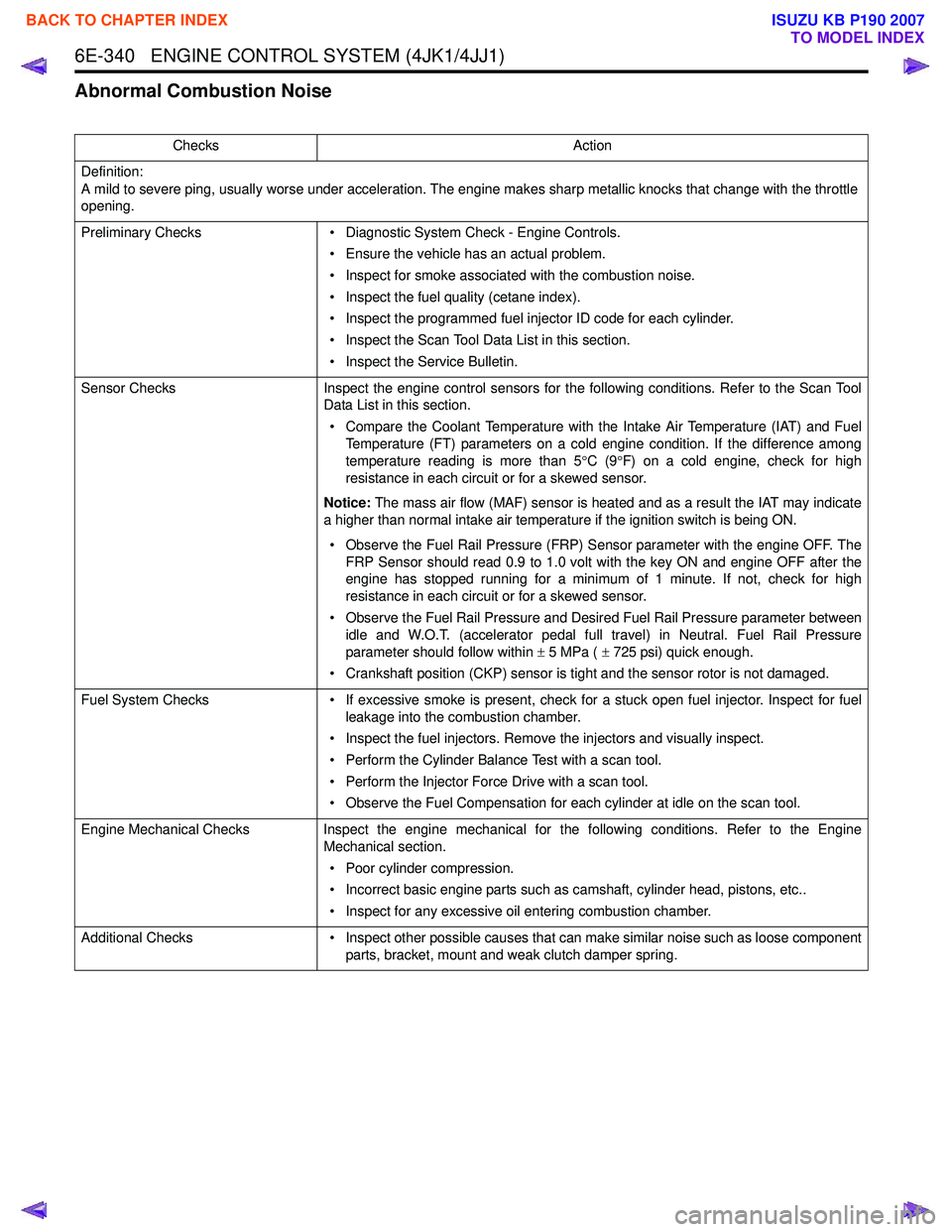
6E-340 ENGINE CONTROL SYSTEM (4JK1/4JJ1)
Abnormal Combustion Noise
ChecksAction
Definition:
A mild to severe ping, usually worse under acceleration. The engine makes sharp metallic knocks that change with the throttle
opening.
Preliminary Checks • Diagnostic System Check - Engine Controls.
• Ensure the vehicle has an actual problem.
• Inspect for smoke associated with the combustion noise.
• Inspect the fuel quality (cetane index).
• Inspect the programmed fuel injector ID code for each cylinder.
• Inspect the Scan Tool Data List in this section.
• Inspect the Service Bulletin.
Sensor Checks Inspect the engine control sensors for the following conditions. Refer to the Scan Tool
Data List in this section.
• Compare the Coolant Temperature with the Intake Air Temperature (IAT) and Fuel Temperature (FT) parameters on a cold engine condition. If the difference among
temperature reading is more than 5 °C (9 °F) on a cold engine, check for high
resistance in each circuit or for a skewed sensor.
Notice: The mass air flow (MAF) sensor is heated and as a result the IAT may indicate
a higher than normal intake air temperature if the ignition switch is being ON.
• Observe the Fuel Rail Pressure (FRP) Sensor parameter with the engine OFF. The FRP Sensor should read 0.9 to 1.0 volt with the key ON and engine OFF after the
engine has stopped running for a minimum of 1 minute. If not, check for high
resistance in each circuit or for a skewed sensor.
• Observe the Fuel Rail Pressure and Desired Fuel Rail Pressure parameter between idle and W.O.T. (accelerator pedal full travel) in Neutral. Fuel Rail Pressure
parameter should follow within ± 5 MPa ( ± 725 psi) quick enough.
• Crankshaft position (CKP) sensor is tight and the sensor rotor is not damaged.
Fuel System Checks • If excessive smoke is present, check for a stuck open fuel injector. Inspect for fuel
leakage into the combustion chamber.
• Inspect the fuel injectors. Remove the injectors and visually inspect.
• Perform the Cylinder Balance Test with a scan tool.
• Perform the Injector Force Drive with a scan tool.
• Observe the Fuel Compensation for each cylinder at idle on the scan tool.
Engine Mechanical Checks Inspect the engine mechanical for the following conditions. Refer to the Engine
Mechanical section.
• Poor cylinder compression.
• Incorrect basic engine parts such as camshaft, cylinder head, pistons, etc..
• Inspect for any excessive oil entering combustion chamber.
Additional Checks • Inspect other possible causes that can make similar noise such as loose component
parts, bracket, mount and weak clutch damper spring.
BACK TO CHAPTER INDEX
TO MODEL INDEX
ISUZU KB P190 2007