start ISUZU KB P190 2007 Workshop Repair Manual
[x] Cancel search | Manufacturer: ISUZU, Model Year: 2007, Model line: KB P190, Model: ISUZU KB P190 2007Pages: 6020, PDF Size: 70.23 MB
Page 71 of 6020
HEATER AND AIR CONDITIONING 1-37
refrigerant container.
1) Make sure the evacuation process is correctly completed.
2) Connect the center-hose of the manifold gauge to the refrigerant container. •
••
•
Turn the charge valve handle counterclockwise to purge
to the charging line and purge any air exiting in the
center-hose of the manifold gauge.
3) Open the low-pressure hand valve and charge the refrigerant about 200 g (0.44 lbs.). •
••
•
Make sure the high-pressure hand valve is closed.
•
••
•
Avoid charging the refrigerant by turning the refrigerant
container upside down.
4) Close the low-pressure hand valve of the manifold gauge. •
••
•
Check to ensure that the degree of pressure does not
change.
5) Check the refrigerant leaks by using a HFC-134a leak detector. •
••
•
If a leak occurs, repair the leak connection, and start all
over again from the first step of evacuation.
6) If no leaks are found, open the low-pressure hand valve of the manifold gauge. Then continue charging refrigerant to
the system. •
••
•
W hen charging the system becomes difficult:
(1) Run the engine at Idling and close the all vehicle doors.
(2) A/C switch is "ON".
(3) Set the fan control knob (fan switch) to its highest position.
(4) Set air source selector lever to “RECIRC”
WARNING
BE ABSOLUTELY SURE NOT TO OPEN THE HIGH-
PRESSURE HAND VALVE. SHOULD THE HIGH-
PRESSURE HAND VALVE BE OPENED, THE HIGH-
PRESSURE REFRIGERANT GAS WOULD FLOW
BACKWARD, AND THIS MAY CAUSE THE REFRIGERANT
CONTAINER TO BURST.
7) W hen the refrigerant container is emptied, use the following procedure to replace it with a new refrigerant container.
(1) Close the low-pressure hand valve.
(2) Raise the needle upward and remove the charge valve.
(3) Reinstall the charge valve to the new refrigerant container.
(4) Purge any air existing in the center hose of the manifold gauge.
BACK TO CHAPTER INDEX
TO MODEL INDEX
ISUZU KB P190 2007
Page 88 of 6020
1-54 HEATER AND AIR CONDITIONING
OIL RETURN OPERATION
There is close affinity between the oil and the refrigerant.
During normal operation, part of the oil recirculates with the
refrigerant in the system.
W hen checking the amount of oil in the system, or replacing
any component of the system, the compressor must be run in
advance for oil return operation. The procedure is as follows:
1) Open the all doors and engine hood.
2) Start the engine and A/C switch is "ON" and Set the fan control knob at its highest position.
3) Run the compressor for more than 20 minutes between 800 and 1,000 rpm in order to operate the system.
4) Stop the engine.
REPLACEMENT OF COMPONENT PARTS
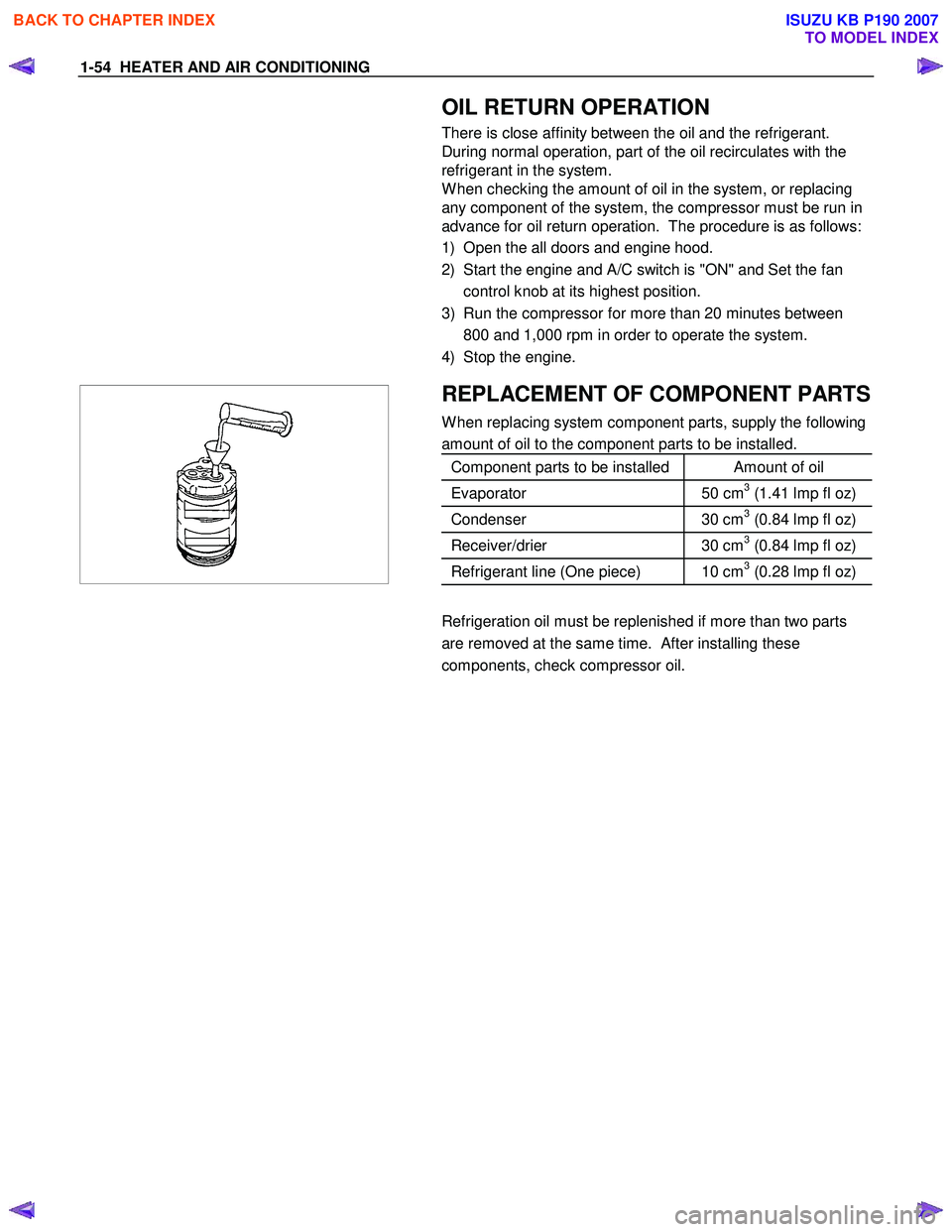
W hen replacing system component parts, supply the following
amount of oil to the component parts to be installed.
Component parts to be installed Amount of oil
Evaporator 50 cm3 (1.41 lmp fl oz)
Condenser 30 cm3 (0.84 lmp fl oz)
Receiver/drier 30 cm3 (0.84 lmp fl oz)
Refrigerant line (One piece) 10 cm3 (0.28 lmp fl oz)
Refrigeration oil must be replenished if more than two parts
are removed at the same time. After installing these
components, check compressor oil.
BACK TO CHAPTER INDEX
TO MODEL INDEX
ISUZU KB P190 2007
Page 268 of 6020
POWER-ASSISTED STEERING SYSTEM 3B-7
Power Steering System Test
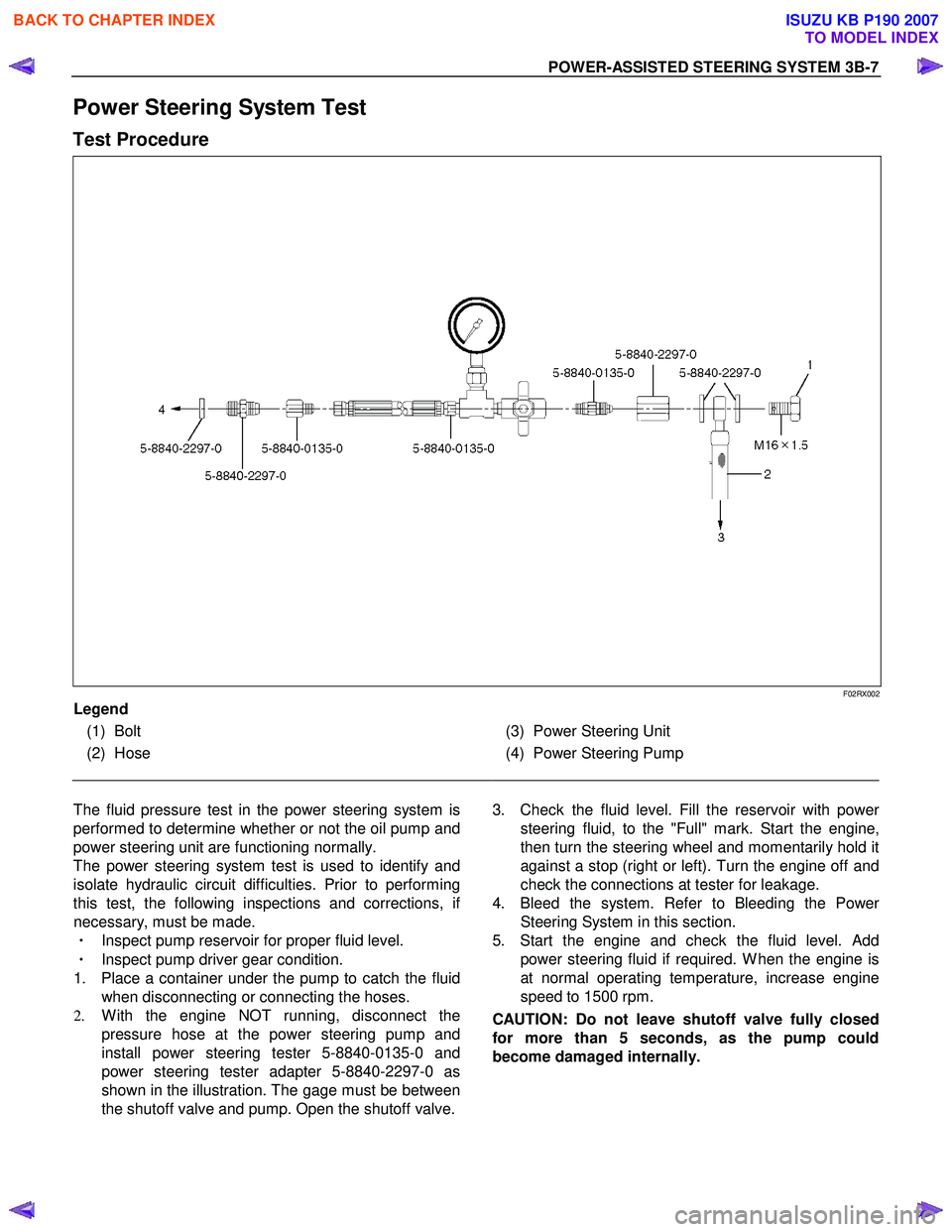
Test Procedure
F02RX002
Legend
(1) Bolt
(2) Hose
(3) Power Steering Unit
(4) Power Steering Pump
The fluid pressure test in the power steering system is
performed to determine whether or not the oil pump and
power steering unit are functioning normally.
The power steering system test is used to identify and
isolate hydraulic circuit difficulties. Prior to performing
this test, the following inspections and corrections, i
f
necessary, must be made.
・ Inspect pump reservoir for proper fluid level.
・ Inspect pump driver gear condition.
1. Place a container under the pump to catch the fluid when disconnecting or connecting the hoses.
2. W ith the engine NOT running, disconnect the
pressure hose at the power steering pump and
install power steering tester 5-8840-0135-0 and
power steering tester adapter 5-8840-2297-0 as
shown in the illustration. The gage must be between
the shutoff valve and pump. Open the shutoff valve.
3. Check the fluid level. Fill the reservoir with powe
r
steering fluid, to the "Full" mark. Start the engine,
then turn the steering wheel and momentarily hold it
against a stop (right or left). Turn the engine off and
check the connections at tester for leakage.
4. Bleed the system. Refer to Bleeding the Powe
r
Steering System in this section.
5. Start the engine and check the fluid level. Add power steering fluid if required. W hen the engine is
at normal operating temperature, increase engine
speed to 1500 rpm.
CAUTION: Do not leave shutoff valve fully closed
for more than 5 seconds, as the pump could
become damaged internally.
BACK TO CHAPTER INDEX
TO MODEL INDEX
ISUZU KB P190 2007
Page 269 of 6020
3B-8 POWER-ASSISTED STEERING SYSTEM
6. Fully close the shutoff valve. Record the highest
pressures.
・ If the pressure recorded is within 9800-10300 kPa
(100-105 kg/cm
2/1422-1493psi), the pump is
functioning within its specifications.
・ If the pressure recorded is higher than 10300 kPa
(105 kg/cm
2/1493psi), the valve in the pump is
defective.
・ If the pressure recorded is lower than 9800 kPa
(100 kg/cm
2/1422psi), the valve or the rotating
assembly in the pump is defective.
7. If the pump pressures are within specifications, leave the valve open and turn (or have someone
else turn) the steering wheel fully in both directions.
Record the highest pressures and compare with the
maximum pump pressure recorded in step 6. If this
pressure cannot be built up at either side of the
power steering unit, the power steering unit is
leaking internally and must be replaced.
8. Shut the engine off, remove the testing gauge.
9. Reconnect the pressure hose, check the fluid level and make the needed repairs.
10. If the problem still exists, the steering and front suspension must be thoroughly examined.
Maintenance
The hydraulic system should be kept clean, the fluid
level in the reservoir should be checked at regula
r
intervals and fluid added when required. Refer to
Recommended Fluids and Lubricants in General
Information section for the type of fluid to be used and
the intervals for filling.
If the system contains some dirt, flush it as described in
this section. If it is exceptionally dirty, the pump must be
completely disassembled before further usage. (The
steering unit cannot be disassembled.)
All tubes, hoses, and fittings should be inspected for
leakage at regular intervals. Fittings must be tight. Make
sure the clips, clamps and supporting tubes and hoses
are in place and properly secured.
Power steering hoses and lines must not be twisted,
kinked or tightly bent. Air in the system will cause
spongy action and noisy operation. W hen a hose is
disconnected or when fluid is lost, for any reason, the
system must be bled after refilling. Refer to Bleeding the
Power Steering System in this section.
・ Inspect gear for looseness or damage.
・ Inspect hoses to insure they are not touching an
y
other parts of the vehicle.
・ Inspect fluid level and fill to the proper level.
Fluid Level
1. Run the engine until the power steering fluid
reaches normal operating temperature, about 55 °
C (130 °F), then shut the engine off.
2. Check the level of fluid in the reservoir.
3. If the fluid level is low, add power steering fluid as
specified in General Information to the proper level
and install the receiver cap.
4. W hen checking the fluid level after the steering system has been serviced, air must be bled from
the system. Refer to Bleeding the Power Steering
System in this section.
Bleeding the Power Steering System
W hen a power steering pump or unit has been installed,
or an oil line has been disconnected, the air that has
entered the system must be bled out before the vehicle
is operated. If air is allowed to remain in the powe
r
steering fluid system, noisy and unsatisfactory operation
of the system may result.
Bleeding Procedure
W hen bleeding the system, and any time fluid is added
to the power steering system, be sure to use only powe
r
steering fluid as specified in General Information.
1. Fill the pump fluid reservoir to the proper level and let the fluid settle for at least two minutes.
2. Start the engine and let it run for a few seconds. Do not turn the steering wheel. Then turn the engine
off.
3. Add fluid if necessary.
4. Repeat the above procedure until the fluid level remains constant after running the engine.
5. Raise and support the front end of the vehicle so that the wheels are off the ground.
6. Start the engine. Slowly turn the steering wheel right and left, lightly contacting the wheel stops.
7. Add power steering fluid if necessary.
8. Lower the vehicle, set the steering wheel at the straight forward position after turning it to its full
steer positions 2 or 3 times, and stop the engine.
9. Check the fluid level and refill as required.
10. If the fluid is extremely foamy, allow the vehicle to settle for a few minutes, then repeat the above
procedure.
Flushing the Power Steering System
1. Raise and support the front end of the vehicle off
the ground until the wheels are free to turn.
2. Remove the fluid return line at the pump inlet connector and plug the connector port on the pump.
Direct the line toward a large container to catch the
draining fluid.
3. W hile running the engine at idle, fill the reservoi
r
with new power steering fluid. Turn the steering
wheel in both directions. Do not contact or hold the
steering wheel to the wheel stops. This will cause
the pump to go to pressure relief mode, which ma
y
cause a sudden fluid overflow at the reservoir.
BACK TO CHAPTER INDEX
TO MODEL INDEX
ISUZU KB P190 2007
Page 303 of 6020
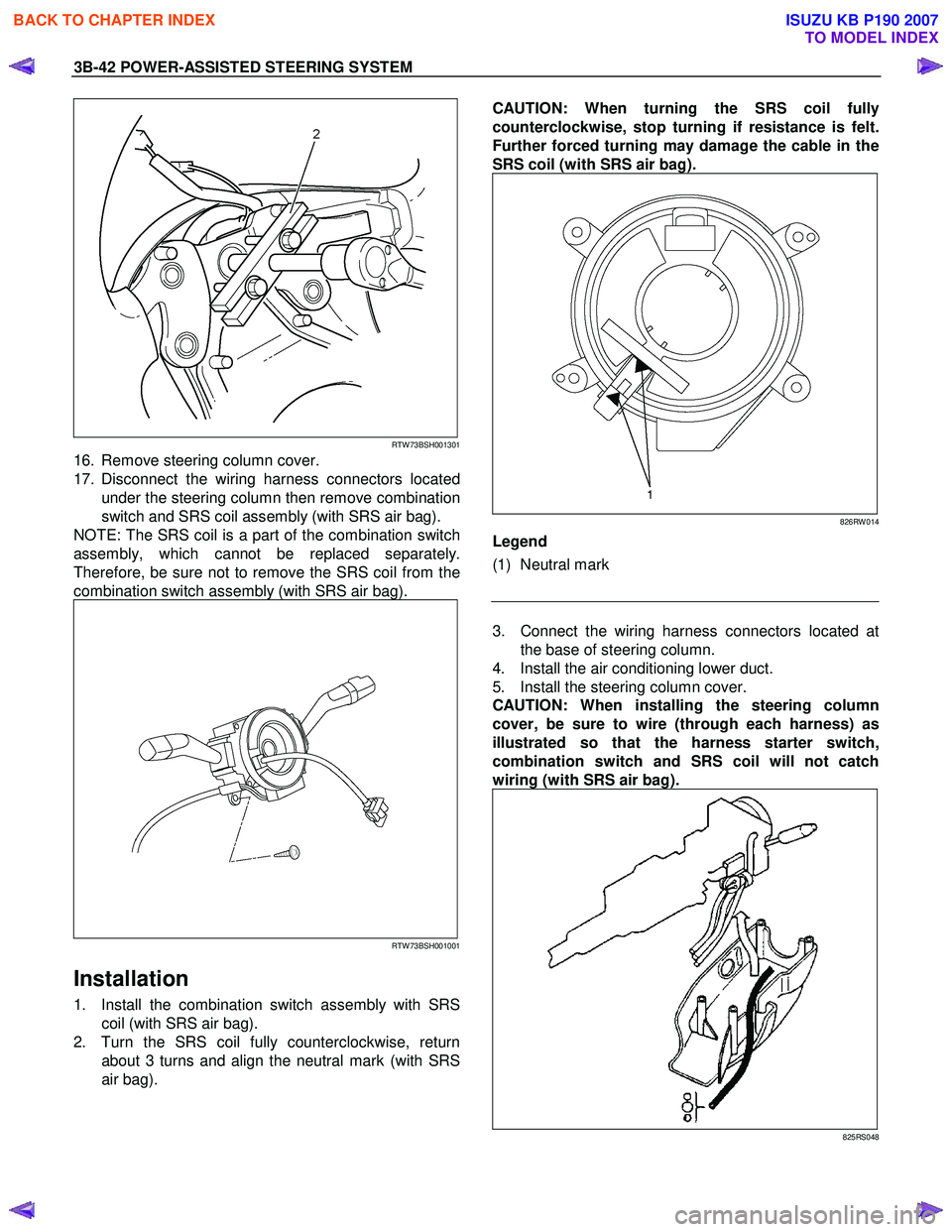
3B-42 POWER-ASSISTED STEERING SYSTEM
CAUTION: When turning the SRS coil fully
counterclockwise, stop turning if resistance is felt.
Further forced turning may damage the cable in the
SRS coil (with SRS air bag).
826RW 014
Legend
(1) Neutral mark
RTW 73BSH001301
16. Remove steering column cover.
17. Disconnect the wiring harness connectors located under the steering column then remove combination
switch and SRS coil assembly (with SRS air bag).
NOTE: The SRS coil is a part of the combination switch
assembly, which cannot be replaced separately.
Therefore, be sure not to remove the SRS coil from the
combination switch assembly (with SRS air bag).
RTW 73BSH001001
Installation
1. Install the combination switch assembly with SRS coil (with SRS air bag).
2. Turn the SRS coil fully counterclockwise, return about 3 turns and align the neutral mark (with SRS
air bag).
3. Connect the wiring harness connectors located at the base of steering column.
4. Install the air conditioning lower duct.
5. Install the steering column cover.
CAUTION: When installing the steering column
cover, be sure to wire (through each harness) as
illustrated so that the harness starter switch,
combination switch and SRS coil will not catch
wiring (with SRS air bag).
825RS048
BACK TO CHAPTER INDEX
TO MODEL INDEX
ISUZU KB P190 2007
Page 315 of 6020
3B-54 POWER-ASSISTED STEERING SYSTEM
16. Remove steering column cover.
17. Disconnect the wiring harness connectors located under the steering column.
18. Remove the combination switch assembly with SRS coil.
NOTE: The SRS coil is a part of the combination switch
assembly, which cannot be replaced separately.
Therefore, be sure not to remove the SRS coil from the
combination switch assembly.
RTW 73BSH001001
19. Disconnect the starter switch harness connector
located under the steering column, then remove
lock cylinder assembly.
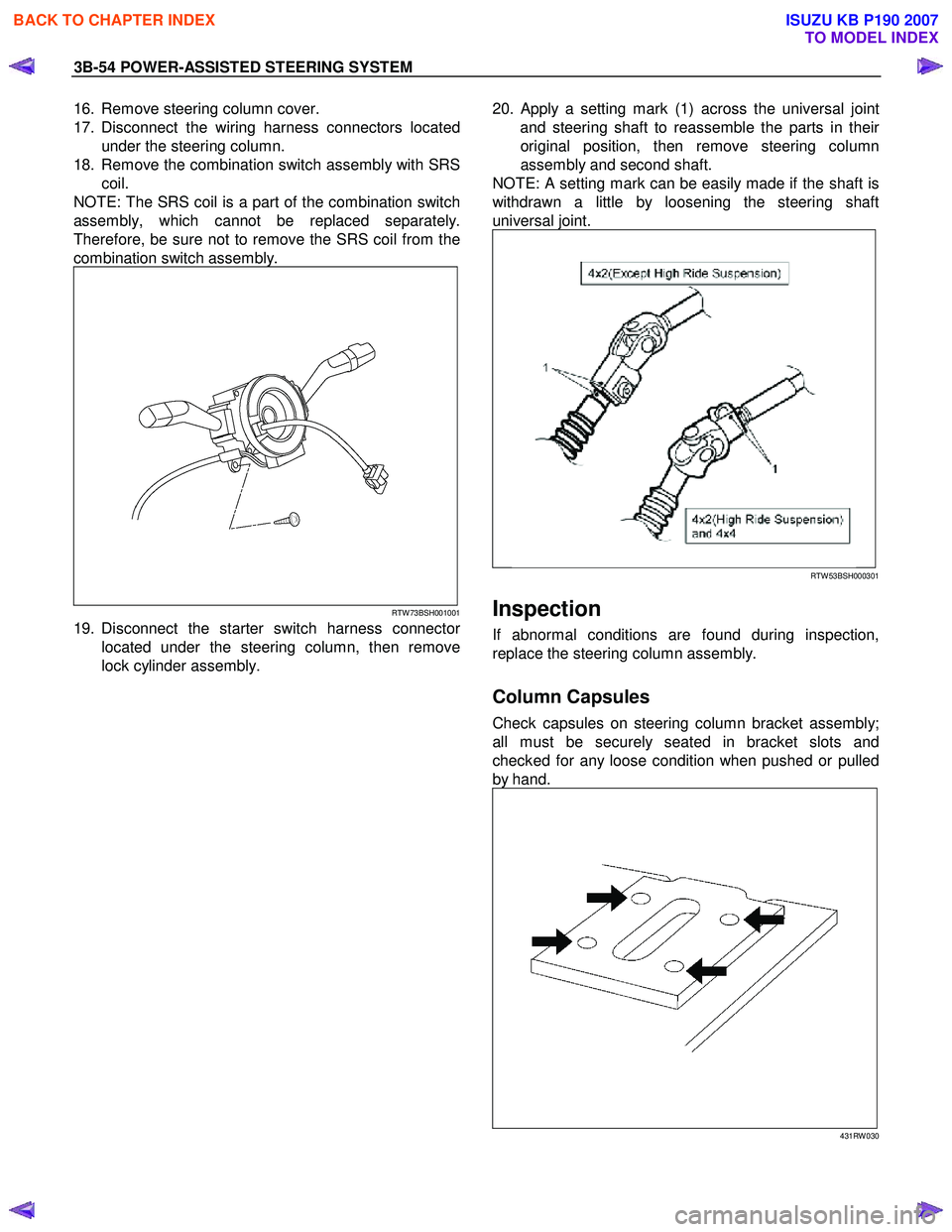
20.
Apply a setting mark (1) across the universal joint
and steering shaft to reassemble the parts in thei
r
original position, then remove steering column
assembly and second shaft.
NOTE: A setting mark can be easily made if the shaft is
withdrawn a little by loosening the steering shaft
universal joint.
RTW 53BSH000301
Inspection
If abnormal conditions are found during inspection,
replace the steering column assembly.
Column Capsules
Check capsules on steering column bracket assembly;
all must be securely seated in bracket slots and
checked for any loose condition when pushed or pulled
by hand.
431RW 030
BACK TO CHAPTER INDEX
TO MODEL INDEX
ISUZU KB P190 2007
Page 317 of 6020
3B-56 POWER-ASSISTED STEERING SYSTEM
9. Turn the SRS coil fully counterclockwise, return
about 3 turns and align the neutral mark (1). (with
SRS air bag)
CAUTION: When turning the SRS coil fully
counterclockwise, stop turning if resistance is felt.
Further forced turning may damage to the cable in
the SRS coil.
826RW 014
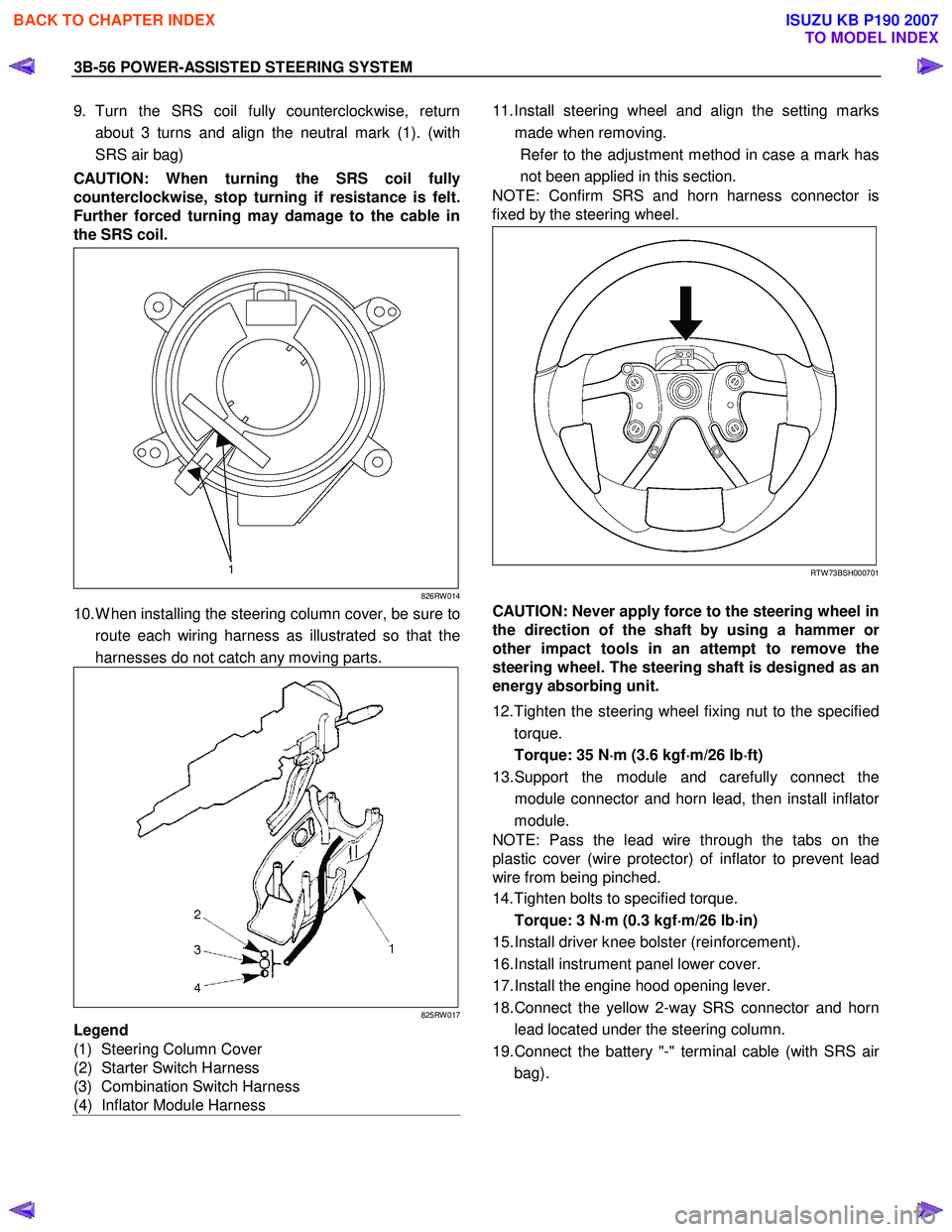
10. W hen installing the steering column cover, be sure to
route each wiring harness as illustrated so that the
harnesses do not catch any moving parts.
825RW 017
Legend
(1) Steering Column Cover
(2) Starter Switch Harness
(3) Combination Switch Harness
(4) Inflator Module Harness
11. Install steering wheel and align the setting marks
made when removing. Refer to the adjustment method in case a mark has
not been applied in this section.
NOTE: Confirm SRS and horn harness connector is
fixed by the steering wheel.
RTW 73BSH000701
CAUTION: Never apply force to the steering wheel in
the direction of the shaft by using a hammer o
r
other impact tools in an attempt to remove the
steering wheel. The steering shaft is designed as an
energy absorbing unit.
12. Tighten the steering wheel fixing nut to the specified torque.
Torque: 35 N ⋅
⋅⋅
⋅
m (3.6 kgf ⋅
⋅⋅
⋅
m/26 lb ⋅
⋅⋅
⋅
ft)
13. Support the module and carefully connect the module connector and horn lead, then install inflato
r
module.
NOTE: Pass the lead wire through the tabs on the
plastic cover (wire protector) of inflator to prevent lead
wire from being pinched.
14. Tighten bolts to specified torque.
Torque: 3 N ⋅
⋅⋅
⋅
m (0.3 kgf ⋅
⋅⋅
⋅
m/26 lb ⋅
⋅⋅
⋅
in)
15. Install driver knee bolster (reinforcement).
16. Install instrument panel lower cover.
17. Install the engine hood opening lever.
18. Connect the yellow 2-way SRS connector and horn lead located under the steering column.
19. Connect the battery "-" terminal cable (with SRS ai
r
bag).
BACK TO CHAPTER INDEX
TO MODEL INDEX
ISUZU KB P190 2007
Page 345 of 6020
FRONT SUSPENSION 3C-25
P1010005
5. Remove upper ball joint bolt and nut.
6. Remove upper ball joint.
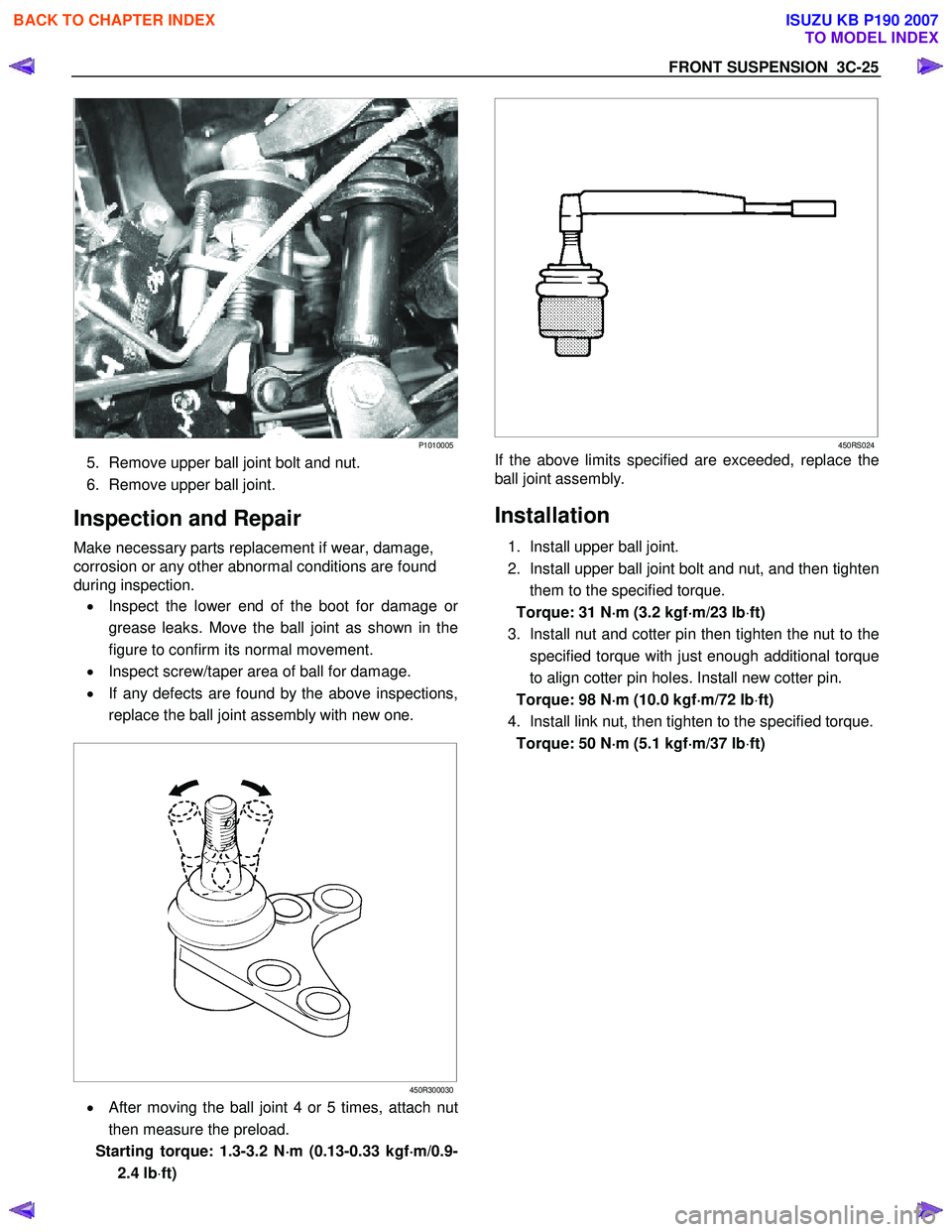
Inspection and Repair
Make necessary parts replacement if wear, damage,
corrosion or any other abnormal conditions are found
during inspection.
• Inspect the lower end of the boot for damage o
r
grease leaks. Move the ball joint as shown in the
figure to confirm its normal movement.
• Inspect screw/taper area of ball for damage.
• If any defects are found by the above inspections,
replace the ball joint assembly with new one.
450R300030
• After moving the ball joint 4 or 5 times, attach nut
then measure the preload.
Starting torque: 1.3-3.2 N ⋅
⋅⋅
⋅
m (0.13-0.33 kgf ⋅
⋅⋅
⋅
m/0.9-
2.4 lb ⋅ft)
450RS024
If the above limits specified are exceeded, replace the
ball joint assembly.
Installation
1. Install upper ball joint.
2. Install upper ball joint bolt and nut, and then tighten them to the specified torque.
Torque: 31 N ⋅
⋅⋅
⋅
m (3.2 kgf ⋅
⋅⋅
⋅
m/23 lb ⋅ft)
3. Install nut and cotter pin then tighten the nut to the specified torque with just enough additional torque
to align cotter pin holes. Install new cotter pin.
Torque: 98 N ⋅
⋅⋅
⋅
m (10.0 kgf ⋅
⋅⋅
⋅
m/72 lb ⋅ft)
4. Install link nut, then tighten to the specified torque. Torque: 50 N ⋅
⋅⋅
⋅
m (5.1 kgf ⋅
⋅⋅
⋅
m/37 lb ⋅ft)
BACK TO CHAPTER INDEX
TO MODEL INDEX
ISUZU KB P190 2007
Page 347 of 6020
FRONT SUSPENSION 3C-27
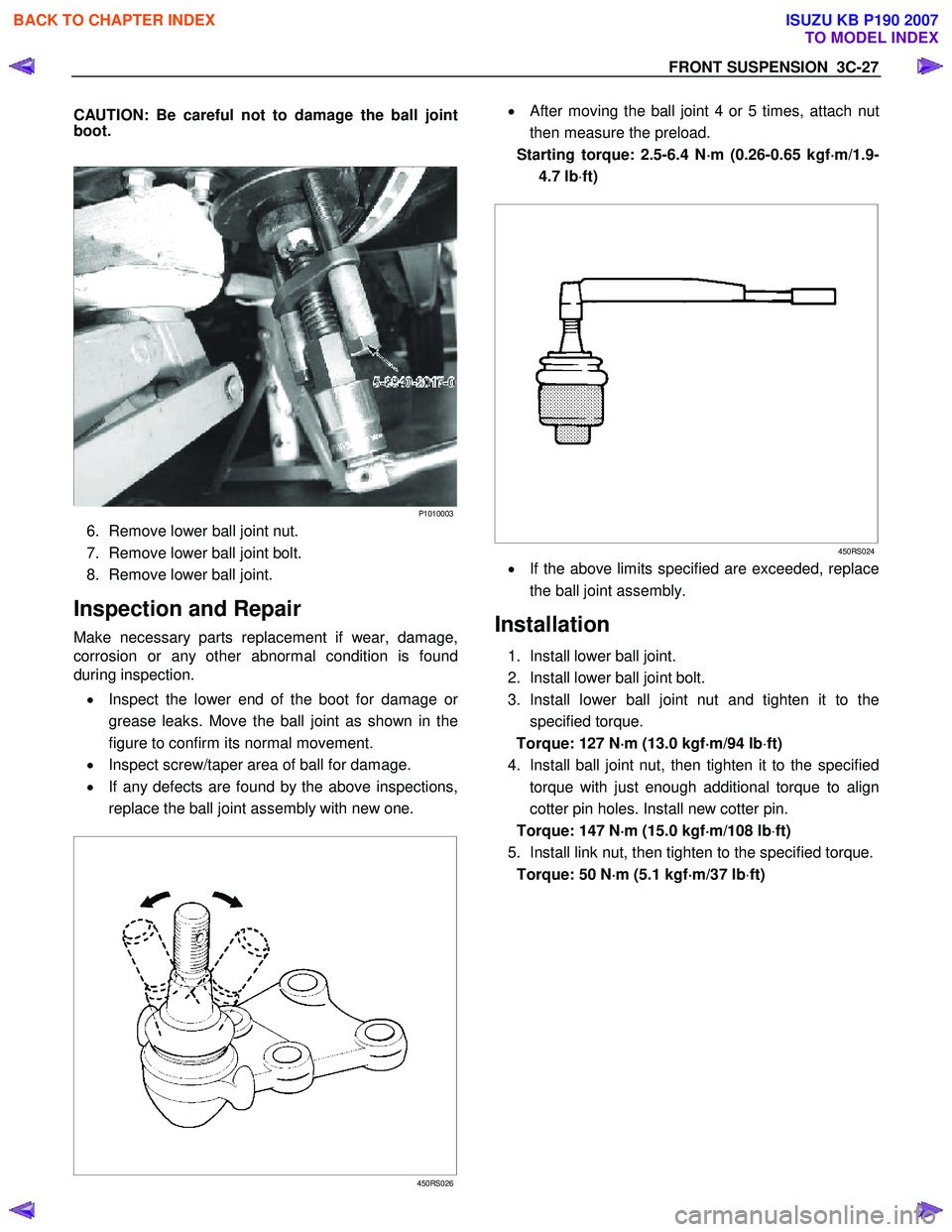
CAUTION: Be careful not to damage the ball joint
boot.
P1010003
6. Remove lower ball joint nut.
7. Remove lower ball joint bolt.
8. Remove lower ball joint.
Inspection and Repair
Make necessary parts replacement if wear, damage,
corrosion or any other abnormal condition is found
during inspection.
• Inspect the lower end of the boot for damage o
r
grease leaks. Move the ball joint as shown in the
figure to confirm its normal movement.
• Inspect screw/taper area of ball for damage.
• If any defects are found by the above inspections,
replace the ball joint assembly with new one.
450RS026
• After moving the ball joint 4 or 5 times, attach nut
then measure the preload.
Starting torque: 2.5-6.4 N ⋅
⋅⋅
⋅
m (0.26-0.65 kgf ⋅
⋅⋅
⋅
m/1.9-
4.7 lb ⋅ft)
450RS024
• If the above limits specified are exceeded, replace
the ball joint assembly.
Installation
1. Install lower ball joint.
2. Install lower ball joint bolt.
3. Install lower ball joint nut and tighten it to the specified torque.
Torque: 127 N ⋅
⋅⋅
⋅
m (13.0 kgf ⋅
⋅⋅
⋅
m/94 lb ⋅ft)
4. Install ball joint nut, then tighten it to the specified torque with just enough additional torque to align
cotter pin holes. Install new cotter pin.
Torque: 147 N ⋅
⋅⋅
⋅
m (15.0 kgf ⋅
⋅⋅
⋅
m/108 lb ⋅ft)
5. Install link nut, then tighten to the specified torque. Torque: 50 N ⋅
⋅⋅
⋅
m (5.1 kgf ⋅
⋅⋅
⋅
m/37 lb ⋅ft)
BACK TO CHAPTER INDEX
TO MODEL INDEX
ISUZU KB P190 2007
Page 370 of 6020
FRONT SUSPENSION 3C-49
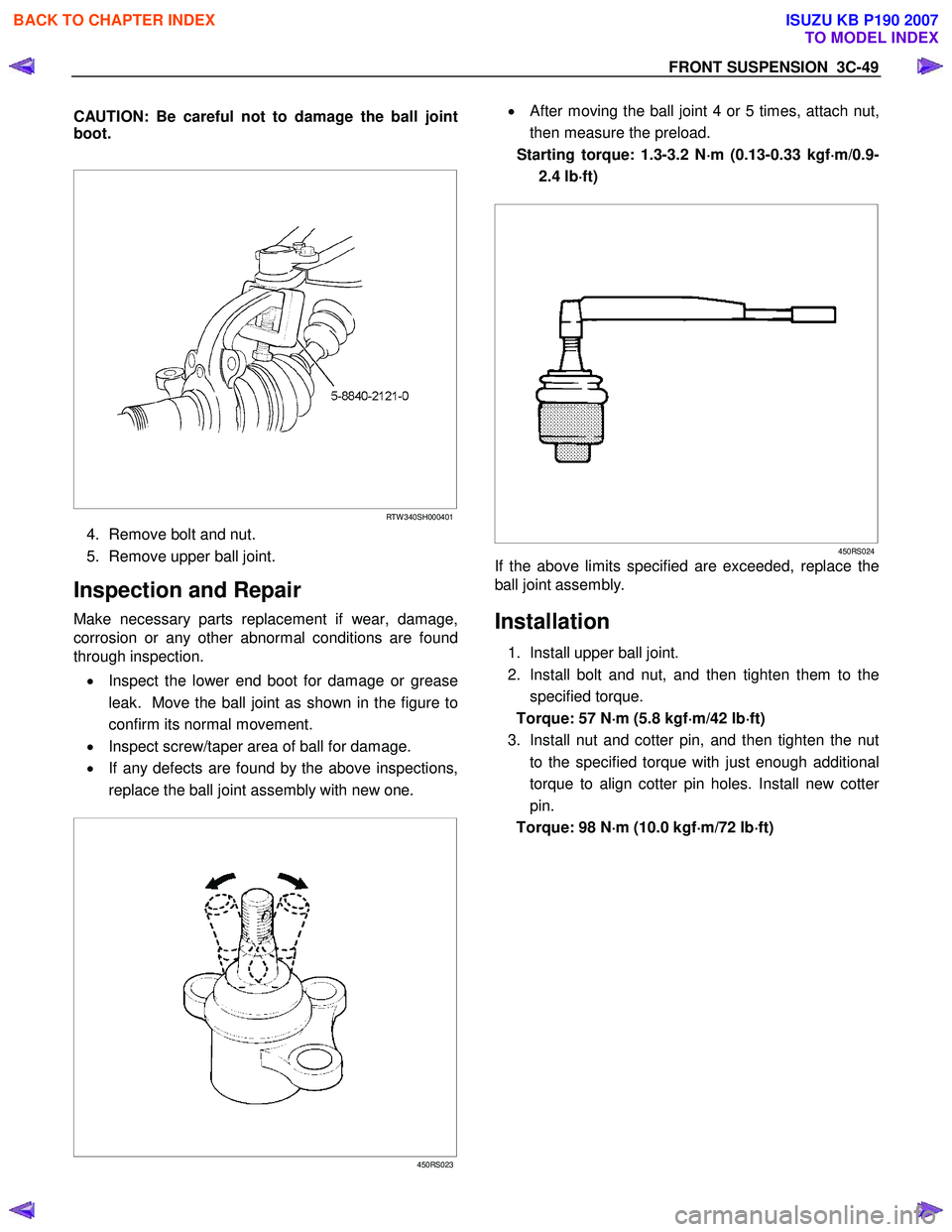
CAUTION: Be careful not to damage the ball joint
boot.
RTW 340SH000401
4. Remove bolt and nut.
5. Remove upper ball joint.
Inspection and Repair
Make necessary parts replacement if wear, damage,
corrosion or any other abnormal conditions are found
through inspection.
• Inspect the lower end boot for damage or grease
leak. Move the ball joint as shown in the figure to
confirm its normal movement.
• Inspect screw/taper area of ball for damage.
• If any defects are found by the above inspections,
replace the ball joint assembly with new one.
450RS023
• After moving the ball joint 4 or 5 times, attach nut,
then measure the preload.
Starting torque: 1.3-3.2 N ⋅
⋅⋅
⋅
m (0.13-0.33 kgf ⋅
⋅⋅
⋅
m/0.9-
2.4 lb ⋅
⋅⋅
⋅
ft)
450RS024
If the above limits specified are exceeded, replace the
ball joint assembly.
Installation
1. Install upper ball joint.
2. Install bolt and nut, and then tighten them to the specified torque.
Torque: 57 N ⋅
⋅⋅
⋅
m (5.8 kgf ⋅
⋅⋅
⋅
m/42 lb ⋅
⋅⋅
⋅
ft)
3. Install nut and cotter pin, and then tighten the nut to the specified torque with just enough additional
torque to align cotter pin holes. Install new cotte
r
pin.
Torque: 98 N ⋅
⋅⋅
⋅
m (10.0 kgf ⋅
⋅⋅
⋅
m/72 lb ⋅
⋅⋅
⋅
ft)
BACK TO CHAPTER INDEX
TO MODEL INDEX
ISUZU KB P190 2007