ECO mode ISUZU TROOPER 1995 Service Manual
[x] Cancel search | Manufacturer: ISUZU, Model Year: 1995, Model line: TROOPER, Model: ISUZU TROOPER 1995Pages: 1928
Page 974 of 1928
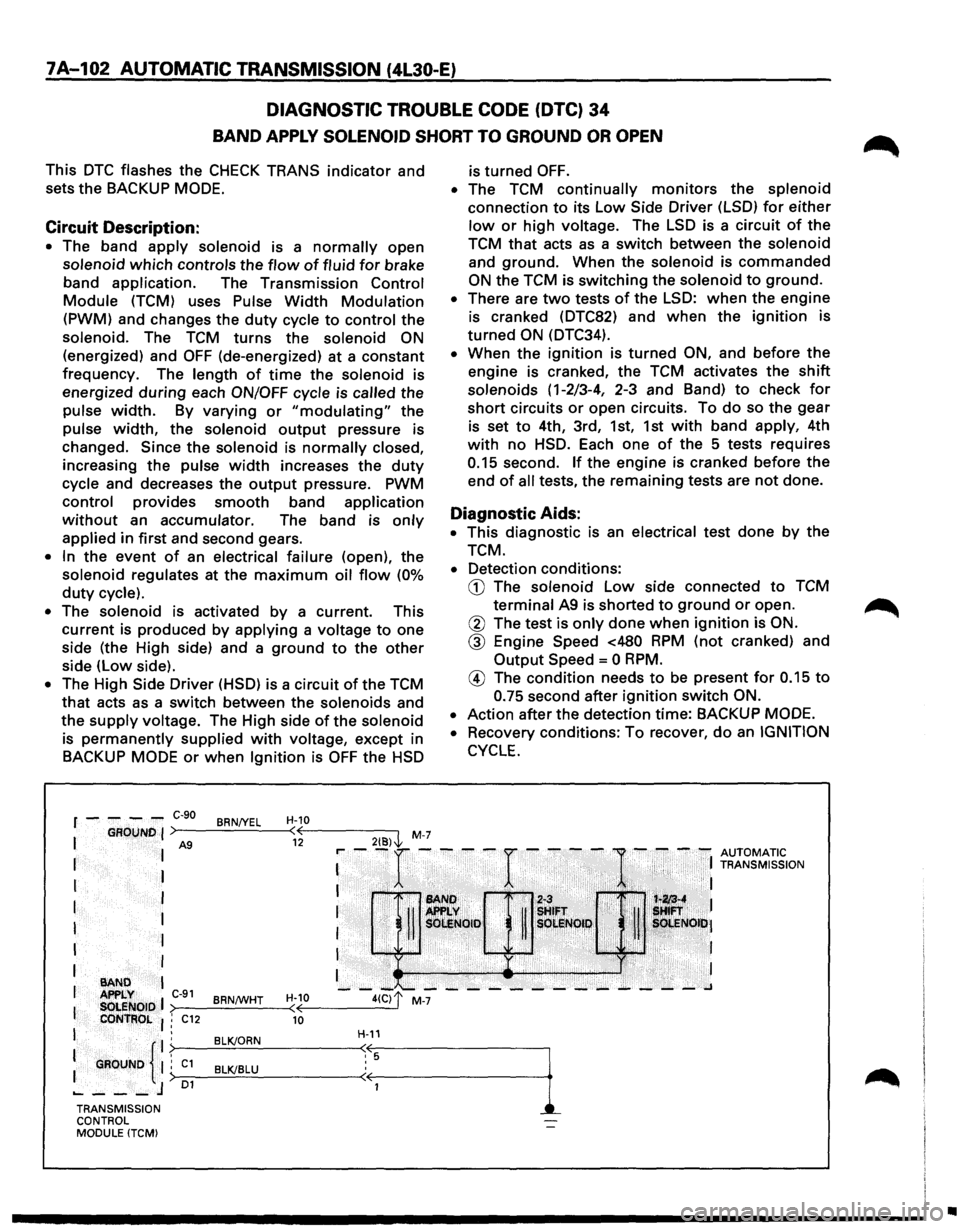
7A-102 AUTOMATIC TRANSMISSION (4L30-E)
DIAGNOSTIC TROUBLE CODE
(DTC) 34
BAND APPLY SOLENOID SHORT TO GROUND OR OPEN
This DTC flashes the CHECK TRANS indicator and
sets the BACKUP
MODE.
Circuit Description:
• The band apply solenoid is a normally open
solenoid
which controls the flow of fluid for brake
band
application. The Transmission Control
Module (TCM) uses Pulse Width Modulation
(PWM) and changes the duty cycle to control the
solenoid. The
TCM turns the solenoid ON
(energized) and OFF (de-energized) at a constant
frequency. The length
of time the solenoid is
energized
during each ON/OFF cycle is called the
pulse
width. By varying or "modulating" the
pulse
width, the solenoid output pressure is
changed.
Since the solenoid is normally closed,
increasing the pulse width increases the duty
cycle and decreases the output pressure. PWM
control provides smooth band application
without an accumulator. The band is only
applied in first and second gears.
• In the event of an electrical failure (open), the
solenoid regulates at the
maximum oil flow (0%
duty cycle).
• The solenoid is activated by a current. This
current is produced
by applying a voltage to one
side (the High side) and a
ground to the other
side (low side).
• The High Side Driver (HSD) is a circuit of the TCM
that acts as a switch between the solenoids and
the
supply voltage. The High side of the solenoid
is
permanently supplied with voltage, except in
BACKUP
MODE or when Ignition is OFF the HSD
2{8)\l, M-7
r----C-90 BRN/YEL H-10 ( 12
is turned OFF.
• The TCM continually monitors the splenoid
connection
to its low Side Driver (LSD) for either
low or high voltage. The LSD is a circuit of the
TCM that acts as a switch between the solenoid
and
ground. When the solenoid is commanded
ON the TCM is switching the solenoid to ground.
• There are two tests of the LSD: when the engine
is cranked (DTC82) and
when the ignition is
turned ON (DTC34).
• When the ignition is turned ON, and before the
engine is cranked, the TCM activates the shift
solenoids (1-2/3-4, 2-3 and Band) to check for
short circuits or open circuits. To do so the gear
is set
to 4th, 3rd, 1st, 1st with band apply, 4th
with no HSD. Each one of the 5 tests requires
0.15 second. If the engine is cranked before the
end
of all tests, the remaining tests are not done.
Diagnostic Aids:
• This diagnostic is an electrical test done by the
TCM.
• Detection conditions:
CD The solenoid low side connected to TCM
terminal A9 is shorted to ground or open.
@ The test is only done when ignition is ON.
@ Engine Speed <480 RPM (not cranked) and
Output Speed= 0 RPM.
® The condition needs to be present for 0.15 to
0.75 second after ignition switch ON.
•
Action after the detection time: BACKUP MODE.
•
Recovery conditions: To recover, do an IGNITION
CYCLE.
: --r ----r ----
1-
- -: ~Z[;'~,~~ION
I 1'•1 ~~ If ~!FT . i '· !:
I
I
I
1 ·. SOI:!Noto· R sOLI!lQI,~, . ~ , ~. sOt.ENOiti•J
I ,Ji'Ji ·
· I
I •• ) . I
--~~---------~---~ >--------<
I
I I
BAND APPLY C-91 BRNtWHT H-10
I SOLENOID ( CONTROL : C12 10
I .
: GROUND {
. BLK/ORN . ; C1 BLK/BLU :> 01 ..... ---J
H-11
TRANSMISSION
CONTROL
MODULE (TCM)
•
Page 976 of 1928
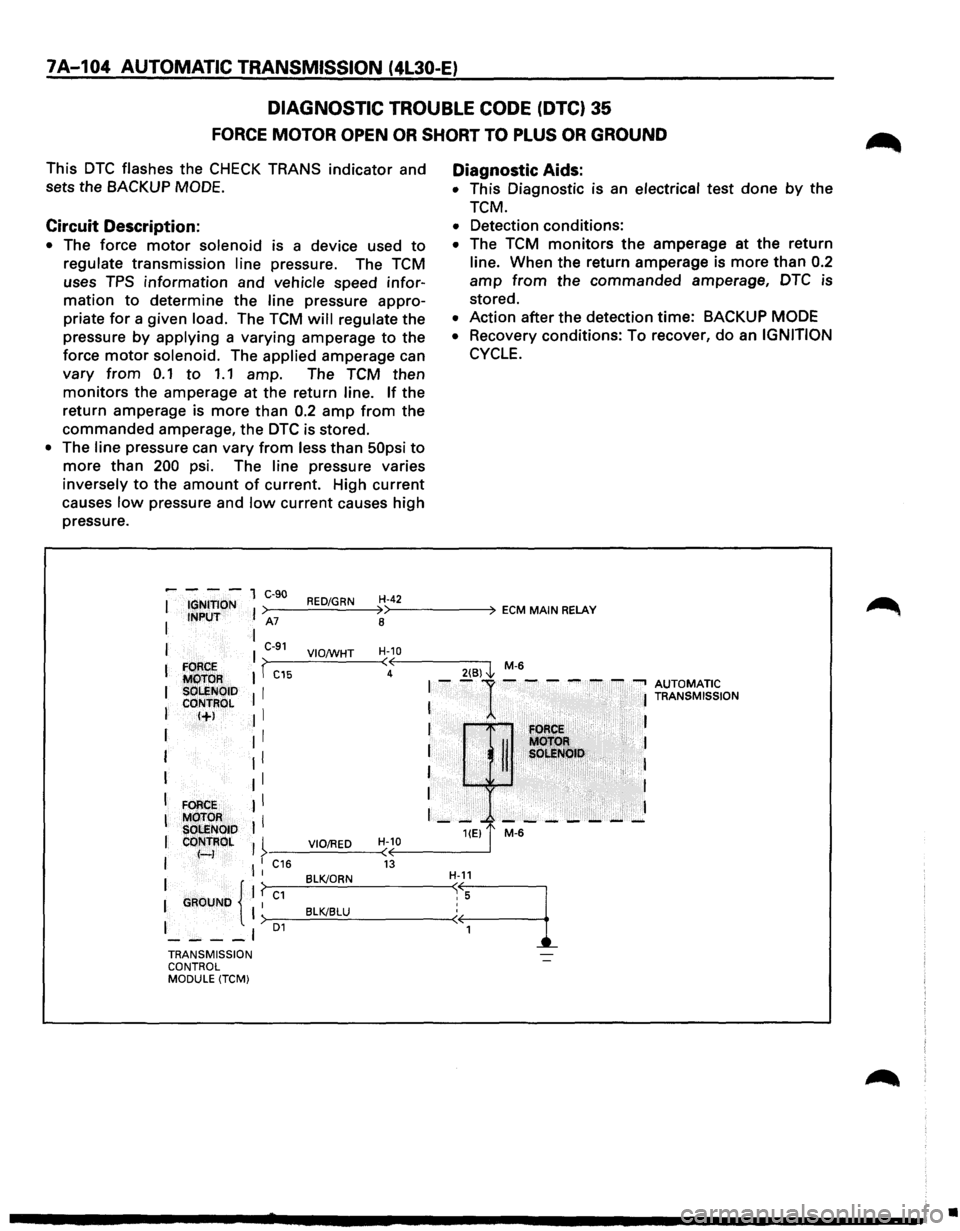
7A-104 AUTOMATIC TRANSMISSION (4L30-E)
DIAGNOSTIC TROUBLE CODE (DTC} 35
FORCE MOTOR OPEN OR SHORT TO PLUS OR GROUND
This DTC flashes the CHECK TRANS indicator and
sets the
BACKUP MODE.
Circuit Description:
• The force motor solenoid is a device used to
regulate transmission line pressure. The TCM
uses
TPS information and vehicle speed infor
mation to determine the line pressure appro
priate
for a given load. The TCM will regulate the
pressure
by applying a varying amperage to the
force
motor solenoid. The applied amperage can
vary from 0.1 to 1.1 amp. The TCM then
monitors the amperage at the return line. If the
return amperage is
more than 0.2 amp from the
commanded amperage, the DTC is stored.
• The line pressure can vary from less than 50psi to
more than 200 psi. The line pressure varies
inversely
to the amount of current. High current
causes
low pressure and low current causes high
pressure.
Diagnostic Aids:
• This Diagnostic is an electrical test done by the
TCM.
• Detection conditions:
• The TCM monitors the amperage at the return
line. When the return amperage is
more than 0.2
amp from the commanded amperage, DTC is
stored.
• Action after the detection time: BACKUP MODE
•
Recovery conditions: To recover, do an IGNITION
CYCLE.
----1 C-90 I IGNITION I >----R_ED_..:./G..:...R_N_4H'>--4
-2----4 ECM MAIN RELAY I INPUT A7
8
I I C-91 H-10 I VIO;WHT >~----'-----~<~<------~ I FORCE I I -C15 4
2(6) l M-6
MOTOR I--1------...., AUTOMATIC I SOLENOID I I T s ON
CONTROL I I RAN MISSI
I I+J Jl I I I FORCE
I : : til: :g~~H> :
I II I
I FORCE II I
I
MOTOR I I I - --- - --- - -SOLENOID HEJ t M-6 I CONTROL I I VIO/RED H-10 I f-) >·-----------(<(~------~ I l : C16 13 BLK/ORN H-11 1 {'f~c-1-=~~----~~.·~
1
I GAOUNO I >-1 __ ___cB:..:l::.c:K/c.::.B=..:LU:..__ ________ -<
I 01
----' TRANSMISSION
CONTROL
MODULE
(TCM)
•
Page 978 of 1928
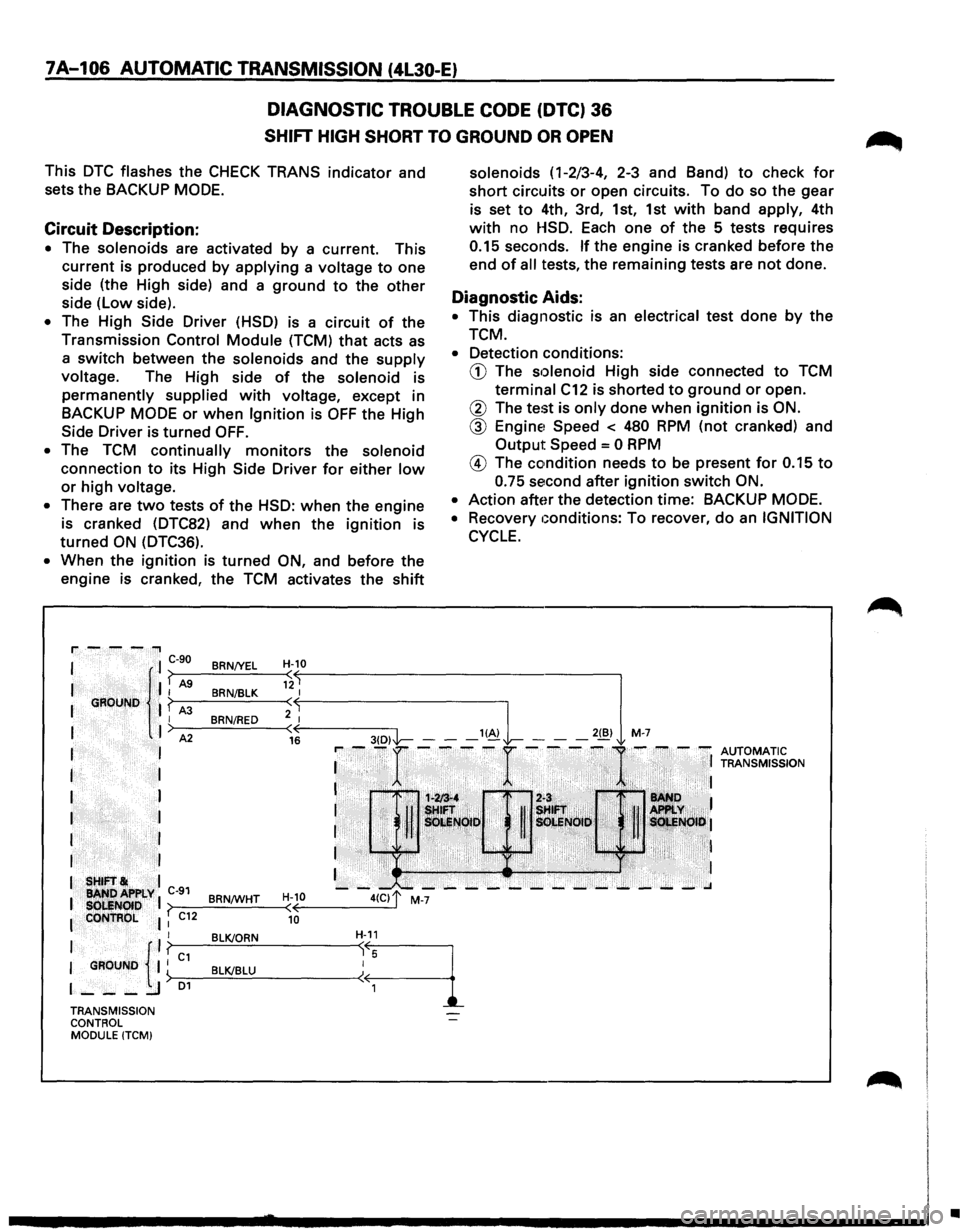
7A-106 AUTOMATIC TRANSMISSION (4l30-E)
DIAGNOSTIC TROUBLE CODE (DTC) 36
SHIFT HIGH SHORT TO GROUND OR OPEN
This DTC flashes the CHECK TRANS indicator and
sets the BACKUP
MODE.
Circuit Description:
• The solenoids are activated by a current. This
current is produced
by applying a voltage to one
side (the High side) and a
ground to the other
side (low side).
• The High Side Driver (HSD) is a circuit of the
Transmission
Control Module (TCM) that acts as
a switch between the solenoids and the supply
voltage. The High side of the solenoid is
permanently supplied with voltage, except in
BACKUP
MODE or when Ignition is OFF the High
Side Driver is turned OFF.
• The TCM continually monitors the solenoid
connection to its High Side Driver for either low
or high voltage.
•
There are two tests of the HSD: when the engine
is cranked (DTC82) and
when the ignition is
turned ON (DTC36).
• When the ignition is turned ON, and before the
engine is cranked, the TCM activates the
shift
BRN/YEL H-10 (
BRN/BLK 12 I
BRN/RED ;: ( 16
solenoids ( 1-2/3-4, 2-3 and Band) to check for
short circuits or open circuits. To do so the gear
is set
to 4th, 3rd, 1st, 1st with band apply, 4th
with no HSD. Each one of the 5 tests requires
0.15 seconds. If the engine is cranked before the
end
of all tests, the remaining tests are not done.
Diagnostic Aids:
• This diagnostic is an electrical test done by the
TCM.
• Detection conditions:
CD The solenoid High side connected to TCM
terminal C12 is shorted to ground or open.
@ The test is only done when ignition is ON.
@ Engine1 Speed < 480 RPM (not cranked) and
Output Speed = 0 RPM
@ The condition needs to be present for 0.15 to
0.75 second after ignition switch ON.
•
Action after the detection time: BACKUP MODE.
•
Recovery Gonditions: To recover, do an IGNITION
CYCLE.
•
Page 980 of 1928
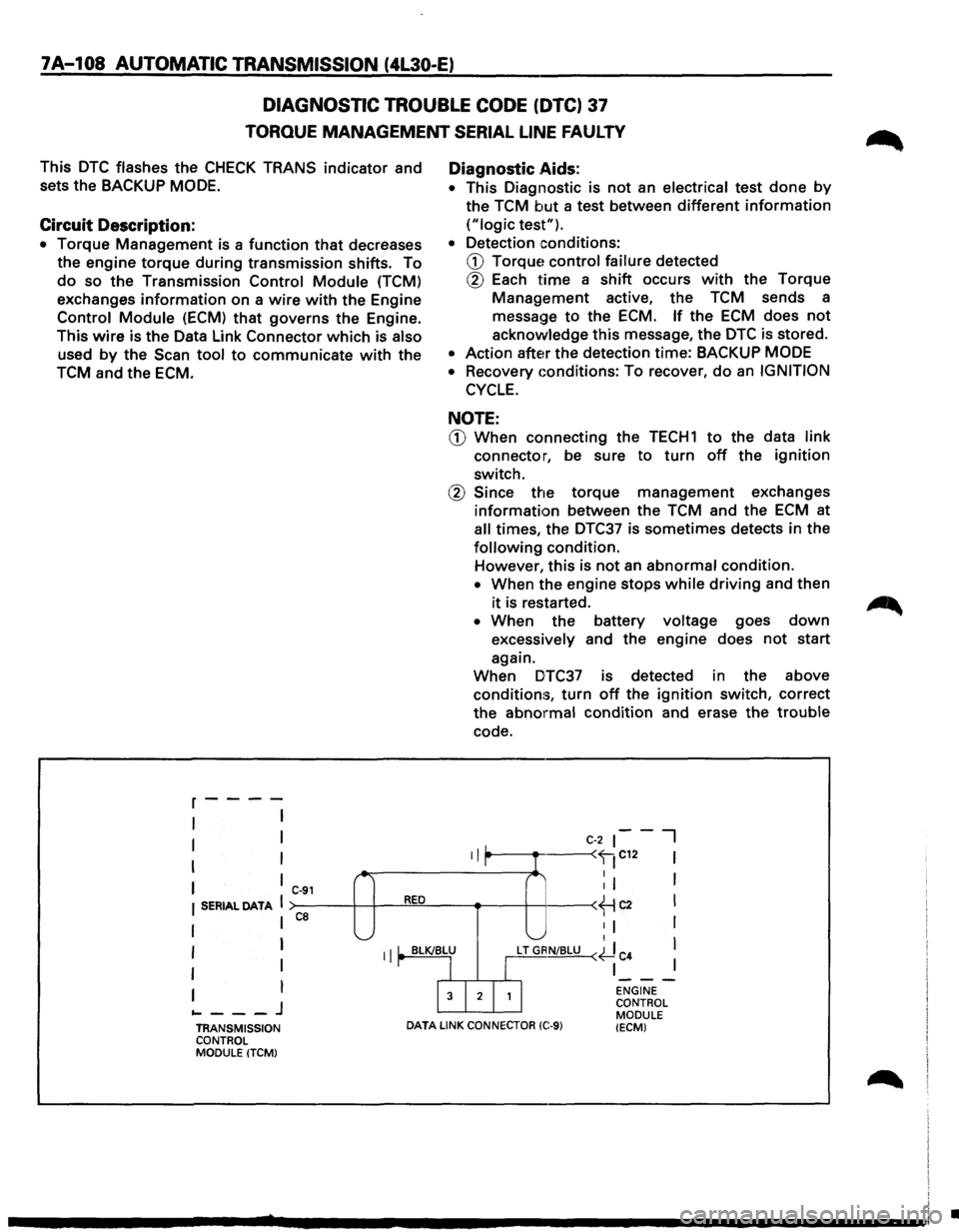
7A-108 AUTOMATIC TRANSMISSION (4l30·E)
DIAGNOSTIC TROUBLE CODE (DTC) 37
TORQUE MANAGEMENT SERIAL LINE FAULTY
This DTC flashes the CHECK TRANS indicator and
sets the
BACKUP MODE.
Circuit Description:
• Torque Management is a function that decreases
the engine
torque during transmission shifts. To
do so the Transmission Control Module (TCM)
exchanges
information on a wire with the Engine
Control Module (ECM) that governs the Engine.
This
wire is the Data Link Connector which is also
used by the Scan tool to communicate with the
TCM and the ECM.
r----
I I
I I
I I
I ,_
I C-91
I SERIAL DATA I RED
ca
I I '-._....;
Diagnostic .Aids:
• This
Diagnostic is not an electrical test done by
the TCM but a test between different information
("logic test").
•
Detection conditions:
CD Torque~ control failure detected
® Each time a shift occurs with the Torque
Management active, the TCM sends a
message
to the ECM. If the ECM does not
acknowledge this message, the DTC is stored.
• Action after the detection time: BACKUP MODE
• Recovery Gonditions: To recover, do an IGNITION
CYCLE.
NOTE:
CD When connecting the TECH1 to the data link
connector, be sure to turn off the ignition
switch.
® Since the torque management exchanges
information between the TCM and the ECM at
all times, the DTC37 is sometimes detects in the
following condition.
However,
this is not an abnormal condition.
• When the engine stops while driving and then
it is restarted.
• When the battery voltage goes down
excessively and the engine does not start
again.
When DTC37 is detected in the above
conditions,
turn off the ignition switch, correct
the
abnormal condition and erase the trouble
code.
II L
C-2 ~--I
r I ----
I I I '-" t
I I II' BLK/BLU
LT GRN/BLU (~ C
4 I
I I
r I I
I
I
I 3 I 2 I 1 I
---I ENGINE
... ---J CONTROL
MODULE
TRANSMISSION
DATA LINK CONNECTOR (C:-9) (ECM) CONTROL
MODULE (TCM)
•
Page 982 of 1928
7A-110 AUTOMATIC TRANSMISSION (4L30-E)
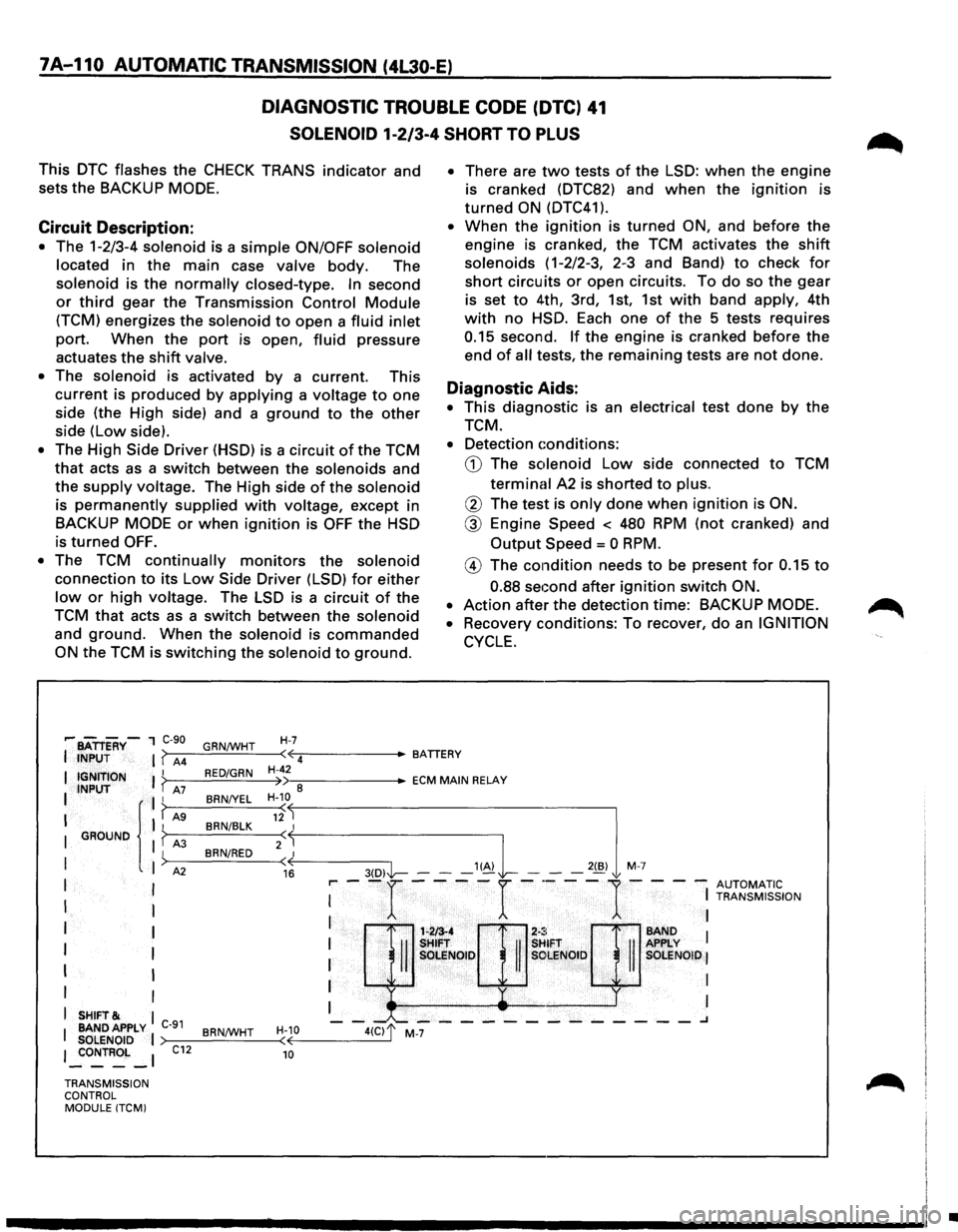
DIAGNOSTIC TROUBLE CODE (DTC) 41
SOLENOID 1-2/3-4 SHORT TO PLUS
This DTC flashes the CHECK TRANS indicator and
sets
the BACKUP MODE.
Circuit Description:
• The 1-2/3-4 solenoid is a simple ON/OFF solenoid
located in the main case valve body. The
solenoid is the normally closed-type. In second
or third gear the Transmission Control Module
(TCM) energizes the solenoid to open a fluid inlet
port. When the port is open, fluid pressure
actuates
the shift valve.
• The solenoid is activated by a current. This
current is produced by applying a voltage to one
side (the High side) and a ground to the other
side (Low side).
• The High Side Driver (HSD) is a circuit of the TCM
that acts as a switch between the solenoids and
the supply voltage. The High side of the solenoid
is permanently supplied with voltage, except in
BACKUP MODE or when ignition is OFF the HSD
is
turned OFF.
•
The TCM continually monitors the solenoid
connection to its Low Side Driver (LSD) for either
low or high voltage. The LSD is a circuit of the
TCM that acts as a switch between the solenoid
and ground. When the solenoid is commanded
ON the TCM is switching the solenoid to ground.
H-7
• There are two tests of the LSD: when the engine
is cranked (DTC82) and when the ignition is
turned ON (DTC41 ).
• When the ignition is turned ON, and before the
engine is cranked, the TCM activates the shift
solenoids ( 1-2/2-3, 2-3 and Band) to check for
short circuits or open circuits. To do so the gear
is set to 4th, 3rd, 1st, 1st with band apply, 4th
with no HSD. Each one of the 5 tests requires
0.15 second. If the engine is cranked before the
end of all tests, the remaining tests are not done.
Diagnostic Aids:
• This diagnostic is an electrical test done by the
TCM.
• Detection conditions:
CD The solenoid Low side connected to TCM
terminal A2 is shorted to plus.
@ The test is only done when ignition is ON.
@ Engine Speed < 480 RPM (not cranked) and
Output Speed = 0 RPM.
@ The condition needs to be present for 0.15 to
0.88 seGond after ignition switch ON.
•
Action after the detection time: BACKUP MODE.
•
Recovery conditions: To recover, do an IGNITION
CYCLE.
,.... BATTERY-1 C-90
I INPUT I ( A4 GRN/WHT
I { I r"'
( 12 BRN/BLK I I GROUND I f A3 BRN/RED 2(~
I
I A2 ( 16 I I
I I
I
I
I I
I I
I I
I
SHIFT& I
I BANDAPPLY C-91 BRN/WHT H-10
SOLENOID I (
I _:oNTROL _I C12 10
·~ ciJr
SHifT . SHIFT
II II SOLENOID II SOLENOID
' y
-"--------------.J
•-::------ECM MAIN RELAY
>---=---=--~--< ~----3(-D-,1'1-- --"~ L -2(B,l M 7
r-- -r ----r -·---
1-- --
AUTOMATIC I
I TRANSMISSION
I I
I BAND 1 APPLY I SOLENOID I
I I
I I
TRANSMISSION
CONTROL MODULE (TCMI
•
Page 984 of 1928
7A-112 AUTOMATIC TRANSMISSION (4l30-E)
DIAGNOSTIC TROUBLE CODE (DTC) 42
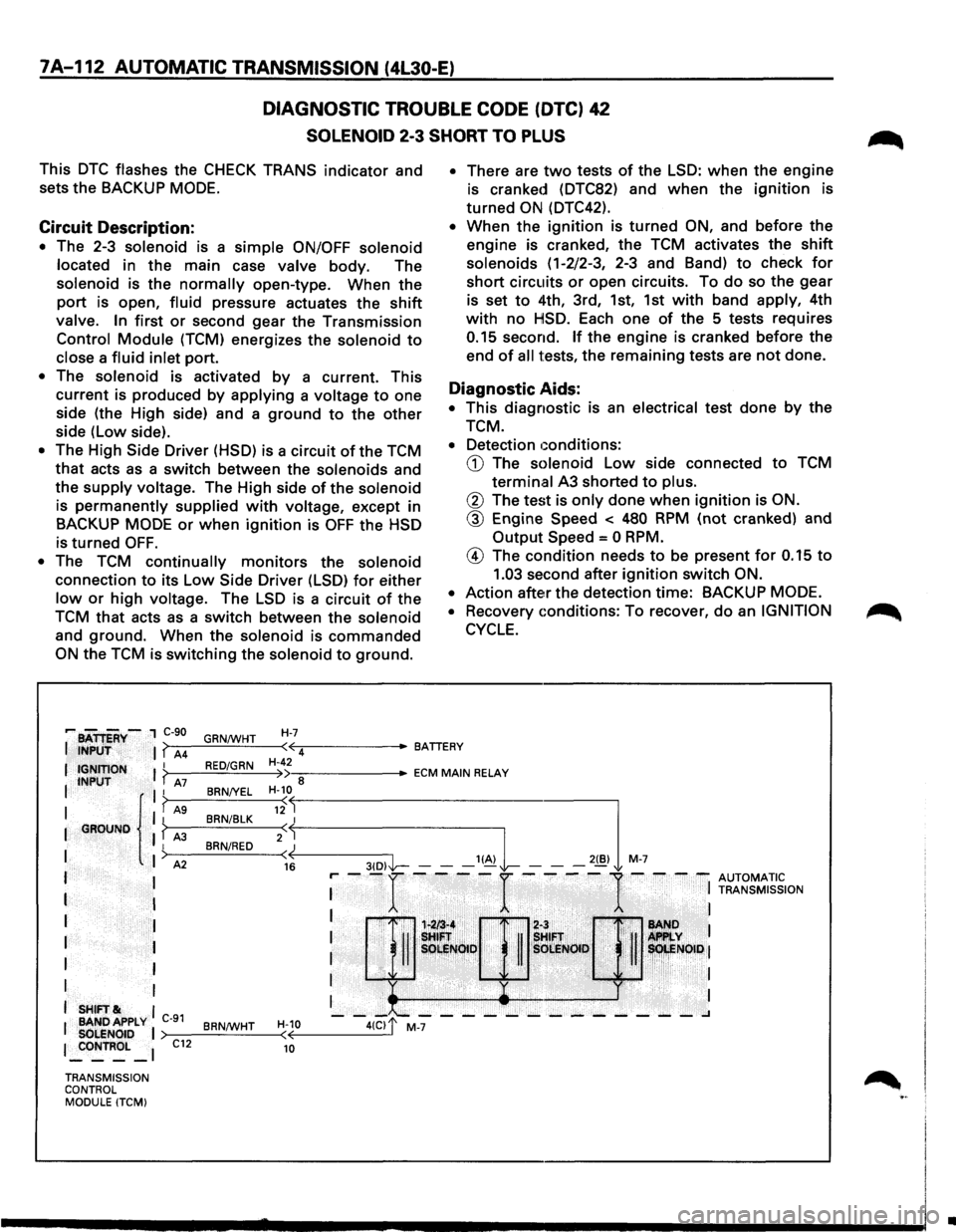
SOLENOID 2-3 SHORT TO PLUS
This DTC flashes the CHECK TRANS indicator and
sets the BACKUP MODE.
Circuit Description:
• The 2-3 solenoid is a simple ON/OFF solenoid
located
in the main case valve body. The
solenoid is the normally open-type. When the
port is open, fluid pressure actuates the shift
valve. In first or second gear the Transmission
Control Module (TCM) energizes the solenoid to
close a fluid inlet port.
• The solenoid is activated by a current. This
current is produced
by applying a voltage to one
side (the High side) and a
ground to the other
side (Low side).
• The High Side Driver (HSD) is a circuit of the TCM
that acts as a switch between the solenoids and
the
supply voltage. The High side of the solenoid
is permanently supplied with voltage, except in
BACKUP
MODE or when ignition is OFF the HSD
is turned OFF.
• The TCM continually monitors the solenoid
connection to its Low Side Driver (LSD) for either
low or high voltage. The LSD is a circuit of the
TCM
that acts as a switch between the solenoid
and ground. When the solenoid is commanded
ON the TCM is switching the solenoid to ground.
• There are two tests of the LSD: when the engine
is cranked (DTC82) and
when the ignition is
turned ON (DTC42).
• When the ignition is turned ON, and before the
engine is cranked, the TCM activates the
shift
solenoids (1-2/2-3, 2-3 and Band) to check for
short circuits or open circuits. To do so the gear
is set
to 4th, 3rd, 1st, 1st with band apply, 4th
with no HISD. Each one of the 5 tests requires
0.15 second. If the engine is cranked before the
end
of all tests, the remaining tests are not done.
Diagnostic Aids:
• This diagnostic is an electrical test done by the
TCM.
• Detection ~:onditions:
CD The solenoid Low side connected to TCM
terminal A3 shorted to plus.
® The test is only done when ignition is ON.
® Engine Speed < 480 RPM (not cranked) and
Output Speed = 0 RPM.
@ The condition needs to be present for 0.15 to
1.03 second after ignition switch ON.
•
Action after the detection time: BACKUP MODE.
• Recovery conditions: To recover, do an IGNITION
CYCLE.
•
Page 986 of 1928
7A-114 AUTOMATIC TRANSMISSION (4l30-E)
DIAGNOSTIC TROUBLE CODE (DTC) 43
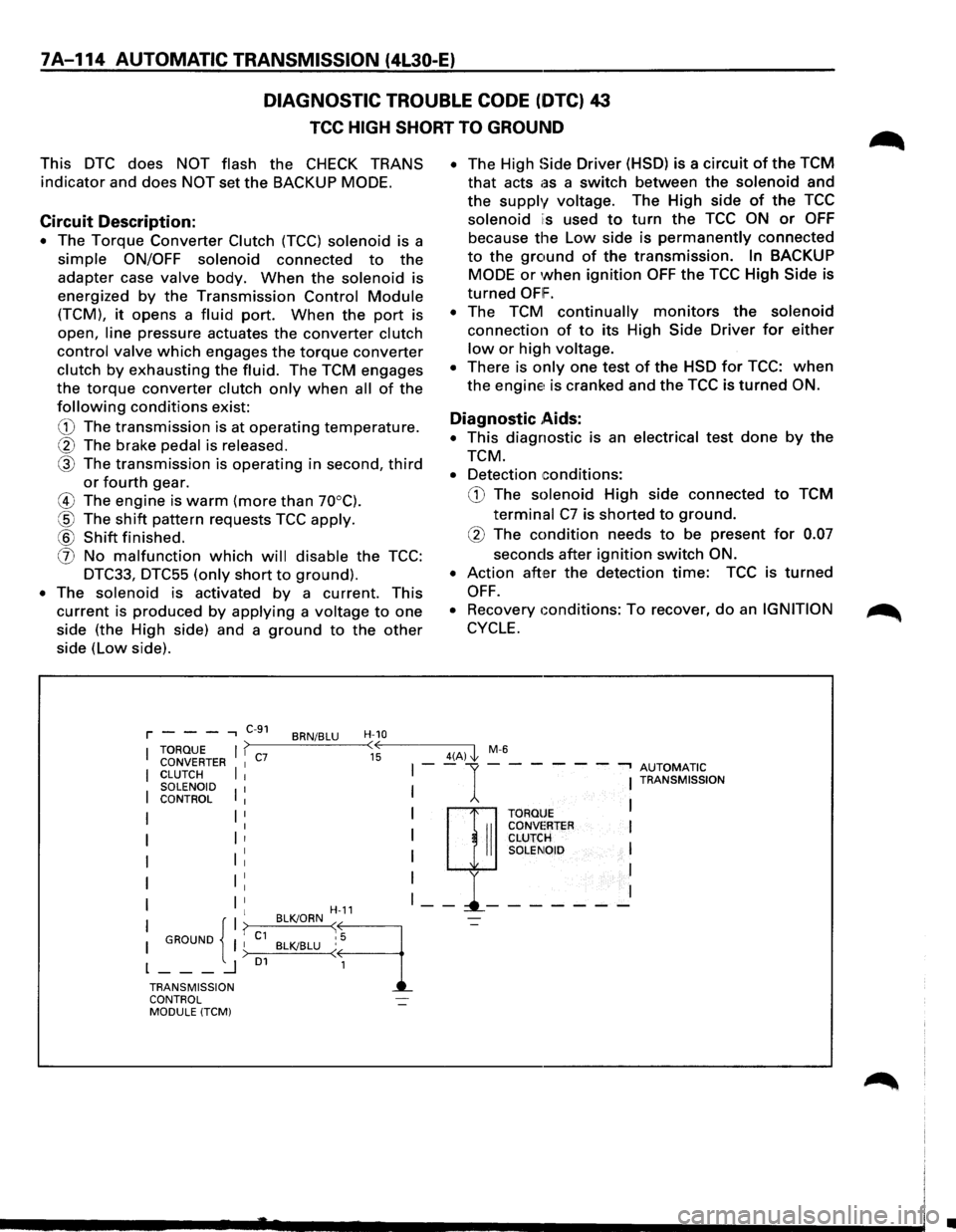
TCC HIGH SHORT TO GROUND
This DTC does NOT flash the CHECK TRANS
indicator and does NOT set the BACKUP MODE.
Circuit Description:
• The Torque Converter Clutch (TCC) solenoid is a
simple ON/OFF solenoid connected to the
adapter case
valve body. When the solenoid is
energized
by the Transmission Control Module
(TCM), it opens a fluid port. When the port is
open,
line pressure actuates the converter clutch
control valve
which engages the torque converter
clutch by exhausting the fluid. The TCM engages
the
torque converter clutch only when all of the
following conditions exist:
G) The transmission is at operating temperature.
@ The brake pedal is released.
® The transmission is operating in second, third
or fourth gear.
® The engine is warm (more than 70°C).
@ The shift pattern requests TCC apply.
® Shift finished.
(f) No malfunction which will disable the TCC:
DTC33, DTC55 (only short to ground).
• The solenoid is activated by a current. This
current is produced
by applying a voltage to one
side (the High side) and a
ground to the other
side (low side).
• The High Side Driver (HSD) is a circuit of the TCM
that acts as a switch between the solenoid and
the supply voltage. The High side of the TCC
solenoid is used to turn the TCC ON or OFF
because the Low side is permanently connected
to the ground of the transmission. In BACKUP
MODE or when ignition OFF the TCC High Side is
turned OFIF.
• The TCM continually monitors the solenoid
connection of to its High Side Driver for either
low or high voltage.
• There is only one test of the HSD for TCC: when
the engine is cranked and the TCC is turned ON.
Diagnostic .Aids:
• This diagnostic is an electrical test done by the
TCM.
• Detection conditions:
G) The solenoid High side connected to TCM
terminal C7 is shorted to ground.
@ The condition needs to be present for 0.07
seconds after ignition switch ON.
•
Action after the detection time: TCC is turned
OFF.
• Recovery eonditions: To recover, do an IGNITION
CYCLE.
r - - --, C-S1 BRN/BLU H-10 TORQUE I >-----__:_---<1 ~ ~'---------4-(A~) \1, M-6
g~~i~~TER I C7 II --1-- -- ---, AUTOMATIC
SOLENOID 1 TRANSMISSION
I
I
CONTROL
I I
I {I? GROUND I I C1 )
l---~ 01
TRANSMISSION CONTROL
MODULE (TCM)
I
: II
I
TORQUE CONVE:RTER CLUTCH
SOLEt\A0
I I H-11 - -~· - - - - - - -BLKJORN ~
9
-=-,5 BLK/BLU (
1
•
Page 988 of 1928
7A-116 AUTOMATIC TRANSMISSION (4L30-E)
DIAGNOSTIC TROUBLE CODE (DTC) 44
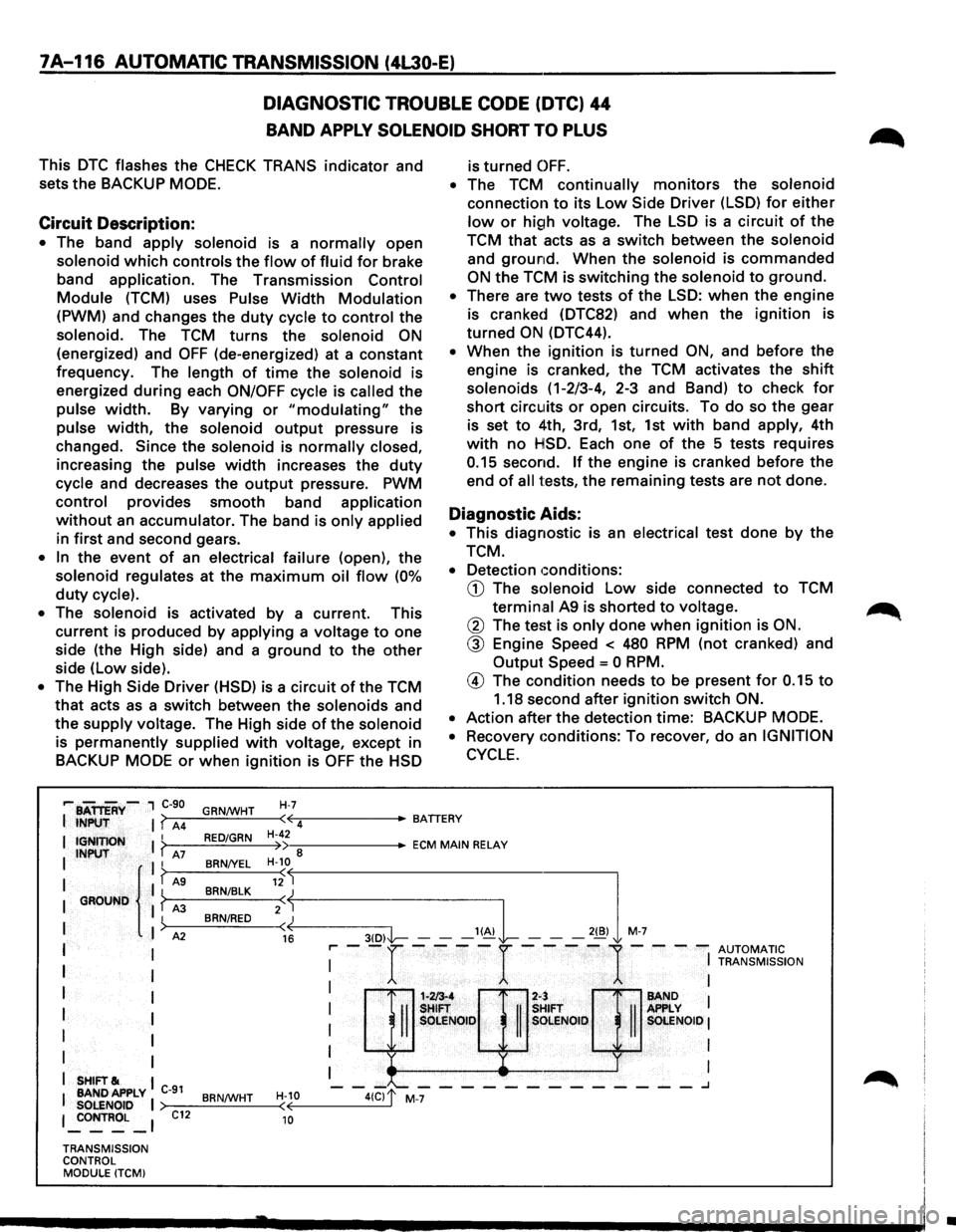
BAND APPLY SOLENOID SHORT TO PLUS
This DTC flashes the CHECK TRANS indicator and
sets the BACKUP
MODE.
Circuit Description:
• The band apply solenoid is a normally open
solenoid which controls the flow of fluid for brake
band
application. The Transmission Control
Module (TCM) uses Pulse Width Modulation
(PWM) and changes the duty cycle to control the
solenoid. The TCM turns the solenoid ON
(energized) and OFF (de-energized) at a constant
frequency. The
length of time the solenoid is
energized
during each ON/OFF cycle is called the
pulse width. By varying or "modulating" the
pulse width, the solenoid output pressure is
changed.
Since the solenoid is normally closed,
increasing the pulse width increases the duty
cycle and decreases the output pressure. PWM
control provides smooth band application
without an accumulator. The band is only applied
in first and second gears.
• In the event of an electrical failure (open), the
solenoid regulates at the maximum oil flow (0%
duty cycle).
•
The solenoid is activated by a current. This
current is produced by
applying a voltage to one
side (the High side) and a
ground to the other
side (low side).
• The High Side Driver (HSD) is a circuit of the TCM
that acts as a switch between the solenoids and
the
supply voltage. The High side of the solenoid
is permanently supplied with voltage, except in
BACKUP
MODE or when ignition is OFF the HSD
H-7
is turned OFF.
• The TCM continually monitors the solenoid
connection to its Low Side Driver (LSD) for either
low or high voltage. The LSD is a circuit of the
TCM
that acts as a switch between the solenoid
and ground. When the solenoid is commanded
ON the TCM is switching the solenoid to ground.
• There are two tests of the LSD: when the engine
is cranked (DTC82) and
when the ignition is
turned
ON (DTC44).
• When the ignition is turned ON, and before the
engine is cranked, the TCM activates the
shift
solenoids (1-2/3-4, 2-3 and Band) to check for
short circuits or open circuits. To do so the gear
is set
to 4th, 3rd, 1st, 1st with band apply, 4th
with no HSD. Each one of the 5 tests requires
0.15 second. If the engine is cranked before the
end
of all tests, the remaining tests are not done.
Diagnostic Aids:
• This diagnostic is an electrical test done by the
TCM.
• Detection conditions:
CD The solenoid Low side connected to TCM
termin.al A9 is shorted to voltage.
@ The test is only done when ignition is ON.
@ Engine Speed < 480 RPM (not cranked) and
Output
Speed = 0 RPM.
@ The condition needs to be present for 0.15 to
1.18 second after ignition switch ON.
•
Action after the detection time: BACKUP MODE.
•
Recovery conditions: To recover, do an IGNITION
CYCLE.
,... BATTERY-, C-90
I INPUT I? A4 GRN/WHT ·~-----BATTERY
( 4
I IGNITION I ? I INPUT A7 II
I { I? AS I GROUND I ? A3
I
)
I A2
I I
I
I
I I
I I
I
I
I I
I SHIFT& I
I BANDAPPLY C-91 SOLENOID I 1 _:oNTROL _ 1
TRANSMISSION
CONTROL MODULE (TCMI
C12
RED/GRN
BRN/YEL
BRN/BLK
BRN/RED
BRN/WHT
H-42 •--::------ECM MAIN RELAY )) 8 H-10
«--------3-(D--,I'l----- --'~L -,,,l M-7
( 12
2:j
16 r-- -r ----r ----
1-- --
AUTOMATIC I
I TRANSMISSION
: H::Q]:;& : I OLE SOlENOID I
I I
I I
1-213-4 2-:
-II
SHIFT
II
s SOLE NOlO s
-"--------_______ .J
H-10 ( 10
•
Page 990 of 1928
7A-118 AUTOMATIC TRANSMISSION (4L30-E)
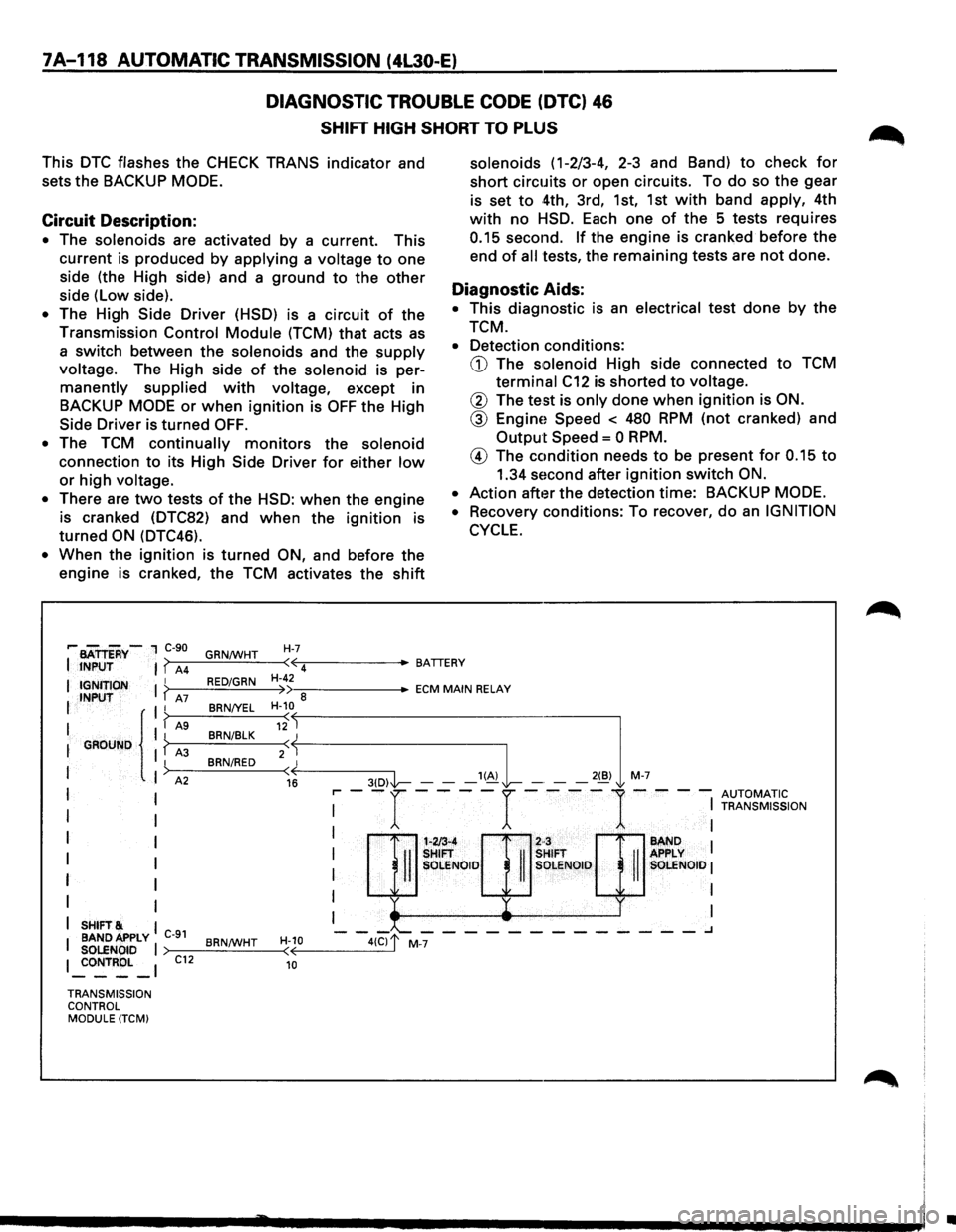
DIAGNOSTIC TROUBLE CODE (DTC) 46
SHIFT HIGH SHORT TO PLUS
This DTC flashes the CHECK TRANS indicator and
sets
the BACKUP MODE.
Circuit Description:
• The solenoids are activated by a current. This
current is produced by applying a voltage to one
side (the High side) and a ground to the other
side (Low side).
• The High Side Driver (HSD) is a circuit of the
Transmission Control Module (TCM) that acts as
a
switch between the solenoids and the supply
voltage. The High side of the solenoid is per
manently supplied with voltage, except in
BACKUP
MODE or when ignition is OFF the High
Side
Driver is turned OFF.
•
The TCM continually monitors the solenoid
connection to its High Side Driver for either low
or high voltage.
•
There are two tests of the HSD: when the engine
is cranked (DTC82) and when the ignition is
turned ON (DTC46).
• When the ignition is turned ON, and before the
engine is cranked, the TCM activates the shift
H-7
solenoids (1-2/3-4, 2-3 and Band) to check for
short circuits or open circuits. To do so the gear
is set to 4th, 3rd, 1st, 1st with band apply, 4th
with no HSD. Each one of the 5 tests requires
0.15 second. If the engine is cranked before the
end of all tests, the remaining tests are not done.
Diagnostic Aids:
• This diagnostic is an electrical test done by the
TCM.
•
Detection conditions:
CD The solenoid High side connected to TCM
terminal C12 is shorted to voltage.
@ The test is only done when ignition is ON.
@ EnginE! Speed < 480 RPM (not cranked) and
Output Speed = 0 RPM.
® The condition needs to be present for 0.15 to
1.34 second after ignition switch ON.
•
Action after the detection time: BACKUP MODE.
•
Recovery conditions: To recover, do an IGNITION
CYCLE.
,.. BATTERY-1 C-90
JNPUT ( A4 GRN/WHT
( 4
IGNJTION I RED/GRN H-42
INPUT ( A7 »a BRN/YEL H-10
-:::------ECM MAIN RELAY
G~UND {
I A9 12 I BRN/BLK
2
SHIFT& BAND APPLY C-91 SOLENOID I ~ONTROL _I C12
TRANSMISSION CONTROL MODULE (TCM) BRN/WHT
H-10 ( 10
H/3-4
2·3
II
SHIFT
II
SHIFT
II SOLENOID SOLENOID
:--r----r----1---: ~~~~;ION
BAND I
I APPLY I SOLENOID I
~ I I
I I
-'--------------.J
•
Page 992 of 1928
7A-120 AUTOMATIC TRANSMISSION (4L30-E)
DIAGNOSTIC
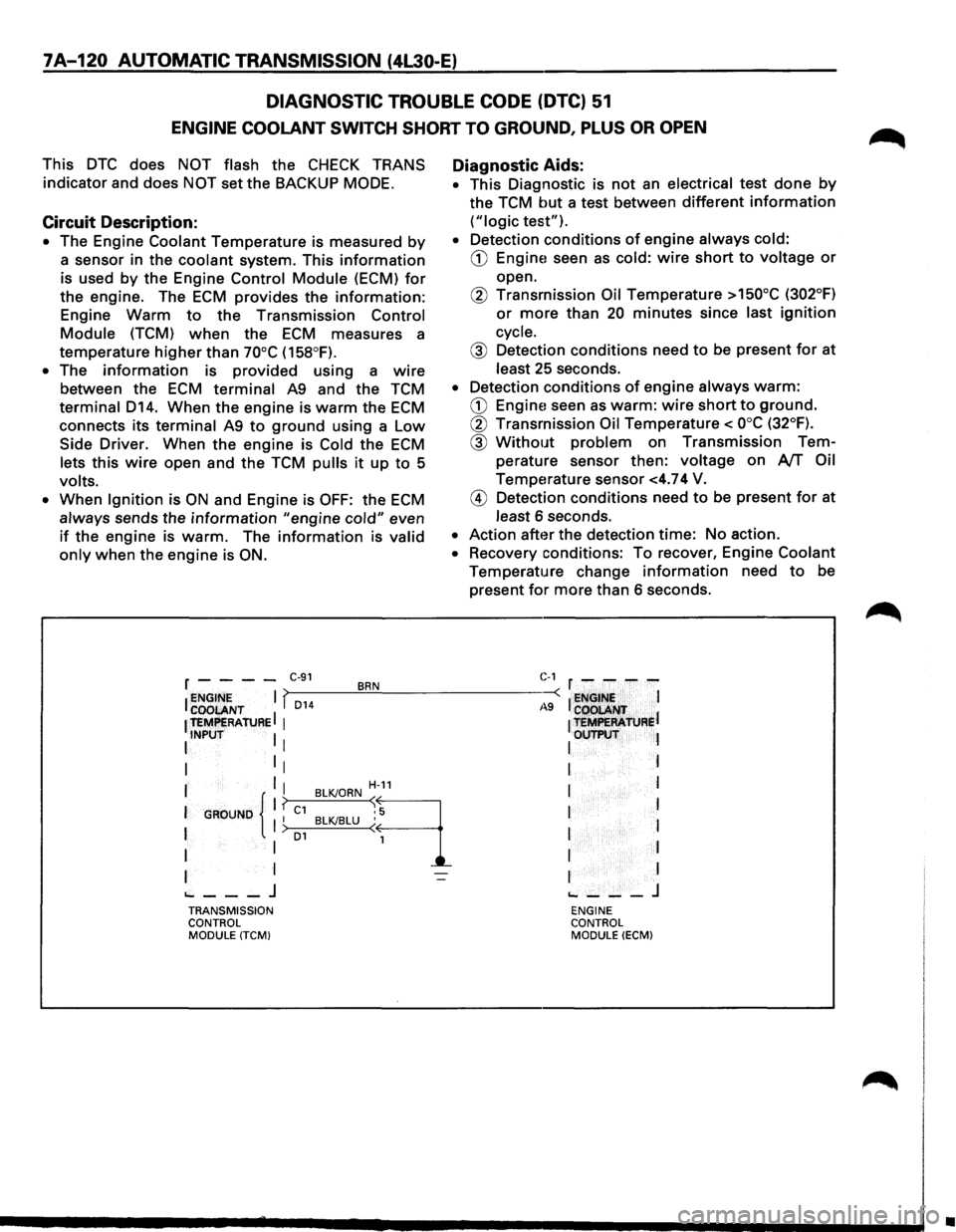
TROUBLE CODE (DTC) 51
ENGINE COOLANT SWITCH SHORT TO GROUND, PLUS OR OPEN
This DTC does NOT flash the CHECK TRANS
indicator and does NOT set the BACKUP MODE.
Circuit Description:
• The Engine Coolant Temperature is measured by
a sensor in the coolant system. This information
is used by the Engine Control Module (ECM) for
the engine. The ECM provides the information:
Engine Warm to the Transmission Control
Module (TCM) when the ECM measures a
temperature
higher than 70°C (158°F).
• The information is provided using a wire
between the ECM terminal A9 and the TCM
terminal D14. When the engine is warm the ECM
connects its terminal A9 to ground using a Low
Side Driver. When the engine is Cold the ECM
lets this wire open and the TCM pulls it up to 5
volts.
•
When Ignition is ON and Engine is OFF: the ECM
always sends the information "engine cold" even
if the engine is warm. The information is valid
only when the engine is ON.
Diagnostic Aids:
• This Diagnostic is not an electrical test done by
the TCM but a test between different information
("logic test").
• Detection conditions of engine always cold:
CD Engine! seen as cold: wire short to voltage or
open.
@ Transmission Oil Temperature >150°C (302°F)
or more than 20 minutes since last ignition
cycle.
@ Detection conditions need to be present for at
least 25 seconds.
• Detection conditions of engine always warm:
CD Engine! seen as warm: wire short to ground.
@ Transmission Oil Temperature< ooc (32°F).
@ Without problem on Transmission Tem
perature sensor then:
voltage on AfT Oil
Temperature sensor <4.74 V.
@ Detection conditions need to be present for at
least 6 seconds.
• Action after the detection time: No action.
• Recovery conditions: To recover, Engine Coolant
Temperature change information need to be
present
for more than 6 seconds.
r - - - -C·91 BRN C-1 r - - - -
I ~~~ENT I f,_D_1_4 __ ~.!__--------~-: I ~NGt~~ I
1 teMPERAtuRE I 1
1 t=R'ATJJRel
I INPUT I I I OUTP\:IT l
I 1
1 I I
I I I H-11 I l
I
GROUND 11 ? C1 BLKJORN ~9 I I I I BLKJBLU ( 1 I > o1 I
I I 1 I I
I I I I
~---J ~---J TRANSMISSION ENGINE
CONTROL CONTROL
MODULE
(TCM) MODULE (ECM)
•