air condition JAGUAR X308 1998 2.G User Guide
[x] Cancel search | Manufacturer: JAGUAR, Model Year: 1998, Model line: X308, Model: JAGUAR X308 1998 2.GPages: 2490, PDF Size: 69.81 MB
Page 312 of 2490
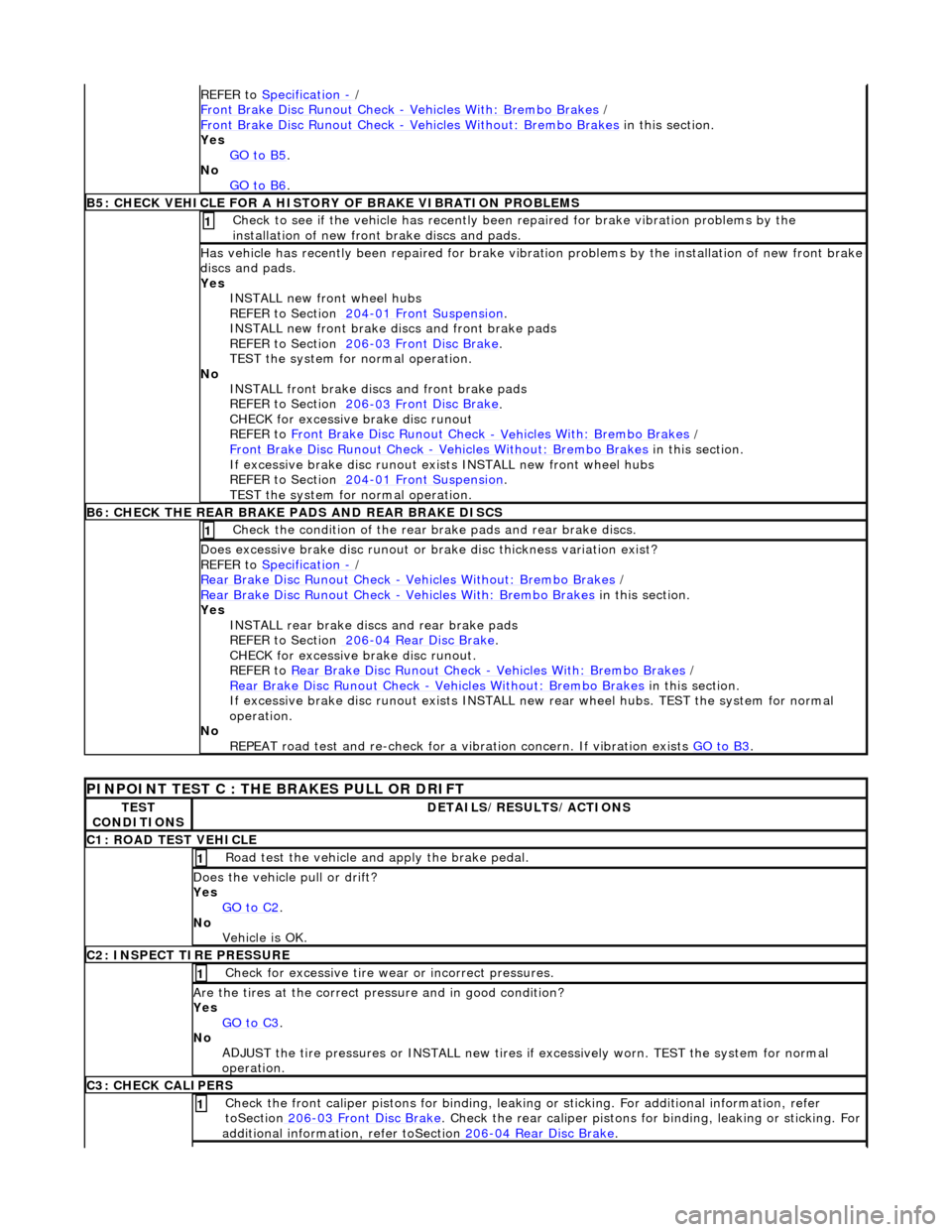
REFE
R to
Specification
- /
F r
ont Brake Disc Runout Check
- V
eh
icles With: Brembo Brakes
/
F
ront Brake Disc Runout Check
- V
e
hicles Without: Brembo Brakes
in this
section.
Yes GO to B5
.
No
GO to B6
.
B5: CHECK VEHICLE
FOR A HISTORY OF BRAKE VIBRATION PROBLEMS
Chec
k to se
e if the vehicle has recently been
repaired for brake vibration problems by the
installation of new front brake discs and pads.
1
Has vehicl
e has recently been repaired for brake vibrat
ion problems by the installation of new front brake
discs and pads.
Yes INSTALL new front wheel hubs
REFER to Section 204
-01 Fron
t Suspension
.
INST ALL new fr
ont brake disc
s and front brake pads
REFER to Section 206
-03 Fr
ont Disc Brake
.
TEST the system for normal
operation.
No INSTALL front brake discs and front brake pads
REFER to Section 206
-03 Fr
ont Disc Brake
.
CHECK for excessiv
e brake disc runout
REFER to Front Brake Disc Runout Check
- Veh
icles With: Brembo Brakes
/
F
ront Brake Disc Runout Check
- V
e
hicles Without: Brembo Brakes
in this
section.
If excessive brake disc runout exis ts INSTALL new front wheel hubs
REFER to Section 204
-01 Fron
t Suspension
.
TEST the system for normal
operation.
B
6:
CHECK THE REAR BRAKE PADS AND REAR BRAKE DISCS
Chec
k
the condition of the rear brake pads and rear brake discs.
1
D
o
es excessive brake disc runout or br
ake disc thickness variation exist?
REFER to Specification
- /
Rear B
rake Disc Runout Check
- Ve
hicles Without: Brembo Brakes
/
Rear
Brake Disc Runout Check
- Veh
icles With: Brembo Brakes
in this
section.
Yes INSTALL rear brake discs and rear brake pads
REFER to Section 206
-04
Rear Disc Brake
.
CHECK for excessiv
e brake disc runout.
REFER to Rear Brake Disc Runout Check
- Veh
icles With: Brembo Brakes
/
Rear
Brake Disc Runout Check
- V
e
hicles Without: Brembo Brakes
in this
section.
If excessive brake disc runout exists INSTALL ne w rear wheel hubs. TEST the system for normal
operation.
No REPEAT road test and re-check for a vi bration concern. If vibration exists GO to B3
.
PINPOINT TEST
C : THE BRAKES PULL OR DRIFT
TE
S
T
CONDITIONS
D E
TAILS/RESULTS/ACTIONS
C1
:
ROAD TEST VEHICLE
Road test th
e veh
icle and apply the brake pedal.
1
D
o
es the vehicle pull or drift?
Yes GO to C2
.
No
Vehicle is OK.
C2:
INS
PECT TIRE PRESSURE
Check f
or ex
cessive tire wear
or incorrect pressures.
1
Are the ti
res at the correct pressure and in good condition?
Yes GO to C3
.
No
AD
JUST the tire pressures or IN
STALL new tires if excessively wo rn. TEST the system for normal
operation.
C3 : CH
ECK CALIPERS
Check the fr
on
t caliper pistons for binding, leakin
g or sticking. For additional information, refer
toSection 206
-03 Fr
ont Disc Brake
. Check the rear cal
i
per pistons for
binding, leaking or sticking. For
additional information, refer toSection 206
-04
Rear Disc Brake
.
1
Page 314 of 2490

D4: CHECK
BRAKE FLUID LEVEL
Check the brake master cyli
nd
er reservoir fluid level.
1
Is the fl
ui
d level OK?
Yes BLEED the brake system. For additional information, re fer to General Procedures in this section. TEST
the system for normal operation.
No CHECK brake master cylinder reservoir sealing points. For additional information, refer to Brake
Master Cylinder in this section. ADD fluid and BL EED the brake system. For additional information,
refer to General Procedures in this section. TEST the system for normal operation. REPEAT road test if
necessary.
P I
NPOINT TEST E : THE
PEDAL GOES DOWN FAST
TES
T
CONDITIONS
D E
TAILS/RESULTS/ACTIONS
E1
:
ROAD TEST VEHICLE
Road test and apply th
e brake peda
l.
1
Is th
e brake pedal ef
fort an
d brake pedal travel normal?
Yes Vehicle is OK.
No GO to E2
.
E2: CHECK BRAK
E FLUID LEVEL
Check the brake master cyli
nd
er reservoir fluid level.
1
Is
t
he fluid level within specification?
Yes GO to E3
.
No
CH
ECK the brake master cylinder reservoir sealing po
ints. For additional information, refer to Brake
Master Cylinder Component Test in this section. ADD fluid and BLEED brake system. For additional
information, refer to General Proc edures in this section. TEST the system for normal operation.
REPEAT road test if necessary.
E3 : CHECK BRAK
E PEDAL TRAVEL-PRESSURIZE SYSTEM
Pump th
e brake pedal rapidly (f
ive times).
1
Does th
e brake pedal trav
el build up and then hold?
Yes BLEED the brake system. For additional information, re fer to General Procedures in this section. TEST
the system for normal oper ation. REPEAT road test.
No GO to E4
.
E4: CHECK FOR
BRAKE SYSTEM LEAKS
Chec
k for e
xternal brake system leaks. For additional information, refer to Master Cylinder in this
section.
1
Are le aks foun
d?
Yes REPAIR as necessary, ADD fluid and BLEED brake syst em. For additional information, refer to General
Procedures in this section. TEST the system for normal operation. REPEAT road test.
No System is OK.
PINPOINT TEST
F : THE PEDAL GOES DOWN SLOWLY
TES
T
CONDITIONS
DE
TAILS/RESULTS/ACTIONS
F1
:
ROAD TEST VEHICLE - CHECK BRAKE PEDAL OPERATION
Chec
k
if the condition occurs duri
ng actual stopping application by applying the brake pedal while
the vehicle is moving.
1
Doe s
the condition occur when the vehicle is moving?
Yes GO to F2
.
No
GO to F
3
.
F2:
CHECK
FOR BRAKE SYSTEM LEAKS
Chec
k for e
xternal brake system leaks. For additional information, refer to Master Cylinder in this
section.
1
Page 315 of 2490
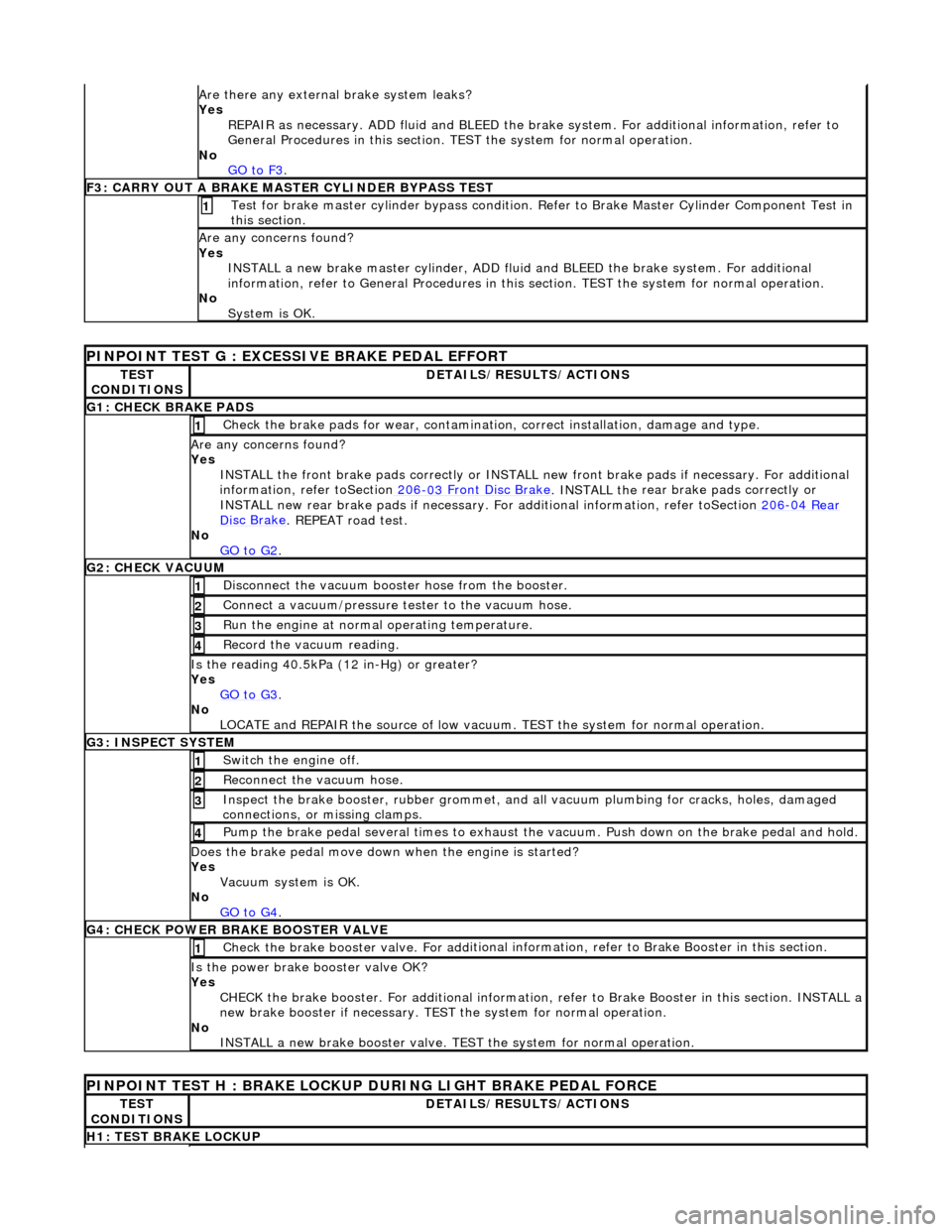
Are th
ere any external brake system leaks?
Yes REPAIR as necessary. ADD fluid and BLEED the brak e system. For additional information, refer to
General Procedures in this section. TEST the system for normal operation.
No GO to F3
.
F
3: CARRY OUT A BRAKE MASTER CYLINDER BYPASS TEST
Te
st for brake master cylinder bypass condition. Re
fer to Brake Master Cylinder Component Test in
this section.
1
A
re any concerns found?
Yes INSTALL a new brake master cylinder, ADD flui d and BLEED the brake system. For additional
information, refer to General Proc edures in this section. TEST the system for normal operation.
No System is OK.
PINPO
INT TEST G : EXCESSIVE BRAKE PEDAL EFFORT
TE
ST
CONDITIONS
D
ETAILS/RESULTS/ACTIONS
G1
: CHECK BRAKE PADS
Check the brake pads for wear, contamin
atio
n, correct installation, damage and type.
1
A
re any concerns found?
Yes INSTALL the front brake pads correctly or INSTALL ne w front brake pads if necessary. For additional
information, refer toSection 206
-03
Front Disc Brake
. INSTALL the
rear brake pads correctly or
INSTALL new rear brake pads if necessary. For additional information, refer toSection 206
-04
Rear
Di
sc Brake
. REPEAT road test.
No
GO to G2
.
G2:
CHECK VACUUM
Di
sconnect the vacuum booster hose from the booster.
1
Conne
ct a vacuum/pressure tester to the vacuum hose.
2
Ru
n the engine at normal operating temperature.
3
Re
cord the vacuum reading.
4
Is
the reading 40.5kPa (1
2 in-Hg) or greater?
Yes GO to G3
.
No
LOCATE and REPAIR the source of low vacuum . TEST the system for normal operation.
G3
: INSPECT SYSTEM
Swi
tch the engine off.
1
Re
connect the vacuum hose.
2
Inspect th
e brake booster, rubber grommet, and al
l vacuum plumbing for cracks, holes, damaged
connections, or missing clamps.
3
Pump th
e brake pedal several time
s to exhaust the vacuum. Push down on the brake pedal and hold.
4
Does th
e brake pedal move down
when the engine is started?
Yes Vacuum system is OK.
No GO to G4
.
G4
: CHECK POWER BRAKE BOOSTER VALVE
Check the brake booster valve. For
add
itional information, refer to
Brake Booster in this section.
1
Is th
e power brake booster valve OK?
Yes CHECK the brake booster. Fo r additional information, refer to Brak e Booster in this section. INSTALL a
new brake booster if necessary. TEST the system for normal operation.
No INSTALL a new brake booster valve. TEST the system for normal operation.
P
INPOINT TEST H : BRAKE LOCKUP
DURING LIGHT BRAKE PEDAL FORCE
TE
ST
CONDITIONS
D
ETAILS/RESULTS/ACTIONS
H1
: TEST BRAKE LOCKUP
Page 317 of 2490
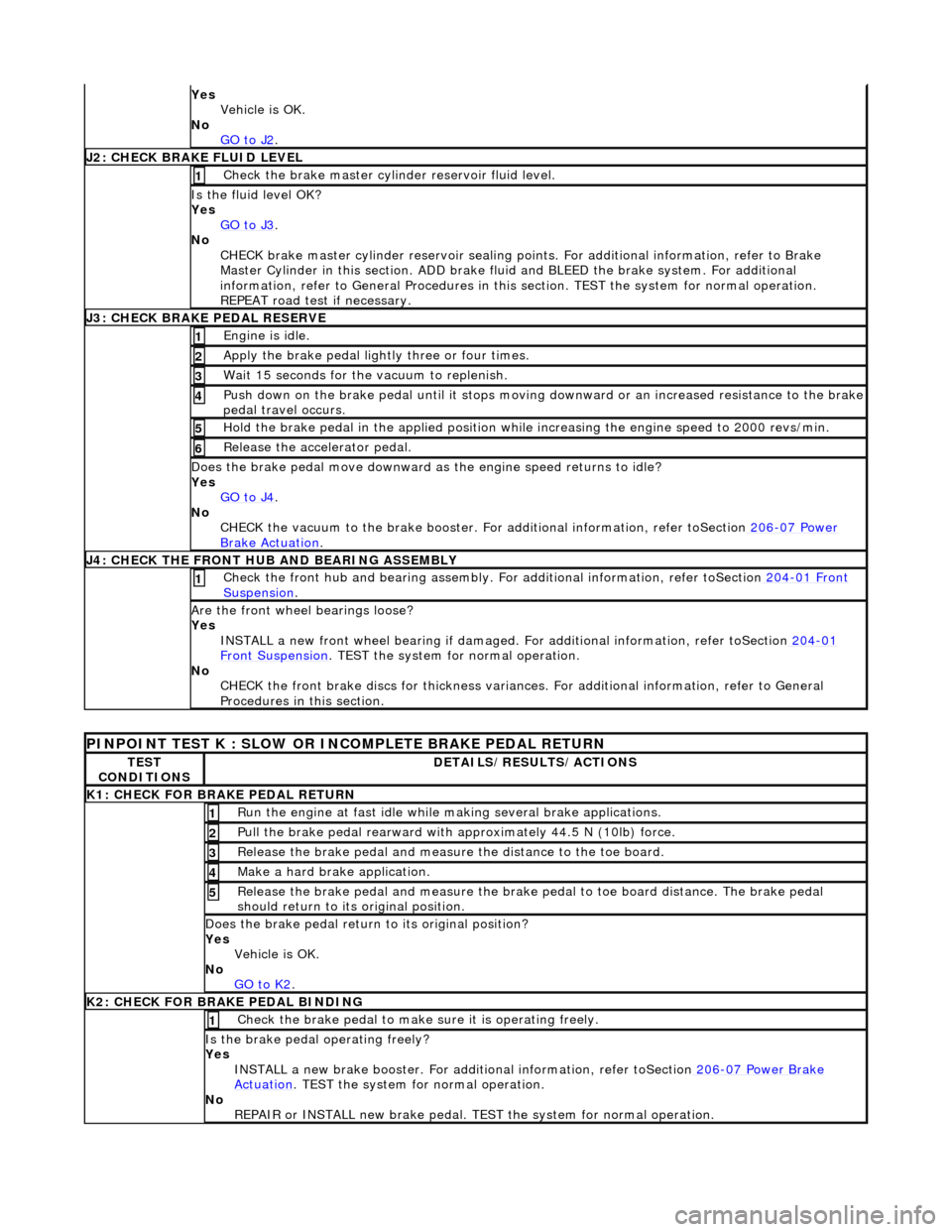
Yes
Vehicle is OK.
No GO to J2
.
J
2: CHECK BRAKE FLUID LEVEL
Check the brake master cyli
nder reservoir fluid level.
1
Is the fl
uid level OK?
Yes GO to J3
.
No
CHECK brake master cylinder reservoir sealing points. For additional information, refer to Brake
Master Cylinder in this section. ADD brake fl uid and BLEED the brake system. For additional
information, refer to General Proc edures in this section. TEST the system for normal operation.
REPEAT road test if necessary.
J
3: CHECK BRAKE PEDAL RESERVE
Engine is
idle.
1
Apply the brake pedal ligh
tl
y three or four times.
2
W
ait 15 seconds for the vacuum to replenish.
3
Push down on
the brake pedal until it stops moving
downward or an increased resistance to the brake
pedal travel occurs.
4
Hol
d the brake pedal in the applied position while increasing the engine speed to 2000 revs/min.
5
Re
lease the accelerator pedal.
6
Does th
e brake pedal move downward as
the engine speed returns to idle?
Yes GO to J4
.
No
CHECK the vacuum to the brake booster. Fo r additional information, refer toSection 206
-0
7 Power
Brake Ac
tuation
.
J
4: CHECK THE FRONT HUB AND BEARING ASSEMBLY
Check the fr
ont hub and bearing assembly. Fo
r additional information, refer toSection 204
-01
Front
Suspe
nsion
. 1
Are th
e front wheel bearings loose?
Yes INSTALL a new front wheel bearin g if damaged. For additional information, refer toSection 204
-01
F
ront Suspension
. TEST
the system for normal operation.
No CHECK the front brake discs for thickness variances. For additional information, refer to General
Procedures in this section.
PINPO
INT TEST K : SLOW OR INCOMPLETE BRAKE PEDAL RETURN
TE
ST
CONDITIONS
D
ETAILS/RESULTS/ACTIONS
K1: C
HECK FOR BRAKE PEDAL RETURN
Ru
n the engine at fast idle while
making several brake applications.
1
Pull the
brake pedal rearward with approximately 44.5 N (10lb) force.
2
Relea
se the brake pedal and measure
the distance to the toe board.
3
Make a hard brake
application.
4
Relea
se the brake pedal and measure the brake
pedal to toe board distance. The brake pedal
should return to its original position.
5
Does th
e brake pedal return
to its original position?
Yes Vehicle is OK.
No GO to K2
.
K
2: CHECK FOR BRAKE PEDAL BINDING
Check the brake pedal to make
s
ure it is operating freely.
1
Is th
e brake pedal operating freely?
Yes INSTALL a new brake booster. For addi tional information, refer toSection 206
-0
7 Power Brake
Actuation. TEST
the system for normal operation.
No REPAIR or INSTALL new brake pedal. TE ST the system for normal operation.
Page 318 of 2490
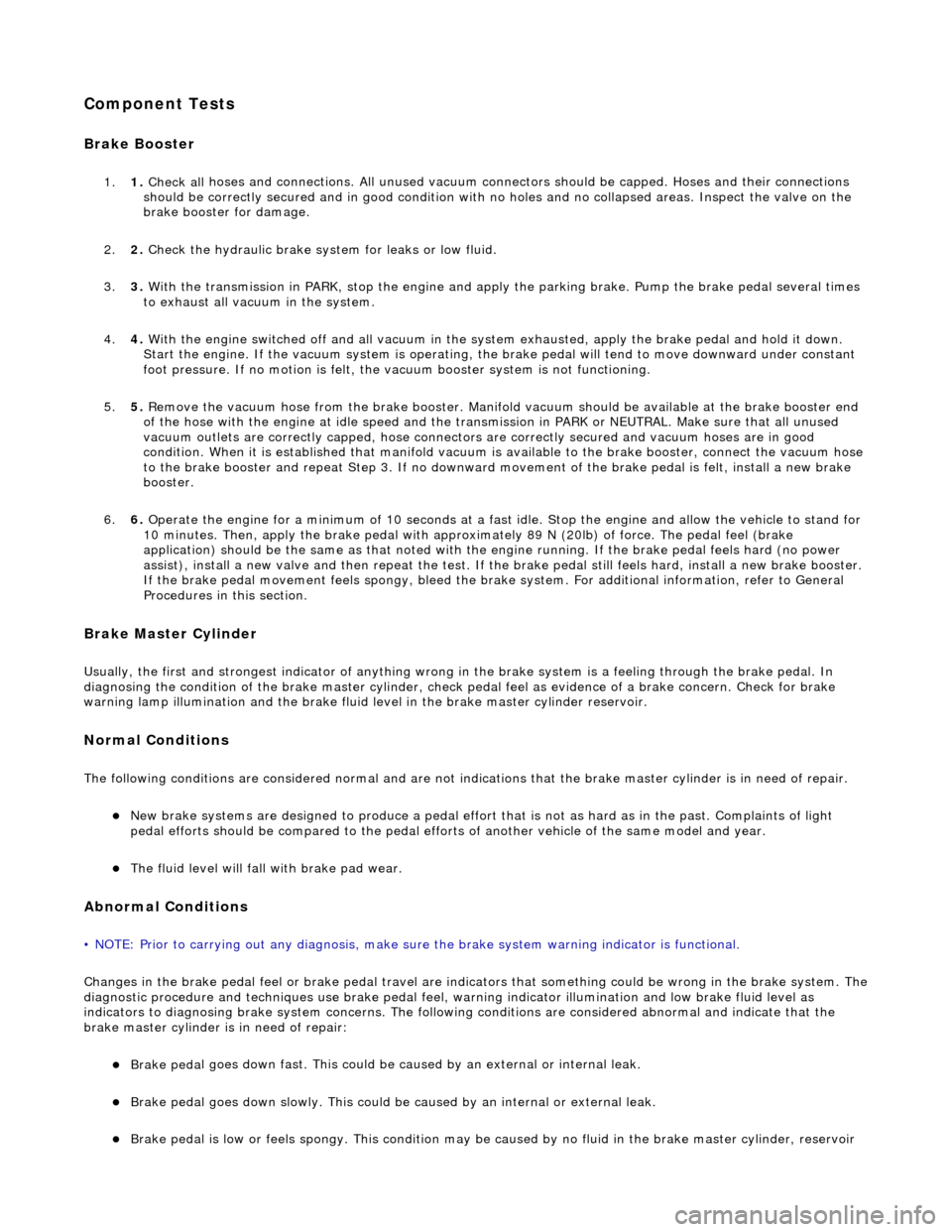
Comp
onent Tests
Bra
k
e Booster
1.
1. Chec k all
hoses and connections. All unused vacuum connectors should be capped. Hoses and their connections
should be correctly secured and in good condition with no holes and no collapsed areas. Inspect the valve on the
brake booster for damage.
2. 2. Check the hydraulic brake system for leaks or low fluid.
3. 3. With the transmission in PARK, stop the engine and apply the parking brake. Pump the brake pedal several times
to exhaust all vacuum in the system.
4. 4. With the engine switched off and all vacuum in the system exhausted, appl y the brake pedal and hold it down.
Start the engine. If the vacuum system is operating, the brake pedal will tend to move downward under constant
foot pressure. If no motion is felt, the vacuum booster system is not functioning.
5. 5. Remove the vacuum hose from the brake booster. Manifold vacuum should be available at the brake booster end
of the hose with the engine at idle speed and the transm ission in PARK or NEUTRAL. Make sure that all unused
vacuum outlets are correctly capped, hose connectors are correctly secured and vacuum hoses are in good
condition. When it is established that manifold vacuum is available to the brake booster, connect the vacuum hose
to the brake booster and repeat Step 3. If no downward movement of the brake pedal is felt, install a new brake
booster.
6. 6. Operate the engine for a minimum of 10 seconds at a fast idle. Stop the engine and allow the vehicle to stand for
10 minutes. Then, apply th e brake pedal with approximately 89 N ( 20lb) of force. The pedal feel (brake
application) should be the same as that noted with the engine running. If the brake pedal feels hard (no power
assist), install a new valve and then re peat the test. If the brake pedal still feels hard, in stall a new brake booster.
If the brake pedal movement feels spongy, bleed the brak e system. For additional information, refer to General
Procedures in this section.
Bra k
e Master Cylinder
Usual
l
y, the first and strongest
indicator of anything wrong in the brake syst em is a feeling through the brake pedal. In
diagnosing the condition of the brake master cylinder, check pedal feel as evidence of a brake concern. Check for brake
warning lamp illumination and the brake fluid le vel in the brake master cylinder reservoir.
Normal Conditio
ns
The fo
llowing conditions are considered norm
al and are not indications that the brake master cylinder is in need of repair.
New bra
ke systems are designed to produc
e a pedal effort that is not as hard as in the past. Complaints of light
pedal efforts should be compared to the pedal effort s of another vehicle of the same model and year.
The fl
uid level will fall with brake pad wear.
Abnormal Conditions
•
NOTE: Prior to carrying out any diag
nosis, make sure the brake system warning indicator is functional.
Changes in the brake pedal feel or brake pedal travel are in dicators that something could be wrong in the brake system. The
diagnostic procedure and techniques use brake pedal feel, warning indicator illu mination and low brake fluid level as
indicators to diagnosing brake system co ncerns. The following conditions are cons idered abnormal and indicate that the
brake master cylinder is in need of repair:
Brake ped a
l goes down fast. Th
is could be caused by an ex ternal or internal leak.
Brake pedal goes down slowly
. This could be
caused by an internal or external leak.
Brak
e pedal is low or feels spongy. This condition may be ca
used by no fluid in the brake master cylinder, reservoir
Page 319 of 2490
cap ven
t holes clogged or air in the hydraulic system.
Brake ped
al effort is excessive. This ma
y be caused by a bind or obstruction in the pedal/linkage, a faulty non return
valve, booster or insuffi cient booster vacuum.
R
ear brakes lock up during light pedal force. This may
be caused by damaged brake pads, an incorrectly adjusted
parking brake, a partially applied parking brake, a damaged ABS sensor or bearing failure.
Brake ped
al effort erratic. This condition could be caused by the brake booste
r or incorrectly installed brake pads.
Brake warning indicator i
s on. This may be caused
by low fluid level or float assembly damaged.
No
n Pressure Leaks
Any reduced fluid v
olume in the brake ma
ster cylinder reservoir condition may be caused by two types of none pressure
external leaks.
Type 1: An external leak may be occur at the master cylinder reservoir cap because of incorre ct positioning of gasket and
cap. Reposition cap and gasket.
Type 2: An external leak may occur at th e reservoir mounting seals. Repair such a leak by installing new seals and make
sure that the reservoir retainin g bolt is correctly installed.
Page 343 of 2490
Front Disc Brake - Brake CaliperVehicles
With: Standard Brakes
Re
moval and Installation
Remov
al
W
ARNING: BRAKE DUST, IF INHALED CAN DAMAGE YOUR
HEALTH. ALWAYS REMOVE BRAKE DUST USING A VACUUM
BRUSH. DO NOT USE A COMPRESSED-AIR LINE TO DISPERSE BRAKE DUST INTO THE ATMOSPHERE.
• CAUTIONS:
Replacement of nuts and bolts: Various thread-locking de vices are used on nuts and bolts throughout the vehicle.
These devices restrict the number of times a nut or bolt can be used. See section 100-00 for information.
Remove brake fluid spilla ge immediately from paint work, with clean water.
A new brake hose must be installe d when replacing a brake caliper.
The brake pad adhesive backing must not be reused, therefore always install new brake pads, irrespective of the
condition of the original pads when replacing a brake caliper. Always replace brake pads as an axle set.
S
pecial Tool(s)
Brake Pedal
Hold Tool
JDS 9013
1. O
pen engine compartment and fit
paint work protection covers
to fenders.
2. Raise vehicle on a four-post lift.
3. Raise front of vehicle and support on stands. Refer to Section
100-02.
4. Remove front wheels. See Section 204-04.
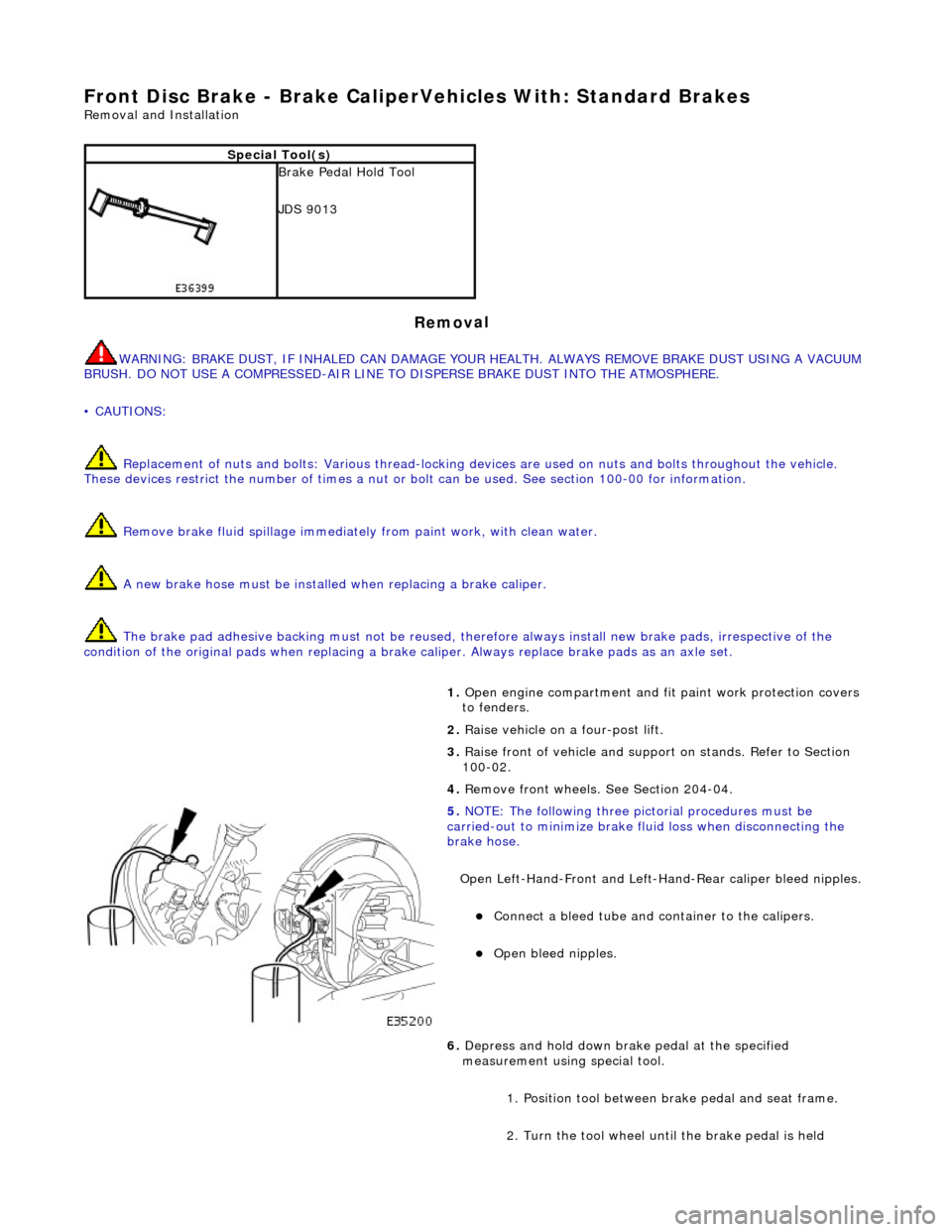
5. NOTE
: The following three pictorial procedures must be
carried-out to minimize brake fl uid loss when disconnecting the
brake hose.
Open Left-Hand-Front and Left-H and-Rear caliper bleed nipples.
Connect
a bleed tube and co
ntainer to the calipers.
O
pen bleed nipples.
6. Depress and hold down brak e pedal at the specified
measurement using special tool.
1. Position tool between brake pedal and seat frame.
2. Turn the tool wheel unti l the brake pedal is held
Page 351 of 2490
Front Dis
c Brake - Brake DiscVe
hicles With: Standard Brakes
Re
moval and Installation
Remov
al
• WAR
NINGS:
BRAKE DISCS MUST ALWAYS BE REPLACED IN PAIRS.
BRAKE DUST, IF INHALED CAN DAMAGE YOUR HEALTH. ALWAYS REMOVE BRAKE DUST USING A VACUUM BRUSH.
DO NOT USE A COMPRESSED-AIR LINE TO DI SPERSE BRAKE DUST INTO THE ATMOSPHERE.
CAUTION: Replacement of nuts and bolts: Various thread-locking devices are used on nuts and bolts throughout the
vehicle. These devices restrict the number of times a nut or bolt can be used. See section 100-00 for information.
1. O
pen engine compartment and in
stall paint work protection
covers to fenders.
2. Raise front of vehicle and suppo rt on stands. See Section 100-
02.
3. Remove front wheels. Re fer to Section 204-04.
4. CAUTI
ON: Remove brake flui
d spillage immediately from
paint work, with clean water.
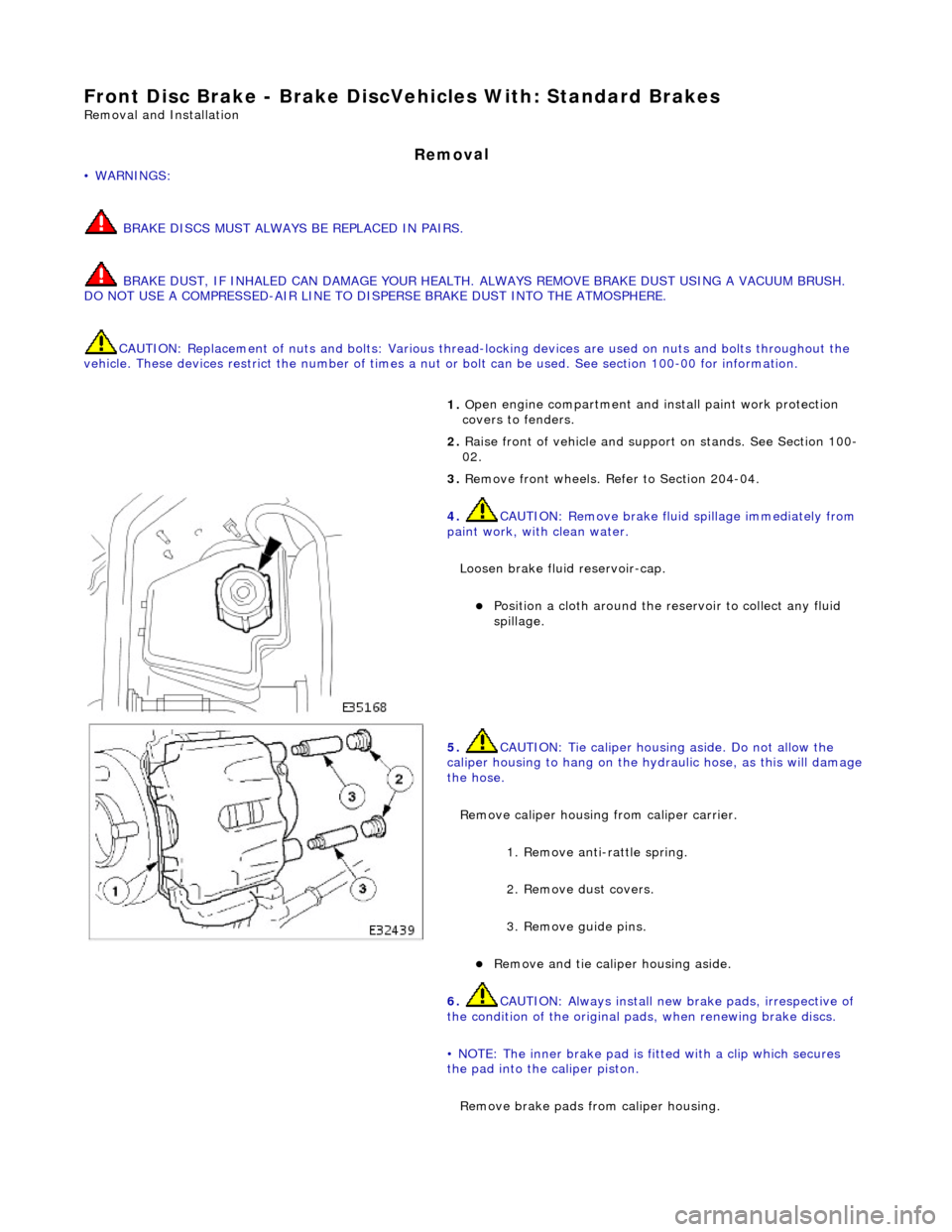
Loosen brake fluid reservoir-cap.
Position a cloth around the
reservoir to collect any fluid
spillage.
5. CAU
TION: Tie caliper housing aside. Do not allow the
caliper housing to hang on the hydraulic hose, as this will damage
the hose.
Remove caliper housing from caliper carrier.
1. Remove anti-rattle spring.
2. Remove dust covers.
3. Remove guide pins.
Re
move and tie caliper housing aside.
6.
CAUTI
ON: Always install new brake pads, irrespective of
the condition of the original pads, when renewing brake discs.
• NOTE: The inner brake pad is fitted with a clip which secures
the pad into the caliper piston.
Remove brake pads from caliper housing.
Page 355 of 2490
Front Dis
c Brake - Brake DiscVehicles With: High Performance Brakes
Re
moval and Installation
Remov
al
1.
WAR
NINGS:
BRAKE DISCS MUST ALWAYS BE REPLACED IN PAIRS.
BRAKE DUST, IF INHALED CAN DAMAGE YOUR HEALTH.
ALWAYS REMOVE BRAKE DUST USING A VACUUM BRUSH. DO
NOT USE A COMPRESSED-AIR LINE TO DISPERSE BRAKE DUST
INTO THE ATMOSPHERE.
• CAUTIONS:
Replacement of nuts and bolts: Various thread-locking
devices are used on nuts and bolts throughout the vehicle. These
devices restrict the number of ti mes a nut or bolt can be used.
See section 100-00 for information.
The Brembo caliper is aligned to the brake disc when it is
first installed to the vehicle, therefore, care must be taken not to
disturb this alignment. When removing the caliper; remove the
bolts that secure the anchor bracket to the vertical link only. DO
NOT loosen any other caliper bolts.
The front brake discs are dire ctional and must be installed
to the correct side of the vehi cle. Refer to Description and
Operation, section 206-03 for further information.
Do not loosen bolts securing brake disc to disc mounting.
Open engine compartment and in stall paint work protection
covers to fenders.
2. R
aise front of vehicle and suppo
rt on stands. See Section 100-
02.
3. Remove front wheels. Refe r to operation 74.20.05.
4. CAUTI
ON: Remove brake flui
d spillage immediately from
paint work, with clean water.
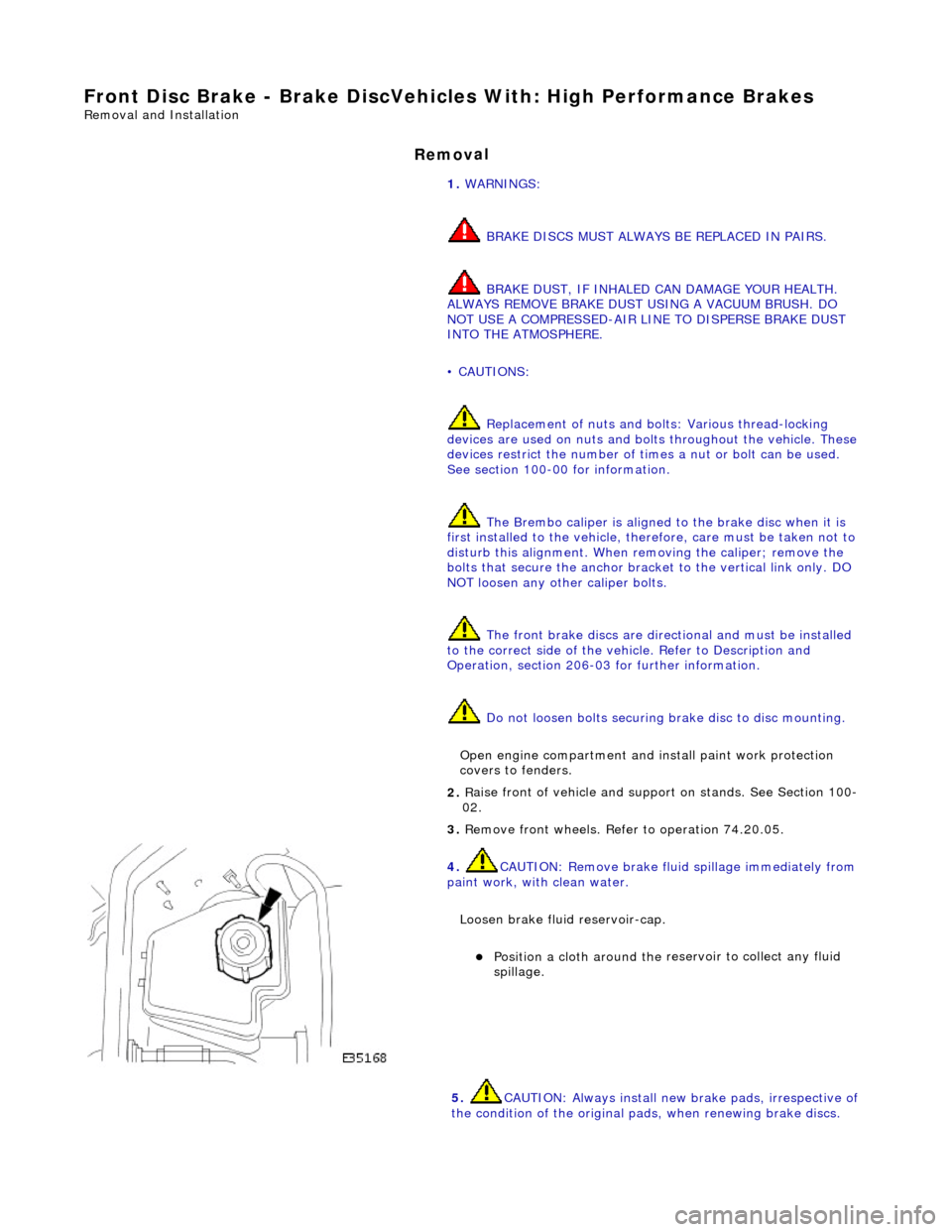
Loosen brake fluid reservoir-cap.
Position a cloth around the
reservoir to collect any fluid
spillage.
5. CAUTI
ON: Always install new brake pads, irrespective of
the condition of the original pads, when renewing brake discs.
Page 366 of 2490
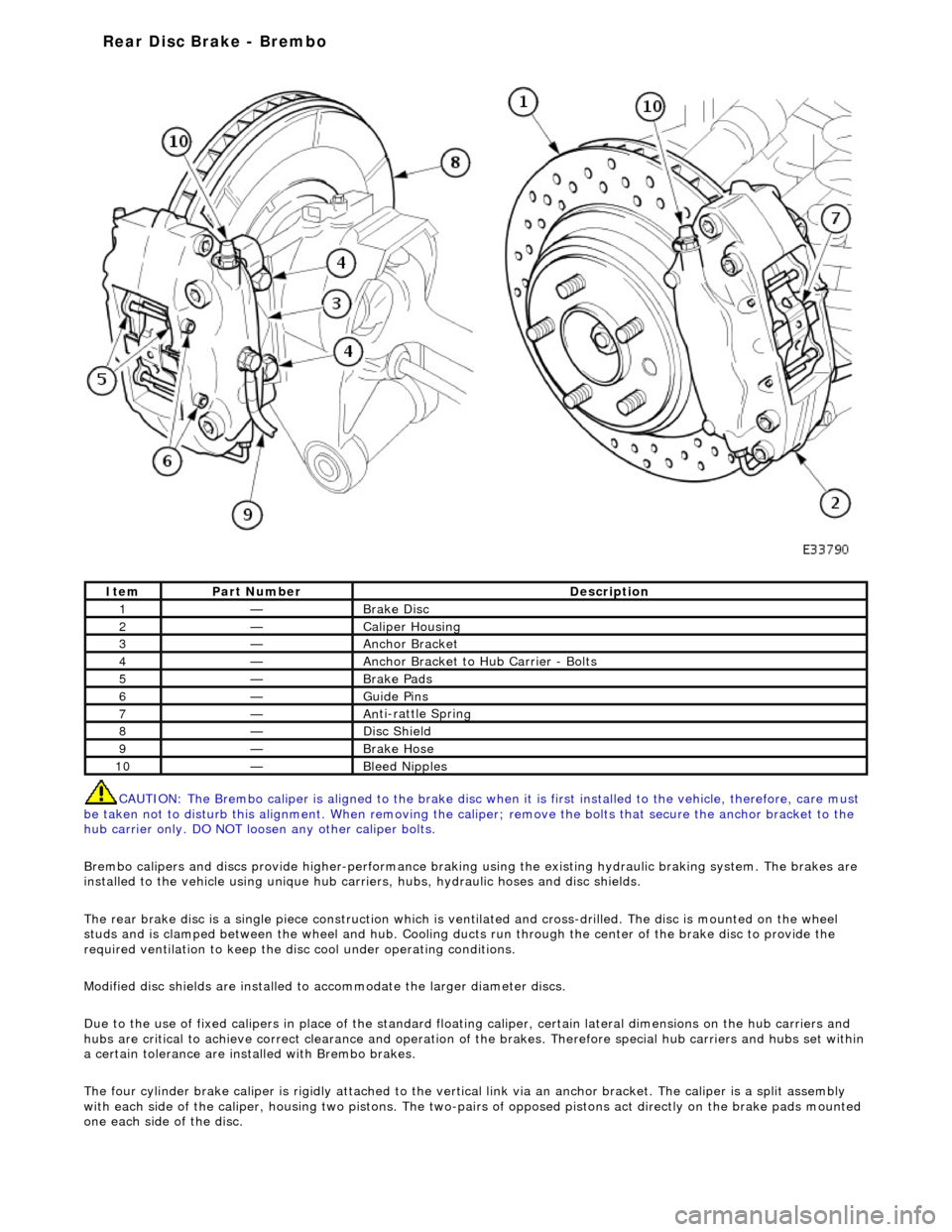
CAUTI O
N: The Brembo caliper is aligned to
the brake disc when it is first installed to the vehicle, therefore, care must
be taken not to disturb this alignment. When removing the ca liper; remove the bolts that secure the anchor bracket to the
hub carrier only. DO NOT loos en any other caliper bolts.
Brembo calipers and discs provide higher -performance braking using the existing hydraulic braking system. The brakes are
installed to the vehicle using unique hub carr iers, hubs, hydraulic hoses and disc shields.
The rear brake disc is a single piece co nstruction which is ventilated and cross-drilled. The disc is mounted on the wheel
studs and is clamped between the wheel and hub. Cooling ducts run through the ce nter of the brake disc to provide the
required ventilation to keep the disc cool under operating conditions.
Modified disc shields are installed to accommodate the larger diameter discs.
Due to the use of fixed calipers in place of the standard floating caliper, certain lateral dimensions on the hub carriers and
hubs are critical to achieve correct cleara nce and operation of the brakes. Therefore special hub carriers and hubs set within
a certain tolerance are inst alled with Brembo brakes.
The four cylinder brake caliper is rigidly attached to the vert ical link via an anchor bracket. The caliper is a split assembly
with each side of the caliper, housing two pistons. The two-pairs of opposed pistons act direct ly on the brake pads mounted
one each side of the disc.
It e
m
Par
t
Number
De
scr
iption
1—Brake D
i
sc
2—Caliper Housin
g
3—Anchor Bracke
t
4—Anchor Bracket to H
u
b Carrier - Bolts
5—Brake Pads
6—Guide Pi
ns
7—An
ti
-rattle Sprin
g
8—Di
sc
Shield
9—Brake Hos
e
10—Bleed Nipp
les
Rear Disc Brake - Brembo