vin JAGUAR X308 1998 2.G User Guide
[x] Cancel search | Manufacturer: JAGUAR, Model Year: 1998, Model line: X308, Model: JAGUAR X308 1998 2.GPages: 2490, PDF Size: 69.81 MB
Page 143 of 2490
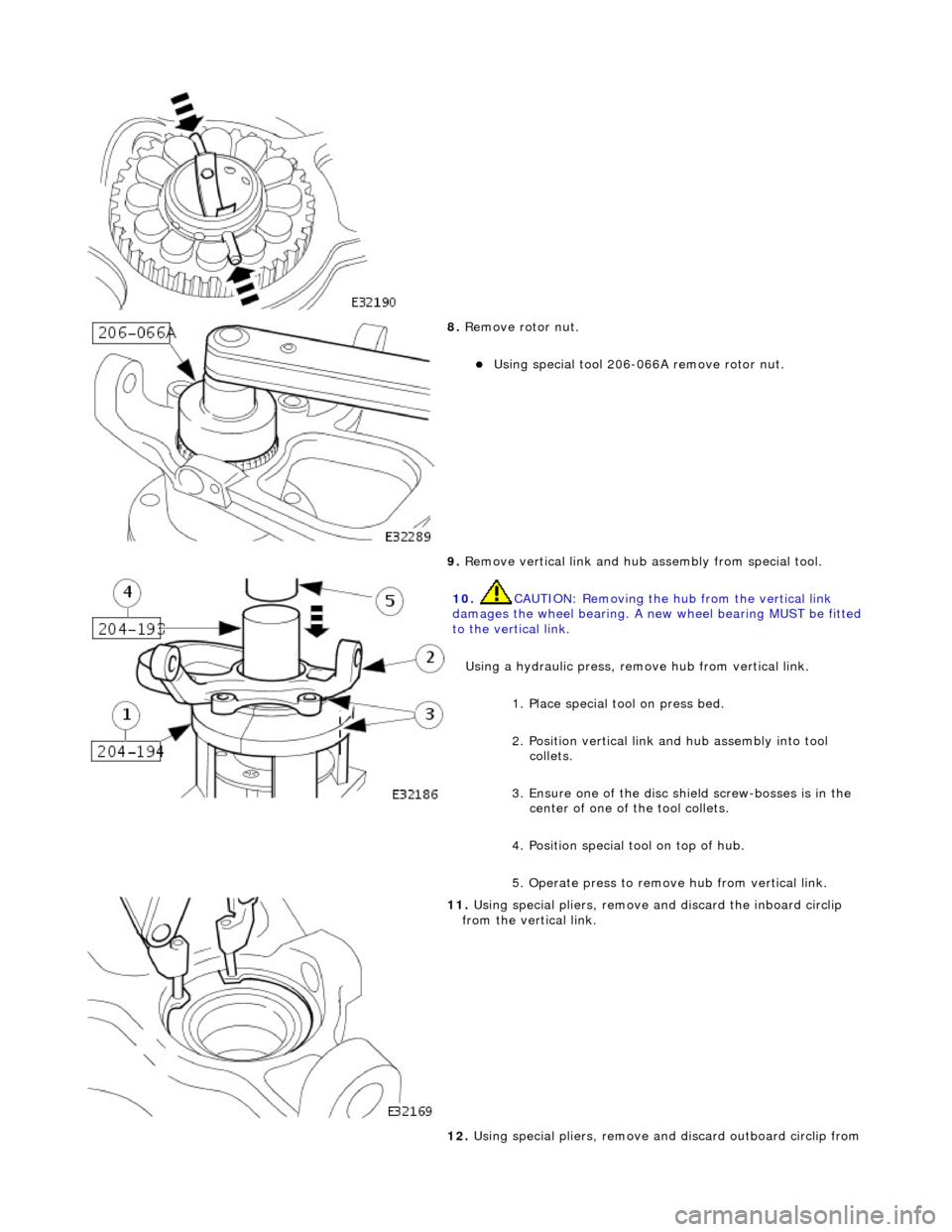
8. R
emove rotor nut.
U
sing special tool 206-066A remove rotor nut.
9. Remove vertical link and hub assembly from special tool.
10
.
CAUTION: Removing the hu b from the vertical link
damages the wheel bearing. A new wheel bearing MUST be fitted
to the vertical link.
Using a hydraulic press, remo ve hub from vertical link.
1. Place special tool on press bed.
2. Position vertical link and hub assembly into tool collets.
3. Ensure one of the disc sh ield screw-bosses is in the
center of one of the tool collets.
4. Position special tool on top of hub.
5. Operate press to remove hub from vertical link.
11
.
Using special pliers, remove an d discard the inboard circlip
from the vertical link.
12. Using special pliers, remove an d discard outboard circlip from
Page 149 of 2490
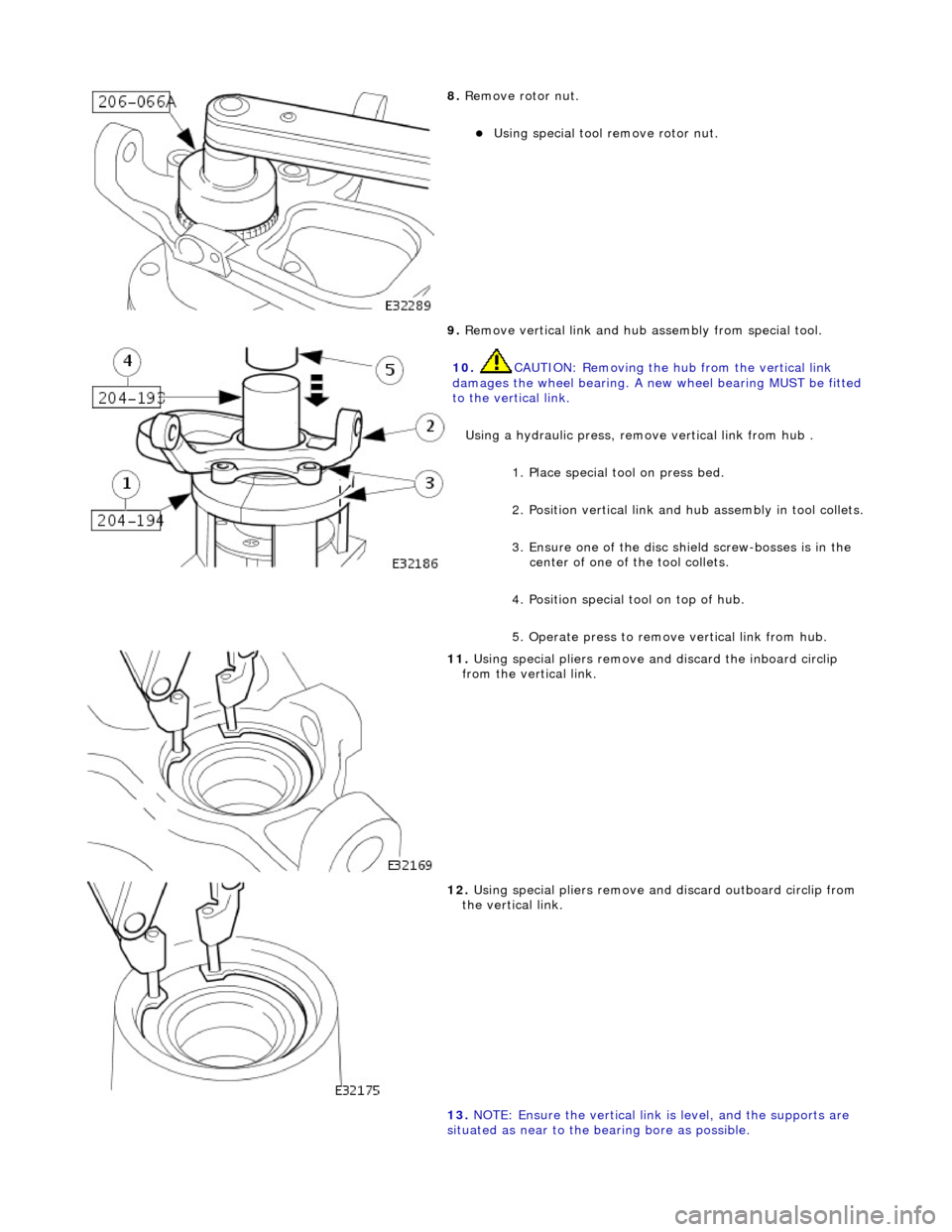
8. R
emove rotor nut.
Using speci
al tool remove rotor nut.
9. Remove vertical link and hub assembly from special tool.
10
.
CAUTION: Removing the hu b from the vertical link
damages the wheel bearing. A new wheel bearing MUST be fitted
to the vertical link.
Using a hydraulic press, remo ve vertical link from hub .
1. Place special tool on press bed.
2. Position vertical link and hub assembly in tool collets.
3. Ensure one of the disc sh ield screw-bosses is in the
center of one of the tool collets.
4. Position special tool on top of hub.
5. Operate press to remove vertical link from hub.
11
.
Using special pliers remove an d discard the inboard circlip
from the vertical link.
12
.
Using special pliers remove an d discard outboard circlip from
the vertical link.
13. NOTE: Ensure the vertical link is level, and the supports are
situated as near to the bearing bore as possible.
Page 276 of 2490
Is hard-wi
red to the instrume
nt cluster message center.
Is hard
-wired to the J1962 diagnostic connector.
Op
era
tion
Th
e
system selects the soft or
firm damper setting according to the current ro ad and driving conditions, to optimise vehicle
ride and handling.
With the vehicle stationary, the dampers are in the firm setting, but will normally switch to the soft setting when the vehicle
exceeds 8 km/h (5 mile/h); all dampers are switched simultaneously.
Sudden movement of the vehicle body, in response to road inputs, is detected by the vertical accelerometers, and the ADCM
switches the dampers to the firm setting to give improved damping of the resultant oscillations.
When cornering forces are detected by th e lateral accelerometer, the ADCM switches the dampers to the firm setting to
reduce the roll rate an d improve wheel control.
After the event has passed, the dampers revert to the soft setting.
When the footbrake is applied, the ADCM re ceives a signal and calculates the rate of vehicle deceleration. If the deceleration
rate is greater than a certain threshold, the dampers are switched to the firm setting to reduce the pitch rate and improve
wheel control.
If a system failure occurs, the ADCM grounds the output line to the instrument cluster message center, which displays a
text warning SUSPENSION FAULT and illuminates the amber warning lamp. Under fault conditions the system always fails to
the firm setting, so that the vehicle will be safe to drive un der all road and driving conditions.
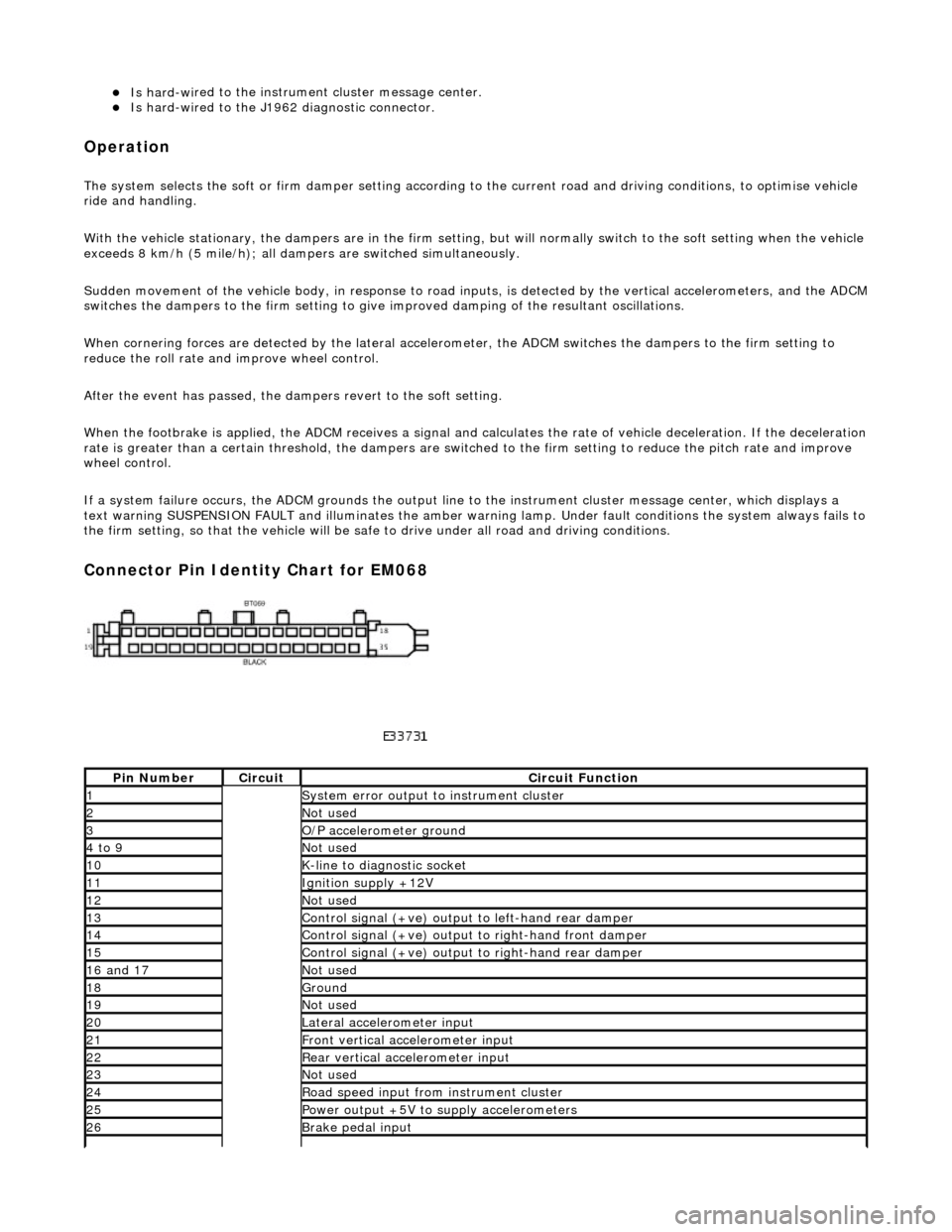
Connector Pin Identity Chart for EM068
Pin
Number
Ci
rcui
t
Circuit Functi
on
1System erro
r output to instrument
cluster
2Not
used
3O/
P a
ccelerometer ground
4 to
9
Not
used
10K-
li
ne to diagnostic socket
11Ignition su
pply +12V
12Not
used
13Control signal (+ve) output
to l
eft-hand rear damper
14Control signal (+ve) output
to right-hand front damp
er
15Control signal (+ve) output
to right-hand rear
damper
16
a
nd 17
No
t
used
18Ground
19No
t
used
20Lateral
accelerometer i
nput
21Front vertical ac
celerometer in
put
22Rear vertical
acce
lerometer input
23No
t
used
24R
o
ad speed input from
instrument cluster
25Power output +5V to suppl y accelerometers
26Brake peda
l input
Page 313 of 2490
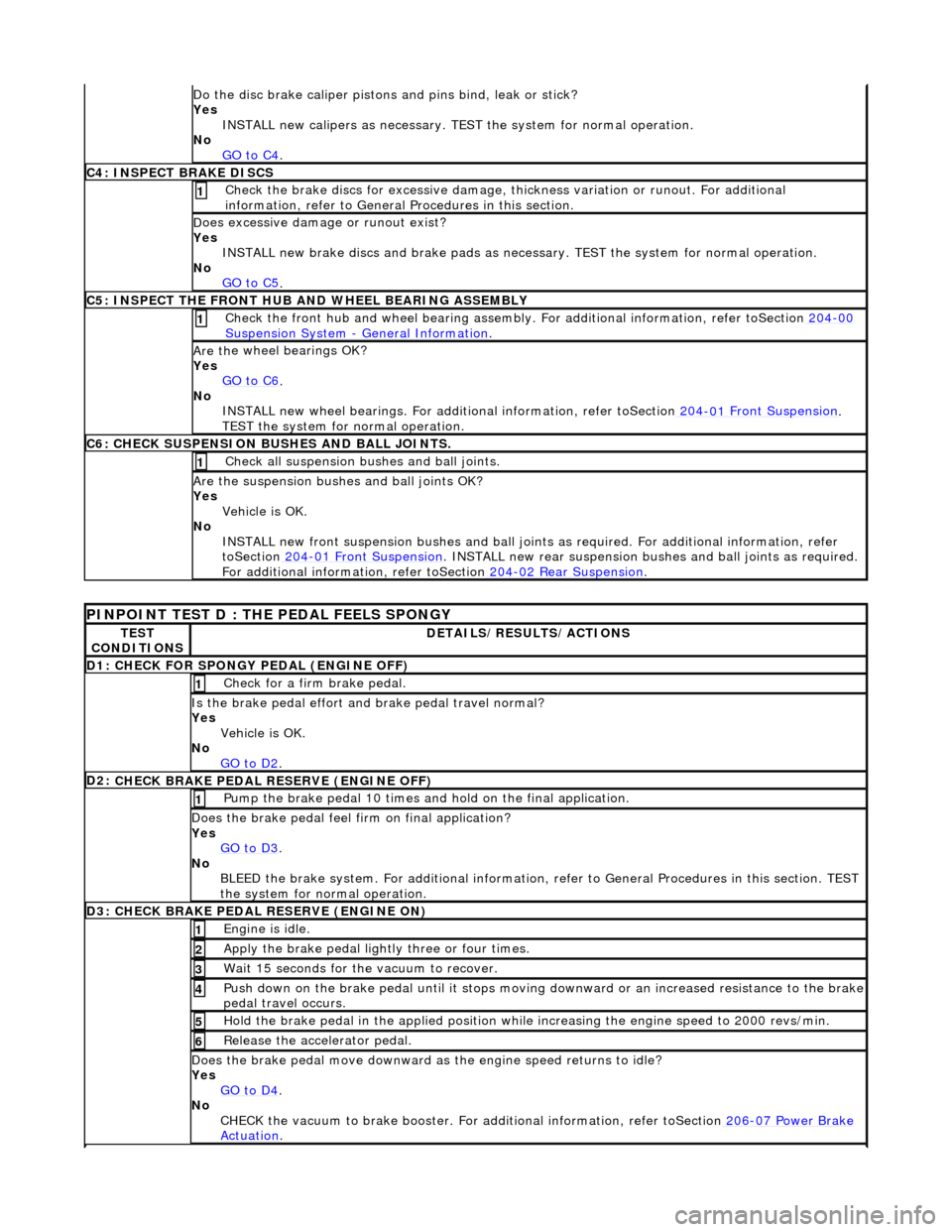
Do t
he disc brake caliper pistons
and pins bind, leak or stick?
Yes INSTALL new calipers as necessary. TE ST the system for normal operation.
No GO to C4
.
C4: INSPECT BR
AKE DISCS
Check the brake discs fo
r excess
ive damage, thickness variatio n or runout. For additional
information, refer to General Procedures in this section.
1
D
oes excessive damage or runout exist?
Yes INSTALL new brake discs and brak e pads as necessary. TEST the system for normal operation.
No GO to C5
.
C5: INSPECT THE FRONT HU
B AND WHEEL BEARING ASSEMBLY
Check the fr
ont hub and wheel bearing assembly.
For additional information, refer toSection 204
-00
Su
spension System
- General
Information
. 1
Are th
e wheel bearings OK?
Yes GO to C6
.
No
INSTALL new wheel bearings. For additional inform ation, refer toSection 204
-01
Front Suspension
.
TEST the system
for normal operation.
C
6: CHECK SUSPENSION BUSHES AND BALL JOINTS.
Chec
k all suspension bu
shes and ball joints.
1
Are th
e suspension bushes and ball joints OK?
Yes Vehicle is OK.
No INSTALL new front suspension bushes and ball joints as required. For additional information, refer
toSection 204
-01
Front Suspension
. INSTALL n
ew rear suspension bush
es and ball joints as required.
For additional informat ion, refer toSection 204
-0
2 Rear Suspension
.
P
INPOINT TEST D : THE PEDAL FEELS SPONGY
TE
ST
CONDITIONS
D
ETAILS/RESULTS/ACTIONS
D
1: CHECK FOR SPONGY PEDAL (ENGINE OFF)
Check f
or a firm brake pedal.
1
Is th
e brake pedal effort an
d brake pedal travel normal?
Yes Vehicle is OK.
No GO to D2
.
D2:
CHECK BRAKE PEDAL RESERVE (ENGINE OFF)
Pump th
e brake pedal 10 times and
hold on the final application.
1
Does th
e brake pedal feel fi
rm on final application?
Yes GO to D3
.
No
BLEED the brake system. For additional information, re fer to General Procedures in this section. TEST
the system for normal operation.
D3:
CHECK BRAKE PEDAL RESERVE (ENGINE ON)
Engine is
idle.
1
Apply the brake pedal ligh
tl
y three or four times.
2
W
ait 15 seconds for the vacuum to recover.
3
Push down on
the brake pedal until it stops moving
downward or an increased resistance to the brake
pedal travel occurs.
4
Hol
d the brake pedal in the applied position while increasing the engine speed to 2000 revs/min.
5
Re
lease the accelerator pedal.
6
Does th
e brake pedal move downward as
the engine speed returns to idle?
Yes GO to D4
.
No
CHECK the vacuum to brake booster. For additional information, refer toSection 206
-0
7 Power Brake
Actuation.
Page 314 of 2490

D4: CHECK
BRAKE FLUID LEVEL
Check the brake master cyli
nd
er reservoir fluid level.
1
Is the fl
ui
d level OK?
Yes BLEED the brake system. For additional information, re fer to General Procedures in this section. TEST
the system for normal operation.
No CHECK brake master cylinder reservoir sealing points. For additional information, refer to Brake
Master Cylinder in this section. ADD fluid and BL EED the brake system. For additional information,
refer to General Procedures in this section. TEST the system for normal operation. REPEAT road test if
necessary.
P I
NPOINT TEST E : THE
PEDAL GOES DOWN FAST
TES
T
CONDITIONS
D E
TAILS/RESULTS/ACTIONS
E1
:
ROAD TEST VEHICLE
Road test and apply th
e brake peda
l.
1
Is th
e brake pedal ef
fort an
d brake pedal travel normal?
Yes Vehicle is OK.
No GO to E2
.
E2: CHECK BRAK
E FLUID LEVEL
Check the brake master cyli
nd
er reservoir fluid level.
1
Is
t
he fluid level within specification?
Yes GO to E3
.
No
CH
ECK the brake master cylinder reservoir sealing po
ints. For additional information, refer to Brake
Master Cylinder Component Test in this section. ADD fluid and BLEED brake system. For additional
information, refer to General Proc edures in this section. TEST the system for normal operation.
REPEAT road test if necessary.
E3 : CHECK BRAK
E PEDAL TRAVEL-PRESSURIZE SYSTEM
Pump th
e brake pedal rapidly (f
ive times).
1
Does th
e brake pedal trav
el build up and then hold?
Yes BLEED the brake system. For additional information, re fer to General Procedures in this section. TEST
the system for normal oper ation. REPEAT road test.
No GO to E4
.
E4: CHECK FOR
BRAKE SYSTEM LEAKS
Chec
k for e
xternal brake system leaks. For additional information, refer to Master Cylinder in this
section.
1
Are le aks foun
d?
Yes REPAIR as necessary, ADD fluid and BLEED brake syst em. For additional information, refer to General
Procedures in this section. TEST the system for normal operation. REPEAT road test.
No System is OK.
PINPOINT TEST
F : THE PEDAL GOES DOWN SLOWLY
TES
T
CONDITIONS
DE
TAILS/RESULTS/ACTIONS
F1
:
ROAD TEST VEHICLE - CHECK BRAKE PEDAL OPERATION
Chec
k
if the condition occurs duri
ng actual stopping application by applying the brake pedal while
the vehicle is moving.
1
Doe s
the condition occur when the vehicle is moving?
Yes GO to F2
.
No
GO to F
3
.
F2:
CHECK
FOR BRAKE SYSTEM LEAKS
Chec
k for e
xternal brake system leaks. For additional information, refer to Master Cylinder in this
section.
1
Page 317 of 2490
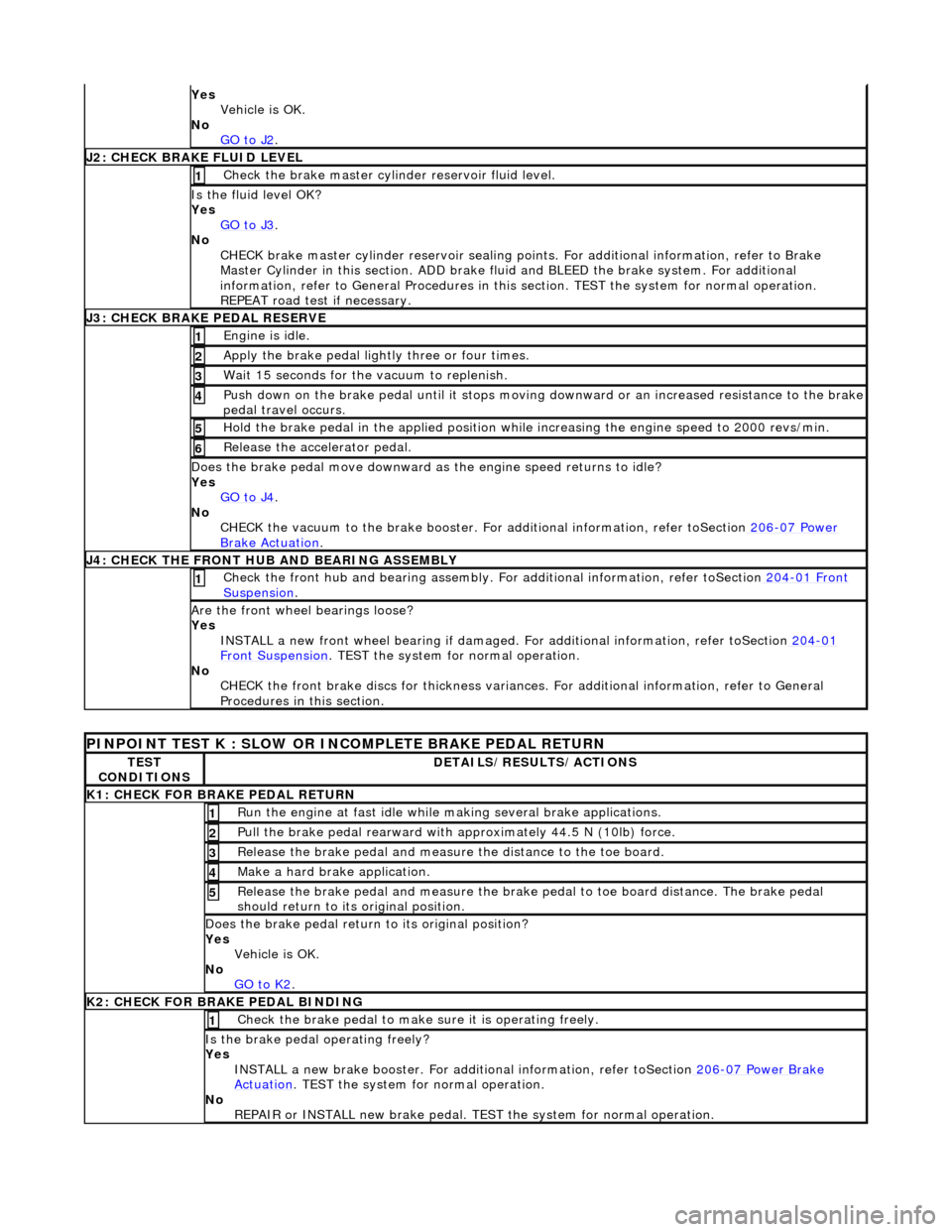
Yes
Vehicle is OK.
No GO to J2
.
J
2: CHECK BRAKE FLUID LEVEL
Check the brake master cyli
nder reservoir fluid level.
1
Is the fl
uid level OK?
Yes GO to J3
.
No
CHECK brake master cylinder reservoir sealing points. For additional information, refer to Brake
Master Cylinder in this section. ADD brake fl uid and BLEED the brake system. For additional
information, refer to General Proc edures in this section. TEST the system for normal operation.
REPEAT road test if necessary.
J
3: CHECK BRAKE PEDAL RESERVE
Engine is
idle.
1
Apply the brake pedal ligh
tl
y three or four times.
2
W
ait 15 seconds for the vacuum to replenish.
3
Push down on
the brake pedal until it stops moving
downward or an increased resistance to the brake
pedal travel occurs.
4
Hol
d the brake pedal in the applied position while increasing the engine speed to 2000 revs/min.
5
Re
lease the accelerator pedal.
6
Does th
e brake pedal move downward as
the engine speed returns to idle?
Yes GO to J4
.
No
CHECK the vacuum to the brake booster. Fo r additional information, refer toSection 206
-0
7 Power
Brake Ac
tuation
.
J
4: CHECK THE FRONT HUB AND BEARING ASSEMBLY
Check the fr
ont hub and bearing assembly. Fo
r additional information, refer toSection 204
-01
Front
Suspe
nsion
. 1
Are th
e front wheel bearings loose?
Yes INSTALL a new front wheel bearin g if damaged. For additional information, refer toSection 204
-01
F
ront Suspension
. TEST
the system for normal operation.
No CHECK the front brake discs for thickness variances. For additional information, refer to General
Procedures in this section.
PINPO
INT TEST K : SLOW OR INCOMPLETE BRAKE PEDAL RETURN
TE
ST
CONDITIONS
D
ETAILS/RESULTS/ACTIONS
K1: C
HECK FOR BRAKE PEDAL RETURN
Ru
n the engine at fast idle while
making several brake applications.
1
Pull the
brake pedal rearward with approximately 44.5 N (10lb) force.
2
Relea
se the brake pedal and measure
the distance to the toe board.
3
Make a hard brake
application.
4
Relea
se the brake pedal and measure the brake
pedal to toe board distance. The brake pedal
should return to its original position.
5
Does th
e brake pedal return
to its original position?
Yes Vehicle is OK.
No GO to K2
.
K
2: CHECK FOR BRAKE PEDAL BINDING
Check the brake pedal to make
s
ure it is operating freely.
1
Is th
e brake pedal operating freely?
Yes INSTALL a new brake booster. For addi tional information, refer toSection 206
-0
7 Power Brake
Actuation. TEST
the system for normal operation.
No REPAIR or INSTALL new brake pedal. TE ST the system for normal operation.
Page 326 of 2490
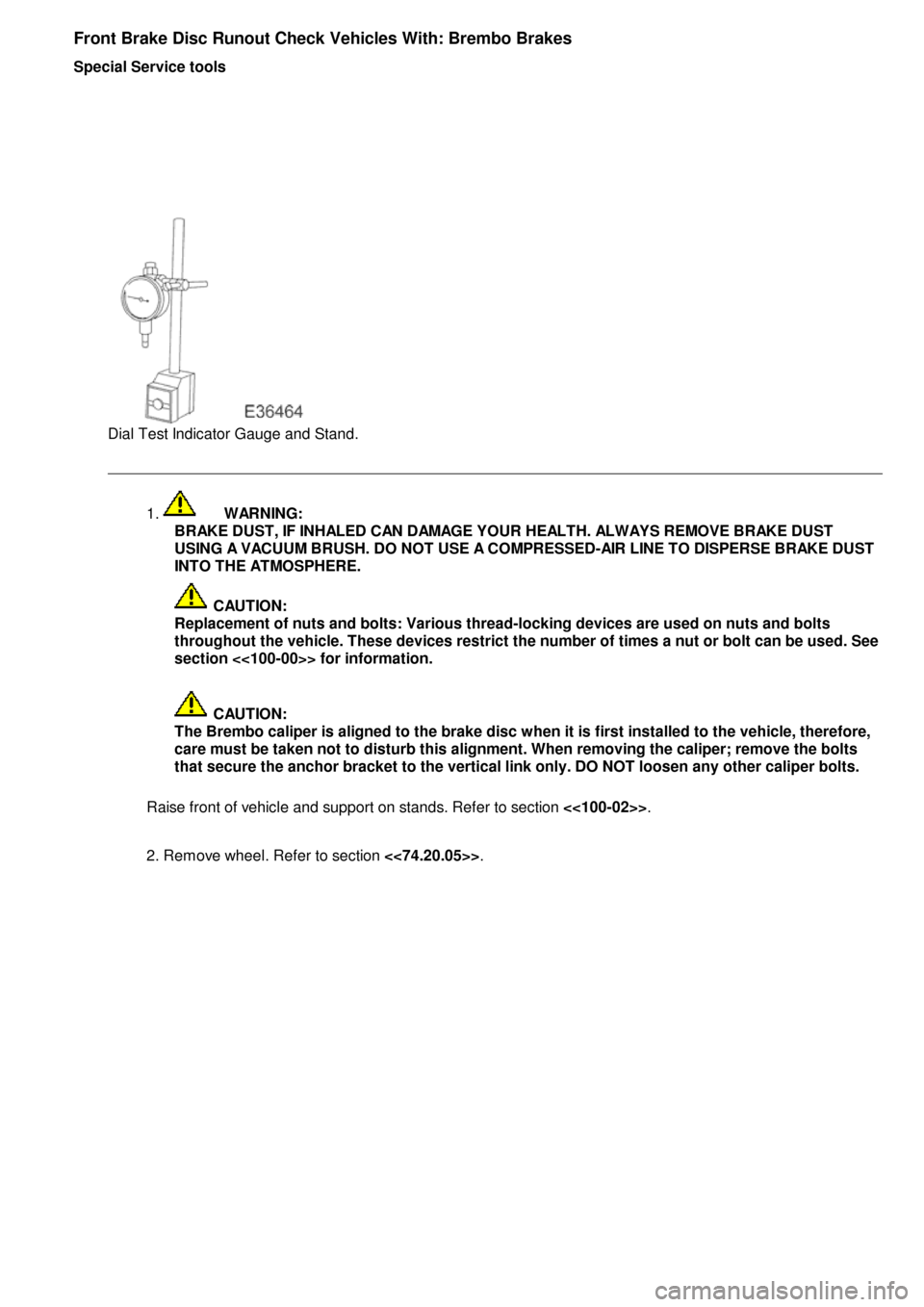
Fr
ont Brake Disc Runout Check Vehicles With: Brembo Brakes
Special Service tools
Di
al Test Indicator Gauge and Stand.
1.
WA
RNING:
BRAKE DUST, IF INHALED CAN DAMAGE YOUR HEALTH. ALWAYS REMOVE BRAKE DUST USING A VACUUM BRUSH. DO NOT USE A COMPRESSED-AIR LINE TO DISPERSE BRAKE DUST
INTO THE ATMOSPHERE.
CA
UTION:
Replacement of nuts and bolts: Various thread-locking devices are used on nuts and bolts
throughout the vehicle. These devices restrict the number of times a nut or bolt can be used. See
section <<100-00>> for information.
CA
UTION:
The Brembo caliper is aligned to the brake disc when it is first installed to the vehicle, therefore,
care must be taken not to disturb this alignment. When removing the caliper; remove the bolts
that secure the anchor bracket to the vertical link only. DO NOT loosen any other caliper bolts.
Raise front of vehicle and support on stands. Refer to section <<100-02>>.
2. Remove wheel. Refer to section <<74.20.05>>.
Page 334 of 2490
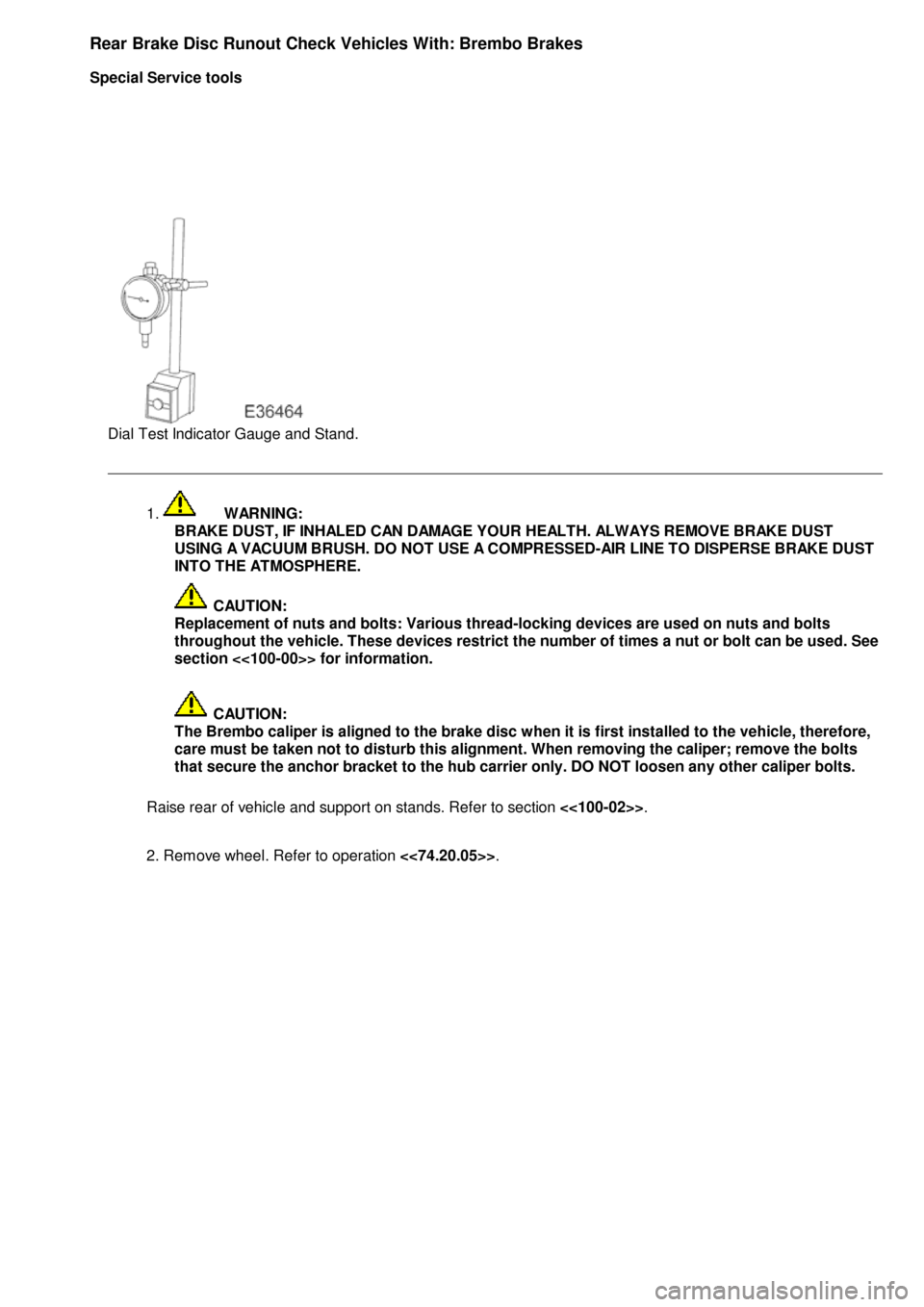
Rear
Brake Disc Runout Check Vehicles With: Brembo Brakes
Special Service tools
Di
al Test Indicator Gauge and Stand.
1.
WA
RNING:
BRAKE DUST, IF INHALED CAN DAMAGE YOUR HEALTH. ALWAYS REMOVE BRAKE DUST USING A VACUUM BRUSH. DO NOT USE A COMPRESSED-AIR LINE TO DISPERSE BRAKE DUST
INTO THE ATMOSPHERE.
CA
UTION:
Replacement of nuts and bolts: Various thread-locking devices are used on nuts and bolts
throughout the vehicle. These devices restrict the number of times a nut or bolt can be used. See
section <<100-00>> for information.
CA
UTION:
The Brembo caliper is aligned to the brake disc when it is first installed to the vehicle, therefore,
care must be taken not to disturb this alignment. When removing the caliper; remove the bolts
that secure the anchor bracket to the hub carrier only. DO NOT loosen any other caliper bolts.
Raise rear of vehicle and support on stands. Refer to section <<100-02>>.
2. Remove wheel. Refer to operation <<74.20.05>>.
Page 347 of 2490

Front Disc Brake - Brake CaliperVehicles With: High Performance Brakes
Re
moval and Installation
Remov
al
S
pecial Tool(s)
Brake Pedal
Hold Tool
JDS 9013
1. WARNING: BRAKE DUST, IF INHALED CAN DAMAGE
YOUR HEALTH. ALWAYS REMOVE BRAKE DUST USING A VACUUM
BRUSH. DO NOT USE A COMPRE SSED-AIR LINE TO DISPERSE
BRAKE DUST INTO THE ATMOSPHERE.
• CAUTIONS:
Replacement of nuts and bolts: Various thread-locking
devices are used on nuts and bolts throughout the vehicle. These
devices restrict the number of ti mes a nut or bolt can be used.
See section 100-00 for information.
Remove brake fluid spillage immediately from paint work,
with clean water.
The Brembo caliper is aligned to the brake disc when it is
first installed to the vehicle, therefore, care must be taken not to
disturb this alignment. When removing the caliper; remove the
bolts that secure the anchor bracket to the vertical link only. DO
NOT loosen any other caliper bolts.
Open engine compartment and fit paint work protection covers
to fenders.
2. R
aise vehicle on a four-post lift.
3. Raise front of vehicle and support on stands. Refer to Section
100-02.
4. Remove front wheels. Refe r to operation 74.20.05.
5. NOTE
: The following three pictorial procedures must be
carried-out to minimize brake fl uid loss when disconnecting the
brake hose.
Open Left-Hand-Front and Left-H and-Rear caliper bleed nipples.
Connect
a bleed tube and co
ntainer to the calipers.
O
pen bleed nipples.
6. Depress and hold down brak e pedal at the specified
measurement using the special tool.
Page 355 of 2490
Front Dis
c Brake - Brake DiscVehicles With: High Performance Brakes
Re
moval and Installation
Remov
al
1.
WAR
NINGS:
BRAKE DISCS MUST ALWAYS BE REPLACED IN PAIRS.
BRAKE DUST, IF INHALED CAN DAMAGE YOUR HEALTH.
ALWAYS REMOVE BRAKE DUST USING A VACUUM BRUSH. DO
NOT USE A COMPRESSED-AIR LINE TO DISPERSE BRAKE DUST
INTO THE ATMOSPHERE.
• CAUTIONS:
Replacement of nuts and bolts: Various thread-locking
devices are used on nuts and bolts throughout the vehicle. These
devices restrict the number of ti mes a nut or bolt can be used.
See section 100-00 for information.
The Brembo caliper is aligned to the brake disc when it is
first installed to the vehicle, therefore, care must be taken not to
disturb this alignment. When removing the caliper; remove the
bolts that secure the anchor bracket to the vertical link only. DO
NOT loosen any other caliper bolts.
The front brake discs are dire ctional and must be installed
to the correct side of the vehi cle. Refer to Description and
Operation, section 206-03 for further information.
Do not loosen bolts securing brake disc to disc mounting.
Open engine compartment and in stall paint work protection
covers to fenders.
2. R
aise front of vehicle and suppo
rt on stands. See Section 100-
02.
3. Remove front wheels. Refe r to operation 74.20.05.
4. CAUTI
ON: Remove brake flui
d spillage immediately from
paint work, with clean water.
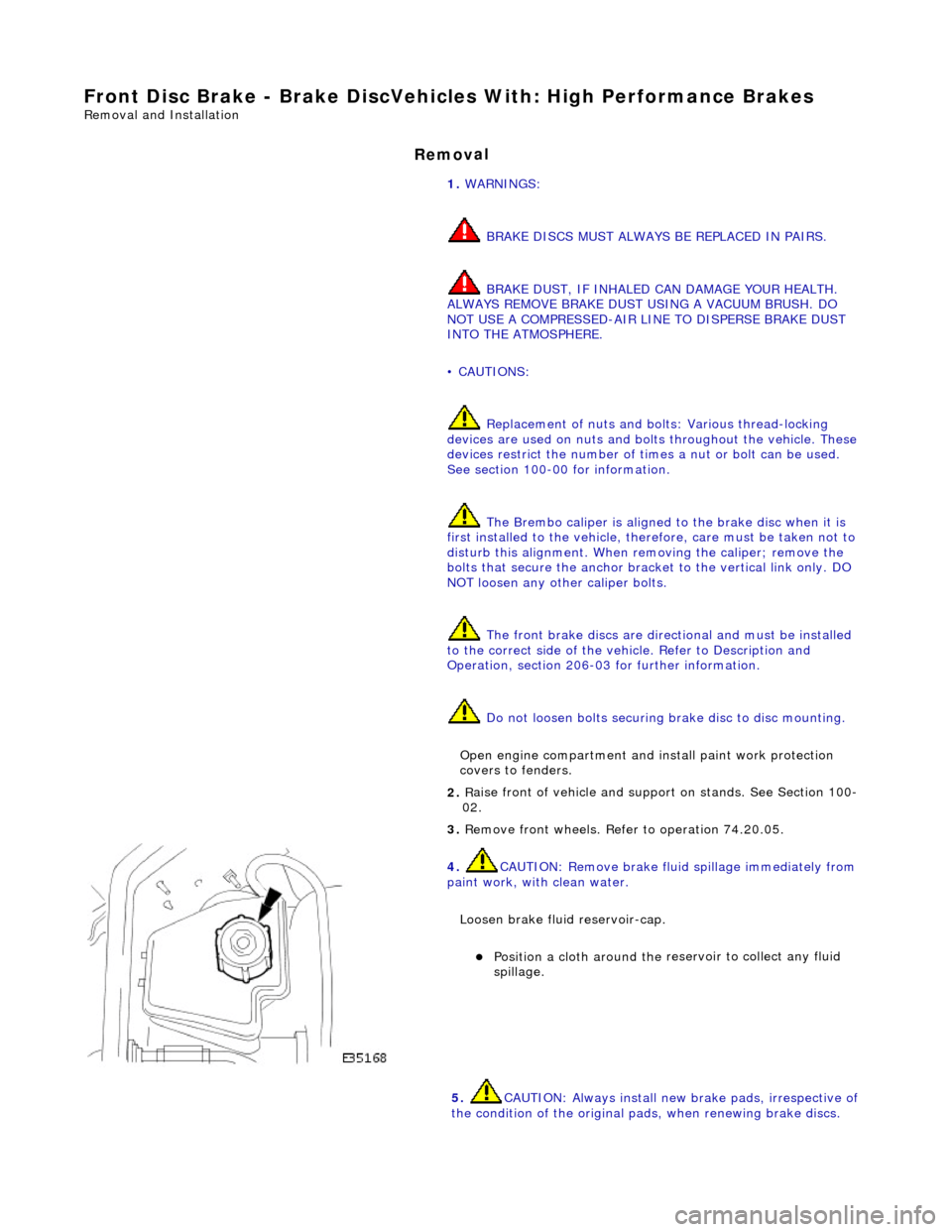
Loosen brake fluid reservoir-cap.
Position a cloth around the
reservoir to collect any fluid
spillage.
5. CAUTI
ON: Always install new brake pads, irrespective of
the condition of the original pads, when renewing brake discs.