Fuel JAGUAR XFR 2010 1.G User Guide
[x] Cancel search | Manufacturer: JAGUAR, Model Year: 2010, Model line: XFR, Model: JAGUAR XFR 2010 1.GPages: 3039, PDF Size: 58.49 MB
Page 54 of 3039

Hydrofluorocarbon HFC High tension HT Hydrocarbon HC Idle Air Control IAC
Stepper motor driven device which varies the volume of air by-passing the
throttle to maintain the programmed idle speed Intake Air Temperature IAT Temperature of intake air Inertia Fuel Shut-off IFS
An inertia system that shuts off the fuel supply when activated by pre-determined force limits brought about by (e.g.) collision Input Shaft Speed ISS Indicates input shaft speed Key On, Engine Off KOEO Key On, Engine Running KOER Kilogram (mass) kg Kilogram (force) kgf Kilogram force per square
centimeter kgf/cm²
Kilometer km Kilometer per hour km/h Kilopascal kPa Kilovolt kV Knock Sensor KS
Sensor which detects the onset of detonation, and signals the ECM to
retard the ignition Liquid Crystal Display LCD
Optical digital display system, to which applied voltage varies the way the crystals reflect light, thereby modifying the display Lighting Control Module LCM Light Emitting Diode LED Low Tension LT
Primary circuit of the ignition system, linking the battery to the primary winding in the ignition coil Left-Hand LH Left-Hand Drive LHD Mass Air Flow MAF
System which provides information on the mass flow rate of the intake air
to the engine Manifold Absolute Pressure MAP Absolute pressure of the intake manifold air Manifold Absolute Pressure and Temperature MAPT
Malfunction Indicator Lamp MIL
A required on-board indicator to alert the driver of an emission related
malfunction Meter (measurement) m Metric (screw thread, e.g. M8) M Farad F Unit of electrical capacitance Millimeter mm Millimeter of mercury mmHg Millisecond ms Model year MY Newton N SI unit of force. 1 N = 0.2248 pounds force Newton Meter Nm SI unit of torque. Must not be confused with nm (nanometer) Negative Temperature
Coefficient NTC
Naturally aspirated N/A
Fuelling system using intake air at atmospheric pressure; not supercharged or turbocharged Noise, Vibration and Harshness NVH North American Specification NAS Vehicles for sale in the USA and Canadian markets On-Board Diagnostic OBD
A system that monitors some or all computer input and output control
signals. Signal(s) outside the pre-determined limits imply a fault in the system or a related system Oxides of Nitrogen Nox Oxygen Sensor O2S A sensor which detects oxygen content in the exhaust gases On-board Refuelling Vapour Recovery ORVR
Output State Control OSC Output Shaft Speed OSS Passenger Air Bag Deactivation PAD Pulsed Secondary Air Injection PAIR Passive Anti-Theft System PATS Positive Crankcase Ventilation PCV Parameter Identification PID
An index number referring to a parameter within a module without knowledge of its storage location Park/Neutral Position PNP Pulse Width Modulation PWM Programmable Electronic
Control Units System PECUS
Process whereby a common ECM is programmed on the production line to
suit the market requirements of a particular vehicle
Page 60 of 3039

Have a suitable fire extinguisher available when using welding or heating equipment.
First Aid
Apart from meeting any legal requirements it is desirable for someone in the workshop to be trained in First Aid procedures.
Splashes in the eye should be flushed carefully with clean water for at least ten minutes.
Soiled skin should be washed with soap and water.
Individuals affected by inhalation of gases, fumes etc. should be removed to fresh air immediately. If effects persist, consult a
doctor.
If liquids are swallowed inadvertently, consult a doctor giving the information on the container or label. Do not induce vomiting
unless this action is indicated on the label.
Fluoroelastomer
See Viton.
Foams - Polyurethane
See also Fire.
Used in sound and noise insulation. Cured foams used in seat and trim cushioning.
Follow manufacturer's instructions.
Unreacted components are irritating and may be harmful to the skin and eyes. Wear gloves and goggles.
Individuals with chronic respiratory diseases, asthma, bronchial medical problems, or histories of allergic diseases should not
work in or near uncured materials.
The components, vapors or spray mists can cause direct irritation, sensitivity reactions and may be toxic or harmful.
Vapors and spray mists must not be inhaled. These materials must be applied with adequate ventilation and respiratory
protection. Do not remove the respirator immediately after spraying, wait until the vapor/mists have cleared.
Burning of the uncured components and the cured foams can generate toxic and harmful fumes. Smoking, naked flames or the
use of electrical equipment during foaming operations and until vapors/mists have cleared should not be allowed. Any heat
cutting of cured foams or partially cured foams should be conducted with extraction ventilation.
Freon
See Air Conditioning Refrigerant.
Fuels
See also, Fire, Legal Aspects, Chemicals and Solvents.
Avoid skin contact with fuel where possible. Should contact occur, wash the affected skin with soap and water.
Gasoline (Petrol)
Highly flammable - observe No Smoking policy.
Swallowing can result in mouth and throat irritation and absorption from the stomach can result in drowsiness and
unconsciousness. Small amounts can be fatal to children. Aspiration of liquid into the lungs e.g. through vomiting, is a very
serious hazard.
Gasoline dries the skin and can cause irritation and dermatitis on prolonged or repeated contact. Liquid in the eye causes
severe pain.
Motor gasoline may contain appreciable quantities of benzene, which is toxic upon inhalation, and the concentration of
gasoline vapors must be kept very low. High concentrations will cause eye, nose and throat irritation, nausea, headache,
depression and symptoms of drunkenness. Very high concentrations will result in rapid loss of consciousness.
Ensure there is adequate ventilation when handling and using gasoline. Great care must be taken to avoid the serious
consequences of inhalation in the event of vapor build up arising from spillages in confined spaces.
Special precautions apply to cleaning and maintenance operations on gasoline storage tanks.
Gasoline should not be used as a cleaning agent. It must not be siphoned by mouth. See First Aid.
Gas - oil (Diesel Fuel)
See warnings and cautions in relevant manual sections.
Combustible.
www.JagDocs.com
Page 63 of 3039

Highly flammable, flammable - observe No Smoking policy
Pressurized Equipment
See High Pressure Air, Lubrication and Oil Test Equipment.
Solder
Solders are a mixture of metals such that the melting point of the mixture is below that of the constituent metals (normally
lead and tin). Solder application does not normally give rise to toxic lead fumes, provided a gas/air flame is used.
Oxy-acetylene flames should not be used, as they are much hotter and will cause lead fumes to be produced.
Some fumes may be produced by the application of any flame to surfaces coated with grease etc. and inhalation of these
should be avoided.
Removal of excess solder should be undertaken with care, to make sure that fine lead dust is not produced, which can give
toxic effects if inhaled. Respiratory protection may be necessary.
Solder spillage and filings should be collected and removed promptly to prevent general air contamination by lead.
High standards of personal hygiene are necessary in order to avoid ingestion of lead or inhalation of solder dust from clothing.
Solvents
See also Chemical Materials, Fuels (Kerosene), Fire.
e.g. acetone, white spirit, toluene, xylene, trichloroethane.
Used in cleaning and de-waxing materials, paints, plastics, resins, thinners etc.
Some may be highly flammable or flammable.
Skin contact will degrease the skin and may result in irritation and dermatitis following repeated or prolonged contact. Some
can be absorbed through the skin in toxic or harmful quantities.
Splashes in the eye may cause severe irritation and could lead to loss of vision.
Brief exposure to high concentrations of vapors or mists will cause eye and throat irritation, drowsiness, dizziness, headaches
and, in the worst circumstances, unconsciousness.
Repeated or prolonged exposure to excessive but lower concentrations of vapors or mists, for which there might not be
adequate warning indications, can cause more serious toxic or harmful effects.
Aspiration into the lungs (e.g. through vomiting) is the most serious consequence of swallowing.
Avoid splashes to the skin, eyes and clothing. Wear protective gloves, goggles and clothing if necessary.
Ensure good ventilation when in use, avoid breathing fumes, vapors and spray mists and keep containers tightly sealed. Do not
use in confined spaces.
When spraying materials containing solvents, e.g. paints, adhesive, coatings, use extraction ventilation or personal respiratory
protection in the absence of adequate general ventilation.
Do not apply heat or flame except under specific and detailed manufacturer's instructions.
Sound Insulation
See Fibre Insulation, Foams.
Suspended Loads
CAUTION: Never improvise lifting tackle.
There is always a danger when loads are lifted or suspended. Never work under an unsupported, suspended or raised load e.g.
suspended engine, etc.
Always make sure that lifting equipment such as jacks, hoists, axle stands, slings, etc., are adequate and suitable for the job,
in good condition and regularly maintained.
Transmission Brake Bands
See Asbestos.
Underseal
See Corrosion Protection.
Page 64 of 3039

Viton
In common with many other manufacturers' vehicles, some components installed to the Jaguar range have 'O' rings, seals or
gaskets which contain a material known as 'Viton'.
Viton is a fluoroelastomer, that is a synthetic rubber type which contains Fluorine. It is commonly used for 'O' rings, gaskets
and seals of all types. Although Viton is the most well known fluoroelastomer, there are others, including Fluorel and
Tecmoflon.
When used under design conditions fluoroelastomers are perfectly safe. If, however, they are exposed to temperatures in
excess of 400º C, the material will not burn, but will decompose, and one of the products formed is hydrofluoric acid.
This acid is extremely corrosive and may be absorbed directly, through contact, into the body.
'O' rings, seals or gaskets which have been exposed to very high temperatures will appear charred or as a black sticky
substance.
DO NOT, under any circumstances touch them or the attached components.
Enquiries should be made to determine whether Viton or any other fluoroelastomer has been used in the affected 'O' ring, seal
or gasket. If they are of natural rubber or nitrile there is no hazard. If in doubt, be cautious and assume that the material may
be Viton or any fluoroelastomer.
If Viton or any other fluoroelastomers have been used, the affected area should be decontaminated before the commencement
of work.
Disposable heavy duty plastic gloves should be worn at all times, and the affected area washed down using wire wool and a
limewater (calcium hydroxide) solution to neutralize the acid before disposing of the decomposed Viton residue and final
cleaning of the area. After use, the plastic gloves should be discarded carefully and safely.
Welding
See also Fire, Electric Shock, Gas Cylinders.
Welding processes include Resistance Welding (Spot Welding), Arc Welding and Gas Welding (and cutting).
Resistance Welding (Spot Welding)
This process may cause particles of molten metal to be emitted at a high velocity, and the eyes and skin must be protected.
Arc Welding
This process emits a high level of ultraviolet radiation which may cause arc-eye and skin burns to the operator and to other
persons nearby. Gas-shielded welding processes are particularly hazardous in this respect. Personal protection must be worn,
and screens used to shield other people.
CONTACT LENS WEARERS ARE ADVISED TO REVERT TO ORDINARY SPECTACLES WHEN ARC WELDING as the arc spectrum is
believed to emit microwaves which dry out the fluid between the lens and the eye. This may result in blindness when the lens
is removed from the eye.
Metal spatter will also occur, and appropriate eye and skin protection is necessary.
The heat of the welding arc will produce fumes and gases from the metals being welded, the rods and from any applied
coatings or contamination on the surfaces being worked on. These gases and fumes may be toxic and inhalation of these
should be avoided. The use of extraction ventilation to remove the fumes from the working area may be necessary particularly
in cases where the general ventilation is poor, or where considerable welding work is anticipated. In extreme cases or confined
spaces where adequate ventilation cannot be provided, air-fed respirators may be necessary.
Gas Welding (and Cutting)
Oxy-acetylene torches may be used for welding and cutting, and special care must be taken to prevent leakage of these gases,
with consequent risk of fire and explosion.
The process will produce metal spatter and eye and skin protection is necessary.
The flame is bright, and eye protection should be used, but the ultraviolet emission is much less than that from arc welding,
and lighter filters may be used.
The process itself produces few toxic fumes, but such fumes and gases may be produced from coatings on the work,
particularly during cutting away of damaged body parts, and inhalation of the fumes should be avoided.
In brazing, toxic fumes may be produced from the metals in the brazing rod, and a severe hazard may arise if brazing rods
containing cadmium are used. In this event particular care must be taken to avoid inhalation of fumes and expert advice may
be required.
SPECIAL PRECAUTIONS MUST BE TAKEN BEFORE ANY WELDING OR CUTTING TAKES PLACE ON VESSELS WHICH HAVE
CONTAINED COMBUSTIBLE MATERIALS, E.G. BOILING OR STEAMING OUT OF FUEL TANKS.
Warning Symbols on Vehicles
Decals showing warning symbols will be found on various vehicle components.
Page 66 of 3039
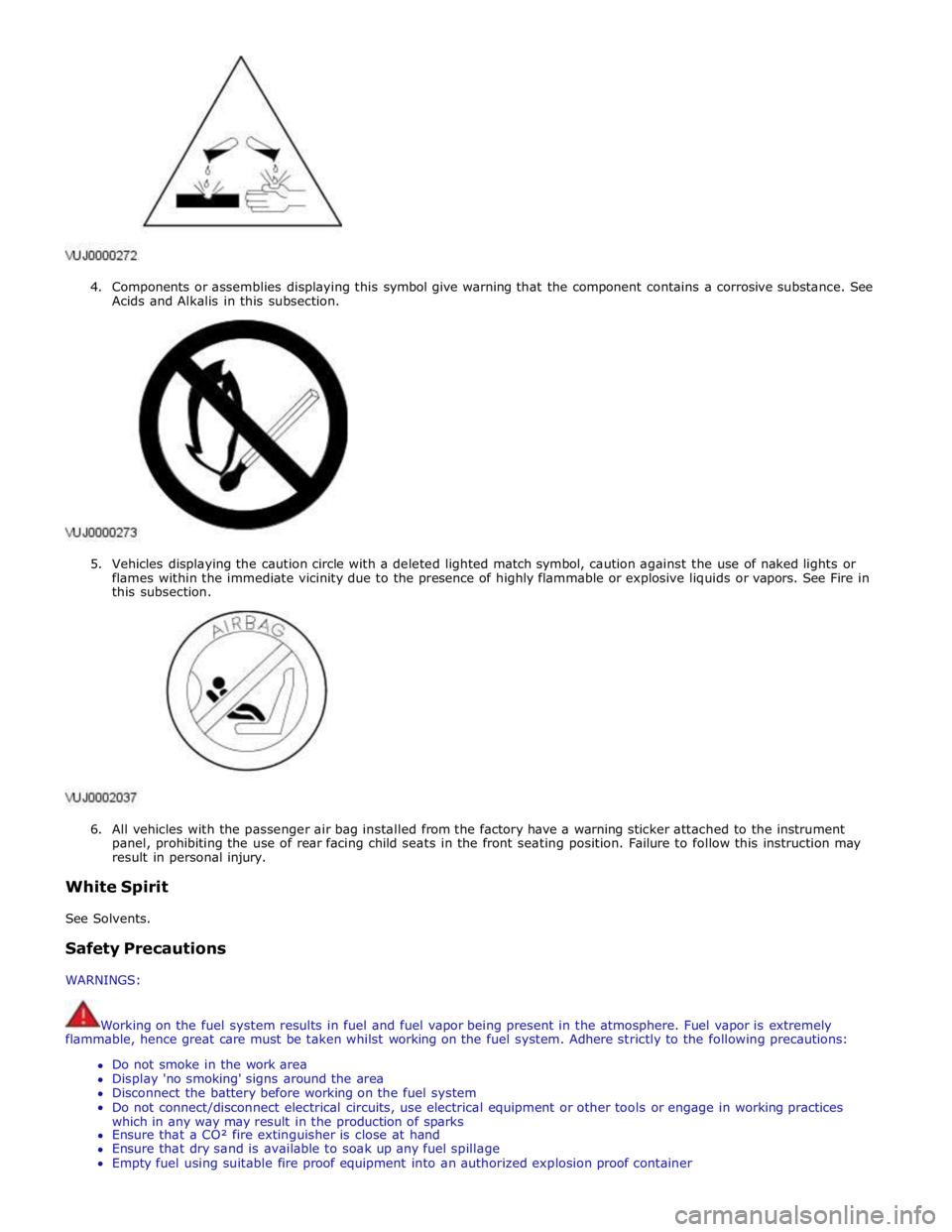
4. Components or assemblies displaying this symbol give warning that the component contains a corrosive substance. See
Acids and Alkalis in this subsection.
5. Vehicles displaying the caution circle with a deleted lighted match symbol, caution against the use of naked lights or
flames within the immediate vicinity due to the presence of highly flammable or explosive liquids or vapors. See Fire in
this subsection.
6. All vehicles with the passenger air bag installed from the factory have a warning sticker attached to the instrument
panel, prohibiting the use of rear facing child seats in the front seating position. Failure to follow this instruction may
result in personal injury.
White Spirit
See Solvents.
Safety Precautions
WARNINGS:
Working on the fuel system results in fuel and fuel vapor being present in the atmosphere. Fuel vapor is extremely
flammable, hence great care must be taken whilst working on the fuel system. Adhere strictly to the following precautions:
Do not smoke in the work area
Display 'no smoking' signs around the area
Disconnect the battery before working on the fuel system
Do not connect/disconnect electrical circuits, use electrical equipment or other tools or engage in working practices
which in any way may result in the production of sparks
Ensure that a CO² fire extinguisher is close at hand
Ensure that dry sand is available to soak up any fuel spillage
Empty fuel using suitable fire proof equipment into an authorized explosion proof container
Page 67 of 3039

Do not empty fuel while working in a workshop or a pit
Ensure that working area is well ventilated
Ensure that any work on the fuel system is only carried out by experienced and well qualified maintenance personnel
Ensure that fume extraction equipment is used where appropriate
Fume extraction equipment must be in operation when solvents are used e.g. Trichloroethane, white spirit, sbp3,
methylene chloride, perchlorethylene. Do not smoke in the vicinity of volatile degreasing agents.
Whenever possible, use a ramp or pit whilst working beneath a vehicle, in preference to jacking. Position chocks at the wheels
as well as applying the parking brake. Never rely on a jack alone to support a vehicle. Use axle stands, or blocks carefully
placed at the jacking points, to provide a rigid location. Check that any lifting equipment used has adequate capacity and is
fully serviceable. Ensure that a suitable form of fire extinguisher is conveniently located. When using electrical tools and
equipment, inspect the power lead for damage and check that it is properly earthed. Disconnect the earth (grounded) terminal
of the vehicle battery. Do not disconnect any pipes of the air conditioning refrigeration system unless you are trained and
instructed to do so. A refrigerant is used which can cause blindness if allowed to come into contact with the eyes. Ensure that
adequate ventilation is provided when volatile degreasing agents are being used.
Adhere strictly to handling and safety instructions given on containers and labels. Keep oils and solvents away from naked
flames and other sources of ignition. Do not apply heat in an attempt to free seized nuts or fittings; as well as causing
damage to protective coatings, there is a risk of damage from stray heat to electronic equipment and brake lines. Do not leave
tools, equipment, spilt oil etc. around the work area. Wear protective overalls and use barrier cream when necessary.
Environmental Protection
In some countries it is illegal to pour used oil onto the ground, down sewers or drains, or into water courses. The burning of
used engine oil in small space heaters or boilers is not recommended unless emission control equipment is installed. Dispose
of used oil through authorized waste disposal contractors, to licensed waste disposal sites or to the waste oil reclamation
trade. If in doubt, contact the Local Authority for advice on disposal facilities.
Page 70 of 3039
Published: 11-May-2011
General Information - Petrol and Petrol-Ethanol Fuel Systems Health and
Safety Precautions
Description and Operation
WARNINGS:
Fuel may not give adequate warning before toxic or harmful effects arise.
Exposure to fuel can be harmful and can cause severe health damage or death.
Extreme care must be exercised when handling hot fluids. Always wash off spilled fluids from affected areas of skin
immediately.
Highly flammable mixtures are always present and may ignite when working on fuel systems. Do not allow naked flames,
sparks or lighted substances to come near fuel related components.
Fuel must not be used as a cleaning agent.
Keep fuel containers tightly closed, out of direct sunlight and in a cool area. Keep away from heat sources, ignition
sources and oxidizing agents.
SKIN CONTACT: Excessive or prolonged skin contact with diesel fuel may cause serious skin disorders including skin
cancer.
SKIN CONTACT: Fuel is mildly irritating to the skin and may cause dermatitis due to defatting effect. Remove
contaminated clothing. Wash affected areas of skin with soap and water. Seek medical attention for any persistent skin
irritation or abnormality. Wash contaminated clothing before reuse.
EYE CONTACT: Fuel is mildly irritating to the eyes. Flush with plenty of running water, blinking as often as possible. Do
not force the eyelid open. Seek medical attention for any persistent eye irritation or abnormality.
SWALLOWED: Fuel is moderately toxic and tends to foam on vomiting. If drawn into the lungs, inflammation may
develop. Do not induce vomiting. If spontaneous vomiting occurs place the victim in a forward position to reduce the risk of
fuel being drawn into the lungs. Give nothing by mouth. If breathing but unconscious, place in the recovery position. If
breathing has stopped, apply artificial respiration. Seek immediate medical attention.
INHALED: Fuel is toxic to the respiratory and other body systems. Exposure may result in various symptoms including
drowsiness, unconsciousness or severe health damage. Move a victim to fresh air. Keep a victim warm and at rest. If
unconscious, place in the recovery position. If not breathing, apply artificial respiration. Give cardiac massage if necessary.
Seek immediate medical attention.
CAUTIONS:
Fuel injection equipment is manufactured to very precise tolerances and fine clearances. It is essential that absolute
cleanliness is observed when working with these components.
Make sure that the workshop area in which the vehicle is being worked on is as clean and as dust free as possible.
www.JagDocs.com
Page 103 of 3039
General Information - Road/Roller Testing
Description and Operation Published: 11-May-2011
Road or roller testing may be carried out for various reasons and a procedure detailing pre-test checks, through engine starting
and stopping, pre-driving checks, on-test checks to final checks on completion of the test is given in this section.
Unless complete vehicle performance is being checked, the full road test procedure need not be carried out. Instead, those
items particularly relevant to the system/s being checked can be extracted.
Pre - Test Checks
WARNING: If the brake system hydraulic fluid level is low, pedal travel is excessive or a hydraulic leak is found, do not
attempt to road test the vehicle until the reason for the low fluid level, excessive pedal travel or hydraulic leak is found and
rectified.
It is suggested that pre-test checks, and functional tests of those systems/circuits which affect the safe and legal operations
of the vehicle, such as brakes, lights and steering, should always be carried out before the road or roller test.
Engine oil level
Engine coolant level
Tires, for correct pressure, compatible types and tread patterns, and wear within limits
There is sufficient fuel in the tank to complete the test
All around the engine, transmission and under the vehicle for oil, coolant, hydraulic and fuel leaks. Make a note of any
apparent leaks and wipe off the surrounding areas to make it easier to identify the extent of the leak on completion of
the test
Starting the Engine
CAUTION: On initial drive away from cold and within the first 1.5 km (1 mile), do not depress accelerator pedal beyond
half travel until the vehicle has attained a minimum speed of 25 km/h (15 miles/h). Never operate at high engine speed or
with the accelerator pedal at full travel whilst the engine is cold.
With the ignition switched off, check:
The parking brake is applied
The transmission selector lever is in Park
All instrument gauges (except fuel gauge) read zero
With the ignition switched on, check:
Ignition controlled warning lamps come on
Engine coolant temperature gauge registers a reading compatible with the engine coolant temperature
Fuel gauge registers a reading appropriate to the fuel level in the tank
The operation of the parking brake and brake fluid level warning lamps
On Road or Roller Test Check:
CAUTION: If road testing, check the brake operation while still travelling at low speed before continuing with the test. If
the brakes pull to one side, or appear to be otherwise faulty, do not continue with the road test until the fault has been found
and rectified.
Initial gear engagement is smooth
Parking brake control operates smoothly and the parking brake releases quickly and completely
Transmission takes up the drive smoothly, without judder
The engine power output is satisfactory, full power is achieved, acceleration is smooth and pedal operation not stiff or
heavy, and engine speed returns to idle correctly
There is no excessive or abnormally colored smoke from the engine under normal driving, heavy load or overrun
conditions
Steering operation, including power steering, is smooth, accurate, not excessively heavy or with excessive free play or
vibration. Does not pull to one side and self centres smoothly after cornering
Speedometer, oil pressure warning lamp, coolant temperature gauge and tachometer register the correct readings or
operate correctly
Switches and controls operate smoothly and positively, warning lamps operate correctly and the direction indicator
control self cancels when the steering is returned to the straight ahead position
Heating and ventilation systems work correctly and effectively
Brake operation and efficiency
Brake Testing
WARNING: When brake testing, avoid breathing the smoke or fumes from hot brakes, this may contain asbestos dust
which is hazardous to health, see Health and Safety Precautions.
Page 104 of 3039

Avoid brake testing on busy roads where it can cause inconvenience or danger to other road users.
CAUTION: Brake testing which includes heavy brake applications should not be carried out with new brake pads/discs or
linings/drums until the components have bedded-in. New brake friction components will not reach full efficiency until the
bedding-in process is complete.
Test the brakes at several speeds within the normal operating range using both light and heavy pedal pressure. Note any
tendency to snatch, pull or drag, and any undue delay in application or release.
Allow the vehicle to coast and note any tendency to pull to one side, or evidence that the brakes are binding.
After stopping the vehicle (not immediately after a period of heavy braking), carefully check the brake temperature. A disc
which feels hot, or appreciably hotter than the others, indicates that the brake is binding.
After completion of the test, check for:
Oil, coolant, hydraulic, air and fuel leaks
Abnormal temperature of any moving components or assemblies, e.g. wheel hubs, transmission, axle etc., which might
indicate over tightness or lack of lubrication
Page 164 of 3039
Published: 18-Apr-2014
General Information - Diagnostic Trouble Code (DTC) Index V8 S/C 5.0L
Petrol, DTC: Engine Control Module (ECM)
Description and Operation
Engine Control Module (PCM) 5.0L SC V8 - AJ133
WARNING: Fuel injector voltage will reach 65 Volts during operation and have a high current requirement.
CAUTION: Diagnosis by substitution from a donor vehicle is NOT acceptable. Substitution of control modules does not
guarantee confirmation of a fault, and may also cause additional faults in the vehicle being tested and/or the donor vehicle
NOTES:
If the control module or a component is suspect and the vehicle remains under manufacturer warranty, refer to the
Warranty Policy and Procedures manual, or determine if any prior approval programme is in operation, prior to the installation
of a new module/component.
Generic scan tools may not read the codes listed, or may read only five digit codes. Match the five digits from the scan
tool to the first five digits of the seven digit code listed to identify the fault (the last two digits give additional information
read by the manufacturer-approved diagnostic system).
When performing electrical voltage or resistance tests, always use a digital multimeter (DMM) accurate to three decimal
places, and with an up-to-date calibration certificate. When testing resistance, always take the resistance of the DMM leads
into account.
Check and rectify basic faults before beginning diagnostic routines involving pinpoint tests.
If DTCs are recorded and, after performing the pinpoint tests, a fault is not present, an intermittent concern may be the
cause. Always check for loose connections and corroded terminals.
Check DDW for open campaigns. Refer to the corresponding bulletins and SSMs which may be valid for the specific
customer complaint and carry out the recommendations as required.
The table below lists all diagnostic trouble codes (DTCs) that could be logged in the electronic engine control module, for
additional diagnosis and testing information refer to the relevant diagnosis and testing section.
For additional information, refer to: Electronic Engine Controls (303-14 Electronic Engine Controls - V8 S/C 5.0L Petrol,
Diagnosis and Testing).
DTC Description Possible Causes Action B10A2-31 Crash Input - No signal
NOTE: - Circuit SRS_SIGNAL -
Loss of communication between
restraints control module and
engine control module
Refer to the electrical circuit
diagrams and check restraints
control module pulse width
modulated SRS signal line circuit,
hard wired connection between
engine control module and restraints
control module for short circuit to
ground, short circuit to power, open
circuit. Repair circuit as required,
clear the DTC and retest B10AC-81
Cruise Control Switch -
Invalid serial data received
The engine control module has
received an invalid command from
the steering wheel switch pack
Clear the DTC and press all the
steering wheel switches, re-check for
DTCs. Refer to the electrical circuit
diagrams and check the speed
control switch circuit for open circuit,
short circuit to power, short circuit to
ground, disconnected
Check and install a new steering
wheel module as required. Refer to
the warranty policy and procedures
manual, or determine if any prior
approval programme is in operation,
prior to the installation of a new