lock JAGUAR XJ6 1994 2.G Owners Manual
[x] Cancel search | Manufacturer: JAGUAR, Model Year: 1994, Model line: XJ6, Model: JAGUAR XJ6 1994 2.GPages: 521, PDF Size: 17.35 MB
Page 330 of 521
Climate Control Systems
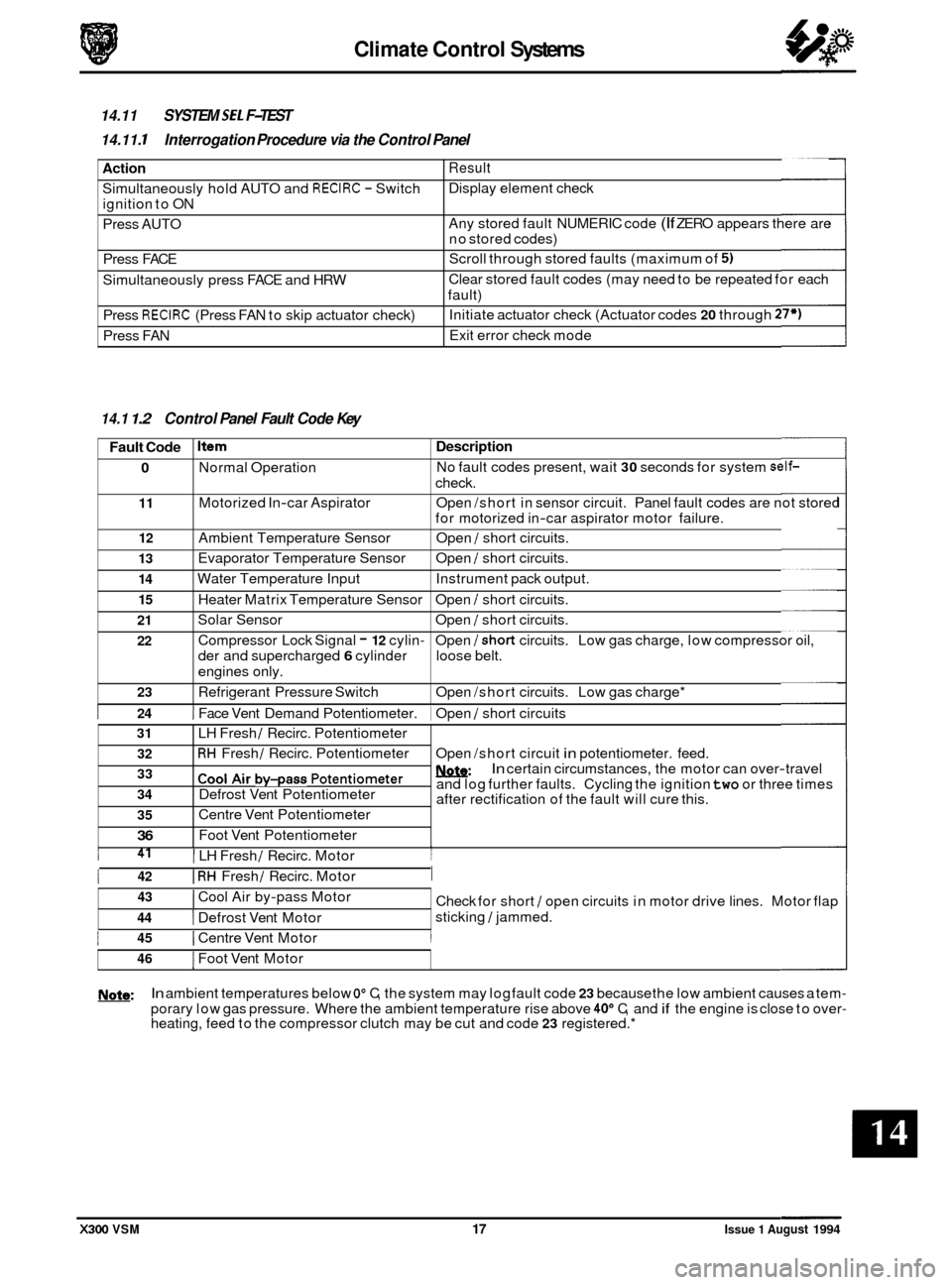
Action
Simultaneously hold AUTO and RECIRC - Switch
ignition to ON
Press AUTO
Press FACE
Simultaneously press FACE and HRW
Press
RECIRC (Press FAN to skip actuator check)
Press FAN
14.11 SYSTEM SE1 F-TEST
14.11. I Interrogation Procedure via the Control Panel
Result
Display element check
Any stored fault NUMERIC code
(If ZERO appears there are
no stored codes)
Scroll through stored faults (maximum of
5)
Clear stored fault codes (may need to be repeated for each
fault)
Initiate actuator check (Actuator codes
20 through 27*)
Exit error check mode
Fault Code
0
11
12
13
14
15
21
22
0
23
14.1 1.2 Control Panel Fault Code Key
Item Description
Normal Operation No
fault codes present, wait 30 seconds for system self-
check.
Motorized In
-car Aspirator Open /short in sensor circuit. Panel fault codes are not stored
for motorized in
-car aspirator motor failure.
Ambient Temperature Sensor Open
/ short circuits.
Evaporator Temperature Sensor Open
/ short circuits.
Water Temperature Input Instrument pack output.
Heater Matrix Temperature Sensor Open
/ short circuits.
Solar Sensor Open
/ short circuits.
Compressor Lock Signal
- 12 cylin- Open /short circuits. Low gas charge, low compressor oil,
der and supercharged
6 cylinder loose belt.
engines only.
Refrigerant Pressure Switch Open /short circuits. Low gas charge*
31
32
33
34
35
36 0
I 24 1 Face Vent Demand Potentiometer. 1 Open / short circuits
LH Fresh
/ Recirc. Potentiometer
RH Fresh / Recirc. Potentiometer
cool ~i~ by-pass potentiometer
Defrost Vent Potentiometer
Centre Vent Potentiometer
Foot Vent Potentiometer Open
/short circuit
in potentiometer. feed.
w: and log further faults. Cycling the ignition two or three times
after rectification of the fault will cure this.
In certain circumstances, the motor can over-travel
43
44
I Defrost Vent Motor
I Cool Air by-pass Motor
I 41 I LH Fresh / Recirc. Motor I
Check for short / open circuits in motor drive lines. Motor flap
sticking
/ jammed.
1 42 I RH Fresh / Recirc. Motor I
1 45 I Centre Vent Motor I
46 I Foot Vent Motor
w: In ambient temperatures below Oo C, the system may log fault code 23 because the low ambient causes a tem-
porary low gas pressure. Where the ambient temperature rise above 40" C, and if the engine is close to over- heating, feed to the compressor clutch may be cut and code 23 registered.*
X300 VSM 17 Issue 1 August 1994
Page 331 of 521
Climate Control Systems
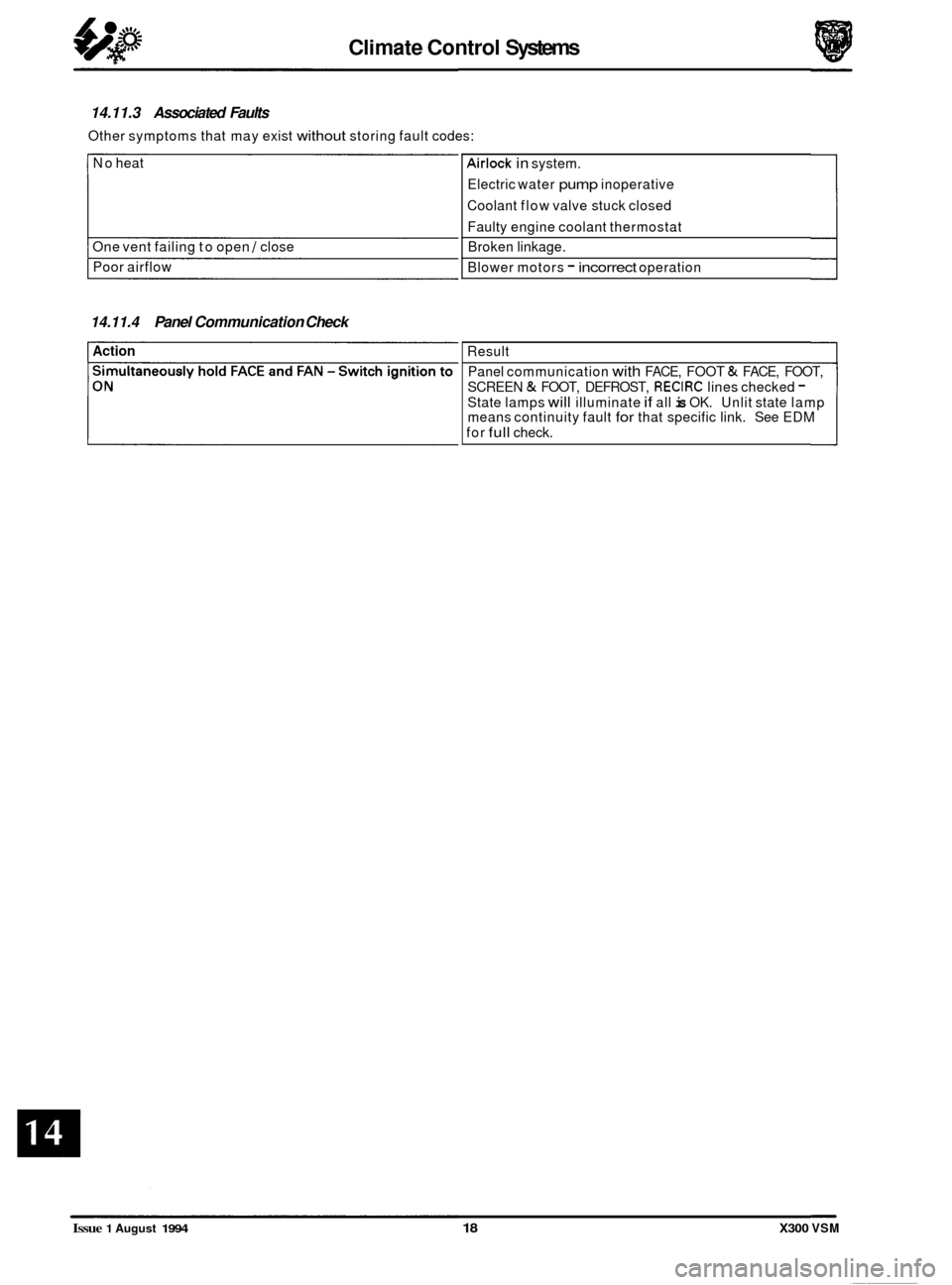
No heat
One vent failing to open
/ close
Poor airflow
14.11.3 Associated Faults
Other symptoms that may exist without storing fault codes:
Airlock in system.
Electric water
pump inoperative
Coolant flow valve stuck closed
Faulty engine coolant thermostat
Broken linkage.
Blower motors
- incorrect operation
14.11.4 Panel Communication Check
Action Result
Panel communication
with FACE, FOOT & FACE, FOOT,
SCREEN
& FOOT, DEFROST, RECIRC lines checked - State lamps will illuminate if all is OK. Unlit state lamp
means continuity fault for that specific link. See EDM
for
full check.
0
0
0
Issue 1 August 1994 18 X300 VSM
Page 332 of 521
Climate Control Systems
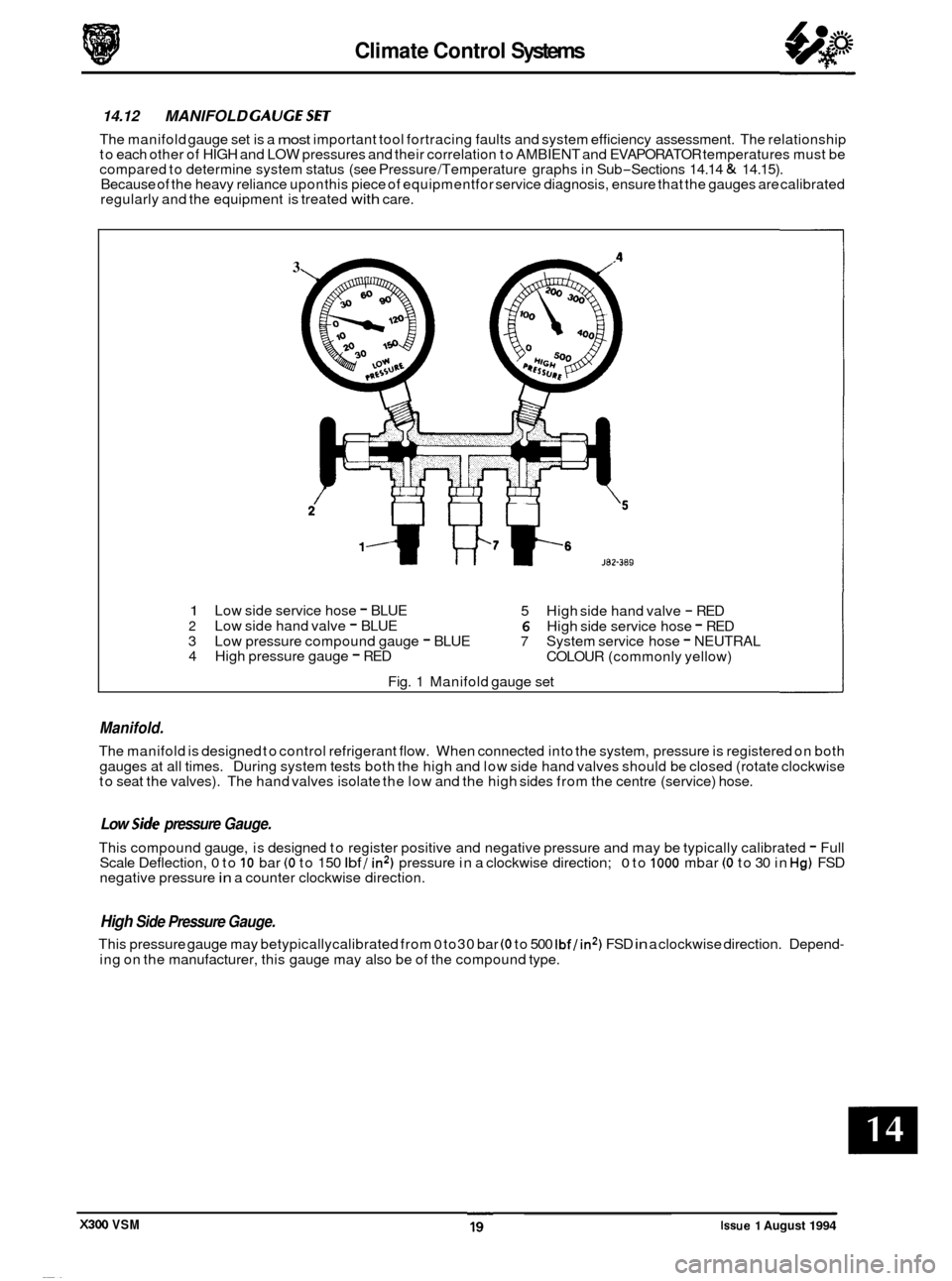
14.12 MANIFOLD GAUGESET
The manifold gauge set is a most important tool fortracing faults and system efficiency assessment. The relationship
to each other of HIGH and LOW pressures and their correlation to AMBIENT and EVAPORATOR temperatures must be
compared to determine system status (see Pressure /Temperature graphs in Sub
-Sections 14.14 & 14.15).
Because of the heavy reliance upon this piece of equipmentfor service diagnosis, ensure that the gauges are calibrated
regularly and the equipment is treated
with care.
3
1 Low side service hose - BLUE
5 High side hand valve - RED 2 Low side hand valve - BLUE 6 High side service hose - RED
3 Low pressure compound gauge - BLUE 7 System service hose - NEUTRAL
4 High pressure gauge - RED
COLOUR (commonly yellow)
Fig. 1 Manifold gauge set
Manifold.
The manifold is designed to control refrigerant flow. When connected into the system, pressure is registered on both
gauges at all times. During system tests both the high and low side hand valves should be closed (rotate clockwise
to seat the valves). The hand valves isolate the low and the high sides from the centre (service) hose.
0 Low side pressure Gauge.
This compound gauge, is designed to register positive and negative pressure and may be typically calibrated - Full
Scale Deflection, 0 to 10 bar (0 to 150 Ibf / in2) pressure in a clockwise direction; 0 to 1000 mbar (0 to 30 in Hg) FSD
negative pressure in a counter clockwise direction.
High Side Pressure Gauge.
This pressure gauge may betypicallycalibrated from 0 to30 bar (0 to 500 Ibf/in2) FSD in a clockwise direction. Depend-
ing on the manufacturer, this gauge may also be of the compound type.
X300 VSM Issue 1 August 1994
Page 336 of 521
Climate Control Systems
High Side Gauge
Normal
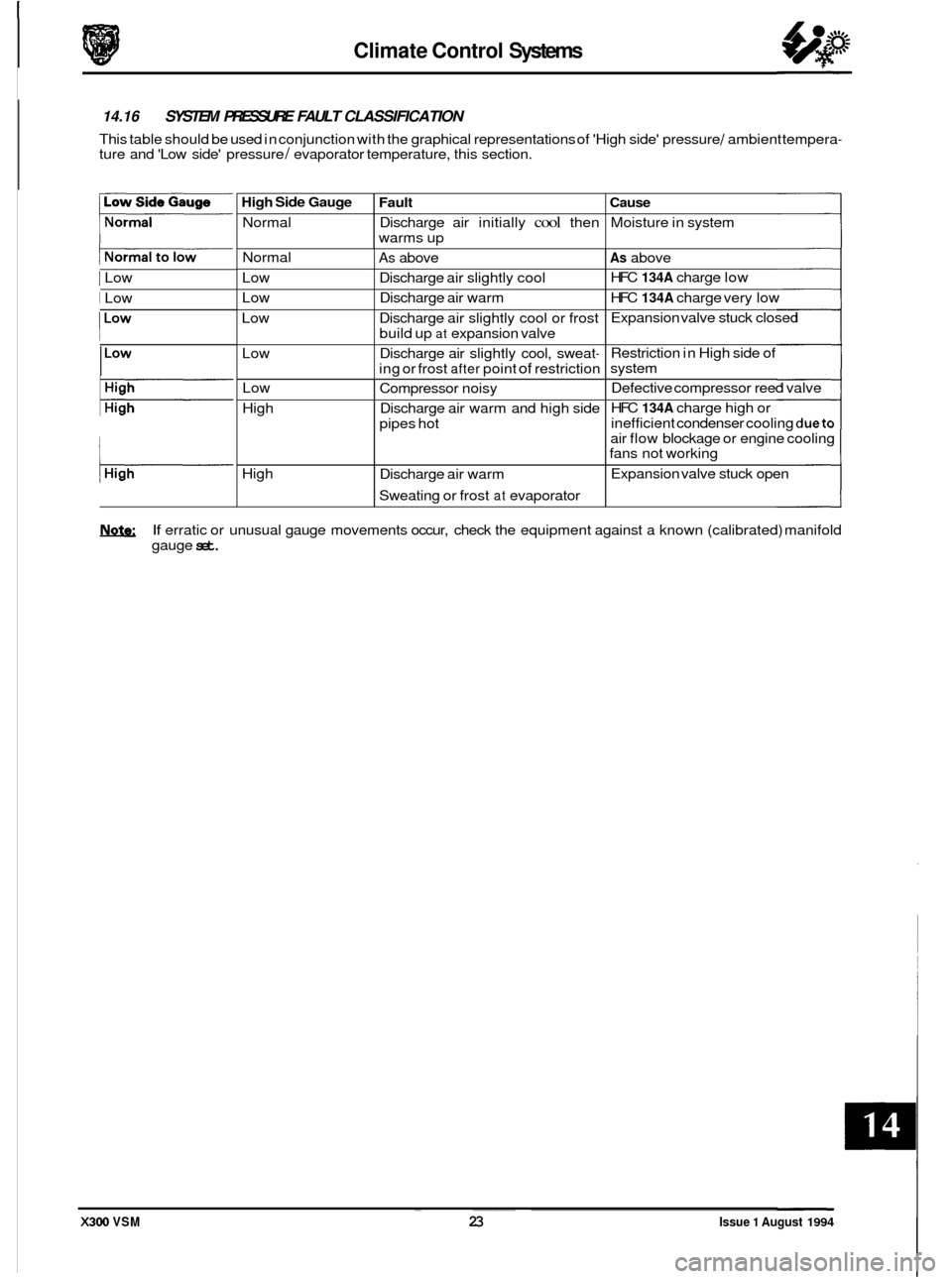
@ 14.16 SYSTEM PRESSURE FAULT CLASSIFICATION
This table should be used in conjunction with the graphical representations of 'High side' pressure / ambient tempera- ture and 'Low side' pressure / evaporator temperature, this section.
Fault Cause
Discharge air initially cool then Moisture in system
warms up
1 Low Normal
Low
Low
Low
Low
I Low
As above As above
Discharge air slightly cool HFC
134A charge
low
Discharge air warm HFC
134A charge very low
Discharge air slightly cool or frost Expansion valve
stuck closed
build up
at expansion valve
Discharge air slightly cool, sweat
- Restriction in High side of
ing or frost
after point of restriction system
I
Low
High
High
I
Compressor noisy Defective compressor
reed valve
Discharge air warm and high side HFC
134A charge
high or
pipes hot inefficient
condenser cooling
dueto
air flow blockage or engine cooling
fans not working
Expansion valve stuck open
Discharge air warm
Sweating or frost
at evaporator
If erratic or unusual gauge movements occur, check the equipment against a known (calibrated) manifold
gauge
set. ~ ~~~
X300 VSM 23 Issue 1 August 1994
Page 343 of 521

15.1.2 Handling Undeployed Modules
The electrically-activated airbag module contains sodium azide and sodium nitrate which are poisonous and
extremely flammable substances.
Their contact with acid, water or heavy metals may produce harmful and irritating gases or combustible compounds.
The airbag module is
non-serviceable and must not be dismantled, punctured, incinerated or welded.
WARNING: DO NOT ATTEMPT ANY REPAIRS TO THE AIRBAG MODULE.
Never measure the resistance of the airbag module, as this may cause the airbag to deploy. Suspect modules must be returned to Jaguar Cars Ltd. or their importer for replacement.
Tampering or mishandling can result in personal injury.
Keep away from heat, sparks and open flames. Do not store
at temperatures exceeding 93O Celsius (200OF).
Keep away from electrical equipment as electrical contact may cause ignition.
Do not drop or impact airbag module.
Always position module 'cover
-up'.
Ensure that the connector is protected to prevent damage.
J76-1058
Fig. 1 The Driver-side Airbag
Store modules in a secure lockable cabinet.
Never position projectile material over the undeployed airbag as this can cause injury in the event of inadvertent
deployment.
Page 345 of 521
rl Electrical
15.1.6 Fire Hazard Infonnath
Thermal decomposition or combustion may produce dense smoke and other dangerous fumes which in fire situations
form
a highly toxic explosive.
In the event of fire the surrounding area must be evacuated and
all personnel kept well upwind of the area.
Full fire fighting protective gear and
a self contained breathing apparatus operating in the positive pressure mode must
be worn for combating fire. Material near fires must be cooled with water spray to prevent ignition.
Fires should be allowed to burn themselves
out if not threatening to life or property. If fire is threatening to life or prop- erty use copious quantities of water to extinguish.
15.1.7 Ventilath
Local exhaust ventilation designed by a professional engineer should be provided if vapours, fumes, or dusts are gen- erated whilst working with airbag module.
The latest issue of the manual for recommended practices on 'Industrial Ventilation' is available from the
ACGIH Com- mittee on Industrial Ventilation, PO Box 16153, Lansing, MI 48910, USA.
The need for local exhaust ventilation should be evaluated by a professional industrial hygienist.
15.1.8 Respiratory Precauth
To prevent the inhalation of dangerous fumes and dusts, an approved mask should be worn.
15.1.9 Eye Protection
Chemical protective goggles are recommended where there is a possibility of eye contact with the propellant.
Safety glasses with side shields are recommended for
all other operations.
15.1. I0 Protective Clothing
Approved protective gloves, overalls and shoes / boots should be worn.
15.1.1 1 Handling and Storage Precautions
Do not store airbag module near live electrical equipment or circuitry. Store in a dry environment at ambient tempera-
tures.
Good housekeeping and engineering practices should be employed to prevent the generation and accumulation of
dusts. Store in compliance with
all local state and federal regulations.
15.1.12 Driver And Passenger Airbag Modules Assembly / Removal / Service Instructions
Before starting work, ensure ignition switch is in 'IocK position, key is removed and negative terminal cable
is disconnected from the battery.
As the airbag is equipped with a back up power source and due to the risk of airbag being inadvertently
deployed, wait one minute or longer before starting work.
0 Disconnecting the battery cancels the memory for clock, radio, seats, mirrors, steering column and any other
components using battery power. Reset memory after work is completed.
0 Never use airbags from other vehicles, always use new parts.
0 After work is completed, reconnect battery and perform warning light check see diagnostic manual.
0 Never use electrical probes to check voltage or electrical resistance.
0 Disconnect the airbag before carrying out any work on, or in the vicinity of module, or when using electric weld- ing equipment.
0 Always ensure that battery negative has been disconnected for one minute or longer before commencing any
removal procedure.
EB
Issue 1 August 1994 4 X300 VSM
Page 350 of 521
31
30
29
28 27
26
4 26 24 21 23 22 7 20 19 18 18 17 8
a
10
11
12
13
14
1s
1M-137
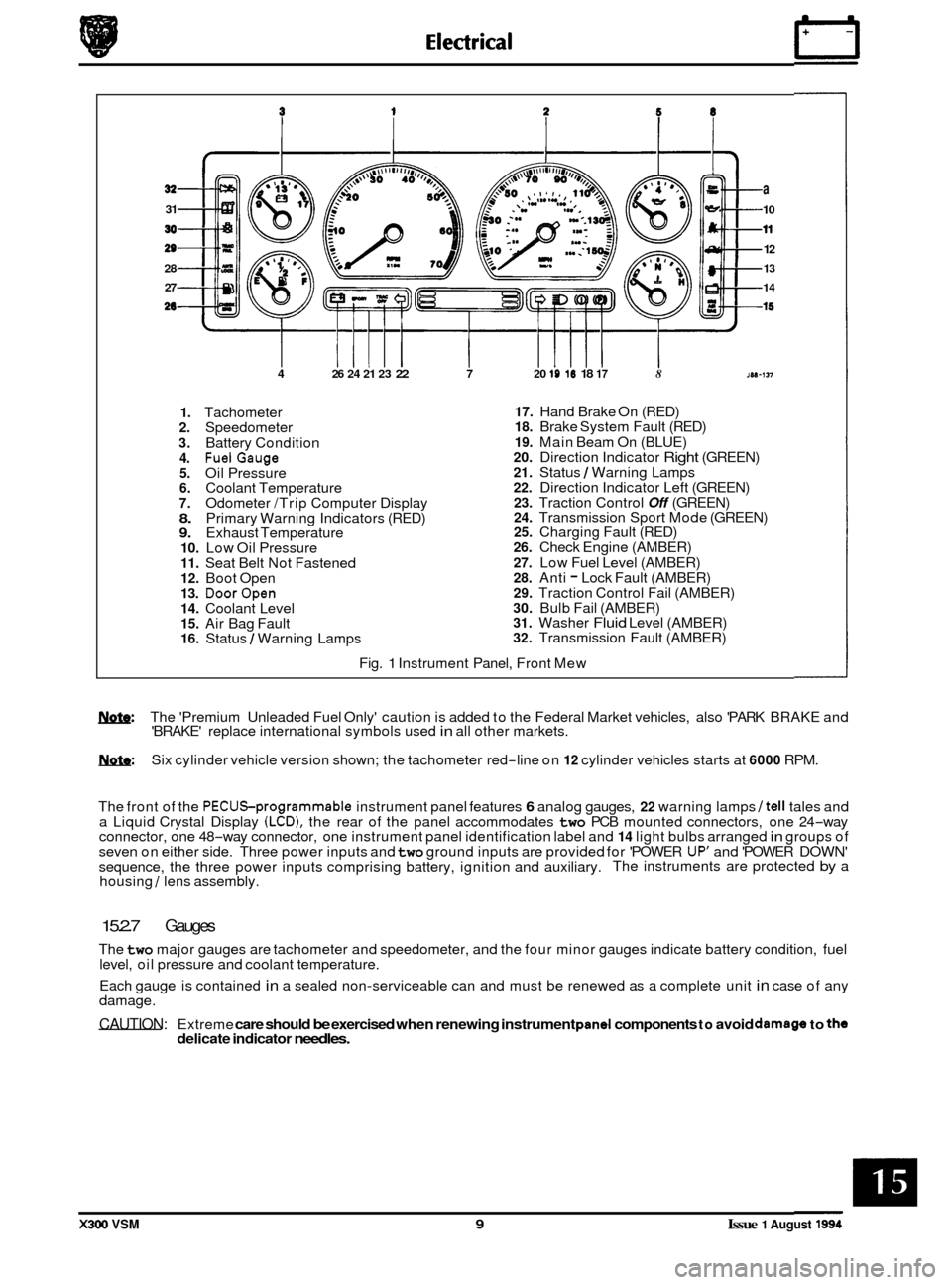
1. Tachometer 2. Speedometer
3. Battery Condition 4. FuelGauge 5. Oil Pressure 6. Coolant Temperature 7. Odometer /Trip Computer Display 8. Primary Warning Indicators (RED) 9. Exhaust Temperature 10. Low Oil Pressure 11. Seat Belt Not Fastened 12. Boot Open 13. DoorOpen 14. Coolant Level 15. Air Bag Fault 16. Status / Warning Lamps
17. Hand Brake On (RED) 18. Brake System Fault (RED)
19. Main Beam On (BLUE) 20. Direction Indicator Right (GREEN) 21. Status / Warning Lamps 22. Direction Indicator Left (GREEN) 23. Traction Control Off (GREEN) 24. Transmission Sport Mode (GREEN) 25. Charging Fault (RED) 26. Check Engine (AMBER)
27. Low Fuel Level (AMBER) 28. Anti - Lock Fault (AMBER) 29. Traction Control Fail (AMBER) 30. Bulb Fail (AMBER) 31. Washer Fluid Level (AMBER) 32. Transmission Fault (AMBER)
Fig.
1 Instrument Panel, Front Mew
w: The 'Premium Unleaded Fuel Only' caution is added to the Federal Market vehicles, also 'PARK BRAKE and
'BRAKE' replace international symbols used in all other markets.
m: Six cylinder vehicle version shown; the tachometer red-line on 12 cylinder vehicles starts at 6000 RPM.
The front of the
PECUSprogrammable instrument panel features 6 analog gauges, 22 warning lamps /tell tales and
a Liquid Crystal Display (LCD), the rear of the panel accommodates two PCB mounted connectors, one 24-way
connector, one 48-way connector, one instrument panel identification label and 14 light bulbs arranged in groups of
seven on either side. Three power inputs and two ground inputs are provided for 'POWER UP' and 'POWER DOWN'
sequence, the three power inputs comprising battery, ignition and auxiliary. The instruments are protected by a
housing
/ lens assembly.
15.2.7 Gauges
The two major gauges are tachometer and speedometer, and the four minor gauges indicate battery condition, fuel
level, oil pressure and coolant temperature.
Each gauge is contained
in a sealed non-serviceable can and must be renewed as a complete unit in case of any
damage.
CAUTION: Extreme care should be exercised when renewing instrument pand components to avoid damago to the delicate indicator needles.
X300 VSM 9 Issue 1 August 1994
Page 376 of 521
I SRO I Rdw* AJ16 v12
Automatic Automatic
Models only Models only
Automatic Automatic
Models only Models only
UK
& ROW -
Manual Seat
only
UK
& ROW -
Manual Seat
onh/
UK & ROW -
Manual Seat
only
Manual Seat
only
UK
& Manual -
Seat only
UK
& Manual -
Seat only
UK
& ROW -
Optional
Optional
Optional Optional
Keylock
Number
13
14
15
16
34
35
17
36
37
38
Driver's Seat Height
Control (Upward)
Driver's Seat Height
Control (Downward)
Passenger Seat
Height Control (Upward)
Passenger Seat
Height Control
(Downward)
Driver's Seat Heater
All Models
All Models
All Models
Passenger Seat
Heater
RH Front
Screen
Heater
LH Front Screen
Heater
Ignition All Models
25
All Models 26
All Models 23
Ignition
Air
-conditioning
Isolate
LH Blower
RH Blower
LH Blower
high
speed
RH Blower high
speed
Deadlock front
lefthear right All
Models All Models
20
Below gear selector 'J' gate.
Not NAS or
Japan
UK
& Europe
only
All Models
All Models
USA
&
Canada only
All Models
All Models
All Models
All Models
Below
gear selector
'J' gate.
Not NAS or
30
UK & Europe 31
All Models 28
All Models 29
USA & 27
All Models 24
All Models 33
All Models 22
All Models 32
Japan
only
Canada only
On
seat panel below
driver's seat.
86.55.78
86.55.74
On seat panel below
driver's seat.
Deadlock front
righthear left
Door Lock
Door Unlock
Driver's Door
Unlock
Mirror Heater
Puddle Lamps
Cigar Lighter
Fuel Flap Lock On
seat panel below
passenger's seat.
On seat panel below
passenger's seat.
On seat panel below
driver's seat.
On seat panel below
passenger's seat.
Left hand side footwell on
front
'A' post, behind cover.
Left hand side footwell on
front
'A' post, behind cover.
Fuse box assembly
RH side heelboard.
Fuse box assembly
LH side heelboard.
Behind
RH side heelboard.
Behind
RH side heelboard.
Behind RH side heelboard.
Behind
RH side heelboard.
Behind
RH side heelboard.
Behind LH side heelboard.
Behind LH side heelboard.
Behind LH side heelboard.
Behind LH side heelboard.
Behind LH side heelboard.
Behind
RH side heelboard.
Behind LH side heelboard.
Behind
RH side heelboard.
Behind LH side heelboard.
Color
Blue
Blue
Violet
Violet
Violet Violet Blue Blue
Blue
Blue
Blue
Blue
Blue
Blue
Blue Blue
Blue
Violet
Violet
Violet
Violet
Violet
Violet Blue
Blue
Violet All
Models All Models
All Models All Models
All Models All Models
18
X300 VSM 35 Issue 1 August 1994
Page 380 of 521
86.52.01
86.91 -83
19.75.21
86.80.24
Universal garage door opener
Security
& Locking Control Module
(SLCM)
Sunroof
Mirror memory control
Seat
/ Mirror Memory (Passenger.)
Speed control
Air conditioning
(NCCM)
Transmission control
Engine Management
BPU (Body Processor Unit)
ABS (Anti
-lock Braking System &
Traction Control (where fitted).
(ABS/TC CM)
Bulb failure
Rear
Front
I Power steering
I Column / mirror ECM
Reader exciter
Location
Roof console panel
LH side upper wheel arch, inside the
trunk below fuel filler pipe
Roof console panel.
Mounted inside driver's
& passenger's
seat.
Behind passenger knee bolster.
RH side of air conditioning unit.
Behind passenger knee bolster.
RH side footwell in front of 'A' post
behind cover.
Behind passenger knee bolster.
Engine compartment below
anti-lock
braking system modulator.
Trunk inside electrical carrier box,
Engine compartment behind each
headlamp assembly.
LH side footwell on
'A' post, behind cover.
On the side of steering column.
Around the lock barrel of steering
column.
Behind passenger knee bolster below the
airbag module.
Behind bumper, LHS of vehicle
Numb
11
13
10
9
14
2
RHD
20 LHD
1
16
RHD
(1 2&6)
7 LHD
(12&16)
6 (12&16)
19 RHD
3 LHD
18 RHD
4 RHD
12
22
& 24
17 5
8
15 RHD
23 LHD
21
X300 VSM 39 issue 1 August 1994
Page 386 of 521
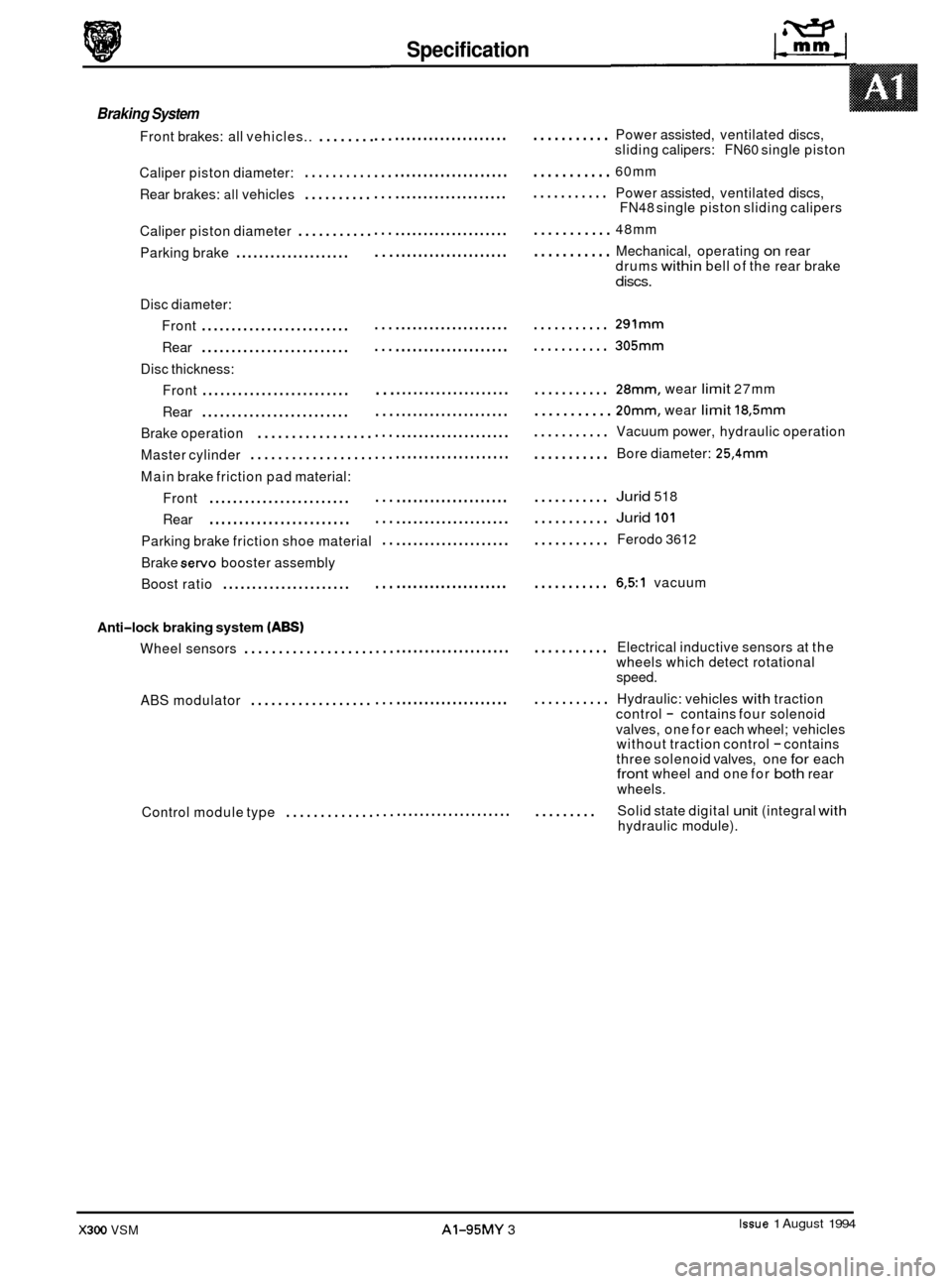
e LmmJ
Power assisted, ventilated discs,
sliding calipers: FN60 single piston
60mm Power assisted, ventilated discs,
FN48 single piston sliding calipers
48mm Mechanical, operating
on rear
drums within bell of the rear brake
discs.
291mm
305mm
28mm. wear limit 27mm
20mm, wear limit 18,5mm
Vacuum power, hydraulic operation
Bore diameter:
25,4mm
Jurid 518
Jurid 101
Ferodo 3612
6,51 vacuum
Electrical inductive sensors at the
wheels which detect rotational
speed.
Hydraulic: vehicles
with traction
control - contains four solenoid
valves, one for each wheel; vehicles
without traction control
- contains
three solenoid valves, one for each front wheel and one for both rear
wheels.
Solid state digital
unit (integral with hydraulic module).
Specification
Braking System
Front brakes: all vehicles.. ........ .................... ........... ...
Caliper piston diameter: ..........
Rear brakes: all vehicles ..........
...
...
....................
....................
...........
...........
Caliper piston diameter ...........
Parking brake ....................
...
...
....................
....................
...........
...........
Disc diameter:
Front
.........................
Rear .........................
Front .........................
Rear .........................
Brake operation .................
Master cylinder ..................
Main brake friction pad material:
Front
........................
Rear ........................
Parking brake friction shoe material
Brake
servo booster assembly
Boost ratio
......................
Disc thickness:
...
... ....................
....................
...........
...........
...
...
...
...
....................
....................
....................
....................
...........
...........
...........
...........
...
...
.. ....................
....................
....................
...........
...........
...........
... .................... ...........
Anti-lock braking system (ABSI
Wheel sensors ................... ... .................... ...........
ABS modulator .................. ... .................... ...........
0
0
Control module type ............. ... .................... .........
Issue 1 August 1994 X300 VSM AI-95MY 3