lock JAGUAR XJ6 1994 2.G Repair Manual
[x] Cancel search | Manufacturer: JAGUAR, Model Year: 1994, Model line: XJ6, Model: JAGUAR XJ6 1994 2.GPages: 521, PDF Size: 17.35 MB
Page 206 of 521
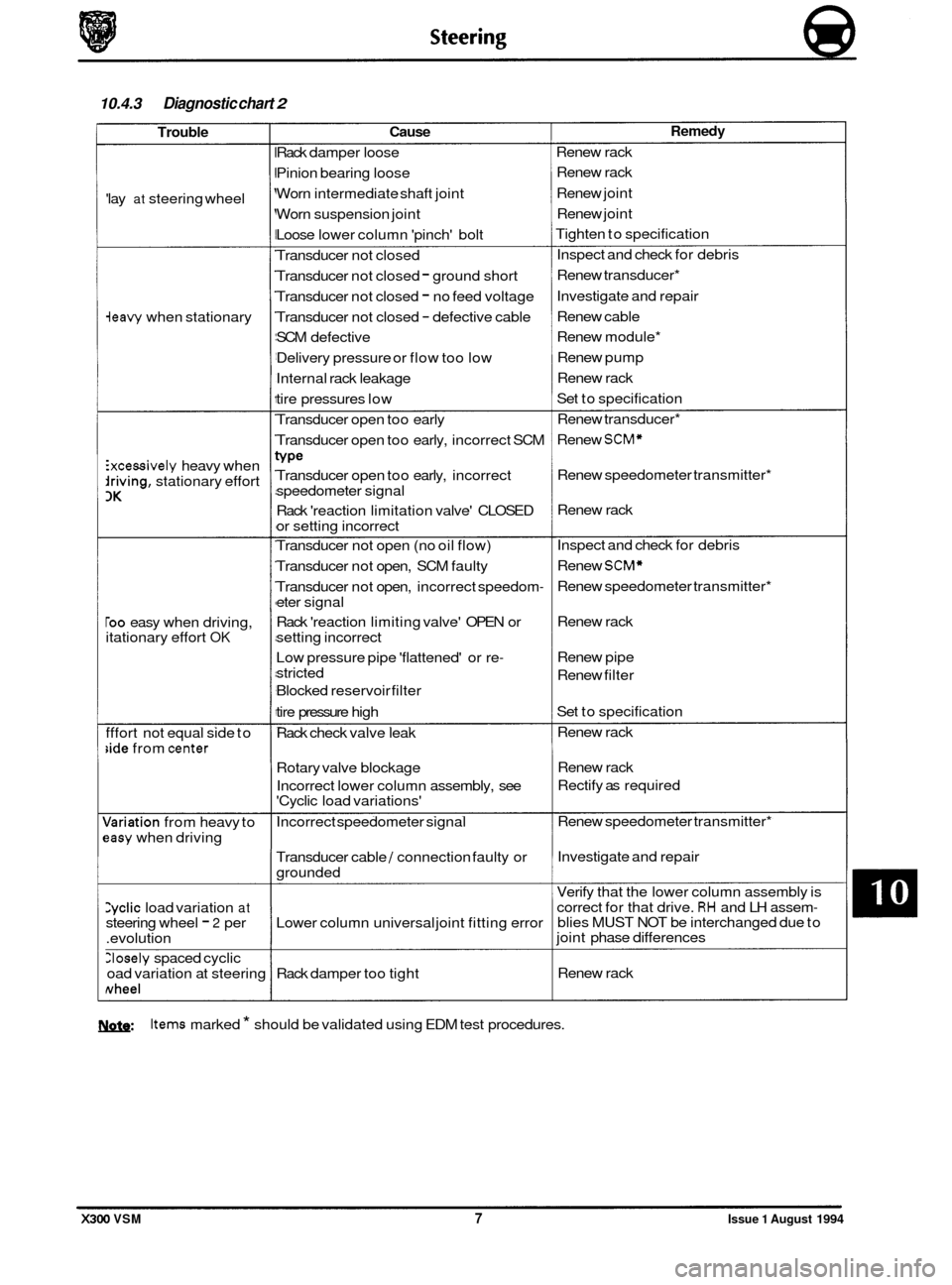
10.4.3 Diagnostic chart 2
0 Trouble
'lay at steering wheel
ieavy when stationary
Excessively heavy when
hiving, stationary effort
3K
Too easy when driving,
itationary effort OK
fffort not equal side to
;ide from center
dariation from heavy to
?asy when driving
:yclic load variation at steering wheel - 2 per
.evolution
:losely spaced cyclic
oad variation at steering
Nheel
Cause
Rack damper loose
Pinion bearing loose
Worn intermediate shaft joint
Worn suspension joint
Loose lower column 'pinch' bolt
Transducer not closed
Transducer not closed
- ground short
Transducer not closed
- no feed voltage
Transducer not closed
- defective cable
SCM defective
Delivery pressure or flow too low
Internal rack leakage
tire pressures low
Transducer open too early
Transducer open too early, incorrect SCM
h/Pe
Transducer open too early, incorrect
speedometer signal
Rack 'reaction limitation valve' CLOSED
or setting incorrect
Transducer not open (no oil flow)
Transducer not open, SCM faulty
Transducer not open, incorrect speedom
-
eter signal
Rack 'reaction limiting valve' OPEN or
setting incorrect
Low pressure pipe 'flattened' or re
-
stricted
Blocked reservoir filter
tire pressure high
Rack check valve leak
Rotary valve blockage Incorrect lower column assembly, see
'Cyclic load variations'
Incorrect speedometer signal
Transducer cable
/ connection faulty or
grounded
Lower column universal joint fitting error
Rack damper too tight
Remedy
Renew rack
Renew rack
Renew joint
Renew joint
Tighten to specification
Inspect and check for debris
Renew transducer*
Investigate and repair
Renew cable
Renew module*
Renew pump
Renew rack
Set to specification
Renew transducer*
Renew
SCM*
Renew speedometer transmitter*
Renew rack
Inspect and check for debris
Renew
SCM*
Renew speedometer transmitter*
Renew rack
Renew pipe
Renew filter
Set to specification
Renew rack
Renew rack
Rectify as required
Renew speedometer transmitter*
Investigate and repair
Verify that the lower column assembly is
correct for that drive.
RH and LH assem- blies MUST NOT be interchanged due to
joint phase differences
Renew rack
W: Items marked * should be validated using EDM test procedures.
X300 VSM 7 Issue 1 August 1994
Page 207 of 521
@ Steering
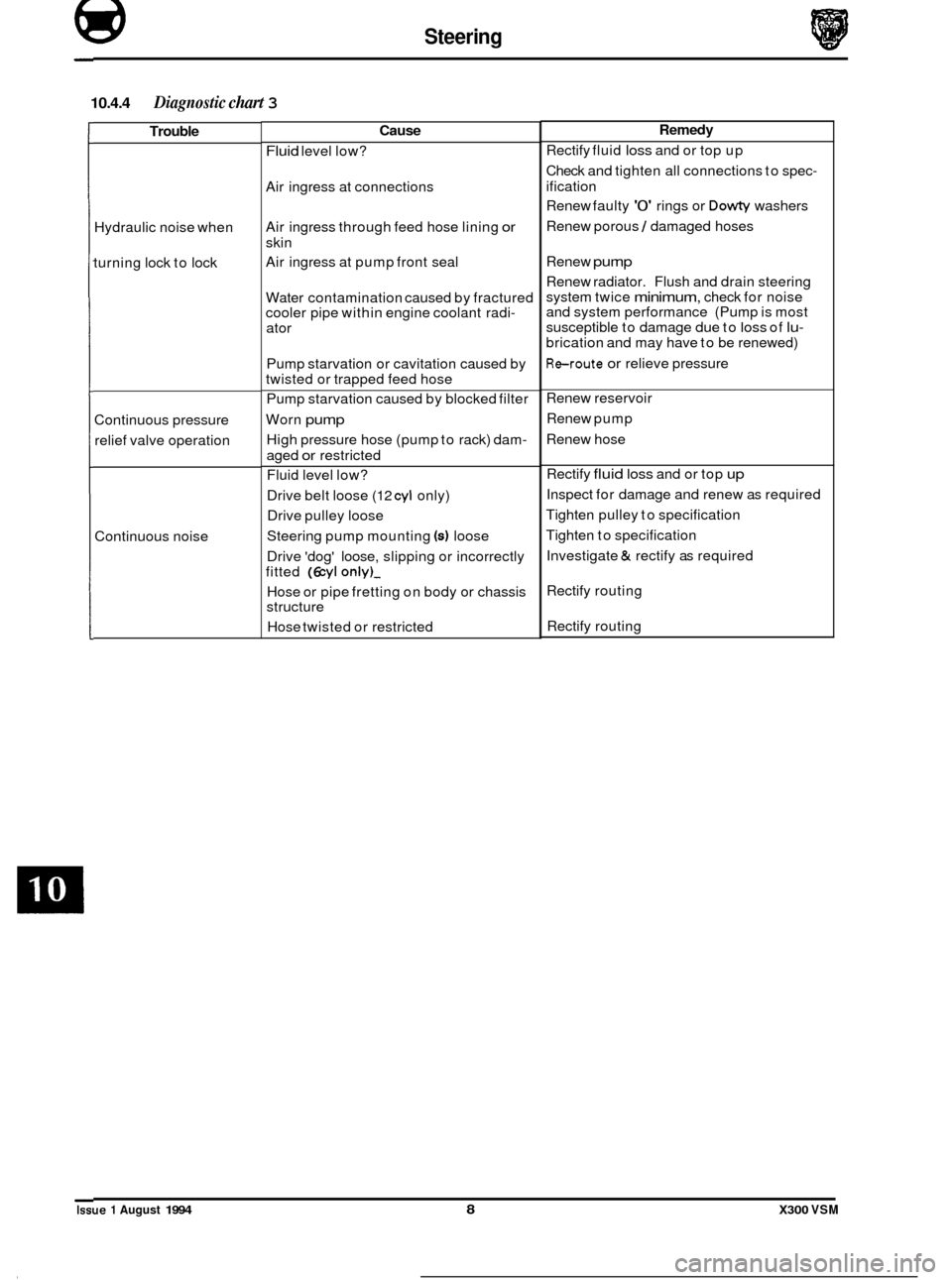
10.4.4 Diagnostic chart 3
Trouble
Hydraulic noise when
turning lock to lock
Continuous pressure
relief valve operation
Continuous noise
Cause
Fluid level low?
Air ingress at connections
Air ingress through feed hose lining
or
skin
Air ingress at pump front seal
Water contamination caused by fractured
cooler pipe within engine coolant radi
-
ator
Pump starvation or cavitation caused by
twisted or trapped feed hose
Pump starvation caused by blocked filter
Worn
pump
High pressure hose (pump to rack) dam-
aged or restricted
Fluid level low?
Drive belt loose
(12 cyl only)
Drive pulley loose
Steering pump mounting
(4 loose
Drive 'dog' loose, slipping or incorrectly
fitted
(6 cyl only)-
Hose or pipe fretting on body or chassis
structure
Hose twisted or restricted
Remedy
Rectify fluid loss and or top up
Check and tighten all connections to spec
-
ification
Renew faulty
'0' rings or Dowty washers
Renew porous
1 damaged hoses
Renew
pump
Renew radiator. Flush and drain steering
system twice
minimum, check for noise
and system performance (Pump is most
susceptible to damage due to
loss of lu-
brication and may have to be renewed)
Reroute or relieve pressure
Renew reservoir
Renew pump
Renew hose
Rectify
fluid loss and or top up
Inspect for damage and renew as required
Tighten pulley to specification
Tighten to specification
Investigate
& rectify as required
Rectify routing
Rectify routing
Issue 1 August 1994 8 X300 VSM
Page 208 of 521
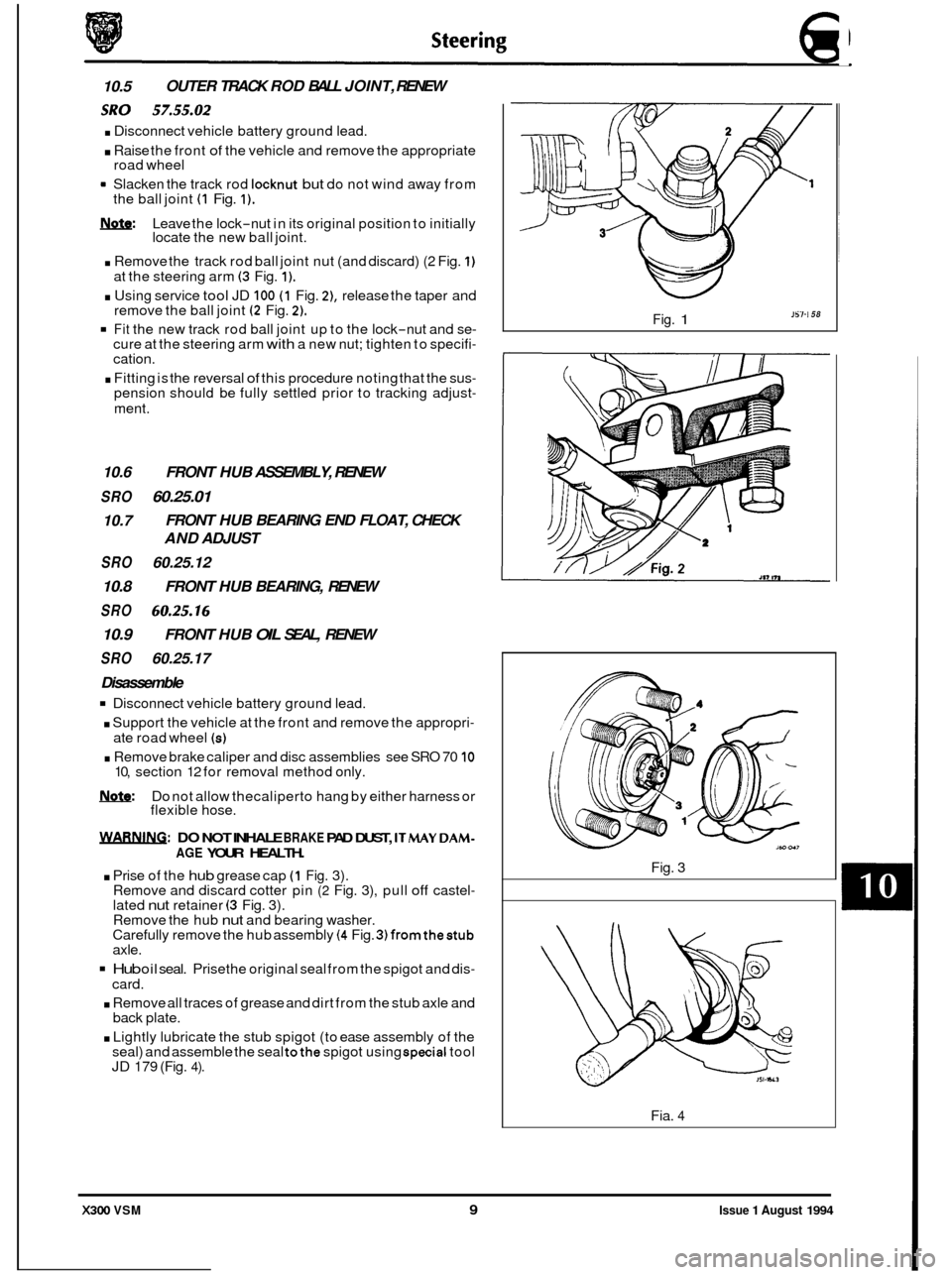
10.5 OUTER
TRACK ROD BALL JOINT, RENEW
sRo . Disconnect 57.55.02 vehicle battery ground lead.
. Raise the front of the vehicle and remove the appropriate
road wheel
Slacken the track rod
locknut but do not wind away from
the ball joint (1 Fig. 1).
m: Leave the lock-nut in its original position to initially
locate the new ball joint.
. Remove the track rod ball joint nut (and discard) (2 Fig. 1)
at the steering arm (3 Fig. 1).
. Using service tool JD 100 (1 Fig. 2), release the taper and
remove the ball joint (2 Fig. 2).
Fit the new track rod ball joint up to the lock-nut and se- cure at the steering arm with a new nut; tighten to specifi- cation.
. Fitting is the reversal of this procedure noting that the sus- pension should be fully settled prior to tracking adjust-
ment.
0 10.6 FRONT HUB ASSEMBLY, RENEW
SRO 60.25.01
10.7
SRO 60.25.12
10.8 FRONT HUB BEARING, RENEW
SRO 60.25.16
10.9
SRO 60.25.17
Disassemble
Disconnect vehicle battery ground lead.
. Support the vehicle at the front and remove the appropri-
. Remove brake caliper and disc assemblies see SRO 70 10
IWQ: Do not allow thecaliperto hang by either harness or
flexible hose.
FRONT HUB BEARING END FLOAT, CHECK
AND ADJUST
FRONT HUB
OIL SEAL, RENEW
ate road wheel (s)
10, section 12 for removal method only.
WARNIM: DO NOT INHALE BRAKE PAD DUST, ITMAY DAM-
0
AGE YOUR HEALTH.
. Prise of the hub grease cap (1 Fig. 3).
Remove and discard cotter pin (2 Fig. 3), pull off castel- lated nut retainer (3 Fig. 3).
Remove the hub nut and bearing washer.
Carefully remove the hub assembly (4 Fig. 3)fromthestub axle.
Hub oil seal. Prise the original seal from the spigot and dis-
card.
. Remove all traces of grease and dirt from the stub axle and
back plate.
. Lightly lubricate the stub spigot (to ease assembly of the
seal) and assemble the seal tothe spigot using special tool JD 179 (Fig. 4).
JS7-i 58 Fig. 1
Fig. 3
Fia.
4
X300 VSM 9 Issue 1 August 1994
Page 214 of 521

Suspension Systems
11.1 INTRODUCTION
This section describes the front and rear suspension systems, and also covers diagnostic procedures.
Fig. 1 Front Suspension Layout
11.2 FRONT SUSPENSION, DESCRIPTION
Theupperrearwishbone(1 Fig.l)andthe upperfrontwishbone(2 Fig.1)arepivotedon the upperfulcrum bolt (3Fig.l), passing through the front cross beam assembly. They are also fitted via an upper ball joint assembly (4 Fig.1) to a verti- cal linkaccommodating the stub axle (5 Fig.l), whereas the vertical linkisfittedvia a lower ball joint assembly (6 Fig.1) to the lower wishbone assembly.
The lower wishbone assembly comprises
a lower rear wishbone (7 Fig.l), lower front wishbone (8 Fig.l), damper (9 Fig.1) (incorporating damper bush 10 Fig.1) and spring pan (1 1 Fig.1) supporting the road spring (12 Fig.1). The lower
wishbone assembly is pivoted on the bushed lower fulcrum shaft (13 Fig.1) which also passes through thecross beam
assembly.
Both independent front suspension assemblies are linked by a stabilizer bar (14 Fig.1) which is secured to the cross
member using a fixing arrangement of mounting rubbers (15 Fig.1, clamps (16 Fig.l), nuts bolts, washers (17 Fig.1) and two link arm assemblies (18 Fig.1). Each link arm assembly is fitted to one end of the stabilizer bar and to one end
of the lower front wishbone using a fixing arrangement of bolts washers and self locking nuts.
All suspension loads, except the damper, are fed into a pressed steel crossbeam which is isolated from the body by
rubber bushes. This mounting method allows the necessary amount of compliance.
The degree
of caster is adjustable via shims positioned on either side of the upper ball joint assembly but camber is facton/ set and is not adjustable. The vertical link and the steering arm form a single forging. Cast iron hubs rotate
on twin tapered roller bearings.
X300 VSM 1 Issue 1 August 1994
Page 222 of 521
SECTION CONTENTS
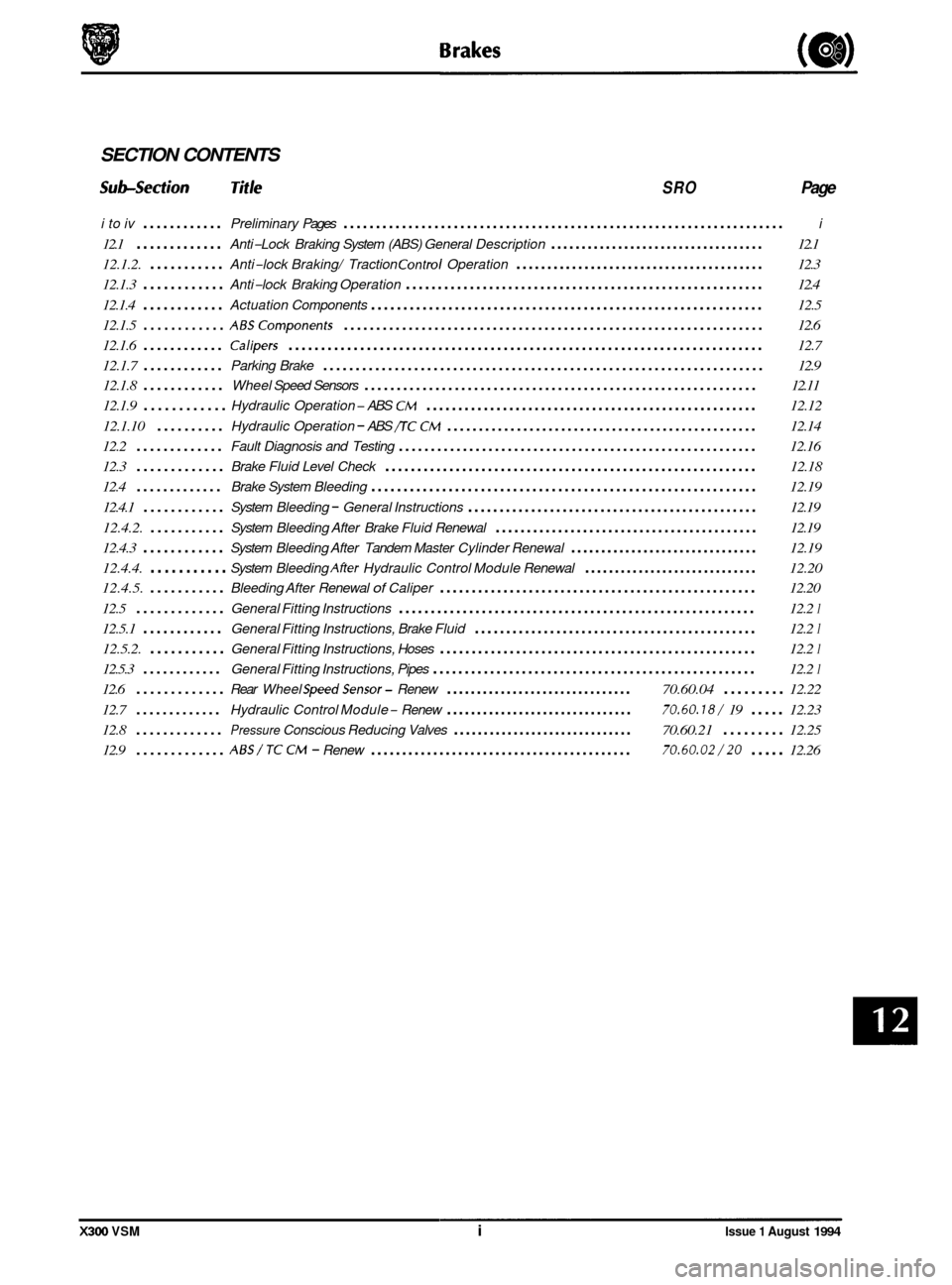
Subsection Tit/e SRO Page
i to iv ............ Preliminary Pages .................................................................... i
12.1 ............. Anti-Lock Braking System (ABS) General Description ................................... 12.1
12.1.2.
........... Anti-lock Braking/ Traction Contd Operation ........................................ 12.3
12.1.3
............ Anti-lock Braking Operation ........................................................ 12.4
12.1.4
............ Actuation Components ............................................................. 12.5
12.1.5
............ ABSComponents ................................................................. 12.6
12.1.6
............ Calipers ........................................................................\
. 12.7
12.1.7
............ Parking Brake .................................................................... 12.9
12.1.8
............ Wheel Speed Sensors ............................................................. 12.11
12.1.9
............ Hydraulic Operation - ABS CM .................................................... 12.12
12.2
............. Fault Diagnosis and Testing ........................................................ 12.16
12.4
............. Brake System Bleeding ............................................................ 12.19
12.1.10
.......... Hydraulic Operation - ABS /TC CM ................................................. 12.14
12.3
............. Brake Fluid Level Check .......................................................... 12.18
12.4.1
............ System Bleeding - General Instructions .............................................. 12.19
12.4.2.
........... System Bleeding After Brake Fluid Renewal .......................................... 12.19
12.4.3
............ System Bleeding After Tandem Master Cylinder Renewal ............................... 12.19
12.4.4.
........... System Bleeding Afier Hydraulic Control Module Renewal ............................. 12.20
12.4.5.
........... Bleeding After Renewal of Caliper .................................................. 12.20
12.5
............. General Fitting Instructions ........................................................ 12.2 1
12.5.1 ............ General Fitting Instructions, Brake Fluid ............................................. 12.2 1
12.5.2. ........... General Fitting Instructions, Hoses .................................................. 12.2 1
12.5.3 ............ General Fitting Instructions, Pipes ................................................... 12.2 1
12.6 ............. Rear Wheel Speedsensor- Renew ............................... 70.60.04 ......... 12.22
12.7
............. Hydraulic Control Module- Renew ............................... 70.60.18/ 19 ..... 12.23
12.8
............. Pressure Conscious Reducing Valves .............................. 70.60.21 ......... 12.25
12.9
............. ABS/TCCM - Renew .......................................... 70.60.02/20 ..... 12.26
X300 VSM i Issue 1 August 1994
Page 224 of 521
12.1 ANTI-LOCK BRAKING SYSTEM (ASS), GENERAL DESCRIPTION
The anti-lock braking system (ABS) components are combined with a hydraulic booster and tandem master cylinder (TMC) to provide a two-circuit braking system. The anti-lock braking system comprises the following components:
0 Four inductive wheel speed sensors, hub end mounted
0 ABS warning light
0 Hydraulic module.
The hydraulic module consists of an electric motor driven pump,
two low pressure accumulators, valve block and an
ABS electronic control module.
m: Electronic control modules for vehicles without traction control are designated ABS CM. Control modules for
vehicles with traction control are designated ABS /TC CM.
The valve block houses solenoid operated valves which are activated by voltage signals from the control module. The
signals are generated using wheel speed information received from the wheel speed sensors.
For vehicles without traction control the valves operate on three circuits, two front and one rear, as necessary to pre
- vent wheel locking during braking. Brake pressure is modulated individually at thefront wheels and collectively at the
rear. Rear wheel control operates on a 'select low' principle i.e. locking in either wheel is sensed, and controlled brake
pressure is applied to both wheels.
For vehicles with traction control the valves operate on four circuits. During ABS control the rear wheel are controlled
on a 'select low' principle (as above), but during traction control operation the rear wheels are controlled individually.
0
1yQfB: Functional and diagnostic information for the ABS CM and the ABS/TC CM is contained in the Electrical Diag-
nostic Manual (EDM), Section 12.
ABS Warning lamp / Traction Control Warning lamp /Fluid level Indicator
The ABS and traction control warning lamps, mounted in the instrument panel, indicate a fault in the ABS or traction
control. These systems are inhibited or disabled when the lamps are lit, although conventional braking is unaffected.
When the ignition is switched on, an ABS self test is initiated. During this test, the ABS and traction control warning
lamps are
lit for approximately 1.7 seconds and then extinguish. A fault is indicated if the warning lamps remain lit or
come on whilst the vehicle is being driven.
W: The ABS self test is masked by the 5 second lamp test initiated when the ignition is switched on.
The fluid level indicator lamp, mounted in the instrument panel, is
lit when the brake fluid falls below the minimum
mark on the brake fluid reservoir.
ABS / Traction Control - Inhibit / Disable
Faults conditions are detected by the ABS/TC CM which disables the ABS and traction control until the fault is rectified.
The ABS and traction control warning lights on the instrument pack remains lit whilst a fault exists. The system will
be disabled when the following conditions occur:
0
0 Valve failure
0 Sensor failure
0 Main driver failure (internal ABS /TC CM fault)
0 Redundancy error (internal ABS JTC CM fault)
0 Overvoltage J undervoltage
0 Pump motor failure.
0 Throttle valve actuator motor failure (traction control vehicles only).
0 Throttle valve actuator potentiometer failure (traction control warning light only).
X300 VSM 1 Issue 1 August 1994
Page 226 of 521
Brakes (a)
12.1.2. Anti-lock Braking / Traction Control Operation
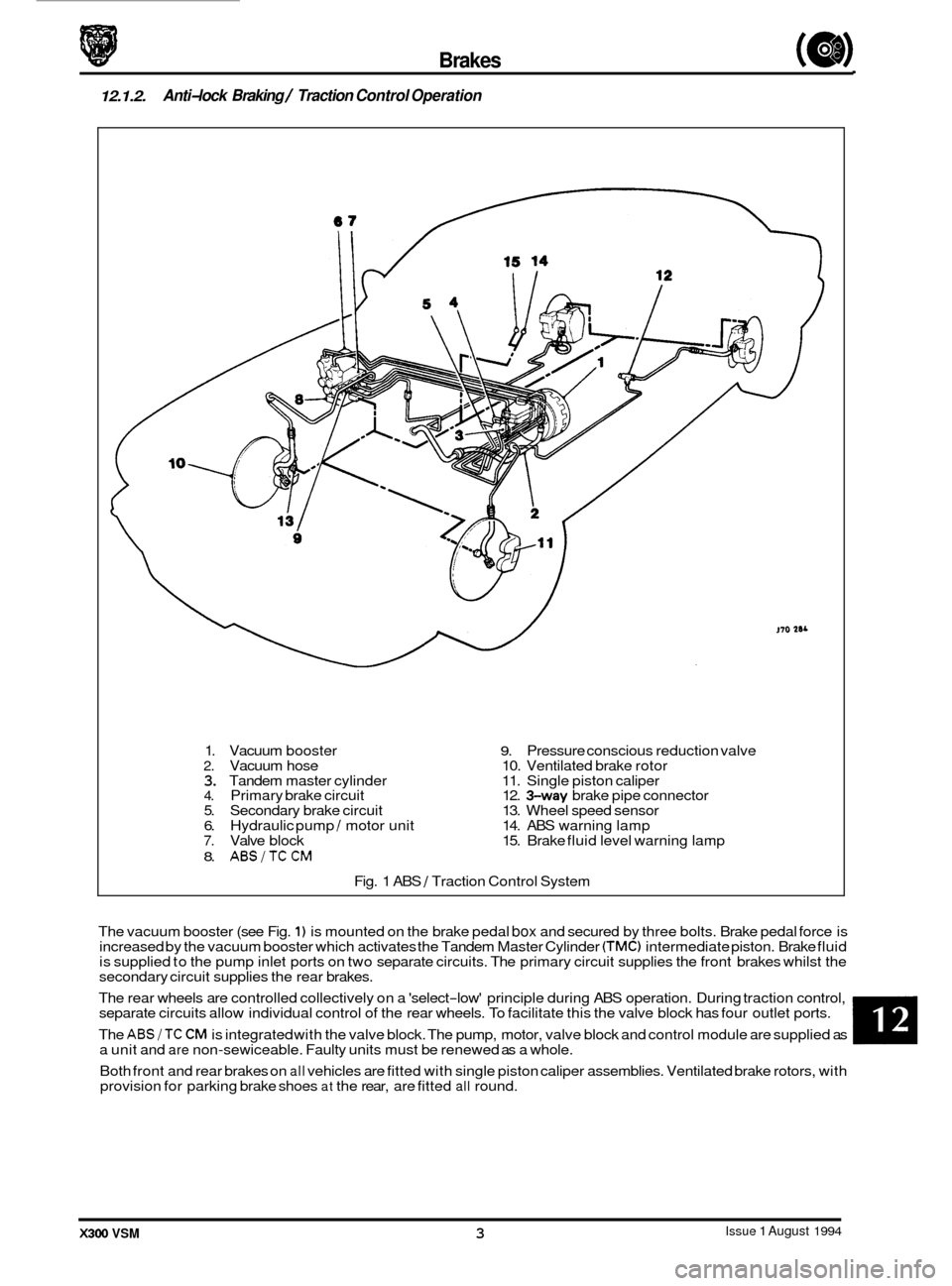
The rear wheels are controlled collectively on a 'select-low' principle during ABS operation. During traction control,
separate circuits allow individual control of the rear wheels. To facilitate this the valve block has four outlet ports.
The
ABS/TC CM is integrated with the valve block. The pump, motor, valve block and control module are supplied as
a unit and are non-sewiceable. Faulty units must be renewed as a whole.
Both front and rear brakes on
all vehicles are fitted with single piston caliper assemblies. Ventilated brake rotors, with
provision for parking brake shoes at the rear, are fitted all round.
0
Issue 1 August 1994 X300 VSM 3
1. Vacuum booster 9. Pressure conscious reduction valve 2. Vacuum hose 10. Ventilated brake rotor 3. Tandem master cylinder 11. Single piston caliper 4. Primary brake circuit 12. %way brake pipe connector
5. Secondary brake circuit 13. Wheel speed sensor
6. Hydraulic pump / motor unit 14. ABS warning lamp 7. Valve block 15. Brake fluid level warning lamp
8. ABS/TCCM
Fig. 1 ABS / Traction Control System
The vacuum booster (see Fig.
1) is mounted on the brake pedal box and secured by three bolts. Brake pedal force is
increased by the vacuum booster which activates the Tandem Master Cylinder (TMC) intermediate piston. Brake fluid
is supplied to the pump inlet ports on two separate circuits. The primary circuit supplies the front brakes whilst the
secondary circuit supplies the rear brakes.
Page 227 of 521
Pressure conscious reduction valves (PCRVs) are fitted between the outlet of the valve block and the rear brake circuit
to optimize. The valves are fitted to prevent over braking due to the increased size of the rear brake calipers which are
required for traction control. Up to a threshold of 15 bar, brake pressure to the front and rear brakes is equal. Above
15 bar the PCRVs reduce pressure to the rear brakes to provide a closer balance between front and rear brakes and
optimize road adhesion.
Wheel speed sensors are fitted to all wheels to transmit wheel speed information to the control module. The module
uses this information to modulate brake pressure during anti
-lock braking or traction control.
12.1.3. Anti-lock Braking Operation
170 287
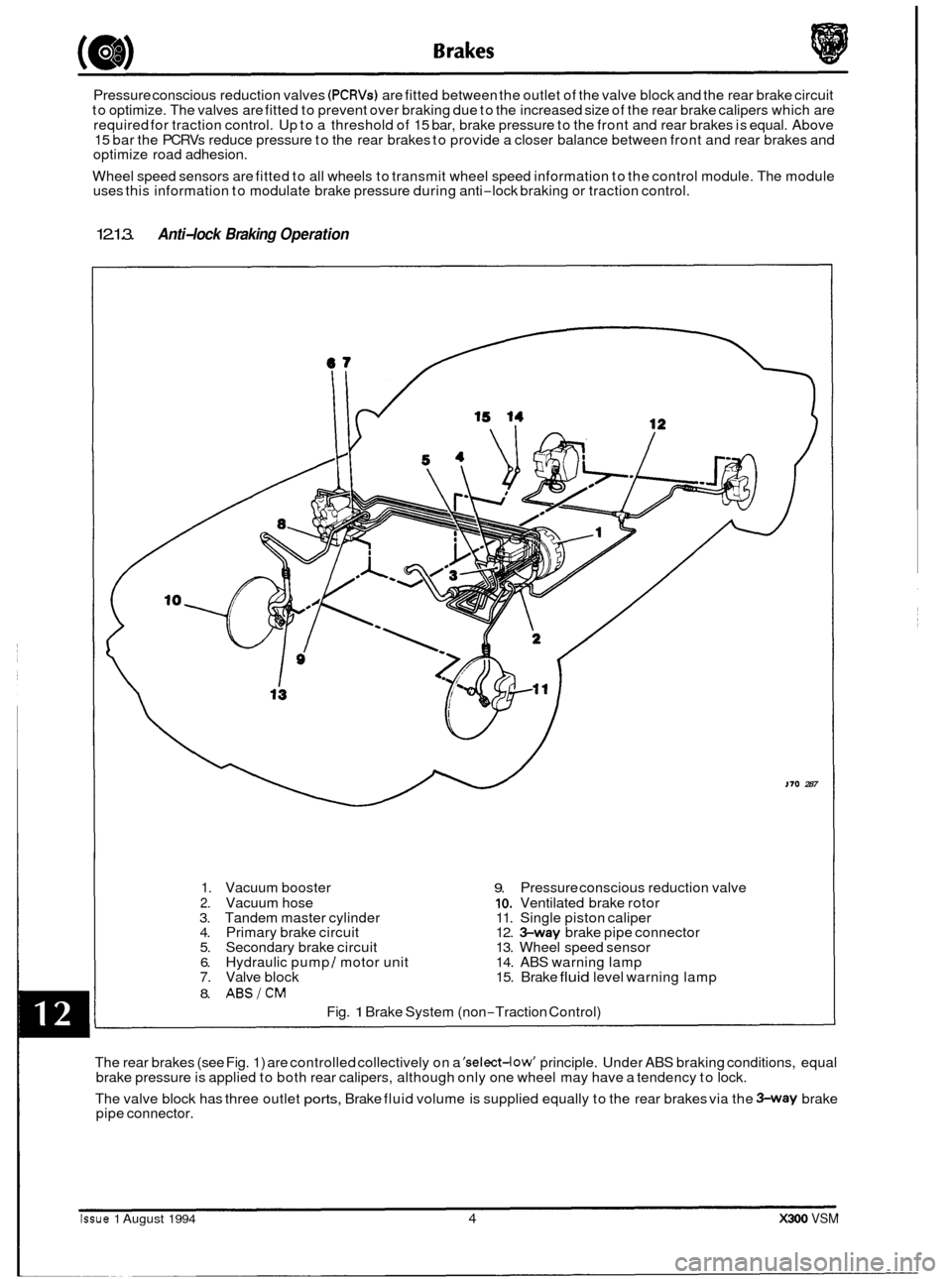
1. Vacuum booster 9. Pressure conscious reduction valve
2. Vacuum hose 10. Ventilated brake rotor
3. Tandem master cylinder 11. Single piston caliper
4. Primary brake circuit 12.
%way brake pipe connector
5. Secondary brake circuit 13. Wheel speed sensor
6. Hydraulic pump I motor unit 14. ABS warning lamp 7. Valve block 15. Brake fluid level warning lamp
8. ABSICM
Fig. 1 Brake System (non-Traction Control)
The rear brakes (see Fig. 1) are controlled collectively on a
'select-low' principle. Under ABS braking conditions, equal
brake pressure is applied to both rear calipers, although only one wheel may have a tendency to lock.
The valve block has three outlet
ports, Brake fluid volume is supplied equally to the rear brakes via the %way brake
pipe connector.
Issue 1 August 1994 4 X300 VSM
Page 229 of 521
12.1.5. ABS Components
Hydraulic Module
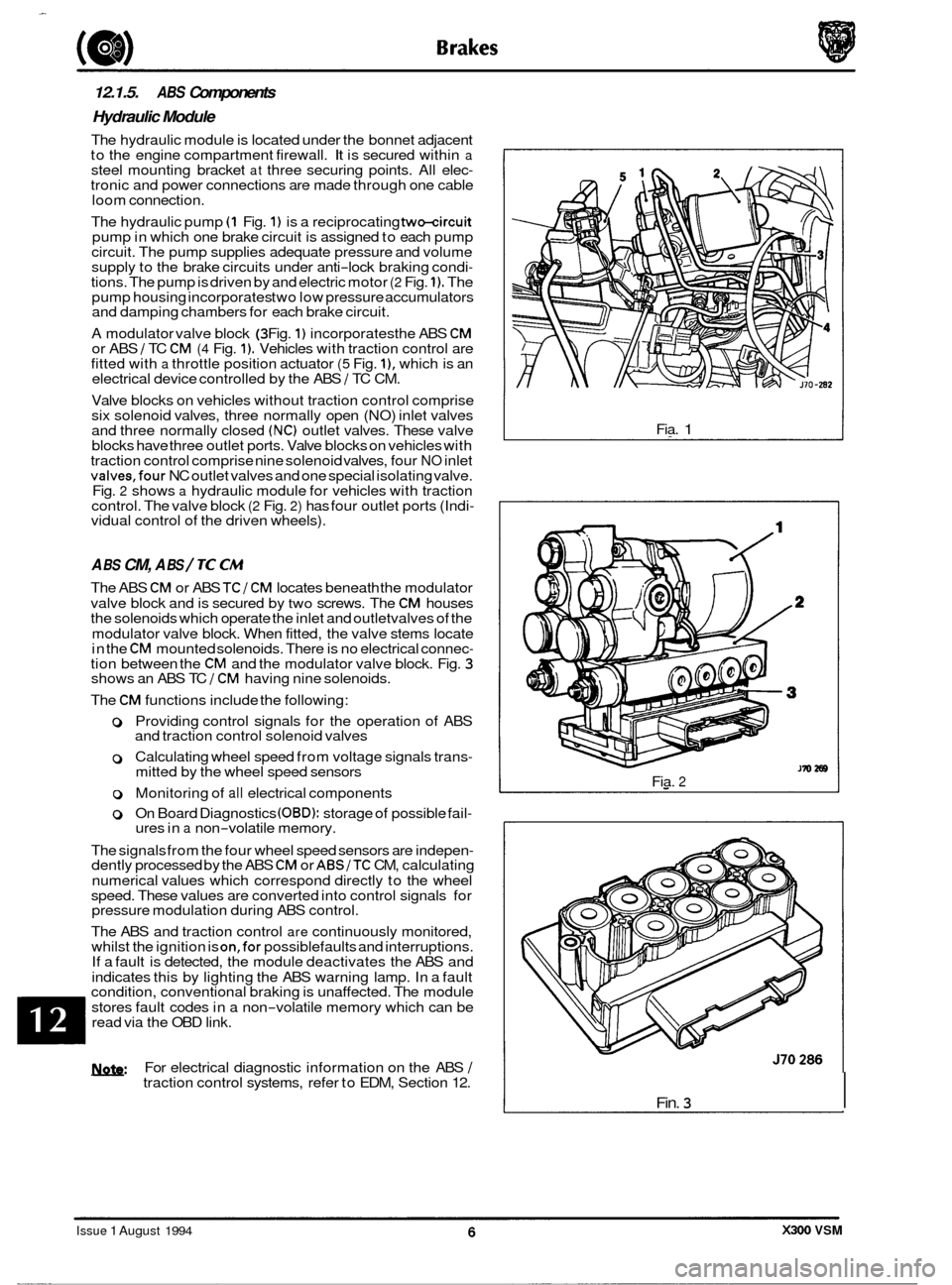
The hydraulic module is located under the bonnet adjacent
to the engine compartment firewall. It is secured within a steel mounting bracket at three securing points. All elec- tronic and power connections are made through one cable
loom connect ion.
The hydraulic pump
(1 Fig. 1) is a reciprocating two-circuit pump in which one brake circuit is assigned to each pump
circuit. The pump supplies adequate pressure and volume
supply to the brake circuits under anti
-lock braking condi- tions. The pump is driven by and electric motor (2 Fig. 1). The
pump housing incorporates two low pressure accumulators
and damping chambers for each brake circuit.
A modulator valve block
(3 Fig. 1) incorporates the ABS CM or ABS / TC CM (4 Fig. 1). Vehicles with traction control are
fitted with a throttle position actuator (5 Fig. I), which is an
electrical device controlled by the ABS 1 TC CM.
Valve blocks on vehicles without traction control comprise
six solenoid valves, three normally open (NO) inlet valves
and three normally closed
(NC) outlet valves. These valve
blocks have three outlet ports. Valve blocks on vehicles with
traction control comprise nine solenoid valves, four
NO inlet valves,four NC outlet valves and one special isolating valve.
Fig. 2 shows a hydraulic module for vehicles with traction
control. The valve block (2 Fig. 2) has four outlet ports (Indi- vidual control of the driven wheels).
A BS CM, A BS / TC CM
The ABS CM or ABS TCI CM locates beneath the modulator
valve block and is secured by
two screws. The CM houses
the solenoids which operate the inlet and outletvalves of the
modulator valve block. When fitted, the valve stems locate
in the
CM mounted solenoids. There is no electrical connec- tion between the CM and the modulator valve block. Fig. 3 shows an ABS TC 1 CM having nine solenoids.
The
CM functions include the following:
0 Providing control signals for the operation of ABS
and traction control solenoid valves
0 Calculating wheel speed from voltage signals trans- mitted by the wheel speed sensors
0 Monitoring of all electrical components
0 On Board Diagnostics (OBD): storage of possible fail- ures in a non-volatile memory.
The signals from the four wheel speed sensors are indepen
- dently processed by the ABS CM or ABSITC CM, calculating
numerical values which correspond directly to the wheel
speed. These values are converted into control signals for
pressure modulation during ABS control.
The ABS and traction control
are continuously monitored,
whilst the ignition is on,for possiblefaults and interruptions.
If a fault is detected, the module deactivates the ABS and
indicates this by lighting the ABS warning lamp. In a fault
condition, conventional braking is unaffected. The module
stores fault codes in a non
-volatile memory which can be
read via the OBD link.
U: For electrical diagnostic information on the ABS I traction control systems, refer to EDM, Section 12. Fia.
1
Fia. 2
Fin. 3 I
J70286
Issue 1 August 1994 X300 VSM
Page 230 of 521
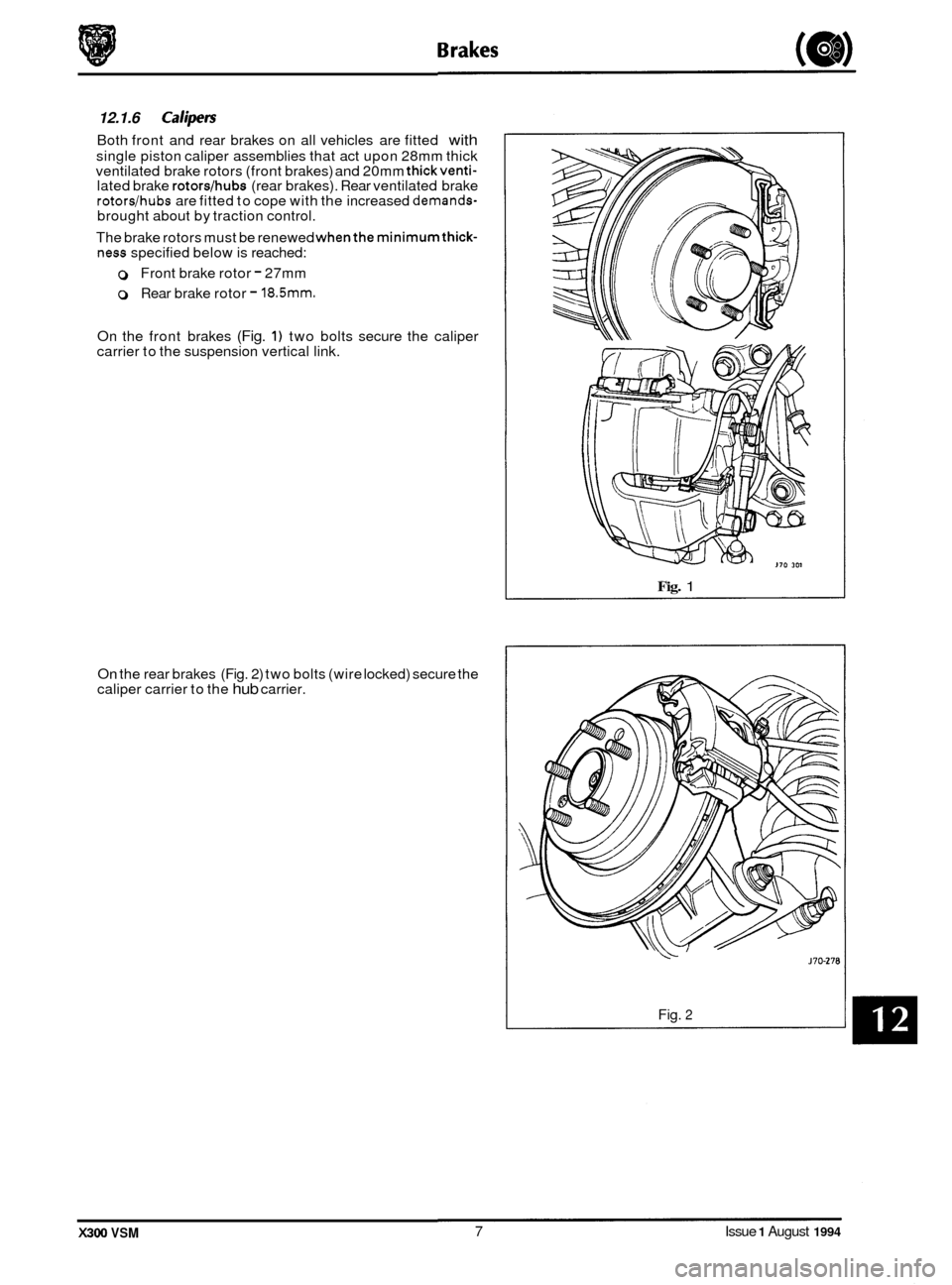
0 12.1.6 Calipers
Both front and rear brakes on all vehicles are fitted with
single piston caliper assemblies that act upon 28mm thick
ventilated brake rotors (front brakes) and 20mm thickventi- lated brake rotors/hubs (rear brakes). Rear ventilated brake rotordhubs are fitted to cope with the increased demands- brought about by traction control.
The brake rotors must be renewed
whenthe minimumthick- ness specified below is reached:
0 Front brake rotor - 27mm
0 Rear brake rotor - 18.5mm.
On the front brakes (Fig. 1) two bolts secure the caliper
carrier to the suspension vertical link.
On the rear brakes (Fig. 2) two bolts (wire locked) secure the
caliper carrier to the hub carrier.
Fig. 1
\
Fig. 2
J70-278
X300 VSM 7 Issue 1 August 1994