wheel JAGUAR XJ6 1994 2.G User Guide
[x] Cancel search | Manufacturer: JAGUAR, Model Year: 1994, Model line: XJ6, Model: JAGUAR XJ6 1994 2.GPages: 521, PDF Size: 17.35 MB
Page 33 of 521
gg Jacking, Lifting & Vehicle Recovery
.-
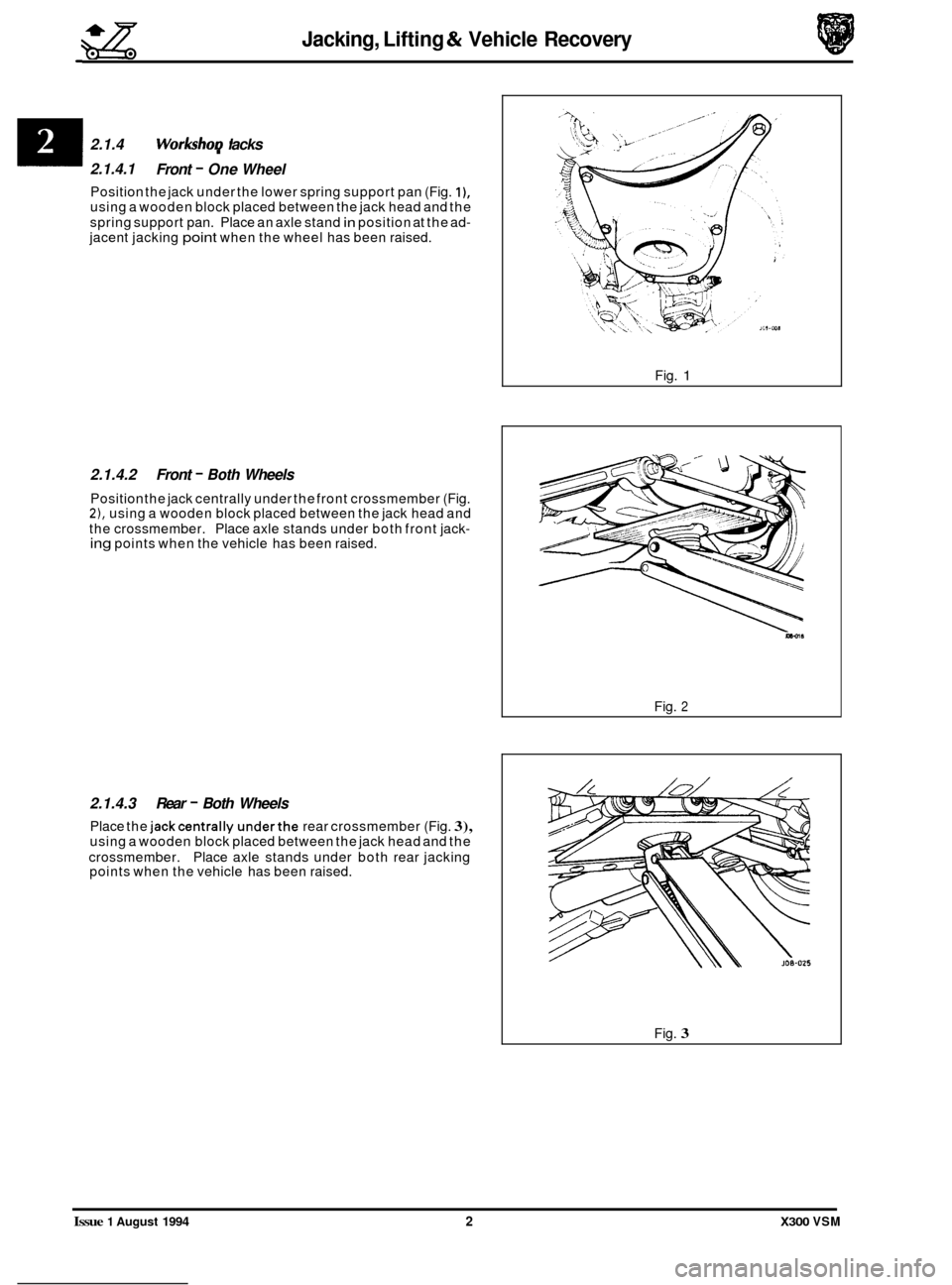
- 2.1.4.1
Front - One Wheel
Position the jack under the lower spring support pan (Fig. I), using a wooden block placed between the jack head and the
spring support pan. Place an axle stand
in position at the ad- jacent jacking point when the wheel has been raised.
2.1.4.2 Front - Both Wheels
Position the jack centrally under the front crossmember (Fig. 2), using a wooden block placed between the jack head and
the crossmember. Place axle stands under both front jack- ing points when the vehicle has been raised.
2.1.4.3 Rear - Both Wheels
Place the jackcentrally underthe rear crossmember (Fig. 3), using a wooden block placed between the jack head and the
crossmember. Place axle stands under both rear jacking
points when the vehicle has been raised.
I 2.1.4 WorkshoD lacks
Fig. 1
Fig. 2
Fig. 3
Issue 1 August 1994 2 X300 VSM
Page 35 of 521
gg Jacking, lifting & Vehicle Recovery
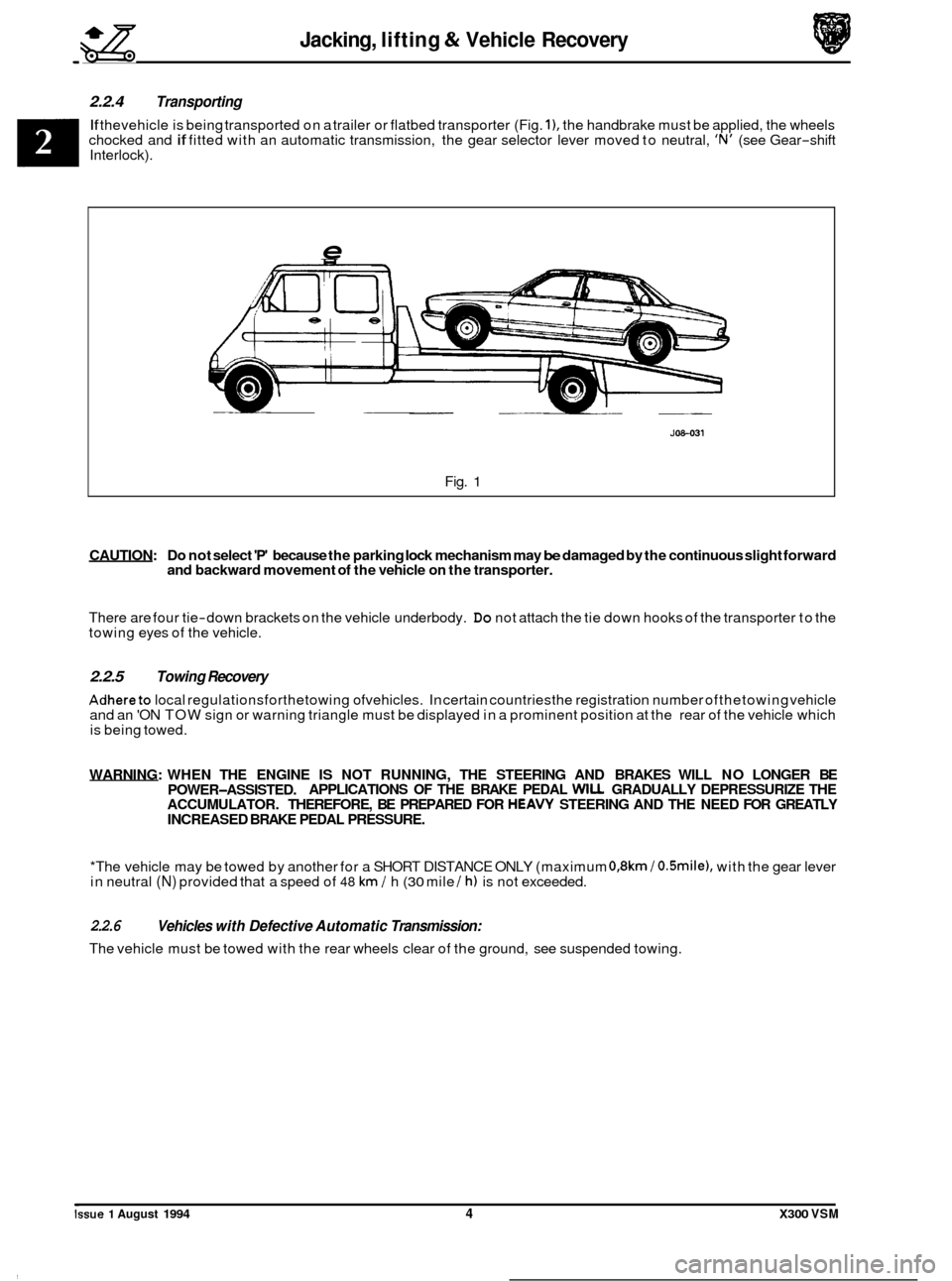
2.2.4 Transporting
If thevehicle is being transported on a trailer or flatbed transporter (Fig. I), the handbrake must be applied, the wheels
chocked and if fitted with an automatic transmission, the gear selector lever moved to neutral, 'N' (see Gear-shift
Interlock).
e
JOS-031
Fig. 1
CAUTION: Do not select 'P' because the parking lock mechanism may be damaged by the continuous slight forward
and backward movement of the vehicle on the transporter.
There are four tie-down brackets on the vehicle underbody. Do not attach the tie down hooks of the transporter to the
towing eyes of the vehicle.
2.2.5 Towing Recovery
Adhereto local regulationsforthetowing ofvehicles. In certain countriesthe registration number ofthetowing vehicle
and an 'ON TOW sign or warning triangle must be displayed in a prominent position at the rear of the vehicle which
is being towed.
WARNING: WHEN THE ENGINE
IS NOT RUNNING, THE STEERING AND BRAKES WILL NO LONGER BE
ACCUMULATOR. THEREFORE, BE PREPARED FOR
HEAVY STEERING AND THE NEED FOR GREATLY
INCREASED BRAKE PEDAL PRESSURE.
POWER-ASSISTED.
APPLICATIONS
OF THE BRAKE PEDAL WILL GRADUALLY DEPRESSURIZE THE
*The vehicle may be towed by another for a SHORT DISTANCE ONLY (maximum
0,8km / O.Smile), with the gear lever
in neutral (N) provided that a speed of 48 km / h (30 mile / h) is not exceeded.
2.2.6
The vehicle must be towed with the rear wheels clear of the ground, see suspended towing.
Vehicles with Defective Automatic Transmission:
Issue 1 August 1994 4 X300 VSM
Page 36 of 521
Jacking, lifting & Vehicle Recovery gg
2.2.7 Suspended Towing
CAUTION: Do not tow with sling-type equipment as damage to the bodywork may result. Do not front suspend tow vehides with automatic transmission.
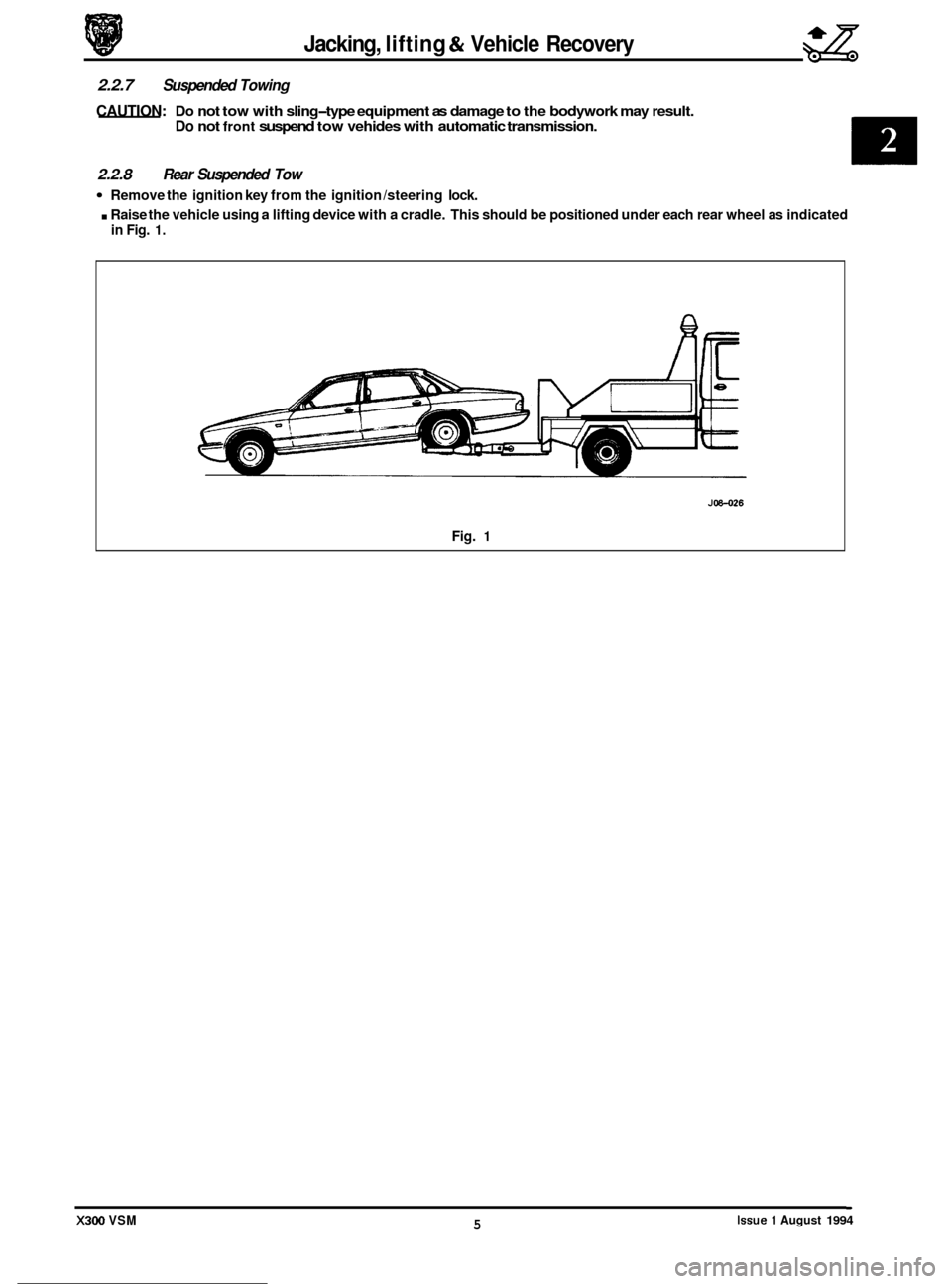
2.2.8 Rear Suspended Tow
Remove the ignition key from the ignition /steering lock.
. Raise the vehicle using a lifting device with a cradle. This should be positioned under each rear wheel as indicated
in Fig. 1.
0
0
0
J08-026
Fig. 1
Issue 1 August 1994 5 X300 VSM
Page 115 of 521
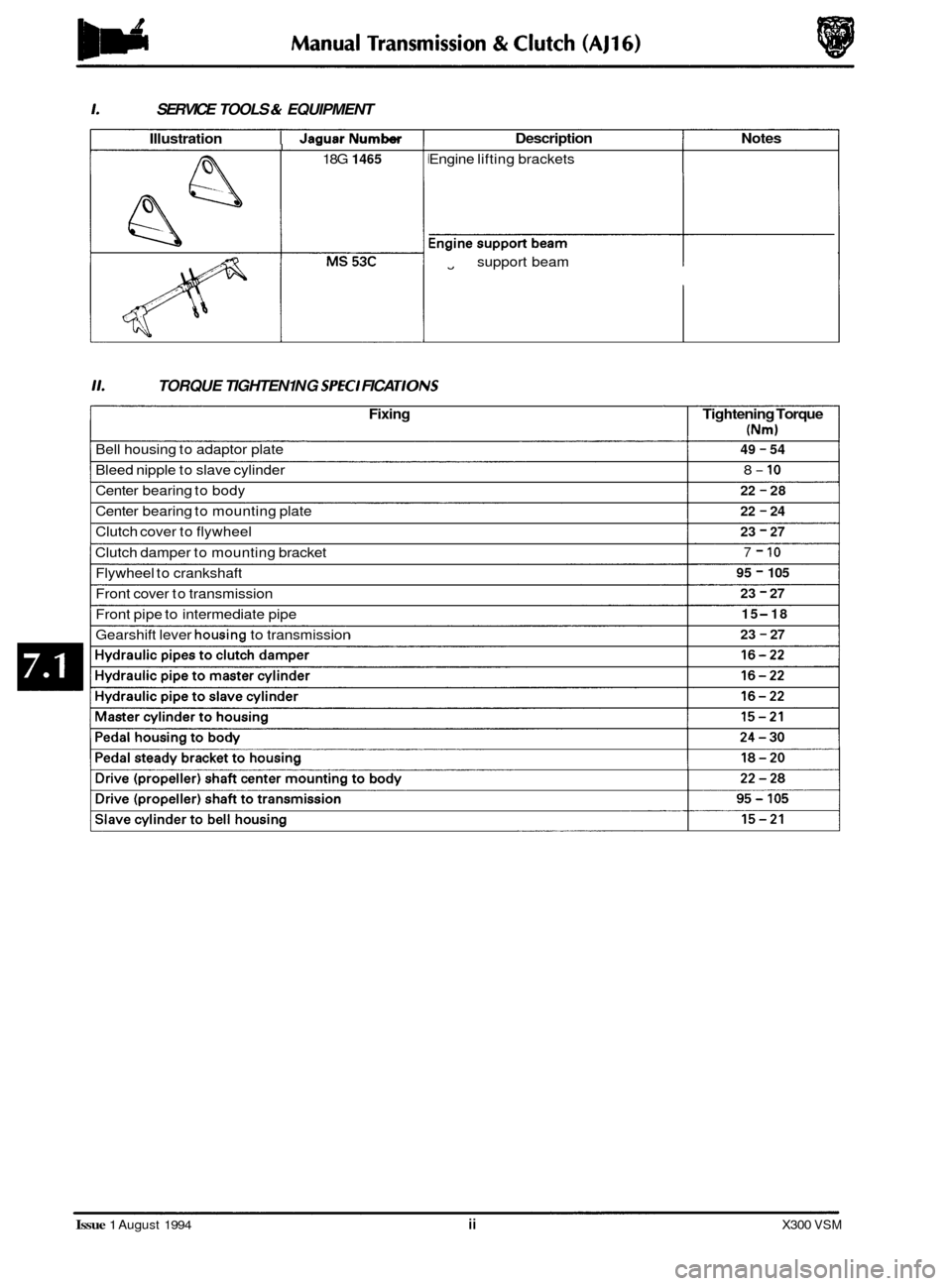
1. SERVICE TOOLS & EQUIPMENT
Illustration I JaauarNumber I -
18G 1465
Description Notes
Engine lifting brackets
Engine
fl support beam
11. TORQUE TIGHTEN1 NG SPEC1 FICA TIONS
Fixing Tightening Torque
(Nm)
49 - 54
8- 10
22 - 28
22
- 24
23 - 27
7 - 10
95 - 105
23
- 27
15
-18
23
- 27
Bell housing to adaptor plate
Bleed nipple to slave cylinder
Center bearing to body
Center bearing to mounting plate
Clutch cover to flywheel
Clutch damper to mounting bracket
Flywheel to crankshaft
Front cover to transmission
Front pipe to intermediate pipe
Gearshift lever
housing to transmission
Issue 1 August 1994 ii X300 VSM
Page 118 of 521
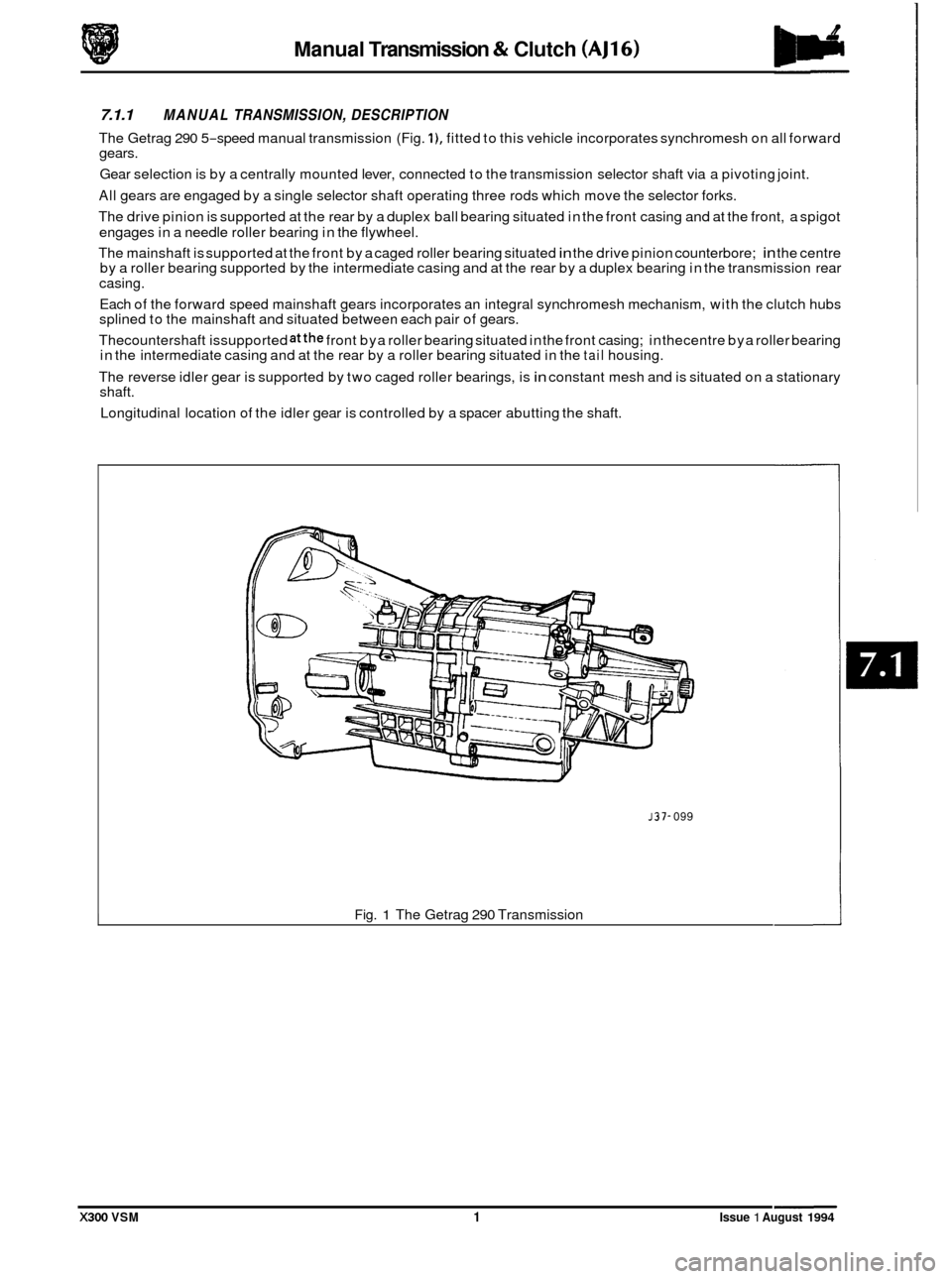
Manual Transmission & Clutch (AJ16)
7.1.1 MANUAL TRANSMISSION, DESCRIPTION
The Getrag 290 5-speed manual transmission (Fig. I), fitted to this vehicle incorporates synchromesh on all forward
gears.
Gear selection is by a centrally mounted lever, connected to the transmission selector shaft via a pivoting joint.
All gears are engaged by a single selector shaft operating three rods which move the selector forks.
The drive pinion is supported at the rear by a duplex ball bearing situated in the front casing and at the front, a spigot
engages in a needle roller bearing in the flywheel.
The mainshaft is supported at the front by a caged roller bearing situated
in the drive pinion counterbore; in the centre
by a roller bearing supported by the intermediate casing and at the rear by a duplex bearing in the transmission rear
casing.
Each of the forward speed mainshaft gears incorporates an integral synchromesh mechanism, with the clutch hubs
splined to the mainshaft and situated between each pair of gears.
Thecountershaft issupported
atthe front bya roller bearing situated in the front casing; in thecentre bya roller bearing
in the intermediate casing and at the rear by a roller bearing situated in the tail housing.
The reverse idler gear is supported by two caged roller bearings, is
in constant mesh and is situated on a stationary
shaft.
Longitudinal location of the idler gear is controlled by a spacer abutting the shaft.
J37- 099
Fig. 1 The Getrag 290 Transmission
X300 VSM 1 Issue 1 August 1994
Page 127 of 521
Manual Transmission & Clutch (AJ16)
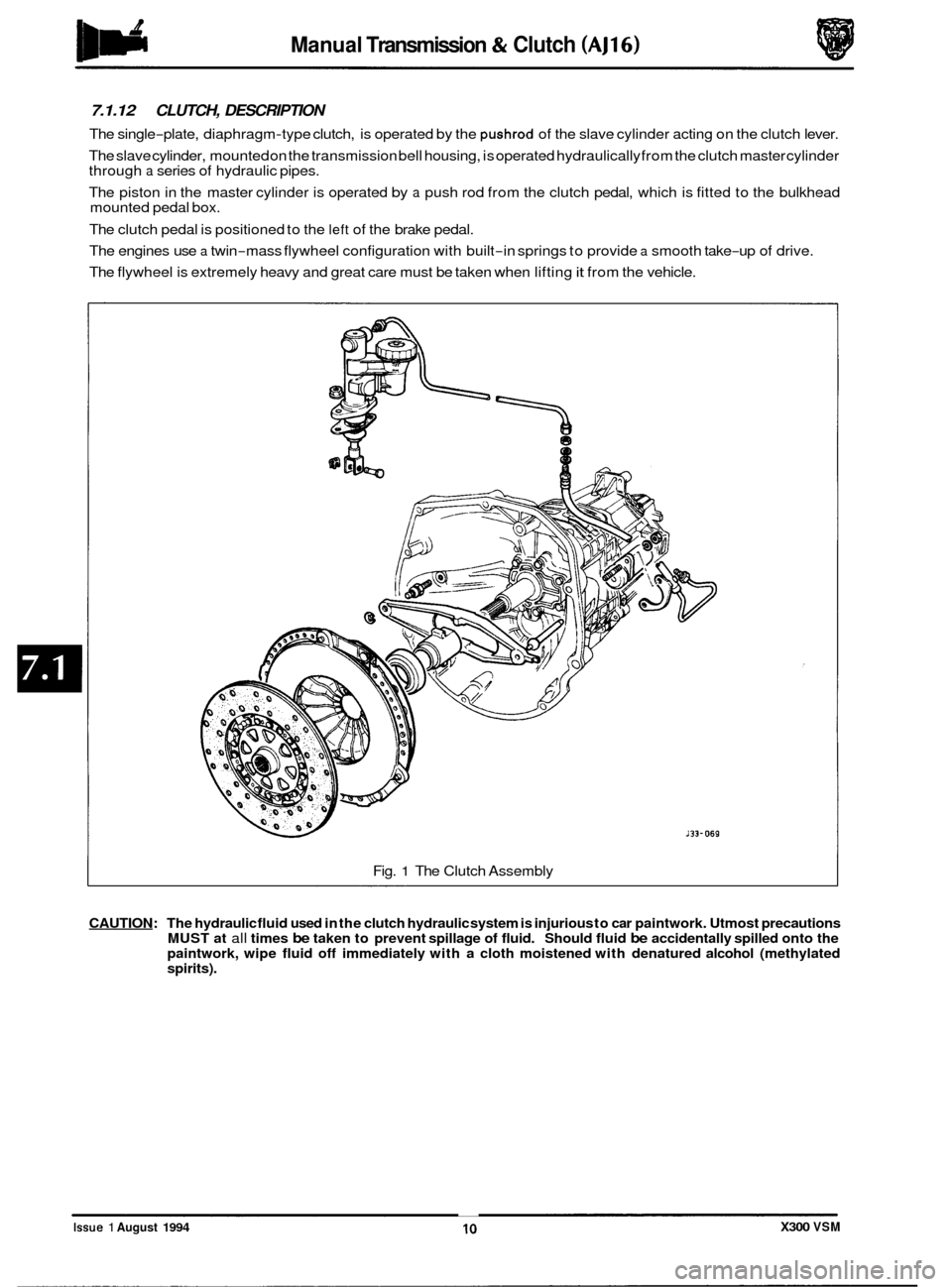
7.1.12 CLUTCH, DESCRIPTION
The single-plate, diaphragm-type clutch, is operated by the pushrod of the slave cylinder acting on the clutch lever.
The slave cylinder, mounted on the transmission bell housing, is operated hydraulically from the clutch master cylinder
through
a series of hydraulic pipes.
The piston in the master cylinder is operated
by a push rod from the clutch pedal, which is fitted to the bulkhead
mounted pedal box.
The clutch pedal is positioned to the left of the brake pedal.
The engines use
a twin-mass flywheel configuration with built-in springs to provide a smooth take-up of drive.
The flywheel is extremely heavy and great care must be taken when lifting
it from the vehicle.
Fig.
1 The Clutch Assembly
CAUTION: The hydraulic fluid used in the clutch hydraulic system is injurious to car paintwork. Utmost precautions
MUST at all times be taken to prevent spillage of fluid. Should fluid be accidentally spilled onto the
paintwork, wipe fluid off immediately with a cloth moistened with denatured alcohol (methylated
spirits).
Issue 1 August 1994 X300 VSM
Page 128 of 521
Manual Transmission & Clutch (AJl6)
0
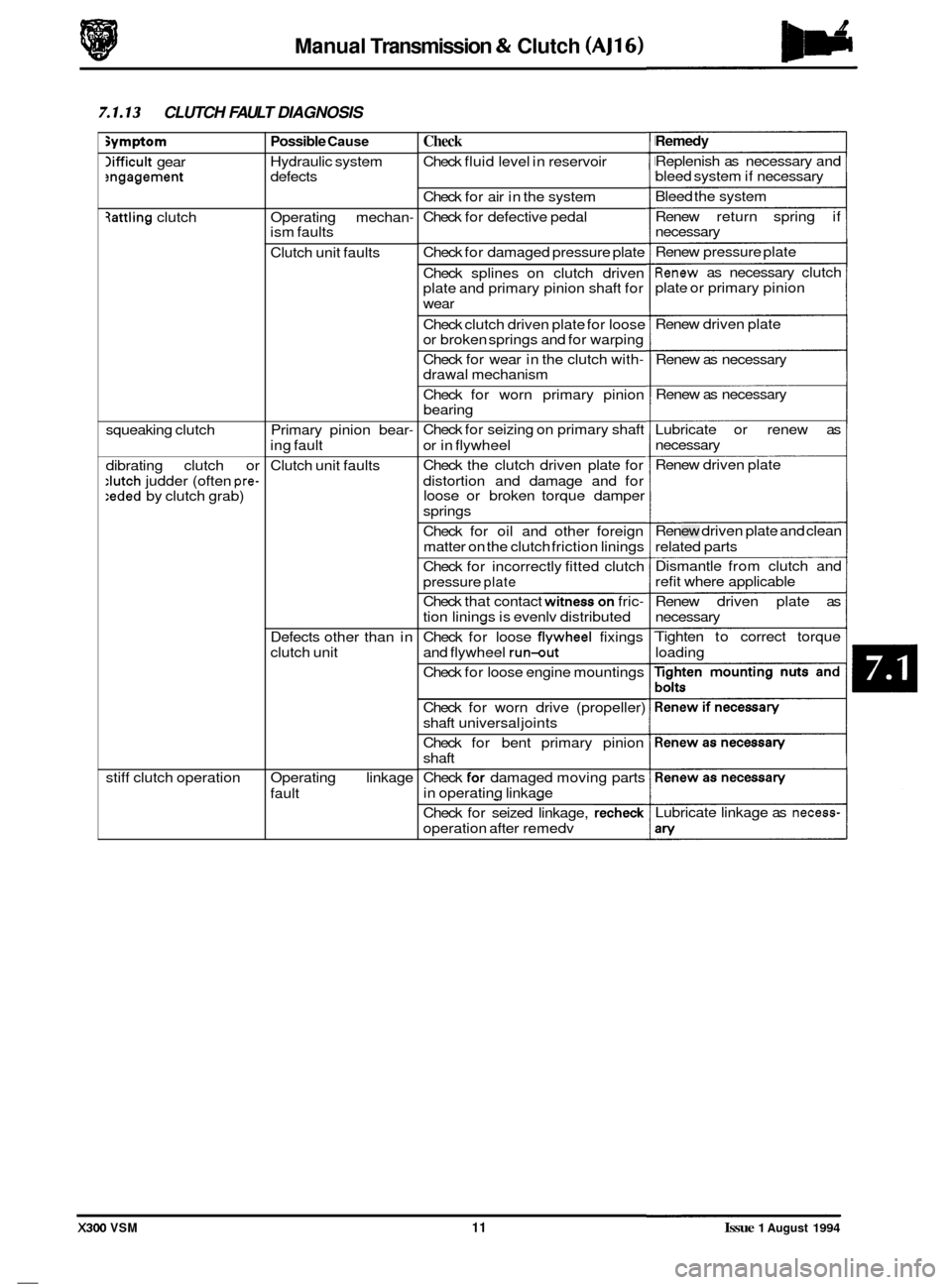
7.1.13 CLUTCH FAULT DIAGNOSIS
symptom
lifficult gear ?ngagement
3attling clutch
squeaking clutch
dibrating clutch or
:lutch judder (often pre- :eded by clutch grab)
stiff clutch operation
Possible Cause
Hydraulic system
defects
Operating mechan
- ism faults
Clutch unit faults
Primary pinion bear
-
ing fault
Clutch unit faults
Defects other than in
clutch unit
Operating linkage
fault
Check
Check fluid level in reservoir
Check for air in the system
Check for defective pedal
Check for damaged pressure plate
Check splines on clutch driven
plate and primary pinion shaft for
wear
Check clutch driven plate for loose
or broken springs and for warping
Check for wear in the clutch with
- drawal mechanism
Check for worn primary pinion
bearing
Check for seizing on primary shaft
or in flywheel
Check the clutch driven plate for
distortion and damage and for
loose or broken torque damper
springs
Check for oil and other foreign
matter on the clutch friction linings
Check for incorrectly fitted clutch
pressure
plate
Check that contact witness on fric-
tion linings is evenlv distributed -
Check for loose flvwheel fixings
and flywheel
run-out
Check for loose engine mountings
Check for worn drive (propeller)
shaft universal joints
Check for bent primary pinion
shaft
-
Check for damaged moving parts
in operating linkage
- -
Check for seized linkage, recheck
operation after remedv
Remedy
Replenish as necessary and
bleed system if necessary
Bleed the system
Renew return spring if
necessary
Renew pressure plate
Renew as necessary clutch
plate or primary pinion
Renew driven plate
Renew as necessary
Renew as necessary
Lubricate or renew as
necessary
Renew driven plate
Renew driven plate and clean
related parts
Dismantle from clutch and
refit where applicable
Renew driven plate as
necessary
Tighten to correct torque
loading
Lubricate linkage as
necess-
X300 VSM 11 Issue 1 August 1994
Page 129 of 521
Manual Transmission & Clutch (AJ16)
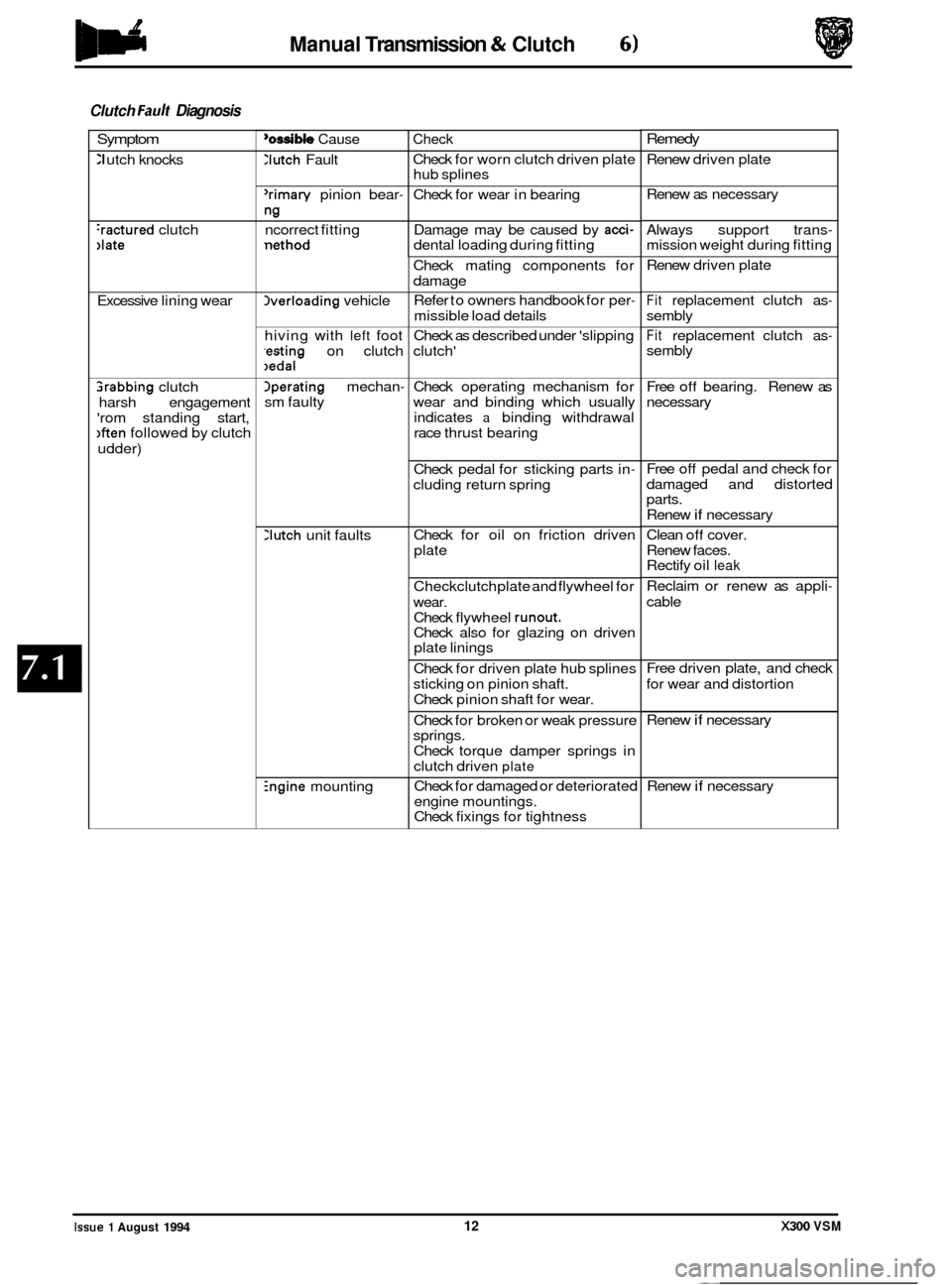
'ossible Cause
:Iutch Fault
'rimary pinion bear-
ng
ncorrect fitting nethod
Clutch Fault Diagnosis
Check
Check for worn clutch driven plate
hub splines
Check for wear in bearing
Damage may be caused by
acci- dental loading during fitting
Symptom
:I utch knocks
herloading vehicle
hiving with
left foot
,esting on clutch )edal
:ractured clutch )late
Check mating components for
damage
Refer to owners handbook for per
-
missible load details
Check as described under 'slipping
clutch'
Excessive
lining wear
lperating mechan-
sm faulty
:Iutch unit faults
3rabbing clutch
harsh engagement
'rom standing start,
Iften followed by clutch
udder) Check
operating mechanism for
wear and binding which usually
indicates
a binding withdrawal
race thrust bearing
Check pedal for sticking parts in
-
cluding return spring
Check for oil on friction driven
plate
Checkclutch plate and flywheel for
wear. Check flywheel
runout. Check also for glazing on driven
plate linings
Check for driven plate hub splines
sticking on pinion shaft.
Check pinion shaft for wear.
Check for broken or weak pressure
springs.
Check torque damper springs in
clutch driven
plate
hgine mounting Check
for damaged or deteriorated
engine mountings.
Check fixings for tightness
Remedy
Renew driven plate
Renew as necessary
Always support trans
- mission weight during fitting
Renew driven plate
Fit replacement clutch as-
sembly
Fit replacement clutch as- sembly
Free
off bearing. Renew as
necessary
Free
off pedal and check for
damaged and distorted
parts.
Renew
if necessary
Clean
off cover.
Renew faces.
Rectify oil
leak
Reclaim or renew as appli-
cable
Free driven plate, and check
for wear and distortion
Renew
if necessary
Renew
if necessary
Issue 1 August 1994 12 X300 VSM
Page 130 of 521
![JAGUAR XJ6 1994 2.G User Guide Clutch Fault Diagnosis
Symptom
Slipping clutch
[indicated by vehicle
speed not responding to
engine speed increase)
]ragging or spinning :lutch
Manual Transmission & Clutch (AJ16)
Poss](/img/21/7690/w960_7690-129.png "JAGUAR XJ6 1994 2.G User Guide Clutch Fault Diagnosis
Symptom
Slipping clutch
[indicated by vehicle
speed not responding to
engine speed increase)
]ragging or spinning :lutch
Manual Transmission & Clutch (AJ16)
Poss")
Clutch Fault Diagnosis
Symptom
Slipping clutch
[indicated by vehicle
speed not responding to
engine speed increase)
]ragging or spinning :lutch
Manual Transmission & Clutch (AJ16)
Possible Cause
Poor driving tech- nique
Operating mechan
-
ism faulty
Clutch unit faults
Operating mechan
-
ism faulty
Zlutch unit faults
2lutch unit faults
Check
Ensure that none of the remedy
conditions prevail
Checkfor binding withdrawal lever
Check for binding of clutch pedal
movement components
Check for oil on friction faces
Check for binding withdrawal lever
Check for binding of clutch pedal
movement components
Check for oil on friction faces
Check for broken or weak pressure
springs
.-
Check clutch plates and flywheel
for wear and distortion
Check clutch driven plate for frac
- tures and distortion.
Damage may be caused by acci
-
dental loading during assembly of
transmission to engine.
Always support transmission
weight during refitting
Check for primary pinion bearing
seized
Check clutch driven hub for bind
- ing on primary pinion splines.
Check for too thick friction linings.
Ensure linings
are good
Check for foreign matter in clutch
unit
Remedv
Do not increase engine speed
with clutch paGially' en-
gaged. Do not drive with left foot
resting on clutch pedal.
Free lever and check for wear
and distortion
Free
off seized or binding
components
Clean
off metal faces.
Renew driven plate.
Rectify oil leak.
Free lever and check for wear
and distortion
Free
off seized or binding
components
Clean
off metal faces.
Renew driven plate.
Rectify oil leaks.
Renew cover as necessary
Reclaim or renewclutch
plate
as applicable
Renew driven plate and
check mating components
for damage
Rectify or renew as necess
-
ary
Renew as necessary
Clean and renew compo
-
nents as necessary
X300 VSM 13 Issue 1 August 1994
Page 131 of 521
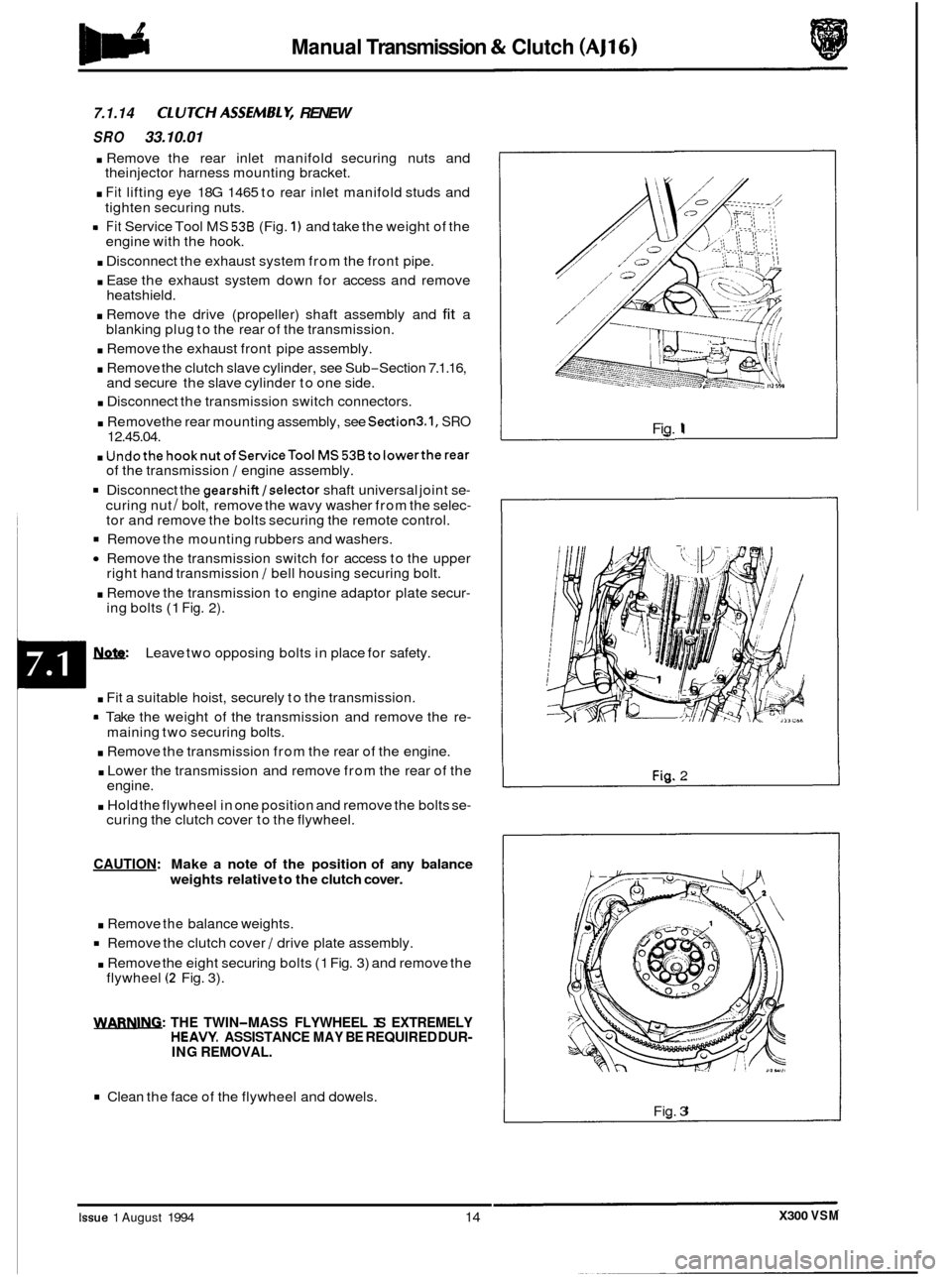
Manual Transmission & Clutch (AJ16) IBh
7.1.14 ClUTCHASSEMBLY, RENEW
SRO 33.10.01
. Remove the rear inlet manifold securing nuts and
. Fit lifting eye 18G 1465 to rear inlet manifold studs and
rn Fit Service Tool MS 538 (Fig. 1) and take the weight of the
. Disconnect the exhaust system from the front pipe.
. Ease the exhaust system down for access and remove
. Remove the drive (propeller) shaft assembly and fit a
. Remove the exhaust front pipe assembly.
. Remove the clutch slave cylinder, see Sub-Section 7.1.16,
and secure the slave cylinder to one side.
. Disconnect the transmission switch connectors.
. Removethe rear mounting assembly, see Section3.1, SRO 12.45.04.
. Undothe hooknutofServiceTool MS53Btolowertherear of the transmission / engine assembly.
Disconnect the gearshift/selector shaft universal joint se-
curing nut / bolt, remove the wavy washer from the selec- tor and remove the bolts securing the remote control.
Remove the mounting rubbers and washers.
Remove the transmission switch for access to the upper
. Remove the transmission to engine adaptor plate secur-
theinjector harness mounting bracket.
tighten securing nuts.
engine with the hook.
heatshield.
blanking plug to the rear of the transmission.
right hand transmission
/ bell housing securing bolt.
ing bolts
(1 Fig. 2).
Leave two opposing bolts in place for safety.
m . Fit a suitable hoist, securely to the transmission.
= Take the weight of the transmission and remove the re-
. Remove the transmission from the rear of the engine.
. Lower the transmission and remove from the rear of the
. Hold the flywheel in one position and remove the bolts se-
maining two securing bolts.
engine.
curing the clutch cover to the flywheel.
CAUTION: Make a note of the position of any balance
weights relative to the clutch cover.
. Remove the balance weights.
Remove the clutch cover / drive plate assembly.
. Remove the eight securing bolts (1 Fig. 3) and remove the
flywheel (2 Fig. 3).
WARNING: THE TWIN-MASS FLYWHEEL IS EXTREMELY HEAVY. ASSISTANCE MAY BE REQUIRED DUR- ING REMOVAL.
Clean the face of the flywheel and dowels.
Fig. 1
Fig. 2
Fig. 3
X300 VSM Issue 1 August 1994 14