battery JAGUAR XJ6 1994 2.G Repair Manual
[x] Cancel search | Manufacturer: JAGUAR, Model Year: 1994, Model line: XJ6, Model: JAGUAR XJ6 1994 2.GPages: 521, PDF Size: 17.35 MB
Page 350 of 521
31
30
29
28 27
26
4 26 24 21 23 22 7 20 19 18 18 17 8
a
10
11
12
13
14
1s
1M-137
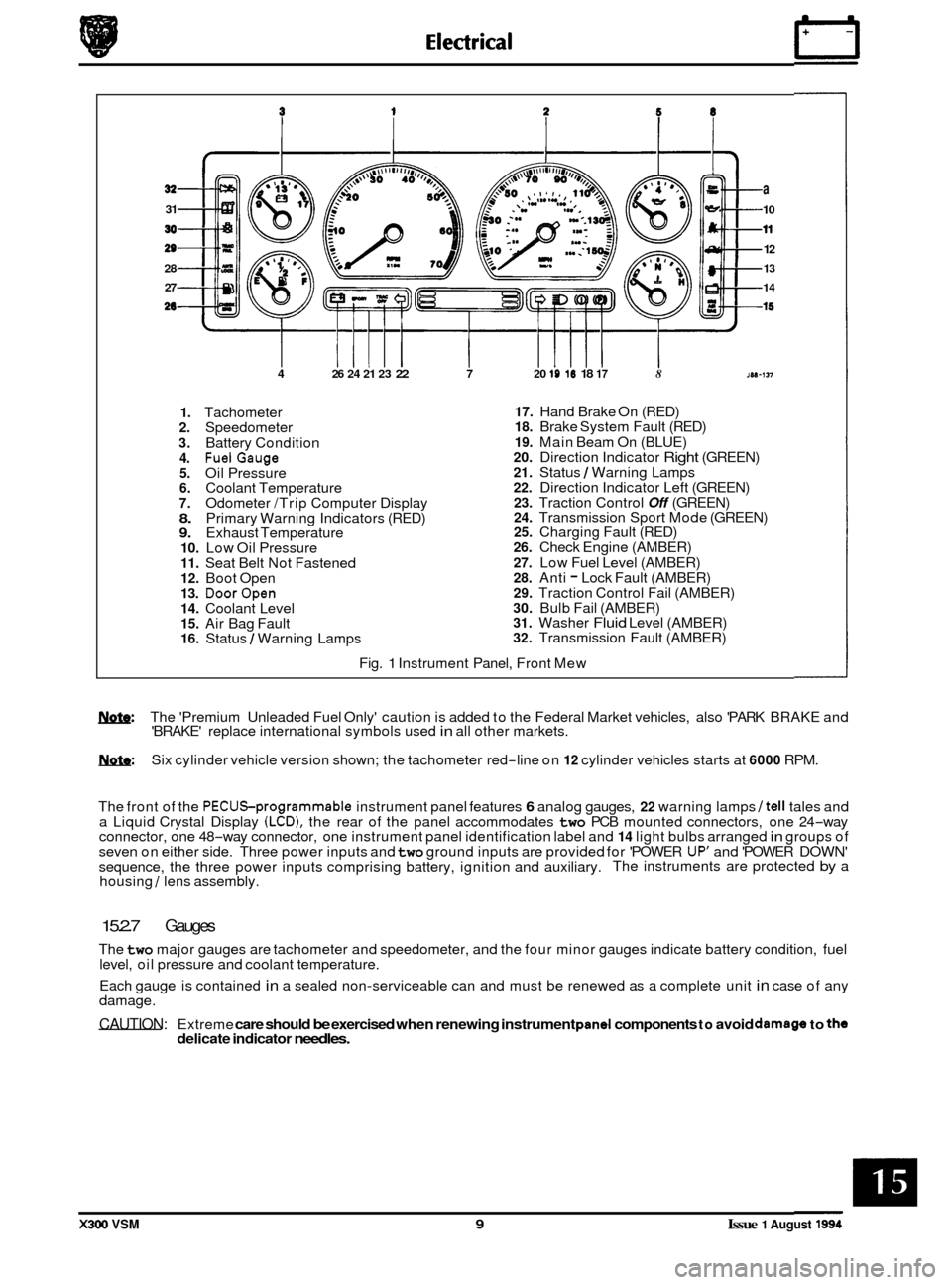
1. Tachometer 2. Speedometer
3. Battery Condition 4. FuelGauge 5. Oil Pressure 6. Coolant Temperature 7. Odometer /Trip Computer Display 8. Primary Warning Indicators (RED) 9. Exhaust Temperature 10. Low Oil Pressure 11. Seat Belt Not Fastened 12. Boot Open 13. DoorOpen 14. Coolant Level 15. Air Bag Fault 16. Status / Warning Lamps
17. Hand Brake On (RED) 18. Brake System Fault (RED)
19. Main Beam On (BLUE) 20. Direction Indicator Right (GREEN) 21. Status / Warning Lamps 22. Direction Indicator Left (GREEN) 23. Traction Control Off (GREEN) 24. Transmission Sport Mode (GREEN) 25. Charging Fault (RED) 26. Check Engine (AMBER)
27. Low Fuel Level (AMBER) 28. Anti - Lock Fault (AMBER) 29. Traction Control Fail (AMBER) 30. Bulb Fail (AMBER) 31. Washer Fluid Level (AMBER) 32. Transmission Fault (AMBER)
Fig.
1 Instrument Panel, Front Mew
w: The 'Premium Unleaded Fuel Only' caution is added to the Federal Market vehicles, also 'PARK BRAKE and
'BRAKE' replace international symbols used in all other markets.
m: Six cylinder vehicle version shown; the tachometer red-line on 12 cylinder vehicles starts at 6000 RPM.
The front of the
PECUSprogrammable instrument panel features 6 analog gauges, 22 warning lamps /tell tales and
a Liquid Crystal Display (LCD), the rear of the panel accommodates two PCB mounted connectors, one 24-way
connector, one 48-way connector, one instrument panel identification label and 14 light bulbs arranged in groups of
seven on either side. Three power inputs and two ground inputs are provided for 'POWER UP' and 'POWER DOWN'
sequence, the three power inputs comprising battery, ignition and auxiliary. The instruments are protected by a
housing
/ lens assembly.
15.2.7 Gauges
The two major gauges are tachometer and speedometer, and the four minor gauges indicate battery condition, fuel
level, oil pressure and coolant temperature.
Each gauge is contained
in a sealed non-serviceable can and must be renewed as a complete unit in case of any
damage.
CAUTION: Extreme care should be exercised when renewing instrument pand components to avoid damago to the delicate indicator needles.
X300 VSM 9 Issue 1 August 1994
Page 351 of 521
IT Electrical
15.2.8 Odometer
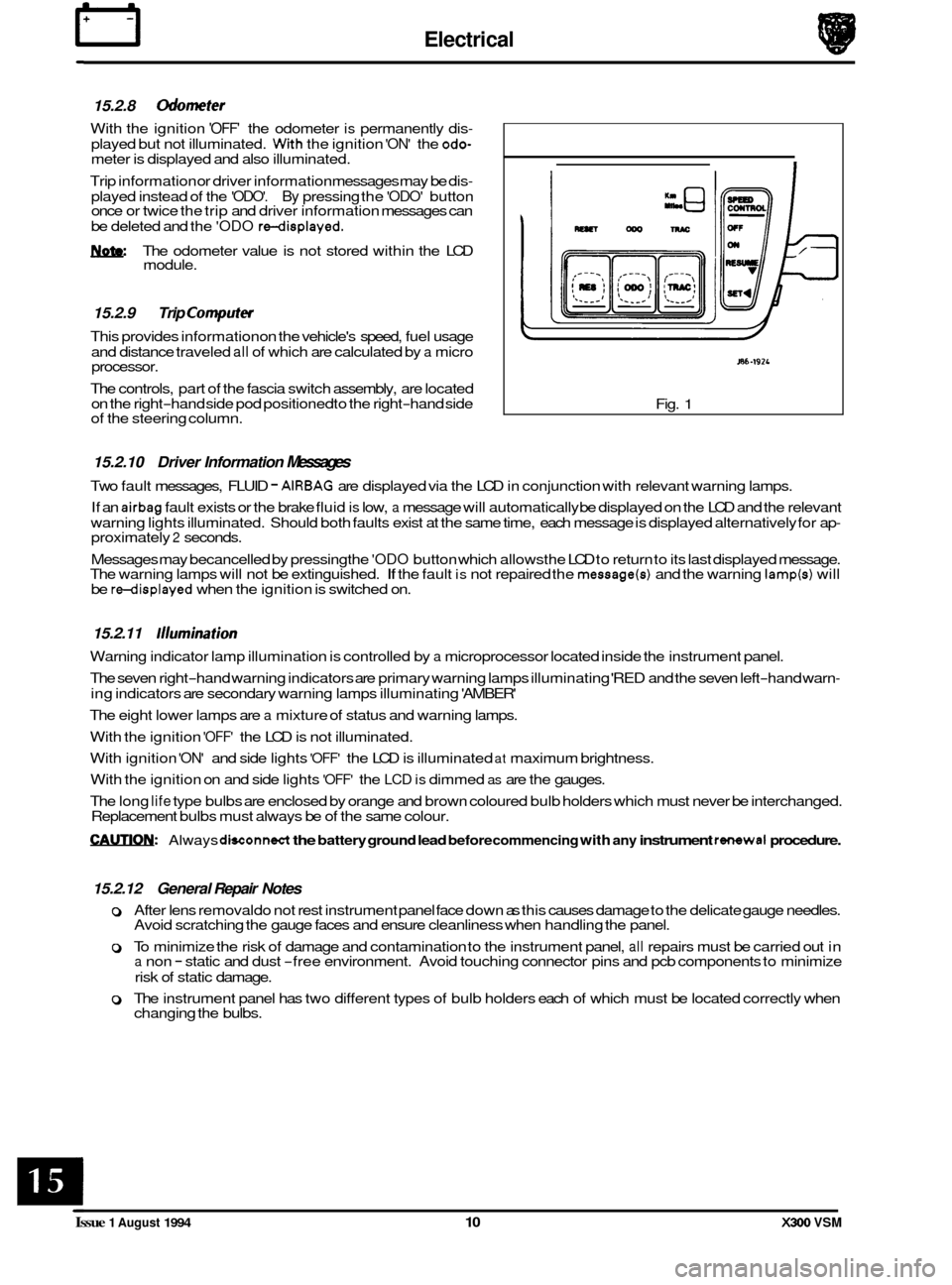
With the ignition 'OFF' the odometer is permanently dis-
played but not illuminated. With the ignition 'ON' the odo- meter is displayed and also illuminated.
Trip information or driver information messages may be dis
-
played instead of the 'ODO'. By pressing the 'ODO' button
once or twice the trip and driver information messages can
be deleted and the
'ODO rdisplayed.
W. The odometer value is not stored within the LCD
module.
15.2.9 Trip Computev
This provides information on the vehicle's speed, fuel usage
and distance traveled
all of which are calculated by a micro
processor.
The controls, part of the fascia switch assembly, are located
on the right
-hand side pod positioned to the right-hand side
of the steering column.
I
/
J86-192L
Fig. 1
15.2.10 Driver Information Messages
Two fault messages, FLUID - AIRBAG are displayed via the LCD in conjunction with relevant warning lamps.
If an
airbag fault exists or the brake fluid is low, a message will automatically be displayed on the LCD and the relevant
warning lights illuminated. Should both faults exist at the same time, each message is displayed alternatively for ap
- proximately 2 seconds.
Messages may becancelled
by pressing the 'ODO button which allowsthe LCD to return to its last displayed message.
The warning lamps will not be extinguished. If the fault is not repaired the message(s) and the warning lamp(s) will
be redisplayed when the ignition is switched on.
15.2.11 /llumination
Warning indicator lamp illumination is controlled by a microprocessor located inside the instrument panel.
The seven right
-hand warning indicators are primary warning lamps illuminating 'RED and the seven left-hand warn-
ing indicators are secondary warning lamps illuminating 'AMBER'
The eight lower lamps are
a mixture of status and warning lamps.
With the ignition
'OFF' the LCD is not illuminated.
With ignition
'ON' and side lights 'OFF' the LCD is illuminated at maximum brightness.
With the ignition on and side lights
'OFF' the LCD is dimmed as are the gauges.
The long
life type bulbs are enclosed by orange and brown coloured bulb holders which must never be interchanged.
Replacement bulbs must always be of the same colour.
CAUTIQN: Always dwonnect the battery ground lead before commencing with any instrument rsimwal procedure.
15.2.12 General Repair Notes
0 After lens removal do not rest instrument panel face down as this causes damage to the delicate gauge needles.
Avoid scratching the gauge faces and ensure cleanliness when handling the panel.
0 To minimize the risk of damage and contamination to the instrument panel, all repairs must be carried out in a non - static and dust -free environment. Avoid touching connector pins and pcb components to minimize
risk of static damage.
0 The instrument panel has two different types of bulb holders each of which must be located correctly when
changing the bulbs.
Issue 1 August 1994 10 X300 VSM
Page 354 of 521
UK Market
Battery Capacity 7214 120hr
Rapid discharge voltage
Reserve capacity duration
Rapid
discharge current
590A at -18OC
7.5V at -18OC
25A at 135 minutes
Reat of World
92A 120hr
7.5V at -18OC
25A at 170 minutes
700A at -18OC
Open circuit voltage 12.70V 12.37V 12.11V 11.74V
Specific gravity voltage (temperature 1.280 1.225 1.180 1.120
compensated hydrometer)
% Charged 100 75 50 25
11.30V
1.050
0
Battmy Condition
Specific gravity State of charge
(temp. compensated
hydrometer)
1.180 to 1.225
1.120
to 1.180
1.050
to 1.120 50%
to 75%
25%
to 50%
0 to 20% Charge
Rates
Maximum Slow
charge rate
1 times charge
rate 1 times
20A 1120 min.
30A1120 min.
40A 1120 min.
5A 1 240 min.
10A 1 240 min.
15A 1 240 min.
Test Load Electrolyte lemper8ture (OC)
Load to half battery cold cranking
Load to half battery cold cranking
amps
(ROW): 295A 21.11
amps (UK): 295A
15.55
10.00
4.44
-1.11
-6.66
-12.22
-17.77
Min. Voltage Under 1Ssec. Load
9.6V
9.5v
9.4v
9.3v
9.1v
8.9V
8.7V
8.5V
Page 355 of 521
15.5.8 wific Gravity Test
The specific gravity of the electrolyte determines the level of the float in the liquid. With the float in a high position
the specific gravity is high and when the specific gravity is low the float sinks to the lower position.
Using
a hydrometer the specific gravity readings are taken when the liquid level crosses the scale on float. This should
give a accurate indication of the state charge of the battery.
The volume and the specific gravity of the electrolyte varies with the change in temperature.
15.5.9 Electrolyte Temperature Correctkm
For every 10- below 15% subtract 0.007 from the hydrometer reading, and for every 10°C above 15OC add 0.007 to
the hydrometer reading.
Note: Use only distilled water for topping up electrolyte. The electrolyte must not exceed 51.66OC during charging.
If after 30 minutes charging the battery current is not equal or greater than 3A, dispose of the battery.
15.5.10 Heahh and Sakty Precautions
As batteries contain sulphuric acid and explosive mixtures of hydrogen and oxygen gases, it is strongly recommended
that protective clothing is worn.
Avoid spilling acid to prevent damage to clothing and skin bums.
If accidentalty spilled or splashed on clothing or skin, rinse with cold water. As a neutralizer, a solution of baking soda
or ammonia and water may be used.
In the event of skin or eye contact rinse the affected areas with water and should this not
be sufficient seek medical
attention.
Any trace of acid spilled or splashed on the vehicle should be rinsed with clean water.
BEFORE AND WHILST WORKING WITH THE BATTERY BE AWARE OF THE FOLLOWING SAFETY PRECAUTIONS
o particularly during charging, highly explosive hydrogen is emitted.
0 do not smoke when working near the battery.
o avoid sparks, short circuits or other sources of ignition.
o switch off current before connecting or disconnecting any electrical terminals.
o always disconnect battery ground lead first and reconnect last.
o ensure battery is charged in a well ventilated area.
o switch off the charger before disconnecting.
WARNING: WHEN PREPARING ELECTROLYTE OF A DESIRED SPECIFIC GRAVITY, ALWAYS POUR THE
CONCENTRATED ACID SLOWLY INTO THE WATER AND NOT WATER INTO THE ACID.
HEAT IS GENERATED WHEN MIXING ACID WITH WATER, HENCE ADD SMALL AMOUNTS OF ACID AND
STIR SLOWLY INTO THE WATER. ALLOW TO COOL IF NOTICEABLE HEAT DEVELOPS. EXCEPT FOR LEAD
DO NOT STORE ACID
IN EXCESSIVELY WARM LOCATIONS OR DIRECT SUN LIGHT.FUEL VAPOUR IS EXTREMELY FLAMMABLE, HENCE GREAT CARE MUST BE TAKEN WHILST WORKING ON THE FUEL
SYSTEM. LINED
CONTAINERS, ALWAYS USE NON
- METALLIC CONTAINERS AND / OR FUNNELS.
Issue 1 August 1994 14 X300 VSM
Page 356 of 521

15.5.11 6atteq5 Remove & Refit
0 SRO 86.15.01
Remove
m Open the trunk lid.
Remove the battery cover.
Disconnect and insulate the battery negative lead (1 Fig. 1).
Disconnect and insulate the positive lead (2 Fig. 1).
Remove the battery (3 Fig. 1).
Rea
Refitting is a reversal of the removal procedure.
Issue 1 August 1994 X300 VSM 15
Page 363 of 521

Electrical
0
15.10 HARNESSES & CABLES
15.10.1 Battery Power Distribution Cabk, General Description
1 2 8
10-
Fig.1 Battery Power Distribution Cables
Figure 1 shows
a plan view of the battery power distribution cables and their distribution points. This illustration is
to be read in conjunction with the following table. To avoid any accidents such as electric shocks, always disconnect
the battery negative lead from the battery negative terminal before disconnecting any of the listed cables.
Page 364 of 521
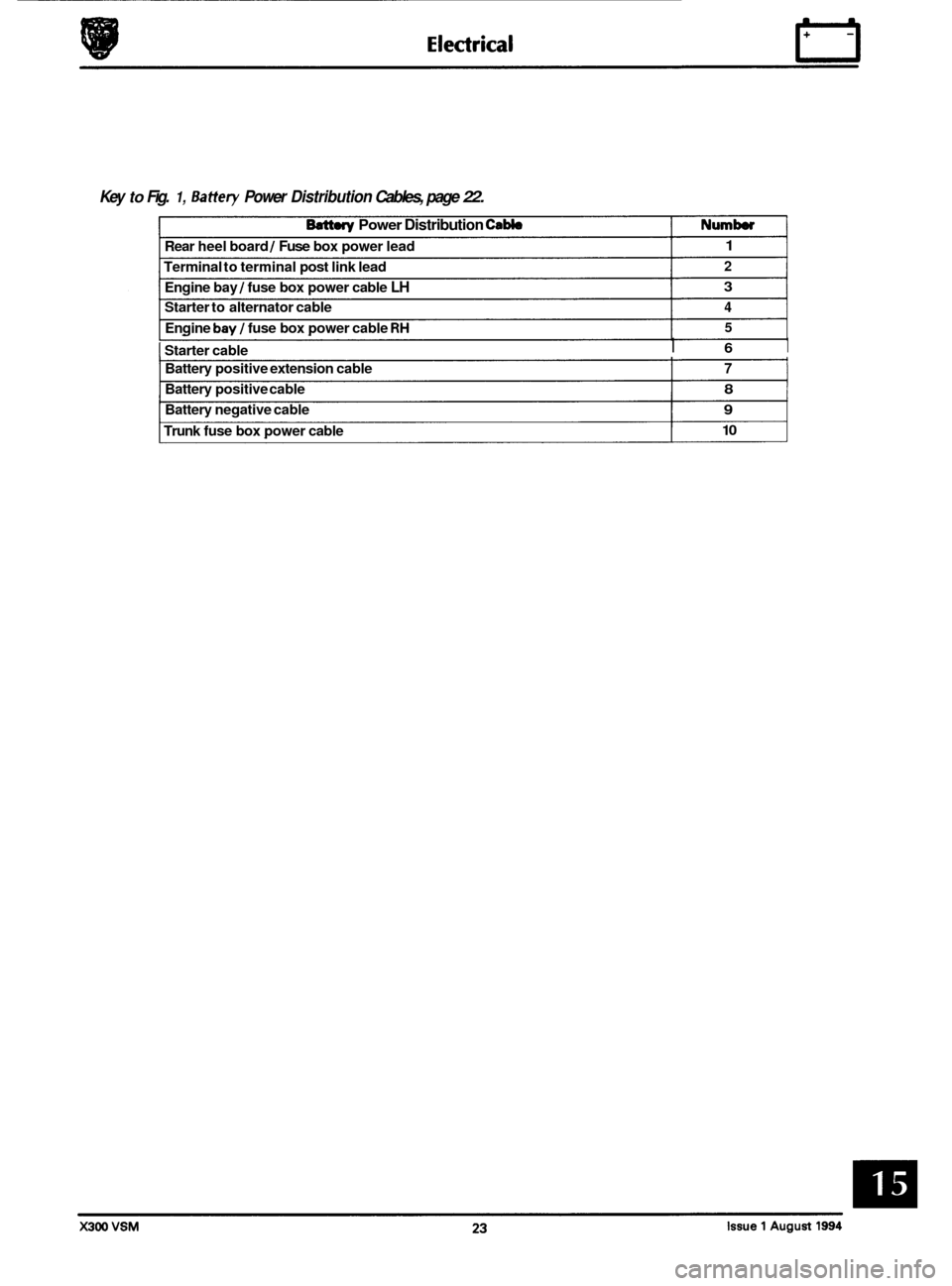
Key to Fig. 1, Battery Power Distribution Cables, page 22.
Rear heel board 1 Fuse box power lead 1
Terminal to terminal post link lead 2
Engine bay 1 fuse box power cable LH 3
Starter to alternator cable 4
Engine bay 1 fuse box power cable RH 5
Batt.ry Power Distribution Cabb Numb
1 Starter cable I 6 I
Battery positive extension cable 7
Battery positive cable 8
Battery negative cable 9
Trunk fuse box power cable 10
Page 365 of 521
IT E I ectr ical
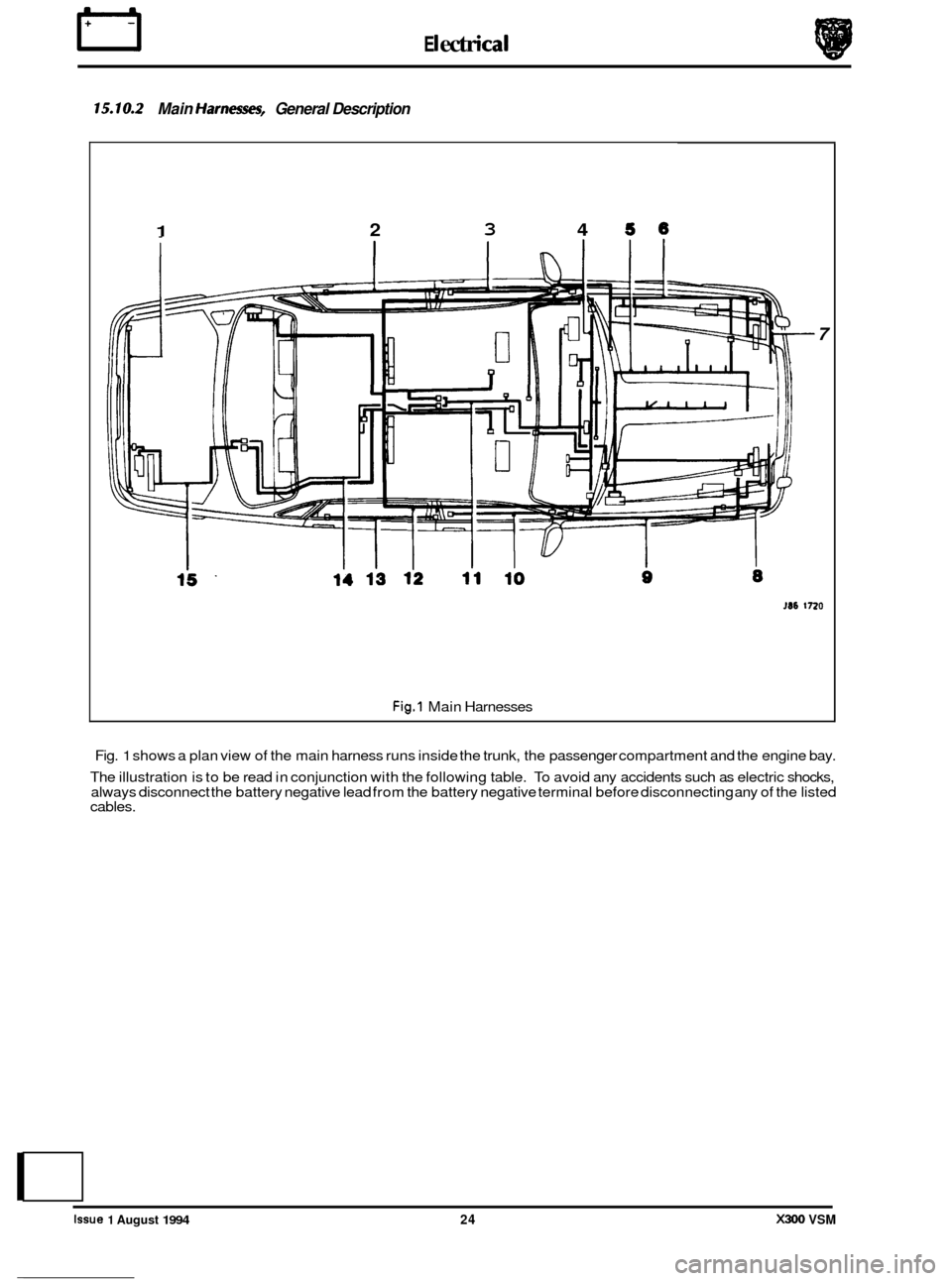
15.10.2 Main Harnm, General Description
1 2 3 4 56
7
M6 1720
Fig.1 Main Harnesses
Fig.
1 shows a plan view of the main harness runs inside the trunk, the passenger compartment and the engine bay.
The illustration is to be read in conjunction with the following table.
To avoid any accidents such as electric shocks,
always disconnect the battery negative lead from the battery negative terminal before disconnecting any of the listed
cables.
e
0
0
0
Issue 1 August 1994 24 X300 VSM
Page 367 of 521
rl Electrical
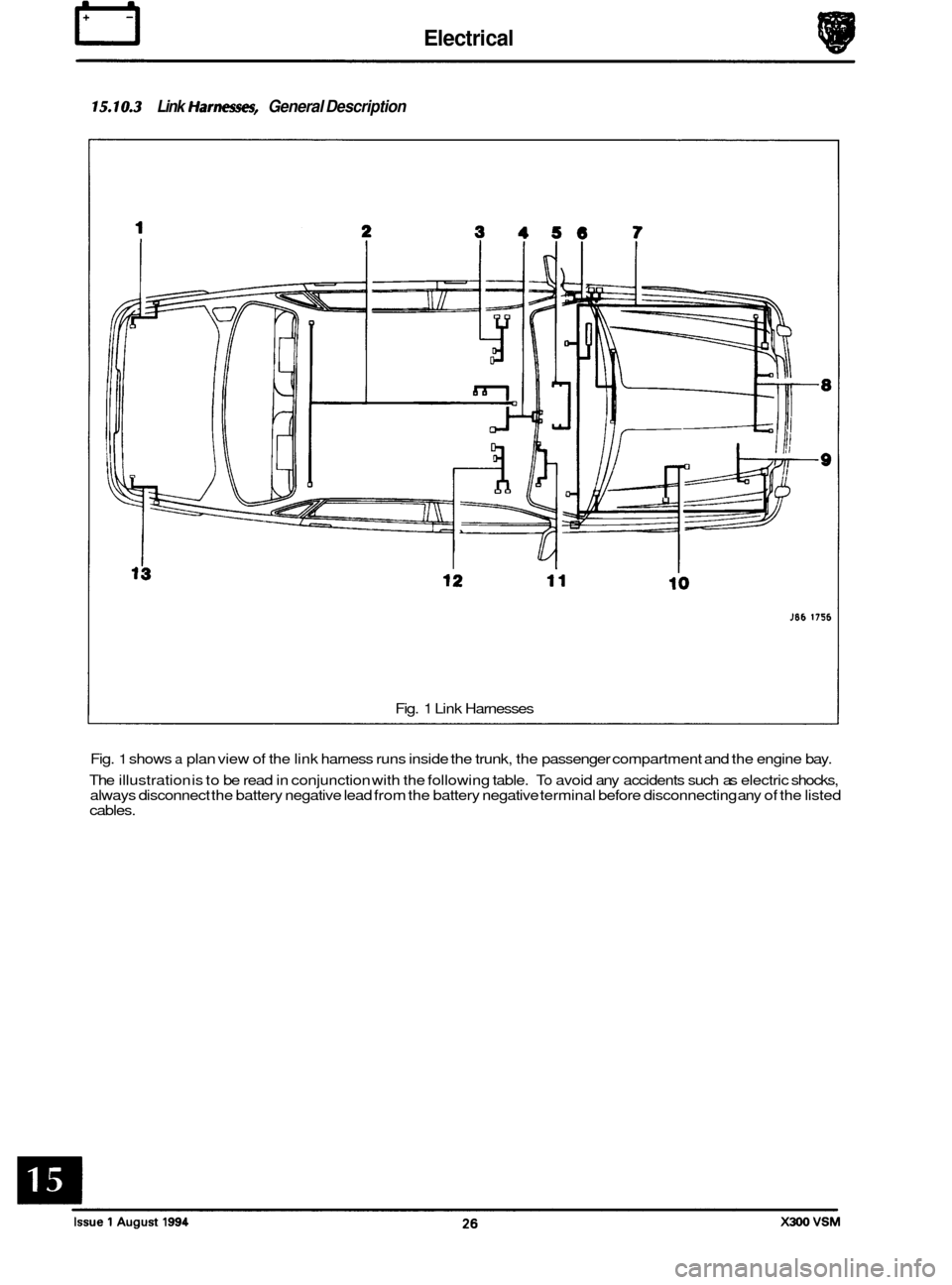
'5.10.3 Link /farnest?$, General Description
Fig. 1 Link Harnesses
Fig.
1 shows a plan view of the link harness runs inside the trunk, the passenger compartment and the engine bay.
The illustration is to be read in conjunction with the following table.
To avoid any accidents such as electric shocks,
always disconnect the battery negative lead from the battery negative terminal before disconnecting any of the listed
cables.
Page 369 of 521

I3 Electrical
'5.10.4 Hamess Connecton, General Descriptbn
21
1 23 4 7 09
10
Fig. 1 Harness Connectors
Fig.
1 shows a plan view of the harness connectors physically linking all the harnesses located in the trunk, the passen- ger compartment and the engine bay.
The illustration
is to be read in conjunction with the following table. To avoid any accidents such as electric shocks,
always disconnect the battery negative lead from the battery negative terminal before disconnecting any of the listed
cables.