wheel torque JAGUAR XJ6 1997 2.G User Guide
[x] Cancel search | Manufacturer: JAGUAR, Model Year: 1997, Model line: XJ6, Model: JAGUAR XJ6 1997 2.GPages: 227, PDF Size: 7.2 MB
Page 42 of 227
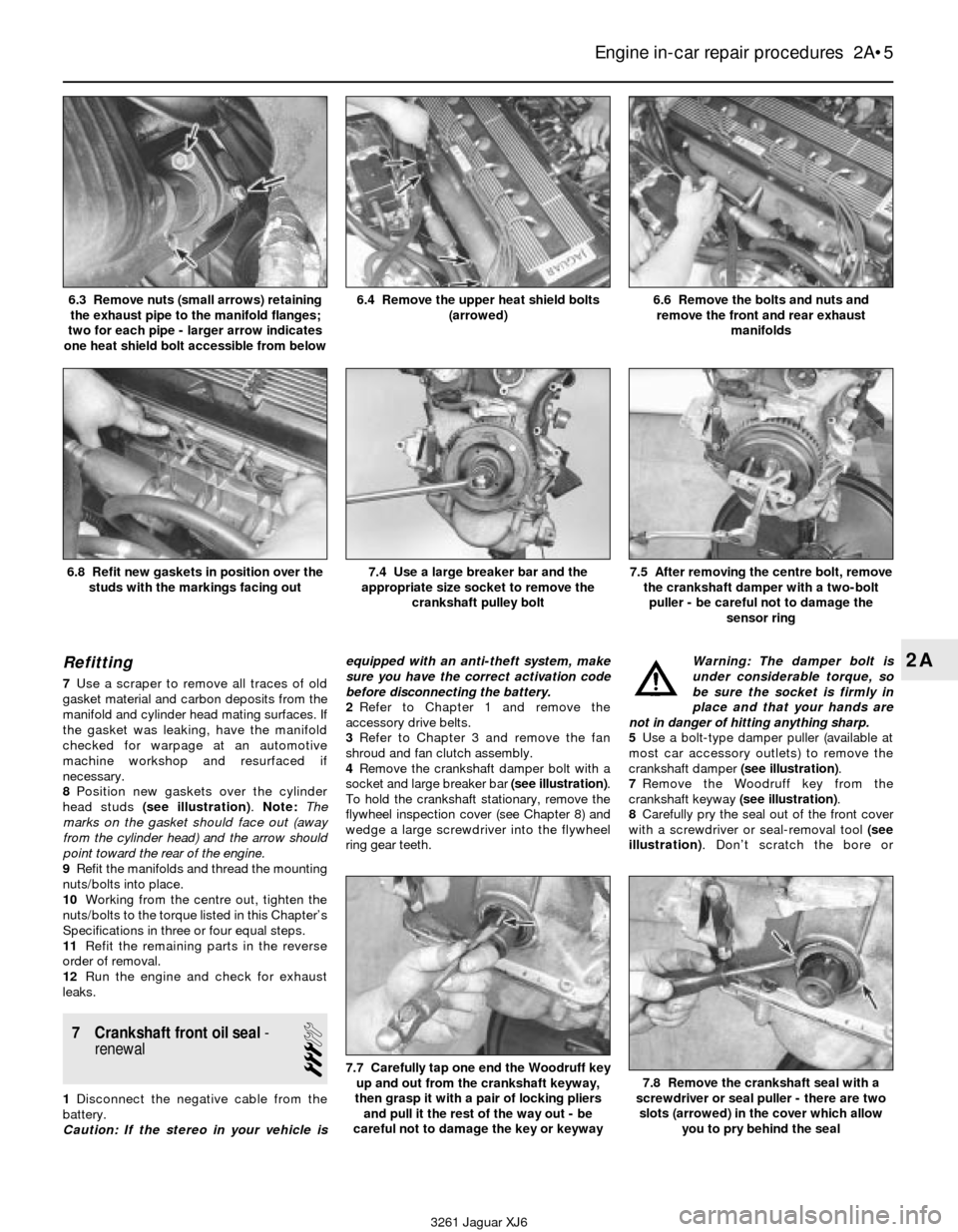
Refitting
7Use a scraper to remove all traces of old
gasket material and carbon deposits from the
manifold and cylinder head mating surfaces. If
the gasket was leaking, have the manifold
checked for warpage at an automotive
machine workshop and resurfaced if
necessary.
8Position new gaskets over the cylinder
head studs (see illustration). Note:The
marks on the gasket should face out (away
from the cylinder head) and the arrow should
point toward the rear of the engine.
9Refit the manifolds and thread the mounting
nuts/bolts into place.
10Working from the centre out, tighten the
nuts/bolts to the torque listed in this Chapter’s
Specifications in three or four equal steps.
11Refit the remaining parts in the reverse
order of removal.
12Run the engine and check for exhaust
leaks.
7 Crankshaft front oil seal-
renewal
3
1Disconnect the negative cable from the
battery.
Caution: If the stereo in your vehicle isequipped with an anti-theft system, make
sure you have the correct activation code
before disconnecting the battery.
2Refer to Chapter 1 and remove the
accessory drive belts.
3Refer to Chapter 3 and remove the fan
shroud and fan clutch assembly.
4Remove the crankshaft damper bolt with a
socket and large breaker bar (see illustration).
To hold the crankshaft stationary, remove the
flywheel inspection cover (see Chapter 8) and
wedge a large screwdriver into the flywheel
ring gear teeth. Warning: The damper bolt is
under considerable torque, so
be sure the socket is firmly in
place and that your hands are
not in danger of hitting anything sharp.
5Use a bolt-type damper puller (available at
most car accessory outlets) to remove the
crankshaft damper (see illustration).
7Remove the Woodruff key from the
crankshaft keyway (see illustration).
8Carefully pry the seal out of the front cover
with a screwdriver or seal-removal tool(see
illustration). Don’t scratch the bore or
Engine in-car repair procedures 2A•5
2A
6.3 Remove nuts (small arrows) retaining
the exhaust pipe to the manifold flanges;
two for each pipe - larger arrow indicates
one heat shield bolt accessible from below6.4 Remove the upper heat shield bolts
(arrowed)6.6 Remove the bolts and nuts and
remove the front and rear exhaust
manifolds
6.8 Refit new gaskets in position over the
studs with the markings facing out
7.7 Carefully tap one end the Woodruff key
up and out from the crankshaft keyway,
then grasp it with a pair of locking pliers
and pull it the rest of the way out - be
careful not to damage the key or keyway7.8 Remove the crankshaft seal with a
screwdriver or seal puller - there are two
slots (arrowed) in the cover which allow
you to pry behind the seal
7.4 Use a large breaker bar and the
appropriate size socket to remove the
crankshaft pulley bolt7.5 After removing the centre bolt, remove
the crankshaft damper with a two-bolt
puller - be careful not to damage the
sensor ring
3261 Jaguar XJ6
Page 43 of 227
damage the crankshaft in the process (if the
crankshaft is damaged, the new seal will end
up leaking).
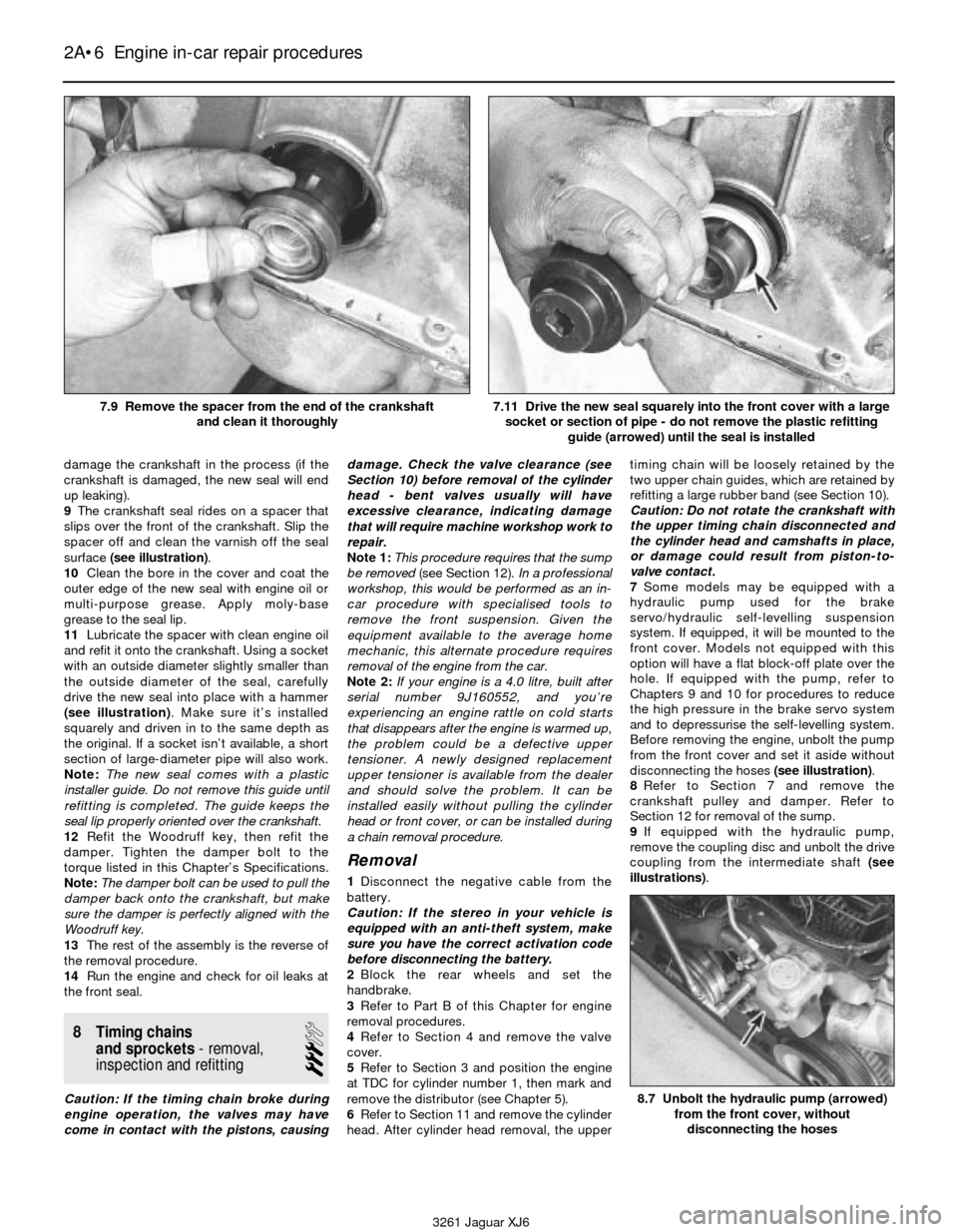
9The crankshaft seal rides on a spacer that
slips over the front of the crankshaft. Slip the
spacer off and clean the varnish off the seal
surface (see illustration).
10Clean the bore in the cover and coat the
outer edge of the new seal with engine oil or
multi-purpose grease. Apply moly-base
grease to the seal lip.
11Lubricate the spacer with clean engine oil
and refit it onto the crankshaft. Using a socket
with an outside diameter slightly smaller than
the outside diameter of the seal, carefully
drive the new seal into place with a hammer
(see illustration). Make sure it’s installed
squarely and driven in to the same depth as
the original. If a socket isn’t available, a short
section of large-diameter pipe will also work.
Note:The new seal comes with a plastic
installer guide. Do not remove this guide until
refitting is completed. The guide keeps the
seal lip properly oriented over the crankshaft.
12Refit the Woodruff key, then refit the
damper. Tighten the damper bolt to the
torque listed in this Chapter’s Specifications.
Note:The damper bolt can be used to pull the
damper back onto the crankshaft, but make
sure the damper is perfectly aligned with the
Woodruff key.
13The rest of the assembly is the reverse of
the removal procedure.
14Run the engine and check for oil leaks at
the front seal.
8 Timing chains
and sprockets- removal,
inspection and refitting
3
Caution: If the timing chain broke during
engine operation, the valves may have
come in contact with the pistons, causingdamage. Check the valve clearance (see
Section 10) before removal of the cylinder
head - bent valves usually will have
excessive clearance, indicating damage
that will require machine workshop work to
repair.
Note 1:This procedure requires that the sump
be removed (see Section 12).In a professional
workshop, this would be performed as an in-
car procedure with specialised tools to
remove the front suspension. Given the
equipment available to the average home
mechanic, this alternate procedure requires
removal of the engine from the car.
Note 2:If your engine is a 4.0 litre, built after
serial number 9J160552, and you’re
experiencing an engine rattle on cold starts
that disappears after the engine is warmed up,
the problem could be a defective upper
tensioner. A newly designed replacement
upper tensioner is available from the dealer
and should solve the problem. It can be
installed easily without pulling the cylinder
head or front cover, or can be installed during
a chain removal procedure.
Removal
1Disconnect the negative cable from the
battery.
Caution: If the stereo in your vehicle is
equipped with an anti-theft system, make
sure you have the correct activation code
before disconnecting the battery.
2Block the rear wheels and set the
handbrake.
3Refer to Part B of this Chapter for engine
removal procedures.
4Refer to Section 4 and remove the valve
cover.
5Refer to Section 3 and position the engine
at TDC for cylinder number 1, then mark and
remove the distributor (see Chapter 5).
6Refer to Section 11 and remove the cylinder
head. After cylinder head removal, the uppertiming chain will be loosely retained by the
two upper chain guides, which are retained by
refitting a large rubber band (see Section 10).
Caution: Do not rotate the crankshaft with
the upper timing chain disconnected and
the cylinder head and camshafts in place,
or damage could result from piston-to-
valve contact.
7Some models may be equipped with a
hydraulic pump used for the brake
servo/hydraulic self-levelling suspension
system. If equipped, it will be mounted to the
front cover. Models not equipped with this
option will have a flat block-off plate over the
hole. If equipped with the pump, refer to
Chapters 9 and 10 for procedures to reduce
the high pressure in the brake servo system
and to depressurise the self-levelling system.
Before removing the engine, unbolt the pump
from the front cover and set it aside without
disconnecting the hoses (see illustration).
8Refer to Section 7 and remove the
crankshaft pulley and damper. Refer to
Section 12 for removal of the sump.
9If equipped with the hydraulic pump,
remove the coupling disc and unbolt the drive
coupling from the intermediate shaft (see
illustrations).
2A•6 Engine in-car repair procedures
8.7 Unbolt the hydraulic pump (arrowed)
from the front cover, without
disconnecting the hoses
3261 Jaguar XJ6 7.9 Remove the spacer from the end of the crankshaft
and clean it thoroughly
7.11 Drive the new seal squarely into the front cover with a large
socket or section of pipe - do not remove the plastic refitting
guide (arrowed) until the seal is installed
Page 54 of 227

2Use a centre punch or paint to make
alignment marks on the driveplate and
crankshaft to ensure correct alignment during
refitting(see illustration).
3Remove the bolts that secure the driveplate
to the crankshaft. If the crankshaft turns,
wedge a screwdriver through a hole in the
driveplate to keep it from turning (see
illustration).
4Remove the driveplate from the crankshaft.
A spacer is located behind the driveplate(see
illustration). Pry it off and store it with the
driveplate.
Warning: The ring-gear teeth
may be sharp, wear gloves to
protect your hands when
handling the driveplate.
Refitting
5Clean the driveplate to remove grease and
oil. Inspect the surface for cracks. Check for
cracked and broken ring gear teeth. Note:If
there is any damage to the driveplate, replace
the driveplate with a new driveplate, a new
spacer and new bolts. Improved parts are
available as a set from the dealer.
6Clean and inspect the mating surfaces of
the driveplate and the crankshaft. If the
crankshaft rear seal is leaking, renew it before
refitting the driveplate (see Section 15).
7Position the driveplate against the
crankshaft. Be sure to align the marks made
during removal. Some models may have an
alignment dowel or staggered bolt holes to
ensure correct refitting. Before refitting the
bolts, apply thread-locking compound to the
bolt threads.
8Wedge a screwdriver in the ring gear teeth
to keep the driveplate from turning and tighten
the bolts to the torque listed in this Chapter’s
Specifications. Follow a criss-cross pattern
and work up to the final torque in three or four
steps.
9The remainder of refitting is the reverse of
the removal procedure.
15 Crankshaft rear oil seal-
renewal
4
1The transmission adapter plate and
driveplate must be removed from the car for
this procedure (see Chapter 7).
2Remove the bolts, and detach the oil seal
retainer. Remove the gasket material from the
block and the seal retainer (see illustration).
3Position the oil seal and retainer assembly
between two wood blocks on a workbench
and drive the old seal out from the backside
(see illustration).
4The new seal must be driven into the
retainer plate from the engine side. Drive thenew seal into the retainer with a wood block
or a section of pipe slightly smaller in diameter
than the outside diameter of the seal (see
illustration). The seal should be driven in only
until it is flush with the transmission side of
the retainer.
Caution: The new seal comes with a
special plastic refitting sleeve inserted in
the seal. It is designed to allow the seal to
slide over the end of the crankshaft
without displacing the seal lip. Do NOT
remove this plastic sleeve until the retainer
and seal have been installed on the engine.
5Lubricate the seal area of the crankshaft
with engine oil. Apply a bead of RTV sealant
to the sealing surface of the retainer (see
illustration).
Engine in-car repair procedures 2A•17
2A
14.2 Mark the driveplate and the
crankshaft so they can be reassembled in
the same relative position14.3 Use a screwdriver to secure the
flywheel while the bolts are removed14.4 Pry off the driveplate spacer - if a
driveplate is replaced, the spacer should
be replaced also
15.2 Remove the bolts (arrowed) and the
crankshaft rear oil seal retainer from the
back of the engine block15.3 After removing the retainer assembly
from the engine block, support it between
two wood blocks and drive out the old seal
with a drift punch and hammer
15.4 Drive the new seal into the retainer
with a wood block
3261 Jaguar XJ6
15.5 Apply RTV sealant
to the sealing surface
Page 70 of 227

21 Engine overhaul-
reassembly sequence
1Before beginning engine reassembly, make
sure you have all the necessary new parts,
gaskets and seals as well as the following
items on hand:
Common hand tools
A 1/2-inch drive torque wrench
Piston ring refitting tool
Piston ring compressor
Short lengths of rubber or plastic hose to
fit over connecting rod bolts
Plastigauge
Feeler gauges
A fine-tooth file
New engine oil
Engine assembly lube or moly-base
grease
Gasket sealer
Thread locking compound
Special Jaguar tools:
Engine lifting brackets (18G 1465)
Timing damper simulator (18E 1436)
Camshaft TDC tool (18G 1433)
2In order to save time and avoid problems,
engine reassembly must be done in the
following general order:
Piston rings (Part B)
Crankshaft and main bearings (Part B)
Piston/connecting rod assemblies (Part B)
Rear main (crankshaft) oil seal (Part B)
Auxiliary shaft (Part A)
Timing chains and sprockets (Part A)
Oil pump (Part A)
Timing chain cover (Part A)
Cylinder head and lifters (Part A)
Camshafts (Part A)
Oil pick-up (Part A)
Sump (Part A)
Intake and exhaust manifolds (Part A)
Valve cover (Part A)
Flywheel/driveplate (Part A)
22 Piston rings- refitting
3
1Before refitting the new piston rings, the ring
end gaps must be checked. It’s assumed that
the piston ring groove clearance has been
checked and verified correct (see Section 18).
2Lay out the piston/connecting rod
assemblies and the new ring sets so the ring
sets will be matched with the same piston and
cylinder during the end gap measurement and
engine assembly.
3Insert the top (number one) ring into the first
cylinder and square it up with the cylinder
walls by pushing it in with the top of the piston
(see illustration). The ring should be near the
bottom of the cylinder, at the lower limit of
ring travel.
4To measure the end gap, slip feeler gauges
between the ends of the ring until a gauge
equal to the gap width is found (see
illustration). The feeler gauge should slide
between the ring ends with a slight amount of
drag. Compare the measurement to that
found in this Chapter’s Specifications. If the
gap is larger or smaller than specified,
double-check to make sure you have the
correct rings before proceeding.
5If the gap is too small, it must be enlarged
or the ring ends may come in contact with
each other during engine operation, which
can cause serious damage to the engine. The
end gap can be increased by filing the ring
ends very carefully with a fine file. Mount thefile in a vice equipped with soft jaws, slip the
ring over the file with the ends contacting the
file face and slowly move the ring to remove
material from the ends(see illustration).
Caution: When performing this operation,
file only from the outside in, and after the
correct gap is achieved, deburr the filed
ends of the rings with a fine whetstone.
6Excess end gap isn’t critical unless it’s
greater than Specifications. Again, double-
check to make sure you have the correct rings
for your engine.
7Repeat the procedure for each ring that will
be installed in the first cylinder and for each
ring in the remaining cylinders. Remember to
keep rings, pistons and cylinders matched.
8Once the ring end gaps have been
checked/corrected, the rings can be installed
on the pistons.
9The oil control ring (lowest one on the
piston) is usually installed first. It’s composed
of three separate components. Slip the
spacer/expander into the groove (see
illustration). If an anti-rotation tang is used,
make sure it’s inserted into the drilled hole in
the ring groove. Next, refit the lower side rail.
Don’t use a piston ring refitting tool on the oil
ring side rails, as they may be damaged.
Instead, place one end of the side rail into the
groove between the spacer/expander and the
ring land, hold it firmly in place and slide a
finger around the piston while pushing the rail
into the groove (see illustrations). Next, refit
the upper side rail in the same manner.
10After the three oil ring components have
been installed, check to make sure that both
Engine removal and overhaul procedures 2B•15
2B
22.3 When checking piston ring end gap,
the ring must be square in the cylinder
bore (this is done by pushing the ring down
with the top of a piston as shown)22.4 With the ring square in the cylinder,
measure the end gap with a feeler gauge22.5 If the end gap is too small, clamp a
file in a vice and file the ring ends (from the
outside in only) to enlarge the gap slightly
22.9a Refit the spacer/expander in the oil
control ring groove22.9b DO NOT use a piston ring refitting
tool when refitting the oil ring side rails
3261 Jaguar XJ6
Page 80 of 227
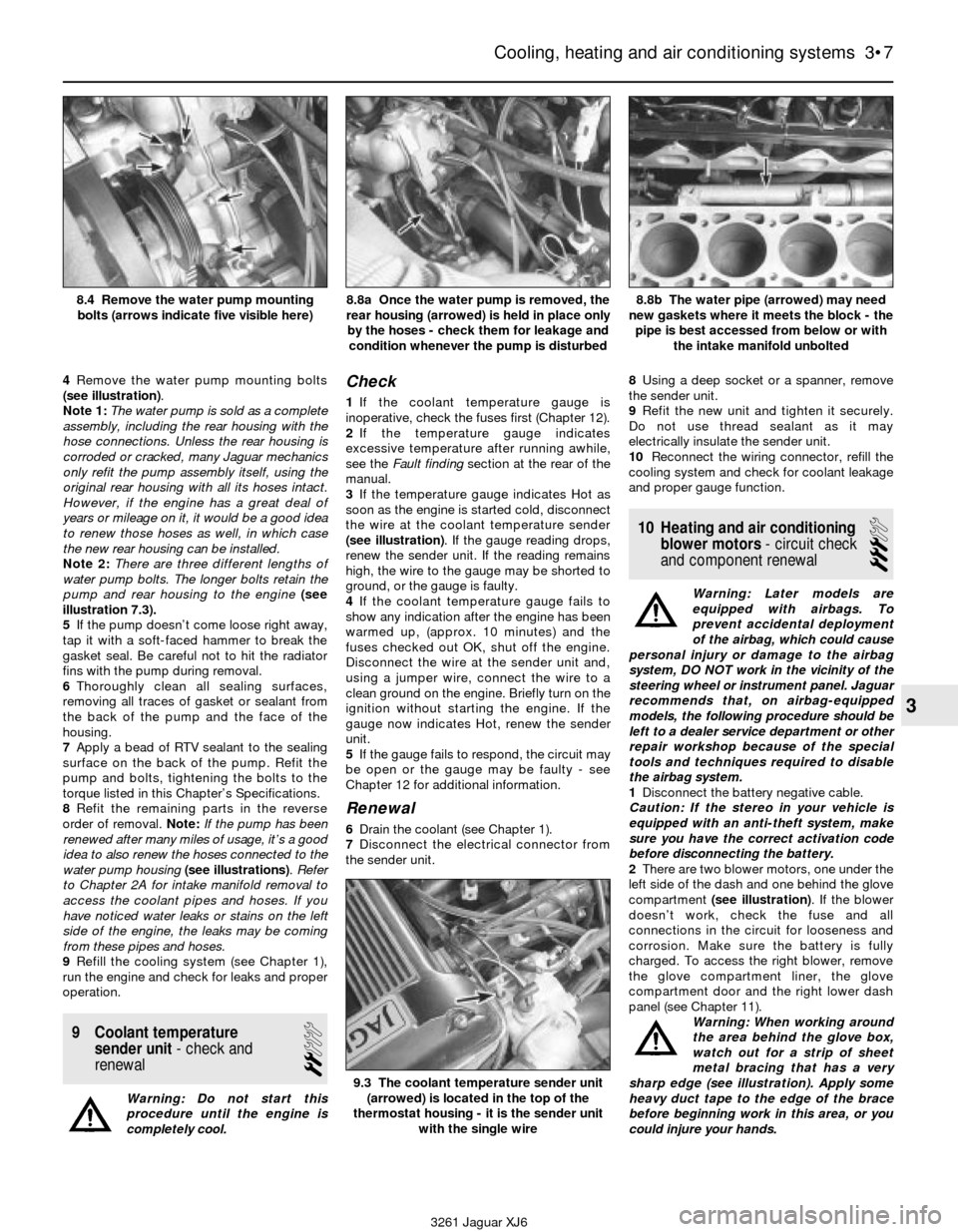
4Remove the water pump mounting bolts
(see illustration).
Note 1:The water pump is sold as a complete
assembly, including the rear housing with the
hose connections. Unless the rear housing is
corroded or cracked, many Jaguar mechanics
only refit the pump assembly itself, using the
original rear housing with all its hoses intact.
However, if the engine has a great deal of
years or mileage on it, it would be a good idea
to renew those hoses as well, in which case
the new rear housing can be installed.
Note 2:There are three different lengths of
water pump bolts. The longer bolts retain the
pump and rear housing to the engine(see
illustration 7.3).
5If the pump doesn’t come loose right away,
tap it with a soft-faced hammer to break the
gasket seal. Be careful not to hit the radiator
fins with the pump during removal.
6Thoroughly clean all sealing surfaces,
removing all traces of gasket or sealant from
the back of the pump and the face of the
housing.
7Apply a bead of RTV sealant to the sealing
surface on the back of the pump. Refit the
pump and bolts, tightening the bolts to the
torque listed in this Chapter’s Specifications.
8Refit the remaining parts in the reverse
order of removal. Note:If the pump has been
renewed after many miles of usage, it’s a good
idea to also renew the hoses connected to the
water pump housing(see illustrations). Refer
to Chapter 2A for intake manifold removal to
access the coolant pipes and hoses. If you
have noticed water leaks or stains on the left
side of the engine, the leaks may be coming
from these pipes and hoses.
9Refill the cooling system (see Chapter 1),
run the engine and check for leaks and proper
operation.
9 Coolant temperature
sender unit- check and
renewal
2
Warning: Do not start this
procedure until the engine is
completely cool.
Check
1If the coolant temperature gauge is
inoperative, check the fuses first (Chapter 12).
2If the temperature gauge indicates
excessive temperature after running awhile,
see the Fault finding section at the rear of the
manual.
3If the temperature gauge indicates Hot as
soon as the engine is started cold, disconnect
the wire at the coolant temperature sender
(see illustration). If the gauge reading drops,
renew the sender unit. If the reading remains
high, the wire to the gauge may be shorted to
ground, or the gauge is faulty.
4If the coolant temperature gauge fails to
show any indication after the engine has been
warmed up, (approx. 10 minutes) and the
fuses checked out OK, shut off the engine.
Disconnect the wire at the sender unit and,
using a jumper wire, connect the wire to a
clean ground on the engine. Briefly turn on the
ignition without starting the engine. If the
gauge now indicates Hot, renew the sender
unit.
5If the gauge fails to respond, the circuit may
be open or the gauge may be faulty - see
Chapter 12 for additional information.
Renewal
6Drain the coolant (see Chapter 1).
7Disconnect the electrical connector from
the sender unit.8Using a deep socket or a spanner, remove
the sender unit.
9Refit the new unit and tighten it securely.
Do not use thread sealant as it may
electrically insulate the sender unit.
10Reconnect the wiring connector, refill the
cooling system and check for coolant leakage
and proper gauge function.
10 Heating and air conditioning
blower motors- circuit check
and component renewal
3
Warning: Later models are
equipped with airbags. To
prevent accidental deployment
of the airbag, which could cause
personal injury or damage to the airbag
system, DO NOT work in the vicinity of the
steering wheel or instrument panel. Jaguar
recommends that, on airbag-equipped
models, the following procedure should be
left to a dealer service department or other
repair workshop because of the special
tools and techniques required to disable
the airbag system.
1Disconnect the battery negative cable.
Caution: If the stereo in your vehicle is
equipped with an anti-theft system, make
sure you have the correct activation code
before disconnecting the battery.
2There are two blower motors, one under the
left side of the dash and one behind the glove
compartment (see illustration). If the blower
doesn’t work, check the fuse and all
connections in the circuit for looseness and
corrosion. Make sure the battery is fully
charged. To access the right blower, remove
the glove compartment liner, the glove
compartment door and the right lower dash
panel (see Chapter 11).
Warning: When working around
the area behind the glove box,
watch out for a strip of sheet
metal bracing that has a very
sharp edge (see illustration). Apply some
heavy duct tape to the edge of the brace
before beginning work in this area, or you
could injure your hands.
Cooling, heating and air conditioning systems 3•7
3
8.4 Remove the water pump mounting
bolts (arrows indicate five visible here)8.8a Once the water pump is removed, the
rear housing (arrowed) is held in place only
by the hoses - check them for leakage and
condition whenever the pump is disturbed8.8b The water pipe (arrowed) may need
new gaskets where it meets the block - the
pipe is best accessed from below or with
the intake manifold unbolted
9.3 The coolant temperature sender unit
(arrowed) is located in the top of the
thermostat housing - it is the sender unit
with the single wire
3261 Jaguar XJ6
Page 123 of 227
3261 Jaguar XJ6
9
Chapter 9
Braking system
General
Brake fluid type . . . . . . . . . . . . . . . . . . . . . . . . . . . . . . . . . . . . . . . . . . . . See Chapter 1
Minimum brake pad thickness . . . . . . . . . . . . . . . . . . . . . . . . . . . . . . . . See Chapter 1
Brake disc minimum permissible thickness . . . . . . . . . . . . . . . . . . . . . . Cast into disc
Parallelism . . . . . . . . . . . . . . . . . . . . . . . . . . . . . . . . . . . . . . . . . . . . . . . 0.013 mm (0.0005 inch) maximum
Runout . . . . . . . . . . . . . . . . . . . . . . . . . . . . . . . . . . . . . . . . . . . . . . . . . 0.102 mm (0.004 inch) maximum
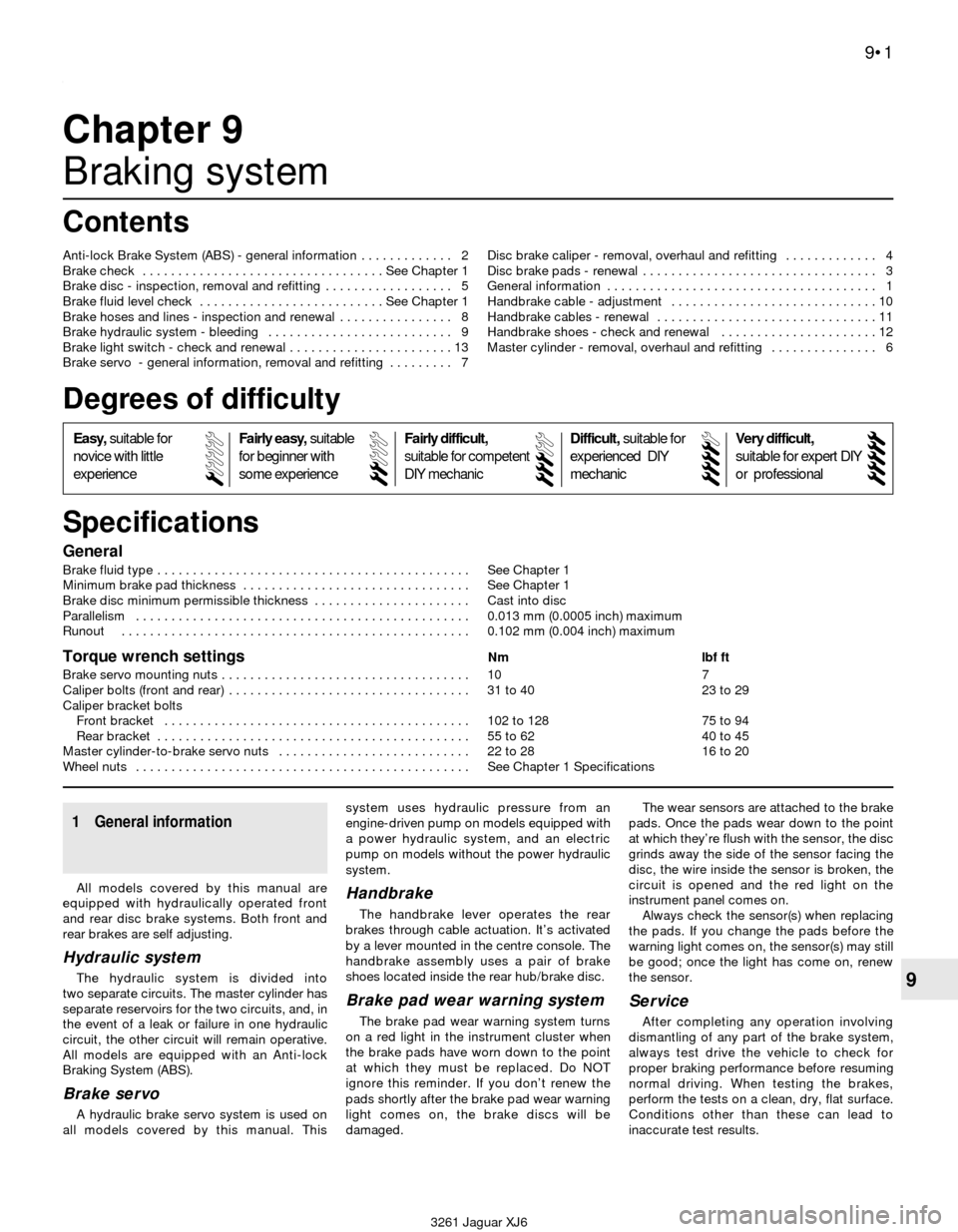
Torque wrench settingsNm lbf ft
Brake servo mounting nuts . . . . . . . . . . . . . . . . . . . . . . . . . . . . . . . . . . . 10 7
Caliper bolts (front and rear) . . . . . . . . . . . . . . . . . . . . . . . . . . . . . . . . . . 31 to 40 23 to 29
Caliper bracket bolts
Front bracket . . . . . . . . . . . . . . . . . . . . . . . . . . . . . . . . . . . . . . . . . . . 102 to 128 75 to 94
Rear bracket . . . . . . . . . . . . . . . . . . . . . . . . . . . . . . . . . . . . . . . . . . . . 55 to 62 40 to 45
Master cylinder-to-brake servo nuts . . . . . . . . . . . . . . . . . . . . . . . . . . . 22 to 28 16 to 20
Wheel nuts . . . . . . . . . . . . . . . . . . . . . . . . . . . . . . . . . . . . . . . . . . . . . . . See Chapter 1 Specifications Anti-lock Brake System (ABS) - general information . . . . . . . . . . . . . 2
Brake check . . . . . . . . . . . . . . . . . . . . . . . . . . . . . . . . . . See Chapter 1
Brake disc - inspection, removal and refitting . . . . . . . . . . . . . . . . . . 5
Brake fluid level check . . . . . . . . . . . . . . . . . . . . . . . . . . See Chapter 1
Brake hoses and lines - inspection and renewal . . . . . . . . . . . . . . . . 8
Brake hydraulic system - bleeding . . . . . . . . . . . . . . . . . . . . . . . . . . 9
Brake light switch - check and renewal . . . . . . . . . . . . . . . . . . . . . . . 13
Brake servo - general information, removal and refitting . . . . . . . . . 7Disc brake caliper - removal, overhaul and refitting . . . . . . . . . . . . . 4
Disc brake pads - renewal . . . . . . . . . . . . . . . . . . . . . . . . . . . . . . . . . 3
General information . . . . . . . . . . . . . . . . . . . . . . . . . . . . . . . . . . . . . . 1
Handbrake cable - adjustment . . . . . . . . . . . . . . . . . . . . . . . . . . . . . 10
Handbrake cables - renewal . . . . . . . . . . . . . . . . . . . . . . . . . . . . . . . 11
Handbrake shoes - check and renewal . . . . . . . . . . . . . . . . . . . . . . 12
Master cylinder - removal, overhaul and refitting . . . . . . . . . . . . . . . 6
9•1
Specifications Contents
Easy,suitable for
novice with little
experienceFairly easy,suitable
for beginner with
some experienceFairly difficult,
suitable for competent
DIY mechanic
Difficult,suitable for
experienced DIY
mechanicVery difficult,
suitable for expert DIY
or professional
Degrees of difficulty
54321
1 General information
All models covered by this manual are
equipped with hydraulically operated front
and rear disc brake systems. Both front and
rear brakes are self adjusting.
Hydraulic system
The hydraulic system is divided into
two separate circuits. The master cylinder has
separate reservoirs for the two circuits, and, in
the event of a leak or failure in one hydraulic
circuit, the other circuit will remain operative.
All models are equipped with an Anti-lock
Braking System (ABS).
Brake servo
A hydraulic brake servo system is used on
all models covered by this manual. Thissystem uses hydraulic pressure from an
engine-driven pump on models equipped with
a power hydraulic system, and an electric
pump on models without the power hydraulic
system.
Handbrake
The handbrake lever operates the rear
brakes through cable actuation. It’s activated
by a lever mounted in the centre console. The
handbrake assembly uses a pair of brake
shoes located inside the rear hub/brake disc.
Brake pad wear warning system
The brake pad wear warning system turns
on a red light in the instrument cluster when
the brake pads have worn down to the point
at which they must be replaced. Do NOT
ignore this reminder. If you don’t renew the
pads shortly after the brake pad wear warning
light comes on, the brake discs will be
damaged.The wear sensors are attached to the brake
pads. Once the pads wear down to the point
at which they’re flush with the sensor, the disc
grinds away the side of the sensor facing the
disc, the wire inside the sensor is broken, the
circuit is opened and the red light on the
instrument panel comes on.
Always check the sensor(s) when replacing
the pads. If you change the pads before the
warning light comes on, the sensor(s) may still
be good; once the light has come on, renew
the sensor.
Service
After completing any operation involving
dismantling of any part of the brake system,
always test drive the vehicle to check for
proper braking performance before resuming
normal driving. When testing the brakes,
perform the tests on a clean, dry, flat surface.
Conditions other than these can lead to
inaccurate test results.
Page 125 of 227
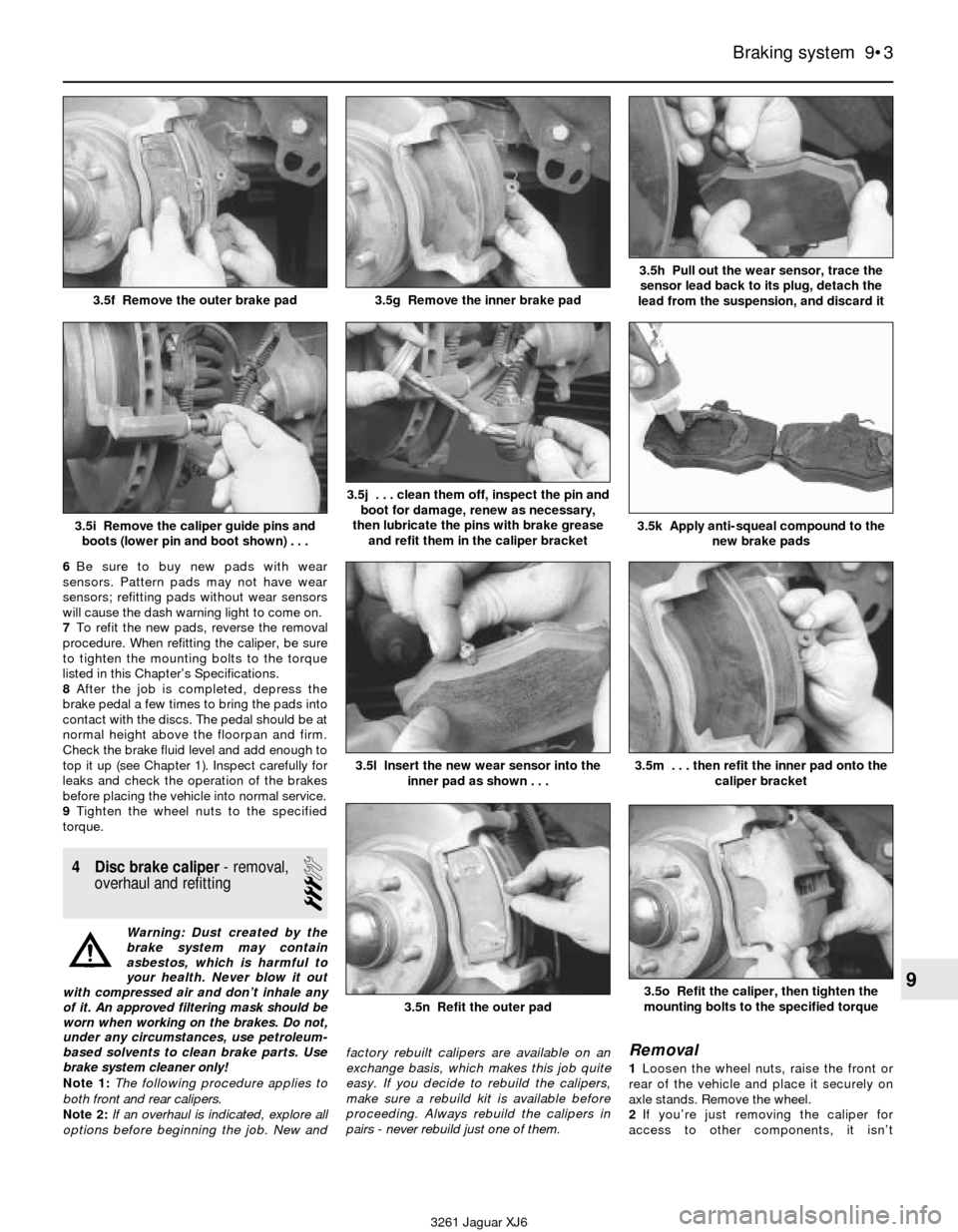
6Be sure to buy new pads with wear
sensors. Pattern pads may not have wear
sensors; refitting pads without wear sensors
will cause the dash warning light to come on.
7To refit the new pads, reverse the removal
procedure. When refitting the caliper, be sure
to tighten the mounting bolts to the torque
listed in this Chapter’s Specifications.
8After the job is completed, depress the
brake pedal a few times to bring the pads into
contact with the discs. The pedal should be at
normal height above the floorpan and firm.
Check the brake fluid level and add enough to
top it up (see Chapter 1). Inspect carefully for
leaks and check the operation of the brakes
before placing the vehicle into normal service.
9Tighten the wheel nuts to the specified
torque.
4 Disc brake caliper- removal,
overhaul and refitting
3
Warning: Dust created by the
brake system may contain
asbestos, which is harmful to
your health. Never blow it out
with compressed air and don’t inhale any
of it. An approved filtering mask should be
worn when working on the brakes. Do not,
under any circumstances, use petroleum-
based solvents to clean brake parts. Use
brake system cleaner only!
Note 1:The following procedure applies to
both front and rear calipers.
Note 2:If an overhaul is indicated, explore all
options before beginning the job. New andfactory rebuilt calipers are available on an
exchange basis, which makes this job quite
easy. If you decide to rebuild the calipers,
make sure a rebuild kit is available before
proceeding. Always rebuild the calipers in
pairs - never rebuild just one of them.
Removal
1Loosen the wheel nuts, raise the front or
rear of the vehicle and place it securely on
axle stands. Remove the wheel.
2If you’re just removing the caliper for
access to other components, it isn’t
Braking system 9•3
9
3.5f Remove the outer brake pad3.5g Remove the inner brake pad
3.5h Pull out the wear sensor, trace the
sensor lead back to its plug, detach the
lead from the suspension, and discard it
3.5i Remove the caliper guide pins and
boots (lower pin and boot shown) . . .
3.5j . . . clean them off, inspect the pin and
boot for damage, renew as necessary,
then lubricate the pins with brake grease
and refit them in the caliper bracket
3.5k Apply anti-squeal compound to the
new brake pads
3261 Jaguar XJ6
3.5l Insert the new wear sensor into the
inner pad as shown . . .
3.5n Refit the outer pad
3.5m . . . then refit the inner pad onto the
caliper bracket
3.5o Refit the caliper, then tighten the
mounting bolts to the specified torque
Page 128 of 227
Refitting
8Place the disc on the hub and refit the disc
retaining screw. Tighten the screw securely.
9Refit the caliper mounting bracket, using a
new safety wire on the mounting bolts.
10Refit the brake pads and caliper (see
Section 3). Tighten all fasteners to the torque
listed in this Chapter’s Specifications.
11Refit the wheel and wheel nuts, then lower
the vehicle to the ground. Tighten the wheel
nuts to the specified torque (see Chapter 1
Specifications). Depress the brake pedal a
few times to bring the brake pads into contact
with the disc.
12Adjust the handbrake shoes, if necessary.
13Check the operation of the brakes
carefully, if possible before driving the vehicle
on public roads.
6 Master cylinder- removal,
overhaul and refitting
3
Note:Although master cylinder parts and
rebuild kits are available for most models, we
recommend replacing the master cylinder with
a new or remanufactured unit, if possible.
Removal
1The master cylinder is connected to the
brake servo, which is attached to the pedal
box, in front of the bulkhead on the driver’s
side of the engine compartment.
2Remove as much fluid as you can from the
reservoir with a syringe.
3Place rags under the line fittings and
prepare caps or plastic bags to cover the
ends of the lines once they are disconnected.
Caution: Brake fluid will damage paint.
Cover all body parts and be careful not to
spill fluid during this procedure.
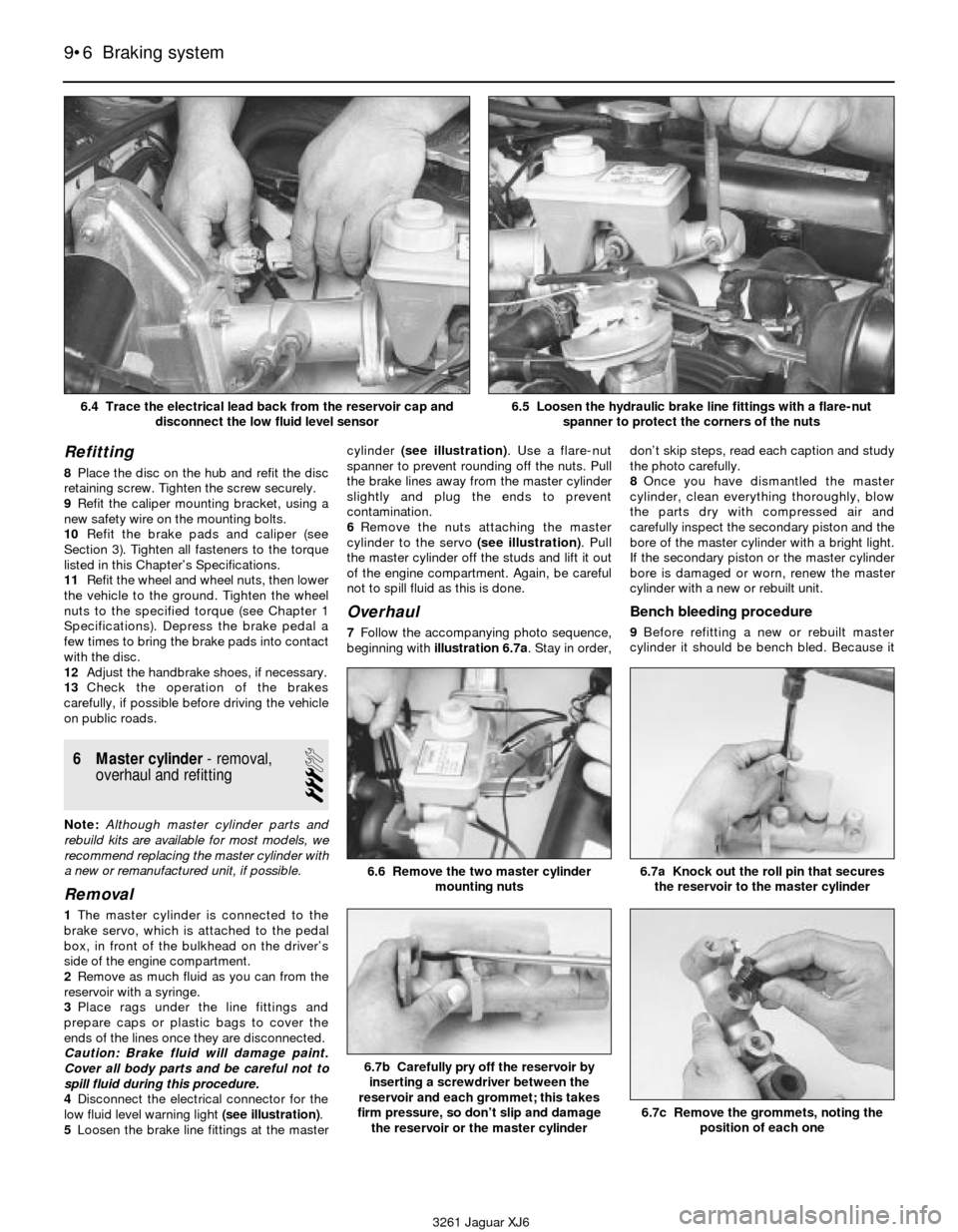
4Disconnect the electrical connector for the
low fluid level warning light (see illustration).
5Loosen the brake line fittings at the mastercylinder (see illustration). Use a flare-nut
spanner to prevent rounding off the nuts. Pull
the brake lines away from the master cylinder
slightly and plug the ends to prevent
contamination.
6Remove the nuts attaching the master
cylinder to the servo (see illustration). Pull
the master cylinder off the studs and lift it out
of the engine compartment. Again, be careful
not to spill fluid as this is done.
Overhaul
7Follow the accompanying photo sequence,
beginning with illustration 6.7a. Stay in order,don’t skip steps, read each caption and study
the photo carefully.
8Once you have dismantled the master
cylinder, clean everything thoroughly, blow
the parts dry with compressed air and
carefully inspect the secondary piston and the
bore of the master cylinder with a bright light.
If the secondary piston or the master cylinder
bore is damaged or worn, renew the master
cylinder with a new or rebuilt unit.
Bench bleeding procedure
9Before refitting a new or rebuilt master
cylinder it should be bench bled. Because it
9•6 Braking system
6.7a Knock out the roll pin that secures
the reservoir to the master cylinder
6.7b Carefully pry off the reservoir by
inserting a screwdriver between the
reservoir and each grommet; this takes
firm pressure, so don’t slip and damage
the reservoir or the master cylinder
6.7c Remove the grommets, noting the
position of each one
6.6 Remove the two master cylinder
mounting nuts
3261 Jaguar XJ6 6.4 Trace the electrical lead back from the reservoir cap and
disconnect the low fluid level sensor
6.5 Loosen the hydraulic brake line fittings with a flare-nut
spanner to protect the corners of the nuts
Page 135 of 227
at a time, so you can use the other side as a
reference during reassembly.
6Refitting is the reverse of removal.
7After refitting the brake disc, adjust the
handbrake shoes. Temporarily refit two nuts,
turn the adjuster (see illustration 5.7c)and
expand the shoes until the disc locks, then
back off the adjuster until you can spin the
disc without the shoes dragging.
8Adjust the handbrake cable (Section 10).
9Remove the axle stands and lower the
vehicle. Tighten the wheel nuts to the specified
torque (see Chapter 1 Specifications).
13 Brake light switch-
check and renewal
1
1The brake light switch activates the brake
lights when the brake pedal is depressed. It‘s
located at the top of the brake pedal, inside
the pedal box.
2If the brake lights don’t come on when the
brake pedal is depressed, check the fuses
(the fuse for the left brake light is in the left
fuse panel and the fuse for the right brake
light is in the right panel).
3If the fuses are okay, check the brake light
bulbs (see Chapter 12).
4If the fuses and bulbs are okay, either the
switch isn’t getting voltage (there’s an open-
circuit between the voltage source and the
switch), voltage isn’t reaching the brake light
Braking system 9•13
9
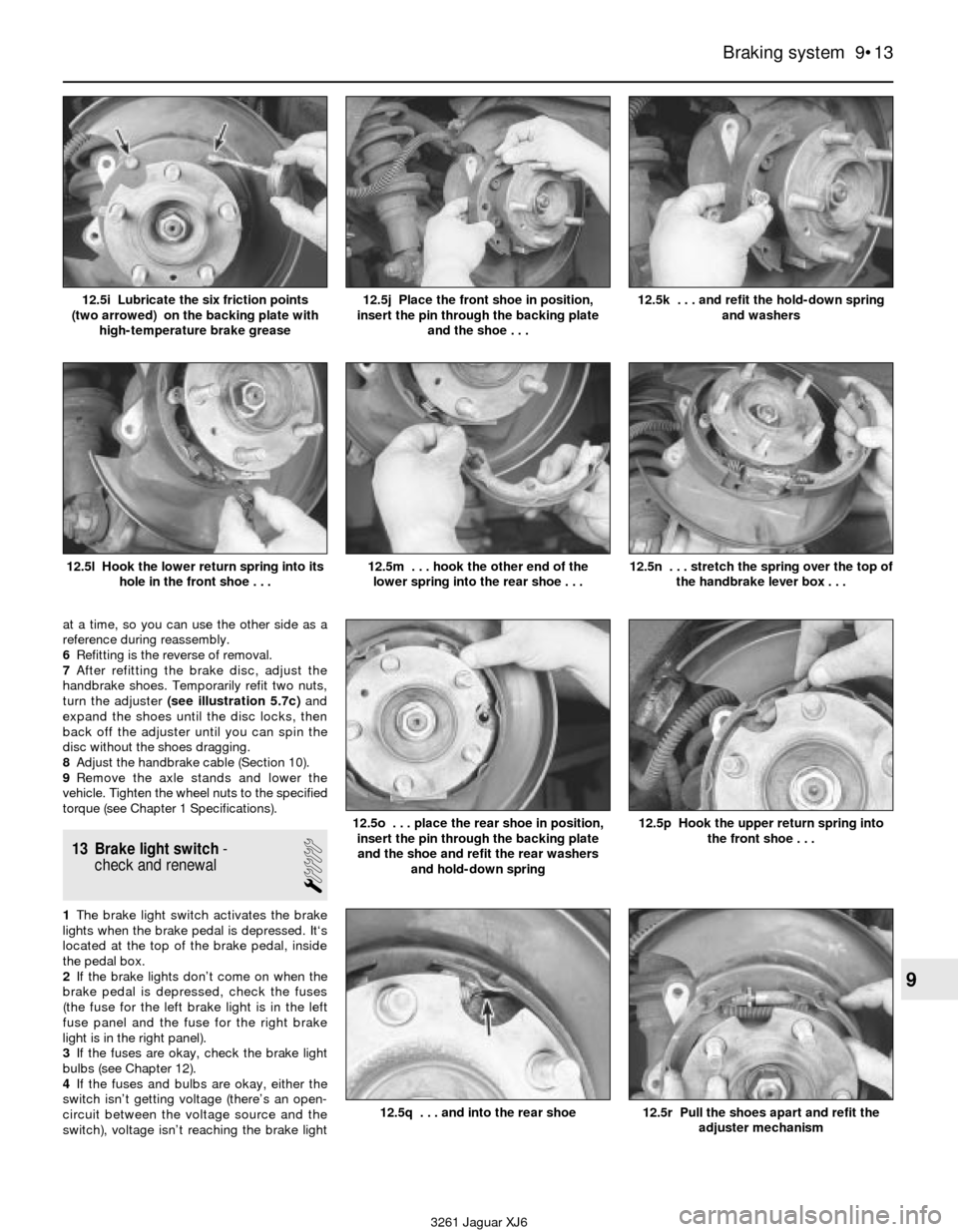
12.5j Place the front shoe in position,
insert the pin through the backing plate
and the shoe . . .12.5k . . . and refit the hold-down spring
and washers12.5i Lubricate the six friction points
(two arrowed) on the backing plate with
high-temperature brake grease
3261 Jaguar XJ6 12.5l Hook the lower return spring into its
hole in the front shoe . . .
12.5m . . . hook the other end of the
lower spring into the rear shoe . . .12.5n . . . stretch the spring over the top of
the handbrake lever box . . .
12.5o . . . place the rear shoe in position,
insert the pin through the backing plate
and the shoe and refit the rear washers
and hold-down spring12.5p Hook the upper return spring into
the front shoe . . .
12.5q . . . and into the rear shoe12.5r Pull the shoes apart and refit the
adjuster mechanism
Page 137 of 227
3261 Jaguar XJ6
10
Chapter 10
Suspension and steering systems
General
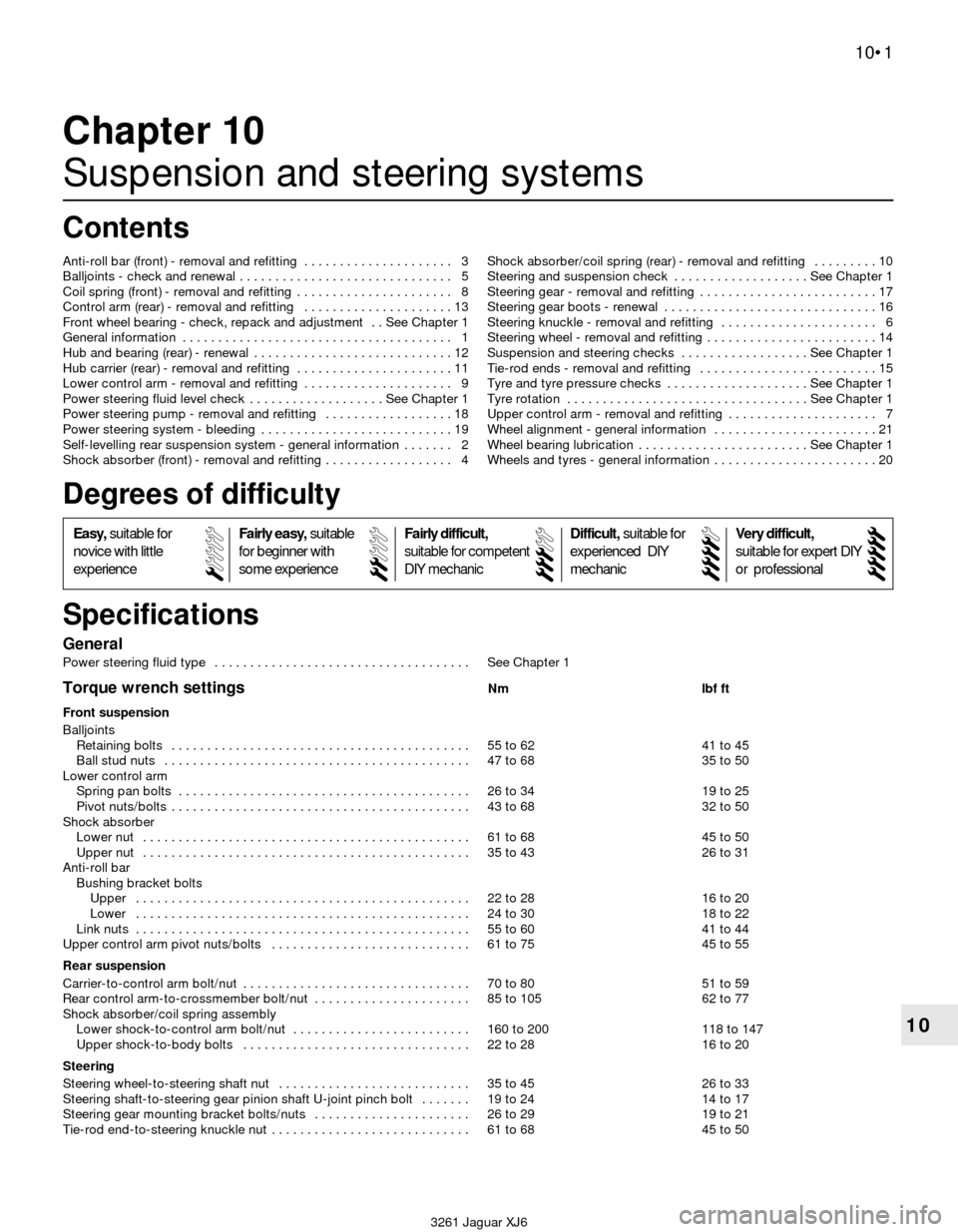
Power steering fluid type . . . . . . . . . . . . . . . . . . . . . . . . . . . . . . . . . . . . See Chapter 1
Torque wrench settingsNm lbf ft
Front suspension
Balljoints
Retaining bolts . . . . . . . . . . . . . . . . . . . . . . . . . . . . . . . . . . . . . . . . . . 55 to 62 41 to 45
Ball stud nuts . . . . . . . . . . . . . . . . . . . . . . . . . . . . . . . . . . . . . . . . . . . 47 to 68 35 to 50
Lower control arm
Spring pan bolts . . . . . . . . . . . . . . . . . . . . . . . . . . . . . . . . . . . . . . . . . 26 to 34 19 to 25
Pivot nuts/bolts . . . . . . . . . . . . . . . . . . . . . . . . . . . . . . . . . . . . . . . . . . 43 to 68 32 to 50
Shock absorber
Lower nut . . . . . . . . . . . . . . . . . . . . . . . . . . . . . . . . . . . . . . . . . . . . . . 61 to 68 45 to 50
Upper nut . . . . . . . . . . . . . . . . . . . . . . . . . . . . . . . . . . . . . . . . . . . . . . 35 to 43 26 to 31
Anti-roll bar
Bushing bracket bolts
Upper . . . . . . . . . . . . . . . . . . . . . . . . . . . . . . . . . . . . . . . . . . . . . . . 22 to 28 16 to 20
Lower . . . . . . . . . . . . . . . . . . . . . . . . . . . . . . . . . . . . . . . . . . . . . . . 24 to 30 18 to 22
Link nuts . . . . . . . . . . . . . . . . . . . . . . . . . . . . . . . . . . . . . . . . . . . . . . . 55 to 60 41 to 44
Upper control arm pivot nuts/bolts . . . . . . . . . . . . . . . . . . . . . . . . . . . . 61 to 75 45 to 55
Rear suspension
Carrier-to-control arm bolt/nut . . . . . . . . . . . . . . . . . . . . . . . . . . . . . . . . 70 to 80 51 to 59
Rear control arm-to-crossmember bolt/nut . . . . . . . . . . . . . . . . . . . . . . 85 to 105 62 to 77
Shock absorber/coil spring assembly
Lower shock-to-control arm bolt/nut . . . . . . . . . . . . . . . . . . . . . . . . . 160 to 200 118 to 147
Upper shock-to-body bolts . . . . . . . . . . . . . . . . . . . . . . . . . . . . . . . . 22 to 28 16 to 20
Steering
Steering wheel-to-steering shaft nut . . . . . . . . . . . . . . . . . . . . . . . . . . . 35 to 45 26 to 33
Steering shaft-to-steering gear pinion shaft U-joint pinch bolt . . . . . . . 19 to 24 14 to 17
Steering gear mounting bracket bolts/nuts . . . . . . . . . . . . . . . . . . . . . . 26 to 29 19 to 21
Tie-rod end-to-steering knuckle nut . . . . . . . . . . . . . . . . . . . . . . . . . . . . 61 to 68 45 to 50 Anti-roll bar (front) - removal and refitting . . . . . . . . . . . . . . . . . . . . . 3
Balljoints - check and renewal . . . . . . . . . . . . . . . . . . . . . . . . . . . . . . 5
Coil spring (front) - removal and refitting . . . . . . . . . . . . . . . . . . . . . . 8
Control arm (rear) - removal and refitting . . . . . . . . . . . . . . . . . . . . . 13
Front wheel bearing - check, repack and adjustment . . See Chapter 1
General information . . . . . . . . . . . . . . . . . . . . . . . . . . . . . . . . . . . . . . 1
Hub and bearing (rear) - renewal . . . . . . . . . . . . . . . . . . . . . . . . . . . . 12
Hub carrier (rear) - removal and refitting . . . . . . . . . . . . . . . . . . . . . . 11
Lower control arm - removal and refitting . . . . . . . . . . . . . . . . . . . . . 9
Power steering fluid level check . . . . . . . . . . . . . . . . . . . See Chapter 1
Power steering pump - removal and refitting . . . . . . . . . . . . . . . . . . 18
Power steering system - bleeding . . . . . . . . . . . . . . . . . . . . . . . . . . . 19
Self-levelling rear suspension system - general information . . . . . . . 2
Shock absorber (front) - removal and refitting . . . . . . . . . . . . . . . . . . 4Shock absorber/coil spring (rear) - removal and refitting . . . . . . . . . 10
Steering and suspension check . . . . . . . . . . . . . . . . . . . See Chapter 1
Steering gear - removal and refitting . . . . . . . . . . . . . . . . . . . . . . . . . 17
Steering gear boots - renewal . . . . . . . . . . . . . . . . . . . . . . . . . . . . . . 16
Steering knuckle - removal and refitting . . . . . . . . . . . . . . . . . . . . . . 6
Steering wheel - removal and refitting . . . . . . . . . . . . . . . . . . . . . . . . 14
Suspension and steering checks . . . . . . . . . . . . . . . . . . See Chapter 1
Tie-rod ends - removal and refitting . . . . . . . . . . . . . . . . . . . . . . . . . 15
Tyre and tyre pressure checks . . . . . . . . . . . . . . . . . . . . See Chapter 1
Tyre rotation . . . . . . . . . . . . . . . . . . . . . . . . . . . . . . . . . . See Chapter 1
Upper control arm - removal and refitting . . . . . . . . . . . . . . . . . . . . . 7
Wheel alignment - general information . . . . . . . . . . . . . . . . . . . . . . . 21
Wheel bearing lubrication . . . . . . . . . . . . . . . . . . . . . . . . See Chapter 1
Wheels and tyres - general information . . . . . . . . . . . . . . . . . . . . . . . 20
10•1
Specifications Contents
Easy,suitable for
novice with little
experienceFairly easy,suitable
for beginner with
some experienceFairly difficult,
suitable for competent
DIY mechanic
Difficult,suitable for
experienced DIY
mechanicVery difficult,
suitable for expert DIY
or professional
Degrees of difficulty
54321