engine KIA SPORTAGE 2020 Owners Manual
[x] Cancel search | Manufacturer: KIA, Model Year: 2020, Model line: SPORTAGE, Model: KIA SPORTAGE 2020Pages: 624, PDF Size: 15.41 MB
Page 603 of 624
Specifications, Consumer information, Reporting safety defects
88
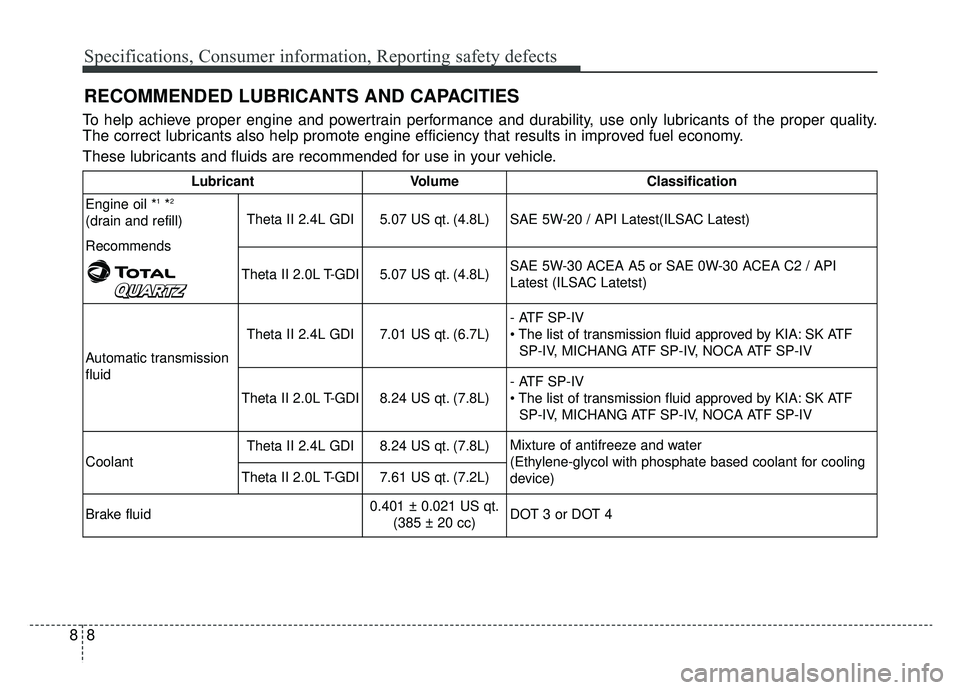
RECOMMENDED LUBRICANTS AND CAPACITIES
To help achieve proper engine and powertrain performance and durability, use only lubricants of the proper quality.
The correct lubricants also help promote engine efficiency that results in improved fuel economy.
These lubricants and fluids are recommended for use in your vehicle.
LubricantVolumeClassification
Engine oil *
1*2
(drain and refill)
Recommends Theta II 2.4L GDI5.07 US qt. (4.8L) SAE 5W-20 / API Latest(ILSAC Latest)
Theta II 2.0L T-GDI
5.07 US qt. (4.8L) SAE 5W-30 ACEA A5 or SAE 0W-30 ACEA C2 / API
Latest (ILSAC Latetst)
Automatic transmission
fluid Theta II 2.4L GDI
7.01 US qt. (6.7L)
- ATF SP-IV
• The list of transmission fluid approved by KIA: SK ATF
SP-IV, MICHANG ATF SP-IV, NOCA ATF SP-IV
Theta II 2.0L T-GDI
8.24 US qt. (7.8L) - ATF SP-IV
SK ATF
SP-IV, MICHANG ATF SP-IV, NOCA ATF SP-IV
Coolant Theta II 2.4L GDI
8.24 US qt. (7.8L)
Mixture of antifreeze and water
(Ethylene-glycol with phosphate based coolant for cooling
device)
Theta II 2.0L T-GDI
7.61 US qt. (7.2L)
Brake fluid
0.401 ± 0.021 US qt. (385 ± 20 cc) DOT 3 or DOT 4
Page 604 of 624
89
Specifications, Consumer information, Reporting safety defects
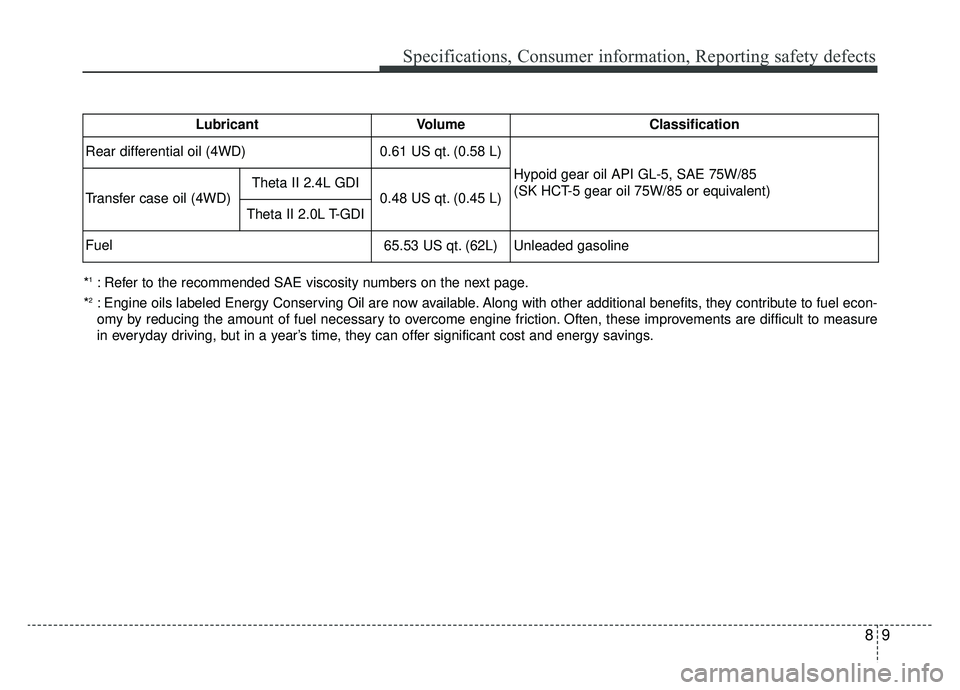
*1: Refer to the recommended SAE viscosity numbers on the next page.
*
2: Engine oils labeled Energy Conserving Oil are now available. Along with other additional benefits, they contribute to fuel econ-
omy by reducing the amount of fuel necessary to overcome engine friction. Often, these improvements are difficult to measure
in everyday driving, but in a year’s time, they can offer significant cost and energy savings. Lubricant
Volume
Classification
Rear differential oil (4WD)
0.61 US qt. (0.58 L) Hypoid gear oil API GL-5, SAE 75W/85
(SK HCT-5 gear oil 75W/85 or equivalent)
Transfer case oil (4WD) Theta II 2.4L GDI
0.48 US qt. (0.45 L)
Theta II 2.0L T-GDI
Fuel
65.53 US qt. (62L) Unleaded gasoline
Page 605 of 624
Specifications, Consumer information, Reporting safety defects
10
8
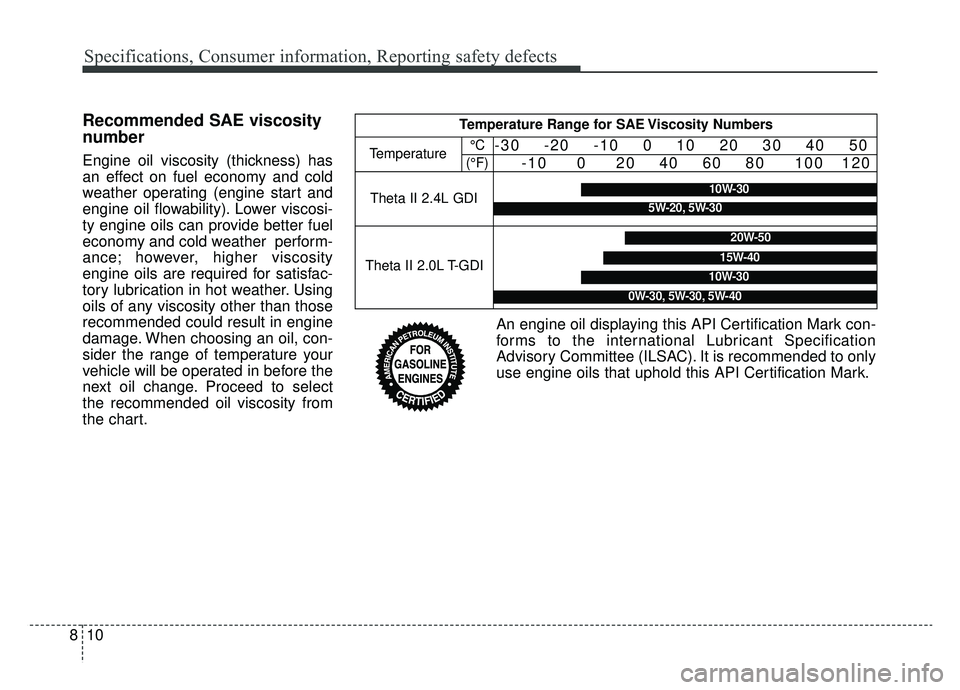
Recommended SAE viscosity
number
Engine oil viscosity (thickness) has
an effect on fuel economy and cold
weather operating (engine start and
engine oil flowability). Lower viscosi-
ty engine oils can provide better fuel
economy and cold weather perform-
ance; however, higher viscosity
engine oils are required for satisfac-
tory lubrication in hot weather. Using
oils of any viscosity other than those
recommended could result in engine
damage. When choosing an oil, con-
sider the range of temperature your
vehicle will be operated in before the
next oil change. Proceed to select
the recommended oil viscosity from
the chart.
Temperature Range for SAE Viscosity Numbers
Temperature°C
(°F)-30 -20 -10 0 10 20 30 40 50 -10 0 20 40 60 80 100 120
Theta II 2.0L T-GDI
20W-50
10W-30
15W-40
0W-30, 5W-30, 5W-40
Theta II 2.4L GDI10W-30
5W-20, 5W-30
An engine oil displaying this API Certification Mark con-
forms to the international Lubricant Specification
Advisory Committee (ILSAC). It is recommended to only
use engine oils that uphold this API Certification Mark.
Page 606 of 624
811
Specifications, Consumer information, Reporting safety defects
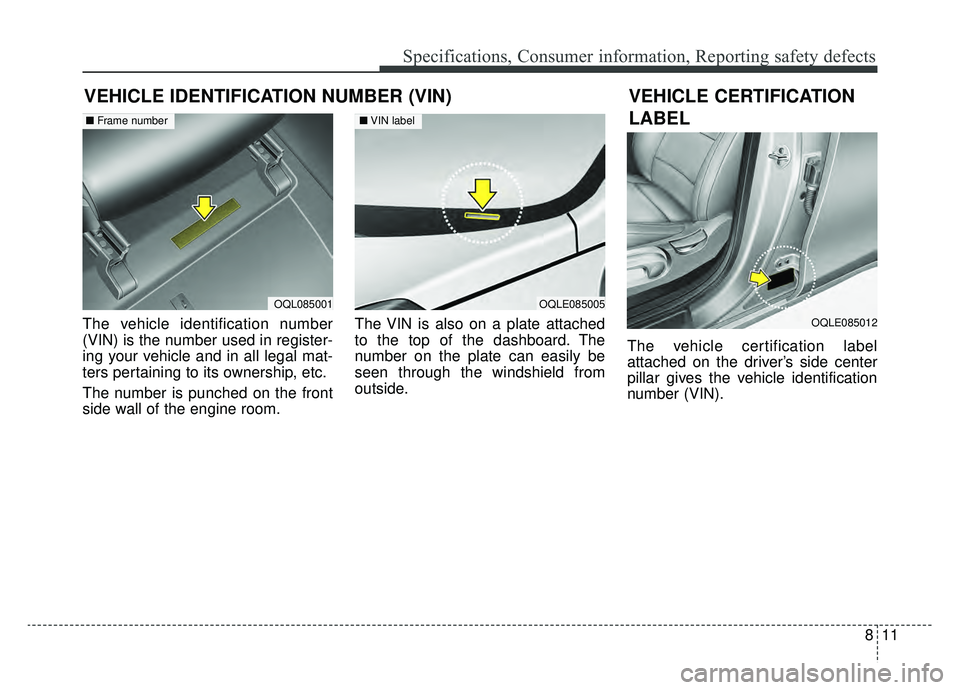
VEHICLE IDENTIFICATION NUMBER (VIN)
The vehicle identification number
(VIN) is the number used in register-
ing your vehicle and in all legal mat-
ters pertaining to its ownership, etc.
The number is punched on the front
side wall of the engine room.The VIN is also on a plate attached
to the top of the dashboard. The
number on the plate can easily be
seen through the windshield from
outside.
The vehicle certification label
attached on the driver’s side center
pillar gives the vehicle identification
number (VIN).
VEHICLE CERTIFICATION
LABEL
OQL085001
■
Frame number
OQLE085005
■VIN label
OQLE085012
Page 607 of 624
Specifications, Consumer information, Reporting safety defects
12
8
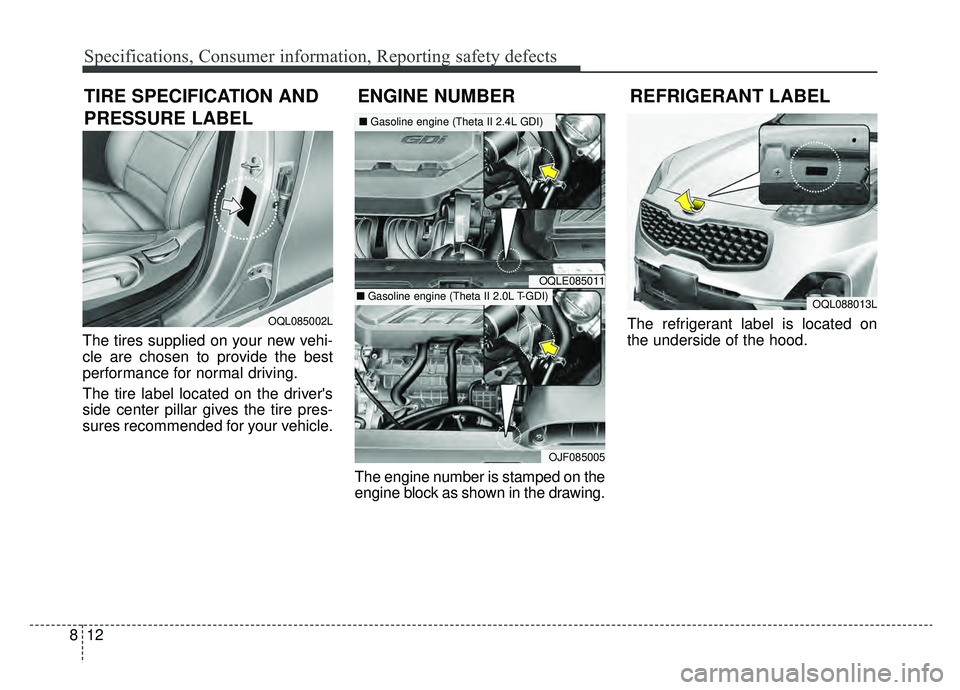
The tires supplied on your new vehi-
cle are chosen to provide the best
performance for normal driving.
The tire label located on the driver's
side center pillar gives the tire pres-
sures recommended for your vehicle.
The engine number is stamped on the
engine block as shown in the drawing.The refrigerant label is located on
the underside of the hood.
ENGINE NUMBER
TIRE SPECIFICATION AND
PRESSURE LABELREFRIGERANT LABEL
OQL085002L
OQL088013L
OQLE085011
OJF085005
■ Gasoline engine (Theta II 2.4L GDI)
■Gasoline engine (Theta II 2.0L T-GDI)
Page 610 of 624
815
Specifications, Consumer information, Reporting safety defects
Registering your vehicle in a foreign country
If you plan to register your vehicle in a foreign country,
you should confirm that it conforms to the regulations in
that country. Even if you successfully register the vehicle
in a foreign country, you may experience the following
problems and should therefore consider the possibility of
having to deal with them:
1. The fuel specified for your vehicle may be unavailable.If other than the specified fuel is used, it could cause
damage to the engine, the fuel injection system, and
other fuel-related parts which may not be covered
under your New Vehicle Emissions Limited Warranty.
2. We must, therefore, clearly state that when you leave the country in which you purchased your Kia new and
register it in another country, problems arising from the
use of fuel other than the specified fuel are not subject
to manufacturer’s warranty. Because vehicles like
yours may not be marketed in the new country of reg-
istration, parts, servicing techniques and tools neces-
sary to maintain and repair your vehicle may be
unavailable.
Even if vehicles like yours are sold there, mechanical
specifications required by the government may vary
enough from the country of purchase to cause addi-
tional problems. 3. There may not be an Authorized Kia Dealer in the area
in which you plan to register your vehicle. You may
additionally experience difficulty in obtaining services
in a foreign country for any number of reasons.
Further, we cannot assume any responsibility for prob-
lems that result from unsatisfactory service or lack of
service outside of the United States.
Page 611 of 624
Specifications, Consumer information, Reporting safety defects
16
8
The electrical system of your vehicle is designed to per-
form under all reasonably expected operating conditions.
However, before any additional electrical equipment is
installed in your vehicle, consult an Authorized Kia
Dealer, in order to ensure that you do not void your war-
ranty.
Certain electrical equipment, or the way in which it is
installed, may adversely affect the operation of your vehi-
cle, including such systems as the engine control system,
the audio system and the electrical charging system and
thus potentially void all or part of your warranty.
We assume no responsibility for any expense you may
incur or for any malfunction of your vehicle or any of its
components or systems that may result from the installa-
tion of additional electrical equipment that is not supplied,
or recommended for installation by, Kia.Installation of a mobile two-way radio system
If a mobile two-way radio system is installed improperly,
or if an excessively powerful type of system is used, other
electronic systems may be adversely affected. To avoid
damage to your vehicle, consult an Authorized Kia Dealer
concerning the proper equipment and installation.
Kia motor vehicles are designed and manufactured to
meet or exceed all applicable safety standards.
For your safety, however, we strongly urge you to read
and follow all directions in this Owner's Manual, particu-
larly the information under the headings "NOTICE",
"CAUTION" and "WARNING".
If, after reading this manual, you have any questions
regarding the operation of your vehicle, safety issues and
defects please contact your Kia's toll-free Consumer
Assistance hot line as below:
National Consumer Affairs Manager
Kia Motors America, Inc.
P.O. Box 52410
Irvine, CA 92619-2410
1-800-333-4Kia (4542)
ELECTRICAL EQUIPMENT (U.S. ONLY)
Page 612 of 624
817
Specifications, Consumer information, Reporting safety defects
If you believe that your vehicle has a defect which could
cause a crash or could cause injury or death, you should
immediately inform the National Highway Traffic Safety
Administration (NHTSA) in addition to notifying Kia
Motors America, Inc.
If NHTSA receives similar complaints, it may open an
investigation, and if it finds that a safety defect exists in a
group of vehicles, it may order a recall and remedy cam-
paign. However, NHTSA cannot become involved in indi-
vidual problems between you, your dealer, or Kia Motors
America, Inc.
To contact NHTSA, you may call the Vehicle Safety
Hotline toll-free at 1-888-327-4236 (TTY: 1-800-424-
9153); go to http://www.safercar.gov; download the
SaferCar mobile application; or write to: Administrator,
NHTSA, 1200 New Jersey Ave. SE., Washington, DC
20590. You can also obtain other information about
motor vehicle safety from http://www.safercar.gov.The following publications are available on
www.KiaTechinfo.com
Service manual:
This manual covers maintenance and recommended pro-
cedures for repair to engine and chassis components. It
is written for the Journeyman mechanic, but is simple
enough for most mechanically inclined owners to under-
stand.
Electrical troubleshooting manual:
This manual complements the Service Manual by provid-
ing indepth troubleshooting information for each electrical
circuit in your vehicle.
Owner's manual:
This manual describes the overall features and operating
procedures for the vehicle.
REPORTING SAFETY DEFECTS
(U.S. ONLY)
ONLINE FACTORY AUTHORIZED MANUALS
(U.S. ONLY)
Page 616 of 624
Index
4I
Operating door locks from inside the vehicle ............4-24
Operating door locks from outside the vehicle ..........4-23
Drive mode integrated control system ........................5-109 Drive mode................................................................5-109
Driver Attention Warning (DAW)................................5-136 Resetting the system ................................................5-138
System malfunction ..................................................5-138
System setting and activation ..................................5-136
System standby ........................................................5-138
Economical operation ..................................................5-141 Driving at night ........................................................5-146
Driving in flooded areas ..........................................5-147
Driving in the rain ....................................................5-146
Driving off-road ........................................................5-147
Hazardous driving conditions ..................................5-143
Highway driving ......................................................5-147
Reducing the risk of a rollover ................................5-143
Rocking the vehicle ..................................................5-145
Smooth cornering ......................................................5-145
Special driving conditions ........................................5-143
Electrical equipment (U.S. only) ..................................8-16 Installation of a mobile two-way radio system ..........8-16
Emergency starting ..........................................................6-5 Jump starting ................................................................6-5
Push-starting ................................................................6-6 Emission control system ..............................................7-102
Crankcase emission control system ..........................7-102
Evaporative emission control (including ORVR: Onboard Refueling Vapor Recovery) system ........7-102
Exhaust emission control system ..............................7-103
Engine ........................................................................\
......8-2
Engine compartment ................................................2-6, 7-3
Engine coolant ..............................................................7-29 Changing the coolant ..................................................7-32
Checking the coolant level..........................................7-29
Engine number ..............................................................8-12
Engine oil ......................................................................7-\
27 Changing the engine oil and filter ..............................7-28
Checking the engine oil level ....................................7-27
Engine start/stop button ................................................5-11 Engine start/stop button position ................................5-11
Illuminated engine start/stop button ..........................5-11
Starting the engine with a smart key ..........................5-13
Explanation of scheduled maintenance items ..............7-21
Exterior features ..........................................................4-188 Roof rack ..................................................................4-188
Exterior overview ....................................................2-2, 2-3
Folding key ......................................................................4-\
5 Battery replacement ......................................................4-8
Immobilizer system ......................................................4-9
E
F
Page 617 of 624
I5
Index
Key operations ..............................................................4-5
Record your key number ..............................................4-5
Transmitter precautions ................................................4-7
Forward Collision-avoidance Assist (FCA) system camera type..................................................................5-54Brake operation ..........................................................5-58
FCA sensor (Front view camera)................................5-58
FCA warning message and system control ................5-56
Limitation of the system ............................................5-61
System malfunction ....................................................5-60
System setting and activation ....................................5-54
Forward Collision-avoidance Assist (FCA) system sensor fusion type (front radar+front view camera) ..............5-67Brake operation ..........................................................5-71
Downhill Brake Control (DBC)..................................5-81
FCA sensor (front radar + front view Ccamera) ........5-71
FCA warning message and system control ................5-69
Good braking practices ..............................................5-83
Limitation of the system ............................................5-75
System malfunction ....................................................5-74
System setting and activation ....................................5-67
Fuel filler lid ..................................................................4-48 Closing the fuel filler lid ............................................4-49
Opening the fuel filler lid ..........................................4-48
Fuel requirements ............................................................1-2 Do not use methanol ....................................................1-4
Fuel Additives ..............................................................1-4
Gasoline containing alcohol and methanol ..................1-3 Operation in foreign countries ......................................1-5
Fuses ........................................................................\
......7-61 Engine compartment fuse replacement ......................7-65
Fuse/relay panel description ......................................7-67
Inner panel fuse replacement ......................................7-63
Gross vehicle weight........................................................8-7\
Hood ........................................................................\
......4-46 Closing the hood ........................................................4-47
Opening the hood ........................................................4-46
How to use this manual ..................................................1-2
If the engine overheats ....................................................6-7
If the engine will not start ..............................................6-4 If engine doesn't turn over or turns over slowly ..........6-4
If engine turns over normally but does not start ..........6-4
If you have a flat tire (with spare tire) ..........................6-15 Changing tires ............................................................6-17
Jack and tools ..............................................................6-15
Removing and storing the spare tire ..........................6-16
H
G
I