tow LINCOLN MKZ 2013 Workshop Manual
[x] Cancel search | Manufacturer: LINCOLN, Model Year: 2013, Model line: MKZ, Model: LINCOLN MKZ 2013Pages: 474, PDF Size: 3.79 MB
Page 259 of 474
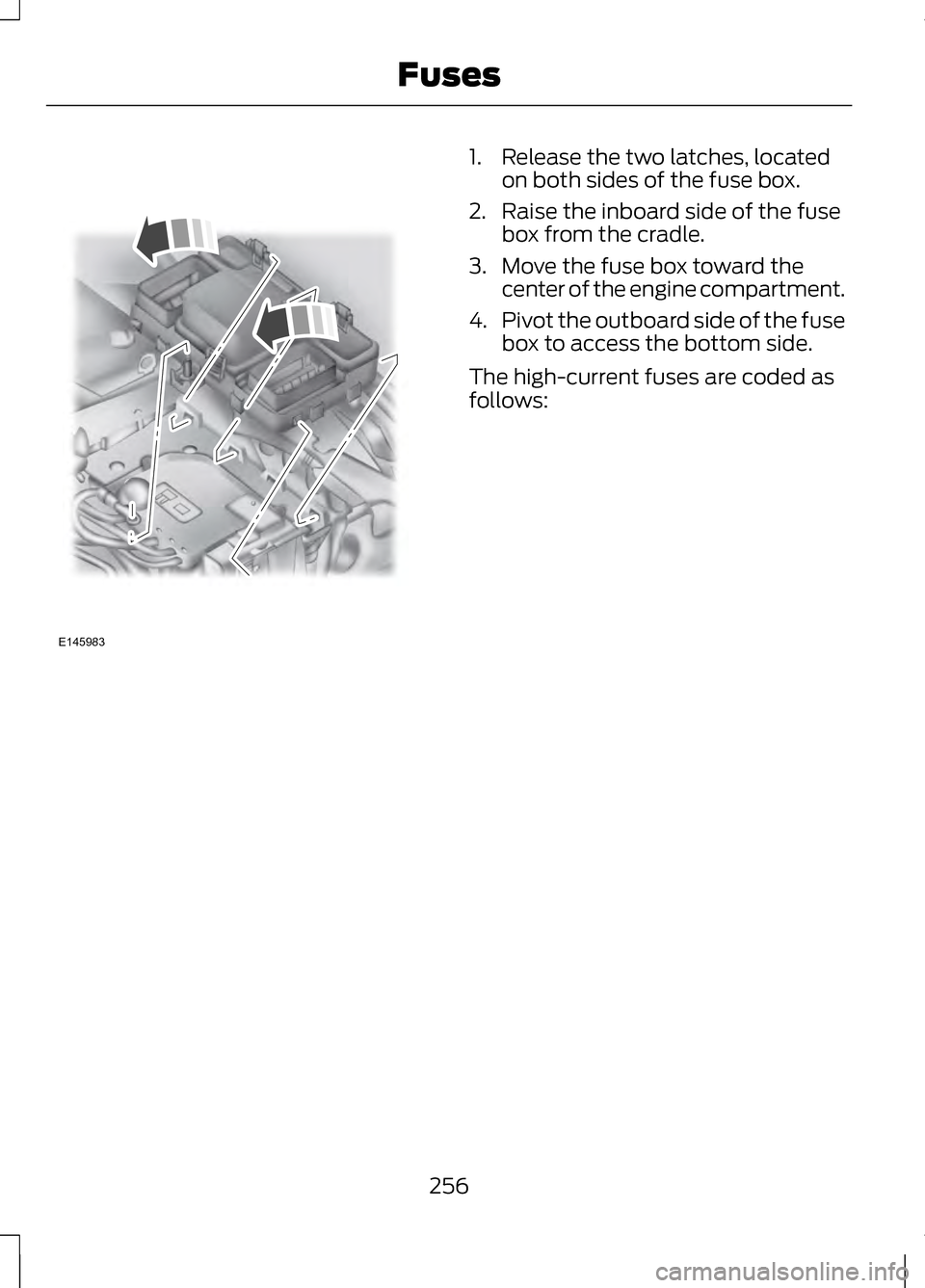
1. Release the two latches, located
on both sides of the fuse box.
2. Raise the inboard side of the fuse box from the cradle.
3. Move the fuse box toward the center of the engine compartment.
4. Pivot the outboard side of the fuse
box to access the bottom side.
The high-current fuses are coded as
follows:
256
FusesE145983
Page 267 of 474
OPENING AND CLOSING
THE HOOD
1. To open the hood, go inside the
vehicle and pull the hood release
handle located under the
instrument panel. 2. Go to the front of the vehicle and
find the secondary release lever,
which is located under the front of
the hood, near the Lincoln badge.
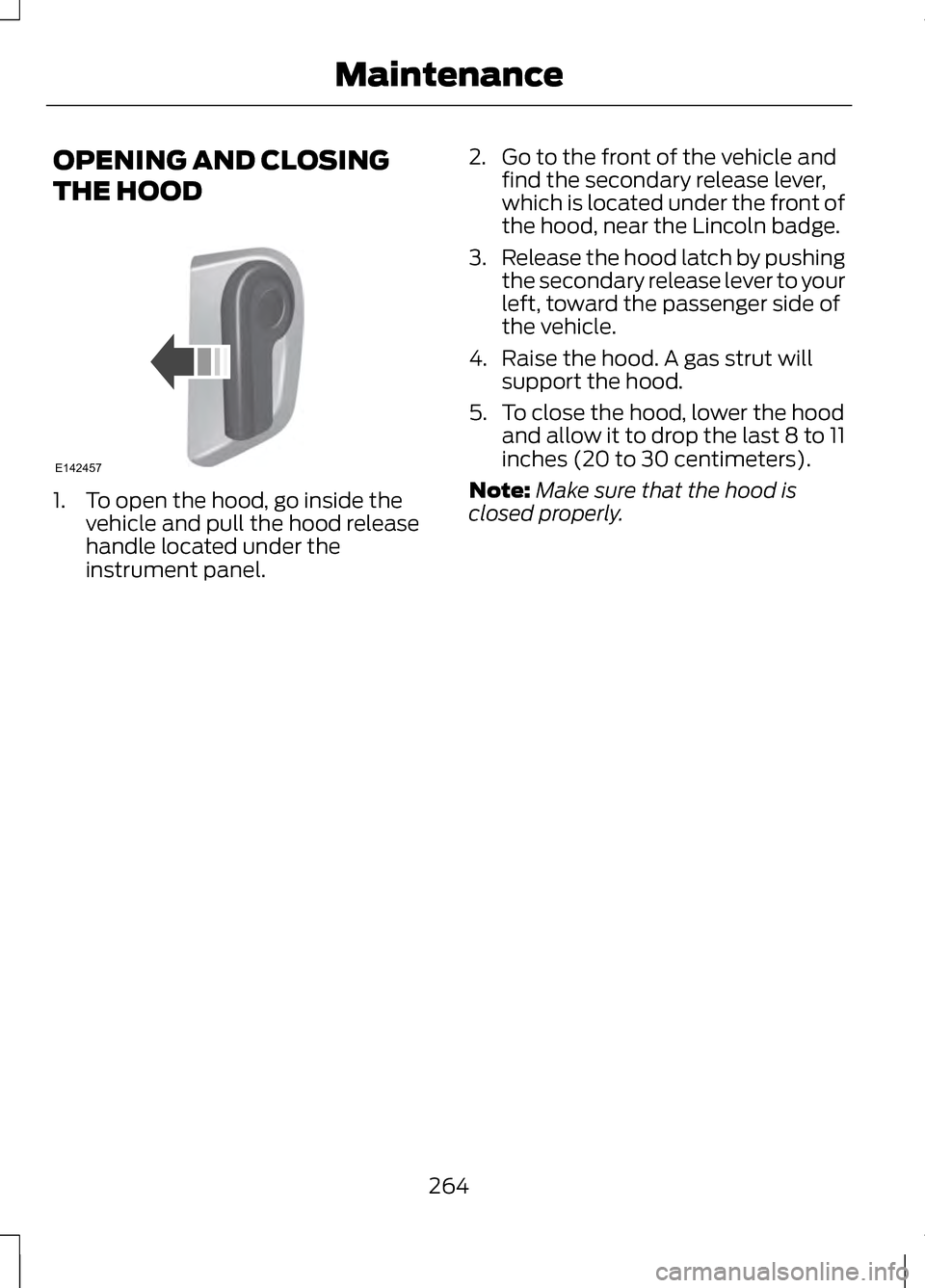
3. Release the hood latch by pushing
the secondary release lever to your
left, toward the passenger side of
the vehicle.
4. Raise the hood. A gas strut will support the hood.
5. To close the hood, lower the hood and allow it to drop the last 8 to 11
inches (20 to 30 centimeters).
Note: Make sure that the hood is
closed properly.
264
MaintenanceE142457
Page 287 of 474
GENERAL INFORMATION
Your Ford or Lincoln authorized dealer
has many quality products available
to clean your vehicle and protect its
finishes.
CLEANING PRODUCTS
For best results, use the following
products or products of equivalent
quality:
Motorcraft® Bug and Tar Remover
(ZC-42)
Motorcraft® Custom Bright Metal
Cleaner (ZC-15)
Motorcraft® Detail Wash (ZC-3-A)
Motorcraft® Dusting Cloth (ZC-24)
Motorcraft® Engine Shampoo and
Degreaser (U.S. only) (ZC-20)
Motorcraft® Engine Shampoo
(Canada only) (CXC-66-A)
Motorcraft® Multi-Purpose Cleaner
(Canada only) (CXC-101)
Motorcraft® Premium Glass Cleaner
(Canada only) (CXC-100)
Motorcraft® Premium Quality
Windshield Washer Fluid (Canada
only) [CXC-37-(A, B, D or F)]
Motorcraft® Premium Windshield
Washer Concentrate (U.S. only)
(ZC-32-A)
Motorcraft® Professional Strength
Carpet & Upholstery Cleaner (ZC-54)
Motorcraft® Spot and Stain Remover
(U.S. only) (ZC-14)
Motorcraft® Ultra-Clear Spray Glass
Cleaner (ZC-23)
Motorcraft® Vinyl Cleaner (Canada
only) (CXC-93)
Motorcraft® Wheel and Tire Cleaner
(ZC-37-A)
CLEANING THE EXTERIOR
Wash your vehicle regularly with cool
or lukewarm water and a neutral pH
shampoo, such as Motorcraft® Detail
Wash.
•
Never use strong household
detergents or soap, such as dish
washing or laundry liquid. These
products can discolor and spot
painted surfaces.
• Never wash a vehicle that is “hot
to the touch ” or during exposure
to strong, direct sunlight.
• Dry the vehicle with a chamois or
soft terry cloth towel in order to
eliminate water spotting.
• Immediately remove items such
as gasoline, diesel fuel, bird
droppings and insect deposits
because they can cause damage
to the vehicle ’s paintwork and trim
over time. Use Motorcraft® Bug
and Tar Remover.
• Remove any exterior accessories,
such as antennas, before entering
a car wash.
Note: Suntan lotions and insect
repellents can damage any painted
surface; if these substances come in
contact with your vehicle, wash off as
soon as possible.
284
Vehicle Care
Page 296 of 474
General Information
WARNING
Failure to follow these guidelines
could result in an increased risk
of loss of vehicle control, injury or
death. Note:
Do not use the kit if a tire has
become severely damaged by driving
the vehicle with a tire that has
insufficient air pressure. Only punctured
areas located within the tire tread can
be sealed with the kit.
Do not attempt to repair punctures
larger than 1.4 inch (6.4 mm) or
damage to the tire's sidewall. The tire
may not completely seal.
Loss of air pressure may adversely
affect tire performance. For this
reason:
Note: Do not drive the vehicle above
50 mph (80 km/h).
Note: Do not drive further than 120
miles (200 km). Drive only to the
closest Ford Motor Company
authorized dealer or tire repair shop to
have your tire inspected.
• Drive carefully and avoid abrupt
steering maneuvers.
• Periodically monitor tire inflation
pressure in the affected tire; if the
tire is losing pressure, have the
vehicle towed.
• Read the information in the Tips
for Use of the Kit section to ensure
safe operation of the kit and your
vehicle. Tips for Use of the Kit
Read the following list of tips to
ensure safe operation of the kit:
•
Before operating the kit, make sure
your vehicle is safely off the road
and away from moving traffic. Turn
on the hazard lights.
• Always set the parking brake to
ensure the vehicle doesn't move
unexpectedly.
• Do not remove any foreign objects,
such as nails or screws, from the
tire.
• When using the kit, leave the
engine running (only if the vehicle
is outdoors or in a well-ventilated
area) so the compressor doesn't
drain the vehicle's battery.
• Do not allow the compressor to
operate continuously for more
than 15 minutes; this will help
prevent the compressor from
overheating.
• Never leave the kit unattended
when it is operating.
• Sealant compound contains latex.
Make sure that you use the
non-latex gloves provided to avoid
an allergic reaction.
• Keep the kit away from children.
• Only use the kit when the ambient
temperature is between -22°F
(–30°C) and 158°F (70°C).
293
Wheels and Tires
Page 299 of 474
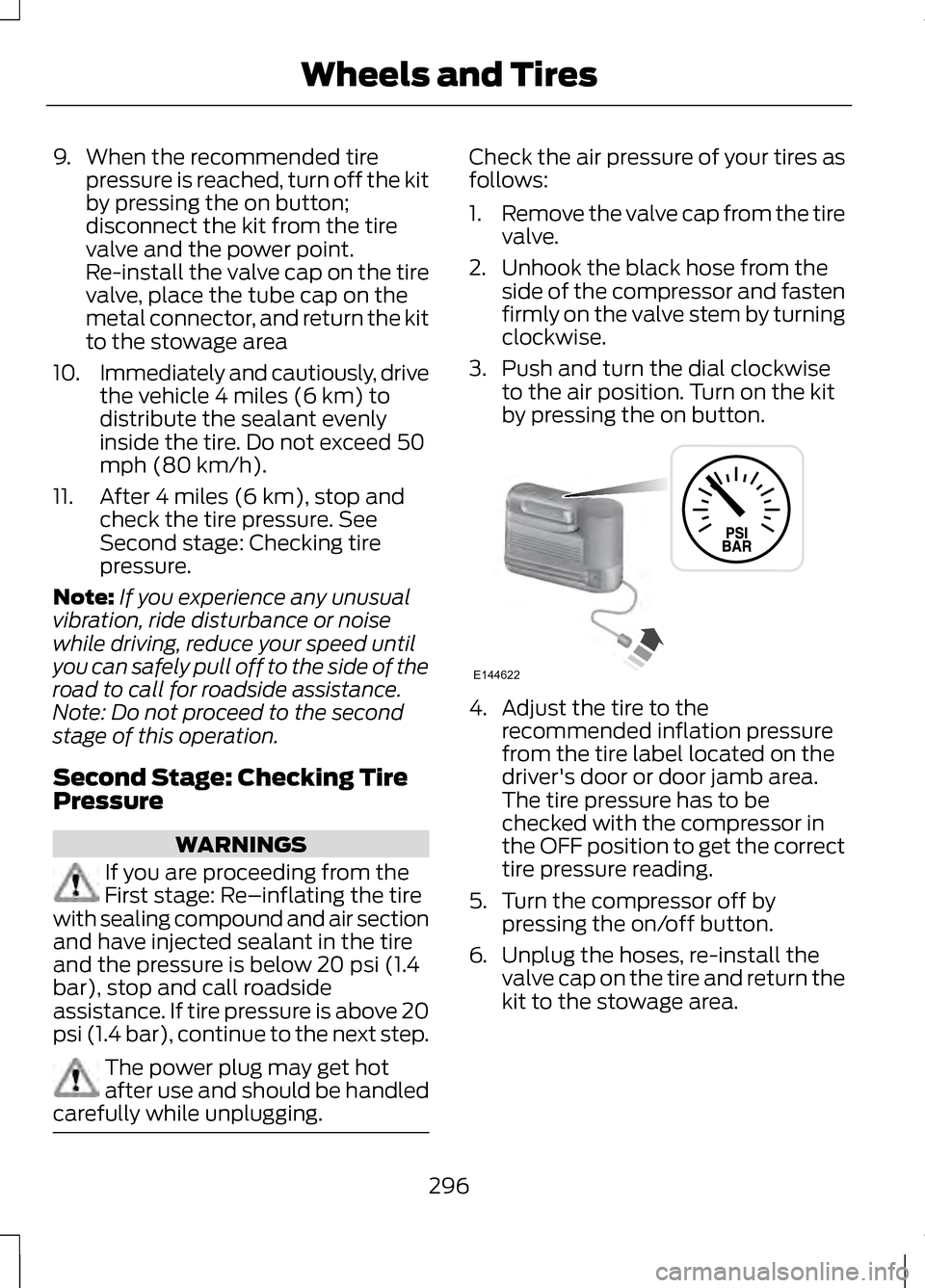
9. When the recommended tire
pressure is reached, turn off the kit
by pressing the on button;
disconnect the kit from the tire
valve and the power point.
Re-install the valve cap on the tire
valve, place the tube cap on the
metal connector, and return the kit
to the stowage area
10. Immediately and cautiously, drive
the vehicle 4 miles (6 km) to
distribute the sealant evenly
inside the tire. Do not exceed 50
mph (80 km/h).
11. After 4 miles (6 km), stop and check the tire pressure. See
Second stage: Checking tire
pressure.
Note: If you experience any unusual
vibration, ride disturbance or noise
while driving, reduce your speed until
you can safely pull off to the side of the
road to call for roadside assistance.
Note: Do not proceed to the second
stage of this operation.
Second Stage: Checking Tire
Pressure WARNINGS
If you are proceeding from the
First stage: Re–inflating the tire
with sealing compound and air section
and have injected sealant in the tire
and the pressure is below 20 psi (1.4
bar), stop and call roadside
assistance. If tire pressure is above 20
psi (1.4 bar), continue to the next step. The power plug may get hot
after use and should be handled
carefully while unplugging. Check the air pressure of your tires as
follows:
1.
Remove the valve cap from the tire
valve.
2. Unhook the black hose from the side of the compressor and fasten
firmly on the valve stem by turning
clockwise.
3. Push and turn the dial clockwise to the air position. Turn on the kit
by pressing the on button. 4. Adjust the tire to the
recommended inflation pressure
from the tire label located on the
driver's door or door jamb area.
The tire pressure has to be
checked with the compressor in
the OFF position to get the correct
tire pressure reading.
5. Turn the compressor off by pressing the on/off button.
6. Unplug the hoses, re-install the
valve cap on the tire and return the
kit to the stowage area.
296
Wheels and TiresE144622
Page 320 of 474
Safety Practices
WARNINGS
If your vehicle is stuck in snow,
mud, sand, etc., do not rapidly
spin the tires; spinning the tires can
tear the tire and cause an explosion.
A tire can explode in as little as three
to five seconds. Do not spin the wheels at over
35 mph (56 km/h). The tires may
fail and injure a passenger or
bystander. Driving habits have a great deal to do
with your tire mileage and safety.
•
Observe posted speed limits
• Avoid fast starts, stops and turns
• Avoid potholes and objects on the
road
• Do not run over curbs or hit the tire
against a curb when parking
Highway Hazards
No matter how carefully you drive
there ’s always the possibility that you
may eventually have a flat tire on the
highway. Drive slowly to the closest
safe area out of traffic. This may
further damage the flat tire, but your
safety is more important. If you feel a sudden vibration or ride
disturbance while driving, or you
suspect your tire or vehicle has been
damaged, immediately reduce your
speed. Drive with caution until you can
safely pull off the road. Stop and
inspect the tires for damage. If a tire
is under-inflated or damaged, deflate
it, remove wheel and replace it with
your spare tire and wheel. If you
cannot detect a cause, have the
vehicle towed to the nearest repair
facility or tire dealer to have the
vehicle inspected.
Tire and Wheel Alignment
A bad jolt from hitting a curb or
pothole can cause the front end of
your vehicle to become misaligned or
cause damage to your tires. If your
vehicle seems to pull to one side when
you’re driving, the wheels may be out
of alignment. Have an authorized
dealer check the wheel alignment
periodically.
Wheel misalignment in the front or
the rear can cause uneven and rapid
treadwear of your tires and should be
corrected by an authorized dealer.
Front-wheel drive vehicles and those
with an independent rear suspension
(if equipped) may require alignment
of all four wheels.
The tires should also be balanced
periodically. An unbalanced tire and
wheel assembly may result in irregular
tire wear.
317
Wheels and Tires
Page 323 of 474
Have a flat serviced by an authorized
dealer in order to prevent damage to
the tire pressure monitoring system
sensors. See Tire Pressure
Monitoring System (page 298).
Replace the spare tire with a road tire
as soon as possible. During repairing
or replacing of the flat tire, have the
authorized dealer inspect the tire
pressure monitoring system sensor
for damage.
Dissimilar Spare Wheel and
Tire Assembly Information WARNING
Failure to follow these guidelines
could result in an increased risk
of loss of vehicle control, injury or
death. If you have a dissimilar spare wheel
and tire, then it is intended for
temporary use only. This means that
if you need to use it, you should
replace it as soon as possible with a
road wheel and tire assembly that is
the same size and type as the road
tires and wheels that were originally
provided by Ford. If the dissimilar
spare tire or wheel is damaged, it
should be replaced rather than
repaired.
A dissimilar spare wheel and tire
assembly is defined as a spare wheel
and tire assembly that is different in
brand, size or appearance from the
road tires and wheels and can be one
of three types: 1.
T-type mini-spare:
This spare tire
begins with the letter T for tire size
and may have Temporary Use Only
molded in the sidewall.
2. Full-size dissimilar spare with
label on wheel: This spare tire has a
label on the wheel that states: THIS
WHEEL AND TIRE ASSEMBLY FOR
TEMPORARY USE ONLY.
When driving with one of the
dissimilar spare tires listed above, do
not:
• Exceed 50 mph (80 km/h)
• Load the vehicle beyond maximum
vehicle load rating listed on the
Safety Compliance Label.
• Tow a trailer.
• Use snow chains on the end of the
vehicle with the dissimilar spare
tire.
• Use more than one dissimilar spare
tire at a time.
• Use commercial car washing
equipment.
• Try to repair the dissimilar spare
tire.
Use of one of the dissimilar spare tires
listed above at any one wheel location
can lead to impairment of the
following:
• Handling, stability and braking
performance.
• Comfort and noise.
• Ground clearance and parking at
curbs.
• Winter weather driving capability.
320
Wheels and Tires
Page 324 of 474
•
Wet weather driving capability.
• All-wheel driving capability (if
applicable).
3. Full-size dissimilar spare
without label on wheel
When driving with the full-size
dissimilar spare wheel and tire
assembly, do not:
• Exceed 70 mph (113 km/h).
• Use more than one dissimilar spare
wheel and tire assembly at a time.
• Use commercial car washing
equipment.
• Use snow chains on the end of the
vehicle with the dissimilar spare
wheel and tire assembly.
The usage of a full-size dissimilar
spare wheel and tire assembly can
lead to impairment of the following:
• Handling, stability and braking
performance.
• Comfort and noise.
• Ground clearance and parking at
curbs.
• Winter weather driving capability.
• Wet weather driving capability.
• All-wheel driving capability (if
applicable).
• Load leveling adjustment (if
applicable). When driving with the full-size
dissimilar spare wheel and tire
assembly additional caution should
be given to:
•
Towing a trailer.
• Driving vehicles equipped with a
camper body.
• Driving vehicles with a load on the
cargo rack.
Drive cautiously when using a full-size
dissimilar spare wheel and tire
assembly and seek service as soon as
possible.
Tire Change Procedure WARNINGS
When one of the front wheels is
off the ground, the transmission
alone will not prevent the vehicle from
moving or slipping off the jack, even if
the transmission selector lever is in
position P. To help prevent the vehicle from
moving when you change a tire,
be sure to place the transmission
selector lever in position
P, set the
parking brake and block (in both
directions) the wheel that is
diagonally opposite (other side and
end of the vehicle) to the tire being
changed. Never get underneath a vehicle
that is supported only by a jack.
If the vehicle slips off the jack, you or
someone else could be seriously
injured.
321
Wheels and Tires
Page 326 of 474
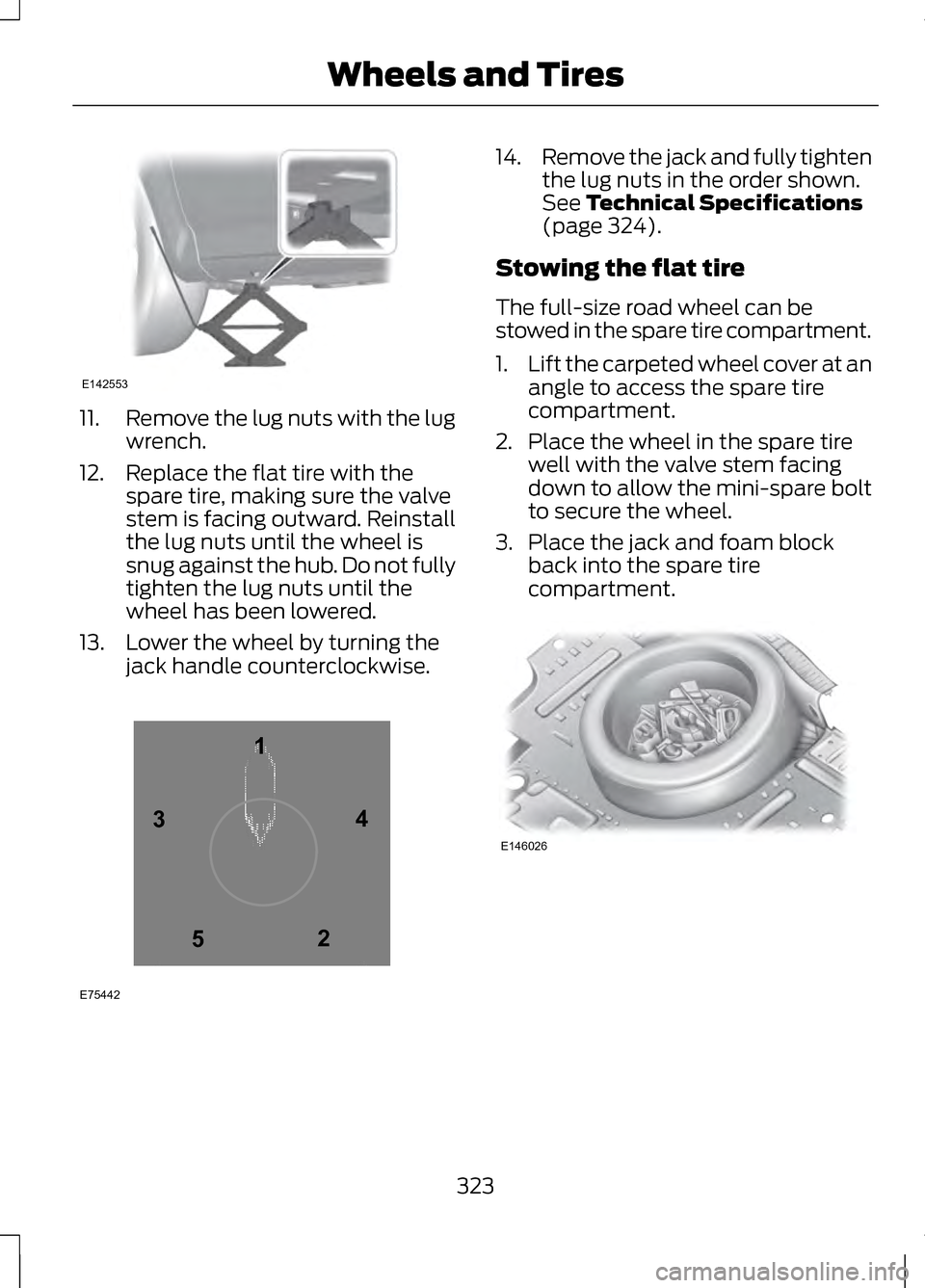
11.
Remove the lug nuts with the lug
wrench.
12. Replace the flat tire with the spare tire, making sure the valve
stem is facing outward. Reinstall
the lug nuts until the wheel is
snug against the hub. Do not fully
tighten the lug nuts until the
wheel has been lowered.
13. Lower the wheel by turning the jack handle counterclockwise. 14.
Remove the jack and fully tighten
the lug nuts in the order shown.
See Technical Specifications
(page 324).
Stowing the flat tire
The full-size road wheel can be
stowed in the spare tire compartment.
1. Lift the carpeted wheel cover at an
angle to access the spare tire
compartment.
2. Place the wheel in the spare tire well with the valve stem facing
down to allow the mini-spare bolt
to secure the wheel.
3. Place the jack and foam block back into the spare tire
compartment. 323
Wheels and TiresE142553 12
3
4
5
E75442 E146026
Page 337 of 474
SERVICE PLANS (U.S. only)
More than 32 million Ford and Lincoln
owners have discovered the powerful
protection of Ford Extended Service
Plan. It is the only extended service
plan backed by Ford Motor Company,
and provides peace of mind
protection beyond the New Vehicle
Limited Warranty coverage.
Up to 500+ Covered Vehicle
Components
There are four, new-vehicle Extended
Service Plans with different levels of
coverage. Ask your dealer for details.
1. PremiumCare - Our most
comprehensive coverage. With
over 500 covered components,
this plan is so complete that we
generally only discuss what’ s not
covered!
2. ExtraCare - Covers 113 components, and includes many
high-tech items.
3. BaseCare - Covers 84 components.
4. PowertrainCare - Covers 29 critical
components.
Ford Extended Service Plan is honored
by all Ford and Lincoln Dealers in the
U.S. and Canada. It is the only
extended service plan authorized and
backed by Ford Motor Company. That
means you get: •
Reliable, quality service anywhere
you go.
• Factory-trained technicians.
• Ford Authorized Parts used with
every covered repair.
Rental Car Reimbursement
If your vehicle is kept overnight for
covered repairs, you are eligible for
rental car coverage, including
Bumper-to-Bumper warranty repairs,
or manufacturer ’s recalls.
Transferable Coverage
If you sell your vehicle before your
Ford Extended Service Plan coverage
expires, you can transfer any
remaining coverage to the new owner.
Whenever you’re ready to sell your car,
prospective buyers may feel better
about taking a risk on your used
vehicle. Ford Extended Service Plan
may add resale value!
Plus, exclusive 24/7 roadside
assistance, including:
• Towing, flat-tire change and
battery jump starts.
• Out-of-fuel and lock-out
assistance.
• Travel expense reimbursement for
lodging, meals and rental car.
• Destination assistance for taxi,
shuttle, rental car coverage and
emergency transportation.
334
Ford Extended Service Plan (ESP)