clutch MAZDA 626 1987 Workshop Manual
[x] Cancel search | Manufacturer: MAZDA, Model Year: 1987, Model line: 626, Model: MAZDA 626 1987Pages: 1865, PDF Size: 94.35 MB
Page 896 of 1865
7B TROUBLESHOOTING (G4A-EL)
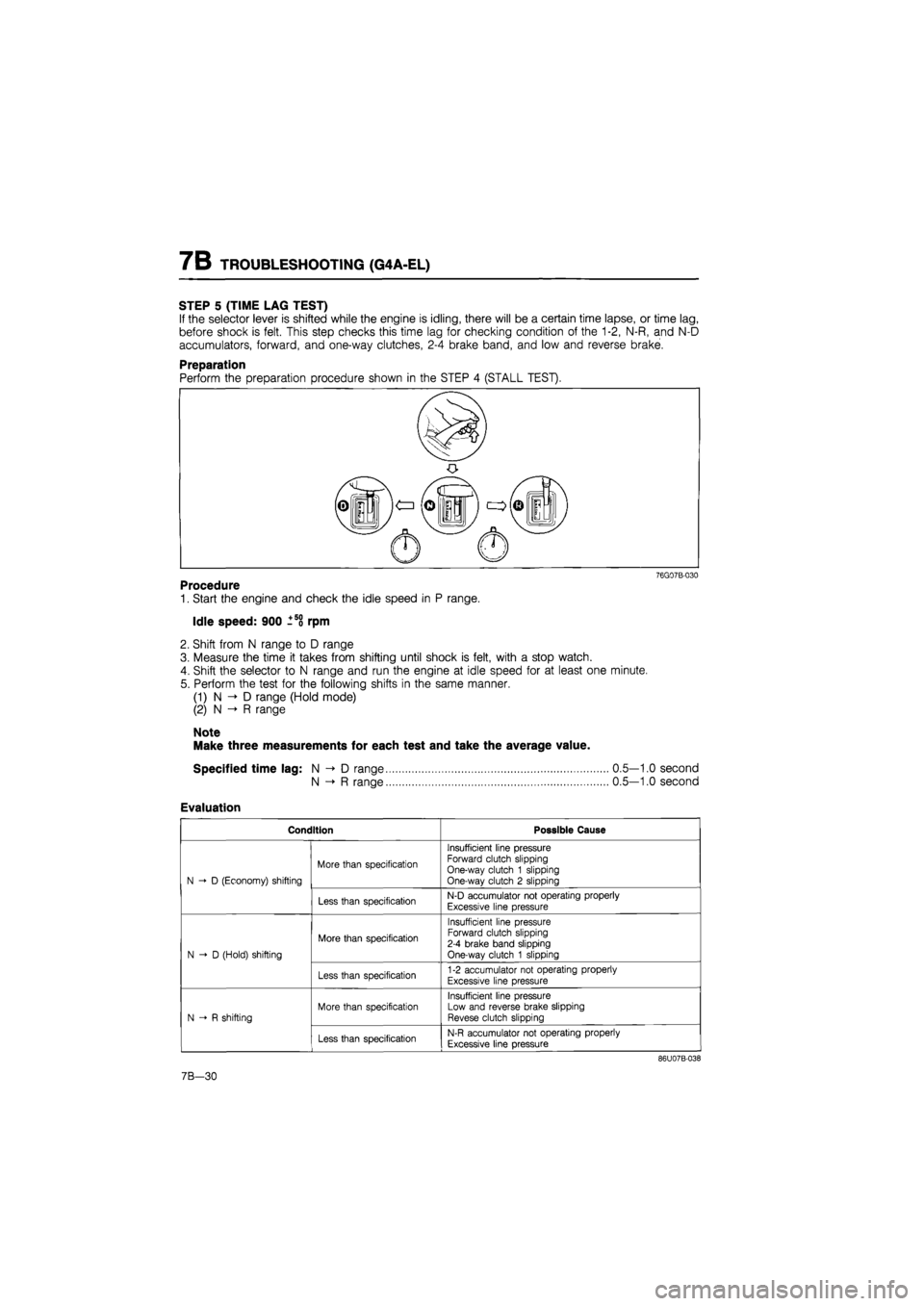
STEP 5 (TIME LAG TEST)
If the selector lever is shifted while the engine is idling, there will be a certain time lapse, or time lag,
before shock is felt. This step checks this time lag for checking condition of the 1-2, N-R, and N-D
accumulators, forward, and one-way clutches, 2-4 brake band, and low and reverse brake.
Preparation
76G07B-030
Procedure
1. Start the engine and check the idle speed in P range.
Idle speed: 900 ±58 rpm
2. Shift from N range to D range
3. Measure the time it takes from shifting until shock is felt, with a stop watch.
4. Shift the selector to N range and run the engine at idle speed for at least one minute.
5. Perform the test for the following shifts in the same manner.
(1) N D range (Hold mode)
(2) N -» R range
Note
Make three measurements for each test and take the average value.
Specified time lag: N -> D range
N -»• R range
Evaluation
Condition Possible Cause
N D (Economy) shifting
More than specification
Insufficient line pressure Forward clutch slipping One-way clutch 1 slipping One-way clutch 2 slipping N D (Economy) shifting
Less than specification N-D accumulator not operating properly
Excessive line pressure
N-D (Hold) shifting
More than specification
Insufficient line pressure Forward clutch slipping 2-4 brake band slipping One-way clutch 1 slipping N-D (Hold) shifting
Less than specification 1-2 accumulator not operating properly
Excessive line pressure
N R shifting
More than specification
Insufficient line pressure Low and reverse brake slipping Revese clutch slipping N R shifting
Less than specification N-R accumulator not operating properly
Excessive line pressure
86U07B-038
0.5—1.0 second
0.5—1.0 second
7B-30
Page 898 of 1865

7B TROUBLESHOOTING (G4A-EL)
Specified line pressure:
Line pressure kPa, (kg/cm2, psi)
Range DSL R
When idling 353-432 (3.6-4.4, 51-63) 598—942 (6.1-9.6, 87—137)
At stall speed 873-1040 (8.9-10.6, 127-151) 1668-2011 (17.0-20.5, 242-292)
76G07B-032
Evaluation
Line pressure Possible location of problem
Low pressure in every position
Worn oil pump
Fluid leaking from oil pump, control valve body, or transaxle case
Pressure regulator valve sticking
Low pressure in D and S only Fluid leaking from hydraulic circuit of forward clutch
Low pressure in R only Fluid leaking from hydraulic circuit of low and reverse brake
Higher than specification
Throttle valve sticking
Throttle modulator valve sticking
Pressure regulator valve sticking
76G07B-033
7B—32
Page 902 of 1865

7B TROUBLESHOOTING (G4A-EL)
Evaluation
Condition Possible Cause
No 1-2 up- or down-shift Stuck 1-2 shift solenoid valve
Stuck
1
-2 shift valve
No 2-3 up- or down-shift Stuck 2-3 shift solenoid valve Stuck 2-3 shift valve
No 3-OD up- or down-shift Stuck 3-4 shift solenoid valve Stuck 3-4 shift valve
No lock-up shift Stuck lock-up control solenoid valve Stuck lock-up control valve
Incorrect shift point Mis-adjusted throttle sensor Sticking shift valves
Excessive shift shock or slippage
Excessive shift shock Stuck accumulators Stuck or no one-way check orifice
Worn clutches, brakes, or one-way clutch
No engine braking effect Worn clutches or brakes
76G07B-035
Noise and vibration
Drive the vehicle in OD (lock-up), OD (no lock-up), 3rd (Hold) and check for abnormal noise or vibration.
Note
Abnormal noise and vibration can also be caused by the torque converter, drive shaft, or
differential. Therefore, checking of cause must be made with extreme care.
Kick-down
Drive the vehicle in OD, 3rd and 2nd gears and check that kick-down occurs for OD->3, OD->2, OD->1,
3->2, 3-+1, 2-> 1, and the shift points are as shown in the shift diagram.
S Range Test
Shift pattern
1. Shift the selector lever to S range and select the Economy mode.
2. Accelerate the vehicle and check that 1-2 and 2-3 up-shifts and down-shifts are obtained, and that
no overdrive and no lock-up are obtained.
Note
a) Inspections of shift shock and shift point are not necessary because these are the same
as those of the D Range Test.
b)ln S range, the shift patterns for Economy and Power modes are the same.
c) Shift points are the same as those of the D range (Power) shift diagram.
3. While driving in S range (Economy mode) and 3rd gear, select the Hold mode and check that 3rd
gear is held until the 3-2 down-shift point as shown in the S range (Hold) shift diagram is achieved.
4. Accelerate the vehicle with S range (Hold mode) and check that 2nd gear is held.
7B i—36
Page 906 of 1865

7B TROUBLESHOOTING (G4A-EL)
Slippage Test
This step is performed to inspect slippage of the friction elements.
Preparation 1. Perform the preparation procedure shown in STEP 4 (STALL TEST). 2. Connect a tachometer to the engine and set it in the cabin.
3. Connect the EC-AT Tester and the adaptor harness between the EC-AT control unit and wiring
harness.
Procedure
Drive the vehicle in each of the gears indicated below and check whether the vehicle speed or engine
speed is above or below specification excessively as shown by the drum speed.
Driving condition
Speed
Drum speed (rpm)
No. Gears Other condition Speed
1,000 2,000 3,000 4,000
1 1st L range, Hold mode 11 (7) 22 (14) 33 (20) 44 (27)
2 1st D range, Economy mode 11 (7) 22 (14) 33 (20) 44 (27)
3 2nd S range, Hold mode Vehicle speed km/h (mph) 20 (12) 40 (25) 60 (37) 80 (50)
4 3rd D range, Hold mode 31 (19) 61 (38) 92 (57) 123 (76)
5 OD D range, Economy
mode 44 (27) 88 (55) 131 (81) 173 (107)
6 OD D range, Economy mode, Lock-up Engine speed (rpm) 1,000 2,000 3,000 4,000
76G07B-038
Evaluation
When there is no malfunction in the electrical system or hydraulic system, but vehicle speed or engine
speed is below specification, the problem can be attributed to slippage of the friction elements.
Driving conditions below specification Possible Cause
No.1 condition only Low and reverse brake
No.2 condition only One-way clutch
No.3 condition only 2-4 brake band
No.4 condition only Coasting clutch
No.5 condition only 3-4 clutch
No.1-No,5 conditions Forward clutch
No.6 condition only Lock-up piston (in torque converter)
76G07B-039
7B—40
Page 917 of 1865

TROUBLESHOOTING (G4A-HL) 7B
Evaluation
Condition Possible cause
Above specification
In all ranges Insufficient line pressure
Worn oil pump
Above specification
In all ranges Insufficient line pressure Oil leakage from oil pump, control valve, and/or transaxle case
Stuck pressure regulator valve
Above specification
In D 2, and 1 One-way clutch 1 slipping
Above specification
In D range only One-way clutch 2 slipping
Above specification In 2 range only 2-4 brake slipping Above specification
In R range only
Low and reverse brake slipping
Above specification
In R range only
Reverse clutch slipping
Above specification
In R range only Perform a road test, to determine if this is caused by the low and reverse brake or the reverse clutch, as follows:
a) Effective engine braking in 1 range Front clutch
b) No engine braking in 1 range Low and reverse brake
Within specification All shift control elements within transaxle are functioning
normally.
Below specification
Engine out of tune
Below specification One-way clutch slipping within torque converter
76G07B-055
7B—51
Page 918 of 1865

7B TROUBLESHOOTING (G4A-HL)
STEP 4 (TIME LAG TEST)
If the selector lever is shifted while the engine is idling, there will be a certain time lapse, or time lag,
before shock is felt. This step checks this time lag for checking the condition of the N-D and N-R ac-
cumulators, forward, reverse and one-way clutches, and low and reverse brake.
Preparation
Perform the preparation procedure shown in the STEP 3 (STALL TEST).
Procedure
1. Start the engine and check that the idle speed is 900 l5o rpm.
2. Shift from N range to D range
3. Measure the time it takes from shifting until shock is felt using a stop watch.
4. Shift the selector to N range and run the engine at idle speed for at least one minute.
5. Perform the test for the shift from N range to R range in the same manner.
Note
Make three measurements for each test and take the average value.
Specified time lag: N -> D range 0.4—1.2 second
N -> R range 0.4—1.5 second
Evaluation
Condition Possible Cause
N D shift
More than specification
Insufficient line pressure
N D shift
More than specification Forward clutch slipping
N D shift
More than specification One-way clutch 1 slipping N D shift
More than specification
One-way clutch 2 slipping N D shift
Less than specification N-D accumulator not operating properly
N D shift
Less than specification Excessive line pressure
N-R shift
More than specification
Insufficient line pressure
N-R shift
More than specification Low & reverse brake slipping
N-R shift
More than specification
Reverse clutch slipping N-R shift
Less than specification N-R accumulator not operating properly
N-R shift
Less than specification Excessive line pressure
76G07B-056
7B-52
Page 925 of 1865
TROUBLESHOOTING (G4A-HL) 7B
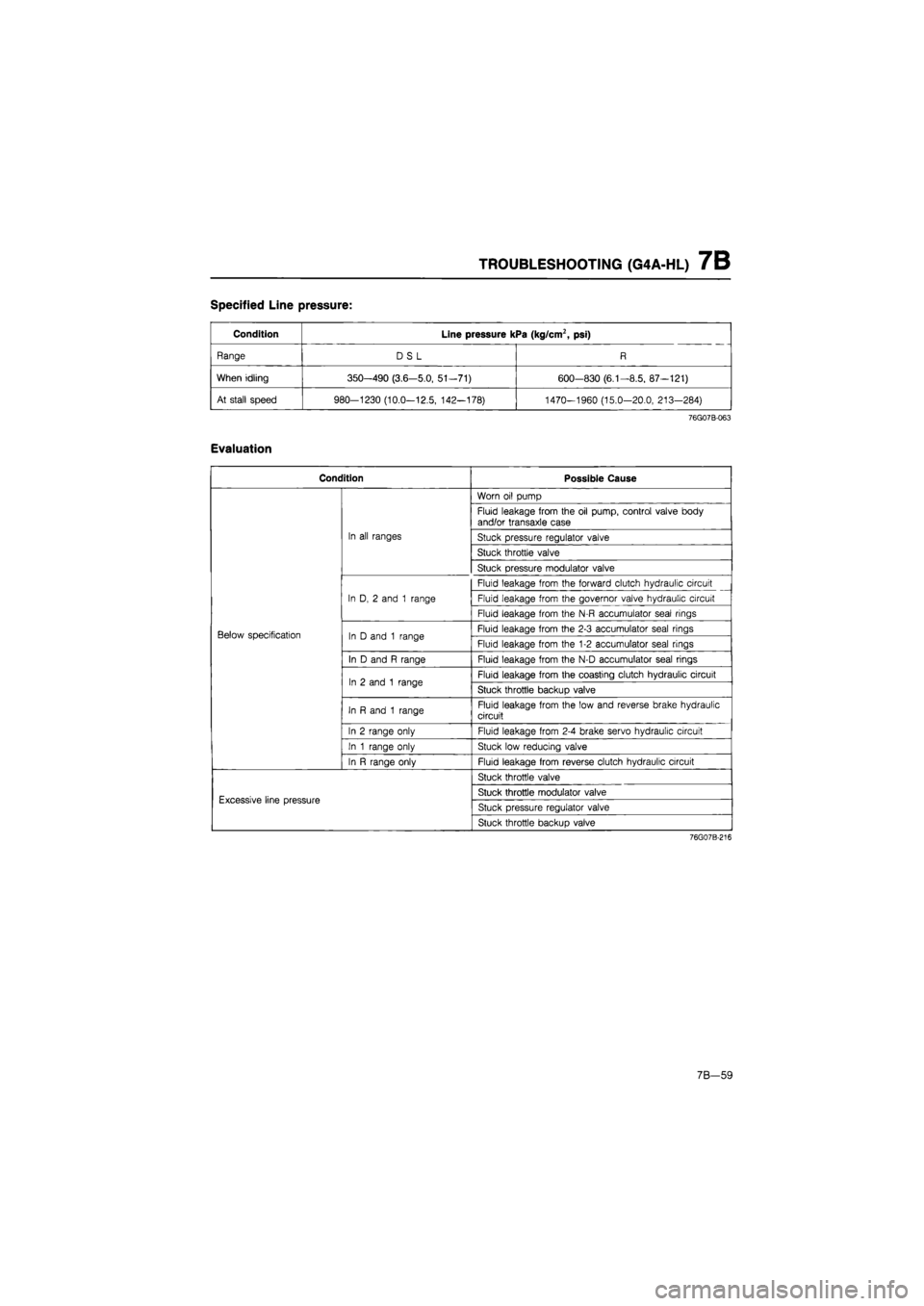
Specified Line pressure:
Condition Line pressure kPa (kg/cm2, psi)
Range DSL R
When idling 350-490 (3.6-5.0, 51-71) 600-830 (6.1-8.5, 87-121)
At stall speed 980-1230 (10.0—12.5, 142—178) 1470-1960 (15.0-20.0, 213-284)
76G07B-063
Evaluation
Condition Possible Cause
Below specification
In all ranges
Worn oil pump
Below specification
In all ranges
Fluid leakage from the oil pump, control valve body
and/or transaxle case
Below specification
In all ranges Stuck pressure regulator valve
Below specification
In all ranges
Stuck throttle valve
Below specification
In all ranges
Stuck pressure modulator valve
Below specification
In D, 2 and 1 range
Fluid leakage from the forward clutch hydraulic circuit
Below specification
In D, 2 and 1 range Fluid leakage from the governor valve hydraulic circuit
Below specification
In D, 2 and 1 range
Fluid leakage from the N-R accumulator seal rings
Below specification In D and 1 range Fluid leakage from the 2-3 accumulator seal rings Below specification In D and 1 range Fluid leakage from the 1-2 accumulator seal rings Below specification
In D and R range Fluid leakage from the N-D accumulator seal rings
Below specification
In 2 and 1 range Fluid leakage from the coasting clutch hydraulic circuit
Below specification
In 2 and 1 range Stuck throttle backup valve
Below specification
In R and 1 range Fluid leakage from the low and reverse brake hydraulic
circuit
Below specification
In 2 range only Fluid leakage from 2-4 brake servo hydraulic circuit
Below specification
In 1 range only Stuck low reducing valve
Below specification
In R range only Fluid leakage from reverse clutch hydraulic circuit
Excessive line pressure
Stuck throttle valve
Excessive line pressure Stuck throttle modulator valve Excessive line pressure Stuck pressure regulator valve Excessive line pressure
Stuck throttle backup valve
76G07B-216
7B—59
Page 960 of 1865

7B DISASSEMBLY
DISASSEMBLY-STEP 2
Components
1. Piston stem
2. Snap ring
3. Clutch assembly
4. 2-4 brake band
5. Small sun gear and one-way clutch
6. Anchor strut and shaft
7. Servo
8. One-way clutch and carrier hub assembly
86U07B-135
—Low and reverse brake—
9. Retaining plate
10. Drive and driven plates
11. Internal gear
12. O-ring
13. 3-4 clutch assembly
14. Turbine shaft
7B—94
Page 961 of 1865

DISASSEMBLY 7B
Procedure
1. Remove the piston stem from the servo.
86U07B-136
2. Remove the clutch assembly.
(1) Remove the turbine shaft snap ring.
86U07B-137
(2) Pull the reverse and forward drum and remove
the clutch assembly.
86U07B-138
3. Remove the 2-4 brake band.
Note
Use a piece of wire to secure the brake band
so that it is not damaged by being stretched.
86U07B-139
7B—95
Page 962 of 1865
7B DISASSEMBLY
86U07B-142
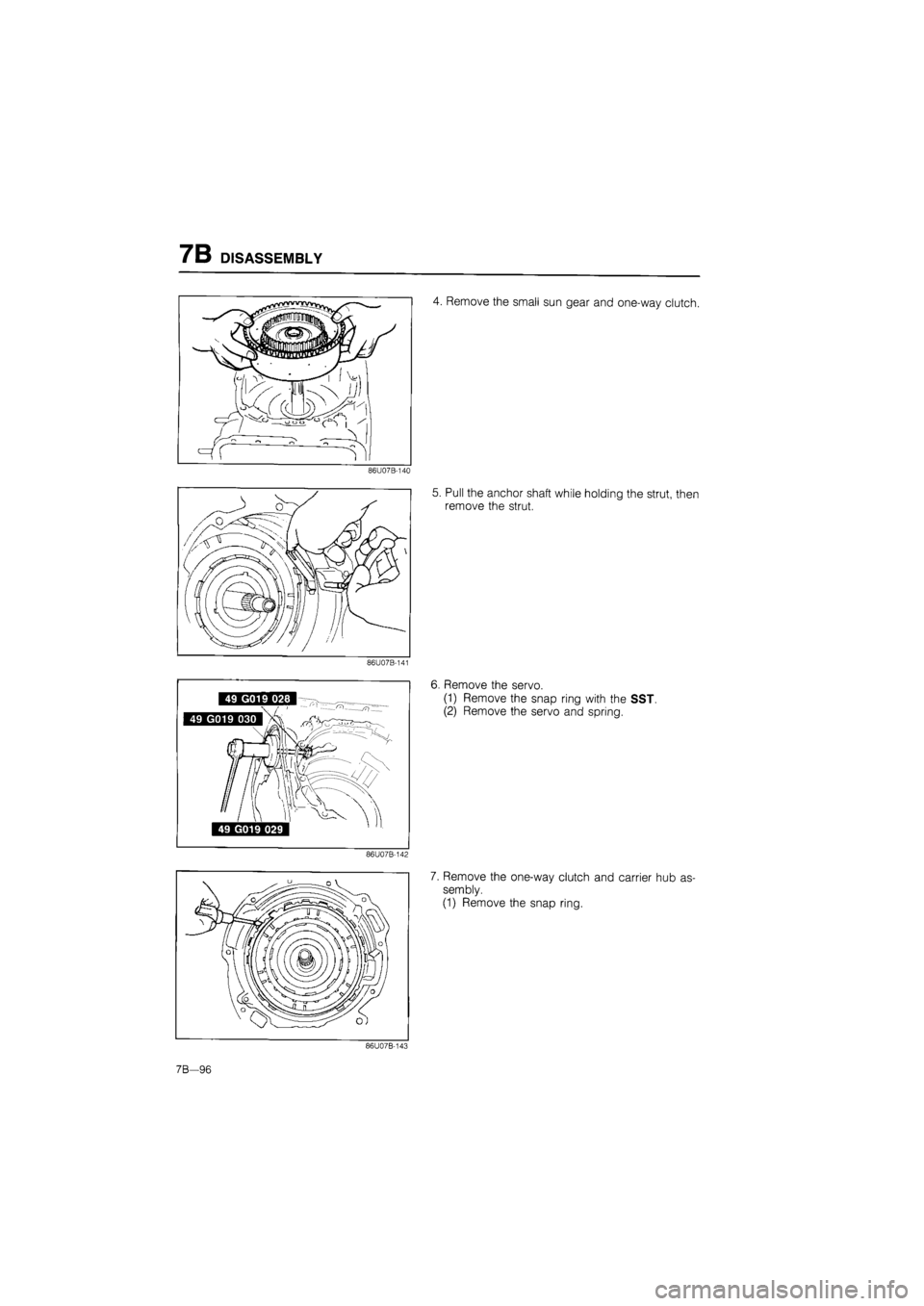
4. Remove the small sun gear and one-way clutch.
5. Pull the anchor shaft while holding the strut, then
remove the strut.
6. Remove the servo.
(1) Remove the snap ring with the SST.
(2) Remove the servo and spring.
7. Remove the one-way clutch and carrier hub as-
sembly.
(1) Remove the snap ring.
7B—96