ABS MERCEDES-BENZ C-CLASS COUPE 2015 Owner's Manual
[x] Cancel search | Manufacturer: MERCEDES-BENZ, Model Year: 2015, Model line: C-CLASS COUPE, Model: MERCEDES-BENZ C-CLASS COUPE 2015Pages: 385, PDF Size: 13.12 MB
Page 344 of 385
G
WARNING
If the required tyre pressure is not reached
after driving for ashort period, the tyre is too
badly damaged. The tyre sealant cannot
repair the tyre in this instance. Damaged tyres and atyre pressure that is too low can signif-
icantly impair the vehicle's braking and driv-
ing characteristics. There is arisk of accident.
Do not continue driving. Contact aqualified
specialist workshop.
i In yourv
ehicle, you willf indasticker with
the Mercedes-Benz Service24h telephone
number, e.g. on the B-pillar on the driver's
side.
X Correct the tyre pressure if it is still at least
130 kPa (1.3 bar/19 psi) .See the tyre pres-
sure table on the fuel filler flap for values.
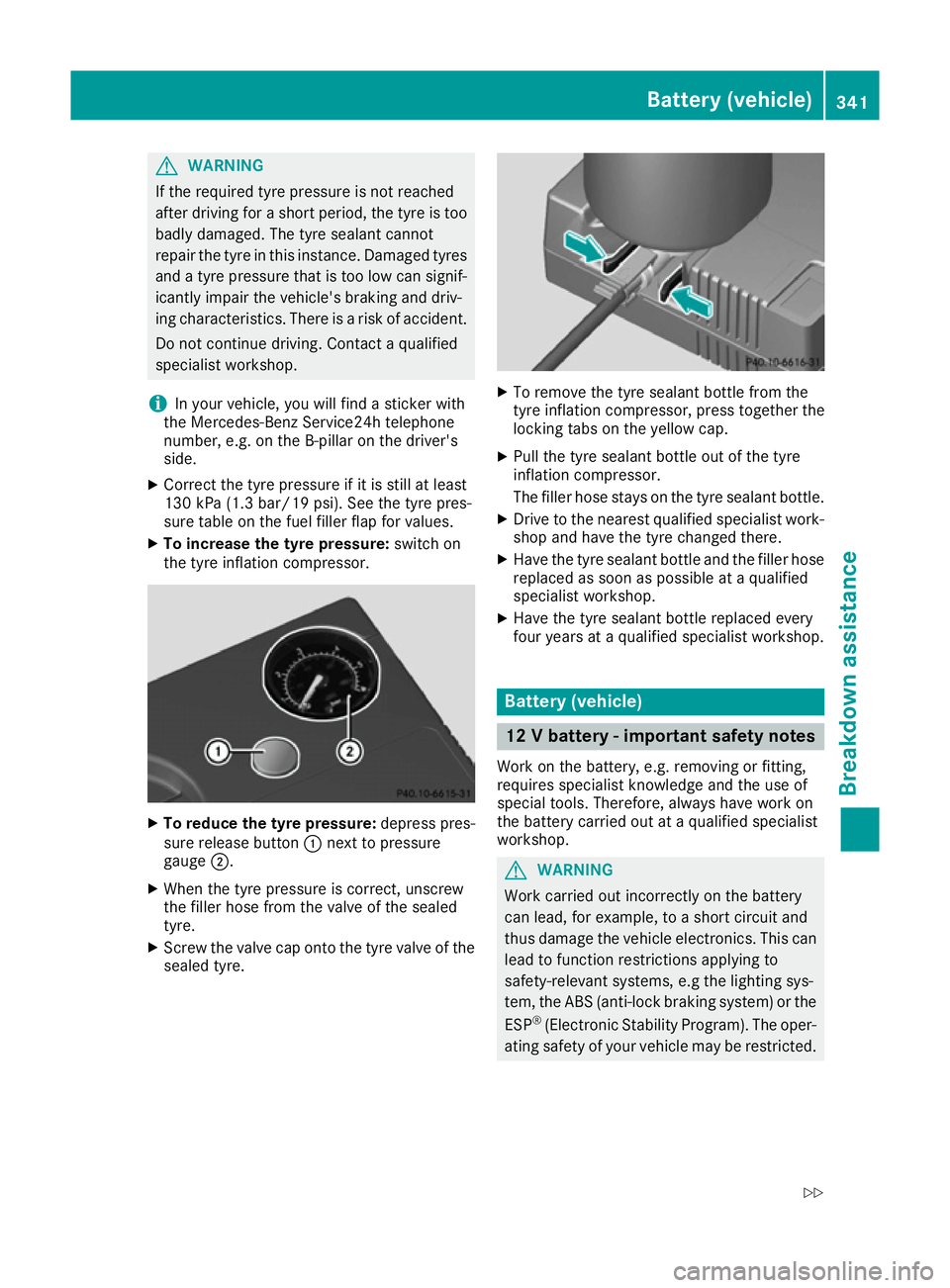
X To increase the tyre pressure: switch on
the tyre inflation compressor. X
To reduce the tyre pressure: depress pres-
sure release button :next to pressure
gauge ;.
X When the tyre pressure is correct, unscrew
the filler hose from the valve of the sealed
tyre.
X Screw the valve cap onto the tyre valve of the
sealed tyre. X
To remove the tyre sealant bottle from the
tyre inflation compressor, press together the
locking tabs on the yellow cap.
X Pullt he tyre sealant bottle out of the tyre
inflation compressor.
The filler hose stays on the tyre sealant bottle.
X Drive to the neares tqualified specialist work-
shop and have the tyre changed there.
X Have the tyre sealant bottle and the filler hose
replaced as soon as possible at aqualified
specialist workshop.
X Have the tyre sealant bottle replaced every
four years at aqualified specialist workshop. Battery (vehicle)
12
Vb attery -important safety notes
Work on the battery ,e.g. removing or fitting,
requires specialist knowledge and the use of
special tools. Therefore, alwaysh ave work on
the battery carrie dout at aqualified specialist
workshop. G
WARNING
Work carrie dout incorrectly on the battery
can lead, for example, to ashort circui tand
thus damage the vehicl eelectronics. This can
leadtof unction restrictions applying to
safety-relevant systems ,e.g the lighting sys-
tem, the ABS (anti-lock braking system) or the
ESP ®
(Electronic Stability Program). The oper-
ating safety of yourv ehiclemay be restricted. Battery (vehicle)
341Breakdown assistance
Z
Page 346 of 385
Observe the service intervals in the Service
Booklet or contact
aqualified specialist work-
shop for more information.
! Alwaysh
ave work on the batteries carried
out at aqualified specialist workshop. Should
it, in exceptional circumstances, be abso-
lutely necessary to disconnect the 12-volt
battery yourself, please observe the follow-
ing:
R secure the vehicle to prevent it from rolling
away.
R switch the ignition off.
R first, disconnect the negative terminal, fol-
lowed by the positive terminal.
Vehicles with automatic transmission: the
transmission is locked in position Pafter dis-
connecting the battery.
After the work has been completed, firmly
reinstall the battery and the cover of the pos-
itive terminal.
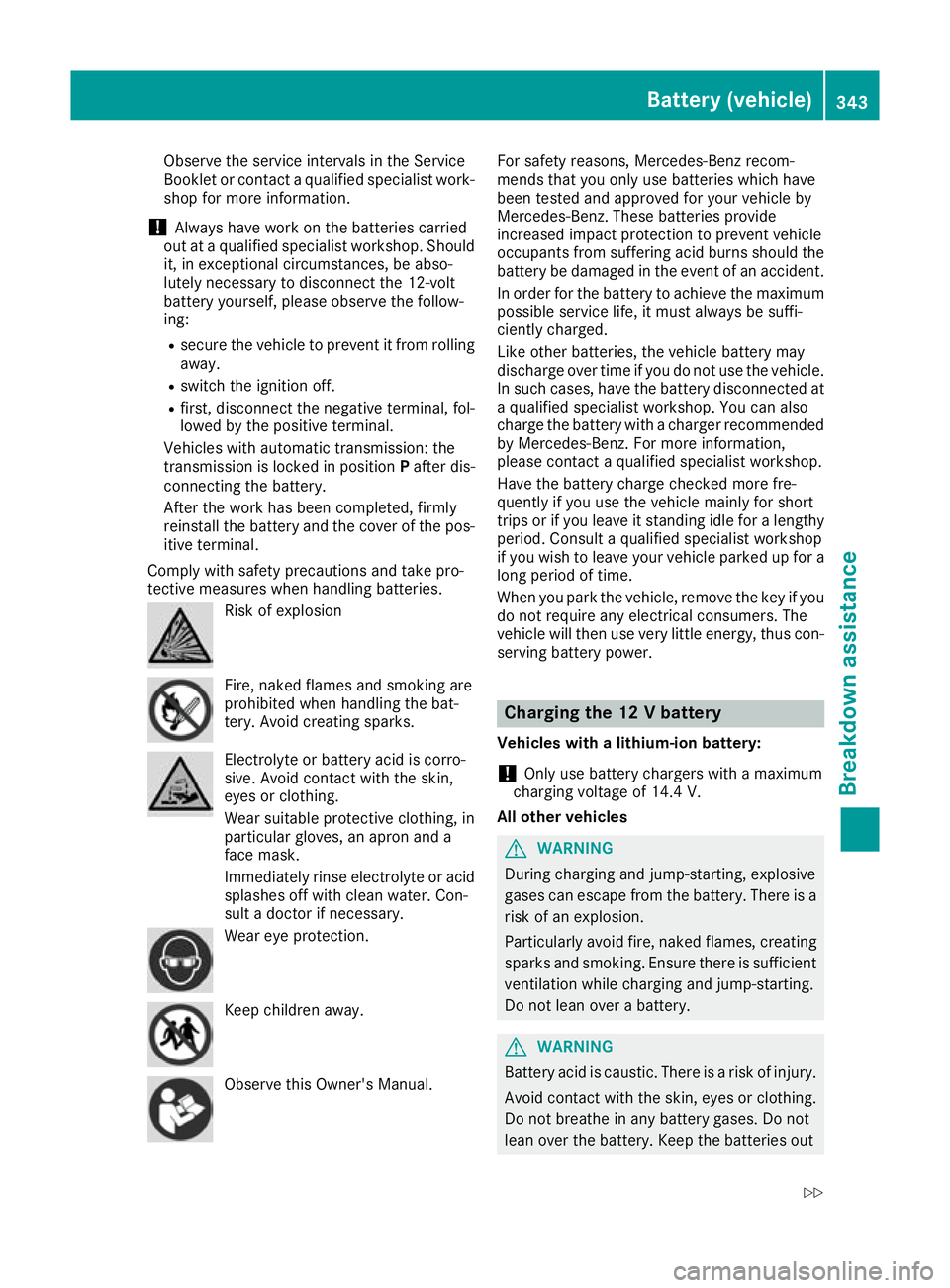
Comply with safety precautions and take pro-
tective measures when handling batteries. Risk of explosion
Fire, naked flames and smoking are
prohibited when handling the bat-
tery. Avoid creating sparks.
Electrolyte or battery acid is corro-
sive. Avoid contact with the skin,
eyes or clothing.
Wear suitablep rotective clothing, in
particular gloves, an apron and a
face mask.
Immediately rinse electrolyte or acid
splashes off with clean water. Con-
sult adoctor if necessary. Wear eye protection.
Keep children away.
Observe this Owner's Manual. For safety reasons, Mercedes-Benz recom-
mends that you only use batteries which have
been tested and approved for your vehicle by
Mercedes-Benz.T
hese batteries provide
increased impact protection to prevent vehicle
occupants from suffering acid burns should the battery be damaged in the event of an accident.
In order for the battery to achieve the maximum possible service life, it must always be suffi-
ciently charged.
Like other batteries, the vehicle battery may
discharge over time if you do not use the vehicle.In such cases, have the battery disconnected ataq ualified specialist workshop. You can also
charge the battery with acharger recommended
by Mercedes-Benz.F or more information,
please contact aqualified specialist workshop.
Have the battery charge checked more fre-
quently if you use the vehicle mainly for short
trips or if you leave it standing idle for alengthy
period. Consult aqualified specialist workshop
if you wish to leave your vehicle parked up for a
long period of time.
When you park the vehicle, remove the key if you do not require any electrical consumers. The
vehicle will then use very little energy, thus con- serving battery power. Charging the 12
Vbattery
Vehicles with alithium-ion battery:
! Only use battery chargers with
amaximum
charging voltage of 14.4 V.
All other vehicles G
WARNING
During charging and jump-starting, explosive
gases can escape from the battery. There is a risk of an explosion.
Particularlya void fire, naked flames, creating
sparks and smoking. Ensure there is sufficient
ventilation while charging and jump-starting.
Do not lean over abattery. G
WARNING
Battery acid is caustic. There is arisk of injury.
Avoid contact with the skin, eyes or clothing.
Do not breathe in any battery gases. Do not
lean over the battery. Keep the batteries out Battery (vehicle)
343Breakdown assistance
Z
Page 369 of 385
X
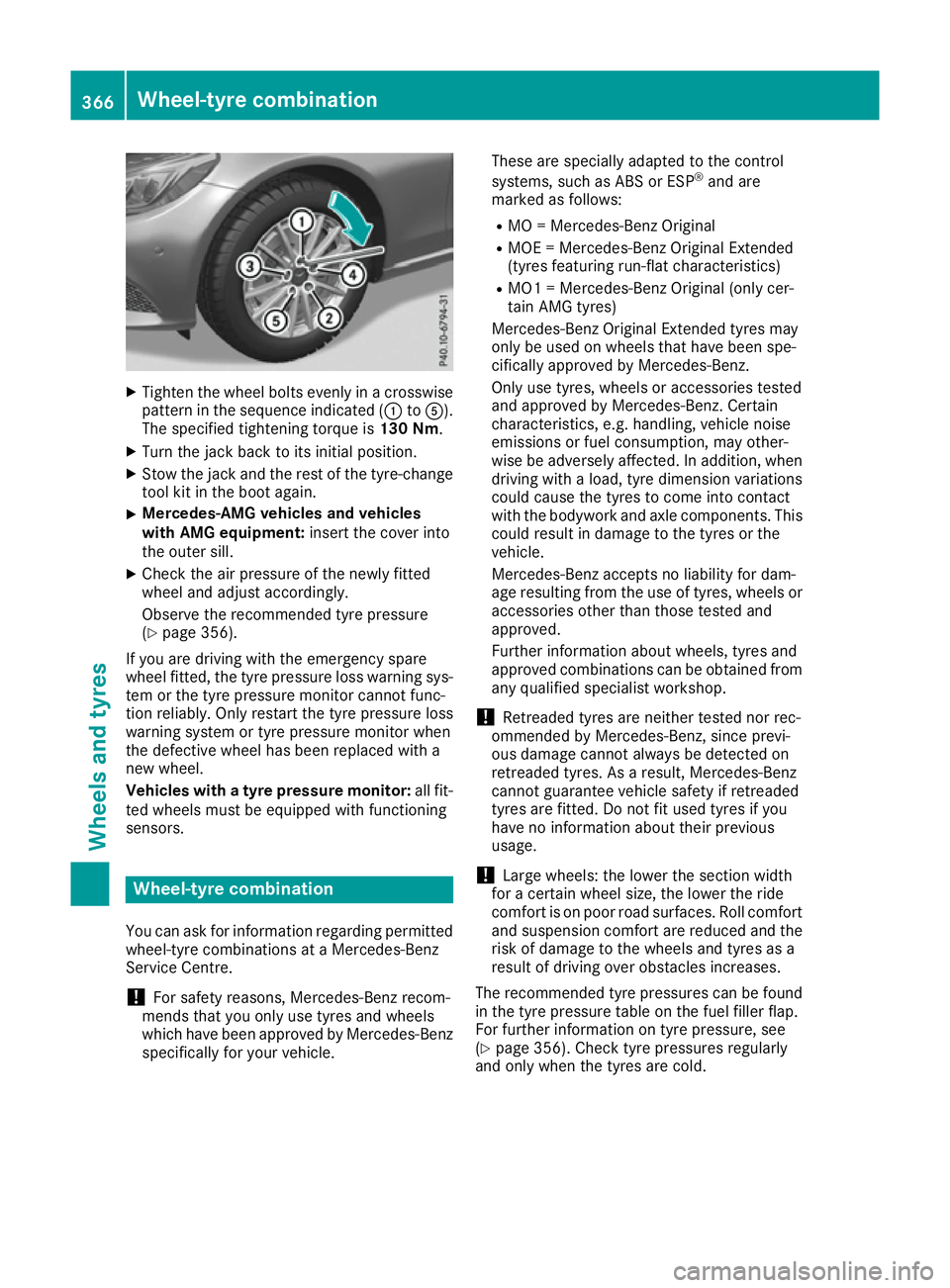
Tighten the wheel bolts evenly in acrosswise
pattern in the sequence indicated (: toA).
The specified tightening torque is 130 Nm.
X Turn the jack back to its initial position.
X Stow the jack and the rest of the tyre-change
tool kit in the boot again.
X Mercedes-AMG vehicles and vehicles
with AMG equipment:
insert the cover into
the outer sill.
X Check the air pressure of the newly fitted
wheel and adjust accordingly.
Observe the recommended tyre pressure
(Y page 356).
If you are driving with the emergenc yspare
wheel fitted, the tyre pressure loss warning sys-
tem or the tyre pressure monitor cannot func-
tion reliably .Only restart the tyre pressure loss
warning system or tyre pressure monitor when
the defective wheel has been replaced with a
new wheel.
Vehicles with atyrep ressur emonitor: all fit-
ted wheels must be equipped with functioning
sensors. Wheel-tyr
ecombination
You can ask for information regarding permitted wheel-tyre combinations at aMercedes-Benz
Servic eCentre.
! For safety reasons, Mercedes-Benz recom-
mends that you only use tyres and wheels
which have been approved by Mercedes-Benz specifically for your vehicle. These are specially adapted to the control
systems, such as ABS or ESP
®
and are
marked as follows:
R MO =Mercedes-Benz Original
R MOE =Mercedes-Benz Original Extended
(tyres featuring run-flat characteristics)
R MO1 =Mercedes-Benz Original (only cer-
tain AMG tyres)
Mercedes-Benz Original Extended tyres may
only be used on wheels that have been spe-
cifically approved by Mercedes-Benz.
Only use tyres, wheels or accessories tested
and approved by Mercedes-Benz.C ertain
characteristics, e.g. handling, vehicle noise
emissions or fuel consumption, may other-
wise be adversely affected. In addition, when
driving with aload, tyre dimension variations
could cause the tyres to come into contact
with the bodywork and axle components.T his
could result in damage to the tyres or the
vehicle.
Mercedes-Benz accepts no liability for dam-
age resulting from the use of tyres, wheels or accessories other than those tested and
approved.
Further information about wheels, tyres and
approved combinations can be obtained from
any qualified specialist workshop.
! Retreaded tyres are neither tested nor rec-
ommended by Mercedes-Benz,s ince previ-
ous damage cannot alway sbedetected on
retreaded tyres. As aresult, Mercedes-Benz
cannot guarantee vehicle safety if retreaded
tyres are fitted. Do not fit used tyres if you
have no information about their previous
usage.
! Large wheels: the lower the section width
for acertain wheel size, the lower the ride
comfor tisonp oor road surfaces. Roll comfort
and suspension comfor tare reduced and the
risk of damage to the wheels and tyres as a
result of driving over obstacles increases.
The recommended tyre pressures can be found
in the tyre pressure table on the fuel filler flap.
For further information on tyre pressure, see
(Y page 356). Check tyre pressures regularly
and only when the tyres are cold. 366
Wheel-tyr
ecombinationWheels and tyres
Page 379 of 385
Additives
!
Do no
tuse any additive switht he engin eoil.
This could damag ethe engine. Brak
efluid G
WARNING
The brak efluid continuously absorbs mois-
tur efromt heair. This result sintheboiling
poin toft hebrak efluid lowering .Iftheboiling
poin toft hebrak efluid is to olow, vapour
pockets may for mwhen th ebrakes are sub-
jected to aheav yload. This would impair brak-
ing efficiency. There is ariskofana ccident.
Hav ethe brak efluid renewed at th eprescri-
bed intervals.
When handlin gbrak efluid ,observ ethe impor-
tan tsafet ynotes on servic eproducts
(Y page 371).
The brak efluid chang eintervals can be foun din
th eS ervic eBooklet.
Only use brak efluid approve dbyMercedes-
Benz in accordanc ewithM B-Freig abe or MB-
Approval 331.0.
Information about approve dbrak efluid can be
obtained at any qualified specialis tworkshop or
on th eInterne tat
http://bevo.mercedes-benz.co m.
i Have the brake fluid regularly replaced at a
qualified specialist workshop in accordance
with the replacement intervals and the
replacement confirmed in the Service Book-
let. Coolant
Importan tsafety notes G
WARNING
If antifreeze comes into contact with hot com- ponents in the engine compartment, it may
ignite. There is arisk of fire and injury.
Let the engine cool dow nbefore yo utop up
the antifreeze .Make sur ethat antifreeze is
not spilled next to the filler neck. Thoroughly clea
nthe antifreeze from components before
starting the engine.
! Only ad
dcoolant that has bee npremixed
with the desire dantifreeze protection. You
coul dotherwise damag ethe engine.
Furthe rinformatio noncoolants can be found
in the Mercedes-Benz Specifications for Ser-
vice Products, MB Specifications for Service
Products 310.1, e.g. on the Internet at
http://bevo.mercedes-benz.com .Orcontact
aq ualifie dspecialist workshop.
! Always use
asuitabl ecoolant mixture, even
in countries where hig htemperatures prevail.
Otherwise ,the engine cooling system is not
sufficiently protected from corrosion and
overheating.
i Have the coolant regularly replaced at a
qualified specialist workshop and the replace- ment confirmed in the Service Booklet.
Comply with the important safety precautions
for service products whe nhandling coolant
(Y page 371).
The coolant is amixture of water and anti-
freeze/corrosion inhibitor. It is responsible for
the following:
R anti-corrosion protection
R antifreeze protection
R raising the boiling point
If antifreeze/corrosion inhibito rispresent in the
correct concentration, the boiling point of the
coolant during operation will be approximately
130 †.
The antifreeze concentrate/corrosion inhibitor
concentration in the engine cooling system
should:
R be at least 50%. Thi swillp rotect the engine
cooling system against freezing dow nto
approximatel y-37 †.
R not excee d55% (antifreeze protection down
to -45 †). Hea twillo therwise not be dissipa-
ted as effectively.
Mercedes-Benz recommends an antifreeze/
corrosion inhibito rconcentrate in accordance
with MB Specifications for Service Products
310.1.
i Whe
nthe vehicle is first delivered, it is filled
with acoolant mixtur ethat ensures adequate
antifreeze and corrosion protection. 376
Service products and capacitiesTechnical data