light MERCEDES-BENZ CL COUPE 2009 Owners Manual
[x] Cancel search | Manufacturer: MERCEDES-BENZ, Model Year: 2009, Model line: CL COUPE, Model: MERCEDES-BENZ CL COUPE 2009Pages: 421, PDF Size: 10.78 MB
Page 311 of 421
R
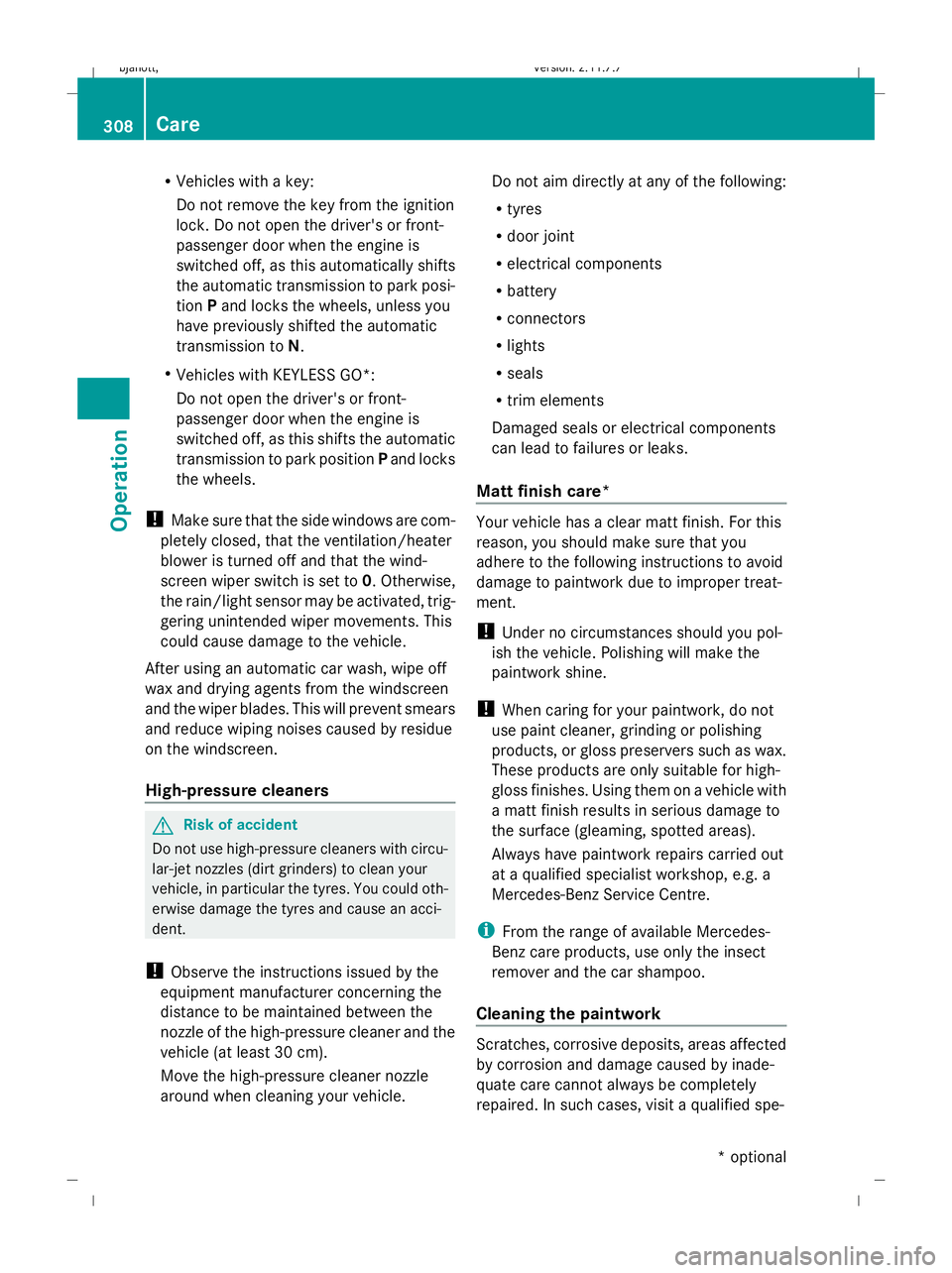
Vehicles with a key:
Do not remove the key from the ignition
lock. Do not open the driver's or front-
passenger door when the engine is
switched off, as this automatically shifts
the automatic transmission to park posi-
tion Pand locks the wheels, unless you
have previously shifted the automatic
transmission to N.
R Vehicles with KEYLESS GO*:
Do not open the driver's or front-
passenger door when the engine is
switched off, as this shifts the automatic
transmission to park position Pand locks
the wheels.
! Make sure that the side windows are com-
pletely closed, that the ventilation/heater
blower is turned off and that the wind-
screen wiper switch is set to 0. Otherwise,
the rain/light sensor may be activated, trig-
gering unintended wiper movements. This
could cause damage to the vehicle.
After using an automatic car wash, wipe off
wax and drying agents from the windscreen
and the wiper blades. This will prevent smears
and reduce wiping noises caused by residue
on the windscreen.
High-pressure cleaners G
Risk of accident
Do not use high-pressure cleaners with circu-
lar-jet nozzles (dirt grinders) to clean your
vehicle, in particular the tyres. You could oth-
erwise damage the tyres and cause an acci-
dent.
! Observe the instructions issued by the
equipment manufacturer concerning the
distance to be maintained between the
nozzle of the high-pressure cleaner and the
vehicle (at least 30 cm).
Move the high-pressure cleaner nozzle
around when cleaning your vehicle. Do not aim directly at any of the following:
R
tyres
R door joint
R electrical components
R battery
R connectors
R lights
R seals
R trim elements
Damaged seals or electrical components
can lead to failures or leaks.
Matt finish care* Your vehicle has a clear matt finish. For this
reason, you should make sure that you
adhere to the following instructions to avoid
damage to paintwork due to improper treat-
ment.
! Under no circumstances should you pol-
ish the vehicle. Polishing will make the
paintwork shine.
! When caring for your paintwork, do not
use paint cleaner, grinding or polishing
products, or gloss preservers such as wax.
These products are only suitable for high-
gloss finishes. Using them on a vehicle with
a matt finish results in serious damage to
the surface (gleaming, spotted areas).
Always have paintwork repairs carried out
at a qualified specialist workshop, e.g. a
Mercedes-Benz Service Centre.
i From the range of available Mercedes-
Benz care products, use only the insect
remover and the car shampoo.
Cleaning the paintwork Scratches, corrosive deposits, areas affected
by corrosion and damage caused by inade-
quate care cannot always be completely
repaired. In such cases, visit a qualified spe-308
CareOperation
* optional
216_AKB; 2; 3, en-GB
bjanott,
Version: 2.11.7.7 2009-02-27T14:54:17+01:00 - Seite 308
Dateiname: 6515230602_buchblock.pdf; erzeugt am 04. Mar 2009 11:16:30; WK
Page 312 of 421
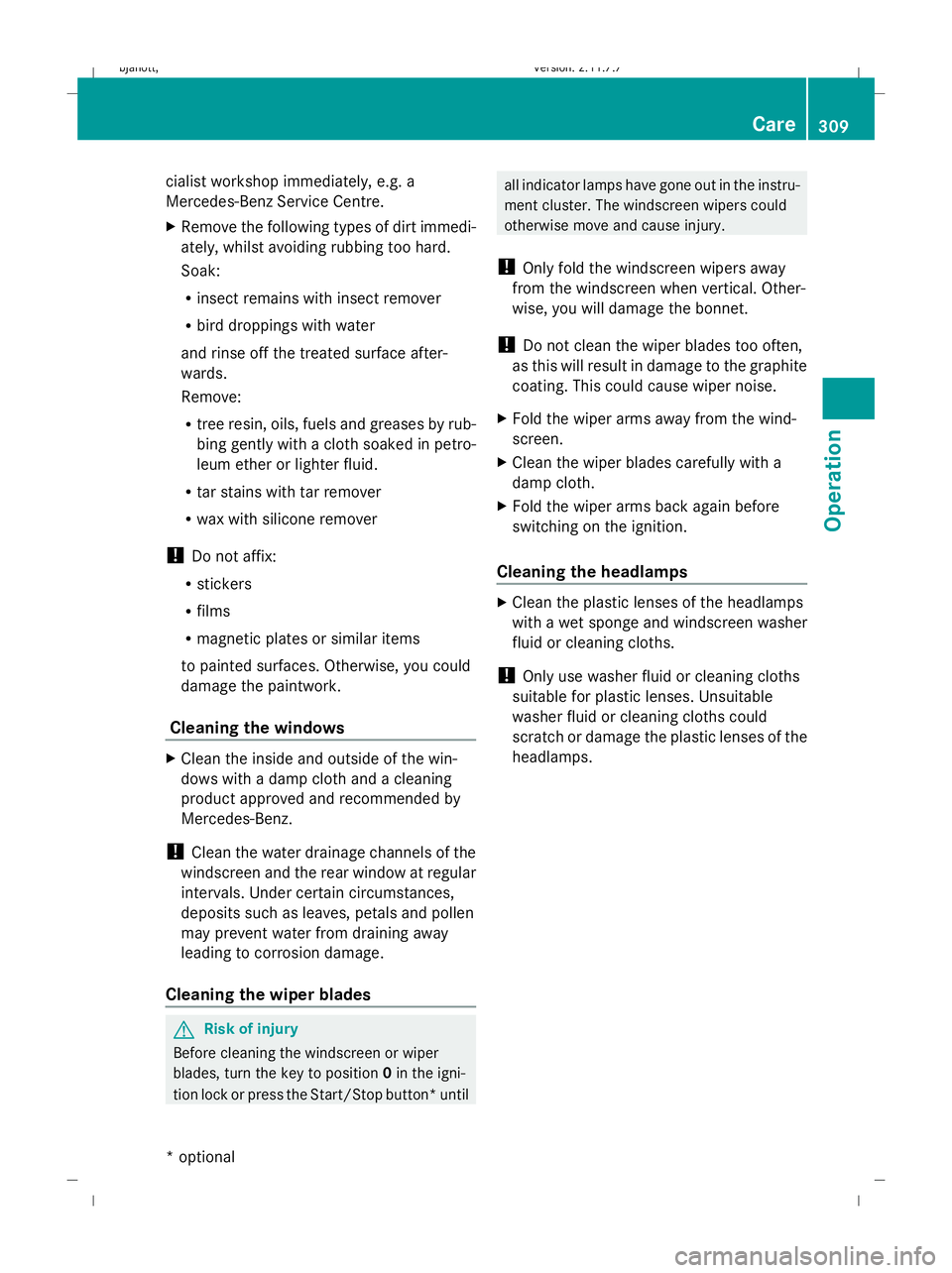
cialist workshop immediately, e.g. a
Mercedes-Benz Service Centre.
X
Remove the following types of dirt immedi-
ately, whilst avoiding rubbing too hard.
Soak:
R
insect remains with insect remover
R bird droppings with water
and rinse off the treated surface after-
wards.
Remove:
R tree resin, oils, fuels and greases by rub-
bing gently with a cloth soaked in petro-
leum ether or lighter fluid.
R tar stains with tar remover
R wax with silicone remover
! Do not affix:
R stickers
R films
R magnetic plates or similar items
to painted surfaces. Otherwise, you could
damage the paintwork.
Cleaning the windows X
Clean the inside and outside of the win-
dows with a damp cloth and a cleaning
product approved and recommended by
Mercedes-Benz.
! Clean the water drainage channels of the
windscreen and the rear window at regular
intervals. Under certain circumstances,
deposits such as leaves, petals and pollen
may prevent water from draining away
leading to corrosion damage.
Cleaning the wiper blades G
Risk of injury
Before cleaning the windscreen or wiper
blades, turn the key to position 0in the igni-
tion lock or press the Start/Stop button* until all indicator lamps have gone out in the instru-
ment cluster. The windscreen wipers could
otherwise move and cause injury.
! Only fold the windscreen wipers away
from the windscreen when vertical. Other-
wise, you will damage the bonnet.
! Do not clean the wiper blades too often,
as this will result in damage to the graphite
coating. This could cause wiper noise.
X Fold the wiper arms away from the wind-
screen.
X Clean the wiper blades carefully with a
damp cloth.
X Fold the wiper arms back again before
switching on the ignition.
Cleaning the headlamps X
Clean the plastic lenses of the headlamps
with a wet sponge and windscreen washer
fluid or cleaning cloths.
! Only use washer fluid or cleaning cloths
suitable for plastic lenses. Unsuitable
washer fluid or cleaning cloths could
scratch or damage the plastic lenses of the
headlamps. Care
309Operation
* optional
216_AKB; 2; 3, en-GB
bjanott,
Version: 2.11.7.7 2009-02-27T14:54:17+01:00 - Seite 309 Z
Dateiname: 6515230602_buchblock.pdf; erzeugt am 04. Mar 2009 11:16:30; WK
Page 321 of 421
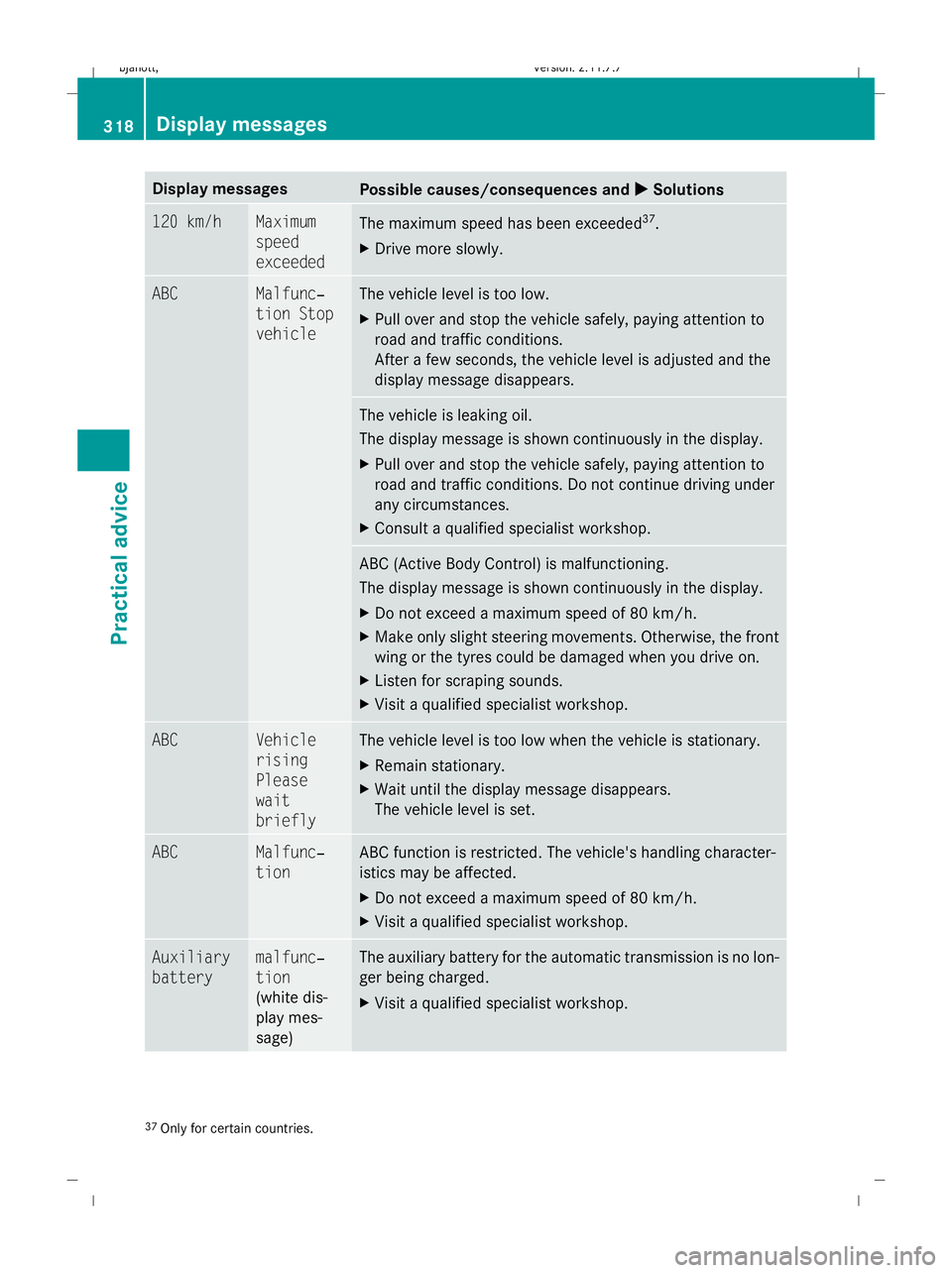
Display messages
Possible causes/consequences and
X
X Solutions 120 km/h Maximum
speed
exceeded
The maximum speed has been exceeded
37
.
X Drive more slowly. ABC Malfunc‐
tion Stop
vehicle The vehicle level is too low.
X
Pull over and stop the vehicle safely, paying attention to
road and traffic conditions.
After a few seconds, the vehicle level is adjusted and the
display message disappears. The vehicle is leaking oil.
The display message is shown continuously in the display.
X
Pull over and stop the vehicle safely, paying attention to
road and traffic conditions. Do not continue driving under
any circumstances.
X Consult a qualified specialist workshop. ABC (Active Body Control) is malfunctioning.
The display message is shown continuously in the display.
X
Do not exceed a maximum speed of 80 km/h.
X Make only slight steering movements. Otherwise, the front
wing or the tyres could be damaged when you drive on.
X Listen for scraping sounds.
X Visit a qualified specialist workshop. ABC Vehicle
rising
Please
wait
briefly The vehicle level is too low when the vehicle is stationary.
X
Remain stationary.
X Wait until the display message disappears.
The vehicle level is set. ABC Malfunc‐
tion ABC function is restricted. The vehicle's handling character-
istics may be affected.
X
Do not exceed a maximum speed of 80 km/h.
X Visit a qualified specialist workshop. Auxiliary
battery malfunc‐
tion
(white dis-
play mes-
sage) The auxiliary battery for the automatic transmission is no lon-
ger being charged.
X
Visit a qualified specialist workshop. 37
Only for certain countries. 318
Display
messagesPractical advice
216_AKB; 2; 3, en-GB
bjanott ,V ersion: 2.11.7.7
2009-02-27T14:54:17+01:00 - Seite 318
Dateiname: 6515230602_buchblock.pdf; erzeugt am 04. Mar 2009 11:16:35; WK
Page 326 of 421
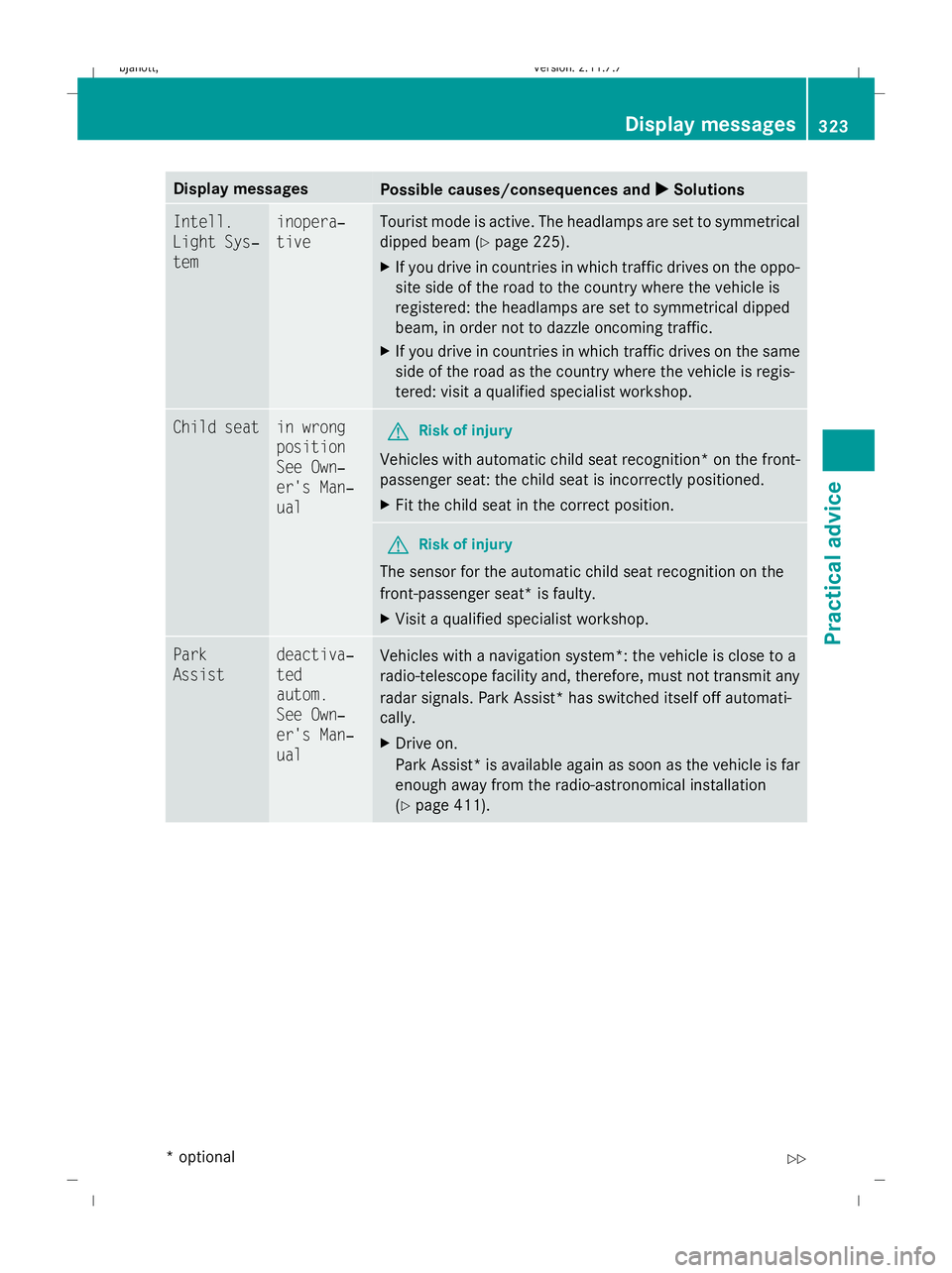
Display messages
Possible causes/consequences and
X
X Solutions Intell.
Light Sys‐
tem inopera‐
tive Tourist mode is active. The headlamps are set to symmetrical
dipped beam (
Ypage 225).
X If you drive in countries in which traffic drives on the oppo-
site side of the road to the country where the vehicle is
registered: the headlamps are set to symmetrical dipped
beam, in order not to dazzle oncoming traffic.
X If you drive in countries in which traffic drives on the same
side of the road as the country where the vehicle is regis-
tered: visit a qualified specialist workshop. Child seat in wrong
position
See Own‐
er's Man‐
ual
G
Risk of injury
Vehicles with automatic child seat recognition *on the front-
passenger seat: the child seat is incorrectly positioned.
X Fit the child seat in the correct position. G
Risk of injury
The sensor for the automatic child seat recognition on the
front-passenger seat* is faulty.
X Visit a qualified specialist workshop. Park
Assist deactiva‐
ted
autom.
See Own‐
er's Man‐
ual
Vehicles with a navigation system*: the vehicle is close to a
radio-telescope facility and, therefore, must not transmit any
radar signals. Park Assist* has switched itself off automati-
cally.
X
Drive on.
Park Assist *is available again as soon as the vehicle is far
enough away from the radio-astronomical installation
(Y page 411). Display messages
323Practical advice
* optional
216_AKB; 2; 3, en-GB
bjanott,
Version: 2.11.7.7 2009-02-27T14:54:17+01:00 - Seite 323 Z
Dateiname: 6515230602_buchblock.pdf; erzeugt am 04. Mar 2009 11:16:35; WK
Page 334 of 421
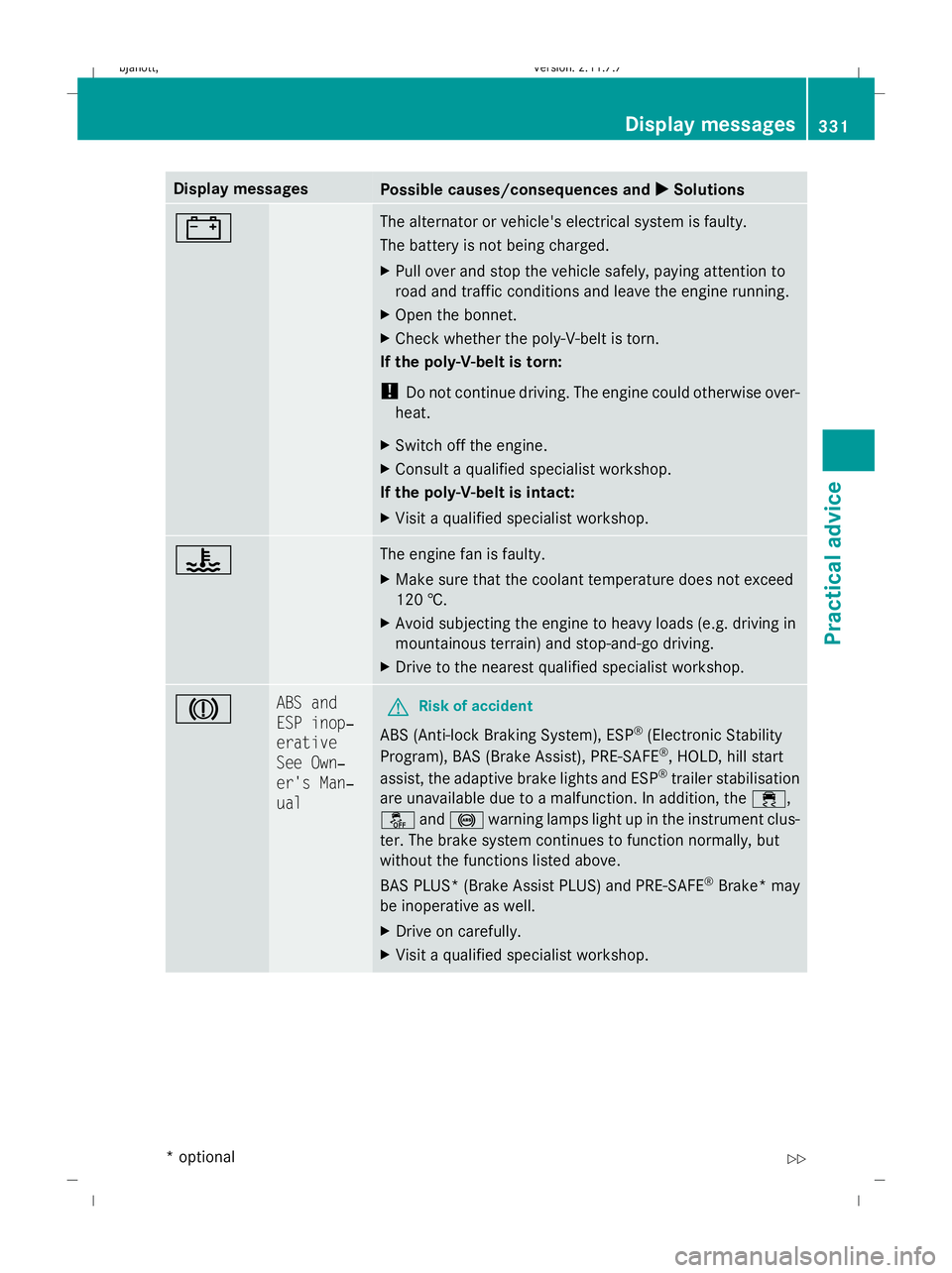
Display messages
Possible causes/consequences and
X
X Solutions # The alternator or vehicle's electrical system is faulty.
The battery is not being charged.
X
Pull over and stop the vehicle safely, paying attention to
road and traffic conditions and leave the engine running.
X Open the bonnet.
X Check whether the poly-V-belt is torn.
If the poly-V-belt is torn:
! Do not continue driving. The engine could otherwise over-
heat.
X Switch off the engine.
X Consult a qualified specialist workshop.
If the poly-V-belt is intact:
X Visit a qualified specialist workshop. ? The engine fan is faulty.
X
Make sure that the coolant temperature does not exceed
120 †.
X Avoid subjecting the engine to heavy loads (e.g. driving in
mountainous terrain) and stop-and-go driving.
X Drive to the nearest qualified specialist workshop. J ABS and
ESP inop‐
erative
See Own‐
er's Man‐
ual
G
Risk of accident
ABS (Anti-lock Braking System), ESP ®
(Electronic Stability
Program), BAS (Brake Assist), PRE-SAFE ®
, HOLD, hill start
assist, the adaptive brake lights and ESP ®
trailer stabilisation
are unavailable due to a malfunction. In addition, the ÷,
å and! warning lamps light up in the instrument clus-
ter. The brake system continues to function normally, but
without the functions listed above.
BAS PLUS* (Brake Assist PLUS) and PRE-SAFE ®
Brake *may
be inoperative as well.
X Drive on carefully.
X Visit a qualified specialist workshop. Display messages
331Practical advice
* optional
216_AKB; 2; 3, en-GB
bjanott,
Version: 2.11.7.7 2009-02-27T14:54:17+01:00 - Seite 331 Z
Dateiname: 6515230602_buchblock.pdf; erzeugt am 04. Mar 2009 11:16:37; WK
Page 335 of 421
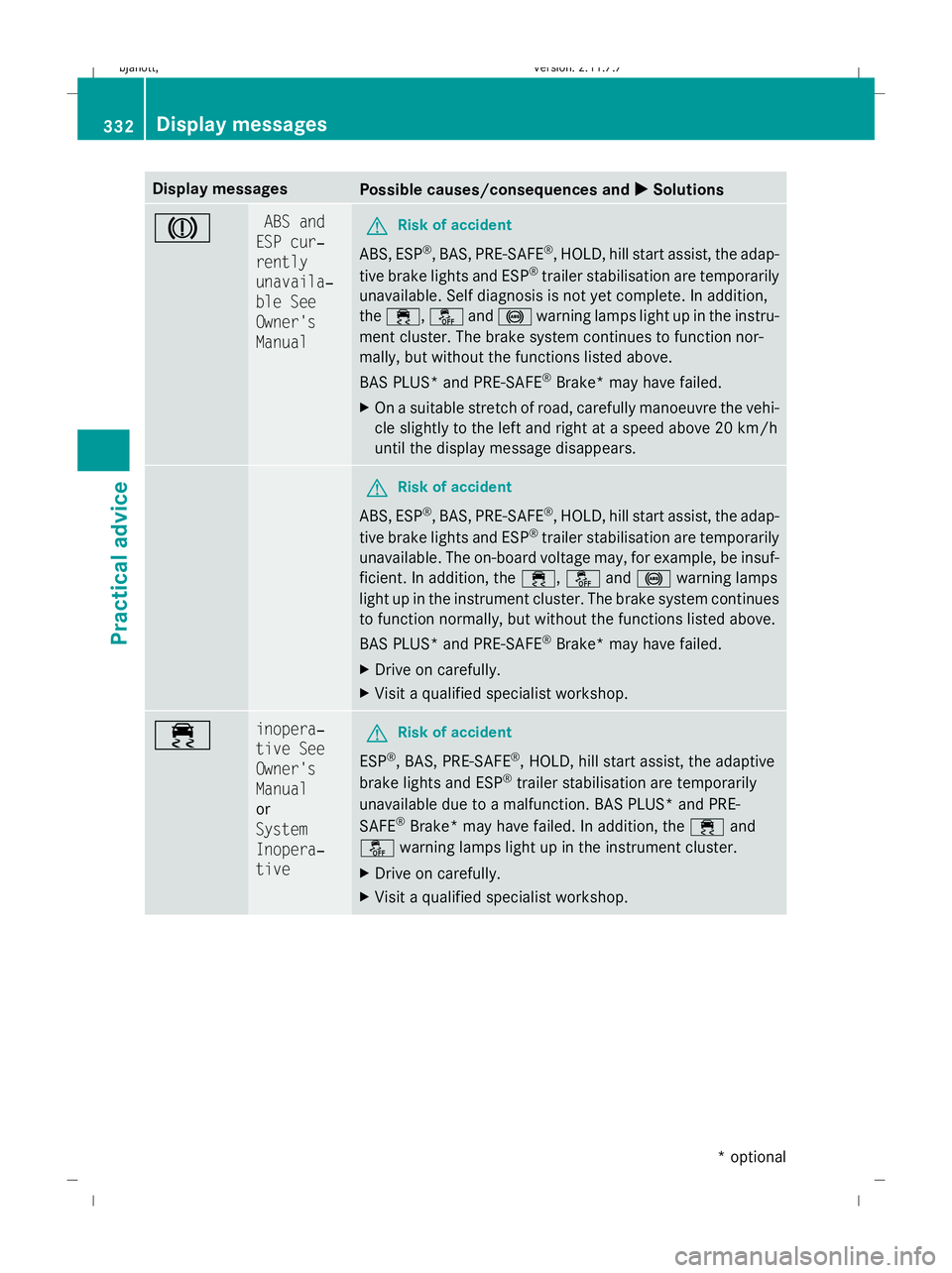
Display messages
Possible causes/consequences and
X
X Solutions J ABS and
ESP cur‐
rently
unavaila‐
ble See
Owner's
Manual G
Risk of accident
ABS, ESP ®
, BAS, PRE-SAFE ®
, HOLD, hill start assist, the adap-
tive brake lights and ESP ®
trailer stabilisation are temporarily
unavailable. Self diagnosis is not yet complete. In addition,
the ÷, åand! warning lamps light up in the instru-
ment cluster. The brake system continues to function nor-
mally, but without the functions listed above.
BAS PLUS* and PRE-SAFE ®
Brake* may have failed.
X On a suitable stretch of road, carefully manoeuvre the vehi-
cle slightly to the left and right at a speed above 20 km/h
until the display message disappears. G
Risk of accident
ABS, ESP ®
, BAS, PRE-SAFE ®
, HOLD, hill start assist, the adap-
tive brake lights and ESP ®
trailer stabilisation are temporarily
unavailable. The on-board voltage may, for example, be insuf-
ficient. In addition, the ÷,åand! warning lamps
light up in the instrument cluster. The brake system continues
to function normally, but without the functions listed above.
BAS PLUS* and PRE-SAFE ®
Brake* may have failed.
X Drive on carefully.
X Visit a qualified specialist workshop. ÷ inopera‐
tive See
Owner's
Manual
or
System
Inopera‐
tive
G
Risk of accident
ESP ®
, BAS, PRE-SAFE ®
, HOLD, hill start assist, the adaptive
brake lights and ESP ®
trailer stabilisation are temporarily
unavailable due to a malfunction. BAS PLUS* and PRE-
SAFE ®
Brake* may have failed. In addition, the ÷and
å warning lamps light up in the instrument cluster.
X Drive on carefully.
X Visit a qualified specialist workshop. 332
Display
messagesPractical advice
* optional
216_AKB; 2; 3, en-GB
bjanott
,V ersion: 2.11.7.7
2009-02-27T14:54:17+01:00 - Seite 332
Dateiname: 6515230602_buchblock.pdf; erzeugt am 04. Mar 2009 11:16:37; WK
Page 336 of 421
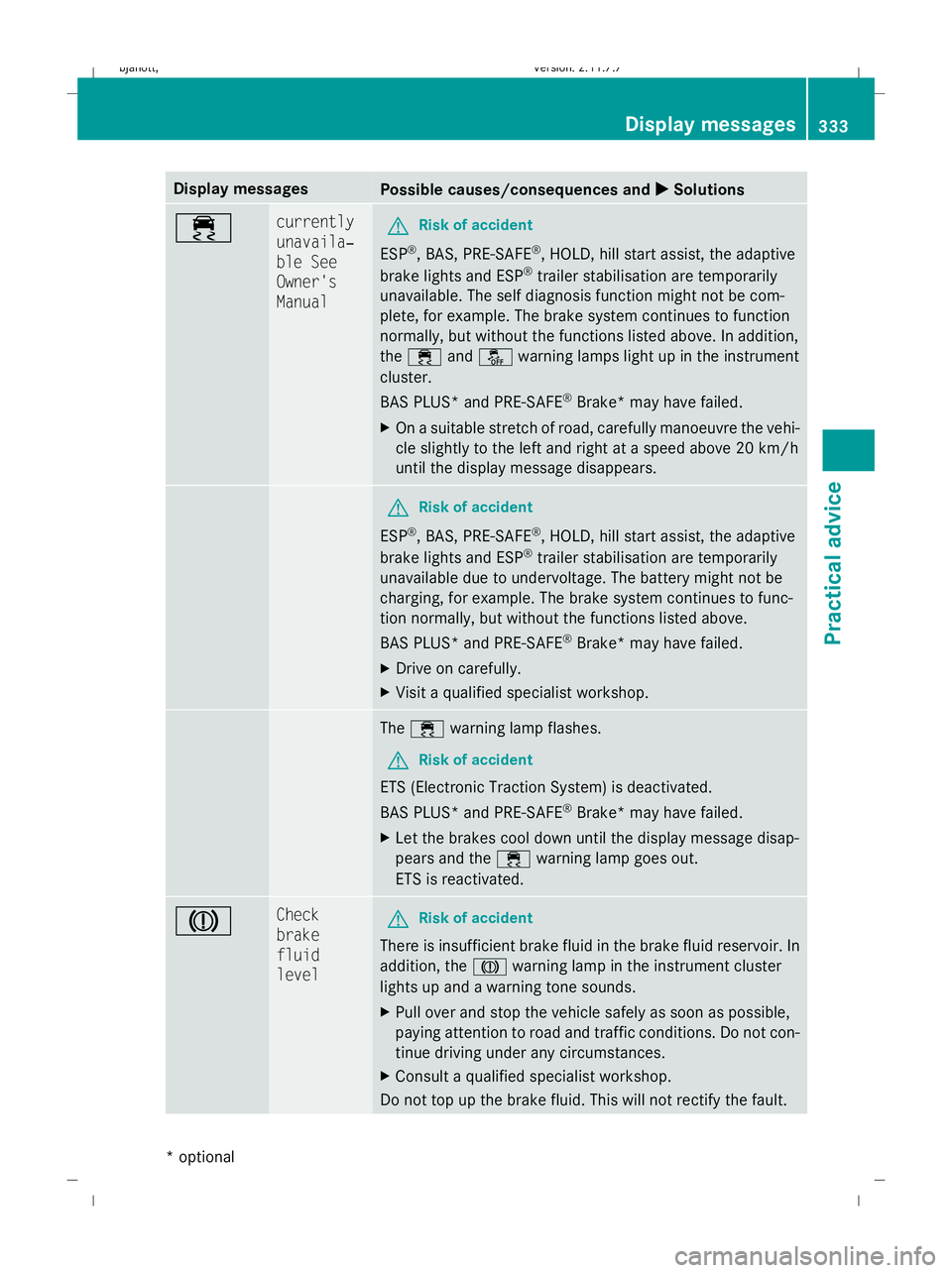
Display messages
Possible causes/consequences and
X
X Solutions ÷ currently
unavaila‐
ble See
Owner's
Manual
G
Risk of accident
ESP ®
, BAS, PRE-SAFE ®
, HOLD, hill start assist, the adaptive
brake lights and ESP ®
trailer stabilisation are temporarily
unavailable. The self diagnosis function might not be com-
plete, for example. The brake system continues to function
normally, but without the functions listed above. In addition,
the ÷ andå warning lamps light up in the instrument
cluster.
BAS PLUS* and PRE-SAFE ®
Brake* may have failed.
X On a suitable stretch of road, carefully manoeuvre the vehi-
cle slightly to the left and right at a speed above 20 km/h
until the display message disappears. G
Risk of accident
ESP ®
, BAS, PRE-SAFE ®
, HOLD, hill start assist, the adaptive
brake lights and ESP ®
trailer stabilisation are temporarily
unavailable due to undervoltage. The battery might not be
charging, for example. The brake system continues to func-
tion normally, but without the functions listed above.
BAS PLUS* and PRE-SAFE ®
Brake* may have failed.
X Drive on carefully.
X Visit a qualified specialist workshop. The
÷ warning lamp flashes.
G Risk of accident
ETS (Electronic Traction System) is deactivated.
BAS PLUS* and PRE-SAFE ®
Brake* may have failed.
X Let the brakes cool down until the display message disap-
pears and the ÷warning lamp goes out.
ETS is reactivated. J Check
brake
fluid
level
G
Risk of accident
There is insufficient brake fluid in the brake fluid reservoir. In
addition, the Jwarning lamp in the instrument cluster
lights up and a warning tone sounds.
X Pull over and stop the vehicle safely as soon as possible,
paying attention to road and traffic conditions. Do not con-
tinue driving under any circumstances.
X Consult a qualified specialist workshop.
Do not top up the brake fluid. This will not rectify the fault. Display
messages
333Practical advice
* optional
216_AKB; 2; 3, en-GB
bjanott
,V ersion: 2.11.7.7
2009-02-27T14:54:17+01:00 - Seite 333 Z
Dateiname: 6515230602_buchblock.pdf; erzeugt am 04. Mar 2009 11:16:37; WK
Page 337 of 421
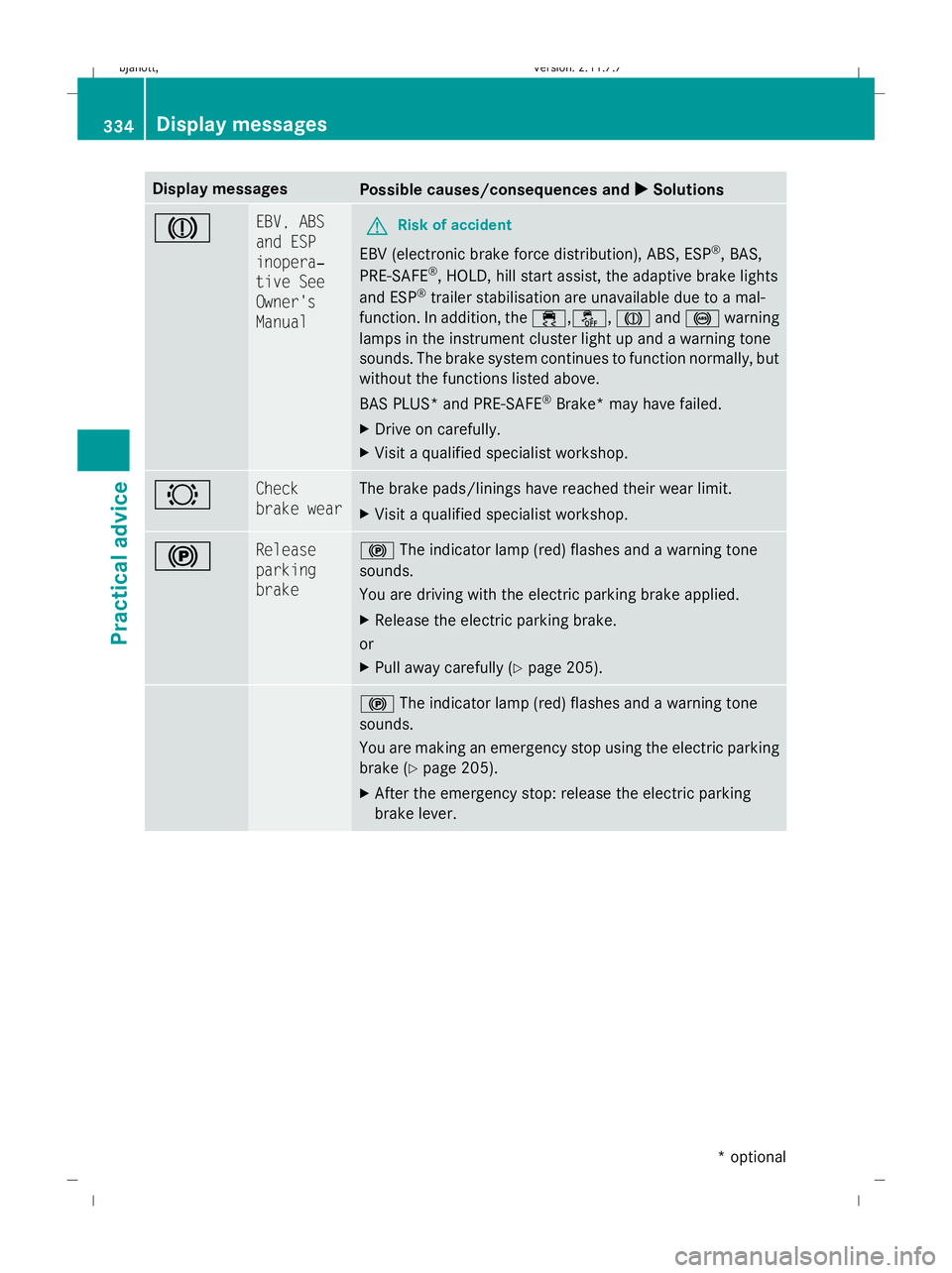
Display messages
Possible causes/consequences and
X
X Solutions J EBV, ABS
and ESP
inopera‐
tive See
Owner's
Manual
G
Risk of accident
EBV (electronic brake force distribution), ABS, ESP ®
, BAS,
PRE-SAFE ®
, HOLD, hill start assist, the adaptive brake lights
and ESP ®
trailer stabilisation are unavailable due to a mal-
function. In addition, the ÷,å,J and! warning
lamps in the instrument cluster light up and a warning tone
sounds. The brake system continues to function normally, but
without the functions listed above.
BAS PLUS* and PRE-SAFE ®
Brake* may have failed.
X Drive on carefully.
X Visit a qualified specialist workshop. # Check
brake wear The brake pads/linings have reached their wear limit.
X
Visit a qualified specialist workshop. ! Release
parking
brake !
The indicator lamp (red) flashes and a warning tone
sounds.
You are driving with the electric parking brake applied.
X Release the electric parking brake.
or
X Pull away carefully (Y page 205). !
The indicator lamp (red) flashes and a warning tone
sounds.
You are making an emergency stop using the electric parking
brake (Y page 205).
X After the emergency stop: release the electric parking
brake lever. 334
Display
messagesPractical advice
* optional
216_AKB; 2; 3, en-GB
bjanott
,V ersion: 2.11.7.7
2009-02-27T14:54:17+01:00 - Seite 334
Dateiname: 6515230602_buchblock.pdf; erzeugt am 04. Mar 2009 11:16:37; WK
Page 338 of 421
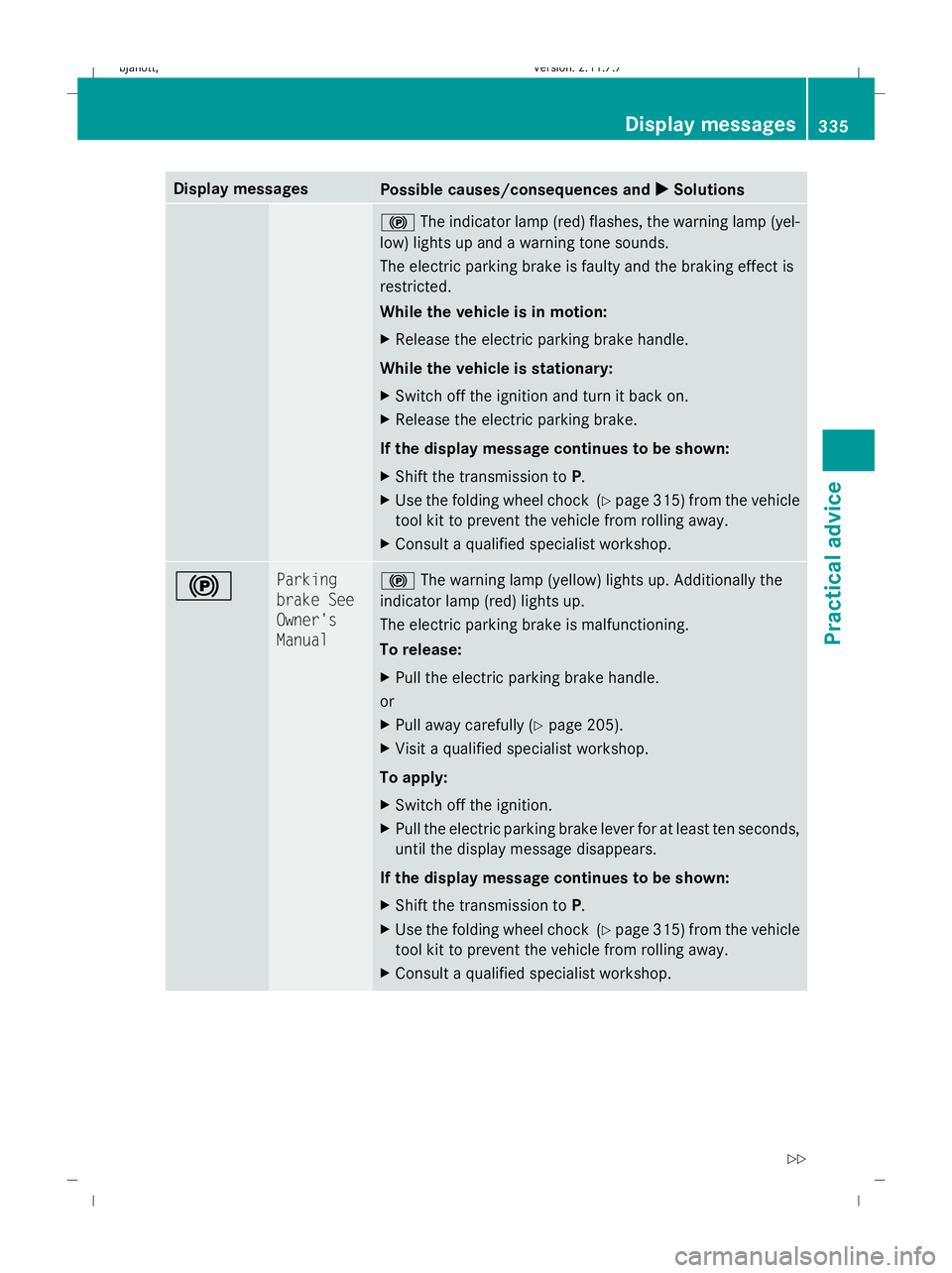
Display messages
Possible causes/consequences and
X
X Solutions !
The indicator lamp (red) flashes, the warning lamp (yel-
low) lights up and a warning tone sounds.
The electric parking brake is faulty and the braking effect is
restricted.
While the vehicle is in motion:
X Release the electric parking brake handle.
While the vehicle is stationary:
X Switch off the ignition and turn it back on.
X Release the electric parking brake.
If the display message continues to be shown:
X Shift the transmission to P.
X Use the folding wheel chock (Y page 315) from the vehicle
tool kit to prevent the vehicle from rolling away.
X Consult a qualified specialist workshop. ! Parking
brake See
Owner's
Manual !
The warning lamp (yellow) lights up. Additionally the
indicator lamp (red) lights up.
The electric parking brake is malfunctioning.
To release:
X Pull the electric parking brake handle.
or
X Pull away carefully (Y page 205).
X Visit a qualified specialist workshop.
To apply:
X Switch off the ignition.
X Pull the electric parking brake lever for at least ten seconds,
until the display message disappears.
If the display message continues to be shown:
X Shift the transmission to P.
X Use the folding wheel chock (Y page 315) from the vehicle
tool kit to prevent the vehicle from rolling away.
X Consult a qualified specialist workshop. Display
messages
335Practical advice
216_AKB; 2; 3, en-GB
bjanott ,V ersion: 2.11.7.7
2009-02-27T14:54:17+01:00 - Seite 335 Z
Dateiname: 6515230602_buchblock.pdf; erzeugt am 04. Mar 2009 11:16:37; WK
Page 339 of 421
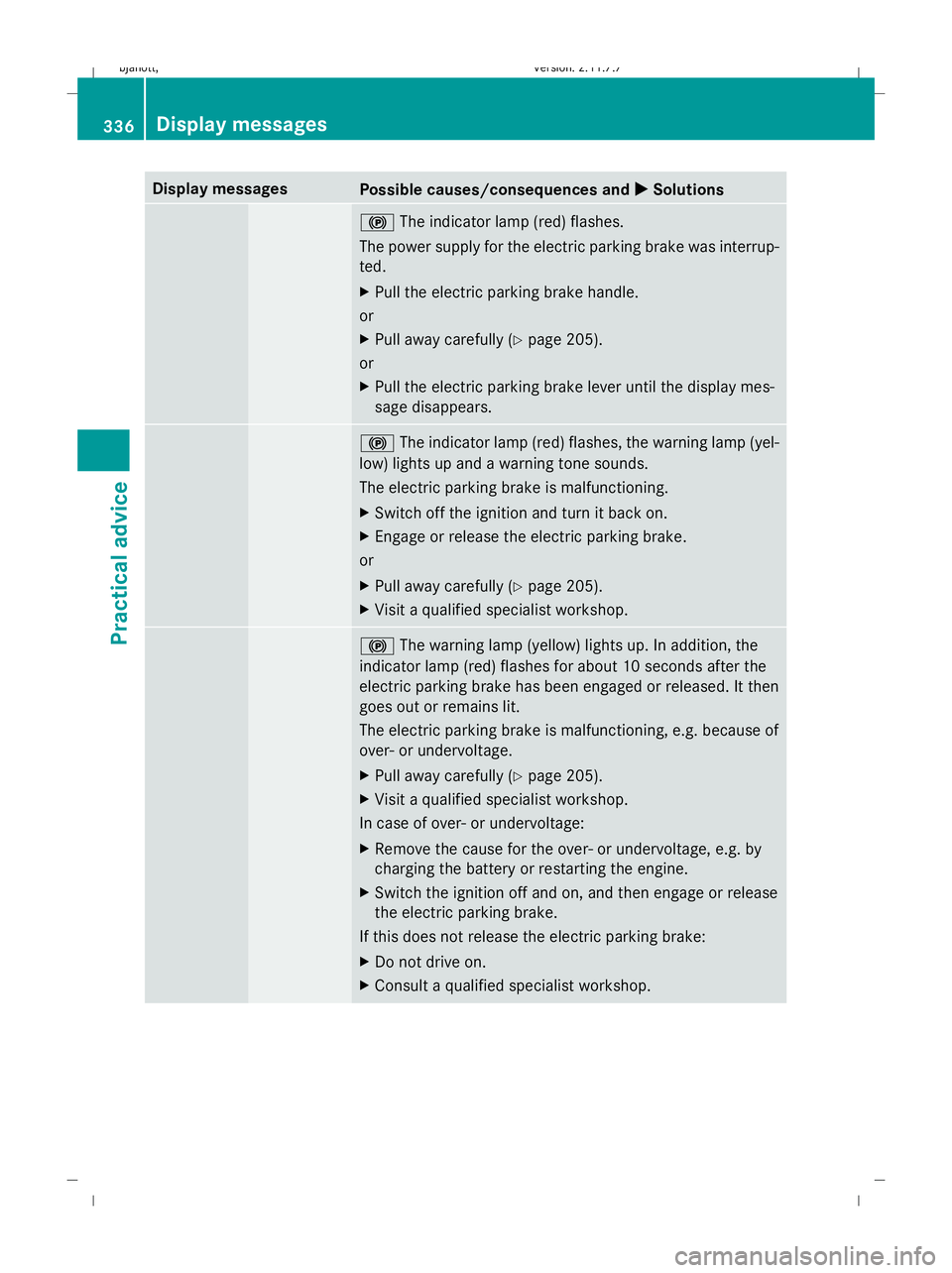
Display messages
Possible causes/consequences and
X
X Solutions !
The indicator lamp (red) flashes.
The power supply for the electric parking brake was interrup-
ted.
X Pull the electric parking brake handle.
or
X Pull away carefully (Y page 205).
or
X Pull the electric parking brake lever until the display mes-
sage disappears. !
The indicator lamp (red) flashes, the warning lamp (yel-
low) lights up and a warning tone sounds.
The electric parking brake is malfunctioning.
X Switch off the ignition and turn it back on.
X Engage or release the electric parking brake.
or
X Pull away carefully (Y page 205).
X Visit a qualified specialist workshop. !
The warning lamp (yellow) lights up. In addition, the
indicator lamp (red) flashes for about 10 seconds after the
electric parking brake has been engaged or released. It then
goes out or remains lit.
The electric parking brake is malfunctioning, e.g. because of
over- or undervoltage.
X Pull away carefully (Y page 205).
X Visit a qualified specialist workshop.
In case of over- or undervoltage:
X Remove the cause for the over- or undervoltage, e.g. by
charging the battery or restarting the engine.
X Switch the ignition off and on, and then engage or release
the electric parking brake.
If this does not release the electric parking brake:
X Do not drive on.
X Consult a qualified specialist workshop. 336
Display
messagesPractical advice
216_AKB; 2; 3, en-GB
bjanott ,V ersion: 2.11.7.7
2009-02-27T14:54:17+01:00 - Seite 336
Dateiname: 6515230602_buchblock.pdf; erzeugt am 04. Mar 2009 11:16:37; WK