ABS MERCEDES-BENZ METRIS 2020 MY20 Operator’s Manual
[x] Cancel search | Manufacturer: MERCEDES-BENZ, Model Year: 2020, Model line: METRIS, Model: MERCEDES-BENZ METRIS 2020Pages: 320, PDF Size: 26.38 MB
Page 232 of 320
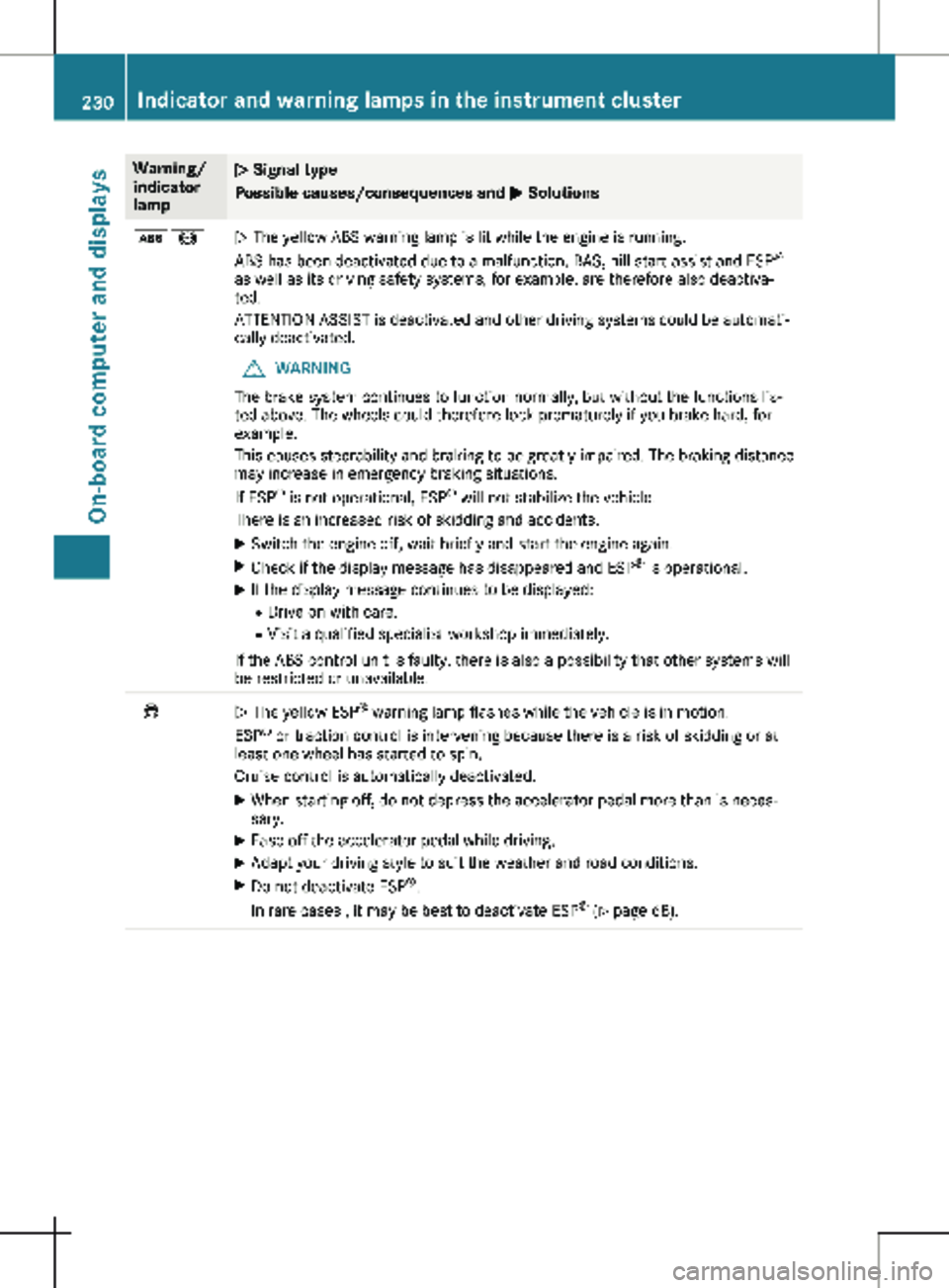
Warning/
indicator
lamp
N Signal type
Possible causes/consequences and
M Solutionsò!
N The yellow ABS warning lamp is lit while the engine is running.
ABS has been deactivated due to a malfunction. BAS, hill start assist and ESP
®
as well as its driving safety systems, for example, are therefore also deactiva-
ted.
ATTENTION ASSIST is deactivated and other driving systems could be automati-
cally deactivated.
G WARNING
The brake system continues to function normally, but without the functions lis-
ted above. The wheels could therefore lock prematurely if you brake hard, for
example.
This causes steerability and braking to be greatly impaired. The braking distance
may increase in emergency braking situations.
If ESP ®
is not operational, ESP ®
will not stabilize the vehicle.
There is an increased risk of skidding and accidents.
X Switch the engine off, wait briefly and start the engine again.
X Check if the display message has disappeared and ESP ®
is operational.
X If the display message continues to be displayed:
R Drive on with care.
R Visit a qualified specialist workshop immediately.
If the ABS control unit is faulty, there is also a possibility that other systems will
be restricted or unavailable. ÷
N The yellow ESP
®
warning lamp flashes while the vehicle is in motion.
ESP ®
or traction control is intervening because there is a risk of skidding or at
least one wheel has started to spin.
Cruise control is automatically deactivated.
X When starting off, do not depress the accelerator pedal more than is neces-
sary.
X Ease off the accelerator pedal while driving.
X Adapt your driving style to suit the weather and road conditions.
X Do not deactivate ESP ®
.
In rare cases , it may be best to deactivate ESP ®
(Y page
68).230
Indicator and warning lamps in the instrument cluster
On-board computer and displays
Page 246 of 320
X
Always transport loads in the cargo com-
partment and with the seat backrests folded
up and properly locked in position.
X Always place the load against the backrests
of the front or rear seats.
X Move large and heavy loads as far towards
the front of the vehicle as possible against
the front or rear seats. Stow the load flush
with the rear or front seats.
X Always additionally secure the load with
suitable load-securing aids or tie downs.
Observe the following notes:
R Do not stack loads higher than the upper
edge of the backrests.
R Transport loads behind seats that are not
occupied.
R If the rear bench seat is not occupied, insert
the seat belts crosswise into the buckle of
the opposite seat belt. Cargo compartment variations
You can vary the cargo compartment accord-
ing to your transportation requirements as fol-
lows:
R by folding the seat backrests forward to the
table position.
R by removing the rear bench seat.
You will find information about rear bench
seats in the "Rear bench seats" section
( Y page
89). Securing loads
Important safety notes
G
WARNING
If you attach the tie-down incorrectly when
securing the load, the following may occur in
the event of abrupt changes in direction,
braking maneuvers or an accident:
R the cargo tie-down rings may become
detached or the tie-down may tear if the
permissible load is exceeded
R the load may not be restrained. This may cause the load to slip, tip over or
be tossed about, striking vehicle occupants.
There is a risk of an accident and injury.
Always tension the tie-downs in the proper
manner and only between the described
cargo tie-down rings. Always use tie-downs
designed specifically for the loads.
! Observe the information on the maximum
loading capacity of the individual cargo tie-
down points.
If you use several cargo tie-down points to
secure a load, you must always take the
maximum loading capacity of the weakest
cargo tie-down point into account.
If you brake hard, for example, the forces
acting could be up to several times the
weight force of the load. Always use multi-
ple cargo tie-down points in order to distrib-
ute the force absorption. Load the ancho-
rages evenly.
As the driver, you are responsible for ensuring
that: R The load is secured against slipping, tipping,
rolling or falling off in normal traffic condi-
tions, should the vehicle swerve to avoid an
obstacle, in the event of maximum full-stop
braking and on poor road surfaces
R The applicable requirements and guidelines
relating to load-securing practices are met
If this is not the case, this may constitute a
punishable offense, depending on local leg-
islation and any ensuing consequences.
Always observe the legal requirements for
the country you are currently in.
Make sure that the load is secure before every
journey and at regular intervals during a long
journey. Correct an incorrectly or inadequately
secured load if necessary.
Always observe the operating instructions or
the notes of the lashing strap manufacturer for
the operation of the lashing strap.
You can obtain information about securing the
load correctly from the manufacturer of the
load securing aids or tie down for securing the
load. Also observe the safety information in
the loading directions ( Y page 242).
X Fill spaces between the load and the cargo
compartment walls or wheel housings (form-244
Securing loads
Transporting loads
Page 247 of 320
locking). Use rigid load securing aids, such
as wedges, wooden fixings or padding.
X Attach secured and stabilized loads in all
directions to the cargo tie-down rings and
the guide rails in the rear compartment.
Only use tie downs, such as lashing nets
and lashing straps, that have been tested in
accordance with current standards.
When securing a load, always use the clos-
est cargo tie-down rings and pad sharp
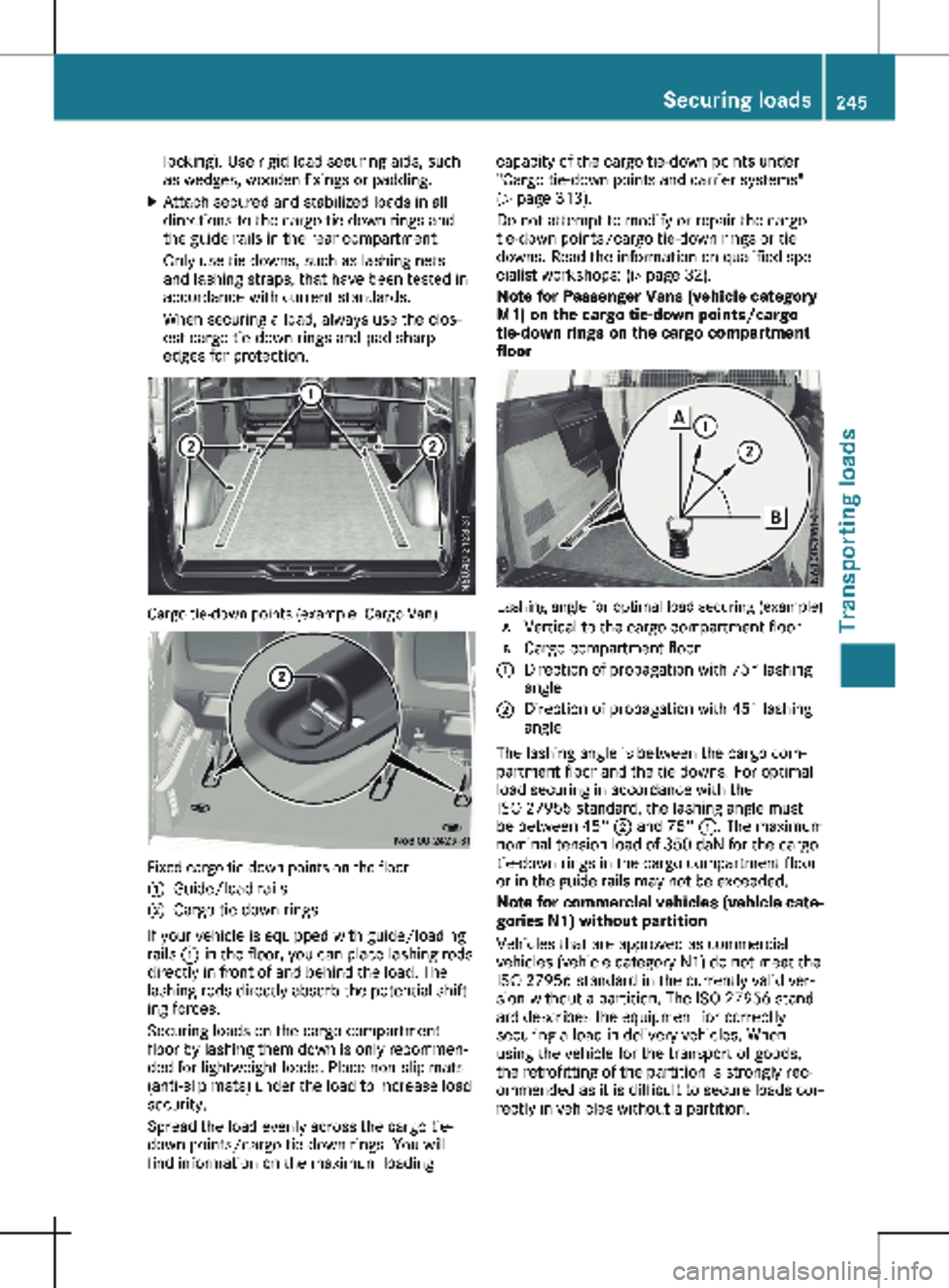
edges for protection. Cargo tie-down points (example: Cargo Van)
Fixed cargo tie-down points on the floor
:
Guide/load rails
; Cargo tie-down rings
If your vehicle is equipped with guide/loading
rails : in the floor, you can place lashing rods
directly in front of and behind the load. The
lashing rods directly absorb the potential shift-
ing forces.
Securing loads on the cargo compartment
floor by lashing them down is only recommen-
ded for lightweight loads. Place non-slip mats
(anti-slip mats) under the load to increase load
security.
Spread the load evenly across the cargo tie-
down points/cargo tie-down rings. You will
find information on the maximum loading capacity of the cargo tie-down points under
"Cargo tie-down points and carrier systems"
(Y page
313).
Do not attempt to modify or repair the cargo
tie-down points/cargo tie-down rings or tie
downs. Read the information on qualified spe-
cialist workshops: (Y page 32).
Note for Passenger Vans (vehicle category
M1) on the cargo tie-down points/cargo
tie-down rings on the cargo compartment
floor Lashing angle for optimal load securing (example)
d
Vertical to the cargo compartment floor
e Cargo compartment floor
: Direction of propagation with 75° lashing
angle
; Direction of propagation with 45° lashing
angle
The lashing angle is between the cargo com-
partment floor and the tie downs. For optimal
load securing in accordance with the
ISO 27955 standard, the lashing angle must
be between 45° ; and 75° :. The maximum
nominal tension load of
350 daN for the cargo
tie-down rings in the cargo compartment floor
or in the guide rails may not be exceeded.
Note for commercial vehicles (vehicle cate-
gories N1) without partition
Vehicles that are approved as commercial
vehicles (vehicle category N1) do not meet the
ISO 27956 standard in the currently valid ver-
sion without a partition. The ISO 27956 stand-
ard describes the equipment for correctly
securing a load in delivery vehicles. When
using the vehicle for the transport of goods,
the retrofitting of the partition is strongly rec-
ommended as it is difficult to secure loads cor-
rectly in vehicles without a partition. Securing loads
245
Transporting loads Z
Page 248 of 320
Lashing straps
Important safety notes
G
WARNING
If you attach the tie-down incorrectly when
securing the load, the following may occur in
the event of abrupt changes in direction,
braking maneuvers or an accident:
R the cargo tie-down rings may become
detached or the tie-down may tear if the
permissible load is exceeded
R the load may not be restrained.
This may cause the load to slip, tip over or
be tossed about, striking vehicle occupants.
There is a risk of an accident and injury.
Always tension the tie-downs in the proper
manner and only between the described
cargo tie-down rings. Always use tie-downs
designed specifically for the loads.
! Observe the information on the maximum
loading capacity of the individual cargo tie-
down points.
If you use several cargo tie-down points to
secure a load, you must always take the
maximum loading capacity of the weakest
cargo tie-down point into account.
If you brake hard, for example, the forces
acting could be up to several times the
weight force of the load. Always use multi-
ple cargo tie-down points in order to distrib-
ute the force absorption. Load the ancho-
rages evenly.
Always observe the operating instructions or
the notes of the lashing strap manufacturer for
the operation of the lashing strap.
Securing loads on the cargo compartment
floor by lashing them down is only recommen-
ded for lightweight loads. Place non-slip mats
(anti-slip mats) under the load to increase load
security. Notes and information on:
R the operation of the cargo tie-down rings
and cargo tie-down points can be found in
the "Securing a load" section
(Y page 244)
R the maximum loading capacity of the cargo
tie-down points can be found in the "Techni-
cal data" section ( Y page 313)
R the maximum loading capacity of the lashing
strap can be found on the lashing strap label
If the label is missing or illegible, the lashing
strap is ready to be discarded. Such a lash-
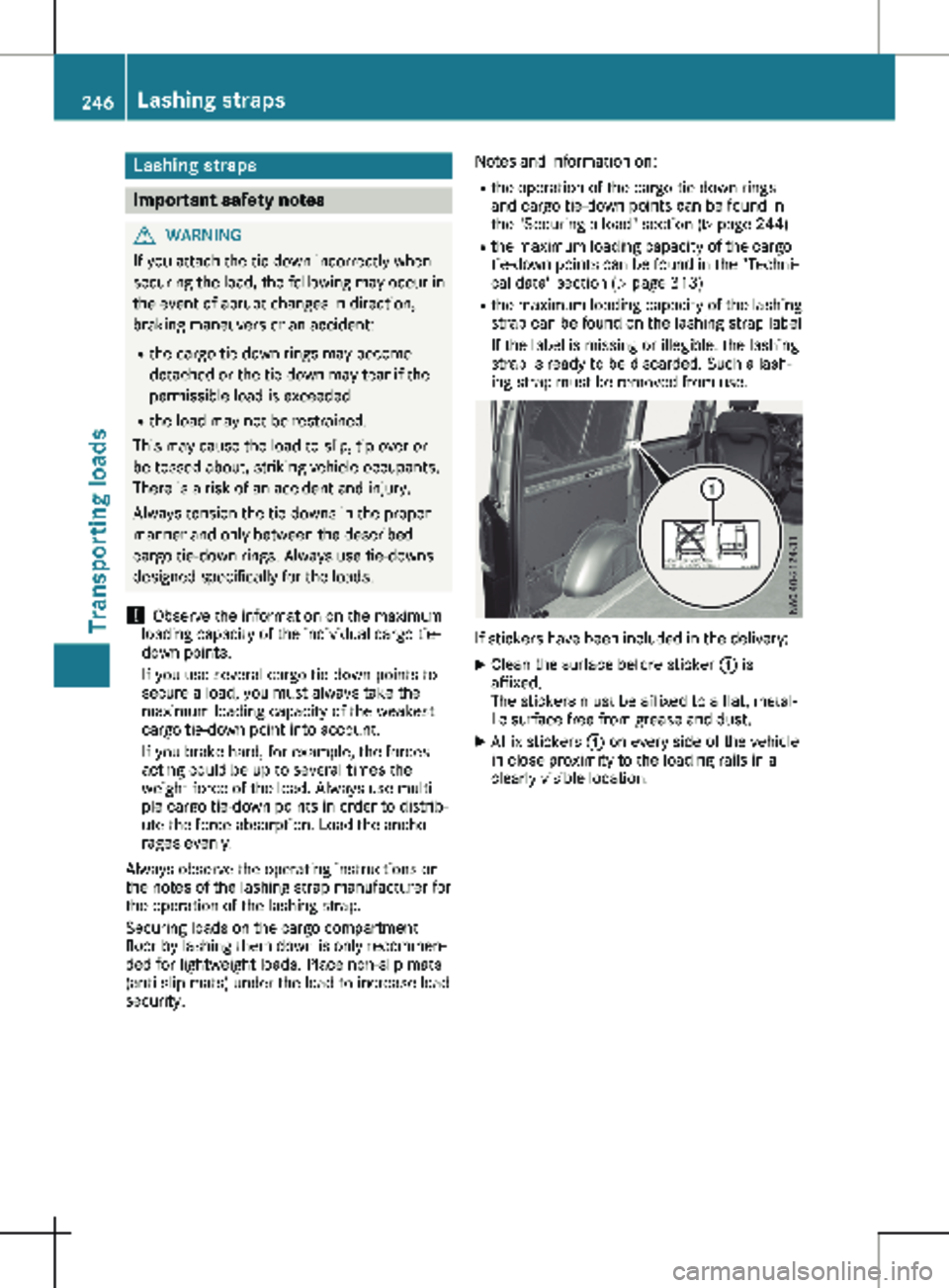
ing strap must be removed from use. If stickers have been included in the delivery:
X Clean the surface before sticker : is
affixed.
The stickers must be affixed to a flat, metal-
lic surface free from grease and dust.
X Affix stickers : on every side of the vehicle
in close proximity to the loading rails in a
clearly visible location. 246
Lashing straps
Transporting loads
Page 257 of 320
X
Turn cap : further and remove it from cool-
ant expansion tank ;.
X Check the coolant level.
If the coolant is up to marker bar =
in the
filler neck when cold, there is a sufficient
amount of coolant in coolant expansion
tank ;.
If the coolant is approximately 0.59 in
(1.5 cm) above marker bar = in the filler
neck when warm, there is a sufficient
amount of coolant in coolant expansion
tank ;.
Adding coolant X If the coolant drops under marker bar = in
the filler neck, add coolant.
Observe the information on the correct cool-
ant mixture ratio and the required water
quality under "Service products and capaci-
ties" ( Y page
310). To prevent damage to
the engine cooling system, use only
approved corrosion inhibitor/antifreeze that
complies with the Mercedes-Benz Specifica-
tions for Service Products.
X Replace cap : and tighten in a clockwise
direction.
X Start the engine.
X Set the temperature in the vehicle interior to
the maximum output on the air-conditioning
system control panel.
X After approximately five minutes, switch off
the engine again and allow it to cool down.
X Check the coolant level again and add cool-
ant if necessary.
X Close the hood. Brake fluid
G
WARNING
Service products may be poisonous and haz-
ardous to health. There is a risk of injury.
Comply with instructions on the use, storage
and disposal of service products on the
labels of the respective original containers.
Always store service products sealed in their
original containers. Always keep service
products out of the reach of children. G
WARNING
Opening the hood when the engine is over-
heated or when there is a fire in the engine
compartment could expose you to hot gases
or other service products. There is a risk of
injury.
Let an overheated engine cool down before
opening the hood. If there is a fire in the
engine compartment, keep the hood closed
and contact the fire department. G
WARNING
Certain components in the engine compart-
ment, such as the engine, radiator and parts
of the exhaust system, can become very
hot. Working in the engine compartment
poses a risk of injury.
Where possible, let the engine cool down
and touch only the components described in
the following.
Brake fluid is hazardous to health. Also
observe the safety notes under "Service prod-
ucts and capacities"
(Y page 305). G
WARNING
The brake fluid constantly absorbs moisture
from the air. This lowers the boiling point of
the brake fluid. If the boiling point of the
brake fluid is too low, vapor pockets may
form in the brake system when the brakes
are applied hard. This would impair braking
efficiency. There is a risk of an accident.
You should have the brake fluid renewed at
the specified intervals.
! If the brake fluid level in the brake fluid
reservoir has fallen to the MIN mark or
below, check the brake system immediately
for leaks. Also check the thickness of the
brake linings. Visit a qualified specialist
workshop immediately.
Do not add brake fluid. This does not cor-
rect the malfunction.
! Brake fluid corrodes paint, plastic and rub-
ber. If paint, plastic or rubber has come into
contact with brake fluid, rinse with water
immediately. Engine compartment
255
Maintenance and care Z
Page 260 of 320
The prescribed service interval is based on
normal vehicle use. Service work will need to
be performed more frequently than prescribed
if the vehicle is operated under more arduous
conditions or with higher loads. Such arduous
conditions include:
R regular city driving with frequent intermedi-
ate stops
R driving predominantly short distances
R frequent operation in mountainous terrain or
on poor road surfaces
R leaving the engine idling for long periods on
a frequent basis
In these or similar operating conditions, have
the air filter, engine oil and oil filter, for exam-
ple, replaced more frequently. Under more
arduous operating conditions, the tires must
be checked more often. Further information
can be obtained at a qualified specialist work-
shop, e.g. an authorized Mercedes-Benz Com-
mercial Van Center.
Hiding service messages Vehicles without steering wheel buttons
X Press the 3 button on the instrument clus-
ter.
Vehicles with steering wheel buttons
X Press the a or % button on the steer-
ing wheel.
Calling up the service due date Vehicles without steering wheel buttons
The vehicle must be stationary. Use the but-
tons in the instrument cluster.
X Turn the key to position 2 in the ignition
lock.
X Press È to select the service display.
The display shows a possible service mes-
sage.
Vehicles with steering wheel buttons
Using the steering wheel buttons
X Turn the key to position 2 in the ignition
lock.
X Press = or ; to select the Service
menu.
X Press 9 or : to select the ASSYST
PLUS submenu and press a to confirm.
The display shows the service due date. Battery
Important safety notes
Work on the battery, e.g. removing or instal-
ling, requires specialist knowledge and the use
of special tools. Therefore, always have work
on the battery carried out at a qualified spe-
cialist workshop. G
WARNING
Work carried out incorrectly on the battery
can lead, for example, to a short circuit and
thus damage the vehicle electronics. This
can lead to function restrictions applying to
safety-relevant systems, e.g. the lighting
system, the ABS (anti-lock braking system)
or the ESP ®
(Electronic Stability Program).
The operating safety of your vehicle may be
restricted.
You could lose control of the vehicle, for
example:
R when braking
R in the event of abrupt steering maneuvers
and/or when the vehicle's speed is not
adapted to the road conditions
There is a risk of an accident.
In the event of a short circuit or a similar
incident, contact a qualified specialist work-
shop immediately. Do not drive any further.
You should have all work involving the bat-
tery carried out at a qualified specialist
workshop.
Further information can be found under "ABS"
(Y page
67) and under "ESP ®
" (Y page 68). G
WARNING
Electrostatic build-up can lead to the crea-
tion of sparks, which could ignite the highly
explosive gases of a battery. There is a risk
of an explosion.
Before handling the battery, touch the vehi-
cle body to remove any existing electrostatic
build-up.
The flammable gas mix is produced when the
battery is charged or when the vehicle is jump-
started. 258
Battery
Maintenance and care
Page 282 of 320
R
Break in new tires at moderate speeds for
the first
65 miles (100 km).
R Do not drive with tires which have too little
tread depth, as this significantly reduces the
traction on wet roads (hydroplaning).
R Replace the tires after six years at the lat-
est, regardless of wear. This also applies to
the spare wheel. Operation in winter
General notes
Have your vehicle winterized at a qualified spe-
cialist workshop at the onset of winter.
Only use wheels with tire sizes approved for
Mercedes-Benz.
Prior to the onset of winter, ensure that snow
chains are stowed in the vehicle
(Y page
281). Snow chains cannot be moun-
ted on all wheel/tire combinations. Observe
the restrictions on the use of snow chains
under "Wheel/tire combinations"
(Y page 302).
Also observe the notes in the "Changing a
wheel" section ( Y page 297).Driving with summer tires
At temperatures below 45 ‡
(+7 †), summer
tires lose elasticity and therefore traction and
braking power. Change the tires on your vehi-
cle to M+S tires. Using summer tires at very
cold temperatures could cause tears to form,
thereby damaging the tires permanently.
Mercedes-Benz cannot accept responsibility
for this type of damage. M+S tires
G
WARNING
Wheel and tire dimensions as well as the
type of tire can vary between the spare
wheel and the wheel to be replaced. When
the spare wheel is mounted, driving charac-
teristics may be severely affected. There is a
risk of an accident. In order to reduce risks:
R you should therefore adapt your driving
style and drive carefully.
R never mount more than one spare wheel
that differs from the wheel to be replaced.
R only use a spare wheel that differs from
the wheel to be replaced for a short time.
R have a spare wheel that differs from the
wheel that has been changed replaced at
the nearest qualified specialist workshop.
You must observe the correct wheel and
tire dimensions as well as the wheel type. G
WARNING
M+S tires with a tire tread depth of less than
ã in
(4 mm) are not suitable for use in win-
ter and do not provide sufficient traction.
There is a risk of an accident.
M+S tires with a tread depth of less than ã
in (4 mm) must be replaced immediately.
Use winter tires or all-season tires at tempera-
tures below 45 ‡ (+7 †). Both types of tire
are identified by the M+S marking.
Only winter tires bearing the i snowflake
symbol in addition to the M+S marking provide
the best possible grip in wintry road condi-
tions.
Only these tires will allow driving safety sys-
tems such as ABS and ESP ®
to function opti-
mally in winter. These tires have been devel-
oped specifically for driving in snow.
For safe driving, use M+S tires of the same
make and tread pattern on all wheels.
Always observe the maximum permissible
speed specified for the M+S tires you have
mounted.
If you mount M+S tires that have a lower maxi-
mum permissible speed than the maximum
design speed of the vehicle, affix a corre-
sponding warning label in the driver's field of
vision. You can obtain this at a qualified spe-
cialist workshop.
Once you have mounted the winter tires:
X Check the tire pressure (Y page
282).
X Restart the tire pressure monitor
(Y page
288).280
Operation in winter
Wheels and tires
Page 303 of 320

X
Turn the jack back to its out-of-use position.
X Stow the jack and the rest of the tire-
change tool kit in the vehicle again.
X Wheel with hub cap: position the opening
for the tire valve in the hub cap over the tire
valve.
X Push the edge of the hub cap with both
hands against the wheel until it clicks into
place. Make sure the hub cap retaining
catches engage on the steel wheel.
X If included in the vehicle equipment, secure
the faulty wheel in the spare wheel bracket
(Y page
303). Otherwise, transport the
faulty wheel in the cargo compartment.
X Check the tire pressure of the newly moun-
ted wheel and adjust it if necessary.
Observe the recommended tire pressure
( Y page
282).
Vehicles with the tire pressure monitor sys-
tem: all mounted wheels must be equipped
with functioning sensors.
X Retighten the wheel bolts or wheel nuts to
the specified tightening torque after the
vehicle has been driven for
30 miles
(50 km).
When using a wheel/spare wheel with a new
or newly painted wheel rim, have the wheel
bolts/nuts retightened again after approx-
imately
600 to 3,000 miles (1,000 to
5,000 km). Observe the specified tightening
torque. Wheel and tire combinations
General notes
! Retreaded tires are neither tested nor rec-
ommended by Mercedes-Benz, since previ-
ous damage cannot always be detected on
retreaded tires. As a result, Mercedes-Benz
cannot guarantee vehicle safety if retreaded
tires are mounted. Do not mount used tires
if you have no information about their previ-
ous usage.
! For safety reasons, Mercedes-Benz recom-
mends that you only use tires, wheels and accessories which have been approved by
Mercedes-Benz specifically for your vehicle.
These tires have been specially adapted for
use with the driving safety systems, such as
ABS or ESP
®
.
Only use tires, wheels or accessories tested
and approved by Mercedes-Benz. Certain
characteristics, e.g. handling, vehicle noise
emissions or fuel consumption, may other-
wise be adversely affected. In addition,
when driving with a load, tire dimension var-
iations could cause the tires to come into
contact with the bodywork and axle compo-
nents. This could result in damage to the
tires or the vehicle.
Mercedes-Benz accepts no liability for dam-
age resulting from the use of tires, wheels
or accessories other than those tested and
approved.
Further information on wheels, tires and
approved combinations can be obtained
from a qualified specialist workshop.
! Large wheels: the lower the section width
for a certain wheel size, the lower the ride
comfort is on poor road surfaces. Roll com-
fort and suspension comfort are reduced
and the risk of damage to the wheels and
tires as a result of driving over obstacles
increases.
You will find a table with the recommended
tire pressures for various vehicle loads on the
inside of your vehicle's fuel filler flap or under
"Tire pressure tables"
(Y page 289). You can
find further information under "Tire pressure"
( Y page 282).
Check tire pressures regularly and only when
the tires are cold.
Notes on the vehicle equipment – always
equip the vehicle:
R with tires of the same size across an axle
(left/right)
R with the same type of tires on all wheels at
a given time (summer tires, winter tires)
i Not all wheel/tire combinations can be
installed at the factory in all countries. Wheel and tire combinations
301
Wheels and tires Z
Page 312 of 320
Transmission oil
Automatic transmission Operating fluid: automatic transmission
fluid Product name/number Maintenance
interval Mobil ATF 134 FE
Valvoline ATF Pro 236.15
MB Sheet No. 236.15 —
More information can be obtained at any quali-
fied specialist workshop.
Rear axle Operating fluid: transmission oil
Product name/number Maintenance
interval Mobilube FE 75W-85
Mobilube FE Plus NG
75W-85
MB Sheet No. 235.7 —
More information can be obtained at any quali-
fied specialist workshop.
Brake fluid
G
WARNING
The brake fluid constantly absorbs moisture
from the air. This lowers the boiling point of
the brake fluid. If the boiling point of the
brake fluid is too low, vapor pockets may
form in the brake system when the brakes
are applied hard. This would impair braking
efficiency. There is a risk of an accident.
You should have the brake fluid renewed at
the specified intervals.
! Brake fluid corrodes paint, plastic and rub-
ber. If paint, plastic or rubber has come into
contact with brake fluid, rinse with water
immediately.
When handling, storing and disposing of brake
fluid, please observe the relevant regulations and the important safety notes for service
products (Y page
305).
Over a period of time, the brake fluid absorbs
moisture from the air. This reduces its boiling
point.
Have the brake fluid replaced at specified
intervals by a qualified specialist workshop.
i There is usually a notice in the engine
compartment to remind you when the next
brake fluid change is due.
Use only approved brake fluids that comply
with the Mercedes-Benz Specifications for Ser-
vice Products. Always check for the identifica-
tion DOT 4 plus.
Information about approved brake fluids can
be obtained:
R on the Internet at
http://bevo.mercedes-benz.com. Coolant
Important safety notes G
WARNING
If antifreeze comes into contact with hot
components in the engine compartment, it
may ignite. There is a risk of fire and injury.
Let the engine cool down before you add
antifreeze. Make sure that antifreeze is not
spilled next to the filler neck. Thoroughly
clean the antifreeze from components
before starting the engine.
! Take care not to spill any coolant on pain-
ted surfaces. You could otherwise damage
the paintwork.
When handling, storing and disposing of cool-
ant and antifreeze, please observe the relevant
regulations and the important safety notes for
operating fluids
(Y page 305).
Coolant additive with corrosion and
antifreeze protection !
Use only approved antifreeze/corrosion
inhibitor that complies with MB Specifica-
tion for Service Products, Sheet Number
325. Using other, non-approved antifreeze/
corrosion inhibitors may cause damage to 310
Service products and capacities
Technical data
Page 316 of 320
If you brake hard, for example, the forces
acting could be up to several times the
weight force of the load. Always use multi-
ple cargo tie-down points in order to distrib-
ute the force absorption. Load the ancho-
rages evenly.
You will find additional information about
cargo tie-down points and cargo tie-down rings
in the "Securing loads" section
(Y page 244).
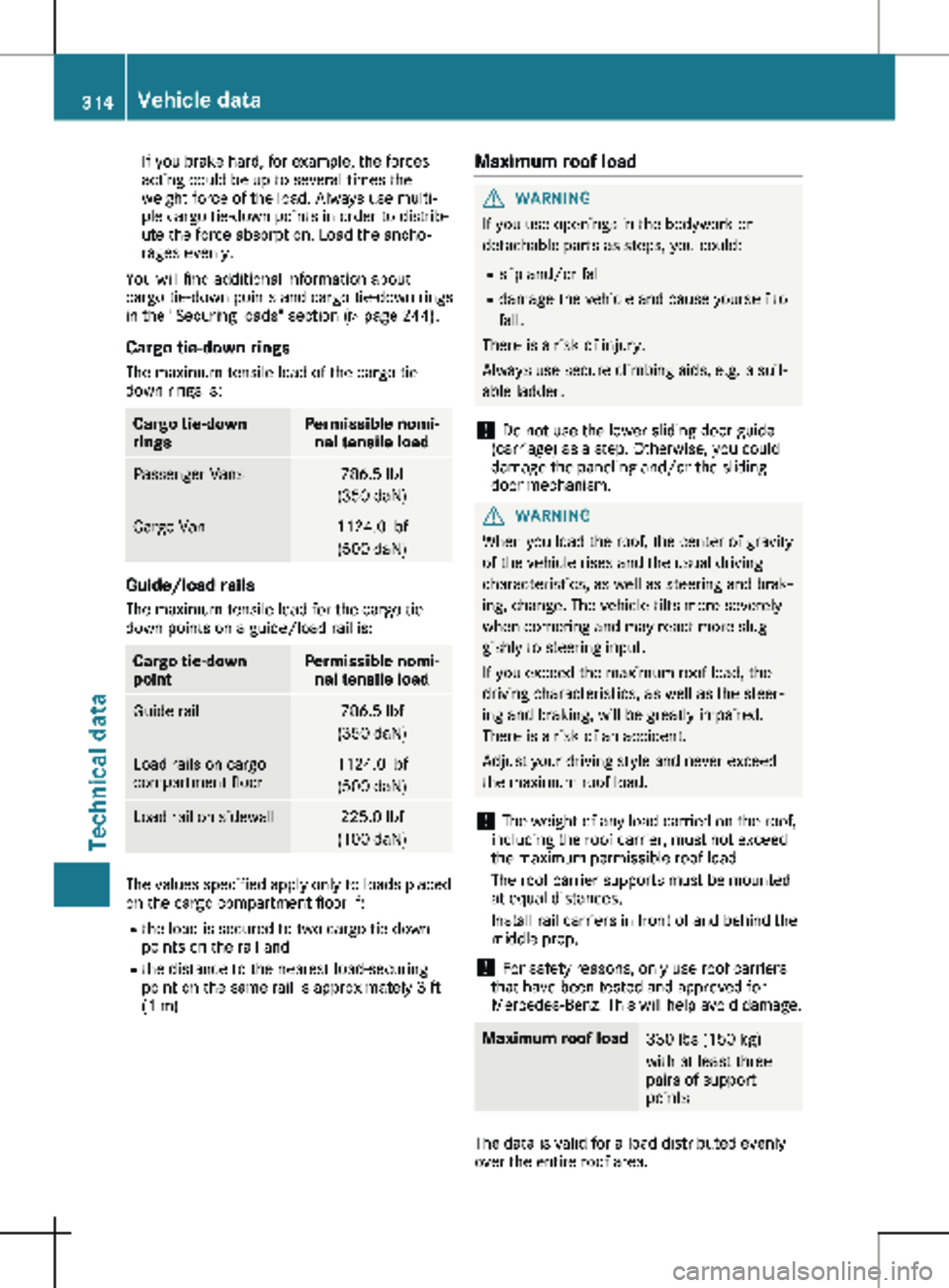
Cargo tie-down rings
The maximum tensile load of the cargo tie-
down rings is: Cargo tie-down
rings Permissible nomi-
nal tensile load Passenger Vans 786.5 lbf
(350 daN) Cargo Van 1124.0 lbf
(500 daN) Guide/load rails
The maximum tensile load for the cargo tie-
down points on a guide/load rail is: Cargo tie-down
point Permissible nomi-
nal tensile load Guide rail 786.5 lbf
(350 daN) Load rails on cargo
compartment floor 1124.0 lbf
(500 daN) Load rail on sidewall 225.0 lbf
(100 daN) The values specified apply only to loads placed
on the cargo compartment floor if:
R the load is secured to two cargo tie-down
points on the rail and
R the distance to the nearest load-securing
point on the same rail is approximately
3 ft
(1 m) Maximum roof load G
WARNING
If you use openings in the bodywork or
detachable parts as steps, you could:
R slip and/or fall
R damage the vehicle and cause yourself to
fall.
There is a risk of injury.
Always use secure climbing aids, e.g. a suit-
able ladder.
! Do not use the lower sliding door guide
(carriage) as a step. Otherwise, you could
damage the paneling and/or the sliding
door mechanism. G
WARNING
When you load the roof, the center of gravity
of the vehicle rises and the usual driving
characteristics, as well as steering and brak-
ing, change. The vehicle tilts more severely
when cornering and may react more slug-
gishly to steering input.
If you exceed the maximum roof load, the
driving characteristics, as well as the steer-
ing and braking, will be greatly impaired.
There is a risk of an accident.
Adjust your driving style and never exceed
the maximum roof load.
! The weight of any load carried on the roof,
including the roof carrier, must not exceed
the maximum permissible roof load.
The roof carrier supports must be mounted
at equal distances.
Install rail carriers in front of and behind the
middle prop.
! For safety reasons, only use roof carriers
that have been tested and approved for
Mercedes-Benz. This will help avoid damage. Maximum roof load
330 lbs (150 kg)
with at least three
pairs of support
points
The data is valid for a load distributed evenly
over the entire roof area. 314
Vehicle data
Technical data